



Abstract
Top civil society organisations (CSOs) face a particular legitimacy dilemma as they need to have leaders who are seen as legitimate by the elite groups they interact with, and by those they represent. This article investigates how they handle this dilemma by studying legitimation practices of newly appointed leaders. Based on Weber’s theory of authority and Pitkin’s theory of representation, the article investigates 114 public announcements of governance leaders in the United Kingdom, Sweden, and the EU. The article finds a common model of civil society elite legitimation beyond national differences. The observed model draws on two types of claims: promoting leaders as excellent and astounding professional leaders (charismatic authority) and as able spokespersons (substantive representation). Major European CSOs hence legitimate their leaders as being ‘on par with’ other top leaders, as an elite among other elite groups, similar to trends of personalisation in politics and business.
Introduction
Top civil society leaders are today prominent actors as they are formally and personally charged with the key tasks of maintaining and representing powerful organisations. Over the last several decades, increased resource stratification in European civil societies has led to the disproportionate concentration of political and economic resources in the hands of a small group of large civil society organisations (hereafter CSOs) (Johansson and Uhlin, 2020; Lindellee and Scaramuzzino, 2020). Organisations like Amnesty International, Greenpeace, Oxfam, Friends of the Earth, the World Wildlife Fund, and Caritas are examples of major players in their respective contexts. Such resource-rich organisations tend to be recognised brands with millions of members, generous donors, extensive turnover, and significant access to corridors of power. Their central position compared to other CSOs allows them to engage in shaping decisions that affect not only their members and beneficiaries, but also society in general (e.g. Guo and Saxton, 2020).
Leaders of such large CSOs tend to enjoy status and prestige not only among other civil society leaders but also among politicians and the general public. This is further fuelled by oligarchic tendencies within major CSOs, turning leaders into civil society elites (Johansson and Uhlin, 2020; Michels, 1967). Specifically, studies observe widening gaps between constituencies and the leaders who are supposed to represent them (e.g. Hwang and Powell, 2009; Van Deth and Maloney, 2012). As professionals and top leaders take over key areas of decision-making, beneficiaries and members risk being reduced to ‘donors’, ‘check book participants’, or ‘credit card suppliers’ (e.g. Skocpol, 2003). Like in politics and business (e.g. Adam and Maier, 2010; Balmas et al., 2014; Rahat and Kenig, 2018), we hence see tendencies of a personalisation ‘at the top’ in terms of a shift from organisational to personal sources of power (Bloom and Rhodes, 2018; Townsley et al., 2021). Having a high-profile leader could be beneficial to generate more donations, mobilise new members, or provide access to decision-makers.
These developments provide top CSOs with key opportunities to exercise influence, however, also create for them a particular legitimacy dilemma. As CSOs, they are expected to have leaders who derive their legitimacy from being seen as good representatives in the eyes of organisational members or constituencies (Guo and Musso, 2007; Montanaro, 2012). As powerful CSOs, they are also expected to have leaders who obtain legitimacy from personal authority, matching that of negotiation partners in private business and politics. Too much emphasis on the latter could imply that the leader is seen as lacking connection to constituencies, while too little might signal a lack of ability to lead a major organisation.
The purpose of this article is to study how top CSOs in Europe handle this legitimacy dilemma, and the analysis is guided by the following research questions: (1) how are leaders of top CSOs legitimised by their organisations and (2) do major, resource rich CSOs in Europe legitimise their leaders in a similar way, indicating a common model of civil society elite legitimation across different civil society regimes? For this purpose, we construct an original analytical framework combining Weber’s (1978) theory of authority and Pitkin’s (1967) theory of democratic representation. This allows us to analyse legitimation claims relating to individual authority and excellence or claims that portray the leader as a representative of a certain constituency, thus reflecting both sides of the legitimacy dilemma (see Meeuwisse and Scaramuzzino, 2017; Schrader and Denskus, 2010). Benefitting from a comparison of diverse cases (i.e. the United Kingdom, Sweden, and the EU as a whole), we thus investigate whether the centralisation of power and resources in European civil societies has led to a common model of elite legitimation across countries. We focus on the legitimation of governance leaders (Chairs or Presidents) among top CSOs, since they are most likely to face the dilemma described above.
Our study advances debates on civil society legitimacy through its explicit focus on civil society elite legitimation rather than on CSO legitimacy. Researchers so far have studied organisational legitimacy; that is, CSOs’ efforts to make themselves legitimate in a complex environment through adjustment to external norms and requirements (Leardini et al., 2019; Meyer et al., 2013; Willner, 2019), yet less connected to legitimation of leaders at the top. There are extensive studies on CSOs’ democratic legitimacy which address internal democratic procedures, representational capacity, and models of democratic governance (e.g. Johansson and Lee, 2014; Dalton, 2017; Egholm et al., 2020; Guo and Musso, 2007; Halpin, 2006; Keating and Thrandardottir, 2017), but few have addressed these themes in connection to personalisation or elites.
The article proceeds as follows: in the next section, we present our analytical framework, followed by a discussion on research design and methodology, and we compare public announcements of newly appointed governance leaders, rarely used to capture legitimation claims. This article finds that top European CSOs promote leaders primarily through their individual characteristics and claims of personal elevation across country differences and legitimation is less-often based on organisational characteristics and formal procedures of representation, although these remain relevant in some contexts.
An analytical framework for elite legitimation
Legitimacy is a key concept in studies of civil society, as well as political science, sociology, and organisational studies (e.g. Beetham, 1991, 2013; Easton, 1975). This article primarily focuses on ‘legitimation’ – understood as claims to legitimacy – rather than actual ‘legitimacy’ (Saward, 2009, 2010). We see legitimacy and legitimation as entangled, as legitimacy is a relational concept that implies an audience, and as such, is bound to ‘acts of legitimation’ (Matheson, 1987). The act studied in this article is that of how top CSOs (as claim-makers) portray newly appointed leaders (being the subject of claims) as authoritative and/or representative. Such acts of legitimation (we use the terms ‘legitimacy claims’ and ‘acts of legitimation’ interchangeably in the article) are reasoned elaborations that involve an element of persuasion, as those in power present their arguments and seek to convince, develop support, and build faith and loyalty among followers (Von Haldenwang, 2017). Claims may thus be intentional or unintentional acts, and Matheson’s (1987) focus on deliberate acts of legitimation is adequate for our purposes. Outside the scope of our analysis is whether the acts studied actually succeed in building legitimacy or whether actors are seen as legitimate according to some normative standards.
To study civil society elite legitimation, our framework builds on two analytical distinctions: (1) ‘authority over’ or ‘representation of’ and (2) ‘organisational’ or ‘individual’ characteristics. Our first dimension draws on the distinction between ‘authority over’ (Weber, 1978) and ‘representation of’ (Pitkin, 1967), which by some are also conceptualised as top-down or bottom-up legitimacy, respectively (e.g. Walton et al., 2016). Acts of legitimation may focus on the authority of leadership to inspire, to lead by example, and to operate as an executive. Leadership legitimacy depends on whether leaders are seen as having the personal and professional competencies (ability) to lead. This resembles a classic view on ‘authority’, which Weber defined as a form of domination that is less costly compared to rule by force, as authority is based on subjects’ faith in those in power as legitimate leaders and their voluntary willingness to comply (Grafstein, 1981; Spencer, 1970). Weber, thus, defined authority as closely related to the term ‘legitimacy’ because leaders’ authority was dependent on peoples’ beliefs and social acceptance, later defined as empirical legitimacy (e.g. Risse and Stollenwerk, 2018).
Weber’s three versions of authority operate from the top down, and leaders are seen as having authority over followers, or those who are ruled. Traditional authority is linked to norms and customs, and aristocratic, patriarchal, or gerontological orders are examples of such where planned succession or ‘the will of the ancestors’ is the source of leaders’ legitimacy. Weber contrasted traditional forms of authority with modernist legal–rational authority. As people started to lose faith in customs, the grounds for traditional legitimacy lost relevance. The legal–rational model instead rests on the ‘legality of enacted rules and the right of those elevated to authority under such rules to issue commands’ (Weber, 1978: 215). The term ‘legality’ indicates that persons gain authority when put into power by recognised and codified legal rules or practices. Weber specified charismatic authority as a third form prevalent in periods of turmoil and change. Such periods imply reduced belief in the rule of law as well as traditions, which leaves room for charismatic and inspirational leaders to attract followers.
Acts of legitimation may also focus on the leader as a representative, as embodying the key issues of the organisation or the group the leader stands for (Johansson and Lee, 2014; Guo and Musso, 2007). Pitkin’s theory (1967) of representation is an example of this and has been central in discussions on legitimacy (De Wilde, 2013; Saward, 2010). Her theory identifies the various grounds of democratic legitimacy that (political) leaders can draw upon and provides a typology to study sources of legitimacy running from the bottom up. Her category of formal representation stresses formal procedures of democratic authorisation and accountability. This category is parallel to Weber’s legal–rational authority, yet where Weber thought of bureaucracy, Pitkin (1967: 43) primarily emphasises the democratic election of representatives. Pitkin’s second category – substantive representation – stresses the extent to which leaders are bound to the wishes of the people they represent. Thus, this form of representation is about the ability to speak on behalf of a certain constituency (Severs, 2012). Sometimes it is presumed that substantive representation requires what Pitkin terms ‘descriptive representation’; that is, that representatives mirror the characteristics of their constituencies. This is a frequent feature in disability organisations, which tend to be led by disabled people (see also Mansbridge, 2003).
Following the scholarly debate on personalisation reviewed above, our second dimension stresses that claims of legitimation can be related to ‘organisational’ or ‘individual’ characteristics; that is, claims linked to organisational procedures or the qualities of the individual leader. As discussed above, the personalisation literature suggests that today’s political leadership draws to a large extent upon personal ties to communities and leaders acting with greater autonomy vis-á-vis parties or other forms of political organisations (McAllister, 2007; Townsley et al., 2021). Some talk of the age of personalisation (Rahat and Kenig, 2018) following a two-fold move first from the collective (party) to the leader (politicians), and second from topics to private persons (e.g. Adam and Maier, 2010). While the former implies a shift from the traditional organisational politics of groups (political parties and CSOs alike) towards a greater focus on persons (often at the central level), the latter indicates the growing significance of the private qualities of leaders at the expense of policy content.
Although personalisation is a contemporary debate in social science, similar tension between organisational and individual sources of legitimacy can also be found in Weber’s and Pitkin’s reasoning. For Weber, organisational procedures tied to legal–rational authority grant leaders authority over followers, while for Pitkin such formal representation procedures are carried out by members of a constituency; for instance, members of an organisation electing their representatives. Weber and Pitkin also stressed authority and representation, respectively, as being founded on the individual characteristics of leaders. For Weber, charismatic authority is based on a belief in the extraordinary capabilities of certain leaders. Pitkin’s categories of descriptive and substantive representation suggest that leaders can represent their constituency either by mirroring the characteristics of their constituency, or by acting as a spokesperson; that is, a person who is able to stand for a group or an organisation due to value congruence and/or extensive knowledge on the issue.
The two dimensions form the groundwork for our study of civil society elite legitimation (see Table 1). It is a framework inspired by Weber’s and Pitkin’s classic theories, but does not view original concepts as ready-made analytical categories. The adjusted meanings of the classic concepts are as follows: starting with claims which draw on organisational characteristics, claims relating to traditional authority present the leader as one of a great line of (past) leaders or references the organisational legacy that the leader inherits upon appointment. Claims relating to legal–rational authority refer to organisational characteristics such as the due process and fairness of procedures through which the leader has been appointed; for example, selection and recruitment processes. Claims related to formal representation refer to internal organisational democratic procedures. Proceeding to claims which draw upon individual characteristics, charismatic authority refers to the extraordinary professional achievements and trajectory of the leader, while descriptive representation refers to the ways in which the leader mirrors organisational constituencies. Claims relating to substantive representation also draw on individual characteristics and portray the leader as an able representative of the cause and values of the organisation or the constituency and highlight past personal experiences with the organisation, the cause, or the policy area. 1
Framework for acts of elite legitimation.
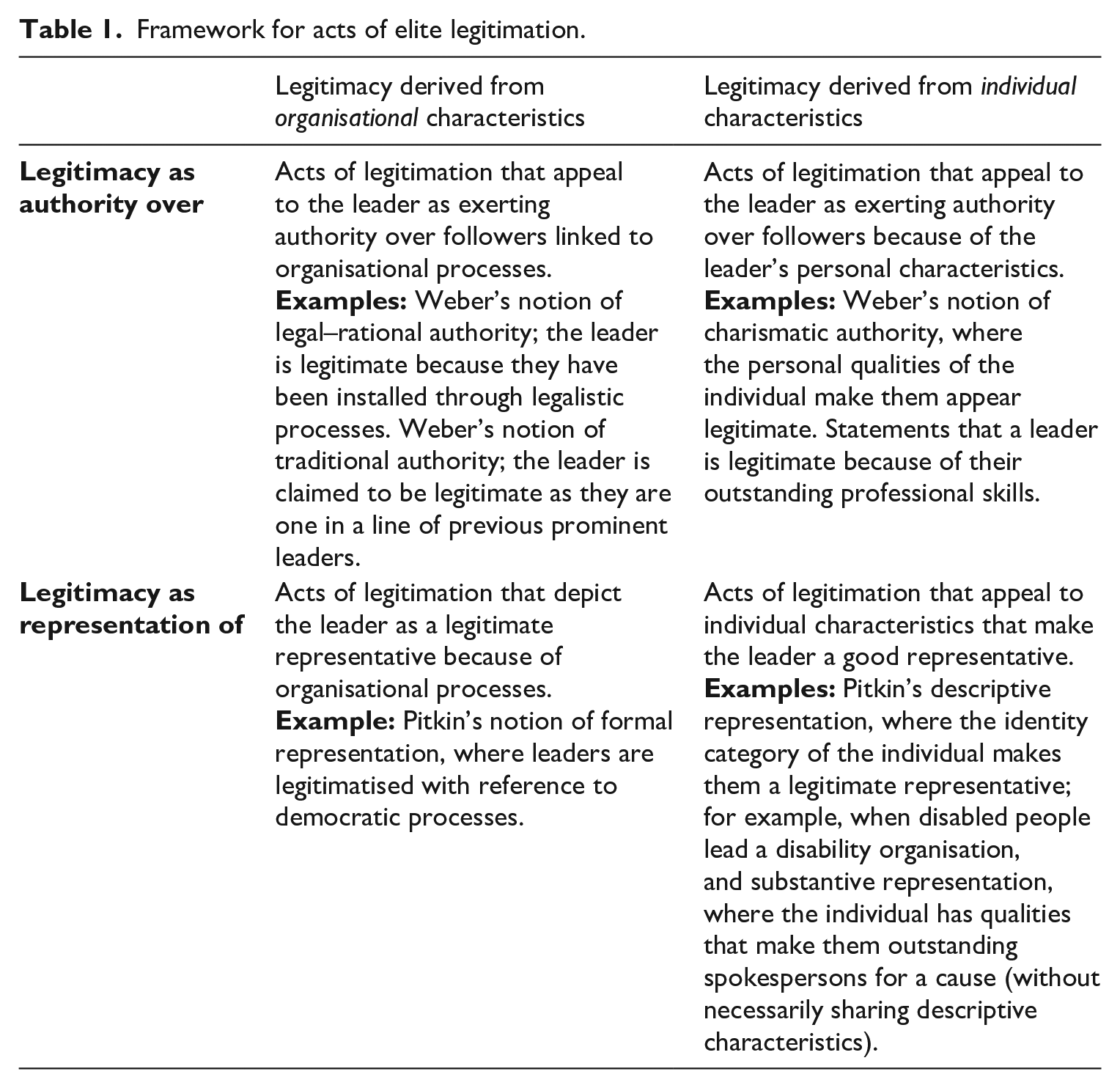
Because we analyse acts of legitimation in practice, we expect to see combinations of various claims in the announcements. For example, an announcement may include claims related to organisational democracy in electing a new chair (formal representation) and that he or she is replacing a former prominent leader (traditional authority).
Research design and methodology
Our research design consists of three parts: (1) country selection; (2) selection of elite organisations; and (3) selection of announcements of governance leaders, namely persons occupying the top formal voluntary position in the CSO (commonly titled Chair of the board or President). See Appendix 1 for extended information on our sampling process.
Selection of countries
We follow the strategy of diverse case selection to allow us to draw conclusions about the legitimation practices of top CSOs across regime contexts. The article analyses legitimation in three different civil society contexts: Sweden, the United Kingdom, and the EU (Salamon et al., 2004). We have selected the EU as a supra-national context for civil society mobilisation and organising (Johansson and Kalm, 2015; Meeuwisse and Scaramuzzino, 2018), since studies have shown that EU-level population groups are comparable to national level-population groups, due to sufficient similarity in terms of organisational types and representational capacity (see Berkhout et al., 2017; Heylen et al., 2020; Meeuwisse and Scaramuzzino 2017). Also, similar to national civil societies, processes of resource stratification and centralisation have been detected at the EU level (Lindellee and Scaramuzzino, 2020).
CSOs in Sweden and the EU have more pronounced expressive and representation function and are also less involved in delivering service than UK CSOs, which tend to mix public service delivery and advocacy activities. This might lead to differences in the legitimation of leaders of top CSOs, with leaders in Sweden and the EU level more often legitimised in terms of their ability to stand for the cause, and mirror their constituencies, while leaders in the United Kingdom to be legitimised more often in relation to their extraordinary professional abilities, needed to manage complex professionalised organisations. In addition, CSOs in these contexts differ in their governance models, due to legal requirements regulating the legal forms available in each context. CSOs based in Brussels (active at the EU level) register as associations, which requires them to appoint members of the board through an annual general meeting of its members; that is, elect governance leaders (Rosenzweigová et al., 2018). In Sweden, similarly, CSOs most often register as associations, which are required to have a governing body and a membership assembly, which in practice elects the governing body. On the other hand, large CSOs based in the United Kingdom are most often registered as companies limited by guarantee, a form that does not require the members to elect the board (which is optional) (Ivanovska Hadjievska, 2019). 2 This might result in different legitimation claims, with formal representational claims dominating in EU and Sweden and rational–legal legitimation (focusing on external recruitment procedures instead of democratic election of leaders) dominating the UK context. Thus, if despite these differences in the three contexts, we find similarities in legitimation claims across top CSOs, this could point to a common legitimisation model of civil society elites in Europe.
Sampling elite organisations
Our study focuses on the legitimation of civil society elites as a group of leaders of top CSOs distinct from other political, business, and societal elites, and we therefore exclude political parties, unions, and associations representing professions, employers, or industrial branches from our case selection. Our identification of top CSOs draws on a database of resource-rich CSOs in Europe compiled by the research programme ‘Civil society elites? Comparing elite composition, reproduction, integration and contestation in European civil societies’ based at Lund University, Sweden. It identifies elite CSOs in the three contexts based on a multi-dimensional measure of resource stratification (Scaramuzzino and Lindellee, 2020). The strategy is consistent with a positional approach of elite identification, which aims to identify dominant organisations in a sector (e.g. business, politics, or civil society) and on the basis of this identification, isolate individuals who occupy the highest formal positions in such resource-rich organisations (Gulbrandsen, 2019; Higley and Burton, 2006; Hoffmann-Lange, 2018). The sampling approach developed by Scaramuzzino and Lindellee (2020) identifies two sets of resources – political and economic – deemed as being of key significance for civil society actors’ status and capacity to influence. Three indicators capture internal recognition and status within civil society, including the following: the organisation is a member of a recognised umbrella in its policy area, a recognised infrastructure body for CSOs, and or belongs to a group of disproportionately resourceful organisations in terms of financial and human resources. The other three indicators capture the external recognition of CSOs in relation to the state, as reflected in the reception of substantive sums of public funding, inclusion within consultation processes and inclusion in key state–CSO bodies (often referred to as ‘insider status’). Operationalisation of these indicators has been adapted to data availability and the institutional specifics of the three contexts. The database includes CSOs active at the national level that represent citizens or users across 10 policy areas 3 (Salamon et al., 2004). See Appendix 1 for detailed information on sampling strategy and country specific decisions.
To identify organisations at the ‘peak’ of the sector, in each country we have created lists of organisations based on the six indicators listed above. Then, we merged the lists and calculated an ‘elite score’ based on how many of the six lists the CSO appeared on in their respective country. CSOs that have appeared on two lists; for example, on the list with CSOs that have received large grants and the list of CSOs that have the most employees in the sector, will be allocated with an ‘elite score’ of 2. Each indicator has the same weight of 1. CSOs were ranked based on their ‘elite score’, and the CSOs selected for our analysis are those that have the highest ‘elite scores’ in each of the countries. Our sample includes 76 organisations in the United Kingdom (elite scores 2 and 3), 50 organisations in Sweden (elite scores 3, 4, and 5), and 47 organisations at the EU level (elite scores 3, 4, and 5). Differences in scores (resource concentration) between the United Kingdom on the one hand and EU and Sweden on the other might be due to the fact that in a pluralist system of interest representation; while there is some centralisation of resources, recognised umbrella organisations (e.g. associations of associations) do not have the same role and significance in aggregating interests (and resources) as they do in corporate systems.
As the last step, we have identified the names of persons occupying voluntary positions, commonly known as Chairs and Presidents. These types of leaders play an important boundary-spanning role, linking the organisation to key stakeholders (constituencies, governments, and wider public) and steering CSOs’ strategic direction (Harlan and Saidel, 1994; Miller-Millesen, 2003). It is important, therefore, to understand how these governance leaders are legitimised.
Data collection and description of the material
We study the announcements of governance leaders (chairs and presidents) from the selected elite organisations. Announcements were collected from organisations’ websites, press archives, and in a few cases from media which published press releases of the CSO. Data collection took place in the summer of 2019 (EU) and the summer of 2020 (the UK and Sweden). We updated data for the EU in the autumn of 2020 to identify new announcements not captured in the initial data collection. We collected 56 announcements for chairs in the United Kingdom (74% of the sample), 25 announcements for chairs in Sweden (50%), and 33 announcements for chairs at the EU level (68%). In a few cases, two consecutive announcements for the appointment of chair were published on organisational websites (e.g. England Cricket, the UK’s Football Association), as related to the two-step process of recruitment and election/confirmation of the chair. These have been coded as one announcement. We have opted to not use the names of leaders. We consider the actual name of the person to be of less value, and when announcements include names of newly appointed leaders we put these in brackets [Leader]. This is also due to ethically precautionary measures, which do not offer full anonymisation, yet considering that the data comes from organisations’ public press releases, announcements have most likely been approved by the leaders themselves.
Announcements have similar structure across contexts, taking the form of public press releases announcing the incoming leader. They tend to be short (one to two pages, some up to four pages) containing personal and professional information about the new leader. Commonly, announcements authored by PR professionals consist of distinguishable blocks of text, each of which convey a separate claim. Hence, a claim in our analysis can be constituted by one or several sentences that convey an overarching message; for example, a few sentences introducing the extraordinary professional achievements of the leader. We have chosen this type of material since it reflects the assumed mediatisation of society and personal leadership (e.g. Rahat and Kenig, 2018), yet also for availability reasons. It is, moreover, a material that engages with internal and external audiences, which we assume offers a better picture of acts of legitimation in comparison to studying newsletters as an internal form of CSO communication, for instance.
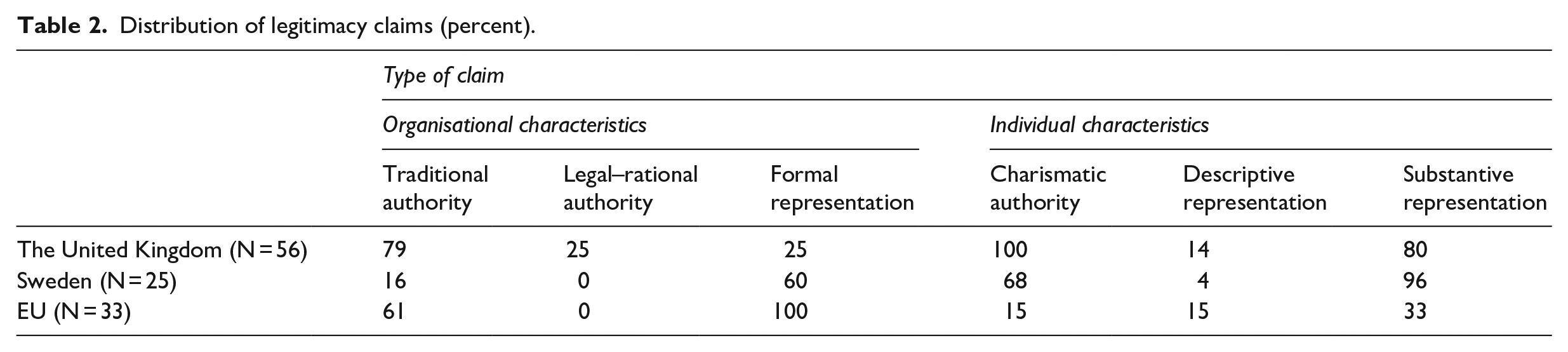
We followed a three-step analytical strategy for coding and analysing the data. First, we conducted a deductive qualitative content analysis of the announcements within each sector, applying a priori-defined categories of claims in our analytical framework (Bingham and Witkowsky, 2022). We sorted the empirical material of each announcement into a separate analytical grid for each CSO based on our key analytical distinctions: claims made in reference to organisational or individual characteristics, and claims made in reference to a possession of authority or in reference to the representation of certain constituencies and causes (see excerpts in Appendix 2). The coders coordinated, cross-checked, and made joint decisions when coding the data. Second, we performed a cross-organisational analysis within the contexts using our analytical framework. This resulted in the following distribution of claims (see Table 2). Because each announcement contains several claims, the percentages refer to how many of the total announcements contain a particular type of claim. For instance, all announcements at the EU level contain a claim related to formal representation. Third, we conducted a cross-regime analysis to see which categories prevail across which contexts.
Distribution of legitimacy claims (percent).
Results
The analysis is structured along the division between ‘organisational procedures’ and ‘individual characteristics’, following the distinction between organisations and individual leaders in the personalisation literature. This dimension cuts across claims based on ‘representation of’ (Pitkin) and claims based on ‘authority over’ (Weber).
Claims based on organisational procedures
Legitimacy claims connected to organisational procedures are most common in Sweden and at the EU level. In both cases, these claims focus on formal representation. Claims relating to formal representation are the least present in the United Kingdom. Considering that most major CSOs at the EU level are associations, all announcements include a legitimisation claim that refers to the leader as a formal representative. Claims often refer to the ‘election of our new chair’ by an annual general assembly, thus establishing a formal link between members and their new representative. More elaborate versions stress the unanimous election of the new chair, for example: ‘The membership unanimously approved [Leader] (EfVET) as new LLLP President!’ (Announcement, LLLP Europe) or by stressing that the election was well attended: ‘. . .members gathered in Brussels from all corners of Europe: a joyful occasion to discuss important issues within the LLL Platform. . .’ (Announcement, LLLP Europe). Some announcements also include more detailed information on the actual election, which works to strengthen the democratic legitimacy of the new chair, for instance, ‘. . . votes were counted on Friday evening and the results announced this morning’ (Announcement, European Movement International).
This way of legitimising new leaders is also common in Sweden. Most often, such claims briefly inform that the new chair is elected at a congress, but there are also some examples in which more information is presented on procedures and practices: ‘[Leader] was unanimously elected by the delegates’ (Announcement, Reumatikerförbundet). In another example, the turnout among member organisations is highlighted.
To create and maintain engagement is a challenge shared with many other organisations. Thus, we are very satisfied that a third of our member organisations chose to attend our congress rather than the springtime sun. 47 out of 140 member organisations were at the congress to mingle, vote and give Forum Syd a mandate for the coming year. (Announcement, Forum Syd)
By contrast, only a quarter of the British announcements contained claims based on formal representation. In these cases, it was only a short mention of the election process at the annual general meeting.
In line with the organisation’s Articles of Association, trustees duly elected the next chair from their number when they met on 15 July. (Announcement, Canal & River Trust)
In some cases, UK organisations announce the new leader before the annual general meeting, stating that the appointment is subject to ratification, the decision being a matter of formality.
Claims relating to traditional authority also drew largely from organisational procedures, where the new leader is described as following a line of succession, and these are most prevalent in the United Kingdom, followed by the EU, while almost absent in Sweden. In UK announcements, there were often a few formulations praising the departing leader and the great legacy that the new leader is inheriting.
[Leader] who has been appointed as the next Chairman of the Age UK Board of Trustees when current Chairman [. . .], reaches the end of her final term. [Leader] is Age UK’s founding Chairman, and over the last 10 years her leadership has been instrumental in making Age UK the force for older people that it is today. (Announcement, Age UK)
Common phrases used in the United Kingdom are ‘handing over the baton’ or ‘stepping into someone’s shoes’ to establish the continuity of great leaders. Similarly, in the EU a majority of announcements start by offering gratitude to the service of the predecessor and placing new leaders within a sequence of leaders. These claims promote the ‘line of succession’ and legitimise the new leader with reference to previous outstanding leaders. In Sweden, we find few legitimacy claims of this kind, in which the legacy of the past leader and the long history of the organisation are highlighted (such as Riksteatern and Naturskyddsföreningen).
Claims drawing on legal–rational authority are less prevalent. In our study, we only find these in a quarter of UK announcements, while they are completely absent in Sweden and the EU. In these cases, the British CSOs claim legitimacy on the grounds of the procedure of recruitment, nomination, or selection of new leaders. Often, the announcements mention the competitive nature of the process and provide information on the recruitment panel composition or the recruitment agency to increase the legitimacy of the selection procedure: He was offered the ECB position following a rigorous search and selection process run by a dedicated Nominations Committee chaired by ECB Non-Executive Director and ex-England cricketer, Lucy Pearson, and former England Captain and current Chair of the ECB Cricket Committee, Sir Andrew Strauss. [Leader] has a lifelong passion for the sport and, in an incredibly strong field of candidates, he was the stand-out all-rounder. (Announcement, England Cricket)
Claims based on individual characteristics
Claims based on individual characteristics are more frequent compared to organisational procedures (see Table 2). References to past leaders or references to the new leader being democratically elected are relatively short, and most announcements devote significantly more space to the individual and their merits, experiences, and competencies. In the United Kingdom, a strong focus lies on what we refer to as ‘professional charismatic authority’; that is, legitimacy claims that describe the leader as outstanding and inspirational with an outstanding CV. In Sweden, on the other hand, emphasis is placed on the leader’s capacity to act as a spokesperson, similar to the substantive representation described in Pitkin’s framework, although references to professional charismatic authority are relatively common as well. In the EU, legitimacy claims pertaining to individual characteristics are not as common.
We find that all announcements of British CSOs contain claims aiming to establish the charismatic authority of the new leader. These statements elevate the individual as a professional leader. Specifically, most of the claims highlight the leader’s ability to govern major organisations across private, non-profit, and public sectors. There is a tendency to include 1–3 paragraphs of biographical information that stresses the professional steppingstones and career highlights of the leader, including recognitions and awards they received during their professional life. For example, when announcing the new chair of Barnardo’s, both notable leadership positions across sectors and professional recognitions were highlighted.
[Leader] joins the charity after a long career in international business and the charity sector. She has served as deputy chair of Cancer Research UK, as trustee of The Prince’s Trust and she is also non-executive director of NHS England. [. . .] Her business leadership roles include chief executive of fashion house Jack Wills, group marketing officer on Vodafone’s global executive committee and managing director of TalkTalk Residential. [Leader] was also featured in the Financial Times list of the Top 50 Women to Watch in International Business, and was this year a finalist in the 2018 Sunday Times Non-Executive Director of the Year (Not for Profit\Public Sector). (Announcement, Barnardo’s)
In Sweden, claims related to professional charisma are also present in most announcements. Although descriptive words such as ‘excellence’ or ‘standout’ are very rare, there are a number of examples where the impressive career of the new leader is stressed.
[Leader] – who’s succeeding [. . .] as chair – was the CEO of the Public Fishing Agency between 2005 and 2011, and he has thereafter among other things made a proposition for sea planning in Sweden. He has for many years been working with sustainability in private businesses, in various public agencies, and within the UN. In 2011, he was awarded the international Baltic Sea prize from the WWF for his engagement and work around a new sea planning legislation. (Announcements, WWF).
At the EU level, claims related to charismatic authority are less prevalent. The ones that we do find emphasise the new leader as an individual with a distinguished professional career.
[Leader] was the 75th secretary of the treasury for the first term of President Barack Obama’s administration, and served as president and CEO of the Federal Reserve Bank of New York between 2003 and 2009. He is currently the president of Warburg Pincus, a global private equity firm based in New York. (Announcement, The International Rescue Committee)
Legitimacy claims focusing on the individual as a representative spokesperson (substantive representation) are frequently expressed, especially in the United Kingdom and Sweden. First, there are claims focusing on the capacity of the individual to act as a spokesperson for an issue or a cause. Such references to substantive representation are most prevalent in Sweden, where they are featured in almost all announcements. Here, there is a clear focus on the individual leader’s ability to represent the views of the members and policy issues.
I see all the issues and topics that Funktionsrätt Sverige works with as important for our members’, says [Leader]. ‘Personally, I have the most experience in the health care issue, which can be a matter of life and death, and which has a great impact on quality of life, but I look forward to working from a broader disability perspective. (Announcement, Funktionsrätt Sverige)
In this quote, the newly appointed leader stresses the importance of the issues that the organisation works for and connects her track record of representing healthcare issues as a good basis also for advocating for disability issues of relevance to the members. The chair’s commitment to the cause, as well as knowledge of a certain issue area, makes the leader a good spokesperson. It is also common that long-standing engagement in an organisation or policy area is highlighted, operating as a guarantee that the new leader knows the issues and has the required engagement.
Substantive representation also features in a large majority of UK announcements. For instance, when Cancer Research UK appointed their new chair, extraordinary achievements in the field of cervical cancer research were highlighted (Announcement, Cancer Research UK). Likewise in Sweden, there are also legitimacy claims that stress the leader’s track record of contributing to the organisation or to another organisation working in the same area. For example, Care International UK highlighted the different positions that the new chair has held in the organisation in the past, signalling knowledge about intra-organisational governance and commitment to the organisational mission.
[Leader] has been a trustee of CARE International UK for almost five years and has acted both as Vice-Chair of the Board and as Chair of the Finance & Audit Committee. [. . .] She has shown her strong commitment to CARE and the people we serve over the last five years, and she has a passion for empowering women and girls. (Announcement, Care International UK)
The environmental organisation The Woodland Trust similarly presented the track record of their new chair in leading many different environmental organisations more broadly.
In her public life [Leader] is President, Vice-President, Ambassador or Patron of a range of environmental and conservation charities, including the RSPB, Birdlife International, The South Georgia Heritage Trust, Flora and Fauna International, Plantlife, the Wildlife Trust for Bedfordshire, Cambridgeshire and Northamptonshire, Lantra and the Institute of Ecological and Environmental Management. (Announcement, the Woodland Trust)
While these draw on previous experience and expertise, substantive representation also builds on claims of value alignment between the new leader and the organisation (e.g. ‘she is passionate about equality’), which in turn makes the new leader a capable spokesperson for the organisational cause. This is achieved by portraying leaders as ‘lifelong supporters’ or as having ‘long-standing commitment’ to the cause, without necessarily providing evidence of past experiences or a track record of expertise or advocacy work.
Claims related to substantive representation are less prevalent at the EU level. Organisations nonetheless legitimise leaders by referring to their long-standing experience from within (national) member organisations: ‘[s]he has been a Board Member of the EWL since May 2016 representing the French national women’s rights coordination’ (Announcement, European Women’s Lobby). Like in the United Kingdom and Sweden, we also find claims drawing on leaders’ long-lasting engagement within the movement and the relevant issue area. However, while substantive representation dominates in Sweden and is very common in the United Kingdom, it does not play as prominent a role in how EU CSO leaders are legitimised.
Individual legitimacy claims referring to descriptive representation are overall very rare. Some UK announcements portray the leader as having shared characteristics with the constituencies or users of the organisation. For example, in the announcement of a new chair of the Royal National Institute for the Blind (Announcement, RNIB), it is said that the new Chair has been blind since birth. Similarly, Scope UK highlighted that their newly appointed chair has been diagnosed with Parkinson’s and that his appointment ‘reflects Scope’s commitment to having a disabled person lead the organisation’ (Announcement, Scope). Claims based on descriptive representation also present the person as clearly embedded and as part of an occupational group and/or community of likeminded persons, defined as the organisation’s constituency. For example, England Athletics highlighted that their new chair is a former international athlete (Announcement, England Athletics).
At the EU level, we find some rare expressions of claims related to descriptive representation tied to the announcements of CSOs promoting the rights of a particular social group.
A chronic patient himself [Leader] pledges to see the genuine expertise of patient leaders acknowledged by other stakeholders. As he stated in his first speech as President of EPF, ‘I was first diagnosed when I was 17, and I became a patient advocate the day after. Because this is not what I do, this is what I am. What we all are. Patients’. (Announcement, European Patient Forum)
In a few of the other announcements, claims to descriptive representation are expressed as a personal experience of a shared identity. As Table 2 shows, claims based on descriptive representation are almost completely absent in the Swedish context, with only one announcement including such a claim.
Discussion
This study shows that top resource-rich CSOs handle the legitimacy dilemma (the dilemma of having leaders with status and authority comparable to leaders in business and politics, while simultaneously having leaders who are seen as good representatives in the eyes of organisational members and constituencies) primarily by promoting their leaders through claims relating to individual characteristics and personal elevation and less on organisational characteristics and formal procedures. These are patterns familiar in politics and business where the individual leader has become dominant at the expense of the collective or the organisation (e.g. Adam and Maier, 2010; Balmas et al., 2014; Rahat and Kenig, 2018).
The identified model of civil society elite legitimation draws on two types of claims: promoting leaders as excellent and astounding professional leaders (charismatic authority), and as able spokespersons (substantive representation). Top leaders gain legitimacy through claims relating to what we refer to as professional charismatic authority because they are promoted as the best choice to lead the organisation due to an extraordinary professional track record and proven leadership experience. This is not the full picture, as top CSOs also legitimise their leaders as highly capable spokespersons who can stand for their constituencies due to proven records of accomplishments and knowledge of the issue area as well as commitment to the values and mission of the CSO. The combination of professional charisma and substantive representation can be seen as a means for top CSOs to maximise the appeal of the newly appointed leader, both to elite groups that civil society leaders interact with and the constituencies that they lead. This indicates that top CSOs carefully project their leaders’ personalities, characteristics, and credentials to show that they differ from other leaders in civil society due to top leaders’ perceived excellence and extraordinariness, illustrating a turn to personalised legitimation (e.g. Rahat and Kenig, 2018). These are congruent with Weber’s proposition that in times of rapid change people tend to turn to charismatic leaders and engage as followers.
A constitutive element of this personalised and hence certainly elitist model of legitimation is the lack of claims referring to descriptive representation. Across contexts, we find a limited reference – if any – to the promotion of leaders as ‘one of us’. Having close connection to the group one speaks for (e.g. in terms of demographic characteristics) is thus not a significant element in the legitimation of top leaders. They are rather promoted through a form of symbolic closeness, rather than by sharing common characteristics. Acts of legitimation linked to substantive representation stress leaders not necessarily being part of the constituency, but with a ‘long-standing commitment’, ‘history within the organisation’, or through ‘commitment to the cause’. Being excellent at speaking for the cause thus seems to be more important than the need to share social and personal features with those that they speak for. This only partly resembles personalisation as a shift from topics to persons (e.g. Van Aelst et al., 2012), as civil society elites are mainly legitimised through connection to the topic (substantive) and less through their personal attributes (descriptive). Civil society elites thus seem to gain legitimacy through a professional form of personal elevation (e.g. Adam and Maier, 2010). This might be due to them not being known either to a wider audience or their constituencies, logically following that they are promoted in reference to their achievements, rather than in reference to personality traits or the idea that this is what is needed to be at the top of elite organisations.
We find that this model cuts across different sectors, indicating congruence at the top of European civil societies. However, we also find variation across civil society regime contexts. For instance, the high number of claims relating to formal representation in Sweden, suggests that the governance traits of civil society follow an associational logic with large voting memberships. The presence of claims related to legal–rational authority in the United Kingdom also reflects regime features, since most top CSOs do not have a voting membership, but a governing board of trustees in charge of formal recruitment processes with the help of external recruitment agencies. Claims expressed by EU-based CSOs similarly reflect the particularities of that regime as most of them are umbrella associations (EU-based associations of national associations). This might be one of the reasons why EU leaders are justified as being democratically elected through formal procedures (formal representation) or as an organisational successor of the previous leader (traditional authority), and why there is less emphasis on individual characteristics. EU-based CSOs moreover have to make their announcements in connection to audiences in 27 different member states. This distance makes individual characteristics less relevant in building legitimacy.
Conclusion
This article contributes to the personalisation literature, as we show that civil society follows similar developments as politics and business. Top European CSOs legitimise their leaders as being ‘on par with’ other top leaders, as an elite among other elite groups (potentially) reflecting social distance between leaders and constituencies. This shows that top CSOs attract individuals who are part of a broader social elite and have extraordinary achievements across sectors, which opens questions as to what extent these people are sharing life experiences and values with the constituencies the CSOs seek to serve. It is, however, beyond the scope of this article to determine whether the observed model of elite legitimation leads to increased (or decreased) legitimacy and trust for the newly appointed leaders and top CSOs. This way of legitimising civil society elites contrasts with the established understanding of CSOs role in modern democracies, acting as intermediaries between states and citizens. It is too soon to address whether personalised modes of legitimation will undermine organisational legitimacy, but this indicates the need for further integration between civil society and personalisation studies.
This article moreover shows that studies of civil society legitimacy ought to approach organisational and individual sources of legitimacy in combination. Our proposed framework combining Weber and Pitkin is a step in that direction, as it encapsulates organisational and individual characteristics based on authority and representation. It hence goes beyond established approaches which mainly have addressed organisational legitimacy and rarely leader legitimacy. The conceptual framework paves the way for further exploration in connection to the legitimisation of politicians or business leaders.
Our study, however, only addresses legitimation at the top; that is, ‘elite legitimation’, and does not explore whether organisational characteristics like core mission, internal governance models, or resource bases foster similar or different types of leader legitimation. Although all country samples include CSOs with clear constituencies in terms of particular groups, this does not seem to shape legitimation claims. With a different sample and study, one could, however, have further explored the connection between modes of legitimation and organisational characteristics. It is in that respect a matter for future research to explore whether the legitimation model we find among top European CSOs also has relevance for less resource-rich organisations with varying characteristics.
Footnotes
Appendix 1
Appendix 2
Acknowledgements
We are grateful to our colleagues from the research programme on civil society elites at Lund University for their comments on earlier drafts as well as for the feedback from the anonymous reviewers. We are particularly grateful to Roberto Scaramuzzino and Jayeon Lindellee who have led and coordinated the comparative mapping of top CSOs included in the study.
Funding
The author(s) disclosed receipt of the following financial support for the research, authorship, and/or publication of this article: This study is funded by the Riksbankens Jubileumsfond, project number M17-0188:1. This support is gratefully acknowledged.
