



Abstract
This article analyses the effect of ministers’ exposure to periods of low presidential approval in Brazil and Chile between 1990 and 2014. Approval is explored with quarterly estimates using a dyad-ratios algorithm and merged into a time-dependent cabinet data set to evaluate individual ministerial terminations (N = 4245). The empirical strategy combines time-varying exposure Cox regressions with observational data and propensity score and matching to estimate the effect of low approval on ministerial survival and perform a moderation analysis with three profiles associated with presidential strategies: (1) nonpartisan ministers to limit agency loss and moral hazard; (2) economists as ministers to optimise cabinet performance and send positive signals to the electorate; and (3) party leaders as ministers to optimise legislative support. The main findings show that risk increases by 135.1% in periods of low approval. In addition, approximately only one in five nonpartisan ministers is removed compared to party members.
Keywords
Introduction
In May 2010, just a month after the start of Sebastián Piñera’s first presidential term, Jaime Mañalich, the recently appointed health minister, was summoned to testify about an allegedly falsified alcohol test performed 7 months earlier on Piñera’s brother after a traffic accident. The test took place at a private clinic where Mañalich was then general manager and Piñera was a shareholder. Regardless of public pressure, Mañalich remained health minister throughout the 4-year administration. A very different situation occurred in June 2020, when Piñera made the fourth cabinet change of his second term (2018–2022). Despite persistent questioning of the government’s response to the coronavirus pandemic, the change consisted only in a reshuffle of the same ministers, designed partly to protect questioned Health Minister Jaime Mañalich. The protagonists are the same as in 2010, but the outcome was entirely different: only 9 days after the reshuffle, Mañalich resigned in the face of criticism of the inefficiency of the dynamic quarantines implemented by the government and a mismatch between the statistics reported by the Health Ministry and the World Health Organization (WHO). Thus, while the President was again willing to protect Mañalich, the pressure was unsustainable.
This case is an excellent example of how a president can protect ministers from calls for their resignation and the effect of scandals. In this particular example, Piñera reappointed Mañalich as a minister in his second term but, this time, was unable to protect him. Moreover, this is a case of a nonpartisan minister close to the president and illustrates how a president can limit moral hazard and agency loss by appointing and protecting independent ministers close to his entourage or inner circle and without partisan loyalties.
While ministers’ attributes and trajectories are a recurrent topic of study from different approaches, theoretical arguments tend to result in a conceptual heterogeneity that complicates empirical research (Camerlo and Martínez-Gallardo, 2018). This heterogeneity translates into a variety of concepts for identifying profiles that are complex to measure empirically, posing a methodological challenge for testing how ministers’ profiles offer advantages in the face of unexpected events or shocks that impact governments’ stability. In this context, we consider periods of low presidential approval, a situation common to almost every administration that should impact actors’ incentives and strategies.
Thus, our main question is: How can a minister’s attributes prevent his exit from the cabinet during periods of low presidential approval? Answering this question allows us to offer an empirically approachable conceptualisation of ministerial profiles linked to presidential strategies in contexts of approval crises and, in this way, make a theoretical contribution to bridging the gap in the general conceptualisation of profiles. In addition, we propose a specific procedure for correctly estimating effects and bias using the survival approach, which constitutes a substantial, novel methodological contribution. This contribution is relevant since straightforward modelling of the relationship between low approval and cabinet turnover may be biased and exposed to endogeneity because presidents or prime ministers tend to reshuffle their cabinets at times of low popularity (Kam and Indriðason, 2005; Martínez-Gallardo, 2014).
We will refer to two country-specific cases: Brazil and Chile. Although both are cases of multi-party coalitions, political alliances in Chile have been remarkably stable in recent decades and, for instance, Chile has more robust party organisation capabilities (Martínez, 2021). In addition, both cases have shown a higher degree of technical control over economic policies in recent decades compared to other countries in the region, such as Argentina, where technocracy has gradually declined (Dargent, 2015). Finally, as evidenced below, both countries have experienced periods of low presidential approval and comparable levels of ministerial survival in the medium to long term.
In the next section, we present the theory and empirical expectations, reflecting first on stochastic events, low approval and ministerial recruitment before going on to connect recruitment and political careers with different ministers’ profiles and principal–agent, signalling and coalition theories. We then present our empirical strategy with the encoding of the time-dependent data set, detailed information on the regressions with observational data and the application of propensity score and matching along with placebo tests and robustness checks. The main results are then presented with the estimation of the effect of exposure to low approval on the exit of cabinet ministers, moderation analyses and additional tests. Finally, the main findings are summarised and briefly discussed.
Ministerial turnover and ministers’ profiles
Stochastic events, low approval and ministerial recruitment and careers
The concept of crisis is associated with stochastic events in the framework of the event-based approach in government survival literature, especially in the case of parliamentary systems (Browne et al., 1986; Fortunato and Loftis, 2018; King et al., 1990; Warwick, 1994). This concept accounts for unforeseen events or shocks that affect the stability of governments. The magnitude of their effect depends on different factors, such as the complexity of the bargaining environment and the party system’s characteristics. More complex environments render governments more sensitive to these events (Chiba et al., 2015; Laver and Schofield, 1990; Laver and Shepsle, 1996). Such events can be critical and generate a renegotiation of the balance of power as it stood at the beginning of a presidential term and may even lead to a reordering of parties and coalitions. Both situations can, in turn, trigger a cabinet reshuffle (Martínez-Gallardo, 2012).
Events that typically affect cabinet stability include protests, economic crises, media scandals, corruption cases, low approval and natural disasters of different sorts (Camerlo and Pérez-Liñán, 2015a; Martínez-Gallardo, 2014). It is to be expected that different events will have different effects on the actors’ behaviour depending on the specific context. However, as Berlinski et al. (2010) indicate, evaluating all possible random shocks is empirically complex, and we, therefore, opted to focus on periods of low presidential approval.
In these periods, a president should have incentives to correct drops in her 1 approval by making cabinet changes and firing inefficient ministers or those whose profile does not tally with strategic presidential decisions, in a similar fashion to what happens with prime ministers in parliamentary systems (Dewan and Dowding, 2005; McAllister, 2003).
Presidential approval dynamics tend to follow a cyclical model with quadratic patterns: a honeymoon period just after the election, a gradual deterioration and a slight recovery towards the end of the term; see also Brace and Hinckley, 1992; Carlin et al., 2018). In Latin American countries, the evidence confirms a significant honeymoon effect during the first three quarters of an administration, followed by a deterioration to a low of 40%–45% approval and, finally, a slight recovery (Carlin and Martínez-Gallardo, 2019; Carlin et al., 2018).
Consequently, our first empirical expectation is that presidents do indeed carry out reshuffles in a bid to counter periods of low approval. Therefore, we formulate the following hypothesis:
Low Approval Hypothesis. Exposure to periods of low presidential approval increases the likelihood that a minister will be removed from the cabinet.
Our argument and empirical expectation are straightforward: low approval increases the likelihood of the dismissal of ministers. This viewpoint differs slightly from Camerlo and Pérez-Liñán (2015b) since, albeit asserting that portfolio reallocation is mediated by approval, they also suggested that partisan ministers choose to leave the cabinet when the government is unpopular and presidents command only the loyalty of their inner circle. In other words, presidents do not fire ministers in turbulent times but are abandoned by them. We suspect this idea is driven by the Argentine single-party government case, which these authors analysed. In multi-party coalitions, a failure to renegotiate the initial equilibrium of the coalition could imply the parties’ abandonment of the government (Martínez-Gallardo, 2012). In this case, their abandonment of the president should trigger a major change in the bargaining environment and a new government coalition, not just a cabinet reshuffle.
At this point, we nuance our argument by incorporating the idea that specific ministers’ profiles and attributes can temper or moderate the presidential decision to dismiss them because specific profiles are linked to identifiable presidential strategies. Therefore, we are particularly interested in testing the protective effect of some traits linked to specific strategies. To support this argument, we examine some theoretical perspectives related to ministerial recruitment and the political career concept.
Ministerial recruitment in European parliamentary systems has been studied extensively by, for example, Blondel (1988), Blondel and Müller-Rommel (1997) and Blondel and Thiébault (1991). According to Camerlo and Martínez-Gallardo (2018), this work is related to studies of trajectories and circulation of the elite. From the standpoint of the study of political elites, recruitment can be understood as a process of selecting citizens with sufficient motivation and social advantages to attain important positions (Putnam, 1976). In this vein, recruitment is intrinsically linked to a ministerial career as part of an individual’s political career. A ministerial career can be defined as the time between a minister’s first appointment to the cabinet and his final departure from the government (Rodríguez Teruel, 2011). In this sense, ministers’ careers may be dynamic, and their departure from the cabinet may not be synonymous with the end of their political career. In their analysis of European parliamentary cabinets, Blondel and Müller-Rommel (1993, 1997) conclude that ministers’ careers do not terminate when they leave office and they generally move to other important public positions or positions that, albeit less prominent publicly, are important in professional terms. In some cases, they also subsequently return to the cabinet (González-Bustamante and Garrido-Vergara, 2018). In Latin America, ministers with higher levels of political capital are, in general, less likely to face abrupt removal from office (Escobar-Lemmon and Taylor-Robinson, 2005, 2009).
Political careers can be explained using structuralist, interactionist or motivational approaches (Alcántara and Llamazares, 1997). The structuralist approach focuses on the effect of individuals’ background, social capital and academic credentials on their access to positions of power, while the interactionist approach emphasises processes of interaction associated with the political circumstances in which individuals operate. Finally, the motivational approach attempts to explain their interests and strategies at different stages of their political career as conditioned by individual ambition in accordance with the classic concept of Schlesinger (1966).
The structuralist approach can be related to a series of studies that have focused precisely on individuals’ educational background and academic credentials. Examples include the work of Escobar-Lemmon and Taylor-Robinson (2016) and Ai Camp (1995, 2002) on the advantages that academic credentials and family ties confer in obtaining positions of privilege in the Mexican elite. These studies tend to connect with specific sociological approaches suggesting that individuals’ political trajectories are conditioned by their resources and capital (Joignant, 2012) and that political capital operates symbolically based on recognition (French, 2011).
At this point, it is possible to note that both ministerial recruitment and the political career concept have been strongly influenced by approaches based on the characteristics of individuals, resembling sociological perspectives. This influence is associated with an important drawback. These approaches do not constitute a homogeneous theoretical body, and as pointed out by Camerlo and Martínez-Gallardo (2018), this makes it difficult to work empirically with their conceptualisations. Indeed, some of these approaches use professional politician, outsider, specialist or generalist concepts and nuanced measurements based on fuzzy-set theory (Camerlo and Pérez-Liñán, 2015b). Moreover, when the sociological approach based on resources and capital is incorporated (Joignant, 2011, 2012), an overwhelming number of subtypes of politicians, technocrats and technopols can be identified and, strictly speaking, these can be too fuzzy for empirical analysis.
In light of these difficulties, we look at potential connections between individual attributes and ministerial profiles using approaches such as principal–agent perspectives, signalling and coalition studies that allow us to explore specific presidential strategies in crisis contexts.
Nonpartisan ministers, technocrats and party leaders
A number of studies have suggested that presidential cabinets are lighter on party members than parliamentary cabinets and that there is not necessarily a correlation between parties’ representation in the cabinet and the seats they hold in Congress. This reflects presidents’ high autonomy in choosing their ministers, which they exercise to appoint nonpartisan ministers (Altman, 2000; Altman and Castiglioni, 2008). Indeed, the appointment of nonpartisan ministers can be understood as a presidential strategy to control moral hazard problems and the risk of agency loss (Chaisty et al., 2018; Martínez-Gallardo and Schleiter, 2015). This situation can be remarkably delicate in multi-party systems, although the institutional architecture of presidentialisms should allow the principal – in this case, the president – to exercise better control of moral hazard in the chain of delegation with her ministers. Thus, we propose the following hypothesis:
Nonpartisan Hypothesis. Nonpartisan ministers are less likely to be removed from the cabinet during periods of low presidential approval.
Conversely, classifying all a president’s non-legislative support simply as nonpartisan can be too general and imprecise, creating a gap between studies of cabinet formation and ministerial recruitment. Martínez-Gallardo and Schleiter (2015) and Camerlo and Martínez-Gallardo (2018) suggest that, to bridge this gap, the recruitment of nonpartisan ministers should be considered a strategic decision on the part of a president in order to address crises and particular circumstances.
In a similar vein, and in combination with signalling theorising, incentives operate in the second chain of delegation in presidential democracies, where the president is an agent of the electorate (Elgie, 2020). In this chain, the president has incentives to limit moral hazard and ensure ministers perform adequately in order to send signals to the electorate and increase presidential popularity. These incentives should be more substantial when re-election is permitted (Camerlo and Pérez-Liñán, 2015a; see also Beckman and Schleiter, 2020). They also enable us to reinterpret the role of expertise in the cabinet. Our argument does not explain the supremacy of technocracy and the role of economists only in terms of socio-historical processes but rather the opportunity they offer the president to show good results and send adequate signals to the electorate for the sake of the party’s or coalition’s continuity in government or with the aim of obtaining re-election.
In Latin America, ministers’ profiles have been studied in the context of the appointment in the 1990s of technocrats, who can also be classified as nonpartisan ministers (Centeno and Silva, 1998; Silva, 2009; see also Camerlo and Martínez-Gallardo, 2018; Joignant, 2011). Their emergence reflected the specific socio-historical circumstances of the region’s democratisation, the influence of the World Bank’s first-generation reforms and the recommendations of the Washington Consensus, which tended to foster significant changes in the ministerial recruitment process, consolidating the role of technocrats in public policymaking (Camerlo and Martínez-Gallardo, 2018; Centeno and Silva, 1998). Technocrats have since gone on to play a leading role in political and economic transformations in Latin America (Centeno and Silva, 1998; Silva, 2009).
The World Bank reforms boosted the New Public Management (NPM) approach in the region, fostering a clear-cut separation between politics and administration. This separation was accompanied by a critical view of the balance between patronage and merit-based appointments in the executive (González-Bustamante, 2020). This view was also driven partly by the World Bank’s second-generation reforms, which focused on professionalising civil services and reforming the public administration to make it more meritocratic (Panizza and Philip, 2005).
Therefore, it is possible to observe a change in patronage systems depending on the hierarchical level and the cohabitation of politicians with technocrats at the highest levels of the executive (Panizza et al., 2019). Indeed, not all patronage appointments are clientelist in nature and some have other purposes (Kopecký et al., 2016). For example, Panizza et al. (2018) propose a taxonomy of patronage practices that identifies different types of motivations for appointments used to reward and maintain a network of political activists: to provide technical expertise, to control the public bureaucracy, to secure support for policy initiatives and to gather electoral support. The appointment of technocrats or technopols at the higher level of the executive is associated precisely with the need for technical expertise (see also Dargent, 2015; Joignant, 2011).
We evaluated technical knowledge as a desirable trait in a presidential cabinet since it can help to manage difficult moments and promote the government agenda. Indeed, the high levels of expertise required by some ministries can make it more difficult to replace the incumbent minister (Martínez-Gallardo, 2014). We are specifically interested in the role played by economists, given the abundant literature on the influence of the technocratic phenomenon in Latin America (Centeno and Silva, 1998; Silva, 2009; see also Camerlo and Martínez-Gallardo, 2018). However, given that not all countries have experienced a clear hegemony of technocracy and, particularly, of economists (Dargent, 2015), we also use robustness checks to test alternative measures of expertise such as the technopol profile (González-Bustamante and Garrido-Vergara, 2018; Joignant, 2011) and the holding of a PhD (Camerlo and Pérez-Liñán, 2015b). The argument is that a more technical cabinet allows presidents to obtain good results in implementing public policies and send signals to the electorate through which to maintain or regain their popularity. Therefore, our empirical expectation is as follows:
Technocracy Hypothesis. Ministers who are economists are less likely to be removed from the cabinet during periods of low presidential approval.
Finally, the role of party leaders or political capital can be understood as a mediating factor in power balances in a multi-party system or even in single-party governments in the framework of relations between the executive and the legislature. Rather than the symbolic dimension of political capital, we highlight the argument that cabinet allocation can be used strategically to negotiate with parties (Schleiter, 2020). In this sense, appointing and protecting ministers who are party leaders can be analogous or complementary to the strategy of forming coalitions to circumvent legislative blockages (Martínez-Gallardo, 2012; Amorim Neto, 2006). This strategy operates in the opposite way to the limiting of agency loss through the appointment of nonpartisan ministers close to the president: it may increase moral hazard but may also translate into explicit legislative support (Altman, 2000; Amorim Neto, 2006).
A side effect of the increased moral hazard may be the extension of the patronage system to the highest levels of the civil service. For example, the politicisation of senior civil servants tends to be higher in ministries than in government agencies (Bach et al., 2020). Moreover, Staronova and Rybář (2021) show that senior civil servants are more likely to be replaced after a cabinet reshuffle, which is consistent with politicisation of the civil service. Similarly, González-Bustamante (2020) shows high turnover rates among senior civil servants, comparable to those seen in the cabinet.
Despite these negative externalities, a president may need political support, and in this context, being a party leader could also offer ministers protection since it implies an ability to mobilise support and affect the negotiation environment and, consequently, the president’s legislative strategy. Indeed, ministerial appointments of party leaders could be used as a strategy to negotiate legislative support (Schleiter, 2020). Consequently, we pose the following hypothesis:
Political Capital Hypothesis. Ministers who are party leaders are less likely to be removed from the cabinet during periods of low presidential approval.
Empirical strategy
Time-dependent data encoding
Our empirical strategy combines time-varying exposure survival models, propensity score analysis and matching techniques. Several recent studies of ministerial duration and turnover have adopted this approach (Berlinski et al., 2007, 2010; Camerlo and Pérez-Liñán, 2015a; Kerby, 2015; Martínez-Gallardo, 2014; Quiroz Flores, 2015). However, these models are not exempt from the problem of non-random selection inherent to observational data. We, therefore, combine propensity score and matching estimation in order to estimate correctly the effect of presidential approval crises on the departure of cabinet ministers and the possible moderating effect of certain specific profiles and attributes.
First, we merged the data sets of Franz and Codato (2016) and González-Bustamante and Olivares (2022) about ministers in Brazil and Chile between 1990 and 2014. Both sets contain information about the ministers’ attributes and trajectories and the exact dates on which they became and ceased to be ministers, which are particularly important for our empirical strategy. We thereby obtained a set of 488 observations that we coded as a time-dependent data set with quarterly cut-off points for the whole period in order to incorporate presidential approval and macroeconomic data as time-varying covariates.
For this procedure, we used the time-interval model of Therneau et al. (2020) in which the base is encoded with cases that have multiple observations – in this case, ith ministers – according to defined time intervals corresponding to the four quarters of each year (
The variance of the time-varying covariates is coded over the closed interval, that is, at the end of each quarter. It is then possible to observe the different covariates
In addition, we merged World Bank (2020) macroeconomic indicators (see also Piburn, 2020) and the legislative effective number of parties (ENP) with the Gallagher and Mitchell (2005) indicator updated for the period between 1990 and 2014, derived from the original measurements of Laakso and Taagepera (1979) and Gallagher (1991). The macroeconomic indicators that are merged into the set are gross domestic product (GDP) growth, measured as the annual percentage per capita change, and inflation, measured as the annual change in consumer prices. The code programmed to encode the data set and replicate the main article analyses is available in the Supplementary Material.
This procedure allowed us to obtain a set of 4245 observations to which we applied administrative censoring in the final interval when it coincided with the end of the corresponding presidential term. Figure 1 shows a nonparametric Kaplan–Meier estimation based on individual ministerial terminations and a LOESS (Locally Weighted Least Squares Regression) estimation of presidential approval between 1990 and 2014 in both countries.
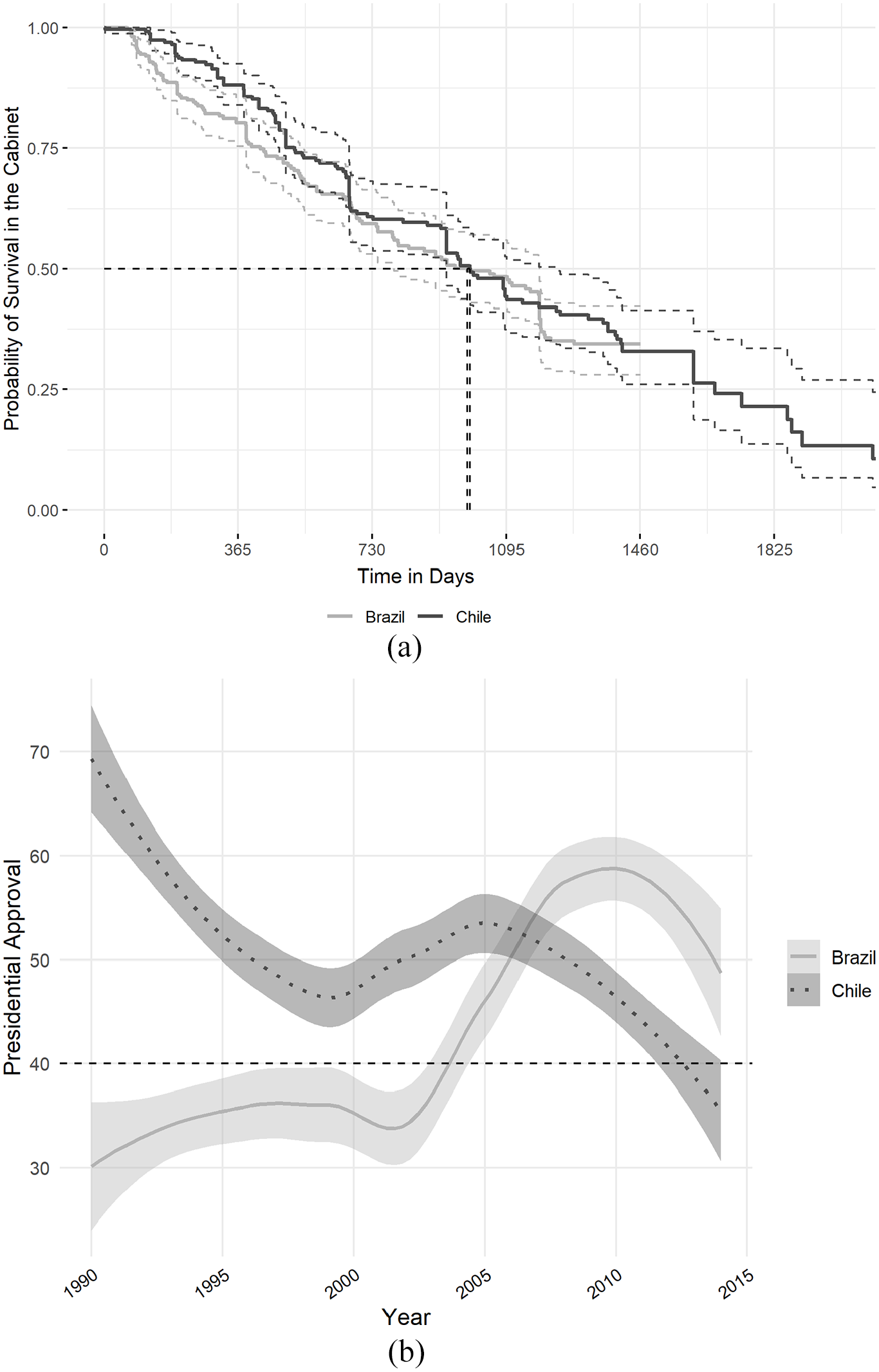
Kaplan–Meier survival estimations for ministers and presidential approval in Brazil and Chile : (a) Nonparametric Kaplan-Meier estimation and (b) LOESS estimation of presidential approval.
Time-varying exposure Cox regressions
Once the data had been encoded, the econometric and causal estimation strategy was divided into three stages to estimate the effect of low presidential approval on the dismissal of cabinet ministers, considering specific attributes and profiles as factors that may moderate this effect. We worked with observational Cox survival models before estimating the propensity score and matching the sample to estimate the effect of presidential approval correctly. Next, we performed an additional moderation analysis incorporating interaction terms. Finally, we conducted placebo tests and robustness checks to validate our results.
For econometric estimation with observational data, we used an extension of Cox models with time as the dependent coefficient. This extension involved working with non-proportional hazards due to the data set’s structure. The equation is similar to that for proportional hazards with a baseline hazard
First, we estimated a baseline model with our quarterly exposure variable to low presidential approval
Our baseline model does not include any covariates or specifications. We then extended the equation incorporating moderating covariates
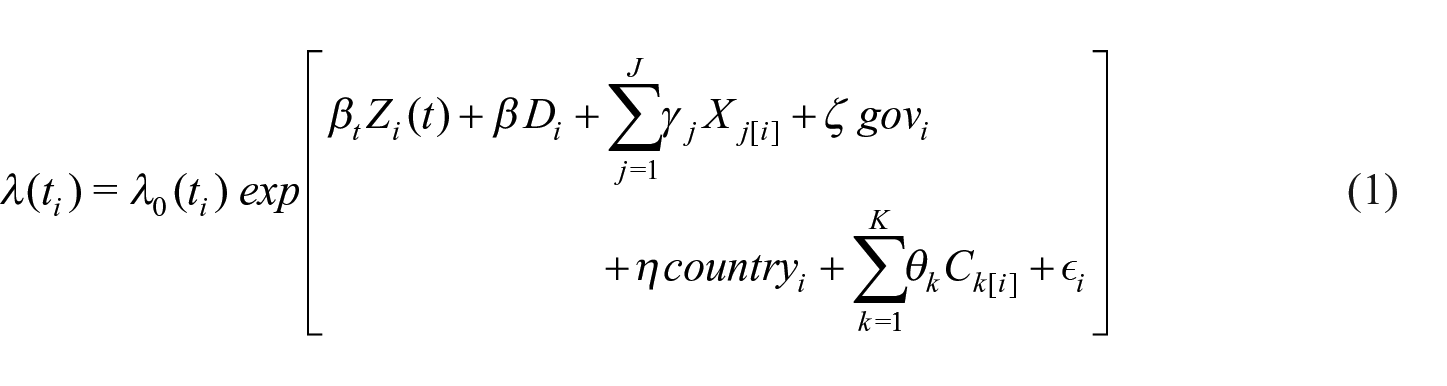
Next, we incorporated the interaction effect between low presidential approval
The vector
These nine covariates are considered potential confounders for the propensity score estimation as they could affect both presidential approval and the decision to fire ministers. For example, legislative ENP reflects the complexity of the negotiation environment, which may impact not only approval by implying more significant political challenges and problems, but also the need to renew the cabinet in a quest to gather political support and advance the government agenda (Chiba et al., 2015; Schleiter, 2020). In addition, re-election may interact with the pre-election dummies, and when consecutive re-election is allowed, the president has incentives to send signals of good performance to the electorate, which may affect cabinet reshuffle decisions (Camerlo and Pérez-Liñán, 2015a; see also Beckman and Schleiter, 2020).
Macroeconomic indicators, meanwhile, are often predictors of approval (Carlin et al., 2018) and are also considered shocks that affect cabinet survival (Camerlo and Pérez-Liñán, 2015a; Martínez-Gallardo, 2014). Finally, binary variables of quadratic presidential approval patterns may affect cabinet stability: barring serious adverse selection problems in the inaugural cabinet appointments, presidents are unlikely to make major cabinet reshuffles during their honeymoon and, particularly, the first quarter. Similarly, the impending end of an administration, particularly with upcoming elections, can have various effects. Presidents may have incentives to send signals to the electorate, whether seeking re-election or supporting a candidate from the same party or coalition. However, an effect in the opposite direction is also possible because reshuffles may be limited by the depletion of the talent pool of potential ministers towards the end of a president’s term (Dewan and Myatt, 2010; see also Martínez-Gallardo and Schleiter, 2015).
Propensity score analysis, matching and moderation analysis
To control for the non-random selection problem in our observational data, we next employed propensity score analysis and matching techniques to correct for imbalances and control for bias. We estimated the propensity score by performing a probit regression of periods of low presidential approval

We then classified ith observations into different propensity score balanced groups with the nearest neighbour algorithm without replacement to match observations with and without exposure to low approval
The assessment of covariate balance and matching suggests the choice of the sample with full matching where only legislative ENP and inflation fail to balance (Figure 2). Consequently, we integrated these variables as controls in the outcome models (Austin et al., 2007; Olmos and Govindasamy, 2015). In addition, we incorporated the weights obtained with the matching process and adjusted for the sth clusters of the matching to test the effect of exposure to low presidential approval on individual ministerial terminations (Austin and Stuart, 2015; Ho et al., 2011)

Subsequently, we included interaction terms between low approval
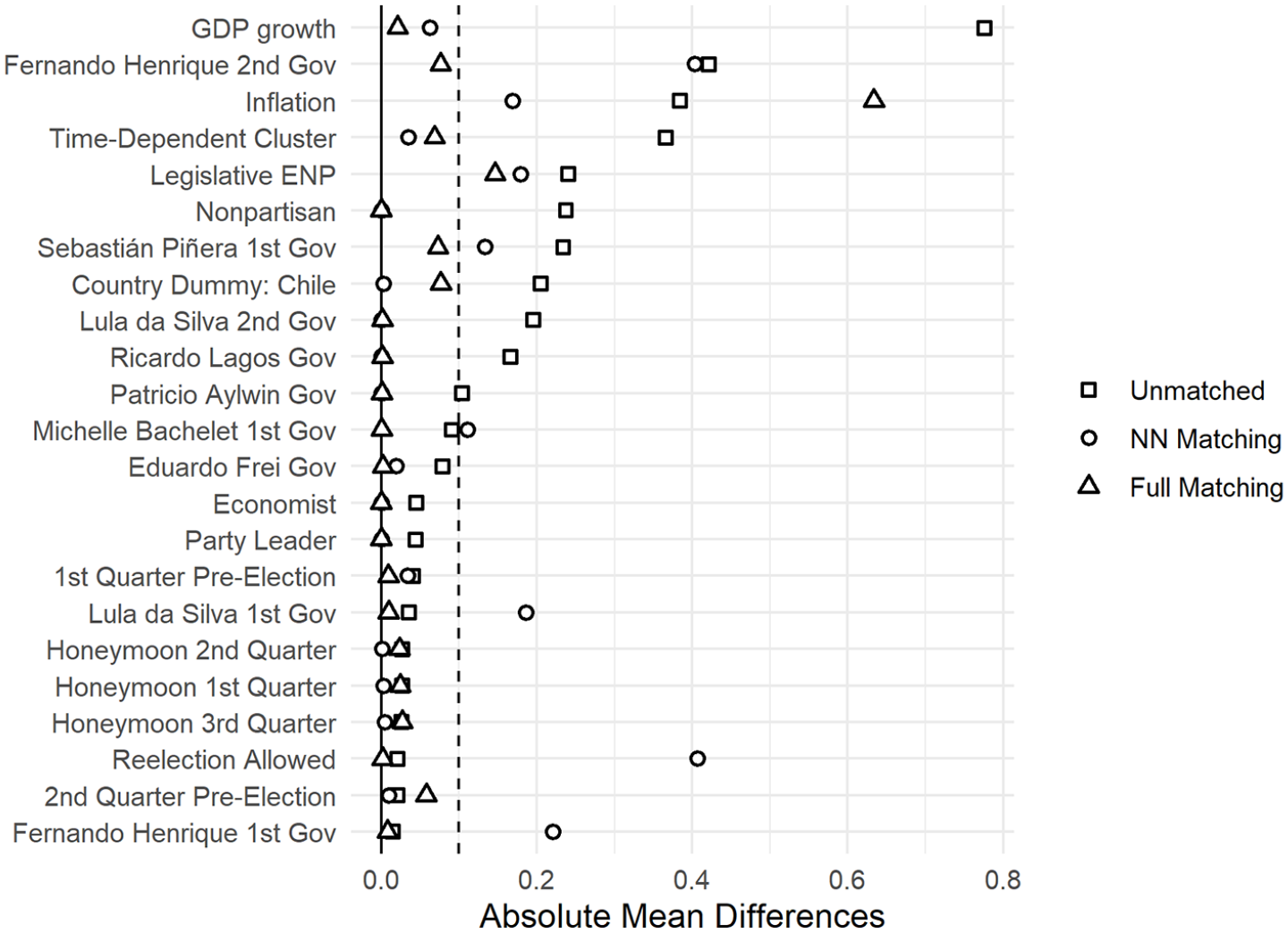
Standardised and absolute mean differences before and after matching.
Placebo tests and robustness checks
We incorporated standard statistical tests in all estimations to evaluate the models. For example, Akaike Information Criterion (AIC) and variance inflation factor (VIF) were calculated for all models to assess prediction error and multicollinearity. In addition, we incorporated the C-Index, which accounts for the proportion of all pairs of observations in which the model adequately predicted individual termination (Harrell et al., 1996; see also Adolph et al., 2020). It should be noted that, in general, Cox regressions must meet the assumption of proportional hazards (Box-Steffensmeier and Jones, 2004). However, as this is a time-dependent data set, the hazard is non-proportional.
To ensure the plausibility of our identification strategy, we conducted a placebo test with the treatment-altered
As a robustness test, we used a stricter definition of the technical profile than merely considering economists, preferring a combination with partisan leadership, which the literature usually defines as a political technocrat or technopol (González-Bustamante and Garrido-Vergara, 2018; Joignant, 2011). In addition, we used educational level, defined as holding a PhD, as an alternative measure of technical profile. 3 We also added the sex and age of ministers as controls and confounders. In our main models, these variables are not considered because, although they may affect a minister’s performance and thus his likelihood of remaining in the cabinet, they are unlikely to affect presidential approval. Finally, we tested smoothed presidential approval as a continuous variable and alternative cut-off points of low approval with time-varying Cox regressions (see the Supplementary Information file for further details and additional checks).
Results
Estimating the effect of low approval on the dismissal of ministers
Our main results show that, in periods of low presidential approval, the risk of dismissal of cabinet ministers increases by 135.1% compared to regular periods. However, nonpartisan ministers are better protected during these periods, with approximately only one in five being removed from the cabinet during a crisis period compared to partisan ministers. Details of these findings are set out below.
First, in this subsection, we present the primary analysis of the effect of low approval on cabinet dismissal. Then, in the following subsection, we look in greater depth at the moderation analysis for individual attributes. Finally, we present the placebo tests and a summary of our robustness checks.
Table 1 compares our baseline model with the survival regressions for time-varying exposure to periods of low approval with the observational data and the matched sample. The coefficient of low approval is positive and significant in the three models, increasing the risk of ministerial dismissal. By exponentiating these coefficients, we obtain the hazard ratio estimate, finding that the matching allowed for a bias correction of 16.2% compared to the unmatched model and 20.6% compared to the baseline model:
Time-varying exposure Cox regressions and survival outcome model after matching for presidential approval on individual ministerial terminations.
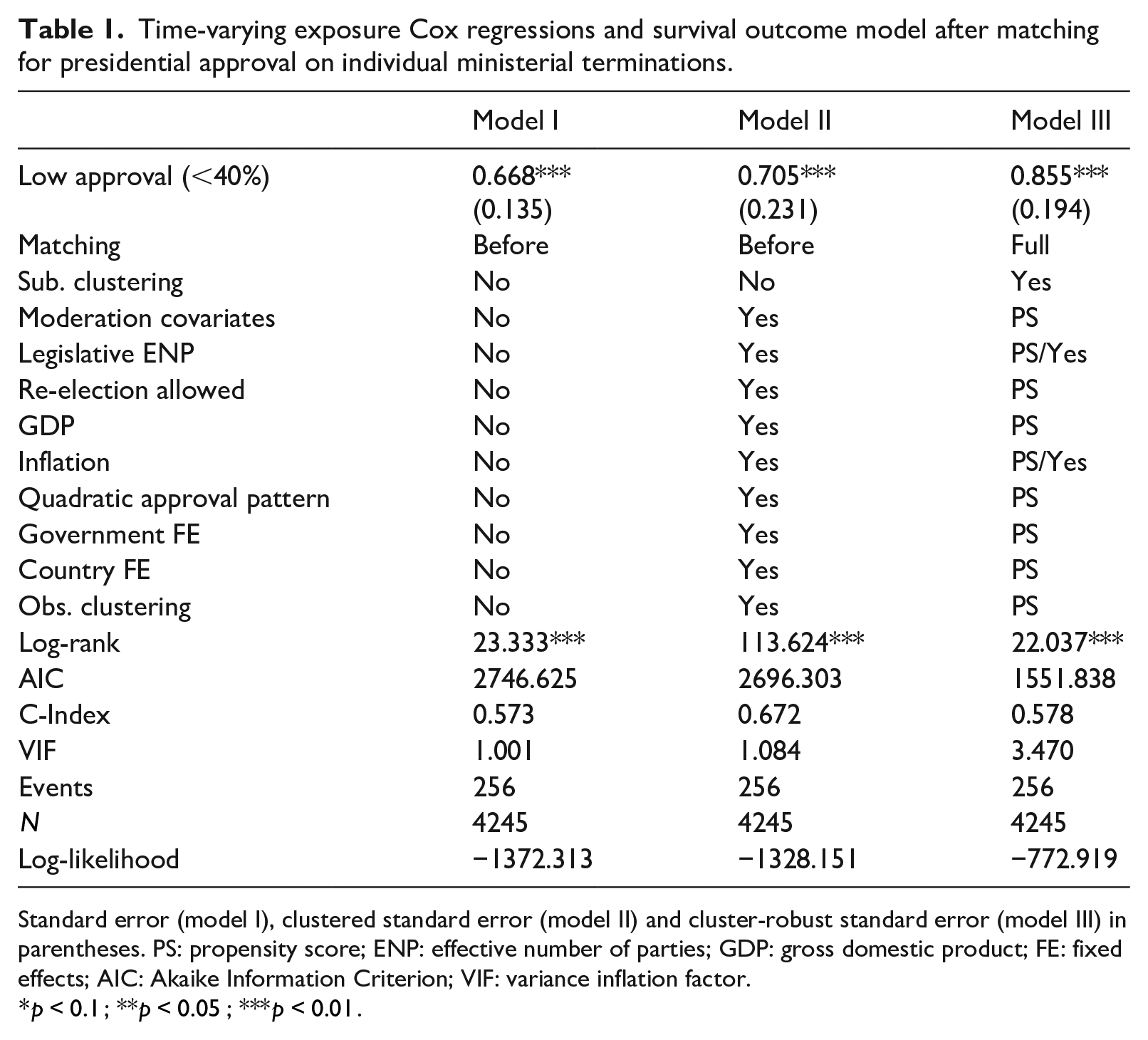
Standard error (model I), clustered standard error (model II) and cluster-robust standard error (model III) in parentheses. PS: propensity score; ENP: effective number of parties; GDP: gross domestic product; FE: fixed effects; AIC: Akaike Information Criterion; VIF: variance inflation factor.
Moderation analysis of exposure to low approval
In the same way as for Table 1, Table 2 shows three models before matching and three models after the adjustment. These models integrate moderation covariates
Time-varying exposure Cox regressions and survival outcome models after matching for moderation analysis of individual ministerial terminations.
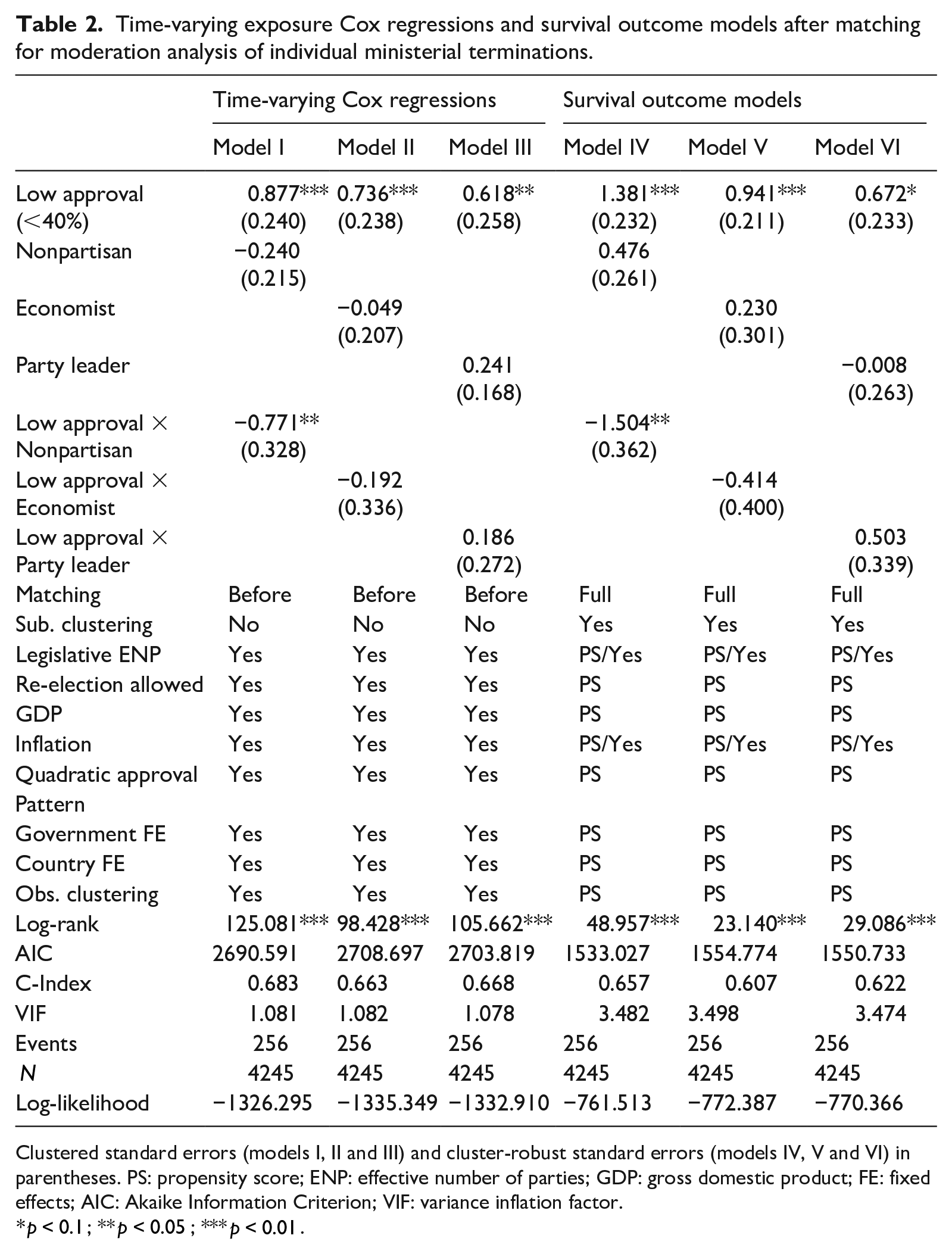
Clustered standard errors (models I, II and III) and cluster-robust standard errors (models IV, V and VI) in parentheses. PS: propensity score; ENP: effective number of parties; GDP: gross domestic product; FE: fixed effects; AIC: Akaike Information Criterion; VIF: variance inflation factor.
Model IV corrects the bias of model I by 52%:
To deepen the scope of the test of the Nonpartisan Hypothesis, Figure 3 plots the risk predicted by the moderation analysis of model IV in the matched sample, considering the interaction between partisan and nonpartisan ministers in periods of below and above 40% presidential approval. The risk for partisan ministers is significantly higher in periods of crisis. In contrast, the risk is comparatively lower for nonpartisan ministers, and there is no significant difference depending on the level of approval. Even in periods with approval below 40%, the CI and the risk of cabinet dismissal tend to decrease.
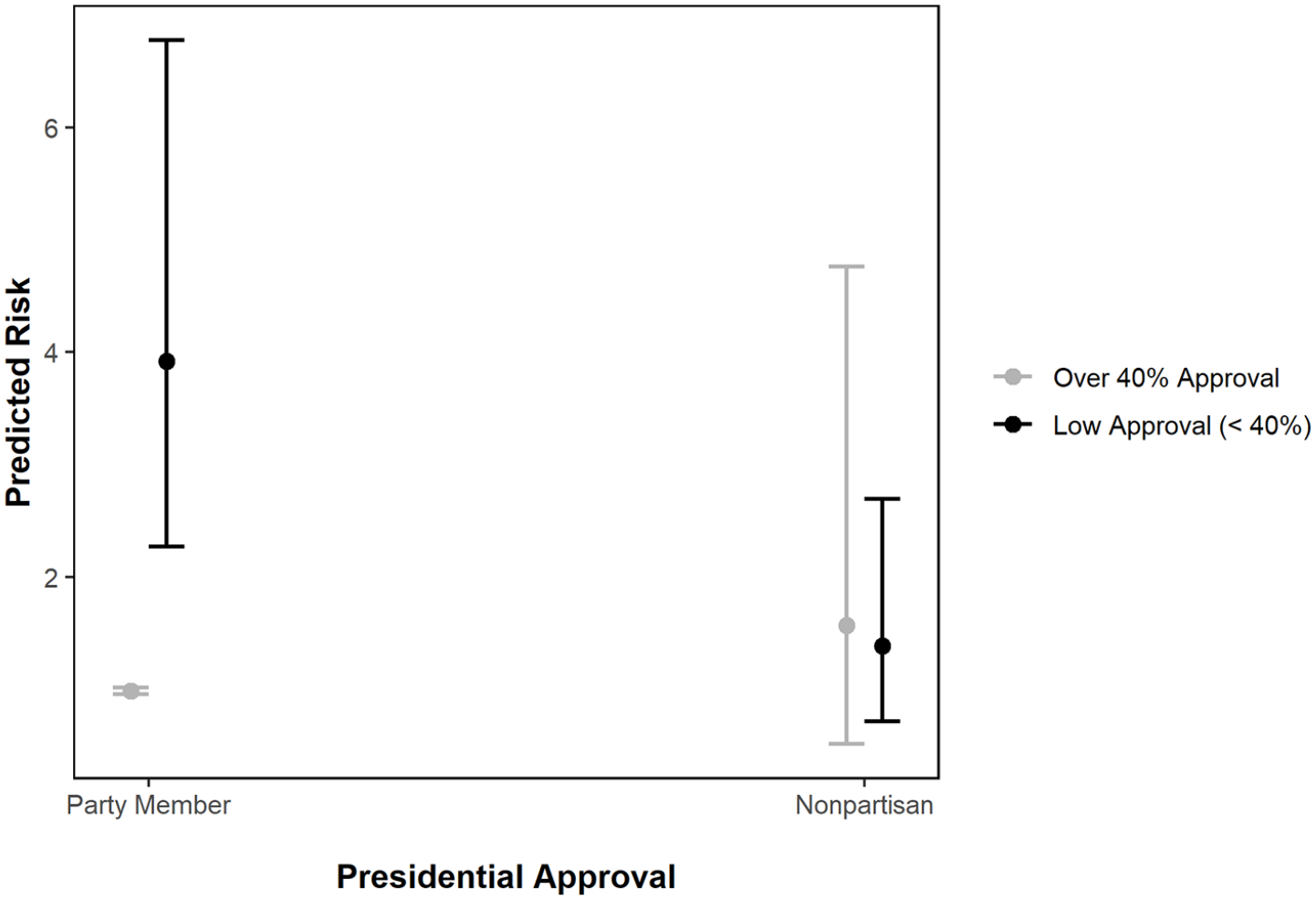
Predicted risk of presidential approval on individual nonpartisan and partisan minister terminations.
Placebo and additional tests
Finally, Table 3 presents the results of our placebo analysis which shows that there is no effect on individual ministerial termination. There are also no significant relationships in the two-way interactions between
Survival placebo outcome models after matching.
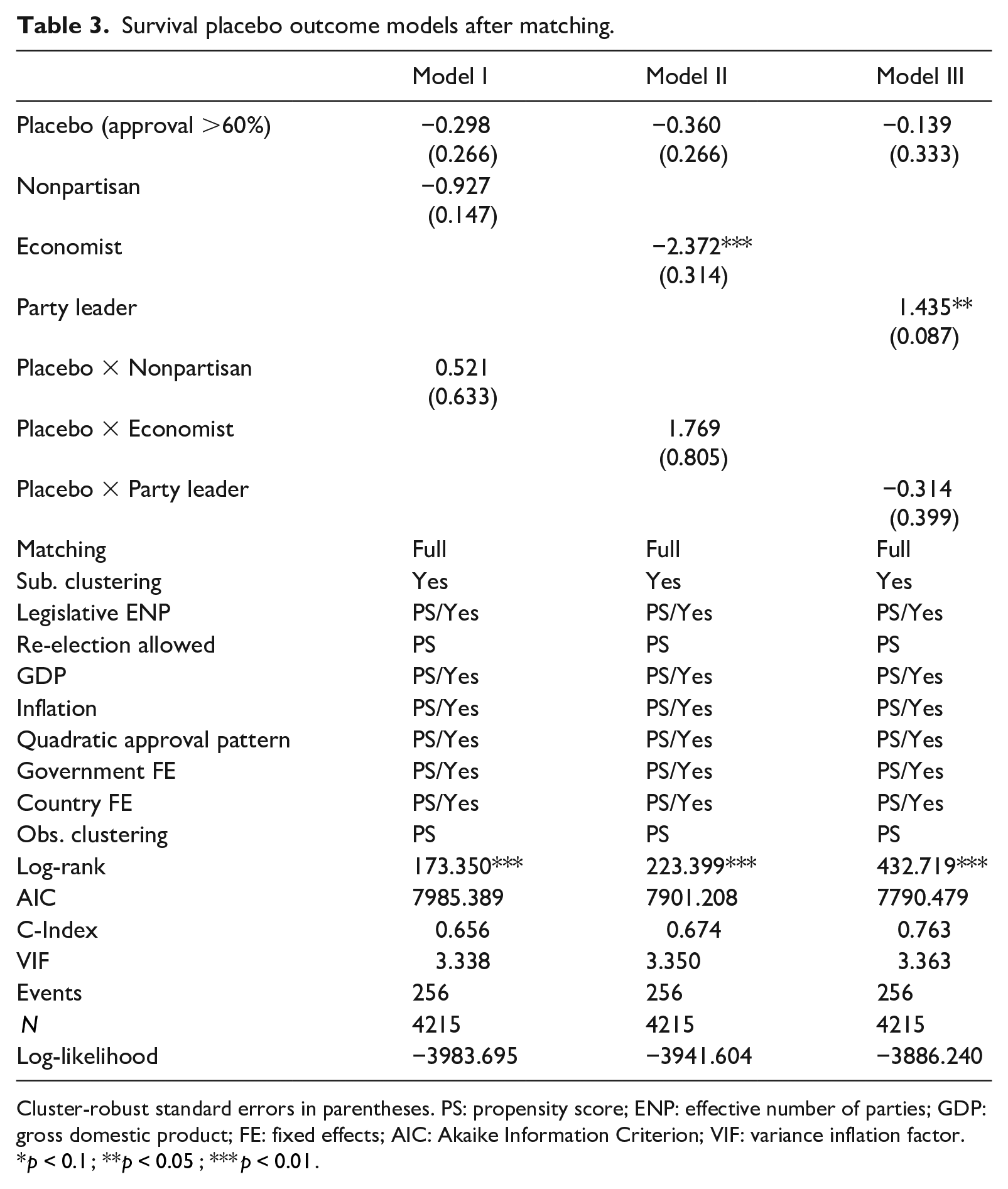
Cluster-robust standard errors in parentheses. PS: propensity score; ENP: effective number of parties; GDP: gross domestic product; FE: fixed effects; AIC: Akaike Information Criterion; VIF: variance inflation factor.
Robustness tests, available in the Supplementary Information file with figures assessing the balance of their covariates and placebo tests, show the same patterns as our primary analysis, with a slightly more pronounced moderating effect in the case of nonpartisan ministers. This again confirms the Nonpartisan Hypothesis:
Discussion
When a president reshuffles her cabinet, there are a number of outcomes that may denote a strategic decision to make corrections in the face of stochastic events. This article focuses on periods of low presidential approval in Brazil and Chile between 1990 and 2014. Our central argument is that the risk of a minister’s removal increases during periods of low presidential approval. However, the risk may be moderated if a minister has attributes and a profile in line with the presidential strategy during the approval crisis.
Our main findings allow us to test our Low Approval Hypothesis: the risk increases by 135.1% compared to regular periods. We also test our Nonpartisan Hypothesis since nonpartisan ministers are better protected during these periods: only one in five is removed from the cabinet in an approval crisis compared to partisan ministers. This evidence is in line with our expectation that nonpartisan appointments could denote a presidential strategy to limit moral hazard and agency loss in turbulent times. An alternative explanation could be that partisan ministers abandon the cabinet when the government is unpopular, as suggested by Camerlo and Pérez-Liñán (2015b). However, it is important to consider that the two countries analysed had multi-party coalitions at a time when government coalitions had not collapsed and it is, therefore, likely that our findings indicate a strategy to deal with agency problems.
Both main results were obtained from the matched sample and we have, therefore, controlled for imbalances and the absence of counterfactuals. It is important to note that the matching allowed a 20.6% and 52% adjustment for the main and moderation effects, respectively. This procedure of bias correction using the survival approach is a novel methodological contribution that focuses on straightforward measurement of ministers’ profiles, improving specification in the modelling processes and avoiding empirically complex measures of attributes. This contribution connects to our theoretical contribution of offering an approachable conceptualisation of ministerial profiles grounded in presidential strategies in the face of approval crises.
Our placebo tests and robustness checks confirm our findings. We see that technocrats are less at risk when presidents have high approval, and the opposite is the case for party leaders. These side findings suggest that administrations with higher approval may be less politicised and exposed to patronage. Finally, the Technocracy Hypothesis and the Political Capital Hypothesis were rejected. This rejection does not necessarily mean that these are not relevant profiles and attributes but rather that presidents prefer to limit moral hazard during periods of low approval. This preference is consistent with the greater autonomy they possess compared to prime ministers, a situation that translates into a great propensity and ability to appoint and protect independent and loyal ministers at times of crisis.
Supplemental Material
sj-pdf-1-bpi-10.1177_13691481221124850 – Supplemental material for Ministerial stability during presidential approval crises: The moderating effect of ministers’ attributes on dismissals in Brazil and Chile
Supplemental material, sj-pdf-1-bpi-10.1177_13691481221124850 for Ministerial stability during presidential approval crises: The moderating effect of ministers’ attributes on dismissals in Brazil and Chile by Bastián González-Bustamante in The British Journal of Politics and International Relations
Supplemental Material
sj-pdf-2-bpi-10.1177_13691481221124850 – Supplemental material for Ministerial stability during presidential approval crises: The moderating effect of ministers’ attributes on dismissals in Brazil and Chile
Supplemental material, sj-pdf-2-bpi-10.1177_13691481221124850 for Ministerial stability during presidential approval crises: The moderating effect of ministers’ attributes on dismissals in Brazil and Chile by Bastián González-Bustamante in The British Journal of Politics and International Relations
Footnotes
Acknowledgements
I am grateful to Petra Schleiter, Radoslaw Zubek, David Doyle, Stephen Whitefield and Moshe Ben Hamo Yeger for their substantial theoretical and methodological comments. I also thank Adriano Codato, Renato Perissinotto and Carla Cisternas for their valuable comments on early design versions. Preliminary versions of the observational nonparametric models and some deprecated parametric versions of this article were presented at the International Symposium on Ministers and Ministries at the Universidade Federal do Paraná, Curitiba 2018, and at the XXXVII Congress of the Latin American Studies Association, Boston 2019. In addition, the casual identification strategy was presented at the Pembroke College Research Design Workshop at the University of Oxford, Oxford 2020, and at the XXVI World Congress of Political Science, virtual 2021.
Funding
The author(s) disclosed receipt of the following financial support for the research, authorship, and/or publication of this article: This research has been funded by the Chilean National Agency for Research and Development (ANID/PFCHA/72200340).

Supplemental material
Additional supplementary information may be found with the online version of this article.
Notes
References
Supplementary Material
Please find the following supplemental material available below.
For Open Access articles published under a Creative Commons License, all supplemental material carries the same license as the article it is associated with.
For non-Open Access articles published, all supplemental material carries a non-exclusive license, and permission requests for re-use of supplemental material or any part of supplemental material shall be sent directly to the copyright owner as specified in the copyright notice associated with the article.
