



Abstract
What makes voters more or less willing to vote online? This article uses a unique survey experiment to assess the effect of information about who delivers the online ballot; and which groups of voters are more likely to take up the option of online voting. Voters are much more favourable if it is associated with a public body than a well-regarded private sector company. We also find a clear relationship between online activity in the personal world and a willingness to vote online. Those that expose themselves to greater potential online risk in their personal lives are likely to favour having the option to cast their ballot online, but those who perceive more risk are only likely to do so if they receive additional information about the purported advantages of online voting. Who delivers, and perception of online risk are key to understanding when voters are more willing to cast their ballot online.
Introduction
A key elections policy across many democracies has been to introduce alternative and potentially more convenient methods to cast the ballot. The first substantive voter reform adopted was postal voting (Mellon et al., 2017: 14). This has proved to be popular among voters, but has also led to significant concerns about increased electoral fraud (James and Clark, 2020; Wilks-Heeg, 2009). With the rapid growth of digital technology, the possibilities for casting votes remotely online – known as i-voting 1 – have become available, and therefore generated further prospects for alternative means of casting the ballot. Postal voting paved the way for the adoption of i-voting, both by establishing a period of time over which votes can be cast (unlike a single election day), and creating the possibility for remote voting (Alvarez et al., 2009: 497). And, i-voting may also be especially effective in encouraging participation of socially excluded groups, those with mobility impairment, and the young, many of whom have grown-up with digital applications in many aspects of their lives (Alvarez et al., 2009: 497; Vassil et al., 2016). Several countries have trialled forms of i-voting – for example, Armenia, Austria, Australia, Brazil, Canada, Estonia, France, India, Mexico, the Netherlands, Panama, Norway, Switzerland, the United Kingdom and the United States (Alvarez et al., 2013; Germann and Serdült, 2014, 2017; Goodman, 2010; Goodman and Stokes, 2018; Mellon et al., 2017; Trumm, 2021). Relatively few, however, have adopted i-voting on any scale and voters overall continue to display some reluctance to adopt the approach. This article seeks to establish why this may be the case and what factors lead some voters to be more willing to embrace i-voting than others. In so doing, it makes a significant contribution to understanding about the likelihood of citizens adopting this additional method of casting their ballots.
Comparative background and research questions
Although several countries have trialled i-voting – relatively few have adopted it on any scale, the most prominent being Estonia, Switzerland and Canada. Estonia is widely regarded as being the most advanced in terms of the implementing i-voting (Alvarez et al., 2009; Krivonosova, 2021; Trechsel and Vassil, 2010; Trumm, 2021). It was the first country in the world to have nationwide elections where all voters could choose to cast their ballots through the Internet (Trechsel and Vassil, 2010: 10). Since 2005, the option to vote online has been available in all elections. This derives in part from wider aspects of Estonian policy, such that Internet access has been legislated as a social right since 2000, but has also been driven by a deliberate policy backed by the Estonian government’s information policy, which explicitly favours information and communication technologies (ICTs) (Trechsel and Vassil, 2010: 9–10). Voters in Estonia are increasingly likely to vote online. Some 44% of those who turned out in the 2019 Parliamentary elections did so through the Internet (28% of the eligible electorate). 2 Switzerland is also comparatively advanced in terms of the introduction of i-voting. This is partly a function of concerns about voter engagement when voters are called upon relatively frequently to exercise direct democracy (Germann and Serdült, 2014), but also to encourage participation among expatriate voters. Switzerland has run trials of i-voting since 2003, but these have been confined to just three cantons (Geneva, Neuchàtel and Zurich). In all three, postal voting was well established and was a significantly more popular mode than casting the ballot at a polling station (Germann and Serdült, 2017: 4). Canada too has established i-voting in selected municipal elections (Goodman and Stokes, 2018).
In many other countries, however, the use of i-voting has been spasmodic and has not resulted in the wider adoption of the technology. Online pilots took place in the United Kingdom in three local authority referendums between 2000 and 2001 (The Independent Commission on Alternative Voting Methods, 2002) and the UK Electoral Commission (the independent public body that oversees elections in the United Kingdom) ran a series of trials from 2002 to 2007. The initial experience of the pilots was generally positive, with a majority of voters in the evaluation exercises deeming the new availability of online voting to make the process of voting better (MORI, 2003: 44). However, there were concerns related to the possibility of fraud or abuse, with votes over the Internet seen as being particularly vulnerable (MORI, 2003: 48–50). A review of the administration of the trials painted a less positive picture however (Xenakis and Macintosh, 2005), and the last trial took place in 2007.
The Netherlands, Austria and Norway also abandoned experimentation with online voting (Germann and Serdült, 2017: 1), while Alvarez et al. (2009: 498) highlight four major trials in the United States, of which only one was conducted by government (the others were run by private companies and a specific political party). In no cases was there any substantial effort to evaluate their efficacy. In Germany, the Constitutional Court even went so far as to effectively ban online voting in 2009, on the grounds that the process of casting the ballot and verifying the results should be available to anyone without specialist knowledge (Clark, 2017b). And in 2021, South Africa rejected a move to pursue online voting, over concerns about electoral fraud.
Notwithstanding, it does appear that many i-voters are ‘faithful’: once they start using the method, they stick with it (Alvarez et al., 2009: 502; Germann and Serdült, 2014). Indeed, as Trumm (2021) shows, so embedded is the idea of casting ballots online in Estonia, that both online and offline voters respond equally positively to online and offline campaigning. The implication here is that online voting is not solely the preserve of those who are mobilised by online campaigning (Trumm, 2021: 14). But faithfulness is contingent on the experience of i-voting. Trechsel and Vassil (2010: 40) observe, for example, that negative experiences in the testing of online voting in the Netherlands led Dutch voters to be more reluctant to adopt the approach.
Overall, we observe that while Internet use is steadily increasing, many voters appear reluctant to embrace i-voting, but those that do tend to stick with this mode of voting if the experience is a positive one. At the most general level, comparative evidence suggests that concerns over the security of the process are uppermost in voters’ minds (see, for example, The Electoral Commission, 2021). Postal voting does not appear to face the same level of concern, even though it too is potentially insecure compared with in-person voting (though see The Electoral Commission, 2021). Indeed, Smith (2013) argues, i-voting is no more susceptible to voter interference than other modes of voting and as Beaulieu (2016) observes, respondents in the United States have fewer concerns about electronic voting than other potential areas of electoral fraud.
The question arises therefore as to why some voters appear reluctant to utilise the method despite the widespread availability and critically, the adoption of online activity in key areas of people’s lives such as banking and shopping. In order to examine this, we examine a country where despite early trials of online voting, the practice has not been introduced – the United Kingdom. The United Kingdom is a particularly useful example for a number of reasons. First, the principle of remote voting is well-established, with the introduction of postal voting on demand in 2000. Postal voting has grown in popularity – 21% voted this way in the 2019 general election (Townsley et al., 2021: 4), but as elsewhere, has been accompanied by concerns about electoral integrity. Second, there are high levels of online activity in shopping and banking. For example, in 2020, 80% of the UK population accessed online banking sites – an identical proportion to Estonia. 3 Third, as a result of the COVID-19 pandemic, elections were postponed in 2020 because of concerns around voter safety (a phenomenon also observed in other countries). Had remote online voting been available, these elections could feasibly have gone ahead as scheduled, and in response to the pandemic, the UK Electoral Commission engaged in reviews of citizens’ preferences in respect of voting mode in 2020 and 2021. 4 Fourth, the question of remote online voting is currently being explored again as part of the UK Electoral Commission’s research on modernising elections (The Electoral Commission, 2021). This provides an excellent backdrop to the study. Voters are accustomed to (and a large proportion engage in) remote voting through post, are familiar with online activity, and have experienced the postponement of key democratic events because of the safety concerns associated with casting ballots in more traditional ways – conditions and circumstances familiar to many other democracies, and the examination of the expansion of alternative methods of casting the ballot is again being considered by the public body that oversees elections. The evidence from the United Kingdom, therefore, may also potentially be instructive in respect of other democracies who have also yet to embrace i-voting.
Critically, however, unlike other studies of online voters, the vast majority of UK voters – like voters in most other countries – have never had the opportunity to vote online. Our analysis considers what would make voters more or less willing to engage in i-voting – not whether they have or have not done so. Not only that it seeks to address a puzzle. Despite the convenience, general familiarity with the technology and, under the circumstances of a pandemic, the safety that online activity affords, there still appears to be some reticence to engage with i-voting. In Scotland, for example, the clear preference for casting a ballot at the May 2021 Scottish Parliament elections was in person or by post – despite the pandemic (The Electoral Commission, 2020). Equally, a qualitative study by the Electoral Commission in 2021 showed that voters were particularly committed to the in-person casting of a ballot (The Electoral Commission, 2021). In sum, existing research tells us that there is reluctance, but tells us rather less about why it exists or among whom.
What we are interested in, therefore, in this article is what drives people to be more or less positive about the possibility of voting online in the United Kingdom. Specifically, we ask the following two questions:
What factors affect voters’ intention to take part in online voting?
How do different voters respond to the prospect of online voting?
In the next section, we review the literature and identify two gaps relating to these questions, allowing us to frame our hypotheses in the section ‘Research questions and hypotheses’. The data and method section describes a survey experiment that allows us to isolate the causal effect of information about the administrative oversight of i-voting. We compare willingness to vote online when a public body manages i-voting relative to a private technology company. We also investigate differences across voters, seeking to understand how prior online behaviours might explain attitudes towards i-voting. Our analysis makes two significant and original contributions to the literature. First, we find that voters do care about who oversees i-voting, and clearly prefer a public body. This raises important policy implications. Second, we gather new insights on which voters are more likely to be persuaded to vote online, once they have more information about how it will run: those with greater Internet access, and more exposure to online risks in their everyday lives.
Theory
The extant literature highlights the following four broad approaches to explain either participation or potential participation in i-voting. The first is based in rational choice theory: the attraction of online participation is the convenience, with lower participation costs for voters. Classic rational choice theory predictors of turnout offset cost against the chances that an individual vote will influence the production of public goods (expressed by the result of the election). Notwithstanding the fact that the chances of an individual vote being pivotal are vanishingly small, prompting Laver to deem electoral turnout to be the ‘paradox that ate rational choice theory’ (Laver, 1997: 91–98), the principle is nonetheless sound. If the cost function is lowered for a voter then she is more likely to participate (Downs, 1957; Germann and Serdült, 2017; Mellon et al., 2017). Certainly, in the case of postal voting, those who vote in this way are more likely to gain in terms of reduced costs – especially older voters and voters with mobility issues (Townsley et al., 2021). In addition, Clinton et al. (2021) show early enthusiasm in the United States for remote postal voting, as a safety measure during the early stages of pandemic; but this receded among citizens who became less fearful of contracting the virus (who were disproportionately Republican). In respect of i-voting, there is also evidence for the cost function principle in the Estonian case. Despite Estonians going to the polls on a Sunday (which Franklin (1996) has shown at the aggregate level, tends to boost turnout), around a quarter of i-voters nevertheless cast their ballots when the polls were closed. Individual-level analysis further suggested that 86% of i-voters cast their ballot online because of the convenience of so-doing (Alvarez et al., 2009: 502). This principle of convenience making i-voting attractive to those with mobility issues, those living in remote locations, and expatriates is a feature of the comparative literature (Petitpas et al., 2021: 2). That said, analyses of Internet voting in the first three set of elections in Estonia (2005, 2007 and 2009) showed no relationship between propensity to vote online and location – urban dwellers were just as likely to vote in this way as rural dwellers (Trechsel and Vassil, 2010: 22). Notwithstanding this particular finding, the overall expectation here is that the convenience afforded by i-voting should be a key factor in voters’ willingness to vote online, especially among those who already participate in other remote convenience forms of voting, such as postal voting.
The second approach draws on socio-demographics. The focus here has been largely on age, sex, education, and to a lesser extent, income and ethnicity. Age is highlighted in terms of likelihood of Internet use – the logic being that younger voters will be more familiar with online applications and therefore more willing to participate in i-voting (Germann and Serdült, 2014; Goodman, 2010; Mellon et al., 2017; Powell et al., 2012; Smith, 2016). Certainly, Beaulieu (2016) finds that older voters are more concerned with the possibility that electronic voting could be susceptible to fraud (though these effects are conditioned to an extent by levels of political polarisation). Interestingly, however, the relationship with age has often been found to be curvilinear (Germann and Serdült, 2014; Petitpas et al., 2021; Trechsel and Vassil, 2010; Vassil et al., 2016). Goodman (2010: 509–510), for example, shows that in four separate trials in Canada, the age group most likely to participate in i-voting was those aged 40–59.
Sex has also been used as an explanatory variable, the logic being that male voters are more likely to adopt technological solutions earlier, having less computer anxiety than females (Powell et al., 2012). 5 The evidence, here is mixed. Germann and Serdült (2014) observe sex effects in the expected direction among expatriates i-voting in Switzerland, while Petitpas et al. (2021: 8) observe similar effects in Geneva – especially among those who do not usually vote. Mellon et al. (2017) also observe such effects in Brazil. However, while Alvarez et al. (2009) found effects related to sex in Estonia, a subsequent study found the effect to diffuse over time (Trechsel and Vassil, 2010: 30). In Australia, women were found to be slightly more confident in electronic modes of voting, albeit not to a statistically significant degree (Smith, 2016: 78). The finding in Australia is more in line with that in the United Kingdom in respect of postal voting. Townsley et al. (2021: 12–13) find that women are more likely to engage in the private act of postal voting.
Education was also shown to be important in studies in Brazil (Mellon et al., 2017), Estonia (Trechsel and Vassil, 2010) and in Switzerland (though not among Swiss expatriates; Germann and Serdült, 2014), such that i-voting appealed more to those with higher levels of education. On income, the evidence is mixed. While the effects of higher income tended to be subsumed by the effects of other variables in Mexico (Mellon et al., 2017: 18), they remained apparent in Estonia (Trechsel and Vassil, 2010: 48) where wealthier citizens were more likely to vote online. Finally, ethnicity has been observed to be important, though this is largely due to the mechanics of the process. In Estonia, the online voting procedure was all in Estonian. However, the country has a range of different languages spoken, with the Russian-speaking minority being especially prominent. The analyses of participation in i-voting show that Russian speakers are significantly less likely to participate than Estonian speakers (Alvarez et al., 2009: 501; Trechsel and Vassil, 2010: 46). Overall, the expectation arising from the comparative literature is that demographics – specifically the impact of age, sex and education – may be an important predictor of whether someone is willing vote online.
A third approach is linked to political engagement and confidence in the political process. Once again, empirical evidence reveals no consistent patterns. Trechsel and Vassil (2010: 54–55) find that those voting online in Estonia were slightly less likely to be regular voters, suggesting the possibility of mobilisation effects. Petitpas et al. (2021: 7) find similar effects, but principally among older voters. Political knowledge is also relevant. Among Swiss voters, higher political knowledge is a key prompt to engaging in i-voting (Germann and Serdült, 2014). However, Mellon et al. (2017: 20) found that the best predictor of online vote share in Brazil was offline vote share, suggesting that there was no systematic bias in respect of which political groups voted in which way. Thus, while i-voting is attractive to different demographic groups in Brazil, there was no evidence that the outcome was any different than it would have been in all voters cast their ballots offline.
In terms of confidence, we can observe effects at the macro and micro levels. At the macro-level, Smith (2016: 78) found that voters with positive attachments to the political system had more confidence in electronic voting channels (as well as paper ones, compared with those with no party identification, low political interest, extreme political ideologies and lower levels of satisfaction with Australian democracy). That said, trust in politicians was negatively associated with propensity to vote online in Estonia (Trechsel and Vassil, 2010: 52). At the micro level, Trechsel and Vassil (2010: 54–55) find that the most powerful predictor was trust in the procedure of i-voting, a similar finding observed in Australia (Smith, 2016) and comparative qualitative research (Oostveen and Van Den Besselaar, 2004: 71). Partisanship was not a factor, however in this respect. Smith (2016: 79) found no partisan basis for confidence in electronic voting in Australia (Smith, 2016: 79), reflecting the findings of Alvarez et al. (2009) in Estonia, where partisanship was not related to participation in i-voting. In sum, this approach suggests that citizens who are more engaged with politics and who have more confidence in the political process may be more willing to vote online. It may be expected that those who already vote regularly, who identify with parties, who pay more attention to politics and who have confidence in the electoral process may be more likely to entertain the idea of voting online.
A related fourth approach draws on theory from computer science in respect of adoption of new technology. Powell et al. (2012) highlight performance expectancy (or expected usefulness), effort expectancy (likely effort involved in using the system), social influence (capturing social pressure to use a system) and trust in the Internet, the government, and computer anxiety. They find that performance expectancy and social influence increase propensity to engage in i-voting, while effort expectancy and trust in the Internet are most relevant for older voters – younger voters in particular are more trusting of the Internet. And, while they find that trust in government has no effect, computer anxiety appears to be a relevant factor among women. Those with more computer anxiety are less likely to be positively disposed towards i-voting. What flows from this is another dominant theme is the literature in respect of the likelihood of people who engage in more online activity, such as banking and shopping being more positively pre-disposed to online voting (Alvarez et al., 2009; Mellon et al., 2017). In a similar vein, Vassil et al. (2014: 454) highlight work by Rogers (2003) whereby the adoption of technology is driven by and ‘innovation decision process’. This involves gaining knowledge of the technology, becoming convinced of its usefulness. Once a sufficiently large group of voters adopt the process, others follow – the diffusion thesis. Early adopters tend to be ‘innovative risk-takers’, but Vassil et al.’s (2016: 457–459) analysis of Estonian election confirms the wider diffusion thesis after at least three elections. Overall, this approach suggests that those who use the Internet more frequently and who engage in important everyday activities such as shopping or banking may be more likely to vote online.
However, while these four approaches to explaining the willingness to engage in i-voting are useful, they are also under-developed in places. There are two particular gaps that we identify, which warrant further and focused investigation. First, there are recurring questions of who or what delivers i-voting. As Trechsel and Vassil (2010: 54) found in Estonia, trust in the online procedure is key to understanding to who participates in i-voting. But, there is no indication of whether some forms of administration of i-voting are more trusted than others. In many countries, the software to enable the process has been developed by private companies (Krivonosova, 2021; Powell et al., 2012; Xenakis and Macintosh, 2005). Indeed, Krivonosova (2021) shows in the Estonian case that the adoption of i-voting has led to a proliferation of private sector actors involved in the electoral process. However, she also finds that this proliferation is apparent in paper-based voting methods; a function of the ‘. . . general trend of contracting out in the Estonian public sector’ (Krivonosova, 2021: 17). Similarly, in the United States, election equipment is exclusively purchased from private sector vendors, applying not only hardware and software, but also the service’s initial implementation and support. This can manifest itself further in training for local officials, election day support, voter outreach, and even helping to plan and conduct elections on behalf of jurisdictions (Gibson, 2020). Significant comparative evidence also points to concern about the level of private sector involvement in elections (relative to public bodies like election management boards; Loeber, 2020). Levels of confidence in private providers may, however, be different from public providers, perhaps because they are perceived as having different or even competing interests (Krivonosova, 2021). Indeed, the United Kingdom’s evaluations in 2003 (MORI, 2003: 52) noted that there were ‘. . . suspicions of the role of private firms involved in supplying the equipment’.
The administrative evaluation of online voting in the United Kingdom highlighted a number of issues, including coordination and multiple sub-contracting; and recommended that attention be paid to the control of online voting, and to ensure that this is done by traditional electoral administrators (Xenakis and Macintosh, 2005: 194–196). Moreover, as Powell et al. (2012: 362) show in the United States case, one of the reasons that the online voting software developed by Accenture Limited Corp was not used in the 2008 US Presidential election was the identification of ‘. . . insider attacks, lack of voter-verified audit trails, DOS attacks, spoofing, tampering, fabricated user accounts, and non-open-source code’. While data breaches are common in both private and public organisations, there is a clear difference between the administration of existing modes of voting. Both in-person and postal votes are administered in the United Kingdom by public organisations. Even though the Royal Mail is privatised in terms of its ownership, it is governed by law such that there must be a universal service and has a privileged position as a mail carrier. Thus, the Royal Mail can deliver completed postal votes while other courier services cannot by virtue of the return envelope. By way of contrast, it is plausible that an online voting service could be developed and administered by a private company. Overall, a core theme in both trials and recent literature on the use of technology in elections revolves around the themes of who provides the technology and who oversees the process – public or private organisations. And, while the provision of i-voting also involves questions about such matters as verification processes, the top-level question for citizens is who is charge, rather than how a process is administered, particularly where (as in most democracies) i-voting is not currently available. It is important to establish, therefore, whether there is stronger support for online voting if the process is administered by a public or private provider.
The second research gap in the existing literature is around the amount of existing online activity and propensity to vote online. The focus on banking and shopping in prior studies tells us only that those who engage in more of this kind of activity may be more pre-disposed to undertaking another online activity: more delivers more. But that only tells us so much. What we also need to know is why engagement with activities such as banking and shopping may be useful predictors of positive views of i-voting. Here, we draw on the idea of online risk, building on Powell et al.’s (2012) concept of trust in the Internet. The idea is that in addition to learning about what voters do online, we also need to capture their conception of online risk. If voters engage in a lot of online banking or shopping, we might logically expect them to accept the risk associated with financial transactions online. However, banking and shopping online come with certain safeguards such that fraudulent transactions may be refunded, and goods not received will be replaced, and so on. To better understand willingness to vote online, we should also consider how concerned voters may be about breaches of privacy – a potentially significant area of risk in the online world. Modern elections are based on the secret ballot such that in theory, no-one can ascertain how an individual has voted. However, remote voting creates the possibility of a breach. Indeed, postal voting has been criticised for undermining this principle (Townsley et al., 2021). Certainly, the UK Electoral Commission found that UK citizens, while welcoming the potential convenience of online voting, concerns were expressed about the security of devices and connections, and whether their ballot would remain secret (The Electoral Commission, 2021: 30). It is important to test, therefore, what level of concern voters have about the possibility that their private information relating to their favoured shopping outlets, the identity of their friends and their social and political views may become publicly known. Some voters, of course, may be relaxed about these matters. But that will not apply to all voters, particularly if they hold views that may be less widely held, or at least less widely championed. To better understand willingness to vote online, we need to capture not only regularity of Internet use and exposure to online risk, but also concerns about online privacy as a measure of perceived risk. 6 Not only that, it is important to establish how these perceived risks interact with questions of who administers i-voting.
Research questions and hypotheses
We look to explore the willingness of voters in the United Kingdom to engage in online voting, with a view to addressing the two research gaps identified. We ask the following two research questions:
RQ1. What factors affect voters’ intention to take part in online voting?
RQ2. How do different voters respond to the prospect of online voting?
In order to address these questions, we develop a series of hypotheses, which draw upon both the existing literature outlined in the theory section above and those areas that we identify as being under-developed – the impact of who administers the process of online voting, and the impact of exposure to online risk and concerns about data privacy. The first hypotheses are informed by rational choice theory. Specifically, we are interested in whether voters are more inclined to vote online if they are informed about the benefits of convenience, and, in the context of the COVID-19 pandemic, safety and public health. Hypotheses 1 and 2 are based on providing information on the advantages of online voting, and differ only in their description of who might manage the ballot.
H1. Providing information on the advantages of online voting and it being administered by a public body raises willingness to vote online.
H2. Providing information on the advantages of online voting and it being administered by a private technology company raises willingness to vote online.
Our third hypothesis is informed by one of the areas where theory is hitherto under-developed. Available evidence suggests that citizens will be more willing to entrust their vote to a process administered by a public body rather than a private technology company. Voting in person is administered by local government. Existing remote voting in the form of postal voting is delivered by the Royal Mail – privately owned in recent years, but regulated by law to be the principal provider of mail services across the country and the only means by which postal voters can be returned through the mail. Evidence from the UK evaluation studies and the United States suggests that voters will have more confidence in an online voting system administered by a public sector provider rather than one by a private sector one, even if they are doing so on behalf of the public sector.
H3. Online voting administered by a public body elicits higher willingness to vote online than if it were administered by a private company.
Our fourth, fifth and sixth hypotheses aim to go beyond average treatment effects, and delve into the differences among voters based on their individual characteristics. In line with existing work, our expectations are that those who have greater access to the Internet, and who use it for a range of day to day activities, will be more amenable to i-voting. Hypothesis 5 in particular is based on the logic that citizens who expose themselves to greater online risk by engaging in hobbies, shopping and banking online should also be more amenable to any perceived risk associated with i-voting. In contrast, we expect that those who have fewer concerns about data privacy will be more willing to vote online. We, therefore, capture both citizens’ exposure to online risk and perceptions of online risk.
H4. Individuals with greater online access are more willing to vote online.
H5. Individuals with more experience of online activities are more willing to vote online.
H6. Individuals with higher concerns about data privacy are less willing to vote online.
Hypotheses 4, 5 and 6 also allow us to understand variation among voters. The differences among these sub-groups are not randomly assigned, so cannot be used for claims of causal inference. Nevertheless, such analysis of local average treatment effects is key for understanding variation in treatment effects and ‘which individuals will be most responsive’ (Gerber and Green, 2012: 289).
Data and method
To test these hypotheses, we commissioned an online survey through YouGov to understand what factors affect willingness to vote online. The survey embedded a vignette experiment that could isolate the effects of information about who administers the voting system (private or public sector actors) on willingness to vote. Our survey design extends existing analysis in three significant ways. First, we broaden the existing empirical evidence base by focusing on the United Kingdom, a country which shares many of the attributes of countries that have adopted i-voting, but which itself has not. Second, we build on the theory discussed earlier by isolating the effects of who administers the online voting system. We go beyond general questions about attitudes towards online voting and present a specific choice to our respondents. Finally, our survey design allows us to look beyond average treatment effects – the overall difference between the treatment vignettes and the control group – to consider the heterogeneity among different voters. We are also able to look at the associations with demographic characteristics, and to delve further into whether i-voting responses differ for each vignette based on the characteristics of the voter, in line with prior research discussed earlier.
Participant recruitment
We recruited a panel of online survey participants through YouGov. 7 All participants were aged above 18 and belonged to YouGov’s panel of respondents, and were nationally, demographically and politically representative of the UK population. 8 Participants were compensated as part of the company’s reward scheme, and were not paid directly for taking part in this survey. A total of 1855 responses were collected in April 2021, meeting our target sample size.
Experimental design 9
Participants completed a brief survey that asked about their attitudes towards voting and recent behaviour in UK elections. Data were also gathered on a range of demographic characteristics, including sex, age, country of residence and educational background. Respondents were then randomly assigned to receive one of three messages about i-voting. We varied the content of the messages to correspond with the three experimental arms of the study (see Figure A1 in Appendix 1 for survey flowchart).
A control group received a vignette that provided some basic information about online voting, and the fact that other countries use it. The two treatment groups included this basic information, plus two additional statements that mentioned the potential advantages of online voting, and how online voting might be run. The advantages text was identical in both, but first vignette mentioned a public body, the Electoral Commission, running the online ballots; while the second vignette mentioned a non-specific well-regarded technology company. For the purposes of shorthand (and reflecting the framing in the comparative literature), we describe these as the public and private sector vignettes (see Table 1). Immediately after seeing the vignettes, participants were asked, ‘if online voting was available, would you use it?’ Due to the randomised survey design, any differences in response to this question can be attributed to the difference in the messages to which the participants were exposed.
Experimental groups and vignettes.
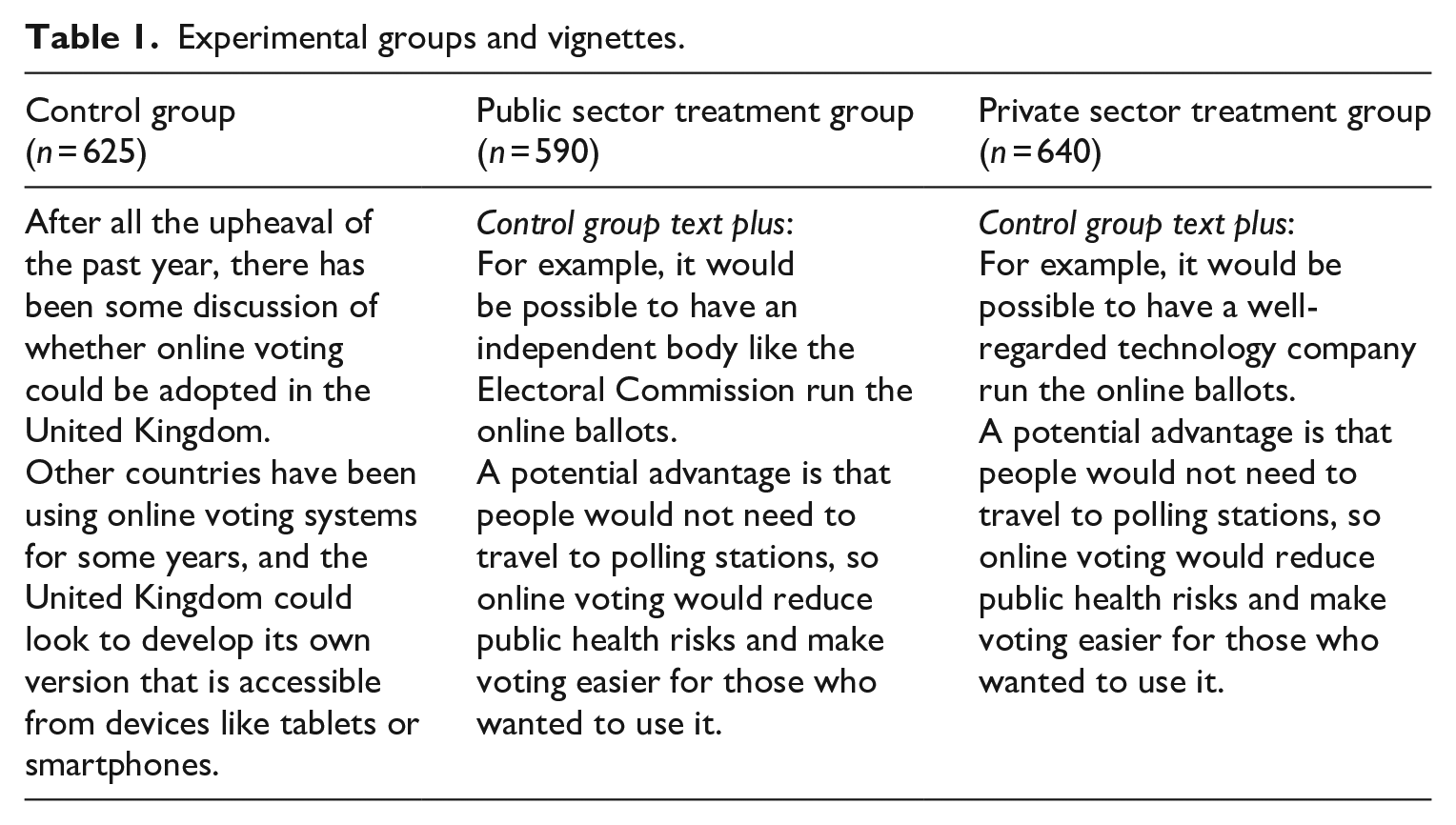
The outcome variable is willingness to vote online, measured on a scale of 0–10 (See Table A2 for coding of all variables). Our additional variables include a wide range of characteristics based on age, sex, location, education, political affiliations and recent political behaviours. These covariates capture the demographic and political characteristics discussed in the theory section. The experimental groups are well balanced (see Table A1 in Appendix 1). Minor imbalances (e.g. on age and use of the Internet daily) are not significant at the 5% level. There was no attrition to report in this cross-sectional survey. A risk with any online survey is the level of attention that participants give to the questions. To mitigate against any potential data quality problems, we gathered data on survey response times. Robustness checks (see Table A4 in Appendix 1) show that there are no major impacts from excluding the quickest survey responses; indeed, our main results which include the full sample provide more conservative estimates of the treatment effects.
Two statistical models were employed. Equation (1) allows us to isolate average treatment effects, using binary variables that captured the treatment group to which the respondent belonged (T1 is the public sector group and T2 is the private sector group). Baseline covariates W include political attitudes and behaviours, and demographic characteristics reflecting the discussions in the theory section and other work (Clark, 2015, 2017a; Fisher and Sällberg, 2020) that suggests variations in levels of perceived electoral integrity in Britain, with Scotland enjoying the highest (all are listed in Table A1 in Appendix 1).
We control for level of attention paid to politics, which is captured on a scale of 0–10. We ask about respondents’ attitudes towards electoral fraud using a question employed in studies of electoral integrity (Fisher and Sällberg, 2020) and model this as a binary variable identifying those who believe there may have been ‘a little’ or ‘a lot’ of fraud in general elections (rather than those who do not express a view that there has been insignificant fraud responding ‘hardly any’, ‘none’ or ‘don’t know’). Our model incorporates a binary variable capturing a lack of party identification, using the responses ‘none’ or ‘don’t know’ to a standard question about party identification mentioning seven mainstream parties and an ‘other’ option. We identified respondents who ‘usually vote’ with a binary variable derived from a four-point question, distinguishing them from others who say they ‘do not usually vote’ (regardless of whether they ‘probably would’ or ‘definitely would not’ if a General Election were called tomorrow). We use binary variables to identify voters who have used proxy or postal voting methods in the past. We also control for recent voting decisions. We identify those who report having voted in the 2019 General Election (distinguishing them from those who reported ‘no’ or ‘don’t know’); and we identify those voted Leave in the 2016 referendum (derived from a variable with alternative response options including Remain, ‘can’t remember’ or ‘did not vote’). These control variables are all intended to improve the precision of the model but do not allow for causal inference. Only the treatment variables indicate a causal effect.
We hypothesised that the treatment groups would be more favourable towards online voting, because of the information about the potential advantages (H1, H2), so we expect that coefficients


Equation (2) provides a framework for investigating heterogeneous treatment effects. Here, we introduce treatment-covariate interaction terms for each treatment group with three pre-specified variables V, namely access to the Internet, exposure to online risks and concerns about online data privacy. These variables are structured as follows. The access to the Internet is modelled as a binary variable identifying respondents who accessed the Internet daily, and was derived from a seven-point variable capturing level of Internet use (every day, a few times a week, once a week, once a fortnight, once a month, less often than once a month, never). Exposure to online risk is derived from three variables relating to use of the Internet for banking, shopping for food and everyday necessities, and for hobbies and entertainment. All three were measured on the same seven-point scale as Internet use. Concerns about online privacy are derived from three variables capturing concerns in respect of purchasing habits, social interactions, and social and political views; each measured on four-point scale.
The variables capturing exposure to online risk are likely to be related. The same is true for those variables capturing data privacy in different domains. To test for this, the variables for each cluster of questions were entered into two separate Principal Components Analyses (PCAs). Using conventional cut-off criteria, the PCAs did indeed suggest that one factor was sufficient to represent the variance in each set of original variables (see Table A3 in Appendix 1). The PCAs produced factor scores which were then standardised around means of 100 to create indexes capturing Exposure to Online Risk and Concerns about Data Privacy. These were then used in the modelling. In order to account for the possibility of false discovery from multiple hypothesis testing, we apply Benjamini-Hochberg corrections to the significance thresholds.
Results
What factors affect voters’ intention to take part in online voting?
Our sample of voters was reasonably supportive of i-voting, with the control group registering an average score of 6.6 on a scale of 0–10 measuring willingness to vote online (see Figure 1). We are interested in whether the additional information – including about who administers the online vote – is influential. Does knowing more about the actors involved lead to higher willingness to vote online?
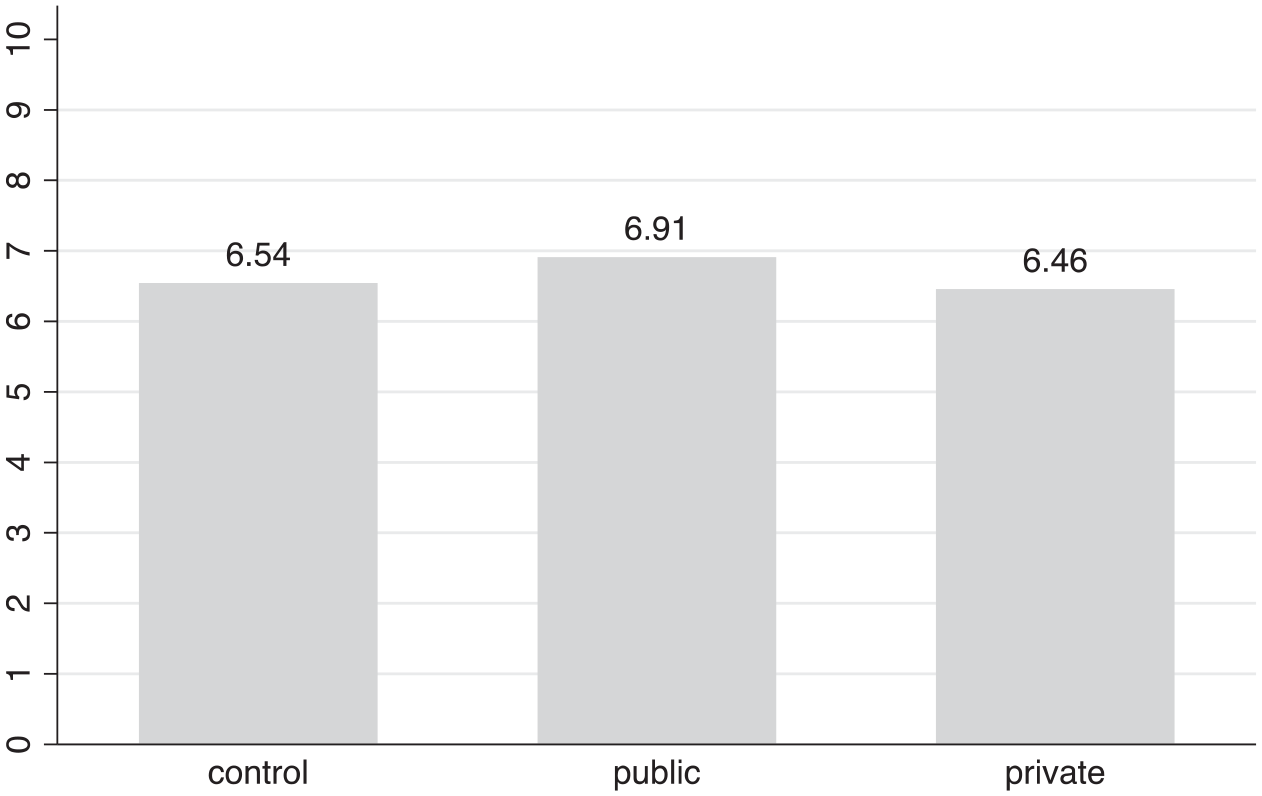
Willingness to vote online by experimental group: Scale of 0 to 10.
The results provide clear support for H1 relating to the public sector vignette (see Table 2). Our preferred model (Model 1) applies an ordinary least squares (OLS) estimator with a full range of political covariates. We present alternative model specifications (Models 2, 3, 4) to serve as robustness checks. Model 2 includes an age-squared term (reflecting the curvilinear relationship with age often observed in the extant literature). Model 3 excludes the Leave vote variable, while Model 4 excludes the electoral fraud variable. Across all model specifications, the treatment effect from the public sector vignette is positive and statistically significant (p = 0.015 in Model 1, p = 0.016 in Model 2 and p = 0.013 in Models 3 and 4). Despite the control group offering a reasonably high bar of support for i-voting, our public sector vignette exercises a statistically significant, positive impact on willingness to vote online.
Does information about i-voting make voters more willing to vote online?
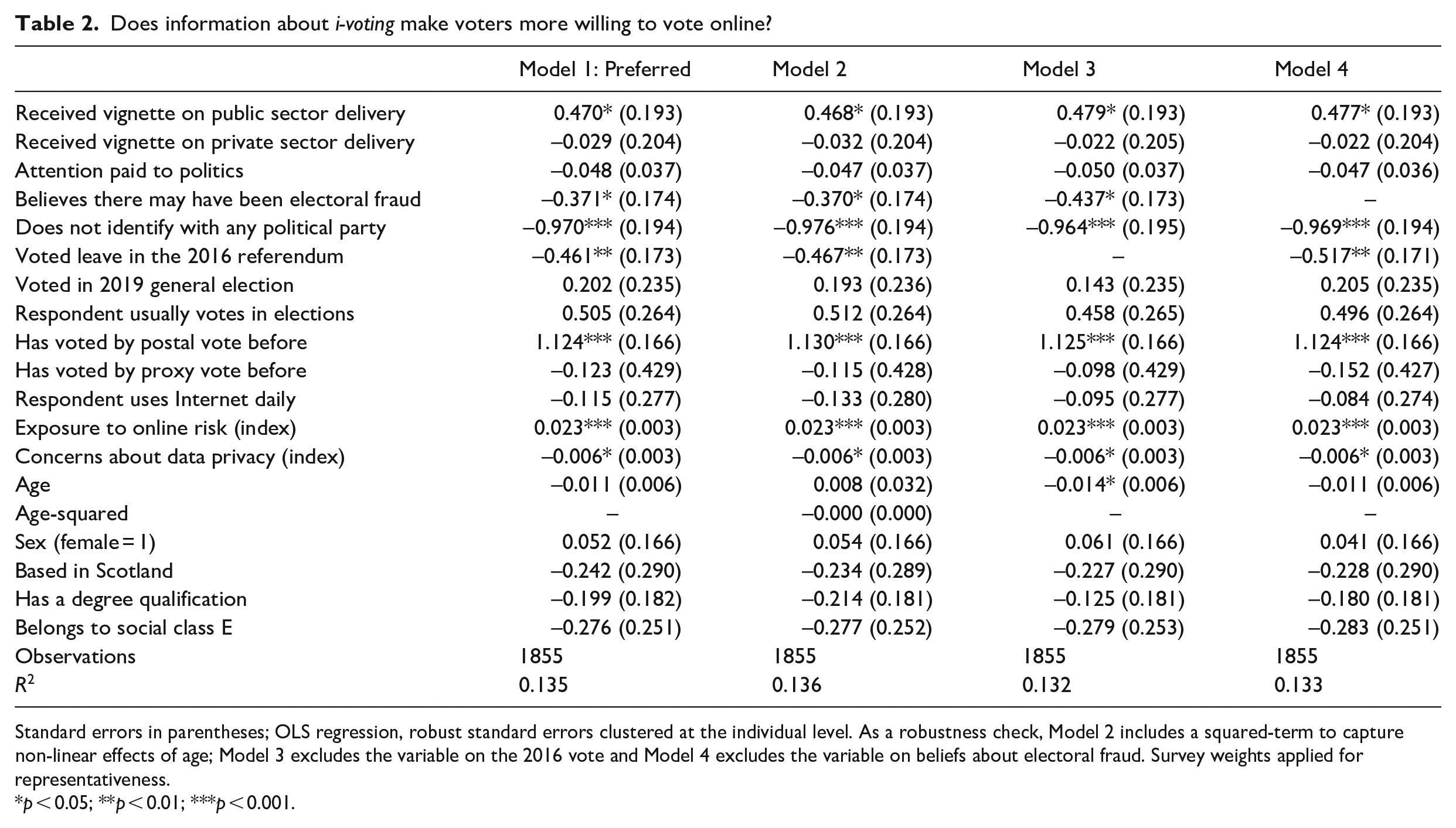
Standard errors in parentheses; OLS regression, robust standard errors clustered at the individual level. As a robustness check, Model 2 includes a squared-term to capture non-linear effects of age; Model 3 excludes the variable on the 2016 vote and Model 4 excludes the variable on beliefs about electoral fraud. Survey weights applied for representativeness.
p < 0.05; **p < 0.01; ***p < 0.001.
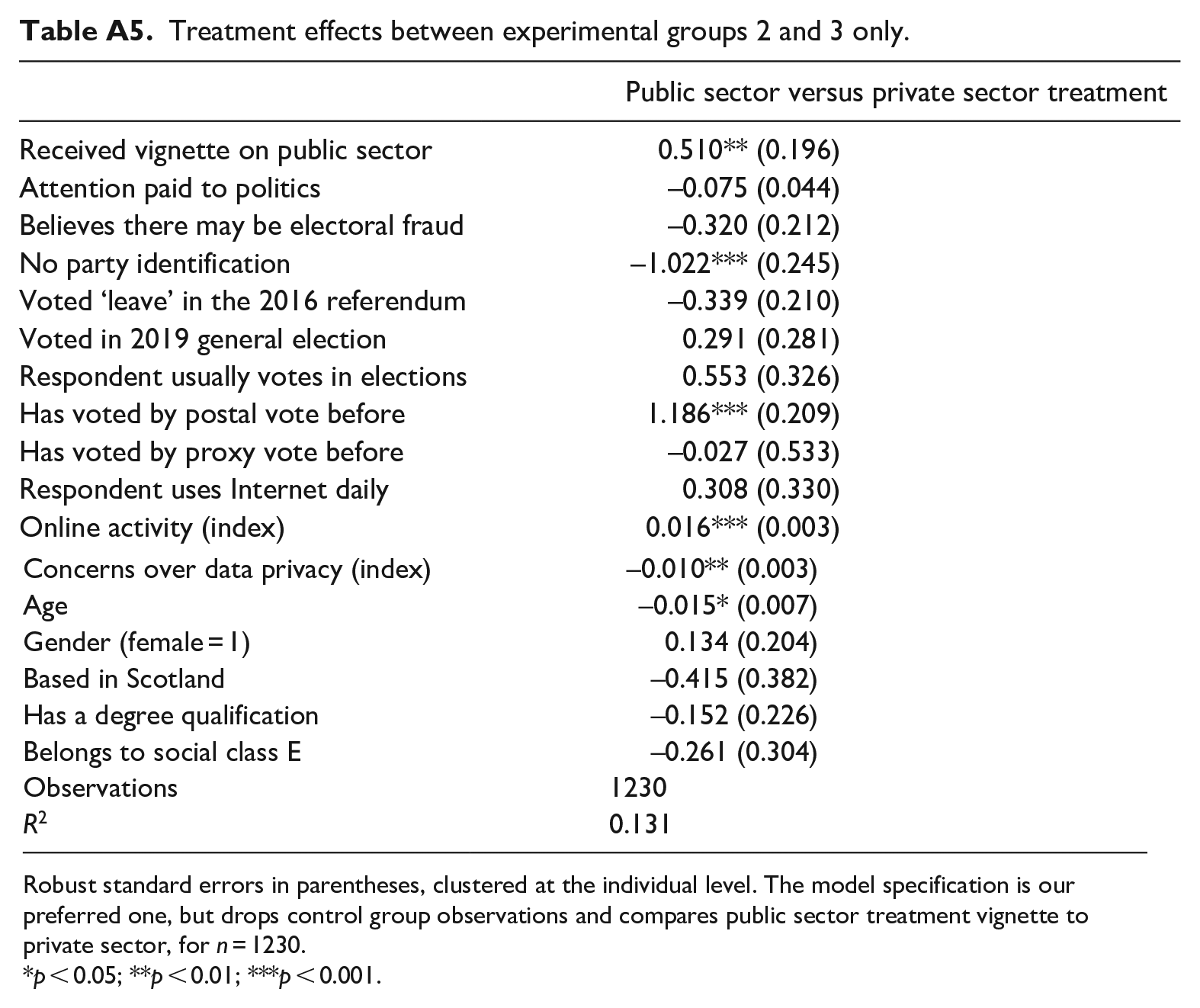
However, we find no support for H2, relating to the private sector vignette in any model specification (p > 0.05). With this finding, we are able to confirm H3, with the public sector treatment effect stronger than the private sector treatment effect. As a further robustness check, we compare only the treatment groups. Both of these groups received information about the convenience of i-voting and differ only in the type of organisation who would administer the ballot. This allows us to isolate the effect of learning about public sector involvement relative to private sector involvement. We can confirm that the public sector treatment effect is positive and statistically significant (p = 0.010; see Table A5 in Appendix 1).
Overall, we can report that having more information about the online voting system matters, but it is only the information relating to public sector oversight that shifts voters’ willingness to engage in online voting. Our findings suggest that, rather than the lowering of voters’ costs identified in rational choice theory alone, the more important theoretical underpinning to the likelihood of online voting relates to the question of who administers the online ballot. Different perceptions of public and private sector electoral administrators appear to make a significant difference when trying to persuade a voter to engage in the process. While having previously engaged in remote voting by post (but not proxy) is associated with an increased likelihood of voting online, the broader considerations of rational choice theory outlined in the theory section are only applicable in a scenario where online voting is administered by a public body. Our findings are not sensitive to model specification, as shown in Table 2. An additional robustness check excludes respondents who are relatively quick to respond to the ‘willingness to vote online’ survey question, and the findings here (reported in Table A4 in Appendix 1) further corroborate our results. 10
Unlike the extant literature, our results also suggest little association between willingness to vote online and demographic characteristics including age, sex and education. In respect of age, we test both a linear relationship and a curvilinear one (reflecting comparative findings from prior research). Neither produced a statistically significant effect, nor do we find any significant associations with location (country) or social class.
In terms of political engagement and confidence in the politics process, we find mixed results. While we observe no association between regularity of voting and attention to politics, and willingness to vote online, other covariates are significantly correlated with such an inclination (although there is no causal inference attached to these coefficients, only association). Respondents who did not identify with any political party were significantly less willing to consider voting online (contra to Townsley et al. (2021: 12) who find the reverse in respect of postal voting). We also observe that those who voted Leave in the 2016 referendum on membership of the European Union were less willing to vote online. A lack of partisan identity and voting ‘Leave’ can be understood as proxies for not being political ‘insiders’. The impact of a lack of partisan identity on the propensity to vote online is straightforward to understand, but equally, the decision to vote Leave may capture a similar effect. Although won by the Leave side, the result of the referendum is frequently portrayed as a victory for the outsider against the establishment. Taken together, it appears that identifying as a relative ‘outsider’ politically is associated with being less willing to vote online. Coupled with these measures of political engagement, we observe that a belief that there may have been electoral fraud is related to a lower willingness to vote online while, as we have seen, past experience of voting by post is significantly and positively associated with willingness to do so. Taken together, these covariates indicate some support for the idea in the extant literature that at least some political engagement together with trust in the integrity of the voting system plays a part in deciding whether to take up a new voting option.
And, as predicted, respondents with easy (daily) access to the Internet, and those reporting higher levels of activity across shopping, banking and hobbies, were significantly more willing to consider online voting. Conversely, those reporting a greater degree of concern about privacy of online data were less willing to vote online. It is these three characteristics that we turn to next, to explore in more detail who wants to vote online.
How do different voters respond to the prospect of online voting?
To investigate heterogeneous treatment effects, or the difference in treatment effects across different groups of voters, we expand our preferred model specification to incorporate treatment-covariate interaction terms. The full table of results for the heterogeneous treatment effects model is reported Table 3. For ease of interpretation, we report the linear combined effects of the treatment and the treatment-covariate interaction terms (see Table 4), which allow for testing H4, H5 and H6. Table 4 reports both the p-value and whether this remains statistically significant after the corrected threshold based on there being three hypothesis tests for each treatment. The results do not allow for causal interpretation, but do tell us how treatment effects vary across voters based on their initial characteristics.
How do different voters respond to the prospect of online voting?.
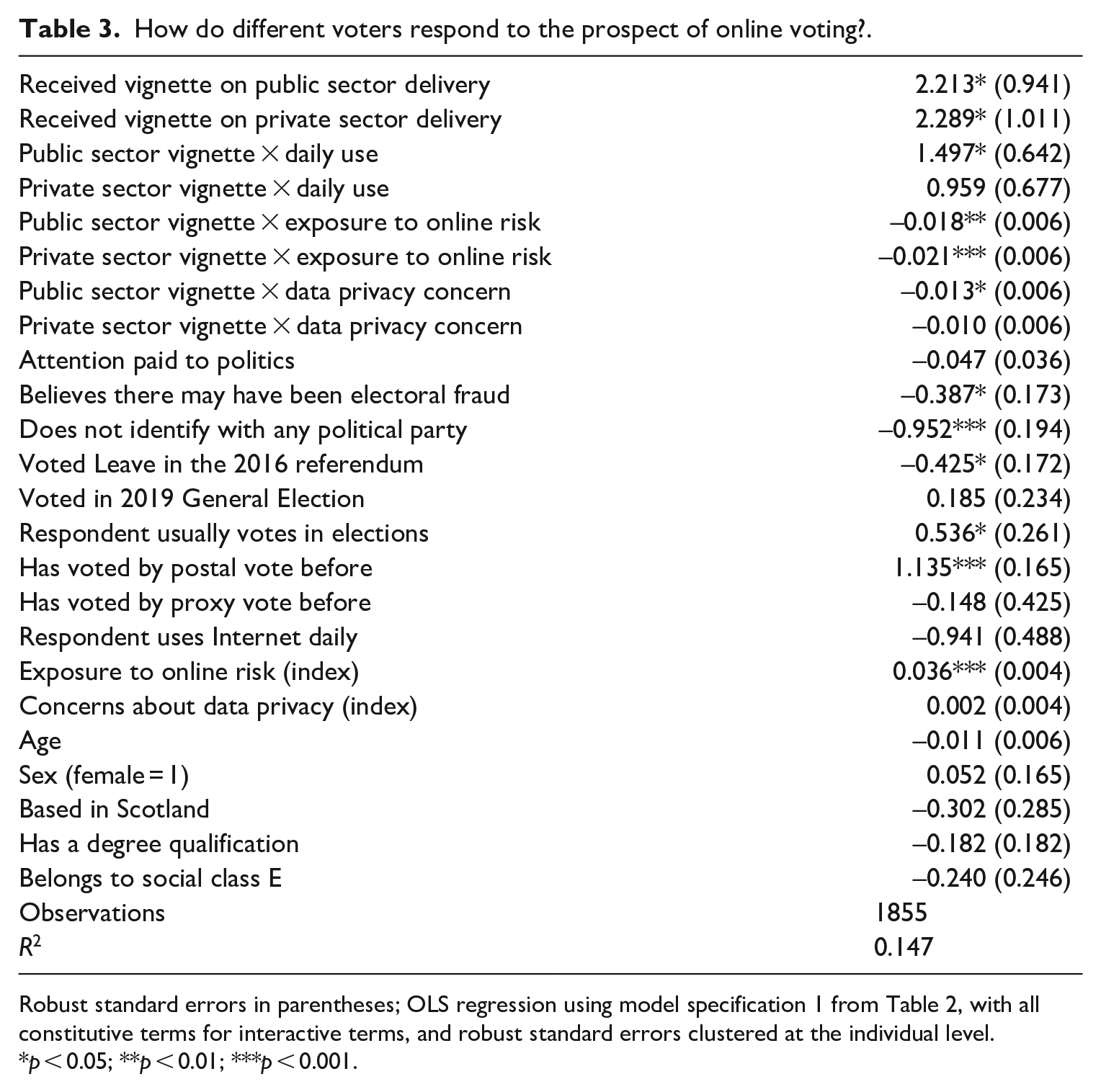
Robust standard errors in parentheses; OLS regression using model specification 1 from Table 2, with all constitutive terms for interactive terms, and robust standard errors clustered at the individual level.
p < 0.05; **p < 0.01; ***p < 0.001.
Heterogeneous treatment effects.
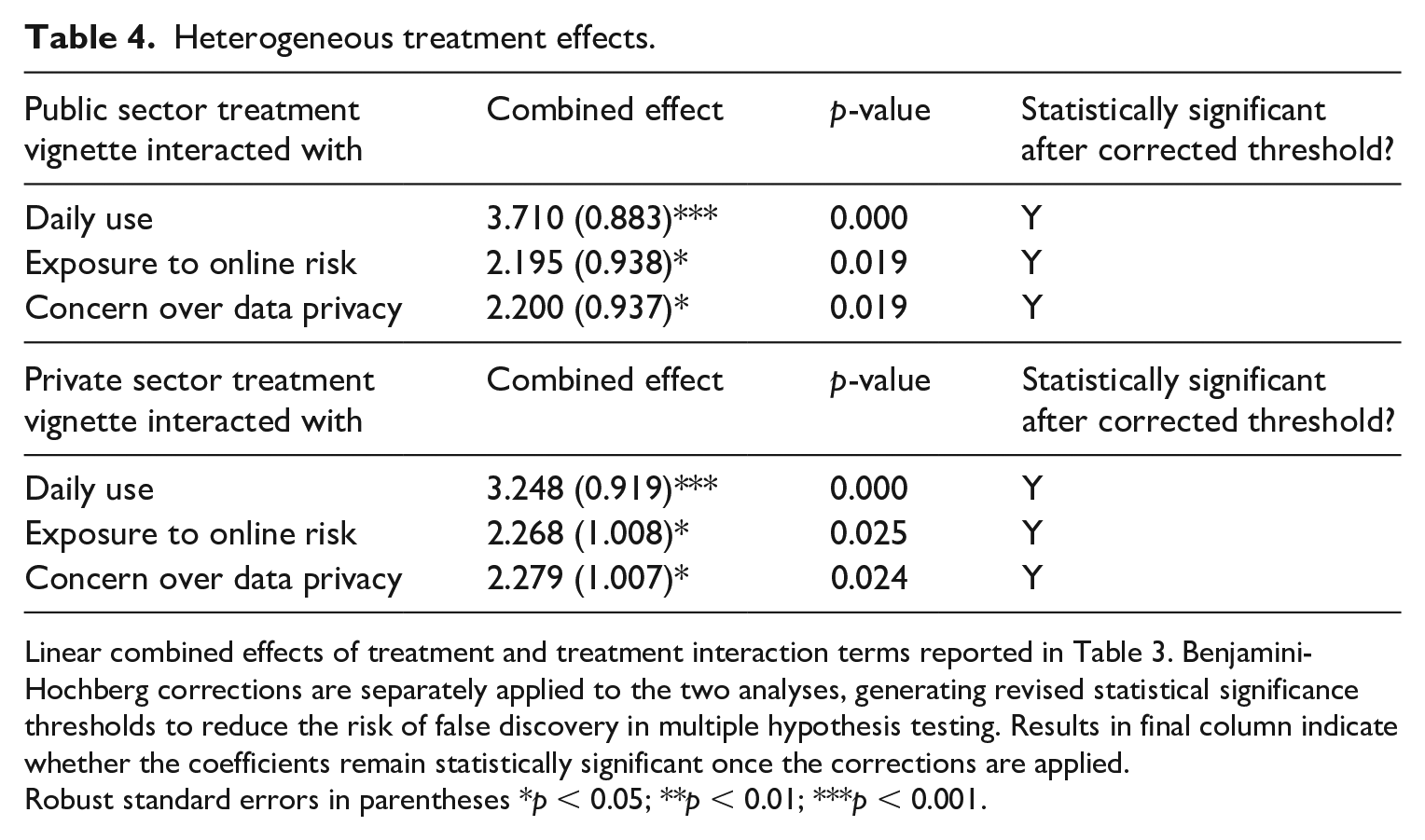
Linear combined effects of treatment and treatment interaction terms reported in Table 3. Benjamini-Hochberg corrections are separately applied to the two analyses, generating revised statistical significance thresholds to reduce the risk of false discovery in multiple hypothesis testing. Results in final column indicate whether the coefficients remain statistically significant once the corrections are applied.
Robust standard errors in parentheses *p < 0.05; **p < 0.01; ***p < 0.001.
We expected that individuals with greater access to the Internet would be more willing to support online voting, and this is borne out in the data (H4). We also find that voters who engage in more online activity are more favourable towards online voting when they receive the additional information in the vignettes (H5). These findings hold for both the public and private sector vignettes.
Finally, we find that concerns over data privacy are an important factor (H6). Although these data suggest that having more concern is associated with a lower willingness to vote online in general (see Table 2), the combined linear effects from the interaction model yields positive and statistically significant coefficients. We can infer that those who are more concerned with issues related to data privacy express more willingness to vote online once they have received additional information about the process.
In sum, we find support for the idea that level of Internet use, exposure to online risk and concerns about data privacy are all important baseline predictors of willingness to participate in i-voting when respondents learn more about the process. In relation to these sub-group effects, it appears less important whether a public or private body is involved in the delivery of online ballots. Rather, the exposure to additional information about i-voting seems to make the difference, in line with more traditional theories based on rational choice. Of course, as with any single experiment or cross-sectional study, such findings can be reinforced following replication.
Conclusion
Citizen engagement with a wide variety of online activity continues to grow, and with that growth comes increased risk relating to fraud, impersonation and the release of personal data. Much of this online activity is conducted through private sector providers. And while there may be safeguards in place to protect consumers from fraud and impersonation, the associate stress that occurs when such crimes are committed remains. Despite extensive use of online activity through shopping and banking with private providers, the evidence presented here suggests that British voters are strongly committed to the public management of i-voting. Who delivers matters a great deal. Voters may potentially lose more personally in cases of fraud, impersonation and the sacrifice of online privacy, but they are committed to the management of any online voting to be clearly undertaken by public authorities. Perception of risk also matters, and those who regard online activity as being of higher risk appear more favourable to the idea of i-voting when they learn more about its advantages and how it might be delivered.
The analysis in the article is of particular significance because we have been able to test a wide range of explanatory variables. For example, despite the extensive attention given to demographic effects in the extant literature, our analyses show that these have no significant effect relative to information about Internet use and perception of risk. We have also been able – though our use of the survey experiment – to isolate the causal effects of who delivers i-voting. The article therefore makes a significant and original contribution, both by extending the theory in respect of i-voting, but also in respect of the method used. Of particular note is the finding that who delivers i-voting is more important to electors than solely the convenience of i-voting predicted by rational choice models. In line with rational choice theory, however, more information about i-voting positively influences people with higher concerns about data privacy, and existing high levels of use and online exposure to risk. Indeed, our findings may be conservative. This survey experiment was conducted online. We might expect, therefore, that online survey respondents may themselves be more likely to entertain the idea of i-voting overall. That said, as we show in Footnote 7, the sample is typical in respect of their daily online use. Notwithstanding, running such an experiment using both online and offline samples would be likely to accentuate the differences further between groups.
So who delivers and perceptions of online risk are key to understanding when voters are more willing to cast their ballot online. But the article also suggests that there may be a relationship between being a political ‘insider’ or ‘outsider’ and propensity to vote online. Townsley et al. (2021) find that those with partisan identification are less likely to vote by post, suggesting that partisans are more likely to derive expressive benefits by voting in person. In respect of i-voting, our results suggest the opposite. Partisans are more willing to vote online. And in general, that is true of political ‘insiders’. However, while our article offers suggestive evidence of insider or outsider effects, we cannot yet demonstrate the casual effects with the same level of robustness that we can apply in respect of who delivers the process of i-voting. That is a subject of further research. Equally, the article only captures the effects of administrative oversight. Further research will need to examine if there are differential effects resulting from the various different security provisions employed in online voting, such as ID cards and two-step verification. That said, such considerations are likely to be of secondary importance to citizens in the bigger picture of who is charge of the online voting process. Future work could also usefully expand into a wider selection of countries where the question of public appetite for i-voting remains under-researched.
The findings also have significant policy implications. Receiving information about i-voting can have positive effects on willingness to cast ballots online. The content of information campaigns matters. Our results indicate that for voters to engage in i-voting, public providers need to be clearly identified as the managers, leads and primary providers of the process. The public appears sceptical of private sector involvement in this domain and thus if there is any private sector involvement in delivery, public bodies must be capable of reassuring electors that this involvement is not compromising the electoral process in any way. In some ways, these findings may seem at odds with the public’s reliance on online banking and shopping. But the results are clear; voters are more likely to engage in i-voting if it is – and is fundamentally seen to be – an exercise run by a public body. Of course, a few aspects of public delivery will be 100% sourced from the public sector – we need to explore further what is an acceptable mix. But our findings demonstrate a clear preference for where that balance should lie when delivering elections.
Footnotes
Appendix 1
Treatment effects between experimental groups 2 and 3 only.
| Public sector versus private sector treatment | |
|---|---|
| Received vignette on public sector | 0.510** (0.196) |
| Attention paid to politics | –0.075 (0.044) |
| Believes there may be electoral fraud | –0.320 (0.212) |
| No party identification | –1.022*** (0.245) |
| Voted ‘leave’ in the 2016 referendum | –0.339 (0.210) |
| Voted in 2019 general election | 0.291 (0.281) |
| Respondent usually votes in elections | 0.553 (0.326) |
| Has voted by postal vote before | 1.186*** (0.209) |
| Has voted by proxy vote before | –0.027 (0.533) |
| Respondent uses Internet daily | 0.308 (0.330) |
| Online activity (index) | 0.016*** (0.003) |
| Concerns over data privacy (index) | –0.010** (0.003) |
| Age | –0.015* (0.007) |
| Gender (female = 1) | 0.134 (0.204) |
| Based in Scotland | –0.415 (0.382) |
| Has a degree qualification | –0.152 (0.226) |
| Belongs to social class E | –0.261 (0.304) |
| Observations | 1230 |
| R 2 | 0.131 |
Robust standard errors in parentheses, clustered at the individual level. The model specification is our preferred one, but drops control group observations and compares public sector treatment vignette to private sector, for n = 1230.
p < 0.05; **p < 0.01; ***p < 0.001.
Funding
The author(s) disclosed receipt of the following financial support for the research, authorship and/or publication of this article: This study was funded by Brunel University London.
