



Abstract
Gaining an understanding of the concerns and aspirations of a country’s diaspora can help domestic politicians to better connect with this community and gain their support in elections. The United Kingdom’s diaspora is large and spread among many countries, and currently has the right to vote in UK general elections only for a limited time. However, there are proposals to abolish these time limits and this will make this community of increasing interest to politicians. This study uses signatories to the UK Parliaments e-petitions platform to gain an understanding of the foreign and domestic political concerns of this community. The analysis uses Latent Dirichlet allocation to identify common topics among the e-petitions and hierarchical clustering to identify commonalities among countries, territories and regions. It is found that there are five meaningful groups of such, and they are diverse in the topics that are of most concern.
The UK diaspora and engagement with Westminster
While the recent past has proved to be a challenging time for most governments, and a traumatic time for their citizens, the UK government has been pre-occupied with both Covid-19 and also the consequences of the Brexit referendum (Usherwood, 2021). Having negotiated a deal with the European Union (EU) in late 2019, and having autonomy in international matters, the UK now needs to work out its path and role in the World after leaving the EU (Gaskarth and Langdon, 2021).
An important aspect of the Brexit vote was the desire of UK citizens to have greater control over immigration policy (Goodwin and Milazzo, 2017) and to be able to ‘direct’ the government to adopt certain policy changes (Wellings, 2020). What was often not recognised is that British citizens themselves emigrate to other countries and become immigrants. It is natural that these two aspects, immigration into the United Kingdom and emigration to another country from the United Kingdom are linked (Weinar, 2017). UK emigrants are likely to be of a different character to their fellow UK residents (Cranston, 2017), motivated to live abroad for many reasons, including professional opportunities (Harvey and Beaverstock, 2016), economic prospects (Croucher, 2012), family ties (Richardson, 2006) or for lifestyle improvements (Botterill, 2017).
The size of this UK diaspora is large, with a 2019 estimate by the United Nations Population Division of nearly 4.3 million UK migrants resident abroad (United Nations – Department of Economic and Social Affairs, 2019). This places the UK 14th on a list of 234 countries and territories ranked by the size of their diaspora, ahead of counties such as Germany (4 million), the United States (3.2 million) and France (2.3 million).
While these citizens are not living in the United Kingdom, they are still able to have some influence on the political journey of the United Kingdom. For democratic purposes, UK migrants abroad are currently entitled to vote in domestic UK elections for a period of 15 years beyond their departure from the United Kingdom. The estimate for the size of this electorate living overseas is about 233,000 (Johnston, 2021). This may appear to be a small number relative to the size of the diaspora quoted above, but given that the typical size of a UK Westminster parliamentary constituency is 80k electors, this diaspora in aggregate is the equivalent of 3 such constituencies. However, in practice, these overseas citizens vote in their ‘home’ constituency, usually where they were last resident in the United Kingdom and their impact will therefore be dispersed. Using data from the Office for National Statistics (2021) shows that there is still, however, some spatial clustering of overseas citizens in some constituencies, with the four inner London constituencies of Hammersmith, Cities of London and Westminster, Chelsea and Fulham, and Westminster North having an overseas electorate of 2% or more in December 2019 (in Kensington, the Conservative majority over Labour in the December 2019 General Election was just 150 votes while the number of the overseas citizens registered to vote there is 1168).
Given this large pool of potential voters, many UK political parties are starting to organise so as to try and capture these votes (Collard and Kernalegenn, 2019; Von Nostitz, 2021), all with varying degrees of success (Collard and Kernalegenn, 2021; Collard and Webb, 2020). The current proposals from the UK Government are to abolish this 15-year limit and make re-registration less cumbersome, recognising that ‘. . . decisions made in the UK Parliament on foreign policy, defence, immigration, pensions and trade deals directly affect British citizens who live overseas’ (Smith, 2021).
An aspect of political engagement that has come to the fore in recent years are e-petition platforms, particularly those hosted by governments and legislative bodies (Le Blanc, 2020). The United Kingdom’s Parliament has such a platform and it has enjoyed considerable popularity with the population. To sign a UK Parliament e-petition the signatory must first identify as a British citizen or UK resident (although no check is made on this status) and provide a valid email address, to which a link is sent, that when activated registers their signature. The signatory can also enter a UK postcode or a country of residence to identify their location. This information is not validated by the e-petitions platform. The number of signatures for each e-petition in each constituency, and also each country, is provided by the e-petition platform.
This study uses the number of signatures to e-petitions, by country of residence, which were active during the 2017 to 2019 UK Parliament to gain an understanding of what e-petition topics gained the most support in each country, territory or region. We are concerned with three research questions:
Research Question RQ1: What e-petition topics are popular among the British diaspora?
Research Question RQ2: Are there commonalities or concerns among groups of countries, territories and regions?
Research Question RQ3: How do the concerns in these groups compare to those of UK citizens resident in the United Kingdom?
In our reading of the literature, there are few studies that use such data to take a quantitative look at domestic and international UK politics through the lens of ‘insiders’ who choose to live on the ‘outside’. This article introduces the existing literature on this topic and provides a consideration of the e-petition data and the computational content analysis. The results are presented and the study concludes with a discussion of the findings.
E-petitioning and its relevance to the diaspora
The rights of citizens to petition their elected and governing representative to seek redress for some grievance is long enshrined in most societies (Huzzey and Miller, 2020; Knights and Shapiro, 2009). In recent years, this activity has been translated into the electronic sphere by the adoption of various e-petition platforms. Some of these platforms are provided by non-governmental organisations, such as change.org and 38 degrees.org.uk, while others are hosted within government, for example ‘We the People’ in the United States, ‘Petitionen’ in the Federal German Parliament and the ‘Petitions Web Portal’ of the European Parliament. Following on from a successful Scottish initiative (Seaton, 2005), the UK Government and then the UK Parliament has had an e-petitioning platform available since 2010 (Leston-Bandeira, 2019; Wright, 2015). The effectiveness of such systems in achieving stated or assumed gaols is debatable (Bochel, 2016). Leston-Bandeira (2017) argues that e-petitions have a role in raising the awareness of issues to national politicians and the media, and can be a good vehicle for demonstrating discontent or protest. Indeed, Blumenau (2020) found that an e-petition with strong opinions and support in a constituency was more likely to be viewed sympathetically by that member of Parliament. Conversely, others argue that such systems are less effective and in some cases are actually antagonistic to political actors (Matthews, 2021) and frustrating to e-petition initiators (Wright, 2015). In terms of future developments, Girvin (2018) highlights that the UK e-petition system does not necessarily encourage debate and nuance, and suggests that mechanisms within other countries’ e-petition platforms should be considered for the United Kingdom.
Access to data made available by the UK Parliament’s e-petition platforms has facilitated a strand of research that has used e-petitioning activity to gain an understanding of citizen’s concerns and priorities in the period between elections (Briassoulis, 2010; Briassoulis, 2021; Hagen et al., 2018). These UK data have been used in a diverse range of quantitate research studies. These include a desire to understand what linguistic factors may influence the popularity of e-petitions (Clark and Lomax, 2020), the interaction of e-petitions with social media (Asher et al., 2019), the estimation of electoral outcomes (Clark et al., 2018), how the design of a platform can influence usage (Hale et al., 2018), what e-petitions on a single topic tells us about citizens’ concerns (Kolosok et al., 2021), and how to group together constituencies (Clark et al., 2017).
While the above studies have been concerned with either the generality of signatures to e-petitions or have a geographic consideration limited to just the United Kingdom, none have studied specifically those signatories resident outside the United Kingdom. Also while there are non-governmental e-petitioning platforms that encourage a diversity and range of participation among many nationalities (Geron, 2012), governmental e-petition platforms tend to want to focus in on the concerns and desires of those citizens they are responsible for and accountable to, and are more likely to attract the attention of legislators.
There is only limited literature on ‘foreign actors’ use of governmental e-petition platforms. Lin (2021) highlighted how Taiwanese nationals interact with the e-petition systems of other countries (specifically the ‘We the People’ platform of the federal United States) to raise the profile of their country on the international stage. Everington (2019) also reports how support for Taiwan has been raised within the Federal German government’s e-petition platform, which ‘. . . included a “Taiwan” nationality option’. This highlights that while the study reported here has been couched as an examination of how foreign-resident UK citizens interact with the e-petition platform, some regard for the ability of non-UK citizens to sign UK e-petitions may be required.
E-petition data
Parliamentary e-petitions can be created by any UK citizen or resident, and after some checking (e.g. for duplication or relevance) and gaining the email address for 5 supporters, the e-petition is hosted on the UK Parliament’s Petitions Committee’s platform. These e-petitions can be signed by UK citizens or residents who are required to supply their home neighbourhood (via a post code or a country) and an email address. Any e-petition that gains 10,000 signatures will receive a response from the relevant government authority and those that gain 100,000 will be considered for a debate in Parliament. In the 2010 to 2015 Parliament, 32,873 e-petitions were accepted and there were 15,124,600 signatures (mean per e-petition of 460, but a median of just 8). For the shorter 2015 to 2017 Parliament, there were 10,950 e-petitions with 31,473,502 signatures (mean 2874, median 42), and for the last complete Parliament of 2017 to 2019 there were 8154 e-petitions and 32,358,934 (mean 3968 and median 57). Thus, each successive Parliament has seen rising e-petition engagement. Each e-petition stays open for a maximum of 6 months or until the next General Election. Topics covered by these e-petitions are diverse, covering local issues, national concerns and international policies. The e-petition platform provides an updated real-time count of signatures to each open e-petition and the final number of signatures for closed e-petitions. These signatures are allocated to the Westminster Parliamentary constituency of the signatory, or for those outside the United Kingdom, to their country of residence. Of note is that the legislative coverage of some e-petitions does not extend to the whole of the United Kingdom since certain matters, such as education and health are to varying degrees devolved to law-making bodies in Scotland, Wales and Northern Ireland (Trench, 2007). However, any UK resident or citizen located anywhere in the world can sign any e-petition.
The data used in this study are obtained from the UK Parliament e-petition platform and covers the period of the 2017 to 2019 UK Westminster Parliament (United Kingdom Petitions Committee, 2019). The data contain 8154 e-petitions attracting 32,358,934 signatures in total. Those e-petitions that were started after 28 August 2019 are not included in the analysis since they will not have been opened for a sufficient length of time before all e-petitions were closed on the 6 November 2019 (the date that the 2017-2019 parliament was dissolved prior to a general election that took place on 12 December 2019). This is a period of 10 weeks and studies by Yasseri et al. (2017) suggest that after (70*24 =) 1680 hours of life the average e-petition can expect to have accumulated nearly 90% of its lifetime signatures. We therefore have a reasonable expectation that the number of signatures in each remaining e-petition opened on or before the 28 August is close to what it would have been if it ran for the full 6 months. This leaves 7460 e-petitions with 31,138,372 signatures. In addition, four e-petitions are not used since they include emoticons that hinder the textual analysis of their content. This leaves 7456 e-petitions for analysis, attracting at total of 31,125,064 signatures. Most of these signatures are by people resident in the United Kingdom (30,303,161 which is 97.4%).
There are large differences in the number of signatures by country. Residents in France provided 136,306 signatures to e-petitions while those in the Congo and the Comoros provided just 4. The concern here is that any statistics computed on some of these small numbers of signatures will be unreliable and in any analysis undue weight may be given to countries with just a few signatories. Looking down the list of countries ordered by number of signatories (see Supplementary Table S1), there is a natural break in this count at around the 3500 mark: Finland has 3495 signatories, Malta has 3473, which then drops to 2522 for Czechia, and 2195 for Bulgaria. The solution adopted here, in order to reduce bias by utilising suitable signatory numbers, is to aggregate all countries with fewer signatures than Malta into geographic regions based on a United Nations grouping or historic ties (e.g. Francophone Africa). The composition of these 50 countries/territories/regions is shown in Figure 1.
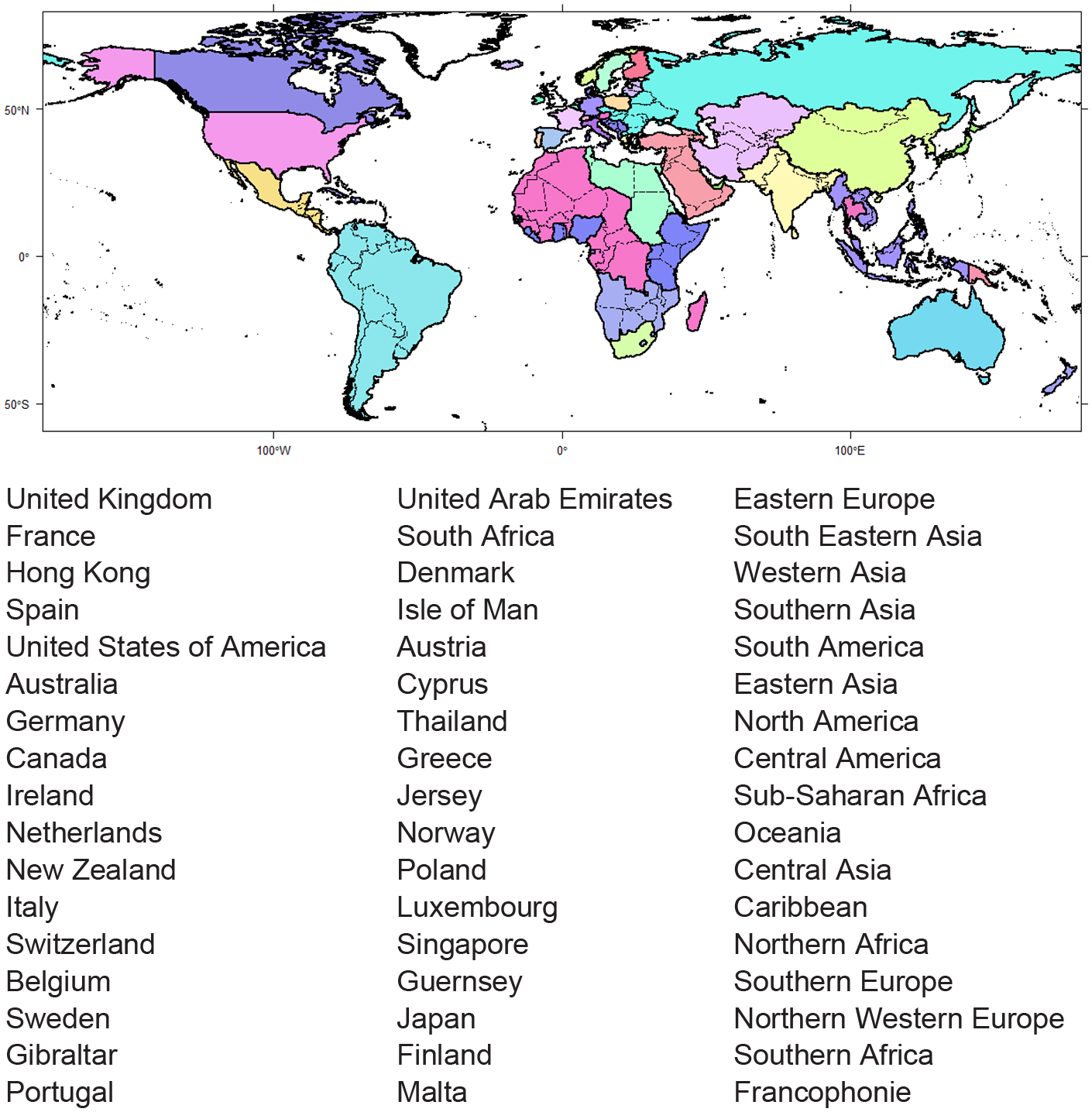
Composition of countries, territories and regions used as the unit of analysis.
Identifying e-petition topics
Turning to the subject matter of each e-petition, clearly individual consideration of over seven and a half thousand e-petitions is a monumental task. Some form of aggregation or data reduction is required in order to gain an understanding of the level of support for various issues among the signatories. To achieve this, topic modelling is performed to identify what common topics exist among these e-petitions. This is a common approach, used for tasks such as exploratory and trend analysis (Samvelyan et al., 2020), lexical analysis (Clark and Lomax, 2020; Hagen et al., 2016) and classification (Anthony and Haworth, 2020; Vidgen and Yasseri, 2020). Here, the Latent Dirlitch Analysis Approach (LDA) is adopted. LDA hypotheses that topics are composed of ‘bags’ of words and that documents (here the e-petition title and Background text) are composed of a number of these topics (Blei, 2011). Specifically for our purposes, the method provides a measure of what proportion of the document is concerned with each topic. To apply LDA, the corpus of e-petition documents is randomly split into two groups: a training group consisting of 75% of e-petition documents and the remaining 25% documents used for testing the ability of the model to predict the topics with the documents. The corpus was pre-treated by removing whitespace and punctuation, conversion of all characters to lower case and removal of stop words. The remaining words were reduced to their stem. For fitting the LDA, with a given number of topics, a 10-fold cross classification approach is used. To determine the likely number of topics in the corpus, various metrics are available (Cao et al., 2009; Griffiths and Steyvers, 2004) as well as a likelihood measure.
Once a trained and tested LDA had been estimated, the approach outlined in Vidgen and Yasseri (2020) is used to provide z-scores (zci in their notation) that measures how much more or less concerned each country/territory/region is with a topic than countries/territories/regions in general. This approach uses the matrix that estimates what proportion of each petition is concerned with each topic. The number of signatures in each country/territory/region for each e-petition is then distributed among the topics using these proportions. When this has been done for all e-petitions, the number of signatures for each topic is summed. At the end of this process, rather than having the number of signatures for each e-petition we now have the number of signature for each topic. As Vidgen and Yasseri (2020) point out, these raw sums cannot be used directly since the populations on which they are based are unequal (e.g. the diaspora population of Western countries will be many magnitudes bigger than in South American counties). To correct for this, these sums are converted to percentages, showing how the signatures from these countries distribute across the topics. Following the notation of Vidgen and Yasseri (2020), we have

Where c is the country/territory/region i is the issue (topic), sc is the number of signatures in country c, and sci is the number of signatures in country c on issue (topic) i
These data allow us to consider the first research question (RQ1) on which topics are most popular in each country/territory/region. These percentages are then converted to z-scores by the use of an average and a variance of the percentages calculated across all countries/territories/regions, except the United Kingdom. Again, following Vidgen and Yasseri (2020) notation



Where C is the number of countries/territories/regions, n is the number of countries/territories/regions (excluding the United Kingdom). Note c = 1 is the United Kingdom, and is not included in the summary statistics
The z-scores then represent the relative importance of each topic within each country/territory/region measured against the average importance across all countries/territories/regions (µi). We can now use these z-scores to classify the countries/territories/regions into those whose z-scores are the most similar. While the topics from the LDA may be uncorrelated, when the signatures are apportioned to the topics, correlations may be introduced. So before the clustering exercise, pairs of topics that are highly correlated (with a linear correlation greater than 0.80) have one of the pair removed. The clustering method adopted here is a hierarchical approach using Wards clustering criteria (Ward, 1963). The stability of the cluster solution is examined (Hennig, 2007). This analysis allows us to answer the second research question (RQ2) on how the countries/territories/regions have common concerns and form groupings.
The final piece of analysis is to see how these groups defined by the clusters compare with the pattern of signatures for the United Kingdom. This is done by assessing the ratio of the percentage of signatures in each topic for each group mean (µg) relative to the UK mean (µUK). This is how we address Research Question (RQ3) and identify which of the diaspora groupings most resemble the United Kingdom, and also what significant departures are present.
Topic modelling results
The three metrics used to determine the number of topics in the corpus of e-petition texts, computed for various numbers of topics in the corpus, is shown in Figure 2. These metrics point to there being between 60 and 80 topics, with consistent peaks at 60 for the Griffiths and Loglikelihood metrics. In the interest of parsimony, we will use the lower end of the scale, 60 topics. This number is much higher than that reported by Clark and Lomax (2020) (25 topics), Vidgen and Yasseri (2020) (10) and Anthony and Haworth (2020) (14) who all used e-petitions from the earlier 2015 to 2017 Parliament.
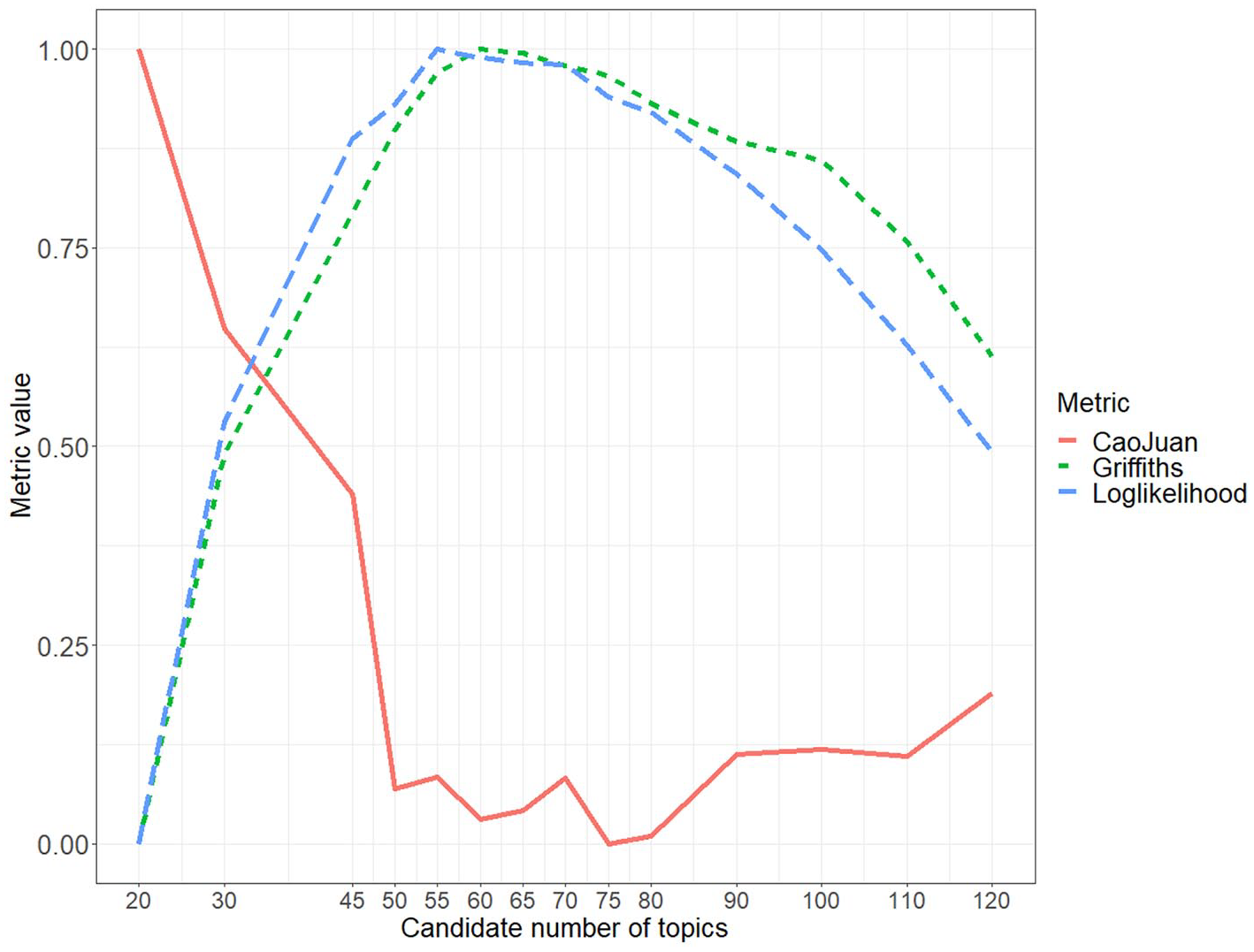
Metrics for the number of topics in the e-petitions.
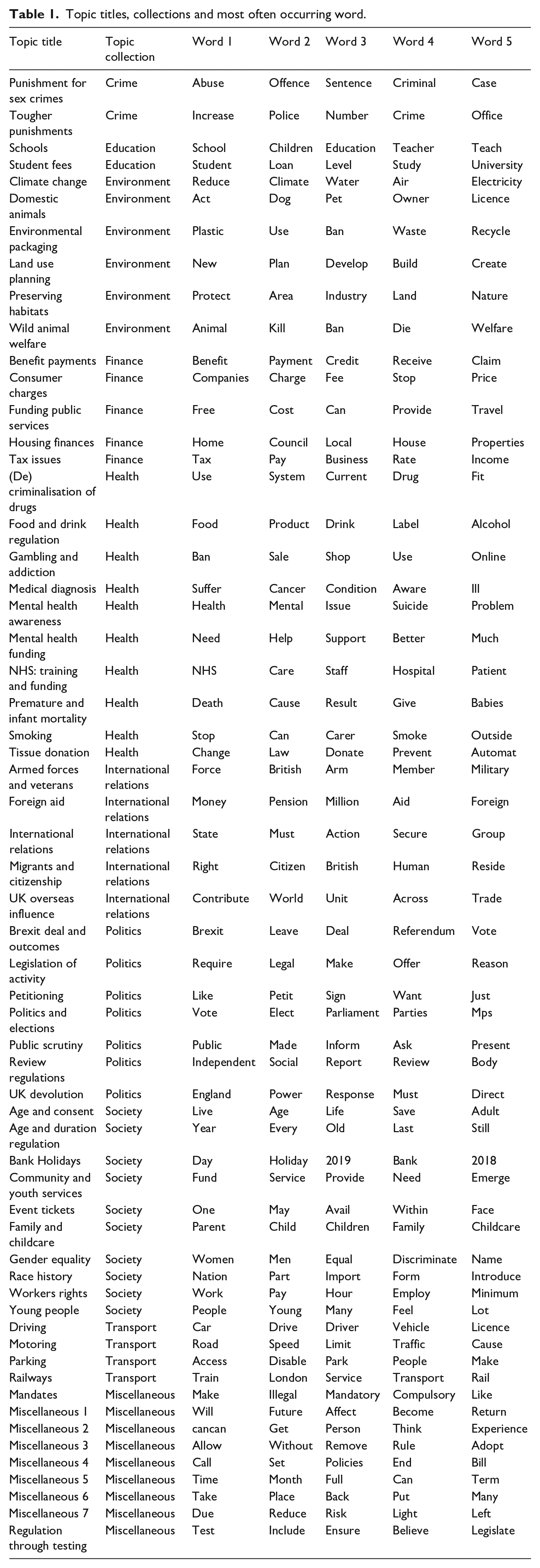
From an examination of the top 10 words associated with each topic and the subject matter of the e-petitions that mostly represented the topic, short descriptive titles are given to each topic. These are shown in Table 1 along with the most frequent top five words. Looking at these topic descriptions, it is possible to arrange topics that are concerned with the same aspects of life, for example, politics. This curation of topics has been done by the authors, and is also shown in Table 1, with some of these titles mapping well on to the topics identified in Vidgen and Yasseri (2020) and Anthony and Haworth (2020).
While meaningful titles have been given to most topic there are seven that are difficult to interpret and have been kept as Miscellaneous topics (these are akin to the ‘incoherent’ topics in Hagen et al., 2016).
Looking at the topics that received the largest share of signatures in each country/territory/region allows us to answer RQ1: What e-petition topics are popular among the British diaspora? The table of values for Spci in equation 1, arranged as topics by country/territory/region are provided in Supplementary Table S2. The topic of the Brexit deal and outcomes is the top topic in every country/territory/region except for Hong Kong (Migrant rights & citizenship are the most popular here), Poland (Family & childcare) and Northern Africa (International relations). The second most popular topic is commonly Public scrutiny (second most popular for 31 countries/territories/regions) or Politics and elections (11 countries/territories/regions). The third most popular topic is UK Devolution (third in 19 countries/territories/regions) or (again) Public scrutiny (12 countries/territories/regions). Looking more widely at the top 10 most popular topics for each country/territory/region, the most common popular topics are: Brexit deal & outcomes; Public scrutiny; Miscellaneous 1; UK devolution; Miscellaneous 6; Young people; Benefit payments; Politics & elections; and Environmental packaging.
Topic titles, collections and most often occurring word.
Groupings of countries, territories or regions
The dendrogram in Figure 3 shows how countries/territories/regions merge into groups as the distance in the data space, captured via the z-scores, between them increases. An initial inspection suggests that there could be five distinct groups in these countries/territories/regions. The stability of the five group solution is (0.88, 0.94, 0.73, 0.63 and 0.82) (generally a valid stable value should be 0.75 or greater, with vales 0.85 or greater considered ‘Highly stable’ (Hennig, 2007)). Supplementary Tables S3 and S4 shows the centres of these groupings (µg = Σ µi/ng) for the ng countries/territories/regions in group g, see Vidgen and Yasseri (2020) and the deviation (z-score) of these centres (a zci, see Vidgen and Yasseri, 2020).
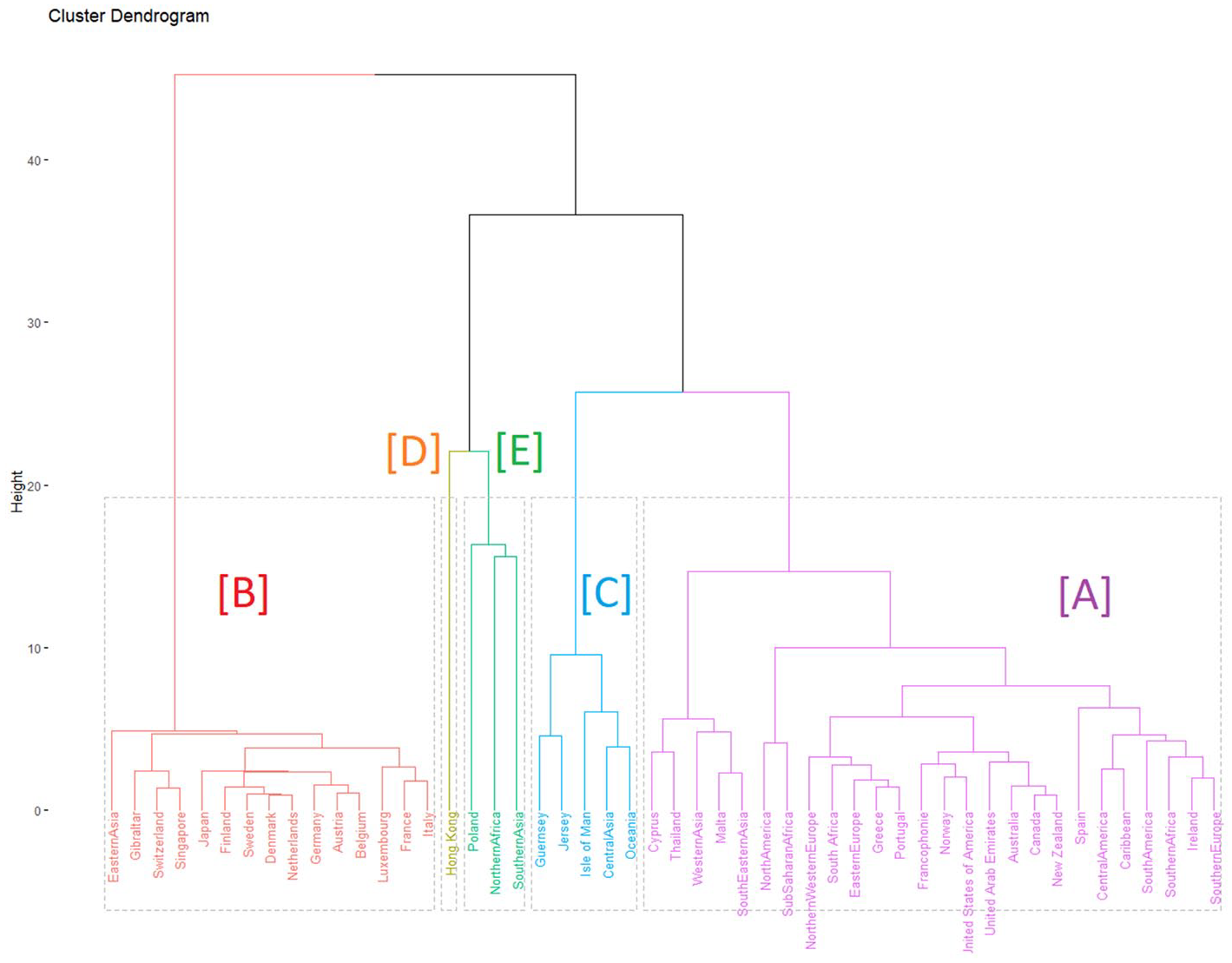
Dendrogram of the hierarchical clustering exercise.
Assessment of these groupings allows us to answer Research Question RQ2: Are there commonalities of concerns among groups of countries, territories and regions? Using the assumption that there are 5 groupings in these countries, we see a block of 15 countries/territories/regions [B] that are mainly Western European countries that group together very soon and stay distinct. These countries’ signatories are over represented for topics that are concerned with politics, such as Public scrutiny, the Brexit deal and the outcomes of the negotiation process, UK devolution and the generic Politics and elections topic, and under-represented for topics around animal welfare, land use and punishment for crimes. This groups stays as a district grouping, only when the distance threshold is extended to around 45 do they join with the remaining countries/territories/regions.
The largest group of 26 [A] consists of a mixture of world countries and regions. The level of concern for each topic in this group is not dis-similar to the level of concern across all countries/territories/regions. Issues that are particularly important though are Foreign aid, crime and punishment and animal welfare. This remains a distinct group until the distance expands to about 24 when they merge with a small group of 5 territories and regions [C], composed of island territories close to the UK mainland, small island nations in the Pacific and a grouping of central Asia republics. This small group of 5 are particularly concerned with issues around mental health, student fees and motoring but have very little regard for the political topics. There is a small 3 country/territory/region grouping [E] which is concerned with childcare and international relations topics but less so about politics. Hong Kong [D] is distinct in the five group solution and does not join well with any other country/territory/region. The overwhelming concern of signatories in Hong King relates to migrants and citizenship.
Comparison to the United Kingdom
A comparison of how the signatures distribute as percentages among the topics for UK citizens or residents against the distribution in the five groups allows us to answer RQ3: How do the concerns in these groups compare to those of UK citizens resident in the United Kingdom?
The ratio of the percentage of signatures in each topic for each groups mean (µg) relative to the UK mean (µUK) is shown in Figure 4 as a dot symbol. In addition, the ratio of the maximum and minimum percentage in each topic across each group relative to the United Kingdom is also shown as range bars (
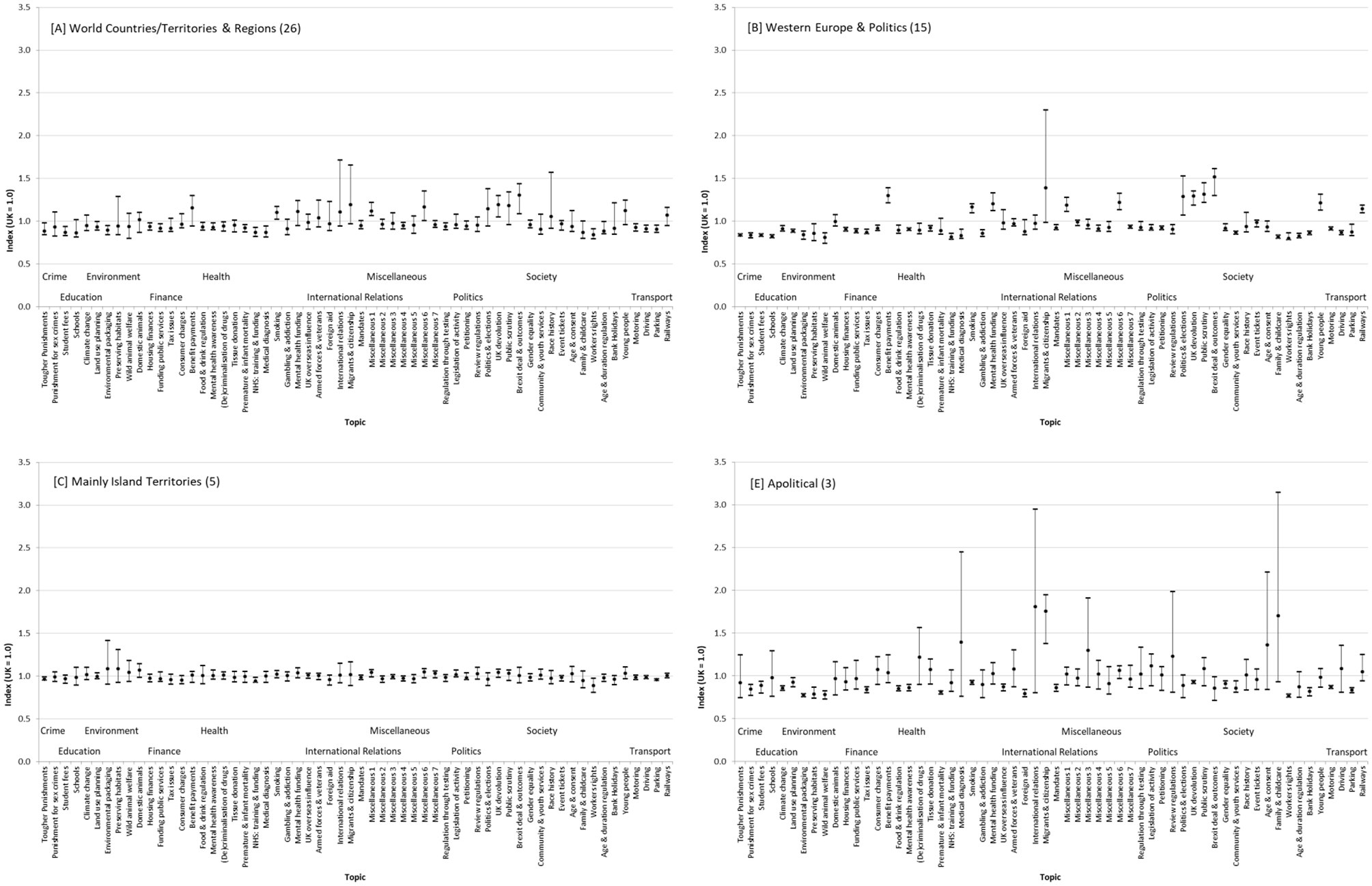
Relative score on each topic relative to the United Kingdom. Whisker plots showing the average popularity (•) of topics – as an index relative to the United Kingdom, and the maximum and minimum popularity (
The group that is the closed to the United Kingdom is group [C] of mainly island territories close to the United Kingdom or in the pacific islands. Both the [A] world countries/territories/regions group and especially the [B] Western European countries/territories/regions group have a greater share of concern for the political topics than the UK population. They also have very little concern for domestic UK topics such as education (Schools, Student fees), Health (NHS: training & funding, Medical diagnosis) and Employment (Workers’ rights). The small [E] group of countries/regions are much more concerned with topics of International relations, Migrants & citizenship and Family & childcare than the UK population. The remaining group [D] consisting of just Hong Kong, is very much more concerned about one topic, Migration & citizenship than the UK resident population (by a factor of 10.0).
It is interesting to assess the variation which emerges in these figures. For example, variability for the third smallest group [C] of five mainly island territories is low across the majority of petition topics (compared with, for example, the larger group (A) containing 26 countries), signatories residing in this group have concerns that are largely consistent with those in the United Kingdom. Whereas the other small group [E] has higher variability for many e-petition topics, which is evident from looking at Supplementary Table S2 where there is less consistency of support across the topics in this group.
Discussion of the findings
In the study, we have been able to use a valuable resource provided by the UK Parliaments’ Petitions Committee to study what the recent concerns were of a population of signatories living outside the United Kingdom. In total, these overseas signatories are a small proportion of the total signatories, once UK based signatories are taken in to count; however, their concerns are seen to be particularly concentrated around certain topics which vary by county. The utility of these findings demonstrates how opinion and concern vary considerably by place.
The topics related to political matters, both international (e.g., Brexit) and domestic (e.g., politics and elections) were by far the most popular with these overseas signatories. This is hardly surprising since the Parliament, which ran from 2017 to 2019 was largely consumed by the type of Brexit deal that was to be negotiated between the EU and the United Kingdom (Heide and Worthy, 2019; Martill and Staiger, 2020; Schnapper, 2020). While in a post-Brexit deal world it may be thought that this topic is now settled, this is unlikely to be the case with opinions still polarised on the topic (Hobolt et al., 2020; Ryder, 2020) and much detail still to be worked out (Gamble, 2021; Murphy, 2021; O’Reilly, 2020). Thus, Brexit and to an extent domestic UK politics (e.g., the devolution of powers or the possible separation of member kingdoms) are likely to be continuing topics of interest. These political topics were a distinct concern for larger EU countries, each with sizeable UK national populations whose lives were likely to most directly be affected by the nature of the Brexit deal (Ferbrache and Macclancy, 2020).
The most popular non-political UK domestic topics were concerns around support for young people, either through the health service or social services; making access to the benefits system easier for claimants; and environmental packaging, primarily the over-use of plastics. These are issues that some may term ‘progressive’ in that they are attempting to improve the outcomes of those in society who are disadvantaged and may sometimes be ignored or neglected (Diamond et al., 2017). This is especially so for environmental concerns, with plastic pollution of the oceans been a big concerns in recent years (Xanthos and Walker, 2017). The prominence for these issues may indicate a progressive leaning for the UK diaspora (Holden et al., 2017).
In terms of groupings, the largest group of 26 countries/territories/regions [A] have concerns not that dissimilar to the entire diaspora community, with some evidence for a greater concern for the UK policy in regard to foreign aid. This policy of a 0.7% of Gross National Income target for such aid is well established (Mawdsley, 2017) but has recently come into question as pressures on a finite national budget increase, with the UK Government legislating for a reduction to 0.5% (Loft and Brien, 2021). This highlights an area for potential enhancement for this study, that while topic models can identify the topic of the e-petition, they are unable to discern the sentiment for the topic, that is if the e-petition is in support or opposition to the topic in question. This is important for divisive topics, such as this foreign aid target, with sizable sections of society both in support and in opposition to the target (Dasandi et al., 2021). However, what is import here is that the topic is of concern, one way or another, to the diaspora UK population.
The second largest grouping of 15 countries/territories/regions [B] are those most overtly concerned with political topics, dis-proportionally calling for changes to public scrutiny, the Brexit deal and outcomes and matters around UK devolution. The more progressive topics are also favoured by those in this group. Looking at the dendrogram in Figure 3 we see that this group forms quickly with very little ‘space’ between members of the group, and that they do not merge with the other groups until the distance threshold is greatly expanded.
The third largest group [C] is mainly composed of territories that are associated with the British Crown and are located in the British Isles (Morris, 2018). The concerns for this group are very distinct to those of the other diaspora groupings, with domestic UK topics around mental health, student fees, motoring and community & youth services of greater concern, in contrast to the political topics which are of little interest. This is the group that also most closely matches the concerns of the signatories in the resident UK population.
The second smallest group [E] of just 3 countries/territories/regions is also an apolitical group but with concerns for international relations and migrants and citizenship. There is also interest in some domestic UK topics not highlighted elsewhere, including family and childcare, medical diagnosis and issues connected to age of consent for assistance and activities. However, this is probably the least cohesive of the five groups, which is evident when looking at how their concerns distribute among the topics.
Hong Kong stands out as a group [D] of just one territory – an outlier. This is down to one topic, Migration & citizenship, and in particular two e-petitions both concerned with the desire to enable British National (Overseas) Citizens be given full British Citizenship (Summers, 2021). These two e-petitions gained 12k and 102k signatures in total, and Hong Kong residents provided 8.7k (73%) and 81k (19%), respectively, of these signatures. This level of exposure and support has been maintained beyond the 2017 to 2019 Parliament and prompted government action on expanding citizenship options for Hong Kong residents (Gower and Kirk-Wade, 2021). Other e-petitions on the topic of migration and citizenship were concerned with the rights of EU citizens that are resident in the United Kingdom, and also UK citizens resident in the EU, but these issues were not supported in sufficient numbers to cause other countries/territories/regions to group with Hong Kong.
While technically to be able to sign these e-petitions the signatories needed to identify as British citizens, in reality there is no check on this status, allowing individuals with a sufficient interest in UK politics to signify their support for an e-petition. Similarly the country locations of the signatories are not validated. This latter issue is no different to the (lack of) checks for postcodes provided by domestic UK signatories, with the UK Parliament choosing not to adopt a system that requires registration, and hence the possibilities of bona-fides checks. So, while we have couched this study as that of the UK diaspora and their country of residence, care should be taken not to over interpret these aspects.
The influence of overseas voters in UK General Elections should also not be overstated; where at the moment around 0.5% of the registered electors are resident overseas. However, the planned changes to the legislation in this area are geared towards opening up opportunities for overseas residents to participate in these elections and the increased interest from political parties to galvanise these expatriates for support are likely to further increase this participation.
Concluding remarks
In this study, we are concerned with three research questions. First, we identify that political topics are popular among the British diaspora. These political issues cover both international and domestic issues. There is also support for some more ‘progressive’ issues. Second there are distinct grouping of countries/territories/region that exhibit commonalities of concerns. There are two very political groupings [A] and [B], two that are concerned with domestic UK issues [C] and [E], and a single group consisting of Hong Kong that is overwhelmingly concerned with migration & citizen issues. Finally looking to which group is most similar to the resident UK population, this is a small group of countries, many of which are Crown dependant territories located within the British Isles.
While this study has demonstrated the utility of recent historic e-petition data, there is the scope to repeat these analyses using more recent UK Parliamentary e-petition data to monitor on-going concerns for what could become a significant section of the electorate in UK General Elections.
Supplemental Material
sj-docx-1-bpi-10.1177_13691481221109737 – Supplemental material for A worlds-eye view of the United Kingdom through parliamentary e-petitions
Supplemental material, sj-docx-1-bpi-10.1177_13691481221109737 for A worlds-eye view of the United Kingdom through parliamentary e-petitions by Stephen D Clark and Nik Lomax in The British Journal of Politics and International Relations
Supplemental Material
sj-docx-2-bpi-10.1177_13691481221109737 – Supplemental material for A worlds-eye view of the United Kingdom through parliamentary e-petitions
Supplemental material, sj-docx-2-bpi-10.1177_13691481221109737 for A worlds-eye view of the United Kingdom through parliamentary e-petitions by Stephen D Clark and Nik Lomax in The British Journal of Politics and International Relations
Supplemental Material
sj-docx-3-bpi-10.1177_13691481221109737 – Supplemental material for A worlds-eye view of the United Kingdom through parliamentary e-petitions
Supplemental material, sj-docx-3-bpi-10.1177_13691481221109737 for A worlds-eye view of the United Kingdom through parliamentary e-petitions by Stephen D Clark and Nik Lomax in The British Journal of Politics and International Relations
Supplemental Material
sj-docx-4-bpi-10.1177_13691481221109737 – Supplemental material for A worlds-eye view of the United Kingdom through parliamentary e-petitions
Supplemental material, sj-docx-4-bpi-10.1177_13691481221109737 for A worlds-eye view of the United Kingdom through parliamentary e-petitions by Stephen D Clark and Nik Lomax in The British Journal of Politics and International Relations
Footnotes
Funding
The author(s) disclosed receipt of the following financial support for the research, authorship, and/or publication of this article: This work was funded by UK Research and Innovation, ESRC grant ES/L011891/1.

Supplementary information
Additional supplementary information may be found with the online version of this article.
Text Table S1: Count of signatures by country/territory. Table S2: Percentage signatures in each topic by each country/territory/region Table S3: Distribution of signatures among topics for each grouping. Table S4: Difference in percentage support for topics for each group, relative to the average and expressed as a z-score.
References
Supplementary Material
Please find the following supplemental material available below.
For Open Access articles published under a Creative Commons License, all supplemental material carries the same license as the article it is associated with.
For non-Open Access articles published, all supplemental material carries a non-exclusive license, and permission requests for re-use of supplemental material or any part of supplemental material shall be sent directly to the copyright owner as specified in the copyright notice associated with the article.
