




Abstract
Since the Second World War, the Labour Party has alternated between periods in which it has been positioned further to the left and others when it has been further to the right. The standard explanation for those oscillations is electoral–ideological. Labour moves to the right (towards the political centre) when it prioritises electoral considerations, usually after a period in opposition. It moves to the left when it prioritises ideology, usually after periods in government. Against this we propose a political economy–policy explanation. Labour moves to the right and a redistributive economic strategy when the economy is performing reasonably well. It moves to the left and adopts a structural economic reform programme when the economy is perceived to be in crisis. We argue that the political economy–policy explanation offers a more satisfactory account of when and why Labour has changed its spatial policy positioning in this period. By acknowledging the role of what we term ‘policy reasoning’ in the processes by which political parties (and the public) adopt and change spatial policy positions, our approach provides an alternative to the mechanistic models deriving from Downsian rational choice theory. It suggests that, contrary to general expectation, the Labour Party under Keir Starmer does not need to react to its 2019 election defeat by shifting significantly to the right.
I
Labour’s comprehensive defeat in the 2019 general election has led to a widespread assumption that Keir Starmer must inevitably move the party decisively to the right, towards the political centre-ground, to have a chance of regaining power. This is a movie many people will feel they have seen before. For it is a commonplace of political analysis that Labour is doomed to choose between electability and ideology, a tension manifested in a history of periodic policy shifts. Labour moves to the right in search of voters following periods of frustrated opposition, and moves back to its more ideologically comfortable left after the compromises and disappointments of office. We call this the electoral–ideological explanation for Labour’s spatial positioning.
In this article, we offer an alternative political economy–policy explanation. Labour’s policy positioning shifts as a result of changes in the external economic environment. Labour moves to the right and a redistributive economic strategy (emphasising higher spending on public services and welfare) when the economy is performing reasonably well. It moves to the left and a structural economic reform programme (emphasising government intervention in investment and ownership) when the economy is performing badly and perceived to be in crisis.
Section II offers a conventional account of Labour’s spatial movements since the Second World War, in terms of its approach to economic policy. 1 Section III describes in more detail the assumptions and claims of the electoral–ideological and political economy–policy explanations. In Section IV, we argue the latter offers a more satisfactory account of a particularly contested period in Labour’s history, that from 1960 to 1975 under Harold Wilson’s leadership. Our article is focused quite closely on the historiography of the Labour Party. But our argument is premised upon more general claims about why and when political parties shift their policy stance. In Section V, we argue that theories of party positioning need to incorporate an understanding of the processes of policy reasoning through which political parties adopt and change policy. Such reasoning focuses – in the case of economic policy – on how a party can achieve its overall goals in the light of changing economic conditions. Attention to such reasoning offers a corrective to the largely mechanistic models of party positioning derived from Downsian theories of rational choice. Acknowledgement of policy reasoning in turn casts new light on when politicians and others may rationally find themselves changing their ideological position. In the final section, we suggest how this might now affect the policy direction of the Labour Party under Keir Starmer.
II
The history of the Labour Party has routinely been described in terms of a series of movements between more left-wing and more right-wing positions.
At various periods in its history Labour’s left and right wings have differed on a variety of issues. Membership of the European Economic Community (EEC), nuclear disarmament, foreign policy, attitudes towards law and order and the organisation of public services have all been sites of conflict. A consistent defining feature of ideological division has been the party’s approach to economic policy. It was economic policy issues which animated early statements of the party’s position such as Labour and the New Social Order (Labour Party, 1918). It was an analysis of the changing nature of capitalism which provided an intellectual platform for revisionism in the 1950s. Since the 1970s, major battles between the left and right of the party have been fought over economic policy issues such as taxation, public ownership, trade unionism and industrial strategy, while economic issues have consistently remained voters’ most pressing consideration (Ipsos Mori, 2015).
Labour’s right, broadly speaking, has taken the view that the party’s overall objectives of social justice, reduced inequality and improvements in the position of the least well-off can best be achieved by expanding and improving public services, and making the welfare state more generous. This can be done by ensuring that the capitalist economy performs well, generating strong and consistent economic growth which yields sufficient tax revenues to provide the resources for redistribution through public services and welfare. We might call this a ‘redistributive’ approach to economic policy. By contrast, Labour’s left has been more sceptical about the merits of British capitalism. It has argued that the UK economy’s over-dependence on the City of London and its shareholder-based system of corporate governance has led to consistent under-investment in productive industry, and a skewing of the returns from growth towards capital and away from labour. To achieve Labour’s objectives, the left has therefore argued for more economic planning by the state, the public ownership of key sectors and the tighter regulation of labour and financial markets. We might call this the ‘structural reform’ approach to economic policy. These general approaches have changed in their details over time, as the UK economy has itself evolved and political-economic arguments about it have changed. But their broad contours can be discerned throughout the period since the Second World War.
A conventional history of Labour’s policy positioning between these two approaches would go as follows.
After 1945, under Clement Attlee, the Labour government adopted a highly interventionist economic policy (Labour Party, 1945). Committed to full employment, the Attlee government sought to raise productivity and output. It nationalised 20% of the economy, instituted various industrial planning measures and maintained strict controls over imports and financial flows (Tomlinson, 1989). Out of office in the 1950s, however, Labour, under Hugh Gaitskell, moved distinctly to the right (Brivati, 2006). Influenced by the revisionism of Anthony Crosland, Labour abandoned its commitment to deeper economic planning and public ownership, and focused instead on reducing inequalities through higher spending on public services and the welfare state (Labour Party, 1955, 1959).
Labour’s positioning in the 1960s and early 1970s under Harold Wilson is contested, and we shall return to it below. By the early 1980s, however, the party had clearly turned again to the left and, in 1983, committed to a 5-year national economic plan, the establishment of a national investment bank and the renationalisation of the steel, shipbuilding and aerospace industries privatised under Margaret Thatcher (Labour Party, 1983).
Labour lost the 1983 election; shortly afterwards its new leader, Neil Kinnock, began, once again, to change the party’s direction. Having defeated a challenge to his leadership from the left, led by Tony Benn, Kinnock used a wide-ranging Policy Review to push Labour away from its past commitments to nationalisation and planning and towards the political centre-ground (Labour Party, 1989, 1992; Shaw, 2007). What Kinnock began, Tony Blair and Gordon Brown completed, establishing New Labour as a party focused on using the fruits of growth to increase public services and welfare spending (Labour Party, 1997, 2001, 2005; Shaw, 2007). After Brown’s defeat in 2010 the party once again began to change its position. Ed Miliband distanced himself from New Labour and took the party cautiously towards the left, advocating a more interventionist economic policy (Diamond, 2013). Following Labour’s defeat in the 2015 general election, his successor, Jeremy Corbyn, pushed the party significantly further left.
We acknowledge that this stylised account of Labour’s spatial movements glosses over important nuances in policymaking. For example, during the Attlee government, Chancellors Dalton and Cripps pursued rather different economic agendas (Ellison, 2002). Blair moved decisively against Clause IV, but for a brief period was a convert to a ‘stakeholding’ approach which identified endemic faults in British capitalism (Hindmoor and Pike, 2020). It is also important to recognise that a rightward or leftward shift in policy can still leave a party further to the left or right than it was in a previous period. Gaitskell, for example, downgraded the importance of public ownership but did not oppose it in all its forms. Kinnock, while clearly moving Labour to the right, continued to support an active industrial policy, and the 1992 manifesto reflected this.
We use Labour’s election manifestos as the clearest indicator of its policy positioning. Manifestos offer a verifiable snapshot of where a party stands. Of course, parties don’t necessarily remain in that place: once in office, they may be blown off their manifesto course by events, or may choose to take a different approach in practice from what they have promised. Manifestos are, however, critical statements of party positioning (Norris, 2019). They are the public face of the party’s policies at the key moment of engagement with the electorate. They are almost always the product of an intra-party process of consultation and argument, which gives them a reasonable claim to be representative of the party’s positioning at that time. And they enable us to ‘fix’ a party’s positioning in an objective sense, allowing temporary movements and intra-party disputes to be left to be one side (Brivati, 2000).
Academic attempts to document changes in party position usually revolve around either expert surveys or manifesto analysis (Ecker, Marcelo, and Muller, 2021). The Manifestos Project (https://manifesto-project.wzb.eu/) provides data on the spatial position of over 1000 parties in over 50 countries since 1945. It breaks manifestos down into individual statements which are assigned to one of nearly 60 issue categories and different policy positions within them. The overall content of any one manifesto is then described in terms of the relative emphasis upon each issue. Finally, these data are then scaled to estimate parties’ positions on a fixed left–right scale (Budge, 2001; Dowding et al., 2012).
Figure 1 shows Manifesto Project estimates for Labour’s left–right position between 1945 and 2019. It clearly shows the left and rightward movements with which we are concerned. (It is important to note that our argument is about these shifts, rather than about the absolute positioning on the left–right scale. The latter are determined by contemporary debates and expectations, which change over time.) The analysis confirms our stylised history. Relative to 1945 and 1951, Labour engaged from 1955 in a sustained shift to the right, moving from a spatial position of −38 in 1955 to −26 in 1959 and then, under Harold Wilson (a period to which we will return presently), to -10 by 1970. The party then moved sharply back to the left, to −48 in February 1974. There followed a reversion to the right in October 1974 (−28) and 1979 (−27) before a marked shift further to the left, to −39, in 1983. Labour is then shown to move dramatically to the right in subsequent years: actually crossing the threshold to become a right-of-centre party (+8) in 1997. It then again moves sharply to the left in 2015 under Ed Miliband (−18) and further left under Jeremy Corbyn in 2017 (−28) and 2019 (−32).
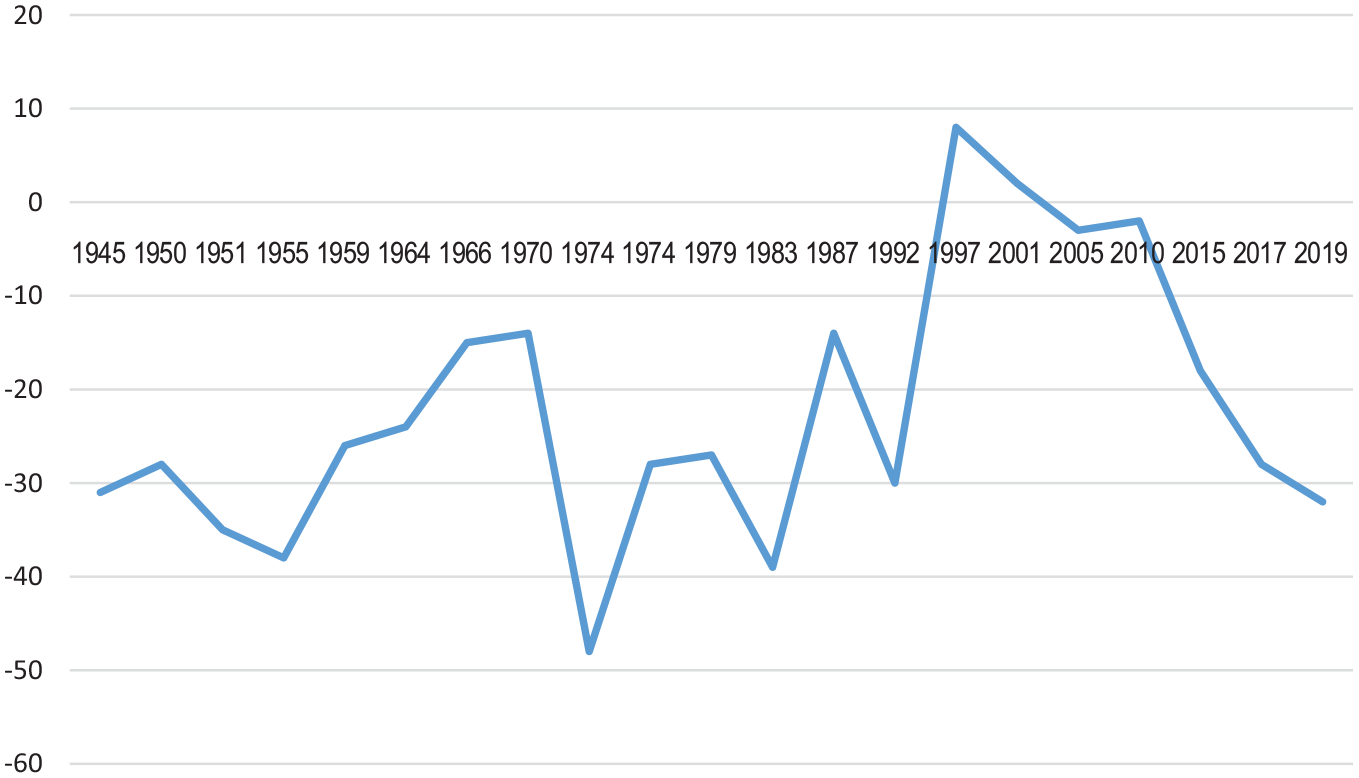
Labour Party, left–right position 1945–2017.
III
How can Labour’s policy movements be explained? One answer which is found frequently within both academic literature and media-political commentary is that Labour swings alternately left and right in response to the inescapable tension between ideology and electability.
Labour was founded as an ideologically left-wing party. Labour and the New Social Order, for example, offers an unambiguous denunciation of the ‘degradation and brutalisation of capitalism’ (Labour, 1918, 2). Yet the problem the party has always faced, in a country in which most voters do not self-identify as being on the left, is of attracting enough votes to secure office. This has resulted in a constant pressure on the party’s leadership to compromise with the electorate and to move to the right in order to win power.
Within the academy, this electoral–ideological explanation of policy shifts finds its most obvious underpinnings in the median voter theorem articulated in Anthony Downs’ (1957) An Economic Theory of Democracy. Downs, we should emphasise, offers a more nuanced analysis of party’s spatial positioning than is often recognised. In particular, once he has offered an account of how parties find it in their interests to move towards the position of the median voter, Downs discusses the ways in which different assumptions about voters, voting and political parties might lead to different results. Nevertheless, Downs’ work and his basic account of the centripetal dynamics of party competition remains hugely influential.
In the first place, Downs’ argument (along with Duncan Black’s (1948) more formal statement) continues to provide a foundational anchor for subsequent work within rational choice theory on spatial party competition (see Grofman, 2004, as an example). This includes work which, to varying degrees, directly challenge the median voter argument by emphasising the difference made by, variously, intra-party dynamics (Aldrich, 1995; Budge et al., 2010; Dunleavy, 1991; Hummel, 2010; McCarty and Schickler, 2018), multi-party competition (Adams et al., 2004; and see Shepsle, 2012 for a general review), voter uncertainty (Budge, 2009; Hinich and Munger, 1996) and expressive (rather than instrumental) voting (Brennan and Hamlin, 1998). We are not claiming that Downs’ arguments, let alone more recent post-Downsian models, should be seen in any sense as an instruction manual for politicians, electoral strategists or commentators. Rather, we highlight Downs because his arguments about party competition, even where they have since been superseded in the academic literature, can help us to make sense of why politicians of very different stripes so often claim to be at the centre-ground.
Downs’ argument, and the rational choice work it has inspired, comes with very particular methodological baggage. But it is not the only source for the electoral–ideological view. A very different analytical tradition has generated a very similar explanation of Labour’s positioning. Originating in Ralph Miliband’s (1961) analysis of Parliamentary Socialism, and Nairn’s (1964) and Anderson’s (1964) contemporary critiques, this has centred on the conflict between the party’s founding commitment to a Parliamentary political strategy and the ideology of a Marxist-inspired socialism (Wickham-Jones, 2018). For these authors, and those subsequently writing in a ‘Milibandian’ tradition, such as Coates (1975, 2005) and Leys and Panitich (2001), Labour has never been, and cannot be, a vehicle for socialism. Its basis in a conservative trade union movement, its anti-theoretical (specifically, anti-Marxist) philosophical traditions (in contrast to, for example, continental social democratic parties) and its commitment to parliamentary processes (rather than to building social movements) make it incapable of sustaining radical policy positions. In the work of Przeworski (1985), this argument is indeed connected back to rational choice theory.
Versions of the electoral–ideological explanation can also be found in other analyses. A common thread in Labour’s ideological argument since the war has been the change in the sociological composition of the electorate. The declining numbers of unionised manual workers and the growing size of the ‘aspirational’ middle class underpinned, in different ways, the arguments of Abrams and Rose (1961, ‘must Labour lose?’) and Hobsbawm (1978, ‘the forward march of Labour halted?’). Crosland, Kinnock and Blair all warned their party that it could no longer rely on traditional working-class voters and socialist traditions. The argument in each case was that as the electorate became less working class, Labour could only win by moving economically to the right.
Yet there is a very different way of explaining Labour’s policy movements: one which focuses upon the economic context in which policy is made. The Labour party was established to promote the interests of labour and achieve greater economic equality. At its inception, as already noted, it believed that this required the replacement, or at least fundamental reform, of the capitalist system. This ‘democratic socialist’ position informed the party’s 1945 programme and it remained largely unchallenged until the 1950s. It was at this point that Anthony Crosland (1952, 1956) developed the ‘revisionist’ position that Labour could achieve its goal of reducing inequality through higher taxation and more generous funding of public services. At the heart of Crosland’s argument was the claim that capitalism had changed from the dysfunctional model of the pre-war period. Future economic growth could now reasonably be assumed; the ownership and management of companies had been separated; managers were now willing to work with trade unions to negotiate pay; and unemployment could be maintained at low levels by Keynesian demand management. Capitalism no longer needed to be replaced or be radically reformed. Instead, Labour could redistribute the proceeds of capitalist growth through public spending and taxation.
The revisionist position was resuscitated in the 1980s by Neil Kinnock (1987) and his deputy Roy Hattersley (1987). It was further developed by Tony Blair, who described New Labour as following a ‘Third Way’ between left and right (Blair, 1998), and by Gordon Brown. Brown (1994) defined socialism in terms of equal opportunity, argued that globalisation and the end of the norm of full-time male employment had changed the nature of the economy, and proposed an economic programme based on full employment, better workforce skills and reform of the welfare state with progressive taxation to end poverty.
Critical both to the argument of this revisionist position and to its acceptance in the party was the strong performance of the UK economy in each of these periods. Whereas the Labour manifesto of 1983 was written at the height of the recession and mass unemployment brought about by Thatcher’s early economic policy, Kinnock’s shift of the party to the right occurred when growth had resumed. As Thorpe notes, Kinnock’s Policy Review was ‘buttressed by, even predicated upon, the “boom” conditions which were clearly prevailing by the end of 1985’ (Thorpe, 1997, 220). This upswing ended with a sharp recession between 1990 and 1992. But by the time Blair was elected Labour’s leader in 1994, the age of the ‘great moderation’ (Bernanke, 2004) had begun. The period from 1992 to 2008 saw the longest economic boom in more than a century (Hay, 2011). Low inflation was combined with rising employment levels and rising household income. Higher incomes and corporate tax yields in turn made possible sustained increases in expenditure on public services and social security benefits. With the precarious financial models on which the growth of the 2000s rested not yet properly understood, the Labour government enjoyed their fruits, seeing its tax revenues boosted by the booming profits and bonuses of the City of London (Richards, 2010).
In this way, the contemporary performance of the UK economy was a critical foundation of the redistributive economic policy positions taken by Labour in the second half of the 1950s and 1980s and in the period from 1994 to 2008. Equally, it was also central to the structural reform approach to economic policy to which Labour swung at other moments.
In 1945, the new Labour government was faced not simply by an economy ravaged by war and a national debt of almost 250% of gross domestic product (GDP). It had to confront an economic system which had proved incapable of addressing the mass unemployment and poverty of the Great Depression. An interventionist economic policy based on planning, market controls and nationalisation represented therefore not just the ideological conviction of the Labour leadership. It was widely seen as economically necessary (Tomlinson, 1989). Only by restructuring British capitalism could Labour hope to create the conditions for steady economic growth, and therefore to provide the resources for the creation of the National Health Service (NHS) and the implementation of the Beveridge Report which were its primary political goals.
The situation in the early 1980s was equally, if differently, crisis-ridden. The Labour governments of Wilson and Callaghan had been unable to stabilise the UK economy after the collapse of the Bretton Woods system and the oil price shocks of the early 1970s, and the ‘stagflation’ which followed (Whiteley, 1983). The government’s budget deficit had soared, forcing the humiliating appeal to the International Monetary Fund (IMF) for financial support in 1976. The UK’s poorly managed and under-invested nationalised industries, its weak manufacturing and export performance and apparently over-powerful trade unions had given it the widely used label of ‘the sick man of Europe’. By 1980–1981, it was also clear that the anti-inflationary policies of Margaret Thatcher’s government – restricting the money supply, slashing public expenditure and raising value-added tax – had caused a huge loss of competitiveness as the exchange rate rose, leading not just to the deepest slump since the war and a devastating rise in unemployment, but to the incipient destruction of many of the country’s longest established industries.
In such conditions, it was hardly surprising that Labour turned to a different approach to economic policy altogether, one centred on structural reform. The so-called Alternative Economic Strategy (AES) which underpinned the party’s 1983 manifesto was a product of a decade of economic rethinking on the left (Conference of Socialist Economists (CSE) London Working Group, 1980; Holland, 1975; Rowthorn, 1980). Although there were different versions of the AES, its core was an analysis that the UK’s economic weaknesses arose from two sources. One was the historic role of the City of London, whose interests lay in global financial trading, not investment in UK industry, and whose threat of capital flight acted as a constant constraint on a reflationary fiscal policy. The other was the changing character of a modern capitalist economy. Industrial concentration had created powerful near-monopoly companies, many of them now multinational, which were no longer constrained by market competition or commitment to investment in the United Kingdom. The necessary policy response, the AES proposed, was an industrial strategy based on extended public ownership, industrial democracy and planning agreements with individual firms; a national economic plan coordinating this with a reflationary fiscal policy to achieve full employment; and regulatory controls on prices, imports and international capital movements. Such a programme was adopted more or less wholesale in the 1983 manifesto (Thompson, 2006).
By 2010, the UK economy was again in crisis. The financial crash of 2008 had led to the largest fall in output since the Great Depression, with over a million people made unemployed. It became clear that the apparently benign growth of the previous decade had been founded on an unsustainable rise in household and commercial debt, and that rising asset prices had led to a huge increase in wealth inequality. Over the next few years, as the Coalition Government’s austerity policies cut public services and public investment, productivity stalled, wages stagnated and the number of workers on precarious zero-hour contracts soared, it was evident that the existing growth model was no longer viable (Jacobs et al., 2016). Again, the response of the Labour Party was a shift to a structural reform position to address the causes of the crisis. Under Ed Miliband, it advocated an active industrial strategy supported by a new National Investment Bank and regional economic development policies, the renationalisation of the railways, price caps on energy companies and reform of corporate governance to put elected workers on company boards (Diamond, 2013). Under Jeremy Corbyn, its renationalisation programme was extended to other sectors; its industrial strategy added a major increase in public investment and a specific focus on ‘green industrial revolution’ to address the gathering climate crisis; and Labour committed to raising corporation tax and introducing a financial transaction tax (Labour Party, 2017, 2019; Bassett, 2019).
In each of these periods, Labour’s policy position shifted to the left for essentially the same reason. Labour’s leadership (and more widely its membership) came to the conclusion that the crisis in the economy could only be solved by a programme of government-led structural reform. Redistributing the fruits of growth was not enough to achieve Labour’s egalitarian purpose – not least because there wasn’t much growth to redistribute. Profound weaknesses in the UK model of capitalism could only be tackled by systematic government intervention.
This, then, is the alternative political economy–policy explanation for Labour’s spatial movements. Labour’s policy positioning shifts as a result of changes in the external economic environment. Labour moves to the right and adopts a redistributive economic strategy (emphasising higher spending on public services and welfare) when the economy is performing reasonably well. It moves to the left and proposes a structural economic reform programme (emphasising government intervention in investment and ownership) when the economy is performing badly.
It is important to recognise that what counts as good and bad economic performance is not fixed. It is judged relative to recent experience and expectations. With the benefit of hindsight, the slowdown in economic growth in the early 1960s (which we discuss below) and the stagflation of the 1970s were not nearly as severe problems as the major recessions of the early 1980s and post-2008 periods. Nevertheless, both were unquestionably perceived at the time as troubling indications of national economic decline, especially relative to the boom years of the 1950s. In this sense, perceptions of economic performance are not objective and timeless. They reflect contemporary public and political discourse. It is this which determines the economic choices made by politicians. Indeed, that discourse will partially be constructed by politicians themselves, seeking to persuade the public that things are going well or ill. It is to the debate that the politicians will respond, not simply to the data.
IV
The electoral–ideological and political economy–policy explanations for Labour’s policy shifts are not the only ones available. Various scholars have sought to explain the ideological positions parties adopt and the relationship between those positions and specific policy choices with reference to a range of other factors. These include changes in the values of the electorate; changes in organisational membership; partisan and class dealignment; the development of new policy challenges and new policy ideas; intra-party conflict; the imperatives of coalition-building; perceptions of competence; organisational resources and political marketing; and the properties of electoral systems (Dalton et al., 2011; Bale and Webb, 2021; Dommett, 2020).
We focus on these two broader approaches for two principal reasons.
First, as we have noted, the electoral–ideological explanation is a commonplace of day-to-day political argument about how elections are won and lost (see, for example, Freedland, 2021, for a specific reference to the median voter theory). As Hay (1999) observes, whether formally acknowledged or not, versions of the median voter argument have often been used by politicians to justify policy moves to the centre. At the present moment, in ways familiar to anyone who has lived through previous iterations of Labour’s left–right disputes, the claim that elections are won at the centre-ground is a key feature of debates about Labour’s strategy and electoral prospects (Allen, 2020). Crudely, ‘New Labour’ supporters insist that Labour’s election victories in 1997, 2001 and 2005 were products of its shift towards the centre-ground, and the losses in 2015, 2017 and 2019 due to its movements away from it.
Second, while the electoral–ideological and the political economy–policy explanations both fit quite a lot of the facts of Labour’s economic policy history, we believe that the latter offers a more accurate account of how policy change actually occurs.
We shall discuss this in more depth in the next section. Before doing that, however, we need to examine the period we have carefully avoided so far, from 1960 to 1975, for it sheds a helpful light on our argument. The Manifesto Project analysis (Figure 1) suggests that Wilson’s 1964, 1966, 1970 manifestos were all to the right of their predecessors. Wilson is indeed today often seen as being on the right of the Labour Party (Fielding, 2007; Thorpe, 1997). This then would fit with an electoral–ideological explanation of Labour policy positioning. After losing the 1959 election, Labour moved further to the right in pursuit of the votes it had failed to win in the two elections before, and succeeded twice, in both 1964 and 1966.
But this account is unsatisfactory. Wilson in 1960 was not seen as being on the party’s right. He had been a left-wing Bevanite in the 1950s and had stood for the leadership against both Gaitskell (in 1960), and George Brown and James Callaghan (in 1963) from the left (Heppell, 2010). More importantly, in terms of specifically economic policy – rather than policy across the range of the Manifesto Project’s issue criteria – Labour’s manifestos in 1964 and 1966 were not to the right of its platform in 1959. Labour’s 1964 manifesto promised to introduce ‘socialist planning’, proposing a new Ministry of Economic Affairs and Ministry of Technology, regional planning, a detailed Charter of Rights for all employees, stricter controls over monopolies and mergers, and a national incomes policy (Labour Party, 1964). None of this had appeared in the 1959 manifesto, in which economic policy was limited to a few imprecise paragraphs (Labour Party, 1959). Labour’s 1966 manifesto spelled out its economic planning commitments in even greater detail. This included the public ownership of ports and the use of a new Industrial Reorganisation Corporation to restructure Britain’s major industrial sectors (Labour Party, 1966).
Why did Wilson propose such a radical economic programme? In 1955 and 1959, the Conservatives had campaigned on their ‘never had it so good’ economic record. By the early 1960s, however, the UK economy was faltering. A balance of payments surplus in 1958 had turned into an even larger deficit in 1960, at a time when a positive balance of payments was seen as both a symbol of and a precondition for economic prosperity. The economy fell into recession in late 1961, and contracted further in 1962. From around 1960 onwards there was a growing sense in public commentary that Britain was falling behind other economies, particularly in manufacturing investment and technological development (Koestler, 1963; Kynaston, 2014; Shanks, 1961). The 1964 general election was dominated by arguments about the poor performance of the UK economy (Barberis, 2007). As a result, as Wilson’s biographer Ben Pimlott (1992: 276) has noted, by 1964 both political consensus and public sentiment in relation to economic policy had already shifted towards Labour’s platform of planning and reform.
So the political economy–policy explanation is not simply that Labour shifts to the left in periods of perceived and real economic crisis. It is that Labour succeeds electorally in such shifts when the public mood has also changed, making voters more conducive to the arguments for structural economic reform. This is important, because it challenges a core assumption of the electoral–ideological explanation, which is that a majority of the electorate will always be repelled by more radical economic policies. This simply isn’t the case. Labour won in 1945, 1964 and 1966 on left-of-centre platforms of structural economic reform, because it persuaded enough of the electorate that the perceived economic crisis of the time made such reform appropriate and necessary. Margaret Thatcher won in 1983 and 1987 on comparably radical right-wing reforming manifestos (Cannadine, 2017). On this account, public opinion, and its relationship to political parties, is much more mutable than the electoral–ideological explanation allows. Parties do not simply have to accommodate themselves to fixed electoral preferences. Such preferences can change – and parties can shape them. 2
V
The period under Wilson is important in this argument because it reminds us that Labour does not always win from the economic centre-ground. (It also points to the significant gap that can arise between manifesto promises and government practice.) There is, however, another reason why we favour the political economy–policy account of party positioning. Political parties, contrary to the assumptions of Downsian-derived models, do not simply engage in electoral calculation, identifying and then moving towards the position of the median voter. They adopt and change policies also as a result of reasoned argument about the efficacy of different policy options to achieve their goals – with such reasoning dependent on, and therefore changing according to, the economic context in which policy is being made.
The Downsian theory of party competition, in common with other rational choice approaches, has a singular neglect of the capacity of agents to reason about the circumstances they find themselves in, and therefore the policies they should adopt (Hampsher-Monk and Hindmoor, 2010). Given their assumptions, such theories conclude that parties will inevitably gravitate towards the position of the median voter. Later models, which relax some of Downs’ initial assumptions, provide a more complex account of political goals, including policy-seeking (as well as office-seeking), ideological consistency (building on Downs’ own observations, 1957, 103-9) and political survival. Yet, even here, the trade-offs between goals are mediated mechanically, resulting in optimal, albeit complex, utility-maximising choices. Rational choice theories of party competition can be used to generate precise predictions about party positioning because they effectively exclude the possibility of agency, and any form of reasoning other than around voter preferences.
In particular, rational choice models ignore the ways in which policy ideas are developed and arguments are won and lost. In practice, parties engage in policy reasoning: substantive debates about the merits of alternative policies and the likelihood of their being successful in achieving the party’s goals. Such arguments are the lifeblood of political parties, of all ideological kinds.
In turn, such arguments help explain why particular factions within parties win out at different times. This is not simply a matter of how many fixed adherents such factions have: it is of the persuasiveness of their arguments in winning over the undecided, whether that is among a political leadership group with the power to determine policy or a wider party membership. Meaningful policy reasoning requires that at least some of the participants in such arguments do not have inviolably fixed ideological views on what the correct policy course of action is. Their views can change.
Within such debates on economic policy, the economic context is critical. Economic policy arguments are always historically situated: they are about what policies are needed given the performance of the economy at that time. And it is this which explains not just why but when Labour – or indeed any other political party – shifts between its economic poles. When the economy is performing reasonably well, with persistent economic growth, relatively high employment levels and therefore buoyant public revenues, arguments that a purely redistributive approach is appropriate are more likely to gain traction. Structural economic reform is difficult: it requires new competencies of the state, vested interests to be taken on and time to work. When the economy is performing well, such reform may appear not just difficult but unnecessary. By the same token, it is when the economy is in crisis or performing relatively poorly, reflecting its underlying weaknesses, that the structural reform approach comes to the fore.
This process of policy reasoning is clearly revealed in accounts of Labour Party policy making which cite contemporary policy papers and the recollections of the protagonists. In these studies, we see vigorous policy disagreements conducted, not simply in terms of what will be electorally popular or not (indeed sometimes with almost no attention to this), but in terms of different policies’ likely effectiveness in solving the economic problems faced at the time and achieving the party’s egalitarian aims. Our own interviews with some of the key figures in such arguments over the last 50 years confirm this perception. We can illustrate it with three examples.
The first relates to the drawing up of Labour’s 1973 Programme, which went on to form the basis of the party’s manifesto in both 1974 elections. It included a commitment to the creation of a National Enterprise Board which would take strategic stakes in leading industrial companies, and to ‘planning agreements’ with these and other companies in return for public investment and other support. These proposals represented a significant shift to the left from the 1970 manifesto. As detailed and personal accounts of Labour’s internal policy processes show (Bell, 2004; Callaghan, 2000; Hatfield, 1978; Holland, 2004; Wickham-Jones, 1996; Holland, interview, 2020), the new policies emerged from an analysis by Wilson’s former economic adviser Stuart Holland of Britain’s industrial weaknesses, the growth of multinational corporations and the failures of the 1964–1970 government. Holland’s prescriptions differed both from those of Labour’s left, who advocated wholesale nationalisation of leading companies, and from those on its right, who believed that a broad national economic plan, coupled with prices and incomes policies, would stimulate sufficient growth. Studying these debates, it is clear that many of Labour’s leading figures changed their views in response, and not in a self-evidently ideological way. Tony Crosland was Holland’s chief opponent. But Roy Jenkins, another on the party’s right, initially supported Holland’s view, going so far as to ask him to draft a speech on the matter, which the former Chancellor then published in his 1972 book What Matters Now (Jenkins, 1972, Holland, interview, 2020). While Crosland certainly argued that Holland’s proposals would be difficult to sell to the voters, it was policy reasoning among its key policymakers, not electoral considerations, which determined Labour’s shift.
A similar process is evident in the formation of New Labour’s economic policy in the 1990s (Fielding, 2003; Gould, 1995; Hay, 1999; Heffernan, 2001; Hill, 2001; B. Gould, interview, 2020). After the election defeat in 1992, Blair and Brown, and their advisers Peter Mandelson and Phillip Gould, were determined that Labour should no longer be seen by voters as a party of high taxation (Gould, 1998). But the party’s economic revisionism went much further than this. In speeches and pamphlets (Blair, 1996; Brown, 1994), its leaders argued that modern capitalism had radically changed. Globalisation meant it was impossible to regulate business within national borders. To promote economic growth and a fairer distribution of its rewards, the job of a Labour government was, first, to maintain conditions of economic stability, particularly in terms of inflation, and second, to develop the supply side of the economy, notably in education and skills. Strong economic growth after ‘Black Wednesday’ in 1992 aided their case, along with the growing transatlantic policy consensus among macroeconomists, based on new theories of endogenous growth and inflation targeting by central banks. In making these arguments, Blair and Brown took on, and defeated, those in the party, centred around former shadow industry spokesman Bryan Gould and the Tribune Group, who sought a more active Keynesian approach to fiscal policy aimed at full employment (Berry and Hain, 1993; Gould, 1995). There is little doubt that electoral considerations played an important part in Labour’s shift to the right in this period. But a much broader argument was won in the party as well, based on policy reasoning about the nature of the economy and how to manage it best.
A third example can be taken from the end of the Labour government (Seldon and Lodge, 2011). Ed Miliband is generally regarded as the person who took Labour to the left after its defeat in 2010. But it was actually Peter Mandelson, one of the original architects of New Labour, who as Business Secretary in 2008–2010 first revived an interventionist industrial strategy. As his adviser Roger Liddle explained (Liddle, interview, 2020), after the precipitous decline in investment and output which followed the great financial crash, Mandelson was convinced that the government had to step in to support British industry get back on its feet. Gordon Brown and the Chancellor, Alistair Darling, were initially sceptical but eventually persuaded, and an active industrial strategy appeared in Labour’s 2010 manifesto (Labour Party, 2010). This shift in policy position, by three of New Labour’s most convinced opponents of industrial strategy a decade before, arose because economic conditions had changed, and policy reasoning prevailed. Comparable arguments among Ed Miliband’s shadow cabinet and advisers persuaded him similarly that the failings of austerity and the continued weakness of productivity meant that Labour’s economic policy after the crash had to be more interventionist (Wood, interview, 2020).
Policy reasoning of this kind is not confined to parties. Public opinion too shifts when economic conditions change. When the economy is performing badly, it is hardly surprising that public appetite for more radical economic policy – for structural reform measures of various kinds – can increase. It is notable, for example, that support for higher public spending and taxation rose to a 15-year high in 2017, just when Labour was espousing such a position (NatCen, 2018). Between 2017 and 2019, public support for renationalisation of the railways, Royal Mail and water and energy companies increased (Hall, 2020). There was surely both cause and effect here: Labour was both responding to public opinion and helping to shape it. It is because of this that Labour’s structural reformers have been able to argue, at such moments, that moving the Labour Party to the left is not the electoral suicide the right claims, but, rather, is potentially popular. Such a strategy was manifested in both Wilson’s rhetoric of technological advance in 1964 and 1966 and Corbyn’s anti-austerity stance in 2017.
Voters do not need to believe that they have shifted their own location. Many may perceive themselves still to be in the centre-ground, insofar as they associate this with political moderation and pragmatic good sense rather than, more narrowly and precisely, with the position of the median voter. The political centre-ground is not fixed and exogenously determined; it is constructed (Hindmoor, 2004). New Labour sought, often successfully, to persuade voters that policies like a minimum wage and a windfall tax on utilities were not examples of old-style socialism. As Corbyn (2017) told the Labour Party conference in 2017:
It is often said that elections can only be won from the centre ground. And in a way that’s not wrong – so long as it’s clear that the political centre of gravity isn’t fixed or unmovable, nor is it where the establishment pundits like to think it is. (Corbyn, 2017)
The possibility of adopting preference-shaping (as opposed to preference-accommodation) strategies as a means of winning votes is recognised within the rational choice literature on party competition (Dunleavy, 1991). Riker’s (1986) concept of ‘heresthetics’ further emphasises the way in which issue choice and framing can yield competitive advantage (see also McLean, 2001). The way is open here to see how the electoral–ideological and political economy–policy explanations may therefore converge. If preference-shaping is successful enough, the median voter may end up where the radical reformers want them. The key argument underlying the political economy–policy explanation nevertheless remains: the likely electoral success of policy arguments at any particular time will be determined and constrained by current economic conditions, and by substantive reasons why such policies will lead to better economic performance.
Recognising the role of policy reasoning of this kind casts a new light on some important arguments of Labour historiography. In the late 1990s, for example, Mark Wickham-Jones (1995a, 1995b, 1997) and Colin Hay (1994, 1997, 1999) engaged in an important dispute about New Labour’s economic stance. In essence, Wickham-Jones argued that the adoption by Blair and Brown of an essentially neoliberal approach to globalisation and the role of the state – seeking not to resist the former and taking a relatively non-interventionist position on the latter – was more or less inevitable given the finance-dominated structure of UK capitalism and its weak labour market institutions. Hay demurred, arguing that Labour had a choice, with an investment-led industrial strategy a realistic and more desirable alternative.
Looking back on the United Kingdom and global economic context in which this debate occurred, it is now possible to acknowledge a third option: that Labour did have a choice, as Hay claimed, but that in the circumstances of the time, New Labour’s approach was in fact an entirely reasonable one. By the late 1990s, the UK economy had already experienced a long period of growth. Few economists were, at that time, pointing to the unsustainable foundations which would become clear a decade later (Hindmoor and McConnell, 2014, 2015). Why not go for a redistributive strategy?
Understanding the role of policy reasoning therefore gives us a much richer way of explaining why, and when, political parties change policy positions. It also offers a new way of thinking about how individuals may do so. Much political analysis assumes that those engaged in politics – politicians and party members – have fixed positions along the left–right spectrum. They are ‘on the left’ or ‘on the right’, and always so. Policy reasoning does not lend itself to such a static perspective. When economic conditions change, it is not unreasonable – indeed it may be highly logical – for politicians and party members, as indeed for members of the public, to change their minds. What appeared to them the right policy approach in benign conditions of economic growth and rising public revenues might appear wholly inappropriate when the economy slumps and major structural flaws are revealed. It might be entirely rational, in other words, for the same person to be a Blairite (or Brownite) in the 2000s, and a Corbynista (or at least a McDonnellista) in the 2010s. In such different economic conditions, someone with consistent egalitarian goals may reasonably favour in the two periods quite different policy prescriptions to achieve them.
VI
The political economy–policy explanation for Labour’s spatial movements casts new light on Labour’s current predicament. Since the party’s catastrophic defeat in the 2019 election, it has been almost universally assumed that Labour’s new leader Keir Starmer has to take the party rightward, back to the centre-ground of politics. Informed (often without much examination) by the electoral–ideological account, media commentary has regarded it as more or less obvious that this is what Starmer must do to win back voter support (see, for example, Rea, 2020; Rentoul, 2020). Starmer’s party conference speech in 2021 appeared to indicate that he agreed (The Times, 2021).
The political economy–policy analysis would suggest something different. The economic conditions which gave rise to the party’s leftward shift after 2010 have not gone away. Indeed, the Covid-19 crisis has made them worse. The UK economy is still characterised by low investment, low productivity and low wages (OECD, 2020). Millions of workers experience an increasingly precarious labour market of self-employed, zero-hour and part-time contracts (TUC, 2019). Deep divides remain between London and the South East and the rest of the country (Department for Levelling Up, Housing and Communities, 2022). The UK’s banking system remains unreformed, disproportionately invested in land and property, and its corporate sector largely focused on short-term profits and shareholder dividend payments (Christophers, 2020). The ‘cost of living crisis’ consequent upon high inflation, which seems likely to dominate domestic politics in 2022–2023, could reasonably be said to require solutions which go beyond centrist ‘sticking-plasters’ and towards deeper structural reforms (Meadway, 2022).
It is clear that Labour’s next manifesto will be closer to the centre than 2019’s. But it should not be seen as a foregone conclusion that Labour either must or will fight the next election on a manifesto closer to those of Tony Blair than those of Jeremy Corbyn. Almost no economic commentators think this would be adequate (see, for example, Wolf, 2019). In economic policy, public opinion has remained quite far to the left, supportive of many of Labour’s 2017 and 2019 policies (Inman, 2019). And indeed the speech made by Shadow Chancellor Rachel Reeves at the same 2021 party conference proposed a variety of structural reforms, from industrial and procurement policy aimed at reviving UK industry to collective wage bargaining and corporate governance reform (Reeves, 2021).
With an election not due till 2024, it would of course be unwise to predict either the state of the economy by then or Labour’s policy stance towards it. But the kind of policy reasoning by which the party has made policy in the past – and on more than one occasion persuaded the public to follow it – does not suggest that the outcome is, or should be, a foregone conclusion.
Footnotes
Acknowledgements
The authors would like to thank the editorial team at the British Journal of Politics and International Relations, particularly Richard Hayton, along with two referees who offered detailed and helpful comments on earlier drafts. We would also like to thank Andrew Gamble and Colin Hay for their thoughts and suggestions.
Funding
The author(s) received no financial support for the research, authorship, and/or publication of this article.
