




Abstract
Populist leaders base their electoral appeal on underlying their agenda with claims to authenticity reflected both in the content and in the style of their political communication. Based on a conceptualisation of authenticity as discursive performance, we conduct a comparative analysis of the authenticity claims of two right-wing populist leaders, Boris Johnson and Donald Trump. We focus on authenticity claims associated with international politics. International issues are central to populist exclusionary narratives, but also difficult for populist incumbents to narrate authentically. We find that despite differences in their public personas, Johnson and Trump show considerable similarities in both content and style of their authenticity performances. In particular, they ‘domesticate’ international politics to reinforce domestic issues assumed closer to ‘ordinary’ voters, all the while employing rhetorical styles suggestive of their authenticity. These findings highlight the centrality of authenticity performances to populist politics and electoral appeal.
Keywords
Introduction
The electoral success of populist leaders has challenged international order because it threatened to break with decades of post-war tradition in foreign policy. Right-wing populist agendas on both sides of the Atlantic have challenged core values of liberal internationalism – alliances, multilateralism, international law, and trade agreements, and democratic norms like human rights (Destradi and Plagemann, 2019; Ikenberry, 2017; Voeten, 2020). Populists are electorally appealing because they are perceived as authentic. Their authenticity relates both to their political ideas and to their rhetorical style: they ‘say it like it is’. Despite much definitional divergence, most scholars agree that populism rests on the distinction between two antagonistic groups – the ‘pure people’ and the ‘corrupt elite’ – and associated demands that politics operate exclusively as an expression of the former’s interests and will (Mudde, 2004). This ‘thin’ ideational commitment is ‘performed, embodied and enacted’ in different contexts, including through language (Moffitt, 2016: 3). Accordingly, we focus on populism as a combination of ideas and rhetorical style to argue that central to populist political communication is the discursive performance of authenticity.
Authenticity has recently attracted scholarly attention precisely because of its linkage to populism (Bossetta, 2017; Enli, 2017; Enli and Rosenberg, 2018; Pillow et al., 2018; Stiers et al., 2019; Wood et al., 2016). We understand authenticity as a social construct ‘created and negotiated in different communication processes among politicians, the media, and the audience’ that refers to the degree a leader is perceived to be ‘true to themselves’ (Luebke, 2020: 2; Montgomery, 2017; Pillow et al., 2018). We suggest that performances of authenticity are central both to the ideational content and style of populist political rhetoric (Layoff, 2017; Montgomery, 2017; Stiers et al., 2019; Valgarðsson et al., 2020). At the core of populism is the populist’s alleged connection and proximity to the ‘authentic’ people, which they claim to represent against the ‘fake’ elite. Correspondingly, any political problem or challenge is translatable to a consistent political idea at the core of their populist agenda and familiar to voters. While populists can employ different styles (McDonnell and Ondelli, 2020), populist rhetoric often aims at ‘speaking like the people’ (Bischof and Senninger, 2018; Moffitt and Tormey, 2014). Together, populist ideas and rhetorical style aim at presenting a worldview expressing common-sensical knowledge (Holland and Fermor, 2020).
In the following, we compare two political leaders, Boris Johnson and Donald Trump, and carry out a qualitative content analysis of their Twitter communication prior to elections (November–December 2019 for Johnson; October–November 2020 for Trump). The comparative angle allows us to study cross-country variation in authenticity performances of populist incumbents on the right of the political spectrum. Drawing on recent scholarship on populism and political authenticity, we explore how these leaders communicate authentically about international politics. To that end, we propose an operationalisation of political authenticity based on variation along four categories of political communication: consistency, intimacy, ordinariness, and immediacy.
We focus on international politics and foreign policy for three main reasons. One, existing research has focused predominantly on the content and style of populist discourses and on populist communication about domestic political issues. Two, this is surprising because international political issues are closely connected to populist discourses, and often constitutive of their electoral success (Verbeek and Zaslove, 2017). Concurrently, their complexity can render authentic communication about them difficult (Meibauer, 2021: 18). Three, populist incumbents in particular face a gap between voters’ expectations of what their ‘anti-political’ approach can deliver and what the messy business of foreign policy actually produces (Flinders and Kelso, 2011). Given their experience in office, they have an even harder time portraying themselves as outsiders. For the populist incumbent seeking to perform authenticity, this compounds a strategic problem: how to ‘play the game’ competently and conduct foreign affairs successfully (‘statesperson-like’), and still be perceived as ‘just like’ (or at least clearly on the side of) their voters. Because authenticity performances are so central to populist communication, this may have international politics effects once populists are in office, for example, regarding personalisation (Destradi and Plagemann, 2019; Jenne, 2021; Schneiker, 2020).
We find that both candidates’ authenticity performances overlap in ways confirming their shared categorisation as right-wing populists. While Johnson’s and Trump’s political rhetorics differ in important ways, we suggest such differences actually indicate similar strategies to gain electoral support: not unlike other politicians, both seek to perform authenticity in ways that befit their personas and political contexts. In both cases, authenticity performances anchored in right-wing populist ideas and style whitewash far-from-ordinary biographies. This extends to their rhetoric about international politics, which they use to frame their positions on key domestic policy issues. While left-wing populists and indeed non-populist leaders likely also perform authenticity and may even do so in stylistically similar ways, Johnson’s and Trump’s form and content align in important ways. In particular, they both employ a Manichean binary of ‘elites’ and ‘people’ saturated in right-wing ideology. Their foreign policy ‘proposals’ are aimed primarily at evoking authentic concern for economic and social issues presumed much closer to the ‘everyman’, and contrasted against those of uninterested or downright hostile ‘globalist elites’. This ‘domestication’ of foreign policy is co-occurring with a search for authentic connection with the ‘ordinary’ voter, that is defined in exclusionary, nationalist, and even xenophobic terms. We contend that the shift in focus on authenticity as a core driver of populist political communication allows a more fine-grained appreciation of similarities and differences between right-wing populists and mainstream politicians than previously realised in relevant scholarship. Our framework for the empirical investigation of populist authenticity performances fits with previous research on the two leaders’ ideas and styles, showing promise for future comparative investigation of populists across the political spectrum and helping to delineate more clearly populist and non-populist electoral appeals.
Populism, authenticity, and international politics
As outlined in this special issue’s Introduction, populism remains a contested concept. Scholars disagree on whether it is best understood as a ‘thin-centred’ ideology (Mudde, 2004; Stanley, 2008), a mobilisation strategy (Weyland, 2001), or a socio-cultural frame (Aslanidis, 2015; Ostiguy, 2017; Rooduijn, 2014). Building on the literature that has addressed the importance of populist language and discourse (Aslanidis, 2015; de Vreese et al., 2018; Homolar and Löfflmann, 2021; Laclau, 2007; Moffitt, 2016; Ostiguy, 2017), we suggest that populist authenticity performances are characterised by the combination of ideational commitments in political rhetoric strategically aimed at electoral gain (Hawkins et al., 2019; Mudde, 2004). This retains the ideational approach’s strengths, especially its ability to complement the ‘thin’ veneer of populism with ‘thick’ political ideas and thereby uncover elements of consistency often considered key to authenticity claims (Mudde, 2017: 30). Concurrently, it highlights populism’s discursive characteristics, for example, the need to differentiate oneself rhetorically to be able to speak and act for ‘the people’; similar to what Kissas (2020: 269) calls a discursively patterned ‘performative ideology’.
Populists across the political spectrum claim to promote the interest of a virtuous ‘people’ against self-serving elites, especially by curbing a dangerous ‘other’ who is a threat to the people’s sovereignty. They challenge the status quo, give voice to the collective will, and promise a political order that resonates with the longings and aspirations of the true ‘people’ (Moffitt, 2015; Rooduijn, 2014). Populists lend political significance to particular narratives, symbols, and myths that serve their electoral goals, resonating with voters at an emotional level, for example, by evoking nostalgia for an imagined past (Browning, 2019; Kinnvall, 2018; Menke and Wulf, 2021). They often use a rhetorical style that enables their self-portrayal as outsiders – direct, intimate, simple, and indelicate (Bischof and Senninger, 2018; Bonikowski and Gidron, 2016; Moffitt, 2016; Ostiguy, 2017). While notable stylistic differences persist due to, for example, personal preferences and abilities, cultural contexts, societal norms, or party-political positions (Ekström et al., 2018; McDonnell and Ondelli, 2020), this shared ‘low-style’ aims to disrupt elite norms of political behaviour and challenge the status quo (Moffitt and Tormey, 2014; Ostiguy, 2017). In particular, flaunting rules of political communication through a lack of decorum, bad manners, and combative ‘low politics’ makes populists appear different and ‘authentic’ (Montgomery, 2017). 1 This signals to voters a commitment to protect their interests at all costs (Oliver and Rahn, 2016; Theye and Melling, 2018).
The discursive combination of anti-elitism, the “true” people’s sovereignty, and common-sense with politically incorrect ordinariness (in a ‘low-style’ rhetoric) is already suggestive of a particular link between populism and authenticity. In principle, appearing authentic is a central concern for all politicians (on the importance of authenticity in electoral contexts: Enli and Rosenberg, 2018; Jamieson and Waldman, 2003; M. Wood et al., 2016: 581). Non-populist leaders also make authenticity claims (Bossetta, 2017; Stiers et al., 2019); performing authenticity is not the same as populism (March, 2017). Specifically, highlighting closeness to the ‘common folk’ may be a response to declining trust and popularity of political elites. It is aimed at making politicians more relatable to voters (Ekström et al., 2018; Wood et al., 2016: 584), and more directly affecting voters’ intentions and behaviour (Stiers et al., 2019: 7). Where non-populists might highlight other characteristics desirable to voters, for example, talent or competence, populists especially rely on their supposed ability to channel the ‘will of the people’ against self-serving elites. They therefore must try hard to differentiate themselves from those deemed ‘fake’ and removed from the ordinary people’s interests and values (Stiers et al., 2019: 5). In so doing, they may aim to speak more to their voters’ emotions than their interests, for example, by evoking feelings of shared belonging. Authenticity performance is thus interlinked with the emotional underpinnings of populist politics (Homolar and Löfflmann, 2021; Kinnvall, 2018; Kissas, 2020). If successful, authenticity performances underpin the populist’s legitimacy in defining threats, fears and enemies, and speaking for the ‘people’ in the first place.
Following the relevant literature, we mean by authenticity a social construct ‘created and negotiated in different communication processes among politicians, the media, and the audience’ that refers to the degree to which a leader is and remains ‘true to themselves’ (Luebke, 2020: 2; Montgomery, 2017; Pillow et al., 2018). Authenticity is not the same as honesty or integrity; it does not require telling an objective truth or adhering to good principles (Hahl et al., 2018; Jones, 2016: 491–492). Authenticity invokes (successful claims to) ‘speaking one’s mind’, that is, presenting one’s identity, principles and ideas transparently, and committing to them consistently (Jones, 2016: 492; Luebke, 2020: 2; Stiers et al., 2019: 7). Thus, authenticity does not relate to ‘truth’ as much as to sincerity, of which it is a subset focusing on the accurate and transparent representation of beliefs that define the own self (Enli and Rosenberg, 2018: 3; Hahl et al., 2018; Stiers et al., 2019: 3–5). The opposite of authenticity is ‘fake-ness’, that is, deception about one’s self (Jones, 2016: 496; Stiers et al., 2019: 3–5).
In contrast to some authors conceptualising authenticity as a character trait (Jones, 2016; Stiers et al., 2019: 3–5), we are predominantly interested in the production of authenticity through discursive performance. As Kissas (2020: 270) suggests, ‘the performative elements of communication [. . .] are to be taken not as mere epiphenomena of political activity but as the very means of doing politics and acting politically’. We investigate not whether populists are actually authentic, but how they portray themselves as such (Shane, 2018). Understanding authenticity as discursive performance therefore means focusing on the discursive authenticity claims that politicians make. 2 These claims can then be received, interpreted, accepted, or rejected based on, for example, the degree to which they resonate with voter preferences or emotions (Alexander, 2012; Luebke, 2020: 2). Politicians perform authenticity not primarily to reveal their true selves (although they still might). Rather, performing authenticity is about being seen, or constructing themselves publicly, as authentic (Enli and Rosenberg, 2018; Liebes, 2001; Luebke, 2020: 4–5; Peterson, 2005: 1086; Wood et al., 2016: 595). Authenticity therefore results from successful performance. The resulting ‘paradox’ (Enli and Rosenberg, 2018: 3; Luebke, 2020: 2), namely that the politician’s authentic ‘true self’ is actually socially constructed, seems to hinge on an interpretation of performance as necessarily deceptive and ‘fake’, that is, inauthentic (Louden and McCauliff, 2004; Luebke, 2020: 4; Pillow et al., 2018).
Instead, our understanding of discursively performed authenticity is agnostic as to the performer’s intent to deceive. 3 The performer may make authenticity claims deceptively, knowing that they are not in fact authentic, or alternatively truly believe their own claims. In either case, we assume that their authenticity performances are strategic in the sense of a persuasive effort to attract electoral support. It primarily matters not whether their speech is (not) deceptive, but whether audiences think it is. Authenticity performances ideally appear non-strategic and non-performative (Luebke, 2020; Pillow et al., 2018; Stiers et al., 2019). Whether the speaker succeeds in this might depend more on their rhetorical skills and/or underlying ideas than their sincerity (Alexander, 2012: 167; in: Luebke, 2020: 4–5).
Authenticity performances are multi-dimensional, ‘discursive configurations’ of ideational and rhetorical elements (Kissas, 2020: 272). The most straightforward such element is the continued use of rhetoric consistent with the politician’s own self (Luebke, 2020: 4–5), that is, a leader’s character or public persona (Bossetta, 2017; Enli, 2017; Mueller et al., 2019; Pillow et al., 2018; Wood et al., 2016). More general strategies involve consistency with a political habitus, for example, taking positions against what is perceived to be the own self-interest or challenging the ‘status quo’ (Pillow et al., 2018). Voters establish consistency in terms of previously held political positions or ‘convictions’, which they associate with honesty and openness and prize at least equally as highly as other perceived candidate characteristics, for example, competence or preference alignment (Lacatus and Meibauer, 2021; Pillow et al., 2018; Sorek et al., 2018). If successful, authenticity bridges, in voter perception, the ‘expectations gap’ between what politicians promise and what they can deliver (Flinders and Kelso, 2011: 252–254). Remaining ‘true’ to one’s professed values and positions may then be more important than political success. This may be because it resonates with emotions rather than ‘rational’ policy preferences (Ekström et al., 2018; Homolar and Löfflmann, 2021; Kissas, 2020).
Authenticity performances involve prevalent appeals to ordinariness. This includes speaking differently than other politicians, violating assumed norms and expectations of normal political behaviour and even politeness. It involves relying on spontaneity, rudeness or simplicity (Ernst et al., 2019; McDonnell and Ondelli, 2020; Moffitt and Tormey, 2014; Ostiguy, 2017; Theye and Melling, 2018; Wang and Liu, 2018), as well as attempts to facilitate directness, approachability, and engagement, including on social media (Clarke and Grieve, 2019; Enli, 2017). Emotional appeals or the seemingly confessional sharing of private feelings create a sense of intimacy and shared belonging (Kinnvall, 2018; Stanyer, 2012; Wood et al., 2016). These dimensions are usually combined to operationalise authenticity in the (few) empirical investigations of its performance (Stiers et al., 2019). Following Luebke (2020), we operationalise authenticity performances as characterised (to different degrees) by elements from four categories that span ideational content and rhetorical style: consistency, intimacy, ordinariness, and immediacy.
In the below analysis, we focus on right-wing populist leaders’ authenticity performances on and about international politics for three main reasons. First, while foreign affairs represent a challenge for all politicians during electoral campaigns, scholarship on the intersection of populism and foreign policy is still in its infancy (Destradi et al., 2021). This is surprising given that international political issues, for example, migration or institutional cooperation, are closely connected to populist discourses and often constitutive of their electoral success (Verbeek and Zaslove, 2017). The combination of global political, economic, and cultural crisis narratives has frequently offered populists opportunities for electoral expansion (Caiani and Graziano, 2019; Lacatus and Meibauer, 2021). Once populists gain office, their political anti-globalist, illiberal, transactional, or isolationist tendencies - shape foreign policy (Destradi and Plagemann, 2019; Jenne, 2021). For example, far-right populists’ international impact has been argued to threaten a rules-based international order, and thus reproduce the uncertainty that brought them electoral success (Ikenberry, 2017).
Second, however, the complexity of international politics poses particular challenges to (right-wing) populist authenticity performance. On the one hand, this relates to the translation of complex, ever-changing international issues to consistent, intimate, and ordinary rhetoric, which should make these issues an unlikely candidate for authenticity claims. On the other, populist incumbents in particular face a gap between voters’ expectations of what their ‘anti-political’ approach can deliver vis-a-vis what the messy business of international politics actually produces (Flinders and Kelso, 2011). Their ‘un-normal’ behaviour in office clashes with the political approach most likely to bring desired results. The successful management of international issues hinges on cooperation, compromise, secrecy, and adherence to conventional norms of international conduct. This produces a problem for populist leaders having to ‘play the game’ to conduct foreign affairs successfully and be perceived as authentically ‘just like’ their voters (Jones, 2016; Wood et al., 2016: 581–582).
Third, on the right side of the political spectrum, populists tend to advance an exclusionary, nativist view of the ‘people’ that perceives cultural, religious, linguistic, and racial minorities as threatening (Bonikowski, 2017). They legitimate their claim to power by criticising the elites’ ‘globalist’ policies and ideologies, including cosmopolitanism, institutional integration, and multilateralism. Their rhetoric about reclaiming sovereignty appeals to nostalgic nationalism, fears of threatening ‘others’, and anxieties surrounding the impacts of globalisation, which may aid electoral mobilisation (Browning, 2019; Oliver and Rahn, 2016). Focusing on right-wing populist authenticity performances is a methodological choice, as there is little in the above framework that may not similarly be applied to left-wing populists. However, in contrast to prominent left-wing populist leaders, the two right-wing populists here under investigation – Donald Trump and Boris Johnson – may be suspected to have a hard time performing authenticity (e.g. regarding ‘ordinariness’) due to their own elite background. This puts their strategies for doing so in sharp focus. Concurrently, the overlap in their incumbency and shared language makes comparing them both easier and particularly fruitful. Both have attracted considerable scholarly attention: Trump’s political ideas and style are often considered far-right populist par excellence (Boucher and Thies, 2019; Holland and Fermor, 2020; Lacatus, 2020; Lowndes, 2017; Oliver and Rahn, 2016; Wang and Liu, 2018). Johnson’s categorisation as a right-wing populist remains contested (Casiraghi, 2021; De Luca, 2021; Norris and Inglehart, 2019; Smith et al., 2020). We contend that a close examination and comparison of how these populist leaders discursively perform authenticity can sharpen the conceptual boundaries of right-wing populist communication. It is important for our understanding of their leadership in office, and adds to still-nascent comparative scholarship on populist foreign policy (Destradi et al., 2021).
Methods
To examine populist authenticity performances about international politics, we offer a cross-case analysis based on a qualitative content analysis of the Twitter accounts of Boris Johnson and Donald Trump during the month prior to the 2019 UK parliamentary election (12 November–12 December 2019) and 2020 US presidential election (3 October–3 November 2020). The pre-election phase was purposely selected: incumbents of any type are likely to communicate on pressing issues and simultaneously seek to mobilise voter support. If authenticity performances are a primary tool of their electoral strategy, this should mean that authenticity indicators are prevalent for both leaders. We expect these authenticity performances to be tied to expressions of right-wing political ideas. Concurrently, both elections centred on international politics to an unusual degree, especially in the UK case.
Twitter has become a common tool for politicians, including populists, to communicate directly with voters (Clarke and Grieve, 2019; Ernst et al., 2019; Stier et al., 2018). It allows for the immediacy, intimacy, and spontaneity that mediated accounts, even interviews, do not (Enli and Rosenberg, 2018; Luebke, 2020). Through their personal Twitter accounts, @BorisJohnson and @realDonaldTrump, the two leaders share their views on political developments and seek to advance their re-election campaigns. Importantly, their use of the social media platform presumably targets not only Twitter users, but also mass media reporting their activity to larger audiences.
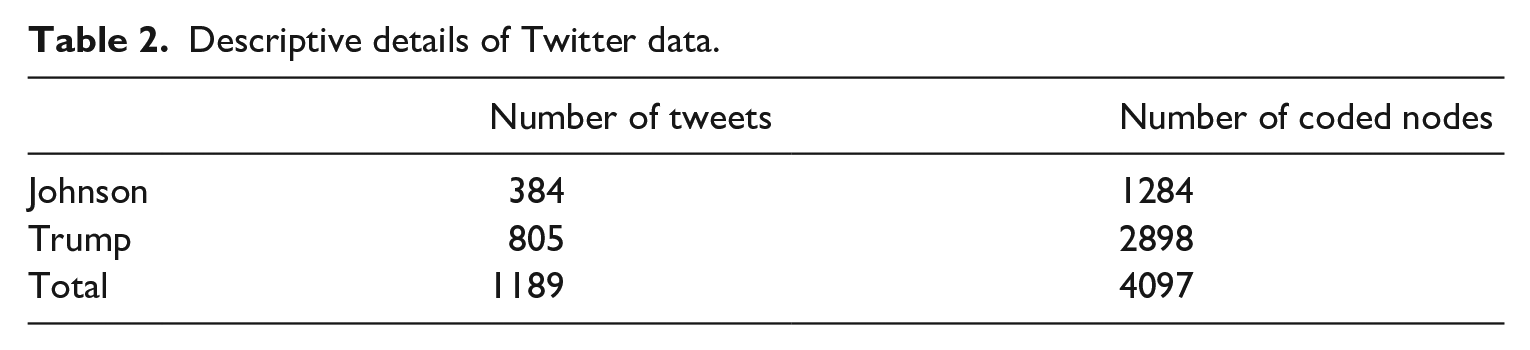
We perform qualitative content analysis on tweets from @BorisJohnson and @realDonaldTrump (Table 2; for similar approaches: Enli, 2017; Lacatus, 2019, 2020; Stier et al., 2018). Coding was carried out using NVivo, a content analysis software that generates qualitative and quantitative data based on coded texts. The coders used the operationalisation of authenticity developed above (Table 1) and identified relevant indicators in the two Twitter-spheres. Textual data was coded according to the most appropriate thematic category. These categories consist of ‘idea clusters’ that share features and resist reductive essentialisation (Spiro and Jehng, 1990). Coding was done manually and followed the same set scheme for both politicians’ tweets. Although coders identified additional nodes in the politicians’ communication, the authenticity indicators in Table 2 were included in the codebook and became the main analytical focus in addition to the foreign policy-related themes. Next, indicators and nodes were grouped in larger thematic categories based on thematic similarity reported below (Figure 1). The Supplemental Appendix includes details on coding scheme, frequency tables and inter-coder reliability.
Authenticity indicators per category, based on Luebke (2020).

Descriptive details of Twitter data.
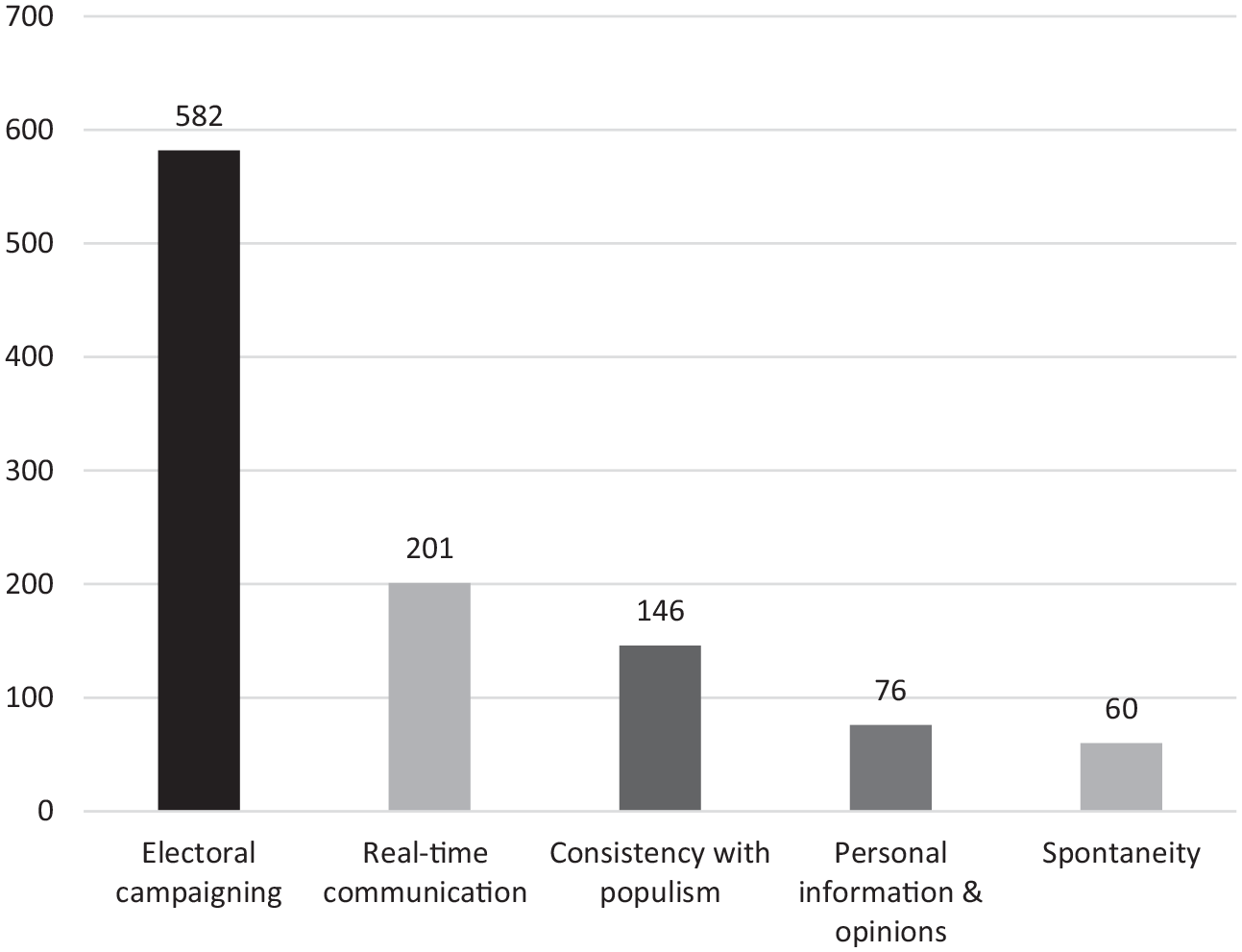
Themes (categories of aggregated nodes) occurring in Johnson’s (November–December 2019) and Trump’s campaign Twitter-spheres (October–November 2020).
Populist authenticity performances and international politics
We find that several themes (24 coded nodes) occur in both politicians’ political communication. These themes present the respective performer as authentic, indicating their interest in immediate, ‘real-time’, and ‘spontaneous’ communication that offers a window into not only their political agendas, but also personal opinions and feelings. This aims at establishing an intimate, emotional connection. The two candidates seek to mobilise supporters through two main ways of performing authenticity. First, stylistically, they focus on creating a sense of immediacy and closeness with their electorate. Trump and Johnson favour real-time, seemingly spontaneous communication that allows them to share quick reactions to external events or media reporting. Second, content-wise, both candidates prioritise ideas that signal consistency with tried-and-tested populist messages familiar to their electorates from previous campaigns (Figure 1).
Both candidates regularly touch on international politics. International politics are often assumed not to figure prominently in elections because they represent a ‘tough sell’ to voters primarily concerned with domestic problems. Instead, both candidates place international issues at the centre of their electoral campaigning. However, foreign policy messages appear not as formal position-taking or agenda-setting on international issues. Rather, they often remain vague and sloganesque, and are ‘domesticated’ to address economic and social issues presumed closer to their voters’ hearts. Correspondingly, the protection of sovereignty from threatening external powers, which translates to increased border security and control over migration, is predominant. This supposedly produces increased economic security through jobs, more funding for domestic policies, and solutions to voter concerns around safety, wellbeing, and even identity and purpose in everyday life.
Johnson adopts key thematic elements of far-right rhetoric from the Brexit campaign. He commits to ‘getting Brexit done’ and ‘taking back control’ from the European Union (EU). He does not present the promised potential ‘Brexit deal’ as a set of complex and well-defined policies resulting from a rigorous negotiation process with the EU. Rather, Brexit is a problem to be fixed swiftly so government can start focusing on issues closer to the voters’ hearts: increased investment in education, healthcare, police and the economy. Brexit enables ‘sovereign’ solutions to domestic priorities. Here, ‘sovereignty’ serves as redress to interdependent political authority, globalisation, and social change, towards exclusionary territorial control based on nationalist sentiment (Basile and Mazzoleni, 2020: 144–145). For Trump, external powers, refugees, and undocumented migrants similarly constitute security and economic threats. The ‘open borders’ policy and sanctuary cities promoted by the Democrats are directly responsible for a rise in crime and for America’s alleged loss of economic sovereignty (Boucher and Thies, 2019). Additionally, China’s grip on corrupt politicians, including Joe Biden and the Democratic Party, allowed it to promote its economic interests unhindered, with negative consequences for local US economies.
Boris Johnson
Johnson’s authenticity performances highlight his consistency with right-wing populist rhetoric, familiar to voters from the 2016 Leave campaigns (Figure 2). Couched in nationalist themes around British sovereignty and independence from the EU (De Luca, 2021; Dick and Gifford, 2021; Tournier-Sol, 2021), Johnson runs a single-issue campaign focused on leaving the EU via an advantageous deal in Brussels (‘Get Brexit done!’). This deal is not understood as a complex treaty, terms of which are to be drafted carefully in bilateral negotiations. Rather, Brexit constitutes an ‘empty signifier’, open to redefinition and fillable with whatever positions interlocutors may think or wish are at stake (Laclau, 2005: 40–41). Its downsides (if any) are easily overcome through ordinary, quintessentially British traits (‘pluckiness’).
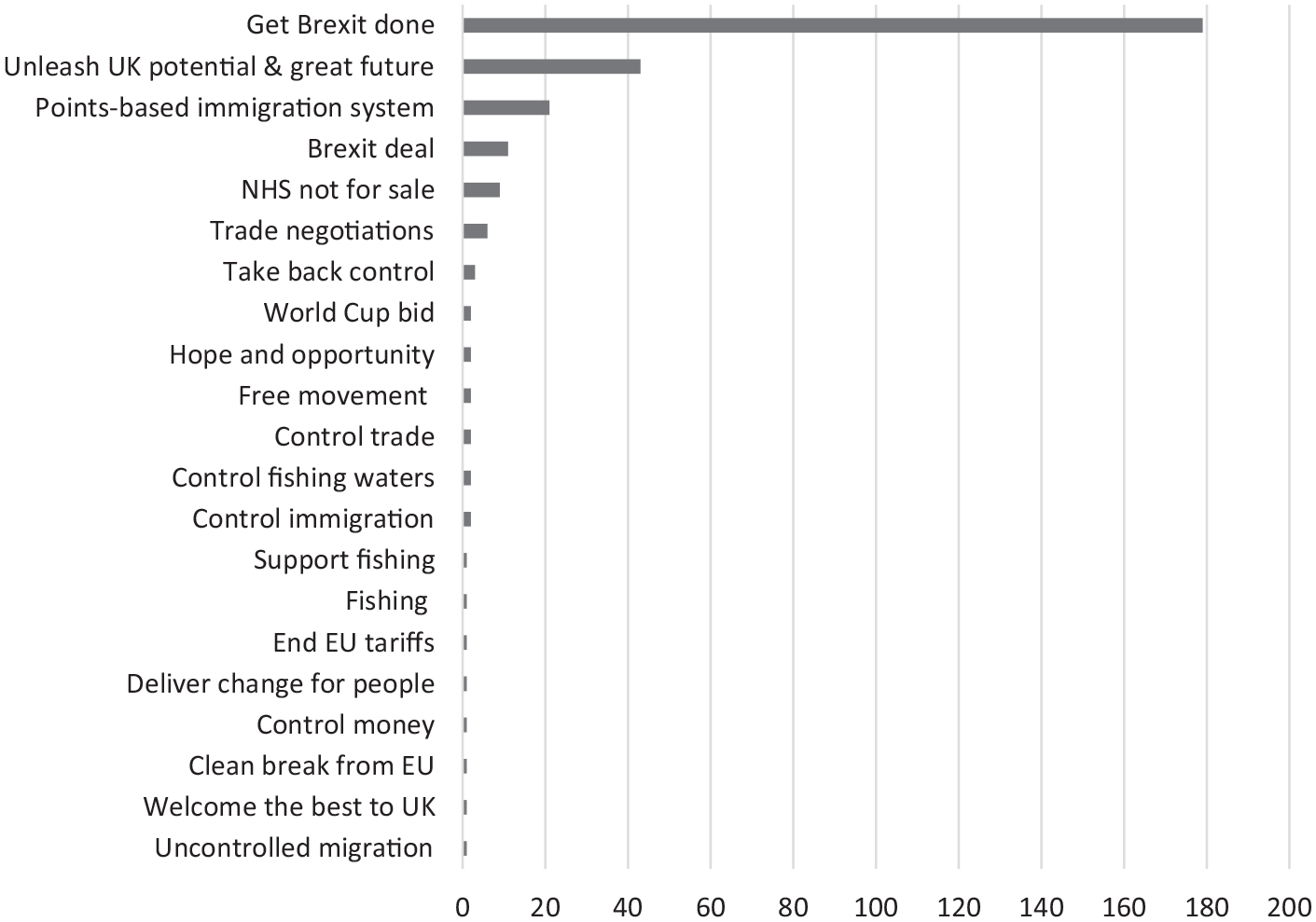
Foreign policy nodes occurring in Johnson’s Twitter-sphere (November–December 2019).
Brexit is the ‘will of the people’ expressed in the 2016 referendum. Johnson takes upon himself the responsibility to be the ‘leader of the people’ who guides them towards a future where a ‘fully sovereign’ country can ‘reach its true potential’ free from the EU’s corrupt, imperial control. Johnson presents Brexit as something to ‘get done’ quickly so government can move on to domestic issues more consequential to Britons’ daily lives – healthcare, infrastructure, education, police, and small businesses. He repeatedly tweets: ‘I want a future where Brexit is done and we’re focusing on the issues that matter to you and your family’ (9 December). The National Health Services (NHS) serves as perhaps the best example of this desired, future return to domestic affairs truer to ‘common folk’ concerns. Brexit-focused rhetoric is intermingled with pledges that ‘the NHS is not for sale’ and that, if re-elected, Johnson would protect and invest in it. The recurrent appeal to the people, to common-sense, and to the exasperation with complex political questions actually involved in Brexit negotiations are both consistent with the wider populist style and representing Johnson, paradoxically, as the embodiment of authenticity (Dommett, 2015; Wood et al., 2016).
Borrowing heavily from the ‘Vote Leave’ campaign in which he had previously been involved, Johnson proposes that a vote for the Conservatives would break the deadlock in Parliament, which was the main reason for calling the early election in the first place: ‘Only the Conservatives can break the deadlock of Parliament and set Britain free’ (1 December). He promotes himself as best suited to negotiate a quick Brexit deal. Following this logic, he is critical of Parliament and the Labour Party for blocking the deal he had negotiated. On 6 December, he tweets: ‘Folks, we’re having this election because Parliament simply wasn’t working – it was stuck in endless dither and delay. The only way we can move forward now is to get Brexit done with a majority Conservative government’. This appeals to the common-sense logic, ‘saying-it-like-it-is’, important for populist authenticity performances (Bischof and Senninger, 2018).
Substantive policy implications of the Brexit deal are limited and focus on three dimensions of autonomy from the EU – control over migration and border security, trade and fisheries. Johnson equates what he calls ‘uncontrolled migration’ with too high a risk for criminals to enter the country. Losing ‘freedom of movement’ is flaunted as a felicitous consequence, as it allows Britain to implement an ‘Australian-style points-based system’ that would permit only the best and the brightest to enter’. This would lead to economic growth and a safer society. This taps into prevailing themes in British political culture, including Euroscepticism, but also attempts to reinvoke the authentic core of the Brexit referendum as the expression of the ‘people’s will’. Appeals to ‘Australia’ and the ‘Commonwealth’, in turn, mobilise nostalgic longing for an imagined past when a sovereign Britannia enjoyed influence and reputation (Browning, 2019; Kinnvall, 2018 also: Menke and Wulf, 2021).
To perform authentic leadership, Johnson uses a range of stylistic techniques indicative of three markers: immediacy, intimacy, and ordinariness (Figure 3). This fits with Johnson’s offline political communication, which is known to include markers of immediacy, intimacy and ordinariness (Wood et al., 2016). He portrays himself as an ordinary person who cares about the people’s wellbeing. He supposedly shares many ‘typically British’ preferences and behaviours with his voters, which he communicates in seemingly revealing tweets. On 20 December, he writes: ‘Today I played football with a brilliant team of 10-year-old girls – the future of women’s football is bright! We will invest £550 million in grassroots football so more people can play this wonderful sport’, on 12 November: ‘For those who’ve noticed, this really is how I make my tea. It lets it brew and makes it stronger’, and on 11 December, in humorous allusion to his campaign slogan: ‘Getting breakfast done!’ While signalling ordinariness and intimacy, this belies his upbringing, previous career and even public persona; a contradiction which occasionally reproduces an authenticity problem in interactions with voters (Wood et al., 2016: 589). In contrast to his political opponents, these authenticity claims are not aimed at particular communities, but at the ‘everyman’, which also explains their generic nature (De Luca, 2021; Wood et al., 2016). Johnson constructs a fictitious, homogeneous British folk as a discursive tool to establish emotive connections with his voters (Wood et al., 2016: 593).
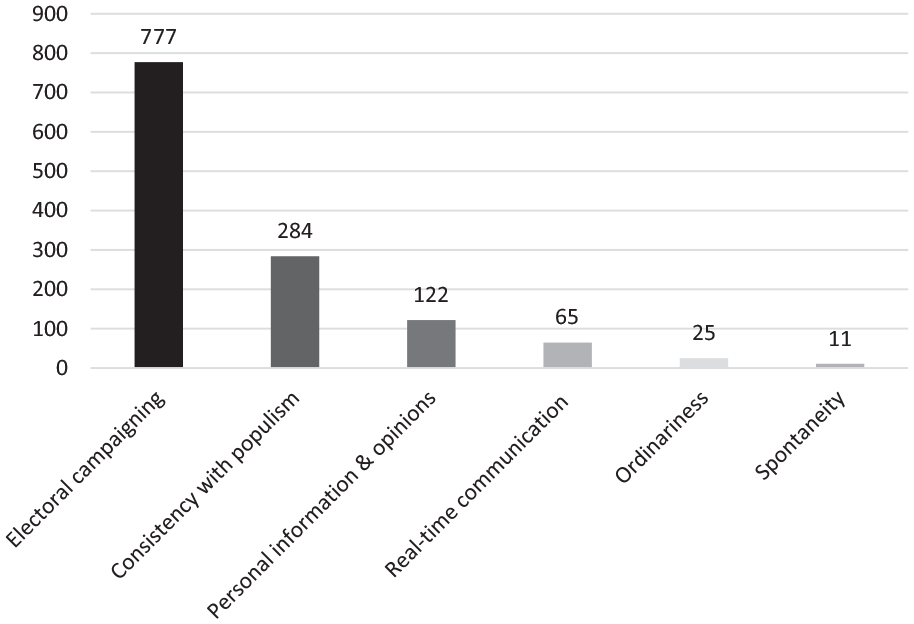
Themes (categories of aggregated nodes) occurring in Johnson’s rhetoric (November–December 2019).
To signal intimacy, he communicates personal opinions and thoughts on campaign and other public events in real time. Here, Johnson strikes a careful balance in how he performs authenticity, which is connected to his public persona – he is both populist outsider and competent leader, both bumbling, cheeky Boris as well as incumbent, former mayor and political celebrity (Wood et al., 2016: 583, 592). He often informs his electorate of his schedule, in what appears a spontaneous communication style aimed at creating an intimate connection. On 6 December, he writes: ‘Tune in tonight. Join me tonight for the Final Leader's Debate on BBC 1’, and later: ‘Folks, handing Twitter over to my team. Wish me luck!’ He comments on news and presents his own reaction to them, including in emotional terms. Still, aside from some colloquialisms, his rhetoric remains largely professional and error-free, even mundane (in contrast to Trump). He signals immediacy through spontaneity, ‘zaniness’ and informality cultivated on Twitter, in interviews and other appearances, including in presumably orchestrated ‘gaffes’. This is contradicted by attempts to portray himself as a competent, professional leader (Dommett, 2015).
Donald Trump
Prior to the November 2020 elections, Trump uses Twitter to create an image of himself as an authentic leader, an effective president worthy of re-election. His discourse on Twitter indicates consistency with his tried-and-tested populist rhetoric, reassuring supporters that their candidate remained the same despite the challenges of pandemic management or mobilisation of support for his opponent. Trump turns to foreign policy–related themes to offer simple explanations and solutions to several economic and social issues that are important for his electorate. Trump’s communication is characterised by a larger volume of tweets, greater thematic diversity, and greater diversity in stylistic markers of authenticity than Johnson’s (Figure 4). These differences may relate to constraints imposed by the COVID-19 pandemic that made other forms of campaigning (e.g. rallies) difficult. They are also reflective of the importance social media campaigning has for Trump, whose 88 million followers dwarf Johnson’s 1.5 million. Twitter allows him to shorten the perceived distance of communication to his supporters, and circumvents mediatisation in allegedly biased, inauthentic mainstream media.
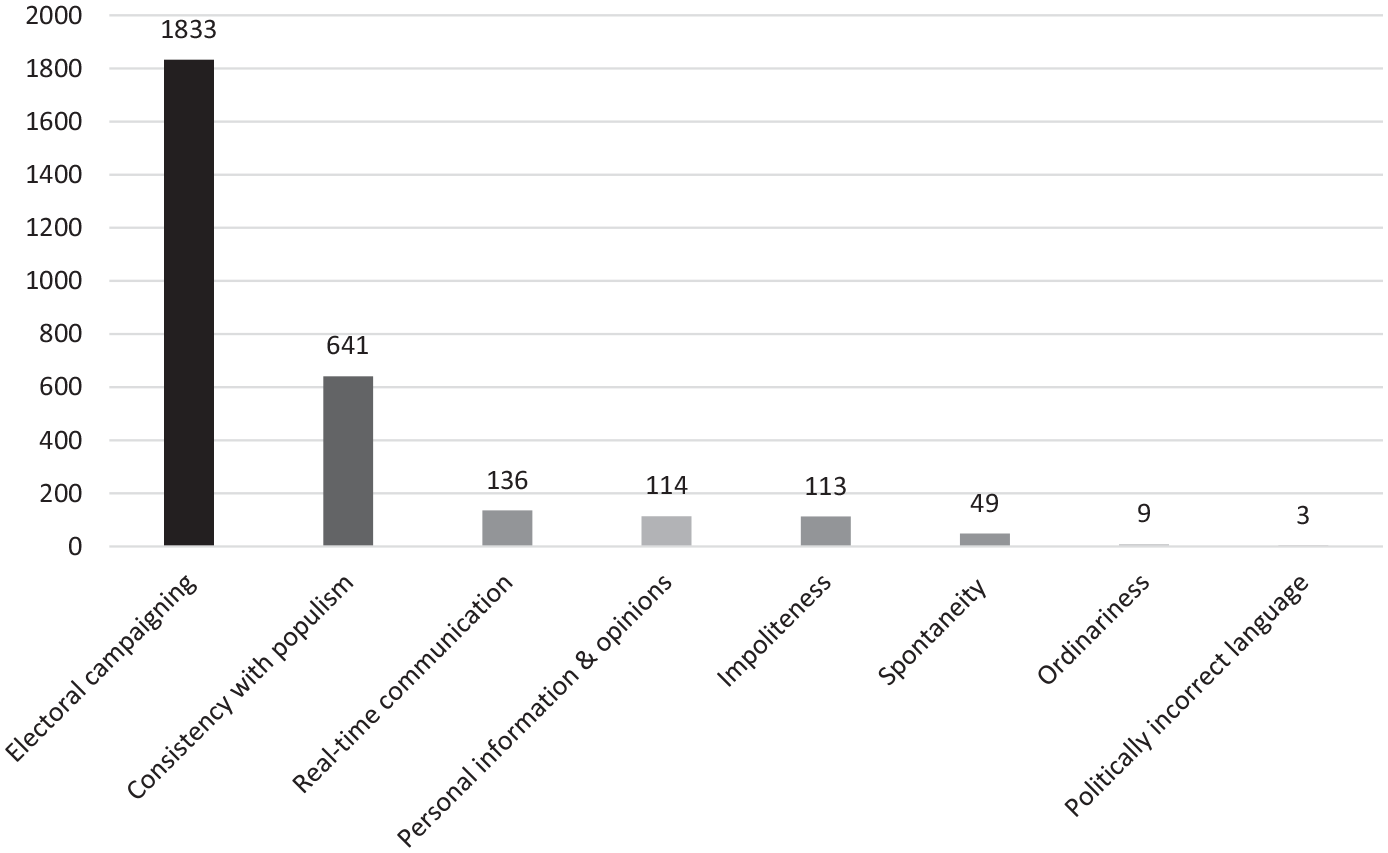
Themes (categories of aggregated nodes) occurring in Trump’s rhetoric (October–November 2020).
Trump communicates about foreign policy to highlight his successes through themes consistent with his previous rhetoric (Figure 5). His justification for stronger border security and limits to migration is linked to his depiction of migrants and refugees as criminals and potential terrorists. On 27 October, he tweets: ‘Under my leadership, we achieved the most Secure Border in U.S. History! My opponent’s insane immigration plan completely eliminates U.S. borders by implementing nationwide catch-and-release. Joe Biden would make every community into a Sanctuary City for violent criminals’.
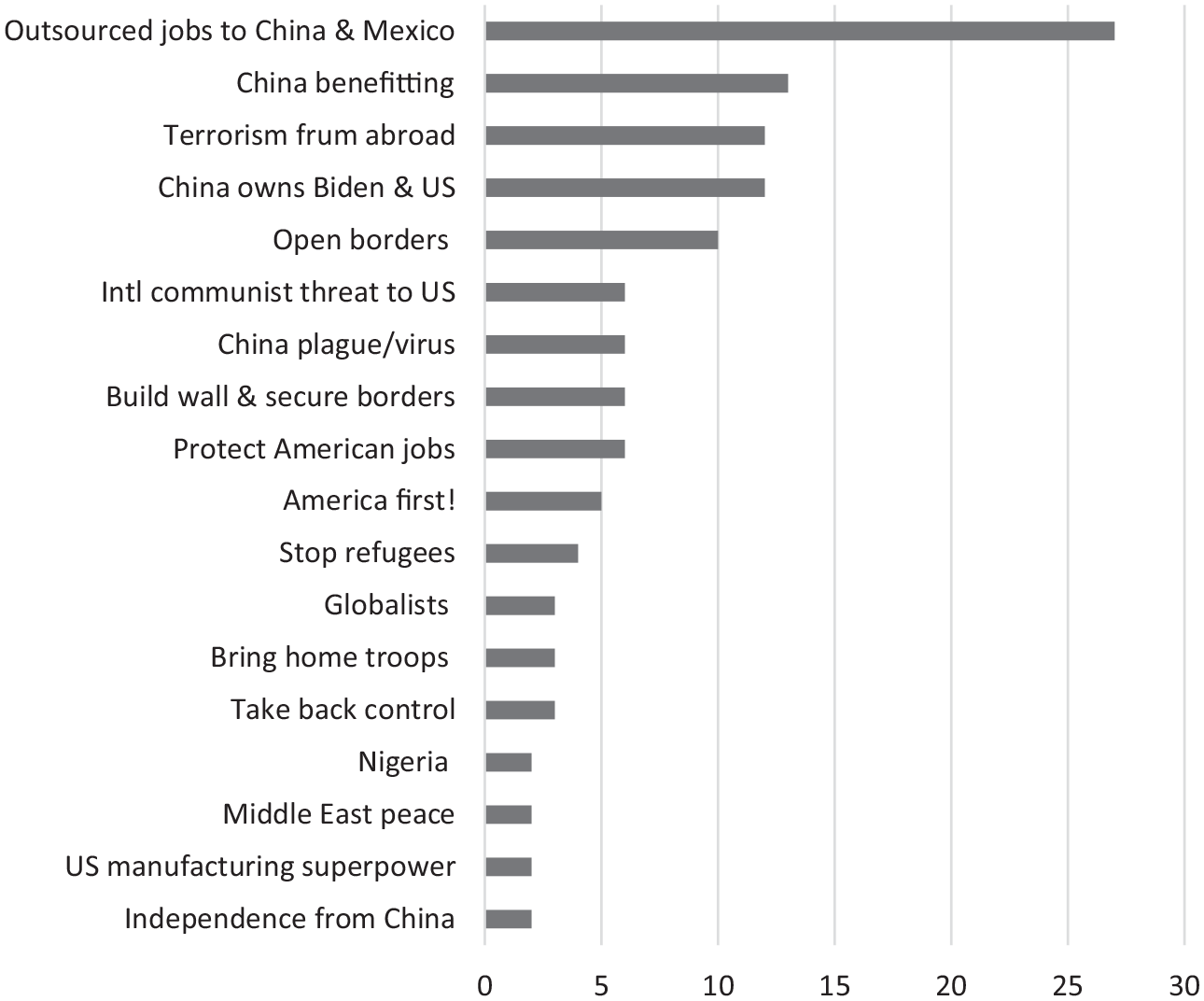
Foreign policy nodes in Trump’s Twitter-sphere (October–November 2020).
Trump’s involvement in the Middle East and, closely linked, his support of the military supposedly go hand in hand with his policies for veterans and military infrastructure. On 31 October, he tweets: We invested $2.5 TRILLION in the Military and we saved the Philly Shipyard. We passed VA Choice and VA Accountability. Al-Baghdadi and Soleimani are DEAD. I withdrew from the disastrous Iran Nuclear Deal – and instead of endless war, we are forging PEACE in the Middle East!
His backing of the military is steeped in nationalism and opposition to the Democrats’ alleged promotion of socialism and leftist radicalisation. On 31 October, he tweets: Over the next four years, we will stop the radical indoctrination of our students, and restore PATRIOTIC EDUCATION to our schools. We will teach our children to love our Country, honor our history, and always respect our great American Flag.
He continues with a statement of unity, familiar from his 2016 campaign: ‘We are ONE movement, ONE people, ONE family, and ONE GLORIOUS NATION UNDER GOD! Together with the incredible people of Pennsylvania, we will MAKE AMERICA GREAT AGAIN!’ (also see: Lacatus, 2019).
The most prevalent theme of Trump’s foreign policy rhetoric is the economy’s strength and continued growth despite the pandemic, which is tied to international economic policies: Trump managed to ‘bring back home’ jobs that had been outsourced to China and Mexico. He does not offer examples, or indeed a coherent foreign policy agenda. Rather, he uses slogan-like rhetoric suggestive of an isolationist-exceptionalist view of America’s role in the world. Previous economic losses are tied to corrupt leadership by ‘globalists’ like Obama and Biden. On 27 October, he tweets: Joe Biden is a corrupt politician. He wants to send YOUR jobs to China, while his family rakes in millions from the Chinese Communist Party. If Biden wins, China will OWN the USA. When we win, YOU win, Wisconsin wins, and AMERICA wins!
These messages are not policy proposals. They are about who belongs to authentic America (and who does not) rather than what its foreign policy should be (Skonieczny, 2020, 132).
Trump also turns to foreign policy to present himself as a more suitable candidate than his opponent. Here again, he refers especially to China and Mexico – one standing in for great power rivalry and existential threat, the other for migrants and/or criminals. Trump allegedly safeguarded the economy against ‘bad trade deals’ that had lost jobs to China and Mexico. The Democratic Party and their candidate are portrayed as enemies of the American people, corrupt politicians cut from the cloth of Washington’s insider fabric, whose globalised ideology lost ‘hardworking people’ their jobs. On 30 October, Trump writes a series of tweets that epitomise these themes: Joe Biden spent the last 47 years outsourcing your jobs, opening your borders, and sacrificing American blood and treasure in endless foreign wars. He is a diehard globalist who cares nothing for working people. He repeatedly tried to cut Medicare & Social Security. Biden was a cheerleader for NAFTA – sending your auto Jobs to Mexico. He voted for China’s entry into the World Trade Organization – gutting your industries to finance China’s rise. HALF of all Michigan auto manufacturing jobs were ELIMINATED after the Biden-Backed NAFTA and China Disasters. At every turn, Biden twisted his knife into the back of Michigan workers. In 2016, Michigan voted to FIRE this corrupt political establishment and you elected an outsider as President who is finally putting AMERICA FIRST!
Trump stakes his ordinariness and intimacy as a ‘political outsider’ not primarily on family life or even stereotypically ‘normal’ habits. Rather, Trump focuses on his career as a real estate developer. His claimed success as president results from his business experience and his capacity to, as such, represent the true American people. This version of combining authenticity and public persona is suggestive of two American hero narratives: that of the uncorruptable outsider and that of the dishwasher-to-millionaire (Bonikowski and Gidron, 2016; Lowndes, 2017; Schneiker, 2020). That he is not in fact a self-made entrepreneur living the American dream and giving back in public service does not restrict Trump from making this claim to authenticity. It enables Trump to be both special and authentically ordinary, a leader and president of the people who gives the ‘losers of globalisation’ a voice. On 22 and 29 October, he tweets: If I do not sound like a typical Washington politician, it’s because I’m NOT a politician. If I do not always play by the rules of the Washington Establishment, it’s because I was elected to fight for YOU, harder than anyone ever has before!
Unlike Johnson, who produces ‘gaffes’ occasionally (e.g. inappropriate jokes for which he later apologises; Wood et al., 2016), Trump’s style regularly includes immediacy markers like politically incorrect, emotive, and sometimes aggressive and offensive tweeting. Beyond simply criticising his political opponents and the Democratic Party’s policy agendas, Trump’s rhetoric can be aggressive, often using expletives as well as rude speech. He portrays the Democratic party as radical, corrupt, and fundamentally harmful for the United States, especially because they promote an ‘open borders’ policy, which decreases jobs and invites crime. In this, they are supported by liberal mass media. On 7 October, he writes about Biden: He’s been a wacko for years, and everyone knows it. The Lamestream Media is stuck with him and they are just now trying to clean up his act. Notice how all of the bad things, like his very low IQ, are no longer reported? Fake News! #MAGA.
This politically incorrect ‘outspokenness’, the willingness to question and undermine norms of communication and decorum, evokes another narrative of authenticity: that of the ‘straight-shooter’. It also connects with voters at an emotional level, stirring sentiments of anger, hatred, fear and resentment. Notably, the willingness to ‘troll’ or ‘trigger’ opponents shares with Johnson’s ‘bumbling’ the potential to entertain. However, it can also make key supporters uneasy, wishing that Trump would ‘stop tweeting’ at the same time as he should continue being true to his ‘authentic’ self and speaking his mind. This suggests a problem: either, that Trump is too ‘authentic’ and voters realise that some inauthenticity is electorally desirable, or that they recognise some aspects of Trump’s authenticity as a strategic performance that can be dialled up or down.
Conclusion
Electorally Successful right-wing populists like Johnson and Trump are arguably indicative of a deep-seated fragility and vulnerability of liberal democracy across the globe. But the electoral appeal of these leaders does not rest solely on the ideas and policies they promote. Rather, their success is due to their ability to portray themselves as authentic political leaders, including through the use of social media. Successful authenticity performances allow them to credibly claim that they channel the ‘true people’s will’ in the first place, and therefore underpin populist politics. We build on existing scholarship conceptually and empirically to operationalise authenticity through four categories – consistency, intimacy, ordinariness, and immediacy. We code these indicators in the Twitter communication of Boris Johnson and Donald Trump to analyse their thematic and stylistic choices. Our analysis nuances existing studies on the discursive strategies and styles right-wing populist leaders employ to curry electoral support. In particular, it is suggestive of the outsized importance of authenticity performances to ‘low-style’ populist communication, including online. This paves the way for future comparative studies investigating the intersection of political ideas, rhetorical style and electoral behaviour in the performance of authenticity, including for left-wing populists, mainstream political leaders, and/or non-incumbent candidates.
Our analysis finds that the two right-wing populist leaders perform authenticity similarly. This is surprising especially when considering differences between their public personas. It holds even as the content of their communication differs, reflecting different political contexts. The most obvious difference between the two leaders, often highlighted by those who contest their shared right-wing populism, is the use of transgressive speech, even as they are incumbents and speak about international politics. This difference can be explained through a focus on authenticity performance. Indeed, this suggests that ‘low-style’ populist politics may be characterised not so much by rhetorical transgression, as by particular types of authenticity claims along the four proposed categories of consistency, intimacy, ordinariness and immediacy.
While the prevalence of real-time communication may be resulting from our focus on Twitter data, seemingly spontaneous commentary, sharing of personal, even intimate viewpoints, and appeals to ordinariness are interwoven with anti-elitism and right-wing ideas to underpin both leaders’ political agendas. Both Trump and Johnson make reference to key foreign policy themes to signal consistency with tried-and-tested right-wing populist rhetoric. In the United Kingdom, Johnson focuses on ‘get(ting) Brexit done’ to fulfil the ‘will of the people’. His rhetoric presents the Brexit deal as a catch-all solution to economic and social problems. Rather than a complex diplomatic strategy with different policy dimensions, it is a necessary nuisance, to be solved to free the nation so that it can tackle domestic concerns. This mobilises the ‘ordinary’ voter’s assumed annoyance with long-winded, needlessly complicated political processes. For Trump, problems are met with simple solutions and explanations: control of borders and migration flows secures jobs and lowers crime; America’s downturn can be explained by the link between corrupt elites and shadowy foreign elements.
We demonstrate that, in such a way, right-wing populists ‘domesticate’ complex international politics to lend their agendas authentic appeal. This domestication, however, compounds a problem for populist incumbents: how to continue being perceived as authentic ‘straight-shooters’ while also having to deliver international successes. The authenticity right-wing populists perform affects not only the content but also the style of their foreign policies, for example, in terms of personalisation, or changes in rhetoric vis-a-vis partners and adversaries. Where this approach does not yield the successes Johnson or Trump promised, their solution is not to acknowledge the limits of a foreign policy based on the populist politics of authenticity. Rather, it is to characterise ever-wider segments of domestic and international politics as ‘fake’. This not only damages the state’s ability to conduct successful foreign policy. It also relinquishes democratic accountability of political leaders in the name of their authenticity.
Supplemental Material
sj-docx-1-bpi-10.1177_13691481221089137 – Supplemental material for ‘Saying it like it is’: Right-wing populism, international politics, and the performance of authenticity
Supplemental material, sj-docx-1-bpi-10.1177_13691481221089137 for ‘Saying it like it is’: Right-wing populism, international politics, and the performance of authenticity by Corina Lacatus and Gustav Meibauer in The British Journal of Politics and International Relations
Footnotes
Acknowledgements
The authors thank the participants of the special issue workshop on the study of populism in International Relations, held in March 2020, and especially the special issue editor Georg Löfflmann, for extensive feedback and suggestions on an early draft of this article. We are also grateful to the editors and anonymous reviewers for detailed and constructive comments.
Funding
The author(s) received no financial support for the research, authorship, and/or publication of this article.

Supplementary information
Additional supplementary information may be found with the online version of this article.
Content A. Online Appendix. A. 1. Method and coding. A. 2. Frequencies and relative frequencies of codes corresponding to main themes in Johnson’s and Trump’s Twitter-spheres (due to space limitations, the below tables only include nodes identified in the textual data at least 5 times; relative frequencies are calculated out of the total of coded nodes; indicators listed in italics occur in the campaign communication of both candidates). Table 3: Frequencies and relative frequencies in Trump’s Twitter-sphere (October–November 2020). Table 4: Frequencies and relative frequencies in Johnson’s Twitter-sphere (November–December 2019). A. 3. List of words associated with main topics and themes in Trump’s Twitter-sphere.
Notes
References
Supplementary Material
Please find the following supplemental material available below.
For Open Access articles published under a Creative Commons License, all supplemental material carries the same license as the article it is associated with.
For non-Open Access articles published, all supplemental material carries a non-exclusive license, and permission requests for re-use of supplemental material or any part of supplemental material shall be sent directly to the copyright owner as specified in the copyright notice associated with the article.
