



Abstract
The Brexit campaign was based on the idea that newly gained British sovereignty and flexibility in global trade governance would facilitate the quick negotiation of preferential trade agreements. We explore how long it may take for a state to negotiate bilateral preferential trade agreements to offset potential losses from International Organizations withdrawals. We address the question of ‘timing’, and discuss several mechanisms that delay or speed up the implementation of bilateral trade deals after exiting International Organizations. The empirical findings are based on quantitative data and models accounting for the likely simultaneous relationship between International Organizations exits and preferential trade agreements’ formation. We show that leaving economic organisations significantly lowers the likelihood of subsequent preferential trade agreements ratification. This effect wears out after about 1 year. This research has crucial implications for our understanding of International Organizations, state benefits’ stemming from their membership therein, bilateral trade deals, and international cooperation.
Introduction
The former British Secretary of State for International Trade, Liam Fox, emphasised in 2017 that the United Kingdom could effortlessly replace and extend European Union (EU) trade agreements once it left the Union because of the 2016 referendum. Specifically, Mr Fox stressed that the United Kingdom ‘would easily be able to copy and paste all 40 of the EU’s external trade deals the second after midnight on Brexit day’, 1 while ‘a post-Brexit trade deal [with the EU] should be the easiest in human history’. 2 He also insisted that there will be numerous opportunities for more such agreements in the months after leaving the world’s largest single market (Jackson and Shepotylo, 2018), 3 making use of the newly gained sovereignty in international trade governance, to ensure that the United Kingdom would not be deprived of economic prospects. However, the British government has found it somewhat difficult to meet these expectations. Only four agreements were concluded by February 2019 (with Switzerland, Chile, Eastern and Southern African (ESA) countries, and the Faroe Islands, respectively). Towards the end of the transition period in December 2020, in which the United Kingdom remained part of the common market, only about half of the more than 40 European Union (EU) trade deals were rolled over to 2021, while treaties signed with Canada and Japan were the only significant agreements before a deal could be concluded with the EU on 24 December 2020. 4 Moreover, there are only provisional applications or signed (but not ratified) treaties in place for important EU contracts with, for example, Turkey, 5 and a trade deal with the United States is far from conclusion although it has been long promised.
A main reason behind the British government’s confidence in quickly replacing previous trade arrangements once it withdrew from the EU was the idea that existing treaties could simply be rolled over (Allee and Elsig, 2019; Allee et al., 2016), while many states would also find the newly gained British sovereignty and flexibility in international trade attractive for (re-) negotiating terms. That said, the United Kingdom’s track record in replacing old and securing new deals suggests that other mechanisms may be at work. For instance, major trading powers such as Japan could have a little incentive to grant the United Kingdom the same rules as the EU. While a comparison is tied to certain assumptions, it is estimated that although the UK-Japan trade agreement would increase gross domestic product (GDP), growth will be lower by about £1.1 billion than the rise estimated as a result of the EU-Japan Economic Partnership Agreement (£2.6 billion). 6 In addition, the time pressure the United Kingdom faces in the post-Brexit period likely weakens its bargaining power considerably (Dür, 2008; Schneider, 2005; Wagner, 1988; see also Carnevale and Lawler, 1986; Pruitt, 1981). While the case of Brexit and the UK government’s efforts to replace previous arrangements with bilateral deals is just one example, there may be a general pattern for leaving multilateral economic organisations and seeking to establish preferential trade agreements (PTAs) instead as a compensation for lost economic gains (Baccini, 2019; Mansfield et al., 2002; Mansfield and Milner, 2012). 7 In fact, Borzyskowski and Vabulas (2019) document several withdrawals of countries from major economic multilateral organisations since 1945, including the General Agreement on Tariffs and Trade (GATT) or the World Bank. Although membership in those International Organizations (IOs) does not impede countries from signing bilateral PTAs and leaving them may be motivated by several reasons, states could have incentives to address the economic losses stemming from IO withdrawal by creating PTAs and reaping economic benefits through these. If there is a general pattern along those lines, though, what are the underlying mechanisms that help explaining how IO exits influence the formation of PTAs? And, if problems do arise from leaving IOs and creating bilateral trade agreements, how long may the corresponding challenges persist? In this context, we address the question of ‘timing’, namely how long it would take for a government to restore, for example, reputation and bargaining power losses and successfully form bilateral PTAs to offset those losses.
Dür et al. (2014) define PTAs as any form of international agreement that can, in principle, liberalise trade. For reasons outlined in the research design, we focus on bilateral agreements only. To define international organisations, we follow Pevehouse et al. (2020: 494) in that institutions must be a formal entity, have at least three state members, and there is a permanent secretariat or other indication of institutionalisation. Coordination and collaboration through IOs (Gray et al., 2017; Pevehouse et al., 2020) can create substantial benefits for participating states, arguably the lowering of transaction costs being the most prominent advantage (Abbott and Snidal, 1998; Elsig et al., 2011; Hawkins et al., 2006; Mansfield and Pevehouse, 2006; Martin, 1992; Martin and Simmons, 1998; North, 1984; Schneider, 2011; Trommer, 2017). At the same time, joining IOs is not without costs as states must contribute financial resources or accept cuts into their decision-making power (Abbott et al., 2000; Fearon, 1998; Kahler, 2000; Simmons, 2010; Vaubel, 2006). Against this background, while participating in and employing IOs remains to be one of the most beneficial forms of international cooperation, states increasingly consider alternative options in global governance to maximise benefits and lower costs, particularly regarding one’s own sovereignty (Borzyskowski and Vabulas, 2019; Johnson, 2014; Wessel, 2016). In fact, there is a trend towards states deciding to leave IOs (Walter, 2021): Borzyskowski and Vabulas (2019) explore the determinants of countries’ decisions to withdraw from multilateral agreements. When focusing on economic organisations only, their data report 118 exits in the post-1945 period, with an increasing tendency over time. IO withdrawals are not random; they are shaped by international factors such as countries’ preference divergence, domestic influences like the form of government, or transnational determinants in the form of contagion processes (Borzyskowski and Vabulas, 2019). We build on and aim to extend these findings by shedding light on the consequences of IO exits. The implications of IO withdrawals are not well understood (Borzyskowski and Vabulas, 2019). We help addressing this when answering how much time states may need to replace previous arrangements by potentially more flexible, bilateral deals in light of leaving an economic IO (Jackson and Shepotylo, 2018). We focus on bilateral PTAs as these are among the most notable international arrangements for states’ economic growth, trade flows, and investment (Abbott et al., 2009; Baccini, 2019; Baier and Bergstrand, 2007; Baier et al., 2008; Mansfield and Milner, 2012).
Theoretically, we discuss the literatures on bargaining power (Dür, 2008; Schneider, 2005; Wagner, 1988), transaction costs of cooperation (Barnett and Finnemore, 2004; Koremenos et al., 2001; Martin and Simmons, 1998), the replication of existing agreements (Allee and Elsig, 2019; Allee et al., 2016; Allee and Lugg, 2016), and international reputation, credibility, as well as reliability (Crescenzi et al., 2012; Downs et al., 1996; Downs and Jones, 2002; Gibler, 2008; Keohane, 1984; Simmons, 1998, 2010; Simmons and Hopkins, 2005) to develop arguments about a retarded or accelerated process of bilateral PTA formation in lieu of multilateral forms of governance. The process of negotiating bilateral deals could be slow, cumbersome, and costly (Lechner and Wüthrich, 2018). Especially if a PTA is seen as a direct replacement for the membership in an economic IO and bargaining power is low, the ‘old-and-new’ negotiation partners might be interested in striking more favourable deals, thus avoiding equally strong concessions as in the past. Leaving an IO likely also creates reputational damage affecting states’ credibility and reliability, which raises transaction costs for future forms of cooperation even if only bilaterally (Crescenzi et al., 2012; Downs et al., 1996; Gibler, 2008; Keohane, 1984; Simmons and Hopkins, 2005). However, previous multilateral terms could also be rolled over and translated into bilateral deals (Allee and Elsig, 2019; Allee et al., 2016; Allee and Lugg, 2016). And although leaving a multilateral IO might create reputational costs, states benefit from ‘multiple reputations’ (Downs and Jones, 2002), thus not being that disadvantaged when it comes to negotiating new terms. Hence, there are different, though not necessarily mutually exclusive, mechanisms that may influence the process behind PTA formation after an IO exit.
The arguments make the issue of IO withdrawal and the timing of PTA conclusions an empirical question, which we address with recently compiled data on exits from economic IOs (Borzyskowski and Vabulas, 2019) and bilateral trade agreements (Dür et al., 2014) in the post-1960 period. The results from simultaneous equations models show that withdrawing from an economic IO makes it significantly less likely to strike a bilateral trade deal in the immediate aftermath. However, our main result is indeed that this effect wears out after about 1 year – the chances to sign at least one PTA do then not significantly differ between states leaving IOs and those deciding to stay. This result has important implications for our understanding of IOs, state benefits’ stemming from their membership therein, PTAs and international cooperation more generally. We discuss these key contributions in the conclusion.
Theoretical arguments
Leaving an IO is driven by several factors, including states’ dissatisfaction with current terms (Borzyskowski and Vabulas, 2019). A withdrawal from multilateral agreements may not imply, however, that states completely reject all forms of international cooperation and coordination. They will likely look for alternative options to deal with transboundary problems and satisfy interests previously addressed within an IO. Hence, we do not expect a state leaving an IO to withdraw from any future cooperation entirely. Instead, the opposite may be true, but in a different form and we highlight as well as discuss some of the challenges that may arise for future bilateral economic collaboration.
Yet, once states leave a multilateral agreement, negotiations for future bilateral pacts may not be as quick or easy as expected, and countries likely face a series of trade-offs. The process of leaving IOs and forming other types of cooperation likely takes time as there are political and administrative costs involved, (domestic) audience costs that need to be taken into account, and all of this would affect the bargaining power (Dür, 2008; Schneider, 2005; Wagner, 1988). In exploring this process and addressing the question of ‘timing’, that is, how long it takes to overcome potential negative consequences from IO withdrawals and to successfully negotiate a bilateral PTA, we suggest that several mechanisms could accelerate or create obstacles for the quick conclusion of replacement arrangements after IO exits.
First, withdrawing from an IO implies that a state’s international legal position is ‘reset’ to some degree and certain dimensions of its statehood will have to be reactivated. In the words of Wessel (2016: 205), countries would have to ‘shift from being a member state to being a state again’. This goes hand in hand with an increase in transaction costs, that is, those ‘costs specifying and enforcing the contracts that underlie exchange and therefore comprise all the costs of political and economic organisation’ (North, 1984: 7), which the multilateral organisation addressed to a large degree during membership before. Most importantly, having left an IO also increases transaction costs due to the need for additional time, efforts, and resources that individual state must invest (again) to secure a bilateral agreement (Trommer, 2017). For instance, the UK had to form own trade delegations replacing EU experts that negotiate deals with third parties on behalf of the entire Union (Kaddous, 2015). At the same time, an inexperienced negotiating team that likely works under pressure to rebuild its trade regulatory architecture makes concessions more readily, so that more deals do not necessarily mean the highest possible economic benefit for the country. Recovering from a rise in transaction costs and gaining expertise in areas a multilateral IO framework previously dealt with does take time, which probably weakens states’ bargaining power and, in turn, their efforts to negotiate replacement agreements quickly (Lechner and Wüthrich, 2018).
Second, however, there could be ways to speed up the PTA formation process. Adopting the design of already established agreements enables countries to reach deals in significantly less time. Any bargaining situation is costly and time-consuming, but this can be addressed when states agree adopting pre-existing trade terms and simply rolling them over to the new contract (Alschner and Skougarevskiy, 2016; Poulsen, 2015). While many – bilateral and multilateral – agreement designs vary as actors, interests, and problems differ from one case to another (Koremenos et al., 2001; Starkey et al., 2005), negotiations in the international system are intertwined (Crump, 2007) and there are clear benefits of replicating existing trade agreement deals and using them as templates for current negotiations – even in the case of replacing an economic IO with bilateral PTAs (Allee and Elsig, 2019; Allee et al., 2016; Allee and Lugg, 2016; Arbia, 2013). When parties rely on existing treaty templates, negotiators can progress faster, since they use large amounts of previously written and edited legal terms. In addition, a treaty text that has been employed before is well received and more easily trusted by bureaucratic cultures that are keen to adopt past practice rather than new developments (Allee and Elsig, 2019). This way, states that, for example, have a little experience in negotiating PTAs can carry over an existing text to ease and accelerate bargaining. For instance, the main text of the US trade agreement signed with Colombia in 2006 merely replicates the core of the 2003 US-Chile pact (Allee and Elsig, 2019). Likewise, several of the post-Brexit UK trade agreements mirror the terms of EU trade treaties in core aspects. 8
Third, some reputational damage might be caused by an IO withdrawal, which could make it more difficult to negotiate PTAs in turn. States care about their reputation and are aware of ‘reputational costs of inconsistency’ (Simmons and Hopkins, 2005: 624). As Keohane (1984: 106) highlights, compliance with and membership in IOs occur for ‘reasons of reputation, as well as fear of retaliation and concern about the effects of precedents’. In essence, IOs offer a profound opportunity for states to establish credibility and reliability (Bakaki, 2018; Kydd, 2001; Mansfield and Pevehouse, 2006; Milewicz and Elsig, 2014). Membership therein implies some degree of compliance and accountability, which allows states to develop a good reputation that becomes an asset when they negotiate agreements or promise prospect action. Trust and predictability about future behaviour are enhanced, and it is signalled to others that a state does honour its agreements (Gray, 2009). All this could foster countries’ bargaining power in the international community. However, the international system will of course take note of IO exits and may re-assess the reliability, credibility, and trustworthiness of a leaving state (e.g. Downs et al., 1996; Keohane, 1984; Sharman, 2007; Simmons, 1998, 2010; Simmons and Hopkins, 2005). Some of the assets stemming from IO participation could be lowered once withdrawal takes place because of reputational damage. Indeed, IO exits signal treaty breach and disagreements, which could not be solved within the institution. Simmons and Hopkins (2005: 623) emphasise here that ‘pacta sunt servanda – treaties are to be observed. By choosing to become a treaty party, governments ante up a greater reputational stake than would otherwise be the case’ (see also Fearon, 1998; Keohane, 1984; Simmons, 1998: 81, 2000). Yet, if a state withdraws from an IO and, in the eyes of the international community, leaves a contract with other states, it might incur reputation costs, which could decrease the chances of securing future types of cooperation swiftly – even if ‘only’ through bilateral PTAs. In line with this, there is robust evidence that countries violating alliance terms are in a weaker position to form new alliances in the future (Crescenzi et al., 2012; Gibler, 2008).
Fourth, while the existence of reputational damage considering non-compliance is widely accepted in the literature, there is disagreement on how extensive it is. And this could imply that any reputation damage, if it does exist at all, may not be an obstacle for forming PTAs after an IO withdrawal and, hence, delay the negotiation process. Specifically, consider the notion of ‘multiple reputations’ (Keohane, 1997; Simmons, 2010: 276). As Downs and Jones (2002: S102) stress, a country tends to have an ‘an overall average compliance rate, but the other states have no reason to be preoccupied with it’. Full compliance with agreements may be difficult to achieve and some deviations from it will be accepted by the international community without punishment (Downs et al., 1996). Related to this, compliance is contract specific and while it is high for one treaty, it may be less strongly given for another (Sobel, 1985). For instance, while a country is willing and able to comply with a trade agreement, there are issues with fully adhering to an IO regulating emissions for example, the Convention on Long-Range Transboundary Air Pollution. Ultimately, other states in international affairs acknowledge this, for themselves and others, inducing that ‘a state might have different levels of reliability in connection with treaties in two different regulatory areas’ (Downs and Jones, 2002: S104) or even different deals in the same policy field. For our context of countries leaving IOs and seeking to conclude PTAs quickly as a replacement, the idea of multiple reputations emphasises that the former act may not retard in substantive ways the latter process. The observable implication is that the chances of forming PTAs do not differ across countries leaving IOs and those remaining. 9
In sum, there are several different, although not mutually exclusive, mechanisms that influence the process of PTA formation after IO withdrawal. It takes some time for a country to negotiate new PTAs after leaving an IO as there are political and administrative costs involved, audience costs that need to be considered, and states’ bargaining power will have been affected by leaving an IO (Lechner and Wüthrich, 2018). Some of the mechanisms we discussed could make the quick conclusion of alternative arrangements replacing previous IO terms more challenging or, in fact, facilitate the negotiation process. The question of timing, meaning how long it takes for a country joining PTAs for offsetting a ‘negative’ effect of IO exits, thus is an empirical question, which we address in the following.
Research design
Our analysis is based on data for bilateral trade agreements and states’ withdrawals from multilateral organisations. For the former, we rely on Dür et al. (2014) who compiled the Design of Trade Agreements (DESTA) data set covering any treaty since 1948 with the potential to liberalise trade. The latter is covered by the recently published data in Borzyskowski and Vabulas (2019) who offer information on about 200 state withdrawals from intergovernmental organisations in the post-Second World War period. We focus on bilateral trade agreements to be better able to distinguish them clearly from IOs, which usually involve at least three members (Pevehouse et al., 2020). If we were to consider regional trade agreements comprising three member states or more, there would be an overlap with the treatment and definition of IOs. This, in turn, would induce a series of problems pertaining to conceptual clarity and endogeneity. 10 We combine the two data sets relying on the country-year as the unit of analysis and, eventually after accounting for missing values, focus on the years between 1961 and 2012 (N = 5820). Given our theory, the country-year unit of analysis is the most suitable one avoiding the inflation of the sample size we would have when using, for example, country-treaty years instead (see Cranmer and Desmarais, 2016).
While our main arguments concentrate on the impact of countries’ withdrawal from any economic IO on the formation of bilateral trade agreements, there are concerns about simultaneity: if the withdrawal from an IO affects countries’ chances to form bilateral trade agreements, it is plausible to assume that the latter influences the former at the same time. For example, states anticipate IO withdrawal and, in preparation, try to secure as many trade deals as possible before leaving the multilateral framework. Models not accounting for these simultaneous effects are likely biased. Instead, we estimate three-stage least-squares estimation (3SLS) for simultaneous equations (Zellner and Theil, 1962). This approach combines seemingly unrelated regression (SUR) with two-stage least-squares estimation (2SLS). Specifically, the Zellner and Theil (1962) estimator is suitable when there are at least two possible equations (or processes influencing each other) with endogenous variables. This is the 2SLS component. However, the estimator directly accounts for the correlation in the equations’ error terms (the SUR element). For the endogenous variables in the model, instruments have to be identified. In our case, the endogenous items pertain to the withdrawal from IOs and, second, the formation of bilateral trade agreements. The exogenous variables are described in detail below – 3SLS first uses these to create the instrumented values of the endogenous items. In turn, a cross-equation covariance matrix is estimated. Finally, we calculate the simultaneous equations with the two endogenised variables through generalised least squares, employing the instrumented variables and the exogenous items (unique instruments, fixed effects for units and years, cubic polynomials, and a linear time trend) as well as the estimated covariance matrix. 11
The first equation in the 3SLS model focuses on the formation of bilateral trade agreements as the outcome variable. The DESTA data concentrate on any form of international agreements that can, in principle, liberalise trade (at least to some degree). To this end, framework (mostly), cooperation, and interim agreements are excluded, while trade deals with small island nations have not been considered either for coding. Dür et al. (2014) incorporate pacts beyond bilateral agreements, although the latter constitutes our focus here. Hence, we omit trade deals that are not of a bilateral nature. Ultimately, this treatment gives us 577 bilateral trade agreements, which are coded as base treaties (569 cases) or consolidated deals, that is, entries that have been consolidated with their relevant corresponding base treaty (eight cases). We transform this information to the country-year unit of analysis by creating a binary variable receiving the value of 1 if a state formed at least one bilateral trade agreement each year (0 otherwise). Out of the 5820 observations for our final model, 558 country-years are coded as 1.
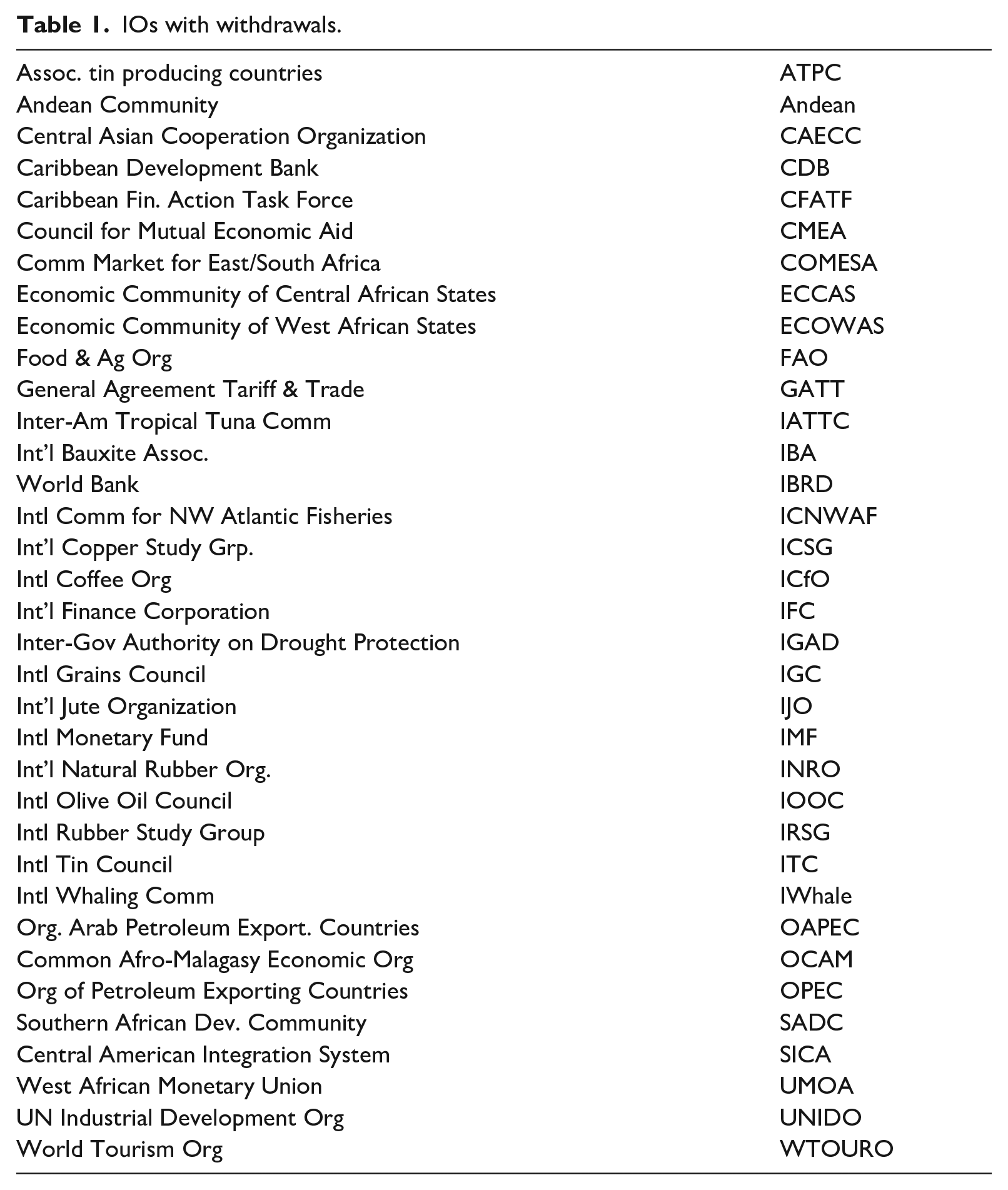
The right-hand side endogenous predictor in the first equation is Withdrawal. This variable is taken from Borzyskowski and Vabulas (2019) and captures in a dichotomous fashion whether a state decided to leave any economic IO in a given year or not. Note that Borzyskowski and Vabulas (2019) consider organisations based on the Correlates of War data (Pevehouse et al., 2020) across a variety of policy fields, including political, security, or environmental IOs. The trade-off we aim to model most plausibly works only for economic IOs – a state is less likely to compensate leaving, for example, a security IO by entering a bilateral trade agreement. Hence, we omit all non-economic organisations for Withdrawal. Between 1961 and 2014, Borzyskowski and Vabulas (2019) record at least one withdrawal from an economic IO in 106 country years. These IO departures are not confined to a narrowly defined set of countries, but are coded for 66 different states. In addition, Table 1 gives an overview of which IOs saw withdrawals during our sample period. All those institutions may be linked to economic gains, which become lost once states leave them and could be compensated through PTAs. However, in the Online Appendix, we re-estimate the main model focusing on major IOs only.
IOs with withdrawals.
Next to this variable, we include country and year fixed effects to capture time-invariant forms of cross-section heterogeneity as well as temporal shocks. Fixed effects for units are also crucial from a substantive point of view, since only certain countries will receive a reputational boost or damage. States like the United States or Russia may suffer no consequences for leaving economic IO. Only smaller countries that investors do not have a great deal of information on are likely to suffer more because the withdrawal decision is used in place of more detailed information. We further incorporate a linear time trend to address temporal autocorrelation more generally and cubic polynomials (Carter and Signorino, 2010) on the time elapsed since the last bilateral trade agreement formation to model path dependencies. As more substantive controls, we consider a parsimonious set of variables capturing domestic politics influencing IO departures and PTA formation (Baccini, 2019; Borzyskowski and Vabulas, 2019). Domestic-level factors influence the chances simultaneously for exiting an IO and forming a PTA. In the main models discussed below, we focus on states’ form of government and power. The former is the temporally (1-year) lagged polity2 score from the Polity IV data set, which varies between –10 (full autocracy) and 10 (full democracy). The latter is the CINC Score from the Correlates of War data (Singer, 1987) and is also temporally lagged by 1 year. In the Online Appendix, we explore the effect of other domestic-level determinants as we control for nationalism, change of power, backsliding, the number of veto players, and trade dependency.
Finally, the instrument in the first equation is a country’s 1-year lagged GDP growth as taken from the World Bank Development Indicators. For PTA formation, the instrument should be directly associated with this variable, but not the other endogenous dependent variable (Withdrawal). Borzyskowski and Vabulas (2019) discuss GDP growth, but find a little evidence for a consistent impact on the withdrawal of IOs. Instead, the sign of this item varies depending on model specifications and is not significant at conventional levels. However, GDP growth features prominently in the study of forming bilateral trade agreements. Baier and Bergstrand (2004) emphasise that gravity-like variables including the size and growth of the economy help predicting the formation of PTAs. They argue that the probability of a bilateral trade deal increases with the economic size of the trading partners (Baier et al., 2014; Baldwin and Jaimovich, 2012). At the monadic, country-year level, a negative effect of GDP growth on agreement formation seems likely; according to Whalley, perhaps the most conventional objective thought to underlie a country’s participation in any trade negotiation is the idea that through reciprocal exchanges of concessions on trade barriers there will be improvements in market access from which all parties to the negotiation will benefit. Whalley (1998: 71)
Hence, when GDP is likely to decrease, states may be particularly incentivised to counter this development and seek the formation of PTAs.
In the second equation of the 3SLS model, Withdrawal that we introduced earlier is the dependent variable. The endogenous predictor is the binary variable coding the formation of at least one bilateral trade agreement in a given country-year (also described earlier). We furthermore consider country and year-fixed effects, a linear time trend, and cubic polynomials (Carter and Signorino, 2010) next to states’ democracy scores and CINC values. The instruments used in the second equation pertain to the discussion that the relationship between members and IOs is limited in time and scope, while the principal granting authority in the first place can leave essentially any time (Vaubel, 2006). If a state sees that its interests are no longer met by an IO, it can revoke its membership. According to Borzyskowski and Vabulas (2019), there are two main factors that explain this. On one hand, there is Contagion, which captures the withdrawal of lead states from an IO in a given year. Lead states are defined as ‘the largest economic power in the organisation by GDP’ (Borzyskowski and Vabulas. 2019: 353). The original information in Borzyskowski and Vabulas (2019) is coded per treaty – due to our different unit of analysis, we concentrate on the (temporally lagged) total number of lead states’ withdrawals from any IO each year. On the other hand, Borzyskowski and Vabulas (2019) report that preference divergence from other organisation members is one of the most powerful predictors of leaving IOs. The variable measures ‘the degree to which a state’s voting in the United Nations diverged from the average voting behaviour of other states in the relevant IGO in the previous year’ (Borzyskowski and Vabulas, 2019: 353). We aggregate the original variable to the country-year level by calculating a state’s average level of preference divergence across all IOs it is a member of. The final item is 1-year lagged as well. Note that a direct effect on the formation of bilateral trade agreements of this variable is theoretically unlikely given that both Preference Divergence and Contagion are not based on bilateral PTAs, but the entire range of multilateral IOs in the system.
Empirical findings
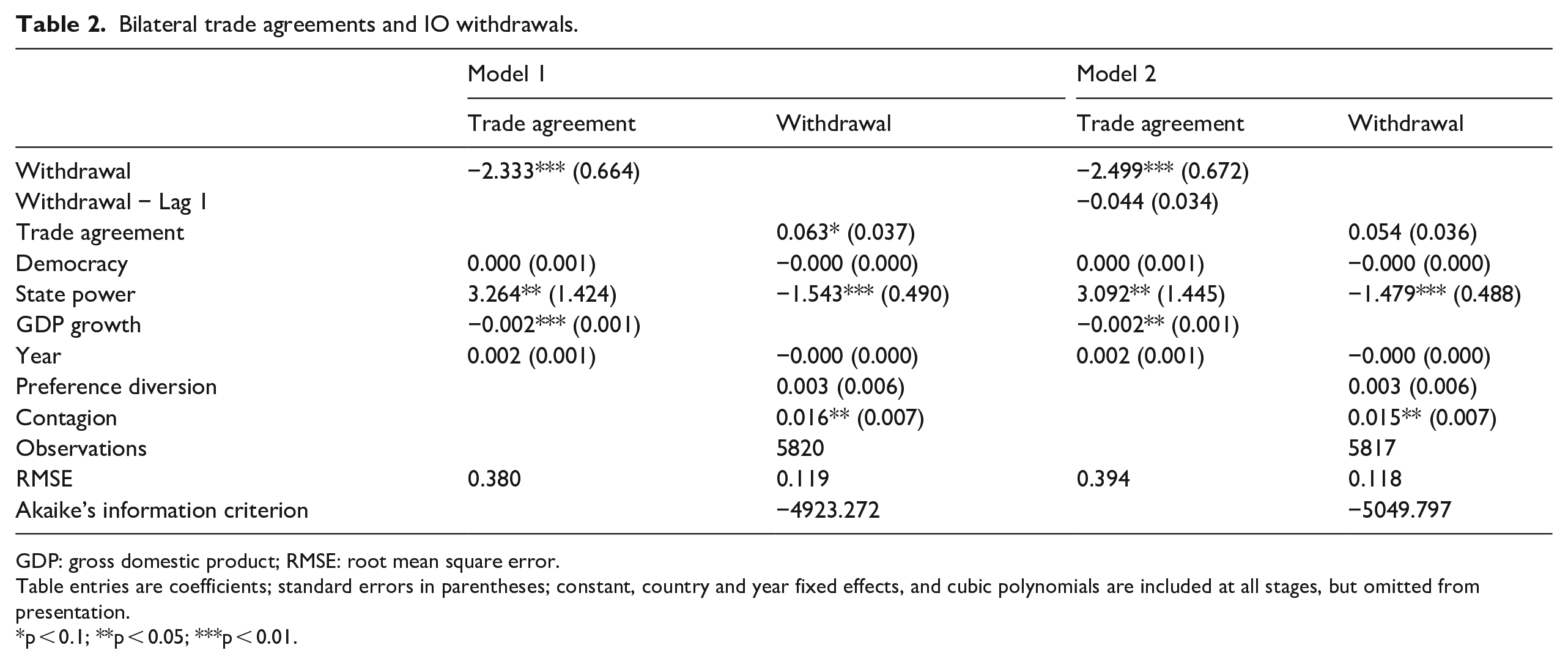
We begin the discussion of our empirical findings with Model 1 in Table 2. This constitutes our main estimation as we consider all variables introduced in the previous section. In the equation with Trade Agreement as the dependent variable, the coefficient of Withdrawal is negative and significant at the 1% level. This suggests that countries exiting from an economic IO are significantly less likely to form a bilateral trade agreement the same year than states that remained in such a multilateral framework, all else equal. The coefficient highlights that this effect is quite substantial and Figure 1 underlines this; here, we plot the predicted probabilities of trade agreement formation given the different values of Withdrawal. 12 Specifically, the likelihood to form a bilateral PTA is at around 3%, holding all else constant at their means; in turn, this probability shrinks to almost 0% (0.020%) if a state did indeed leave a multilateral IO.
Bilateral trade agreements and IO withdrawals.
GDP: gross domestic product; RMSE: root mean square error.
Table entries are coefficients; standard errors in parentheses; constant, country and year fixed effects, and cubic polynomials are included at all stages, but omitted from presentation.
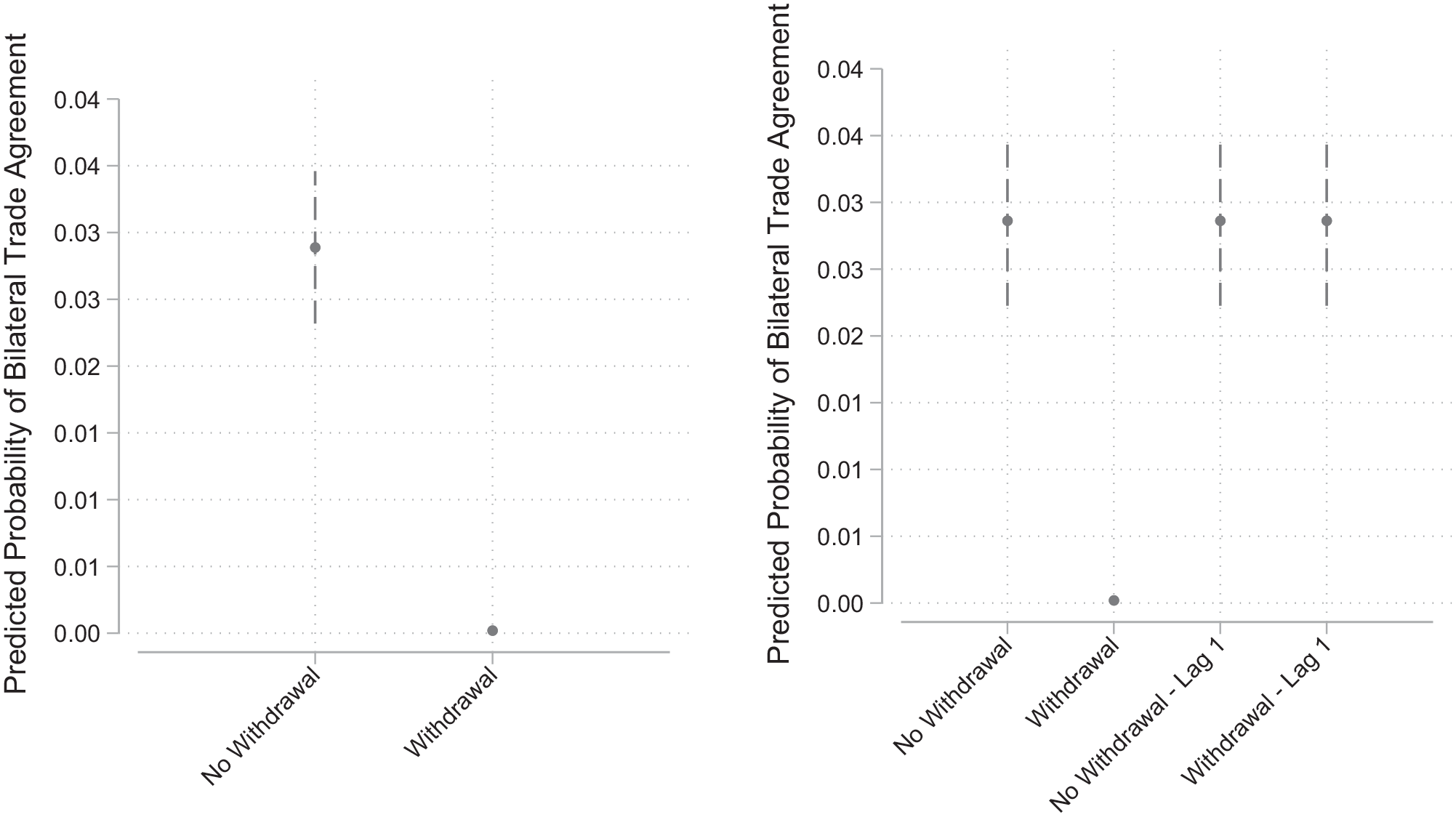
Substantive quantities of interest.
Linking this finding back to the theoretical discussion, we obtain evidence for the view that states will encounter some challenges when exiting an IO – especially having it more difficult to form PTAs in the immediate aftermath of leaving an economic IO. Having said that, it may not be surprising to find this negative effect in the first year after leaving an IO, since median durations of PTA negotiations tend to be longer than 1 year to begin with (Lechner and Wüthrich, 2018). What is more, countries may want to negotiate a new deal in earnest until the economic situation of the partner state is clear (they have exited from an IO). The more imminent question is then how long the negative effect we identify in Model 1 does persist.
To answer this, we re-estimate Model 1, while including a 1-year temporally lagged withdrawal variable. The corresponding results are summarised in Model 2 and the right panel of Figure 1. On one hand, the negative and significant impact for the immediate aftermath of the decision to leave an IO is robust. Substantively, there is also no real difference as the size of the effect is virtually the same (though more strongly given with a point estimate of –2.499 for Withdrawal). On the other hand, and we see this as the main result of our analysis, the insignificant effect estimated for the temporal lag of Withdrawal emphasises that the negative influence of leaving IOs on the formation of PTAs quickly wears out: 1 year after the decision of IO withdrawal, the country is no more or less likely to secure trade agreements than states that did not exit from multilateral agreements. The substantive quantities of interest for both groups converge to around 2.9% of making a deal. Hence, in sum, withdrawing from economic IOs hurts the prospects of trade-deal formation in the first year after leaving an IO, but this could also be expected as negotiating new trade deals usually does take longer than 12 months. More crucially, there do not seem to be overly negative consequences after about 1 year since IO withdrawal. Still, note that the impact of the temporal lag of Withdrawal is merely insignificant in Model 2 – not positively signed and significant; hence, while there is no difference between ‘leavers’ and ‘IO remainers’ when it comes to securing PTAs, those withdrawing from IOs are not put at a massive advantage over those staying after the first 12 months since exit. The arguments surrounding the replication of previous trade pacts and ‘multiple reputations’ (Downs and Jones, 2002; Keohane, 1997; Simmons, 2010) thus seem to matter, though not necessarily in the first few months after leaving an IO.
Our analysis in the Online Appendix and the coefficient estimates of Trade Agreement in Table 2 provide some support for a simultaneous relationship with the withdrawal from IOs. That is, Trade Agreement is positively signed in both Models 1 and 2, albeit significant at conventional levels only in the former. This means that the formation of a bilateral trade deal can increase the chances of withdrawing from an economic IO. The effect is only moderately pronounced, however, as we estimate an influence of about 5.4–6.3 percentage points. The democracy variable is insignificant throughout Table 2, but state power seems to be an important predictor in either equation. While more power increases the chances of securing a bilateral trade deal, it lowers the likelihood of exiting multilateral IOs. We find little evidence for a linear trend in the data, while Preference Diversion is, at least in our setup, a poor predictor (and instrument) of Withdrawal. The other two instruments, GDP Growth and Contagion, perform reasonably well and as expected. First, GDP Growth is negatively signed and significant, which implies that a decline in economic power makes it more likely to form a bilateral trade agreement in the following year. The variable is measured in annual percentage and, hence, a 1% drop in GDP increases the chances of a bilateral trade deal by about 0.2 percentage points. The results from the recursive bivariate probit model in the Online Appendix confirm this. This finding is thus consistent with the claim that countries do indeed make use of bilateral trade deals to improve their economic performance – and this seems very much in need if the economy just weakened (Whalley, 1998). Second, Contagion is positively signed and significant at the 5% level. This result mirrors Borzyskowski and Vabulas (2019); if important countries leave a multilateral IO, a diffusion effect materialises that may motivate others to follow. In the Online Appendix, we further discuss the validity of these instruments.
Conclusion
Contrary to many of the (populist) statements surrounding Brexit, the British government found it quite challenging to secure trade deals in the immediate aftermath of the decision to leave the EU (29 March 2017, when the United Kingdom invoked Article 50 of the Treaty on European Union). And while states certainly do rely on templates when negotiating PTAs (Allee and Elsig, 2019; Allee et al., 2016; Allee and Lugg, 2016), there hardly are ‘oven-ready’ deals (as referred to by the British Prime Minister). In this article, we examined the general relationship between states leaving multilateral IOs and their subsequent ratification of bilateral trade deals. Our main research interest lies in the aspect of timing, that is, how long it takes for a country after an IO exit to recover from potential negative consequences and successfully negotiate a PTA. The main results from our analysis stress that while the chances to conclude negotiations for PTAs are rather low immediately after a country exits an IO, this effect swiftly dies out. According to our calculations, there is no significant difference between ‘leavers’ and ‘IO remainers’ already in the second year after IO withdrawal.
This research makes central contributions to different strands of the literature. First, IOs are important instruments for international coordination and collaboration (Abbott and Snidal, 1998; Elsig et al., 2011; Mansfield and Pevehouse, 2006; Martin, 1992; Schneider, 2011). However, states also withdraw from them (Borzyskowski and Vabulas, 2019), arguably as alternatives exist. While previous works extensively explore the determinants of leaving IOs, we sought to enrich the understanding of the consequences of IO withdrawals. Second, PTAs are crucial for economic growth, trade, and foreign investment (Baccini, 2019; Baier and Bergstrand, 2007; Baier et al., 2008). We contribute to this literature by adding the perspective that states may see bilateral PTAs not always as complements, but rather as substitutes of multilateral forms of cooperation. To this end, new pacts are concluded, and they may well overlap with previous commitments albeit comprising different, smaller membership compositions. This further adds to ‘institutional complexity’ and a more fragmented structure in global governance, potentially with key implications for the effectiveness and performance of international institutions (Hofman, 2009, 2019; Haftel and Hofman, 2019; Keohane and Victor, 2011; Zelli and Asselt, 2013).
Third, we focus on the influence of economic IOs on bilateral trade deals (and vice versa), but patterns like the ones we identify may exist in other issue areas or across policy fields. Haftel and Hofman (2017, 2019) examine security cooperation within regional economic organisations and explore the conditions under which economic institutions ‘trespass’ into the domain of security organisations. In light of their findings, it may be plausible that countries considering the exit from a military alliance may want to address this security deficit through bilateral defence treaties – and then face similar problems in the short run as in the case of economic IOs and PTAs. Future research may also study whether leaving economic IOs affects non-economic (bilateral) forms of cooperation.
Fourth, while increases in transaction costs and reputational damage are arguably more influential in the immediate aftermath of leaving an IO, replicating previous agreements and multiple reputations across treaties and agreements lower the challenges after about 12 months. Ultimately then, our findings provide additional support for many of the well-established claims in the literature. However, it seems an effort worth making to conduct more qualitative and experimental research to fully disentangle the various mechanisms at play that influence the prospects for PTA formation.
At the same time, PTAs may not be perfect substitutes for multilateral organisations. Future research should thus also address this aspect more thoroughly than we can do here and compare the performance of IOs with the effectiveness of bilateral forms of trade cooperation. Given this last point, another avenue of future research could be to analyse the scope conditions that facilitate or hamper the replacement of IO terms by PTAs, for example, the influence of public opinion (see, for example, Spilker et al., 2020). Along those lines, the literature on institutional design provides a useful starting point: by opening the ‘black box’ of IO exits and trade-deal formations, the design of an IO (Koremenos et al., 2001) or the features of a trade agreement (Dür et al., 2014) offer valuable information for the transition of IOs to PTAs, the effectiveness of the latter given IO withdrawal, and the conditions when both trade-pact formation and institutional performance are likely highest.
Finally, there is indeed the question of how beneficial PTAs are for the countries involved. While bilateral trade deals often benefit both parties, one side might profit from the agreement more than the other. This aspect also echoes the Brexit narrative, which stressed that the United Kingdom would benefit greatly from the new, post-EU arrangements. It could be that an inexperienced negotiating team that is in a hurry to rebuild its trade regulatory architecture makes concessions more readily, so that more deals do not necessarily mean the highest possible economic benefit from PTAs for the country. We believe that this issue provides a promising future avenue for research.
Supplemental Material
sj-docx-1-bpi-10.1177_13691481221082454 – Supplemental material for New deals ‘The Second After Leaving?’ IO withdrawal and bilateral trade agreements
Supplemental material, sj-docx-1-bpi-10.1177_13691481221082454 for New deals ‘The Second After Leaving?’ IO withdrawal and bilateral trade agreements by Zorzeta Bakaki and Tobias Böhmelt in The British Journal of Politics and International Relations
Footnotes
Acknowledgements
The authors would like to thank the editors of the British Journal of Politics and International Relations and the two anonymous reviewers for their constructive comments.
Funding
The author(s) received no financial support for the research, authorship, and/or publication of this article.

Supplementary information
Additional supplementary information may be found with the online version of this article.
Context Online Appendix Validity of Instruments Table A1. Reduced Form Regressions Table A2. Testing for Endogeneity Omitting Controls Table A3. Omitting Controls Recursive Instrumental Variable Model Table A4. Instrumental Variable Model Table A5. Bivariate Probit Models Bivariate Probit Models Lag Effects of Withdrawal Figure A1. Lag Effects of Withdrawal Number of PTAs Table A6. Bilateral Trade Agreements and IO Withdrawals Additional Control Variables Table A7. Additional Controls Table A8. Coarsened Exact Matching Coarsened Exact Matching All Types of Trade Agreements Table A9. All Trade Agreements and IO Withdrawals Major International Organizations Table A10. Bilateral Trade Agreements and Major IO Withdrawals Veto Players and Trade Dependency Table A11. Veto Players Table A12. Trade Dependency
Notes
References
Supplementary Material
Please find the following supplemental material available below.
For Open Access articles published under a Creative Commons License, all supplemental material carries the same license as the article it is associated with.
For non-Open Access articles published, all supplemental material carries a non-exclusive license, and permission requests for re-use of supplemental material or any part of supplemental material shall be sent directly to the copyright owner as specified in the copyright notice associated with the article.
