




Abstract
In spite of being criticised as ‘talking shops’ and easily replaced by technological innovations, dialogues – defined as face-to-face interactions in an institutionalised framework – remain a staple of international politics. While prevailing accounts have shown that dialogues help states advance their quest for security and profit, the key role dialogues play in the quest for recognition has been overlooked and remains undertheorised. Emphasising the socio-psychological need for ontological security, this article argues that institutions relentlessly engage in dialogues because it allows them to seek, gain and anchor the recognition of their identity. The significance for international relations is illustrated through the emblematic case of the European Union–US dialogues, specifically the Transatlantic Legislators’ Dialogue. The multi-method qualitative analysis based on original interviews, participant observations, visuals and official documents demonstrates how the European Union exploits these dialogues with its ‘Significant Other’ to seek, gain and anchor the recognition of its complex institutional identity.
Introduction
Every day brings news of another diplomatic meeting held somewhere in the world involving representatives of states and/or international institutions. Be it the recent US–Russia Summit in Geneva in June 2021 or the traditional United Nations General Assembly (UNGA) meetings in September, diplomats maintain a long tradition of face-to-face encounters. The persistence of diplomatic dialogues is puzzling, as they have been criticised as cheap talking shops and empty performances (Morrow, 1999) – even more so with the advance of communication technologies. Still, face-to-face meetings between diplomats, and large gatherings of international representatives remain a staple of international politics. So, why do states and international institutions still resort with so much insistence to old-fashioned face-to-face dialogues?
This article analyses diplomatic dialogues, arguing that one of their functions is to recognise and anchor institutional identity. Dialogues – defined as a face-to-face interaction in an institutionalised setting – are part of the struggle for recognition in which both states and institutions relentlessly engage in world politics. Collective actors extensively resort to dialogues to seek, gain and anchor the recognition of their identity, thereby meeting their socio-psychological needs. This conceptualisation draws from scholarship on dialogue (Barston, 2006; Fierke, 1999; Watson, 1982) and recognition theories (Agné, 2013; Greenhill, 2008; Gustafsson, 2016a; Lindemann and Ringmar, 2012), while adding insights from socio-psychology to challenge our established understanding of the role of dialogue in international politics. So far, international relations (IR) theorists have emphasised the role of dialogues in the pursuit of security and profit, conceptualising them as a reflection of power constellations (see realists like Fierke, 1999; Langholtz and Stout, 2004: 3), as an engine for cooperation through information exchange (see liberal institutionalists’ accounts like Crawford, 2011: 29; Keohane, 1988), and as a process of persuasion and arguing, leading to shared understandings (see constructivists, such as Adler, 1997; Risse, 2000). Yet, little attention has been given to the role dialogues play in the quest for recognition in international politics. Institutions and states are sensitive to identity matters and therefore take advantage of dialogues as rich social settings to seek, gain and anchor the recognition of their identity.
The socio-psychological approach adopted here proposes a full appreciation of dialogues’ human and emotional dimensions, especially in the way micro-practices anchor the institutional identity of international organisations, such as the European Union (EU). Drawing on Goffman (1959), we conceptualise the practice of dialogue as a symbolically framed interaction through which institutional identity is recognised and anchored. Participants fulfil a symbolic function as carriers of institutional identity seeking recognition on behalf of their institutions. This explains why institutions are keen in participating in these dialogues and in turning each event within the dialogue into a success story to be amplified through not only official documents, but also through social media. While the literature focuses on formal and informal modes of recognition at the macro-level (Fabry, 2010; Gustafsson, 2016a; Newman and Visoka, 2018), we suggest recognition processes occur also at the micro-level in everyday diplomatic practice. This study therefore broadens the universe of instances in which recognition is sought, granted and routinised. Given the global backlash against liberal assertiveness (Alter and Zürn, 2020) and recognition struggles coming from both West and semi-periphery (Adler-Nissen and Zarakol, 2021), this research is particularly timely.
To illustrate how dialogues are used to seek recognition of institutional identity, we focus on the EU as it has set up an entire ‘dialogue system’ (Monar, 1997: 272), becoming one of the international actors conducting the highest number of diplomatic dialogues. We examine the transatlantic dialogue, featuring an intensity of consultations unprecedented in the history of diplomacy writ large (Ginsberg, 2001). Specifically, we look at the Transatlantic Legislators’ Dialogue (TLD), which is among the most thriving dialogues institutionalised between the EU and the United States. Methodologically, the article relies on ethnographic methods, including participant observations in confidential meetings and interviews with European and American lawmakers participating in these dialogues, to collect data about the socio-psychological dynamics underpinning these interactions. Beyond the description of the dialogue’s formalities, it offers a novel and textured analysis of the practitioners’ perspectives to understand what they do and how they understand what they do – thereby, shedding light on the relevance of the micro-practice of dialogue for wider political phenomenon (i.e. recognition). The data complemented with primary sources are analysed through a thematic analysis. It shows that against the backdrop of a lesser American commitment to the transatlantic dialogue, the EU is eager to conduct these dialogues to gain recognition and anchor its institutional identity.
Section ‘Recognition, institutional identity and dialogue’ overviews the recognition literature and suggests that institutions are relentlessly seeking recognition of their institutional identity to meet their ontological needs. Section ‘Recognising and anchoring institutional identity through dialogue’ draws on socio-psychology to conceptualise the role of dialogue in the quest for recognition. It articulates an innovative framework analysing the process through which institutional identity is recognised and anchored. Section ‘The quest for recognition through the Transatlantic Legislators’ Dialogue: “We, as Europeans, feel more and more recognised”’ empirically exemplifies how the EU uses the TLD to gain the recognition of its identity from its arguably most ‘significant other’ (the United States). The conclusion highlights the relevance of recognition theory to diplomatic practice and provides suggestions for future research. Focusing on recognition struggles in dialogical interactions helps comprehend the intricacies of diplomatic practice and wider dynamics of identity formation in international politics.
Recognition, institutional identity and dialogue
The struggle for recognition is one of the core motivational dynamics characterising international affairs alongside the search for security and profit (Lindemann and Ringmar, 2012). For Ringmar (2002: 116), ‘not only physical, but also social survival is at stake in international politics’. Several drivers exist behind the quest for recognition. Recognition brings material benefits both for the party being recognised (in terms of prestige, leader’s political survival or resources in the case of an organisation) and for the recogniser, as its powers and legitimacy expand in the process (Agné, 2013). Yet, this instrumental perspective is only part of the story. Recognition is also emotionally loaded and taps into moral and identity matters. Drawing on political theories of justice and entitlement, several studies see the quest for recognition as the ambition to be perceived as an equally ‘moral person’, capable of taking autonomous moral decisions (Honneth, 1995; Taylor, 1994).
Our view is that recognition is a powerful psychological need related to the process of identity formation and maintenance of ontological security (Greenhill, 2008; Lindemann and Ringmar, 2012). In line with Meads’ symbolic interactionalist approach, actors construct themselves and gain a sense of ontological security through interactions with Others (Mead, 1967). While collective actors internally develop a self-image arising from domestic discourses and historical experiences, this self-understanding can only become a secure identity when it is framed and recognised through social interactions (Kinnvall and Mitzen, 2017: 4). Actors need other’s validation of their identity, ‘lest they feel insecure about who they really are’ (Wolf, 2011: 109). This stable sense of identity is crucial as it informs both the actors’ interests and how they are to act in pursuit of these interests (Murray, 2015: 70). As Albert et al. (2000: 13–17) remind us: ‘Whether an organization, group or person, each entity needs a preliminary answer to the question: “who are we?” or “who am I?” to act and interact effectively with other entities over the long run’. Conversely, a lack of recognition can be perceived as ‘traumatic’ (Mitzen, 2006; Ringmar, 2014: 7) and have detrimental consequences on peace and prospects for cooperation. While mutual recognition pushes IR in a peaceful direction, misrecognition can spark conflict and deteriorate relationships (Gustafsson, 2016a; Strömbom, 2014). It is therefore crucial to scrutinise the ways through which recognition is secured in international politics – dialogue, being one of the most important – yet overlooked one.
But which types of actors seek recognition on the international stage? While states have long been considered the main actors seeking recognition and being able to grant it, recent studies have shown that international institutions and non-state actors are also involved in recognition struggles (Geis et al., 2015). International institutions are not only pursuing material gains but are also seeking the satisfaction of identity needs involving recognition processes (Mitzen, 2006; Oelsner, 2013). This quest for recognition is linked to the imperative to gain legitimacy and assert authority (Tallberg and Zürn, 2019). Yet, not all collective actors have the same recognition needs. The EU, for instance, has pressing recognition needs due to its sui generis nature as a political actor, its ever-evolving machinery of decision-making and ambiguous end purpose. Even within the EU, there is variation in the recognition needs of different institutions: the European Parliament (EP) being the neediest one, trying to assert its role as a new foreign policy player (Blanc, 2018). While more theorisation on the sources and evolution of recognition needs of states and institutions alike is needed, this article suggests that the more acute the recognition needs of an actor, the more it will use dialogues to gain and anchor its identity. The exact way through which dialogues are exploited for this purpose remains valid across diverse cases.
In this study, we are interested in ‘thick recognition’ as opposed to ‘thin recognition’ (Gustafsson, 2016a). Whereas thin recognition refers to the legal status of a sovereign state, thick recognition acknowledges difference and uniqueness in the form of specific qualities. It refers to the recognition of distinct identity narratives of an individual, group or state (Strömbom, 2014). Institutions, too, develop a sense of institutional identity for which they seek recognition. It corresponds to ‘the identity, which is the most central, enduring, and distinctive about an organization’ (Albert and Whetten, 1985: 410). It encapsulates the organisation’s essential characteristics, like its missions, values, qualities and procedures (Missoni, 2014: 370). In line with the socio-psychological literature on identity construction (Brewer, 1991), we consider two institutional identity claims for which recognition is sought: relevance and distinctiveness. Relevance relates to the recognition of a social status (Ringmar, 2012: 7) and of a subsequent privileged relationship (i.e. relationship identity of partners), for which the demonstration of capabilities, efficiency in delivering results, coherence and reliability are indicators. Distinctiveness refers to the positive appreciation of the institution’s values, interests and procedures that make it unique. This implies giving respect to the differences of the Other (Scott, 2000; Wolf, 2011).
For Lindemann and Saada (2012: 1–28), thick recognition is granted when the nature of the interaction confirms the actors’ self-ascribed value and importance along these dimensions. At the core of the recognition process therefore lies a match between the self-image of the actor seeking recognition and the treatment it deems appropriate to receive by the recognising party. Conversely, the denial of thick recognition entails not recognising an actor’s unique identity (Gustafsson, 2016b: 617). The actor is recognised in a way that differs from its own understanding and this leads to a mismatch between the actor’s self-image and the perceived inadequate treatment it receives from the actor granting recognition.
A note on the ‘aggregation issue’ is in order here. While the actors seeking recognition during the dialogue are individuals, their interactions at the micro-level have far-reaching consequences at the macro-level, reinforcing the institutional identity of the organisation they represent. Without theorising the transmission mechanisms from the individual to the collective, we follow the ‘quasi-behavioural approach’ devised by IR scholars to incorporate psychological insights into IR by treating aggregate actors as unitary (Gildea, 2020: 3). Adopting the ‘social conception of institutional identity’, we consider institutions as social actors, authorised to engage in social intercourse as a collective, and possessing rights and responsibilities, as if the collective were an individual (Whetten and Mackey, 2002: 395).
How do institutions and states engage in recognition games? The recognition literature typically privileges macro-level rather than micro-level interactions. Regarding thin recognition, the emphasis has been on legal one-off acts of recognition easy to capture (e.g. statehood recognition in the UN); (Agné, 2013: 101). Yet, given that thick recognition cannot be expressed once and for all by a single act, as collective entities are constantly seeking recognition in interaction with Others, recent studies have uncovered subtle ways through which actors seek, grant and routinise recognition (Gustafsson, 2016b). It involves both practices of recognition (Kessler and Herborth, 2013: 158) and representations (Duncombe, 2016). Gustafsson’s (2016b) work on the recognition dynamics underlying Sino–Japanese relations is illustrative. While it highlights macro-practices of recognition, including the acceptance of foreign aid and public apologies, it overlooks the fact that recognition also permeates micro-practices of international life. To put it succinctly, ‘recognition, or its negative counterpart, “misrecognition” is relevant whenever people or their collective organisations interact – or fail to interact’ (Geis et al., 2015: x). As a powerful dynamic omnipresent in any social interaction, it is necessary to conceptualise how recognition unfolds in the micro-practice of dialogues and how it affects the identity of the relevant actors. Hence, this research answers Pouliot and Cornut’s (2015: 306) call to explore synergies between practice theory and diplomatic studies using an inter-disciplinary approach. By foregrounding insights from socio-psychology to uncover the micro-foundations of political interaction, this research also complements the growing scholarship on the benefits and pitfalls of face-to-face interactions (see, for instance, Holmes and Wheeler, 2020).
Recognising and anchoring institutional identity through dialogue
Dialogue as a unique form of social interaction favourable to recognition processes
The term ‘dialogue’ has been used in different contexts, ranging from cooperation and diplomacy to conflict resolution (Jönsson and Hall, 2005; Rothman, 1992; Watson, 1982). We define dialogue in narrower terms as ‘a face-to-face interaction in an institutionalized setting’, as it allows to conduct a granular analysis of a specific and long-lasting diplomatic practice. On this basis, two features allow recognition processes to unfold intensively at this level of interaction: (1) the temporal and spatial immediacy inherent in the face-to-face encounter and (2) the symbolic nature of the institutionalised meeting.
Temporal and spatial immediacy
The temporal and spatial immediacy opens verbal and non-verbal opportunities not easily obtained in other communicative settings (Markova, 1990: 6). It provides subtle ways for collective actors to seek and grant recognition. While diplomacy scholars have shown that non-verbal communication in direct visual contact allows the exploitation of body language (gestures, dress code etc) and of social rituals (Berridge, 2005: 113–114), thereby facilitating communication processes – we go further and argue that these gestures are used to signify a certain type of relationship in a subtle recognition process. Similarly, emotional display is not only a mechanism for intention understanding (Holmes, 2018; Wong, 2016) and trust-building (Markova, 2012). It provides cues regarding the degree to which actors feel that their identity has been recognised, as the recognition of one’s identity – or lack thereof – taps into personal and collective emotions. Denial of recognition is understood as humiliating whereas acts confirming an identity are seen as respectful and thus induce pride and joy, making actors feel ontologically secure (Wolf, 2011).
Dialogue as a symbolically framed interaction
The institutionalised nature of the interaction entails a strong symbolic dimension. It is thanks to the symbolism inherent in the institutionalised encounter between representatives of institutions that the recognition process at the micro-level can be extrapolated to the macro-institutional level. Symbols make relationship between abstract entities concrete. For Failluzaev (2013: 92), the abstract nature of any political institution requires a degree of objectification to allow meaningful interactions. ‘When no one see the state, and international politics does not present itself directly to our senses’ (Wendt, 1999: 5), the use of symbols becomes indispensable to make institutions more tangible. Well-aware of their role in the interaction, actors engage in a ‘team performance’ defined as a collection of individuals cooperating to project and maintain a certain impression upon others (Goffman, 1959: 47). The key point is that if the individual’s activity is to become significant to others, he must mobilize its activity so that it will express during the interaction what he wishes to convey. The performer may be required not only to express his claimed practices during the interaction but also to do so during a split second in the interaction.
To achieve this aim, ‘the individual typically infuses his activity with signs, which dramatically highlight and portray confirmatory facts that might otherwise remain unapparent and obscure’ (Goffman, 1959: 19). The dialogue therefore becomes the scene on which the actors ‘perform’ their institutional identity to get this identity recognised. The power of symbolism helps us make the jump from the interactions at the individual level to the macro-level, tackling the ‘aggregation issue’ (Gildea, 2020). By their very essence as representatives, individuals engaged in institutionalised dialogue, embody and perform the institutional identity for which recognition is being sought. The image of an institution is the result not only of its activities but also of the behaviour of those who represent it. A negative image of the organisation will be generated if their attitudes are not coherent with the organisation’s declared values and aims (Missoni, 2014: 370). The anthropomorphic discourse equalising the characteristics of the diplomats with the institution they represent shows we can experience institutions (Failluzaev, 2007: 532). The dialogue can thus be conceptualised as an instance in which the state or institution represented is experienced firsthand, opening unique recognition opportunities. While this study focuses on the use of dialogue to seek and grant recognition, it can equally be exploited negatively to misrecognise the other and hurt its self-esteem (Failluzaev, 2020).
The threefold process of recognition of institutional identity through dialogue
We map three stages in the recognition process of institutional identity through dialogue: seeking recognition by projecting different dimensions of identity (relevance and distinctiveness), gaining recognition in the case of a perceived match between one’s self-image and the treatment received, and anchoring recognition through the enactment of visual, discursive and practical anchors. These stages roughly overlap with key moments of the dialogue: first, ‘the entry to the room’, including the preparation; second, ‘the interaction within the room’, corresponding to the bulk of the dialogue in which participants experience the relationship; and third, ‘the leaving of the room’, whereby symbolic elements are projected to the world allowing the recognition of identity to be anchored and celebrated outside the room. Regarding the debate on how to recognise thick recognition (i.e. ‘the recognition of recognition’; Lindemann, 2012, 2014; Steele, 2014), we follow Gustafsson’s (2016a: 260) approach, which identifies the main dimensions of an actor’s self-identity and the acts and statements interpreted as recognition by recognition-seeking actors. Relying on Failluzaev (2007, 2013), we specify the symbolic elements available in the dialogical context that are exploited by representatives to seek, gain and anchor recognition or alternatively to misrecognise Others.
Seeking recognition before and during the dialogue
The participants’ recognition-seeking behaviour is apparent in the preparation and during the dialogue through the efforts made to project the different dimensions of their institutional identity. The preparation corresponds to the ‘rehearsal’ of the dialogue whereby actors coordinate ‘their team performance’ (Goffman, 1959: 47) to come across as competent, coherent and knowledgeable in line with the relevance component of institutional identity. Taking a leadership role is a way to project these qualities and the ability to organise high-level meetings is a symbolic demonstration of power and prestige (Failluzaev, 2013: 109). The intense coordination efforts among relevant bodies are also part of this ‘team rehearsal’ aimed at sending a unified message to convey a coherent image of the institution. This is particularly relevant for complex organisations, such as the EU, often criticised for its incoherent foreign policy (Gebhard, 2017). Likewise, the selection process of participants matters. Top experts are selected to participate in the delegation to project a high degree of competency. The more focused the discussions are, the stronger the image of the institution is, and consequently, the higher the likelihood of recognition to be granted.
Similarly, participants exploit the dialogical interaction itself to seek recognition by performing key dimensions of institutional identity. For instance, the distinctiveness component is enacted through specific procedures. Turn-taking is strategically designed to reflect the delegation’s composition and hence the plurality of views characterising the institution. For a deliberative and normative body, like the EU, it is important to exemplify the values it represents. Ensuring that all views are given due consideration and respect is a defining feature of democracy and consensus-building. Informal activities, outside the formal meeting room, equally reflect recognition dynamics. Activities, such as fact-finding visits, are designed to prove the institutional relevance of the organisation in certain policy areas by highlighting its achievements and ability to deliver.
Gaining recognition within the room: Match between self-image and treatment received
To be granted recognition, there needs to be a match between the self-image of the actor seeking recognition and the treatment it deems appropriate to receive (Lindemann and Saada, 2012: 1–17). This does not imply that the interaction goes perfectly smooth. Actors seeking recognition can at times feel not properly recognised through certain practices. Yet, what matters is the predominant perception of the interaction among members. Here are symbolic aspects of the dialogical interaction that can be interpreted as acts of recognition in line with the dimensions of institutional identity. The dialogue’s format is instructive in terms of relevance; the large size of a delegation and the presence of influential personalities demonstrate the foreign delegates’ interest to invest time and resources to make the visit (Failluzaev, 2013: 109), thereby recognising the host’s importance. The ‘relevance’ component of institutional identity relates to the concept of ‘relationship identity’, describing the roles that actors play vis-à-vis each other (Failluzaev, 2013: 110). As the EU and the United States have long held a relationship identity of partnership and friendship, we focus on the ways through which the nature of the dialogical interaction provides recognition for this type of identity. First, actors defining each other as friends share a project of ‘world building’ and strive towards realising this shared vision of international order (Berenskoetter and Van Hoef, 2017: 6). This commitment is expressed in the practice of dialogue whereby actors understand the aim of their encounter in terms of the advancement of common objectives with the ambitious vision of setting world-wide standards. Friendship is also associated with practices consisting of ‘giving counsel and privileged access’(Berenskoetter and Van Hoef, 2017: 8), whereby actors disclose private information exclusively. For Oelsner and Koschut (2014: 20), ‘friends usually expect each other to reveal more information to each other than to others and to display a higher level of tolerance towards bad news’. One observes this characteristic when actors display mutual trust. Extra-gestures, like a visit to a publicly restricted site, can also be perceived as a recognition act. Finally, another indicator revealing the recognition of identity (i.e. distinctiveness dimension) is the widely shared feeling among actors seeking recognition that their counterparts fully understand and respect their fundamental differences, and hence distinctiveness.
Leaving the room: Anchoring and celebrating recognition with the rest of the world
While the bulk of the recognition process unfolds within the meeting room, it needs to be externalised and publicised for the institutional identity to be effectively anchored. So how does the recognition process experienced by individuals at the micro-level transcend the meeting room to reinforce the institution’s identity? We identify three forms of anchors of institutional identity emanating from the dialogue: visual, discursive, practical anchors.
Visual anchors comprise photographs carrying the visualisation of recognition and anchoring institutional identity. More than objective reflections of reality, images have their own agency in the sense that they can do things (Lisle, 2016). They are part of a visibility strategy deployed by institutions to make tangible their identity and increase their visibility world-wide. Thanks to the ‘circulability’ inherent in visuals, that is, its capacity to transgress linguistic boundaries, images reach more audiences than words (Hansen, 2011: 53). While in the past, few people could observe diplomatic interactions wrapped with symbols and rituals, technological developments have made digital public diplomacy effective in making these images available for millions of television viewers and Internet users.
Second, dialogues generate discursive anchors of institutional identity in the form of official documents. These statements carry the recognition of the actors’ distinctiveness and the essence of their relationship. As Oelsner (2013: 119) points out: ‘Institutional identity crystallises in normative and discursive statements that define what the institution is: what its purpose, goals and limits are; how it plans to achieve them’. The wording of the documents captures the recognition process and discursively anchors institutional identity in a long-lasting manner. Indeed, these statements result from tough negotiations, in which each party attempts to integrate into the text the values at the core of its identity. Having these distinctive identity features reflected in the final documents amount to the granting of recognition. Praise and congratulatory remarks anchor recognition, as they give credibility and acknowledge achievements. The recognition of relevance claims (articulated in a discourse of partnership) is enshrined in the final text, whereby both sides highlight their shared values and interests. The world-wide dissemination of these statements further embodies the partnership identity, as it presents to the world a unified front sending strong signals to third countries and delineating ‘them versus us’ (Berenskoetter and Van Hoef, 2017: 10).
Finally, institutional identity is anchored through practices emanating from the dialogue – or ‘practical anchors’ of institutional identity. The ‘consultation reflex’ that develops, thanks to personal contacts created during face-to-face encounters, is another act of recognition of friendship. It corresponds to the pavlovian habit of consulting counterparts and involves the formation of informal and ad hoc meetings in-between formal meetings. As one American official put it: ‘Through these inter-personal connections, you want to create an institution-to-institution relationship’ (Interview, Brussels, 2 November 2016), making clear the link between the individual and institutional level of relationship. This practice of ongoing consultation anchors institutional identity as it establishes a partnership relationship in which both institutions are regarded as relevant and necessary interlocutors (Oelsner and Koschut, 2014: 16).
Conversely, in the case of misrecognition, the predominant negative feeling of not being properly treated in line with one’s self-image has a negative influence on the dialogical dynamics in the room and does not lead to a fully-fledged anchoring of institutional identity. Instead, the misrecognised actor must reposition itself and engage in various strategies to seek further the recognition of its identity (Greve, 2018; Ringmar, 2012).
Methodology
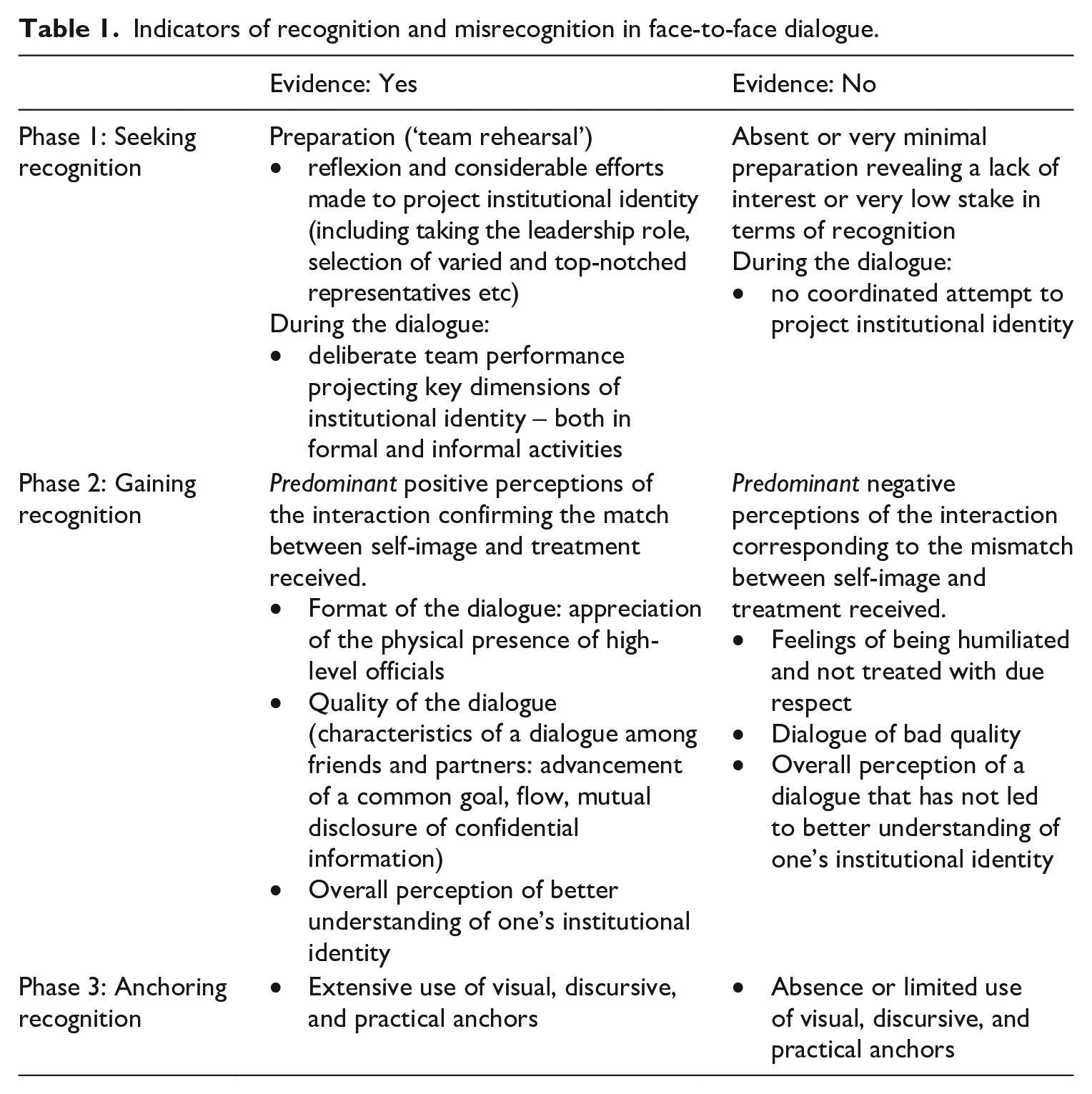
In Table 1, we summarised the symbolic elements used and interpreted by actors, as recognition acts and markers of recognition-seeking behavior – or conversely as indicators of misrecognition. To test this model, we investigated the practices related to the dialogue and the participants’ perceptions thereof. Despite the confidentiality and lack of accessibility issues surrounding these high-level meetings, we collected innovative data relying on ethnographic tools. We conducted 25 semi-structured interviews, consisting of open conversations around core questions to understand the subjective perspectives of TLD’s participants (Bogner et al., 2009: 52). They were conducted in person between December 2015 and July 2017 with a representative sample of members of European Parliament (MEPs) and Congressmen that participated at least once in the TLD. A combination of convenience, snowball and purposive samplings was used to reach ‘theoretical saturation’ (Morse, 2004). We also conducted participant observations in high-profile meetings 1 to capture thick descriptions of these social interactions (Gold, 1958). Finally, we gathered primary sources (private records related to the dialogue, joint statements, and social media reporting, including photographs of the dialogues) and conducted a thematic qualitative analysis of the data.
Indicators of recognition and misrecognition in face-to-face dialogue.
The quest for recognition through the Transatlantic Legislators’ Dialogue: ‘We, as Europeans, feel more and more recognised’
To exemplify these theoretical dynamics, we present the case study of the TLD that has gathered MEPs and members of US Congress since the 1970s. The bi-annual dialogues held in Europe and the United States are composed of official sessions and informal activities, including dinners in sophisticated locations and fact-finding visits. These meetings culminate with the signature of the joint statement summarising the spirit of the discussions. As such, the TLD lends itself to the analysis of the constellation of symbolic practices that are mobilised to seek and anchor recognition. While the TLD officially aims at increasing democratic oversight and leading to a greater convergence of positions (European Parliament, 1999), our analysis – conducted under the Obama administration – demonstrates that the TLD also allows MEPs to seek recognition and anchor EU’s identity. It highlights a striking asymmetry in the dialogical engagement between the EU and the United States. From the preparation to the anchoring phase, MEPs are more invested than their American counterparts. However, while the way through which the dialogue is conducted renders this asymmetry visible, it also provides an opportunity for MEPs to project the different dimensions of EU’s identity and gain recognition.
The European Parliament’s recognition-seeking behaviour before and during the dialogue
MEPs approach the dialogue as a performance in which they can seek recognition by projecting the ‘relevance and distinctiveness’ dimensions of EU’s institutional identity. In the EU case, relevance refers to the competences attributed to a ‘partner’ capable of delivering results and to the identity of ‘friendship’, as we scrutinise EU–US relations (Steffenson, 2005). Distinctiveness relates to the values associated with the EU as a normative power, like the commitment to representative democracy, the promotion of human rights, multilateralism and more (Manners, 2002). 2
The preparation reveals an asymmetry in terms of commitment to the dialogue between European and American representatives whereby the EU invests greater efforts to be recognised as a relevant and unified interlocutor. First, while the EU and the United States formally have the co-responsibility to prepare the meetings, in practice, the EU drives the choice of topics to be discussed and the drafting of the Joint Statements (Interview, Washington, 19 May 2016). As an American official mentioned, ‘the initiative comes mainly from the EU, they are in the driver seat while for the Americans, this is a reactionary thing’ (Interview, Washington, 24 June 2016). This strong sense of initiative is not only a subtle way to exert influence on the dialogue’s parameters and hence on its outcome. It is also designed to convey the image of a highly committed and competent partner.
The asymmetry is also blatant regarding the ‘rehearsal of the team performance’. MEPs are more committed to the provision of expertise and the coordination of their institutional position than their American counterparts – the aim being to appear as a knowledgeable and unified actor. Eager to counteract the criticism regarding the EU’s lack of coherence as a political actor, the EP takes measures to ensure excellent coordination both among MEPs and other EU institutions. 3 This internal process crystallises EU’s institutional identity as it requires members to define their identity’s core elements. As MEPs highlighted, ‘the preliminary meetings are crucial, we try to figure out our positions, what is important for us. We try hard to coordinate ourselves to avoid sending contradictory messages to the Americans’ (Interview, Brussels, 16 March 2016). The rationale behind this preparation is therefore to prove to the Americans that it was worth talking to Europeans, in short that Europe is relevant: ‘Meeting for the sake of meeting is not good enough so we need to bring some added value to convince Americans to travel’ (Interview, Brussels, 9 December 2015).
The interaction between European and American representatives during the formal and informal sessions exposed the MEPs’ recognition-seeking behaviour vis-à-vis their American counterparts. Every single gesture, statement and facial expression matters in this symbolic interaction. Thus, nothing is left to chance, not even the rules for taking turns to speak. As the EU and US chairmen have the prerogative to give the floor to the participants from their own delegation, the European chair purposefully reaches to members from various parties to reflect the EP’s unique features in terms of the plurality of its political views. As one MEP testified: It’s true that we are supposed to portray the position of the EP, but this does not mean that we may not expose our divergences. We have done so in the past, and Americans appreciate it because they understand that we are not a uniform parliament. The beauty of the exercise is to see the nuances that characterize our parliament. This is who we are. (Interview, Brussels, 17 March 2016)
This is a compelling illustration of how the dialogue turns into a performance in which the distinctiveness of the institution becomes more tangible thanks to the concerted efforts of the members to project this identity.
The on-site visits in Europe are perceived as another opportunity to prove to the Americans that the EU can deliver by highlighting its achievements often underestimated by the United States. The visit to Europol and to the Rotterdam harbour (78th TLD) is a case in point. As a senior figure in the EU parliamentary delegation to the US explained: This visit to Europol serves our agenda. If the Americans see how serious the work Europol is doing, they may not just think Europe is letting all the terrorists run free. I hope that when they see what is happening in Europe, they will not be so aggressive and tell us we are naïve. (Interview, Brussels, 18 March 2016)
In the room: Match between self-image and the treatment received
The MEPs’ predominantly positive perceptions of the dialogue suggest they succeeded in gaining recognition from their American counterparts, and by extension from the United States. First, the mere presence of American representatives is considered a success. Given the competing demands of US reps, the fact they prioritise travelling to Europe indicates the importance of the transatlantic relationship: ‘Most important in the end, is to get the American side involved. In the last meeting, we had good American participation. If you get ten Americans coming to Europe, it’s a huge achievement’ (Interview, Brussels, 9 December 2015). Likewise, the increased involvement of Senate members is seen as a sign of honour for the European participants and their institutions (Interview, Washington, 3 June 2016). This is confirmed by American participants: The attendance to these dialogues is a way to show commitment to the value of the dialogue and the transatlantic relationship: It is important not to neglect the fact that Congressmen are coming because they see value in these dialogues. Otherwise, they wouldn’t come! (Interview, Washington, 24 May 2016)
Second, the content of the interaction confirms the relationship identity as friends and partners – reinforcing the EU’s relevance as an international player. First, the fact that the rationale guiding the discussions corresponds to the advancement of a common project in terms of world governance strengthens the feeling among MEPs that they are part of an important endeavour with the United States, whereby both entities are leading the world as partners and form the pillars of the Western liberal order (Interview, Washington, 22 May 2016). Many ideas discussed during these working sessions refer to the EU–US ambition of ‘setting the gold standards so that others can follow’ (Fieldwork notes, The Hague, 2016). Second, by contrast to distrustful dialogues (i.e. dialogue with Iran), the flow of the dialogue is appreciated by European and American lawmakers because it confirms the friendship relationship identity whereby both sides are part of the same community of values and recognise each other as such. For many participants, the exceptional quality of exchange is due to shared political and cultural values (Interview, Brussels, 24 March 2016). Third, MEP interpret the high-level of mutual disclosure as the recognition of the EU as a valued partner and friend. Highlighting this routine of amity whereby both sides feel comfortable to talk openly, one EP official mentioned: It’s not a dialogue of the deaf but a dialogue between friends. I am happy, as a European, that we can be frank and tell them why we think they are wrong sometimes. If we would agree with everything, we wouldn’t behave like friends. We need them and they need us. (Interview, Brussels, 10 December 2015)
The same interviewee added that, sometimes congressmen admit the partial responsibility of the United States in global problems (Interview, Brussels, 10 December 2015). MEPs appreciate these ‘confessions’, as it highlights their privileged relationship with the United States. Even outside the room, MEPs interpret the extra-gestures of their American counterparts to honour them as a way to grant recognition for their relevance as friends and partners: The little bonus we [EU] got when we were in Washington, is that the Americans took us to the balcony of the Speaker of the House. It’s nice, they let us go through ‘secret’ corridors not open otherwise to the public. These little things are part of the meetings and help build the relationship. (Interview, Brussels, 11 December 2015)
Overall, the dialogue is deemed effective in helping Americans better understand the EU’s distinctiveness, thereby granting the EU recognition for its institutional identity. As one EP official put it: There is recognition, they recognise now who we are. Ten years ago we had to repeat in each meeting ‘who we were, what was the European parliament’. Now we don’t have to go through all this anymore. One of the biggest achievements is that, even if we don’t agree on everything, we are discussing on an equal-to-equal basis. (Interview, Washington, 24 May 2016)
This assessment of the increased recognition of EU’s distinctiveness is shared among American interviewees, who admit that ‘Congressmen have begun to realise MEPs have legislative authority. The EU all the sudden had become an important legislative institution – even though it was this “union thing,” which is something that people are still trying to grasp’ (Interview, Washington, 21 June 2016). They also admit that they ‘learn a lot from the EU – particularly regarding Justice and Home Affairs issues’. This last quote illustrates the anthropomorphisation of the EU as a distinct and competent actor achieved through the performance of its representatives.
Leaving the room: Anchoring and projecting recognition to the world
In the third stage, European representatives exploit visual, discursive, and practical anchors emanating from the dialogue to clinch the recognition of their institutional identity and project it to the world. The asymmetry in the dissemination scope of the dialogues’ outcomes between the EU and the United States reflects yet again the EP’s acute need to have the recognition of its institutional identity also seen by others – by contrast to the United States.
In terms of visual anchors, the EP does not miss an opportunity to take pictures of the delegations standing side-by-side in a spirit of equality and cooperation, with the landmark buildings in the background to emphasise distinctive cultural features. Apart from being the official portrait of the relationship, this ‘family picture’ visually captures the relationship identity as equal partners; the same number of European and American representatives on the picture, their respective flags at the exact same length and the honourable position in which they stand, are part of the strategy of symbolic equalisation (Figure 1). These visual anchors become even more relevant when publicised. Noteworthy is the difference between the European and American delegations in the way they publicise these images towards their domestic constituencies and international audiences. While the EP pro-actively publicises the TLD using various media channels – TV, radio and social media – coverage of these meetings on the American side is much more modest (Figure 2).
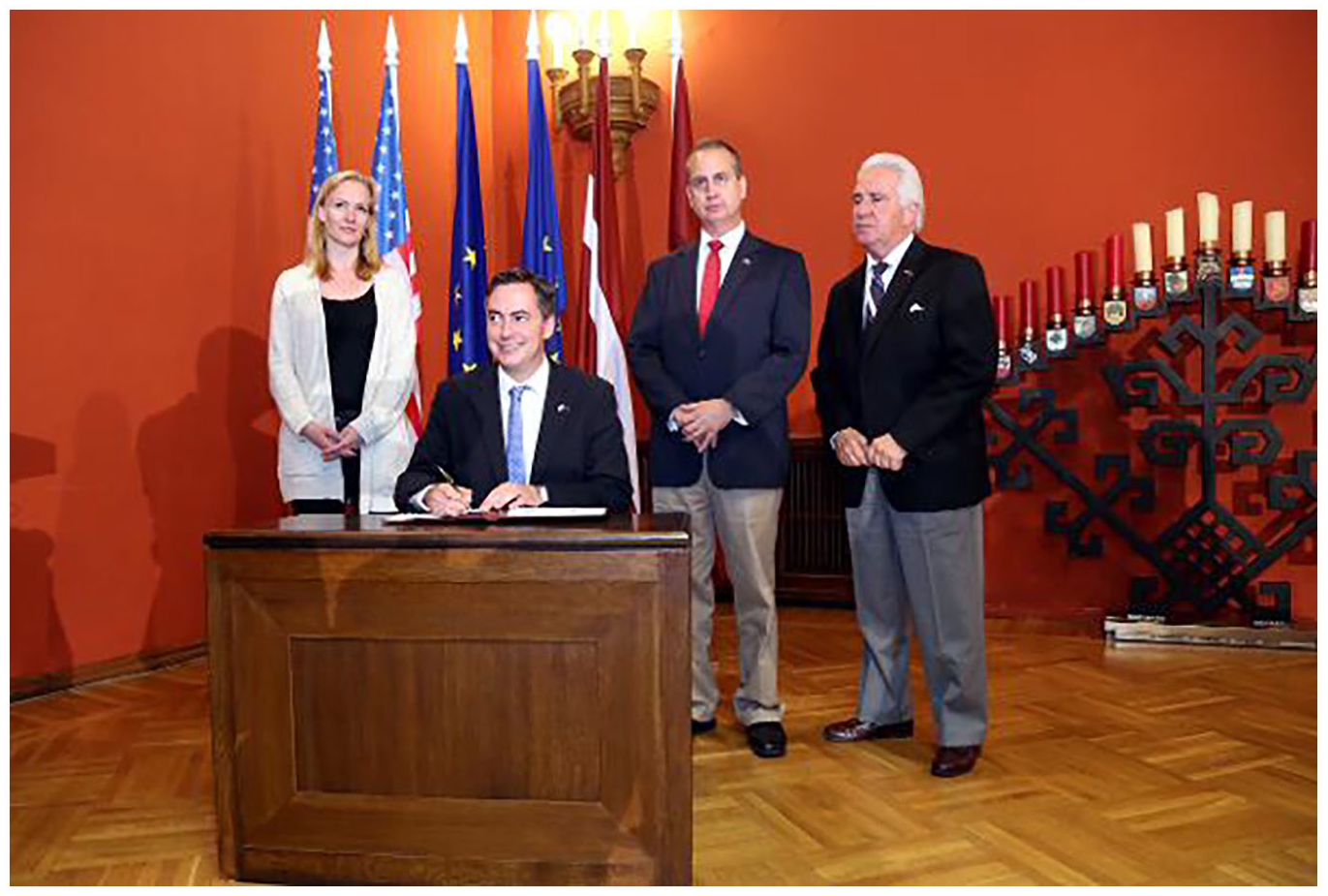
Signature of the Joint Statement, 76th IPM, 27–28 June 2015, Riga© (European Union, (2019) – Source: European Parliament).
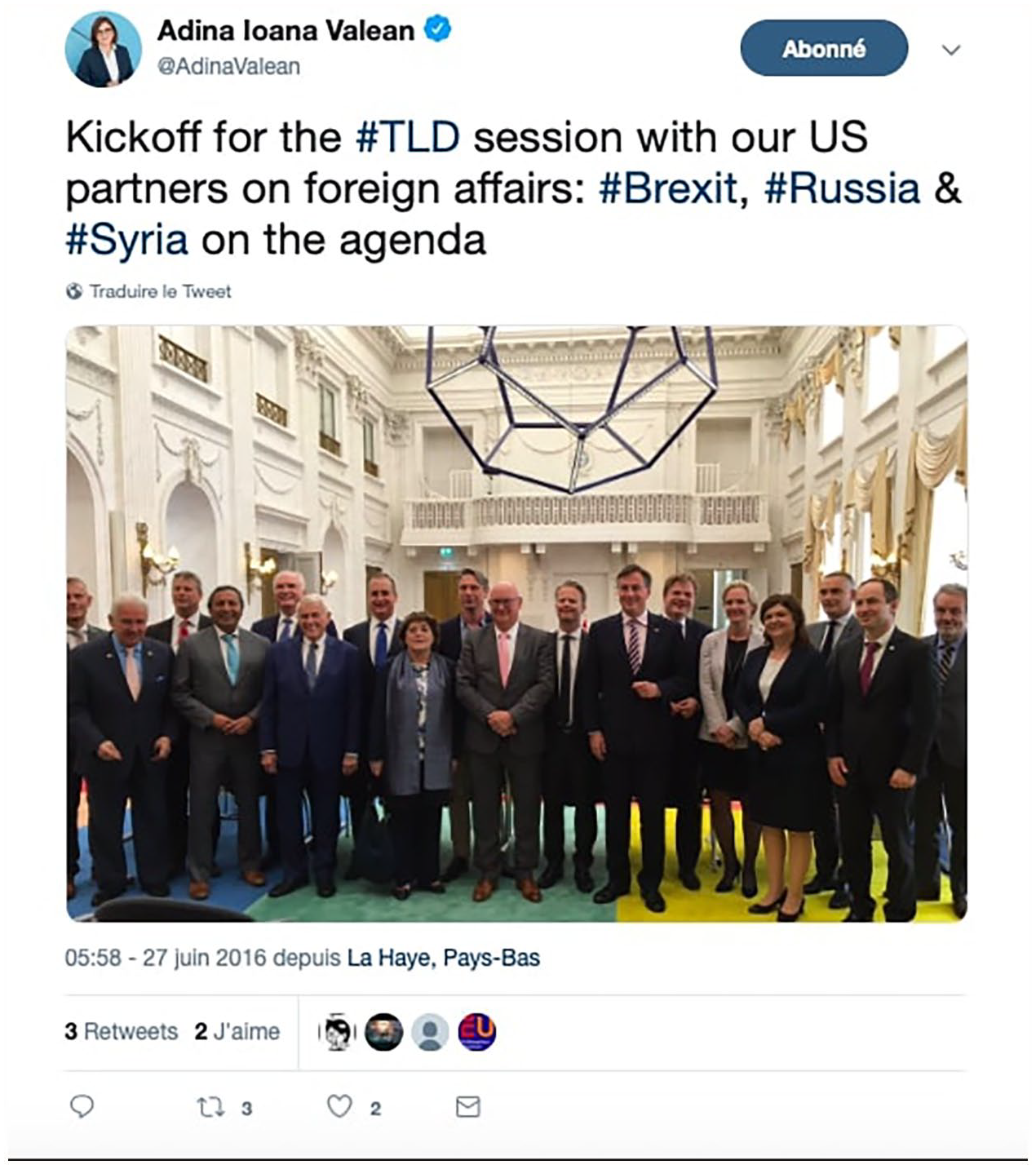
Tweet by MEP Adina Ioana Valean on the 78th Inter-parliamentary Meeting between the European Parliament and the US Congress, 26–27 June 2016, The Hague (Source: https://twitter.com/adinavalean/status/747413852766220288, accessed 21 February 2019).
The drafting and dissemination of joint statements anchor the recognition of the EU’s identity. The recognition that has taken place in the room is literally ‘imprinted’ on the documents. It matters as these statements are key references on transatlantic inter-parliamentary cooperation (Interview, Brussels, 9 December 2015) and crystallise the identity of the actors involved. For instance, the EU’s and the United States’ identity as shapers and guarantors of the current world order feature heavily. During the transatlantic trade and investment partnership (TTIP) negotiations, several joint statements reiterated that ‘the EU and the US were unique strategic partners’ working on a transatlantic trade agreement that shall “establish modern global trade rules”’ (European Parliament, 2016). Moreover, the incorporation of the EU’s achievements in these statements – signed by the US Congress – contributes to the EU’s recognition as an ‘efficient’ partner able to deliver. The recognition of the EU’s distinctiveness is also anchored in joint statements, reflecting the fact that US participants understand and accept their European counterparts’ concerns. For instance, the United States’ willingness to consider the refugee issue as a matter of shared responsibility following the dialogue was mentioned in an internal EU report with a great sense of pride. This achievement reinforced the EU’s institutional identity through the reification of differences: ‘When we must defend our values as Europeans, it makes us feel more Europeans’ (Interview, Brussels, 10 December 2015).
Finally, the recognition of institutional identity is carried out of the room through the intensification of dialogues. A constellation of contacts takes place in-between the formal inter-parliamentary meetings among representatives ignited by the contacts established during the TLD (Interview, Washington, 24 May 2016). These intense exchanges are tangible proof of the recognition granted to the EU in terms of relevance. The very act of consulting each other on matters of common interest and organising further meetings reinforces the institutional identity of the EP as a relevant partner with whom it is worth engaging.
Conclusion
This article has shown that dialogical interactions also serve to anchor institutional identity by enabling recognition processes to unfold. The TLD’s ethnographic study has revealed the socio-psychological function of dialogue related to the ontological and recognition needs of institutions, thereby adding value to the study of dialogue in IR. While traditional IR theories have conceptualised the role of dialogue in the search for security and profit, we proposed a novel understanding of dialogical interactions among representatives of states and institutions, rooted in the quest of recognition. Unpacking the powerful socio-psychological dynamics in dialogue matters not only for the outcome of the interaction (i.e. agreement) but also for the very identity of the actors involved.
This study also contributes to the recognition scholarship by enlarging the scope of ‘recognition acts’ identified so far. Current approaches to recognition obscure important ways in which recognition is provided and withheld internationally. Going beyond the macro-level of interaction, be it in the form of legal recognition or public statements, we proposed that the quest for recognition permeates everyday practices jumping over different levels of analysis: from individuals, groups, states and international institutions. With the revival of recognition politics, this insight has profound consequences on how one should conduct these emotionally loaded interactions, potentially triggering powerful responses. It is noteworthy that even lawmakers – which are not fully considered diplomatic actors – feel the need to get their institutional identity recognised. It speaks to the salience of these significant identity dynamics too often overlooked.
This article represents a first step to systematically investigate the quest for recognition of institutional identity through dialogue. While the EU may have acute recognition needs due to its sui generis nature and crises of legitimacy, future research could explore other instances of dialogues to determine the background conditions impacting the saliency of recognition processes; to what extent are these recognition processes of institutional identity at play with other interlocutors? Does the nature of the recogniser significantly change the dialogical dynamics? Furthermore, given the proliferation of virtual dialogues in the age of COVID-19, future research could scrutinise how recognition dynamics play out online. These examples outline a promising agenda to further investigate the salience of recognition processes through the persistent practice of dialogue in IR.
Footnotes
Acknowledgements
The author is particularly grateful to the following for their detailed feedback on the manuscript: the two anonymous reviewers, Federica Bicchi, Cora Lacatus, Eleonore Heimsoeth, Cristina Blanco Sío-López and Heidi Maurer. A special note of appreciation also goes to her European and American interviewees who kindly gave their time and shared their views, feelings and memories.
Funding
The author(s) disclosed receipt of the following financial support for the research, authorship and/or publication of this article: The work for this article was done as part of my PhD dissertation at the London School of Economics for which I received financial support (LSE Scholarship).
