




Abstract
How were comprehensive pension reforms in the UK successfully developed, enacted and implemented from 2002 to 2015, despite changes in government composition and the financial crisis? Why were they not subject to policy conflict, electoral competition and policy reversal? Drawing on actor-centred historical institutionalism and thirty interviews with key actors, we demonstrate the critical role played by a limited number of politicians and policy entrepreneurs and their ideas and agency. Institutional continuity with the Beveridgean policy legacies of the pension system and the United Kingdom’s `growth regime’ enabled a coalition space to open up for policy agreement. between the government and Opposition parties, and for partisan electoral competition over the reforms to be `bracketed’. The incremental and interlocking nature of the reform package reduced interest group opposition and enabled a centralisation of decision-making power. A long-term timeframe for reform cemented the formation of an elite coalition and buttressed political control. Cross-party support for the reform package, coupled with judicious phasing of the implementation of auto-enrolment and fiscal reforms, enabled it to withstand the impact of the financial crisis and the austerity that followed it, and to minimise opposition among the critical electoral constituency of older voters. The dominance of the reform process by political actors and policy entrepreneurs in the UK nonetheless came at a price, as institutional continuity and incrementalism foreclosed alternative reforms. We demonstrate the importance of political statecraft and policy entrepreneurship in the UK pensions’ reform process, but within boundaries set by its institutional context.
Keywords
Introduction
Since the 1980s, pension systems in many Organisation for Economic Co-operation and Development (OECD) countries have undergone significant, often politically contentious reforms. As Natali (2018: 53) argues, ‘Pension reforms are a risky process. Even when reforms pass, their implementation is uncertain. Risks of partial or total reversal are always present’. Policy consensus can weaken in the face of austerity fatigue, party political change, policy instability and the fragility of reform agendas (Natali, 2018: 53). This article addresses the puzzle as to why major pension reforms in the United Kingdom proposed by the ‘Turner’ Pensions Commission in 2002 did not follow a similar trajectory of policy conflict, party competition and policy reversal. Between 2002 and 2015, a series of reforms to public and private pensions were successfully developed and then implemented in the United Kingdom despite two general elections, changes in government composition and political leadership, the exogenous shock of the 2008 financial crisis, and the austerity enacted after 2010.
The reform package was a comprehensive one, involving interlocking measures for both state and private pensions: (1) a more generous Basic State Pension (BSP) uprated by a ‘triple-lock’ of the (highest of) average earnings, inflation or 2.5%, and the abolition of the State Second Pension (S2P); (2) automatic enrolment into workplace private pensions with the freedom to opt out; (3) the creation of a state-run defined contribution scheme, the National Employment Savings Trust (NEST) mainly targeting low to medium income earners and their employers; and (4) progressively stepped up increases in the state pension age from 65 to 68. 1 The reforms were substantial and involved distributional trade-offs between social classes and age cohorts, yet at no point was the reform process derailed by interest group conflict or political competition. The United Kingdom’s recent history of pension reform therefore offers an interesting and under-examined case through which to study the political dynamics of policy change.
The first section of the article sets out our theoretical approach. We briefly examine existing accounts of the UK case, situating these in the context of the recent scholarly literature on ‘growth regimes’ and welfare states in advanced capitalist economies which give a central role to domestic consumption, financialisation and commodified welfare in the growth models and economic strategies of the United Kingdom (Hassel and Palier, 2021). We postulate that the United Kingdom’s pension reforms were consistent with this growth regime and the historical institutions of the welfare state, creating a space for cross-party consensus to emerge on the reform trajectory, and for electoral competition, particularly in respect of powerful older voters, to be ‘bracketed’ by political actors. In turn, this enabled politicians and policy entrepreneurs to assume a central role in the development and implementation of the reforms. We set out how historical institutionalist perspectives on gradual reform – and the key concepts of ‘layering’ and temporality – enable us to explain how these actors were critical to the puzzling success of the UK case. We draw on ideational theories to examine the role of the key actors’ ideas in setting the policy agenda and shaping the reform process.
The second section outlines our research methodology. The research is designed as a single case study based on elite semi-structured interviews with key actors in the pensions reform process. The article then proceeds to the main exposition of the research. We conclude with reflections on the relevance of our findings to the comparative study of pensions reforms.
Institutional context, ideas and political agency
Hitherto, analyses of the United Kingdom’s pension reforms have largely focused on their political-economic dimensions. Klitzke (2018) finds that the preferences of economic interest groups were structured by the labour-capital cleavage, with trade unions opposed to proposals for state pension age increases. Ebbinghaus (2019) argues that interest groups aligned themselves with the reforms; in particular, organised interests within capital, rather than labour, entered into alliances in support of the Turner Commission’s agenda, including the ‘striking proposal’ to improve the BSP, contrary to a priori expectations. Bridgen and Meyer (2018: 25) provide a comprehensive understanding of the social class and interest group dynamics involved in the reforms, arguing that the latter were ‘the product of a temporary cross-class alliance’ among trade unions, employers’ associations, insurers, and key pension advocacy groups. Berry (2016), in turn, argues that auto-enrolment and the new single-tier state pension reforms are exemplary of the financialisation of the UK welfare state.
These different findings are broadly consistent with the theoretical perspectives of recent scholarly literature on growth regimes and welfare states in advanced capitalist economies, in which the United Kingdom is considered paradigmatic of a demand-led, consumption-based economic growth regime, characterised by extensive financialisation, credit driven access to housing, and high levels of employment in deregulated labour markets (Hassel and Palier, 2021). The welfare state contributes to the United Kingdom’s growth regime through an extensive role for the financial sector in the pensions system, privatised housing supply, targeted and parsimonious benefits focused on the consumption needs of low-income households, and limits to social insurance or taxes levied on employment (Hassel and Palier, 2021).
The UK pension reforms contributed to the evolution of this growth regime, maintaining the institutional architecture of a multi-pillar pension system and the Beveridgian welfare state, while addressing critical problems, such as the decline in occupational pensions saving, the rise of pensioner poverty, and the disincentives to save caused by the extension of means-tested benefits. The reforms extended the role of financial services in pension provision through auto-enrolment into defined contribution schemes, kept employers’ pension contributions relatively low, increased the state pension age, and upheld consumption among low-income pensioner households through improved state pensions and allied benefits. Reform of the BSP and the creation of an auto-enrolment occupational pensions system enabled resource redistribution to women with interrupted contribution records and low-income earners outside of defined benefit schemes, but the institutions of the post-war ‘liberal’ welfare state were maintained intact and the political-economic interests embodied in the UK pensions system were incrementally reassembled, not radically reformed.
There are at least two features of the reform process that remain theoretically unaccounted for in this political-economic analysis, however. The first is why pensions policy did not become subject to partisan electoral competition, as we would expect from comparative analyses of pensions policy. We follow a ‘constrained partisanship’ political-economic analysis of welfare states (Beramendi et al., 2015) to argue that institutional continuity of the reforms with the United Kingdom’s growth regime and Beveridgean welfare state created the opportunity for a cross-party consensus or ‘coalition space’ to emerge on the ‘supply side’ of politics which inhibited exploitation of the process for partisan purposes, in sharp contrast to other areas of social policy, such as care of the elderly. Between the general elections of 2001 and 2005, the main political parties coalesced around the central proposals of the Turner Commission’s reform agenda and maintained this consensus throughout the 2008 financial crisis and its aftermath. Parties thus operated on the supply side of politics to ‘bracket’ electoral competition on pensions policy. To prevent countervailing pressures from the ‘demand-side’ of voter preferences, the reforms were implemented in stages, minimising immediate costs, such as increased occupational pension contributions for employers and employees, and maximising benefits, such as the ‘triple lock’ increases to the BSP. Tax increases and compulsory pension contributions were rejected.
It was particularly important that the critical electoral constituency of older voters was not expected to shoulder any substantial costs of the reforms, save for workers approaching retirement in the years running up to the extension of the state pension age. In the United Kingdom, over 65 year olds have much higher turnout rates at elections than the young and middle aged, and age has become a central political cleavage (Chrisp and Pearce, 2019; Tilley and Evans, 2017). Political parties therefore had an interest in promoting the improvements to older voters’ pensions, while avoiding blame for retrenchment that would impinge on their entitlements, as the new politics of the welfare state literature would predict (Pierson, 1996, 2001). This political strategy was particularly visible in the major parties’ manifesto commitments at both the 2005 and 2010 general elections, where commitments to re-index the BSP to average earnings or the ‘triple lock’ are clearly spelled out, but the retrenchment dimension of increases in the state pension age is mentioned only once, in the 2010 Labour Party manifesto (Labour Party, 2010: 6). As the 2005 Secretary of State for Work and Pensions notes, older voters have more of a voice . . . vote in very much larger numbers, even today but it was particularly true in the 2005 election and also in 2010. And as a consequence, they have political clout and they know it . . . [therefore] . . . the central issue of the state pension and of making sure that people were comfortable is something that was a political imperative. (David Blunkett)
The second issue that requires further theoretical explanation is the centrality of political actors and policy entrepreneurs to the reform process. Politicians, in both governments and opposition parties, and the members of the Turner Commission, acting as policy entrepreneurs, were key agents driving and securing change in the United Kingdom. Recent historical institutionalist research has emphasised the role of agency in bringing about reform, in particular, gradual endogenous change, rather than radical change during critical junctures (Mahoney and Thelen, 2010). That political actors are required for any change involving legislation is a given (Zohlnhöfer, 2009), but how and why politicians matter can differ significantly across countries and different reform eras (Bandau, 2015; Bonoli, 2000; Hausermann, 2010; Immergut et al., 2007; Natali and Rhodes, 2008). Our analytical perspective is informed by ‘actor-centred’ or ‘agent-led’ forms of historical institutionalism. The underlining assumption here is that politicians exercise ‘statecraft’ (James, 2016) depending on specific institutional and temporal conditions. The practice of ‘statecraft’ can steer the course of reform in different directions, substantially altering reform outcomes. As we show below, the United Kingdom’s pension reform process could have been altered, blocked, or reversed by a limited number of critical political agents at a number of important moments. We draw on actor-centred historical institutionalism and theories of incremental policy change (Mahoney and Thelen, 2010; Pierson and Skocpol, 2002) to identify politicians as critical agents of change and to understand how they shaped their political strategies within the institutional and historical context of the UK growth regime and welfare state institutions set out above.
In addition, we analyse the role of the Turner Commission members, notably its chair, as policy entrepreneurs, acting both inside and outside the state, to prosecute their reform agenda. The Commission demonstrates many of the attributes, skills, and strategies commonly associated with policy entrepreneurs in research studies, particularly those of ambition, credibility, and tenacity in developing a policy agenda, framing problems and policy debate, mobilising evidence, engaging key policy networks, and addressing multiple audiences (Mintrom, 2019). This policy entrepreneurship was central to the success of the reform agenda; indeed, it is arguable that the reforms were inconceivable without the agency of the Turner Commission itself.
The 2002–2015 UK pension reforms have been already identified in the welfare state literature as incremental changes to the UK pension system (Price, 2008). We further identify ‘layering’ (Streeck and Thelen, 2005) as the most important incremental reform dynamic in the UK pension reform process. According to Schickler (in Conran and Thelen, 2016: 63), layering occurs when new rules are attached to existing ones in ways that affect how the old rules structure behaviour. In this way . . . change occurs through seemingly marginal amendments, revisions, or additions to existing institutions or rules that have downstream implications for how the original institutions operate.
As we show, the incremental layering of the reforms, and a small number of important policy concessions, limited the scope for conflict between interest groups and their recourse to political mobilisation, and hence, concentrated the need for support for reforms largely within the executive of the government, and between the government and Opposition parties.
Another key insight of historical institutionalism is the need to ‘take time seriously’ (Pierson and Skocpol, 2002). The concept of temporality sheds light on the sources of change and the course of the reform process. Temporality is manifested in the historical legacies of earlier structure-agency interactions that affect contemporary reform strategies and outcomes. In the UK context, the policy legacies of the Beveridgean welfare state and the shift to a post-industrial, financialised, and consumption-led demand model of economic growth in the 1980s are key institutional features and the most important temporal considerations in this research. At the same time, the Turner Commission recommendations were themselves developed and implemented across a number of years, and the duration and sequence of the reforms therefore also requires an understanding of the temporality upon which historical institutionalists insist (Pierson, 2000). While pension reforms are often characterised by long-term implementation – given the need for planning and preparation for retirement – the staging and sequencing of the United Kingdom’s pension policy changes were designed to minimise opposition from important electoral constituencies.
Finally, we draw on recent ideational theories of social policy to examine the role of ideas in the UK reform process (Béland, 2018). Ideas, including ideational frames and the ideologies of policymakers, matter in policy change because political agents make sense of the world and their own interests through them, and use ideas to define policy problems, frame agendas, and initiate proposals (Béland and Waddan, 2012). The Turner Commission proposals reflected the persistence of liberal Beveridgean ideas of the welfare state, which could be readily integrated into the ideological frames of the Labour government and the ‘two liberalisms’ of the Coalition government. But the proposals did not simply replicate a policy paradigm or the economic ‘gestalt’ of the United Kingdom’s growth model in the early 2000s (Hall, 1993, 2021). Relatively new policy ideas emerging from behavioural economics, or so-called ‘Nudge’ insights, were influential in the introduction of auto-enrolment into workplace pensions, and new sources of evidence and argumentation were marshalled to dislodge the long-standing policy of indexing the BSP to prices, rather than earnings: an issue which became the focus of bitter political arguments at the highest levels of government. In this way, the Commission creatively drew innovative ideas into their reform package (Carstensen, 2011).
Our research also demonstrates that one core idea acted as an enabler of coalition building or ‘coalition magnet’ (Béland and Cox, 2016), namely the idea that pensions policy was being designed to be irreversible, grounded in a consensus that would endure in the long-term. This idea animated Prime Minister Tony Blair’s perception of the purposes of his second term in office, and of the Turner Commission’s understanding of its task. It also enabled the Opposition to frame their engagement in a cross-party consensus as the practice of responsible politics.
Methodology
The research was designed as a single case study based on elite semi-structured interviews. This allowed us to undertake in-depth institutional and historical analysis of the UK pension reforms process and to access political actors’ accounts of how policy proposals were developed, negotiated, and implemented. The qualitative data used in this study include 30 elite semi-structured interviews conducted in 2019 with core political actors: former Prime Ministers (2), departmental Secretaries of State and Ministers (5), Special Advisers (5), the members of the Turner Pensions Commission (3), civil servants (7), interest groups (4), academics experts (3), and journalists (1) who were involved in any or all of the stages of the reform process or had in-depth knowledge about the pension reforms. A list of those interviewed is given at Appendix 1. 2 We study the period between 2002 and 2015, from the appointment of the Pensions Commission (2002–2006), to the enactment of its recommendations under the third term of the Labour government (2006–2010), and implementation by the Conservative-Liberal Democrat Coalition government (2010–2015).
The information political actors provide can be exaggerated or biased because of their ‘faulty memories, self-serving statements, misrepresentations, or elusiveness’ (Natow, 2020: 161). Scholars acknowledge that elite interviews raise concerns about reliability and validity (Berry, 2002). To address these concerns (Downie, 2013), the data from interviewees were compared against those of other informants, existing literature, and historical documentation collected and collated in a pension policy archive (Pearce and Massala, 2020a). The documents were used to develop interview guides, cross-check findings, and obtain additional information on elite interviews. The types of documents included policy statements, academic literature, biographies, contemporary historical accounts, and news media.
Endogenous pressures for reform in the early 2000s
We begin our analysis by identifying the reasons why the Labour government initiated the Turner Pensions Commission reform process in 2002. When Labour first came to power in 1997, an estimated 2.7 million pensioners were living in poverty, while private pension saving rates were falling (Goodman et al., 2003). In order to reduce pensioner poverty, means-tested benefits for pensioners were substantially increased through a Minimum Income Guarantee; legislation was passed to replace SERPS with a State Second Pension (S2P) primarily to help lower earners, winter fuel payments for pensioners were introduced, and a Stakeholder Pension was created to encourage private provision on more favourable terms to savers. Between 1996/1997 and 2001/2002, the number of pensioners in poverty fell from 2.7 to 2.2 million (Goodman et al., 2003).
However, the Stakeholder Pension failed to expand private provision coverage and encourage more people to save for retirement, while increasing numbers of defined-benefit occupational schemes were closed to new members. Increases in means-tested benefits reduced pensioner poverty substantially but at a perceived cost to pension saving incentives. Dissent within the Labour Party also flared up after the BSP, indexed to inflation, was increased by only 75p in 2000. Opposition parties, trade unions, and think-tanks, as well as the insurance industry and pension advocacy groups, all began to propose re-indexing the BSP to average earnings in order to reduce reliance on means-testing and improve savings incentives (Carey Oppenheim, Matthew Taylor).
As a result of these pressures, pensions became one of a handful of domestic policy issues that were given particular attention by the Labour government during its second term (2001–2005). Former Prime Minister Tony Blair explained that ‘it was only in the second term that I started to grapple with some of the long-term big problems that needed to be resolved around education, healthcare, criminal justice reform and pensions’. Blair saw pensions as a paradigmatic long-term policy challenge and wanted both to secure his personal legacy as a reformer and to cement his party’s reputation for competence in the implementation of enduring policy change. However, his approach to pensions policy was also shaped by a wider political strategy of avoiding, where possible, compulsory regulation of employers or increases in the rates of income tax to pay for higher levels of public expenditure (Tony Blair). As a consequence, certain pensions policy options, particularly those that would have involved compulsory savings, substantial redistribution, or a radical reconfiguration of relations between employers and their employees, were rendered politically unfeasible. From the outset, the reform process would therefore be structured by continuity with the existing institutions of the United Kingdom’s pensions provision.
The Turner Pensions Commission
The publication of the Green Paper ‘Simplicity, Security and Choice: Working and Saving for Retirement’ in December 2002 announced the establishment of a Pensions Commission to ‘keep under review the regime for UK private pensions’ (Department for Work and Pensions, 2002: 31). This announcement had been introduced into the Green Paper ‘at the last minute’ at the insistence of No10 Downing Street advisers (Gareth Davies), to create a space for an ‘all-embracing look at the pension issue’ and creative policy development (Carey Oppenheim). Within 6 months, the Commission had decided to expand its remit to make recommendations for the whole pension system, both public and private (Adair Turner). This was a critical instance of policy entrepreneurship by the Commission.
The selection and composition of its membership were important in developing effective and politically feasible policies. The commission was chaired by Lord Adair Turner, who had previously run the Confederation of British Industry (CBI) and had been a respected chairman of the Low Pay Commission. He was joined by two other members, Baroness Jeannie Drake, a senior trade union official, and Professor Sir John Hills, a leading social policy academic at the London School of Economics. This trio was regarded to as capable of offering independent expert advice, while being aware of the sectoral interests involved and thus ‘credible across a wide political spectrum’ (Gareth Davies). Moreover, Blair explained that having ‘a commission that was small and tight . . . was clearly going to do great work’, noting that the National Minimum Wage had been successfully introduced in 1999, despite having been ‘a fierce bone of contention politically between business and the Conservatives on the one side, and trade unions and Labour on the other’ (Tony Blair).
The Pensions Commission published three reports between 2002 and 2006. The first report, ‘Pensions: Challenges and Choices’, published in October 2004, framed the problems faced in pensions policy through an extensive presentation of statistical evidence (Pensions Commission, 2004). The second report, ‘A New Pension Settlement for the Twenty-First Century’, published in November 2005 (Pensions Commission, 2005) set out the Commission’s recommendations. The reform package comprised the following:
(a) A more generous BSP through re-indexation to average earnings by 2010.
(b) An increase in the state pension age to between 67 and 69 by 2050.
(c) The introduction of auto-enrolment at a national level with a minimum level of compulsory employer contributions at 3%.
(d) The creation of a National Pension Savings Scheme (NPSS).
The third and final report, ‘Implementing an integrated package of pension reforms’, was issued in April 2006 to refine Commission’s proposals and respond to the main arguments that had been levied against them (Pensions Commission, 2006). 3
Institutional continuity and an elite ‘coalition space’ for reform
The reform package proposed by the Pensions Commission was consistent with the historical institutional context of the British growth regime and welfare state. Members of the Pensions Commission recognised that their work was ‘in a sense building on an existing political economy . . . with the grain of the system that [they had] got but willing to do some pretty radical things to make that system work more effectively’ (Adair Turner). They ‘tried to divert from that’ to some extent in their recommendations but ‘in the end we came back to the original Beveridgean road’ (John Hills). The reforms reflected a strain of liberal thought, which we find pretty consistently in British pensions and going right back to Beveridge . . . a flat-rate state pension, at a fairly minimal rate, thus leaving a very significant space for individual initiative, thrift, voluntary provision. (Hugh Pemberton)
This institutional alignment of the reforms meant that the Labour government did not seek to return to the earnings related redistribution it had promoted in 1970s with the creation of a state-earnings related pension, nor to compel all employers and employees to contribute to occupational pension schemes. The Pensions Commission reasoned that it was neither possible nor desirable to rebuild a second tier of state earnings related pensions. As Baroness Drake argued, ‘to re-build the first and second tier in the state system as the solution . . . would have taken a percentage of GDP that was quite high . . . [so] you have to be realistic because the UK system had suffered incremental interventions’ that were reversed by successive governments.
The Pensions Commission’s reforms were enacted in legislation in 2007 and 2008, and then further implemented – with the important change of the introduction of a single-tier state pension in 2016 – by the Conservative-Liberal Democrat Coalition government between 2010 and 2015. This cross-party consensus that underpinned the trajectory of change had already emerged in the early stages of the formulation of policy at the elite level of party spokespersons in Parliament. The Secretary of State for Work and Pensions between 2005 and 2007, John Hutton MP (interview) noted that Labour ministers did not want the reforms ‘to be beset by party political divide, because . . . going back to [the Labour party in the 1970s] . . . everything was opposed, everything was started for a few weeks and then stopped’. Moreover, he emphasised that ‘we have to get a consensus in Parliament about these reforms because otherwise it will not stick. The party consensus around pensions reform is a fundamental building block to making sure that this system does last’ (House of Commons Work and Pensions Committee, 2006).
The re-indexation of the BSP to earnings gained the support of the Opposition parties, providing an important basis for cross-party support. Earnings indexation appealed to the electoral constituencies of the Opposition parties, including employers, the insurance industry, and pension advocacy groups, each of whom favoured a more generous BSP to eliminate means-testing in pensions and provide a secure foundation for second-tier private savings. It responded directly to the fierce criticisms made by the Opposition parties of the high levels of pensioner means-testing in the early 2000s (Conservative Party, 2001; Liberal Democrat Party, 2001). By the general election of 2010, each of the main parties’ manifestos contained a commitment to uprate the BSP at least in line with earnings.
However, an increase in the state pension age to pay for a higher BSP was not electorally popular and met significant initial opposition from the trade unions. Here, the policy entrepreneurship of the Turner Commission was critical in establishing both an agreed evidence base for the future costs and benefits of different reform options, and the inevitability of trade-offs between them – helping to bring trade union movement representatives into agreement on the reform package. Extensive public engagement exercises, including deliberative events, were also used to demonstrate that informed public opinion could be marshalled to support an increase in the state pension age (Labour minister).
At the same time, a more generous BSP entailed redirecting the UK pensions system back towards the Beveridgean system of old-age insurance. This was supported by Conservative Party spokespeople, who argued that the UK pensions system had been ‘moving further and further away from a Beveridgean welfare state’ and had diminished incentives for private savings (David Willetts). Moreover, a back-to-Beveridge reform package was ideologically amenable to the Liberal Democrats, as it was consistent with both a state system of poverty alleviation and liberal property rights in a second-tier pension (Steve Webb). Adjusting the uprating of the BSP from average earnings to a ‘triple-lock’ that guaranteed at least a 2.5% increase every year became an additional Liberal Democrat policy because it ‘was a useful political argument to say as Liberal Democrats you need to distinguish yourselves from the Conservatives and Labour’, that is, from both the Thatcher government’s inflation-linked indexing of the BSP and the Labour government’s 75p rise in 2000 (Steve Webb).
On the private sector side, the introduction of a system of automatic enrolment and the creation of a national defined contribution pension scheme, further highlight the importance of the institutional context in the formation of cross-party consensus. At the inception of the Turner Commission, the Conservative Party opposed any scenario of a compulsory system for private provision, even claiming that the Labour government opportunistically created the Turner Pensions Commission to introduce compulsion (Money Marketing, 2002). Yet, as noted earlier, there was a little prospect of the Labour government backing compulsory pension savings; Ministers feared that workers would view compulsory pension contributions as an additional tax on income rather than as deferred salary.
The use of the behavioural economics – with evidence drawn from other liberal market economies like New Zealand and the United States – and in particular, ‘liberal paternalism’ provided the ideational rationale for avoiding compulsion. Leading behavioural economists were invited to give evidence about auto-enrolment in the United States to Department for Work and Pensions officials, and academic studies of the effects of such pension schemes were utilised in the evidence base marshalled by the Turner Commission (Helen Dean, David Halpern, David Laibson, Shlomo Benartzi). For the right, the fact that ‘compulsion was not on the table . . . but you could see you needed some mechanism to promote pension savings, [automatic enrolment] was a neat solution’ (David Willetts). It would address low pension participation, sustain the pubic–private pension mix and at the same time, appeal to key electoral constituencies, like private sector employees and managers. For similar reasons, the centre-left also found automatic enrolment a ‘really good idea’ (Steve Webb) with potential appeal to different electoral constituencies (David Blunkett).
The original proposal of the Pensions Commission for a default national pension savings scheme for auto-enrolment was strongly criticised by the insurance industry (Pearce and Massala, 2020b). The insurance lobby argued that auto-enrolment contributions should be made instead into private sector occupational pension schemes provided on a ‘turn-by-turn’ basis (Department for Work and Pensions, 2006). One of the key pension advocacy groups in the United Kingdom – the Pensions and Lifetime Savings Association – also argued for a market-oriented approach ‘with six or eight big players’ under a master trust arrangement (Joanne Segars), with its then senior management describing the default national scheme proposal as a ‘Stalinist’ intervention. On this issue, the government compromised, establishing a national pensions scheme with a public service obligation to provide an occupational pension to all applicants, while enabling auto-enrolment into private sector schemes (Pearce and Massala, 2020b). In sum, the ‘liberal paternalism’ of automatic enrolment, coupled with the concession to the insurance sector that a public national pension scheme would not become the default, enabled a political compromise to be forged, securing policy consensus.
The institutionally embedded features of reform created an elite ‘coalition space’ between government and the main Opposition parties, where the latter could seek policymaking opportunities and present themselves as constructive political agents, acting in the long-term national interest. Opposition politicians could benefit from engaging in constructive reform efforts towards the main measures in the Turner Commission package, without the need to make any significant ideological compromises. As one Secretary of State for Work and Pensions in the Labour government put it: . . . the person who helped me the most was none of my Labour Cabinet comrades, it was Philip Hammond, who was my Conservative shadow . . . he came to me and said, John we’ve looked at this, we will support you as the opposition if you go for the whole Turner package because we think it’s the right thing to do. (John Hutton)
When the Coalition government took office in 2010, Conservatives who had been involved in the reform process endorsed the implementation within their own party on the grounds that it ‘was a very sensible reform [we] should stick with it’ (David Willetts). With the appointment of Steve Webb, a recognised pensions expert, as the Minister for Pensions in 2010, the Liberal Democrats were given a central role in the reform process, something which Pensions Commissioners themselves acknowledged (Adair Turner).
There were concerns in the Conservative Party over mandating employer contributions to employees’ workplace pension schemes, particularly for small- and medium-sized enterprises; ‘the “chippy” became a sort of emblematic question, was this a fair burden to put on the local chippy?’ (David Willetts). Yet, these concerns were overcome by positive public attitudes towards auto-enrolment that ‘created political licencing’ to accept and then implement the reform (David Halpern). The phased implementation of auto-enrolment – which limited contribution rates in the initial stages and postponed their introduction for small employees – minimised employer opposition and mollified Conservative ministers’ concerns (Steve Webb).
Consequently, the 2002–2015 pension reforms did not become subject to partisan political competition, particularly between the Labour and Conservative parties. This is contrary to what would be otherwise expected in a majoritarian polity characterised by bipolar party competition, which makes cross-party consensus highly unlikely (Immergut et al., 2007). By anchoring consensus behind the reforms in the existing institutional structure of the welfare state and ensuring its consistency with political-economic interests in the United Kingdom’s growth regime, political actors across the main parties were able to ‘bracket’ electoral competition. This consensus could be rationalised as sensible, long-term reform that would endure through political change and provide a lasting legacy for its progenitors.
Incremental layering and interest-groups
The incremental mode of change and the layering processes underpinning it maintained the interests of key pension policy stakeholders, namely, the insurers’ lobbies, employers’ associations and trade unions, each of whom could have attempted to use their relationships with Opposition parties to try to block the reforms.
From the appointment of the Pensions Commission onwards, the Labour government wanted to develop proposals that could secure consensus among stakeholders. As the chair of the Commission recalls ‘we were trying to . . . build consensus for the overall package, paying attention in particular to the bits of the package that might be most difficult for some constituencies to accept’ (Adair Turner). Consensus was important for achieving long-term sustainability of the reforms. One of the members of the Commission argued out that ‘we wouldn’t get a sustainable solution unless we built the consensus ourselves’ (Jeannie Drake). Moreover, it was part of Labour’s strategy to show that they were responsive, not only to trade unions in formulating policy, but also to the interests of employers and insurers. For example, there were concerns in the Labour party and trade unions ‘whether the increase in the retirement age was a good idea’ (David Blunkett). But there were also concerns with employers and mandatory employer contributions, ‘our biggest anxiety as ministers . . . was the compulsory employer contribution, because this was not really what New Labour was all about’ (John Hutton).
The cross-class consensus facilitated by the Pensions Commission’s recommendations, as documented in Bridgen and Meyer (2018), granted quid-pro-quos to key political-economic interests. The arrangement of ‘giving something in exchange for something’ locked-in interest groups to the outcomes of the reform process. The private pensions industry accepted the reform package, including the introduction of a national pension scheme, because they had not been ‘excluded from [the reform] totally’ (Otto Thoresen) and would benefit from the introduction of automatic enrolment. In addition, since the Conservatives had supported auto-enrolment and the creation of NEST, the industry ‘had nowhere to go’ (Labour minister). Similarly, trade unions accepted the reform package because it represented ‘a substantial step forward’ for workplace pensions and increased the value of the BSP backed up employers and parliamentary opposition. As such, despite their intense disagreement with the increases in the state pension age (Nigel Stanley), they decided not to mobilise against the reform outcome and the government. Finally, employers were prepared to support pension reforms as long as the agreed level of contributions was maintained (John Hutton).
The incremental reform package was therefore developed in such a way as to be inclusive of all the interests of key stakeholders, rather than just those that were in coalition with the governing party. It anticipated and neutralised the likelihood of any sectional interest using political mobilisation to block policy change. Although the reforms redistributed the costs and benefits of the pensions system across social classes and age cohorts, they did not create a new social coalition and embed this in the reform agenda. Instead, the existing structure of social interests was reassembled. In turn, this meant that capacity and resources to enact and implement reform remained concentrated within the government, and between the governing party and the Opposition parties. As Bonoli (2001: 244) notes the ‘absence of veto points does concentrate power’. As we will see in the next section, the main points of conflict and disagreement in the UK pensions reform process took place between a small number of key political figures within the Labour government and the Turner Commission, while implementation was secured largely because of the cross-party consensus formed during earlier policy stages.
Temporality and political agency
When we examine the temporality of the reform process – that is, the reform process over its whole duration or timeframe and the sequence of events therein – we can see the primacy of a key group of politicians and policy entrepreneurs within it.
The critical dispute which could have resulted in reform deadlock took place within the executive over the re-indexation of the BSP to average earnings. Contrary to what we would expect from research which focuses on partisan and party effects on public spending and benefits increases (see Savage, 2019 for a literature review) rather than intra-party conflict, in this case, the divide emerged between the Prime Minister and ministers in the Department for Work and Pensions on one hand, and the Treasury, on the other hand. Until the creation of the Pensions Commission, the Treasury had de facto control of pensions policy, at least insofar as fiscal policy was involved. The fact that an external body had developed pension policies with fiscal policy implications ‘felt uncomfortable politically but also officially’ (Treasury civil servant). The Treasury resisted the re-indexation of the BSP to average earnings, on both fiscal and political grounds. The Chancellor, Gordon Brown, and his team of advisers did not want state pensions policy being determined by No10 and the Department for Work and Pensions, or to lose control of a major area of fiscal policy before an expected transition of power to the Prime Ministership by the Chancellor, Gordon Brown, himself (Nicholas Timmins, special adviser). Of all the policy issues that were substantively contested in the reform process between 2002 and 2015, this was the most serious (Matthew Taylor, Gareth Davies, Carey Oppenheim). Without a resolution, the whole reform agenda would have been derailed (Timmins, 2017: 585).
Over time, an accommodation was reached within the executive, principally between the Prime Minister and Chancellor. The Turner Commission had an active role to play in this resolution of the political conflict by robustly defending its analysis and the costs and benefits of its policy recommendations. The Commissioners attended a series of closed, private meetings with the Chancellor where they unanimously defended the re-indexation of the BSP as an essential part of the reform package. The publication of the 2006 White Paper ‘Security in Retirement: Towards a New Pension System’ announced the government’s response to the Pension Commission’s proposals, prefiguring legislation that would be enacted in 2007 and 2008. It was agreed by the key political actors in the executive to delay the implementation of BSP re-indexation into the next electoral cycle, so that it would take effect ‘by 2012 or the end of the Parliament at the latest’. In addition, cost containment measures of increases to the state pension age and an increase of the savings credit point, which both addressed short-term costs, were also agreed (Treasury civil servant). These adjustments made the earnings link politically and fiscally acceptable to the Treasury. For Gordon Brown, what made it possible was an understanding that as the pension age changed, and we had made the pension credit work, and actually because earnings and inflation were not rising in the same way that they did in the past, it was possible to afford this.
The actual implementation of the legislation would fall to the Coalition government elected in 2010 in the aftermath of the 2008 financial crisis. An exogenous shock or critical juncture of the size of the global financial crisis might have been expected to delay or substantively alter the course of the reform. Yet, neither the crisis nor the austerity that followed it substantively changed the reform package, which was largely implemented with ‘some tweaks and some accelerations’ as one of the Commissioners noted (John Hills).
One reason for this is that the financial crisis did not redefine the institutional context of reform. The ‘two liberalisms’ – liberal conservatism and Orange book liberalism – that dominated the Coalition government (Beech, 2011: 278) both supported Beveridgean continuity in the UK pensions system. Moreover, both David Cameron, Conservative Prime Minister in the Coalition government, and Nick Clegg, Liberal Democrat Deputy Prime Minister, were ‘in strong agreement regarding the need for limited state intervention’ (McAnulla, 2012: 179).
Nonetheless, the central objective of the Coalition’s government, and in particular, the overriding objective of the Treasury and the Chancellor, George Osborne, was the reduction in the ‘structural deficit’ on the public finances (Beech, 2011). Any social security policies that could be construed as incompatible with this objective would be blocked or reversed. How then did the ‘triple-lock’ and the implementation of the Turner reforms survive austerity?
The key reason is that, while reforming the state pension system had been the most important source of disagreement prior to the enactment of relevant legislation, it subsequently enabled an acceleration of the reforms during the Coalition government. This was primarily because ending the S2P and creating a single-tier BSP released immediate public expenditure savings. The abolition of National Insurance rebates to contracted out pension savers, had a ‘huge impact on short-term cash flow’ (Steve Webb) and therefore on deficit reduction. Integrating the BSP and S2P into the single-tier state pension thus counterbalanced additional costs resulting from implementing the BSP re-indexation or ‘triple-lock’ guarantee. Future costs were controlled by accelerating the timetable for increases in the state pension age. More widely, cuts in social security spending in the period 2010–2015 were concentrated on the working age population; the electorally critical retired population saw its benefits protected (Chrisp and Pearce, 2019). The staged implementation of the reforms, and the careful sequencing of the costs of auto-enrolment and increases in the state pension age, combined with increases in the BSP, ensured that older voters did not mobilise in opposition to them.
Ministers who had been engaged with the Turner Commission reform process when in opposition were also appointed to key positions in the Coalition government (David Willetts), including Steve Webb MP, who was appointed Minister of State for Pensions in 2010. Webb had been the Liberal Democrats pensions spokesperson throughout most of the reform process and was a pensions expert himself, with a background in academia and think-tanks. Although the Department of Work and Pensions was led by a Conservative Secretary of State, Iain Duncan Smith MP, effective control of pensions policy was handed to the Minister of State. Steve Webb himself concedes that ‘it’s absolutely right to say Iain didn’t have a particular strong pensions agenda’. Webb’s expertise (Grødem and Hippe, 2019) and the control over pensions policy he exercised enabled him to secure continuity in the implementation of the Pensions Commission reforms.
One important element of the reform package, the creation of the national pension scheme (National Employment Savings Trust) was at risk of reversal because Steve Webb and other Liberal Democrats were still uncertain about its merits, and it was subject to residual Conservative ideological suspicions (Nicholas Timmins). However, this risk was dealt with by commissioning an external review of the NEST proposal from Paul Johnson, Director of the Institute for Fiscal Studies. Johnson’s review concluded that the creation of a national pension scheme was a major but necessary intervention into the pension market ‘if auto-enrolment is to be introduced at anything like the currently envisaged scope on anything like the currently envisaged timescale’ (Johnson et al., 2010: 7). Conservative support for ‘Nudge’ interventions, sunk costs in the development of the NEST’s delivery infrastructure, and the careful implementation of employer contributions, ensured that the commitment to auto-enrolment, and a national scheme was preserved.
A focus on the reform timeframe and its sequence renders visible the primary role of a small number of politicians within central government and the policy entrepreneurs of the Turner Commission, and that of an elite cross-party consensus, in the course of the United Kingdom’s 2002–2015 pension reforms. While control over policy adoption was centralised within the core executive of the government itself, the elite coalition space formed in the initial stages of the reforms proved to be influential, not just for the policies adopted and legislated for by the Labour government, but most importantly, for their continued successful implementation by the Coalition government.
Conclusion
This article has analysed the political dynamics that led the United Kingdom’s 2002–2015 pension reforms to be successfully developed, enacted, and implemented, foregrounding the critical role played by a relatively limited number of key political actors within the United Kingdom’s Labour, Conservative, and Liberal Democrat parties and the policy entrepreneurship of the Turner Commission. As the historical institutionalist framework we have developed here suggests, the centrality of political agency and policy entrepreneurship was made possible by key features of the reform process. Institutional continuity with the Beveridgean policy legacies of the pension system and the United Kingdom’s ‘growth regime’ enabled a coalition space to open up for policy agreement between the government and Opposition parties, and for partisan electoral competition over the reforms to be ‘bracketed’. The incremental and interlocking nature of the reform package reduced interest group opposition, particularly from trade unions and the pensions industry, and enabled a centralisation of decision-making power in the executive of government and between the governing party and Opposition parties. A long-term timeframe for reform cemented the formation of an elite coalition and buttressed political control. Cross-party support for the reform package, coupled with judicious phasing of the implementation of auto-enrolment and fiscal reforms that realised short-term gains and distributed costs over the medium and longer term, enabled it to withstand the impact of the 2008 financial crisis and the austerity that followed it, and to minimise the scope for opposition among the critical electoral constituency of older voters.
There are broader implications from this study for the politics of pension reforms. Recent scholarship on pension politics has necessarily shifted from blocked reform processes and political conflict to ‘dynamic bargaining processes among political parties and societal interest groups’ (Immergut and Abou-Chadi, 2014: 269) and coalition formation. In the UK context, the dynamic bargaining to achieve successful pension reforms was dominated by politicians and their ‘statecraft’ strategies, rather than interest group coordination or conflict. Social class and sectional interests were managed within incremental reform of existing institutions by political actors and policy entrepreneurs. The scope for distributive conflict between social classes and demographic groups was minimised by spreading out the reforms over time, and ruling out certain options, such as the restoration of a significant earnings related pension scheme and defined benefit occupational schemes, or compulsory contributions. Partisan competition was held in check by limiting the possibilities of ideological fragmentation and the mobilisation of opposition by key voting blocs.
The dominance of the reform process by political actors and policy entrepreneurs in the United Kingdom nonetheless came at a price: institutional continuity and incrementalism foreclosed alternative reforms to improve pension savings and raise incomes in retirement. The relatively parsimonious nature of the Beveridgean welfare state remains intact, and therefore the lessons of the UK reform process for comparative study of pensions reforms may be limited to countries with similarly liberal welfare states or under-developed social security systems. Our study has drawn attention to the importance of political statecraft in the UK pensions’ reform process, but within boundaries set by its institutional context.
Supplemental Material
sj-docx-1-bjp-10.1177_13691481211044655 – Supplemental material for Statecraft and incremental change: Explaining the success of pension reforms in the United Kingdom
Supplemental material, sj-docx-1-bjp-10.1177_13691481211044655 for Statecraft and incremental change: Explaining the success of pension reforms in the United Kingdom by Thomais Massala and Nick Pearce in The British Journal of Politics and International Relations
Footnotes
Appendix 1
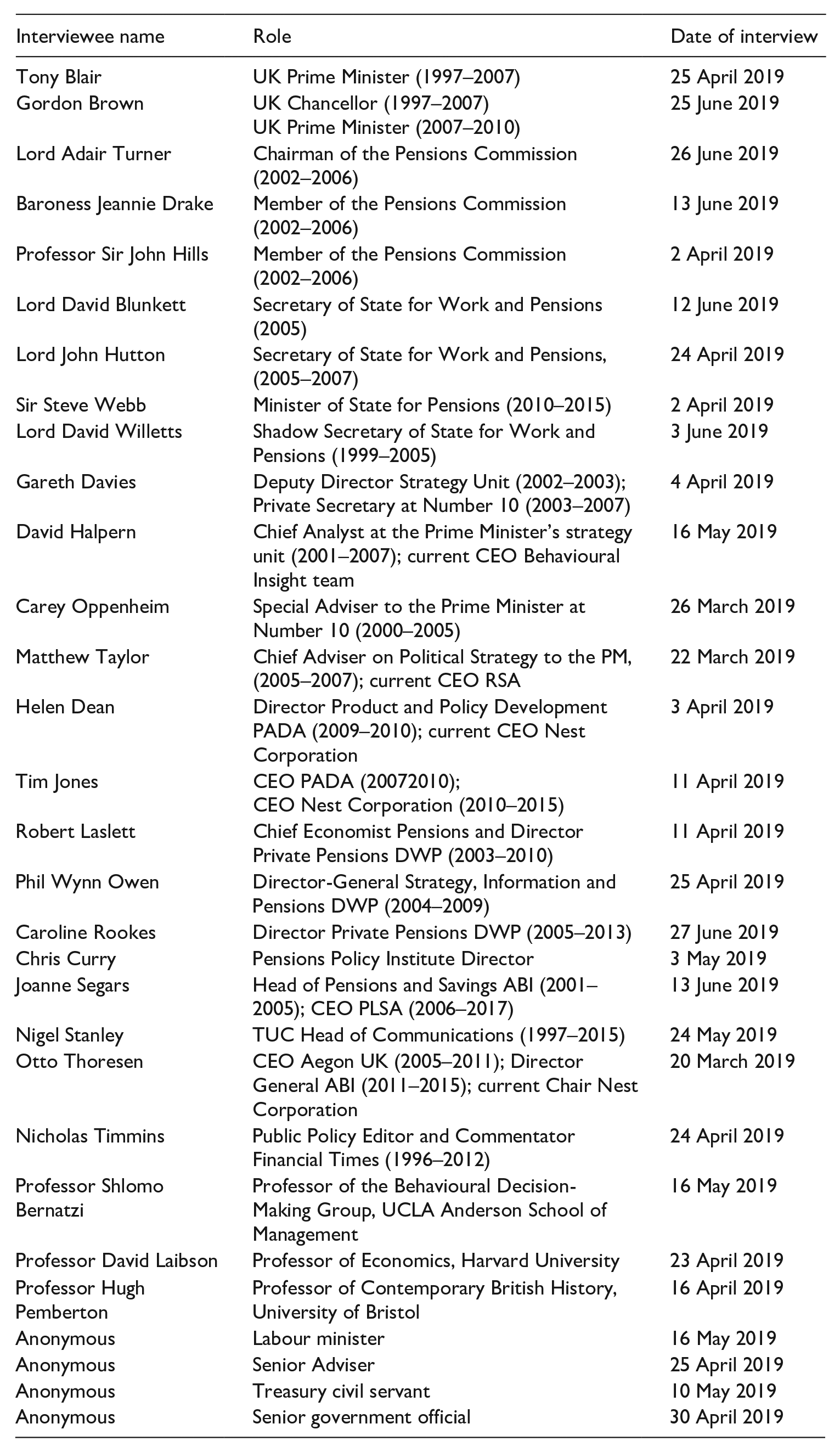
| Interviewee name | Role | Date of interview |
|---|---|---|
| Tony Blair | UK Prime Minister (1997–2007) | 25 April 2019 |
| Gordon Brown | UK Chancellor (1997–2007) UK Prime Minister (2007–2010) |
25 June 2019 |
| Lord Adair Turner | Chairman of the Pensions Commission (2002–2006) | 26 June 2019 |
| Baroness Jeannie Drake | Member of the Pensions Commission (2002–2006) | 13 June 2019 |
| Professor Sir John Hills | Member of the Pensions Commission (2002–2006) | 2 April 2019 |
| Lord David Blunkett | Secretary of State for Work and Pensions (2005) | 12 June 2019 |
| Lord John Hutton | Secretary of State for Work and Pensions, (2005–2007) | 24 April 2019 |
| Sir Steve Webb | Minister of State for Pensions (2010–2015) | 2 April 2019 |
| Lord David Willetts | Shadow Secretary of State for Work and Pensions (1999–2005) | 3 June 2019 |
| Gareth Davies | Deputy Director Strategy Unit (2002–2003); Private Secretary at Number 10 (2003–2007) | 4 April 2019 |
| David Halpern | Chief Analyst at the Prime Minister’s strategy unit (2001–2007); current CEO Behavioural Insight team | 16 May 2019 |
| Carey Oppenheim | Special Adviser to the Prime Minister at Number 10 (2000–2005) | 26 March 2019 |
| Matthew Taylor | Chief Adviser on Political Strategy to the PM, (2005–2007); current CEO RSA | 22 March 2019 |
| Helen Dean | Director Product and Policy Development PADA (2009–2010); current CEO Nest Corporation | 3 April 2019 |
| Tim Jones | CEO PADA (20072010); CEO Nest Corporation (2010–2015) |
11 April 2019 |
| Robert Laslett | Chief Economist Pensions and Director Private Pensions DWP (2003–2010) | 11 April 2019 |
| Phil Wynn Owen | Director-General Strategy, Information and Pensions DWP (2004–2009) | 25 April 2019 |
| Caroline Rookes | Director Private Pensions DWP (2005–2013) | 27 June 2019 |
| Chris Curry | Pensions Policy Institute Director | 3 May 2019 |
| Joanne Segars | Head of Pensions and Savings ABI (2001–2005); CEO PLSA (2006–2017) | 13 June 2019 |
| Nigel Stanley | TUC Head of Communications (1997–2015) | 24 May 2019 |
| Otto Thoresen | CEO Aegon UK (2005–2011); Director General ABI (2011–2015); current Chair Nest Corporation | 20 March 2019 |
| Nicholas Timmins | Public Policy Editor and Commentator Financial Times (1996–2012) | 24 April 2019 |
| Professor Shlomo Bernatzi | Professor of the Behavioural Decision-Making Group, UCLA Anderson School of Management | 16 May 2019 |
| Professor David Laibson | Professor of Economics, Harvard University | 23 April 2019 |
| Professor Hugh Pemberton | Professor of Contemporary British History, University of Bristol | 16 April 2019 |
| Anonymous | Labour minister | 16 May 2019 |
| Anonymous | Senior Adviser | 25 April 2019 |
| Anonymous | Treasury civil servant | 10 May 2019 |
| Anonymous | Senior government official | 30 April 2019 |
Funding
The author(s) disclosed receipt of the following financial support for the research, authorship, and/or publication of this article: Funding from NEST Insight and the Research England QR Strategic Priorities Fund for the research underpinning this article.

Notes
References
Supplementary Material
Please find the following supplemental material available below.
For Open Access articles published under a Creative Commons License, all supplemental material carries the same license as the article it is associated with.
For non-Open Access articles published, all supplemental material carries a non-exclusive license, and permission requests for re-use of supplemental material or any part of supplemental material shall be sent directly to the copyright owner as specified in the copyright notice associated with the article.
