




Abstract
How and when do intergovernmental organisations (IGOs) promote incorporation of international norms in domestic politics? In this article, I assess the impact of the International Labour Organization (ILO) on national labour regulations. I advance a new argument regarding how and when labour regulations are shaped by the ILO. More specifically, I argue that the ILO can shape labour regulations during the preparatory process of international labour standards. I theorize that the preparatory period of international labour conventions constitutes a propitious condition for mechanisms of elite socialisation, learning and domestic mobilisation. To test our argument, we focus on national dismissal regulations covering the period 1970-2013. The findings provide evidence in line with my argument that states improve their regulations during the adoption process. However, I find no evidence that states improve their regulations after formal adoption. The results have substantive implications for our understanding of IGOs and labor standards in particular.
Keywords
Introduction
How and when do intergovernmental organisations (IGOs) shape domestic regulations? Can IGOs shape domestic policies during the development phase of an international law or norm? The role of IGOs as shapers of domestic laws and policies is well established in the international relations (IR) and international law (IL) literatures. Extant research has shown that IGOs can influence national policies within various domains, such as labour rights (Strang and Chang, 1993), human rights (Risse and Sikkink, 1999), economic growth (Blanton et al., 2018) and educational policies (Finnemore, 1993). However, we still lack answers as to how and when IGOs can influence national policies.
This article contributes to the strand of research that explains and assesses the impact of IGOs on domestic politics by focusing on international labour standards and the International Labour Organization (ILO). The ILO – a Nobel Peace Prize laureate for its contribution to the sustenance of peace – is one of the oldest IGOs, which has the task to create and monitor international labour standards. Currently, it governs over 180 conventions dealing with various issues, such as the right to organise and bargain collectively, child labour, discrimination and job security. Existing research on the ILO has exclusively focused on how the organisation can promote labour standards through the ratification or monitoring of labour rights conventions (Peksen and Blanton, 2017; Rodrik, 1996; Strang and Chang, 1993; Thomann, 2011). By focusing on ratifications, this literature has overlooked alternative efforts by the ILO to influence state policies.
Indeed, there are reasons to assume that efforts that precede ratification and monitoring may produce tangible results for national labour rights. For instance, in 2011, the ILO adopted a convention on Decent Work for Domestic Workers (C189). C189 asks countries to recognise the legal rights of domestic workers and include provisions that protect these workers from discrimination and various forms of abuse. Following the formal adoption, many countries ratified the convention and introduced new regulations regarding domestic workers. However, some countries, such as Spain and Zambia, introduced appropriate regulations during the development phase of C189 (ILO, NORMLEX 2020). Do countries adjust their regulations during the development phase of international treaties? If so, why and when do they do that?
I argue that the ILO can shape domestic labour regulations already during the preparatory process of new conventions. Drawing on previous studies and interviews with senior ILO staff, I theorise that the ILO can shape national labour regulations during the adoption period through the mechanisms of elite socialisation, learning and domestic mobilisation. While not all states are receptive to these mechanisms – especially those who vote against the conventions – the ILO is in a particularly favourable position to motivate many states to pass relevant regulations during the adoption period. For the purpose of the argument, I focus on national dismissal regulations and the Termination of Employment Convention (C158), which is considered the most important international convention that regulates dismissal. C158 was formally adopted by the ILO in 1982 and requires national labour regulations that protect workers from unjust dismissals by their employers. I test my argument using data on national dismissal regulations covering the period 1970–2012.
The empirical analysis suggests that states adjust their regulations during the adoption period. The adoption process is characterised by exchange and dialogue between the ILO and member states, which facilitates elite socialisation, learning and domestic mobilisation. I do not assert that the adoption path is the exclusive road to domestic implementation; rather, I advance the argument of an additional part of the broader standard-setting efforts of the ILO, which previously has been overlooked. Neither do I provide undisputable proofs of the theorised mechanisms. I do, however, identify propitious conditions for these mechanisms to operate in the ILO context based on the existing literature and interviews with senior ILO officials.
The findings of this article have substantial implications for our understanding of IGO influence and the impact of the ILO on labour rights. First, this article is the first to theorise and assess the impact of the ILO through states’ adoption of conventions. One important implication of this study is that the ratification or ILO monitoring of conventions is not the exclusive path to domestic influence. I show how seemingly ‘toothless’ processes pertaining to the drafting of conventions may be effective in bringing domestic regulations into compliance with international standards. I surmise that similar effects should be identifiable within issue areas such as environment, trade and human rights, although generalisations from this study to other IGOs require caution. Second, the article suggests that studies focusing on the impact of ILO conventions are not only underestimating this but are also likely to be biased as countries that fail to ratify a convention after formal adoption might improve their regulations during the adoption phase, which is overlooked.
IGOs and domestic politics
When should we expect IGOs to shape national regulations? The IR and IL literatures have suggested several pathways through which international norms are translated into domestic politics. This broad literature recognises that international norms can influence domestic politics through various channels, such as IGOs (Finnemore, 1993; Strang and Chang, 1993; Weisband, 2000), transnational actors (Keck and Sikkink, 1998), domestic actors (Dai, 2005), bilateral dynamics (Dobbin et al., 2007: 454) and political elites (Goodman and Jinks, 2004; Johnston, 2001).
Studies on international labour standards have exclusively centred on if and how ratification of ILO conventions can shape domestic labour regulations and practices (Kim, 2010; Rodrik, 1996; Strang and Chang, 1993; Weisband, 2000). The findings of these studies are decidedly mixed (Haas, 1964; Peksen and Blanton, 2017). For instance, Peksen and Blanton (2017) find that additional ratifications of core ILO conventions have a negative impact on collective labour rights regulations and practices. Neumayer and De Soysa (2006) find no impact of ratifications on fundamental labour rights, such as freedom of association and collective bargaining rights. They conclude that ratifications have no impact since the ILO lacks enforcement mechanisms (Neumayer and De Soysa, 2006: 43). There is also a more general criticism of the ILO that emanates from its alleged declining (or lack of) power and legitimacy in contemporary global governance. These scholars suggest that the ILO is an inefficient ‘toothless tiger’ with no impact on national labour rights (Alston, 2005; Elliott and Freeman, 2003; Standing, 2010).
Other studies, however, suggest that the ILO and international labour conventions matter within a range of domains, such as employment benefits (Kim, 2010), welfare policies (Strang and Chang, 1993), wages (Rodrik, 1996) and general collective labour rights (Kahn-Nisser, 2014). Moreover, several studies suggest that the ILO’s monitoring efforts improve national labour rights (Chayes and Chayes, 1995; Koliev et al., 2020; Koliev and Lebovic, 2018; Weisband, 2000). More broadly, and in case study settings, research has also shown that ILO conventions often are perceived as model legislation for national regulations (Bartolomei de la Cruz et al., 1996: 25; Poblete, 2018; Polaski, 2006) and incorporated by other IGOs (Hassel, 2008).
While these studies have contributed considerably to our understanding of the ILO and international labour standards, there are still important gaps to be filled. First and foremost, previous studies have overlooked the impact of adoption, that is, the development phase of labour rights conventions. There are both theoretical and empirical reasons to believe that involvement in this extensive and intense process leading to adoption affects states’ domestic labour regulations. Second, studies ignore the timing aspect, that is, when the ILO’s efforts are likely to matter for national regulations. Drawing on previous research and interview material, I advance a new argument concerning when adoption is likely to shape national policies. I also formulate alternative hypotheses related to adoption and ratification of ILO conventions. Last but not least, a large share of studies focuses on correlations between the number of ratified conventions and general compliance with labour rights, which leads to speculations about the causal chain that connects these. Moreover, many previous studies tend to focus on one outcome of an ILO convention, overlooking other provisions in the same convention. These studies fail to account for the fact that most conventions have several substantive provisions that may affect national policies. In this study, I offer a more direct assessment by focusing on one convention (C158) and specific national dismissal regulations reflected in the provisions of C158.
Theorising IGO influence
The political science literature on policy convergence and diffusion has identified multiple mechanisms that may explain how IGOs affect domestic politics. In this article, I propose three mechanisms through which the ILO can shape domestic policy output during the adoption process: elite socialisation, learning and domestic mobilisation. I argue that these mechanisms are predominantly salient during the adoption process of international labour conventions.
Elite socialisation may occur through distinctive processes within IGOs, such as through participation in the preparation of international rules and norms, consultations with IGO bureaucrats or involvement in constructive and dialogue-oriented committees. Elite socialisation refers to the processes that make individuals adopt the norms and attitudes of international communities. It involves elements of persuasion and social influence. In the case of persuasion, IGOs can be characterised as ‘teachers’ with the credibility and normative power to persuade elites to adopt norms or policies that are valuable in themselves, for example, for the greater cause of sustaining peace or fair treatment (Barnett and Finnemore, 1999; Checkel, 2005; Finnemore, 1993). Social influence is related to peer or social pressure that alters the behaviour of elites through social rewards and punishments without necessarily leading to the internalisation of norms (Johnston, 2001; Weisband, 2000). Socialisation theories view IGOs as status providers that can promote international norms by exerting social pressure through praise and disapproval (Checkel, 2005; Goodman and Jinks, 2004; Johnston, 2001).
Learning is another mechanism through which IGOs can exert influence on domestic policy outputs. At the vertical level, interaction with IGO staff can generate new information, ideas and practices regarding the best implementation strategies of international norms. Even if elites may all agree that, for instance, children should be at school and not at work, it does not mean that all elites know what types of policies are required or desirable to ensure this. Kari Tapiola, former Deputy General of the ILO, described a meeting with a minister of Bahrain, which was followed by a report published by the ILO on the worker conditions in Bahrain. The minister asked, ‘are we really that bad, and if so, is there something you can do?’ (Tapiola, 2019: 35). 1 The dialogues and interactions between government elites and IGO representatives reduce policy uncertainties and thus facilitate learning (Chayes and Chayes, 1995).
Domestic mobilisation is another mechanism through which influence may be exerted on domestic policies. The debates, discussions and proposals that take place at the IGO level may spill over on domestic politics, thereby mobilising domestic societal interests and pushing governments to implement international conventions (Cortell and Davis, 1996; Interview 1, Swedish labour union representative at the ILC. Multiple interviews in Geneva (2018), Stockholm (2019) and via phone (2019)). Many IGOs also have formal procedures that require governments to report on international instruments to national parliaments, which offers additional formal opportunities to discuss various international matters. While there are different motivations for states to alter their behaviour – instrumental or norm-based – the information generated by IGOs informs various domestic groups and provides them with necessary equipment to demand change (Dai, 2005).
The argument
I argue that the process leading to the creation of international labour standards – what I here label as the adoption period – is imperative for the national implementation of these standards. The adoption period starts with the decision to discuss and prepare a new convention and ends with the formal adoption of a convention. During this period, as displayed in Figure 1, the ILO’s active engagement and efforts to promote the new norm creates favourable conditions for elite socialisation, learning and domestic mobilisation and increases the likelihood of the adoption of national labour regulations.
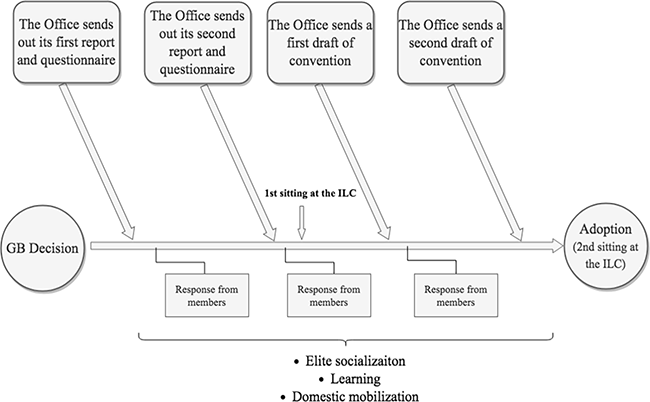
The adoption process of international labour standards.
The ILO creates two types of international labour instruments: conventions and recommendations. Whereas conventions can be legally binding through ratification, recommendations cannot be ratified and are often technical in nature. The international labour conventions are adopted by the International Labour Conference (ILC), which is a tripartite body consisting of governments, businesses and workers. The Governing Body (GB) is also a tripartite body that sets up the agenda of the ILC, including items related to international labour conventions. The International Labour Office (the Office) serves as the permanent secretariat of the ILO and is constituted by nearly 3000 officials from over 150 countries. The Office’s main task, broadly speaking, is to assist the GB and the ILC. However, it enjoys considerable authority. For example, most conventions are initiated by the Office.
The first step in the adoption process starts with the decision of the GB to place a new convention on the ILC agenda, usually following an initiative by the Office. All decisions are preceded by the Office assisting the GB on the matter, preparing documents and reports on the current state of regulations and practices of the member states. When the decision is taken by the GB, the Office prepares a law and practice report, which is published and sent to all member states. In addition to the law and practice report, the Office sends a questionnaire to member states, asking them to identify obstacles and challenges that would prevent them from implementing regulations related to the subject. The Office already at this stage provides states with a clear idea of what a new convention requires, what action is needed by governments and what the Office can do to solve various legal and practical concerns. This interaction is constructive as the Office emphasises both norm-based and instrumental aspects – such as fairness and industrial peace – associated with, for instance, implementing dismissal regulations. Indeed, the main tasks of the Office is to (a) convince governments that the issue at hand needs to be addressed, (b) ensure that they understand that their current legislation is insufficient and (c) provide reasons for action and technical help to introduce relevant regulations. Workers and business groups are also involved in this process and may provide their views and start mobilising for their issues.
When the governments have addressed their concerns through the questionnaire, they send it back to the Office. Based on the answers from the members, the Office produces a second report and sends this to the governments along with a new questionnaire. This creates an opportunity for the Office to follow up on issues and facilitate the implementation of labour regulations. Governments have the option to communicate directly with the Office, much like workers and business groups. In practice, the dialogue between the Office and members can be of both informal and formal character, where possibilities to persuade and teach are likely to arise (Interview 2, Previous high-ranked ILO official with over 40 years of experience. Multiple interviews in Geneva (2018) and e-mail (2019–2020)). This step usually takes around 2 years.
The second step in the adoption process is the public discussion of the proposed convention at the ILC, which usually occurs for two consecutive years. The ILC formally adopts the convention during the second sitting. At the first sitting, members discuss the content of the convention drafted by the Office and have the opportunity to suggest amendments. Based on discussions and proposals from the first sitting at the ILC, the Office drafts a second version of the convention and sends it back to members for further comments and discussions. When the answers reach the Office, it drafts a third version and communicates it to the governments before the second and last sitting at the ILC. Much like the previous procedure, the Office is constructive in its approach and attempts to persuade as well as find practical solutions to increase states’ incentives to adjust their regulations. At the second sitting, states discuss the content of the convention. The final action to adopt the convention requires a two-thirds majority of votes. When the ILC votes in favour, the convention is open for ratifications.
My theory privileges IGO influence. The role of the Office in promoting the standards during the adoption stage should not be underestimated. The Office enjoys considerable autonomy in drafting the convention texts and is often the main actor to initiate conventions – about 80% of labour standard proposals are made by the Office (Bartolomei de la Cruz et al., 1996). Already in the 1960s, scholars documented and described the Office as an active agent that expanded its mandate and influenced domestic law-making (Cox, 1973; Dufty, 1972; Haas, 1964; Thomann, 2011). For example, Dufty (1972) described how the Office managed to expand the focus of the organisation from social to economic issues, with the subsequent creation of conventions dealing with dismissal and unemployment insurance (Dufty, 1972: 48–483). Even scholars like Cox – who subscribed to the realist school – concluded that the Office enjoys considerable autonomy in relation to the members (Cox, 1973: 102-107).
The mechanisms of elite socialisation, learning and domestic mobilisation are likely to activate already when the GB decides to put an item on the ILC agenda. Elite socialisation takes place through iterative processes – both across and within particular issue areas – where government representatives participate in discussions of labour regulations with the Office. Through the reports and questionnaires, the governments are ‘taught’ what the ILO community – represented by ILO experts and committees – expects from them. When communicating with states, the Office stresses the moral obligation of states to bring their national policies in line with the new standard. The Office engages in constructive dialogue with members and is viewed as a highly competent and independent body of experts, which suggests that the Office is likely to possess the power to persuade members (Barnett and Finnemore, 1999). Moreover, the iterative element of this process creates trust between the Office and members. The established timeframes, opportunities to request clarifications and legal advice, as well as drafts – more or less – of certain national policies create the normative expectation that governments should act during this period. Although the Office does not use confrontative language, in contrast to the monitoring bodies (Koliev and Lebovic, 2018), it makes clear when governments misinterpret the standards by identifying shortcomings and offering solutions. By using social cues, such as praise and disapproval, the Office alters the behaviour of states (Strang and Chang, 1993: 242).
The learning mechanisms may also trigger as a result of interactions between the governments and the Office. The Office has a number of tools to promote learning through ‘best practices’. For example, it promotes learning forums through the International Training Centre, which offers knowledge-sharing and institutional capacity-building for governments as well as workers and businesses. Through the International Institute for Labour Studies, the Office supports a practical understanding of the benefits of labour and social policies by disseminating research findings. Indeed, persuading, teaching and learning are integral parts of the ILO machinery (Chayes and Chayes, 1995: 231–234; Thomann, 2011; Interview 2, Previous high-ranked ILO official with over 40 years of experience. Multiple interviews in Geneva (2018) and e-mail (2019–2020); Interview 3, Current senior ILO official with over 20 years’ experience. Interviews conducted in Geneva (2018)). During the preparatory period of the conventions, the Office has the opportunity to stress the benefits of national regulations, compare different forms of policies and even draft or recommend specific laws suited to different governments and national contexts. This approach also includes elements of capacity-building and knowledge-sharing, both of which aim to facilitate learning and the implementation of international standards (Interview 2, Previous high-ranked ILO official with over 40 years of experience. Multiple interviews in Geneva (2018) and e-mail (2019–2020); Interview 3. Current senior ILO official with over 20 years’ experience. Interviews conducted in Geneva (2018)). No less important, this process involves learning at both ends – the Office might learn about the specific labour rights conditions in a country, while government elites learn about the position of the Office.
The pre-adoption period can also trigger domestic mobilisation that pushes governments to introduce relevant policies (Interview 1, Swedish labour union representative at the ILC. Multiple interviews in Geneva (2018), Stockholm (2019) and via phone (2019)). The presence of domestic groups – workers and businesses – in the adoption process constitutes an important component of the domestic mobilisation mechanism (Kang, 2012). When the decision of a standard proposal is taken by the GB, domestic groups have access to communications between the Office and the government. Thus, they are able to mobilise against the government and demand policy implementation if, for example, it is unwilling to follow the advice of the Office. The adoption period is a particularly favourable phase as a certain standard gains attention during a long period of time, with intense exchanges between governments and the Office. Governments may then alter their positions in order to avoid the risk of being criticised for violating labour norms following the adoption of the convention (Koliev, 2020a; Koliev et al., 2020).
The records from the preparatory meetings regarding C158 at the ILC provide anecdotal evidence supporting my argument. For instance, in 1981, a year before the adoption of C158, Egypt introduced a law requiring employers to submit a written notice to a competent authority (e.g. a tripartite committee) in cases of dismissal. Identical provisions are found in C158 (Articles 13 and 14), which suggests that the convention influenced the Egyptian national labour regulations during the adoption process.
Another case that provides support for the outlined mechanisms is the Hungarian government’s introduction of necessary laws – with the help of the Office – related to the termination of employment at the ILC in 1981(ILC 1982:30/2). In addition, the German government stated that ‘the help given by the ILO Secretariat has been very considerable in producing the necessary preparatory documents and in assisting our deliberations’ (ILC 1982:29/5). Numerous governments expressed satisfaction with how the Office provided support and information on the law and with the practice of dismissal laws. There are also indications that governments to some extent have been persuaded regarding the importance of dismissal regulations through their interactions with the Office. For example, Indian government representatives, who were sceptical of the impact of C158 on economic conditions during the early stage of the process, expressed support for C158 at the ILC in 1982 (ILC 1982:29/5). The role of unions and employers cannot be underestimated. The interviews suggest that union members attempt to influence their governments already during the adoption process (Interview 1, Swedish labour union representative at the ILC. Multiple interviews in Geneva (2018), Stockholm (2019) and via phone (2019)). The ILC records provide plentiful examples of primarily labour unions pushing their own as well as other governments to implement the provisions of C158.
To be clear, I do not assume that all states are receptive to the mechanisms of elite socialisation, learning and domestic mobilisation. In particular, I contend that members that explicitly resist a certain norm throughout the adoption process – for various reasons – are unlikely to introduce labour regulations included in the convention. In fact, the records from the ILC (1981–1982) reveal that some governments – mainly due to economic and ideological reasons– participated in the adoption process in order to prevent the adoption of C158. Concerned by the impact of C158 on economic growth, these states demanded a more flexible instrument than a convention. Although the opposition to C158 was sizable (32 members), the United States and Zimbabwe were among the most critical of C158. The US statement provides an illustrative example of governments’ concerns related to C158:
Our concern for unemployment is a major common meeting ground. My own country is just as deeply concerned as the rest of the world and just as dedicated to increasing real growth and the generation of more employment worldwide. [. . .] The United States believes that in the final analysis this is best accomplished through less government intervention and increase private initiative. (ILC 1982:35/5)
In other words, the participation in the adoption process is a necessary but not sufficient condition for IGO influence. I assume that states are unlikely to improve regulations if they have opposed the convention throughout the adoption process and subsequently voted against it. I expect states that have participated in the adoption process and voted in favour of a convention to, on average, be more likely to adjust their regulations.
Hypothesis 1. Governments in favour of international labour rights conventions will introduce domestic regulations during the adoption period.
While my argument puts a strong emphasis on the adoption period, there are reasons to assume that governments may implement a convention in the post-adoption period, despite significantly less interaction with the Office and the lack of general discussions at the ILC. The argument could be made that the mechanism of domestic mobilisation is salient since governments are obliged to submit the formally adopted conventions to national (or regional) parliaments. While there are no other obligations than the submission of the convention to the national parliaments – the government or parliaments are not obliged to propose anything – submission might lead to domestic mobilisation by providing political parties or other groups with opportunities to discuss the issue. Moreover, one could also argue that states in general bring their national policies in line with conventions first after formal adoption (Thomann, 2011).
Hypothesis 2. Governments in favour of international labour rights conventions will introduce domestic regulations after formal adoption
Research design
To test my theory, I focus on C158 from 1982, which regulates dismissal policies. We limit our focus to C158 for several reasons. First, it enables the examination of my argument due to data availability of national dismissal regulations prior to formal adoption of C158. Second, C158 represents a typical convention type that can be generalisable to other processes leading to international labour conventions. Third, it constitutes a hard case for my argument as C158 regulates policies that governments view as their ‘internal affairs’ and sensitive to economic conditions. Historically, dismissal practices have been unregulated by state policy, so the contracts between employer and employee could be terminated without any justification. However, the inequality of the consequences led worker movements to push for dismissal policies protecting workers and employers from the abusive exercise of the right to terminate the contract. Finally, and more broadly, protection from unjust dismissal can be viewed as an imperative aspect of more fundamental human rights and rights at work, such as the right to unionise. If dismissal policies are arbitrary, it can be used in order to deprive workers of fundamental labour rights (De Stefano, 2014).
I acknowledge that our focus on policy output tells us little about the effectiveness of policies on the ground. Yet, a focus on policy output provides a more direct test of the causal links and the theoretical argument than policy outcomes. Although passing regulations and policies is easier than enforcing them, regulations often enable enforcement and can raise the expectations among citizens and societal groups, creating pressure to enforce them. In addition, policy outputs may be considered a more objective measure of state behaviour than aggregate outcome measurements.
To assess the hypotheses, I utilise time-series cross-sectional (TSCS) data with country-year as the unit of analysis. I focus on the period 1970–2013, for which data are available. I employ various regression techniques and perform multiple robustness checks.
The dependent variable: Dismissal regulations
The national labour regulations data are drawn from the Center for Business Research Labour Regulation Index (CBR-LRI). The three other datasets known to us – the World Bank Employing Index, the Employment Protection Index (Organisation for Economic Co-operation and Development (OECD)) and the ILO’s Employment Protection Legislation (EPLex) – are not relevant for this study due to limitations in time and country coverage. In contrast, the CBR-LRI dataset offers the most fine-grained record of labour regulations and covers 117 countries, which account for more than 95% of the world’s gross domestic product (GDP), from 1970 to 2013 (Adams et al., 2017). The CBR-LRI is based on multiple sources, such as national documents, court decisions and other international databases on national labour laws, including the ILO’s NATLEX database on employment protection that is explicitly linked to C158. Unlike the World Bank and the OECD data, the CBR-LRI does not assign a normative value or assess the stringency of regulations; rather, it captures the content of legal rules found in official documents. Akin to the ILO’s EPLex, it is neutral regarding whether particular regulations impose costs on employers (Adams et al., 2017: 463). Indeed, the CBR-LRI uses coding procedures similar to those of the EPLex indicators, where the dismissal regulation index relies on the provisions outlined in C158 (ILO, 2015: 5). Equally important, it accounts for the content of both formal laws and non-formal laws, such as collective agreements or other practices that function as laws in certain countries.
Specifically, the CBR-LRI dataset focuses on five broader categories of labour regulations, including (a) different forms of employment, (b) regulations of working time, (c) regulation of dismissal, (d) employee representation and (e) industrial action. Each of these areas contains specific indicators. The dismissal regulations consist of eight specific regulations, as shown in Table 1. Each of these regulations ranges from 0 to 1, where 0 indicates the lowest protection and 1 represents the maximum protection. For our purpose, I combine these regulations into one general index of dismissal regulations, which in the sample of 117 countries ranges from 0 to 6.67.
Regulation of dismissal.
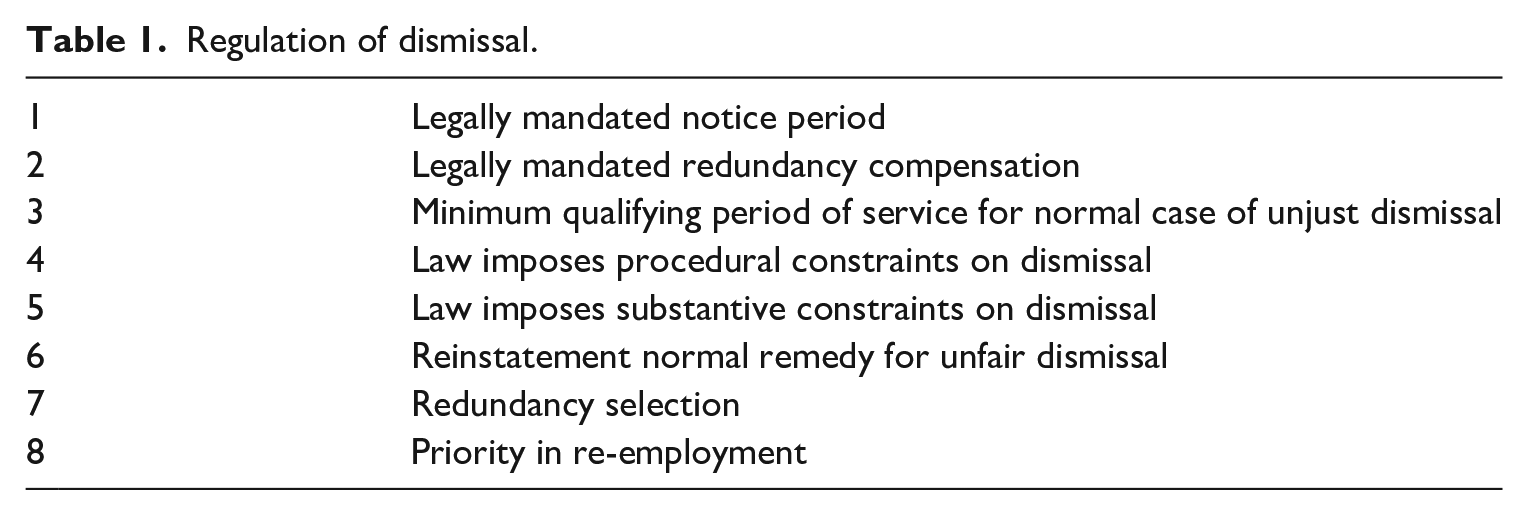
Figure 2 shows the average change in national dismissal regulations over time. In the early 1970s, regulations experienced a sharp increase but then stabilised in 1975 and even experienced a negative trend between 1978 and 1980. While the overall trend has been positive since 1980, the sharpest increase occurred after the fall of the Soviet Union, which explains the sharp increase in dismissal regulation during the period 1991–1994.
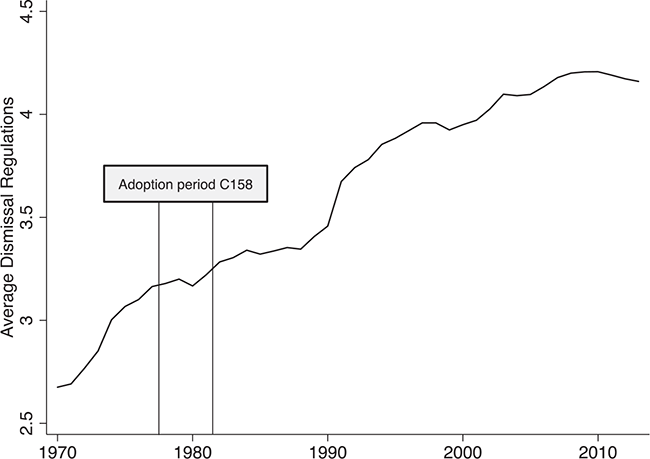
Regulation of dismissal, 1970–2013.
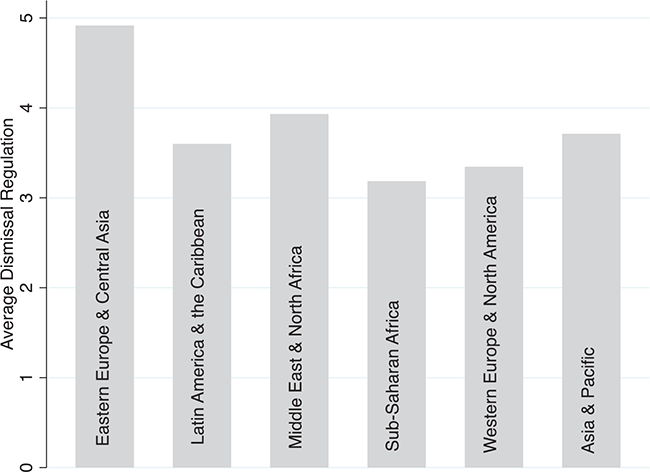
Average dismissal regulation, by region.
Over time, all regions have experienced an increase in dismissal regulations. Particularly the Middle East, Northern Africa and Sub-Saharan Africa have seen a steady increase in dismissal regulations over time, while Eastern Europe and Central Asia have not improved much after the early 1990s. Western Europe and North America mainly experienced an increase in dismissal regulations between 1983 and1993. At the end of the period (2013), Uganda, the United States and Costa Rica were the countries with the weakest dismissal regulations, while Poland, Armenia and Lithuania had the highest numbers of dismissal regulations.
The independent variables
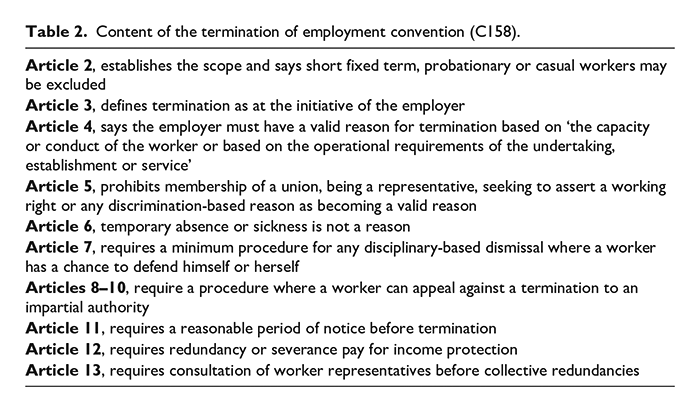
The main independent variables relate to the adoption process of C158, which is the main international convention on general dismissal regulations. As shown in Table 2, C158 requires states to adopt several laws that protect workers from unjust dismissals and provide workers with rights in other precarious situations – for the complete content of C158, see ILO (1982).
Content of the termination of employment convention (C158).
Since the theory is particularly interested in the timing of C158 adoption, I create theory-informed variables indicating the adoption and post-adoption period. As I have noted above, not all countries approved the adoption of C158. One viable way to capture the commitment to C158 is to look at the voting record of the last ILC in 1982. The voting record reveals which countries voted against C158 or abstained, which in practice has the same function as voting against. 2 The adoption period runs from the year when the GB took its decision (1978) to the year when the C158 was formally adopted (1982). Thus, in line with hypotheses 1, I construct the variable Adoption period (=1 from 1978 to 1982 if voted in favour of C158; =0 otherwise) that captures the preparatory period of C158 and the activities of the Office. In line with hypothesis 2, I create a Post-adoption variable that captures the years after formal adoption of C158 (=1 from 1983 to 1986 if voted in favour; =0 otherwise). 3 After formal adoption, governments are obliged to submit information on adopted conventions to their national or regional parliaments. In order to capture the post-adoption process, we expect that states are likely to improve their domestic regulations during a period of 4 years after formal adoption.
Control variables
In line with previous studies, I include a set of control variables that might influence countries’ national dismissal regulations (Mosley, 2011; Mosley and Uno, 2007; Neumayer and De Soysa, 2006; Peksen and Blanton, 2017). First, I include three economic variables for which data were available from 1970: GDP per capita, GDP growth and Trade. The GDP per capita and GDP growth variables account for the economic conditions, while Trade (% of GDP) accounts for states’ global economic openness (WDI, 2020). Second, I include two political variables: Democracy (V-Dem) and Left (DPI) leaning governments. The Democracy variable measures the level of democracy, where a higher score has been shown to be associated with better protection of labour rights (Mosley and Uno, 2007). Moreover, left-leaning governments have been shown to be willing to protect labour rights in general (Peksen and Dursun, 2017). To capture states’ general commitment to international labour standards, we add a variable that captures the total number of ratified ILO conventions (ILO NORMLEX database). I also control for states’ overall labour regulation behaviour by including a composite index of all regulations in the CBR-LRI dataset, excluding dismissal regulations. I assume that states with more labour regulations are more likely to introduce dismissal regulations than states with less labour regulations in general. Finally, studies have also controlled for states’ population size, which I also include in all models (WDI, 2020). For the summary of all variables, see Supplemental Table A1.
Model
Since I utilise a TSCS structured dataset where the number of countries (117) exceeds the number of years (43), standard assumptions of ordinary least squares (OLS) models are likely to be violated. Beck and Katz (1995) showed in their simulation study that standard errors estimated by OLS and feasible generalised least squares (FGLS) models generated confidence intervals that underestimated variability by about 50%. Indeed, the Breusch–Pagan test suggests heteroskedasticity in the sample. Moreover, following Drukker (2003), the tests suggest the existence of first-order autocorrelation. To address these issues, Beck and Katz (1995) propose the estimation of OLS with panel-corrected standard error (PCSE). The PCSE models are robust to both unit heteroskedasticity and contemporaneous correlation across the units (Beck and Katz, 2011). For these reasons, I opt for the PCSE model and also use the Prais–Winsten estimation to account for first-order serial correlation. Furthermore, I include year fixed-effects to account for the aggregate rising trends in both dependent and independent variables, and country fixed-effects to account for time-invariant country characteristics. All the control variables are lagged by 1 year in order to control for any possible simultaneity bias between the dependent and independent variables. While I opt for these model preferences in the main analysis, I also use several other specifications and models, which I mainly report in the ‘Robustness checks’ section below.
Findings
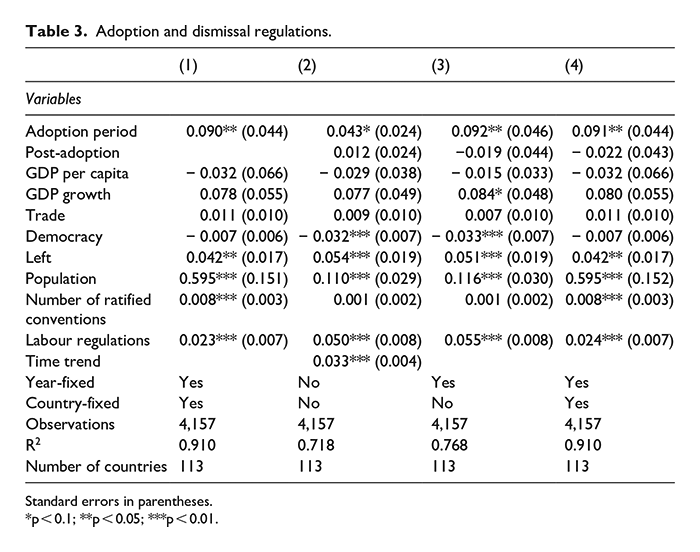
I present the results of the PCSE models in Table 3. The estimates provide support for my main argument (H1). More specifically, the pre-adoption process has a significant and positive impact on national regulations across different specifications.
Adoption and dismissal regulations.
Standard errors in parentheses.
p < 0.1; **p < 0.05; ***p < 0.01.
To gain a better picture of when states adjust their dismissal regulations, I also run the analysis with the pre-adoption variable, covering only the final 3 years of the adoption period. I display the results in Figure 4 (based on model 4, Table 3).
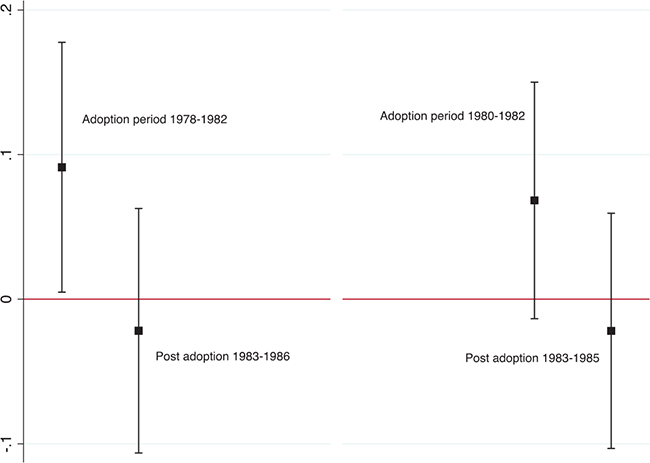
Adoption and post-adoption.
The results show that the adoption period motivates states that voted in favour of C158 to strengthen their dismissal policies. This lends support to my argument of ILO influence during this period. When I shorten the adoption period to 3 years, the estimates are not statistically significant at conventional levels, but the coefficients remain positive. However, I find no statistically significant effects of the post-adoption period (H2). This indicates that states take no or little action to adjust their labour policies after the preparatory period. Although states must submit the content of a new convention after formal adoption, the Office plays a minor, if any, role at this stage.
The estimates also reveal the average effects of other factors on national dismissal regulations, which in general are in line with previous studies (Blanton and Blanton, 2012; Mosley, 2011; Peksen and Blanton, 2017). The GDP per capita and Trade as share of GDP variables do not exert a significant influence on states’ dismissal regulations. The variables GDP growth and number of ratified ILO conventions are positive and significant only in two models. Left-leaning governments and populous states are more likely to protect dismissal regulations (Peksen and Blanton, 2017). Unsurprisingly, states that have a higher general level of labour regulations are also likely to have more dismissal regulations. Although not significant in all of the models, and with relatively small coefficients, democracy seems to have a negative impact on dismissal regulations. This suggests that while democracies are likely to have a higher degree of fundamental labour rights protection, such as the rights to unionise and collective bargaining (Mosley and Uno, 2007), democracies do not necessarily promote dismissal regulations.
A question that may arise is why only 34 countries have ratified C158. Why did states that vote in favour of C158 and improved their dismissal regulations during the adoption period, as I have shown, not ratify the convention? I identify three possible answers. First, one reason not to ratify is to escape the rigorous ILO monitoring, the substantive reporting requirements and the risks of public naming and shaming (Koliev, 2020a, 2020b; Koliev and Lebovic, 2018). ILO shaming has been identified as one of the reasons for states to be reluctant to ratify conventions. The second reason is that while states bring their dismissal regulations in line with C158, they choose not to ratify the convention in order to leave the door open for the flexibilisation of law and practice. This has been documented in the ILO’s own member states survey (ILO, 2000). A third reason, identified by interviewees, is that states may be ready to improve legislation already during the adoption period, but only with regard to particular parts of a convention, that is, they are not prepared to go ‘all the way’ (Interview 2, Previous high-ranked ILO official with over 40 years of experience. Multiple interviews in Geneva (2018) and e-mail (2019–2020)). In fact, in my interview with a senior ILO official, it was conveyed that ratification constitutes a ‘political act, but it is not necessary in order for [a] Convention to be used for guidance for the development of national law’ (Interview 2, Previous high-ranked ILO official with over 40 years of experience. Multiple interviews in Geneva (2018) and e-mail (2019–2020)). These three factors, separately or in combination, can make states reluctant to ratify ILO conventions (see also Maupin, 2013).
Robustness checks
I perform multiple robustness checks. First, in Supplemental Table A4, I run the main model without the AR(1) specification and observe that the results are unchanged. Second, I restrict the time period of the analysis to 1972–1993, that is, 10 years prior to and following ratification. 4 Moreover, I replace country fixed-effects with region fixed-effects. The results are robust and support my argument (models 2–4, Supplemental Table A4). Third, when I test the main model using OLS with clustered standard errors, the findings remain the same (models 5 and 6 in Supplemental Table A4). Fourth, I include a placebo dependent variable. For this purpose, I construct a combined score of other regulations in the CBR-LRI dataset, including (a) different forms of employment, (b) regulation of working time and (c) an overall score of all regulations in the CBR-LRI dataset, excluding dismissal regulations. The results for the adoption variables are not statistically significant in any model and have different coefficient signs, which provides strong evidence that the results are specific to my argument and relate to the preparatory process of C158 (Supplemental Table A5). Fifth, I run PCSE models for each of the seven sub-indicators of dismissal regulations. The overall findings are substantively robust and in line with the main argument (Supplemental Table A6). Sixth, I re-estimate the models on the samples of developing and developed states. I define developing states as those categorised as non-high-income countries by the World Bank. In the sample, I identify 73 developing states and 42 developed states. The results are substantively robust across models (Supplemental Table A7). Finally, I utilise a matching analysis, which primarily accounts for selection bias and also endogeneity bias. Countries that adopt conventions are not a non-random group and may therefore differ not only in relation to adoption decisions but also with regard to other factors. If these factors influence the adoption decision (voting) and the probability of improving dismissal regulations, the models may produce biased estimations. More specifically, I use coarsened exact matching (CEM), which in simulation studies has been shown to perform better than other matching techniques (King et al., 2011). CEM matches states with similar characteristics from both the group of states that has adopted and that which has not adopted, allowing us to estimate the main models using the non-adopted units as the imputed control for adopted units. The CEM requires us to select variables for matching those that voted in favour with those that voted against C158. I choose four key variables – with the data available from 1970 and throughout the period – that are important determinants of adoption decisions and associated with the probability of improving dismissal regulations, including (a) GDP per capita, (b) level of democracy, (c) number of ratified ILO conventions related to job security, and (d) legal tradition. Drawing on the literature on human rights and labour standards, these factors are expected to affect the probability of signing a treaty or ratifying a labour convention and relates to domestic improvements of human and labour rights (Neumayer and De Soysa, 2006; Peksen and Blanton, 2017). Consequently, I estimate the PCSE models using the sample generated by the CEM, including all variables in the full model in Table 3. The results remain unchanged (Supplemental Table A7). 5 I also estimate two-stage least squares (2SLS) models to test the endogeneity of the adoption variable to labour regulations and ratification of C158. Sagan tests report that the null hypothesis of exogeneity cannot be rejected at the convention level of significance (Supplemental Table A7).
Conclusion
In this article, I argued that the ILO can influence domestic labour regulations already during the preparatory process of conventions. I theorised that the adoption process creates propitious conditions for the ILO Office to socialise elites and increase learning opportunities and for domestic groups to mobilise for their issues.
The empirical analysis provides preliminary evidence for my argument. States that participated in the adoption process and voted in favour of C158 improved their regulations. The study has several substantial implications for our understanding of IGO influence and international labour conventions.
First, the results suggest that researchers have overlooked the significance of the process of adoption as a source of influence on domestic politics. While political science, legal and economics scholars mainly have focused on the act of ratification, this study suggests that ratification is not IGOs’ main pathway to domestic policy output. Second, this article suggests that studies focusing on the impact of ILO conventions have not only underestimated its impact but are also likely to be biased as countries might improve their regulations during the adoption process without ratifying the convention after formal adoption. Third, this study suggests that IGOs with similar autonomy and resources may influence domestic politics already during the preparation process of international conventions.
There are also limitations to this study. First, I recognise that the observational study design does not allow us to completely rule out possible endogeneity. However, I exploit the unique data to its fullest – using multiple techniques to strengthen the confidence in the findings – in an effort to assess the validity of my argument. Second, I also acknowledge that the study cannot determine whether the protection of dismissal regulations in practice protects workers from unjust dismissal. Indeed, we can construct a hypothetical case where states during the adoption process adjust their regulations but nevertheless fail to completely align these with a convention. These adjustments can then be framed as improvements without actually signifying sufficient convention alignment or actual changes in policy and practice. Finally, when generalising to a broader group of IGOs, caution should be raised. The ILO is unique in its tripartite structure, where workers’ and employers’ organisations may play a key role in domestic mobilisation. At the same time, it is important to note that non-state actors are also highly active in other IGOs and may play an important role in domestic mobilisation as well as in standard-setting processes. There are also fundamental differences in the adoption process, for instance, within the United Nations (UN) and the ILO. Human rights standard-setting in the UN is often disorganised, with separate supervisory systems, while the ILO has a more unified approach to the adoption of conventions. The Office also plays a more active role in standard-setting than other UN officials. But these particularities of the ILO in relation to other IGOs should not preclude the possibilities of other IGOs to influence state behaviour during the adoption process.
Supplemental Material
sj-docx-1-bpi-10.1177_13691481211027513 – Supplemental material for Promoting international labour standards: The ILO and national labour regulations
Supplemental material, sj-docx-1-bpi-10.1177_13691481211027513 for Promoting international labour standards: The ILO and national labour regulations by Faradj Koliev in The British Journal of Politics and International Relations
Footnotes
Acknowledgements
The author thanks Helena Hede Skagerlind, Nina Reiners, Thomas Sommerer, Markus Johansson, James Lebovic, Kari Tapiola, Joakim Kreutz, Oscar Ernerot and the three anonymous reviewers for their valuable comments on earlier drafts of this article.
Funding
The author(s) received no financial support for the research, authorship and/or publication of this article.

Supplementary Information
Additional supplementary information may be found with the online version of this article.
A1. Summary Statistics.
A2. List of Members that Voted Against (or Abstain) Adoption of C158.
A3. List of Members that have Ratified C158.
A4. Robustness Checks, Adoption Models. Without AR1(M1), Restricted Time Period (M2), Regional Effects (M3), Ordinary OLS Models.
A5. Placebo Dependent Variable Models.
A6. Sub-Indicators of Dismissal Regulation Index.
A7. Developed and Developing Sample, Matching & 2-sls Models.
Table A1. Variable Names, Measures, and Sources.
Table A2. Members Voted against C158.
Table A3. Ratification of C158.
Table A4. Additional robustness checks.
Table A5. Placebo DV with PCSE Models.
Table A6. Sub-Indicators of Dismissal Regulation Index.
Table A7. Developed and Developing Sample, and CEM Models.
Notes
References
Supplementary Material
Please find the following supplemental material available below.
For Open Access articles published under a Creative Commons License, all supplemental material carries the same license as the article it is associated with.
For non-Open Access articles published, all supplemental material carries a non-exclusive license, and permission requests for re-use of supplemental material or any part of supplemental material shall be sent directly to the copyright owner as specified in the copyright notice associated with the article.
