




Abstract
This study reflects on sovereignty as dynamic, whereby associated conditions, like recognition, fluctuate in quality and quantity within a unit and over time, and adds to existing discussions that concentrate on changes in the meaning of (rather than associated conditions with) sovereignty or more static approaches to partial sovereignty relative to other actors in international relations (e.g. in the context of hierarchical relations). I do so by reflecting on different degrees of recognition, as associated with external sovereignty, such as extensive but not general recognition (e.g. Kosovo); different types of recognition, such as recognition of a right to (as opposed to the presence of) statehood (e.g. Palestine); as well as change in recognition over time, such as with those witnessing significant fluctuations in their recognition (e.g. Taiwan, Sahrawi Arab Democratic Republic). Towards explaining these changes and theory development, I argue for historicising sovereignty, and by doing so, I contribute to a literature that has focused more on changes in the meaning of sovereignty across time rather than changes in its within-unit practical manifestations. I also offer some preliminary theoretical assumptions on how internal and external dimensions of sovereignty might interplay over time in processes of state emergence and on issues of agency, particularly on how recognisers define what we understand as sovereignty but also how some statehood claimants navigate or even embrace their lack of recognition to advance their sovereignty. With this range of conceptual and theoretical propositions presented, the study seeks to facilitate the development of further analysis of statehood, recognition and sovereignty.
Keywords
Introduction
Posed with the question of whether the World Health Organization (WHO) would consider Taiwan’s membership following the COVID-19 outbreak, an official from the organisation appeared to hang up (or been cut off from) the video interview. The incident served to highlight the fact that Taiwan is not welcome in many international organisations because it is not recognised as a state by most, who, instead, recognise China’s sovereignty over the island. The incident was widely reported in the media, prompting the response of the WHO and of the foreign minister of Taiwan, who called the organisation to put politics aside and offer membership. And yet, Taiwan’s status has not always been so controversial. The government of Taiwan, officially the Republic of China (RoC), was, in fact, one of the original signatories of the United Nations (UN) charter in 1945. However, by the end of the Chinese civil war, the communists established People’s Republic of China in the mainland, and the RoC was self-exiled in the island of Taiwan, with both governments claiming sovereignty over both the island and the mainland. The Cold war climate did not permit a fast and universal welcome of communist China by other states, but by the 1960s more or less half of the UN members recognised Mao’s government and, consequently, de-recognised the one in Taiwan. De-recognition intensified after the effective expulsion of Taiwan from the UN in 1971 1 and has continued ever since.
Taiwan is not alone in being somehow but not fully recognised or experiencing changes in the extent of its recognition over the years. Kosovo is recognised by around half of the UN members, while some have recently de-recognised following successful lobbying by Serbia, to which Kosovo used to belong and which continues to contest its secession. Morocco has also managed to secure some de-recognition of the Sahrawi Arab Democratic Republic (SADR) in Western Sahara. Palestine is recognised by most but not all UN members and is only an observer to the UN, although a member to other organisations. Palestine is also an interesting example of what looks like a different type of recognition sitting somewhere in between recognition and non-recognition, that is, the recognition of a right to (as opposed to the presence of) statehood: many might not recognise a Palestinian state today, but they still recognise the right of Palestinians to eventually have a state. A similar recognition was enjoyed by former colonies that were eventually recognised as states.
Such a complex picture of recognition has important and relatively unexplored consequences for how we understand sovereignty as the condition of recognised state authority. Sovereignty is often implicitly or explicitly treated as a binary (see Malmvig, 2006, for a discussion), while approaches to sovereignty as not absolute tend to focus on variations of sovereignty across different units (e.g. how some states are seen as more sovereign than others in the context of hierarchical relationships) or the sharing of sovereignty between different actors (e.g. between state governments and external actors, such as a UN transitional administration), rather than degrees of sovereignty in the same unit as partial sovereignty, which seems to be the case with Kosovo, Palestine or the SADR. What is more, changes in recognition, such as the journey of the RoC from general recognition through UN membership to partial recognition, raise questions that require a new way of historicising and contextualising sovereignty, which will focus on changes within a unit and over time.
In this article, therefore, I explore the different degrees and types of state recognition and I argue for understanding sovereignty as dynamic, whereby associated conditions, like recognition, fluctuate in quality and quantity within a unit and over time, as opposed to existing discussions that concentrate on changes in the meaning of (rather than associated conditions to) sovereignty and more static approaches to partial sovereignty (e.g. sovereignty and hierarchy discussion). In the next section, I critically examine existing literature in order to reflect on the value of exploring state recognition as an analytical aspect of sovereignty and the contribution that the study seeks to make. After that, I present my conceptualisation of the different degrees (i.e. number of recognitions afforded) and types of recognition (recognition, non-recognition, titular recognition). This conceptualisation draws on existing literature and a scoping exercise of recognition positions adopted by UN members individually and more collectively through the UN and other major international organisations. The focus on these organisations follows similar research choices on issues of recognition (e.g. Talmon, 1998) and rests on the assumption that membership of all-encompassing clubs at the regional or international level (such as the AU for Africa, or the UN globally) matters more for state recognition. Within this exercise, the study of 24 identified claimants to statehood without general recognition (in the form of UN membership) since 1945 2 becomes especially important for thinking about situations of partial recognition and, therefore, variations of sovereignty. I gathered data on recognition from secondary sources (e.g. books, articles, news reports) and original sources that included statements of politicians in press releases, legal documents and non-attributable interviews with 41 individuals working on or with good knowledge of the statehood claimants without general recognition under investigation (conducted on location, such as capital cities of those claimants and/or headquarters of international organisations), with a small number occurring online. The purpose of the interviews was mostly triangulation, and this is why only a selected number is cited in the text. I used the large body of descriptive findings produced to develop a conceptualisation of the different degrees and types of recognition. The aim here is more to conceptualise ideal types of recognition positions rather than elaborate on the classification of cases across these types (see also Elman, 2005). However, I draw on a range of examples throughout and I elaborate more on some in the last section, where I also attempt a partial, tentative categorisation that allows me to illustrate the value of the conceptualisation for theory-building, present some preliminary theoretical ideas and suggest a few areas that might merit further research.
Crucially, this identification of state recognition as a certain condition linked to the more abstract concept of sovereignty aims at methodological rigour, which has been seen as a challenge when studying sovereignty (e.g. Kurtulus, 2005: 4). Bartelson (2014) highlights that defining sovereignty prevents us from observing changes; this seems to refer to changes in the construction of sovereignty in the theory and practice of international relations. Indeed, my approach to sovereignty acknowledges this and rests on ideas advanced by, for example, Holm (in Costa Lopez et al., 2018), who argues that practices (here, of denoting a recognition stance) constitute an identifiable phenomenon (the way and extent to which a statehood claim is recognised) and that such practices produce, reform and redefine sovereignty and its constitutive elements (Biersteker and Weber, 1996: 9). By doing so, we avoid what Werner and De Wilde (2001: 283) describe as a ‘descriptive fallacy’, that is, the erroneous assumption that the discourse of sovereignty means (rather than is correlated to, as argued by this study) an empirical reality. Still, by embracing currently dominant conceptualisations that link sovereignty to certain observable conditions, like recognition, we can problematise and question their tenets, in this case, the absolute and static character of sovereignty. I follow previous works (e.g. Jackson, 2011; Krasner, 1999) that have looked at recognition as external sovereignty alongside other aspects, such as state-like control over territories and populations as internal or de facto sovereignty, but I choose to concentrate on recognition in order to develop a more nuanced understanding of its variations and what they mean for sovereignty. I draw, however, on this discussion of internal and external sovereignty to highlight potential interplays between changes in recognition and other aspects of sovereignty over time. Importantly, I recognise that this is only a working conceptualisation drawing on analyses of sovereignty in modern international relations, rather than a general and exhaustive definition that could run the risk of de-contextualising (Biersteker and Weber, 1996: 2) and de-historising sovereignty (Walker, 1993: 166). Instead, the conceptualisation of sovereignty here encourages thorough analysis by guiding and setting the boundaries of investigation and allowing this study to make the following specific arguments and contributions.
Based on my conceptualisation of different degrees and types of recognition, I advance our understanding of sovereignty by elaborating on its dynamic character. While the idea of sovereignty as a spectrum is not completely new (e.g. Lake, 2003), it has been mostly discussed in static terms and with reference to situations where actors share sovereignty, or have their sovereignty compromised, rather than sovereignty being partial in and of itself, which is a conceptual implication of the findings of this study. Instead, this study allows us to reflect on a rather dynamic nature of sovereignty, which can vary not only between units of world politics but also within units and across time, with a unit seeing its sovereignty progressively increasing or decreasing. In this regard, embracing a working conceptualisation of sovereignty not only does it not de-historisise the concept but also allows us to view it as dynamic and by doing so also add to historical accounts that have concentrated more on changes in the concept and practice of sovereignty rather than its manifestations within specific units and across time. Here, the investigation of the historical context might serve to understand how sovereignty is progressively earned or lost over time and challenge the idea of sovereignty as a rigid and static system of inclusion/exclusion (Wendt, 1999: 292) and respond to calls for accounting for the sovereign agency of seemingly more passive (e.g. Getachew, 2019) or peripheral actors to that system (Visoka, 2021; see also Bryant and Hatay, 2020; McConnel, 2016). By treating recognition as a condition associated with external sovereignty, alongside an international dimension of sovereignty, we are also allowed to better capture how the two interplay over time and statehood processes that transcend dichotomies of inside/outside (De Carvalho and Leira, 2021: 235).
Second, such a nuanced conceptualisation of recognition allows us to broaden our understanding of agency in relation to sovereignty as a structural dimension of world politics. In specific, the study offers a better understanding of how those who claim and those who recognise sovereignty, and their actions, relate. For example, my conceptualisation allows us to observe how the acts of recognisers define what we understand as sovereignty and also how the results of these acts (e.g. the status of being recognised, or not) are negotiated by statehood claimants in international relations. This, in turn, uncovers the agency of statehood claimants in advancing their sovereignty despite their lack of recognition, which has been seen as enabling this agency (Epstein et al., 2018; Holm and Sending, 2018) and allows us to reflect on potential interplays between recognition and other dimensions of sovereignty, particularly internal sovereignty as the ability to govern territories.
Finally, the proposed conceptualisations seek to facilitate the formulation of new knowledge, the more systematic organisation of information about sovereignty and recognition, and the opening up of new research avenues for understanding the implications of those concepts. The conceptualisations advanced aim to encourage theorising (Diesing, 1971; George and Bennett, 2005), and some preliminary theoretical assumptions about the relationship between different aspects of sovereignty and the role of different agents in this context are presented in the final section. As such, the concepts introduced in this article can be the basis for the development of more complicated, multidimensional and/or explanatory arguments and consequent analysis of a number of issues surrounding statehood, recognition and sovereignty, including via comparisons (for the value of concept-building for comparative methods, see, for example, Hall, 2003).
Sovereignty and recognition
In political thought and practice, sovereignty has been understood with reference to a state’s rule over a territory and a population internally but also the external recognition of this rule in international relations. Early conceptualisations of sovereignty concentrated more on internal matters. For example, Bodin opens his discussion by referring to those who have full control of the state (Franklin, 1992: xliii), while Hobbes focuses on the relationship between people and their rulers. Later studies follow a similar approach. In his influential work, Hinsley (1966) speaks of the absolute authority in the political community, highlighting the importance of the ability to rule internally. Fowler and Bunck (1996) add to this the ability to conduct foreign policy, what they call external independence, while Jackson (2011: 12) speaks of sovereignty as also the capacity, authority and capability to conduct diplomatic relations; establish or employ international laws; carry on commercial relations; or declare or wage war. Chayes and Handler Chayes (1995) write of the capacity to participate in international regimes as the ‘new sovereignty’ in the face of increasing globalisation, and similarly, Sørensen (1999) argues that, in post-modern states characterised by globalised economies, external linkages are also very important. In the same vein of having the government’s ability to act as a starting point when analysing international relations, other works have focused on the respect of non-interference as recognition of state authority by other states (Kratochwil, 1989) and the limits that can be externally imposed on such authority (e.g. see Jackson, 2011; Werner and De Wilde, 2001). This understanding of sovereignty has also been used to analyse situations that relate to the Responsibility to Protect doctrine (e.g. Malmvig, 2006; Ramos, 2013).
A slightly different approach is to view recognition not as an exogenous legal affirmation of the presence of effective government, but, rather, as a more endogenous dimension of sovereignty. For example, Thompson (1995) conceptualises sovereignty as also the recognition by external actors that the state has the exclusive authority to intervene coercively in activities within its territory. Such an approach is similar to Jackson’s (2011) distinction between internal and external sovereignty and views Krasner’s (2013) Westphalian/Vattelian sovereignty as part of internal sovereignty, also dependent upon recognition, as related to external sovereignty. Indeed, when it comes to international relations, mutual recognition of sovereigns has been seen as the very foundation of a society of states (Reus-Smit, 1997; Wight, 1977: 135) and what makes external sovereignty an inherently social concept (Bull, 1977), whereby forms of doing (state practices) legitimise forms of being (sovereign states, see Weber, 1995). In this context, internal and external sovereignty demarcates the world within the state from the world of states (Onuf, 1991) and claims to sovereignty construct a social environment, but recognition is also an important element in the self-construction of states. These approaches suggest a view of the state as the main agent capable of constructing other states through the practice of recognition and of sovereignty as a structure of inclusion and exclusion, denying access to the international society of states to those who do not have it (Wendt, 1999: 292). This seems close to international law approaches that the idea that recognition is constitutive of statehood (see also Grant, 2009). Such a conceptualisation of sovereignty as having distinct but inter-related external and internal dimensions allows a better appreciation of recognition matters and their interplay with more internal features of statehood. While the interplay between the domestic and international has been discussed as crucial for sovereignty (Thompson, 1995: 214), this work and the idea of sovereignty as dynamic allow us to go a step further and reflect on how this interplay might develop over time.
A large part of the literature on sovereignty has been preoccupied with the question of history, particularly how the concept has been historically constructed (Glanville, 2013) and changed over time. This is what Bartelson (2014) refers to as the mutability and contingency of sovereignty, and has been discussed especially from a constructivist point of view (e.g. Barkin and Cronin, 1994; Biersteker and Weber, 1996; Osiander, 2001; Wendt, 1999). In this context, static understandings of sovereignty have been criticised as not conductive for appreciating change in international relations (e.g. Branch, 2014), and historical accounts go on to explore changes over time. In his earlier seminal work, Bartelson (1995) reflects on how sovereignty and knowledge have been co-produced historically. Following works debated the emergence of sovereignty, with many questioning the link of the concept to the Peace of Westphalia (see Osiander, 2001 for an overview), and more recent debates build on these works to explore further the starting points of sovereignty and whether the concept can be applied to a period (De Carvalho, 2018; Lathan, 2018, in Costa Lopez et al., 2018) or place when/where the term did not exist as such (see Seth, 2013; Zarakol, 2018, in Costa Lopez et al., 2018, for challenges to sovereignty’s eurocentricity). Furthermore, there are more specific historical accounts that highlight change in relation to sovereignty. For example, Shadian (2010) studies the gradual development of links between the concepts of sovereignty and of Inuit governance and other forms of political organisations, while, more recently, Costa Lopez (2020) reflects on changes in concepts of political authority similar to sovereignty over the more specific period of the Middle Ages. A set of works drawing on sovereignty and especially relevant to this study seem to be preoccupied with changes over time in the criteria based on which state recognition has been afforded, what Sørensen (1999) regards as part of the changing ‘regulatory rules of sovereignty’, rather than changes in sovereignty per se. Thompson (1995), for example, reflects on democratisation and respect for ethnic minorities as norms of sovereignty in the early 1990s and while states were emerging as a result of the dissolution of the Soviet Union. Biersteker and Weber (1996) discuss changes in the social construction of sovereignty in relation to specific normative schemata that have guided recognition throughout the years, such as the withholding of recognition from those who were considered as uncivilised during colonialism or the republicans during the Napoleonic wars (Strang, 1996: 45). Similarly, Krasner (1999) finds that, at the very minimum, recognition is extended to those with territory and formal juridical autonomy, but that there have also been additional criteria that have varied over time and included the ability to defend and protect a defined territory, the existence of an established government and the presence of a population. Zarakol (in Costa Lopez et al., 2018) elaborates on how recognition developed from being related to internal sovereignty to being related to external sovereignty. In this context, Barkin and Cronin (1994: 109) have argued that the way in which sovereignty is historically constructed means that who is considered to be sovereign changes over time.
A different discussion has to do with variation in the way in which sovereignty is manifested across different units of world politics, rather than changes in sovereignty over time. This is a clearer discussion of the idea of sovereignty as not absolute. For example, the non-absolute character of sovereignty is implicit or explicit basis of analysis in works that concentrate on how states might share dimensions of statehood with others. Focusing more on the sharing of sovereignty between internal actors, Clapham (1998) speaks of degrees of statehood to reflect on phenomena such as insurgency, and similarly, Chowdhury and Duvall (2014) approach failed states as situations where different armed actors share sovereignty in a territory. De Carvalho et al. (2019) build on these works to study how different actors locally, especially those transcending the local/international boundary, enact everyday sovereignty. Other studies have offered accounts of comprised sovereignty more because of external rather than internal actors, for example, by looking at degrees of sovereignty that polities subordinate to empires have had (e.g. Benton, 2014; Krasner, 1999; Stoler, 2006). Later, Krasner (2004) speaks of sharing sovereignty with other states, and along similar lines, Matanock (2014) speaks of joint rather than complete authority. Finally, understandings of sovereignty as a spectrum can also be found in international-level analyses that reflect on how sovereignty is compromised, pooled or shared because of international law (Troper, 2010), interdependence (Gilpin, 1975), international bodies (Philpott, 2001) or multinational corporations (Strange, 1996; see also Skinner, 2010). All these accounts share a view of the non-absolute nature of sovereignty as manifested in the sharing of state authority between different actors, rather than variation manifested in partial sovereignty and changes in its extent or quality over time which seems to be the case with the phenomenon of statehood claimants without general recognition which is an important part of this study.
Finally, important insights on sovereignty as not absolute come through the discussion of sovereignty and hierarchy. Lake (2003: 311) draws on aforementioned works, such as Krasner’s, to reflect on restrictions of sovereignty as hierarchy, while Anghie (2005) discusses colonialism as a confrontation between sovereign European states and non-European societies that can be seen, at best, as only partially sovereign. Focusing on more recent times, Donnelly (2006) elaborates on ‘semi-sovereignty’ as the situation whereby the exercise of some (but not all) sovereignty is restricted through international society institutions that allow special rights to great powers, through the curtailing of rights of certain outlaws and through formal and informal protectorates in international relations. This discussion in hierarchy is ongoing. For example, Nisancioglu (2020) elaborates on racial hierarchies of sovereignty, Spanu (2020) reflects on the historical origins of certain hierarchies in the way in which the principle of sovereign equality informed the expansion of international institutions, while Zambrano Márquez (2020) contends that dependency theory views sovereignty as a relational condition dependent on power asymmetries. There are also more case-driven studies on hierarchy that suggest a non-absolute view of sovereignty. Hancock (2006) draws on the case of Belarus’ relations to Russia to introduce the concept of ‘delegated hierarchy’ to describe the situation whereby a state surrenders some sovereignty to an entity for the exchange of political benefits. Zhu (2020) studies China–Tibet and China–Mongolia relationships and reflects on the concept of ‘suzerainty’ as suggesting hierarchical structures between a superior suzerain and a semi-sovereign vasal state.
This study adds to these discussions of changes in the meaning of sovereignty over time and more static approaches to partial sovereignty relative to other actors in international relations by reflecting on the dynamic character of sovereignty and its degrees and changes within a specific unit over time. Because, if external sovereignty is seen as related to state recognition, then, is Kosovo sovereign or not? Can we think of Palestine, which is recognised by most but not all UN members and is a member to only some international organisations, as having full sovereignty or completely lacking in? How can the historical context explain, not changes in the meaning of sovereignty that have attracted most attention but, rather, over time changes in the extent of recognition of Taiwan, SADR or others, as a condition associated with sovereignty? These are questions about partial sovereignty not as a result of sharing or pooling sovereignty with others that seem to have preoccupied contemplations on sovereignty as not absolute, but partial sovereignty in and of itself and as a result of contestations over statehood. In answering these questions, I turn my attention to those without general recognition, like Kosovo or Palestine, but I move beyond dominant conceptualisations of such phenomena that see them in binary terms as non-recognised at the opposite end of recognised states (e.g. Epstein et al., 2018) or concentrate more on those heavily non-recognised but who display conditions correlated with substantial internal sovereignty, often know as de facto states (e.g. Caspersen, 2012; Kolstø, 2006), 3 towards two directions: first, I treat statehood as an objective rather than an achieved reality, which allows for considering important cases of claimants to statehood that do not display conditions which we correlate with internal sovereignty, such as effective territorial control and government (e.g. Palestine, SADR). This choice builds on similar approaches before (e.g. Florea, 2020; Lynch, 2004: 145), as well as a close reading of Weber’s influential work (Weber in Gerth and Wright Mills, 2009: 78) that reveals an understanding of the state as the human community that claims the legitimate use of force within a territory, whereby the success of such a claim is only parenthetical. Still, this approach permits the study of a meaningful population that does not include secessionist movements (e.g. Kashmir) or less conventional claimants to statehood (e.g. Liberland) that are not engaged in a sustained effort to build or maintain a state and, therefore, do not elicit a recognition response from outsiders. Second and in terms of recognition, I draw on Kurtulus (2005) and others (e.g. Butcher and Griffiths, 2020) to consider UN membership as a sign of general recognition, and consequently, I study statehood claimants with a varied degree of recognition, including extensive but still not general recognition, alongside those generally recognised UN member states (that include some without recognition by all rest of members, for example, Israel). 4 By doing so, we are allowed an appreciation of the different degrees and types of recognition short of general recognition. Such a conceptualisation adds to existing discussion of changes in sovereignty in relation to aspiring states, which concentrate more on the kinds of international exchange other than recognition that build towards it (Huddleston, 2020, 2021) but also responds to calls for the study of sovereignty in relation to the various polities that occupy the world (De Carvalho, 2021: 228), such as those statehood claimants only partially recognised.
This discussion of partial recognition brings us to the next major argument of this study, which is to advance an understanding of sovereignty as dynamic, informed by observing the growth or loss of recognition in cases like Taiwan, the SADR or others. The illustration of the conceptualisation of different recognition stances in the final section allows us to observe changes in recognition over time and raises a series of important questions. First, observing changes in the degree or type of recognition prompts us to look at the historical context for explaining those changes. By treating recognition as related to external sovereignty, we are also allowed to observe how external sovereignty might relate to internal sovereignty over time, for example, how the building of government control as internal sovereignty might justify the granting of recognition of such control as external sovereignty. Finally, the conceptualisation developed and its use for illustration purposes gives birth to a set of questions about agency. For instance, we are prompted to consider how those partially recognised pursue sovereignty, for example, Taiwan’s embrace of loss of external sovereignty, evident in accepting ‘Chinese Taipei’ as a designation that does not recognise its statehood claims, in the pursuit of more internal sovereignty in the form of more effective participation in international relations. All of these add to accounts that have concentrated on changes of the concept of sovereignty rather than its practical manifestations or accounts of varied sovereignty but which remain static, such as much of the discussion on sovereignty as hierarchy. Instead, the conceptualisation proposed here allows us to see how units of world politics can be seen as growing more or less sovereign over time, therefore problematising more the idea of sovereignty as a binary system of inclusion/exclusion and inviting the investigation of reasons behind such variations and their implications.
Types and degrees of recognition
In this section, I elaborate on the ways in which recognition is afforded (or not) to statehood claimants. Three types of positions are presented: recognition, non-recognition and titular recognition (Table 1). I also reflect on more quantitative differences and degrees of recognition manifested in the number of recognitions by UN members individually or expressed more collectively through international organisations, which have attracted less attention than their members (e.g. Coggins, 2014; Talmon, 1998) but which can be seen as carrying a distinct significance for recognition given they express a large number of members. Findings from this section constitute the basis of my argument for approaching sovereignty as a spectrum, with some enjoying substantial but still not general recognition or witnessing more qualitative differences in their recognition, such as having their right to statehood recognised but not their actual state claims yet. In the section after, I illustrate these conceptualisations, where I also make the argument for sovereignty as dynamic, that is, changing within units and across time. I also use that section to present some preliminary ideas about the relationship between different dimensions of sovereignty over time, as well as between collective and individual recognition, which is important for thinking more holistically about how those seeking recognition navigate the actions of recognisers in the pursuit of sovereignty.
Types of recognition and international organisations.
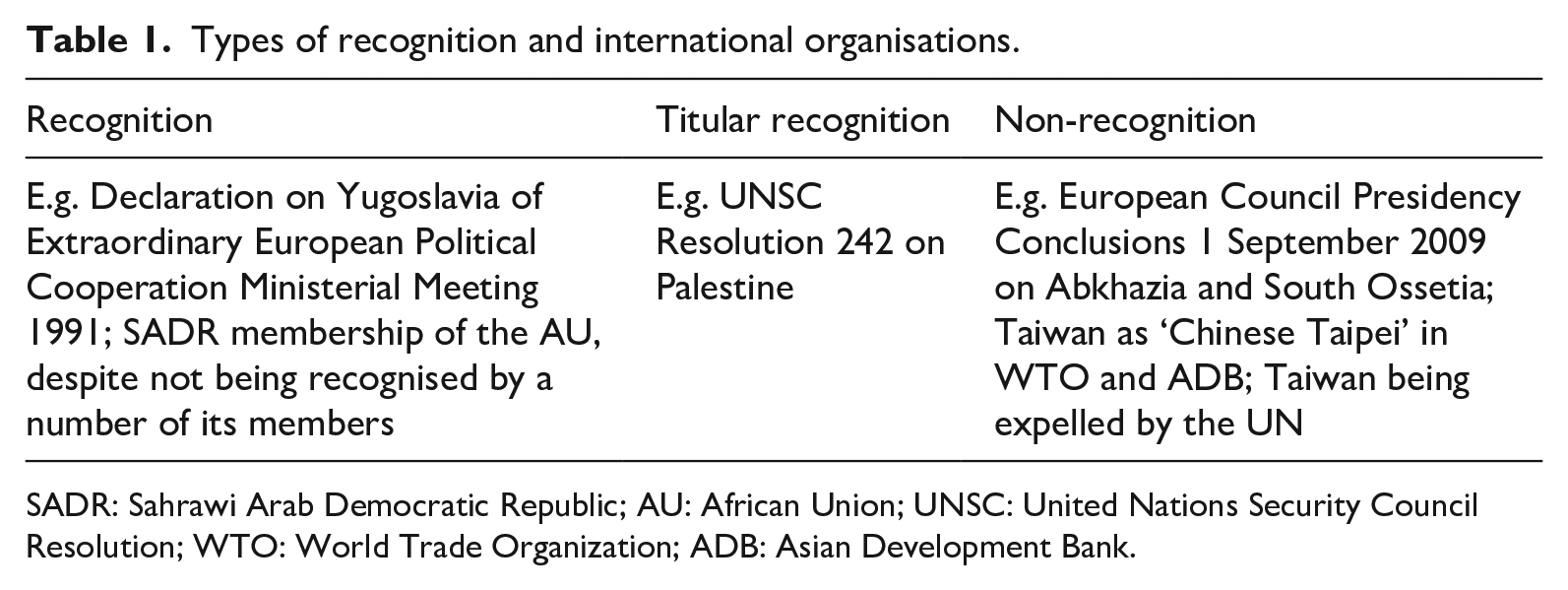
SADR: Sahrawi Arab Democratic Republic; AU: African Union; UNSC: United Nations Security Council Resolution; WTO: World Trade Organization; ADB: Asian Development Bank.
State recognition, correlated, as we discussed above, to ideas of external sovereignty, has been debated by scholars of international politics and law as a predominantly bilateral act occurring between states. For example, Grant (2009: xx) approaches recognition as ‘an authoritative statement issued by competent foreign policy decision-makers’, and Krasner (1999) concentrates on mutual recognition, which suggests a process that occurs between similar entities, that is, states. The Review of International Studies special issue on misrecognition takes a similar approach to recognition as something mutual between states (Epstein et al., 2018), while the symposium on ‘the Politics of International Recognition’ opens with a discussion of recognition as the announcement of an existing government that another political entity has become a sovereign state (Agné et al., 2013). In addition to these declarative ways of recognising, the establishment of diplomatic relations (e.g. Geldenhuys, 2009) can also be seen as a more institutional way of recognition. For example, the United Kingdom recognised India via its ambassadors before a formal declaration of independence. At the same time, the Letter by US President Truman to Lord Louis Mountbatten, Governor General of the Dominion of India can be seen as a declarative form of recognition.
While individual states can be seen as the most typical recognisers, international organisations are also important for facilitating a more collective recognition of statehood either institutionally, via offering membership, or declaratively, via statements (Kyris and Luciano, 2021). While there is not always overlap between the membership of an international organisation and recognition by all of its members, admission as a member has been very important as a sign of recognised statehood, first and foremost at the UN level but also with reference to more regional organisations based on state membership, such as the African Union (AU). A useful illustration here is that a few states did not issue statements of recognition for South Sudan because they considered its acceptance to the UN enough sign of recognition (Dugard, 2013: 64). As a result, a few scholars suggest that membership of international organisations relates to recognition (Geldenhuys, 2009: 22; Pavkovic and Radan, 2007; Richards and Smith, 2015) or indirect collective recognition (Dugard, 1987; Ker-Lindsay, 2012; Raič, 2002). UN membership in particular has been seen as the defining feature of becoming a sovereign state (for a recent work, see Butcher and Griffiths, 2020) and a criterion for being regarded member of the state system (Correlates of War Project, 2019). In instances where admission is not possible or imminent, organisations might issue more explicit recognition statements (e.g. EC statement regarding the states coming out of the dissolution of Yugoslavia).
Such findings contest understandings of international organisations as peripheral to recognition matters both in the theory (see above) and in the practice of international relations. For example, the 1976 Council of Ministers of the Organisation of African Unity (OAU, later AU), and with starting point the question of SADR, concludes that the recognition of an independent and sovereign state is an act of sovereignty pertaining each member of the international community, an act to be taken individually, and it is, therefore, up to member states and each OAU power [to decide] whether to recognise or not the newly independent state [SADR]. (Talmon, 1998)
The OAU’s statement was a response to the controversy surrounding the admission of the SADR to the organisation, which some members suggested amounted to recognition. Yet, what the above extract seems to suggest is that an international organisation – the OAU in this case – cannot prescribe who its member states can recognise or not, rather than whether membership of an international organisation can be seen as recognition. In fact, both arguments can be refuted. Not only international organisations can be seen as facilitating collective recognition stances, such as through UN membership (above), but they seek to influence their members, for example, by discouraging the recognition of certain secessions. These realities become even more obvious in the positions of non-recognition and of titular recognition for which international organisations seem even more important and which I will now move to.
Non-recognition, that is, a denial to recognise statehood claims, is usually reserved for cases of unilateral secession (see also Crawford, 2006). Collective non-recognition has been seen as particularly important (Kurtulus, 2005). In its clearest form, collective non-recognition comes in statements of international organisations that name the unrecognised state and even call their members to not recognise. See, for example, the European Union’s (EU) reaction to secession in Georgia: The European Council strongly condemns Russia’s unilateral decision to recognise the independence of Abkhazia and South Ossetia. That decision is unacceptable and the European Council calls on other States not to recognise this proclaimed independence and asks the Commission to examine the practical consequences to be drawn. It recalls that a peaceful and lasting solution to the conflict in Georgia must be based on full respect for the principles of independence, sovereignty and territorial integrity. (European Council, 2008)
There are also instances whereby statements simply reaffirm the sovereignty of the parent state, that is, the state from which secession is attempted. See, for example, the United Nations Security Council Resolution(UNSC) Resolution 822 following the unilateral declaration of independence from Nagorno Karabakh that mentioned Azerbaijan’s sovereignty, or the Council of the EU Conclusions (2014) supporting Ukraine’s sovereignty vis-à-vis separatism in Luhansk and Donetsk. Finally, there is also some evidence to suggest that being rejected for admission to (or more rarely expelled from) an international organisation can be seen as a more institutional way of denoting non-recognition (e.g. the UN and Taiwan), although not always and mostly with reference to more universal rather than regional or functional organisations, where the scope of membership criteria extends beyond statehood. 5
Finally, I build on Geldenhuys (2009) that sees titular recognition as the acceptance of an entity’s right of or title to statehood (as opposed to the presence of statehood) to further problematise it as a position somewhere in between the two opposite poles of recognition and non-recognition and especially relevant to collective recognition via international organisations. Titular recognition is closely linked to an understanding of self-determination as a right to be actualised via independent statehood (external self-determination, see also Seymour, 2011) and can, therefore, be seen as external sovereignty in waiting. This right was the basis on which former colonies attained their independence. See, for example, statement by the 1946 Cabinet Mission of the British government that ‘. . . if [India] elects for independence, in our view she (sic) has a right to do so’. Furthermore, international organisations seem keener than individual states to highlight titular recognition, often because of their commitment to values or the mission of the organisation (see, for example, the UN Declaration on the Granting of Independence to Colonial Countries and Peoples 1960), thereby highlighting the need to account for more collective stances of recognisers.
Some former colonies are important for our analysis because they have spent a considerable amount of time in a limbo place of titular recognition, thereby allowing us to treat them as a substantially different category to both generally recognised states and statehood claimants that are generally not recognised for a long period of time. One such case is Timor-Leste, which enjoyed titular recognition by the UN for years before its general recognition of independence in 2001. For example, the 1975 UNSC Resolution 384 reaffirmed earlier Resolution of the General assembly, tasked the UN Committee on Decolonisation to work more on the case and, in line with typical decolonisation understandings of self-determination via independent statehood, recognised the inalienable right of the people of East Timor to self-determination and independence in accordance with the principles of the Charter of the United Nations and the Declaration on the Granting of Independence to Colonial Countries and Peoples.
While titular recognition appears to come mostly in a declarative form, Palestine is a good example of the rarer institutional dimension of titular recognition manifested in granting observer status to an international organisation. For example, Krasner (1999: 232) uses the UN observer status of the Palestinian Liberation Organisation (later Palestine) to illustrate cases where full recognition is problematic and for which categories other than membership have been created. Elsewhere, Crawford (2006) views observer status as reserved for ‘states in the making’, which seems a state of affairs not too different from that of being titularly recognised and Similarly, Audifferen (1987, 100) documents that OAU observer status had been usually granted to recognised liberation movements otherwise excluded from full membership. 6
Strictly speaking, then, titular recognition relates more to people (whose right to statehood is recognised) rather than states. Seen in that light, titular recognition looks like a position that has to go together with non-recognition: a recognition of a right to statehood for Palestinians in the future can be seen as implying a non-recognition of their declared state today. However, I consider titular recognition as a type of recognition alongside recognition and non-recognition, which apply more clearly to states, because titular recognition entails the potential of statehood, which becomes even more important as a promise when conferred to groups engaged in disputes over statehood. Furthermore, there seem to be major qualitative differences between those statehood claimants that neither their state nor their right to it is recognised (e.g. unrecognised states of the post-soviet space) and those who, at least, enjoy titular recognition (e.g. Palestine), the main being that titular recognition allows better integration to international relations and also seems to lead to full recognition, often through international assistance too. 7 I elaborate on this in the next section because it illustrates well the core argument of this study about sovereignty as a dynamic and its theoretical potential, including in exploring more the links between conditions associated with internal and external sovereignty.
Finally, a major finding of the study is that, apart from the different types of recognition, there are quite a few statehood claimants that enjoy recognition by some, and this suggests different degrees of recognition too. In a similar way, we can also observe cases that enjoy membership of a limited number of international organisations. For example, there are a few major international organisations, like the World Bank (WB) or the International Monetary Fund (IMF), that have welcomed Kosovo as a state, while others have not. Such findings also have conceptual implications for understanding sovereignty as a zero-sum game. For example, both the Republic of Cyprus and the Turkish Republic of Northern Cyprus (TRNC) claim sovereignty over northern Cyprus, but international actors need to decide which of the two to recognise. Most recognise the Republic of Cyprus and they do not recognise the TRNC, while Turkey does the opposite. This view of sovereignty adds to existing analyses of states being more or less sovereign than others, or the sharing of sovereignty between different actors.
Dynamic sovereignty: conceptual and theoretical avenues
In this section, I draw on various examples and I elaborate more on some in order to illustrate how the conceptualisations proposed help us research questions of recognition and offer some preliminary thoughts on what this means for how we can understand sovereignty as dynamic. Table 2 presents types of recognition (non-recognition, titular recognition and recognition) facilitated 8 by the UN (but also mirrored by other major regional organisations in most cases), with information also on the degree of recognition by individual UN members. This categorisation allows us to observe different types and degrees of recognition over time and, by doing so, is in a way forcing us to break down our observation timeframes into shorter periods (e.g. for Kosovo or Taiwan, see Table 2), improve data quality by collecting more data and explore in more depth how recognition, as a condition associated with sovereignty, changes over time and within cases, and explain such changes through studying more their the contextual and historical background.
Types and degrees of recognition by the UN. a
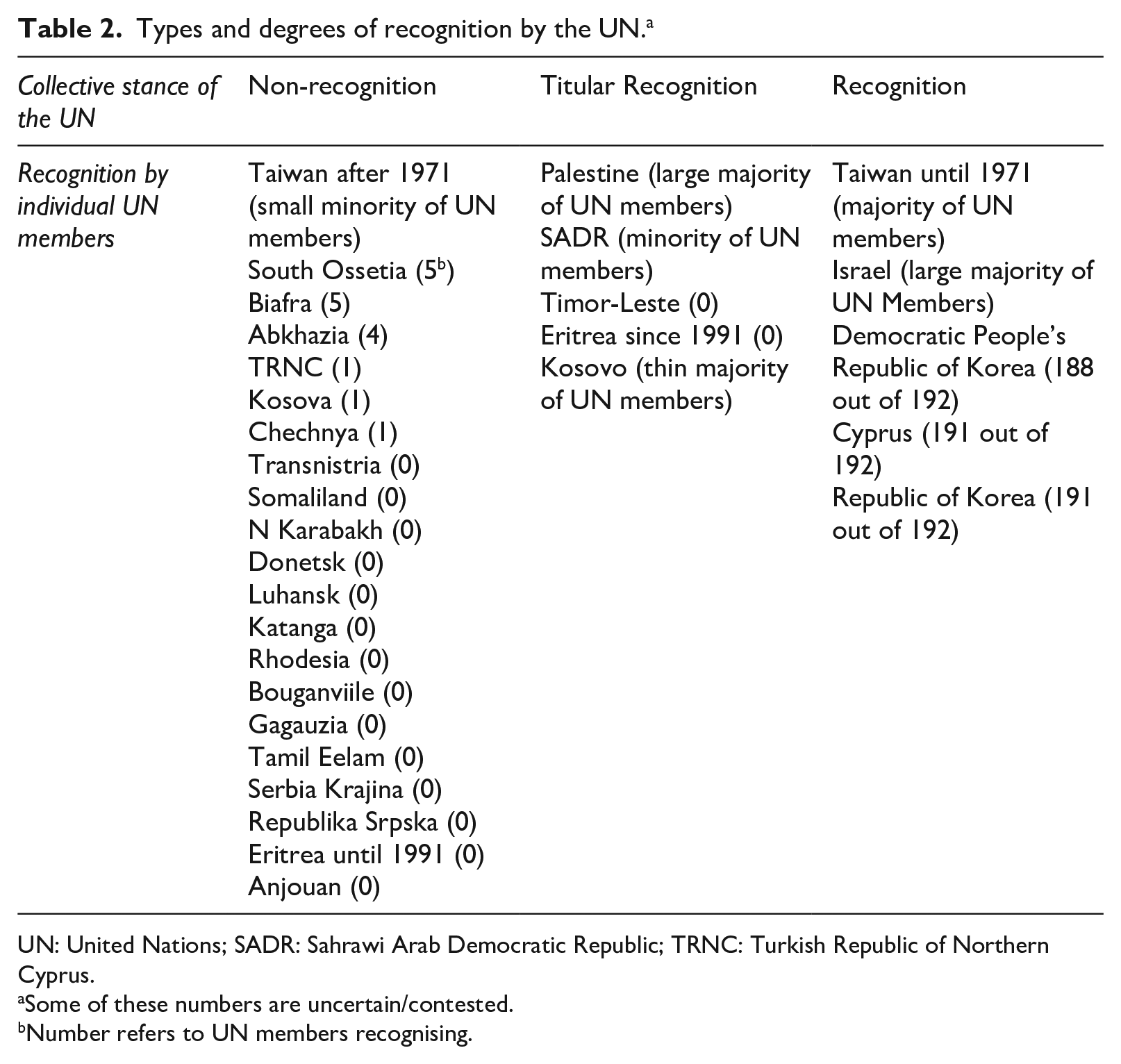
UN: United Nations; SADR: Sahrawi Arab Democratic Republic; TRNC: Turkish Republic of Northern Cyprus.
Some of these numbers are uncertain/contested.
Number refers to UN members recognising.
This dynamic character of sovereignty is illustrated well in the example of efforts at statehood in Kosovo, which displays important overtime fluctuation both in terms of degrees and types of recognition. In terms of degrees, for example, the first declaration of independence in Kosovo in 1991 was recognised only by Albania, but following the 1990s war and the second declaration of independence in 2008, Kosovo progressively increased its recognition and since 2013 has been recognised by the majority of UN members. However, more recently, a number of these states have withdrawn their recognition (see also Figure 1). Similar trends, if not of a greater loss of recognition, can also be observed in SADR in Western Sahara and Taiwan (Figure 2; for more on de-recognition, see also Visoka, 2019).
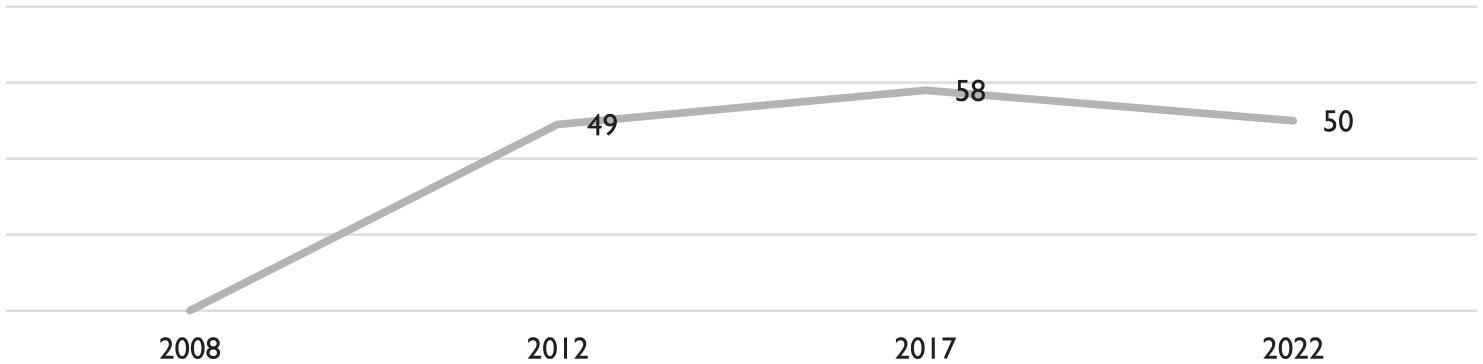
Percentage of UN members recognising Kosovo.
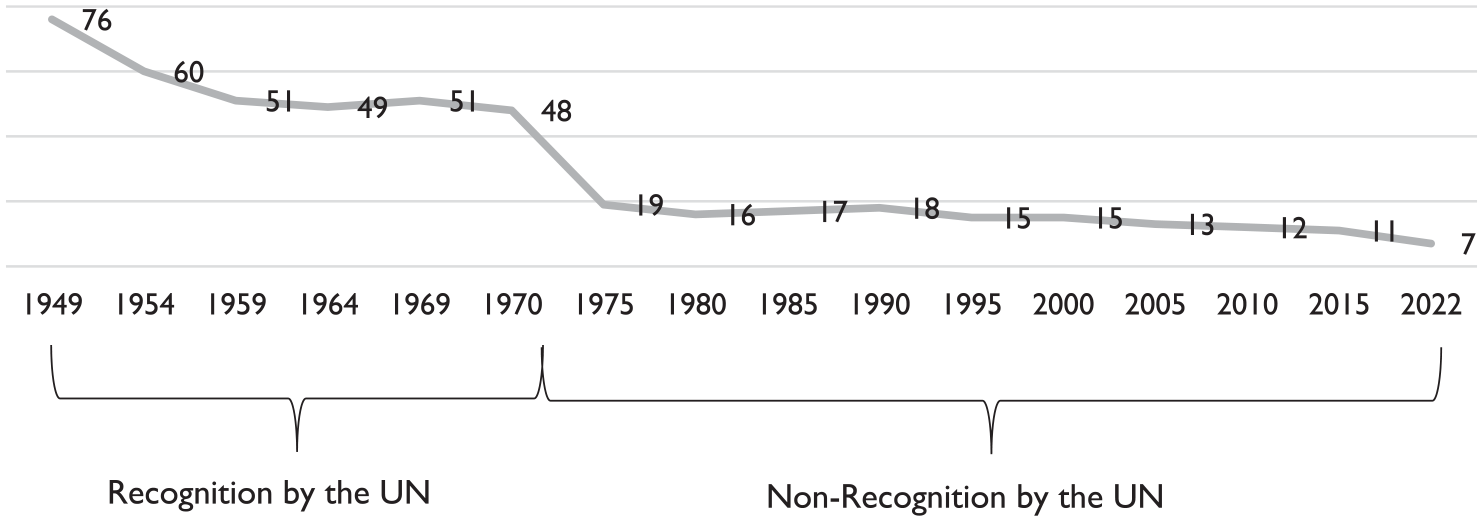
Percentage of UN members recognising Taiwan and recognition by the UN.
This variation and fluctuation in recognition highlight the need to probe the historical context for explanations of critical moments that might have triggered changes. For example, the 2004 riots in Kosovo, which were seen as at least partially added by the frustration of locals with the stagnating process towards independence, have been thought to have catalysed a change towards a clearer support for independence from some international actors through the Ahtisaari plan (interviews with officials from international organisation no4, 2018 and no1, 2019; Ernst, 2011; Pond, 2008). As a result, the conceptualisation presented adds to existing historical treatments of sovereignty, which concentrate more on changes in the concept of, rather than empirical manifestations related to, sovereignty and how they can be analysed by drawing on the historical context.
By categorising cases across the table, we are also allowed to see a significant overlap between degrees of recognition by individual UN members and recognition positions expressed through international organisations. This raises a series of new and important theoretical questions about how sovereignty is practised through individual and collective recognition, the relationship between the two, and the importance of context and history in answering them. Based on the findings, most statehood claimants that are collectively non-recognised through the UN see very low degree of recognition by individual members. Equally, most of those generally recognised via UN membership see much greater degrees of recognition. Do these preliminary findings suggest a certain authority on the part of the UN in recognition matters and defining sovereignty? Or are, instead, international organisations bound by recognition policies of their members? Especially when it comes to controversial statehood claimants, findings suggest that member states look at international organisations for signs on how to deal with them (anonymous interview 2, 2019). Statements of recognition from international organisations are often instructive in nature, suggesting a distinct agency in trying to affect sovereignty practice – see, for example, the EU’s statement on South Ossetia and Abkhazia earlier, the OAU’s call to ‘African States to take a vigorous stand against a Declaration of Independence of Southern Rhodesia by a European minority government’ (Organisation of African Unity (OAU), 1964) or, oppositely, the European Parliament’s encouragement of ‘those EU Member States which have not already done so to recognise the independence of Kosovo’ (European Parliament, 2008, see also Kyris and Luciano, 2021). Answers to some of these questions about the significance of individual versus collective recognition might also be found in the study of critical historical junctures that might have triggered changes in recognition. For example, the operationalisation of the conceptualisation as presented in Figure 2 allows us to see that Taiwan’s de-recognition accelerated after its collective non-recognition by expulsion from the UN in 1971, a finding that invites a more in-depth study of whether the two are causally connected. Elsewhere, the study of the historical context might suggest tensions between individual and collective recognition. For example, in trying to understand why Timor-Leste remained unrecognised for a long time and despite the titular recognition offered collectively via the UN, we can draw on arguments (Hainsworth and McCloskey, 2000) that suggest Cold War dynamics favoured Indonesia at the expense of the East Timor struggle for independence, and this is one of the reasons why many were more willing to resolve the conflict and recognise Timor-Leste after the end of the Cold War. 9
The conceptual choice to view recognition as an external dimension of sovereignty also allows us interesting observations about its relation to more internal aspects of statehood and the significance of different agents for how this relation unravels. First, the building of states internally seems to be informed by titular recognition, as a sign of some external sovereignty, and this highlights the theory-building potential of the conceptualisations proposed here and the wider contribution that this article makes: in all four cases without general recognition explored that have seen international state-building we also see a titular recognition (Eritrea, Timor-Leste, Palestine and Kosovo). This observation suggests that titular recognition might not be a necessary condition for state-building, but it seems to be sufficient. The overarching objective of the EU’s financial support to Palestinians is ‘the implementation of the two-state solution and the creation of a viable, contiguous and democratic Palestinian State living peacefully with the State of Israel’. Something similar happened with UN state-building in East Timor but also Eritrea. Kosovo is a more complicated case, in that both the titular recognition and the state-building policy have been at times less clear, but a more in-depth study of these cases could allow testing of the hypothesised causal relationship. Indeed, literature offers evidence that there is a link between various positions on recognition and the way international actors engage locally. For example, in an opposite scenario, non-recognition seems to have informed an engagement that tries to avoid rather than build the state (Kyris, 2020b).
By linking these observations on recognition and international state-building to the concept of sovereignty, we are also allowed to observe an interplay between changes in different aspects of sovereignty over time, whereby some external sovereignty, in the form of titular recognition, facilitates efforts at the strengthening of internal sovereignty, via state-building, which, in turn, leads to greater sovereignty, in the form of more recognition (see Figure 3). A useful example here is Timor-Leste, which moved from titular recognition to general recognition following a period of international state-building. But we also note similar findings in other cases. For example, the Swedish government justified their 2014 recognition of Palestine on the basis that international law criteria for the recognition of the State of Palestine have been satisfied. There is a territory, albeit with non-defined borders. There is also a population. And there is a government with the capacity for internal and external control. (Government Offices of Sweden, 2015)
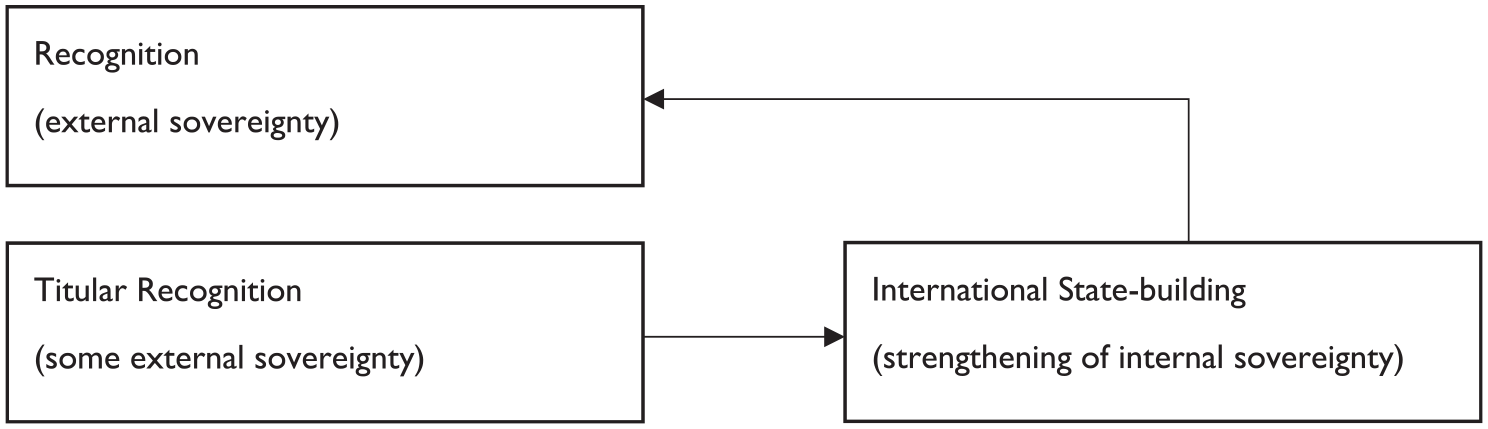
Sovereignty, recognition and international state-building.
This emphasis on changes over time allows us to appreciate better the inter-relation of agents and their actions, and sovereignty. Here, we can think of the above relationship between recognition and state-building as a consequential and dialectical process or a morphogenetic cycle (Archer, 1985), whereby the recognisers contribute to the sovereignty of those recognised and, in turn, sovereignty informs how the recognisers act, first via helping state-building and eventually via recognising more. In this way, this discussion of the relationship between different aspects of sovereignty allows us to see how recognisers inform the apparent sovereignty of those recognised. Perhaps more importantly and whereas recognition has been discussed as enabling of sovereignty (e.g. Epstein et al., 2018), the study also expands our understanding of the agency of those seeking statehood in developing their sovereignty amid an international system that denies it – this can further uncover the sovereignty agency of various actors that have perhaps been seen as more passive (e.g. Getachew, 2019) and/or peripheral, including in recognition matters (e.g. Visoka, 2021). For example and despite being heavily unrecognised, Taiwan has managed to have access to many international fora and develop strong trade and other links with the rest of the world. All these have been achieved mostly through the development of diplomatic flexibility (Li, 2015), since Taiwan partakes to international diplomacy not under its preferred constitutional name (‘Republic of China’, which is disputed by China) but other designations that are acceptable by China, most notably ‘Chinese Taipei’. Taiwan’s international participation is important, and it might be considered as normalisation (see also Berg and Toomla, 2009) and beneficial for accessing international relations, like Taiwanese leadership has suggested (Allen, 2000: 218), but it is best conceptualised as different to recognition. In fact, quite the opposite could be argued: listing Taiwan as Chinese Taipei is an at least implicit non-recognition of statehood claims and, oppositely, a recognition of China’s sovereignty over the island. This is, after all, why China is mostly tolerant of such designations. As a result, here, we witness a perhaps oxymoron of the voluntary abandonment of external sovereignty, via accepting non-recognition and the designation ‘Chinese Taipei’, leading to an increase in sovereignty, as it has been understood before (see earlier, for example, Fowler and Bunck, 1996; Jackson, 2011; Sørensen, 1999) as the ability to develop external diplomatic, economic and other linkages (Figure 4). This challenges accounts of an international society based on typical sovereigns, and findings confirm such a possibility elsewhere. For example, the confidence-building measures supported by the Organisation for Security and Cooperation in Europe (OSCE) that allow cars from Transnistria to travel throughout Moldova with neutral plates have been seen as having the potential of strengthening Transnistria’s sovereignty in practice (anonymous interview 5, 2020).

Sovereignty and participation under a designation other than claimed statehood.
Conclusion
Ιn this article, I have proposed a conceptualisation of the different degrees and types of state recognition, based on which I have argued for understanding sovereignty as dynamic. My conceptualisation was informed by a study of how recognition has been afforded or not. I documented significant variation in claims to statehood recognised by all, many, few UN members or none, or more collectively through international organisations. At the same time, there also seem to be more qualitative differences that suggest a different kind of variation in recognition: while in most cases there is either clear recognition or non-recognition, there are examples where a right to (rather than a presence of) statehood is recognised.
This conceptualisation makes a number of contributions to our understanding of sovereignty, which I discussed by illustrating some of the concepts proposed. First, I advance an understanding of sovereignty as dynamic. Although sovereignty as a spectrum is not a new idea, most studies have concentrated on degrees of sovereignty as a result of the sharing of sovereignty between different actors internal to the state (e.g. Chowdhury and Duvall, 2014; Clapham, 1998) or between internal and external actors (e.g. Krasner, 2004; Matanock, 2014), including in the context of hierarchical relations (e.g. Lake, 2003; Spanu, 2020). Instead, findings of this study highlight situation of partial sovereignty in and of itself (e.g. in those who lack general recognition) and instances in which sovereignty changes within a unit and across time, for example, through the growth or loss of recognition of the SADR, Taiwan or Kosovo. In this, we are invited to contextualise and historicise sovereignty in order to explain differences across time and those crucial moments that caused important shifts in recognition or other conditions associated with sovereignty. By becoming a tool for such investigations, this conceptualisation can contribute to the discussion on changes in sovereignty and history, which has focused more on how the meaning (e.g. Barkin and Cronin, 1994; Osiander, 2001; Wendt, 1999) and practice (e.g. Biersteker and Weber, 1996; Krasner, 1999 on recognition) of sovereignty have changed throughout the years. Furthermore, this understanding of sovereignty serves to highlight the complex ways in which sovereignty agents, for example, those who recognise and those who seek recognition, relate over time. The study showed that recognisers, acting individually or more collectively, might define what we understand as sovereignty and whom we consider possessing it, but also how those who struggle to be recognised navigate this denial of sovereignty – for example, we are allowed to make preliminary observations about how Taiwan has increased its internal sovereignty, understood here as partaking in international relations, through a voluntary undermining of its external sovereignty, as linked to state recognition, by means of the use of the designation ‘Chinese Taipei’. Indeed, discussing sovereignty as having distinct internal and external dimensions has also permitted propositions about how the two might relate and change over time. More research on all those fronts can draw on this conceptualisation of sovereignty as dynamic in order to build and test theoretical knowledge, and ultimately improve our understanding of one of the most fundamental questions of international relations: how the meaning of sovereignty is fixed in theory and practice.
Footnotes
Acknowledgements
I thank Bruno Theodoro Luciano for his assistance with data collection and comments on earlier drafts. For comments, I am also grateful to Christopher Day, Adrian Florea, Beste İşleyen, Maria Koinova, Nicolas Lemay-Hébert, Catalina Neculai, Adam Quinn, Stefan Wolff, the Political Settlements and International Relations and Security Research Groups, the Morning Writing Group at POLSIS, University of Birmingham and to panels at the following conferences: UACES 2016 and 2018, BISA 2017 and 2018, EUSA 2017; ISA 2019 and CES 2019. I would also like to thank the journal editors and reviewers for their constructive engagement with my work.
Funding
The author(s) disclosed receipt of the following financial support for the research, authorship and/or publication of this article: I would like to thank the Leverhulme Trust for supporting my research Grant Reference: ECF-2016-689.
