




Abstract
This article explores persuasive applications of humour in public diplomacy. I propose a new concept of strategic humour – the use of humour by state and proxy actors to promote instrumental interpretations of contested international events to foreign and domestic publics. Through strategic humour, states frame events in ways that advance their interests, deflect external criticism, and challenge narratives of other actors. In an entertaining form, strategic humour delivers a serious message that is simple, accessible, memorable, suited to the new media ecologies, and competitive in capturing news media and public attention. I focus on Russia as a state recently involved in a range of major controversies and demonstrate its use of strategic humour in three case studies. I argue that strategic humour is a fast-emerging, multi-format tool in public diplomacy, facilitated by the rise of social media and post-truth politics and less dependent on the state’s broader power resources.
Keywords
Introduction
RT publishes breaking news: ‘Putin thanks Trump for sharing information about terrorists’. Putin calls Trump: ‘Thank you, Mr. President, for sharing intelligence’. Trump objects, ‘But I did no such thing!’ Putin replies, ‘But all Americans now think you did!’ – Popular Russian joke
Humour is rarely taken seriously – after all, its role has long been to entertain rather than to inform. And yet, stories told through humour – from popular jokes about nations and politicians to Internet memes – are among the most widely circulated and best remembered. As a narrative about international politics, humour has a considerable role to play in how major international events and actors are communicated and understood. When national reputation increasingly depends on ‘whose story wins’ (Nye, 2010: 8), humour can give one’s story a distinct advantage in today’s media ecology. It presents a simplified, highly memorable, newsworthy, and widely appealing narrative that both entertains and informs, with the potential to go viral online.
Political humour has traditionally been regarded in the context of the power structures and media environments of the societies that produce it. In authoritarian states, humour has been widely studied as a grassroots instrument of resistance, offering counter-hegemonic narratives to the official and often ideological news (Davies, 2015; Ding, 2013; Kraidy, 2016; Wedeen, 1999). In democratic contexts, there is growing literature on humour in election campaigns (Shifman et al., 2007; Young, 2004), jokes by or about political leaders, and the effect of popular comedy shows on public opinion and voting behaviour (Farnsworth and Lichter, 2020; Morris, 2009). Online humour has been explored as means to encourage political participation and mobilise apathetic publics (Džanić and Berberović, 2017; Lunde, 2016). However, there have been few attempts to question the role of humour in communicating foreign policy – especially, the multifaceted applications of humour in public diplomacy campaigns, the framing of controversial foreign policy issues, and the promotion of strategic narratives.
This article addresses this gap by formulating the new concept of strategic humour. I define strategic humour as the use of humour by state and proxy actors to promote instrumental interpretations of contested international events to domestic and foreign audiences. Such events involve competing narratives from international actors, affect their domestic public opinion and international standing, and involve the use of strategies that maximise the appeal and outreach of one side’s narrative and diminish the other. How the story is told and how well it reaches audiences becomes no less important than whether the story is true – and short, newsworthy, easily shareable sarcastic and mocking messages are often better adapted to media and online environments than lengthy factual explanations or ordinary public statements. The purposes of strategic humour are to reach wider audiences in order to frame controversial events in ways that advance state interests; to challenge the competing narratives of others; to embarrass, discredit or put pressure on foreign governments and media; to expose and exploit incongruencies between public and private statements of major politicians; to deflect and ridicule external criticism; to influence dominant political agendas; and to portray in a favourable light, support, and legitimate state actions in the international system. I argue that strategic humour is used as a tool of digital public diplomacy and contributes to the rise of post-truth public diplomacy as it exploits and deepens the uncertainty around contested events, relies on emotive messaging, and aims for outreach and popularity to claim consensus and truth.
To evidence strategic uses of humour, this article takes Russia as an example of a state recently involved in a range of contested international events. Strategic humour practices are observed in three different settings, where it is employed by diplomatic missions, external broadcasters, and proxy actors that claim independence but effectively promote state narratives. I demonstrate that the audiences of strategic humour are blurred – through active use of online tools, strategic humour can target domestic and foreign audiences simultaneously, even if the message these audiences infer is different. Finally, I suggest that while strategic humour may be more effectively employed by well-resourced and well-connected states, it relies on factors often independent of broader state power resources.
Humour, foreign policy framing, and public opinion
Major international events are accompanied by competing narratives which create meaning, offer interpretations of past and present, and contribute to public mobilisation towards policies (see Payne, 2001). Frames play a central role in how publics learn about foreign policy issues, presenting ‘a central organizing idea or story line that provides meaning to an unfolding strip of events’ (Gamson and Modigliani, 1989: 143). Frames shape how events are rhetorically presented through ‘problem definition, causal interpretation, moral evaluation, and/or treatment recommendation’ by political actors and media (Entman, 1993), and how events are cognitively structured by audiences amid competitive representations (Chong and Druckman, 2007). Strategic humour helps frame foreign policy issues in both ways – as rhetorical presentation, it provides a simplified interpretation of events that appeals to wide audiences and to media conceptions of newsworthiness; and as a cognitive structure, it helps organise perception and memory.
In their study of media frames and international crises, Berinsky and Kinder (2006: 640) demonstrate how publics understand complicated events by ‘organizing information in a manner that conforms to the structure of a good story’. Yet these are inevitably simplified and selective stories that focus on some interpretations and relationships over others, with consequences for public opinion and behaviour (Domke et al., 1999). From this perspective, humour is a way to tell a ‘good story’ – stripped of inessential detail, structuring its decisive point around the incongruity between the real and unreal, the expected and the realised, and provoking the audience to identify with a side (see Benton, 1988; Hall, 2014). In an informal, entertaining way, humour can in fact transmit serious messages for and about the participants of political communication (see Shilikhina, 2013).
Brassett (2016: 175) goes further by suggesting that comedy itself is ‘serious politics’ – a productive, imaginative, and relational ‘practice of political resistance in its own right’ that demonstrates individual and collective inclination to contest hierarchies, hold differing opinions, and critically reflect on politics. Consequently, as Brassett argues, humour can (de)legitimate political structures, contest power relations, or encourage reimagination of various aspects of politics and society. As Berlant and Ngai (2017) suggest, humour pervades politics in the growing ‘commedification of the public sphere’, stimulated by expanding social fractures and the accompanying identity politics. The experience of humour then plays an important function in delineating identities and the boundaries of what is shared or permissible. Humour and its political functions are therefore a much broader field where not all applications of humour are strategic or calculated to persuade. The concept of strategic humour developed in this article involves two principal characteristics: (1) such humour is used by state and proxy actors to promote instrumental interpretations of events that advance state interests, undermine narratives of other international actors, and achieve foreign policy goals; and (2) humour is chosen amid other narrative forms because of its ability to maximise outreach and engage audiences emotively.
Humour about politics increasingly supplements news about politics. Studies of political humour in democratic contexts show that political satire, comedy shows, and other forms of political humour can present an alternative source of news, particularly for younger audiences (Baym, 2005; Feldman and Young, 2008). Online humour such as viral memes, cartoons, and jokes disseminated by net users can serve as tools of political critique, contestation, and identity construction that add to the mainstream media coverage of politics and give voice to the wider public (Shifman et al., 2007). Websites that provide popular cultural commentary such as BuzzFeed, and traditional mainstream news outlets too, pay increasing attention to online political discourses including humour, particularly around newsworthy events such as elections (Tay, 2015) and major foreign policy issues that enter electoral agendas. Jokes about major political controversies combine several elements of newsworthiness – they surprise and entertain, are highly shareable, involve power elites, and are often a follow-up to stories already in the news (see Harcup and O’Neill, 2017). Humour can present political issues in a form that is simplified, visualised, polarised, and often personalised – in other words, conforming to the storytelling techniques of the media logic that make certain formats more competitive in capturing people’s attention (see Strömbäck, 2008). Consequently, humorous framing is often used in campaigning due to its ability to attract wide media publicity and draw attention to certain issues (Kutz-Flamenbaum, 2014). Strategic humour utilises the advantages of humorous genres well suited to the media logic – presenting a cost-effective, attention-maximising resource for framing international politics and popularising state foreign policy to publics.
Political humour can have an impact on public opinion, especially among people with lower factual knowledge of the issue in question (Young, 2004), although some studies note difficulties in measuring its persuasive force (Innocenti and Miller, 2016). For example, political comedy is better recalled by audiences than traditional news programmes (Becker, 2013), while ridicule directed at media or the political system in general can undermine public attitudes to journalists and politicians (Farnsworth and Lichter, 2020). Similar to other elements of popular culture, humour and satire can generate what Furman and Musgrave (2017) call ‘synthetic experiences’ – the less detailed but satisfying impressions and ideas about world politics based on fictional inputs that can displace factual information. They argue that distinguishing fact from fiction is harder than most international relations theories admit, giving cultural scripts considerable power in shaping audience perception of politics. Indeed, the accuracy of claims made in humorous messages is not scrutinised as closely, since humour tends to be positioned outside the field of rational argument (Petty and Cacioppo, 1986). As a result, humour can be used to voice ideas too controversial to be expressed by mainstream political actors without consequences (Gilbert, 2004), and to depict events in ways that diverge from factual evidence.
Humour, public diplomacy, and strategic narratives
Narratives underlie soft power, as lasting influence depends on ‘creat[ing] consensus around shared meaning’ (Roselle et al., 2014: 72). A narrative presents a story with a plotline that explains political realities, provides a sense of causation and purpose, contains interests of the actors that tell it, and shapes public memory of events (Patterson and Monroe, 1998; Subotić, 2016). States use narratives strategically to offer compelling explanations of events, form and diffuse ideas, shape opinions and behaviour, and project interests (Miskimmon et al., 2013; Roselle et al., 2014). Strategic narratives about major events include the depiction of actors, setting, conflict/action, and resolution as they aim to convince the target audience of the desirability of a particular course of action, shape their understanding of themselves and the international system in general, and direct them to the narrator’s vision of the present and future (Miskimmon et al., 2013; Szostek, 2018). For example, Russia’s strategic narrative that the 2018 Salisbury poisoning was staged by the West not only deflects accusations of responsibility, but contributes to Russian popular suspicion towards democratic states, presents events as a Western plot to be expected because of Russia’s return as a global power, and mobilises a particular form of domestic patriotism and support for authorities. However, US and European narratives about Russian misinformation and interference can discredit Russia’s other actions that do not involve misinformation, contribute to broader discourses around ‘fake news’ and rising global threats to democracy, and enable particular policy responses. Strategic narratives, as Roselle et al. (2014) argue, should therefore be regarded as a power resource, vital to contestation and a complex media ecology, and key to understanding influence.
Strategic narratives are typically proliferated by states, public diplomacy broadcasters, and media. 1 Malone (1985: 199) defines public diplomacy as ‘direct communication with foreign publics, with the aim of affecting their thinking and ultimately, that of their government’. Through public diplomacy, states facilitate the acceptance and legitimation of their foreign policy among foreign populations (Kampf et al., 2015). These efforts involve means beyond traditional diplomacy, such as cultural diplomacy, advocacy and campaigning, intercultural exchanges, and international broadcasting, and increasingly include online communication channels and strategies (Cull, 2013; Jowett and O’Donnell, 2012).
The rise of digital diplomacy, which Bjola (2015: 4) defines as ‘the use of social media for diplomatic purposes’ has provided new ways to present national images abroad and connect to foreign publics. However, the term has been met with critique – for example, Manor (2019) describes digital and non-digital diplomacy as a false dichotomy, offering instead to regard digitalisation as a long-term, uneven process that reshapes diplomatic norms, values, and practices in the environment of a digital society. Digital public diplomacy has been characterised by governments’ reduced ability to control the message in the highly mediatised public sphere, but greater creative opportunities for mobilising populations and nation branding (Brassett et al., 2021). Although states often fail to fully utilise the interactive potential of digital public diplomacy and traditionally lean towards monologic, one-way forms of communication even on social media, the most successful strategies for digital public diplomacy include personalised, emotive, relevant, and positive messaging (see Kampf et al., 2015; Strauß et al., 2015), and humorous content meets these criteria. The audiences are changing too – while traditional public diplomacy targeted foreign publics, digital public diplomacy can influence domestic populations as well, raising ethics concerns (Kampf et al., 2015). Consequently, strategic narratives are becoming blurred and no longer strictly follow geographical lines (domestic/foreign) but include categories that cut across national boundaries, such as online/offline (Szostek, 2018).
The increasingly digital media ecology contributes to the proliferation of a post-truth culture in public diplomacy and strategic narratives (Surowiec and Manor, 2020), which is characterised by the declining value of facts and growing role of emotional messages and uncertainty (Crilley, 2018). Humorous framing of foreign policy issues absorbs these trends, as it challenges dominant representations in emotive and memorable ways and is widely disseminated online. Strategic humour presents a phenomenon where boundaries between political reality and manipulative representations, humour and news, entertainment and information, and domestic and foreign audiences are increasingly blurred. Strategic humour does not necessarily construct falsehoods – yet mocking opponents invites the audience to doubt their truthfulness and note their injustice, thus further feeding the uncertainty around contested events and questioning the trustworthiness of other international actors. Strategic humour combines interest-driven contestation of political reality with incongruity as a basic structure of humour – where humorous content begins with a predictable script and becomes funny when the audience realises the presence of a parallel hidden, incompatible frame and reinterprets old information in light of the new (see Young, 2017). Post-truth narratives often suggest hidden depths and present alternative explanations of events, and strategic humour constructs a similar contrast between the opponent’s familiar or even dominant narrative and one’s own ‘truth’ which it asserts through popularity mechanisms rather than factual evidence.
As a tool of influence, humour has been employed in public diplomacy campaigns to promote state narratives about international events and undermine narratives of other actors. Examples can be found in contexts where states have attracted considerable external criticism, faced sensitive or contested foreign policy issues, and have sought to influence external or mobilise domestic publics. Israel’s public diplomacy campaigns, for instance, have used humour to defend a national identity narrative against external criticism (Adler-Nissen and Tsinovoi, 2019); Poland’s leaders have used online humour to connect with younger audiences, mock Britain’s Brexit position, and embarrass Theresa May (Brassett and Browning, 2018); and Russia’s state television has affirmed the superiority of Russia and Vladimir Putin over other nations and leaders through humorous content (Ozoliņa et al., 2018).
Comedy and satire can be used to legitimate foreign policy, as Crilley and Chatterje-Doody (2020) demonstrate, whereby actors’ actions, interests, and identities become discursively justified and normalised. They argue that the emotive register and platform conventions are no less important than the narrative content of the legitimation claims, and humour can therefore be central to the legitimation of some actions and identities and contestation of others. Taking the example of Russia’s state-funded international broadcaster RT, they demonstrate how satire and comedy ‘make people emotionally invested in RT’s claims about global politics and draw their attention to structural injustices that appear to support a very particular vision of Russia’s role in the world’ (Crilley and Chatterje-Doody, 2020: 16). They argue that audiences could be attracted by RT’s humorous content but still disagree with its political message. And yet, audiences can reproduce overarching strategic narratives even if the source is known to be propagandistic or distrusted (see Szostek, 2018), and humour can produce wider audience outreach than regular content.
Humour is an important social medium through which states discursively negotiate sensitive issues, cope with misrecognition, consolidate common identification against external and domestic others, and create a sense of superiority (Adler-Nissen and Tsinovoi, 2019). Humour (re)creates hierarchical constructions of joke tellers (winners) and the targets of humour (losers), those who get it and those who do not, enabling a display of identity and solidarity in a group (Gruner, 1997; Morreall, 1987; Waterlow, 2013). This capability of humour to affirm identity boundaries and create ‘others’, or excluded groups, has historically been employed in propaganda cartoons and as part of the politics of blame and stigmatisation which alienated classes, professions, and other undesirable groups by mocking them (see Davies, 2015). In international politics, hierarchical constructions as ‘vertical relations of super- and subordination’ are partly created and (re)negotiated through discursive practices (Zarakol, 2017), and narratives that appeal to the wide public often promote an idealised version of one’s nation compared to others (Chernobrov, 2019). From this perspective, strategic humour can become widely reproduced as it reaffirms identity boundaries and supports virtuous and even superior imaginaries of a nation in the international system.
Three case studies of Russia’s strategic humour
This article provides evidence of how humour can be used strategically by looking at a specific example of a state and its public diplomacy practices. Russia is chosen as a state recently engaged in a range of international controversies, including the 2014 Crimea annexation, interference in democratic processes, and the 2018 Salisbury poisoning. Russia contests these accusations domestically and internationally, including through its public diplomacy resources. In recent years, Russia has paid increasing attention to public diplomacy, combining international broadcasting with the use of social networks to engage foreign publics (Simons, 2014). The Russian government regards information technologies and media as central to the application of soft power in foreign policy (Sergunin and Karabeshkin, 2015). It has employed a range of well-received domestic narratives to promote a particular worldview, position Russia as a challenger to US hegemony, explain controversial events in a favourable light, and defend against external criticism, and its state-owned domestic media and external broadcaster RT have been instrumental to this purpose.
I review three cases of Russia’s strategic humour to capture the diversity of its formats and actors. These examples occurred in the last 5 years, received significant media attention both at home and abroad, and demonstrate the potential of strategic humour to attract media publicity and reach wide audiences. Cases were selected using the least-similar approach (Bennett and Elman, 2007), where most variables are dissimilar (such as actors utilising humorous framing, the format of strategic humour, and foreign policy issues they address), but the purpose of strategic humour is the same – to advance, popularise, and facilitate the acceptance of state narratives about contested international issues. I demonstrate that strategic humour has been employed by Russia’s diplomatic missions, external broadcaster RT, and pranksters claiming independence but largely functioning as state proxies. In similar and alternative ways to these cases, the concept of strategic humour can offer a useful way to theorise diverse applications of humour in the increasingly digitalised public diplomacy.
Case 1: Social media trolling as an instrument of public diplomacy
The growing use of social media by governments, foreign ministries, and embassies in recent years has been described as ‘twitplomacy’ that aims to convey policies, shape the image of a state, spread values, and foster public support (Su and Xu, 2015). The incorporation of social media in diplomatic practices enables diplomatic structures to build a base of online followers, engage with them, and maintain lasting relationships (Kampf et al., 2015). Yet alongside regular social media posts such as official statements, news updates, cultural highlights, event announcements, and reposts from other governmental accounts, embassies can engage in trolling in the form of deliberately provocative, short, and attention-catching messages mocking external actors (governments, media, public figures) and often resulting in an exchange of humorous insults. Hannan (2018: 220) describes trolling as a mainstream political practice and a driver of post-truth politics, where short, biting sarcasm can be an effective tool in amassing social media following and pushing falsehoods or responding to criticism. As a form of strategic humour, social media trolling attracts news media coverage, shatters the confines of the existing pool of followers to reach a wider and more diverse public through reposts, promotes and popularises state narratives about contested events, mocks other governments, and engages criticisms from international media.
The embassy in London has been one of Russia’s most active missions in using Twitter trolling. The Russia–UK relationship has been recently marked by tensions, linked to the Ukrainian crisis and Crimea, sanctions, the Syrian war, the 2018 Salisbury poisoning followed by mutual expulsion of diplomats, and accusations of Russian meddling in the UK democratic processes. Through its official Twitter account @RussianEmbassy with over 90k followers, the embassy has addressed many of these issues, often employing humour. Below, I review its use of Twitter trolling to reinforce Russia’s narratives about the Salisbury poisoning scandal.
The poisoning of Sergei and Yulia Skripal in Salisbury on 4 March 2018 led to a major diplomatic fallout. Within days, UK Prime Minister (PM) Theresa May and other senior officials suggested Russia’s involvement, citing among other reasons ‘Russia’s record of conducting state-sponsored assassinations’ (May, 2018). Foreign Secretary Boris Johnson blamed Vladimir Putin for ordering the attack (Elgot and MacAskill, 2018), and an inquiry was launched into ‘alleged Russian state involvement’ in other suspicious deaths in Britain (Travis, 2018). The United Kingdom expelled 23 Russian diplomats in a move reciprocated by Russia. The Russian government denied involvement in the attack, calling these accusations ‘propaganda’ not based on facts (RT, 2018a) and suggesting the United Kingdom had staged it (RT, 2018b). On 31 March, Russia published a list of 14 questions to the UK authorities regarding ‘the Skripal case fabricated against Russia’ (Ministry of Foreign Affairs, 2018), and in later months, Russian state media continued to emphasise the absence of answers.
The Salisbury poisoning attracted intensive media coverage and turned into a battle for public opinion. It happened only 2 weeks ahead of the Russian presidential election and 3 months ahead of the 2018 FIFA World Cup hosted by Russia, so public perceptions of the incident at home and abroad were of great importance. Polls showed 75% of Britons blaming the Russian state for the poisoning (37% were certain of it), but figures varied across Europe, with 38% in France believing Russia was ‘certainly not responsible’ (YouGov, 2018). In Russia, only 3% blamed Russian intelligence agencies, 28% suspected UK intelligence, and 56% said it could have been anyone (Levada-Centre, 2018). The spokesman for Vladimir Putin’s presidential campaign later commented that ‘the Skripal scandal mobilised the nation, increased turnout, and consolidated citizens around Vladimir Putin’ (Carroll, 2018).
The Russian embassy in London used humour to reinforce Russia’s narrative about the incident. Following the expulsion of 23 Russian diplomats, the embassy tweeted a thermometer showing –23°C, saying ‘the temperature of [Russia-UK] relations drops to –23, but we are not afraid of cold weather’. 2 Projecting resilience, the tweet attributed blame for the escalation on the UK government. The post received over 3k retweets, 2.8k likes (by comparison, a regular embassy tweet receives 15–80 retweets and up to 150 likes), sparked a heated debate in the comments, and was described in the British media as a ‘viral hit’ compared to the ‘slickly produced but very formal’ communications of the Foreign Office (Belam, 2018). In another post, ridiculing prompt (and as the Russian government insisted, unfounded) accusations of Moscow’s involvement in the Salisbury poisoning, the embassy tweeted a picture of actor Pierce Brosnan as James Bond, accompanied by caption ‘Does Russia’s dialing code 007 make James Bond a “Russian spy”?’ 3
In weeks that followed Salisbury poisoning, the Russian government and media described Western accusations as guesswork and complained that Russia was denied access to the investigation (RT, 2018c). On 4 May, exactly 2 months after the poisoning, the embassy tweeted a picture of three billboards in a clear allusion to the 2017 Academy award-winning movie Three Billboards Outside Ebbing, Missouri. In the tweet, the billboards read, ‘2 months since Salisbury poisoning’, ‘And still no suspects?’, ‘How come, Prime Minister May?’ (Figure 1). In the movie, the billboards (‘Raped while dying’, ‘And still no arrests’, ‘How come, Chief Willoughby?’) draw public attention to police failure to investigate a murder, and the character who has the courage to ask these uncomfortable questions – the mother of the murdered girl – comes under intense pressure from the police, the town people, and her own family to remove them. By reworking this plot and offering to read Salisbury poisoning aftermath through a popular movie, the embassy portrayed Theresa May’s embarrassing failure to solve a case of national significance, suggested lack of evidence and a cover-up by the UK government, and presented Russia as a victim of unjust pressure.
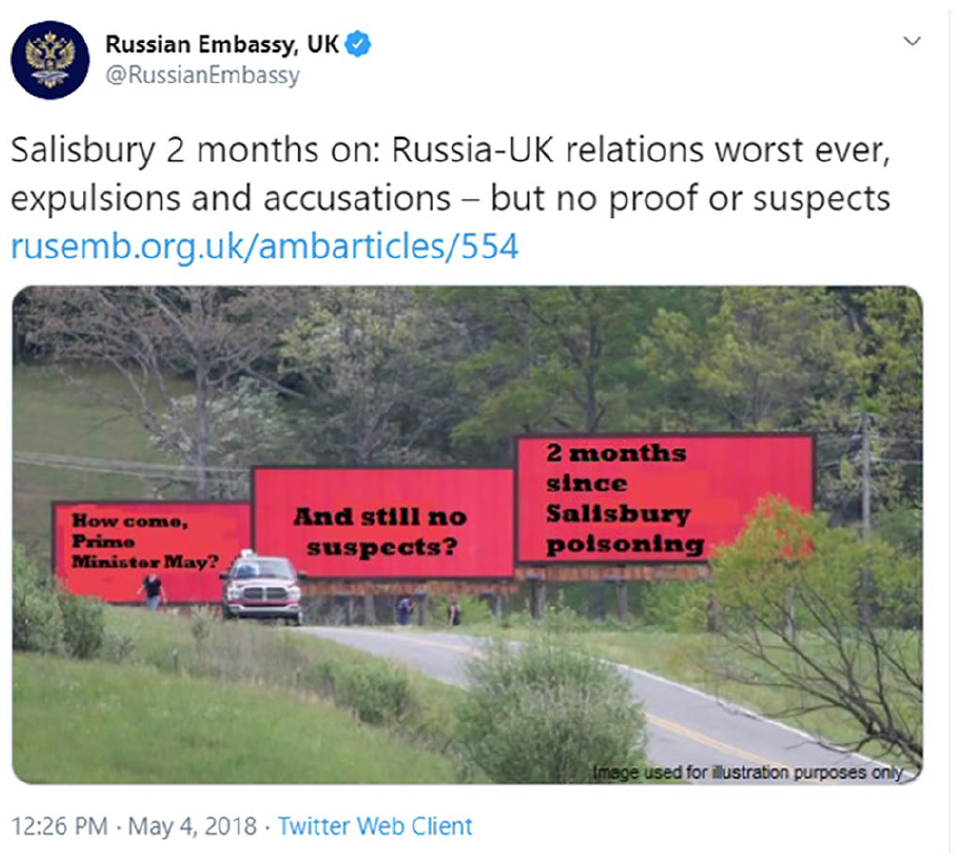
Tweet by the Russian Embassy in the United Kingdom in response to the Salisbury poisoning scandal, 4 May 2018.
Russian embassies are not alone in using humour to reinforce strategic narratives or undermine the narratives of other international actors or media. For example, the US Embassy in Moscow mocked a major Russian daily Izvestia in 2015 for publishing an apparently fake letter as proof of US funding for Russian LGBTI organisations to destabilise Russia. In a Facebook post with 28k likes, 11k reposts, and 1.4k comments, the US Embassy showed a proofread version of the letter, accompanied by a message in Russian: ‘Dear Izvestia, next time you decide to use fake letters, send them to us – we’ll be happy to help correct your mistakes. Yours sincerely, State Department’ (Figure 2). The post further advanced the representation of Russian state media as producers of propaganda and fake news.
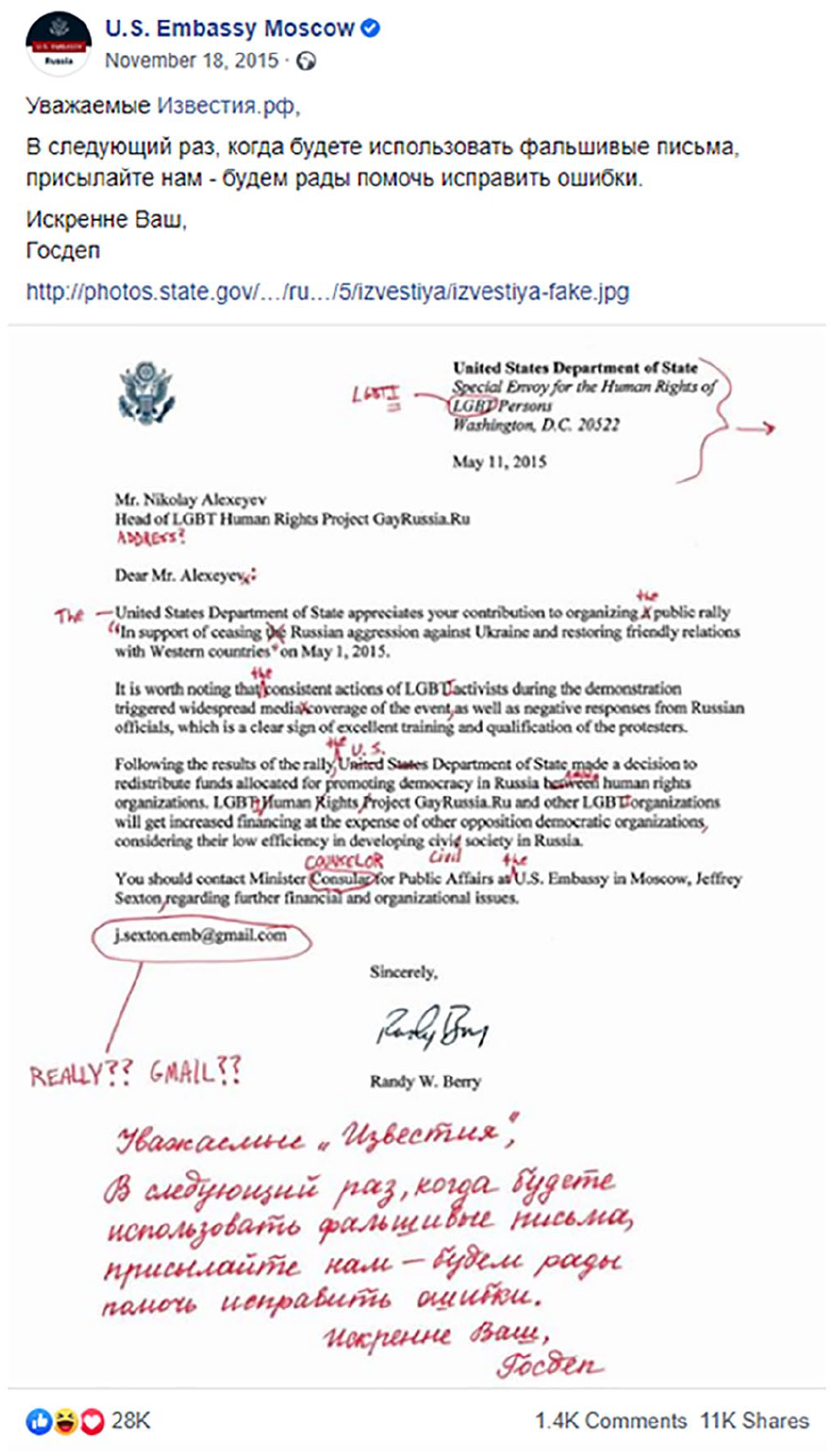
US Embassy in Moscow Facebook post, 18 November 2015.
Social media are increasingly used as a tool of public diplomacy; however, the role of ridiculing and humorous posts is significantly underexplored. As a form of strategic humour, social media trolling can make a substantial contribution to the practice and outreach of public diplomacy. Through its online viral potential and media newsworthiness, humorous content produced by diplomatic missions can convey the state’s position and narrative about contested international events to audiences well beyond their regular online followers, spark debate in an attempt to win the support of foreign publics, engage foreign media to deflect their criticism and embarrass foreign governments, and offer a favourable reading of events, including through recognisable stories from popular culture.
Case 2: Deflecting external criticism through humour in RT campaigns
International broadcasting is a key public diplomacy tool states employ to engage foreign publics and promote strategic narratives. This section will take the example of RT (n.d.) – Russia’s state-funded external broadcaster which sees its mission in ‘acquaint[ing] international audiences with a Russian viewpoint on major global events’. Effectively, it claims to provide alternative rather than unbiased coverage and has been described as ‘Russia’s answer to BBC World and Al Jazeera’ (Pomerantsev, 2014: 46). RT positions itself as providing counter-hegemonic news, thus undermining the global dominance of Western news networks and political agendas (see Rawnsley, 2015; Seib, 2005). In recent years, RT has been repeatedly accused of propaganda in the interests of the Russian state – accusations it has deflected, not least, through strategic humour.
In 2014, the US Secretary of State John Kerry labelled RT a ‘propaganda bullhorn’, ‘deployed’ to Ukraine to promote Russia’s strategic narratives (LoGiurato, 2014). The declassified 2017 US Intelligence Committee Assessment linked RT to Russia’s interference in the 2016 US presidential election, and the US Department of Justice required RT America to register as a ‘foreign agent’. In 2018, the UK media regulator Ofcom ruled that RT had failed to preserve impartiality in its news and current affairs programmes and in 2019, fined the channel. RT (2014) repeatedly dismissed propaganda accusations as ‘coming under fire’ for professional journalism and contributing to democratic accountability in the West in line with the channel’s slogan ‘Question More’. In 2015 and 2017, RT launched humorous campaigns to deflect propaganda accusations and ridicule claims of Russian government’s editorial control over RT.
In December 2015, celebrating its 10th anniversary, RT (2015) published a viral ‘leaked video’ on its digital platforms 4 about how the ‘Kremlin propaganda bullhorn really works’. Lasting 4 minutes, it offers a ‘behind-the-scenes’ view of RT and compiles various stereotypes which, as Russian strategic narratives claim, underlie Russophobia and criticisms of Russia’s policies. The video starts with RT Editor-in-Chief Margarita Simonyan in winter military uniform, personally supervising the unloading of truckfuls of dollars delivered to RT headquarters from the state budget, taking out large sums for bribes and personal expenses, and handing over the rest to the RT’s creative director – a brown bear – to eat. The channel has strict army-like discipline, even the cleaning staff report directly to the Kremlin. News anchors are handcuffed to desks, while news reports from Syria, Ukraine, Iraq, and other conflict zones are produced on a stage set, with a pool of foreign nationals imprisoned in KGB-style dungeons (Figure 3). Asking ‘Is this how you imagined it?’, the video lists accusations against RT from Western officials and promises to ‘keep getting them angry’. It concludes with ‘secret footage’ of Vladimir Putin personally approving the clip, further ridiculing the claim of direct editorial control from the Kremlin. Filmed in Russian with English subtitles, the video targets both Russian and foreign audiences. Its subtitled YouTube version alone received over 267k views, 8k likes (with 500 dislikes) and 1.6k comments and was reposted on multiple news websites.
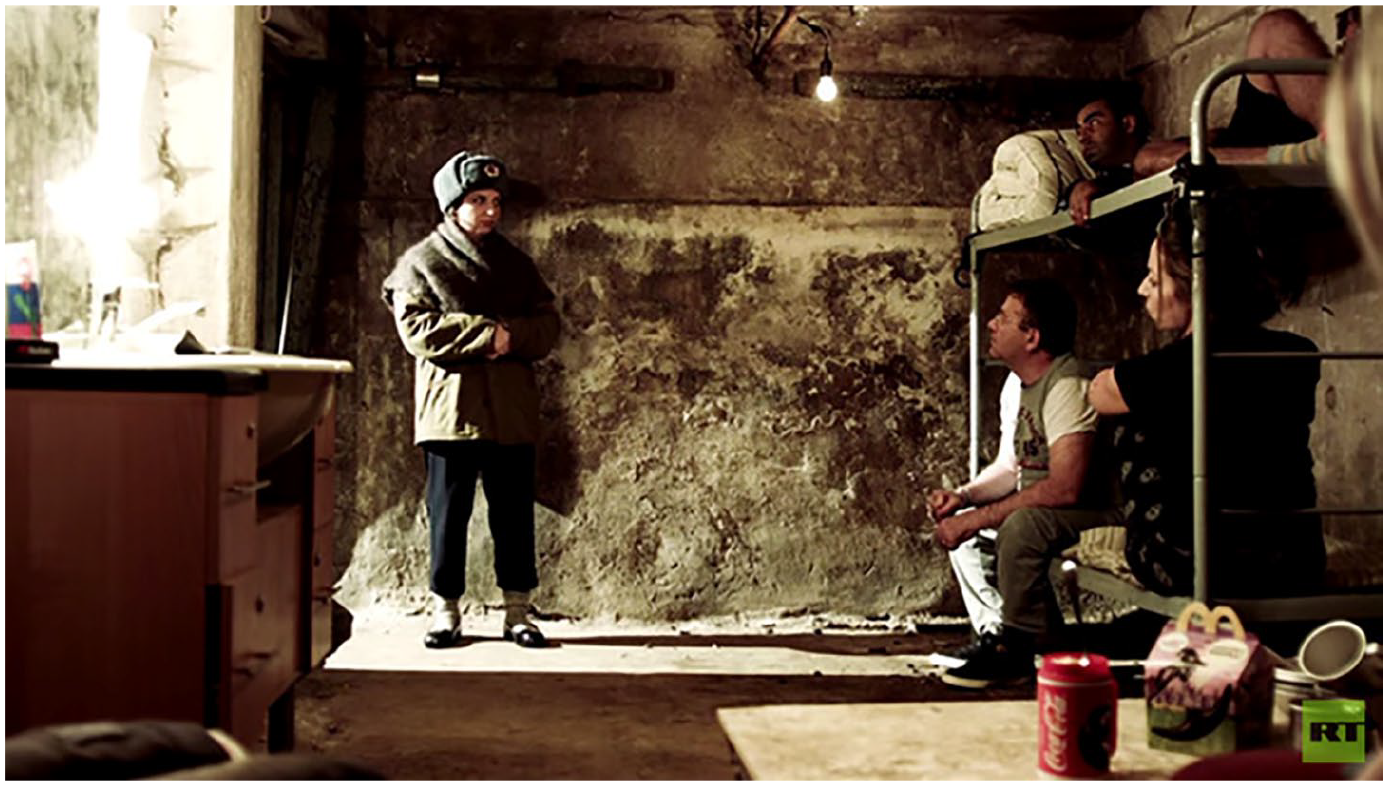
RT Editor-in-Chief keeps foreign nationals imprisoned to use in staged news filming.
In 2017, RT used accusations of interference and propaganda to launch an advertising campaign on the London underground and bus stops. In the US and British political discourse, Russia’s external broadcasters had been accused of meddling in democratic processes, misleading audiences through fake news, creating instability, promoting anti-establishment sentiments, and trying to split the West (Chernobrov and Briant, 2020). RT responded with ridiculing adverts (Figure 4): ‘Missed the train? Lost a vote? Blame it on us!’; ‘Watch RT and find out who we are planning to hack next’; ‘The CIA calls us a “propaganda machine” – find out what we call the CIA’, ‘Beware! A “propaganda bullhorn” is advertising here’. Similar advertisements appeared in Washington and New York – enabling RT to respond to British and American criticism in the heart of major Western cities, symbolically laughing at opponents in the face. The adverts were widely criticised by the US and UK politicians, and had to be removed in the United States (Moyer, 2017).
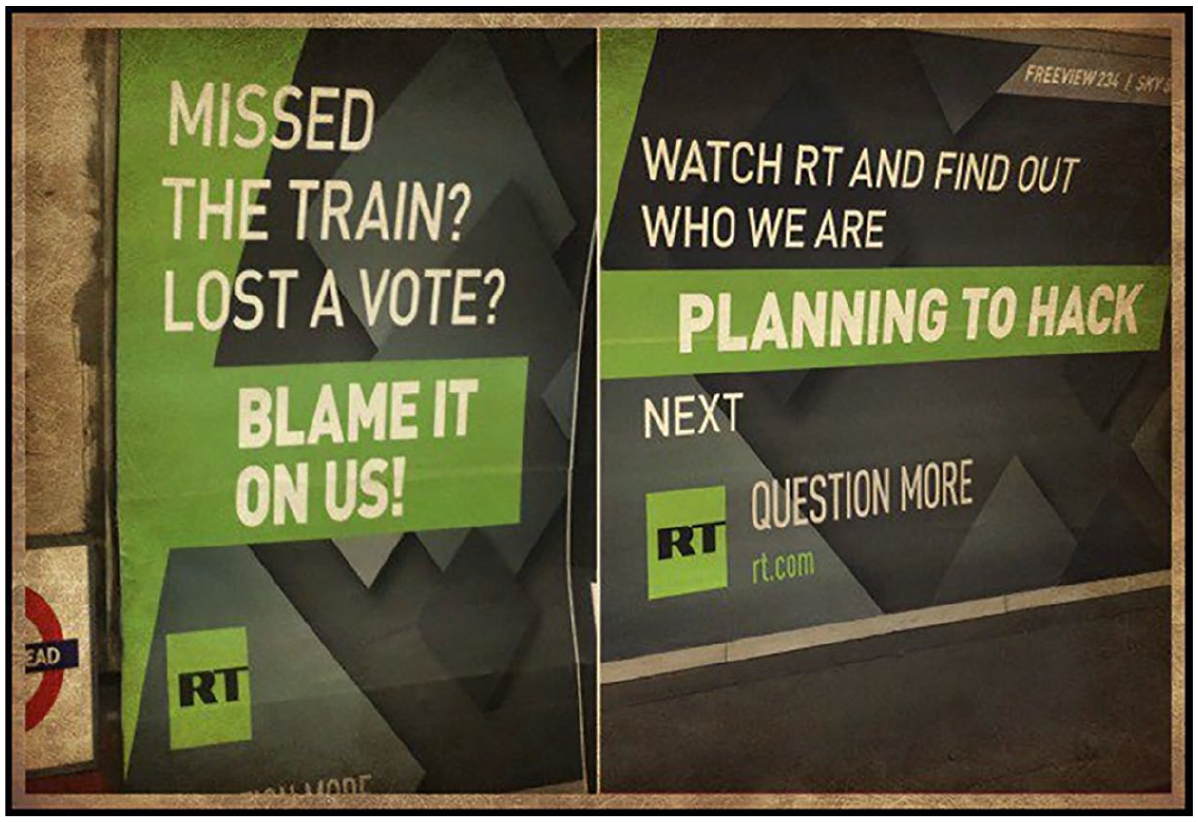
RT advertising campaign on the London underground, October 2017.
The ‘leaked’ video and the advertising campaign deflect and reverse propaganda accusations – suggesting that Western governments portray RT and Russia through the prism of Soviet and Cold War-style clichés, to the advantage of their political agendas, and are therefore involved in propaganda themselves. Attacks on RT are presented as a cover-up of the West’s own problems – ‘losing a vote’, ‘missing a train’, and blaming it on external interference. RT pushes out a dual message: the notion of propaganda is ridiculed to the point that it seems laughable and unreal; and criticism of RT is explained as a long-standing Western political attack on Russia at large rather than a question of RT’s journalistic content. It is worth noting that in the Russian culture, political jokes have long been associated with counter-hegemonic narratives springing from ‘kitchen talk’ – people ridiculing ideology and government in the relative safety of their homes. A similar symbolic position – being silenced, isolated but standing up to Western political and media hegemony – is now claimed by RT in its strategic humour campaigns and extended to the position of Russia vis-à-vis the West.
Case 3: Pranks and foreign policy issues
In February 2017, two Russian pranksters posing as Ukraine’s PM Volodymyr Groysman called US Congresswoman Maxine Waters. In the call, the supposed Ukrainian PM complained about Russia’s occupation of Ukraine’s cities Donetsk and Lviv. He urged the expansion of sanctions against Moscow, accusing Russia of hacking presidential elections in another country, Limpopo, and installing Russia’s puppet Aybolit as president. The ousted leader, Barmaley, was planning to flee to Ukraine. Finally, the PM complained that Putin had invaded Gabon to support President Ondimba. In the call recording (Vovan222prank, 2017) which was widely featured by the Russian state media and went viral online, US Congresswoman appeared surprised but welcomed the call. She took these complaints seriously and assured the pranksters that ‘the US is going to stand with you guys’ and ‘will keep those sanctions on Russia’. She also expressed concern about Russia’s ‘increased invasions of these areas’ and wrote down the names of Putin’s advisors, Vovan and Lexus, responsible for Limpopo election hacking.
Russian state media called this a spectacular prank, concluding that ‘when Maxine Waters’ name is ever mentioned again, the whole world will roll on the floor laughing’ (Russia24, 2017a). For Russian audiences, this appeared to be a most memorable exposure of Western prejudice. Limpopo is a fictitious country, known to all Russians from the iconic children’s book Aybolit and its popular Soviet adaptation as an animated film. The names of Limpopo leaders in the prank call are directly borrowed from there: Aybolit (translating as ‘oh it hurts’) is a kind doctor who goes to the river Limpopo in Africa to treat animals, while Barmaley is the main antagonist. Emphasising the parallel with fiction only children would believe in, TV presenters mocked Maxine Waters as ‘a grown-up [who] does not know that Limpopo does not exist’ (Russia24, 2017b). Russian government officials, too, commented on the prank, with Maria Zakharova, Spokeswoman for the Ministry of Foreign Affairs, saying ‘Russian fairytales are becoming truth. God, don’t leave America!’ (RT, 2017).
Limpopo is not the only element of the prank call that presents US politicians as failing to distinguish reality from fiction. Donetsk and Lviv are major Ukrainian cities, but while the former is in eastern Ukraine and key to the ongoing conflict, the latter is in western Ukraine and far from the fighting. Gabon and President Ondimba are real, but there has been no military intervention. Vovan and Lexus, named as Putin’s advisors behind Limpopo election hacking, are in fact the nicknames of the two Russian pranksters, Vladimir Kuznetsov and Alexei Stolyarov, who in this way hint at their true identities.
The political significance of this prank should not be underestimated. In a humorous form, it delivers a serious message in line with Russia’s strategic narrative – that Western sanctions against Russia are based on distorted realities, demonstrate US policymakers’ ignorance of Russia and the world, and present a series of geopolitical attempts to undermine Russia’s rightful position in the international system that will only continue. Claims of Russophobia, unfounded accusations, and falsified evidence have been Russian government’s defence line in most recent controversies – from the downing of flight MH17 over eastern Ukraine in 2014 to the 2018 Salisbury poisoning, and from the 2016 US election interference to the sport doping scandal (see Birge and Chatterje-Doody, 2020; Hinck et al., 2018; Khaldarova and Pantti, 2016; Toal and O’Loughlin, 2018). Russia’s strategic narratives about these events resonated well with its domestic audience: 71% did not believe in Russian government’s interference in US elections and 80% consider North Atlantic Treaty Organization (NATO) as a threat (Pew Research Center, 2018); the overwhelming majority blamed Ukrainian forces for downing flight MH17 (Levada-Centre, 2014); and 55% believed accusations of mass doping in Russian sport to be fabricated for political reasons (WCIOM, 2016).
This prank is not a singular occurrence – in recent years, Vovan and Lexus claimed multiple successful impersonations, targeting high-ranking foreign officials and raising issues crucial to Russia’s foreign policy. Posing as somebody with whom their target would be willing to speak, the duo provoke them into making unguarded statements, sound their position on important political issues, and afterwards release the recording or its fragments online or pass it on to Russian state media. The resulting revelations ridicule and embarrass Russia’s opponents, expose their hypocrisy or ignorance, and highlight inconsistencies between official and private statements. Most notable targets include NATO Secretary General Jens Stoltenberg (sounding Ukraine’s prospects of NATO membership), Ukrainian President Petro Poroshenko (about the conflict in eastern Ukraine), US Ambassador to the UN Nikki Haley (on Russia’s interference in another fictional country), US Senator John McCain (on sanctions), UK Foreign Secretary Boris Johnson (on the Salisbury poisoning), and Turkish President Recep Tayyip Erdogan (trying to get him to apologise for shooting down a Russian warplane in 2015). Russian officials and media frequently treat the obtained quotes as evidence in support of Russia’s strategic narratives – like the prank with the Director-General of the Organisation for the Prohibition of Chemical Weapons where he allegedly admits that the nerve agent used in Salisbury could have been produced by any state. Many targets have denied these conversations took place; however, growing mediatization of politics means that even inaccurate media reports can shape political processes and the way publics understand key events (see Strömbäck, 2008), and pranks of top political figures are highly newsworthy.
These pranks present a case where humour is produced by a non-state actor but widely publicised by state media and government officials. Media monitoring service Medialogia registered over 400 reports mentioning pranksters Vovan and Lexus on Russian TV in 2017 alone (Shevchenko, 2018). The pranks attract considerable, albeit more critical attention from Western media too, circulate widely online, and have been picked up by opposition campaigners in the United States and Europe. The pro-Kremlin agendas of these pranks, the choice of targets, and the intensive media coverage they receive at home have led to suggestions that the pranksters are linked to Russia’s security services (see Walker, 2016) and serve as Kremlin’s media tool (Shevchenko, 2018). The pranksters deny security links but admit that their activities seek to advance Russia’s state interests (Kuznetsov and Stolyarov, 2018: 380).
Political pranks, with heavy or little use for strategic purposes, have also been employed elsewhere. In 2018, a Ukrainian prankster aimed to provoke anti-governmental protests in Russia and caused an international row (Sukhodolov et al., 2018: 367), and in 2008, Canadian pranksters embarrassed US vice-presidential candidate Sarah Palin (Goldenberg, 2008). In 2005, a Spanish comedian pranked the Bolivian President, increasing tensions between the two governments (Keeley, 2005). Pranks have been theorised as a ‘brand of performed criticism [that] uses media to stage an event that makes a social or political point, circulating it in the public sphere’ (McLeod, 2011: 97). They have been described as a tool in-between information terrorism and fact journalism (Sukhodolov et al., 2018), particularly appealing to young audiences who increasingly learn about politics through comedy shows and soft news (see Feldman and Young, 2008). Pranks have the potential to influence perception of events and politicians, bring certain issues to the forefront of public debate, and cause diplomatic consequences. As Russia’s case shows, they can serve as a form of strategic humour, where pranksters perform the role of state proxies, aiming to frame key foreign policy issues to domestic and foreign audiences in ways that reinforce the strategic narratives of the state.
Conclusion
This article formulates the concept of strategic humour to describe the uses of humour by state and proxy actors as a tool of influence. Strategic humour is employed to frame contested events and controversial foreign policy issues to domestic and foreign audiences, in ways that legitimate state policies, undermine competing narratives of other international actors, deflect external criticism, influence political agendas, and affirm the wider strategic narratives that the state aims to promote. The concept of strategic humour therefore brings to the forefront two principal aspects: the uses of humour as a strategy of communicating and framing contested international issues to the advantage of a particular actor, and the choice of humour amid other narrative forms for maximum appeal and outreach because of its newsworthiness, emotive resonance with audiences, and suitability for digital media environments. Strategic humour translates complex and controversial events into narratives that are simplified, accessible, refreshingly different from routine governmental communications, memorable, and widely shareable. States particularly employ strategic humour in relation to contested events and issues that are important for public opinion or challenge their international standing.
Strategic humour can take various forms and applications. In the case of Russia, entities employing strategic humour include its diplomatic missions, external broadcaster RT, and non-state actors who effectively become state proxies as the content they produce pursues patriotic agendas and is heavily promoted by state media and officials. In different ways, these actors employed humour with a common purpose – to directly advance Russia’s state narratives or indirectly support them by challenging Western representations. Viral diplomatic tweets, RT campaigns ridiculing propaganda accusations, and widely reported pranks on foreign policymakers helped frame contested events in ways that promote their particular interpretation, undermine Western narratives, and deflect external criticism.
Russia’s case highlights the diversity of strategic humour forms and practices, but this is not an exhaustive list, nor is Russia the only state to use them. Russia is a powerful actor with well-resourced embassies, its own international broadcaster, and mostly state-owned domestic media. However, it employed strategic humour to address some of the most problematic issues in its relations with the West, where it finds itself politically isolated, mistrusted, sanctioned, unfavourably portrayed by foreign media, and regarded as a revisionist power that seeks to challenge liberal democratic norms. Strategic humour can therefore be used in situations where traditional and broader power resources have been limited, compromised, or otherwise constrained – as opposed to its use only by powerful and well-connected international actors.
Strategic humour is a fast-emerging public diplomacy tool facilitated by the increasingly digital media ecology. In contrast to traditional propaganda, where state-run media and a highly censored environment ensured control over the narrative and prevented explicit dissent, strategic humour is often disseminated online, with less control and more opportunities for creative engagement with the public or with the other side (e.g. via mutual Twitter trolling). Strategic humour is newsworthy and gets reported by commercial media, as well as by state-funded broadcasters, and is widely shared online by audiences. The domestic/foreign audience distinction is less evident in the case of strategic humour – and its particularly successful examples gain visibility both at home and abroad. Its viral potential makes it a tool for maximising outreach beyond the regular audiences of its actors – although its power to convince audiences can be disputed.
Finally, I have suggested a connection between strategic humour and post-truth politics characterised by emotive messaging, the construction and exploitation of uncertainty in political discourse, and pursuit of popularity as a mechanism of asserting truth claims. Strategic humour is often presented as the exposure of truth about international actors and their hidden motives, inviting reinterpretation of familiar or even dominant narratives. And yet, strategic humour can itself construct a post-reality where real foreign policy problems are communicated through their imitation, fictional scenarios, illusory comparisons, and symbolic metaphors. It highlights the uncertainty of contested events and creates an alternative, simplified but emotionally appealing representation of world politics. The rise of post-truth politics, the growing convergence of news and entertainment, blurred boundaries between domestic and international online audiences, and wide inclusion of social media in public diplomacy practices all contribute to the emergence of strategic humour as a distinct tool of communicating foreign policy issues and advancing state narratives.
