




Abstract
The debate in the United Kingdom over whether the voting age should be lowered to 16 has largely involved political elites demanding change. Public opinion, insofar as it has been tested at UK-wide level, has tended to oppose lowering the voting age for Westminster elections, but change has proceeded for non-Westminster elections in Scotland and Wales. Drawing upon extensive research undertaken as part of a 2-year Leverhulme Trust project on the voting age debate, this article tests public opinion via quantitative surveys on whether the voting age should be lowered for UK-wide elections not only among the existing electorate but also among 16- to 17-year-olds. It suggests three things: (1) there has been a shift among adults towards support for change, but not an outright majority in favour; (2) the insulation of public opinion from the debate is likely to diminish as only a change in attitudes appears capable of eliciting change at UK level; and (3) the divisions on the issue among the public map onto the importance of age as a variable in party choice, with younger Labour supporters most in favour of Votes-at-16 and older Conservatives most opposed. This political partisanship was absent when the United Kingdom became the first country in the world to lower the voting age from 21 to 18 half-a-century ago but is likely to dominate the Votes-at-16 debate for years to come.
Keywords
Introduction
The proposition that the voting age should be lowered to 16 for some or all elections across the United Kingdom has become an increasingly salient political issue. Advocates and opponents of Votes-at-16 have typically framed arguments for or against the policy in terms of normative democratic principles (Cowley and Denver, 2004; Folkes, 2004) or arguments related to young people’s perceived levels of maturity on a number of relevant (and sometimes irrelevant) dimensions (Champion, 2014; Gibson and Hamilton, 2013; Healy and Malhotra, 2013; Harper 2014). The role of public opinion is, however, peripheral in such debates, possibly because the general public has appeared substantially opposed, but largely apathetic, towards the issue (Birch et al., 2014; Chan and Clayton, 2006). This has led to contentions that the bespoke and partial lowering of the voting age across the United Kingdom has – thus far – been largely driven by political elites in a ‘top-down’ manner, with scant acknowledgement of, or reference to, the views of the general public (Loughran et al., 2019; Mycock et al., 2020).
The primary aim and focus of this article is to explain the underlying drivers of public attitudes towards the voting age. In doing so, it addresses the absence of detailed academic consideration of the development of public opinion on voting age reform, including – for the first time – an exploration of the underlying attitudes driving support among 16- to 17-year-olds. The article first presents a comprehensive overview of the (somewhat intermittent) public opinion polling on the voting age over the last two decades to identify trends in public opinion on the issue. We seek to explore whether public support for lowering the voting age has changed in parallel with the growing policy traction it has achieved among a majority of political parties in the United Kingdom (with the significant exceptions of the Conservative and Democratic Unionist parties) and within the devolved governments in Scotland and Wales. It will then present evidence from two parallel surveys (n = 1000) run by Survation in October 2018, as part of the quantitative element of our Leverhulme Trust 2-year research project, Lowering the Voting Age in the UK. 1 These two surveys drew on nationally representative samples of the UK electorate aged 18 or over, and 16- to 17-year-olds who were either partially enfranchised or not franchised, depending on where they lived in the United Kingdom. Both surveys capture levels of support for Votes-at-16 alongside related attitudes, such as perceptions of adulthood and views on political education as well as more standard demographic indicators. This enables us to specify a series of logistic regression models that explore the underlying drivers of voting age support focusing on whether demographic or attitudinal factors provide a stronger explanation of public attitudes on the issue and whether this is congruent with the arguments made by those on either side of the Votes-at-16 debate.
The results from our surveys suggest that there is overwhelming support for lowering the voting age among 16- to 17-year-olds. We also find that support for the policy appears to have increased among those over the age of 18, to the point where there is an almost equal division between supporters and opponents of change. However, our multivariate analysis of the underlying drivers of support for Votes-at-16 highlights important tensions for consideration by advocates and opponents. Within both our samples, support for lowering the voting age appears directly related to the increasingly partisan nature of the issue, which mirrors wider age-related and ideological divisions apparent in British politics. In demonstrating that public attitudes towards Votes-at-16 have moved from apathetic scepticism to partisan polarisation, the article concludes by arguing that public opinion will likely play a more significant role in debates about voting age reform.
Public opinion and voting age reform
According to Simon and Jerit (2007: 256), the role of public opinion in the policy-making process has been traditionally seen as instrumental both in influencing politicians’ policy priorities and outcomes. They note, however, that opinion is seen as increasingly irrelevant by contemporary ‘policy entrepreneurs’ who pursue their own policy agendas irrespective of whether overall support is immediately apparent. They conclude, however, that public opinion can still be important in helping to frame policy debates, both in terms of understanding the motivations and expectations of the general public on some issues.
The lack of significant resonance or impact of public opinion on lowering the voting age is, in part, due to how advocates and opponents have shaped the parameters of debate about the issue. It is somewhat understandable that supporters of voting age reform have chosen to overlook public opinion, as surveys over the past decade or so have regularly indicated a majority of over-18s are opposed. More surprisingly considering the nature of their cause, opponents of lowering the voting age have also proven reluctant to use supportive public opinion evidence to strengthen their point of objection. The merits or otherwise of voting age reform have thus most often been contended in abstract and normative terms, with scant regard for popular opinion on the issue.
Two inter-related perspectives have instead been dominant in debates about Votes-at-16 (Loughran et al., 2019). The first focuses on political socialisation, with supporters and opponents disagreeing on when young people can (or cannot) be considered to have developed the necessary political maturity and social capital to vote effectively (Healy and Malhotra, 2013; McAllister, 2014; Quintelier, 2013). Both academic and public discussion on this issue have been often framed in terms of the relationship between the age of enfranchisement and other thresholds of adult responsibility. The legitimacy or otherwise of 16- to 17-year-olds to join the electorate is thus founded on disputes about transitions to adulthood, evidenced by young people’s political literacy and life experience – or lack thereof (Bergh, 2013; Degerman, 2014; Wagner et al., 2012). It is noteworthy that, while political and academic debate has become mired in repetitive arguments over the definition and parameters of ‘adulthood’, the shared underlying assumption is that the right to vote is exclusive to adult citizens.
The second perspective is a more instrumentally orientated argument related to the political incentivisation of young people to participate in electoral processes and the impact this may have on the democratic health of the country (Berry, 2014; Folkes, 2004; Franklin, 2004; Henn and Oldfield, 2016). Proponents of voting age reform argue that it could prove an effective mechanism for improving overall turnout rates at elections by encouraging young people to develop the habit of voting while still in a stable home environment (Franklin, 2004; Plutzer, 2002). Conversely, opponents raise instrumental concerns that lowering the voting age will lead to a further decline in overall turnout rates, contributing to the long-term erosion of democratic legitimacy (Chan and Clayton, 2006; Cowley and Denver, 2004).
Some advocates of voting age reform have sought to reframe this second perspective around the principle of giving young people greater voice in the political process (Bowman, 2015; Peto, 2018). This reflects an urgent need for younger people to have a stronger collective influence on the political process to re-balance democratic systems which increasingly favour older citizens and alienate the young from democratic institutions (Runciman, 2018). The emphasis on the importance of increasing ‘youth voice’ in the political process thus largely rejects the necessity of the link between enfranchisement and adulthood that has traditionally framed the debate. However, claims that young people seek greater voice in the political system through voting age reform, or the extent to which these aims are shared by the electorate as a whole, have lacked robust and sustained empirical support.
Birch et al. (2014) provide the most substantial analysis of public opinion thus far. Drawing on data from a YouGov (2013) survey, they found sizeable public opposition to Votes-at-16 among the electorate. This noted, they identified that younger (but not the youngest) voters and members of working-class groups were more likely to support lowering the voting age. Interestingly, support for the policy was only weakly predicted by broader political attitudes, identities and preferences. This led them to conclude that the electorate’s attitude to the voting age was one of sceptical apathy and to predict that this would result in any move towards Votes-at-16 in the United Kingdom being driven by elite-level policy interests rather than public pressure. This prediction has – thus far – proven correct.
Developments in UK politics, particularly the 2016 EU referendum and its aftermath, suggest that support for Votes-at-16 may have become more rooted in underlying divisions connected to political socialisation and partisan politics (Jennings and Lodge, 2019). This rise in salience of Votes-at-16 in UK politics can be linked to the emergence of a distinctive ‘politics of age’ (Harrison, 2018; Pickard, 2018). Generational schisms are increasingly resonant, and are founded on a clash of values which, it is argued, are related to differing transition to adulthood experiences and diverse responses to the impact of globalisation (Jennings and Stoker, 2017; Prosser et al., 2018; Sloam and Henn, 2018). Scholars exploring these issues often contrast a well-educated, socially liberal and cosmopolitan group of primarily younger voters with a less-educated, socially conservative and communitarian group of primarily older voters (Dalton and Welzel, 2014; Ford and Goodwin, 2014; Furlong, 2019; Goodhart, 2017; Jennings and Stoker, 2017; Norris, 2011).
Jennings and Stoker (2017) emphasise the importance of geography in structuring this generational division. They highlight divergence between vibrant urban hubs where university-educated younger people study, settle and engage enthusiastically in democratic politics, and post-industrial areas in which groups, including young people, feel ‘left behind’ and politically alienated. Such divisions raise questions as to the universality of claims that lowering the voting age might prove an effective mechanism – on its own – for addressing widespread youth disengagement in politics (cf. Bowman, 2015; McAllister et al., 2017; Surridge, 2010, 2016) has identified education as being the key mechanism driving the evolution of new values-based class divisions in UK politics. Recent work by Sobolewska and Ford (2020) also demonstrates strong educational divides underpinning critical socio-cultural fault lines in UK politics and society. However, Surridge (2016) also demonstrates that the effect of education is nuanced and non-linear with university education having the strongest educational impact in increasing liberal values. It, therefore, seems highly plausible that having a degree would be strongly correlated with increased support for lowering the voting age to 16.
Research indicates that the 2014 Scottish independence referendum had positive short-term effects on the engagement and attitudes towards politics of 16- to 17-year-olds of all social classes (Huebner and Eichhorn, 2020). There was, however, uncertainty to the extent this was a product of enfranchisement or the unique experience of the referendum. It is yet to be proven whether one of the effects of Votes-at-16 could be the further empowerment of engaged young people with existing high levels of political capital, or whether it universally addresses the underlying causes of political apathy and alienation.
Age has also proven more influential in explaining partisan divisions in UK electoral politics. For example, age proved the strongest demographic predictor of vote choice in the Scottish independence referendum of 2014 (Eichhorn, 2017), the 2016 EU referendum and the UK general elections of 2017 and 2019 (Curtice, 2017; YouGov, 2019). Age cleavages have also further disrupted the traditional class-based loyalties of party support (Evans and Mellon, 2016). The proponents of the so-called ‘Youthquake’ thesis associated with the 2017 UK general election present evidence that inter- and intra-generational schisms are increasingly founded on ideological difference. Sloam and Henn (2018) note the emergence of a millennial generation of ‘young cosmopolitans’ who share strong liberal and left-wing attitudes towards social and economic issues. They highlight links between the increased turnout rate among 18- to 24-year-olds in 2017 and the rise in electoral support for the Labour party. Pickard (2018) concurs, noting the emergence of a ‘do-it-ourselves’ generation who are politically literate and engaged, and who participate widely in diverse forms of activism. These young people are critical of mainstream politics and support its reform via policy interventions such as Votes-at-16.
Indeed, the opposition of right-wing parties to Votes-at-16, particularly the governing Conservative Party, may well be grounded in sound electoral reasoning. An Office for National Statistics (2017) study identified 88 constituencies in the 2017 UK general election where the number of 16- and 17-year-olds was greater than the winning margin. The study noted a potential for change in the outcome of results in these constituencies if Votes-at-16 was introduced which would disproportionately hit the Conservatives. Despite this, a small number of Conservative elected representatives have indicated their support for voting age reform (Electoral Reform Society, 2018). Meanwhile, centre and left-leaning political parties in different parts of the United Kingdom have proven increasingly keen to express their support for voting age reform, possibly expecting an electoral dividend from younger voters in return (Loughran et al., 2019). Such optimism may well be misplaced. Evidence of the effects of lowering the voting age in Scotland and Austria have shown it is erroneous to assume that 16- to 17-year olds will exhibit similar electoral behaviour to 18- to 24-year-olds, or that their party preferences will be easily predicted (Eichhorn, 2017; Zeglovits and Aichholzer, 2014; Zeglovits and Zandonella, 2013).
The increasing salience of age as a political cleavage in UK politics has the potential to enhance the importance of public opinion in the voting age debate in the United Kingdom. Put another way, it might be expected that public support and opposition to Votes-at-16 will have moved on from the apathetic scepticism identified by Birch et al. (2014). Due to the increasingly partisan nature of the ‘politics of age’, it is reasonable to hypothesise that public opinion on Votes-at-16 has become more rooted in emerging cultural and ideological cleavages. If that is the case, we would expect political partisanship to have a stronger impact in differentiating supporters from opponents than has been demonstrated in previous studies. Accordingly, we would also expect lowering the voting age to appeal to younger, university-educated, left-leaning, socially liberal and politically interested groups, while opponents are likely to be older, non-university-educated, right-leaning and less politically engaged. Overall, we think it is realistic to expect that support for Votes-at-16 will have an endogenous relationship with the increasing significance of age as a differentiator of political preferences in the United Kingdom.
Trends in UK public opinion towards the voting age (2003–2017)
Methodologically rigorous surveys of UK public opinion on ‘Votes at 16’ have been carried out with moderate frequency since the early 2000s. Yet tracking the development of public opinion has also proven challenging in at least three important ways that raise questions regarding the utility of longitudinal analysis. First, surveys have only sought to assess public opinion on the voting age question intermittently, usually prior to or in the aftermath of a significant electoral event. Second, surveys have lacked consistency in terms their sampling. For example, while some were based on UK-wide sampling, others focused on discrete sub-state national populations. Age cohorts also proved variable, with some engaging with adults over the age of 18, while others focused on younger cohorts that occasionally included non-enfranchised young people. Third, surveys have rarely used the same question wording and response options, thus producing some variability in outcome. Greenwood (2019) notes that the positive or negative framing of survey questions on the issue have a demonstrable impact on levels of support. As such, ‘extending’ the vote to 16- to 17-year-olds typically garners more support than ‘reducing’ the age of enfranchisement. The charting of the varied polling evidence highlighting levels of support for Votes-at-16 from the NOP/HTV Wales (2003) survey to just prior to the 2017 UK general election (Figure 1) reveals the changing nature of public opinion over the period across a number of different populations.
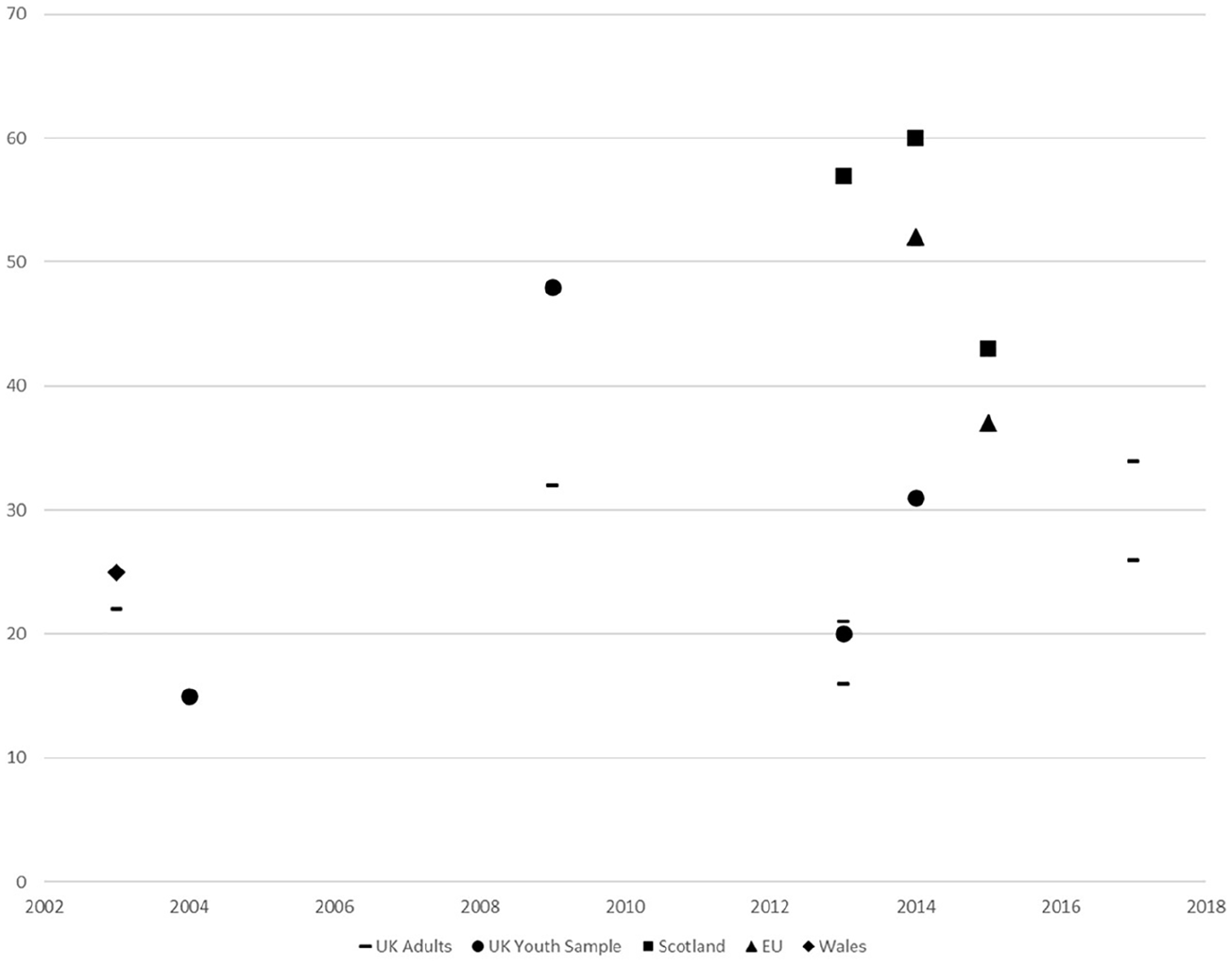
Percentage levels of support for lowering the voting age in the United Kingdom, 2003–17.
Initial surveys were linked to the increased political resonance of voting age reform as a measure for addressing the sharp decline in youth turnout at the 2001 election. The first survey, conducted by NOP in Wales in March 2003 for HTV Wales, saw nearly three-quarters of those polled (73%) oppose lowering the voting age. A survey commissioned by the Electoral Commission/ICM in November 2003, as part of their consideration of the voting age question, also saw only 22% of those polled support Votes-at-16. In both cases, opposition was strongest among older voters. It is noteworthy that a boost to the Electoral Commission survey sample of 234 young people aged 15–19 years also found a majority (54%) favoured the voting age remaining at 18. However, a further relevant survey conducted with over 2000 aged 11–18 years as part of Nestlé’s Family Monitor research series saw 60% of respondents support lowering voting age below 18.
There is then a gap in polling data on the voting age until the Labour government’s establishment of the Youth Citizenship Commission (YCC) in 2008 whose brief included a review of the voting age. This stimulated further surveys of public opinion. The Citizenship Foundation commissioned a survey in 2009 which indicated that less than one-third of 14- to 25-year-olds polled (31%) supported Votes-at-16. However, in the same year, a YCC-commissioned survey of 1114 young people aged between 11 and 25 revealed a slight plurality (by 3%) in favour of lowering the voting age to 16. In both surveys, age once again had an impact on public attitudes. While most participants aged between 11 and 18 years favoured lowering the voting age to 16, those aged between 19 and 25 years were opposed.
The decision to lower the voting age for the 2014 Scottish independence referendum stimulated more frequent polling of public opinion, which indicated a strengthening of views on the issue. In 2012, a YouGov survey of Scottish voters over the age of 18 saw 36% of respondents express support for the decision to allow 16- to 17-year-olds vote in the independence referendum (and 35% support the universal lowering across the United Kingdom). Public support for Votes-at-16 grew in Scotland during the 2014 campaign, with an Electoral Commission/ICM (2014: 65) survey undertaken after the referendum indicating that 60% supported its universal adoption. The extent to which Scottish voters supported lowering the voting age was however strongly influenced by their views on the independence question, with ‘Yes’ voters twice as likely to support the measure than their ‘No’ voting counterparts.
Public support for Votes-at-16 across the rest of the United Kingdom also observed a trend of increased, if variable, backing for lowering the voting age, rising from around 20% to between 30% and 40% (depending on how the question was asked). This suggests that the Scottish referendum significantly increased the saliency of Votes-at-16 as a wider issue in British politics. The lead-up to the 2016 EU referendum stimulated further discussion of ‘Votes at 16’. However, the refusal of the UK government to countenance its introduction ensured that the limited survey work undertaken focused on the attitudes of 16- to 17-year-olds regarding EU membership rather than public opinion on voting age reform (Renwick and McCay, 2015).
Public opinion featured in evidence-gathering by the Welsh Assembly in considering whether the voting age should be lowered to 16 for local and national elections. In 2015, it held a consultation which, though not designed as a methodologically robust statistical exercise, saw over 10,000 young people from across Wales aged 11–25 years participate, with 53% supporting lowering the voting age. An Expert Panel, formed in 2017 to undertake a review of evidence, noted in its final report that public opinion had consistently shown ‘limited support for a reduction’, but that it was an issue of low salience which may well change over time (McAllister et al., 2017: 195). A further consultative and not necessarily representative survey held in 2018 saw 60% of those who responded support Votes-at-16. It would thus appear that the decision to lower the voting age in Wales is following a familiar path to that in Scotland, with public opinion slowly shifting in line with the implementation of voting age reform. It was less clear, however, whether voting age reform in Scotland and Wales had impacted public opinion concerning lowering the voting age for Westminster elections. The next part of this article seeks to engage with this proposition by analysing polling undertaken as part of the Leverhulme Trust–funded ‘Lowering the Voting Age in the UK’ project (2018–2020).
Analysis
Data and methodology
To investigate the levels of support for Votes-at-16 among both the enfranchised electorate and young people, we commissioned two surveys from Survation. The first was a standard representative cross-section of the population aged 18 or over drawn from Survation’s online panel. The second was drawn from Survation’s special online panel of 16- to 17-year-olds. This allows us to compare levels and sources of support for Votes-at-16 among the electorate with that of the intended beneficiaries of the policy – a survey approach not previously applied. The surveys were administered online and fielded between 10 and 22 October 2018. The over-18s population survey had a final n of 1009 and the 16- to 17-year-old survey had an n of 1031. Results were weighted on key demographic variables and questions related to vote choice by Survation to take account of differential response rates from the panel participants. See Tables A1 (16- and 17-year-old sample) and A2 (electorate Sample) for full details of the demographic breakdown of the samples (both weighted and unweighted).
The sample of over-18s was a generally accurate representation of the electorate with a slight over-representation of female respondents and an under-representation of over 65s and retired people. The targets for the weights were derived from Office for National Statistics Census Data and the results of the 2017 UK general election. While the under-representation of older respondents has long been acknowledged as a feature of Internet panel surveys, we do recognise that this slightly biases our adult sample in the direction of those groups who we would expect to be more supportive of voting age reform (Sturgis et al., 2016). For the sample of 16- to 17-year-olds, data were weighted to the profile of all adults in the United Kingdom aged 16–17 years by age, sex and region derived from Office for National Statistics Census Data. As previously noted, levels of support for lowering the voting age are sensitive to differences of question wording (Greenwood, 2019). With this in mind, we used the more neutral ‘oppose/support’ framing of the voting age question as the dependent variable in our surveys. This is more consistent with previous surveys and avoids potential endogeneity problems with other civic rights-based questions that featured in our survey questions.
Following Birch et al. (2014), we sought to capture the strength of feeling towards the voting age issue. Response options were thus aggregated on a Likert-type scale. 2 Standard demographic variables were included for age, gender, education, household income and employment. To these we also added UK region given the variation that now exists in voting age legislation in Scotland and Wales. The surveys also included a bank of standard political questions related to the respondent’s levels of political interest, political trust, turnout intention and party vote choice preferences. A series of questions were designed to probe respondent attitudes to some of the core arguments in the voting age debate, such as those associated with attitudes towards youth transitions to adulthood, rights and responsibilities, political literacy, and engagement. To assess the association between partisan advantage and support for lowering the voting age, we asked respondents which party they thought would most benefit from change.
To highlight key differences in the level and support for Votes-at-16 between the two surveys, we begin our analysis by comparing the key descriptive statistics and bivariate relationships, followed by the results of the multivariate analysis. Consistent with the previous analysis carried out by Birch et al. (2014), we have applied standard binomial logistic regression treating support for lowering the voting age as dichotomous. Similar (though not quite identical) models are applied to the analysis of both samples to assess and compare drivers for the support or opposition of lowering the voting age among over-18s than among 16- to 17-year-olds. We are aware of the substantial literature highlighting the challenges of comparing effect sizes in logistic regression models run on different samples (Hosmer et al., 1997; Mood, 2010). However, in this instance, we are not interested in comparing the absolute size of the effects. Our approach is primarily exploratory; we are interested in whether these effects achieve statistical significance in both samples. We believe that comparing these models is therefore valid.
Descriptive results
Our survey of 16- to 17-year-olds found a substantial majority (71%) in support of Votes-at-16, of whom 40% were strongly in favour. In contrast, only 12% were opposed to lowering the voting age to 16 (see Table 1). The more surprising finding is that we also found a narrow plurality (42%–38%) in support of voting age reform among those aged 18 or over. This is the first time that a representative survey of the UK electorate has shown evidence of majority support for lowering the voting age. Moreover, our survey used the more conservative framing of the voting age question, which has in past surveys garnered less support.
Comparing support for Votes-at-16 (%) among the survey sample of 16- to 17-year-olds with the 18+ electorate sample.
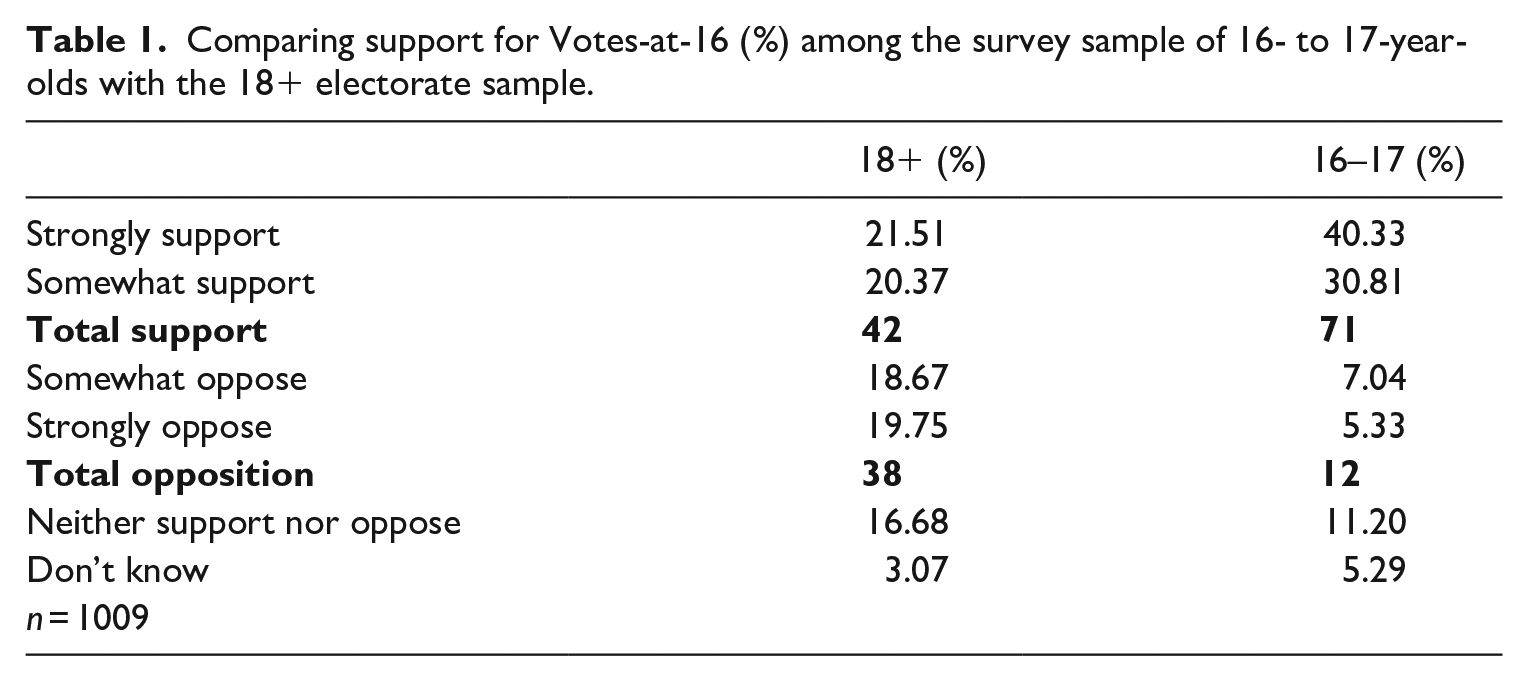
We treat this latter finding with a degree of scepticism, as online political surveys have tendencies towards oversampling groups among whom we would expect to be more sympathetic towards Votes-at-16 – such as younger and more politically engaged citizens (Sohlberg et al., 2017). This noted, our findings reflect recent trends in UK public opinion, which indicate an increase in support for Votes-at-16. To explore whether our findings are a product of a strengthening of public opinion on the issue in the wake of recent major electoral events or a product of our sampling strategy, in the next section, we explore our survey data in more depth.
Bivariate analysis
Figure 2 demonstrates how support for lowering the voting age varies according to key demographic indicators in both the representative sample of the electorate and the sample of 16- to 17-year-olds. As with previous surveys, there is a clear relationship between age and voting age attitudes, with younger respondents considerably more supportive than older ones. Contrary to Birch et al. (2014), our surveys find that support for Votes-at-16 by age follows a linear rather than curvilinear pattern. While Birch et al. (2014) found that support for Votes-at-16 peaked among voters in their 20s and early 30s, our survey finds a strikingly linear pattern across both surveys. Neither of our surveys finds significant variation in support for lowering the voting age by gender.
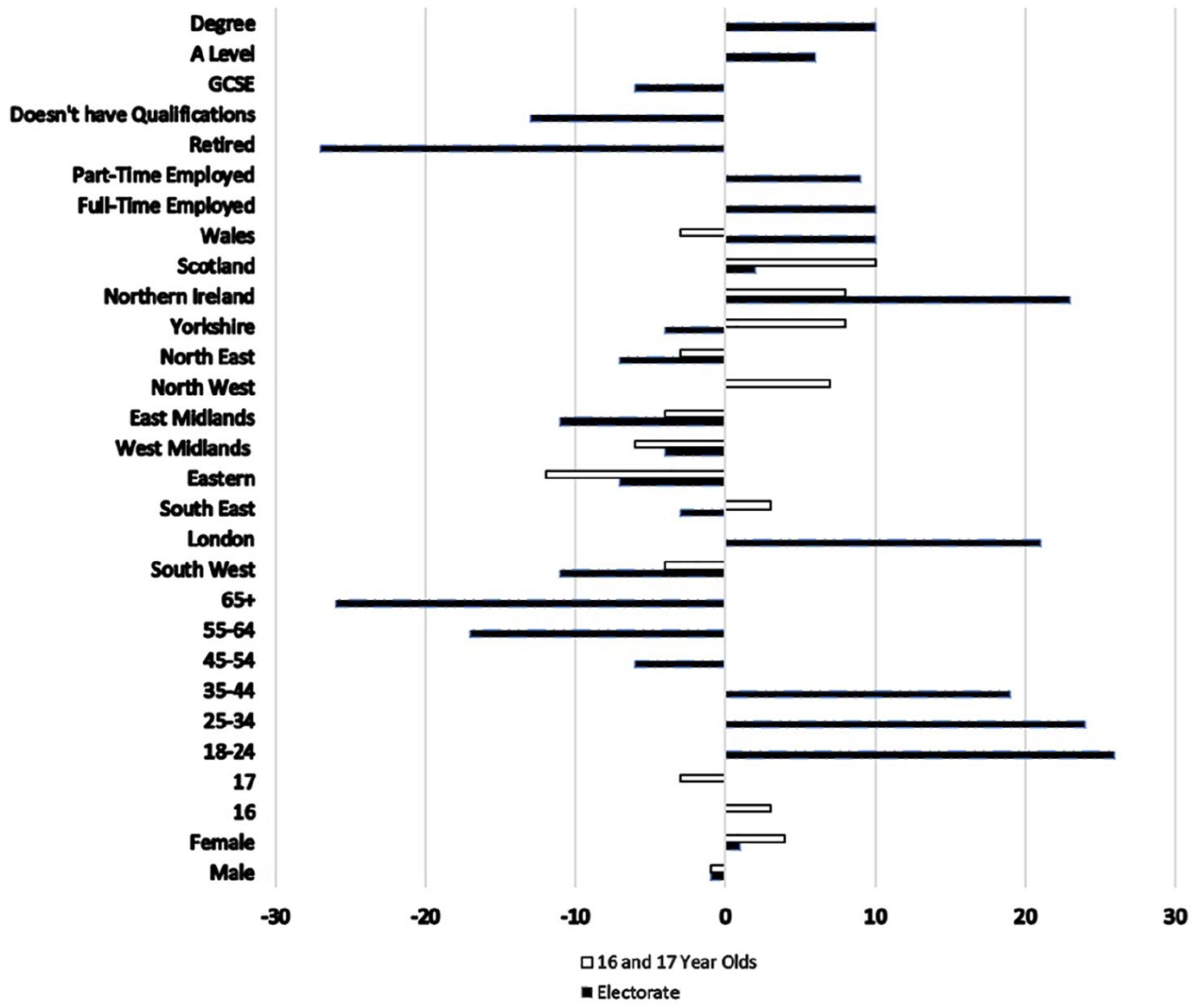
Percentage variation in support (compared with overall sample average) for lowering the voting age by demographic variables in both the 16- to 17-year-olds and 18+ electorate surveys.
There are interesting regional effects in the over-18s survey which might possibly indicate that the fallout from the Brexit referendum and its variation in voting according to age impacted upon public opinion. A second referendum was still a live issue during the period of our survey. As examples of regional variation, 25% more over-18s support Votes-at-16 in London than the national average, while there is significantly less support in the East Midlands (11% lower), the North East (7% lower) and the Eastern region (7% lower). 3 Surprisingly though, we found no evidence of greater support for Votes-at-16 in Scotland. There is increased support among those who are in full time (10% higher) and part-time (9% higher) work and, unsurprisingly, far less support among the retired (27% lower). There is also initial evidence of an education effect with the level of support rising among those with higher qualifications, with 13% less support among those with no qualifications to 10% more support among those with a degree although these differences are more moderate than might be expected relative to other factors.
In contrast, while we find no regional difference in the 16- to 17-year-old sample for London, we find a similar decrease in levels of support in the Eastern English region (8% lower), and near unanimous support for lowering the voting age among Scottish respondents. Overall, the descriptive findings from our surveys provide relatively convincing initial evidence that support for Votes-at-16 maps onto the demographic factors previously identified as underlying the ‘Cosmopolitan–Communitarian’ divide (Jennings and Stoker, 2017; Sloam and Henn, 2018).
However, as demonstrated in Figure 3, the strongest bivariate relationships we identify are attitudinal. Support for Votes-at-16 among the electorate sample is clearly differentiated by partisanship with 71% of Labour voters and 61% of Liberal Democrat voters supporting lowering the voting age compared with 26% of Conservative voters. This partisan divide is less pronounced among 16- to 17-year-olds, with Labour supporters showing only 6% higher support than the average with Conservative supporters being 6% lower than the average. This means that, while the variation in levels of support by partisan leanings is 45% within the electorate, it is only 12% among 16- to17-year-olds.
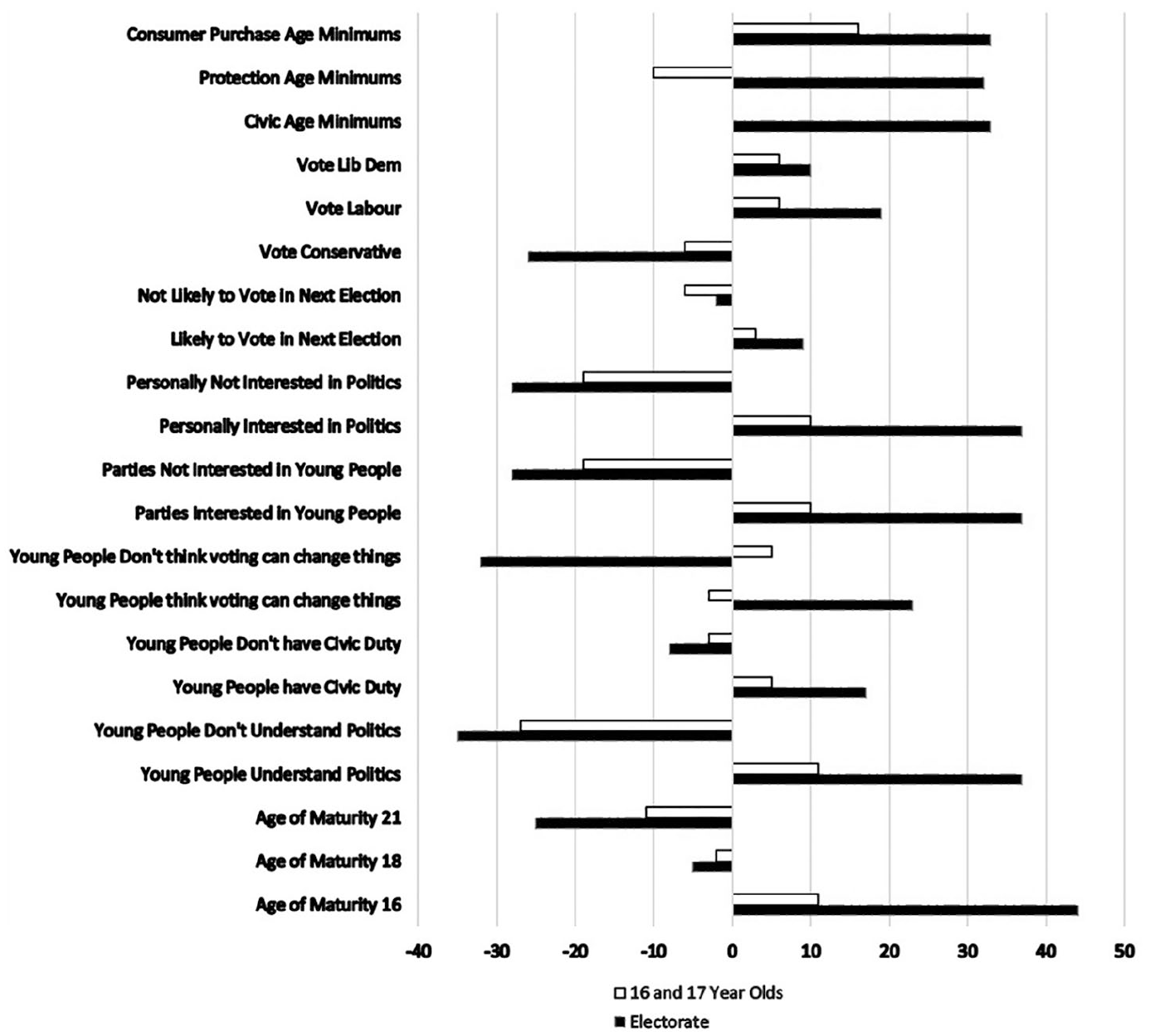
Percentage variation in support (compared with overall sample average) for lowering the voting age by attitudinal variables in both the 16- to 17-year-olds and 18+ electorate surveys.
Support for lowering the voting age also varies by levels of maturity and efficacy that respondents perceive young people to possess. Those in the over-18s sample who believed that young people understood politics (37% higher than the average), possessed civic duty (17% higher than the average) and thought voting could change things (23% higher than the average) were more much more likely to support lowering the voting age. Conversely, those with less faith in young people’s civic capacities offered some of the lowest levels of support. Within the sample of 16- to 17-year-olds, perceptions of young people’s level of political understanding made a significant difference, with those who doubted their peers’ political knowledge 27% less likely than average to support Votes-at-16.
With regards to other political characteristics, we found that intention to vote had little relation to support for Votes-at-16 in either survey. However, levels of personal political interest had one of the strongest relationships within the over-18s cohort, with support for those interested in politics 37% higher than the overall average, while support was 28% lower than the average among those not interested in politics. Crucially, this large differential in levels of support by political interest is also reflected in the sample of 16- to 17-year-olds, with almost unanimous support for lowering the voting age among the most politically interested, while support is 20% lower than the average among those not interested.
To explore how respondents linked the voting age with other minimum ages we asked several questions in the surveys. In both samples, those who thought 16 should be considered the age of maturity were, unsurprisingly, almost unanimous in support of Votes-at-16. Those who thought adulthood began at 21 were much less likely to support voting age reform. Interestingly, those favouring 18 as the age of maturity were only slightly less likely to support lowering the voting age than the sample average. This means that a significant number of respondents – including a majority of 16- to 17-year-olds – saw 18 as the age of adulthood but nevertheless favoured lowering the voting age to 16. This disaggregation of the age of adulthood from enfranchisement is significant as it indicates that sizable numbers reject a central objection of those opposed to Votes-at-16 – namely that 16- to 17-year-olds should not be given the vote as they are not considered ‘adults’.
To explore why support for lowering the voting age does not seem as directly connected to perceptions of the age of maturity as might be expected, we also examined respondent attitudes to other ages of responsibility. We identified three types of age minimums which are often used to frame the Votes-at-16 debate: civic and social rights (age of jury service, electoral candidacy and access to welfare benefits); protective rights (alcohol, gambling and military service); and autonomous rights (age of driving, mortgage and renting). We created three basic binary variables to measure respondents support for lowering any of the age-related rights in our samples. Respondents who selected any of the relevant minimums would be given a value = 1 for that type (‘civic’, ‘protective’ or ‘autonomous’), while those who selected none would be given a value = 0.
Figure 2 demonstrates there is an interesting difference in the way in which the over-18s and 16- to 17-year-old samples relate the age of enfranchisement to other age minimums. Among the over-18s sample, support for Votes-at-16 seems to be consistent with support for a recalibration of other ages of responsibility. For example, 85% of those who support Votes-at-16 also support lowering at least some other civic, protective or autonomous rights to 16. Within the 16- to 17-year-old sample, support for voting age reform is substantially higher among those who also want to lower other civic minimums (85%) when compared with those who support lowering protective (75%) or autonomous age minimums (69%). This represents substantial variation in levels of support for Votes-at-16 given the high levels of overall support in the 16- to 17-year-old sample, providing qualified evidence that young people are perceiving the voting age in terms of defining their civic rights rather than a marker of adulthood.
Logistic regression analysis
By running a binomial logistic regression, we were able assess the strength and nature of the relationship between these variables in predicting support for Votes-at-16 within both samples. Support for Votes-at-16 was treated as a binary dependent variable with support coded as 1 and all other values coded as 0. The model-building strategy adopted a block entry approach with four stages (three stages for the 16/17-year-old sample). The first stage represents the demographic variables including binary dummy variable for gender and having a household income above £50,000 as well as a series of categorical variables for housing status (reference category: private rent), highest qualification level (reference category: GCSE) and region (reference category: East of England). 4 One of the limitations of carrying out the survey at the individual, rather than household level, means that the number of demographic indicators for the 16- to 17-year-old sample are significantly lower and the data regarding type of home and income levels unreliable. As such, we experienced a majority of ‘don’t know’ responses. Therefore, in the model of the 16- to 17-year-old sample, age is included as a demographic variable in stage 1 of the model-building process (whereas, it is added as a final control and potential mediator in the fourth model of the electorate sample analysis).
The second model introduces the personal political attitudes with standard measures used for political trust (based on a 10-point scale from 0 = no trust at all to 10 = complete trust) and political interest (measured on a 5-point Likert-type scale from 0 = not at all interested to 5 = very Interested). We also include a series of binary dummy variables capturing vote choice in the 2017 General Election for the major UK parties (in the youth sample this is ‘support for’ rather than ‘vote’) and turnout (in the youth sample, this is a 10-point ‘likelihood to vote’ scale). The second model also introduces the ages of responsibility typology we created above to measure the effect of support for lowering civic, protective and autonomous rights minimums on attitudes to ‘Votes-at-16’. Each of these is coded as dummy variables. The third model introduces the variables related to perceived political competencies of young people. These are binary variables for whether respondents believe young people understand politics, have a sense of civic duty and believe that voting can produce change (efficacy assessment). Finally, there is a fourth and final stage for the Electorate sample as we introduce age and age2 into the model to see whether this has a moderating effect on the predictive strength of other variables in the model and to test whether the curvilinear relationship we observed in the bivariate analysis holds.
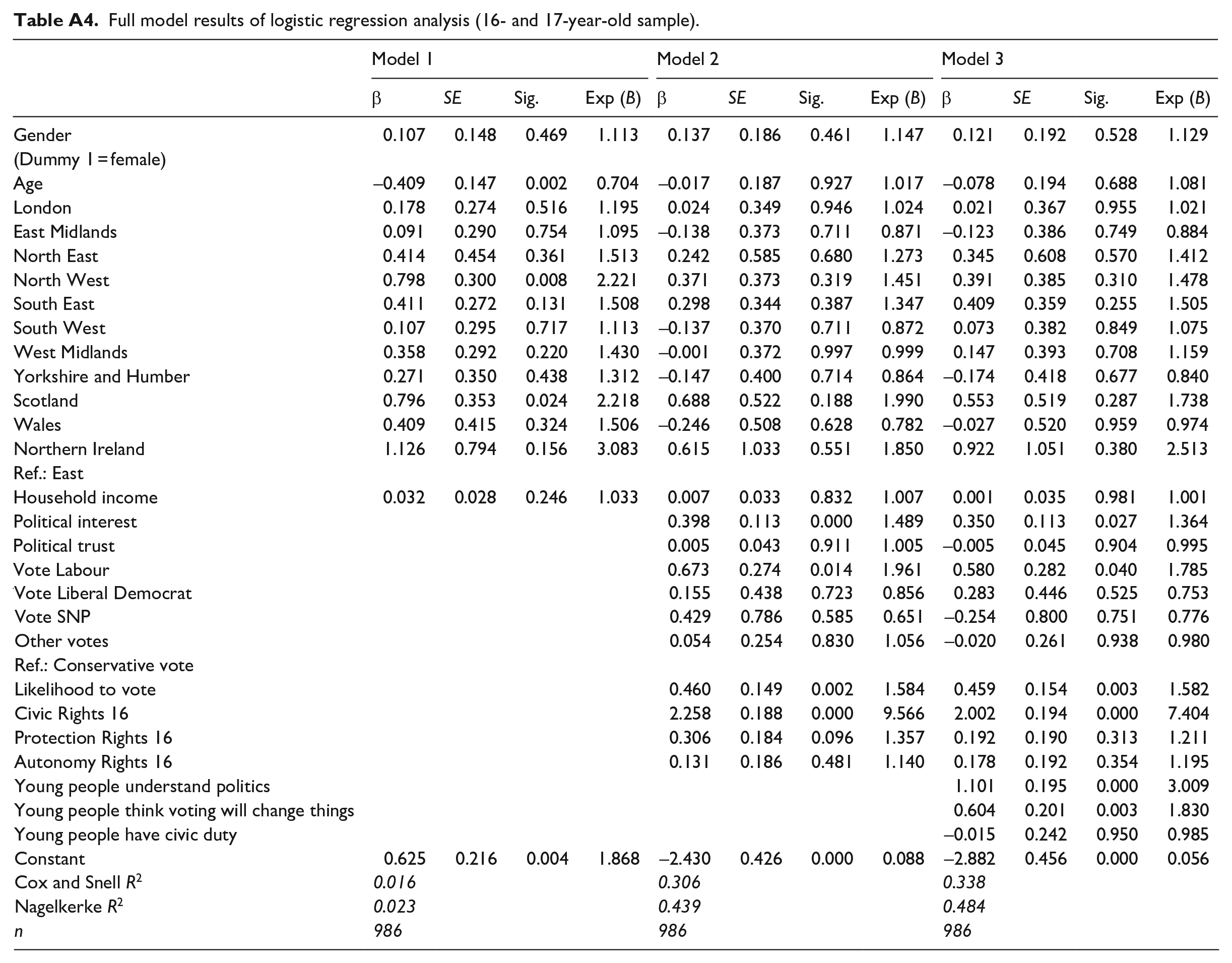
Tables 2 and 3 present the co-efficient results from the logistic regression analysis. These tables report the substantively relevant and statistically significant findings from the model (for the complete regression results please see Tables A3 and A4). Beginning with the over-18s sample, there are some interesting confounding influences in the demographic relationships. There is a strong initial positive effect on support for Votes-at-16 among those who live in London (1.213) and those with a higher level of household income (0.250). This is contrasted with a significant negative effect for home ownership (–0.374). The model-building process shows that this effect is a result of home ownership being a proxy for other factors in the model, as it ceases to be a significant predictor beyond the demographics only model. We also find that having a university degree has an initial positive effect on support for the voting age (0.396), but there is no effect for gender. The effects for living in London and having a degree become non-significant once the attitudinal variables are entered in the second and third models. So while the demographic model is consistent with the findings of Surridge (2016) on the influence of university education as a driver of liberal attitudes, this relationship ceases to hold and education overall has a surprisingly minor influence in our models with its effect dampened by other factors.
Binomial logistic regression models of support for lowering the voting age (18+ electorate sample).
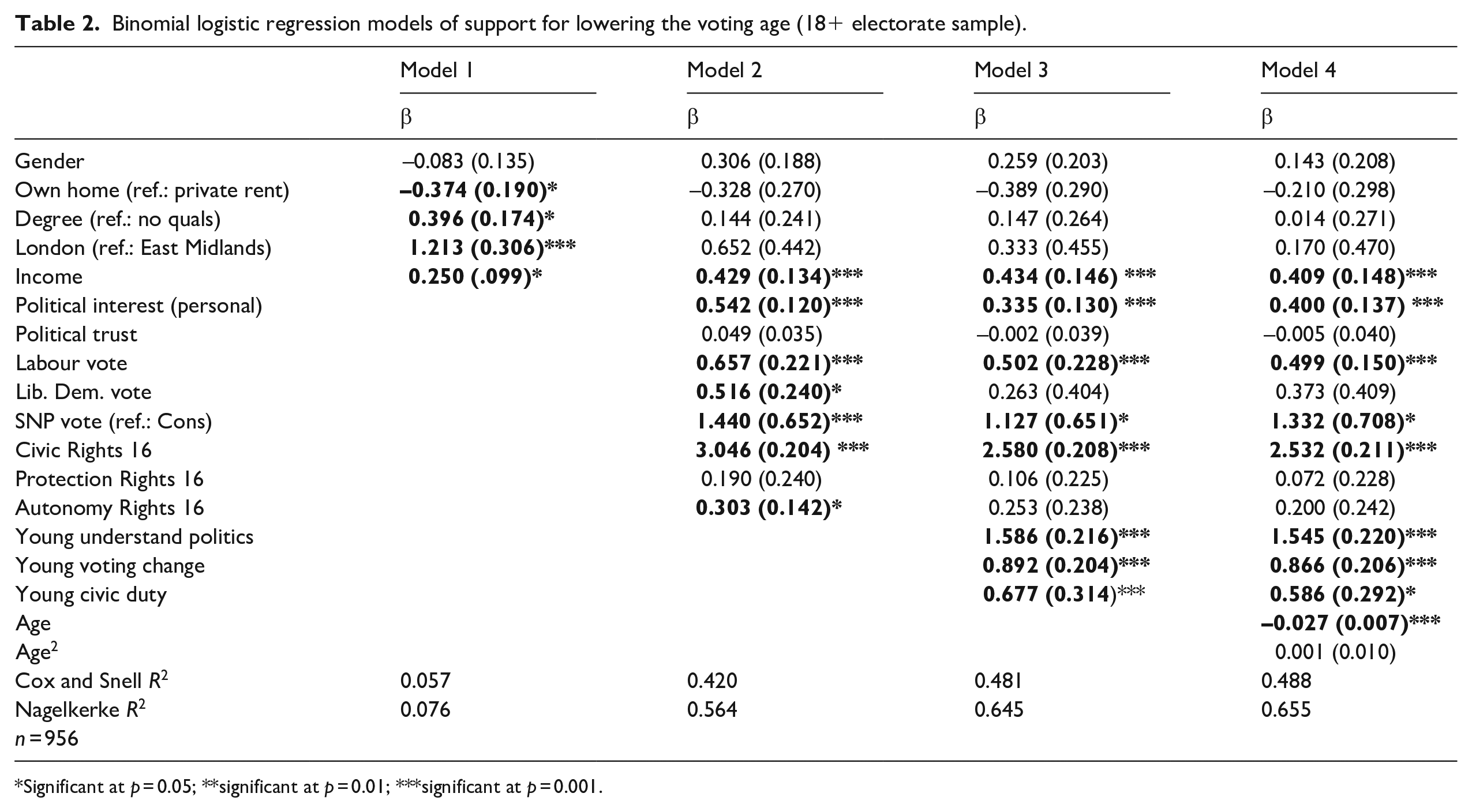
Significant at p = 0.05; **significant at p = 0.01; ***significant at p = 0.001.
Binomial logistic regression models of support for lowering the voting age (16- to 17-year-old sample).
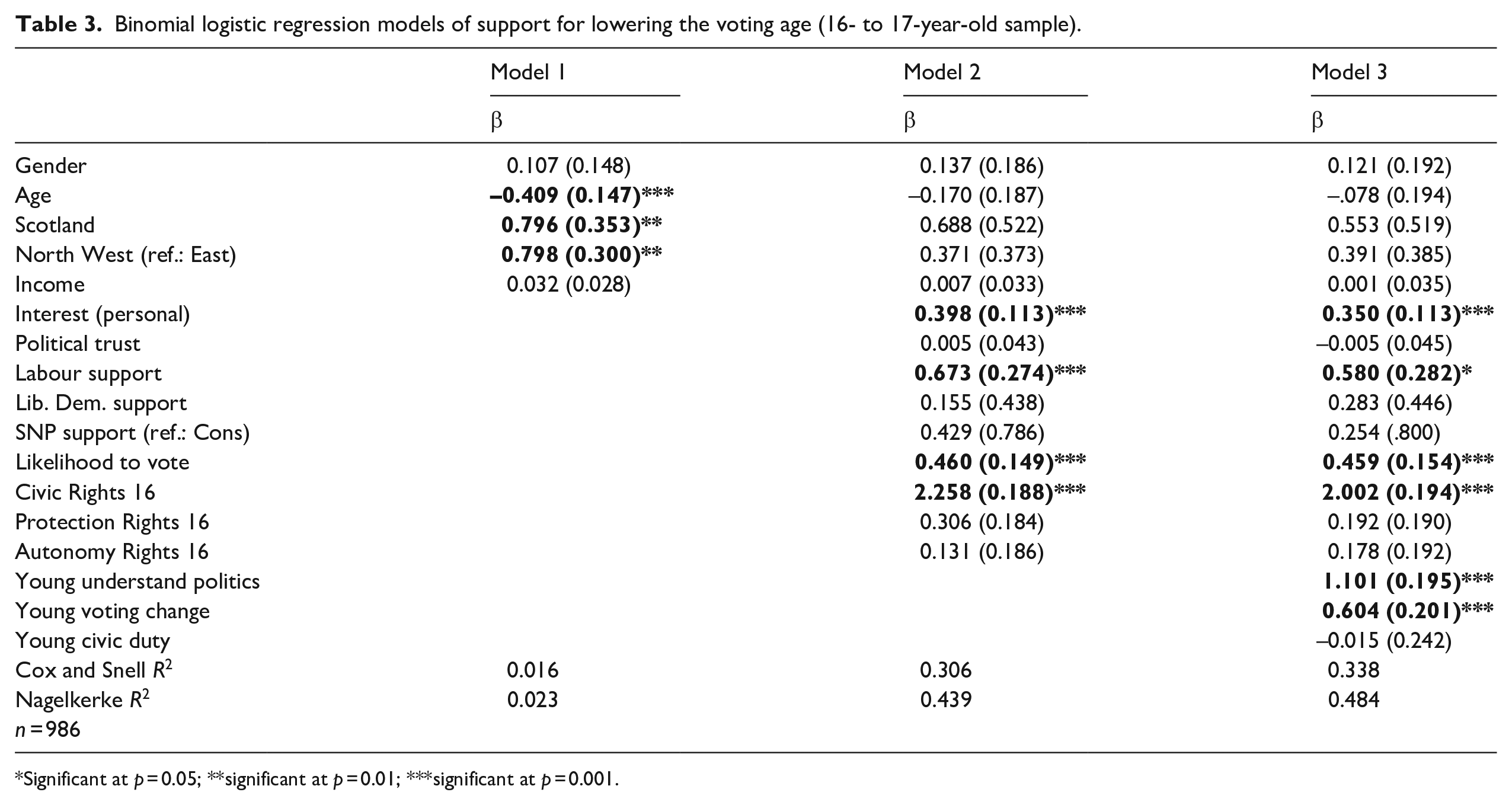
Significant at p = 0.05; **significant at p = 0.01; ***significant at p = 0.001.
The second and third models are critical for demonstrating that support for Votes-at-16 is primarily influenced by respondents’ own political attitudes and perception of young people’s level of political competence. Partisanship emerges as having the strongest and most robust association with support for lowering the voting age, with strong effects for Labour (0.657), Liberal Democrat (0.516) and SNP (1.440) support when added in the second model that, with the exception of the Liberal Democrat effect, are only partially mediated in the third and fourth models. Level of personal political interest also has a strong association with support for lowering the voting age (0.250) when added in second model and remains a strong robust effect in the third and fourth models.
Support for the lowering of ages of responsibility related to other civic rights has a strong effect in the models. We also identify support for lowering ages of autonomous rights as having a significant association with support for Votes-at-16 (0.303) in the second model, but not for protection minimums, although this effect disappears in Models 3 and 4. The introduction of the attitudinal measures sees the predictive power of the model jump from an R2 of 0.057 in Model 1 to 0.420 in Model 2 (using the more conservative Cox and Snell R2 measure). There are also strong positive significant effects for perceptions of young people’s sense of efficacy (0.892) and levels of political understanding (1.585) that are introduced in the third model. These attitudinal effects are not simply a proxy for intergenerational divisions as they remain significant once age is introduced in the final model. The effect of the standard age variable is negative and significant (–0.027), while the age2 variable is non-significant showing there is no evidence of a curvilinear relationship. This provides confirmation of the bivariate findings that support for Votes-at-16 declines according to age. Overall, the analysis therefore supports our hypothesis that contemporary attitudes to Votes-at-16 among the electorate are strongly shaped by partisan political affiliations.
There are also interesting contrasts in the drivers of support within the 16- to 17-year-old sample. Rising age has a strong negative impact on the level of support for Votes-at-16 (–0.409) and although it ceases to be significant once other factors are added to the model. However, it still provides evidence that even among 16- to 17-year-olds, there is an age effect, with 17-year-olds being significantly less likely to support lowering the voting age than 16-year-olds (controlling for other demographic factors). This adds further evidence that contemporary support for lowering the voting age has a linear relationship to age.
There are also interesting regional effects in the demographic Model 1 for the 16- to 17-year-olds with those in Scotland (0.796) and the North West (0.798) being significantly more likely to be supportive of Votes-at-16 but, surprisingly, there is no effect for this living in London and the regional effects cease to be significant once the attitudinal indicators are entered into the models. As with the over-18s sample, political interest has a consistent positive effect on support for Votes-at-16 (0.398) when introduced in model two and remains a strong predictor in Model 3. Likelihood to vote also has a consistent positive significant effect on support for Votes-at-16 among 16- to 17-year-olds. Support for Labour has a significant association with support for Votes-at-16 (0.460) and which remains in Model 3. The lack of effect for Liberal Democrat and SNP partisanship is likely explained by the low number of supporters in the sample compared with Labour and the Conservatives.
When the variables for perception of young people’s level of political competence are introduced in the third model, young people’s level of political understanding (1.101) has a strong positive effect on support for voting age reform, with perceptions of efficacy (0.604) also having a smaller positive effect. However, perception of civic duty among their peers has no effect on support. The third and fourth models provide further support that young people perceive age-related maturity in a more nuanced way to the electorate. Drawing on our 3-point typology, only support for lowering of other civic age minimums predicts positive support for lowering the voting age (2.258). It suggests that young people classify the age of enfranchisement as a civic right which is distinct from other protective and autonomous age minimums. This contrasts with the adult population who have a more universal view of age minimums which is linked to conceptions of adulthood. Overall, while partisanship is clearly an influential factor in support for voting age reform among 16- to 17-year-olds, perceptions of political efficacy and interest emerge as even more relevant drivers than in the sample of the electorate. 5
Discussion and conclusion: Partisan public opinion and Votes-at-16
This article highlights that the drivers and growing strength of support or opposition to lowering the voting age are consistent with contemporary partisan political divisions in UK politics, and other liberal democracies where debates about lowering the voting age to 16 resonate (see Eichhorn and Bergh, 2020). It has been previously argued that public opinion was of only marginal relevance to voting age reform in the United Kingdom, which had proven a largely elite-driven process that the electorate appeared apathetic towards (Birch et al., 2014; Cowley and Denver, 2004). Part of the explanation for the marginal role of public opinion in debates about Votes-at-16 is that, until now, advocates have been unable to point to evidence showing support for the policy among the electorate. Conversely, opponents, have been faced by a growing body of evidence showing that young people support Votes-at-16. Public apathy on the issue in the past undoubtedly benefited Votes-at-16 advocates due to the more strident and dynamic nature of their activism.
Such assumptions were less contentious in the period before the 2014 Scottish independence referendum. However, the effect of the partial introduction of Votes-at-16 in Scotland and Wales, together with the political and cultural divisions associated with the 2016 EU referendum and the growing resonance of a ‘politics of age’, have seen voting age reform become a more salient, politicised and polarised issue. As parties have taken clearer stances on Votes-at-16 and as the age of a voter has become a key variable in party choice, so attitudes towards voting age reform has become an issue in which party support is highly salient.
This article concludes that the issue of voting age reform provides qualified additional evidence supporting the thesis that an age-related cosmopolitan–communitarian divide is reshaping public opinion (Jennings and Stoker, 2017; Sloam and Henn, 2018). It also suggests a deepening political partisanship on the issue. Subsequent studies of public opinion appear to confirm our overarching thesis. For example, a British Social Attitudes (2019) survey demonstrated the age-related linear patterns on some issues and strengthening partisan trends we observe. A UK-wide survey of public opinion regarding the implementation of Votes-at-16 in Wales shows a shift in the support of the over-18 population, with 42% in favour and 35% against (Redfield & Wilton Strategies, 2020).
Our analysis does not provide a test of directionality, and it is plausible a two-way causal relationship exists between partisanship and support for Votes-at-16. However, the evidence from our surveys that public opinion is strengthening and increasingly polarised appears linked to concerted efforts to further politicise the issue. An unsuccessful attempt at Westminster to enfranchise 16- and 17-year-olds for the 2019 UK general election led one Conservative MP to declare his party would fight such a voting age reduction ‘tooth and nail’ (McGrath, 2019). Moreover, Boris Johnson, elected UK Prime Minister in December 2019, has publicly stated his opposition to Votes-at-16 at Westminster. This means that although reform of the voting age for UK elections is currently highly unlikely, debate about the issue is likely to further divide political and public opinion.
This noted, advocates of lowering the voting age can take heart from the substantial support shown for Votes-at-16 in our youth sample and from the mounting evidence of an increase in support among the electorate. It is striking, however, that our analysis shows that support is especially high among those already politically interested, university-educated, and from higher socio-economic backgrounds and those with more positive views of young people’s capacities to understand politics and influence change. We found less support for lowering the voting age amid those from lower income backgrounds holding few qualifications. These relationships demonstrate that Votes-at-16 is a policy that is primarily popular with those who already have a positive view of the efficacy and capacity of young people. Change might also risk empowering mainly the already advantaged without support for those who feel marginalised by electoral politics and less confident about participating in the political process. Voting age reform would be usefully accompanied by delivery of statutory democratic or political education, better engagement from political parties, and improved processes around registration. It is interesting that education level had such a surprisingly minor influence in our multivariate analysis. This is a finding that should be treated with caution, given the substantial evidence of strong education effects elsewhere in the literature especially as it cannot be plausibly accounted for by the mediation effect of age. However, it does appear that views of young people’s efficacy and competency may be more important than educational effects on the voting age issue at least.
Finally, our findings also demonstrate that young people’s perceptions of the voting age debate may have different parameters to those often expressed by advocates and opponents. We show that, in contrast to adult supporters of lowering the voting age, the youth sample did not associate voting rights with perceptions of adulthood or young people’s sense of civic duty. This finding challenges the traditional parameters of the debate which are usually determined by disagreements about when adulthood begins, with voting assumed to be an ‘adult act’. The overall strength of the variables related to young people’s political efficacy in our models is consistent with arguments for voting age reform based on the capacity to raise young people’s level of social capital during critical periods of political socialisation (see also Eichhorn, 2017; Neundorf and Smets, 2017). Our evidence shows that young people clearly have a nuanced conception of transitions to adulthood and the acquisition of voting rights as part of this journey. Protagonists of the voting age debate should therefore move on from the stale and circular arguments about ‘maturity’ which appear to have little relevance to young people themselves.
Footnotes
Appendix 1
Full model results of logistic regression analysis (16- and 17-year-old sample).
| Model 1 |
Model 2 |
Model 3 |
||||||||||
|---|---|---|---|---|---|---|---|---|---|---|---|---|
| β | SE | Sig. | Exp (B) | β | SE | Sig. | Exp (B) | β | SE | Sig. | Exp (B) | |
| Gender | 0.107 | 0.148 | 0.469 | 1.113 | 0.137 | 0.186 | 0.461 | 1.147 | 0.121 | 0.192 | 0.528 | 1.129 |
| (Dummy 1 = female) | ||||||||||||
| Age | −0.409 | 0.147 | 0.002 | 0.704 | −0.017 | 0.187 | 0.927 | 1.017 | −0.078 | 0.194 | 0.688 | 1.081 |
| London | 0.178 | 0.274 | 0.516 | 1.195 | 0.024 | 0.349 | 0.946 | 1.024 | 0.021 | 0.367 | 0.955 | 1.021 |
| East Midlands | 0.091 | 0.290 | 0.754 | 1.095 | −0.138 | 0.373 | 0.711 | 0.871 | −0.123 | 0.386 | 0.749 | 0.884 |
| North East | 0.414 | 0.454 | 0.361 | 1.513 | 0.242 | 0.585 | 0.680 | 1.273 | 0.345 | 0.608 | 0.570 | 1.412 |
| North West | 0.798 | 0.300 | 0.008 | 2.221 | 0.371 | 0.373 | 0.319 | 1.451 | 0.391 | 0.385 | 0.310 | 1.478 |
| South East | 0.411 | 0.272 | 0.131 | 1.508 | 0.298 | 0.344 | 0.387 | 1.347 | 0.409 | 0.359 | 0.255 | 1.505 |
| South West | 0.107 | 0.295 | 0.717 | 1.113 | −0.137 | 0.370 | 0.711 | 0.872 | 0.073 | 0.382 | 0.849 | 1.075 |
| West Midlands | 0.358 | 0.292 | 0.220 | 1.430 | −0.001 | 0.372 | 0.997 | 0.999 | 0.147 | 0.393 | 0.708 | 1.159 |
| Yorkshire and Humber | 0.271 | 0.350 | 0.438 | 1.312 | −0.147 | 0.400 | 0.714 | 0.864 | −0.174 | 0.418 | 0.677 | 0.840 |
| Scotland | 0.796 | 0.353 | 0.024 | 2.218 | 0.688 | 0.522 | 0.188 | 1.990 | 0.553 | 0.519 | 0.287 | 1.738 |
| Wales | 0.409 | 0.415 | 0.324 | 1.506 | −0.246 | 0.508 | 0.628 | 0.782 | −0.027 | 0.520 | 0.959 | 0.974 |
| Northern Ireland | 1.126 | 0.794 | 0.156 | 3.083 | 0.615 | 1.033 | 0.551 | 1.850 | 0.922 | 1.051 | 0.380 | 2.513 |
| Ref.: East | ||||||||||||
| Household income | 0.032 | 0.028 | 0.246 | 1.033 | 0.007 | 0.033 | 0.832 | 1.007 | 0.001 | 0.035 | 0.981 | 1.001 |
| Political interest | 0.398 | 0.113 | 0.000 | 1.489 | 0.350 | 0.113 | 0.027 | 1.364 | ||||
| Political trust | 0.005 | 0.043 | 0.911 | 1.005 | −0.005 | 0.045 | 0.904 | 0.995 | ||||
| Vote Labour | 0.673 | 0.274 | 0.014 | 1.961 | 0.580 | 0.282 | 0.040 | 1.785 | ||||
| Vote Liberal Democrat | 0.155 | 0.438 | 0.723 | 0.856 | 0.283 | 0.446 | 0.525 | 0.753 | ||||
| Vote SNP | 0.429 | 0.786 | 0.585 | 0.651 | −0.254 | 0.800 | 0.751 | 0.776 | ||||
| Other votes | 0.054 | 0.254 | 0.830 | 1.056 | −0.020 | 0.261 | 0.938 | 0.980 | ||||
| Ref.: Conservative vote | ||||||||||||
| Likelihood to vote | 0.460 | 0.149 | 0.002 | 1.584 | 0.459 | 0.154 | 0.003 | 1.582 | ||||
| Civic Rights 16 | 2.258 | 0.188 | 0.000 | 9.566 | 2.002 | 0.194 | 0.000 | 7.404 | ||||
| Protection Rights 16 | 0.306 | 0.184 | 0.096 | 1.357 | 0.192 | 0.190 | 0.313 | 1.211 | ||||
| Autonomy Rights 16 | 0.131 | 0.186 | 0.481 | 1.140 | 0.178 | 0.192 | 0.354 | 1.195 | ||||
| Young people understand politics | 1.101 | 0.195 | 0.000 | 3.009 | ||||||||
| Young people think voting will change things | 0.604 | 0.201 | 0.003 | 1.830 | ||||||||
| Young people have civic duty | −0.015 | 0.242 | 0.950 | 0.985 | ||||||||
| Constant | 0.625 | 0.216 | 0.004 | 1.868 | −2.430 | 0.426 | 0.000 | 0.088 | −2.882 | 0.456 | 0.000 | 0.056 |
| Cox and Snell R2 | 0.016 | 0.306 | 0.338 | |||||||||
| Nagelkerke R2 | 0.023 | 0.439 | 0.484 | |||||||||
| n | 986 | 986 | 986 | |||||||||
Authors’ note
The authors confirm that this is original work which has not been submitted to any other journal.
Funding
The author(s) disclosed receipt of the following financial support for the research, authorship, and/or publication of this article: The authors acknowledge with thanks the financial support from the Leverhulme Trust, Research Project Grant RPG 2017-332, ‘An Analysis of Historical and Contemporary Debates on the Voting Age’, for the research undertaken for this article.
