




Abstract
Technocratic cabinets and expert, non-political ministers appointed in otherwise partisan cabinets have become a common reality in recent decades in young and older democracies, but we know little about how citizens see this change and what values, perceptions and experiences drive their attitudes towards technocratic government. The article explores the latter topic by drawing on recent comparative survey data from nine countries, both young and consolidated democracies from Europe and Latin America. Two individual-level characteristics trigger particularly strong support for the replacement of politicians with experts: low political efficacy and authoritarian values. They are complemented by a third, somewhat weaker factor: corruption perception. At the macro level, technocracy appeals to citizens of countries where the quality of democracy is deficient and where technocratic cabinets are a part of historical legacy. Surprisingly, civic activism and, partially, satisfaction with democracy enhance technocratic orientation, indicating such attitudes are not expressions of alienation or depoliticisation.
Introduction
Technocratic cabinets and independent, expert, ministers appointed to otherwise partisan cabinets, have become more frequent in recent decades in Europe and Latin America, in both young and old democracies (Pinto et al., 2018: 7; Wratil and Pastorella, 2018). In the aftermath of the global financial crisis, several countries showed their commitment to sound fiscal policies by appointing technocratic ministers or full technocratic cabinets, trying to regain the confidence of financial markets (Alexiadou, 2018). Although political parties are still the central actors of political representation (Enyedi, 2014), the weakening of legislatures and the growing relevance of the executive branch increases further the distance between the citizens and the actual decisions. In Europe, these developments are further amplified by the bureaucratic–technocratic tendencies characterising the European Union (EU; Habermas, 2015).
The debates about the normative dangers and opportunities at stake polarise analysts (Fischer, 1990; Schudson, 2006), but we know relatively little of how citizens think about this matter. We know even less about what individual values, social characteristics, perceptions and what country-level features structure the citizens’ attitudes.
Drawing on recent comparative survey data from nine countries, both young and consolidated democracies from Europe and Latin America, this article shows that low political efficacy and authoritarian values play a major role in explaining why some citizens support the idea of replacing partisan ministers with government by non-political experts. In addition, perceptions of corruption as one of the most important societal problems also increase the support for technocratic rule. At a macro level, positive attitudes towards technocracy are more common in countries with an authoritarian past and in countries that experimented more with technocrat-led or full technocratic cabinets (McDonnell and Valbruzzi, 2014). Signs of social anomie, like lack of participation or education, are not among the factors behind such attitudes, contrary to various theoretical expectations.
We build and expand on recent research, which investigated the drivers of citizens’ attitudes towards technocracy. According to the pioneering study of Bertsou and Pastorella (2017), the idea of a technocratic mode of governance is popular among the politically less involved and younger citizens, who are sceptical about democracy and who distrust representative institutions. At the country level, they find weak effects concerning economic development and corruption, stronger effects stemming from Communist legacy, but no influence of past technocratic governments.
Overall, these findings cast a dark shadow over technocratic attitudes, showing them to be part of an anti-democratic orientation. A more recent study qualifies this picture. Bertsou and Caramani (2020) showed, based on survey data from nine European countries, that pro-technocracy citizens are more educated and more urban than those who subscribe to either the principles of party democracy or of populism. Furthermore, they are more interested in politics, have higher political trust and are less attracted by ideological extremes than the populists, although they are less trusting and somewhat less politically involved than the supporters of traditional party democracy.
Citizens’ preferences for expert decision-making were also explored in the context of the ‘stealth democracy’ literature, but this research lacked an empirical comparative dimension, as it invariably adopted a country case study design (Bengtsson and Mattila, 2009; Coffé and Michels, 2014; Font et al., 2015; Hibbing and Theiss-Morse, 2002; Lavezzolo and Ramiro, 2018; Webb, 2013). According to this body of work initiated by Hibbing and Theiss-Morse, (American) citizens would prefer to be even less involved in politics than they currently are, provided that decisions are made in an efficient, non-partisan manner by neutral decision-makers who are not influenced by special interests. Such independence would result either from technical expertise or from a successful business record. Thus, the replacement of elected politicians with their propensity to simultaneously fight needlessly and compromise on essential principles would allow a more efficient identification of solutions for the general welfare.
The stealth democracy studies conducted in Western European countries such as Finland (Bengtsson and Mattila, 2009), Netherlands (Coffé and Michels, 2014) and the United Kingdom (Webb, 2013) revealed that lower educated citizens and those lacking political efficacy are more like to favour this alternative form of decision-making.
In terms of empirical strategy, the current article goes beyond the stealth democracy literature by presenting systematic comparisons of national samples and it goes beyond the studies done on technocratic attitudes by including non-European cases. We rely on comparative survey data from nine countries, which differ greatly on their degree of democratic consolidation, experience with technocracy and citizen disaffection with mainstream politics. Similar to Bertsou and Pastorella (2017), we explain attitudes by both individual- and country-level factors, but contrary to their article, we focus on the role of efficacy, authoritarian values and of individual perceptions of corruption.
The introduction is followed by a presentation of the main arguments and theoretical expectations. The next section presents the research design: the data, case selection and variable operationalisation. We then briefly discuss the countries’ experience with non-political ministers and technocrat-led cabinets. The empirical section presents the findings of our multivariate regression models, ran separately on the pooled sample and on the country samples. The conclusion synthesises the main findings and points to further directions of research.
Theoretical expectations
From the point of view of ordinary citizens, modern democracy is an inherently ambivalent construct. On one hand, it is based on freedom, that is, freedom to speak, organise, vote and run for office, something that is almost universally cherished. On the other hand, it is also based on the rivalry and conflict of partial interests and biased worldviews represented by parties, something that is almost consensually disliked. Political parties themselves are typically accepted as necessary, but the reputation of parties and of partisan politicians could hardly be lower. If one compares the prestige of various politically relevant institutions and professions, the ranking is always led by non-partisan actors, such as military, police, Constitutional Courts and so on. The closer the association between an institution and the parties, the less prestige it commands.
And yet, modern democracies are almost invariably based on party government in the sense that elections are organised around parties. The tension that follows from this paradoxical situation is tackled in various ways around the globe. In some countries, newly emerging organisations that compete for electoral victory eschew the party label. In Europe, Podemos and Five Star Movement are the most prominent examples of this trend. In other cases, the focus shifts from the party to the individual, as it happened recently in the cases of Emmanuel Macron or Donald Trump. In presidential systems the important role of personalities is, to some extent, a given, but even in such systems there is variation between more partisan-oriented presidents, like Jacques Chirac or Ronald Reagan, and personalistic leaders like Alberto Fujimori or Velasco Ibarra.
One of the most general mechanisms used to overcome the trust gap is to depoliticise, or at least make less partisan, certain aspects of the government. The establishment of semi-independent regulatory agencies, the delegation of decisions to expert bodies, the dispersion of political authority to regional and sectoral representatives, the integration of interest groups into the complex systems of governance, all point to this direction (Mair, 2008, 2013; Shapiro, 2004). The clearest and most extreme form of negation of parties is the technocratic government: a cabinet constituted of non-partisan experts. The growing presence of such cabinets is undeniable.
Some observers consider the demand for nonpoliticised, expert decision-making democratically legitimate and a natural part of modern governance (Bersch, 2016), while others rather focus on its tensions with democracy (Centeno, 1993; Hopkin, 2012; Skelton, 2011; Stiglitz, 2003). This second perspective views technocratic preferences as signs of a political anomie, and technocratic governments as symptoms of failing party democracy and of loosened party–voter linkages (Pastorella, 2016). The fact that such cabinets are more frequent in systems characterised by poor economic performance and low political trust (Brunclík and Parízek, 2019), is in line with the second perspective. Most technocratic governments are appointed in times of crisis, often following economic recessions and political scandals, to compensate for the legitimacy deficit of traditional representative bodies and processes (Rosanvallon, 2011; Wratil and Pastorella, 2018, as quoted in Pastorella, 2016; see also the review of Brunclik, 2015). This origin should make them particularly appealing to citizens disaffected with politics. Indeed, comparative research has illustrated that when citizens feel that their opinions and actions cannot make a difference in politics, and if politicians do not care about their needs and views, then they tend to disapprove of the government (Hibbing and Theiss-Morse, 2002: 68) and are more likely to embrace alternatives to classic parliamentary democracy arrangements.
Following this line of argument, we hypothesise that low levels of political efficacy are likely to increase the appeal of technocratic governments. This expectation is in line with those studies that found political efficacy as one of the main drivers of preference for stealth democracy (Bengtsson and Mattila, 2009; Coffé and Michels, 2014; Webb, 2013).
H1. Citizens who display low levels of political efficacy will be more favourable to government by experts.
Although technocratic orientation implicitly or explicitly denies the relevance of ideological debates, and therefore it should be equally (un)attractive to the various ideological camps, we expect right-wing citizens to be more favourably disposed to it. Leftist orientation is typically associated with an emphasis on the direct political involvement of citizens (Bengtsson and Mattila, 2009). The historical overlap between technocracy neoliberal reforms provides further reason for an ideological asymmetry (Centeno and Silva, 1998: 4–6). Indeed, previous studies have shown right-wing voters to support a more technocratic government (Bertsou and Caramani, 2020; Bertsou and Pastorella, 2017) as well as stealth democracy (Bengtsson and Mattila, 2009). Survey data indicate that in Spain the acceptance of stealth democracy is positively related to the support for Ciudadanos, the centre–right party, and negatively related to voting for the radical-left Podemos (Lavezzolo and Ramiro, 2018). Whether this logic should apply to new democracies as well, is far from obvious, but in general we expect an association between left–right self-placement and technocratic attitudes.
H2. Citizens who place themselves on the right end of the political spectrum will be more favourable to government by experts.
The study of the rejection of democracy by citizens with authoritarian values has a long tradition in political science, which can be traced back to the 1950s (Adorno et al., 1950; Lipset, 1959). However, to the best of our knowledge this scholarship has never tested whether holding authoritarian values also leads to preferring technocratic over party-based democratic arrangements. One argument for the existence of such a relationship would be that ‘[t]echnocracy in its extreme form is authoritarian’ (Caramani, 2017: 64), and more authoritarian-minded citizens would be more inclined to support it given their tendency of submission to authority figures. Partial evidence that supports our expectation is that in the United Kingdom, citizens with more authoritarian values were shown to favour stealth democracy (Webb, 2013).
H3. Citizens who hold authoritarian values will be more favourable to government by experts.
It seems rather intuitive that when democracy is widely perceived as functioning well in a country, citizens will be less likely to want to replace elected representatives with other actors, including experts. This relationship was, however, not tested consistently in the previous relevant literature, and when it was tested it produced rather mixed evidence. Thus, when it comes to the stealth democracy literature, Hibbing and Theiss-Morse (2002) and Webb (2013) did not account for this variable or anything similar in their models, while Bengtsson and Mattila (2009) found no significant effect of democratic satisfaction on the stealth democracy preferences of Finnish citizens. On the contrary, Coffé and Michels’ (2014) results showed that satisfaction with government, parliament, politicians and parties has a positive effect on citizens’ support for stealth democracy among Dutch respondents. A study that found evidence in the expected direction, even if it did not use the classical measure of satisfaction with democracy, is the one conducted by Bertsou and Pastorella (2017). They illustrated that citizens’ positive attitudes towards democracy as a regime and as a way of governance decrease the likelihood of preferring experts in charge of important policymaking decisions instead of the government.
H4. Citizens who are less satisfied with the state of democracy will be more favourable to government by experts.
If citizens perceive corruption as pervasive and see politicians and political parties as its root cause, then they are probably more prone to endorse the reduction of the role of professional politicians in decision-making (Hanley, 2018). The attractiveness of experts at the expense of politicians might be also fostered by the increasing popularity of non-elected judiciary officials fighting political corruption. Previous research has shown that citizens punish incumbent governments at polls for perceived corruption (Chiru and Gherghina, 2012; Ecker et al., 2016) and that such perceptions also reduce political trust (Ziller and Schübel, 2015). Moreover, in their analysis of citizen preferences for technocracy in 27 EU Member States, Bertsou and Pastorella (2017) have illustrated that favourable technocratic attitudes are more likely in countries where corruption is more frequent – as measured by the Corruption Perception Index. While this latter contribution is important, we believe the relationship should also be tested at the individual level, both in order to grasp the mechanism and because the country-level association might be contaminated by other factors such as the perceived quality of democracy.
H5. Citizens who see corruption as a major problem in their political system will be more favourable to government by experts.
In addition to the five hypotheses, we also control whether respondents are voters of government parties and for their age, level of education, financial status and social capital. The expectations for more privileged (i.e. highly educated, wealthy and possessing social capital) citizens are ambivalent. On one hand, one can plausibly expect less educated and lower status citizens to have little appreciation of the social benefits of party struggles. The idea that one can eliminate the bickering political class and replace them with clean and efficient experts is more likely to be popular in social segments that have not received civic education and have little chance of having an influence on political representatives. In addition, one would expect more attachment to the current, representative and competitive form of democracy among those who have high status, since they are the beneficiaries of the political status quo (Ceka and Magalhães, 2016). On the other hand, the members of the wealthier and more educated social strata may perceive experts positively because they share similar social status and backgrounds, and possibly also similar ideological preferences. Moreover, these highly educated citizens may be looking for a more modern and efficient form of organising politics, one that is more in line with technological–scientific advancements of our era. The study of Bertsou and Caramani (2020) showed that indeed more educated citizens have more positive attitudes towards technocracy.
Bertsou and Pastorella (2017) find older citizens to be more sceptical of technocratic government, a finding they attribute to socialisation in political systems that had stronger party ties (mainly in Western Europe).
Last but not least, we also examine the role of two country-level factors: the quality of electoral democracy since 1990 and the country’s experience with non-political ministers and various types of non-partisan cabinets. Previous experience with technocratic cabinets might make citizens more favourable to technocracy and less worried about abandoning party political cabinets. Citizens from countries with well-functioning electoral democracies should be less keen to test technocratic solutions than their counterparts coming from more deficient democracies.
Research design
Case selection
The sample of countries included into the analysis maximises variation in institutional arrangements and historical experiences relevant to the research question. Thus, we study the hypothesised relationships in political systems with different degrees of democratic consolidation, different regimes (parliamentary, presidential, semi-presidential and the highly idiosyncratic Swiss directorial regime), different levels of experience with technocratic solutions, different levels of disaffection with democracy and corruption.
Data
The survey data were collected as part of the POLPART ERC Project (Klandermans, 2014; Saunders and Klandermans, 2020) based on a unique questionnaire. The data were collected in July–September 2017 through an online survey by Kantar TNS among 10,719 respondents. The method was computer-assisted web interviewing mode (CAWI), that is, online self-completion questionnaires, using stratified samples. The quota for gender was 50% female; for age: 40% 18–34 years, 45% 35–49 years and 15% 50–65 years; for education: 10% lower secondary education at most, 50% medium-level education and 40% advanced vocational or university education; and for employment: 70% employed. Given the nature of data collection, it is not surprising that lower educated citizens are somewhat underrepresented while young people are somewhat overrepresented in the sample. 1
Methods
We ran two sets of separate regression models. For the first set we used the pooled sample, employing alternative model specifications, including individual-level determinants, country-level factors and country fixed effects. The second set of regressions test the effect of the individual-level determinants separately for each country sample. In addition, we ran simulations with Clarify (King et al., 2000) in order to assess and illustrate graphically the cumulative impact of the two main effects.
Variable operationalisation
Our dependent variable, preference for technocracy, is based on two items. The first captures the agreement of the respondents with the following statement: ‘[Country] would be governed better if our politicians got out of the way, and instead our ministers were non-political experts who knew how to run large organisations’ using a 5-point Likert-type scale. The second item asked respondents to assess whether ‘Political decisions should be made by experts with specialized knowledge’ using a 0–10 scale where 0 meant the worst and 10 the best way to make political decisions. This is one of the four items used by Hibbing and Theiss-Morse (2002) to measure stealth democracy, and the only one directly related to technocracy. We standardised the two items 2 using a 0–1 scale and then we took the average score for each respondent. 3
Figure 1 shows the mean level of support for technocracy in the nine countries included in the POLPART Project. While there is no country where a majority of respondents would reject technocrats, the most negative attitudes towards technocracy are registered in Switzerland followed by Germany and the United Kingdom. At the other end, Romanian, Dutch and Brazilian citizens display the most support for expert rule.
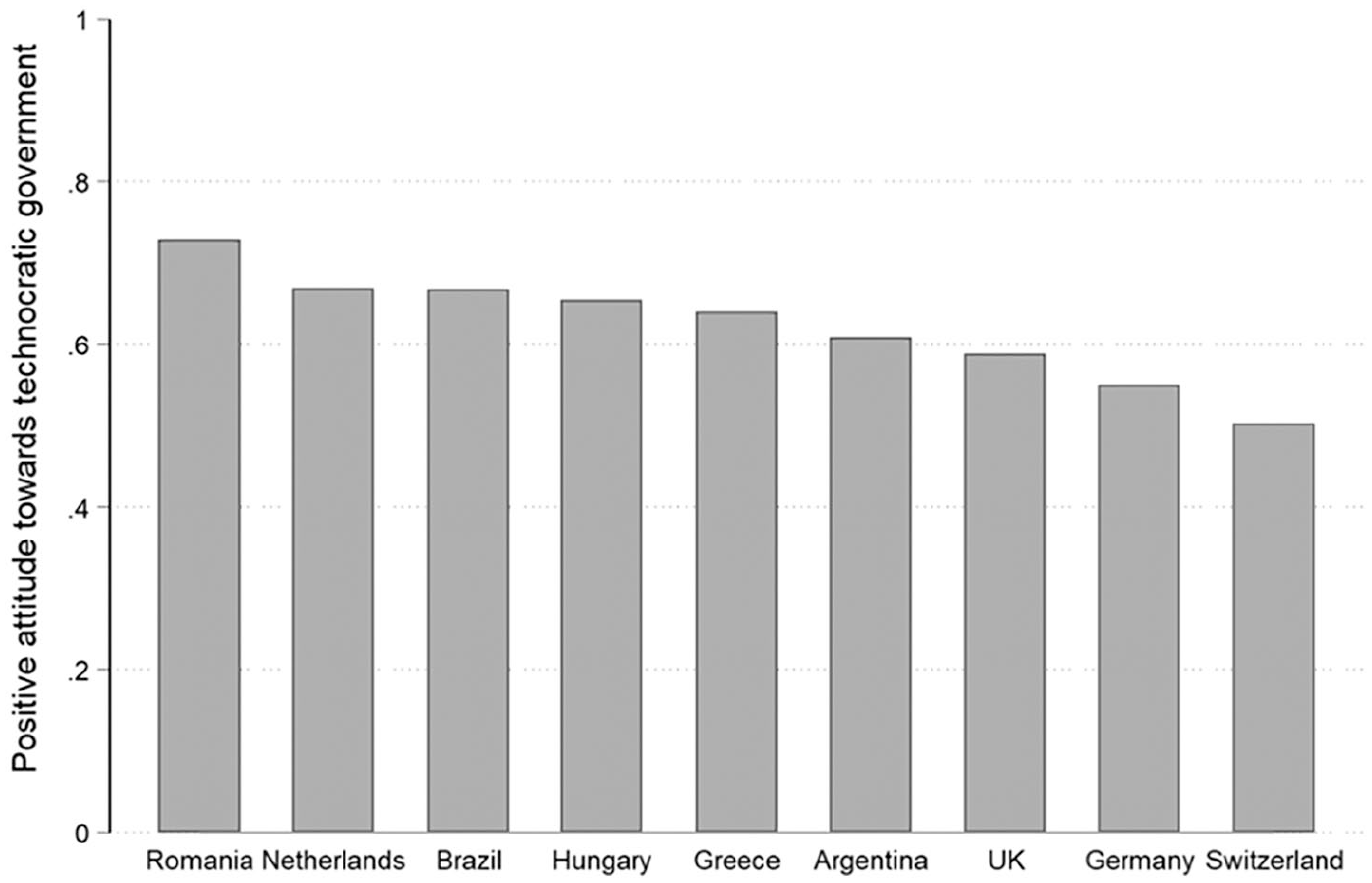
Distribution of attitudes towards technocracy (DV).
The extreme position of the Swiss is not surprising, given the fact that among all consolidated democracies Switzerland is the one that is based most on the direct participation of citizens, from military defence to the initiation and approval of constitutional changes. We also expected the more pro-technocracy countries to be lower on quality of democracy. But the presence of the Netherlands in this group, or the presence of Argentina in the opposite camp, is, to some extent, puzzling.
Political efficacy is a 0–1 index that averages the responses given to two items commonly used (Niemi et al., 1991) to measure external efficacy: ‘People like me don’t have any say about what the government does’ and ‘I don’t think politicians care much what people like me think’. The Cronbach’s alpha for the scale is 0.57.
Democratic satisfaction was measured on an 11-point scale, the endpoints being ‘extremely dissatisfied’ and ‘extremely satisfied’. The same type of scale was used for the respondents’ self-placement on the left–right continuum.
Authoritarianism is another 0–1 index that averages the responses given to two items measured originally on 5-point Likert-type scales: ‘Children should be taught to be obedient’ and ‘People who break the law should be given much harsher sentences than they are these days’. Cronbach’s alpha for the two items is 0.59. Corruption indicates whether the respondent selected corruption as one of the three most important issues the country was facing at the time.
Technocratic experience is a 4-point scale that adapts the typology proposed by McDonnell and Valbruzzi (2014). Thus, countries that never experienced a technocratic government and not even a non-partisan caretaker cabinet are coded as 0: Germany, Netherlands, Switzerland and the United Kingdom. Argentina and Brazil have experienced high shares of non-political ministers and are coded as 1. Countries which have experienced cabinets led by technocrats, but no fully technocratic government are coded as 2: Hungary is the only such case in our sample. Finally, countries that spent time under full technocratic cabinets were coded as 3 (Greece and Romania). The section below details and justifies these choices.
The electoral democracy index averages the electoral democracy index scores computed by the ‘Varieties of Democracies’ project (Coppedge et al., 2017) for the period 1990–2016. Government voter is a dichotomous variable coded 1 if the party indicated by the respondent as her choice (in a hypothetical parliamentary election happening the day after the interview) was represented in government at that time. To code this variable, we used information from the PARLGOV Project (Döring and Manow, 2016) and from other online sources, including official governmental websites.
Financial status is based on a 5-point scale asking respondents how they cope on their household’s income and ranging from ‘Very difficult on present income’ to ‘Living very comfortably on present income’. Education is based on items recording country-specific educational levels which were recoded into three educational groups: low, middle and high.
Social capital indicates the factor scores of a principal component factor analysis of variables registering membership in nine different types of associations, organisations and clubs. Cronbach’s alpha for the nine items was 0.77.
The countries’ experience with technocracy
The POLPART sample includes countries that have had a substantive experience with technocratic cabinets and non-political ministers, countries where pure party government was never abandoned, as well as countries that are situated somewhere in-between. In Argentina, between 27% and 43% of the ministers holding office in the 1983–2011 period could be described as technocrats, depending on their education, professional expertise and lack of political affiliation (Camerlo and Pérez-Liñán, 2015). The share of non-partisan ministers in Brazil is usually presented as higher than in Argentina and higher than in most other Latin American countries. Amorim Neto and Samuels (2011) report that on average roughly half (47%) of the ministers serving in 15 Brazilian cabinets were non-partisan.
Hungary has experienced one technocrat-led cabinet, that of Gordon Bajnai, in 2009–2010, while the share of non-political ministers in cabinets has also been considerable (41%) in the 1990–2014 period (Ilonszki and Stefan, 2018). Greece and Romania have both experienced full technocratic cabinets: that of Panagiotis Pikrammenos in Greece in 2012 (McDonnell and Valbruzzi, 2014) and the one led by Dacian Cioloș in Romania in 2015–2016.
Netherlands and Germany have never experienced a technocrat-led cabinet or a non-partisan caretaker government in the post-war period. Nevertheless, the share of outsiders, that is, ministers with no parliamentary career and no leading party position was generally higher in the Dutch cabinets (37.5%) than in the German cabinets (11.7%) for the 1945–1984 period (De Winter, 1991). The United Kingdom has no recent experience with non-partisan caretaker cabinets or technocrat-led governments. Similarly, and also given the peculiar nature of its executive, Swiss cabinets can be considered fully partisan.
Multivariate analyses
We ran four separate models: the first includes only the individual-level variables, the second and the third introduce two country-level factors – the electoral democracy index and the scale of experience with technocratic government, while the fourth model reassesses the effects of individual-level variables in the presence of country fixed effects. Overall, the models in Table 1 explain between 13% and 18% of the variance in attitudes towards technocracy.
Determinants of citizen preferences for technocracy (OLS regressions on pooled sample). a
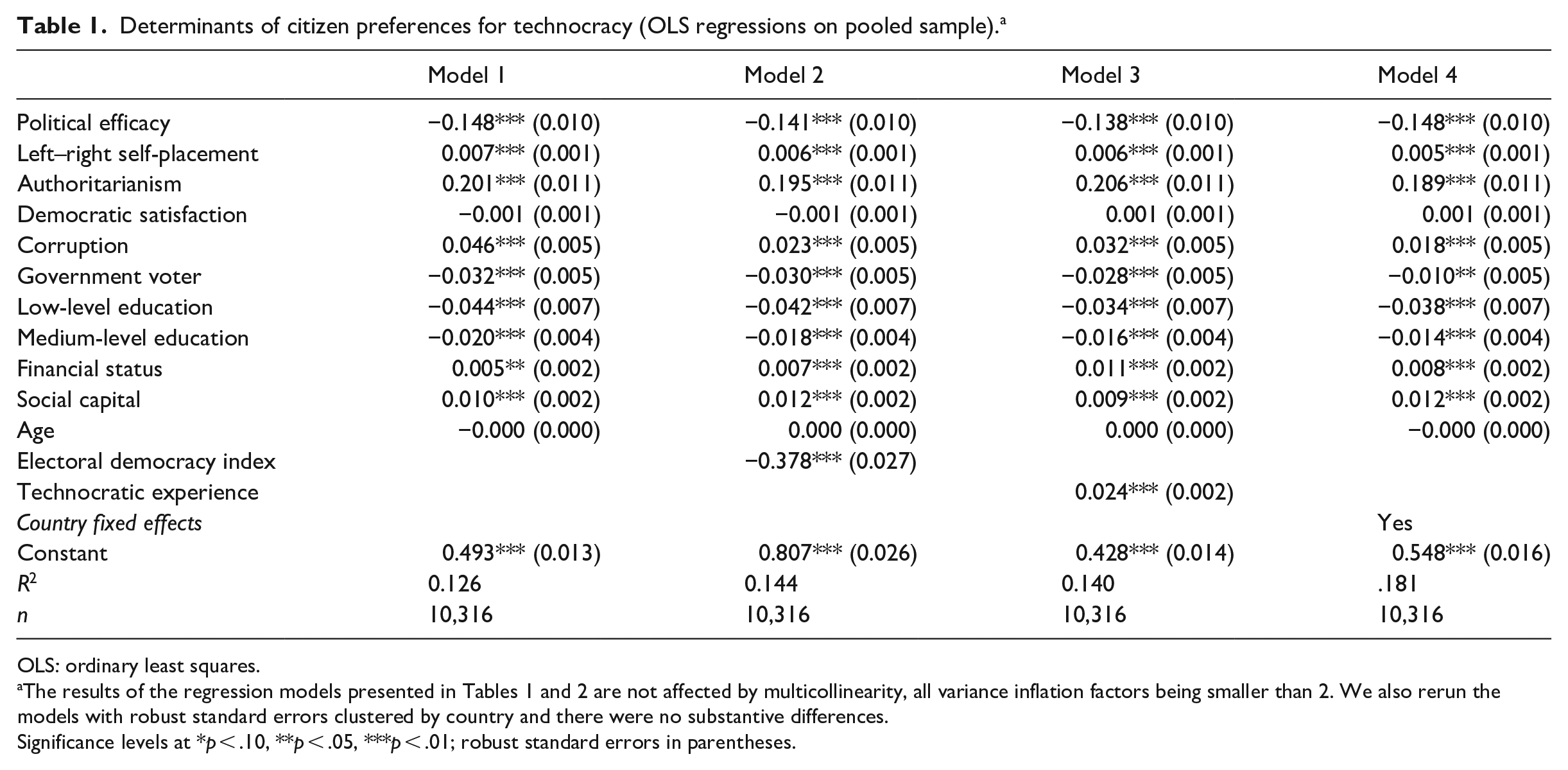
OLS: ordinary least squares.
The results of the regression models presented in Tables 1 and 2 are not affected by multicollinearity, all variance inflation factors being smaller than 2. We also rerun the models with robust standard errors clustered by country and there were no substantive differences.
Significance levels at *p < .10, **p < .05, ***p < .01; robust standard errors in parentheses.
Virtually all main effects are consistent across model specifications. People with lower levels of political efficacy and citizens with more authoritarian values 4 are particularly prone to support the replacement of politicians with expert ministers.
The cumulative effect of political efficacy and authoritarianism is large as can be seen in Figure 2. Because the effects of the two variables go in opposite directions, we replaced political efficacy with its inverse in the model and then ran the Clarify simulations. The figure simulates how a switch from the minimum to the maximum of the two variables 5 would influence the preference for technocracy, while holding all other variables included into Model 1 in Table 1 at their means. The figure shows that there is an almost 0.4 difference on the 0–1 scale measuring technocracy attitudes between respondents who have the lowest levels of political efficacy and held the most authoritarian views and those who have the highest levels of political efficacy and hold the most liberal views, with the former much more in favour of replacing politicians with expert ministers.
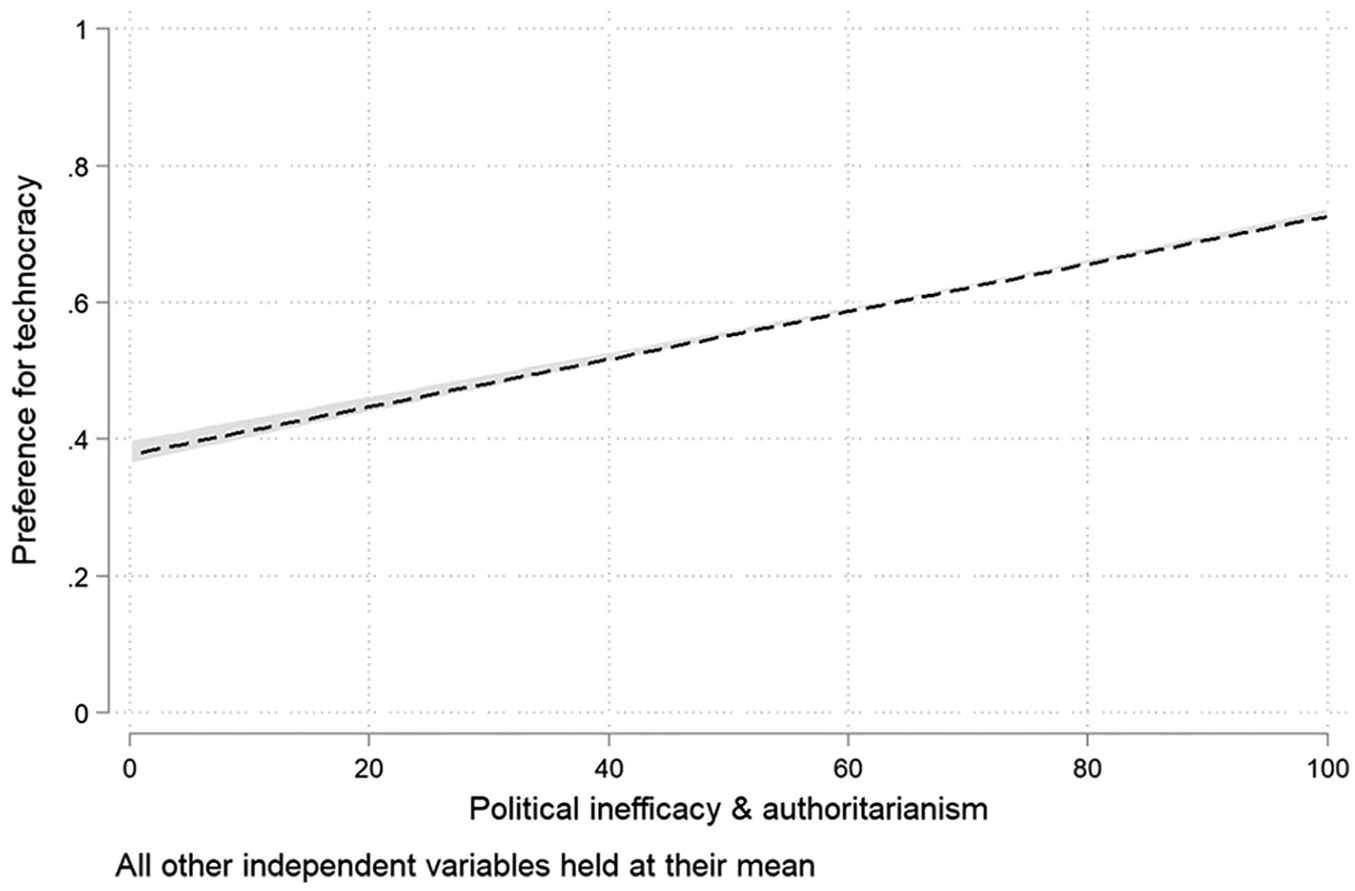
Cumulative effect of political inefficacy and authoritarianism on technocracy attitudes.
As expected, right-leaning citizens favour more government by experts, but the overall effect is rather small. We also find consistent evidence for our expectation regarding positive attitudes towards technocracy of citizens who think corruption is one of the most important problems in their society. 6 Thus, all other things being equal, citizens for whom corruption is very salient have a 5% higher probability to support technocratic government, as opposed to their fellow countrymen who see other issues as more problematic. The only hypothesis that is not corroborated is the one maintaining that citizens exhibiting low levels of satisfaction with democracy 7 would support more decision-making by experts. Most likely, the negative evaluation of the state of democracy is a sign of politicisation, while the perception of high corruption leads one towards depoliticisation. But this result could also mean that those citizens who support technocratic decision-making do so not with the goal of replacing the traditional channels of representative democracy, but to complement them.
Four of the five control variables make a difference in all the models. Thus, government voters oppose, as expected, the idea of technocratic government. More surprisingly, citizens with low and medium levels of educations are less likely than their highly educated compatriots (reference category) to support government by technocrats. In line with this finding, citizens who are better-off financially and those having higher social capital display more positive attitudes towards replacing politicians with experts. These findings contradict the social dominance theories according to which high status groups have a vested interest in maintaining the status quo and, therefore, they support the prevailing political arrangements (Ceka and Magalhães, 2016). They also contradict the assumption that the idea of delegating government to some knowledgeable individuals who are free from partisan biases will primarily appeal to those who haven’t been educated enough.
The two country-level factors examined in Models 2 and 3 have the expected effects. Citizens from countries with lower electoral democracy scores between 1990 and 2016 are significantly more likely to display positive attitudes towards technocracy. Comparing respondents from the countries with the lowest scores in the sample with those from the countries having the highest electoral democracy scores results in an approximately 14% increased support for technocracy. Putting together the individual- and societal-level information, it seems that social elites of badly managed countries are the most natural constituency of technocrats.
Unlike Bertsou and Pastorella (2017), we find evidence that more experience with non-political ministers, technocrat-led cabinets and full technocratic governments increases the likelihood of supporting such solutions, though the effect is rather small. Thus, the difference between citizens from countries who never experienced a technocratic government and those from countries who had full technocratic cabinets amounts to an almost 8% increase in positive attitudes towards technocrats. This indicates that technocracy is a slippery slope: once a political system starts experimenting with it, it becomes more accepted by the citizens. Model 4 shows that there is virtually no change in the main effects discussed above when country fixed effects are introduced in the regression.
Within-country analyses
Table 2 presents the results of the model with individual-level factors ran separately for the nine countries. There is some disparity in the model fit across countries: from approximately 7% explained variance in Switzerland to 21% in Hungary. The first aspect that deserves to be emphasised is that political efficacy and authoritarianism are the most important predictors of technocratic attitudes in each of the countries analysed. Actually, they are the only variables for which we find empirical support in the expected direction in all nine country samples. It is worth noting that the effect of authoritarianism appears to be much stronger in countries with a longer history of dictatorship in the twentieth century. 8 It seems that while in established democracies one can be attracted to expert rule for various ideological reasons, in fragile democracies it is mostly an authoritarian disposition that drives one towards demanding technocracy.
Determinants of support for technocracy by country.
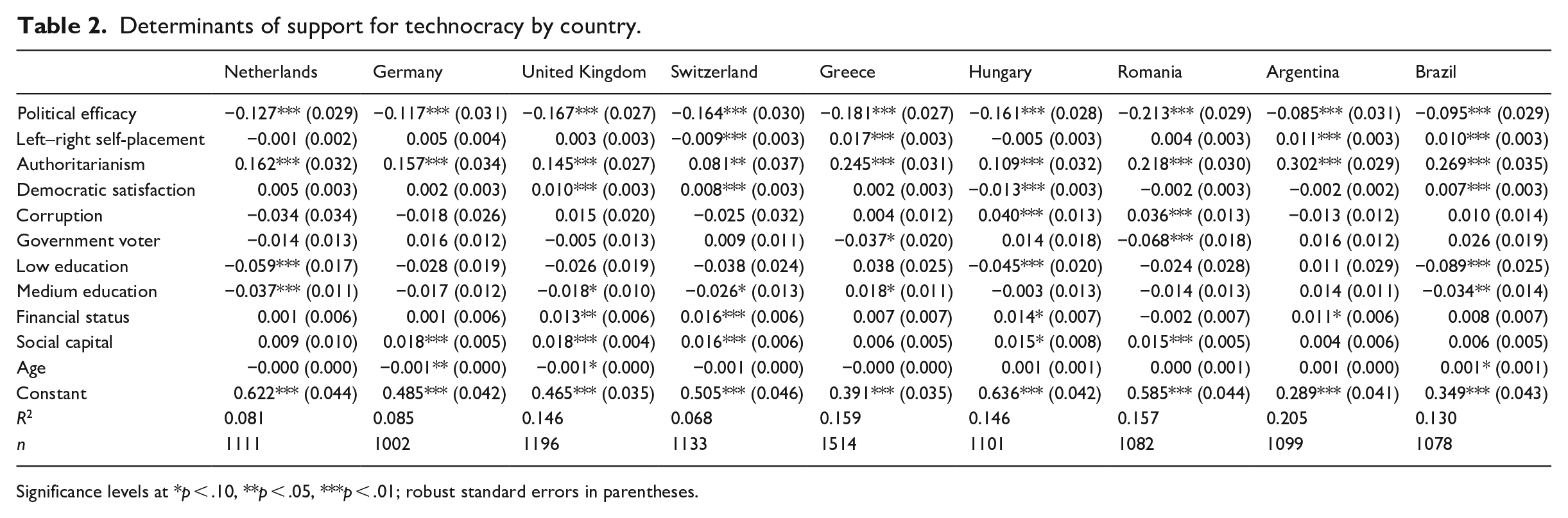
Significance levels at *p < .10, **p < .05, ***p < .01; robust standard errors in parentheses.
The other three independent variables matter only in some countries but not in others. The left–right self-placement works as expected in Greece, Argentina and Brazil, while in Switzerland left-leaning citizens seem more inclined to support technocrats.
The only country where we find support for the democratic dissatisfaction hypothesis is Hungary. Moreover, contrary to our expectation, and similar to the finding of Coffé and Michels (2014), higher levels of satisfaction with democracy increase the support for technocratic government in three of the samples (the United Kingdom, Switzerland and Brazil). It might be that citizens unsatisfied with democracy in these countries reject politics altogether, irrespective of the background of those who run the government, while those who are more satisfied, see an increase in the usage of expertise in politics as a complementary strategy for improving further the quality of democracy.
The corruption effect observed in the models run on the pooled samples seems driven to a certain extent by two particular cases. Thus, after controlling for all the other factors, only in the Hungarian and Romanian samples, citizens who are worried about the levels of corruption are also more prone to support technocratic governments. The fact that corruption has a significant impact on these two countries is, in itself, not surprising. Party politics scholars have argued that in Central and Eastern Europe the issue of corruption has become ‘a genuine, if sometimes vague, dimension of programmatic competition’ (Haughton and Deegan-Krause, 2015: 70) and that citizens worried about corruption constitute a reservoir for new political parties that use their clean image to undermine the established parties. Our finding adds a further layer to this insight, showing that technocratic forces may count on the very same citizens.
Of the control variables, social capital seems to have the strongest effect: in five of the nine samples, citizens who are active in a large number of associations and clubs also tend to view technocracy in a favourable light. This effect might also be interpreted as evidence that in the respective countries, civil society organisations and their members are generally distrustful of parties and would support a more prominent role for technical experts in political decision-making. At the same time, this finding indirectly questions the very concept of ‘politicisation’. Politicised citizens are often pictured as ones who are active in various channels of interest representation and who understand that decision-makers must emerge from competitive multi-party elections, while de-politicised citizens are envisioned as alienated from the public sphere and as supportive of the delegation of power to experts. In reality, the idea of shifting power towards experts seems rather popular among the most active citizens.
There are mixed findings with respect to education, which does not seem to matter at all for preferences regarding party or expert government in Germany, Romania and Argentina. In the Netherlands, Hungary and Brazil lower educated citizens are more opposed to technocratic solutions than those highly educated. In Greece, on the contrary, citizens with a medium level of education are the most likely to support such solutions. More affluent respondents display more support for technocracy in Argentina, Hungary, Switzerland and the United Kingdom. Again, taken together these findings regarding social status and technocracy attitudes do not corroborate the theoretical propositions and findings of Ceka and Magalhães (2016), with respect to more support for the democratic status quo from the most privileged citizens. 9
Government voters are strong opponents of technocracy in Greece and Romania, and this is not at all surprising given that the main parties governing the two countries at the moment of the surveys, SYRIZA and PSD (Social Democratic Party), have cultivated their supporters’ dislike of technocrats and campaigned against the measures implemented by the recent technocratic cabinets – Papademos and Pikrammenos in Greece and Cioloș in Romania. This empirical finding suggests that cues from the preferred party can play an important role in shaping attitudes towards technocracy.
Robustness checks
The main findings are robust to running the pooled sample regressions separately for each of the two items composing the DV. This is illustrated by the coefficient plots displayed in Figures A1 to A3 in the Appendix of the Supplementary Information. The results are also robust if we repeat the same exercise for the country-by-country models, as indicated by the coefficient plots displayed in Figures A4 to A9 in the Appendix of the Supplementary Information. For ease of comparison, these figures plot separately the results from the models run on data from consolidated and young democracies. The only noteworthy differences are the fact that political efficacy fails to reach conventional levels of statistical significance for the model run with Item 2 as DV on the sample from Argentina, and the same is true for authoritarianism in Hungary, again for the model with Item 2 as DV.
The main findings are also robust to controlling for the respondents’ level of political trust. Thus, we added to the models run on the pooled sample an index of political trust (measured on a 0–1 scale), which indicates the respondent’s average level of trust in Parliament, government, political parties and politicians. The results are plotted in Figure A10 in the Appendix of the Supplementary Information and they indicate that while the magnitude of the effects of the independent variables hardly change, respondents with a higher level of political trust tend to have more positive attitudes towards technocrats, although the effect is rather small. This corroborates the findings of Bertsou and Caramani (2020).
Last but not least, we introduced in our analyses on the pooled sample a squared term for the left–right placement variable to explore whether more centrist citizens are more likely to support technocracy compared with their compatriots that identify with the extremes of the political spectrum (Bertsou and Caramani, 2020). We find no evidence for such a curvilinear effect.
Conclusion
The article reveals that two individual-level factors are prominent in triggering citizens’ support for technocracy: inefficacy, that is, the feeling that politicians are not responsive to their needs and views and authoritarian values. The importance of these two variables is underlined by the fact that they had a similarly robust effect in contexts with very different political institutions, democratic experience and societal problems.
Another contribution of the article is to illustrate that corruption perceptions also fuel support for technocracy. While previous research (Bertsou and Pastorella, 2017) had shown that positive attitudes regarding technocracy are more frequent in countries with higher levels of (perceived) corruption, we were able to illustrate that the replacement of political ministers with non-partisan experts is indeed favoured primarily by citizens more concerned with the effects of this phenomenon. This is especially the case in political systems, like those in Central and Eastern Europe, where the issue of corruption has become a dimension of party competition.
Last but not least, our findings show that the most privileged citizens in these societies, that is, those who are better educated, more affluent and have higher social capital, tend to display more favourable attitudes towards technocracy, which contradicts theories that considered the upper strata as the natural supporters of the political status quo. Our results also run counter to previous studies that found that the uneducated strata are most in favour of ‘stealth democracy’ (Bengtsson and Mattila, 2009; Coffé and Michels, 2014; Webb, 2013). Social elites might be more scared by the rise of radical forces today than in the past and may therefore consider experts rule as a safe refuge.
The expansion of available data on cabinet composition and ministerial characteristics (Nyrup and Bramwell, 2020) could enable future comparative research testing the extent to which the correlates of citizen attitudes towards technocracy discussed by our study are also present in defective democracies or more authoritarian settings. In such settings, citizens’ attitudes towards technocrats might also be mediated by the reasons for which rulers choose to rely on non-partisan ministers: to enhance technical capacity to deal with complex policy issues or to solidify their personal rule with the help of faithful cronies, lacking a partisan power base (Schleiter, 2013).
Supplemental Material
sj-docx-1-bpi-10.1177_13691481211018311 – Supplemental material for Who wants technocrats? A comparative study of citizen attitudes in nine young and consolidated democracies
Supplemental material, sj-docx-1-bpi-10.1177_13691481211018311 for Who wants technocrats? A comparative study of citizen attitudes in nine young and consolidated democracies by Mihail Chiru and Zsolt Enyedi in The British Journal of Politics and International Relations
Footnotes
Funding
The author(s) received no financial support for the research, authorship and/or publication of this article.
Supplementary information
Additional supplementary information may be found with the online version of this article.
Contents
Figure A2: Coefficients plot of pooled sample analyses with Item 1 as DV.
Figure A3: Coefficients plot of pooled sample analyses with Item 2 as DV.
Figure A4: Coefficients plot of Western European country-by-country analyses with Technocracy index as DV (models in  ).
).
Figure A5: Coefficients plot of Western European analyses with Item 1 as DV.
Figure A6: Coefficients plot of Western European analyses with Item 2 as DV.
Figure A7: Coefficients plot of young democracies’ country-by-country analyses with Technocracy index as DV (models in ).
Figure A8: Coefficients plot of young democracies analyses with Item 1 as DV.
Figure A9: Coefficients plot of young democracies analyses with Item 2 as DV.
Figure A10: Coefficients plot of pooled sample analyses, controlling for political trust.
Notes
References
Supplementary Material
Please find the following supplemental material available below.
For Open Access articles published under a Creative Commons License, all supplemental material carries the same license as the article it is associated with.
For non-Open Access articles published, all supplemental material carries a non-exclusive license, and permission requests for re-use of supplemental material or any part of supplemental material shall be sent directly to the copyright owner as specified in the copyright notice associated with the article.
