




Abstract
In the context of deteriorating relations with ‘Western’ states, Russia’s state-funded international broadcasters are often understood as malign propaganda rather than as agents of soft power. Subsequently, there is a major credibility gap between how Russian state media represents itself to the world and how it is actually perceived by overseas publics. However, based on the study of RT’s coverage of the Russian hosted FIFA 2018 World Cup and the audience reactions this prompted, we find that this credibility gap was partially bridged. By analysing over 700 articles published by RT, alongside social media and focus group research, we find that RT’s World Cup coverage created an unusually positive vision of Russia that appealed to international audiences. Our study demonstrates how state-funded international broadcaster coverage of sports mega-events can generate a soft power effect with audiences, even when the host state – such as Russia – has a poor international reputation.
Introduction
On 21 March 2018, in a Foreign Affairs Select Committee at the British Parliament, Member of Parliament Ian Austin articulated his concerns about the upcoming FIFA World Cup in Russia, suggesting that ‘Putin is going to use it in the way Hitler used the 1936 Olympics’ (Austin quoted in Wintour, 2018). Austin was disquieted that the tournament would be used to deflect public attention from human rights abuses in Russia and its actions in Ukraine, Syria, and the United Kingdom, where the former Russian spy Sergei Skripal and his daughter Yulia had recently been poisoned. When asked what he thought about the upcoming tournament, the then British Foreign Secretary, Boris Johnson, stated that Austin’s comparison was ‘certainly right’ and that ‘Putin glorying in this sporting event’ was ‘an emetic prospect’ (Johnson quoted in Wintour, 2018). These comments reflect not only British elite attitudes towards the Russian state at the time but also a disdain at the prospect of Putin wielding influence by exploiting this sports mega-event (SME).
Such accounts dovetail with the argument that the Kremlin is doing ‘the opposite of what is needed for soft power creation’, where instead of making Russia attractive to international audiences, Russia’s aggressive and controversial foreign and domestic policies result in negative and hostile perceptions abroad (Grix et al., 2019b: 54; see also Hudson, 2015). Russian state-sponsored campaigns to engage with international publics – public diplomacy – are increasingly viewed as propaganda rather than as a genuine effort to foster a productive dialogue (Van Herpen, 2015). Russia’s public diplomacy efforts therefore suffer from what Rawnsley (2015) has referred to as a ‘credibility gap’. Consequently, SMEs, conventionally envisioned as tools of national image promotion abroad, are primarily understood as instruments of domestic political legitimation in the context of contemporary Russia (Grix et al., 2019b; Orttung and Zhemukhov, 2017). Yet the question of the significance of international communication in the context of Russian SMEs should not be dismissed as categorically as it often is (Nye, 2014).
Existing academic research has produced some insights into how Russia has attempted to promote a favourable image to world audiences through its previous SME, the Sochi 2014 Olympics (Grix and Kramareva, 2017; Hutchings et al., 2015; Kramareva and Grix, 2018; Tenneriello, 2019). However, despite recent preliminary studies (Makarychev and Yatsyk, 2020), surprisingly little is known about Russian political communication efforts and their effects during the 2018 World Cup. This is with respect to (a) how Russian state actors engaged international audiences, (b) how these audiences interpreted Russia-sponsored communication at the time of the SME, and (c) what effects such efforts may have had in shaping international perceptions of Russia.
In this article, we address this gap. We analyse how a Russian state-sponsored international media network RT – formerly Russia Today – reported the 2018 World Cup and examine public reactions to this coverage. We choose to focus on RT because it is Russia’s foremost state-funded international broadcaster with an audience of millions across multiple new media platforms as well as on television across Europe, the Middle East, and North and South America. While this may not provide an overall sense of Russian soft power in its entirety, an analysis of RT’s media reporting and audience responses can provide an insight into how one of the most prominent ‘soft power tools’ or, in different interpretations, ‘propaganda weapons’ of the Russian state represents Russia to international audiences (Hutchings, 2020: 284).
RT is often portrayed as a pariah among international broadcasters, yet the network confidently internalises and reappropriates this status (Yablokov, 2015), attracting diverse, albeit modest, international audiences (Mickiewicz, 2017). Rawnsley (2015: 276) observes that typically, the network’s ‘gaze is not on Russia, but rather is fixed on presenting a critical representation of the US rais[ing] serious doubts about its role in “public diplomacy” and suggest[ing] a more ideological and propaganda-based approach to international broadcasting’. At the time of the 2018 World Cup, RT’s usual tendency to focus on negative representations of Western institutions (Miazhevich, 2018) was replaced by salient reporting of a Russian SME. Having no rights to broadcast the actual football matches, RT’s event coverage and the network’s English-language audiences’ reactions, therefore, present an intriguing case study to shed light on Russian political communication.
This study draws upon multiple original data sources to understand how RT represented the 2018 World Cup. Through a thematic analysis of over 700 articles RT published on their dedicated World Cup website (RT.com/fifa2018) during the tournament, we explore how RT represented Russia. We also discern how international audiences interpreted and responded to RT’s representation of Russia by analysing the social media engagement with RT’s articles, alongside data collected through a month-long digital discussion group with 47 participants and follow-up interviews with 15 of those. In doing so, we ask, how did RT represent Russia through its coverage of the World Cup to global audiences? And how did audiences interpret and respond to such representations?
This article contributes to our understanding of Russian public diplomacy, international broadcasting, and soft power more broadly, in several ways. First, it provides an empirical account of how a Russian state-sponsored international broadcaster represented the host country to international audiences during the World Cup. Second, our article expands our understanding of how audiences of RT interpreted Russian public diplomacy efforts. The study of audiences has often been overlooked in analyses of soft power, and we heed Barr et al.’s (2015: 215) call ‘to explore the ways in which consumers confirm or resist official narratives’. Our study draws upon ethnographic approaches to audience studies (Gillespie, 2006) and recent attempts to analyse ‘everyday narratives of politics’ (Stanley and Jackson, 2016) by using focus group and interview methods (Barbour, 2008; Stanley, 2016). As studies have recently demonstrated the heterogeneity and fragmented nature of RT’s international audience (Crilley et al., 2020), we emphasise that this study is a focused insight into how an English-speaking audience with a common interest in football and politics responded to RT’s English-language coverage of the World Cup. Nonetheless, our study demonstrates how to integrate audience research into the study of public diplomacy and soft power.
SMEs as sites of public diplomacy and soft power
Traditionally, soft power refers to a state’s ability to influence others in international politics through ‘attraction rather than coercion’ (Nye, 2008: 94). According to Grix and Lee (2013: 526), soft power can be understood as ‘a discursive mechanism for increased agency in global affairs through the performative politics of attraction’. Public diplomacy refers to a set of instruments at governments’ disposal, including international broadcasting, cultural exchanges, and SMEs, used ‘to mobilise . . . [soft power] resources to communicate with and attract the publics of other countries’ (Nye, 2008: 95; see also Cull, 2008), and consequently to enhance their ability to wield more tangible international influence. This understanding draws attention to the cultural and communicative foundations of soft power, and the tools used by states and the actors they employ to make themselves and their actions more tangible and attractive to others (Barr et al., 2015).
International broadcasting plays an increasingly important role in enhancing the sponsoring state’s soft power ‘by generating credibility, fostering values [. . .] changing behaviour, and increasing goodwill’ (Pamment, 2014: 53). Unlike traditional public diplomacy, characterised by a one-way flow of preferred messages about a state, public diplomacy today is understood as a two-way flow of communication, whereby state-sponsored actors actively listen to and establish a dialogue with external publics (Pamment, 2014). The issue of credibility of international broadcasting outputs is especially salient for states such as Russia, as it ‘is the single most important factor in determining whether or not a particular broadcast will be interpreted as propaganda or public diplomacy’ (Rawnsley, 2015: 274). The success of soft power or public diplomacy initiatives, including international broadcasting, could be dependent on whether they pass what Brannagan and Giulianotti (2018: 1151) refer to as the ‘credible attraction filter’: in essence, a test of whether the efforts and outputs are indeed deemed attractive, credible, and trustworthy by their international audiences.
In the past decade, a growing number of rising powers have hosted SMEs in order ‘to bolster their “image” and international “prestige”’ (Grix, 2015: 19; see also Cornelissen, 2010). Hosting these events is said to engender a ‘“feel-good” factor’ (Grix, 2015: 7) that states can use to ‘deflect domestic tensions’ (Tomlinson and Young, 2006: 1) and draw attention away from negative issues such as bad governance, human rights abuses, and conflicts. Through the use of international broadcasting, states can represent their SMEs in favourable ways and produce the effect of an in-person visit to audiences, which can contribute to a state’s soft power (Rowe, 2004). However, others have acknowledged the possibility of the opposite effect – ‘soft disempowerment’ – where such efforts instead ‘upset, offend or alienate others, leading to a loss of attractiveness or influence’ (Brannagan and Giulianotti, 2015: 706). If international audiences are not persuaded by the credibility of a state’s efforts to make themselves attractive, their attempts to generate soft power can in fact backfire and lead to disempowerment. This has been the case with Qatar, whose hosting of the 2022 World Cup has drawn attention to the state’s human rights record, ‘leading audiences to question the state’s integrity and adding further to its perceived lack of credibility’ (Brannagan and Giulianotti, 2018: 1156). Similarly, the concerns expressed by UK officials prior to the 2018 World Cup illustrate the reputational risks associated with hosting such events.
Audiences, soft power, and SMEs
Much of the current research on soft power lacks a sufficient theorisation or empirical study of audiences (Fisher, 2020; Gillespie and Nieto McAvoy, 2016), despite the audience being pivotal to the success and effect of soft power efforts. As audiences are often seen as homogeneous, passive groups, receiving and interpreting state messages uncritically, there is scant research into how audiences make sense of, interpret, and feel about soft power initiatives. Indeed, as Barr et al. (2015: 215) have suggested, scholars ‘need to better understand the motivation of those who consume soft power narratives and products’. Therefore, in our research, we place audiences at centre stage by adopting an approach inspired by cultural studies and audience studies. Soft power is reliant on audiences being ‘active contributors’ (Gillespie and Nieto McAvoy, 2016: 205–207) in determining the efficacy of public diplomacy initiatives. This is because, for a state’s image to be improved, an audience has to interpret and accept the positive projection of a state’s image. Only then can soft disempowerment be avoided and the credibility gap bridged. As Rawnsley (2015: 284) highlights, ‘the “power” in soft power ultimately resides with the audience’ – they have to decide whether a soft power initiative is worth engaging with in the first place, and then they have to accept and act upon the communicated message (see also Cheskin, 2017; Szostek, 2018).
A corollary of the limited account of the audience in studies of soft power is an insufficient understanding of how emotions shape the success of soft power initiatives. If we are interested in how SMEs prompt a ‘“feel-good” factor’ (Grix, 2015: 7), then we are ultimately concerned with the politics of emotion. For Solomon (2014), soft power initiatives do not have political significance because of the words and images they use, but rather because of how they make audiences feel. If we are to understand the ‘soft power of attraction’ (Nye, 2008: 101), then the study of emotions ‘must be brought into analysing attractiveness’ (Solomon, 2014: 736). This requires two conceptual steps. First, we need to understand how soft power initiatives elicit emotions in those who view and engage with them (see Ahmed, 2014: 1), because international media ‘evoke feelings and affects, which in turn help to shape how one perceives of and belongs in the world’ (Hutchison, 2016: 19). Second, if audiences ‘play a role in shaping global media events as co-creators of meanings’ (Burchell et al., 2015: 415), then we need to understand how state-sponsored international broadcasters represent SMEs and the emotional responses such representations generate.
‘A brilliant surprise’: International media and the 2018 FIFA World Cup
Despite critical accounts of previous soft power efforts led by the Kremlin (Nye, 2014; Rutland and Kazantsev, 2016) and the noted antagonism towards the Russia-hosted 2018 World Cup prior to and shortly after its commencement (e.g. Dawson, 2018), the post-event media reports did not bear out such scepticism. The Guardian journalist Barney Ronay (2018a: xvii) noted upon completion of the tournament that ‘Russia itself was a brilliant surprise in so many ways’. Despite deteriorating relations between Russia and the West, during the tournament and after it, ‘it became a reflex to describe Russia 2018 as perhaps the best World Cup ever [. . .] a brilliant [event], epic in scale and relentless in its drama, five weeks that seemed to stand outside of everything else around it’ (Ronay, 2018a: 225). The 2018 World Cup went from being widely viewed as an impending catastrophe to being seen as one of the best tournaments arranged by the ‘perfect hosts’ (Jennings, 2018). This sentiment was shared by journalists and commentators from across the political spectrum in the United Kingdom: from The Times (Whittell, 2018), the BBC, and The Independent (Cawthorne, 2018; Jennings, 2018) to The Guardian, all of which are often critical towards contemporary Russian politics. A host of other mainstream international publications also featured positive reflections on the tournament (Muraviev, 2018; Rogers, 2018). Ronay (2018a: 83), for example, concluded: plenty of nations have used the World Cup to placate the people, to build soft power, to legitimize a regime. For this tournament Putin scrubbed the cities, presented a face, ensured that we saw what he wanted us to. It was an exceptional piece of stage management, willingly absorbed and enjoyed by those present. (Ronay, 2018a: 83)
Such a change in favourable perceptions of Russia appears surprising: why were the audiences of this campaign ‘willingly absorbed’ by it when other Russian public diplomacy efforts, such as the Sochi Games, were deemed less effective by audiences?
Content analysis and audience research: Mixing methods
Our study employed several data sources and methods. We collected tweets published by RT’s main Twitter account (
We then used the social media analytics tool CrowdTangle to understand how audiences engaged with and interpreted RT’s coverage. At the time of the study, CrowdTangle calculated the total number of audience interactions – likes, shares, comments, tweets, retweets, and replies – from social media posts that included the URL to each RT article on the social media platforms Facebook, Twitter, reddit, and Instagram. However, as viewing and social media engagement figures ‘tell us nothing about how audiences respond to the programmes they watch, nor if their attitudes or behaviour towards the source have changed as a consequence of engaging with its international broadcasting’ (Rawnsley, 2015: 283), we then conducted further research through a digital discussion group with 47 participants hosted throughout the tournament and follow-up interviews with 15 of these (we discuss these approaches in more detail in the next two sections). Following the tournament, we also conducted a short interview with Daniel Armstrong (2020, Interview), a sports reporter, who covered it for RT, to triangulate our observations with the experiences of a member of the team who wrote some of the stories we investigated. Overall, this mixed-methods approach allowed us to capture the dynamics of both RT’s creation of representations of Russia and their reception by its international audiences during the World Cup, and link these with the wider discussion of Russian public diplomacy.
RT’s representation of Russia throughout the World Cup
Compared with its reporting of the Sochi Olympics, which was multi-pronged yet lacked world-class expertise and appeal (Kazakov, 2019), RT’s coverage of the 2018 World Cup reflected a higher level of investment and effort to reach a wide audience. RT temporarily employed world-famous football personalities like José Mourinho, Peter Schmeichel, and Stan Collymore to provide tournament commentary and lead thematic shows introducing Russia as the World Cup host (RT, 2018b,2018c, 2018e). Such programming drew praise from Western football commentators: ‘it turns out the real genius of RT [. . .] is its unexpected tone and texture. It’s actually good!’, wrote Ronay (2018b). The tactic of employing ‘celebrity diplomats’ (Cooper, 2015) to speak on behalf of the Russia-sponsored tournament was an important part of RT’s effort to tell the story of the World Cup.
Mediating the experiences and opinions of well-known foreigners complemented the ‘citizen diplomacy’ (Mueller, 2008) of RT, which centred on fan experiences in Russia. RT’s World Cup website aggregated their news coverage of the tournament, shared match results, and provided guides to the host cities. It also featured an audience content co-creation function called ‘the footwall’, which shared social media images and videos from fans in Russia and aimed to bring the experience to international observers in real time. Described as ‘the next-best thing to being here’, this feature manifested RT’s desire to deliver the effect of an in-person visit to international viewers (Grix, 2015; Rowe, 2004).
Our analysis of the 776 articles published on RT’s World Cup website suggests that the channel covered the tournament through four broad themes. The first theme consisted of football-related articles (371, 48% of all articles), including news about teams and players, match predictions, and reports. The second consisted of articles broadly focused on culture (152, 20% of all articles). Such stories introduced aspects of Russian culture and traditions, covering cultural performances, arts, and celebrities at the tournament. These stories also shared information about host cities and stadia. The third revolved around fans (146, 19% of all articles), including stories about visiting supporters’ experiences in Russia, spectators following the tournament from abroad, social media reactions, and ‘footwall’ content. Finally, the fourth theme involved articles that were explicitly about politics (107, 14% of all articles). These stories commented on diplomatic relations between countries and shared updates on the national leaders present at, or commenting on, the tournament.
Overall, just under half of RT’s coverage of the World Cup was explicitly about the sporting dimension. Even at a time of such a high-profile tournament hosted in Russia, the SME-focused portal of the network, which did not have broadcast rights to the games, maintained its informational remit. Yet the prevalence of such stories did not mean the network abandoned its ‘counter-hegemonic’ (Hutchings et al., 2015) critique of Western media and institutions in its World Cup reporting. For instance, the RT journalist we interviewed noted that RT actively engaged with and responded to the negative commentary the tournament had received in the foreign media. RT was ‘keen on pick[ing] on some of the untruths being reported [. . .] It wasn’t our sole goal, but it was obviously a factor in some of our reporting’ (Armstrong, 2020, Interview). Such stories (e.g. RT, 2018a) formed part of the network’s international coverage of the tournament, mirroring its mode of reporting on the Sochi Games (Hutchings et al., 2015; Kazakov, 2019).
Situating fans and their experiences, making a virtue out of necessity as RT could not actually broadcast the games, also created a distinctive approach to the network’s coverage and helped generate a powerful affective response. In addition, the reporting of fan experiences and cultural stories flouted expectations among many who thought RT would simply focus on a political line. Referred to by the Russian foreign minister Sergey Lavrov as ‘people’s diplomacy’ (RT, 2018d), RT’s focus on fan experiences was one of the main pillars of the network’s approach to broadcasting the tournament that helped generate soft power effects. Our RT interviewee explained that: We had a big responsibility, we felt, to get in touch with fans and share the fan experiences [. . .] When I was in the field, I reported what I saw [. . . and] everybody with whom I spoke had positive stories to tell. (Armstrong, 2020, Interview)
Reporting fan impressions and re-mediating content from foreign fans’ own accounts captured fan voices and experiences, and aimed to bridge the gap of perceptions of the tournament and its host among international audiences. This tactic was key in ensuring RT’s efforts passed the credible attraction filter. It helped to emphasise that foreign and Russian fans had a ‘shared understanding of the cultural norms, beliefs and values that establish the very meaning of attraction’ (Brannagan and Giulianotti, 2018: 1151), while the foreign fans’ voices and images corroborated the Russian media’s reporting, thereby promoting its credibility. In addition, RT’s coverage involved an emphasis on framing the tournament as a success story by highlighting that international footballers, managers, and pundits were surprised and impressed by the Russian hosts of the World Cup and their encounters with the Russian public. Such messaging aimed to generate favourable representations of Russia as a host of an on-going, well-organised SME.
Another notable aspect of RT’s coverage was its favourable representation of President Putin. RT tended to showcase him being friendly with other world leaders, footballers, and celebrities. All these features are similar to RT’s approach to coverage of the Sochi Olympics, in which Putin served as one of the key national symbols of contemporary Russia (Kazakov, 2019). Although RT has often framed Putin as a disruptive ‘strongman’ in global politics (Beale, 2018), their World Cup coverage shifted representations to depict him as a welcoming and cooperative world leader.
Ultimately, RT’s representation of Russia attempted to ‘normalise’ Russian people, culture, and politics, and present Russia as a modern, outward-looking nation acting in cooperation with other states and publics, just as it did in 2014 during the Sochi Games (Gronskaya and Makarychev, 2014; Kazakov, 2019). Echoing RT’s practice of employing foreign journalists – not only to connect more directly with audiences but also ‘to reinforce [its] respectability and legitimacy’ (Rawnsley, 2015: 284) – RT’s World Cup coverage took advantage of the unprecedented number of foreign football celebrities and fans flocking to Russia as an opportunity to emphasise this point. RT projected a warm and hospitable image of the nation and emphasised that both the Russian people and the state, personified by Putin himself, embody and endorse universal values (Grix et al., 2019a) and, in fact, have much in common with overseas audiences.
Interpreting RT’s representation of Russia
To gauge public interest in RT’s representation of Russia during the World Cup, we calculated the audience interaction figures on social media for the relevant articles. Football-related stories resulted in the most audience interaction overall (281,843 responses), with political articles a close second (269,105 responses). Individual articles that concerned politics gained, on average, over three times the number of interaction than football-related articles, suggesting that RT audiences had a heightened interest in political rather than sporting matters (Table 1).
Themes of articles published on RT.com/fifa2018 with total and average social media interactions.
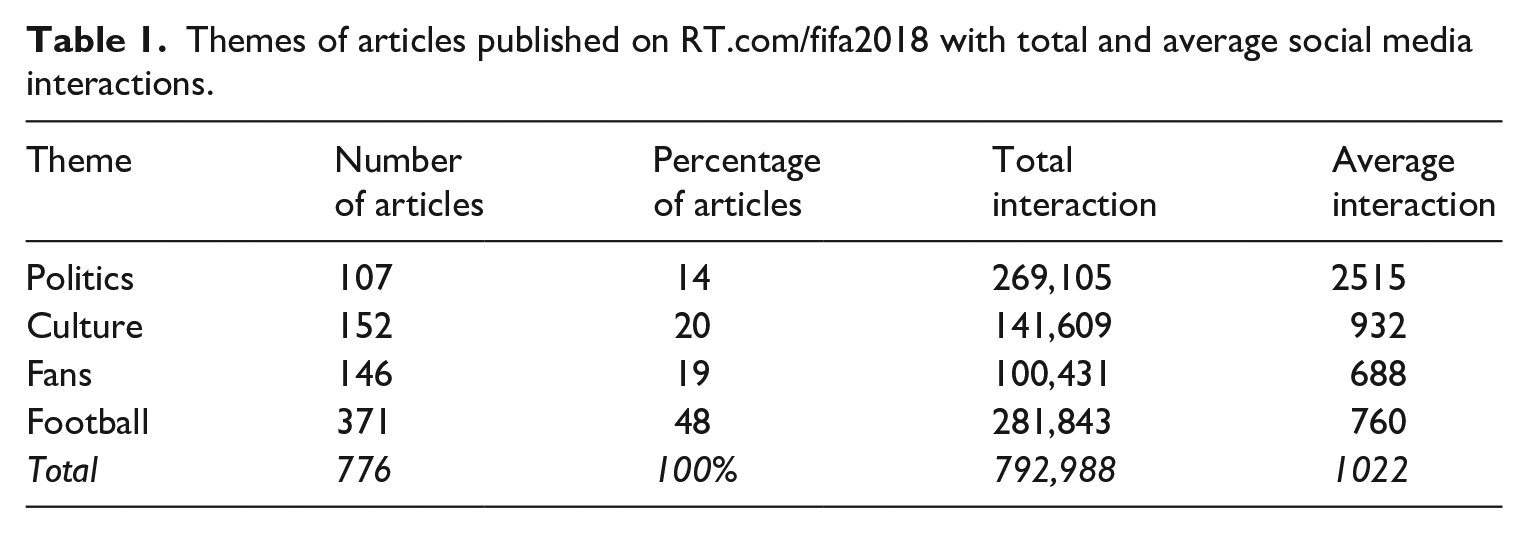
These figures shed light on RT’s audiences during the World Cup. Despite considerable efforts for internationally appealing sporting coverage – such as the employment of internationally renowned experts – it was still political matters rather than sport or cultural issues that prompted, on average, the most social media engagement with RT’s World Cup output. Further to this, Table 2 summarises details about the top 10 most popular RT World Cup articles, collated and sorted based on the number of social media interactions they generated.
Top 10 articles published on RT.com/fifa2018 for audience interaction.
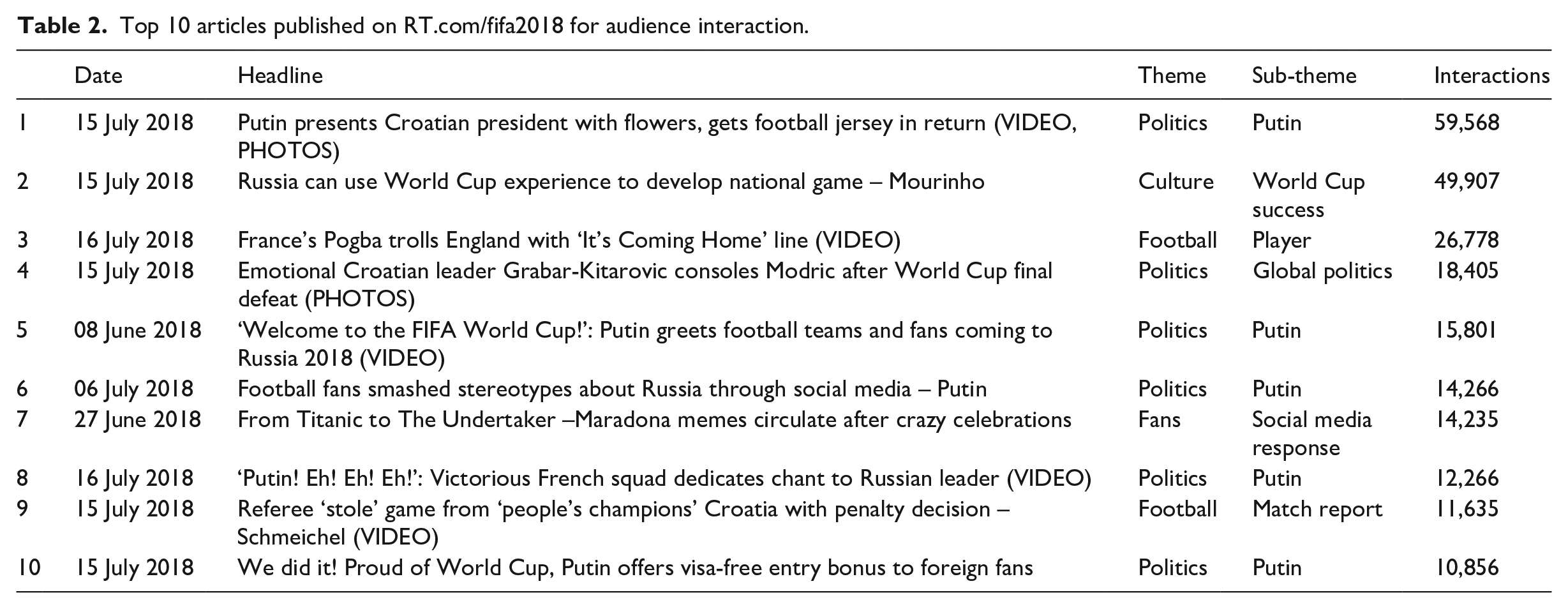
A common feature of these stories is that they all centre on actions or opinions of political and football celebrities, suggesting that RT’s use of celebrity diplomacy bore fruit. The role of Putin as a national icon of Russia and a celebrity personifying the host country was obvious: as the table shows, half of the most engaged-with stories deal with updates from or about him. Rather than the Russian people, host cities, or sporting or cultural outputs, it was the Russian President who spurred the most notable levels of user interactions on social media. Putin’s international, controversial cultural icon status (Goscilo, 2013) appears to have drawn people to engage with RT’s World Cup coverage. In response to the most popular RT World Cup article in our study, commentors on Facebook stated that ‘Putin is always a winner!’, ‘Putin what a gentleman’, and ‘I’d rather swap [Theresa] May for Putin and make Britain an Empire again’. These comments, alongside reflections such as ‘Russia served the game and all visiting nations and football supporters handsomely’, suggest that RT’s followers recognised Putin as a prominent element of Russia’s international image. Moreover, as with comments responding to RT’s broader media reportage (Crilley and Chatterje-Doody, 2020: 725–728), audiences indicate an attachment to the identity of Putin as a strong, masculine figure who can achieve his goals – whether they be making a country ‘great again’ or hosting an SME. Similarly, some of the other most resonant stories demonstrate that hiring internationally renowned pundits, like Mourinho and Schmeichel, resulted in engagement from RT’s audiences.
Finally, the tendency to focus on viral, humorous, potentially controversial content, such as Pogba’s trolling of English fans and Maradona’s eccentric behaviour as well as Internet responses to it, extends RT’s usual practice of attempting to provoke an emotional reaction from audiences, thus boosting online discussion and viewership (Chatterje-Doody and Crilley, 2019; Miazhevich, 2018). RT journalists confirmed that the sports desk, both during the World Cup and beyond it, would aim not only to break the news to their audiences as quickly as possible, but also to ‘write our [stories] in a way that would get our audience to interact’ (Armstrong, 2020, Interview). Sharing content that is humorous, controversial, and generated by or relating to celebrities and cultural icons of a nation and framing it in purposefully affective ways were some of the techniques through which RT spurred an emotional response among its viewers and followers.
Insights from RT’s World Cup audiences
To better understand how audiences interpreted RT’s representation of Russia, we conducted a digital focus group on Facebook and follow-up interviews with research participants. Participants were recruited through requests on our research project’s website and social media channels for participants interested in football and politics to take part in a study of RT’s World Cup coverage. In total, we had 47 participants, the majority of whom were male (36 compared to 11 females), and from a diverse range of ages, locations (although most were British), and personal backgrounds. As such, we do not claim that this group is representative of a general population or of a general RT audience, given that no such general audience exists (Ang, 1991). Instead, following other research in the age of the ‘hybrid media system’ (Chadwick, 2017), our digital focus group and follow-up interviews provide detailed insights into how some audience members actively followed and engaged with RT’s broadcast and social media outputs throughout the tournament.
The majority of our participants were aware of RT but did not watch it regularly or engage with it online. During the tournament, we asked participants to engage with RT on a daily basis and to share news articles about the political and cultural dimensions of the World Cup (as opposed to match reports or football-related news) and to actively comment on posts and engage with one another in our private Facebook discussion group. Over the course of the tournament, they published a total of 227 posts and comments in our discussion group. Of these, 81 posts linked to media articles alongside a group member’s commentary on them, and the other 146 comments were responses to these posts. Having contacted group members on the phone or via video calls beforehand, we are confident that none of the participants were fake accounts, bots, or in the employ of RT or the Russian state. Therefore, the posts and comments that participants shared in our Facebook discussion group provide an insight into how RT’s World Cup coverage was interpreted by external observers and reveal how RT’s reporting was situated alongside other media sources that our participants engaged with throughout the tournament.
After the tournament, to generate further insights, we conducted small-group, follow-up interviews with our study participants. We invited all 47 participants to these interviews and conducted in-person or online video interviews with 15 participants who were the most active members. These interviews were qualitative, semi-structured conversations aimed at understanding the interviewees’ points of view and lived experiences of the World Cup (Kvale and Brinkman, 2009). Participants were asked questions concerning (a) the media sources they used to follow the World Cup, (b) the main events/stories of the World Cup 2018, (c) how Russia was portrayed through media coverage before, during and after the tournament, and (d) specific questions about RT’s World Cup coverage. This last point was the focus of our discussions, and we structured our interviews around these questions: what did RT’s coverage focus on? How did RT represent Russia? How did RT impact your perceptions of Russia? To what extent did you think RT’s coverage was fair and accurate? Our conversations provided us with rich insights building on the comments that participants shared on Facebook and enabled them to elaborate and reflect on the thoughts they had previously shared with others. Three main areas of discussion in response to RT’s World Cup coverage arose during our audience research.
Expectations versus reality: ‘Scare stories in the media’
First, there was a prominent debate around public and media expectations before the tournament compared to what actually happened during the World Cup. Prior to the kick-off, our research participants were worried about Russian racism and hooliganism, echoing the concerns expressed by Western politicians and journalists (Kazakov, 2018). However, they noted that these concerns were perhaps overblown. One respondent commented that ‘the Western (mainly UK) media love a football hooligan, problem is the majority of incidents always contain many of our own fans’. 1 Another noted, ‘I think that there’s a tendency for scare stories in the media regardless of where the tournament is to be held’. Some participants acknowledged that the decision to host the World Cup in Russia was mired in controversy and shaped by FIFA’s corruption. Nonetheless, most participants ultimately felt it was fine for Russia to host the tournament; one said, ‘the World Cup is a celebration of bringing cultures together and we should thank Russia for opening their doors’.
Most discussants were surprised that the World Cup was a success that passed without any high-profile scandals or hooliganism. This indicates a sense of credible attraction in our participants who were originally sceptical of, and then pleasantly surprised by, Russia’s hosting of the tournament. Two participants noted:
We’re all slightly scared of Russia, and stories of Russia being scary go down well. . .
We’ve always been told Russia is the enemy, and that’s why I enjoyed this World Cup, seeing Russians having fun . . .
Such responses revealed the respondents’ understanding that through the World Cup, Russia can flout expectations arising from prior cultural, media, and historical accounts. RT’s persistent challenge of ‘Western’ representations of Russia throughout its tournament coverage made participants reflect on the ways various media conventionally portray Russia. Although participants viewed RT as presenting ‘Russia’s narrative’, they still found it a trustworthy source of news about the World Cup.
‘Ordinary’ Russia: ‘Russia isn’t a country of Putins’
Despite the prominence of Putin in RT’s most popular reports from the World Cup, our interview participants were not invested in, or attracted to, the figure of Putin. They thought Putin was ‘using the World Cup as part of his charm offensive’ and that ‘he has an agenda’ where he was ‘aiming to put Russia on the world stage’. In contrast, the second key topic in our interview discussions was RT’s representation of encounters between the Russian public and foreigners. Participants assessed that ‘big sporting events are about people not governments’ and that media reporting of SMEs in neo-authoritarian states like Russia was ‘ultimately about the joy that sport can bring [. . .] it’s only by accommodating these repressive regimes – that we get to shine a light not only on the bad but the good [. . .] we return to the humanity of the people on the ground’.
Participants were positive in their outlook that the World Cup could improve relations between Russia and the West. As the tournament progressed, RT’s focus on fan experiences became more noticed by our respondents: one person claimed they liked that RT’s coverage ‘centred on the football fans’. Another stated, ‘there is a lot of light fan/social media-based articles [. . .] it is an opportunity to show all the different sides of Russia that those in the West don’t normally see’.
In discussing the ‘footwall’ content on RT’s website, one participant pointed out that part of such user-generated content prominently featured images of LGBTQ (lesbian, gay, bisexual, transgender and queer or questioning) fans, stating that ‘[it is] interesting that they have a post from the [. . .] Gay circuit given [Russia’s] anti-“gay propaganda” stance’, defying pre-tournament expectations. In response, another interviewee commented: For me this World Cup has been such a great opportunity for the world to see that Russia is of course full of loads of wonderful, happy people – just like everywhere else! Too often we portray the mindset of a country’s leaders onto its innocent population – Russia isn’t a country of Putins! Obviously, there are some bad eggs in Russia (just like in every country) but the British media has had us believe that everyone in Russia is a massive racist homophobe!
These responses showcase the participants’ agency and active evaluation – often expressed in emotive ways – of the prominent narratives associated with Russia, as well as their expectations of what tournament coverage on a state-sponsored channel might involve. Such reflections also uncover that RT’s coverage of ‘ordinary’ Russia and Russians piqued the audiences’ interest. Moreover, in the view of the RT journalist we spoke to, even trivial stories of day-to-day positive experiences of foreign fans in Russia made a difference in international perceptions of Russia among viewers abroad (Armstrong, 2020, Interview).
However, such coverage did not result in uniform levels of enthusiasm. One participant, for example, felt that the focus on the fan experience was excessive in its portrayal of normality: ‘Everything is normal. Nothing weird is going on’, and the coverage ‘was like CCTV; boring’. Nevertheless, central to our participants’ discussions were comments that it was ‘refreshing’ to see ‘ordinary Russians’ having fun. These comments illustrate that state-sponsored efforts to normalise the country – as a people, a culture, and political entity – through both the organisation of the World Cup and their international broadcasting of this event were effective during the tournament. Participants felt that they gained an insight into the life of ‘normal Russians’ and that the World Cup improved relations between Russians and people elsewhere.
Emotions and the ‘beautiful game’: The success of the tournament and RT
Finally, our participants addressed the outcomes of RT’s reporting and the success of the tournament itself, as well as its implications for Russia’s international image. The quality of RT’s coverage was met with a range of reflections. At times, participants found it humorous, especially when RT published articles making jokes about Western concerns about hooliganism. For example, in response to an RT article headlined ‘England fans attacked in Volgograd! . . . by swarms of tiny flying midges’, one participant stated, ‘This is funny 1-0 Russian media!’ They reacted in exactly the kind of emotive and approving fashion RT sought to prompt – both in terms of the response’s content and style – thus illustrating this respondent’s ‘affective investment’ (Solomon, 2014) in RT’s framing.
Participants also pointed out that RT published some news stories that were seemingly critical of Russian laws or reported on sexual assault cases at the tournament, thus giving credence to RT’s reporting as ‘balanced’, at least to some degree. At the other end of the spectrum, however, several participants felt that some of RT’s coverage ‘feels a bit OTT [Over The Top]’, ‘relentlessly cheery – to the point where it could have come from the central office of information in Moscow’, and ‘Pure PR/propaganda’. Such comments suggest that some of RT’s content did not manage to overcome the credibility gap of Russian international broadcasting.
The issue of the quality of the tournament itself – both from organisational and sporting perspectives – became prominent in our participants’ discussions. The positive reception of the World Cup as a sporting event dovetailed with some of our participants’ opinion that it had an auspicious impact on Russian and Western relations. One suggested that ‘the quality of the football is overcoming the divisiveness of politicians, and Russians have been welcoming. Have to say that, so far, it’s been a good WC for Russia’. The success of the Russian national team at the tournament was also deemed significant: yesterday’s win was a victory for Putin and a riposte to UK criticism of Russia. By beating Spain, the Russian team has surpassed all expectations [. . .] No doubt the high quality and unpredictable nature of many games is a key factor in the positive evaluation.
The soft power effect of RT’s World Cup coverage was described by one participant as a ‘hit in the stomach of the west’ given how, as another responded, an ‘unexpected feel-good factor’ and ‘a very harmonious image [of Russia]’ emerged after the tournament in the minds of international audiences. Through their coverage of the competition, RT surprised many of our participants and ‘came across as more credible than I thought it would be. . . . I thought it was going to be mindless propaganda’. In this way, one participant felt that ‘by not doing propaganda, they had the best propaganda’. These reflections serve as evidence of the situational success of RT’s coverage in passing the credible attraction filter: RT’s efforts were deemed trustworthy and credible by these audience members, who directly reported their change of perceptions of both the network and Russia as host of the tournament.
Subsequently, the excitement about a captivating football tournament together with its smooth organisation and the unexpectedly impressive performance of the Russian national team were all deemed by our respondents to be important in making Russia look attractive. RT’s coverage of the tournament and a general lack of negative stories and scandals served as a factor that bridged the credibility gap of Russian public diplomacy during the World Cup. Our data suggest that this was achieved by involving RT’s international audiences and visitors to Russia in the co-creation of favourable messaging, allowing tournament viewers to ‘willingly absorb and enjoy’ the spectacle (Ronay, 2018a), while in the process dispelling misconceptions of Russia and Russians alike.
Conclusion
Our findings challenge observations that Russian state-sponsored public diplomacy activities fail to ‘demonstrate any tangible evidence of furthering dialogue with their audiences’ (Rawnsley, 2015: 274). During the tournament, RT promoted a feel-good factor around the SME by encouraging international visitors, as well as renowned football experts employed as celebrity diplomats, to co-create and co-share the story of Russia 2018. Their reports painted a picture of a welcoming, unthreatening, and ‘normal’ Russia to the world, which was hosting one of the most successful and enjoyable tournaments of its kind. Such accounts were remediated by RT to international observers to ensure those who could not attend the event could still feel a part of it. RT’s reports also focused on defying Western criticisms and scepticism in a variety of ways, capitalised on the controversial status of Putin, and were often framed in a purposefully emotive fashion: all features recognisable in RT’s broader broadcasting practices (Crilley and Chatterje-Doody, 2020).
Our study finds an unusually complimentary and receptive reaction to RT. This was buttressed by a set of favourable circumstances including a trouble-free, captivating, and inherently exhilarating event and a lack of interference from unwelcome hard power developments (Grix et al., 2019a). Our respondents reported largely favourable impressions of the tournament itself, Russia as its host, and RT’s mediation, concurring with positive post-tournament accounts by international journalists (Cawthorne, 2018; Jennings, 2018; Ronay, 2018b; Whittell, 2018). The 2018 World Cup created a favourable perception of Russia and its tournament, which surprised many who expected that the event would come short of passing the credible attraction filter and result in soft disempowerment for the host state. Our analysis points to sentiments of improved trust in, and enjoyment of, RT’s output, simultaneously hinting at a bridging of the credibility gap of Russian public diplomacy.
The longevity of such effects, however, still needs to be studied over an extended period. Bridging the credibility gap of public diplomacy efforts and the generation of a feel-good factor among international observers at the time of a high-profile but ultimately short-term World Cup are not automatically indicative of sweeping changes in long-term international perceptions of states like Russia. The attitudes of individual audience members towards Russia evolved over the duration of the SME, and some of our participants contested the idyllic image of the event portrayed by RT as ‘boring’ and ‘propaganda-like’. The twin consideration of mediated outputs and their interpretation by audiences, even after the events in question conclude, needs to be an on-going concern for scholars of political communication in order to better understand the immediate and long-term implications of SMEs.
