




Abstract
Most reports from UK departmental select committees are agreed by consensus, underpinning their reputation for non-partisan working in an adversarial House of Commons. However, divisions (formal votes) are more common than is often assumed, occurring on 9% of reports between 2010 and 2019. This article provides the first comprehensive analysis of unity and divisions on select committees. It finds that the incidence of divisions increases when opposition parties chair committees, when there are more rebellious members of parliament present and when more new members of parliament are in attendance. Brexit provoked significant inter-party and intra-party divisions in the Commons. In committees, divisions on Brexit reports are higher than those on other reports and the Exiting the European Union Committee has a clear Leave-Remain fault line. But, more broadly, the Brexit effect on select committees is limited and unanimity remains the norm even when there are policy differences between parties.
Introduction
In an adversarial House of Commons, departmental select committees have established a reputation for cross-party working with most of their reports agreed unanimously. Unanimity is regarded as a key attribute of these committees by politicians (Tyrie, 2015), officials (Besly and Goldsmith, 2019) and academics (Russell and Benton, 2011). Divisions (formal votes recorded in the minutes of reports) in select committees are depicted as ‘relatively rare’ (House of Commons, 2017: 25). But our analysis of select committee reports published in the three Parliaments from 2010 to 2019 reveals that 131 of 1426 reports (9.2%) saw a division and there were 451 divisions in total. Divisions are thus more frequent than often assumed yet the reasons for this have not been explored fully.
This article is the first systematic analysis of the incidence and features of divisions on departmental select committees. Data are provided on each vote across three Parliaments. We examine whether factors associated with divisions on committees in other legislatures – including the legislative experience of members, the salience of issues covered by committees, and policy preferences of members – explain them in the UK case. We also add to the literature by showing that the presence on committees of MPs who are notably rebellious in the Commons is associated with a higher number of committee divisions – a variable that has not been tested widely in the literature on committee cohesion. Features of departmental select committees are assessed to see if they promote unity, including the party affiliation of the chair.
The article also examines the impact of Brexit on unity in select committees. The scale of intra-party and inter-party divisions on Brexit in the Commons made achieving consensus in committees more challenging. We provide the first detailed analysis of divisions on European Union (EU) and Brexit issues in select committees over time. Reports on EU issues 1 are more likely to see a division than those on other subjects, even when we exclude the Exiting the EU Committee. The latter is particularly divided, recording divisions on all but one report, and has a clear fault line between MPs who voted Remain and those who voted Leave in the 2016 EU referendum.
We find that the incidence of divisions on select committee reports increases when opposition parties chair committees, when there are more rebellious MPs present (defined on the basis of behaviour in the chamber) and when more new MPs are in attendance. This suggests that committee unity in Westminster is affected by factors that are theorised to explain unity in committees more broadly, namely socialisation and MPs’ preferences. We find an effect for Brexit in a bivariate context in 2017–2019, particularly within the Exiting the EU Committee, but no clear effect for EU issues earlier than this or in the 2010–2019 period as a whole, taking into account other factors explaining cohesion.
The article begins with an overview of the literature on committee cohesion before considering the features of departmental select committees that distinguish them from legislative committees. Based on these, and rebelliousness on Commons’ votes on Brexit, we develop expectations about the causes of divisions on select committees before testing them using bivariate and multivariate analyses. Turning to votes within committees, we examine divisions on EU issues on the Exiting the EU Committee and others. The article draws upon interviews with committee members and officials conducted on a non-attributable basis during 2017–2019. 2
Select committees and consensus
Explanations of committee unity focus on two core areas: the institutional features of committees, and the preferences, motivations and characteristics of committee members. On the latter, Sartori (1987: 232–238) claims we see consensus in committees not because members think alike but because each works on the basis that if they concede on one issue, they will get something back on another. This deferred reciprocal compensation, or logrolling, works when preferences of members differ in intensity. This approach is based on the distributive theory of legislative organisation (Weingast and Marshall, 1988) in which committees are viewed as supplying constituency-specific gains through legislation over which they have a gate-keeping role. If these approaches are to apply to committees without legislative powers, such as UK select committees, we cannot make assumptions based on legislative outcomes, rather members must derive utility from reports being agreed unanimously, on the basis that these have a higher chance of influencing government than reports agreed by majorities. Regarding committee members’ characteristics, Curini and Zucchini (2014: 532) find that overall legislative experience, which brings greater knowledge of institutional norms, is associated with higher levels of committee unity. Correspondingly, new legislators are less likely to exhibit socialisation into norms of behaviour.
The salience that parties attach to issues which come up in committees may also affect cohesion. Salience theory (Budge and Farlie, 1983) suggests that parties emphasise issues on which they believe they have an electoral advantage. This may lead to a lower propensity to compromise on issues to which parties, on average, have given greater priority in their manifestos.
Institutional characteristics of committees can promote unity. For Sartori (1987: 237), committees are small, interactive, durable and highly institutionalised, which allows reasoned discussion of decisions. Damgaard and Mattson’s (2004) study of west European parliaments finds that conflict is more likely in strong, specialised committees that control their own agenda, conduct negotiations in public, and have high turnover. Arter (2003) identifies various factors affecting committee cohesion. Higher rates of incumbency create mutual trust, while the policy expertise of members brings a greater likelihood of issue orientation and pragmatism. Socialisation of members into committee norms creates a corporate identity. Broad agreement on policy among members is likely to lead to unanimously agreed outputs. Smaller committees are more likely to be consensual. Finally, Arter also expects extensive party discipline and intra-party divisions to make unity less likely.
However, Commons’ select committees are an uneasy fit with studies of legislative committees (Mattson and Strøm, 1995: 260) because they lack a formal role in the normal legislative process. Studies focusing, for example, on party discipline (Halligan and Reid, 2016) or government-opposition confrontation on bills (Miller and Stecker, 2008) are of limited utility. Given the differences between UK select committees and those in many other contexts, we now examine their distinctive features and draw out expectations.
Departmental select committees
Select committees cannot initiate or amend legislation, with detailed scrutiny of primary legislation occurring in public bill committees where the government has a majority and party discipline is strong (Thompson, 2015). The core tasks of select committees (Liaison Committee, 2012) do include scrutiny of draft bills, assisting scrutiny during the legislative process, and post-legislative scrutiny, but only 3% of reports in our dataset concerned a single piece of legislation. More prominent are other tasks: examining departmental strategy, examining and making proposals on policy, and informing debate.
A culture of consensus (Geddes, 2019; Russell and Benton, 2011) is crucial to understanding how select committees operate. Parliament’s guide for committee members states that having reports agreed by the whole committee is ‘generally perceived to be one of the strengths of the system’ (House of Commons, 2017: 25). Reports on which a committee divides can be dismissed as partisan and may damage its reputation (Tyrie, 2015: 14). If reports prove influential, the committee’s reputation is enhanced, providing incentives for members to reach consensus. Select committees determine which issues they will examine, and chairs may avoid divisive issues (Foster, 2015).
Key among other features promoting unity is that the main tool of party discipline, the party whip, does not apply in select committees. Parties cannot automatically remove members for disciplinary reasons. In 2019, Labour was able to replace members who had defected only after contested votes in the Commons. The 2010 Wright reforms saw departmental select committee chairs elected by secret ballot by the House as a whole, and members elected by secret ballot within their party groups. Party Whips can no longer appoint their preferred candidates or block the reappointment of incumbents, although they still seek to persuade MPs of the relative merits of candidates (Tyrie, 2015: 14).
Socialisation fosters a sense of identity and common purpose. A small group meets regularly in a forum where the emphasis is on deliberation and cross-party agreement not partisan point-scoring (Geddes, 2019). Furthermore, committees meet in private to discuss their reports, making it harder for the Whips to influence proceedings and allowing MPs to consider areas of disagreement informally and reach compromise (Besly and Goldsmith, 2019: 341–342; House of Commons, 2017). The chair may try to resolve differences by suggesting changes to wording (Geddes, 2019) or allocating additional time to address concerns. Most amendments are either withdrawn or agreed without a division. If differences remain after formal consideration of each section, votes are held. These are recorded in the minutes. There is no formal procedure for producing minority reports, but members may table an alternative draft report which is published in the minutes.
Committee chairs are allocated to parties based upon their strength in the Commons, with the allocation of positions agreed before chairs are elected. Election enhanced the political capital of chairs within and beyond their committees (Kelso, 2016). Chairs are expected to ‘encourage the committee to adopt a consensual and cross-party approach’ (Liaison Committee, 2012: 36), but styles vary with some driving the agenda and others led by members (Geddes, 2019; Kelso, 2016). Contrasting perspectives exist on whether having a chair from an opposition party affects the operation of select committees (Russell and Benton, 2011). They may have a greater incentive to criticise government policy than governing-party chairs, but alternatively may make greater efforts to achieve consensus so that reports cannot be dismissed as partisan. Partisan candidates are less likely to win broad support in elections for chairs, so prospective chairs promise a consensual approach (Atkinson, 2017: 39). Nevertheless, given the presence of a government majority on select committees in our study (except for 2017–2019) we expect divisions to be more likely where a committee is chaired by an opposition MP.
Brexit and rebellious MPs
Broad agreement on policy among committee members is likely to produce unanimously agreed reports whereas intra-party divisions make consensus less likely (Arter, 2003). Brexit has been a notably salient and divisive issue, provoking significant inter-party and intra-party divisions. Theresa May’s government suffered a series of defeats, notably on the Withdrawal Agreement. Over 100 MPs from each of the Conservative and Labour parties defied the whip on Brexit votes. Yet the failure of any of the 2019 indicative vote options to achieve a majority or garner extensive cross-party support showed parliament’s inability to reach consensus. This posed fresh challenges for select committees in their attempts to achieve consensus.
Party cohesion in legislatures may result from preference similarity, party discipline, office incentives, socialisation, and institutional arrangements such as agenda-setting powers (Owens, 2003; Sieberer, 2006). As we have seen, many of these factors do not apply to the same extent in select committees as they do in the Commons’ chamber or in legislative committees elsewhere. But neither do the potential electoral rewards of rebellion (Vivyan and Wager, 2012). In examining whether committee cohesion is affected by the presence of MPs who are among those rebelling most frequently in votes on the floor of the Commons, we can envisage different scenarios. Rebels who are out of touch with opinion in their own party but close to positions of another party may find common ground in committee and be less likely to dissent there, although this depends on how far that other party’s leadership position is represented among its delegation. They may also be more receptive to cross-party working. But MPs whose policy preferences differ from their own party and others – such as those on the Labour left or Conservative right (Kam, 2001), particularly hard Eurosceptics – may be more likely to dissent in committee, using a division to ‘grandstand’ or signal their position to voters, MPs and the government (Slapin et al., 2017). Geddes (2019: 13–14) highlights a case where a committee became ‘less consensual’ after the arrival of a ‘very left-wing MP’. Such MPs may be no more likely to accept norms of committee consensus than those of party loyalty, particularly if in a minority on an issue where preferences are intense.
Expectations
Drawing on this literature on committee cohesion and on UK select committees, we test four expectations concerning divisions on select committees:
Legislative experience: We expect lower legislative experience in parliament to be associated with lower cohesion.
Issue salience: We expect higher salience issues to be associated with divisions in committees as members are expected to care more about outcomes on these issues and may be less likely to compromise if they relate to a high-profile element of their party’s programme.
Policy differences: We expect that the closer are members’ policy preferences on the issue, the more likely they are to produce unanimously agreed reports.
Committee chair: We expect having a chair from an opposition party to reduce the likelihood of unity.
On the effects of Brexit and rebelliousness, we test three further expectations:
EU issues: We expect divisions to be more likely to occur on EU and Brexit issues than others.
Rebellious MPs: We expect the greater presence of rebels on committees to be associated with higher frequency of divisions, assuming the most rebellious MPs are those whose preferences make it difficult to find common ground.
Eurosceptic MPs: We expect Eurosceptic rebels to be disproportionately responsible for committee divisions on EU issues.
We cannot test quantitatively claims regarding committee size (there is little variation) or committee norms but provide assessment based on interviews with committee members and clerks. We now explain how we test our expectations.
Data and methods
We manually collected data on all departmental select committee reports (n = 1426) from the beginning of the 2010–2015 Parliament to the end of the 2017–2019 Parliament from select committee pages on Parliament’s website. This covers three Parliaments: 2010–2015 when there was a Conservative-Liberal Democrat coalition, 2015–2017 when there was a majority Conservative government, and 2017-–2019 when a minority Conservative government had a confidence and supply deal with the Democratic Unionist Party. We recorded the number of divisions on each report and data on each division including attendance and the number of votes on each side.
To assess the effect of socialisation on committee cohesion, we measured the number of MPs present at meetings agreeing reports who were new members in that Parliament. We considered measuring socialisation on the basis of committee incumbency but, as shown in the Supplementary Material, incumbency rates are low and we found little relationship at the aggregate level between numbers of committee incumbents and numbers of divisions. We expect new MPs have had less time to be socialised into the culture of committee consensus. We created a variable measuring whether a committee was chaired by an MP from the governing party or an opposition party, to assess how far the clash between opposition chairs and government majorities (for 2010–2017) affects the number of divisions.
To test how far divergence of preferences on committees and the profile of issues with which they deal increase the rate of divisions, we measure the position of parties on issues covered in committee reports, along with the salience of such issues. Given the wide range of subjects covered by reports, we use manifesto-based data to measure party positions as this allows for measurement of position and salience on a bigger range of topics than is possible with expert judgement data. We use the adjustments made to the Manifesto Research on Political Representation (MARPOR) data (Volkens et al., 2017) by Lowe et al. (2011a). These deal with problems resulting from calculations of position made on the basis of the absolute proportion of sentences on each side of a policy issue. Lowe et al. (2011a) begin with the MARPOR data, which indicates the proportion of a manifesto dedicated to particular policy issues. Rather than using the standard MARPOR policy scales for positioning parties on particular issues, which involve calculating the difference between the proportion of a manifesto dedicated to one side of a debate (left-wing policy positions on an issue) and the proportion dedicated to the other side (right-wing positions on the same issue), they measure party positions by calculating the ratio of sentences on one side of an issue to those on the other in a manifesto. They take the natural log of this ratio, meaning that the marginal effect of an extra sentence on the position measure falls as the number of sentences increases. The equation for calculating policy scales is
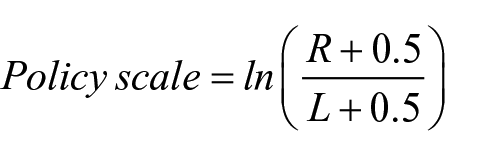
where R is the total number of sentences in the manifesto under codes on the right-wing side of the scale and L is the equivalent figure for codes assigned to the left. Lowe et al (2011a) use this formula to specify policy scales on a wide range of issues. We read committee report summaries and selected one appropriate policy scale (e.g. welfare state, law and order) for each report. To check consistency of coding, a sample of report summaries was manually blind-coded by each author. The inter-coder reliability score was 80% before reconciliation of differences. Once policy scales had been assigned to reports, we measured party positions on each scale for the 2010–2015 Parliament using Lowe et al’s (2011b) transformations of MARPOR data from 2010 manifestos. For the two other Parliaments, we applied their approach to the relevant MARPOR data. In the absence of measures of individual MPs’ policy positions on each issue – for which data are not available – we calculate policy divergence by comparing party positions. We do this using the mean absolute distance between party positions and the position of the party holding the chair. This gives a good sense of the range of party-level views on the policy issue with which a report is concerned. We do this for all parties on each committee. 3 We were unable to assign policy codes to 246 of the 1426 reports as these covered issues where there was no appropriate policy scale derived from manifesto data. These are mainly pre-appointment hearings, assessments of committees’ work or the performance of departments and agencies. There were divisions on 16 (7%) of these reports.
We measured the salience for each party of topics covered by committee reports with Lowe et al’s (2011a) measure of policy importance, based on MARPOR data. 4 The mean policy importance of each report for all parties on a committee was then calculated. We also coded whether committee reports primarily concerned an EU issue by looking at the title, summary and recommendations of a report to establish whether it focused primarily on European integration (e.g. EU policies and UK policy in the EU) or Brexit.
Data on rebellions were collected from Hansard and the Public Whip website. We ranked MPs by their level of rebellion, using attendance and voting lists in the minutes of each select committee report to check how many MPs from among the 30 and – as a robustness check – the 20 most rebellious in each Parliament were present at meetings considering reports (see Tables 2a-2c in the Supplementary Material). The Public Whip treats as a rebellion any vote by an MP on which they are in a minority in their party. 5 This captures votes against the whip but also unwhipped votes. We thus removed votes where both the Conservatives and Labour allowed their MPs a free vote (Priddy, 2018) and those where only one did (e.g. Labour on air strikes in Syria in 2016). We do not measure rebellion by policy area in our multivariate models but consider this in our analysis of the nature of divisions where we examine whether rebels on the EU issue are more likely to be the cause of divisions on the Exiting the EU Committee.
Data were collected on MPs’ preferences on the EU. Given party discipline, a vote in the Commons may not be a true expression of an MP’s preferences. However, on EU issues we have multiple sources of information. Almost all MPs revealed how they voted in the 2016 referendum allowing us to distinguish between Leavers and Remainers. Statements were collected from MPs’ websites and social media. We also recorded rebellions on parliamentary votes on EU issues, classifying Eurosceptics as MPs with records of voting against European integration and/or May’s Withdrawal Agreement on the first meaningful vote. Where a party’s position was to abstain, we counted all who voted as rebels. Where key votes were unwhipped, such as the Conservatives on the indicative votes, we do not include these in tallies of rebelliousness but use them to confirm policy preferences, with hard Brexiteers being MPs who voted for no deal.
Results: Divisions on select committee reports
Divisions (formal votes) occurred on 131 of the 1426 departmental select committee reports (9.2%) between 2010 and 2019, and there were 451 divisions in total. Not all divisions are of all the same magnitude. Those on a final report are most significant as they deny the committee the benefits of producing a unanimous report. MPs can register strong dissatisfaction by tabling an alternative draft report. Across 2010–2019, there were 39 divisions on final reports and 4 on alternative draft reports.
Table 1 shows the incidence of divisions on each select committee across the three Parliaments, with data on divisions on final reports plus all other divisions. Division rates vary significantly. There were no divisions on the Education or Treasury committees, which is remarkable given the salience and contestation on issues they examined.
Select committee divisions, 2010–2019.
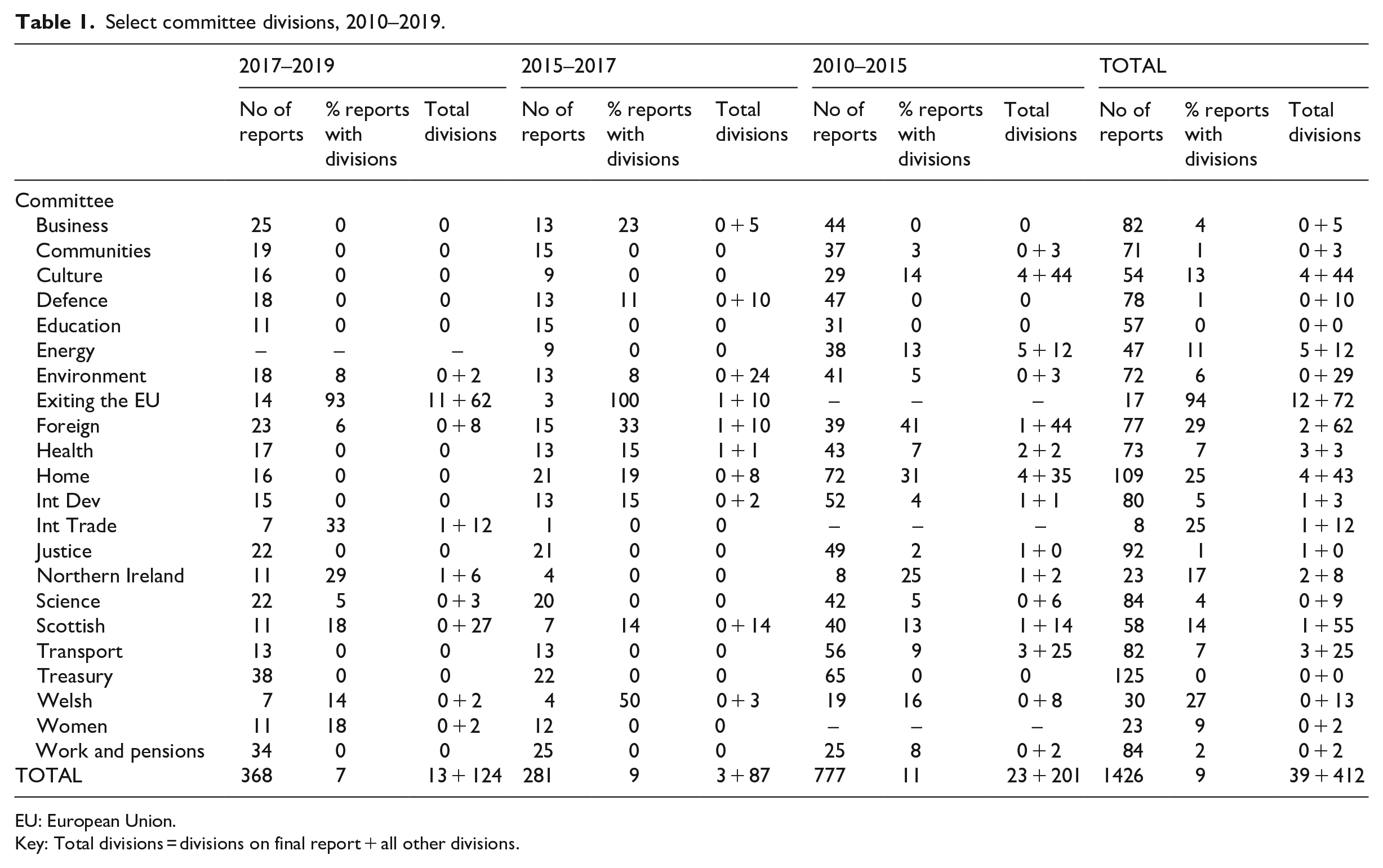
EU: European Union.
Key: Total divisions = divisions on final report + all other divisions.
Our data show the rate of divisions declining from divisions on 11% of reports in 2010–2015, to 9% in 2015–2017 and 7% in 2017–2019. Among these divisions, the proportion that are EU-related increased from 19% in 2010–2015 to 66% in 2017–2019. Departmental select committee engagement with EU issues was limited in 2010–2016: only 22 of 881 reports primarily concerned EU issues. The Exiting the EU Committee accounts for most of the divisions in 2017–2019. Nevertheless, even without it, the proportion of divisions occurring on EU-related reports rises from 19% in 2010–2015 to 27% in 2017–2019. This indicates that Brexit has reduced consensus. Looking only at reports where a committee divided, the average number of divisions on an EU-related report is 4.6 compared to 3.3 for those on other issues.
Table 2 shows that, except for 2010–2015, division rates have been higher on reports focusing on EU than non-EU issues, but these differences are only substantial and statistically significant in 2017–2019.
Division rates on EU-related reports.
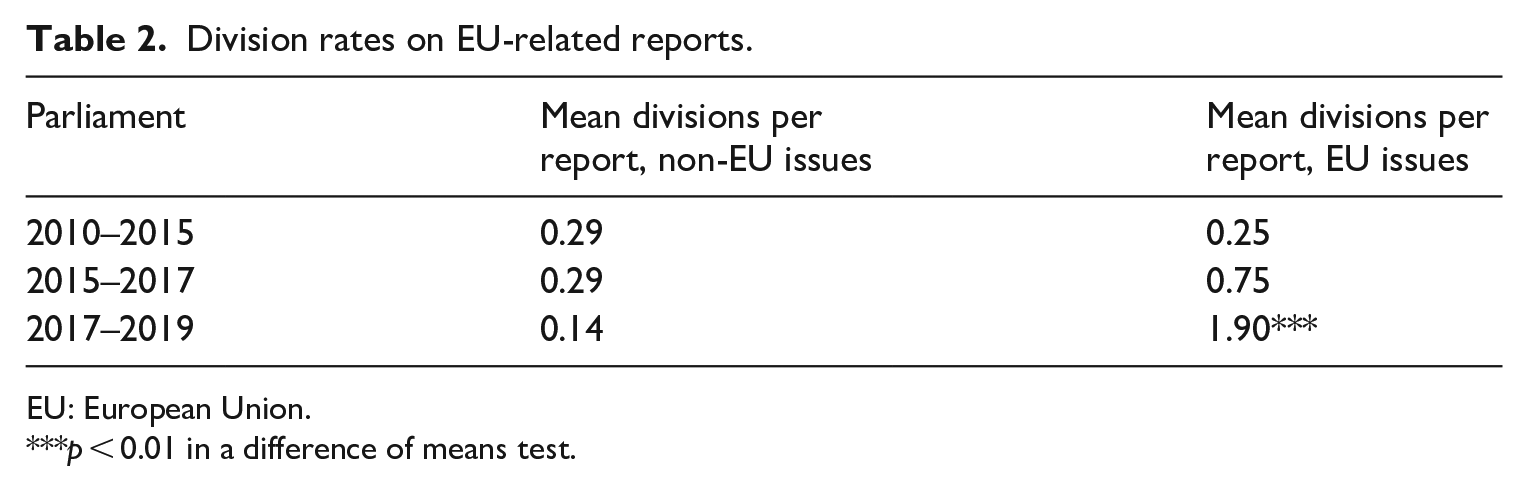
EU: European Union.
p < 0.01 in a difference of means test.
In order to establish whether these differences hold up when we account for other relevant factors, we conducted a multivariate analysis of the variation in numbers of divisions in 2010–2019. Each case constitutes a select committee report. The dependent variable is made up of count data. The starting point for such data would normally be a Poisson regression model but our data are over-dispersed (the conditional variance exceeds the conditional mean) so we use a negative binomial model (Long, 1997: 230–238) which measures the degree of overdispersion.
For our independent variables, we include a dummy variable measuring whether reports were on an EU-related topic. We include the mean distance from the chair of parties on the committee and the mean salience for parties of a report’s subject area, both using the Lowe et al (2011a) approach described earlier. We include measures of the presence of rebellious MPs (based on the top 30 and top 20 most rebellious in each term with these two measures each included in a separate model in Table 3). We include a measure of MPs new to parliament in the relevant term. The three Parliaments we consider are of different durations and had different rates of rebellion. Hence, we include dummy variables for each Parliament (with 2010–2015 as the reference category). We include dummies for each committee with Exiting the EU as the reference category. Results for other independent variables therefore tell us about variations on those variables within committees and parliamentary terms. Descriptive statistics for all the variables are in Table 1 of the Supplementary Material. The results are in Table 3.
Divisions on select committee reports (negative binomial regressions).
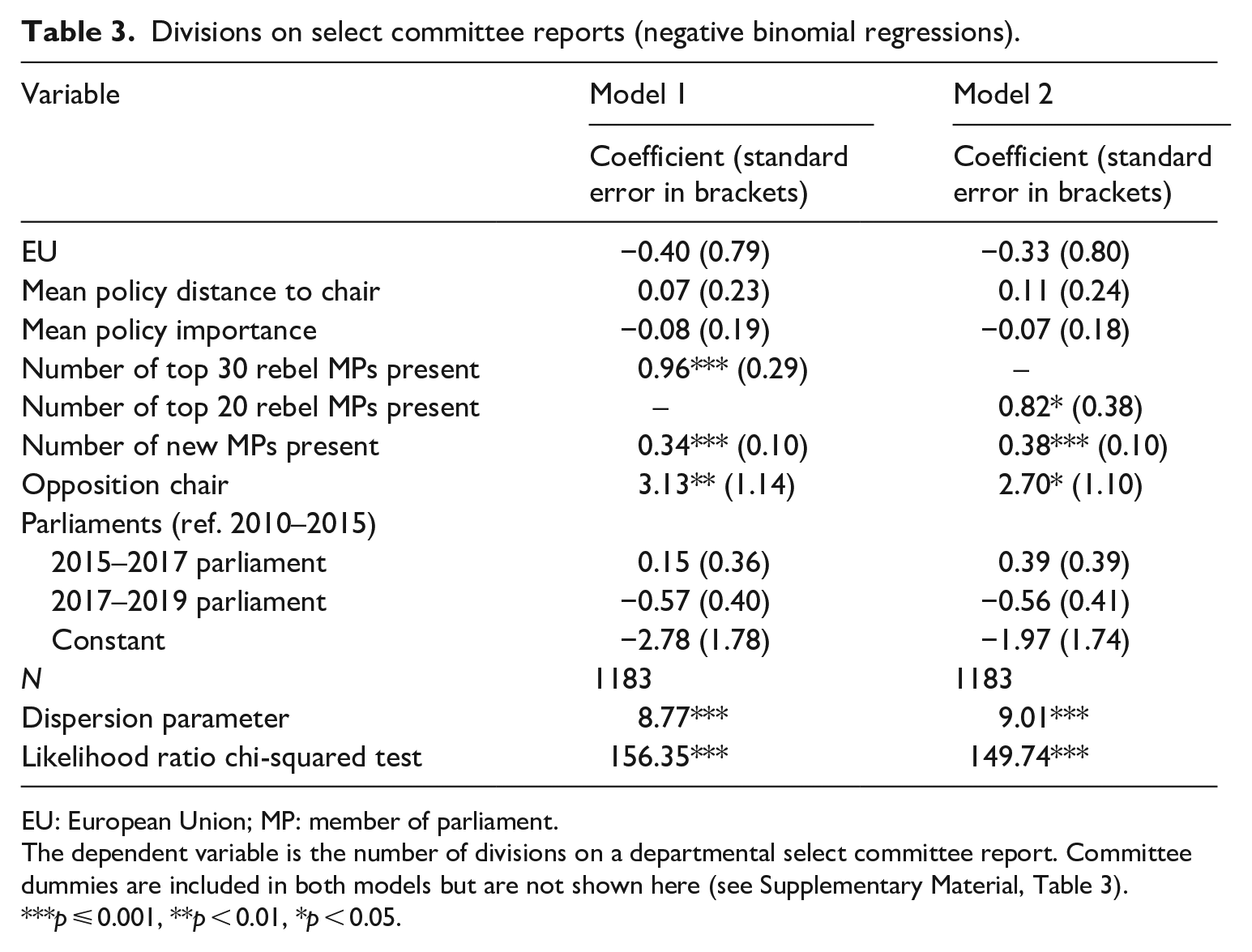
EU: European Union; MP: member of parliament.
The dependent variable is the number of divisions on a departmental select committee report. Committee dummies are included in both models but are not shown here (see Supplementary Material, Table 3).
p ⩽ 0.001, **p < 0.01, *p < 0.05.
Models with the top 30 and top 20 most rebellious MPs both show that, while reports on EU issues are associated with higher numbers of divisions in a bivariate context, this effect does not hold up when we take into account other factors. This is likely due to differences in division numbers for EU compared with non-EU based reports being rather small for the 2010–2015 and 2015–2017 Parliaments, with large, statistically significant differences only present for 2017–2019 in our bivariate measures (see Table 2). Nevertheless, the committee dummies (Table 3 in the Supplementary Material) have negative coefficients in almost all cases. With the Exiting the EU Committee as a reference category, these negative coefficients indicate that committees experience lower numbers of divisions on reports compared with Exiting the EU, although the differences are only statistically significant for 10 committees. This confirms the Exiting the EU Committee as an outlier. Accordingly, we look at this committee, and whether there has been a Brexit effect, in more detail below.
We find no effects for policy differences among parties, or for issue salience. Evidently, many reports are agreed without division on a wide range of topics and with much variation in the policy differences between parties. This suggests that norms of cross-party consensus are strongly engrained. In our data, the biggest gaps between parties on a committee and the chairing party in 2010–2015 were on militarism on International Development where reports were agreed without division, while in 2015–2017 they were on the EU issue on 10 reports across 7 committees but only 1 division occurred. In 2017–2019 period, the biggest gaps concerned the EU on five committees, but divisions only occurred on International Trade.
We do find an effect for the number of MPs who are among the most rebellious in votes on the floor of the chamber. Whether we count those in the top 20 or 30 most rebellious in each of the three Parliaments, we find this variable has a positive and statistically significant effect on the number of divisions. Only around half of the 30 most rebellious MPs in each Parliament were on select committees: 14 in 2010–2015, 16 in 2015–2017 and 17 in 2017–2019. This model cannot tell us whether these MPs are directly responsible for the divisions, something we consider in relation to Eurosceptic MPs below, but it is consistent with the idea that those more likely to dissent in the chamber may also do so in select committees. The findings may also suggest that if rebelliousness is an indicator of policy preferences being far from the median, then policy differences do make a difference to the number of divisions on reports. On legislative experience, we find an effect for the number of new MPs on a committee as expected. This finding is consistent with a socialisation effect where new MPs are less likely to be socialised into committee norms.
The largest effect in both models is the positive effect on the number of divisions of a committee chair being from an opposition party. This might be explained by the government having a majority on these committees (except for 2017–2019). Russell and Benton (2011: 64–65) find that recommendations from reports where the committee is chaired by an opposition MP are more likely to be implemented by governments. While this might seem out of line with our finding concerning divisions, research (Lynch and Whitaker, 2019: 937–938) has shown no clear effect of a division on the likelihood of government accepting a recommendation. Our dummies for parliamentary terms show no statistically reliable differences between terms in numbers of divisions on reports.
Features of select committee divisions
Having explored the incidence of divisions across committees, we now focus on divisions within reports to determine what committee members are dividing on. These formal votes may occur on sections of a report, an amendment, the draft and final report. In total, we have data on 446 divisions occurring between May 2010 and November 2019. 6 The average number of divisions per report is 0.32, or 3.5 if we consider only reports where divisions occurred. Some reports have unusually high numbers of divisions. In all, 42% of all divisions occurred on the 12 reports which saw ten or more votes. These include five reports on EU issues, the Culture, Media and Sport Committee (CMS) report on phone hacking, and reports on climate change (Energy) and military operations in Afghanistan, Iraq and Syria (Foreign Affairs). The most divisions recorded were 26 on the 2014–2015 CMS report on the British Broadcasting Corporation (BBC) and 2019 Scottish Affairs report on drug use.
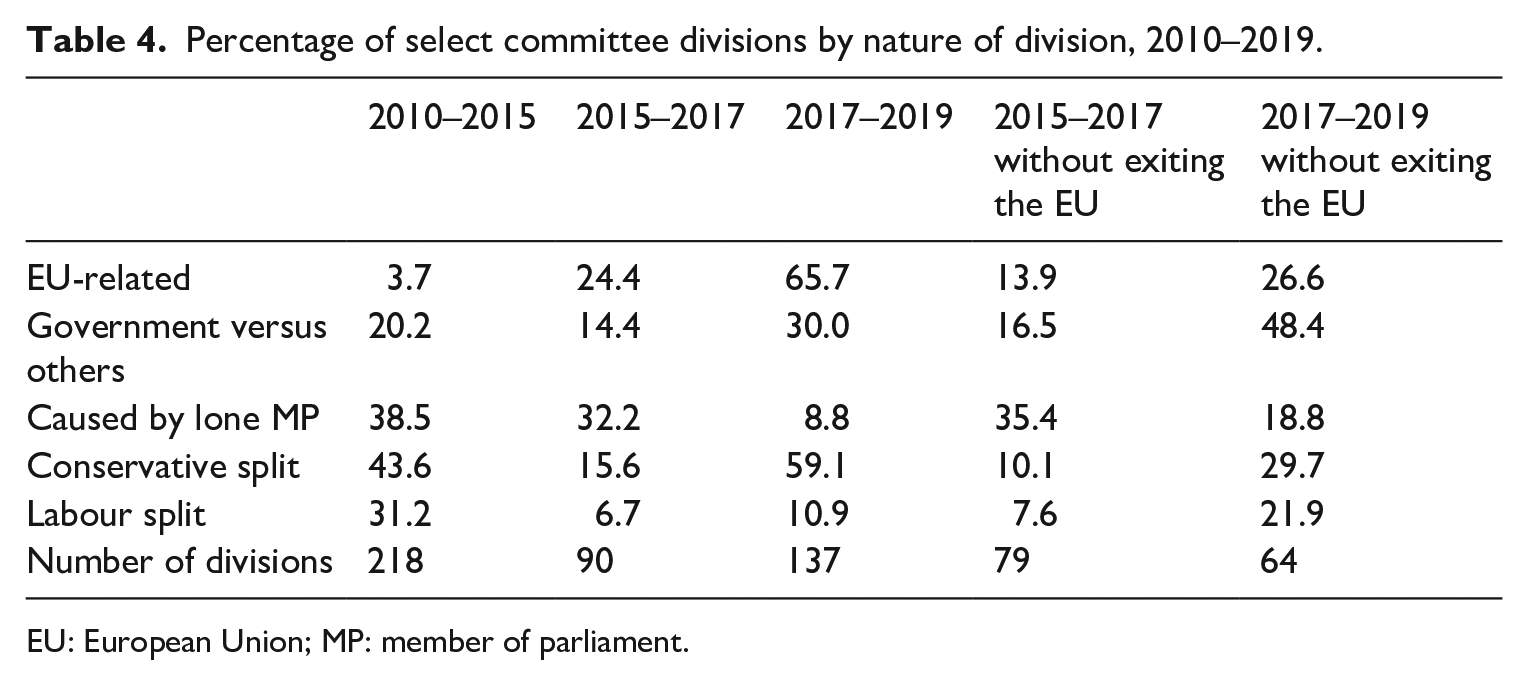
We examined each division to determine voting patterns (see Table 4). When unanimity breaks down in committee, it is not normally the partisan divide seen in Commons votes. Government-versus-opposition votes account for 98 of 446 divisions (22%) across 2010–2019, 7 10 of these occurring on the Exiting the EU Committee. There were 42 cases during the 2010–2015 coalition government when a Liberal Democrat committee member voted differently to Conservatives. This happened on 19% of divisions, offering some support to claims that junior coalition partners use committees to monitor their coalition partners (Martin and Vanberg, 2005). Excluding the Exiting the EU Committee (where, as we show below, most votes see a Remain-Leave split), the proportion of divisions triggered by a lone MP was 28% across 2010–2019.
Percentage of select committee divisions by nature of division, 2010–2019.
EU: European Union; MP: member of parliament.
Conservative MPs voted in different ways on 190 divisions (43% of all divisions), 76 of them on EU issues. Labour was more cohesive, splitting on 90 votes (20%), 12 of them on EU issues. Excluding EU issues, Foreign Affairs produced most intra-party divisions with the Conservatives split on 38 votes and Labour 25. The relationships between variables in Table 4 show that, combining data for all three periods, only 18% of EU divisions involved a government-versus-opposition divide and 12% a lone MP. In all, 63% of divisions on EU issues across 2010–2019 saw a Conservative split but only 10% a Labour split.
With regard to rebellious MPs, we find that 17%, 14% and 6% of amendments on which there were divisions in 2010–2015, 2015–2017 and 2017–2019, respectively, were tabled by MPs among the top 30 rebels in each Parliament (13% overall). This amounts to a pool of only 14, 16 and 17 MPs in each Parliament, respectively, as others among the 30 most rebellious were not on departmental select committees. With our earlier analysis, it seems that while divisions are more likely the more rebellious MPs are present when a report is decided, these rebellious MPs are only sometimes the ones tabling amendments. None of the five most frequent proposers of amendments in 2010–2015 were among the 30 most rebellious MPs in the Commons in that Parliament, although Mike Gapes and Christopher Chope feature on both lists in 2015–2017 and Chope was among the most rebellious as well as being the third most frequent amender in 2017–2019. Many votes in committee are on whether to accept particular paragraphs. While there are no records of which MPs instigated these, we can look at how often rebellious MPs are on the losing side. The proportion of these divisions in which at least one from among the most rebellious MPs was in a minority increases across the three Parliaments from 15% (2010–2015) to 48% (2015–2017) to 51% in 2017–2019.
This evidence suggests our finding of a link between rebellious MPs and divisions is likely explained by committees being less able to avoid formal votes by finding compromises when higher numbers of rebellious MPs are present and, at least since 2015, by rebellious MPs being, in almost half the cases of non-amendment divisions, among those dissenting. Only a minority of Conservative Eurosceptic (2010–2019) and Labour left (2010–2015) Commons rebels are frequent dissenters on committee reports. But, as we show below, Eurosceptic rebels instigated most divisions on the Exiting the EU Committee.
Divisions on EU issues
Table 4 shows that the percentage of committee divisions which are on EU issues has increased substantially, accounting for 66% of votes in 2017–2019. This difference over time is statistically significant (p < 0.001 in a chi-square test of independence). There were 120 divisions on EU issues between 2010 and 2019, 70% occurring on the Exiting the EU Committee. We assessed how much committees are more split on EU issues than others by working out the Rice Index (Clausen, 1977) for all divisions in the 2010–2019 period. This is calculated by finding the absolute value of the difference in the proportion of the committee voting yes and that voting no, and multiplying the result by 100. The index ranges from zero, where a committee is split 50:50, to 100 where all members vote the same way. When we compare Rice Index values for EU and non-EU issues, it is six points lower on average for divisions concerning EU issues. This difference is statistically significant (p < 0.001).
The Exiting the EU Committee
The Exiting the EU Committee is an outlier, recording divisions on 16 of its 17 reports between 2016 and 2019, with 12 divisions on final reports and 84 in total. For the 73 votes on 14 reports in 2017–2019, the average Rice Index value is only 30. The main factor explaining these divisions is the fault line between members who voted Leave in the 2016 referendum and those who voted Remain (Lynch and Whitaker, 2019). This evolved into a divide between those favouring a harder Brexit and those a softer Brexit or staying in the EU, with the former a minority. Of the committee’s members in 2017–2019, 14 voted Remain and seven Leave. Members who voted Remain have an average Rice Index value of 83 and those from opposition parties usually voted together. Members who voted Leave score 98 on the Rice Index in 2017–2019. All were hard Brexiteers who supported no deal on the first indicative votes.
Leavers were responsible for 77% of all divisions, either by proposing amendments or triggering votes on sections they objected to. They were in the majority only seven times in 2017–2019 and five in 2016–2017. Leavers voted against all but one report in 2017–2019 and on the third report (Exiting the EU Committee, 2018), supported an alternative draft report tabled by Jacob Rees-Mogg. This was one of 29 unsuccessful amendments put forward by Leavers since 2016. Peter Bone and Christopher Chope featured in the 30 most rebellious MPs in the Commons in 2017–2019 and, like other Conservative Leavers on the committee, had records of rebellion on EU issues.
The committee also has many of the characteristics that reduce cohesion. It is large (with 21 rather than 11 members), and deals with a salient issue where differences between the parties (with a mean value of 3.1) are considerably bigger than for committees overall (1.3) as measured with our Lowe et al. (2011a) scales. It also has an opposition party chair. Avoiding divisive inquiries was not an option for Hilary Benn who had to consider whether his committee would achieve more by producing bold but non-unanimous reports or bland but consensual ones.
Other committees
There were 36 divisions on EU issues on other select committees in 2010–2019. In all, 13 resulted from a lone MP forcing a vote, 12 saw a government-versus-opposition divide, while Labour MPs split on 11 votes and the Conservatives 8. Notable divisions include seven on two 2017–2019 Northern Ireland Affairs Committee reports on the Irish border which saw a Leave-Remain split, with Leavers in the majority. These are the only cases in which a Labour Leaver (Kate Hoey) voted with other Leavers on an EU issue. Prior to the 2016 referendum, only three reports on EU issues saw divisions.
Eurosceptics were responsible for 21 of the 36 divisions on EU issues (58%). They voted cohesively on 32 and were in a majority on 10. But Eurosceptic dissent in committees was much less pronounced than in Commons’ votes, where 115 Conservatives rebelled on a vote on an EU issue in 2010–2016 and 179 rebelled in 2017–2019. Most were Leave supporters. 23 of the 37 Conservatives who rebelled on 20 or more Commons’ votes on EU issues across 2010–2019 served on departmental select committees. Four were involved in divisions on the Exiting the EU Committee. Divisions on EU issues were forced by Chope on Scottish Affairs, Mark Reckless on Home Affairs, Nigel Mills on Northern Ireland Affairs, and Andrew Rosindell on Foreign Affairs. Seven of the ten Labour MPs who voted Leave were select committee members in 2010–2019 but none instigated a division on an EU issue. There is limited overlap between the 30 most rebellious MPs overall and those most rebellious on the EU issue. Nine of the top 30 rebels in 2010–2015 were among the 30 most rebellious on EU issues, equivalent figures for 2015–2017 and 2017–2019 being 12 and 11, respectively.
This suggests that, aside from the Exiting the EU Committee, Eurosceptics did not regard departmental select committees as a key arena. They focused on other approaches, persuading the Backbench Business Committee to table the 2011 motion on an EU referendum that saw 81 Conservatives rebel. They also used the European Scrutiny Committee, on which Eurosceptics have had a majority since 2010, to press their case. It recommended that the Commons should be able to block new and disapply existing EU law (European Scrutiny Committee, 2013).
Despite the higher than average incidence of divisions on EU issues, unanimity remains the norm. In 2017–2019, 30 of 35 EU-related reports produced by committees other than Exiting the EU achieved unanimity, covering issues including customs, immigration (Home Affairs), transitional arrangements (Treasury) and the impact of Brexit (Business, Energy and Industrial Strategy). Between 2010 and 2017, 29 of 33 EU-related reports from other committees were agreed unanimously, covering topics such as the Common Fisheries Policy (EFRA), Turkish accession and a no deal Brexit (Foreign Affairs). The Treasury Committee, with three Eurosceptic members, discussed its 2016 report on the costs and benefits of EU membership over 2 days before reaching consensus, illustrating how committees strive for unanimity.
Conclusion
We have shown that the rate and number of divisions on departmental select committees is higher than is often assumed given the emphasis on achieving unanimity. Looking at variation in the number of divisions at report level, some expectations derived from the comparative study of legislative committees were borne out in the case of House of Commons non-legislative select committees. On MPs’ preferences and experience, we found the presence of larger numbers of new MPs was associated with higher numbers of committee divisions. This is consistent with our expectation that socialisation would affect the frequency of divisions on the basis that new MPs have had less time to build up trust and be socialised into norms of consensus. We showed that divisions are more frequent when an opposition party chairs a committee, perhaps reflecting the tension between government majorities on committees and opposition leadership. This variable also proves significant in Russell and Benton’s (2011) research using a related dependent variable – whether select committee recommendations are implemented by governments. Taken together, these findings indicate the importance of whether a select committee is chaired by an opposition MP for levels of division and influence.
We do not find evidence that larger differences in party positions and in the salience of issues dealt with by committees increase the incidence of divisions. Evidently, unanimity on departmental select committees is the norm even with large party policy differences. However, divisions within parties are significant for committee unity. We found that the presence of higher numbers of rebellious MPs, which we take as a proxy for those with more extreme preferences within their parties, are associated with higher numbers of divisions, something that could be tested in other legislatures. Aside from the Exiting the EU Committee, there is little evidence of coordinated ‘awkward squad’ activity on select committees, consistent with Geddes’ (2019) finding that committee practices help to generate consensus. Our analysis shows that when consensus breaks down, the partisan divide found in the Commons does not usually appear in committees. More divisions occur because of intra-party splits (particularly Conservative) or a lone MP.
As for institutional factors, it is perhaps no coincidence that the largest select committee (Exiting the EU) is the most divided. Select committees control their own agenda, something that Damgaard and Mattson (2004) found was associated with higher levels of conflict, but on the other hand, they deliberate on reports in private, which likely contributes to high levels of unanimity.
While we do not find that numbers of divisions on reports are higher for EU than non-EU issues in a multivariate context, we have nevertheless uncovered evidence of a Brexit effect. Numbers of divisions on EU-related reports are substantively and statistically significantly higher than those on other reports in 2017–2019. This reflects the divisive nature and salience of Brexit. The Exiting the EU Committee is an outlier in both the number of divisions and its Leave versus Remain fault line. It is alone in experiencing sustained Eurosceptic dissent, which is far less pronounced in committees than on the floor of the House.
A notable feature of the Brexit process in parliament is the much greater interest shown in EU issues than prior to the 2016 referendum. The number of committee divisions on EU issues rises in 2017–2019 even if we exclude the Exiting the EU Committee. But the scale of divisions in the chamber has not transferred to the committee room. To this extent, the Brexit effect on select committees is limited: most reports are agreed by consensus. Indeed, the overall incidence of committee division is lower in 2017–2019 than in the 2015–2017 or 2010–2015 Parliaments. One explanation to consider in future research is that minority government increases the likelihood of select committees influencing policy and the incentives to agree unanimous reports. However, it is difficult to separate the effects of minority government and Brexit, with the latter pushing other issues off the agenda. Future research might also build on our analysis to assess the effect of more nuanced measures of socialisation (such as whether MPs are incumbents on a committee and the duration of their membership) on the likelihood of divisions in committees.
Supplemental Material
BJPIR-1797.R2_-_Supplementary_Material – Supplemental material for Unity and divisions on departmental select committees: A Brexit effect?
Supplemental material, BJPIR-1797.R2_-_Supplementary_Material for Unity and divisions on departmental select committees: A Brexit effect? by Philip Lynch and Richard Whitaker in The British Journal of Politics and International Relations
Footnotes
Acknowledgements
The authors would like to thank the MPs and parliamentary clerks who agreed to be interviewed for this research project, and the anonymous reviewers for their constructive comments on the article. They are also grateful to the University of Leicester for granting them periods of study leave to conduct this research.
Declaration of conflicting interests
The author(s) declared no potential conflicts of interest with respect to the research, authorship, and/or publication of this article.
Funding
The author(s) disclosed receipt of the following financial support for the research, authorship, and/or publication of this article: This work was supported by an Economic and Social Research Council Brexit Priority Grant (grant number ES/R000646/1).

Supplemental information
Notes
References
Supplementary Material
Please find the following supplemental material available below.
For Open Access articles published under a Creative Commons License, all supplemental material carries the same license as the article it is associated with.
For non-Open Access articles published, all supplemental material carries a non-exclusive license, and permission requests for re-use of supplemental material or any part of supplemental material shall be sent directly to the copyright owner as specified in the copyright notice associated with the article.
