




Abstract
This study examines the ways in which and reasons why the remaining Member States of the European Union, the EU 27, communicated about Brexit on the most popular social media in politics – Twitter, by drawing on a multi method examination of UK-based EU 27 diplomatic entities’ Twitter practices during the process of Brexit negotiations. The findings suggest that the EU 27 maintained message consistency on the topic of Brexit on Twitter, supporting the EU’s negotiating position, demonstrating internal cohesiveness and potentially contributing to the EU’s effectiveness in the Brexit negotiations. Our study also reveals that the framing of Brexit on Twitter was deliberate and strategic, but with a range of different motivations behind the promotion of certain frames. Finally, Twitter is seen by diplomats as a tool conducive to meeting public diplomacy’s aim of relationship-building, but not one to be used for advocacy and influencing interpretation of controversial Brexit issues.
Introduction
When the then President of the European Council, Donald Tusk, tweeted in February 2019 ‘I’ve been wondering what that special place in hell looks like, for those who promoted #Brexit, without even a sketch of a plan how to carry it out safely’, political communication actors in Europe went into a frenzy. Citizens, media and political actors took sides and either praised Tusk for such public expression of a controversial opinion on the United Kingdom’s withdrawal from the European Union (EU) or condemned him for it. This episode brought to light benefits, but also disadvantages, of political actors’ use of social media in framing a highly sensitive topic during international negotiations. It also raised another question on the agenda – how do other stakeholders in the Brexit process communicate about it on social media?
This study applies the concept of framing, and in particular strategic framing in political public relations, to examine the ways in which and reasons why the remaining Member States of the EU, the EU 27, communicated about Brexit on the most popular social media in politics – Twitter. Consequently, the paper sheds light on message discipline among EU Member States and the degree of the EU’s internal cohesiveness as observed through external representation. This is achieved through a multi method examination of the UK-based EU 27 diplomatic entities’ Twitter practice during the process of Brexit negotiations.
In doing so, the paper draws on the growing body of literature which considers public diplomacy a strategic political communication practice which relies on tools and techniques of political public relations to achieve its goals (Dodd and Collins, 2017; Golan, 2013; Golan and Viatchaninova, 2014; Kiousis and Stromback, 2014; Molleda, 2011). The focus is put on strategic framing, which is conceptualised and operationalised as one of these communication techniques (De Bruycker, 2017; Froehlich and Rüdiger, 2006; Golan, 2013; Hallahan, 2011), and social media as a tool through which it can be applied. Consequently, this is a theoretically and empirically highly interdisciplinary study which draws on, and contributes to, literature on political communication, international relations, public relations, public diplomacy and digital media.
The main research question that the study aims to answer is: How, if at all, have the Brexit framing strategies among the EU 27’s diplomatic entities on Twitter reflected/supported the EU’s negotiating positions and what motivated particular framing strategies? As will be argued in more detail in the following sections, this issue matters as the EU has drawn power from the notion of the EU 27 being ‘united’ on the issue of Brexit (McTague, 2019), and there is evidence to suggest that this unity, often showcased through internal cohesiveness, makes the EU more effective in international negotiations (Da Conceição-Heldt and Meunier, 2014). Before unpacking this argument in more detail, the paper will discuss the key concepts that the study draws upon – strategic framing and message discipline – and examine the state-of-play of their application in the field of public diplomacy and its social media dimension.
Strategic framing in public diplomacy
An increasing body of scholarship conceptualises one outward-facing diplomatic dimension – public diplomacy – as a form of strategic governmental communication, given its focus on agenda setting, advocacy, influencing interpretation of issues and events and relationship-building (Dodd and Collins, 2017; Golan, 2013; Golan and Viatchaninova, 2014; Kiousis and Stromback, 2014; Molleda, 2011). Given the aims of public diplomacy conceptualised in this way, it is evident it should be considered as closely related to political public relations, which Strömbäck and Kiousis (2011: 8) define as: the management process by which an organisation or individual actor for political purposes, through purposeful communication and action, seeks to influence and establish, build, and maintain beneficial relationships and reputations with its key publics to help support its mission and achieve its goals.
In this sense, it can be expected that public diplomacy will rely on practices and tools of political public relations to achieve its goals.
One of the practices that can be employed in this regard is framing, one of the most discussed and studied concepts in political communication (Brugman and Burgers, 2018; De Bruycker, 2017). This study is primarily concerned with strategic framing as practised by political actors; a technique of selecting and promoting some aspects of a topic at the expense of others with an aim ‘to promote a particular problem definition, causal interpretation, moral evaluation, and/or treatment recommendation for the item described’ (Entman, 1993: 52). Given the definition of strategic framing, this concept can be conceptualised as an intentional and strategic political communication practice (De Bruycker, 2017), that is, a technique of political public relations (Froehlich and Rüdiger, 2006; Hallahan, 2011). In this regard, scholars have in the past most frequently examined three types of questions. First, how do actors, primarily political parties, politicians, states and social movements, frame certain topics (Golan, 2013; Golan and Viatchaninova, 2014; Groshek and Al-Rawi, 2013; Hänggli and Kriesi, 2012; Hon, 2016). Second, how effective are political actors in setting the media agenda (Froehlich and Rüdiger, 2006; Wäscher, 2017). And third, what kind of effects does strategic framing have, or can it have, on audiences/voters (Schatz and Levine, 2010).
It is considered common knowledge in the field of strategic communications, and political marketing in particular, that one of the most important factors leading to successful framing is the message discipline – consistent and coordinated repetition of the main message(s) or frame(s) across all potential communicators and platforms (Freelon, 2017; Scammell, 1999). This discipline in strategic framing and its potential effects are most frequently examined in the context of political campaigns, with scholars studying the extent to which parties, candidates and other political groups have ‘stayed on message’ during campaigns and consequently, how, if at all, this helped them raise certain issues and their interpretations on the agenda and achieve their political goals (Benoit et al., 2011; Norris, 1999).
While studies looking at strategic framing in public diplomacy are rare, those that exist offer a good starting point for conceptualising communication tools that are often used in this context. For example, Golan and Viatchaninova (2014) suggest that diplomats and diplomatic missions can try to communicate their frames by using a range of tools, including sending press releases, creating specialised websites, writing op-eds and/or paying for advertorials in media outlets of the host country. Given the digital context in which diplomacy is nowadays practised, an obvious, yet often overlooked, tool that diplomats have at their disposal for direct and unmediated framing are social media.
Public diplomacy on social media
The past decade saw an increase in the scholarly interest in strategic communication on social media in the context of public diplomacy, and rightly so, as the use of social media, and in particular Twitter, in diplomacy, has become a norm rather than innovation. According to Lüfkens (2018), 97% of all governments use Twitter, as well as more than 4,600 embassies and 1,400 ambassadors. The second most used social network is Facebook, followed by Instagram (Lüfkens, 2018).
While important strides towards unpacking and analysing strategic diplomatic communication on social media have been made, this area of research is still considered to be fairly new and underdeveloped (Park et al., 2019; Vanc and Fitzpatrick, 2016). The early attempts at analysing diplomatic entities’ use of social media mostly approached the topic from the perspective of digital media, trying to gauge the extent to which social media as a tool of communication has been used, the ways in which diplomatic actors use social media, and the extent to which they make use of platforms’ mechanisms and affordances in their social media output (see, e.g. Bjola and Jiang, 2015; Strauß et al., 2015; Zhong and Lu, 2013). These studies often concluded that social media is used as a personal relations (PR) tool for one-way communication with foreign publics.
This body of scholarship gives us a good idea of the level of acceptance of the ‘new’ communication tools in diplomacy and actors’ competence in using them, but it does not significantly further our understanding of how diplomatic entities use social media to try to achieve some of the main public diplomacy goals, such as agenda-setting, advocacy and relationship-building. Several, yet rare, studies have engaged with this research agenda. Bjola and Jiang (2015) analysed agenda-setting practices of the Japanese and the US embassies and EU representation in China by examining the topics these diplomatic missions have been communicating on social media. Dodd and Collins (2017) added to this through an analysis of tweets posted on accounts of 41 embassies from Western and Central Eastern Europe based on their content and public relations strategies used. Further, Sevin and Ingenhoff (2018) examined the ways in which government-run or funded Twitter accounts of Australia, Belgium, New Zealand, and Switzerland engage in relationship-building and image management. While these studies suggest that social media is being used as a tool for achieving public diplomacy goals, we are yet to develop a more thorough understanding of how and why social networks are being used as tools of strategic communications in public diplomacy.
Based on this overview, there are several other important limitations of the existing literature. In the first place, we know little about how international organisations with political mandates, such as the EU, and diplomatic entities, participate in strategic framing. Next, current scholarship rarely provides insight into why political actors strategically frame certain topics in a particular way. Finally, there is little insight into ‘internal’ effects of strategic framing – consequences that a focus on a particular aspect of an issue and message discipline, or lack of it, has on the political actor that promotes it (e.g. internal cohesiveness and unity).
Study context
This study aims to explore the practice of strategic framing in public diplomacy on the example of the Brexit negotiation, that is, the United Kingdom’s withdrawal from the EU. This was a high-stakes, complex international negotiation between the United Kingdom on the one side and the EU and its Member States on the other. The United Kingdom voted to leave the EU in the referendum held on 23 June 2016 and started its official withdrawal on 29 March 2017 by invoking the Article 50 of the Treaty on European Union. This marked the start of the negotiations during which the involved parties aimed to decide on the conditions of the United Kingdom’s withdrawal from the EU and the contours of their future relationship.
These negotiations represent an interesting context to examine strategic framing of actors practicing public diplomacy. It involved 27 EU Member States with sometimes differing priorities and interests, which could have been advocated for via public diplomacy efforts (Durrant et al., 2018; Eidenmuller, 2016), but the negotiations were led by the European Commission and there was also a call for unity among EU 27 which would demand message discipline (McTague, 2019). Regarding the differences among the EU 27, for example, aims to protect EU citizens’ rights, secure financial settlement, and find a solution for the border between Ireland and Northern Ireland were often described as common priorities of the EU 27 (Durrant et al., 2018), but actually, these issues had different value to various Member States. It is argued that, for example, France and Poland were most concerned with securing a financial settlement to protect the EU budget; countries with large diasporas in the United Kingdom, and Eastern European Member States in particular, were focused on protecting the rights of their citizens living and working in the United Kingdom; Spain was prioritising the issue of Gibraltar; Ireland’s priorities were on avoiding a hard border with the United Kingdom; neighbours, such as Netherlands, Baltic and Nordic states were oriented towards the future relationship and wanted to negotiate a strong and close relationship with the United Kingdom in the post-Brexit period (Durrant et al., 2018; Eidenmuller, 2016). Hence, it can be argued that different Member States, while represented in the negotiations by the EU, had a range of different priorities and interests in these negotiations, which arguably could have led its public diplomacy to use strategic communications to frame Brexit around particular issues and advocate for their particular interests.
However, in spite of different national priorities and issues that the EU was experiencing on an internal level, there was a call for unity and cohesiveness in the Brexit process. According to McTague (2019), the then EU Council President Donald Tusk had been lobbying with leaders of the EU 27 even before the referendum to present a ‘united front’ in the potential Brexit process. The first ‘Lines To Take’ (LTT) on Brexit, a communications tool disseminating the common messages to be reproduced by the EU 27, was sent to Member States before the results of the Brexit referendum were officially published. The EU has been dealing with numerous internal and external challenges in the past decade, which are considered to have shown the lack of unity and cohesiveness among the Member States (Durrant et al., 2018; Gamble, 2017; Smith, 2017). In this context, the withdrawal of the United Kingdom was perceived as an opportunity for the EU to showcase the solidarity among its members, unity and internal cohesiveness (Gamble, 2017; Smith, 2017). This could, consequently, increase its strength and power in the Brexit negotiations and on the international level more generally.
Indeed, it is often argued that the EU is most effective in negotiations when it is ‘seen to speak with a single voice’ (Van Schaik, 2013). This is most evident in a show of internal cohesiveness, which Da Conceição-Heldt and Meunier (2014: 966) define as the ‘EU’s ability to formulate internally and represent externally a consistent position with a single voice, even if this is not the preferred position of all the member states’. The authors further argue that while internal cohesiveness is not always the main factor of EU’s effectiveness, there is sufficient evidence to suggest that it is often an important element that contributes to the EU’s success in negotiations (Da Conceição-Heldt and Meunier 2014: 975). Hence, it doesn’t come as a surprise that the EU institutions and leaders put significant effort into securing and showcasing internal cohesiveness in Brexit negotiations. It can be argued that the ‘united front’ has been successfully presented by formulation of common positions on Brexit in spite of internal divergences (Durrant et al., 2018). However, we know far less about the extent to which the EU 27 showcased internal cohesiveness via external representation. Two indicators could be used to capture this by drawing on Da Conceição-Heldt and Meunier’s (2014) conceptualisation of the ‘output’ dimension of internal cohesiveness. First, to what extent did the EU 27 keep aside in the negotiations, allowing the Chief Negotiator Michel Barnier to represent them? And second, did the EU 27 stand behind the collective position and practice message discipline in communicating it?
This study aims to fill this gap by examining the ‘output’ dimension of internal cohesiveness through the practice of strategic framing in the EU 27’s public diplomacy efforts. In particular, this research aims to answer the main research question: How, if at all, have the Brexit framing strategies among the EU 27’s diplomatic entities on Twitter reflected/supported the EU’s negotiating positions and what motivated particular framing strategies?
Research design
The main research question has been operationalised through three sub-questions:
RQ1: To what extent did the EU 27 use Twitter to position themselves as active players in the Brexit process?
RQ2: How have the EU 27 framed Brexit on Twitter?
RQ3: What were the motivations of diplomatic entities in pursuing particular framing strategies?
To answer these research questions, the study combined Twitter analysis with qualitative interviews. Twitter has been chosen as a social network that is most used for political purposes and by political actors, diplomatic entities in particular (Lüfkens, 2018). Further, given the research approach, the study focused on the examination of issue-specific and emphasis frames (Brugman and Burgers, 2018). Accordingly, RQ1 relies on two indicators: the focus that was put on Brexit in diplomatic entities’ overall Twitter output and the extent to which actors expressed position on, and sentiment towards, Brexit. Answering RQ2 draws on the examination of thematic frames used in Brexit-related tweets and sentiments expressed towards particular frames. RQ3 is answered through a series of qualitative interviews.
Twitter analysis
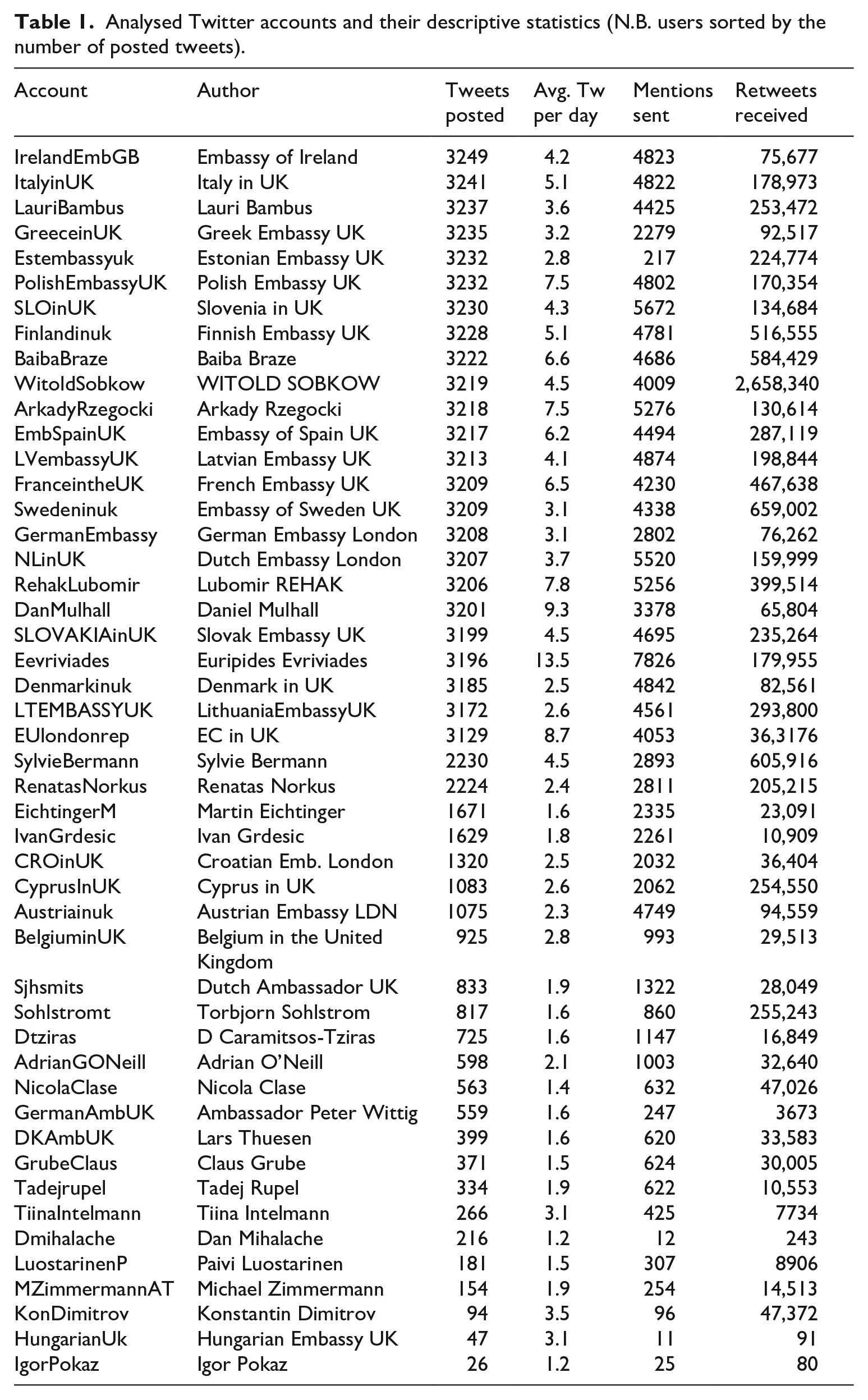
Twitter analysis has been used to answer RQ1 and RQ2. In the first step, a list of all EU 27 missions based in the United Kingdom (e.g. @IrelandEmbGB) and their heads (e.g. @AdrianGONeill) that have an active Twitter account has been designed, supplemented by the Twitter account of EU representation in the United Kingdom as the diplomatic mission of the EU itself. Their tweets have been analysed since the 29 March 2017, when the United Kingdom triggered article 50, until 29 January 2019, when the House of Commons voted on preferable ways forward after rejecting the negotiated Withdrawal agreement. This allows us to examine the EU 27’s public diplomacy strategies during negotiations, in preparations for the ratification of the negotiated deal and in the immediate aftermath of its first rejection by the UK parliament. A Python script programmed for interrogating the Twitter REST API 1 (Russell, 2013) was used to collect data from 48 relevant Twitter accounts (see Table 1). 2 The data were pulled using the ‘GET statuses/user_timeline’ method, which allows developers to get, roughly, the 3,200 most recent tweets published by a given user. 3 The initial dataset contained 93,917 tweets. Two subsets of data were extracted from this dataset; the sample of all tweets published in the specified time period (N = 19,470); and from this, the sample of all tweets in which United Kingdom’s withdrawal from the EU has been mentioned (N = 1,696), so the Brexit-related tweets can undergo a more detailed analysis. Hashtag and automated textual analysis have been applied on the first sample in order to construct the first indicator aiming to answer RQ1 – to grasp the extent to which EU 27 focused on Brexit in general in their Twitter messages. The second sample, that of Brexit-related tweets, has been subjected to hashtag analysis, automated textual analysis and content analysis, with an aim to answer RQ1 and RQ2 – to establish the position/sentiment and thematic frames used by the EU 27 in communicating about Brexit.
Analysed Twitter accounts and their descriptive statistics (N.B. users sorted by the number of posted tweets).
Hashtag and automated text analysis
For hashtag analysis, an ad hoc Python script was used for extracting hashtags from the database, counting their occurrences, and sorting them from the largest to smallest. Regarding the automated text analysis, another Python script was programmed for excluding hashtags from the text of the tweets in the first step and then extracting keywords, counting their occurrences, and sorting them from the largest to smallest. Using the same script, trigrams were also extracted and counted, that is, strings of three words occurring together and in the same order within the text of the tweets. Differently from simple keywords and/or bigrams, they gave a sense of the phrases appearing in the messages; this, in turn, helps in reconstructing context around tweets (Ghiassi et al., 2013).
Content analysis
To analyse the different framing strategies through which the EU 27 addressed Brexit (RQ1 and RQ2), a qualitative content analysis was used, meaning that coding categories emerged from the texts through a grounded and iterative process of close reading (Glaser and Strauss, 2009). With a tweet as the unit of analysis, this method was used to study two main frame types: thematic and position/sentiment frames. Thematic frames were designed by following the digital method approach of content analysis for social media texts (Caliandro and Gandini, 2017), which exhorts researchers to take advantage of metadata and digital keywords to construct coding categories. In this case, coding categories were defined by drawing on hashtag and automated text analysis and in the end consisted of EU Citizens (rights, info meetings etc.), Irish border, Brexit Process (updates, negotiations, withdrawal agreement, ratifications etc.), Economy, Post-Brexit (relationships, effects etc.), European Union, Discussion (general meetings, events, statements), and Other. The variable coded for the dominant frame in a tweet. Regarding the sentiment frame, tweets were coded for sentiment towards Brexit using the three standard categories of sentiment analysis: Positive, Negative, Neutral. A separate variable coded for the presence or absence of the author’s opinion towards Brexit (position frame). Two coders manually coded the 1,696 tweets, with a 10% of the sample double coded for establishing the inter-coder reliability. Krippendorff’s alfa for variable measuring thematic frames is 0.93, for sentiment frame is 0.78 and for position frame 0.88.
Interviews
In order to answer RQ3 and develop an understanding of the motivations behind particular framing strategies, semi-structured interviews were conducted with the EU 27’s London-based heads of mission and mission staff in charge of social media communications. The interview method was deemed the most appropriate method to explore actors’ experiences, motivations and interpretations of employed communication practices (King and Horrocks, 2010). The semi-structured approach ensured that the findings were comparable among interviewees, but the interviewees were able to explore topics they find important relating to the research question (Clarke and Braun, 2013).
All heads of mission and missions that have tweeted about Brexit in the examined time period were invited to participate in interviews, with 15 interviewees accepting the invitation from 10 different missions – Austria, Croatia, Cyprus, Denmark, Estonia, Greece, France, Finland, Italy, and Netherlands. Of the 15 interviewees, 13 held diplomatic positions, while two were locally hired staff. Their positions included Head of Mission, Head of Press, Political Councillor, Press Councillor, Press Attaché, Public Affairs Officer, Communications Advisor and Special Advisor. The name of each participant has been anonymised, as customary in qualitative research (Denzin and Lincoln, 2011). Consequently, contributions are presented with reference to interviewee’s position and two country indicators that were induced from the Twitter analysis findings. Specifically, it appears that countries with higher levels of export to the United Kingdom and/or those with larger number of their citizens living in the United Kingdom were more active in tweeting about Brexit. In line with this, each quote is presented with reference to export and citizens by drawing on data from Durrant et al. (2018). The median of EU 27’s export is 6%, and the median number of citizens in the United Kingdom is 89,000, so these values were used as benchmarks (i.e. each indicator is presented as under/over the median). The interviews were conducted throughout March 2019 in a face-to-face manner, on average lasting just under 25 minutes (the longest interview was 43 minutes, and the shortest 14 minutes). Each interviewee was presented with findings of the Twitter analysis related to the account they manage, and they were asked to contextualise the findings by explaining why specific topics were emphasised and what were the motivations to tweet or not to tweet about Brexit in a particular way.
Findings
‘Don’t tweet anything about Brexit’
The first indicator aiming to establish whether the EU 27 were positioning themselves as active players in the Brexit negotiations is based on the extent to which their Twitter output focused on Brexit. The hashtag analysis of all tweets published by the EU representation and EU 27’s diplomatic entities in the United Kingdom shows that Brexit was one of the main topics that these actors focused on in their Twitter output, as #Brexit was by far the most frequently used hashtag (see Table 2). This is further reinforced by the results of the automated textual analysis of all tweets published in the examined period, as Brexit was the fifth most frequently mentioned word in the sample.
Top 5 most frequently mentioned hashtags and words in the examined period (N = 19,470).
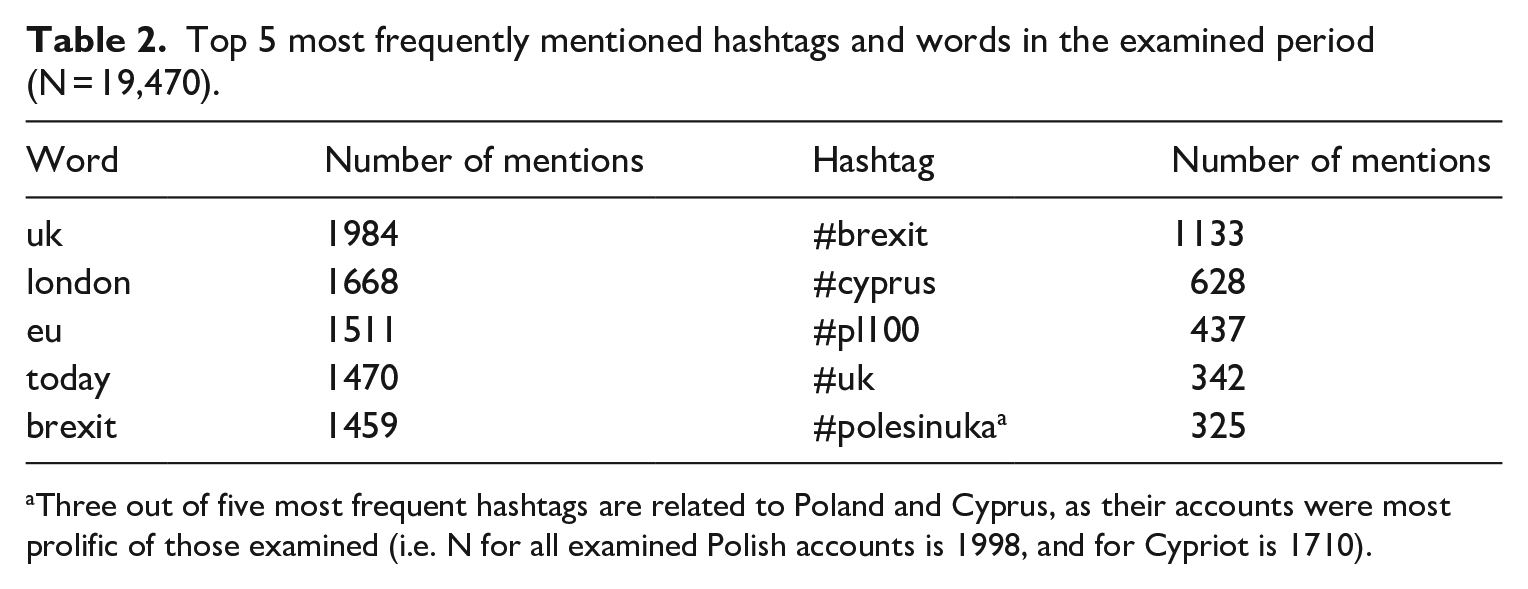
Three out of five most frequent hashtags are related to Poland and Cyprus, as their accounts were most prolific of those examined (i.e. N for all examined Polish accounts is 1998, and for Cypriot is 1710).
However, the examination of the quantity of messages that focused on Brexit by diplomatic entity shows an important caveat – it appears that the messaging about Brexit was primarily the role of the EU representation, which has heavily focused on this topic on Twitter – almost every other tweet was concerned with it (see Table 3). With some exceptions, the results suggest that the EU 27 often didn’t frame Brexit as a priority in their Twitter output – the topic was mentioned on average in 5.3% of all tweets of heads of mission, and in 5% of tweets from mission accounts. This would suggest that the main messaging was left to the EU representation while the diplomatic entities of the EU 27 took a back seat in this communications process.
Percentage of tweets mentioning Brexit in relation to all published tweets by actor (N = 19,470).
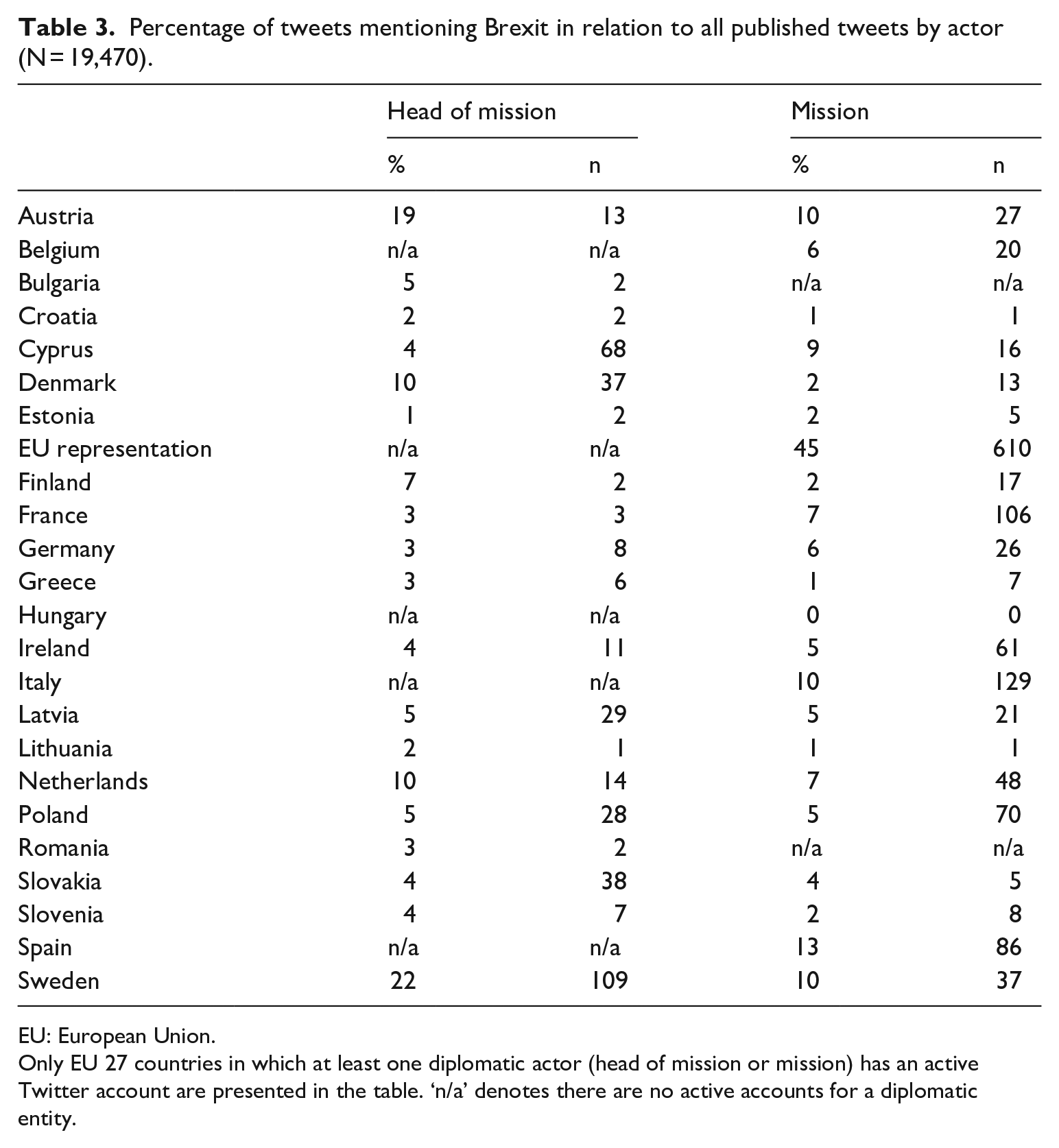
EU: European Union.
Only EU 27 countries in which at least one diplomatic actor (head of mission or mission) has an active Twitter account are presented in the table. ‘n/a’ denotes there are no active accounts for a diplomatic entity.
Interviewees often described the reason for low focus on Brexit by its controversial nature: Communications advisor (exports over 6%; more than 89,000 citizens living in the United Kingdom) In the beginning they’ve told me: ‘Don’t tweet anything about Brexit, just stay away from it, as if it’s not happening’. [I thought] That’s a bit strange. That’s the biggest issue at the moment. I can’t not mention it at all! But I understand we have to be careful with everything. So, in the beginning, in the first few weeks, I tried to do only tweets about things like, I don’t know, cultural exchange and so, but that’s not what we do at the embassy – we’re busy with Brexit every day and everything we do is impacted by Brexit, so I can’t stay away from it. So, I started doing it more. Press attaché (exports over 6%; less than 89,000 of citizens in the United Kingdom) It’s really very simple. Brexit is a divisive issue. And I’m here to build bridges. There are so many things between my country and UK that transcend Brexit. Of course, we’re also sad to see the British leave. But there are so many things when it comes to culture, trade, political values, that unite us. And that’s what I’m focusing on.
Also, the fact that the official negotiations were taking place in Brussels and were conducted by the European Commission was cited by several interviewees, who saw it as a reason not to focus on Brexit in their social media output. For example, one diplomat explained the low focus on Brexit in this way: Press Councillor (exports under 6%; less than 89,000 of citizens in the United Kingdom) The negotiations are being done by the European Commission. And it’s our aim that the EU speaks with one voice. And since the process is complicated enough, we tried to avoid giving any additional signals that might confuse someone.
There are, though, some exceptions. For example, heads of missions of United Kingdom’s traditional allies – Denmark, Netherlands, Sweden – were keener than others to talk about Brexit on Twitter, as well as some missions of countries with a large number of citizens living in the United Kingdom, such as Italy and Spain. Several interviewees explained that they see communicating information to their citizens as one of the main roles of a mission.
Examining the level of activity over time (see Figure 1), it is also interesting to note that the EU27 showed little interest in tweeting about Brexit in the early negotiation period, with the intensity of tweeting only increasing after December 2017, when the negotiations entered into their second phase. There are three main peaks in the Brexit-related tweet activity over the examined period: March 2018, October and November 2018, and January 2019. Each of these peaks happened at a time of Brexit milestones during negotiations, where EU27 diplomatic actors seemed to have been more willing to participate in framing of the Brexit debate on Twitter. Hence, EU27’s framing efforts seem to have been somewhat event-driven.
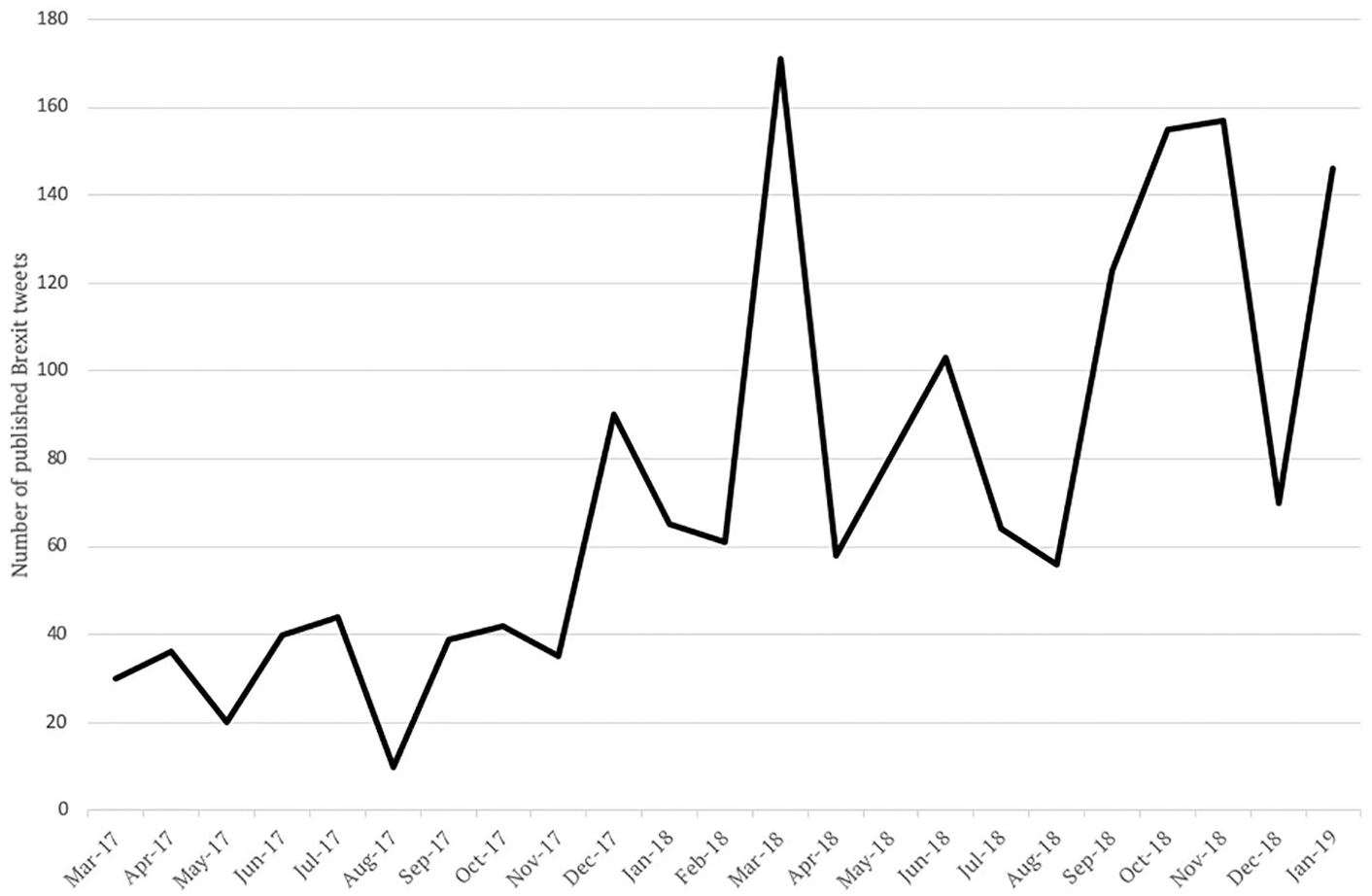
Timeline of publishing Brexit-related tweets (N = 1,696).
‘It will get me into trouble!’
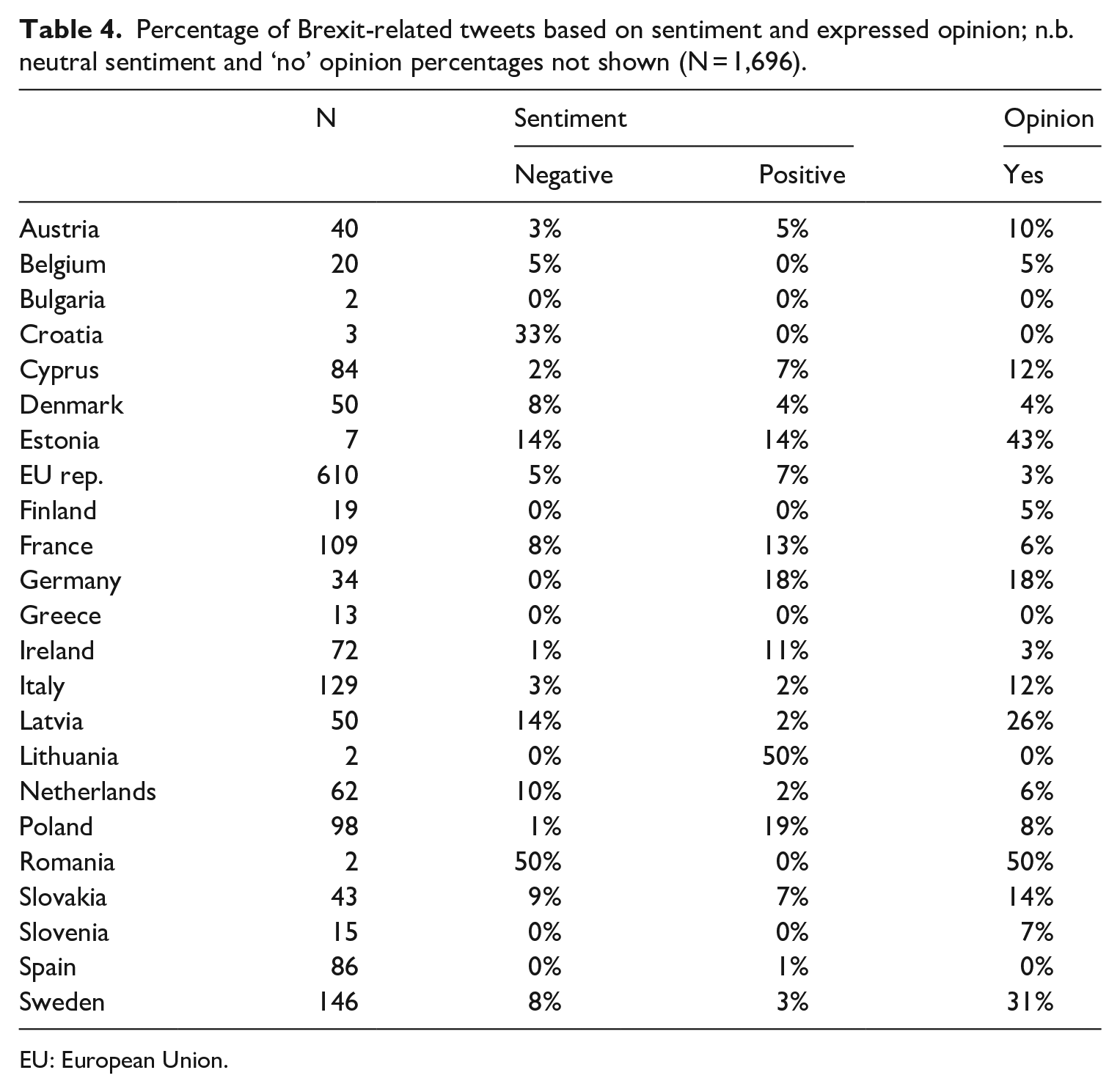
The second indicator aiming to grasp whether the EU 27 were behaving as active players in the Brexit negotiations is based on position frames used in Twitter output. Specifically, this indicator examines the extent to which diplomatic entities expressed opinions and positions in their tweets, and the sentiment shown towards Brexit. The results show that a vast majority of tweets contained no position on Brexit (91%) and that the topic was mostly communicated about in a neutral way (88% of tweets). The breakdown by actors is quite revealing, as it becomes evident that the role of positioning was taken up by heads of missions (33% of all heads of missions’ tweets contain a position on Brexit, see Figures 2 and 3 for examples), while the official missions’ accounts were hardly ever used for communicating a position (4% of their Brexit tweets report a position). Also, it is visible that United Kingdom’s traditional allies, such as Sweden, Estonia and Latvia, were most willing to express a position on Brexit, 4 while most other actors refrained from commenting it on Twitter and/or advocating for a particular interpretation of the topic (see Table 4).
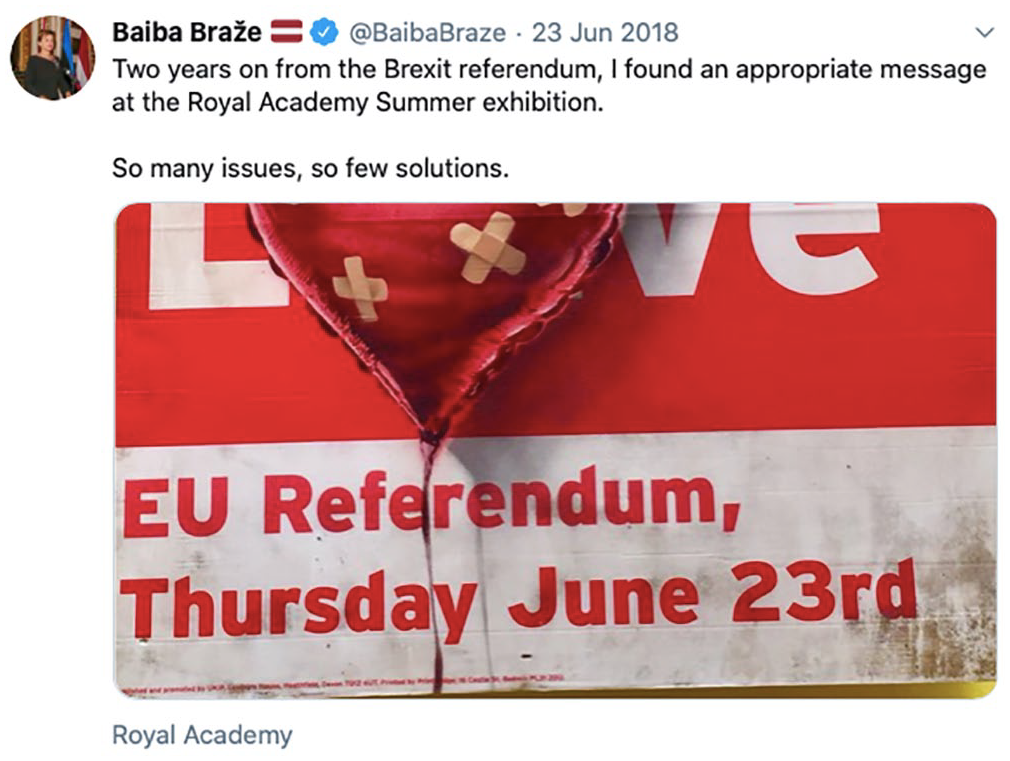
Example of a Brexit tweet with expressed opinion and negative evaluation. Tweet by Ambassador of Latvia to the UK, Baiba Braže.

Example of a Brexit tweet with expressed opinion and positive evaluation. Tweet by Ireland’s Ambassador to the UK, Adrian O’Neill.
Percentage of Brexit-related tweets based on sentiment and expressed opinion; n.b. neutral sentiment and ‘no’ opinion percentages not shown (N = 1,696).
EU: European Union.
According to interviewees, the lack of positioning on Twitter was strategic and intentional, although different actors gave different reasons for it. One group of diplomats claimed that they strategically kept away from communicating opinions on Brexit due to the negotiating framework according to which Member States voice positions to the EU, which then negotiates with the United Kingdom: Head of mission (exports under 6%; less than 89,000 of citizens in the United Kingdom) ‘I’m representing here my country. My country is involved in these very sensitive negotiations and we have no role in negotiations. So, this is why it’s better to be very careful on that so that people don’t start mixing up the roles. If I express an opinion, they think that it’s the opinion of [my] government and it might not be. So, basically, it’s up to the government – because the Commission is conducting negotiations and Member States are giving their views in Brussels. So, it’s not up to us here’. Press Councillor (exports over 6%; more than 89,000 citizens in the United Kingdom) ‘Our constant mantra is to say: ‘Negotiations are dealt with by Brussels’. The Commission is negotiating, the Commission has a mandate from all the Member States, and we are not dealing with this negotiation as a country’.
Several interviewees explained they decided not to voice positions as they did not see the advocacy element as part of their mandate: Head of mission (exports over 6%; less than 89,000 citizens in the United Kingdom) ‘It’s not our place to comment on what the UK government does . . . To offer an opinion . . . We’re not commentators, we’re not political scientists, and we also value the fact that this country is our host’. Special Advisor (exports under 6%; less than 89,000 of citizens in the United Kingdom) We’re here just to monitor and feedback information to the press or our capital. We can’t really put out [opinions] or take part in the discussion itself.
However, there were also those who explained the lack of positioning on Twitter in terms of the limitations of the social media network itself: Public Affairs Officer (exports under 6%; less than 89,000 of citizens in the United Kingdom) Although members of the embassy would not hesitate to state in events their opinion, their regret for the UK deciding to leave the EU, but still when . . . In spoken language it’s easier to make yourself fully understood. Whereas, in the amount of characters that Twitter allows you to say something, there is a high risk that the message will be lost and that various interpretations will be possible. And this is too risky.
Hence, evidence suggests that the EU 27 diplomats did not advocate on particular Brexit issues on Twitter, however, this is not to say they do not do this elsewhere or that they would not like to be more vocal in this regard on social media. As one head of mission put it following a question on whether they think about using Twitter for positioning on Brexit: Head of mission (exports over 6%; less than 89,000 of citizens in the United Kingdom) Very often. But I don’t do it. It’s very often that I want to comment on this, but I still don’t do it. And I also deleted I don’t know how many tweets, thinking ‘oh, this is not going to work, it will get me into trouble! (laughs).
As mentioned, sentiment towards Brexit was shown in only 12% of tweets. Overall, Brexit was framed in a slightly more positive than negative way with a ratio of positive to negative tweets at 1.4. As diplomats explained, this positivity is again strategic, as it allows Member States to continue building relationships with the United Kingdom: Press Councillor (exports over 6%; more than 89,000 of citizens in the United Kingdom) [We tweet] In a sense to mitigate the negative impact of Brexit on our bilateral relationship. So, we might focus on something that is very strong, you know, about bilateral relationship, to kind of compensate the fact that Brexit is going to be a very difficult issue.
Again, diplomatic entities most willing to position themselves in regard to Brexit – in this case, to evaluate Brexit in a negative way, were United Kingdom’s traditional allies – Sweden, Netherlands, Latvia and Denmark, while countries with a large diaspora in the United Kingdom, such as Poland, Germany and France, published most positive tweets, these being primarily focused on the post-Brexit period and their future bilateral relationships with the United Kingdom.
‘Even when there are no rivers – build bridges’
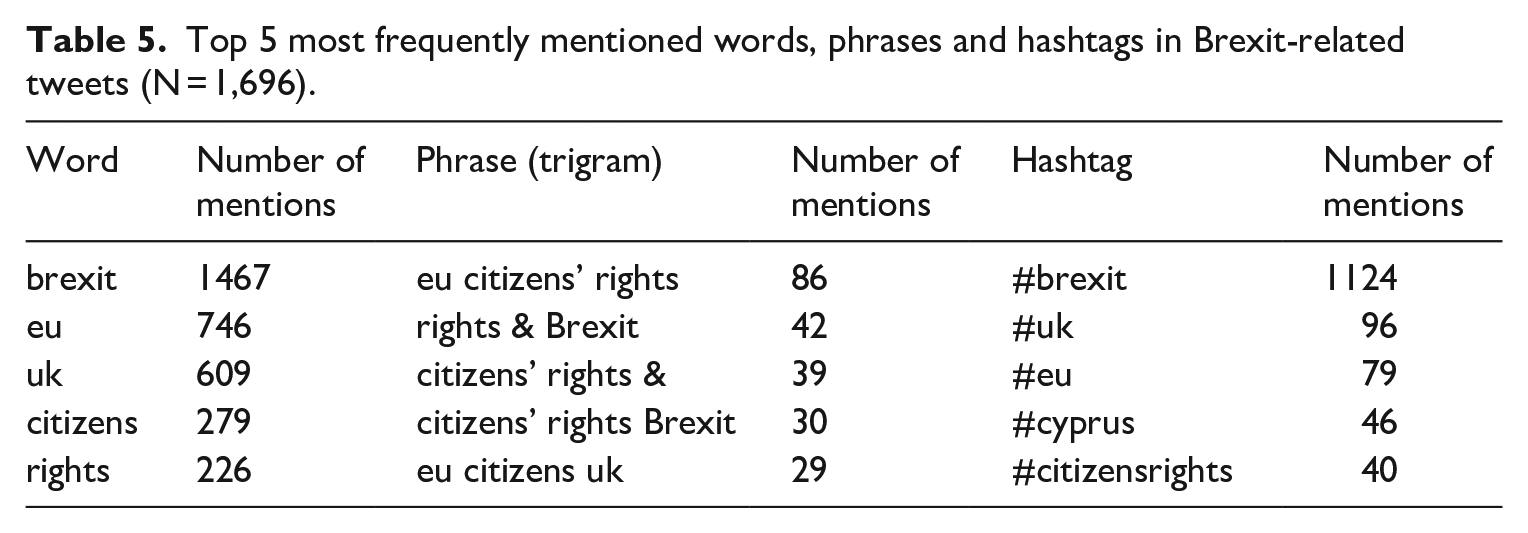
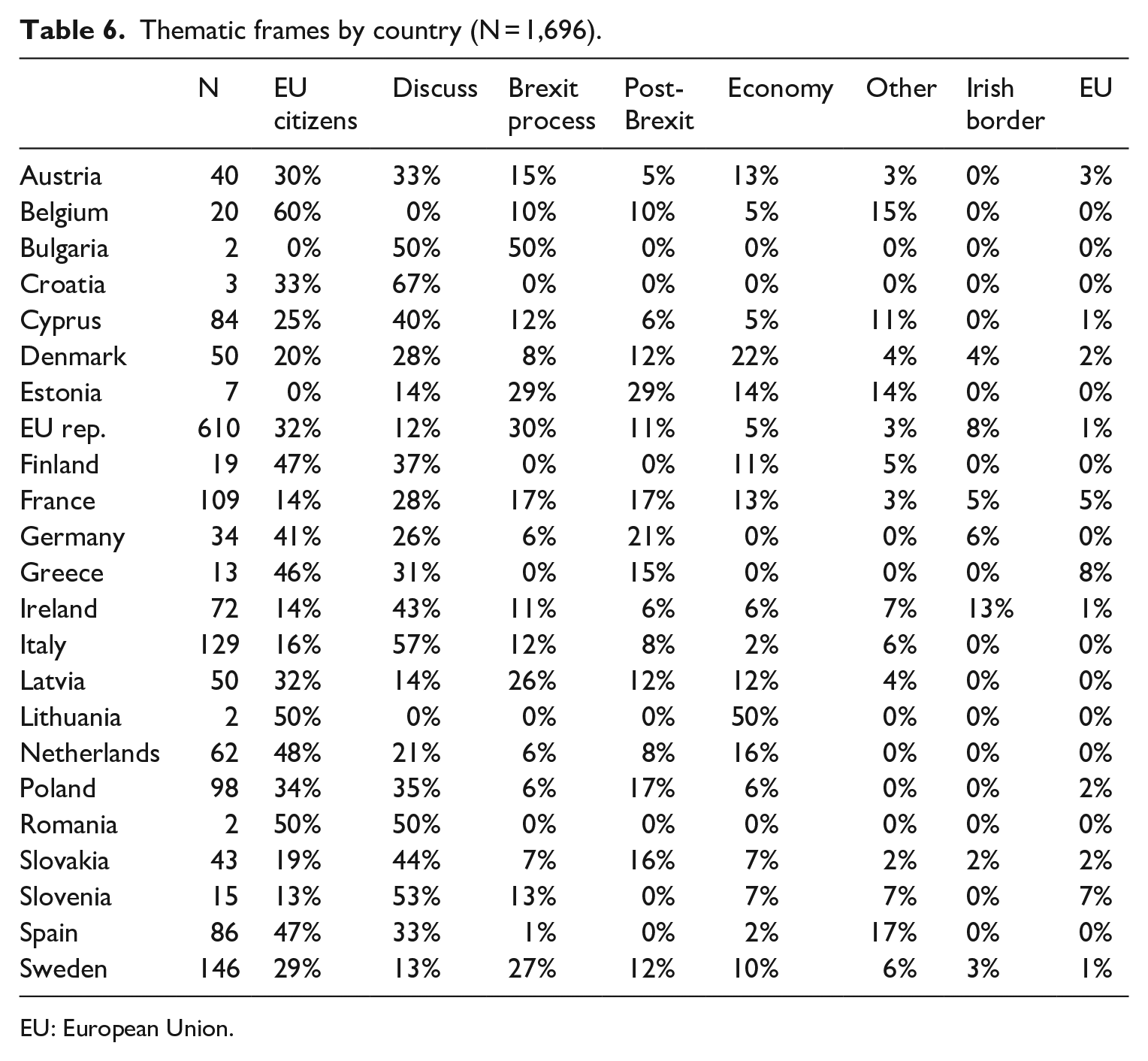
In order to establish how the EU 27 have framed Brexit on Twitter, the study relies on an indicator that examines thematic frames used in messaging on Brexit, supported with the findings from the automated textual analysis. The analysis of thematic frames reveals that the most important frame promoted by the EU 27 was that of citizens’ rights – this topic was central to almost every third tweet on Brexit (see Table 6). This conclusion is further supported by findings from the automated textual analysis of the sample containing Brexit tweets, as citizens’ rights are among the most frequently used words in tweets and hashtags, and also, all five most frequently mentioned trigrams relate to this frame (see Table 5).
Top 5 most frequently mentioned words, phrases and hashtags in Brexit-related tweets (N = 1,696).
From interviews, it became obvious that informing their citizens about their rights during and after Brexit was seen as one of the central roles of EU 27’s missions during the negotiations. As one of them put it: Political Councillor (exports over 6%; less than 89,000 of citizens in the United Kingdom) Our primary focus is to relay the necessary information to our citizens. So, it’s not our job to . . . To judge or to opine on, you know, if there is a delay or if the process is completed or not. I mean – we give information. We will also try to give the information in a timely manner.
However, some interviewees highlighted the challenges of this task in a fluid and uncertain context: Press councillor (exports over 6%; less than 89,000 of citizens in the United Kingdom) We are in a very difficult situation where we have to explain to our citizens what their rights after Brexit will be when we don’t know almost nothing. You know, it’s a very difficult situation because no one knows what Brexit means. What will happen? So how can we explain to our citizens what Brexit means when we don’t know?
The second most commonly used frame, and if the sample is controlled for EU representation, then the main frame used by Member States, is a generic discussion frame. This was considered a ‘safe’ frame, as the message is that there is a statement, event or a meeting related to Brexit, but no specific content is relayed. In this way, diplomatic actors were able to show that Brexit is very much on their agenda but avoid any controversies that the topic may potentially cause. Of other frequently used frames, messaging on the developments related to the Brexit process seems to have been almost exclusively left to the EU representation, although some countries, such as France and Sweden, have also promoted this frame (see Table 6). Furthermore, countries with strong trade links to the United Kingdom put economy into focus (e.g. Denmark, France, Netherlands and Sweden), while a range of countries, and in particular those who have a large body of their citizens living in the United Kingdom (such as Poland, France and Italy) were also promoting a post-Brexit frame which often focused on future bilateral relationships.
Thematic frames by country (N = 1,696).
EU: European Union.
The focus on the ‘post-Brexit’ frame is one of the main reasons why the overall sentiment towards Brexit was more positive than negative, as this was by far the most positively presented frame among the examined ones – almost every third tweet focusing on the post-Brexit context was framed in a positive way (see Figure 4). According to diplomats, this was a result of the strategic communications strategy that aimed to build and fortify bilateral relationship with the United Kingdom. Several interviewees emphasised this strategy: Head of Press (exports over 6%; more than 89,000 of citizens in the United Kingdom) We need to keep the closest ties possible with this country because of a number of historical, political, economic reasons. We very much tried to . . . Specifically, the tweets in our own language tried to focus the messaging on [citizens’] rights and even in a post-Brexit scenario what will happen, but on the other side, especially tweets that were in English – we were trying to focus on the core messaging which is, if you want, underscoring our ties, our bonds, our friendship, which is very genuine and strong. Press Councillor (exports under 6%; less than 89,000 citizens in the United Kingdom) We all hope for the best . . . We’ll still have a very good bilateral relations, regional cooperation, security cooperation and cultural cooperation. That would not change because of Brexit. So, we try to keep this positive note when talking about Brexit.
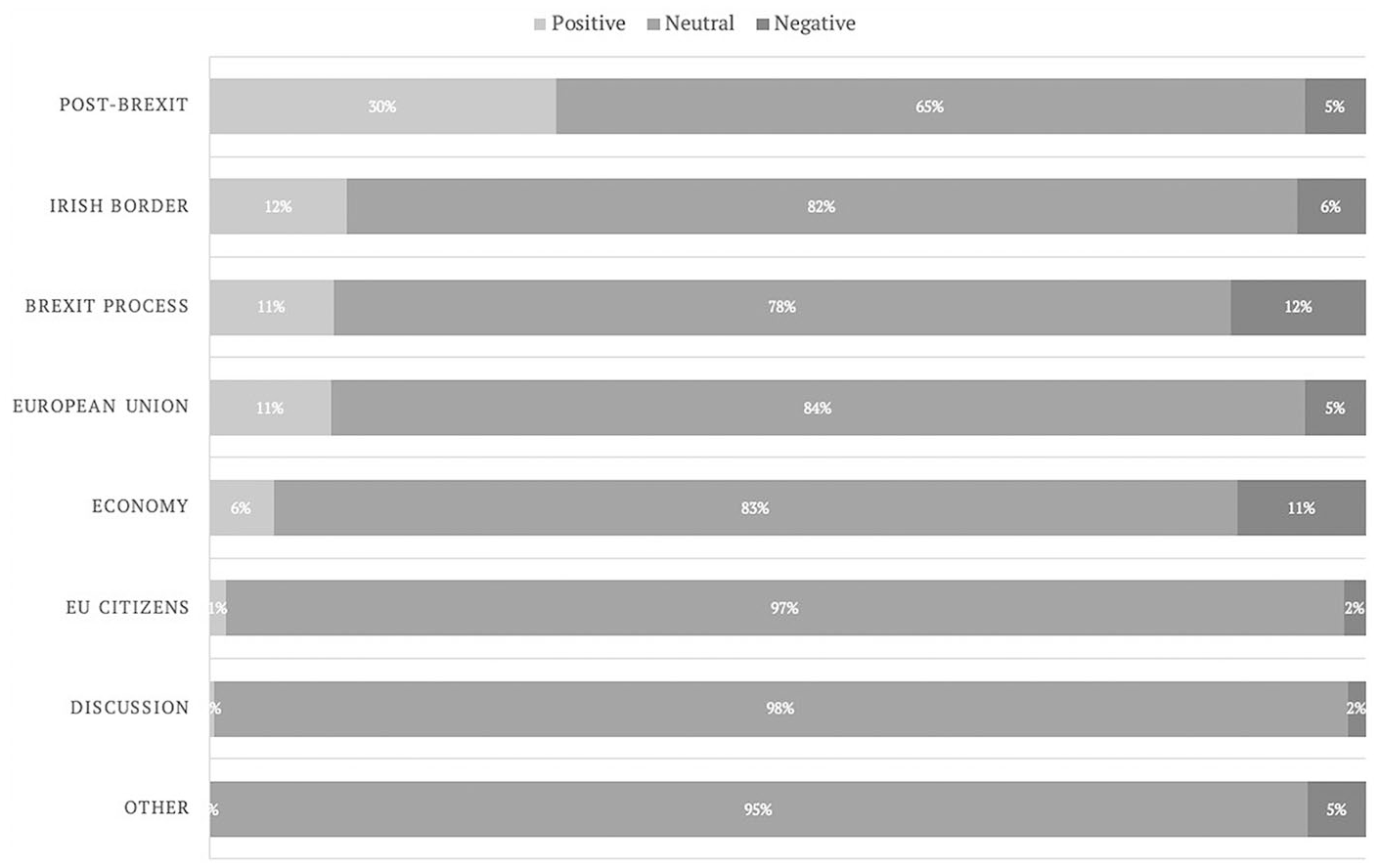
Sentiment towards thematic frames (N = 1,696).
The data show that the tweets concerned with economy, and to an extent Brexit process, were among the most negative ones. This is mostly due to these topics being framed as challenging and potentially problematic. The prevalent positive framing of other themes may be understood as a consequence of a core element of a diplomat’s role. As one head of mission put it, positivity and constructive approach to messaging are important elements of the job: Head of mission (exports over 6%; less than 89,000 of citizens in the United Kingdom) We have to be [positive]. We should be constantly building bridges. Even when there are no rivers – build bridges instead of building walls. It is important to also not to be flying in the clouds. You see the glass half full, half empty – of course it is half full and half empty. Try to make it more full! The narrative in the language we use has a lot to do with the way we think. So, you have to be constructive rather than destructive.
Discussion and conclusion
The findings suggest that the EU 27 diplomatic services in the United Kingdom closely reflected EU’s negotiating framework and positions in the Brexit process, hence demonstrating strong internal cohesiveness. First, the main role in framing Brexit on social media has been left to the EU’s representation in London, while individual missions and heads of missions have in most cases scarcely intervened in the discussion (with some notable exceptions). This is in line with the EU’s framework according to which the Brexit negotiations are dealt with by the EU, not the Member States (McTague, 2019). Second, there is evident uniformity in framing the Brexit negotiations around the issue of citizens’ rights, which the EU has outlined as the top priority in negotiations (Durrant et al., 2018). Third, the EU 27 diplomatic entities have mostly not intervened in the negotiations or ratifications processes, with all actors mostly communicating about Brexit in a neutral way, with rare expressions of opinion on the topic. Overall, these findings reveal substantial message consistency among the EU 27 which made the EU’s external representation in line with the message of ‘united front’ promoted by key EU officials (McTague, 2019; Stone, 2018). This may have important implications for the effectiveness of the EU in the Brexit negotiations, as it has been often claimed that the EU is most effective when it can demonstrate unity among its Member States (Da Conceição-Heldt and Meunier, 2014; Van Schaik, 2013). While the United Kingdom’s withdrawal from the EU has not been finalised, it has already been suggested that the EU has been effective in securing their interests in the negotiation process that led to the Withdrawal agreement agreed by the United Kingdom and EU negotiators in 2018 (McTague, 2019; Perez-Solorzano Borragan, 2018). However, as the Withdrawal agreement has yet to be ratified at the time of writing, maintaining the message discipline in external representation, and consequently, showcasing internal cohesiveness, may be an important asset in securing EU’s interests in the outcome of Brexit.
It is important to acknowledge that while the strategic framing of Brexit on Twitter was quite similar and consistent across the EU 27, interviews suggest there was a complex and diverse reasoning behind it. This contradicts the notion of message discipline, as the consistency in framing doesn’t seem to have derived solely from the coordinated effort (although we know there was one), which the definition requires (Freelon, 2017; Scammell, 1999). Rather, interviews with diplomats and mission staff have revealed that their strategic framing of Brexit on Twitter was driven by a variety of factors, and not exclusively, or in some cases even pre-dominantly, by guidance from the central EU institutions. Specifically, some actors were driven by the evaluation of the issue at stake, others by EU’s negotiating framework, but also important for some were perceptions of a diplomat’s role and/or the nature of the social media environment. The latter two are particularly interesting in the context of this study. While a diplomat’s role, particularly in public diplomacy, is considered to consist of agenda setting, advocacy and influencing interpretation of issues (Dodd and Collins, 2017; Golan, 2013; Golan and Viatchaninova, 2014; Kiousis and Stromback, 2014; Molleda, 2011), diplomats from the EU 27 often described their roles as those of civil servants whose job is not to advocate or influence, or at least, not to be seen as advocating or trying to influence.
In addition, it is evident that some diplomats felt constrained by the affordances of the social media, and particularly Twitter, which they considered to be a high-risk communication tool when positioning on potentially controversial issues. However, Twitter was seen as an appropriate tool to use for another aim of public diplomacy–relationship-building. Evidence suggests that the EU 27 were using Twitter to boost bilateral post-Brexit relationships, as they communicated in quite a positive way about the post-Brexit period, framing it through the narratives of friendship and alliance. According to the EU 27 diplomats, this was a deliberate and strategic frame, through which Member States wanted to ensure that the United Kingdom felt like an appreciated and valuable ally and hence, remaining a close partner even when it leaves the EU. The reluctance to use Twitter for communicating potentially controversial positions and the willingness to use it for relationship-building reveals how the EU 27 diplomats see the opportunities and limitations of using this social network for public diplomacy purposes. These actors found Twitter to be a useful tool for communicating positive, constructive messages that were conducive to relationship-building, as has been suggested before (e.g. Strauß et al., 2015). However, they also emphasised that they did not see social media as a communication tool that can help public diplomacy meet all its aims. Hence, while diplomats can use social media for direct, unmediated and financially cost-free advocacy and agenda-setting (Bjola and Jiang, 2015; Newsom and Lengel, 2012; Zhang, 2013), it appears that the communication risks in high-stake contexts can outweigh the benefits of using this digital communication tool in these purposes. Consequently, it seems that diplomats prefer the traditional practice of advocacy and positioning ‘behind closed doors’ (Mansbridge and Martin, 2013), as they see this practice more valuable and effective than publicising their opinions on social media.
In conclusion, this study established that the EU 27’s diplomatic services based in the United Kingdom maintained message consistency on the topic of Brexit on Twitter, albeit arguably not through message discipline; and consequently supported the EU’s negotiating position, demonstrated internal cohesiveness and potentially contributed to the EU’s effectiveness in the Brexit negotiations. It also revealed that the framing of Brexit on Twitter by individual Member States was deliberate and strategic, but with a range of different motivations behind promotion of certain frames. Finally, Twitter was seen as a tool conducive to meeting the public diplomacy’s aim of relationship-building, but not one to be used for advocacy and influencing interpretation of controversial Brexit issues. One of the obvious limitations of this study is that framing on a single social network was analysed. While Twitter is considered the most ‘political’ social network (Lüfkens, 2018), it is possible that results would be somewhat different if the study encompassed the most popular social network worldwide – Facebook, and/or the fast-growing Instagram. Perhaps future research could widen the study framework and examine similarities and differences in public diplomacy’s strategic framing across different social media platforms. Further, the fact that the coordination of messaging did not seem to be the main driver of message consistency is another point raised by this study which warrants further research. Finally, this study’s methods do not allow conclusions to be made about the actual effects of strategic framing – either on the unity within the EU, or the effectiveness of the EU in the Brexit negotiations. This is a valuable avenue of future research which could shed more light on the practical importance of strategic framing on social media in the context of public diplomacy.
