




Abstract
This article focuses on the governance of migration and borders as key issues of Brexit in a dual sense: as a contested political issue centrally fueling the Brexit debates and as an area of policy formation. First, the article addresses how Brexit has changed free movement as a key principle of the European integration project and transformed cross-border mobility between the European Union (EU) and the UK in a post-Brexit European border regime. Second, it discusses how the politicization of migration during the Brexit campaign has accentuated competing visions of political community. With a view to the effects of Brexit on the governance of migration and borders in Europe, the article demonstrates how the Brexit debates have emphasized the prominence of exclusionary nationalism, while they have simultaneously created new opportunities for the EU to launch a major reform of its migration and asylum policies.
Introduction
Issues of migration and borders speak to the core of Brexit and its political ambitions. Most directly, the decision of the UK to leave the European Union (EU) was critically driven by popular concerns about migration and cross-border mobility. The control over who can enter and reside in the country was central to the ‘Vote Leave Campaign’ 1 and, according to most observers (Dennison & Geddes, 2018; Hobolt, 2016), a key driving force behind the successful 2016 referendum. The centrality of cross-border mobility in the Brexit campaign also signals how the contested nature of migration-related issues has proven instrumental in attacking the European integration project and its underlying political vision. The principle of free movement across national borders is a foundational pillar of the EU. It encapsulates the idea of a European citizenship status (De Witte, 2019; Kostakopoulou, 2018) and a political community with a substantial degree of supranational authority as its defining feature or, as Linklater (1998) put it in ambitious philosophical terms, as a community defined by the ‘ethical foundations of the post-Westphalian era’.
Exploring the significance that the issue of migration and borders has taken on during the Brexit campaign and implementation process, this article examines migration in a dual sense. First, as an area of public policymaking and, second, as a contested issue in public debate that encapsulates some core political ambitions of the Brexit project at large. Regarding the first aspect, it is worth underlining that cross-border mobility and migration emerged as a central issue in the Brexit negotiation process between the UK and the EU from the beginning (Lutz, 2020). Setting the agenda for a lengthy Brexit negotiation process, Liam Fox (at the time Secretary of State for International Trade) ominously stated in 2016 that the status of EU citizens living in the UK could be considered a ‘main card in the negotiation process’. 2 At the time of writing this article, there was a great degree of uncertainty over what form the exit of the UK from the EU will take. In this respect, the rights of EU nationals in the UK and of British citizens in one of the EU member states (combined a group of about five million people) are still being determined amidst growing concerns about how these changes could negatively impact those whose permanent residence status might change as a result of Brexit.
The second focus of this article is the way in which migration and cross-border mobility have been politicized over the past years and how this process is likely to continue to affect migration and border policies in the UK and the EU. What the political dynamic of the Brexit process illustrates is how intimately the governance of borders and migration is tied to the popular perception of, and reaction to, European integration. One seemingly paradoxical picture is immediately apparent: while the freedom of movement for EU citizens is one of EU’s most significant achievements, it has also become one of the most contentious issues driving scepticism towards Brussels across the continent. The debate surrounding the Brexit process has accentuated these tensions and formed the particular political constellation shaping the opposing Leave and Remain campaign, respectively. Arguably, the opposition against a European border regime has allowed for Britain’s deep-seated Euroscepticism to find a reinvigorated and momentous voice in the contemporary political arena (Vasilopoulou, 2016).
Assessing the impact of Brexit on the policies of the EU, I argue that the way in which the issues of borders and migration were politicized in the wake of the ‘Leave campaign’ has provided the vital discursive environment for policy initiatives in the field (Donmez & Sutton, 2020; Seaton, 2016). Theoretically, the article is based on the idea that public discourse shapes policy formation by framing particular issues in a way that limits the options on how they can be addressed politically and in policy terms (Schmidt, 2008). In this respect, I contend that the anti-immigrant rhetoric mobilized as part of the Leave campaign will also have a lasting impact on a post-Brexit approach to governing borders and migration in the UK and Europe more broadly. 3 For the EU, Brexit has demonstrated the divisiveness of issues related to governing migration and borders, as well as their corrosive potential for the process of European integration. At the same time, the political effects of the Brexit experience have accentuated the urgency to develop a sustainable path towards an effective and politically viable European migration and refugee policy.
This article expands on why and how borders and migration have taken on such a prominent role in framing the Brexit debate by empirically analysing competing framing strategies and their underlying visions of (national) political community. From this investigation, the article delves deeper and considers the exclusionary effects of the Brexit process on particular groups of migrants living in the UK. Then, finally, the article looks at the discursive practices of the Leave campaign by discussing the reformulation of UK’s immigration policy and the status of cross-border mobility of EU citizens in a post-Brexit European border regime.
Brexit and the Centrality of Borders
‘Taking back control’ was the master frame around which the Leave campaign developed its political strategy and communication. In this narrative of reconstituting ‘control’, the EU is identified as the central agency depriving the UK (an independent nation state) of its basic sovereign rights. Those advocating in favour of Brexit tout the leaving of the EU as a way of rolling back what is commonly portrayed as a regulatory overreach by Brussels in key domains of public policymaking. In this narrative, the issue of the UK’s contributions to the EU’s budget was one central component. Yet, as demonstrated by Thielemann and Schade (2016), the issue of cross-border mobility took on a most pronounced role in illustrating what—according to the Leave campaign—was at stake in the Brexit decision: the protection of and control over the UK’s borders as a site where the state imposes its sovereign prerogative, deciding who and what goods and services can come into the country. 4
The centrality of borders and migration-related issues in the Brexit debate is all the more noteworthy as the UK has had a relatively successful experience with recruiting foreign workers and including them into the labour market. Although there were some concerns about the threat of an ‘uncontrollable’ influx of EU citizens after the Eastern enlargement of the EU between 2004 and 2007, the experience of currently 2.31 million EU nationals working in the UK (next to 1.34 million non-EU citizens) was widely perceived as unproblematic until recently. The British economy has benefitted considerably from the influx of these migrant workers and, growing faster than their European counterparts over the past decade, could absorb them effectively (Green, 2007). Similarly, in spite of some notable challenges, the societal integration of these migrants unfolded relatively smoothly and did not trigger strong anti-immigrant sentiments. 5 Indeed, Greater London has become one of the most pertinent examples of what Vertovec (2007) has described as ‘superdiversity’ in a major urban centre.
Yet, with the Brexit campaigns and the debates leading up to the referendum in 2016, migration has gradually moved into the spotlight of the political debate in the UK. Before drawing closer attention to how Brexit was significantly framed with a view to border- and migration-related issues, it is important to briefly consider how they played out in competitive party politics (Odmalm, 2012).
Migration does not squarely adhere to the competing political identities defined by the left–right axis. On the left, the Labour Party has found it challenging to determine whether and how a pro-migrant approach could be compatible with its core identity and the sentiments of its supporters. It is one of the fundamental challenges of the moderate left to find a politically effective mode of including immigrants in its narrative of social justice (Schmidtke, 2016). The Labour Party’s protection of immigrants is relatively feeble when compared to the reliance on a nationally defined welfare state regime and its egalitarian spirit. Redistributive effects within this welfare state system depend on a clear sense of membership and entitlements.
Over the past decades, under the auspices of New Labour, the transformation of a social democracy with a more pro-market approach has heightened the sense of insecurity and fear of social downward mobility among its traditional supporters (Roos, 2019). In the wake of the Great Recession during the first decade of the 21st century, the fear of compromising high social security standards and income levels in times of socio-economic uncertainty has become a dominant theme for Labour. At the same time, Labour’s strategic targeting of the middle class has reduced its fundamental commitment to protecting the less privileged in society, a group to which most immigrants are situated. Analysing how leftist politics has addressed migration, Però (2007) argues that the past 20 years have seen the left move towards identity politics. The result is a new emphasis on ethno-cultural diversity by the centre left, yet a failure to link this recognition of diversity to concerns for socio-economic equality.
In a nutshell, the arguments behind the alleged ‘progressive dilemma’ (Parker, 2017) regarding migration suppose that there is a trade-off between, on the one hand, labour and welfare rights, based on a strong sense of collective identity and solidarity and, on the other hand, a liberal approach towards migration and the governance of borders. For Labour, handling the migration portfolio constitutes a delicate balancing act: the party must demonstrate that it is a political advocate for immigrants, while, at the same time, addressing the widespread concern among its core constituency, that migration could promote downward pressure on wages and the erosion of social protection. Arguably, Labour’s fundamental reservation about endorsing an unambiguously pro-migration approach and its reliance on the idea of a strictly bordered national community for ambitious welfare reforms politically provided the fertile ground for the manifest ambivalence of many Labour politicians and supporters towards the option of exiting the EU.
In contrast, the Conservative Party and, in particular, those in favour of Brexit, mobilized the fear of migration as a central building bloc of its Leave campaign. For the master frame of the campaign, ‘win back control’, a strong and tangible sense of the external forces threatening the sovereignty of the UK was instrumental. Migration offered an emotionally charged reference point for depicting the alleged threat from outside and the need to defend the integrity of the country’s borders. The large amounts of refugees seeking to find shelter in Europe during the period leading up to the referendum (2015–2016) was a critical element in adding urgency to this agenda. Indeed, the so-called refugee crisis allowed the Leave campaign to link the anti-immigrant arguments directly with the EU that was accused of facilitating refugees reaching the British isles irregularly. 6
Next to the Conservative Party, the UK Independence Party (UKIP) was a driving force in depicting migration as an imminent threat that could only be effectively addressed if the UK’s membership in the EU were to end. UKIP’s central slogans in support for Brexit were as follows: ‘We Want Our Country Back’ and ‘Believe in Britain’. Its campaign leading up to and following the 2016 referendum was characterized by a nativist ideology that mobilized anti-immigrant sentiments (regardless of the type or status of the migrant) and advocated for an exclusionary nationalism. 7
In their comparative analyses of national media discourses on the ‘refugee crisis’, Heidenreich et al. (2019); also Eberl et al. (2018); and Georgiou & Zaborowski (2017) demonstrate how media coverage, in particular, of refugee camps, in the UK was salient ‘at an increased level just until after the Brexit referendum in June 2016’ (p. 207). While, in other European countries, the media interest gradually waned at the end of 2015, in the UK’s media discourse, the European governance of refugee and, more specifically, the situation in and around Calais remained prominently featured and shaped the public debate right until the Brexit debate. The squalid conditions under which refugees waited for an opportunity to cross the channel into the UK provided a threatening narrative of irregular migration dramatized in the British press and the Leave campaign.
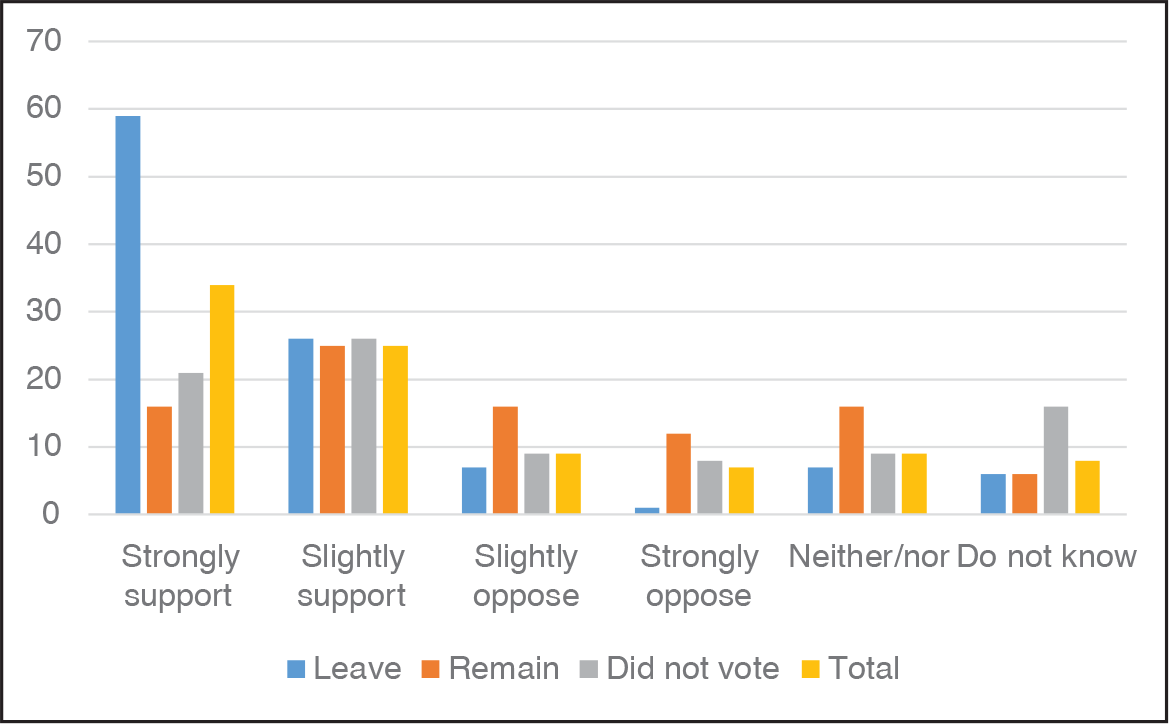
Pleas for advancing stricter border controls and curtailing cross-border mobility rely on robust popular support for such measures. Leading up to the referendum and throughout much of the Brexit process, the promotion of harsher border control was particularly pronounced among the supporters of Brexit. 8 According to a recent survey by the European Council on Foreign Relations, almost 60% of those who voted in favour of ‘leave’ during the referendum still strongly support stricter border controls, and 85% of this group strongly or slightly support this approach (see Figure 1). Overall, there is strong or slight support for stricter border control even within the group that voted in favour of ‘remain’ in the referendum. Based on this survey, the general argument can be made that the governance of borders as a contested issue has had a substantial effect on the Brexit vote and, remaining controversial in public discourse also after the referendum, on the formation of policies accompanying the UK’s exit from the EU.
Politicizing Migration and Cross-border Mobility During the Brexit Campaign
The centrality of issues related to migration and borders points to the political narrative based on which the exit of the UK from the EU was justified beyond the transactional argument regarding the material (dis)advantages of EU membership. Indeed, I argue that the politicization of migration during the Brexit campaign has accentuated competing visions of political community. The debate on borders and migration has addressed the key aspirations of the project of European integration and nurtured a nationalist backlash against foundational principles of the EU’s supranational model of policymaking.
In order to identity the dominant framing strategies of the Leave campaign, I conducted a qualitative study of the campaign’s programmes/manifestos, speeches, contributions to parliamentary debates and social media campaigns over a 4-year period from the start of the Brexit campaign from February 2016 to February 2020. 9 These documents were coded according to the following main frames 10 based on which issues related to migration and borders are interpreted and construed in terms of normative meaning and policy endorsements.
Before focusing on the competing frames in the Brexit debate, I would like to highlight the particular groups of migrants that the discourse of the Leave campaign has focused on. As shown in the enclosed Figure 2, the type of migrant addressed in the Leave campaign is to a large extent refugees (in particular, during the early period of the campaign running up to the referendum when the so-called refugee crisis dominated the media cycles). In spite of the fact that the UK was one of the countries in the EU least affected by the asylum seekers seeking refuge in Europe, the issue created a momentous political backlash in the country. Even in terms of prominence in the discursive practices of those advocating in favour of Brexit are EU citizens from other member states who reside or could potentially take up residence in the UK. The Leave campaign depicted the ability of EU citizens to move to and work in the UK without substantial restrictions as unfair, unjustified and detrimental to the country’s interests. A considerable amount of attention in framing this issue was dedicated to raising concerns about the potential of an ‘uncontrolled’ influx of EU citizens and drawing attention to what further expanding the EU would mean for the UK (the threat of a looming EU membership of Turkey, though far-fetched, was a recurrent feature in this respect).
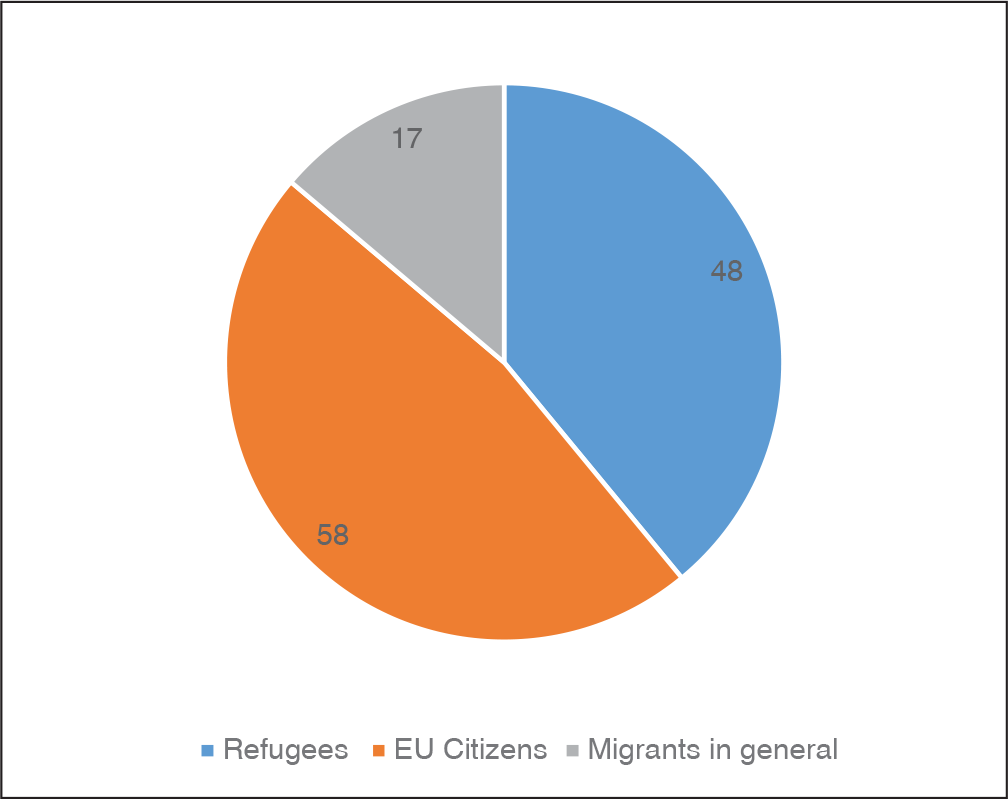
The emphasis on these two groups of migrants is significant for the direction of policymaking in this field in the wake of Brexit, an aspect that will be addressed more fully later in the article. The distribution of references to these groups also indicates how this issue was selected by the Leave campaign to link cross-border mobility directly to the EU and its aspirations in governing refugees and migration from a supranational position. Focusing on refugees and EU citizens immediately involves the issue of competing jurisdiction between the EU and its member states in this policy field. In particular a joint European approach to governing refugees with plans to have mandatory distribution quotas became a major point of political contestation into which the Brexit debate taped. In contrast, there was less concern about migrants that were not directly tied to debates on the reach of EU policies in the field (as I will describe later, this focus on a particular group of migrants is likely to shape current policy reforms in the post-Brexit period). In short, the way in which the Leave campaign has focused on particular migrant groups indicates how closely tied the critical approach to migration is to the project of European integration and to the objective to undermine its basic legitimacy (Portice & Reicher, 2018).
The politicization of these three groups of migrants seeks to link issues related to the governance of migration and borders to the overriding concern of the Leave campaign to protect the UK’s sovereignty and to ‘win back control’. The identity frame speaks to a perspective focused on identity concerns (culture, ethnicity); the security frame is driven by a sense of crime- and terrorism-related threats associated with migrants; and the interest frame is based on considerations of the cost benefit attributable to migration. 11
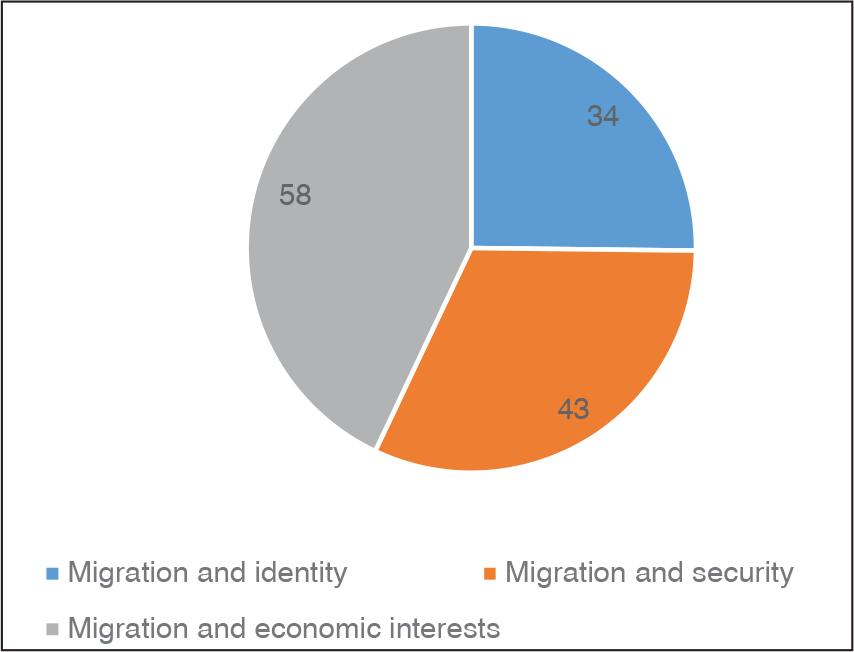
The main emphasis on how issues of migration and borders are framed in the Leave campaign is through the lens of the country’s socio-economic interests (see on the relative weight of the three competing frames in Figure 3). Migration is described as a drain on public resources, in particular, with respect to the British health care system National Health Service (NHS) in the United Kingdom (for instance, the higher birth rates in other EU countries is used as a recurrent illustration). Yet, this interest-based frame operates with a notable ambiguity: while migrants and the costs associated with them are depicted as a liability for the country’s resources, a properly managed migration is referred to a legitimate tool for sustaining the competitiveness of the British economy. Borders are routinely described as the tools for defending the UK’s economic interests, allowing for a properly managed migration regime.
The second frame is migration and borders as a threat to the country’s security and safety: migration is portrayed as a genuine threat to the security of a country as the movement across borders proves to be difficult to control and as immigrants pose a risk in terms of crime and political radicalism (terrorism, fundamentalism, etc.). As argued in one of the Leave campaign’s briefings on migration, the EU border regime makes it easier for terrorists and criminals to get into Britain. 12 The EU’s handling of the ‘refugee crisis’ is regularly depicted as a lax enforcement of border security standards.
Third, migration and borders are framed as a threat to national identity. In this regard, migration is depicted as a challenge to traditional modes of national identity, the British way of life, and as a potential threat to deeply rooted cultural values. Migrants are described in terms of their different cultural (and religious) traditions, values and practices. In the same vein, the culturally based Brexit discourse invokes a return to greatness, to Britain’s lost national–civilizational ‘golden era’ that the EU and migration are depicted as undermining.
The relative significance of these three frames demonstrates how the Leave campaign was able to channel and provide a political avenue for the latent ‘citizen’s’ economic anxieties brought about by the financial crisis, dormant cultural fears, widespread suspicion towards international institutions and frustration with ‘politics as usual’ (Capelos & Katsanidou, 2018, p. 1271). The focus on migrants and framing them as threats to the security, identity and well-being of the UK allowed the campaign to implicate the EU and its open borders policy in attributing blame for these fears and anxieties.
The negative coverage, in particular, of refugees during the Brexit debate, has set the narrative setting for the UK’s evolving policy towards this vulnerable group. In this context, the need to securitize borders and curtail, in particular, irregular migration, shapes the British approach to governing cross-border mobility. Currently, there is a heightened sense of urgency addressing the increasing numbers of migrants seeking to cross the English Channel irregularly (almost 8,000 in 2020 until mid-November). 13
The framing strategy has also had a notable effect on the treatment of migrants and minorities in the UK. A survey from 2019 14 reported a notable increase in overt racism and discrimination that immigrants and ethnic minorities in Britain have experienced. According to this survey, from January 2016 to February 2019, incidents of racism on social media had almost doubled, and ranting or commenting negatively about immigration had risen by almost 20%. The study also found that 7 out of 10 representatives from ethnic minorities in the UK believe racist beliefs and discrimination are widespread. This survey data are confirmed by systematic investigations into the link between the political strategies brought to bare in the Brexit campaigns and changing public attitudes towards migrants and minorities (Pitcher, 2019; Rzepnikowska, 2019; Virdee & McGeever, 2018).
At their core, the campaigns of the Brexit advocates were driven by a discourse that identified threats to the well-being and integrity to the nation by negatively depicting the ethno-cultural Other (Mintchev & Moore, 2019). However, one needs to be cautious in making a direct causal link between Brexit and deepening political cleavages in British society related to issues of migration, identity and diversity. For instance, Sobolewska and Ford (2020) argue that the division of the British electorate along these issues is rooted in the choices made by the country’s political parties, regarding the UK’s increasing cultural diversity and membership in the EU. In this respect, Brexit could be interpreted as reflecting how issues of migration, diversity and identity have been politicized in British politics more broadly. At the same time, the Brexit campaigns deepened these divides and accentuated a more exclusionary vision of the political community as a response to growing societal diversity. 15
In this respect, the rhetoric of pro-Brexit campaign has had the insignia of the identity claims that right-wing populists use to support their anti-elitist agendas. As Bhambra (2017) argues, the claim to ‘take back control of our country’ operates with a notion of an idealized past that, more or less implicitly, references the binary between the White population and racialized others. While the link between the drive towards Brexit and racism is debated, there is robust evidence that the plea to ‘win back control’ was strongly shaped by identity politics (see also Pitcher, 2019). The sense of being threatened by increasing cultural diversity and the societal change it triggers was one of sentiments that motivated voters to support Brexit. Furthermore, it was effectively used by the Leave campaign to popularize an image of the national community in which migrants and minorities are portrayed as a latent peril to its integrity. Mondon and Winter (2017, 2019) demonstrate how right-wing populism in the UK and the USA relies on the ‘racialization of the White working class’ by promoting identity as a legitimate political category and, with the help of this identity politics, normalizes racist attitudes (see also: Anderson, 2016; Bhambra, 2017; Kaufmann, 2019).
The effects of the Brexit debate and the politicization of migration in this context were immediately felt even by more privileged migrant groups. For instance, Rzepnikowska (2019) argues that, first, the financial and economic crisis of 2008–2009 and then, more profoundly, the Brexit referendum in 2016 have changed the popular perception of Poles in the UK. She speaks of an increasingly hostile environment that Polish citizens living in the UK face. Once perceived as unproblematic due to their ‘whiteness’, Polish migrants have witnessed more and more adverse British public that identifies them as being a burden for public services and the labour market. These Polish migrants were one of the most unlikely group of migrants to be branded as unwelcome. Yes, they too were not immune to being targeted by the exclusionary rhetoric with which issues of migration and borders are framed in the wake of the Brexit debate (Benson & Lewis, 2019; Lulle et al., 2018; Lumsden et al., 2019).
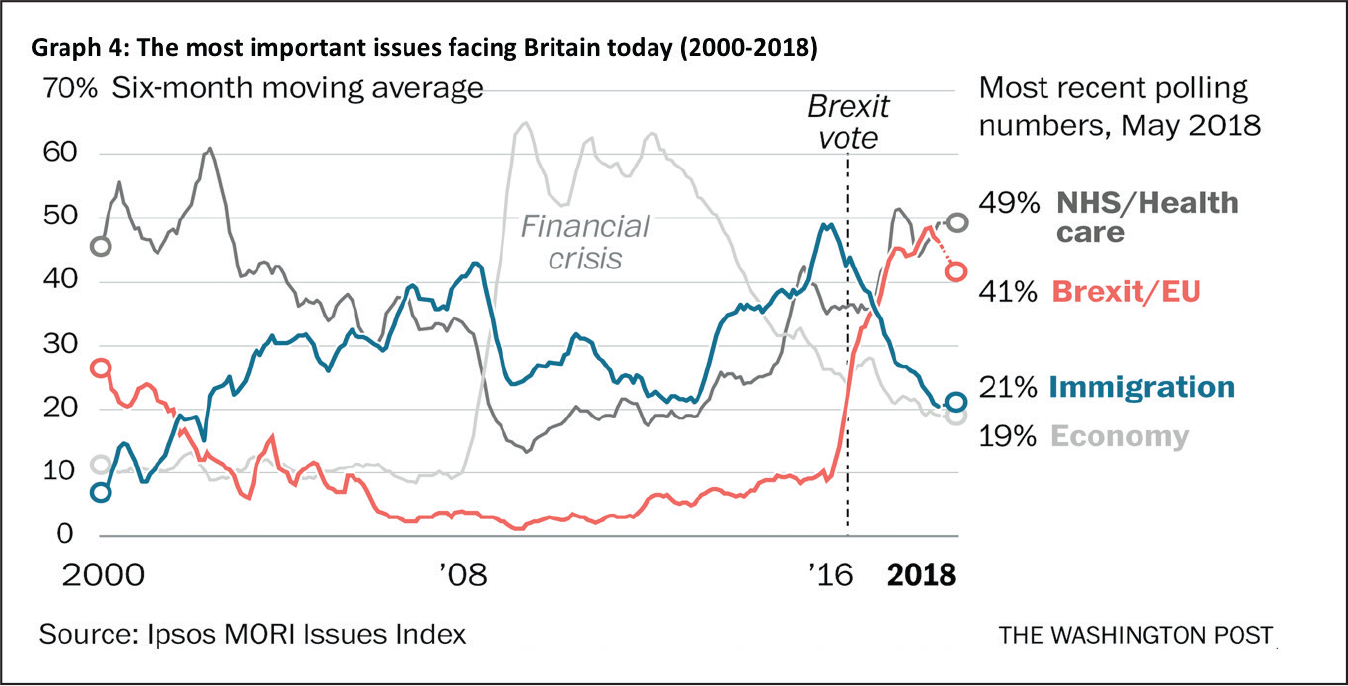
Moving from the effects of the divisive public debate on migration and borders in the wake of the Brexit campaigns to the contemporary policies in the field, I would point to one noteworthy development: the public interest in cross-border mobility was extremely high during the months leading up to the referendum in 2016. According to the IPSOS/MORI Issues Index, 16 the urgency attributed to the issue of migration peaked in 2016 with close to 50% of the respondents ranking immigration as the most important issue facing Britain today. Yet, with the completion of the referendum, these numbers plummeted considerably and were replaced by a new urgency regarding issues directly related to the NHS and the Brexit process itself (see Figure 4). This finding invites a range of hypotheses. Yet, in the context of this article, it is suffice to point out that issues of migration and borders were strategically used in the Leave campaign and provided for a sense of urgency in marked contrast to the UK’s relatively successful recruitment and social integration of immigrants over the past two decades. While discussion of the UK’s ‘overpopulation’ has been a long-standing topic of public debate, migration-related challenges had not taken on such central significance in shaping competitive party politics or pushing major reforms in policymaking until the Brexit debate.
Brexit and the Governance of Borders and Migration: Policy Developments
The discursive environment created in the wake of the Brexit campaigns has shaped the migration and border policy options that the conservative governments, under Prime Ministers May and Johnson, have pursued. In line with the master narrative of the Leave campaign to strengthen borders in the attempt to ‘win back control’, the current UK government has committed to about £705 million in funding for a new border infrastructure system. 17 This investment is designed to increase the capacity of border agencies to conduct checks, controls and facilitate cross-border flows once Brexit comes into effect at the beginning of 2021. This initiative also includes the creation of new border posts, improved information technology (IT) systems and recruitment of 500 new staff to deal with the tasks that need to be addressed with the UK leaving the EU’s Customs Union. 18
Major reforms in governing migration follow, in their overall rationale, the restrictive spirit with which the Leave campaign pleaded to deal with cross-border mobility. Manifestly, a considerable part of the coalition that pushed for an exit of the UK from the EU strategically mobilized anti-immigrant sentiments, if not openly xenophobic attitudes, towards immigrants and foreigners. Yet, at the same time, pro-Brexit forces closer to the mainstream centre–right favour an economic nationalism that is ideologically compatible with and, to a certain degree, economically dependent on exploiting (cheap) labour and foreign-trained talent. The policy responses to the challenges of regulating migration and borders in the post-Brexit world are reflective of how the Leave coalition has framed (un)desirable immigration and legitimate modes of belonging based on identity concerns, on the one hand, and national economic interests, on the other.
The selective framing of desirable and undesirable migrants also informs current policy reforms. While developments in this policy area are still in flux, the Conservative government under Boris Johnson has indicated that it intends to replace immigration from within the EU by a form of recruiting migrants that, irrespective of their origin, relies on considering their qualifications with a close view to the needs of the labour market. The most likely scenario for a post-Brexit immigration system is a point system in which the individual qualifications and experiences of the migrants are the decisive selection criteria (such a point system is already in place for selecting and recruiting non-EU citizens to the UK). In addition, the UK government is likely to include an existing job offer, direct sponsorship from prospective employers and a minimum income threshold as part of a revamped migrant recruitment system. 19 In this context, EU citizens and migrants from around the world would be treated on an equal legal footing as applicants from around the world and would compete based on their projected socio-economic benefit for the British economy.
In contrast, the restrictive migration policy will apply to refugees in the emerging post-Brexit migration policy. With respect to the UK’s commitment to addressing the ‘refugee crisis’ in Europe, it is worth underlining that the UK has actually accepted a comparatively low number of asylum seekers. When Germany was willing to accept over a million refugees in 2015–2016, the British government committed to offering asylum to 20,000 Syrians over 5 years. According to the United Nations High Commissioner for Refugees (UNHCR), from the spring of 2019 to the spring of 2020, the UK received 32,423 asylum applications when compared to 155,295 first-time applicants in Germany, 129,480 in France or 128,520 in Spain. 20 Still, the salience of migration as an issue of public debate remained high in the UK and, arguably, provided one of the fundamental rationales for contesting membership in the EU. It is in line with this anti-immigrant agenda that the conservative government under Johnson has committed to using the Brexit process as a pretext for tightening, in particular, the UK’s refugee policies. 21
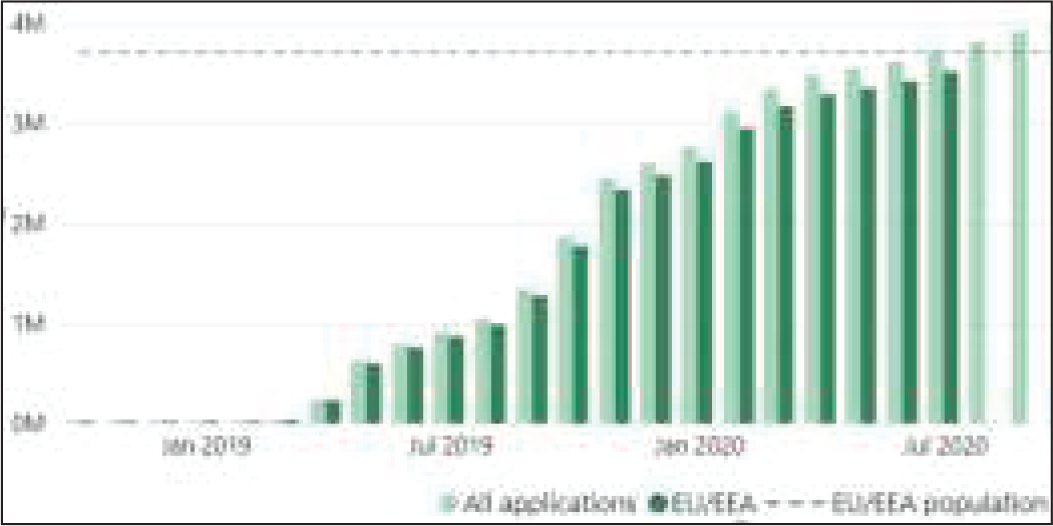
There is still uncertainty about the legal status of EU citizens living in the UK and British citizens residing in EU member states. In order to avoid insecurity and hardship, the UK has stipulated that EU nationals who have lived legally in the UK for at least 5 years, by 31 December 2020, qualify for permanent residence (including their non-EU family members). However, this group—as well as those immigrants who have lived in the UK for less than 5 years—has to apply to the EU Settlement Scheme that the UK started to role out in 2019. As indicated in Figure 5, 22 according to the most recent numbers by the British Home Office, at the end of February 2021, there have been more than 5.1 million applications and more than 4.6 million grants of status. 23
Although the final legal status of EU nationals living in the UK is not fully clear in the final phase of the Brexit negotiations, it is certain that this group will lose much of its privileged access to secure permanent settlement. The key objective of the Leave campaign, to regain control over its borders and reconstitute its sovereign prerogative in key policy areas, has set the course for governing migration and borders: the rejection of the EU’s principle of freedom of movement across its member states and the use of migration as a tool to further the UK’s national interests.
The Brexit process, resulting in the first member state ever to leave the EU, has sent a clear political message to Brussels: the control over borders and migration is a highly divisive political issue that has the potential of nurturing a resurgence of nationalist forces with possibly detrimental consequences for the process of European integration (most notably some of its key achievements like open borders and a single market). It is not by accident that the EU proposed a New Pact on Migration and Asylum in September of 2020 as the Brexit negotiations entered their final stages. 24 Under Germany’s Council Presidency, the EU tackled the thorny issue of migration at least partly driven by the realization that the failed 2015 Agenda for Migration and the inability of the EU to govern the 2015–2016 ‘migration crisis’ effectively (Crawley, 2016) have contributed to the political climate that fueled the campaigns of the Brexiteers in the UK. Indeed, in her speech introducing the new Pact, the European Commissioner for Home Affairs, Ylva Johansson, set a tone that decisively contests the anti-immigrant undercurrent of the pro-Brexit agenda: she makes the argument that immigration is integral and beneficial to Europe as well as that the EU has the capacity to manage also irregular migration successfully based on solidarity among its member states. 25
By the same token, the design of this comprehensive common European framework for governing migration and asylum reflects the political lessons from the Brexit debate: the legislative proposal currently on the table suggests a careful balance between strengthening the EU’s capacity to protect its external borders (with a strong emphasis on returning irregular migrants) and the commitment to address this policy challenge in a common, European approach. 26 At the core of the proposed Pact is an attempt to revive the principle of solidarity in tackling challenges related to governing migration and asylum. The key suggestion is to make the solidarity mechanism mandatory, yet, at the same time, flexible in terms of how member states can fulfil its requirements. In framing the aspiration of this Pact, the EU is careful to avoid the perception of forcing asylum seekers onto its member states, thus moving away from the highly controversial mandatory relocation scheme of the past. The new initiative is evidently framed in a way to circumvent the polarization that fueled the Brexit debates and, at the same time, send the signal that the EU is committed to tackling the governance of migration and asylum in a common European approach.
Conclusions
The governance of borders and migration has taken on a central role in the Brexit debates and the policy challenges resulting from the UK leaving the EU at the beginning of 2021. In this respect, the Leave campaign was critically driven by politicizing migration and tying borders into a broader narrative of reconstituting national sovereign framed as an attempt to ‘take back control’. This narrative allowed Brexit advocates to bridge two decisive frames of the public debate: anti-immigration sentiments and the criticism of the EU as an institution that is accused of undermining the country’s sovereignty by a supranational prerogative in key areas of public policymaking. In this respect, the public debate on migration and borders took on a meaning that exceeded particular policy challenges in this field. The Brexit discussion on securitizing borders and restricting migration brought into focus fundamental choices about the nature and boundaries of Britain’s political community: access to citizenship (van den Brink & Kochenov, 2019), the status of cultural diversity, and the treatment of migrants and minorities. The Brexit debate highlighted different political imaginaries and collective identities with a particular focus on who can legitimately claim to be a citizen, and who belongs and who does not (Manners, 2018; Sotkasiira & Gawlewicz, 2020).
In terms of the immediate policy implications, the Leave campaign has strongly mobilized anti-migration frames that make compromise, in particular, with the EU’s foundational commitment to freedom of movement across its member states exceedingly difficult. Accordingly, the conservative government has set the course for restrictive immigration policies that will likely be narrowly focused on the UK’s national interests and adverse to multilateral cooperation or humanitarian commitments towards refugees. Somewhat ironically, the Leave campaign and the ensuing public debate on Brexit have led to an endorsement of tighter migration rules that are at odds with the freedom of cross-border mobility as a foundational feature of European integration and that, simultaneously, are in line with the EU’s recent decisions to strengthen and securitize its external borders. One of the outcomes of the Brexit process might, indeed, be a hardening of the EU’s external borders that accompanies the establishment of a new border regime between the EU and the British Isles. Yet, at the same time, the political repercussions have triggered a new resolve of the EU to develop a common policy approach to governing migration and asylum. While the New Pact on Migration and Asylum is still being rolled out, its agenda signals a strong push towards finding a new common European approach in this highly controversial policy field.
The strong emphasis on stricter border and migration control was a foundational element in the political strategy of the Brexit supporters and their vision of a strictly nationally bounded political community. While the current British Prime Minister Johnson has promised a ‘global Britain’ as a result of the Brexit process (depicting primarily the country’s new trade arrangements around the globe), there has been a notable backlash against Britain’s societal diversity and the presence of migrants in the UK. The framing strategy of the pro-Brexit campaigns tapped into and, in turn, accentuated xenophobic sentiments towards migrants. It is also in this respect that the polarizing effects of the Brexit debate and the exclusionary nationalism informing significant parts of the Leave campaign are likely to shape the UK’s approach to governing borders and migration well into the future.
Footnotes
Declaration of Conflicting Interests
Funding
The author received no financial support for the research, authorship and/or publication of this article.