




Abstract
What are the roles of government institutions in the design and implementation of effective national security policy? Using the case of post-2010 reform to Britain’s central government security policy machinery, we find that formal institutions can help the informal strategy-making institutions on their periphery to function better. Through interviews with 25 senior officials, we find that Britain’s National Security Council and quinquennial Strategic Defence and Security Reviews – both instituted in 2010 with the intention of improving UK security policymaking – remain limited as formal makers of national strategy. But the networks of individuals and ideas they support, by absolving some decision-makers of audience costs while immersing others in creative yet coherent strategy-development communities, have improved the overall quality of UK security policymaking compared to its pre-2010 condition. This finding also carries implications for other contexts and thus represents a promising avenue for future research. (Final version accepted 20 June 2018.)
Keywords
The informal relationships are what make the system work. You don’t get things decided in informal relationships, but it’s those that actually generate new thinking.
1
Over the last decade, UK security policymaking has undergone a process of institutional formalisation, taking on many ‘American-style’ trappings of the US post–Cold War ‘national security state’ (Porter, 2010). This process began in 2008, with the publication of a standing UK National Security Strategy (NSS) late in the last Labour government’s tenure in office (HM Government, 2008). It accelerated in 2010, when David Cameron’s Conservative–Liberal coalition government established a standing UK National Security Council (NSC) and regular quinquennial Strategic Defence and Security Reviews (SDSRs) to accompany regular NSSs over the same time horizon (HM Government, 2010a, 2010c). As Edmunds (2014: 536) notes, ‘taken together, these initiatives represent the biggest revision of the architecture of British strategy-making for decades, and signify a whole-of-government attempt to take seriously the challenges of contemporary strategic practice’. The Conservative majority government elected in 2015 continued this NSC and NSS/SDSR system (HM Government, 2015), as has Theresa May since becoming Prime Minister (PM) in 2016. And although 2017–2018’s ‘National Security Capabilities Review’ (NSCR) (HM Government, 2018) has sought to reconcile capability commitments with straitened post-Brexit financial circumstances (Haynes, 2017), May has thus far maintained that the 2015 NSS/SDSR provides a stable framework. 2
Yet for all of this formalisation, many in both scholarly and policy circles remain concerned that Britain’s much-lamented limitations in national strategy-making continue. 3 Indeed, these formal institutions have themselves been identified as further sites of strategic failure. The NSC is often accused of having become a short-termist crisis response centre preoccupied with ensuring positive political presentation of the government’s choices, rather than a provider of long-term strategic direction (Devaney and Harris, 2014: 30–35; Joint Committee on the National Security Strategy (JCNSS), 2012b: 4). The quinquennial SDSRs have been depicted as loci for inter-Service budgetary contestation and Treasury-driven fiscal consolidation, which are prone to pre-emption by politically motivated announcements (Blagden, 2015). In addition – thanks to their 5-yearly regularity – the reviews are now themselves a source of rigidity in defence planning assumptions (Cornish and Dorman, 2011, 2013; Martin, 2011). Although the 2015 SDSR was received more favourably (see, for example, The Economist, 2015), the 2010 SDSR in particular was: widely derided for a lack of strategic coherence and a perception that it was led primarily by a hastily implemented and cuts-driven government spending review rather than a by a measured consideration of the UK’s strategic circumstances and requirements in the new context of austerity. (Edmunds, 2014: 527)
Given this critical backdrop, this article aims to answer two related questions. First, how have these institutional innovations changed the process of designing security policy in Britain? Second, do these changes represent an improvement in UK security policymaking that equips the British state with the government machinery needed to protect its citizens in an uncertain, potentially dangerous future?
Drawing on interview research with 25 senior UK officials involved in the post-2010 NSC and NSS/SDSR processes, we find that these institutional reforms have yielded significant changes in government behaviour. These changes have in turn produced better security policymaking – but not for the reasons often supposed, or professed by the reforms’ original architects. In line with popular critique, we find that the formal NSC is often a predominantly tactical body and regularised SDSRs less ‘strategic’ than their names suggest, falling prey too easily to political/fiscal pre-emption. However, the existence of these formal institutions has helped the informal institutions that surround British national security policymaking to function better, by becoming more bureaucratically coherent while retaining adaptability. Innovative strategic thought – and associated inter-departmental policy coordination – within Whitehall has often taken place on the informal margins of formal structures. Such thought involves senior officials swapping notes before and after meetings between departmental ministers – and drawing in external perspectives where necessary – to steer, and subsequently decipher, their elected masters’ political direction. These processes occur in any system of representative government, of course, but are a particular characteristic of Britain’s Whitehall/Westminster ‘village’, which is our focus here (Rhodes, 2011: 225).
Unpacking this ‘headline’ finding, we reach three conclusions. First, the informal institutions surrounding the NSC help to correct some of the formal institution’s shortcomings. Second, the process surrounding SDSR formulation enables central government to make security policy in a way that circumvents certain audience costs and political constraints generally associated with policy change. 4 Third, taken together, the formal and informal processes surrounding the NSC and NSS/SDSR enable an approach to designing security policy that – while far from perfect – is closer to yielding coherent national strategy than would be feasible in these institutions’ absence. These are findings with value far beyond the United Kingdom, moreover: our article’s insights into the complex strategy-making relationship between formal and informal security policy institutions may be applied to other contexts.
The article first describes the pre-existing complex of UK security policy institutions upon which the post-2008 formalisation built. We then introduce the theoretical ideas central to our argument: first, the concept of ‘informal institutions’ as determinants of the success or failure of ‘formal’ institutions; second, the concept of audience costs. We next discuss our methodology. Finally, we present our analysis of interview responses, followed by discussion of the implications of our findings in the British security context.
Britain’s evolving machinery of national strategy
This article is not the place for an exhaustive history of UK security policy institutions, but provides some background to understand the context into which the NSC and NSS/SDSR have been inserted. Briefly put, the historical trajectory has been one of increasing formal centralisation in the pursuit of coherent strategy-making between different state agencies, accompanied by informal attempts between key individuals within such institutions to improve strategic coordination.
Improvised, extemporaneous security policy coordination endured throughout the 19th century (Hamilton, 2011: 23, 123), until the formation in 1902 – gaining an official supporting Secretariat in 1904 – of the Committee of Imperial Defence (CID): an attempt to produce more coherent national strategy in the wake of post–Boer War military reductions (Devaney and Harris, 2014: 7–8). The CID structure subsequently acquired supporting sub-organisations, such as the Chiefs of Staff Committee (CSC), 1923, for operational-level planning and coordination, and the Joint Intelligence Committee (JIC), 1936, for production of agreed all-source intelligence assessments for use by central government. During World War II, the CID was replaced by a dedicated War Cabinet in 1939 (for strategic direction), although subordinate CID-era operational organisations – such as the CSC and JIC – survived.
Following victory in 1945, under the triple shadows of atomic weaponry, Soviet power, and UK relative decline, central government’s security policy coordination machinery continued to evolve. The separate War Office, Admiralty, and Air Ministry merged into a combined Ministry of Defence (MoD) in 1964, under the direction of a single Defence Council (MoD, 2012). The JIC grew in significance during the Cold War, with a supporting Secretariat in the Cabinet Office. It now brings together the operations of the domestic Security Service (SyS/‘MI5’), the overseas Secret Intelligence Service (SIS/‘MI6’), the military Defence Intelligence Staff, and Government Communications Headquarters (GCHQ, for signals/cyber-intelligence) to produce agreed all-agency intelligence assessments for the PM and other governmental consumers. Military forces remained as three individual Services, but with substantial coordination at CSC level. From the early 1970s, the so-called Cabinet Office Briefing Room (COBR) Committee took on an institutionalised crisis management role within the Cabinet Office, again with a supporting Civil Contingencies Secretariat (Mason, 2012).
In the immediate pre-2010 era, then, UK central government already contained significant security policy coordination machinery. HM Government has long enjoyed far-reaching executive power in foreign and defence policy (Knight, 2008), via de facto control of the Royal Prerogative directing the Armed and Diplomatic Services, although a norm of Parliamentary approval for non-emergency military deployments emerged in the 2000s (Haddon, 2013; Mills, 2010; Strong, 2015). In addition, Cabinet – the formal locus of government policymaking/coordination – had a National Security Committee, bringing together relevant Secretaries of State under PM chairmanship. 5 This Committee was already supported by a Cabinet Office-based National Security Secretariat, which was under the direction of an ‘Security and Intelligence Coordinator’ (albeit not yet dubbed a ‘National Security Adviser’ (NSA)). The JIC held regular meetings to coordinate intelligence and security risk assessments, COBR met to respond to emerging security contingencies, and the Defence Council (embodied mainly in its subsidiaries, the Defence Board and the CSC) met to coordinate military activity.
Alongside this central machinery of government, pre-2010 UK security policy was shaped by defence white papers, averaging approximately one per decade (Blackburn, 2015; Taylor, 2010). The last such pre-2010 review was the 1998 Strategic Defence Review, updated/augmented in 2002 and 2003. Crucially, however, these reviews were irregular, conducted occasionally in response to mounting pressure between threats, resources, and priorities, rather than on the routinized basis mandated post-2010. These pre/post-2010 differences are summarised in Table 1.
The Pre- and Post-2010 Evolution of UK Security Policy Machinery and Processes. a
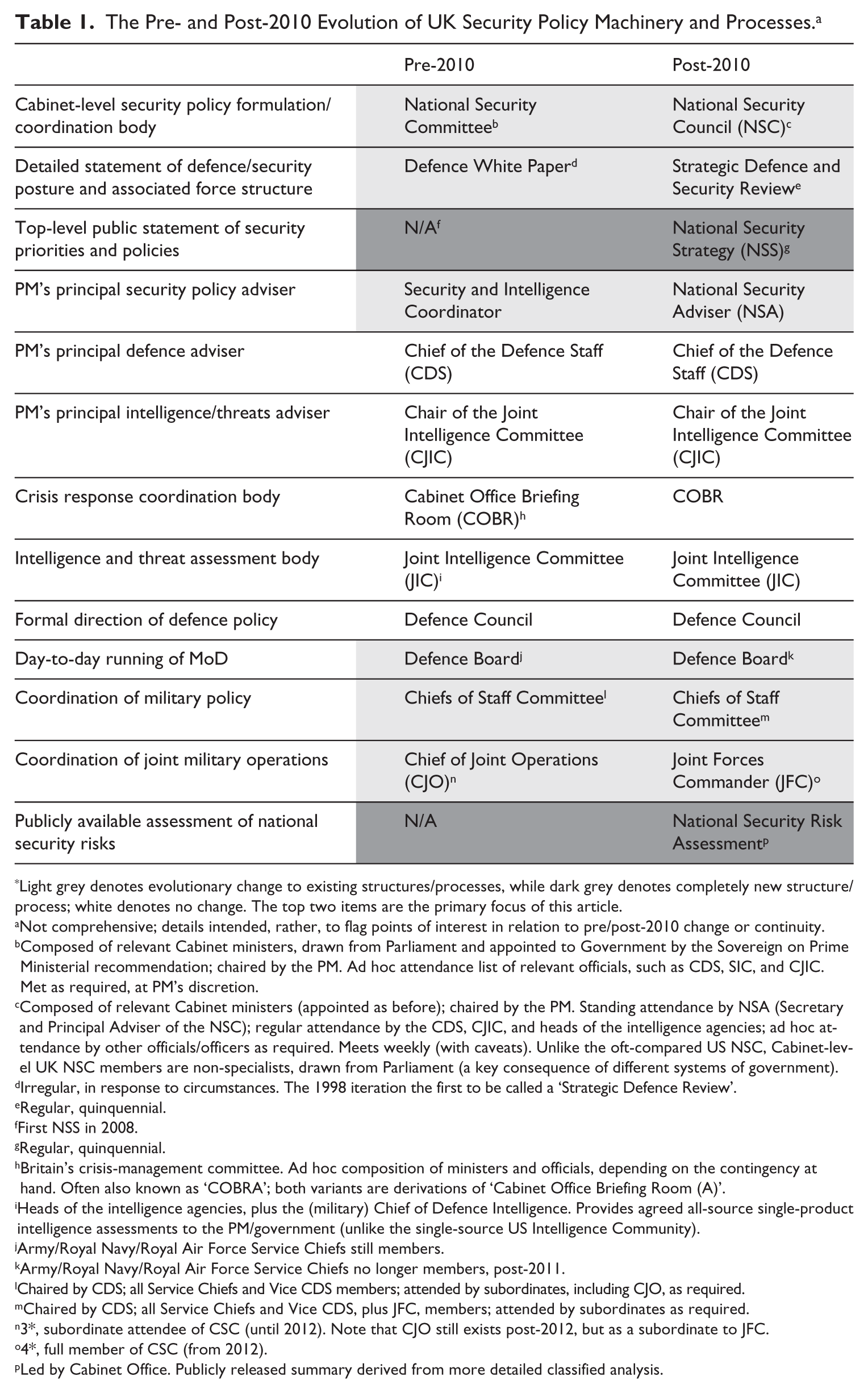
Light grey denotes evolutionary change to existing structures/processes, while dark grey denotes completely new structure/process; white denotes no change. The top two items are the primary focus of this article.
Not comprehensive; details intended, rather, to flag points of interest in relation to pre/post-2010 change or continuity.
Composed of relevant Cabinet ministers, drawn from Parliament and appointed to Government by the Sovereign on Prime Ministerial recommendation; chaired by the PM. Ad hoc attendance list of relevant officials, such as CDS, SIC, and CJIC. Met as required, at PM’s discretion.
Composed of relevant Cabinet ministers (appointed as before); chaired by the PM. Standing attendance by NSA (Secretary and Principal Adviser of the NSC); regular attendance by the CDS, CJIC, and heads of the intelligence agencies; ad hoc attendance by other officials/officers as required. Meets weekly (with caveats). Unlike the oft-compared US NSC, Cabinet-level UK NSC members are non-specialists, drawn from Parliament (a key consequence of different systems of government).
Irregular, in response to circumstances. The 1998 iteration the first to be called a ‘Strategic Defence Review’.
Regular, quinquennial.
First NSS in 2008.
Regular, quinquennial.
Britain’s crisis-management committee. Ad hoc composition of ministers and officials, depending on the contingency at hand. Often also known as ‘COBRA’; both variants are derivations of ‘Cabinet Office Briefing Room (A)’.
Heads of the intelligence agencies, plus the (military) Chief of Defence Intelligence. Provides agreed all-source single-product intelligence assessments to the PM/government (unlike the single-source US Intelligence Community).
Army/Royal Navy/Royal Air Force Service Chiefs still members.
Army/Royal Navy/Royal Air Force Service Chiefs no longer members, post-2011.
Chaired by CDS; all Service Chiefs and Vice CDS members; attended by subordinates, including CJO, as required.
Chaired by CDS; all Service Chiefs and Vice CDS, plus JFC, members; attended by subordinates as required.
subordinate attendee of CSC (until 2012). Note that CJO still exists post-2012, but as a subordinate to JFC.
full member of CSC (from 2012).
Led by Cabinet Office. Publicly released summary derived from more detailed classified analysis.
These formalised processes – both central government security policy machinery and cross-government security policy reviews – were already complemented by informal policy coordination: a long-standing strength of the Whitehall system. In the early days of the CID, formal Cabinet only functioned through ministers’ private secretaries corresponding or convening afterwards to decipher what had been decided (Devaney and Harris, 2014: 7).
Given this pre-existing complex of formal machinery and informal coordination, what motivations account for the decision to further formalise UK security policy process over the 2008–2010 period? Two PMs’ political calculations tell some of the story. Publishing an official NSS enabled Gordon Brown to combat the charge that he did not take national security seriously (Cornish and Dorman, 2008; Guthrie, 2007; Morris, 2008; Norton-Taylor and White, 2004). Creating a formal Cabinet-level NSC and formalising the quinquennial SDSR process allowed Cameron to distance himself from the critique of overly informal decision-making during Tony Blair’s premiership – so damaging to prudent national strategy, as John Chilcot’s Iraq Inquiry has since shown (Blitz, 2016) – while managing intra-coalition relations with the Liberal Democrats (Jones and Blick, 2010).
There was also a mounting consensus during the late 2000s – as Britain’s campaigns in Iraq and Afghanistan foundered, and given the 2008–2009 financial crisis – that the United Kingdom was losing the ability to make coherent national strategy. 6 A 2005–2007 Conservative policy review, early in Cameron’s opposition leadership, recommended the creation of an NSC and regularised defence/security reviews (Branigan, 2007) and the still-ruling Labour Party reached similar conclusions (Kirkup, 2007), as ultimately manifested by the 2008 NSS (Sparrow, 2008). A non-partisan working group of senior defence/intelligence thinkers over the same period argued for the inadequacy of then-extant national security machinery/process, recommending various subsequently adopted innovations (Prins and Salisbury, 2008; Salisbury et al., 2009). Once in office, Cameron professedly aimed to address perceived strategic deficits by creating a powerful Cabinet-level NSC (JCNSS, 2014a), meeting weekly 7 with a supporting Secretariat and NSA. Other related innovations included a formalised National Security Risk Assessment (NSRA) to underpin the NSS (HM Government, 2010b), and a Joint Forces Command to further integrate operational-level military activity (HM Government, 2012). 8 Establishing regular quinquennial SDSRs to align with the 5-yearly general election schedule of the Fixed Term Parliaments Act (FTPA), meanwhile, was similarly supposed to change the previous pattern of defence reviews taking place only in response to fiscal/strategic shocks, once the associated pressure on pre-existing defence planning assumptions had become too severe (JCNSS, 2014a). 9
Formal institutions, informal institutions, and audience costs
Institutional analyses have long been paramount in comparative politics (Helmke and Levitsky, 2004). Traditionally, institutions have been defined as ‘controlling, organized organs of state’ (Lauth, 2000: 23). However, neo-institutionalist approaches focus on expected behavioural patterns. North views institutions as, ‘game rules for society’ (North, 1990: 3), while O’Donnell (1996: 34) defines them as, ‘a regularized pattern of interaction that is known, practiced, and accepted (if not necessarily approved) by actors who expect to continue interacting under the rules sanctioned and backed by that pattern’.
If institutions are shared norms that lead to convergent expectations of appropriate conduct, we can employ Helmke and Levitsky’s definition of formal and informal institutions. The difference between the two lies in the channels through which these rules or procedures are enforced. In formal institutions, these channels are official ones such as constitutions, laws, rules, courts, and legislatures. In informal institutions, this is not the case. Both can be equally important in structuring the ‘rules of the game’, as long as they appear legitimate. Lauth (2000: 24) notes that, ‘in contrast to formal institutions which receive their legitimacy through the state (and in the case of democracy through the sovereignty of the people), informal institutions are based on auto-licensing (that is, self-enactment and subsequent self-assertion)’.
Helmke and Levitsky warn against using informal institutions as a catch-all, residual category. They note that informal institutions ‘must be distinguished from other informal regularities. Not all patterned behaviour is rule-bound or rooted in shared expectations about others’ behaviour’ (Helmke and Levitsky, 2004: 727). For something to be an informal institution, its violation should be expected to generate an external sanction (Helmke and Levitsky, 2004).
Informal institutions can complement formal ones, playing a pivotal role in sustaining them and enhancing their efficiency (Lauth, 2000). Other informal institutions serve an accommodating role by creating ‘incentives to behave in ways that alter the substantive effects of formal rules, but without directly violating them; they contradict the spirit, but not the letter, of the formal rules’ (Lauth, 2000: 729). This means that although they do not necessarily enhance formal institutions, they can contribute to their stability by helping political elites adapt to formal changes by reducing the need for official changes in the system. Throughout our interviews with British security elites, we find that focusing on the interactions that take place between formal and informal institutions (as opposed to analysing formal ones only) allows for a better understanding of the effects of recent innovations, such as the NSC and the fixed-term SDSR, on the UK security system.
The concept of ‘audience costs’ – which can limit the flexibility of security policy – also underscores the benefits of the current setup. At their core, audience costs refer to domestic audiences punishing democratic leaders who renege on their promises: the ‘cost’ being a popularity decline, with potential electoral implications (Thomson, 2016). Even the prospect of paying limited audience costs can affect leaders’ behaviour (Tarar and Leventoglu, 2013). Our interview material suggests that fixed-term SDSRs can help the UK government avoid audience costs when changing security policy, thus allowing greater policy flexibility.
Elite interviews
Elite interviews are useful tools for exploring informal dynamics; published official material is more likely to capture formalised processes only. A total of 25 face-to-face semi-structured interviews were conducted with high-level members of Britain’s security policy community over 2015–2017, on condition of anonymity. Personnel from different government security agencies/departments were selected based on their knowledge of – and experience with – the design of security policy in the United Kingdom, the SDSR process, and/or the NSC. Questions were designed to minimise individuals’ incentives to present their own performance in a positive light (Aberbach and Rockman, 2002; Briggs, 1986: 2; Tansey, 2007), focusing instead on the reforms’ effects on institutional behaviour.
The limitations of interviews aside, our findings are corroborated – albeit not with the granularity that our interviews now provide – by the evidence/assessment of Parliament’s JCNSS, the legislative body created in 2008 to scrutinise the NSS and its associated bureaucratic machinery. They too find that key policymakers derive utility from the discussions sustained by the NSC and SDSR processes, even while agreeing that there are limitations on the generation of long-term strategy within the formal institutions themselves (JCNSS, 2012b: 4–5, 2014b: 7–8, 2015: 17). As such, our findings add detailed empirical support – plus theoretical explanation – to that element of the JCNSS’s assessment.
Our interviewees hold – or recently held – senior positions in their organisations: Senior Civil Servants (and equivalent officials) at Director grade or above; Armed Forces officers at Brigadier (1*) level or higher. 10 Interviewees were either active in the UK system or recently retired. Most have rotated between different UK governmental agencies and have represented different organisations in the 2010 and the 2015 SDSRs (and in some cases, the 1998 SDR too) so cannot neatly be categorised as representing (only) one specific department. The final sample comprised representatives from the MoD (four civilian and four military with tri-Service representation, although all were working in joint posts, plus three more retired), the Foreign and Commonwealth Office (FCO) (two current, one retired), the Department for International Development (DfID) (one), the Cabinet Office (three), defence think-tanks (two), senior academics specialising in UK security (two), the Home Office (one, retired), the National Security Secretariat (one, retired), and a retired Security and Intelligence Coordinator.
Interviews were structured to gauge views on the following areas: national and international security landscape (and appropriateness of UK security policy); the nature of inter-organisational relationships; decision-making processes leading up to the current (and past) SDSR; effectiveness of the NSC; determining how power/influence was exerted within the UK security system; and identifying factors that hinder the flexibility of security policies in crises. A grounded theory approach was utilised to analyse the data. We began with the puzzle of the United Kingdom’s newly formalised security policy institutions, coupled to critiques that these institutions are not as ‘strategic’ as they could be. In addition, there is a sense that much Whitehall business is done on the informal fringes of formal gatherings; we set out to explore this formal/informal interface. Our approach thus reflects a feedback loop between inductive and deductive inference (Blagden, 2016). We answer our guiding research question, ‘Does the recent re-structuring of the UK’s security process represent an improvement in UK security policymaking that equips the British state with the policy flexibility needed to protect its citizens in an uncertain future?’ by disaggregating it into three parts.
How do formal and informal institutions interact with each other in the newly formed NSC?
How do formal and informal institutions interact with each other in the fixed-term SDSR?
What are the overall effects of the NSC and the 5-year SDSR on the flexibility of national security policy in the present international security environment?
The National Security Council
Formally, the NSC is defined as, ‘the main forum for collective discussion of the Government’s objectives for national security and about how best to deliver them in the current financial climate’ (HM Government, 2017). It is chaired by the PM (Cameron then May over the interview period), and includes key departmental Secretaries of State, the NSA as Secretary, and other relevant government ministers/officials as necessary. It meets weekly – with caveats 11 – and has a variable number 12 of ministerial sub-committees dealing with specific policy areas/contingencies. Although a couple of interviewees remained sceptical regarding the level of impact the instauration of the NSC could have in terms of institutional change, respondents generally saw it as a major innovation.
Interviewees framed the creation of the NSC as a response to the changing conceptualisation of national security (Humphreys, 2015; Williams, 2003). As one noted, security ‘is a much broader concept now than it was and reflected in the UK with the creation of the National Security Council, to take the place of informal co-ordination arrangements between the major departments’. Although some interviewees saw value in some aspects of the NSC, the overwhelming consensus was that it was not carrying out its stated objective of setting national strategy, or even significantly aiding the design of national security policy. Instead, it was claimed discussions stayed at an operational or tactical level, making it more of a ‘responsive crisis management organization’. This situation produces frustration, given both that COBR already exists for the short-term crisis management function, and the potential the NSC has to become the strategically-oriented forum many interviewees believe its American counterpart to be.
13
One interviewee noted: It’s got the right people round the table, the right Ministers and the right officials;
14
it has the potential to look at things in a strategic fashion, as well as a tactical one, but I think most people would agree that under the current administration [Cameron] the Prime Minister tends to be tactical, rather than strategic.
Although May was initially perceived as less ‘tactical’ than Cameron (O’Neill, 2016), the NSC is still seldom viewed as taking the strategic role it was intended to have.
Interviewees identified two main explanations for the strategic under-utilisation of the NSC. Some were quite unspecific, stating that it simply did not seem to use the power it could have. One respondent commented that the NSC ‘has to be invested with power’. Several others pinpointed the relevance of the NSA’s professional background, claiming that having a bureaucratic official such as a diplomat in the role (which has been the case thus far) limited its influence. It was suggested it might operate at a more strategic level if the NSA was, ‘politically significant and also independent, someone the PM could listen to, someone who could direct the NSC, work out policy and then present it to the PM or Home Secretary’. Another interviewee proposed that having an NSA who was a ‘secureaucrat’ (a defence, security, and strategy specialist, rather than a Whitehall ‘generalist’) might also make a difference. 15 This proposition suggests that the NSC’s power as a formal institution has not been invested informally by UK security elites to a universal/consistent extent.
Interview material suggests two significant objectives the NSC could fulfil for the Whitehall security policy community (but has not hitherto fully achieved). These are (1) to present a unifying national aim, especially in times of international crisis, and (2) to enhance inter-departmental coordination. One interviewee saw the NSC as being designed in part to, ‘bring the right people together and break down organisational barriers … there’s a whole chapter in the 2010 SDSR which was an attempt to set up the frameworks that would embed the right sort of cross-cutting behaviours and approaches’. Another lamented that he did not yet see this objective being met: I think it still hasn’t quite got a complete grip. I mean, it’s a very important body but actually taking very strategic direction, turning it into task for departments is something that’s not quite there yet, so we haven’t got that mechanism between the NSC, and the departments. Each department, quite rightly, should provide options.
Several interviewees highlighted how the NSC format does facilitate cooperation that might be more difficult in larger group settings. In the Cameron era, the NSC was a ‘good handling tool’, when Liberal Democrat and Conservative Party members’ views diverged. In the post-Cameron era, it serves a similar function between disputing factions of the Conservative Party. An interviewee noted that May values the NSC so much, she has sought to replicate the model with new committees to manage Britain’s forthcoming EU withdrawal.
The need for the first aim was characterised as follows: I think inevitably we all view these things from slightly different angles because we have slightly different mandates: making sure that we’ve got a unified aim at the beginning is absolutely critical. More strategically, I think, it’s about having a clear aim and that’s really difficult because the goal or aim perhaps changes over time, inevitably as politics plays into it, but I would suggest that in Afghanistan we changed far too often. You need to make that clear from the beginning because then each of the government departments can understand their part in the plan and I think we weren’t crystal clear to start with what we were trying to achieve and then, at times, that led to departments pursuing their own agendas and in a slightly divergent way. Perhaps that’s natural and therefore, it should come together at, inverted commas, ‘Board level’, which is the National Security Council who should be able to review this and make sure the departmental strategies are aligned, and the mechanisms exist. How often and how well they’re used is, is a different matter.
However, although these aims were not being achieved formally at NSC meetings, significant informal advances were being made at so-called ‘pre-NSC sessions’, separate from – and prior to – gatherings of the full (ministerial) NSC and subordinate bureaucrats NSC (Officials).
16
These informal pre-meetings also take place before NSC sub-committee meetings, and are not always face-to-face encounters, effectively turning a two-step formal process into a three-step reality. During crises, informal pre-sessions became part of the weekly schedule for representatives of different Whitehall departments. They also structure the work of participating officials back in their ‘home’ organisation. As one interviewee noted, ‘From what I’ve seen there’s an aversion to bringing the debate into the room, there’s a sense that everything needs to be sorted before it gets to the NSC’. Another described the dynamics of these ‘pre-sessions’ in more detail: I think the power lies in the informal network but it is implemented through the formal network, right up to papers that might go to NSCs through an SDSR process or a spending review process and all the rest of it, when you have the set-piece meetings. Now, they would go out into these one hour-long meetings with three or four agenda items which were huge topics, you wouldn’t talk about it for ten minutes. There’s a lot to get through. So those meetings had to just get focus down to the key points and all of that done was in all the pre-sessions.
These inter-departmental pre-sessions were described as: we generated narratives or how we shaped it to what we thought, actually had to be focused on in the one hour session, saying, look, we totally get why you’re interested in this, but there’s a lot of challenges in this, but maybe if we shape it in a certain way, it becomes more feasible, more doable, more palatable.
Other interviewees highlighted the importance of these informal pre-meetings across Whitehall: There are also informal contacts which go on a lot of time outside these committees so there will probably be informal discussions in the run up to these committees to say, around Whitehall, ‘what do you think of this, what’s going on that’, or, indeed, the default, behaviour is various drafting and re-drafting of the papers so papers will be written, they’ll be cleared around Whitehall, people will have the chance to comment on them before they then get to the formal concrete decision points or advisory points which might be in the full committee board.
These networks of regularised, embedded, and often strategically decisive pre-meetings thus operate as informal institutions that enhance and sustain the NSC. They have become as institutionalised as the NSC’s weekly meetings, but – vitally – remain flexible; their frequency and composition varies from crisis to crisis. For instance, during the worst of the 2014–2016 Ebola Crisis, ‘a lot of it was out of committee, there was a bunch of us from the various government departments that met every single morning at nine o’clock … over in the Foreign Office’. Admittedly, there are potential pitfalls with such a set-up. Several interviewees expressed concern over significant policy discussions taking place informally, as it could limit the political accountability of important national decisions. Such concerns were one of the main rationales for creating the NSC. However, although these pre-sessions are important politically, their sole objective is to inform formal, minuted NSC meetings. These are chaired by the PM and are where definitive security policy decisions occur. By analysing the NSC holistically, considering the array of informal discussion and coordination attempts around it, the possibility of it fulfilling the objectives interviewees identified as relevant increases. The creation of the NSC is significantly enhancing inter-departmental cooperation, which in turn helps the pursuit of a cohesive national response in times of crisis. This process was demonstrated during Britain’s Ebola response – a tactical contingency, arguably, but one that demonstrated how informal UK security institutions can sustain and enable their formal corollaries.
A fixed-term Strategic Defence and Security Review
While the NSS assesses levels of security risk to the United Kingdom and appropriate strategic responses, the SDSR seeks to procure and assign forces/capabilities to address such risks. 17 The SDSR process is thus intended to conduct comprehensive, cross-departmental analysis of national security/defence needs, in line with the NSS, before setting/allocating resources via capability choices. The SDSR is our focus, rather than the NSS, because of the resource-induced trade-offs between competing capabilities that it entails and the associated political contestation. That said, Britain’s post-2008 turn to a ‘risk-based’ NSS, underpinned by the NSRA, is an important part of the context to our argument (Cornish and Dorman, 2013; Edmunds, 2012, 2014; Hammerstad and Boas, 2014; Porter, 2016; Blagden, 2018). Attempting to weigh likelihood against impact for the possible universe of adverse security contingencies represents the heart of the planning challenge for both the NSC and the SDSR, and the informal networks that enable/sustain them.
The most recent quinquennial SDSR took place in 2015: a first preceded in 2010. The novelty is not the review in itself – as noted, 1998 also saw an SDR – but that it has been formally regularised. While the 2010 SDSR was widely criticised – mostly for the perception that it was a Treasury-driven fiscal consolidation exercise, rather than a threat-driven appraisal of UK strategic needs – the 2015 version has been received more favourably (Chalmers, 2015; Dorman et al., 2016; House of Commons Defence Select Committee 2015; The Economist, 2015).
Our interviewees agree with this public reception: It’s an opportunity to change everything. It’s absolutely an opportunity for strategic rebalancing, so if things have changed, this is a really good opportunity in a considered, rather than reactive way, to make a strategic change. It’s harder for a government who was in power at the last time to make that change but this is their opportunity to do so.
Another interviewee also highlights how the SDSR can enhance policy flexibility: Defence reviews allow you to make decisions and they give you a focus for those decisions so it’s hard for me to say, ‘I’ve concluded in apparent isolation that this particular programme or this particular piece of my force-structure isn’t a good idea anymore so I’m going to get rid of it and do something else with it’, because you then get, why today, why not tomorrow, how’s this decision situated? … you find yourself standing on the floor of the House of Commons defending your entire approach to national security because you make one dramatic switch and why not more? Whereas if you’ve got a bounded exercise, a review that looks comprehensively at all of that, then there’s your answer, your answer is, I’ve taken a comprehensive look at everything I do within the defence and the security enterprise and in the context of that comprehensive look, looking at threats, risks, my approach, resources, I’ve made a series of decisions against a coherent re-appraisal of the challenges and the outputs I need to deliver. That’s a much, much easier conversation to have rather than, I just woke up this morning and suddenly I decided this was a bad idea.
While having a fixed-term NSS/SDSR ensures an overall examination of national security at least every five years, it does not preclude smaller revisions in between. The 2017–2018 NSCR constitutes such a sub-review: the size/configuration of specific capabilities has been reconsidered but not the overarching NSRA. As one interviewee explained, this mini-review ‘isn’t looking at ends; instead it’s just focusing on the means, on a part of the big picture’. That said, the manner of the NSCR’s conduct – and its military-specific spinoff, the 2018 ‘Modernising Defence Programme’ (MDP) – carries implications under our theory. There were clear political incentives not to label it a new ‘SDSR’, implying (embarrassingly) that the titular ‘strategic’ in the 2015 SDSR lacked even a 2-year shelf life. Yet as an unwanted but fiscally necessitated review of 2015’s capability commitments, led by the NSA within the Cabinet Office and with less external consultation than a full SDSR (Chuter, 2017), it lacks the political cover against audience costs provided by the ‘regular’ SDSR cycle. Sure enough, it has become an acrimonious focal point for political criticism (BBC, 2017).
Although generally in favour of some sort of predictable spending review process, interviewees had varying degrees of support for fixed-term SDSRs. At one end of the spectrum, supporters contend that the NSS/SDSR process is now the primary means by which UK security policy is designed. Its role in reining-in defence costs and reducing uncertainty was also highlighted. At the other extreme, one interviewee claimed that: it’s a great big charade. The SDSR, in and of itself, basically consists of political masters taking decisions on defence spending, fundamentally, which they take in advance, or separate from the SDSR, and then justify through the SDSR process, right? In theory the SDSR then informs the Spending Review, but the SDSR was announced the same day or the day before the Spending Review. I see it as a monster of a bureaucratic exercise, fundamentally to give window-dressing to decisions that have been made or are being made separately in smoke-filled rooms about whether we want aircraft carriers or not and Trident. I think the review itself is largely irrelevant to that process except to justify it, these formal processes have very little impact on what we actually do.
The process preceding the 2015 SDSR document implies at least six months of intra/inter-departmental review. A seemingly contradictory dynamic started occurring this time around: the PM began making public announcements ring-fencing resources to be allocated to some departments. Some of these announcements reflect security commitments (Blagden, 2015), such as allocating 2% of gross domestic product towards defence, which sends a strong signal to both international partners and pro-defence domestic elements. As one interviewee noted: all these things ought to be saved up to be announced at the SDSR but in fact the PM needs to announce them, normally for political reasons, so at Conservative Party Conference, the NATO summit in Wales you need to have something deliverable and that’s where the kind of PR machine which has a time in horizon. So that’s very, very frustrating for the planners.
Publicly announced commitments also included the 0.7% of gross domestic product to go towards Overseas Development Aid, stating that there would be no reduction of the 82,000 Army regulars, as well as tactical-level prioritisation of certain intelligence-gathering resources, such as remotely-piloted aerial vehicles. That these commitments are made outside the formal SDSR process does not limit their effects or importance. Interviewees emphatically claimed that once the PM made such a public announcement, it became a real constraint for those carrying out the SDSR process.
Interviewees saw these public announcements made by the PM as contradicting the spirit of the SDSR; theoretically, such policy decisions should have been discussed across various Whitehall departments before decision/publication.
18
In this sense, they can be seen as the second type of informal institution: one that alters the purpose of the formal SDSR process, without technically violating it. However frustrating and out-of-place these public commitments by the PM might have seemed, they served a vital function in 2015 and were crucial to avoiding a repeat of the disastrous build-up to SDSR 2010. Even frustrated interviewees highlighted the positive effects of such announcements: having more clarity about the budget beforehand helped avoid the toxicity associated with the process leading up to the 2010 SDSR. One interviewee noted that: we have a huge advantage this time because when you’re fighting for resource and there’s not a great deal of manoeuvre space then that becomes quite an emotive business which brings all the worse behaviours out in people. Notwithstanding the fact that there are going to be some difficult decisions in this defence review, people are not fighting for survival as they would see it because of the financial settlement.
These types of informal institutions help sustain associated formal institutions by allowing adaptation to occur without the need to initiate a new formal re-structuring process. This certainly appears to be the case with the 2015 SDSR process, which has been widely lauded as being a significant improvement on 2010 and might set the foundation for the consolidation of a fixed-term SDSR process.
The NSC and SDSR: Unifying objectives while avoiding audience costs
All governments need a certain degree of flexibility in the design of security policy, and democracies in particular face vocal opposition, media, and public contestation of their choices. The contemporary international security environment also increases this need for flexibility. Consistent with ‘securitization’ theory (for example, Williams, 2003), definitions of security policy varied significantly among interviewees. There was consensus in distinguishing between the Cold War period, in which security was generally regarded as synonymous with defence, and the present day (for example, Humphreys, 2015). However, what should be regarded as security policy in the post-Cold War period was less clear. One interviewee thought ‘it’s a fundamentally fuzzy policy domain’. Even those not particularly enthusiastic about the new British security sector re-structuring agreed that some kind of change to the system was necessary to allow more flexibility in the pursuit of national objectives. One interviewee noted: the broadening of the concept of what constitutes security has also been matched by a change in the arrangements in the UK for managing these issues. You can argue that the NSC actually has brought a helpful change and, to some extent we are a bit better now at putting practical success and effect to the rhetoric of comprehensive approaches. Well, we didn’t really have comprehensive approaches and we learnt hard lessons in Iraq and Afghanistan about how difficult it is to link up humanitarian aid and hard security elements in a successful way but that is the concept.
As succinctly stated by another interviewee, ‘it was time for a refresh’.
Having regular SDSRs can help avoid audience costs. That is, the SDSR fulfils a vital political function: it allows the PM to reduce potential loss of domestic support if he or she changes course on a prior commitment to security policy. This function can seem especially relevant if political actors know an SDSR will take place every five years. Several interviewees commented on the benefits of this set-up: Doing a U-turn is thought to be very bad because in the British political culture we have it’s the same as saying, ‘come and hit me’, and so I think there is very little incentive for any to say, ‘you know what, we didn’t get this quite right or things have changed’. The fact is that governments make mistakes and it’s, it’s very, very difficult for any government to admit, sometimes you get the government continuing on a policy which is wrong … Very, very rarely do you get a change of direction, perhaps that’s actually the most important reason why you need an SDSR because it gives cover, political cover to say, ‘not that we made a mistake but the world has changed and therefore we’re going to change. That’s kind of how it’s framed’.
19
Formally instituting an SDSR at regular intervals, giving the PM the opportunity to change course without paying a high cost with relevant political audiences (either in Whitehall, or with the electorate, or in the international arena), can help the newly formed NSC achieve one of its main functions: providing unifying strategic objectives in the face of a deteriorating national security environment. Politicians often favour vague statements to avoid accountability in the event that they renege on announced threats or policy commitments. This situation has led some to advise taking a ‘strategically vague’ stance (Baum, 2004). One interviewee claims: that attitude then does lead to trying to be a little bit vague about your own status and your timeline and things, because then you can’t be held to account for failure, but that doesn’t help the, sort of, levers of power running to a unifying aim, um, so it would be really good if we could address that in some way.
It will be more feasible for HM Government to define clear, concise, and unifying courses of action through the NSC if the possibility for changing such course exists at predetermined intervals in the near future. According to interviewees, this set-up should significantly affect British strategy-making effectiveness during international security crises.
Discussion and conclusion: Implications in the UK strategic context
Although the general election of 8 June 2017 was a departure from the FTPA’s previous commitment to 5-year-long Parliaments, and although subsequent developments have necessitated a reappraisal of SDSR 2015’s capability commitments via the 2017–2018 NSCR/MDP, Britain’s NSC and regularised SDSRs are here to stay. The NSC remains a cherished creation of the ruling Conservative Party, while leaders of Britain’s other two largest nationwide parties – Labour and the Liberal Democrats – have also expressed their intent to retain it if elected. The 2015 SDSR framework has ‘trickled down to other departmental strategies’, meanwhile, and has proved a ‘vital reference point for constructing a strategy for a “Global Britain” as May took office: it was all going to hell in a handcart but the SDSR document provided a handrail’ (anonymous interview). One interviewee noted that May refused the opportunity to modify the SDSR upon taking office as, ‘she needs stability where she can get it’. With strength and stability as the mantra of her 2017 re-election campaign in the face of Brexit’s many uncertainties (Moseley, 2017), this machinery of security policymaking continuity looks set for further entrenchment, even if a rescheduling of the NSS/SDSR is eventually necessitated by its newfound misalignment with the 2017–2022 electoral cycle. 20
The analyses here suggest that considering both the formal and the informal dimensions of the recent overhaul of the UK security design process presents a different picture than a narrow focus on the effects of the formal changes only. The NSC has the potential to present a unifying national aim when confronting the wide array of security challenges the United Kingdom is currently exposed to. Having such an aim can be crucial when personnel from government bodies as diverse as the MoD, DfID, and the FCO are involved but their specific missions differ, given the absence of a clear ‘umbrella’ national mission statement (Crowcroft and Hartley, 2012). Furthermore, the NSC has improved inter-departmental coordination when multi-dimensional solutions are needed. While this coordination is not necessarily occurring in the NSC meetings themselves, pre-NSC meetings see representatives of different governmental departments and agencies set the agenda for the formal meetings and gauge what compromises other departments might accept. These informal meetings enhance and sustain the formal NSC process. The fixed-term SDSRs similarly provide both a strategic handrail in uncertain times and facilitation of policy flexibility, by minimising political audience costs when policies and prior commitments should be changed. While the PM’s unilateral public ring-fencing announcements appear to go against the stated objective of the SDSR, they have actually helped sustain the process. Such statements function as accommodating informal institutions, reducing some of the most negative effects of the often-unpopular formal SDSR process.
While these recent transformations improve the design and implementation of security policy in the United Kingdom, significant limitations exist in the British strategic context, which may constrain the NSC from fully discharging its formal mandate to define national strategy. Like any country, British strategic behaviour is shaped by a combination of external and internal security threats, material wherewithal to address those threats, domestic-political constraints and opportunities, and strategic-cultural idiosyncrasies (Kitchen, 2010). Since the late 2000s – and certainly since Russia’s 2014 invasion of Ukraine and re-confrontation with NATO – certain ‘old’, pre-1990 threats (nuclear-armed hostile major powers) have returned to Britain’s security environment while the ‘new’ threats of the 1990s and 2000s (mass-casualty terrorism, proliferation, climate change, migration, and so forth) have not disappeared. In this climate of limited capabilities and multiple potential dangers, coherent and effective national strategy-making remains vital, but harder to achieve. Britain also faces the complication that – via its bandwagoning relationship with the United States – it is not solely the fashioner of its own grand strategy but also a cog in someone else’s grand-strategic machine (Dunne, 2004; Porter, 2010). And like all strategy-making communities (Hopf, 2010; Porter, 2018), Whitehall security policymakers absorb and reflect various internalised ‘common-senses’, limiting capacity for reconsideration of certain embedded assumptions (McCourt, 2014).
Given this context for decision-making, it is unsurprising that the formal NSC and NSS/SDSR often fail to conduct visionary, long-term strategic planning based on wholesale, back-to-basics reappraisals of underlying assumptions. The NSC represents the very centre of national security ‘establishment’ thinking, by definition, and the NSS/SDSR process is directed by it. Expecting such a body to reconsider formally its underlying assumptions would be like expecting the Bank of England’s Monetary Policy Committee to periodically reconsider the goal of monetary stability. We remain hopeful that the NSC will evolve into a forward-looking maker of coherent national strategy – there had been indications that May’s government might take a longer-term view of national security questions than Cameron’s (O’Neill, 2016), prior to her June 2017 political enfeeblement – and the 2015 NSS/SDSR was widely hailed as an improvement on its 2010 predecessor. Our interviews show, however, that while there has been movement in a positive direction, we are not there yet; following June 2017’s hung Parliament, May’s government will face serious challenges to setting any sort of decisive national direction as long as it lasts. That being the case, the post-2010 improvement in informal strategy-making institutions is welcome news, especially as the United Kingdom faces its greatest foreign-policy challenge since 1945, muddling through Brexit without calamity. If this formal/informal insight holds in Britain, moreover, then it is likely to hold elsewhere too; application to other national contexts therefore represents a promising avenue for future enquiry.
Footnotes
Acknowledgements
We thank Allison Astorino-Courtois, Stephane Baele, Gregorio Bettiza, Belinda Bragg, Mike Clarke, Roz Davis, Knight Lee, Helena Mills, Paul Newton, Claire Packman, Patrick Porter, Pamela Van Arsdale, Paul Woolnough, participants in the University of Exeter’s Centre for Advanced International Studies seminar series, and the anonymous reviewers for their invaluable comments on versions of this argument.
Funding
The author(s) disclosed receipt of the following financial support for the research, authorship, and/or publication of this article: Catarina P Thomson gratefully acknowledges financial support from the Economic and Social Research Council (grant ES/L010879/1).
