




Abstract
In an attempt to systematize the widespread, though analytically vague diagnosis of a “polycrisis,” the article theorizes the current condition as the outflow of a “crisis of crisis management.” In this reading, the paradigm of financialization, established in the 1970s and increasingly overwhelmed by economic risk, geopolitical complexities, and ecological devastation, is no longer trusted to reconcile the competing objectives of emancipation, democratization, sustainability, and growth—thus giving rise to a plethora of co-constitutive crises. Meanwhile, institutional erosion has unleashed affective energies that drive increasingly fierce attempts at political re-articulation. Together, these constitute a defensive turn, in which a revisionist-populist, an eco-modernist, and an eco-emancipatory project appear increasingly entrenched. Yet, given the depth of the crisis and its added ecological complication, likely none of these will prevail. With a further “controlled burning” in the cards, the “organization of pessimism” (Benjamin) will likely move beyond the well-known political options of the present.
The angel of history, revisited
The “organization of pessimism” is a concept by Walter Benjamin which he mentions in passing in notes to his Theses on the concept of history. It addresses the question of what to do in light of the devastations of modernity, as they are addressed in the famous passage about the angel in Klee's painting Angelus Novus, “looking as though he is about to move away from something he is fixedly contemplating.” This, Benjamin says, is how one pictures the angel of history. His face is turned toward the past. Where we perceive a chain of events, he sees one single catastrophe which keeps piling wreckage and hurls it in front of his feet. The angel would like to stay, awaken the dead, and make whole what has been smashed. But a storm is blowing in from Paradise; it has got caught in his wings with such a violence that the angel can no longer close them. The storm irresistibly propels him into the future to which his back is turned, while the pile of debris before him grows skyward. This storm is what we call progress. (Benjamin, 2012 [1969], thesis IX)
Of course, Benjamin wrote the Theses—his last work—at a very specific moment, in 1940, on the run from the Nazis. For a time after, it could seem that he himself was overly apprehensive when organizing his own pessimism into writing. With the “trente glorieuses” of the post-war era, the United Nations, ultimately the fall of the Iron curtain, it could seem, for a brief moment at least, that the storm blowing from paradise had, at long last, reversed course. In fact, when the playwright Heiner Müller unearthed Benjamin's concept of the “organization of pessimism” in a reading in 1990 (in a location called “freeport” in Hamburg, Germany), 1 it looked as if Benjamin's angel could finally close its wings, as progress had reached its port of liberal democratic capitalism. Such at least was the vulgar Hegelian reading of optimists like Francis Fukuyama (1993).
Yet three decades on from the euphoria of the early 1990s, the times have changed once again. Looking at the destruction from Charkiv to Aleppo, at global ecological devastation and the fastest mass extinction in natural history, at the despair along the world's reinforced borders and the writing on the wall that tells of a new block confrontation, catastrophes certainly seem piling up again—while any consensus on any formula of “never again” seems more in doubt than ever. Instead of a universal, ecologically reformed agenda of emancipation and democratization, there is—to take up a term that has recently become a fixture in contemporary commentary—a polycrisis.
The popularity of this concept—which was named word of the year 2022 by the Financial Times and became the theme of the 2023 Davos Forum (WEF, 2023)—certainly speaks to its phenomenal accuracy. Questions remain, however, if it does much else than giving a name to the impression that there is “a lot going on.” It lacks, the objection goes, both intensional and extensional specificity, as well as explanatory prowess. Put another way, it leaves open if there is, beyond the incoherence and confusion, a common denominator to the many simultaneous crises and catastrophes. What is the reason for their joint occurrence? And if there is one, how deep does it run? Part of the charm of confronting the perception of a polycrisis with Benjamin's reading of the trajectory of modernity is that it raises the question of the typicality and the specificity of the current condition. If crises are integral to modernity—is the current “polycrisis” special in any way? Why does it strike now? And is it truly worse than previous crises—a crisis of rather than in modernity? And: is there a way out? Or have we reached our destination of “too late modernity” (Bröckling, 2024)?
These questions are all the more relevant as this time around, the “piling” is accompanied less by competing utopias (i.e., ways out) than by a deep-seated protective impulse. The object of this impulse varies—economic growth, personal autonomy, the nation state and the ecosphere compete in this respect—but it's not emancipation as much as “preservation” (Staab & Sorg, in this issue) that is the focus of contemporary social conflict. As globalization has shifted into reverse (Schmalz, 2022), as democracy has started to “devolve” (Selk, in this issue), and as a supposed “green hegemony” is deemed over (Rödder, 2024), politics as a whole seems to have taken a defensive turn.
Yet much as these observations lend credibility to the description of a highly challenging simultaneity of problems, it makes added explanatory specificity all the more urgent. So in this article, I will take the feeling of being overwhelmed by crises—which haunts the adherents of a polycrisis just like Benjamin's angel—as a starting rather than an end point. Taking up on Benjamin's notion that pessimism can and will be organized, I attempt to unpack the polycrisis’ inner logic in order to understand how it came and what it is about. Reading it against classical sociological treatments of crisis, I will argue that the prevailing sense of disorder should be seen as neither due to a chance encounter of separate crises nor as the outflow of one central dysfunction or even the natural progression of (capitalist) modernity. Instead, I posit that the impression of an overburdening array of problems best be understood as the effect of a “crisis of crisis management” (Offe, 1973). In this reading, the dominant paradigm of crisis regulation established with the turn to financialization in the 1970s has started to give way under the weight of economic, ecological, and societal dynamics it (ultimately unsuccessfully) attempted to externalize or postpone. As a result, trust in modern societies’ central institutions has—slow at first, yet at accelerating speed—eroded to the point of a failure of hegemony. This has, once again, yet with the added complication of ecological catastrophe, given rise to a constellation of competing and thus mutually reinforcing problems (which I will systematize in the triangular shape of a trilemma of trilemmas). Absent any consensus on the intelligibility of these problems, let alone on any coherent strategy for solving them, this has led to a fragmentation of the social space that currently takes the aforementioned form of the defensive turn, powered by a politics of fear.
The focus on affect—trust, fear, and disorientation—is important here because it points to the underlying dynamics as they have evolved throughout modernity's latest phase: what used to be a subtle unease at the depolitized setup of the 1990s has turned into the “hyperpolitical” (Jäger, 2023) rage and indignation of the present. Yet that also means that, being at least as reactive as it is reactionary, the turn to defense—which, following my triangular model, I will reconstruct as a dynamic of fortification of emancipatory, technocratic, and restaurative visions—is not a stable state, but a precarious attempt at holding on to the bits and pieces of certainties shattered. It is precisely this reactive matter, the affective fallout from established mechanisms of crisis management run afoul, what Benjamin aimed at with the “organization of pessimism”: while history “progresses,” there “flares up,” from the cracks of the ruins piling up, the fleeting “trace” of what has been lost. Politics is about the recuperation of this trace, by way of organizing its affective remnants into a new imagery [“Bildraum”]—“to win the power of rapture for the revolution.” Pointing beyond the defensive turn, this—picking up the pieces after hegemonic fragmentation—is what is currently going on. And while the outcome is yet very much uncertain, it's important to realize that familiar answers won’t do this time around; there will be a new normality after the polycrisis, and it's a matter of politics—of organizing pessimism into a new institutional setup—what that normality will be.
Any (larger) crisis is a polycrisis
The term “polycrisis” has been popularized, though not invented, by Adam Tooze. He took it from Jean-Claude Juncker (who had applied it to the Euro-crisis), while it can be traced back to the complexity theoreticians Edgar Morin and Anne Brigitte Kern (1999). Tooze himself had first taken it up in his analysis of the COVID crisis (Tooze, 2021), before returning to it in 2022 in an attempt to map the interrelated challenges right before and after the Russian attack on Ukraine. Commenting on the escalating complexity of the enterprise, he noted: “What was once a relatively legible map has become a tangled mess” (Tooze, 2022a). It is this “tangled mess” that is at the heart of Tooze's use of the term: an inextricable clew of mutually reinforcing problems, making any isolated attempt at a solution fruitless. To solve any, one would have to solve all at once (Figure 1).
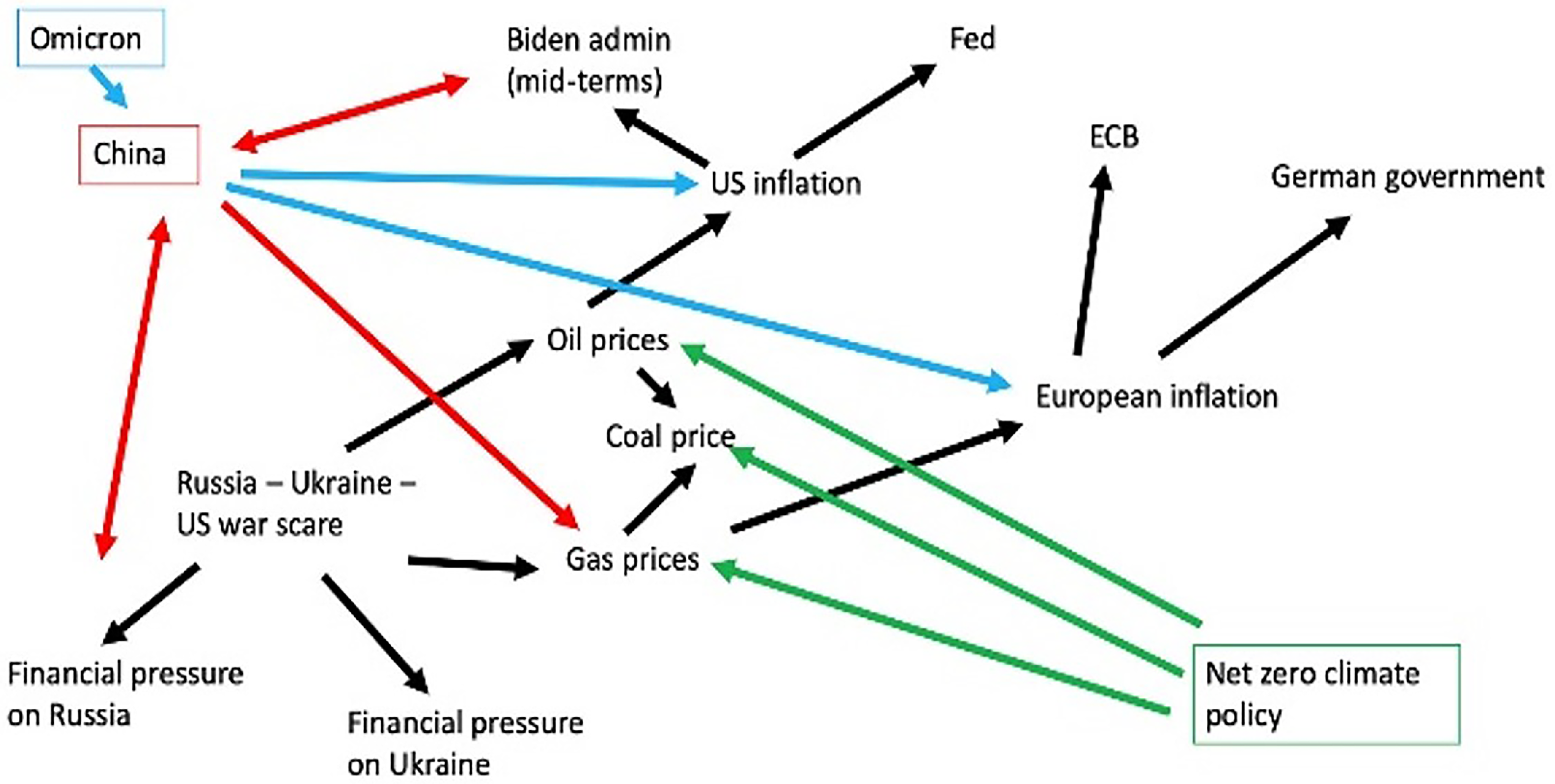
Tooze's mappings of the polycrisis (Tooze, 2022a).
Following Tooze's introduction, the concept rapidly gained currency: beside becoming the theme of the 2023 Davos Forum (WEF, 2023), it also became the topic of numerous publications and conferences. Its diffusion into everyday language since provides further evidence that it (at least in a way in the West 2 ) captures an important aspect of the spirit of the times. Tooze himself has stated that “[w]hat the polycrisis concept says is, ‘Relax, this is actually the condition of our current moment’. […] It's therapeutic. ‘Here is your fear, here is something that fundamentally distresses you. This is what it might be called” (Tooze, 2023).
At the same time, a debate ensued almost immediately on the merits and especially the substance of the concept. Christopher Hobson argued that while “certainly suggestive, […] there is room for more clearly specifying what exactly it entails,” himself identifying eight properties of the concept 3 (Davies & Hobson, 2022; Hobson, 2022). Picking up on this, Tooze referred to a report by the Cascade institute that defined polycrisis as “any combination of three or more interacting systematic risks with the potential to cause a cascading, runaway failure of Earth's natural and social system that irreversibly and catastrophically degrades humanity's prospects. […] A global polycrisis, should it occur, will inherit the four core properties of systemic risks—extreme complexity, high nonlinearity, transboundary causality, and deep uncertainty—while also exhibiting causal synchronization among risks” (Janzwood & Homer-Dixon, 2022; Tooze, 2022b). However, specifications like these did little more than plausibly (yet unspectacularly) underlining that simultaneous crises interact and reinforce each other, making them hard to comprehend and address. Yet by focusing solely on preconceived, simultaneous yet distinct risks, and barring a theory of society to guide the conceptualization of these problems and their interrelation, they have little to say on what brought the sudden spate of problems about, and if their interrelation is more than accidental. “The first and most important bit missing,” Anusar Farooqi lamented this conceptual void, “is the etiology of the polycrisis” (Farooqi, 2022).
In this line of thought, it is important to realize that the insight into the multidimensionality of the crisis as such is hardly an innovation. Instead, it is the staple of any more sophisticated crisis theory. Already in Gramsci, we find the notion that “crisis is a complicated process,” “with manyfold appearances, in which causes and effects intersect and complicate each other” (Gramsci 2011, Notebook 15, §5). Habermas, to cite another example, follows the interlinkage of economic crises and crises of rationality, legitimacy, and motivation, in turn linking them to the interrelation of economic, political, and sociocultural systems (Habermas, 1973, p. 66). In addition, he mentions three syndromes that are not “system specific” but “follow-up problems of late capitalist growth,” namely “disruption of the ecological balance,” alienation and the breakdown of international order (Habermas, 1973, p. 66). These are foregrounded by other approaches, like Ulrich Beck's—who is arguing that the production of external risks is increasingly “overshadowing” (1992, p. 17) the gains through technical-economic progress, in the process severely affecting divisions between classes and nations and fundamentally changing individual trajectories—or world-systems analysis. The latter not only follows the constant interplay of economic development, political order, public consent, and natural resources, but also asserts to “invent a new language to transcend the illusions of the three supposedly distinctive arenas of society, economy and politics” (Wallerstein, 1991, p. 14).
Many more examples come to mind, the most sophisticated maybe being regulation theory (which I will address in more detail below). But the point here is simply that for any serious theoretization of crisis, any crisis worth its name is always a polycrisis. For which, of course, there is a simple reason: as the social space is made up of institutions that link subjectivities within the confines of planet Earth, there is, irrespective of any specific paradigm, always the interlockage of nature, selves, and social relations to account for—or, if you like, the intersection of psychic, social, and biophysical systems. And any significant turmoil in either of these areas will inevitably resonate across the others, too. And what is more: As these interrelated systems rely on politics for their “deparadoxization” (Stäheli, 1998), that is, their balancing, their established mechanisms for conflict resolution become challenged, too, once the turmoil starts reverberating heavily across the established sectoral borders. As heavy as it sounds, then, a diagnosis like that of an “economic-ecological-political-psychological quadruple crisis” (Rosa, 2021, p. 204) might merely describe the dimensions of any significant crisis. Going back to Gramsci, certainly the 1930s saw their own blend of economic, political, psychological, even environmental crisis (think of the “Dust Bowl” and Steinbeck's Grapes of Wrath).
This is not to say that the concept of “polycrisis” is not useful, or incompatible with more classical treatments of crisis. Tooze (2023) in fact acknowledges the named dimensions, saying “the key things for me are economics, politics, geopolitics, and then the natural environment blowing back at us,” while emphasizing also the “psychosocial” component. Also, he speaks of the 1940s as “a very different polycrisis” and concedes that by the 1960s, “sophisticated Marxist theory had abandoned monistic theories of crisis,” making the case for a “Marxist theory of complexity and polycrisis, something towards which thinkers like Louis Althusser and Stuart Hall pointed the way” (2022b). By uniting the “poly” into one “crisis,” the concept indicates that the manyfold problems of today can neither be retraced to a single cause, nor discarded as a chance accumulation of isolated incidents; and its success speaks to its ability to sensitize analysis for this very multidimensionality.
And yet, the value of Tooze's conceptual proposal may indeed lay mostly in giving a name to a widespread feeling of disorientation. Rather than making sense of the crisis, it notes a crisis of making sense. It thus provides a useful starting point for analysis, but for to be of explanatory value, one needs to inquire further: about the roots, the specificity and the inner logic behind that feeling of disorientation. Otherwise, it remains unclear how the “poly” and the “crisis” relate to each other, if the crisis is one or many—and if it relates to anything specific, either historically or analytically, phenomenologically or theoretically. This systematization is what I will undertake in the remainder of this article.
Polycrisis as a crisis of crisis management
It is worth recapitulating what a crisis is at core, namely, a serious problem without an obvious solution. A crisis means that when things continue as they do, they might turn out fatal. So something needs to change, but what that something is or if any available course of action will succeed, we do not know. Which means that even in the clinical sense, any crisis has a dilemmatic structure: just rooting out the disease would be simple; it is saving the patient that complicates the operation.
Society, too, has a propensity for the dilemmatic. As is widely accepted, the strong incentives, that drive the human Mangelwesen (as a “lacking” being) to cooperation don’t come without tradeoffs. As the increased control over nature concerns also the nature that is one's own (Elias, 2012 [1939]; Freud, 1961 [1930]; Horkheimer & Adorno, 2002 [1944]), there remains a fundamental tension between personal freedom, the impositions of the collective and the dangers of the outside world: “Civilization has traded in a portion of his chances for happiness for a certain measure of security,” as Freud has famously put it (1961 [1930], p. 115). This lasting ambivalence between competing objectives, one might say, gives rise to the political. As barring any self-evident answer, it still demands a decision—and is thus very much a question of politics.
Of course, some might be tempted to say that modern societies are, far from being completely malleable, in fact fairly uniform, especially considering their capitalist constitution (Milanovic, 2019) and their dependence on growth and dynamic stabilization (Rosa et al., 2017). But while that is certainly true, that particular type of order is not exactly free of contradictions, the most prominent being that of labor and capital. Dilemma might be as good a term here, at least as concerns the political implications: for the labor force, however routing for its own welfare, has an interest in the increased production of wealth and increased consumption (it just does not want to be exploited for it); whereas capital wishes for, at least in theory, a healthy, skilled and motivated workforce (it just does not want to pay for it). This does not only mean that “class interests” are not quite as transparent as originally thought, but also, as Boltanski and Chiapello (2017) have argued, that capitalism is far from an iron cage from which the spirit has escaped (Weber, 2002 [1905]), but rather a skeleton whose vitality needs to be constantly rekindled through complex practices of governance and justification.
This is precisely the point of regulation theory (Aglietta, 2001) (which nicely links with Tooze's comment on Althusser, given the latter's formative role in this line of thinking): that the dilemma of accumulation—as any relation of subjects and systems, for that matter—is always already embedded in a more or less elaborate framework of regulatory structures that keeps its proneness to crisis under control. This way, Western modernity's most central institutions—the welfare state, democracy, and the rule of law—have developed as counterweights to compensate the dislocations of an ever-accelerating capitalist modernity (Rosa, 2013; Rosa et al., 2017). In line with the seminal reconstruction of E.P. Thompson (1963), one might want to say that the triangle of labor, capital, and political regulation is painted in the colors of the tricolor: blue for freedom/the rule of law, white for equality/democracy, and red for fraternity/the welfare state (Figure 2).
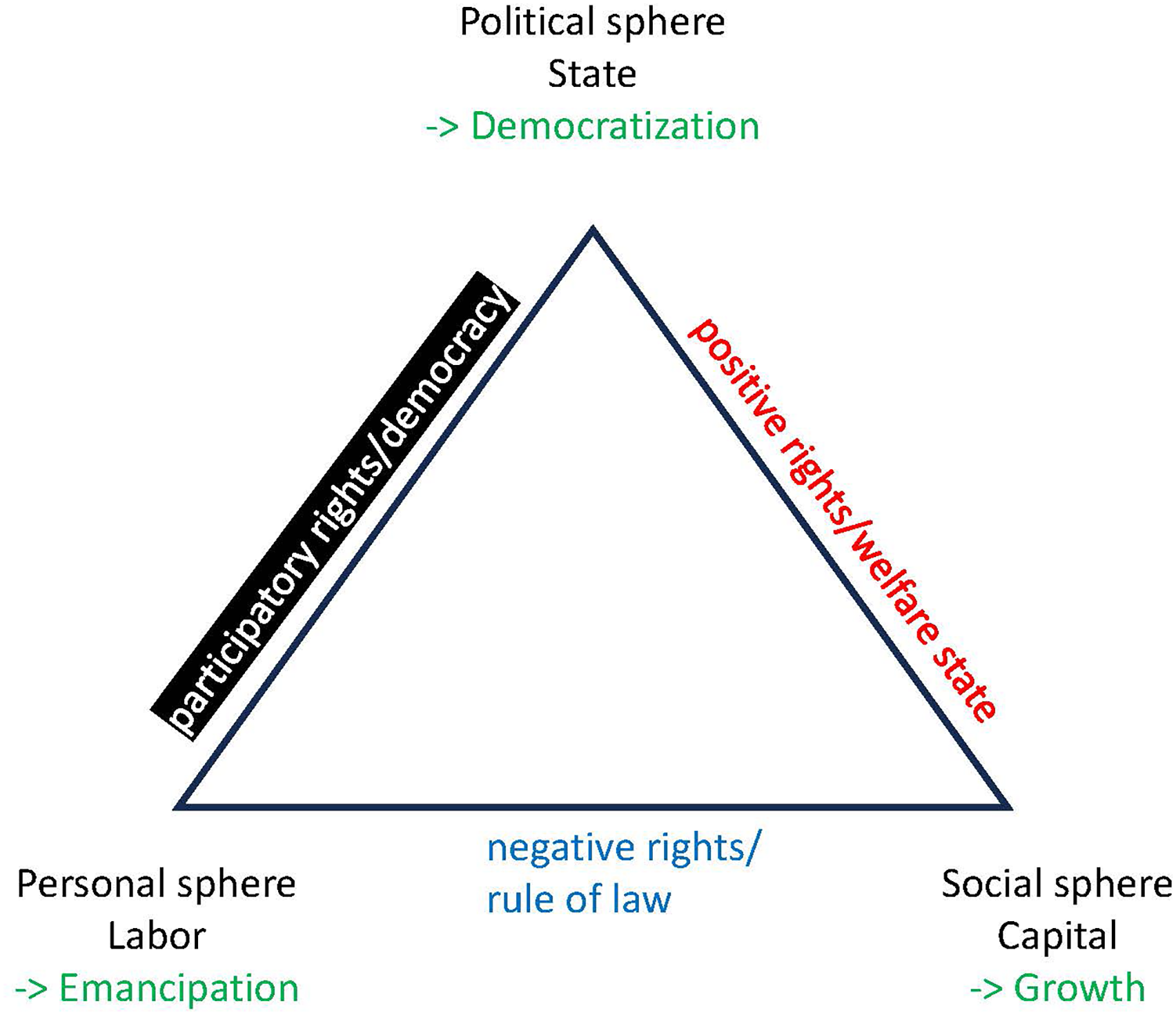
Basic modern relations, objectives and institutions (representation by the author).
Figure 2 tries to schematically illustrate this basic set of relations, interpreting regulation theory's triangle of labor, capital, and the state as a concretization of the more fundamental dimensions of the person, society, and politics. It attempts to show how the tensions arising within this triangle are moderated by the modern institutions of law, democracy, and the welfare state, while at the same time, the conflict of interest between the three competing goals of emancipation, democratization, and growth persists. Of course, one can rightly criticize this systematization as rather reductionist: thus, the powerful feminist critique of the neglect of reproduction (for an overview, see Weeks, 2011); the important point that the political extends far beyond the state (Nancy & Lacoue-Labarthe, 1981); as well as the essential intervention by cultural studies (Williams, 1977; Hall, 1980), recently taken up by Bob Jessop in his notion of “cultural political hegemony” (Jessop, 2004; Jessop & Sum, 2015). Yet at the same time, the reduction of life to labor to production, of society to economy to industry, or of politics to the state to party politics, was not mere intellectual neglect, but reflected the actual Fordist constellation. Which is also part of why it did not last.
For it is important to keep in mind that the succession of regulatory models is not a unidirectional process of the extension of rights, let alone a cunning of reason, but rather a truly political crystallization of capital-labor-relations into a new hegemony, that is, consensus “armored by coercion” (Gramsci, 2011, Notebook 4, §88). Thus, none of the named institutional innovations came along without friction and struggle. Instead, they usually emerged as a viable consensus only after a violent (poly-)crisis. The genesis of the welfare state gives ample evidence for this, originally contrived as a means to keep the workers’ movement at bay and come of age as a new (way to) deal with the centrifugal tendencies of the 1930s and 1940s—which, following the excessive disembeddening of the “market society” (Polanyi, 2001 [1944]), saw the complete dissolution of the “thin varnish of civilization” (Freud, 1961 [1930]) and, subsequently, the most violent fight between liberalism, fascism, and socialism for dominance of the future social order. Regulation theory's paradigm case of the Fordist facilitation of mass production and consumption, organized through Keynesian policies and supported by relatively corporatist labor relations, was the (or one) outcome of this civilizational crisis. Yet, no paradigm, be it theoretical or practical, scientific or societal, can forever control the centrifugal—noticeable, if unrecognized—forces raging under the surface. As any mode of regulation, Fordism had its time.
In her history of financialization, Greta Krippner has reconstructed the constellation at the end of Fordism in the terms of a triple crisis. Translated into the heuristic applied here, it can be thought to look somewhat like this (Figure 3).
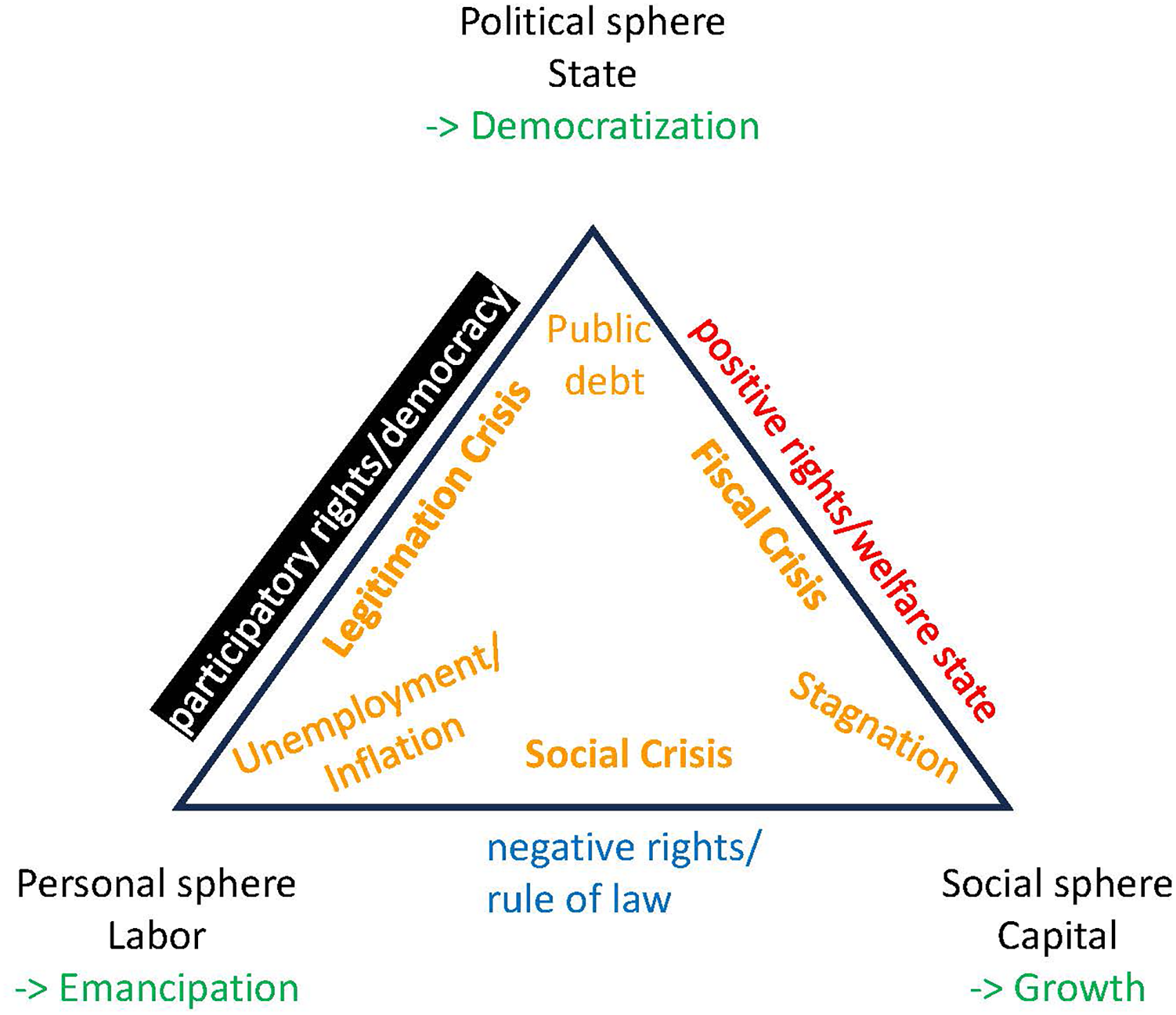
The constellation at the end of Fordism (reconstruction following Krippner, 2011).
Following the end of the Bretton-woods system and the shock of the oil crises, the regulatory constellation that had enabled the post-war era of reconstruction and economic expansion was plagued by the simultaneous problems of low growth, high unemployment and inflation as well as escalating state debt. Under these conditions, the classic Keynesian recipes of anticyclical investment lost their persuasiveness, instead giving rise to an unholy trinity of crises: a social crisis of economic decline, a fiscal crisis of state dysfunctionality, and a legitimation crisis of public disappointment. Naturally, the perception of these crises was culturally mediated and varied widely; but that doesn’t change the fact that there was a widespread sense that new solutions were needed.
Krippner's reconstruction of the late Fordist constellation looks very much like a polycrisis in Tooze's previously discussed understanding of the term. Yet it is important to realize that it is as much the effect as the cause of the crumbling hegemony. As the problems multiply, the limits of the paradigm for dealing with them become apparent. United by a regulative structure that has reached the limit of its problem-solving capacity, the many troubles are neither completely isolated and their joint occurrence a coincidence, nor do they emanate from a clear center; instead, they are co-constitutive.
They constitute what Claus Offe (1973), in a text written just before the first oil crisis, has aptly called a “crisis of crisis management.” According to this theorem, advanced capitalism needs a (growing) minimum and tolerates a maximum of political management. As Offe shows, under conditions of increasing conflicts of interests, these two can collide, thus breaching what Offe calls the “conflict threshold” (1973, p. 214), when a necessary intervention—for example, a fiscal stimulus—jeopardizes the very resources necessary for that intervention. Offe identifies three kinds of resources: fiscal, administrative, and mass loyalty. In theory, there is no necessary crisis point, even though the growing complexity and management needs tend empirically to narrow the space for sensible intervention. However, it's easy to see that in the trilemmatic constellation described by Krippner, each of the resources was in short supply with no easy way out: for stagflation both demanded and forbade stimulus, needing it for growth yet fearing it for further inflation and debt. This puzzled administrative resources in the form of expertise that was calibrated to anticyclical investment (and especially fixated on the Philipps curve), in turn risking the loyalty of the masses expecting security and competent macroeconomic management. As these problems exceeded the system's capacity for problem-solving and more and more of these fires sprung up, things started to spiral out of control. This is the fundamental logic of a crisis of crisis management: though extinguishable in principle, with too many fires to put out all at once, they flare up, grow, and unite once one turns one's back to them—until finally, the only way out is to go for a controlled burning lest the whole world will be on fire. This is what happened with Fordism. And that is, one could think at least, where we are at, once again. Or are we?
From the illusion of the end to the end of illusions: Externalization's revenge and the rise of ecology
In her excavation of the origins of financialization, Greta Krippner reconstructs how a new paradigm developed incrementally over decades. The allure of financialization as a new model of accumulation 4 becomes understandable as an attempt to make the fragmented triangle, tormented and torn by the three interrelated crises, whole again: for it promised to create growth (through additional means of financing) without state sponsorship; to guarantee the necessary consumption through the facilitation of private debt (introducing what Wolfgang Streeck has called “private Keynesianism,” Streeck, 2014); and to relieve the state through fiscal frugality, countering political disappointment by way of reducing state responsibilities. Thus “neoliberalism” and “deregulation” became (indeed as a kind of “controlled burning,” one could say) the new game in town, 5 promising a win-win-win-situation for everybody involved.
One does not need to be a fan of Hayek or Milton Friedman to acknowledge that the results were spectacular, at least in a sense. To be sure, the promise of trickle down economics never materialized: neither did growth rates pick up nor was state debt reduced significantly, while unemployment remained a problem for decades to come and was arguably made more severe through rising inequality (Deutschmann, 2019, p. 189ff.). Yet while hardly delivering on its initial promises, financialization/neoliberalism did create an institutional model to integrate systemic and individual demands: the toolkit of deregulation did become the go-to answer for all sorts of societal problems, not just nationally but (almost) globally. Supported by means like the IMFs “structural adjustment programs” and epitomized in the “Washington consensus,” the expansion of free markets became almost synonymous with globalization. Part of that success might have been due to being “neo,” because one could always say that if the free market didn’t work yet, it was because it was not yet sufficiently liberated (Vogl, 2011, p. 35). But at least in 1990, it was hard to argue that the widespread impression that the conundrum that had brought down Fordism had finally been solved wasn’t success in itself, considering the remarkable harmonization of the social space on one side of the iron curtain and the polycritical—social, fiscal, and legitimatory—shambles of another kind on the other.
And yet again, unlike diamonds, hegemonies are not forever. Especially when they win: as losing your opponent can prove fatal even for democrats (Beck, 1992; Blühdorn, 2025, in this issue). In the particular case of financialization/neoliberalism, what was maybe its most central condition of possibility—its capacity for externalization, that is, of displacing, relocating and postponing costs of all sorts (Lessenich, 2016, 2020a)—turned into its condition of impossibility in a threefold way.
For one thing, financialization, seen from a temporal perspective, was always about “buying time” (Streeck, 2014), that is, about postponing problems into the future: the accumulation of private debt was never a sustainable strategy for growth, due to its inherent limits and repercussions. The same is true for the extension and facilitation of financing mechanisms, as—Keynes argued this already very decidedly—an excess of financial capital tends to lead to excessive speculation and short termism in investment decisions, in effect drawing capital away from creating long term added value (Keynes, 1964, p. 159; comp. Pineault 2019); without which, however, financialization will just lead to asset price inflation and inequality (Deutschmann, 2013, S. 13). While the consequences of the latter, increased desolation and instability, are still left to the state, which is thus never able to redeem all the tax breaks it handed out trusting in their amortization.
For another thing, financialization, seen from a spatial, that is, geopolitical perspective, always had very different consequences in the center and the periphery. On the one hand, it accumulated financial profits in a small sector at the center (Wall Street), while—apart from temporary niches like Germany's export-oriented accumulation model (Stockhammer, 2014)—never working quite as well for other economies in the West. On the other hand, it moved production—together with both its problems and its profits—to the (semi-)periphery, there, too, leading to very different consequences: polycrises of stagnation, desperation, and instability on one side, the rise of the tiger states on the other. Both tendencies, however, weighed heavily on financialization's (and Western hegemony's) survivability.
And then thirdly, a new spatiotemporal conundrum arose over time in the background, related to the consequences of financial and geopolitical externalization yet going beyond them: for both the economy and the human being are “wholly owned subsidiaries of nature,” 6 and the mother company had increasingly gotten into trouble. This realization came to prominence with the club of Rome's report on the limits of growth (Meadows et al., 1972). It has then been theorized by authors like Giddens (1990) and Beck (1992), among others, as the “revolution of side-effects” in a modernity that is increasingly producing its own risks. Obviously, being confronted with the problems caused by its solutions had always been very much part of the dialectic of enlightenment (Horkheimer & Adorno, 2002 [1944]). But the realization of the ecological dimension added another layer of complexity to “reflexive modernity”—thus turning our heuristic triangle into a triangle (or even a pyramid) of triangles by adding another objective (Figure 4).
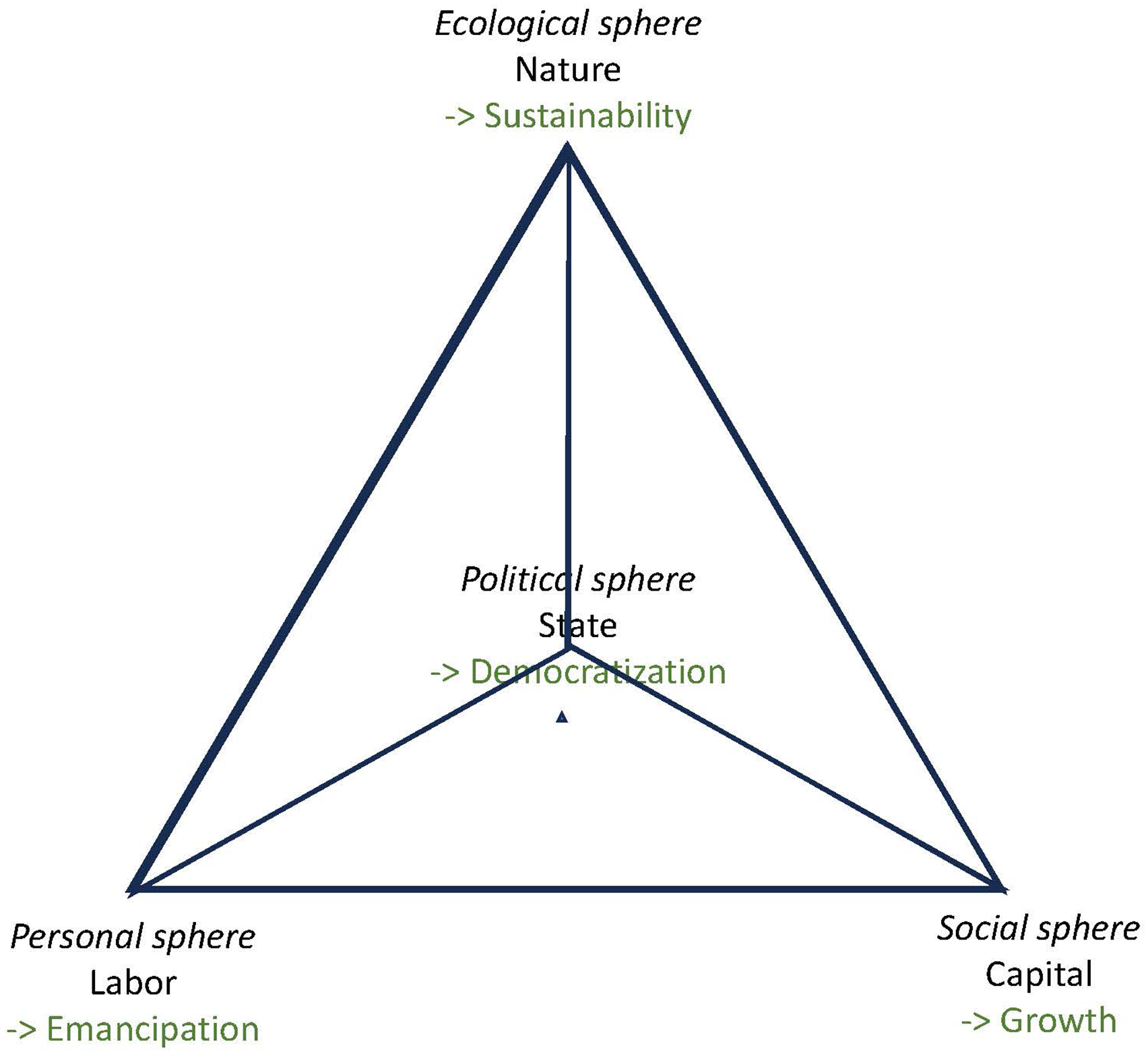
A triangle of triangles (representation by the author).
Of course, the biophysical as a condition of possibility of modernity is by no means new (as capitalist economies themselves are a specific mode of the appropriation of nature): “primary accumulation” was interlaced with questions of land use while the industrial revolution came about as a consequence of the increased use of coal after the forests of Europe had been depleted (Marx, 1990 [1867], ch. 23; Polanyi, 2001 [1944], ch. 7). As Tim Mitchell (2011; comp. Wagner, 2024) has argued, democracy itself only became possible as “carbon democracy,” by distributing the added value of using coal, whereas Fordism was fueled by petroleum. And even before the stoves grew into the Manchester sky, the history of modernity was inextricably linked with extractivism (Moore, 2015; Gudynas, 2020). Just as it is a story of ships, trains, cars, planes, and rockets, it is one of iron, copper, gold, ivory, and lithium as well as of sugar cane, potatoes, cotton, tobacco, and bananas (Santos & Boatcă, 2025). To understand the polycrisis, one should not forget that colonizing the land, its raw materials and its people has always been very much intrinsic to modernity's “triangle of sadness”: if this triangle has been painted in the colors of the tricolor, it has also been steeped in blood.
However, while economic, human, and political limits to the exploitation of nature are nothing new, ecological limits in the literal sense of the word are, at least regarding their universal prevalence. Natural devastation always had economic, social, and political consequences, but it did not threaten the ecosphere as such; the realization that forests, once cut, or fish populations, once depleted, or glaciers, once melted, might not only not grow back, but destabilize the viability of natural systems as a whole, is new. This dramatically changes the weighing of goods and interests and turned nature relations into an end (of the triangle) in themselves, thus greatly increasing complexities of valuation and decision making in late modernity.
The additional pull on the classic constellation has led, over the past five decades, to ecological concerns gradually gaining currency while trickling into the hegemonic paradigm—tempting some (Rödder, 2024) to even speak of a “green hegemony” taking hold in the 2000s. However, rather than identifying a fully fledged new paradigm, it is more plausible to argue that as neoliberalism had to adapt to environmental problems and profess becoming sustainable, it adapted new variants of “artistic critique” (Boltanski & Chiapello, 2017)—thus gently changing its character through co-opting green demands into its understanding of growth, democracy and consumption, leading to a sort of “progressive neoliberalism” (Fraser, 2017). Central to this approach was less the attempt of a new beginning than the belief that the established recipes could be adapted without much further ado: growth was to be green, emissions were to be traded and consumption was to be ethical.
However, the fear always was that these changes would prove to be too cosmetic to address the underlying conflicts of interests and prove ultimately inadequate (see Blühdorn & Seyd, in this issue). After all, if it is true that modern societies have managed their problems by means of sharing the spoils from continuous expansion of extraction, exploitation, and production, the ecological dimension does seem to add another layer of complications—Klaus Dörre has captured this in the dilemmatic formula of the economic-ecological “pincer crisis” (Dörre, 2019), where neither dimension can be improved without worsening the other. 7 Ingolfur Blühdorn has argued that “simulative democracy” (Blühdorn, 2013) and “second order emancipation” haven’t provided real solutions to the ecological question, but in fact stabilized, that is, “sustained” unsustainability (Blühdorn, 2017, 2018). Meanwhile, behind the intricate designs of temporal, spatial, and epistemic-ecological externalization (Wagner, 2023), tensions have risen, as problems were left unanswered. Out of sight at least from the center of the storm, economic, social, political, and ecological problems kept piling up until the piles of the future, 8 on the sidelines and under the ground started collapsing into the present.
For Adam Tooze, 2008 is the catalytic year for the polycrisis. It's the year of Lehman Brothers and the Great Financial Crisis, of course, but there are further indications that the times have changed and something shifted in the gear of globalization: Tooze mentions the failures of the Doha talks and the Copenhagen climate summit, the specter of a major swine flu pandemic and the Russian attack on Georgia with the quasi-annexation of Abkhazia and South Ossetia. So there we have the ecological, the socioeconomic, the political, and geopolitical—and, by extension, the subjective, “psychosocial” (Tooze, 2023)—repercussions.
Of course, 2008 was also the starting point for a more densely connected chain of critical events: as the Financial turned into the Euro Crisis, it was tamed by quantitative easing and the European Central Bank doing “whatever it takes,” yet escalated through a fiscal crisis of several states, foremost among them Greece. With austerity setting in (governed by the “troika” of ECB, IMF, and European Commission), it became conceivable that neither globalization, nor the EU, nor household consumption would necessarily continue to expand as assumed. In many ways, Krippner's unholy trinity of crises—fiscal, social, and legitimatory—had come full circle; while the former go-to recipes fiscal austerity, private debt and financial deregulation now appeared to be part of the problem.
This, however, proved merely the beginning in what may seem in retrospect like an endless succession of crises. 9 In 2011, the short Arab Spring ended without any trace of summer in the Syrian civil war, a chaotic proxy conflict that provided abundant evidence that the international order had eroded and that sent millions of migrants on dangerous roads to safety. If the Financial Crisis and its aftermath had marked the preliminary collapse of “buying time,” the so-called “migration crisis” and its preconditions spoke of the spatial limits to externalization. Both temporally and spatially, globalization and its promise of everyone being better off everywhere at some point in the future had lost its lure.
And finally, there was the virus. A rather unfamiliar type of crisis at least for the Western public (although pandemics had never stopped threatening large parts of the globe), it was difficult to make sense of. Yet even though it seemed that COVID had pulled the rug out from under the growing consciousness of an increasingly noticeable ecological crisis (epitomized by the Fridays for Future movement), it is important to realize that COVID, too, constituted an ecological crisis 10 that snowballed into all sorts of other problems: social, psychological, economic, and political.
Thus, with COVID, all three of the variants of externalization mentioned above—financial, geopolitical, and ecological—had returned with a vengeance. It is this what leads someone like Michael Zürn (2024, p. 11) to attribute the “crisis of liberalism” to a series of “endogenously induced aberrations,” amounting to an “era of broken promises” since the 1990s. In particular, he observes a “loss of trust in its central institutions to find solutions for pressing societal challenges,” while themselves being regarded as the deeper cause for four central crises, which Zürn has called those of “democracy,” “equality,” “universalism,” as well as the “ecological crisis.” Though the wording may vary, it should be fairly obvious that this list of crises isn’t merely associative, but addresses the central dimensions mentioned above: the social, striving for growth, the personal, striving for emancipation, the ecological, striving for sustainability, and the political, striving for democracy. When Putin assaulted Ukraine that February in 2022, the “contestation of the liberal script” (together with the corresponding crisis of Western hegemony) became all too visible. Instead of the end of history, there was the end of illusions (Reckwitz, 2021), as the interregnum—“the fact that the old is dying and the new cannot be born” (Gramsci, 2011, notebook 3, §34)—turned globalization, financialization, neoliberalism into (even if still influential) zombies. Instead of striking a truly consequential green new deal, instead of finally arriving at the turn to sustainability, instead of reinvigorating democracy with a yes-we-can!-attitude and a “parliament of things,” instead of entering an era of recognition and conviviality, the order of the day meant closing ranks, buckling up and finding ammunition. Instead of long-term sustainability, the logic of the “Zeitenwende” turned to the ultra-short term. The call of the altermondialistas had indeed been heeded, another world was possible. It just looked different than most had been hoping for.
The defensive turn: Inside problems and the organization of pessimism
It's important to realize that the polycrisis didn’t strike like a bolt from the blue, but that heavy clouds had been gathering over Western skies a long time before: we didn’t wake up to the crisis of crisis management, we went to bed with it for a very long time. Only that that gathering played out less in the way of conscious realizations than of nasty feelings. As W.H. Auden wrote in The Age of Anxiety (2007, p. 532), “there is only the flash/of negative knowledge.”
The struggles of today have been related to an “age of anger” (Koppetsch, 2019; Mishra, 2017); before that, there had been talk of apathy, alienation, and political disenchantment (e.g., Crouch, 2004; Rosa, 2013). And long before that, unease and alienation had been identified as the inevitable companions of modernization (Freud, 1961 [1930]; Marx, 1992 [1844]; Weber, 2004 [1919]). To turn the chronology on its legs: first, moderns felt unease, a diffuse feeling below or around the threshold of latency that could be easily dismissed in sight of the awesome promises of modernization. As these became stale, apathy ensued, a sense of frustration that led to disidentification, if not yet to outright protest, nicely captured by Lawrence Grossberg in the Warren Zevon line “I’d rather feel bad than not feel anything at all” (Grossberg, 1997, p. 64). 11 Then they did feel bad, angry even, but (at least at first) often without that anger connecting to political alternatives (think of the “epidemic” of high school shootings). This change can be clearly seen in the dynamics of voter participation, which dropped well into the 2000s (to the great dismay of sincere democrats), only to pick up again (to the even greater dismay of sincere democrats) in the form of votes for “right wing populists.” As finally, anger turned into political resentment and protest turned into policies like Brexit, Make America Great Again (MAGA), or “remigration”—and the “alternative,” on the possibility of which the altermundialistas had, contra TINA, been insisting, turned out to be Donald Trump.
This article is hardly the place to prove that point, but it's worth noting that all of these collective affects are variants of fear, or, yet more precisely: they are modulations of anxiety. As affect quite generally is to be understood as a registry of tension, there is nothing erratic about these modulations—nor, for that matter, about their shifting designations. Ultra-sensitively turning the daily frustrations into lived experience, affects serve as a “guidepost to the hotspots of social change” (Seyd, 2013, p. 26)—so that the changing affective signature of late modern societies can be taken as an indicator for the growing cracks in its regulative structures.
Institutions, on the other hand—their very point being in stabilizing expectations, thus making order possible—are naturally limited in their capacity for adaptation. Democracy, of course, is supposed to work precisely as an artful architecture of feedback mechanisms that allows for irritation to be channeled back into the system. However, especially after triumphing over its systemic opponent, it did not work particularly well, as Colin Crouch has prominently argued (2004; see also Blühdorn, 2013 and in this issue). In his reading, while formally intact, liberal institutions had essentially switched on their autopilot and gone to sleep, catering to the saturated instead of the desolate. Thus, the management of societal problems turned rather inattentive across its different dimensions, ignoring rising temperatures as well as rising inequality (Piketty, 2014), and adding tranquilizer to chamomile by reacting to the “capital surplus absorption problem” (Harvey, 2010, p. 26) by making capital available ever more easily, thus getting stuck in a liquidity trap (Krugman, 2000) and ending up with secular stagnation (Summers, 2016).
In effect, all of this led to an increasing rift between—to take up a formulation by Jacques de Saint Victor—“piazza” and “palazzo” or, to put it more analytically, between administration and affect. This divide remained quite manageable for a rather long time, as long as the affective energies remained nicely compartmentalized in the cracks dispersed throughout the institutional order. Yet as these cracks multiplied, they began to connect, hollowing out the system from the inside until ultimately fragmenting it. Like Andrew Bird sings (on his album Inside Problems): “If your position remains fixed, my dear/results will be mixed, I fear.”
Hartmut Rosa (2021, p. 204) has recently characterized these mixed results as a crisis of “overheating” in the most general sense, extending beyond rising natural temperatures to include burnt-out selves, overheated economies and hot wars. This is not meant merely as a metaphor: in all of these cases, frustrations overboil and the “social energy” set free threatens to turn against its own objects of “resonance.” While having much to commend it, however, this view might be too quick to treat overheating as a problem of modernity as such, attributing it to general tendencies of acceleration and alienation (Rosa 2013, 2015)—after all, there were previous instances of “overheating,” not least that “very different polycrisis” of the 1930s. The way I have argued here, it is more plausible to think of the affective overboiling as part of a modern cycle of anxiety that is once again coming to an end; a crisis less of modernity than of its crisis management. And very much, therefore, a political crisis.
The “organization of pessimism” is Benjamin's name for politics. In his Theses, there recurs the idea of a “genuine” or “full” image or picture of the past that “flares up briefly” (thesis VII) or “flits by”: “The true picture of the past flits by. The past can be seized only as an image which flashes up at the instant when it can be recognized and is never seen again” (thesis V). Organizing pessimism, he explains in a note on the text, means “to find in the process of political action the 100-percent image space. But this image-space cannot possibly be measured by way of contemplation […] This sought-after image-space is […] the world of all-around and integral actuality.” 12 (1991, S. 1234f.; own translation) May this notion sound a bit cryptic at first, I would suggest to translate it simply as the experience of affect: as it registers tension and incompletion, affect points to the whole as an absent fullness. And as that fullness is far beyond the faculties of symbolic representation (being “pictured,” not understood), this is the only way to get a fleeting glimpse 13 of the “100% image space”—as an “absence that makes itself felt” (Seyd, forthcoming). 14 In this way, affect is, I have argued elsewhere, “proto-utopian”: laying bare what is left out and missing, it makes the deficiencies of the presence experienceable even where they cannot be articulated—and thus points to a better, fuller future (Seyd, 2015, 2017). For this reason, affect is eminently political in the strict sense of the word—and politics always is about making sense of that primal irritation: it always starts with that pessimism about the deficiencies of the existing order that points toward at least the theoretical possibility of a better future. And it attempts to bring that better future about by organizing these irritations into a new order (which means, of course, to again access them “contemplatively”—with all the risks that entails): “Where thinking suddenly stops in a configuration pregnant with tensions, it gives that configuration a shock […] In this structure [the historical materialist] cognizes […] a revolutionary chance. He takes cognizance of it in order to blast a specific era out of the homogenous course of history” (Benjamin, 2012 [1969], Thesis XVII).
Looking at the polycrisis through the lens of affect makes understandable why politics has become so heated. A number of authors over the past decade have argued that politics have increasingly turned into a “politics of affect” (Massumi, 2015) or “politics of fear” (e.g., Ferudi, 2005; Wodak, 2015; Gore, 2004), even “amygdala politics” marking an “assault on reason” (Gore, 2007). Veith Selk has written that “Angstpolitik” “is characterized by the fact that it uses fear as a justification for political demands and makes affirmative reference to fear, for example the fear of climate catastrophe, the fear of Muslim migrants or the fear of economic decline.” He distinguishes a politics of fear from two other modes of political action, namely identity politics and interest politics, arguing that “those who pursue a politics of fear […] start with fear” (Selk, 2020, p. 155). However, Selk also argues that a politics of fear is a normal part of the political process (p. 157), especially in times of crisis (p. 156). So regardless of the question if a politics of fear can really be identified as a particular kind of politics, there is ample evidence that with rising affect levels, politics has become increasingly about managing—channeling, soothing, at times stoking—fear. Rather than to a sudden onslaught of irrationality, the intensity of political conflict owes to a gradual accumulation of negativity that has reached a tipping point when it boiled over the confines of the established mechanisms of crisis management.
In other words, it's not that the use of the internet makes people suddenly realize that it has always been the gender asterisk that's been their central concern—it's not about strange certainties but about strong uncertainty, not about petty details and remote single issues but about a much more general sense of disorientation that can turn even questions of grammar into “trigger points” (Mau et al., 2023) if only they touch upon the limits of one's identity. In this sense, it is very true that polarization is not driven by attitudes or ideology (Lux et al., 2022; Mau et al., 2020) but that it is “affective polarization” (Iyengar et al., 2012; Wagner, 2021) we’re dealing with. While on the other hand, this does not mean it is any less substantial or “real” or that it were merely “irrational.” Quite the opposite, its existentiality lies precisely in the fact that the accepted rationality has itself been thrown into doubt—as with the protective shelter of hegemonic certainties gone, the “transcendental homelessness” of modernity comes right back through. The affective intensity signals precisely the limits of established (i.e., hegemonic) rationality, its lack vis-à-vis the “100%-image space,” and the demand for a new beginning in the shape of an organization of pessimism.
The problem, of course, is only beginning to take shape at this point (even though this is denied by many a would-be-revolutionary). For while affect signals that something has been missed by the dominant order so far, it says neither what that something is nor how a better order can be construed to guarantee it—for that would, again, demand “measuring out the 100% image space by means of contemplation.” 15 Just think of the controversy about the causes of gun violence. For that reason, any attempt at politics as a process of making sense of affect entails naming, explaining, and attributing it, in the process transforming the accumulated negativity into something else. This way, the ephemeral becomes intelligible, but it must also cater to the demands of intelligibility (which means merely re-presenting the thing itself). Thus, any attempt at reorganizing pessimism will claim to represent the 100%-image-space, but none does—in effect leading to many competing claims at making society whole again.
In a social space fragmented by polycrisis, there are very different starting points for picking up the pieces and defining what the problem is, where it's coming from and who is responsible. In either case, though, the need to organize a “we” entails saying what “we” are not—in a situation of affect bursting its banks (with sediments ending up in unexpected places), building dams is a natural strategy in trying to bring the flooding under control. 16 This way, it becomes plausible that even in times of violent political disagreements (affective polarization), the individual demands overlap in many ways (no ideological polarization), and that incoherent content can blend quite smoothly with fiery rhetoric: because it is exactly that rhetoric that unites the conflicting demands against a common “enemy,” when competing attempts at organizing the fragmented whole fight over the remnants of the previous consensus by setting different limits. The triangular figure introduced above can illustrate how this (rather abstract) train of thought plays out under the current conditions (Figure 5).
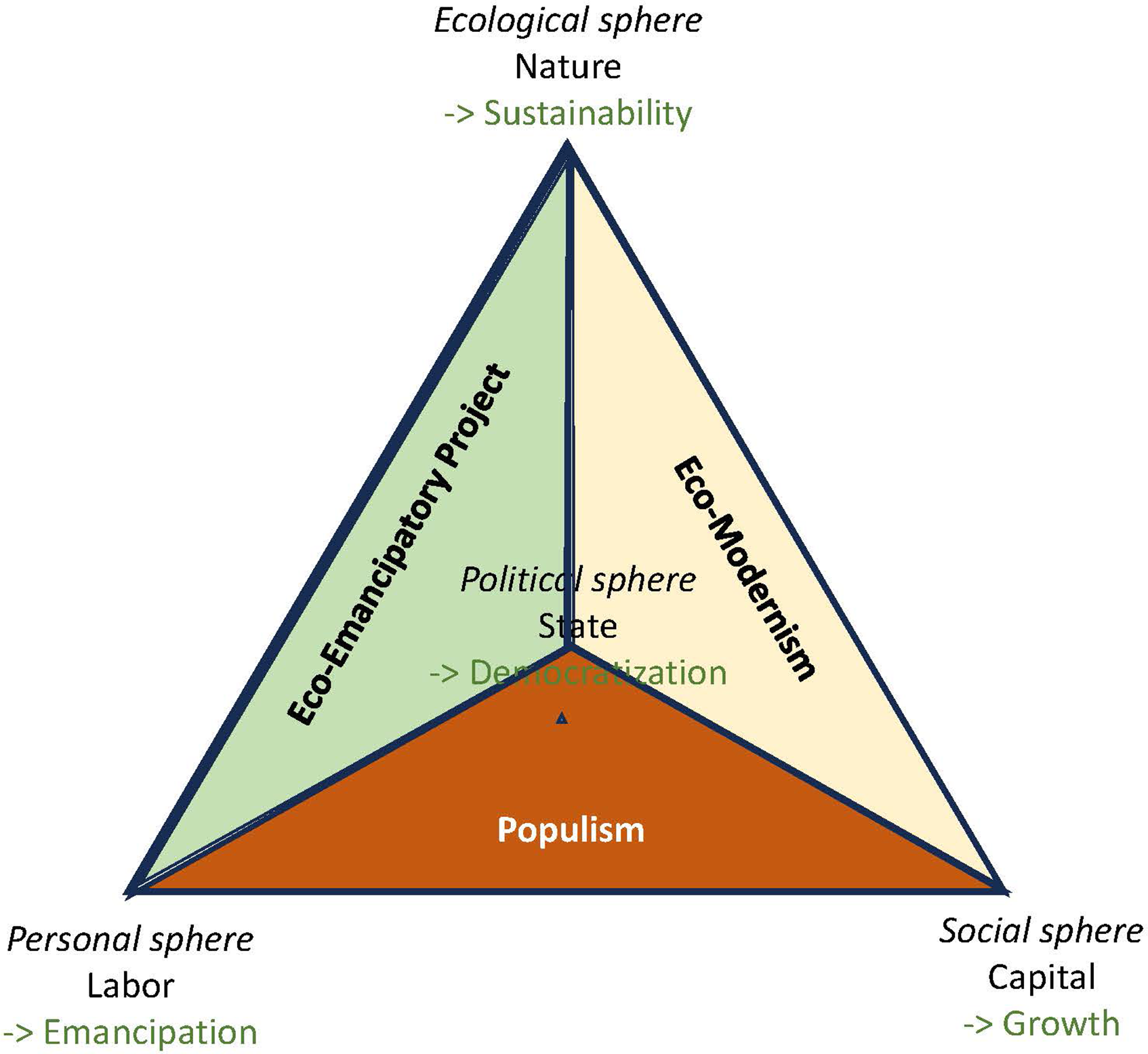
Competing (defensive) attempts at organizing pessimism (representation by the author).
Under the conditions of a polycrisis, when the relations to nature, oneself, society, and the public sphere become strained to the point of being set against each other (turning into a complex array of di- and trilemmas), doing justice to all of these dimensions and bringing them together under a common header must seem increasingly like an exercise at 4-D-chess. And as the 2D standard version is difficult enough already, there follows a tendency to prioritize: if you want to heed the majority's desire to grow and consume happily everafter, you better not care about sustainability. If you want to combine economic growth and ecology, you better not ask about emancipation; and if in contrast, you want to insist that emancipation and ecology are inseparably connected to each other, you better not aspire economic growth at the same time. In this way, the political space is divided into three ideal-typical projects that try to make the best of a bad job:
An eco-emancipatory project (EEP) that sets out to reconcile emancipation and sustainability. It sees ecology as a matter of conviviality and autonomy especially in need of recognition, and its view of democracy focuses especially on minority rights. It is pointing toward growth as an antagonist that privileges the extraction of nature over its preservation, demands democracy to conform to markets and sees living beings as a resource to be exploited. An eco-modernist project (EMP) that focuses on the reconciliation of growth and sustainability. It sees nature as an external asset in need of internalization and growth as progress, and its technocratic view of democracy focuses on the involvement of experts. It's pointing toward emancipation as an antagonist that privileges personal enjoyment over productive discipline, values diversity over integration, and tends to romanticize nature instead of putting it to good use. A populist project (PP) that stresses security and welfare in a classic sense, both public and private. It sees growth as the precondition of being better off as emancipation is centered on self-realization through consumption. Democracy is largely taken to mean majority rule. It's pointing toward ecology as an antagonist that privileges a diffuse future over much-desired present advancements, indulges in a naïve openness instead of protecting the community, and wants to restrict the enjoyment of hard-earned delights.
Naturally, these projects are by no means new. They have evolved from earlier formations, being the successors of the classic triangle of conservatism, liberalism and socialism (for an overview, see Reitz, 2016). Along the lines of the previous section, one could argue that, as the progressive left discovered the ecological dimension, neoliberalism, too, had to address questions of sustainability—so that by both moving toward the ecological pole, they deserted the space now inhabited by a populist alternative. 17 So these projects have always competed to pick up loose energies for their own gain. Meanwhile, their inner tensions have been significant and their boundaries far from clear cut. However, with the onset of the current crisis of crisis management, they have moved apart: As the social space fragmented, they have consolidated themselves by going on defense in the twofold sense of retreating to their core territories and actively confronting their antagonist. This is logical to an extent: since each has become more decidedly one-sided, the need arose for them to delegitimize their opponents—so that they could still make a plausible claim to universality. In this way, the EEP has turned to mild forms of sabotage and civil disobedience (like gluing oneself to a highway or throwing mashed potato at oil paintings). The EMP has given up on expansion of free markets and now proposes a return to tariffs, hard power, and surveillance. And the PP is in an extended state of denial, denying the reality not only of climate change but also of election results, the consequences of globalization or simple facts—in essence ignoring all three failures of externalization introduced above.
Finally, the figure of the triangle is also useful to think about the geopolitical implications. For it would be too simple to think that the polycrisis is merely a Western one, creating a vacuum that others—Russia and China, and maybe India—are preparing to fill. In fact, following neoliberalism's triumph and expansion eastward, pessimism was maybe most pronounced in Russia, stoked by the toxic assemblage of a fossilized economy, severe inequality and an utterly cleptocratic political system. The ensuing (socio-economic-psycho-political) polycrisis provided the breeding ground for Russian revanchism. If we think of the polycrisis coming to fruition in 2008, it's no accident that Russian aggression (in the shape of wars as well as of hybrid influence and disinformation) was always an integral part of it.
China, on the other hand, greeting from the winning side of globalization, has embraced an eco-modernist position, with its paradigm of “eco-civilization” (Huan, 2016) and its technocratic attempt at comprehensive control of its citizenry via a social credit system (Lee, 2019; Mau, 2023, p. 262). And finally, if one wants, one could recognize at least fragments of the EEP in the defense of the rest of the West, as it has at times been framed as the defense of “democracy against autocracy” and flanked by a “green new deal,” and the like.
Conclusion
In this article, I have asked what is behind the widespread perception of a polycrisis. In my reading, it is best understood as a crisis of the dominant paradigm of crisis management that was established with the turn to financialization in the 1970s. The disintegration of this hegemonic mode of regulation has left us with a conflict of objectives, in which ecological, political, personal, and economic goals—namely sustainability, democratization, emancipation, and growth—are set against each other, thus mutually co-constituting crises across all these dimensions. Meanwhile, there is a reason for the discursive success of the rather vague concept of polycrisis: for its lack of specificity corresponds both to a profound feeling of disorientation and a lack of understanding what is going on. The process of picking up the pieces after this fragmentation I have described (following Benjamin) as the organization of pessimism, or, to be more precise, as competing organizations of pessimism that together constitute what can appear as a defensive turn.
While in principle such a polycrisis is nothing unseen in modernity, but rather a cyclical phenomenon, with the added problematic of the ecological dimension there is an added layer of complexity to the current conundrum that makes it go beyond a mere crisis of accumulation. So far, though, the competing positions—idealtypically identified here not as a bipolar but as a triangular juxtaposition of a populist, an eco-modernist and an eco-emancipatory position—look still quite familiar. However, as playing only defense means eventually losing the game (or the war), the current constellation will hardly prove stable: the organization of pessimism does not end with the defensive turn. Already now, one can observe that the current interregnum leads to a process of realignment. And as the geopolitical constellation is very much the outflow of today's crisis constellation, that process of realignment will be global.
Under these circumstances, it is fruitless to stick to recipes of the past. The starting point for any political initiative is to realize that it leads nowhere to insist on a rationality that has been shattered. Moralizing (from a liberal vantage point) about the idiocy of MAGA or the superiority of Western values won’t bring anyone to reason, and will, in fact, prove counterproductive; whereas it only adds to the tenseness of the situation to know that if one doesn’t extend the reach of one's proposal, one might yet get cornered by coalescing competitors.
There is, thus, no reason to think that the interregnum will merge into a long-term game of technocratic adaptation—which does not mean that the attempt won’t be made (comp. Staab & Sorg; Zierott et al.; Pohl & Swyngedouw, all in this issue). But as we have moved on along the cycle of anxiety, it seems unlikely that any effort at depoliticization will take hold before being interrupted—Brexit, Trump, or the Russian attack on Ukraine can serve as cases in point. The end of illusions (Reckwitz, 2021) might well mean, too, that the time of simulative and postdemocracy, of sustained unsustainability and individualization of despair is over—as well as of unlimited growth, for that matter. It's been precisely the point of my constant triangularization in this article that neither adaptation, nor emancipation, nor revisionist preservation (of a past long gone) will win the day. There will be something else.
Of course, at this point it's impossible to say if all this will merge into the bipolarity of a new cold war, if there is a resurgence of Utopian energies around the corner, or if we will wish there wasn’t (Putin's theory of victory looked fairly utopian at first). I have compared the end of Fordism to a “controlled burning”; over the course of writing this article, it has increasingly started to appear like another round of “controlled burning” could be in the cards. The trouble with this (and any) last resort is, though, that in addition to its destructiveness, it sets a limit on its repetition: one can let a forest burn to save a town, but the next time, if the forest has not had time to grow back, it's letting the town burn to save—what exactly? Dismantling democracy, the rule of law, and the welfare state will indeed lead into a very different modernity.
Quite certainly, it's too much to hope that “the wind blowing from paradise” will cease. But it might still be possible to build shelters—as comfortable, secure, spacious, and inviting as possible—that shield against the cold wind of history and the catastrophes piling up. It's certainly too much to hope that Benjamin's angel will fold its wings and make whole what has been smashed. But maybe, just maybe, it can feel relief once in a while.
Footnotes
Acknowledgments
I would like to thank this article's autonomous reviewers as well as the participants of both the Vienna and the Erfurt workshop dedicated to the question of what is “beyond the eco-emancipatory project.” I am especially indebted to Ingolfur Blühdorn, Andreas Exner, and David Tyfield—their detailed comments, recommendations, and encouragement have greatly improved the article and been of enormous value throughout!
Declaration of conflicting interests
The author declared no potential conflicts of interest with respect to the research, authorship, and/or publication of this article.
Funding
The author received no financial support for the research, authorship, and/or publication of this article.
