



Abstract
Despite decades of emancipatory mobilization, there is no realistic prospect for any profound socio-ecological transformation of contemporary consumer societies. Instead, social inequality and ecological destruction are on the rise and an autocratic-authoritarian turn is reshaping even the most established liberal democracies. In explaining these phenomena, the struggle for autonomy and emancipation is an important parameter that has not received sufficient attention so far. This article investigates these phenomena through the lens of the dialectic of emancipation – a concept that I have suggested elsewhere and that I here further elaborate, placing particular emphasis on the relationship between the rule-transgressing and the rule-setting capacities of the emancipatory project. The article specifies constitutive dimensions of the emancipatory project, explores their ongoing reinterpretation and reconfiguration and thus explains how the emancipatory logic itself has come to obstruct the socio-ecological transformation and to nurture new forms of authoritarian governance.
Keywords
Uncomfortable questions
For several decades, eco-emancipatory movements and sociologists have been campaigning for a radically different, liberated society and a profound reorganization of socio-ecological relations. They have militated against the logic of injustice, instrumentalization, exploitation and oppression not only of human beings and demanded a new thinking and societal order that respects also the dignity, integrity and autonomy of nature and the bio-physical environment. Most recently, environmental justice, degrowth and climate protection movements – notably Greta Thunberg and the international Fridays for Future campaign she initiated – have powerfully rearticulated the demand for a socio-ecological transformation of today’s capitalist consumer societies. But although political leaders and institutions right up to the UN fully approved of the legitimacy and urgency of their agenda, there is little to suggest that capitalist consumer societies are turning away from the established logic of inequality, exploitation and destruction. Quite the contrary, in the wake of the COVID-19 pandemic industrial societies are making unprecedented public investment to defend and re-stabilize the system of growth, competitiveness and consumption which social movements, eco-critical sociologists and natural scientists have long recognized as being unsustainable in multiple ways. At the same time, also evidenced by the COVID-crisis, the widely debated recession of democracy (Dalton, 2004; Crouch, 2004; Mair, 2013; Diamond, 2015, 2021; Levitsky & Ziblatt, 2018) and an autocratic-authoritarian turn (Lührmann & Lindberg, 2019; Maerz et al., 2020; also see the contributions by Swyngedouw and Lütjen in this Special Issue) seem to be gaining pace. And, irritatingly, while many actors promoting public health, climate protection or environmental agendas are losing confidence in democratic procedures and are turning – often impressed by the achievements of China – strikingly post-democratic and post-political (Blühdorn, 2020a, 2020b, Delanty, 2020; Shearman & Smith, 2007; van Reybrouck, 2016; Wainright & Mann, 2013), some anti-egalitarian, illiberal and anti-environmental movements are pursuing their apparently regressive struggle (Geiselberger, 2017) explicitly in the name of emancipation, empowerment, critical thinking and authentic democracy – and are suddenly perceived as anti-authoritarian (Lütjen in this Special Issue).
Why is it that emancipatory movements and eco-critical sociologists have obviously failed to bring about the socio-ecological transformation that today many regard as more necessary and urgent than ever? What is driving the autocratic-authoritarian turn? How come that some anti-egalitarian and illiberal movements are successfully appropriating emancipatory claims for their own purposes? Drawing attention to an explanatory dimension that in the burgeoning literature on these questions has received too little attention so far, this article focuses on the core values which have always been the normative point of reference of progressive movements and the critical project: emancipation, autonomy and self-realization. This line of enquiry is not entirely new, of course. The emergence of right-wing populism has been interpreted, inter alia, as a response to a, supposedly, overly narrow emphasis in left-wing and mainstream politics on minority rights and libertarian identity issues, that is, on emancipatory agendas (e.g. Eribon, 2013; Fukuyama, 2018; Lilla, 2017; Norris & Inglehart, 2019). As regards the project of a socio-ecological transformation, misguided notions of emancipation and autonomy have been held responsible for the failure of this project so far (see, for example, the contributions by Dobson, Pellizzoni or Arias-Maldonado in this Special Issue). So, with regard to the above questions, the core values of the emancipatory project have in fact been touched upon. But the explanations that have been suggested so far are rather simplistic. They rely on conceptual distinctions (e.g. identity politics vs. class politics, minority politics vs. majority politics, authentic vs. misguided notions of emancipation) which are problematic; and they suggest that the issues could be resolved simply by refocusing politics on the right issues and/or adopting notions of genuine emancipation and autonomy. Indeed, although perverted understandings of emancipation and autonomy focusing, for example, on material accumulation, mass consumption and the mastery of nature, have always been a key concern in eco-critical thinking and sociology, there has never been any doubt that alternative, more authentic notions of autonomy and emancipation would be the solution and signpost the way towards a truly democratic and socially as well as ecologically liberated society. But, to what extent are in today’s consumer societies agendas of autonomy and emancipation really helpful for the project of a radical socio-ecological transformation? What is the transformative power of emancipatory values in these societies? How have prevailing understandings of these values themselves transformed?
These are questions which the proponents of emancipatory agendas – academic and protest movement based – often prefer to avoid. They want to be transformative, and for that purpose the notions of autonomy and emancipation are essential. These norms are supposed to legitimate and energize the struggle against the established order of social and ecological injustice; they are a constitutive part of the proposed solution. Any critical questioning of these norms may not only be detrimental, politically, but invariably raises suspicions of being anti-emancipatory, regressive or outright reactionary (e.g. Neckel, 2020; Rancière, 2006; van Dyk & Graefe, 2019). Yet, critical theory and sociology commit themselves to connecting ‘the normative aspect of critique with the social-theoretical’ (Fraser & Jaeggi, 2018, p. 122). Indeed, the conjoined pursuit of both aspects is said to be ‘the hallmark of critical theory’ (Fraser & Jaeggi, 2018, p. 122). Inter alia, this implies, Fraser elaborates, to historically situate the dual critique and explore ‘the standpoint of situated agents who are potential participants in social struggle aimed at transforming the system’ (Fraser & Jaeggi, 2018, p. 123). Providing an account of ‘what spurs’ these agents ‘to act politically’, she notes, is an ‘essential ingredient’ of critical theory and sociology, and indispensable for ‘the task of clarifying the grammar of social struggle and the prospects for social transformation’ (Fraser & Jaeggi, 2018, p. 123). For eco-critical theory and sociology, the investigation of the above questions should, therefore – although, admittedly, uneasy and uncomfortable – be essential. To historically situate the concepts of autonomy and emancipation, to shed light on their continuous reinterpretation, and thereby contribute to clarifying the prospects for a socio-ecological transformation of contemporary capitalist consumer societies and the grammar of the autocratic-authoritarian turn is what this article endeavours to do. Rather than by any neoconservative or reactionary agenda, it is driven by a firm commitment, against all odds, to the values and agenda of (eco-)critical theory and sociology.
The argument I will develop is that in contemporary capitalist consumer societies the Enlightenment norms of autonomy and subjectivity that had once been the foundation of the emancipatory project have been comprehensively reframed. In fact, the emancipatory ideals and logic that were once assumed to be the midwife of a socially and ecologically liberated society securing the dignity, integrity and autonomy of all, also including nature, have metamorphosed into the gravedigger of exactly this utopia. And they have become the midwife of new forms of authoritarian governance (Blühdorn, 2013; Blühdorn & Deflorian, 2019; Swyngedouw, 2000) which secure the further liberation, autonomy and self-realization of a privileged minority – at the expense of others. Crucially important in this metamorphosis, I will argue, is the relationship between the two constitutive dimensions of the emancipatory project: the rule-transgressing, disembedding and the rule-setting, restrictive dimensions. The tension between these two dimensions, that is, between the agendas of liberation and limitation has always been built into this project; and eco-emancipatory movements, in particular, being concerned with boundaries, finiteness and limits, have always been struggling with it. Yet, in the wake of a silent revolution much more profound than the one once conceptualized by Inglehart (1977), I will argue, the principle of liberation has not just undermined that of limitation, thus rendering the emancipatory project notoriously unable to supplement its logic of disembedding and transgression with an equally powerful logic of limitation and restraint. But this logic of liberation has itself metamorphosed into a logic of authoritarianism. Elsewhere, I have conceptualized this metamorphosis as the dialectic of emancipation (Blühdorn, 2019, 2020a, 2020b). In the present article, I want to further elaborate this concept and use it as a lens for investigating the persistence of the established order of unsustainability, the appropriation of the emancipatory project by illiberal, anti-egalitarian movements and the grammar of the autocratic-authoritarian turn. I will begin by outlining some distinctive features of the historical conjuncture at which this enquiry is situated and, arguably, more important than ever. The third section focuses on the continuing rise of emancipatory values, distinguishes constitutive dimensions of the emancipatory project and investigates their ongoing reinterpretation and reconfiguration. The fourth section turns to the societal transformations which this reformulation of the emancipatory project effects and, in particular, to the rise of authoritarian governance. The conclusion returns to the significance of (eco-)critical theory and sociology taking the dialectic of emancipation much more seriously – and to the challenge of critically reflecting this dialectic while avoiding to turn neoconservative or outright reactionary.
A critical conjuncture
Just as critical theorists believe that to explore ‘the standpoint of situated agents who are potential participants in social struggle aimed at transforming the system’ is ‘crucial for clarifying the prospects for social transformation’ (Fraser & Jaeggi, 2018, p. 123), critical political ecology scholars, too, regard ‘conjunctural analysis’ as a means ‘to determine where opportunities may lie’ (Eckersley, 2020, p. 17). They, too, emphasize their objective ‘to realise’ critical political ecology’s ‘practical emancipatory intent’ (Eckersley, 2020, p. 11). Critical conjunctures, Eckersley notes, are phases of high uncertainty where structural contradictions and political antagonisms destabilize the established order to an extent that collapse becomes likely or even inevitable. Hence, she believes that critical conjunctures ‘hold the greatest potential for a systematic reconfiguration’ (Eckersley, 2020, p. 10). They provide opportunities for the re-politicization of beliefs and arrangements which before had successfully been depoliticized and become hegemonic. Indeed, reflecting this confidence, the financial crisis of 2008/9, the arrival of the Anthropocene or COVID-19, for example, have all been invested with considerable (eco-)emancipatory hopes (e.g. Dean, 2020; also see the contributions by Dobson and Arias-Maldonado in this Special Issue).
Yet, such critical conjunctures, such phases of radical denormalization and repoliticization, also open up opportunities for actors pursuing very different agendas (Blühdorn & Deflorian, 2021). Therefore, close conjunctural analysis is indeed crucial to understanding which parameters, at the particular point in time, restructure the discursive arena, condition the political struggle and shape the transformations that factually occur. Furthermore, conjunctural analysis, if taken seriously, must not confine itself to investigating the external parameters determining the ‘potentials for emancipatory social transformation’ (Fraser & Jaeggi, 2018, p. 124), but must also extend to the prevailing interpretations of the ideals of emancipation themselves, which are supposed to guide such social transformation. In this regard, however, many (eco-)critical theorists and sociologists are much less interested: They claim normative validity and superiority for their particular understandings of autonomy and emancipation and, all too easily, discard and disregard competing understandings as perverted or distorted (Fraser & Jaeggi, 2018, pp. 134–135). From a normative perspective, this is exactly what they might be expected to do. Yet, they commit themselves, as cited above, to connecting ‘the normative aspect of critique with the social-theoretical’; and when seeking ‘to determine where opportunities may lie’, and trying ‘to realise’ their ‘practical emancipatory intent’, (eco-) critical theorists and sociologists should regard close engagement with competing understandings of autonomy and emancipation as conditio sine qua non – not least because some of these are, it seems, much more effective politically than their own.
For critical theorists and sociologists, the objective of such engagement cannot be, of course, to adapt their own norms and ideals to factual conditions or empirically prevailing value preferences; but it will be – in line with their commitment to social-theoretical diagnosis and analysis – to understand ‘the grammar of political struggle’ and the reasons why, despite favourable conditions of denormalization and repoliticization, their own demands and hopes for a socio-ecological transformation appear to have less resonance, empirically, than competing visions of liberation, autonomy and self-determination. And this engagement with competing understandings seems even more essential as leading critical theorists had noted already in the 1960s that in affluent consumer societies the mobilising power of alienation, for example, must not be overestimated (Marcuse, 1969) and the project of ‘liberation is […] without a mass basis’ (Marcuse, 1968, pp. 176–182). In the early 1990s, Laclau then famously declared ‘the classical notion of emancipation’ dead (Laclau, 1996: 4) and highlighted that beyond the ‘end of emancipation’ (Laclau, 1996, p. 18) all ‘new discourses of liberation’ (Laclau, 1996, p. 13) would invariably have entirely contingent foundations. So, the need to make the exploration of notions of autonomy and emancipation differing from their own understandings an essential part of critical theory’s and sociology’s conjunctural analysis should be even more self-evident.
Some key parameters which, in doing so, critical theorists and sociologists ought to take into account because at the present conjuncture they restructure the discursive arena, reshape the political struggle and condition the societal transformation that is occurring include: – In post-industrial consumer societies in the global North, the confidence in continuous growth, expansion and transgression that has determined their development so far is deeply shattered. Several decades after the publication of the famous Limits to Growth (Meadows, 1972), issues of finiteness, limitation and scarcity have fully permeated into the societal mainstream, public debate and policymaking. This is evidenced by the widely debated sustainability crisis, climate emergency or the crisis of democratic capitalism (Streeck, 2014, 2016) just as much as by new signals of deglobalization (e.g. Balsa-Barreiro et al., 2020), the new debate on planetary boundaries (Biermann, 2012) and the centrality of migration issues. – Recent shifts in social value preferences have promoted understandings of autonomy and self-realization which are more delimited and transgressive than ever (Reckwitz, 2020; also see Swyngedouw in this Special Issue), which, more evidently than ever, cannot be generalized and explicitly rely on the principles of inequality, injustice and exclusion (Brand & Wissen, 2018; Lessenich, 2019). – Given the coincidence of the latter two points, the problem of eco-emancipatory politics that has been touched upon above becomes particularly pressing: Although their visions of a socially and ecologically liberated society have always assumed that such rules are indispensable, emancipatory social movements and critical sociologists have never managed to supplement their logic of liberation with an equally powerful logic of limitation and restraint. – As signalled above, concepts such as emancipation, autonomy or self-determination as well as agendas of elite-critique, independent critical thinking or grassroots empowerment (Beck, 1997; Dalton, 2008; Norris, 2002) have recently been appropriated and reinterpreted by social movements and other political actors – neoliberals, right-wing populists, anti-COVID protestors, conspiracy theorists – whose political agendas are very different from those promoted by the previous owners of the emancipatory project (Blühdorn & Butzlaff, 2019; Boltanski & Chiapello, 2017; also see Lütjen in this Special Issue). While the latter are losing political impact, the new proprietors are very effective in setting political agendas and reshaping public political discourse. – Exactly these political actors – most notably market-liberals and right-wing populists – are readily addressing the increasingly pressing issues of boundaries, limitations and restriction which emancipatory actors as traditionally understood have always found so difficult to handle. Yet, they are resolving these issues in their own ways – which foster social division, aggressive conflict and ecological devastation. – Meanwhile, the norms, assumptions and institutions which had once been constitutive to the (eco-)emancipatory project – imperatives of reason, ecological necessities, universal human rights, public reason, the force of the better argument, ecological rationality, the notion of civic maturity and so on – have themselves become the target of emancipatory critiques – of feminist, post-colonial, ecological and other origins (Chakrabarty, 2000; Davis, 1982; Fraser, 2013; Nandy, 1983; Dobson, Pellizzoni, Arias-Maldonado all in this Special Issue). Seeking to avoid that the subject they aim to liberate is immediately subjected again to new rules, restrictions and disciplinary power, emancipatory movements and critical theorists have become increasingly sceptical of positive visions of the liberated condition favouring, instead, negativistic understandings of emancipation which prioritize the struggle against the obstacles to autonomy (e.g. Allen, 2015; Foucault, 1984, 2008; Laclau, 1996). But in turning the critical project against itself, emancipatory movements are chipping away at the normative foundations – be they located in Kantian transcendental or Habermasian communicative reason or in any functional equivalent – of the emancipatory project. They are finalising the decline of the classical notion of emancipation, accelerate its metamorphosis into an empty signifier (Laclau, 1996, p. 36–40), thus themselves facilitate its appropriation by their political opponents, and further reinforce the imbalance between the rule-transgressing and rule-setting dimension of the emancipatory project, which for eco-political purposes, in particular, is indispensible.
Together, these parameters constitute a condition which is critical in at least two senses: Firstly, as the logic of expansion and transgression that has powered the process of societal modernization, the progressive project and emancipatory agendas so far is colliding with new limits to growth – bio-physical and social – a great transformation is occurring irrespective of the moral demands of eco-emancipatory actors – and new arrangements of restriction and exclusion are evolving in its wake. Being triggered by material conditions and structural contradictions, this factual transformation is not primarily a matter of being morally or politically willed, but in addition to institutionalized power relations, factually prevailing understandings of autonomy and emancipation do contribute to shaping its trajectory. Accordingly, the investigation of these prevailing understandings, and the rules and logics of restriction that come with them, must now, more than ever, become a focal point of conjunctural analysis – at least, if critical theory is serious about its diagnostic-explanatory commitment. Investigating the incorporation of the emancipatory project by market liberal thinking into the new spirit of capitalism, Boltanski and Chiapello (2017) have gone a significant step into that direction. But at the present conjuncture, the appropriation and metamorphosis of the emancipatory project go much further than this.
Secondly, as regards the normative commitment of (eco-)critical theory and sociology, the present conjuncture is critical in that today, going well beyond the doubts Marcuse raised already in the 1960s, the normative foundations of the classical notion of emancipation have fully collapsed. The emancipatory agendas pursued by the myriad of today’s particularized social movements – and by (eco-)critical theorists and sociologists – have become fully contingent (Foucault, 1984, 2008) – a process also reinforced by the emancipatory project becoming reflexive and critical activists challenging central elements of its traditional normative foundations. As Lefort, Mouffe, Rancière and many other proponents of post-foundational (Marchart, 2007) political thought have pointed out, this constellation renders everything radically political and irresolvably conflictual and, as such, may entail substantial emancipatory potentials. Empirically, however, radical contingency seems to be a threat much more than a promise for (eco-)critical theory and sociology. Ecological activists – movement based and academic – seek to resolve the problem by referring to the findings of climate and sustainability science. But in politics, facts can never stand in for values (Latour, 2004), least of all in the era of post-truth and post-factuality. In the absence of any authoritative criteria, with emancipation turning into an empty signifier and essentially contested concept (Gallie, 1956), there is little to suggest that the supposedly more legitimate or authentic understandings of emancipation held by progressive movements and can secure more agreement and political traction than their competitors’. Quite the contrary, in today’s politics and society of unsustainability (Blühdorn, 2011, 2020c), actors contesting egalitarian, inclusive, liberal as well as ecological values seem to prevail (Blühdorn & Deflorian, 2021). In this situation, neither the attempt to position distributional and class politics against identity and minority politics seems a particular promising way forward, nor the moralising denunciation of supposedly perverted notions of emancipation and autonomy. At the present conjuncture reinforcing the effort to understand which understandings of these ideals factually condition the grammar of political struggle – and why – seems the more promising strategy for, as Eckersley put it, determining ‘where opportunities may lie’ and realising critical theory’s and sociology’s ‘practical emancipatory intent’. It is in this spirit that I now focus in on those notions of autonomy and emancipation which, while not being normatively desirable, in contemporary consumer societies factually seem to prevail.
Emancipatory values and the emancipatory project
Inglehart and many others have suggested that in post-industrial and post-modern societies values of self-determination, self-realization and self-expression are steadily gaining in significance (Dalton, 2008; Inglehart, 1977, 1997; Inglehart & Welzel, 2005; Norris, 1999, 2002). As more traditional values of security, obedience and conformity are losing in relative importance, he argues, these societies are becoming ever more liberal, democratic and concerned with the quality of life, also including environmental quality. In the present context, Inglehart’s work is a useful point of reference firstly because it focuses – as I am doing in this article – specifically on post-industrial consumer societies and diagnoses a value shift which can be described as the rise of emancipatory values. Secondly, Inglehart’s approach is in line with what conjunctural analysis, arguably, needs to place more emphasis on: Rather than making normative appeals, he focuses on value orientations for which he finds empirical evidence. Thirdly, and most importantly, Inglehart argues that even the current tide of right-wing populism does not suspend or even reverse the rise of emancipatory values, that is, these seemingly contradictory phenomena are, in fact, not incompatible. Inglehart thus raises the question for their interrelationship and suggests, offering a political culture-based complement to the more class-oriented analyses by Eribon (2013), Lilla (2017), Fraser (2017) and others, that a one-sided emphasis in mainstream politics on emancipatory agendas such as minority rights and identity issues may be an important trigger of right-wing and anti-democratic movements. But Inglehart’s analysis of the interrelationship between emancipatory politics and its apparent counterpart remains unsatisfactory. In particular, he understands the autocratic-authoritarian turn in terms of relapse, retrogression and cultural backlash (Inglehart, 2018; Norris & Inglehart, 2019). Yet, given that the political actors commonly associated with the rise of illiberal democracy (Zakaria, 1997), post-democracy (Crouch, 2004) or even a hatred of democracy (Rancière, 2006) often explicitly conceive of themselves as emancipatory, empowering and critical (Blühdorn & Butzlaff, 2019) – contemporary protest movements against COVID-19 policies are another case in point (Lütjen in this Special Issue) – such conceptualizations seem too simplistic. In fact, as his investigation of the rise of emancipatory values does not consider the ongoing reinterpretation and transformation of these values themselves, Inglehart cannot really capture the important respects in which today’s consumer societies differ from the ones to which his hypothesis of the silent revolution originally related, nor the particular ways in which today emancipatory values relate to the autocratic-authoritarian turn.
For a closer analysis of this relationship, in order to understand the grammar of political struggle and societal transformation at the present conjuncture, it is useful to rethink the rise of emancipatory values and the emancipatory project from the perspective of the key concept which in Inglehart’s analysis does not feature but which for the classical notion of emancipation is the very core: The ideal of the autonomous subject that in the era of European Enlightenment inaugurated the emancipatory and the critical project and ever since has been the normative point of reference of all progressive movements and emancipatory struggles and politics. Ever since the Enlightenment has installed the norm of the autonomous subject, emancipation and the emancipatory project have been concerned with (a) the self-constitution of the subject as an entity that distinguishes and disembeds itself from the context vis-à-vis which it then claims autonomy – I will call this the autopoietic dimension of emancipation; (b) the struggle against the forces which thwart this claim to autonomy, that is, the restraints and boundaries and the forces of heteronomy and oppression – I will call this the assertive dimension; (c) the development of the capacities und abilities which are expected to facilitate the practical empowerment of the subject and the realization of its autonomy – the formative dimension of emancipation; and (d) the regulative ideal, vision or utopia which are the final objective of this struggle and its energizing power – the teleological dimension. These are – have always been and seem set to remain – four constitutive dimensions of the emancipatory project. Adapting Isaiah Berlin’s distinction between negative and positive freedom (Berlin, 1969), the first two of them, that is, the autopoietic and the assertive dimensions may be said to constitute the negative aspect of the emancipatory project (emancipation from); the latter two, that is, the formative and the teleological dimension constitute its positive aspect (emancipation of). At the same time, the first two dimensions might be said to constitute the rule-transcending dimension of the emancipatory project, while the latter two constitute the rule-setting dimension. The analytical distinction and labelling of these four constitutive dimensions – as summarized in Figure 1 – may be contested and further refined 1 ; its objective here is to provide a purely formal description of emancipation and the emancipatory project which remains open to very diverse interpretations and specifications. Rather than to specify ‘minimum substantive criteria of what may count as emancipation’ and ‘key demands of emancipatory movements’ (van Dyk & Graefe, 2019, p. 421), the endeavour here is to identify the formal structure of a substantively empty signifier. This provides a matrix for conceptualising how understandings of emancipation and the struggle for autonomy changed over time in substantive and practical terms.
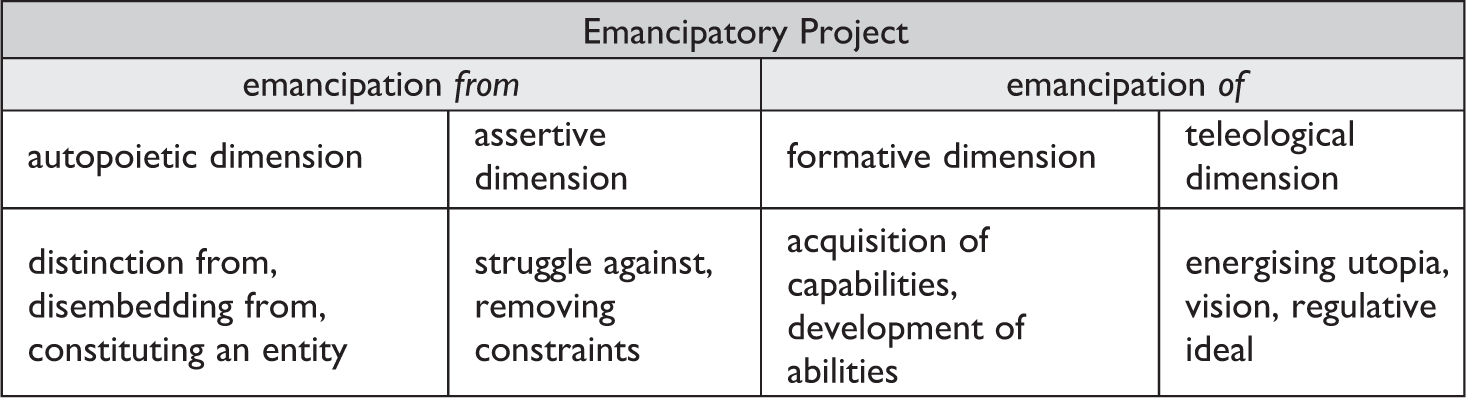
Constitutive dimensions of the emancipatory project.
Kantian rationalist philosophy famously imagined emancipation – or rather Enlightenment – as the emergence of mankind from its self-incurred immaturity (Kant, 1970). For Kant, the emancipatory project was – despite his demands on the individual and his belief in inalienable individual rights – explicitly not an individual project but one of the human species at large that aimed for the realization of a potential, the rule of reason, endowed to the entirety of humankind. The constitution of the subject and its claim to autonomy (autopoeietic dimension) were based on the assumption that all human beings are provided with the faculty of reason which distinguishes them from other living beings and mere objects. The realization of the normative claim to autonomy demanded the struggle against natural instincts, pure convenience and all kinds of superstition (assertive dimension). The acquisition of maturity, that is, the full development of the human faculties of reason and their practical application, accompanied by the overcoming of cowardice and laziness – sapere aude – constituted the formative dimension of the emancipatory project. And the vision, the regulative ideal, was a fully enlightened cosmopolitan society in which freedom and necessity (the categorical imperatives of reason) would become congruent, thus realising the idea of a universal history culminating in a condition of perpetual peace (teleological dimension).
If, following Laclau (1996), this can be regarded as the classical understanding 2 of the emancipatory project, it was subsequently reframed and adapted in line with historical development and changing socio-economic conditions. In this process it, incrementally, became detached from both the idea of transcendental reason and the concept of the transcendental subject to which Kant’s idea of autonomy primarily relates. Adopting a modernization-theoretical rather than a post-modernist perspective; that is, putting to one side the view that beyond the death of its classical understanding, the emancipatory project diversified into a myriad of particularized emancipatory agendas (e.g. Laclau, 1996; Foucault, 1984, 2008), and working, instead, with the distinction between a first, industrial, a second, post-industrial, and a third, post-subjective modernity (Beck, 1992, 1997; Blühdorn, 2007a, 2009; Blühdorn & Butzlaff, 2019) for each of which we may specify one distinctive ideal-typical master-framing, the ongoing reconfiguration of the emancipatory project may be conceptualized as three-stage process:
Referring to capitalist industrial society, Marx and the post-Marxian tradition saw labour, the enslaved industrial working class, as the primary subject of the emancipatory project, constituted by the material conditions of industrial capitalism. Its claim to autonomy implied, in the first instance, the liberation from, that is, the struggle against, the domination, exploitation and oppression by the owners of capital. The formation of a new class consciousness, the ability to see through ideology and false consciousness, the acquisition of capabilities for political organization and collective action as well as the development of an ethos of solidarity and collectivity were the formative dimension of this emancipatory project. In light of biting poverty and miserable social conditions, the achievement of workers’ rights, the enhancement of working conditions and the improvement of material provision were the primary objectives and political energizer. Compared to these immediate targets the idea of the fully liberated subject and society that would emerge beyond the eventual collapse of capitalism remained secondary. Yet, ultimately, the grand vision was the liberated and pacified world society in which each individual and society at large would fully develop their respective potentials and the human essence. Ultimately, the emancipatory project which under conditions of capitalist industrial society initially takes the form of a class project, would thus culminate in the liberation of global society at large.
With the relative decline in western societies of the industrial working class and the emergence of the new, well-educated and materially secure post-industrial middle class, the individual subject and its struggle for individual self-determination and self-realization became the new focus of emancipatory struggles. To some extent, the new social movements since the 1970s still perceived of themselves as collective subjects and engaged in collective action, yet, Giddens (1991, 1994), Beck (1992, 1997) and many others have described in much detail how the emancipation of the individual now gained prominence vis-à-vis the emancipation of the class subject. In its autopoietic dimension, the emancipatory project was now increasingly about the distinction of the individual from the societal context. The struggle against heteronomy (assertive dimension) was ever less directed against the domination by a ruling class or by capitalism at large but against the experience of standardization and mass culture, on the one hand, and diverse forms of social predetermination, on the other. In its formative dimension, the emancipatory project now focused on the individual and collective acquisition of the capability to discover and practically realize the individual’s authentic self and identity – which was the visionary target of the emancipatory project (Melucci, 1996). It was this kind of society that Inglehart’s diagnosis of a silent revolution originally referred to. But today, this society and phase of modernity has been superseded by a new phase that is still post-industrial but has been substantially reshaped by the globalization of the economy, in particular, the proliferation of new electronic and communication technologies, the rise of market-liberal ideology and new ideals of identity, subjectivity and a fulfilled life.
In this new phase, the emancipatory project has once again adopted a substantially different form. In its autopoietic dimension, it is not simply concerned with the differentiation of the individual from society, that is, the constitution of the individual self vis-à-vis society at large but, more importantly, with the construction of context-specific distinctiveness and singularity. As Sennett, Bauman, Reckwitz and many others have highlighted, the objective is no longer to realize a consistent, stable, maturing and authentic self and identity, but the design of purpose-built profiles which may be multiple, dynamic and mutually contradictory (Sennett, 1999; Bauman, 2000; Reckwitz, 2020). Accordingly, the assertive dimension of the emancipatory project no longer just focuses on liberating the individual Self and its identity from socially predetermined roles, but the struggle is directed against the very idea of a homogenous Self, consistent identity and autonomous subject in the more traditional sense. Liberation from established commitments to norms such as rationality, consistency, reliability and authenticity is hoped to facilitate the full development of potentials and capabilities – alternative rationalities, emotionality, multiplicity, spontaneity and so on – as resources for the realization of distinctiveness und uniqueness. Put differently, in its formative dimension the emancipatory project now focuses specifically on the development of qualities which more traditional notions of rational, principled, mature and autonomous subjectivity had excluded. In this sense, this emancipatory struggle may suitably be conceptualized as second-order or reflexive emancipation (Blühdorn, 2013, 2020a, 2020b; also see the discussion by Haderer in this Special Issue). At this stage, the great objective of the emancipatory struggle (teleological dimension) is liberation from the disciplinary and potentially oppressive powers built into any positive vision of a liberated society (Allen, 2015; Foucault, 1984; Laclau, 1996). Turned positively, it is the maximization of potentials and opportunities for self-realization, self-expression and self-experience – which neoliberal ideology framed as the realization of the entrepreneurial self (Bröckling, 2015) and its ongoing self-optimization for the competitive framework of market-liberal consumer society (Boltanski & Chiapello, 2017; also see Swyngedouw in this Special Issue). For significant parts of contemporary societies, these new opportunities, choice, flexibility and self-realization always remain an aspiration rather than a liveable practice, of course (Reckwitz, 2020). But even as unfulfilled aspirations these new understandings of autonomy and emancipation reconfigure the grammar of political struggle.
This simplifying three-stage model – as tentatively summarized in Figure 2 – does not aim to represent the manifold ways in which particular social groups and movements interpret norms of autonomy and emancipation and mobilize them for their respective struggles for equal recognition, participation and inclusion. Instead, it sketches and contrasts ideal-typical master-framings of emancipatory politics for the respective type of society and phase of modernity. And it seeks to capture how in a silent revolution, claims to and expectations of self-determination and self-realization have not just become much stronger and more articulate in contemporary consumer societies at large, as Inglehart and many others have rightly pointed out. But in the wake of another silent revolution, they have also radically changed in substantive terms – not least because prevailing notions of subjectivity, identity and a good life have changed as well. Therefore, fully acknowledging that in contemporary consumer societies diverse social groups promote many different and competing agendas of autonomy and emancipation, and appreciating that the ideal-typical distinction between just three phases of modernity and related master-framings of the emancipatory projects does not depict real world diversity and complexity, this three-stage model, focuses attention on the interpretations of autonomy and emancipation which social theorists have identified as being distinctive for the respective phase of modernity.
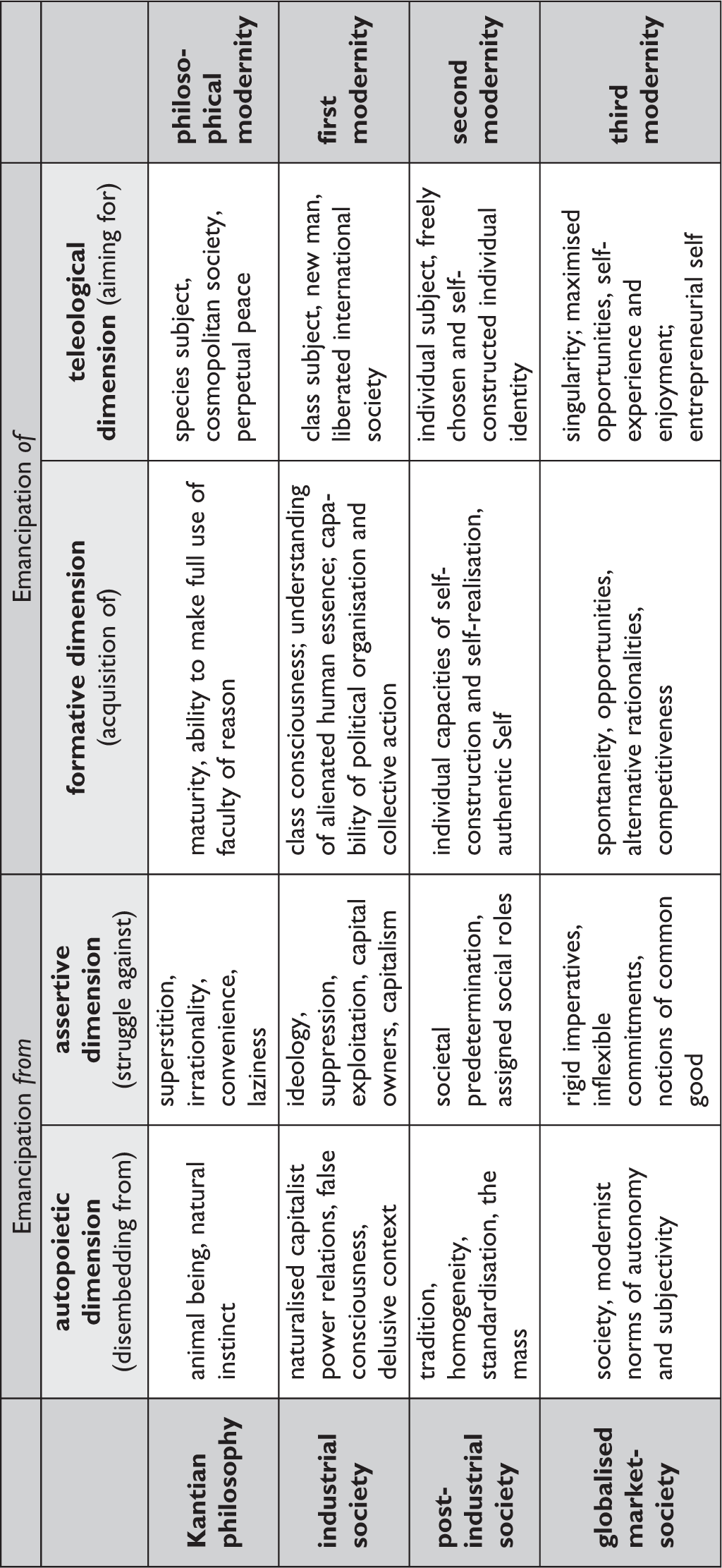
The historicization of the emancipatory project.
More specifically, the objective is to demonstrate how in the wake of a silent revolution much more profound than the one conceptualized by Inglehart, the grammar of political struggle and the prospects for societal transformation have been comprehensively reconfigured. The understandings of the emancipatory project prevailing in today’s post-industrial consumer societies are radically and intentionally incompatible with the Kantian understanding of the autonomous subject. While the labels autonomy, subjectivity and emancipation – as well as the formal dimensions of the emancipatory project distinguished in Figure 1 – are still the same, mainstream interpretations of these norms and dimensions have become detached from imperatives of reason just as much as from bourgeois notions of maturity and romantic ideas of authenticity. Emancipation has become a largely individualized and personal affair (also see Butzlaff in this Special Issue). The collective aspect has become just as marginal as egalitarian values. The utopian and transformative dimension, relating to both the individual and society as a whole, have largely disappeared. Prevailing notions of emancipation are not about anticipating a radically different future society, but autonomy and self-determination are primarily about self-optimization and the maximization of opportunities within the established order. Under conditions of third modernity, the entity that is claiming self-determination and self-realization no longer has the status of an autonomous subject in the Kantian sense, nor does it claim autonomy and subjectivity in the Kantian sense. Quite the contrary, by the most progressive, emancipated and politically articulate social groups, in particular, these norms have explicitly been abandoned – while being carefully cultivated as ‘recreational performance’ (Blühdorn, 2020b, pp. 399–400, 2007b; Blühdorn & Butzlaff, 2019) – so as to make room for more complex, flexible, competitive and present-oriented forms of self-realization, self-expression and self-experience.
If the classical project of emancipation can be described as a project of disembedding that remains firmly embedded into a set of moral-cum-rational imperatives, duties and restraints which are firmly inscribed into the Kantian understanding of the autonomous subject, the notions of emancipation prevailing today may be conceptualized as disembedded emancipation, which is not just post-foundational (Marchart, 2007) but, more specifically and importantly, essentially unrestrained. At this point a dialectic cycle comes to completion: The emancipatory logic and dynamic – in tandem with an economic logic and dynamic (neoliberalism) as well as a technological logic and dynamic (digital revolution) which have not been considered here (Blühdorn, 2020b) – has radically reframed, what had once been both the precondition and the target of the emancipatory project: the Kantian norm of the autonomous subject. In pursuit of the realization of changing notions of autonomy, self-realization and self-expression, and in pursuit of ‘genuine emancipation’ as the ‘possibility of a subject free from power relations’ (Allen, 2015, p. 515, emphasis in original), the emancipatory logic itself has removed earlier notions of emancipation which it perceived as obstacles – and has thus hollowed its own foundations. In the wake of this dialectic – the dialectic of emancipation – the notorious imbalance in the emancipatory project between its rule-transcending and its rule-setting dimensions becomes more visible and problematic than ever. The emancipatory project now fully loses the ability to counterbalance its logic of expansion and transgression with a logic of limitation and restraint. At this stage, ‘the war of emancipation is not over’ (Bauman, 2000, p. 51), of course, nor is its dialectic; it is ‘only the meaning assigned to emancipation under past but no more present conditions that has become obsolete’ (Bauman, 2000, p. 48). Yet, this dialectic radically reconfigures the grammar of political struggles and societal transformation – even if for significant parts of contemporary consumer societies, these new understandings of self-determination and self-realization will never be more than aspirations which they will never be able to realize in practice. And there is much to suggest – witness the explosive fractioning and polarization of society not just in the United States – that the end of emancipation in its classical sense is not, as Laclau and many other post-foundational thinkers suggested, ‘the beginning of freedom’ (Laclau, 1996, p. 18; Foucault, 1984, 2008; Allen, 2015; also see Butzlaff in this Special Issue), but rather of a ‘war of emancipation’ in a more literal sense than Bauman may have had in mind. Indeed, under the particular conditions of the present conjuncture, as sketched earlier in this article, there is ample evidence for a new ‘brutalization of social struggles for recognition’ (Honneth, 2012), of public discourse turning increasingly uncivilized, indeed violent, and of tendencies towards a new Hobbesian state of nature (Latour, 2017).
Great transformations
Reversely, a socio-ecological transformation and a new social contract for sustainability (WBGU, 2011) as demanded by social movements, many scientists and critical (eco-)sociologists seems, in light of this second silent revolution, an increasingly unlikely prospect. For this kind of transformation and social contract, a powerful principle of limitation is indispensable, and if the coming of eco-authoritarianism (Beeson, 2010; Shahar, 2015) is to be avoided, this principle needs to be compatible with, and built into, prevailing notions of autonomy and emancipation. Put differently, it needs to be a logic of democratic self-limitation, a functional equivalent of Habermas’ unforced force of the better argument. Yet, the dialectic of emancipation seems to have eradicated the very idea of any such logic from the prevailing understandings of self-determination, self-realization and self-expression. For (eco-)critical theory and sociology, this is a critical conjuncture, indeed.
The factual transformation that contemporary consumer societies are experiencing instead may, in the first instance, be described drawing on Bauman’s diagnosis of the secession of the successful (Bauman, 2001, pp. 50–57) – a concept that seems much in line with the notion of second-order emancipation. Making reference to Polanyi’s Great Transformation (Polanyi, 1944/2001), Bauman conceptualizes a ‘great transformation mark two’ (Bauman, 2001, pp. 39–49). In particular, he takes up Polanyi’s notion of disembedding – again a concept that figures prominently above. In the same way that, in Polanyi’s great transformation, the capitalist economy disembedded itself from its societal context and the foundations on which it rests, Bauman argues, the strong and successful are pursuing a great transformation mark two in which they are emancipating themselves from their commitments to and responsibilities for the community. Central to his diagnosis is the ambivalence of individualization which Beck (Beck & Beck-Gernsheim, 1996, 2002) and many others have highlighted, too: on the one hand, processes of emancipation and gaining autonomy open up new spaces for self-determination and self-realization, but at the same time the severance from established ties and contexts also generates new risks and uncertainties, which might easily become unmanageable (also see Butzlaff in this Special Issue). For the privileged and secure, however, Bauman suggests, the aspect of liberation has always taken priority over concerns about security. Given their resourcefulness ‘freedom seemed […] to be the best warrant of security imaginable’, and ‘the foolproof recipe for both freedom and security was the cutting and shaking off of the few hands-tying bonds that remained’ (Bauman, 2001, p. 22). Thus the great transformation mark two, Bauman suggests, firstly entails the cultivation of an understanding of freedom that implies ‘the ability to get things done according to one’s wishes, with no one else able to resist the result, let alone to undo it’ (Bauman, 2001, p. 22) and, secondly, an understanding of emancipation that is strongly exclusive, for, ‘the package deal of freedom cum security […] was not on general offer’, but ‘available only to selected customers’ (Bauman, 2001, p. 23). As a matter of fact, ‘the emancipation of some called for the suppression of others’ (Bauman, 2001, p. 26); and ever since the industrial revolution, Bauman notes, ‘this is exactly what happened’ (Bauman, 2001, p. 26).
For today’s neoliberal market societies, all this undoubtedly fully applies. More than ever neoliberal thinking has succeeded in framing and denouncing every political intervention and regulation as repression of individual freedom, spontaneity and initiative. Very visibly – even the COVID-19 pandemic, which has reinforced the exclusive escape- and self-protection efforts of the successful, being only a partial and temporal exemption, at best – ideological neoliberalism ‘declared war on the community’ which is being ‘waged in the name of freeing the individual from the inertia of the mass’ (Bauman, 2001, p. 27). While ‘received notions of communal duty’ are being ‘dismissed as outmoded tradition’, those endowed with the required forms of capital regard ‘the sky’ as ‘the sole limit’ of their ambition (Bauman, 2001, p. 30). In these respects, Bauman’s concept of the great transformation mark two captures important features of today’s market-liberal consumer societies. Yet, the secession of the successful is not specific to the contemporary post-industrial condition but, as Bauman himself points out, a principle that has applied ever since the beginning of the industrial revolution. Also, Bauman focuses rather one-dimensionally on the tension between security and freedom. His concept does not account for the incremental reframing of freedom and the emancipatory project in the wake of the transition from industrial society and modernity to post-industrial society (second modernity) and on to today’s globalized market society (third modernity). And although Bauman makes a direct connection between the secession of the successful und the suppression of others, he does so from a rather traditional perspective of capitalist class structures. In today’s consumer societies, however, following the silent revolution outlined above, the successful who are seeking to cut ties and shed commitments in order to realize ideals of self-determination and self-realization which require the suppression of others are no longer just the small elite of capital owners. Instead, significant societal majorities pursue – more or less successfully – ideals of autonomy and self-expression which in view of planetary boundaries necessarily depended on socio-ecological marginalization and exclusion.
The concepts of second-order emancipation and the dialectic of emancipation capture these conditions more accurately. They focus more specifically on the ‘imperial mode of living’ (Brand & Wissen, 2018) and the principle of ‘living at the expense of others’ (Lessenich, 2019), which in today’s consumer societies have become a central parameter in the grammar of social struggle and societal transformation. At the same time, the notions of second-order emancipation and the dialectic of emancipation also lead towards an explanation for the recession of democracy and the autocratic-authoritarian turn that reaches beyond common conceptualizations in terms of retrotopia (Bauman, 2017), cultural backlash (Norris & Inglehart, 2019) and the great regression (Geiselberger, 2017).
With regard to this autocratic-authoritarian turn, too, Polanyi’s Great Transformation provides instructive pointers (e.g. Novy, 2020). Indeed, for Polanyi the concept of the great transformation refers not only to the metamorphosis of feudal society into industrial society and the disembedding of the capitalist economy from its societal context, but also to the collapse of the liberal order and the ‘victory of fascism’ (Polanyi, 1944/2001: 3, pp. 249–258). More importantly, Polanyi makes a direct connection between the two and conceptualizes the struggle for unrestrained freedom as the very trigger for an authoritarian counter-movement. In the present context, that is, with regard to disembedded emancipation and the dialectic of emancipation, this is instructive, indeed. The ‘liberal philosophy’, Polanyi argues, pursues a perverted agenda of freedom, ‘tainted at the source’ (Polanyi, 1944/2001, pp. 256–257). It ‘claims that power and compulsion are evil’; it denounces ‘the freedom that regulation creates […] as unfreedom’; it rejects ‘the justice, liberty and welfare’ secured through political intervention into the market ‘as a camouflage of slavery’; and it adamantly obstructs ‘any reform involving planning, regulation, or control’ (Polanyi, 1944/2001, pp. 256–257). It benefits a privileged few ‘at the cost of justice and security’ for society at large – until, eventually, ‘the conflict between the market and the elementary requirements of an organized social life’ triggers counter movements which put ‘the confessed enemies of freedom’ in a position to impose ‘planning, regulation and control’ in ways that ‘abolish freedom altogether’ (Polanyi, 1944/2001, pp. 249, 255–257). While Polanyi himself clearly hoped for and normatively endorsed a counter movement of a different kind, perhaps even leading to socialism, he was concerned that the ‘victory of fascism’ and ‘freedom’s utter frustration’ would be ‘practically unavoidable’ and the ‘inevitable result of the liberal philosophy’ (Polanyi, 1944/2001, p. 257).
So, Polanyi explicitly suggests a dialectic relationship between the understandings of freedom entertained by societal elites and the rise of fascism: ‘It appears that the means of maintaining freedom are themselves adulterating and destroying it’ (Polanyi, 1944/2001, p. 254). However, his hypothesis of the collapse of liberalism and the ‘end of the market society’ (Polanyi, 1944/2001, p. 252) have, as yet, not come true. Furthermore, the autocratic-authoritarian turn today’s consumer societies are undergoing is qualitatively different from the fascist movement Polanyi saw as an inevitable consequence of the ‘liberal philosophy’ – not least in that today’s authoritarian turn occurs within the framework of market-liberalism. Furthermore, as in the case of Bauman, Polanyi’s analysis is also not applicable to a constellation where, in the wake of the dual silent revolution outlined above, the elites’ exclusive notions of freedom have become democratized, that is, have permeated society at large. But, drawing on Polanyi’s ideas, the rise of autocratic-authoritarian tendencies today can, arguably, be traced back to the interplay of (a) the ongoing reframing and democratization of notions of autonomy and emancipation as outlined above; (b) the ever-widening abyss between claims and expectations to autonomy and self-realization, on the one hand, and experiences of increasing disempowerment, inequality and exclusion, on the other; and (c) the increasing visibility of planetary boundaries which render prevailing notions of autonomy and emancipation ever more directly dependent on rising levels of social inequality and exclusion, thus necessitating an explicit politics of exclusion.
The interaction of these parameters – steadily reinforced by the ongoing secession of the successful and eco-political panic and emergencies – does not just trigger a dramatic erosion of confidence in democratic procedures and institutions (e.g. Blühdorn, 2020a, 2020b; Mair, 2013), but it gives rise to explicit demands for post-democratic, post-political, autocratic-authoritarian rule. It propels a dynamic of autocratization that is, curiously, propelled by rather diverse actors and agendas:
– the much-cited losers of modernization who in search of orientation and protection turn towards illiberal, anti-pluralist and authoritarian leaders (e.g. Inglehart, 2018; Norris & Inglehart, 2019);
– the politically disillusioned who are deeply disappointed by established politics, experience a profound crisis of political representation, no longer believe that political institutions may be reformed and have adopted a mode of permanent rebellion against the established order and its rationality;
– those looking for narratives helping them to make sense of, find orientation in and navigate conditions of high complexity, and allowing them to take back control and reinstate a sense of self-efficacy;
– those entertaining understandings of autonomy, self-determination and a good life whose viability demands effective policies of social exclusion (Brand & Wissen, 2018; Lessenich, 2019);
– those who believe that the societal issues that need to be dealt with swiftly and efficiently are best managed by non-majoritarian modes of expert governance;
– those who in view of prevailing notions of autonomy and the liberation from maturity visible in virtually all sectors of society have lost confidence in the political competence and responsibility of major parts of the citizenry (e.g. Brennan, 2016; van Reybrouck, 2016);
– those demanding rigorous government action to enforce restrictions which may stave off ecological collapse, global warming and the extinction of the human species;
– those who have come to believe that, ultimately, centralist, autocratic and authoritarian systems might be better positioned for managing the crises and catastrophes which in the Anthropocene are, increasingly, part of normality than democratic systems.
This enumeration is not meant to be exhaustive, and the diverse motivations for autocratic-authoritarian inclinations analytically distinguished here empirically blend in a variety of ways, giving rise to heterogeneous and oscillating ideological orientations and forms of political practice. These diverse actors – the radical opposition between American Trumpism and the Fridays for Future movement being a case in point – may well conceive of each other as political enemies. Yet, collectively – even if against each other – they propel the autocratic-authoritarian turn and are in this sense companions on the road towards authoritarian governance (Swyngedouw, 2000). In the grammar of the autocratic-authoritarian turn their synergies, neither intended nor declared but still very effective, are a key parameter. And no less important is that most of these political actors actually conceive of themselves as emancipatory. In their own different ways, they all understand themselves as being critical of ruling elites, committed to independent critical thinking, rebels against oppressive mainstream rationality, empowering disempowered citizens and defenders of civil liberties (also see Lütjen in this Special Issue). These diverse actors have equally diverse understandings of the emancipatory project and its constitutive dimensions – as selectively illustrated by the examples portrayed in Figure 3. Yet their respective understandings are all strongly exclusive, even though each of them employs a different mechanism of exclusion (ethnicity-based, lead-culture-based, market-based, common sense based, scientific evidence-based etc.). Furthermore, many of them explicitly regard a socio-ecological transformation of society beyond liberal consumer capitalism as unnecessary and undesirable. For these actors, prevailing understandings of freedom, self-determination and self-realization – the imperial way of living at the expense of others – are entirely non-negotiable. Issues of finiteness are to be resolved by suitable mechanisms of non-egalitarian social distribution, and for issues of climate change and ecological sustainability, to the extent that their reality is conceded, technological innovation and market instruments are regarded as the appropriate response.
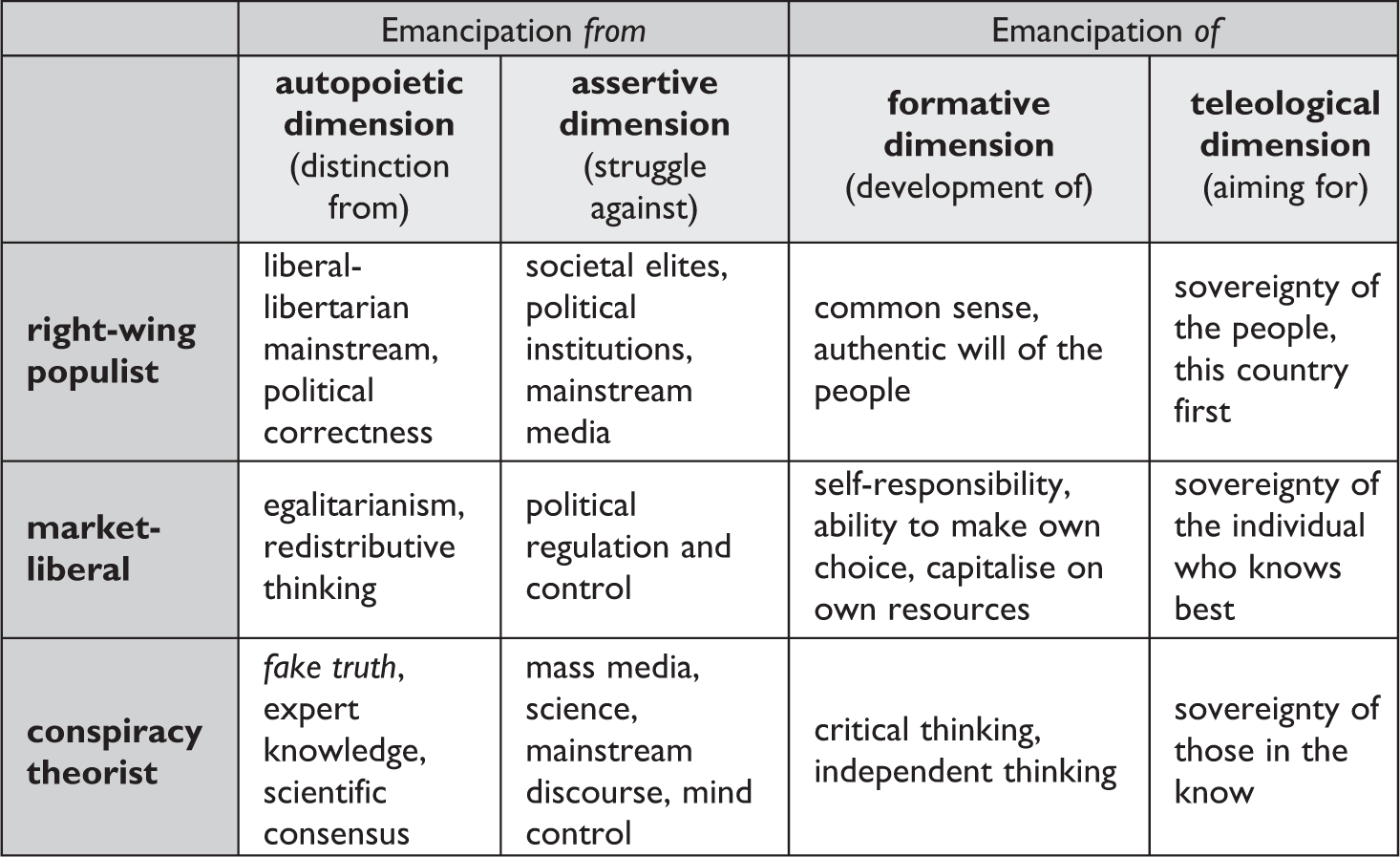
Appropriations of the emancipatory project.
To some extent, radical eco-movements which demand System Change not Climate Change seem to contradict this analysis. Yet, given the socio-economic background of the majority of activists supporting, for example, Fridays for Future (de Moor et al., 2020a, 2020b; Wahlström et al., 2019), it remains uncertain to what extent they really do. In any case, with their post-political confidence in science and their post-democratic demand that the state ought to rigorously implement the supposedly categorical imperatives of climate and sustainability science, these movements, too, pour water onto the mills of the autocratic-authoritarian turn. Given the diversity of players, the emerging patterns of authoritarian governance are not formalized and institutionalized. Some of these actors are openly illiberal, nationalist or racist. But contradicting Polanyi’s predictions, authoritarian governance is neither fascist nor totalitarian. It also cannot be reduced to authoritarian populism (Norris & Inglehart, 2019). It is an informal, decentralized and inclusive form of politics in which a threatened majority (Krastev, 2017) covering a diverse range of social groups and political positions across the full ideological spectrum, collectively – though often against each other – organize exclusion and sustain the unsustainable (Blühdorn, 2013; Blühdorn & Deflorian, 2019).
Conclusion
The objective of this article has been to explore the problems of a socio-ecological transformation and the grammar of the autocratic-authoritarian turn in today’s post-industrial consumer societies through the lens of the dialectic of emancipation. More specifically, I have argued that this lens reveals insights helping (a) to explain why, despite decades of campaigning, a socio-ecological transformation of these societies has still not materialized, and (b) to understand why an autocratic-authoritarian turn is occurring instead. There is no shortage of explanatory literature on both of these issues, but the role of emancipatory values and agendas has so far remained under-investigated, and analysis through the lens of the dialectic of emancipation can make a contribution that reaches far beyond the hypotheses suggesting synergies between emancipatory and neoliberal agendas (Boltanski & Chiapello, 2017; Fraser, 2017) or a co-responsibility of liberal-emancipatory movements for the rise of right wing populism (Eribon, 2013; Lilla, 2017; Norris & Inglehart, 2019).
Hegel, Marx and also Marcuse understood dialectics as a historical process – propelled by social contradictions – at the end of which full and permanent freedom for all would be realized. Others, such as Horkheimer, Adorno, Beck or Bauman understood dialectics as the parallel growth, in the process of modernization, of freedom, security and potentials for self-determination, on the one hand, and new risks, pressures and forces of enslavement, on the other. They regarded this dilemma as inescapable and irresolvable, but never gave up the belief in the emancipatory project. At the present conjuncture, it seems – as already Plato (1955) and much later Polanyi had anticipated – that the struggle for emancipation which had been hoped to transform the established socio-economic order into a radically different one granting freedom, justice, dignity and integrity to all, including nature, may have metamorphosed from a potential midwife of a socially and ecologically appeased world into the gravedigger of this very idea, into the driver of an autocratic-authoritarian turn and the midwife of a socially and ecologically destructive world.
Understanding emancipation as an empty signifier and further developing Boltanski and Chiapello’s suggestion that the emancipatory project can be appropriated by political actors with ideological orientations far removed from what many social movements and critical sociologists would describe as authentic or genuine emancipation, I have argued that the emancipatory logic itself – in tandem with economic and also technological drivers (Blühdorn, 2020a, 2020b, 2020c) which the analysis here has left aside – seems to have hollowed the foundations of the emancipatory project on which it once rested. In the name of ‘genuine emancipation’, aiming to realize the ‘possibility of a subject free from power relations’ (Allen, 2015, p. 515), emancipatory movements and critical theorists have themselves, actively contributed to this hollowing and, unintendedly, facilitated the appropriation of the emancipatory project by anti-egalitarian, illiberal and anti-environmental actors. In particular, seeking to escape the apparent paradox that the emancipatory project has always entailed a restrictive and disciplinary dimension, too, they have profoundly reinterpreted and reconfigured the relationship between the rule-challenging, transgressive and the rule-setting, restrictive dimensions of the emancipatory project. This reconfiguration is at the core of the dialectic of emancipation conceptualized here. It raises fundamental questions about the viability of (eco-)critical theory’s and sociology’s attempts to present emancipation as a norm energising and guiding a socio-ecological transformation of today’s consumer societies.
In these societies, the ‘war of emancipation’, that is, the struggle for freedom, self-determination and self-realization is, as Bauman rightly notes, not over; and, ‘as always, the job of critical thought’ remains ‘to bring into the light the many obstacles piled on the road to emancipation’ (Bauman, 2000, p. 51). This article is part of this endeavour. But, in contrast to the approaches taken by (eco-)critical theory and sociology so far, it has investigated the parallel proliferation and transformation of emancipatory values as one of these ‘obstacles on the road to emancipation’. Put differently, while (eco-)critical theory and sociology have so far – too easily, I have argued – portrayed emancipation and emancipatory politics as the solution to modern society’s socio-ecological unsustainability, it has been investigated here as being part of the problem: It has been shown that in the grammar of the autocratic-authoritarian turn and of the societal transformation that is factually occurring while the much-debated socio-ecological transformation remains elusive, the reframing and appropriation of the emancipatory project is, indeed, a key parameter. The failure of the socio-ecological transformation as well as the autocratic-authoritarian turn can, in part at least, be traced back to this reframing which is itself propelled by the logic and dynamic of emancipation.
Thus, the notion of the dialectic of emancipation supplements Boltanski and Chiapello’s appropriation hypothesis with a voluntary severance hypothesis. And rather than dismissing the argument that the emancipatory left is co-responsible for the rise of right-wing populism as anti-emancipatory and reactionary (van Dyk & Graefe, 2019), the notion of the dialectic of emancipation separates this idea from the untenable distinction between post-modern identity politics and traditional class politics and suggests that the autocratic-authoritarian turn and new forms of authoritarian governance are carried by synergies between diverse political actors which have implications reaching far beyond the forms of complicity debated by Lilla, Fraser and many others.
The analysis undertaken here does in no way imply any normative endorsement of the reframing and appropriation of emancipation by anti-egalitarian, illiberal and anti-environmental actors. The objective has not been to delegitimate and abandon the emancipatory project, nor to launch any neoconservative or reactionary agenda. Also, there is no intention to ‘categorically deny the possibility of a radical societal transformation including the transformation of currently prevailing modes of subjectivation’ (van Dyk & Graefe, 2019, p. 423). The dialectic of emancipation is and remains an open process. The metaphor of the gravedigger points to the decline of a particular vision of liberation and autonomy, but not of the struggle for emancipation as such. Indeed, whatever the prevailing interpretations of emancipation in contemporary consumer societies, there is a wealth of movements committing to egalitarian values and universal rights. And there is nothing to suggest that critical theorists and sociologists should abandon their struggle for their own understandings of emancipation. For the time being, there is evidence of a ‘brutalization of social struggles for recognition’ (Honneth, 2012), of public discourse becoming increasingly uncivilized and of tendencies towards a new Hobbesian state of nature (Latour, 2017). But in the same sense that Boltanski and Chiapello sought to recapture the emancipatory project from its neoliberal appropriation, the analysis offered here is underpinned by the hope that – against all odds – it might be possible to rescue the emancipatory project from its reflexive self-undermination.
In any case, as cited at the beginning of this article, equal commitment to the normative and the social-theoretical dimensions of its agenda is the ‘hallmark of critical theory’. If (eco-)critical theory and sociology really want to honour this dual commitment, they will have to pay much more attention to the dialectic of emancipation and its impact on the grammar of political struggle and societal transformation. They will have to acknowledge their own role in and contribution to the phenomena investigated here; and they have to concede that the rejection of any disciplinary power, the belief in purely negativistic understandings of emancipation and the confidence in the post-foundational, irresolveably conflictual struggle between ever differentiating discourses of liberation have run into a cul-de-sac. The refusal to engage with the dialectic of emancipation and the attempt to resolve the ‘uncomfortable questions’ raised in the introduction to this article by denouncing endeavours to address them anti-emancipatory and reactionary betray both the social theoretical as well as the transformative commitment of critical theory and sociology.
As regards the tension between liberation and limitation, eco-critical theory and sociology – myself included – are stuck in a dilemma: In the post-foundational constellation, any attempt to reinstall older logics or principles of restriction and limitation would seem reactionary. But in light of planetary boundaries and ever more delimited understandings of autonomy and emancipation, a functional equivalent for Habermas’ unforced force of the better argument is indispensable. If (eco-)critical theory, sociology and movements are serious about their ‘practical transformative intent’ and their effort ‘to determine where opportunities may lie’, they will need to address the worsening imbalance in the emancipatory project between liberation and limitation. Or else, we leave the issue of limitation and boundaries – as Polanyi put it – to ‘the confessed enemies of freedom’.
Footnotes
Acknowledgement
I would like to thank the participants of my doctoral research seminar (Winter 2020/1) for the intense collective reading and discussion of a number of academic texts which have come to play a crucial role in this article. I dedicate this article to this excellent group of students. In addition, thanks are due to Margaret Haderer, Felix Butzlaff, Dirk Jörke and two anonymous reviewers for their critical reading and constructive comments on earlier versions of this article.
Declaration of conflicting interests
The author(s) declared no potential conflicts of interest with respect to the research, authorship, and/or publication of this article.
Funding
The author(s) received no financial support for the research, authorship, and/or publication of this article.
