




Abstract
When prototypical leaders commit organizational transgressions, highly-identified members of the organizations are motivated to punish their leaders, due to increased group-based image concerns. However, do similar dynamics apply when high-status ingroup leaders transgress against vulnerable low-status outgroups? Moreover, does this lead to outgroup solidarity? To address these gaps, we conducted three pre-registered experiments with European, Australian, and British samples, respectively (Ntotal = 1,039). The first two studies, in which we manipulated leader prototypicality, focused on EU and Australian leader transgressions regarding the treatment of refugees. Moderated mediation analyses showed that, when their leader was prototypical, high-identifiers exhibited greater outgroup solidarity, indirectly through increased group-based image concerns. The third study, conducted in the UK, examined prototypical leader transgressions regarding minority mental health issues following the 2024 riots. This study manipulated transgression ambiguity and found that high-identifiers’ image-based outgroup solidarity was more pronounced when the transgression case was clear-cut rather than ambiguous. Across all studies, low-identifiers expressed outgroup solidarity through perceptions of injustice about the treatment of outgroups, regardless of leader prototypicality and transgression ambiguity. These findings integrate the transgressive leadership literature with solidarity-based collective action research by highlighting leader prototypicality as a key factor in eliciting outgroup solidarity through image concerns among individuals highly invested in high-status transgressor groups, especially when transgressions are clear-cut. Implications are discussed.
Keywords
Introduction
According to social identity research, a leader is defined as someone who represents a social group from a position of authority and steers actions in line with the group’s stakes (Hogg et al., 2012; Thomas et al., 2013; van Knippenberg, 2011). Because group leadership concerns collective rather than personal stakes, group members tend to evaluate their leaders’ actions based on how well they represent and advance the ingroup identity (Steffens et al., 2014, 2021). This evaluation process, known as leader prototypicality, plays a crucial role in shaping perceptions of both positive and negative leader actions (see Steffens et al., 2021 for a review). In cases of negative leader actions (e.g., evident leader transgressions that harm other ingroup members), prototypical leaders face harsher punishment from ingroup members than non-prototypical ones (Chang, 2022). This occurs because their transgressions are perceived as more detrimental to the ingroup’s image, especially among members with stronger identification, marked by commitment, satisfaction, and belongingness (Tajfel, 1974). Chang (2022) investigated this phenomenon within organizational settings, showing that ingroup leaders who mistreat their subordinates or breach norms face greater punishment from fellow subordinates. However, their research was confined to intragroup settings, leaving intergroup contexts underexplored. Do similar dynamics apply when leaders of high-status ingroups transgress against vulnerable, low-status outgroups? Do such transgressions also spark outgroup solidarity, that is, collective action intentions aimed at alleviating the suffering of low-status groups (Radke et al., 2020)? The present research aimed to address these questions.
Moreover, recent research suggests that transgressions committed by ingroup members can foster outgroup solidarity among low-identified ingroup members, albeit through a distinct motivational pathway (Çakmak, Gordijn, Koc, & Stroebe, 2025): Low-identifiers are more likely than high-identifiers to prioritize the needs of victimized groups and perceive transgressions as unjust rather than as a threat to the ingroup’s image. This heightened sense of injustice, in turn, motivates their solidarity with outgroups (Çakmak, Gordijn, Koc, & Stroebe, 2025; Iyer & Ryan, 2009). Nevertheless, no research has yet examined whether this justice-based solidarity among low-identifiers extends to transgressions by prototypical (or non-prototypical) leaders.
Addressing these gaps, the present research experimentally investigates whether transgressive ingroup leader prototypicality influences group members’ outgroup solidarity and support for leader punishment via heightened group-based image concerns and perceived injustice. Additionally, we investigate whether ingroup identification moderates these processes and the conditions under which they become stronger. Hence, the first two studies manipulated the prototypicality of transgressive ingroup leaders, while the third study tested a boundary condition for these effects by manipulating the situational ambiguity of transgressions (i.e., ambiguous vs. clear-cut).
The Potential Effects of Transgressive Leader Prototypicality among High-identifiers
People have positive views about the groups they highly identify with (Tajfel, 1974), but witnessing transgressions by ingroup members increases high-identifiers’ concerns about their group’s external image and fosters their solidarity with victimized outgroups (Çakmak, Gordijn, Koc, & Stroebe, 2025; Shuman et al., 2018). When leaders transgress, their ingroup prototypicality becomes vital: High-identifiers view wrongdoings by prototypical leaders as more detrimental to the ingroup’s image than those by non-prototypical leaders, as their actions are perceived as more representative of the entire group (Chang, 2022). This finding also aligns with the subjective group dynamics account of ingroup deviance (Marques et al., 1998). Prototypical leaders strongly embody the descriptive features of the ingroup, and their behaviors are expected to meet prescriptive criteria, thereby reinforcing the distinctiveness of the valued ingroup from outgroups (Abrams et al., 2002; Marques et al., 1998). For this reason, when they engage in transgressions, they render the ingroup’s subjective positive validity questionable, particularly for those valuing their group (Abrams et al., 2002; Pinto et al., 2016). Thus, transgressive leader prototypicality exacerbates high-identifiers’ image concerns by threatening their perceived ingroup positivity.
Moreover, this threatened ingroup positivity should be psychologically reconciled through deviance derogation (Marques et al., 1998). Consequently, increased image concerns results in leader punishment in organizational settings (Chang, 2022). Yet, as Chang (2022, p. 1900) noted, organizational groups often have permeable boundaries, where punishing transgressive leaders or, in extreme cases, leaving the group may suffice. However, in less permeable groups, such as those based on nationality or ethnicity, leaving is often impractical. In high-status groups of this nature, punishing leaders for transgressions against low-status groups may be insufficient to restore the ingroup’s reputation (Çakmak, Gordijn, Koc, & van der Ham, 2025). When high-status group leaders transgress against low-status outgroups (e.g., through racist remarks or discriminatory policies), high-identifiers may go beyond punishment and engage in collective efforts to show solidarity with victims (Radke et al., 2020). This aligns with research suggesting that high-identifiers express outgroup solidarity to protect their ingroup’s reputation after transgressions (Çakmak, Gordijn, Koc, & Stroebe, 2025; Shuman et al., 2018). Accordingly, we predict that transgressions by prototypical (vs. non-prototypical) leaders against low-status outgroups predict outgroup solidarity and leader punishment among high-identifiers via heightened group-based image concerns.
The Potential Effects of Transgressive Leader Prototypicality among Low-identifiers
Unlike high-identifiers, low-identifiers hold negative ingroup perceptions (Becker & Tausch, 2014; Gligorić & Obradović, 2024) and are more motivated to act altruistically towards outgroups in response to transgressions out of justice concerns (Çakmak, Gordijn, Koc, & Stroebe, 2025; Zebel et al., 2009). Related to our research, Platow and van Knippenberg (2001) explored high- and low-identifiers’ responses to prototypical leaders’ distributive decisions in experimental groups: High-identifiers endorsed prototypical leaders regardless of their distributive decisions (i.e., ingroup-favoring, outgroup-favoring, or fair) but only endorsed non-prototypical leaders when they favored the ingroup. Conversely, low-identifiers endorsed leaders who acted fairly, regardless of prototypicality (cf. Ullrich et al., 2009). These findings suggest that low-identifiers prioritize fairness in leaders’ actions over their prototypicality.
A similar pattern may emerge when leaders transgress against vulnerable outgroups. Low-identifiers may perceive transgressions as unjust, regardless of the leader’s prototypicality, with heightened perceived injustice motivating their punishment and solidarity intentions (Çakmak, Gordijn, Koc, & Stroebe, 2025). In the current research, we therefore assumed that, independent of leadership prototypicality, low identifiers would express more outgroup solidarity through justice concerns. However, caution is warranted, as Platow and van Knippenberg’s (2001) findings on low-identifiers’ responses to leaders rely on a complex 3 × 3 design with a small sample (N = 216, ~20 participants per cell) and were not replicated in Ullrich et al. (2009). Accordingly, we explored whether transgressions by leaders (whether prototypical or not) against vulnerable outgroups elicit greater outgroup solidarity and leader punishment among low-identifiers via heightened perceived injustice.
Setting a Boundary Condition: Transgression Ambiguity
Our predictions so far hinge on the evident nature of transgressions, aligning with prior research. For example, Shuman et al. (2018) examined high-identifiers’ outgroup solidarity against internationally recognized war crimes. Similarly, Çakmak, Gordijn, Koc, and Stroebe (2025) studied the solidarity-motivating role of image and justice concerns against blatant discrimination of lower-educated people, using figures presented as scientific findings. Chang (2022) investigated leader punishment for obvious leader misconducts (e.g., labor exploitation, tax evasion) or participants’ recall of clear-cut leader transgressions from daily life. Nevertheless, whether outgroup solidarity and leader punishment occur in ambiguous transgressive situations remains uninvestigated.
According to transgression credit research, leaders receive more lenient judgment than their ingroup subordinates for transgressions (Abrams et al., 2013; Davies et al., 2024). This leniency holds when transgressions are seen as serving the ingroup (Abrams et al., 2013), but not when they stem from clear personal faults like blatant racism (Abrams et al., 2014). These findings suggest that ingroup members may exhibit ingroup bias towards their leaders when transgressions are open to interpretation, which may occur in ambiguous situations (Otten & Gordijn, 2014). Such bias could be particularly strong among high-identifiers, whose motivation is to favor their group (Doosje et al., 1998; Tajfel, 1974): When evidence regarding the recognition of transgressive acts is more tentative than definitive, high-identifiers may evaluate leader transgressions more leniently, indicating less concern for their group’s image (Minto et al., 2016; Otten & Gordijn, 2014). Accordingly, we predict that high-identifiers’ outgroup solidarity and leader punishment, driven by heightened group-based image concerns, are stronger against leader transgressions in clear-cut (vs. ambiguous) situations.
Conversely, research suggests that individuals generally tend to perceive harm in interpersonal contexts with ambiguous harm cues (Hester et al., 2020). In our context, this tendency may extend to low-identifiers, who, free from ingroup bias, could focus more on the potential harm leaders inflict on vulnerable outgroups, even in ambiguous situations (Çakmak, Gordijn, Koc, & Stroebe, 2025; Doosje et al., 1998). Accordingly, we predict that low-identifiers’ outgroup solidarity and leader punishment, driven by heightened perceived injustice, remain consistent regardless of the situational ambiguity.
Non-Radical and Radical Forms of Solidarity as Collective Responses to Leader Transgressions
As noted earlier, group boundaries are less permeable outside organizational settings, likely requiring outgroup solidarity as collective responses to transgressive leaders. These responses can be non-radical or radical, depending on their level of confrontation with the established order (Çakmak, Gordijn, Koc, & Stroebe, 2025; Jiménez-Moya et al., 2015): Non-radical actions align with the status quo and are more passive (e.g., petitioning), whereas radical actions challenge the status quo and are more confrontational (e.g., civil resistance). But how might high-status ingroup members endorse these solidarity forms against transgressive leaders?
Although not previously studied in this context, intergroup relations theories offer some insight. The status concern account suggests that highly-invested members of high-status groups often hesitate to support radical social change, as it may threaten their group’s interests (Jost et al., 2004; Sidanius et al., 2004; Tajfel, 1974). However, since leader transgressions can render their group’s position questionable, they may still engage in non-radical solidarity to save their group’s face (Çakmak, Gordijn, Koc, & Stroebe, 2025; Shuman et al., 2018; Teixeira et al., 2020). Conversely, low-identifiers, being less invested in group-based interests (Çakmak, Gordijn, Koc, & Stroebe, 2025; Iyer & Ryan, 2009), may support both solidarity forms to address their justice concerns.
Beyond status concerns, ingroup positivity accounts from the social identity framework provide further insight. Research on subjective group dynamics shows that deviance by established ingroup members provokes stronger derogation than deviance by marginal and new members, as the former more profoundly threatens the ingroup’s subjective positive validity (Pinto et al., 2010). Since prototypical leaders are typically established members who embody core descriptive ingroup features (Steffens et al., 2021), their transgressions may pose greater image threats to ingroup positivity, potentially triggering radical change demands that transcend status concerns even among high-identifiers (Marques et al., 1998; Pinto et al., 2016).
Given these divergent possibilities and the lack of prior research on outgroup solidarity against transgressive leaders, we explored different outgroup solidarity forms in the current research.
The Current Research
In short, we hypothesized that prototypical (vs. non-prototypical) leader transgressions increase group-based image concerns among high-identifiers, driving their leader punishment and outgroup solidarity. Furthermore, we predicted that these effects are stronger in clear-cut (vs. ambiguous) situations. Additionally, in our first two studies, we explored whether low-identifiers express leader punishment and outgroup solidarity through increased perceived injustice, regardless of leader prototypicality. Upon finding support for this link, we hypothesized that low-identifiers express leader punishment and outgroup solidarity via increased perceived injustice, independently of the situational ambiguity. Regarding the role of identification on the links between motives and outcome variables, we mainly followed Çakmak, Gordijn, Koc, and Stroebe (2025): We expected high-identifiers to be more prone than low-identifiers to express solidarity and support leader punishment via the image-based route, whereas low-identifiers were expected to be more prone than high-identifiers to do so via the justice-based route. One reason is that high-identifiers are primarily motivated to repair the impaired image of the group to which they are strongly committed. Conversely, low-identifiers, being freer from group-based interests, are more motivated to restore their impaired sense of justice, for they may perceive transgressions as transcending group boundaries (see also Radke et al., 2020).
We tested our predictions with citizens from the European Union (EU; Study 1), Australia (Study 2), and the United Kingdom (UK; Study 3). Leadership transgressions focused on fictional instances where governmental officials in leadership positions 1 ostensibly made transgressive remarks about real-life victimization cases. Figure 1 illustrates the proposed models.
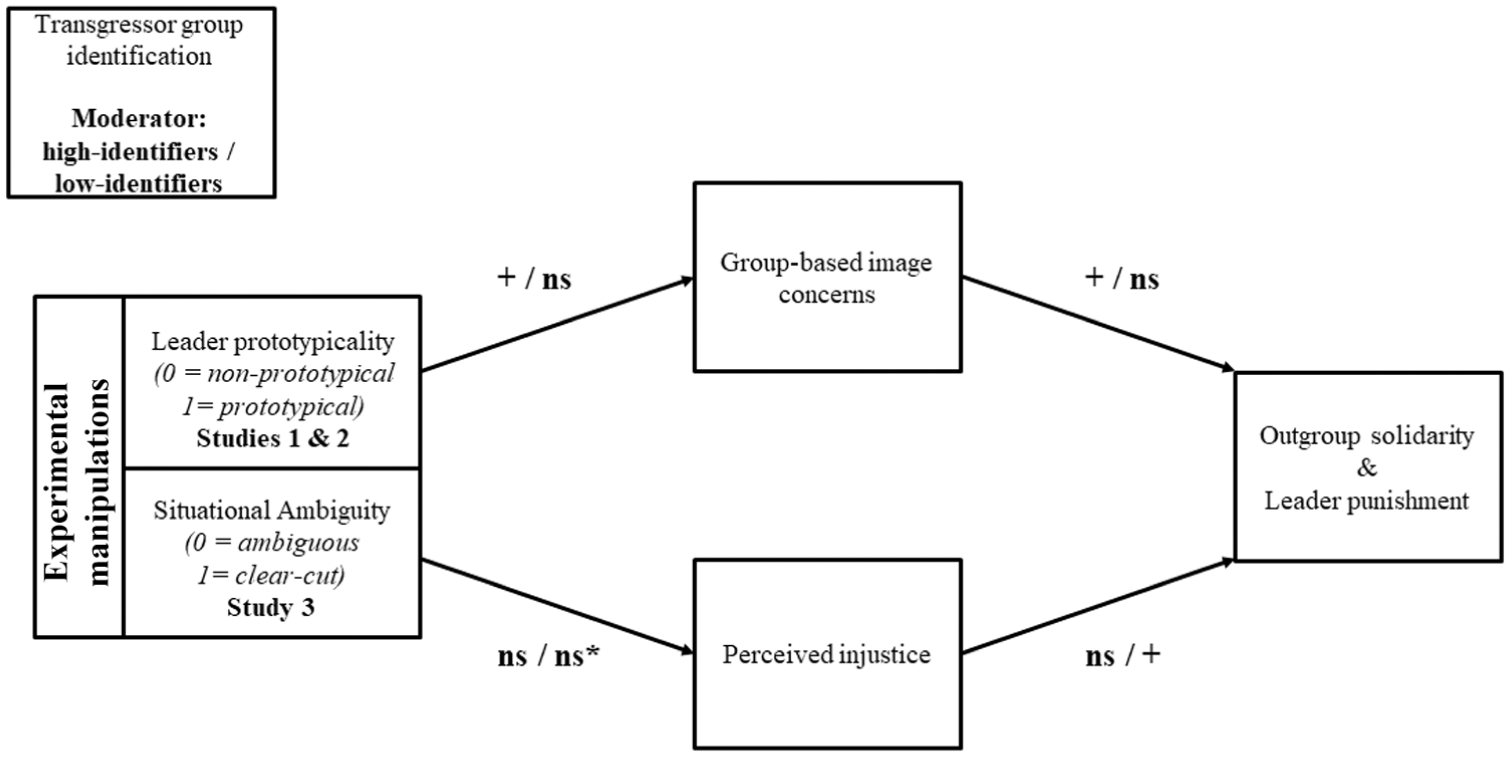
Moderated mediation models examining the effects of transgressive leader prototypicality (Studies 1 and 2) and situational ambiguity of transgressions (Study 3) on outgroup solidarity and leader punishment against transgressive leaders.
Lastly, since no prior research examined distinct types of outgroup solidarity against leader transgressions, we explored solidarity forms in our first two studies. In Study 3, we based our hypotheses on this distinction.
We made all study materials, datasets, and analysis scripts publicly available (https://osf.io/s8az2). The University’s Ethical Committee of Psychology approved all studies. For detailed analysis plans, please refer to the preregistration forms (Study 1: https://aspredicted.org/k6c5-6dbb.pdf; Study 2: https://aspredicted.org/6yys-yqgw.pdf; Study 3: https://aspredicted.org/926x-wjm9.pdf). The Appendix contains the remainder of the exploratory findings. All analyses were performed in R Version 4.2.4 (R Core Team, 2024).
Study 1
In Study 1, the transgressive situation focused on cases of sexual violence against refugee women in EU asylum centers, where the inadequate provision of gender-sensitive settlement arrangements by EU authorities has increased their vulnerability (Cayreyre et al., 2024; UNHCR, 2016). Study 1, therefore, sought to examine whether the prototypicality of an EU leader influences EU citizens’ group-based image concerns and outgroup solidarity intentions following the leader’s transgressive remarks about the case, alongside whether EU citizen identification moderates these influences. Our hypotheses were as follows:
In the prototypical leader condition, group-based image concerns are higher than in the non-prototypical leader condition (H1). 2 This effect is stronger as the level of European citizen identification increases (H2). Group-based image concerns mediate the link between experimental manipulation and solidarity-based collective action intentions (H3). This mediational link is stronger as the level of European citizen identification increases (H4).
Additionally, we explored the justice-based outgroup solidarity path for low-identifiers. Furthermore, Study 1 was our first attempt to examine whether Chang’s (2022) findings on leader punishment extend to leader transgressions against vulnerable outgroups; thus, we only explored whether the hypothesized model predicts leader punishment in this study. Lastly, we investigated whether controlling for political orientation affects the hypothesized model, given that outgroup solidarity has an ideological facet (see Becker, 2020).
Method
Participants and design
Relying on previously reported small-to-medium effect sizes on collective action and solidarity (Al-Amine & Çakmak, 2025; Çakmak, Gordijn, Koc, & Stroebe, 2025; Çakmak et al., 2024; Shuman et al., 2018; Teixeira et al., 2020), we conducted a power analysis using intxpower.com (Sommet et al., 2023) for a fully attenuated interaction in a 2 (prototypical vs. non-prototypical leader) × 2 (high vs. low identification) between-subjects design, with two-tailed testing and a contrast approach (β = .80 and p < .05). The goal was to detect a main effect of d = 0.35 and an interaction effect of d = 0.17. The analysis indicated that a sample size of 342 participants would suffice. Considering potential exclusions, we recruited 351 students with EU citizenship through the University’s SONA system for course credit and through Prolific for £1.20 between April and May in 2024. After applying the preregistered exclusion criteria, two participants were excluded for failing the comprehension check question. The final sample included 349 participants (Nfemale = 197, Nmale = 138, Nnon-binary = 11, Nprefer not to say = 3), with the following age distribution: N16–19 years = 113, N20–22 years = 143, N22–25 years = 53, and N+25 years = 40.
Procedure
The study was advertised as a survey about social issues in the EU. Participants first reported their demographics, including political orientation, followed by EU citizen identification and the leader prototypicality manipulation. The focal leader was the EU Commissioner for Migration and Home Affairs, responsible for overseeing refugee issues. The manipulation was adapted from Chang (2022, Study 1), with leader prototypicality operationalized based on how much the leader advances ingroup values and visions (also see Steffens et al., 2021, p. 41). For EU identity, these values include humanitarianism, respect for human rights and dignity, and endorsement of European integration and unity, according to the EU’s official webpage (European Union [EU], n.d.). In both conditions, participants were initially presented with the leader’s responsibilities, derived from the official webpage on this leadership role (European Commission, n.d.). This information ended with two different sentences, based on a random experimental assignment. In the (non-)prototypical leader condition (nprototypical = 173; nnon-prototypical = 176), the leader was portrayed as oftentimes (rarely) emphasizing humanitarianism in their public speeches, pledging to advance (not prioritizing) European values on human rights and dignity, and being committed to (skeptical about) EU integration and unity. After manipulation, participants rated the leader prototypicality (manipulation check). Subsequently, all participants were presented with a story about sexual violence against refugee women in EU asylum centers, purportedly presented as a newspaper article. The incidents of sexual violence were depicted as evident based on official reports from international non-profit organizations, emphasizing EU’s inadequate provisions as a primary cause. The story concluded with the leader’s transgressive remarks, dismissing the reported incidents and refusing to improve the refugee women’s conditions, claiming they are accustomed to such conditions in their home countries (see the OSF repository for details). Ultimately, participants completed measures of group-based image concerns and outgroup solidarity intentions, followed by a debriefing. For exploratory purposes, we measured perceived injustice, support for leader punishment, and group-based emotions.
Measures
Unless otherwise noted, all scales range from 1 (strongly disagree) to 7 (strongly agree). Higher values represent high levels of the respective variables.
EU citizen identification
Six modified items from social identification scale by Koc (2018) assessed EU citizen identification (e.g., “I am glad to be an EU citizen”; α = .80).
Group-based image concerns
Beginning with “The EU Commissioner’s comments. . .”, three modified items from the social-image scale (Teixeira et al., 2020) assessed how participants perceived their leader’s remarks as damaging to their ingroup’s image (e.g., “will make European citizens seem bad to the rest of the world”; α = .92).
Perceived injustice
Beginning with “The EU Commissioner’s comments. . .”, three modified items from Tausch et al. (2011) assessed how unfair participants perceived their leaders’ remarks to be towards refugee women (e.g., “illustrate the ongoing unfair treatment against refugee women in Europe”; α = .93).
Outgroup solidarity
Six items modified from Çakmak, Gordijn, Koc, and Stroebe (2025), beginning with “We, as EU citizens, need to. . .”, measured solidarity intentions, capturing non-radical and radical forms with three items for each (e.g., non-radical intentions: “show solidarity with refugee women in Europe to improve their conditions in peaceful ways” [α = .90]; radical intentions: “support radical actions to show solidarity with refugee women in Europe” [α = .87]).
Support for leader punishment
Five modified items from Marques et al. (2021) assessed participants’ support for leader punishment (e.g., “Authorities should initiate a disciplinary procedure for the EU Commissioner”; α = .91).
Political orientation
Participants indicated their political orientation on a scale from 1 (very left-wing) to 7 (very right-wing).
Results and Discussion
Hypothesis testing
To test the first two hypotheses regarding the effects of the condition and its interaction with EU citizen identification on group-based image concerns, we ran a moderation model employing the PROCESS macro (Model 1; Hayes, 2017) with 5,000 bootstrapped samples to estimate standard errors and confidence intervals. The model included the experimental manipulation as the dummy-coded predictor, EU citizen identification as the moderator (mean-centered: M – 1 SD = low-identifiers, M + 1 SD = high-identifiers), political orientation as the control, 3 and group-based image concerns as the outcome. In all the models throughout the paper, findings on political orientation were reported in the Appendix.
Failing to support H1, the model yielded no significant effect of the condition (b = 0.27, SE = 0.15, 95% CI [−0.10, 0.56]), meaning that when an EU leader made transgressive remarks against low-status vulnerable groups, leader prototypicality had no unique effect on group-based image concerns. However, supporting H2, the interaction between the manipulation and identification was significant (b = 0.39, SE = 0.16, 95% CI [0.07, 0.71]). The simple slopes analysis (see Figure 2) demonstrated that witnessing a prototypical (vs. non-prototypical) leader’s transgressive remarks heightened EU citizens’ concerns about Europeans’ image more when identification as EU citizens was high (b = 0.62, SE = 0.20, 95% CI [0.22, 1.02]) than when it was low (b = −0.08, SE = 0.20, 95% CI [−0.48, 0.33]). These findings suggest that the transgressive ingroup leader prototypicality is especially crucial for high-identifiers’ concerns about their group’s external image. Furthermore, there was a significant main effect of identification (b = 0.21, SE = 0.08, 95% CI [0.05, 0.37]).
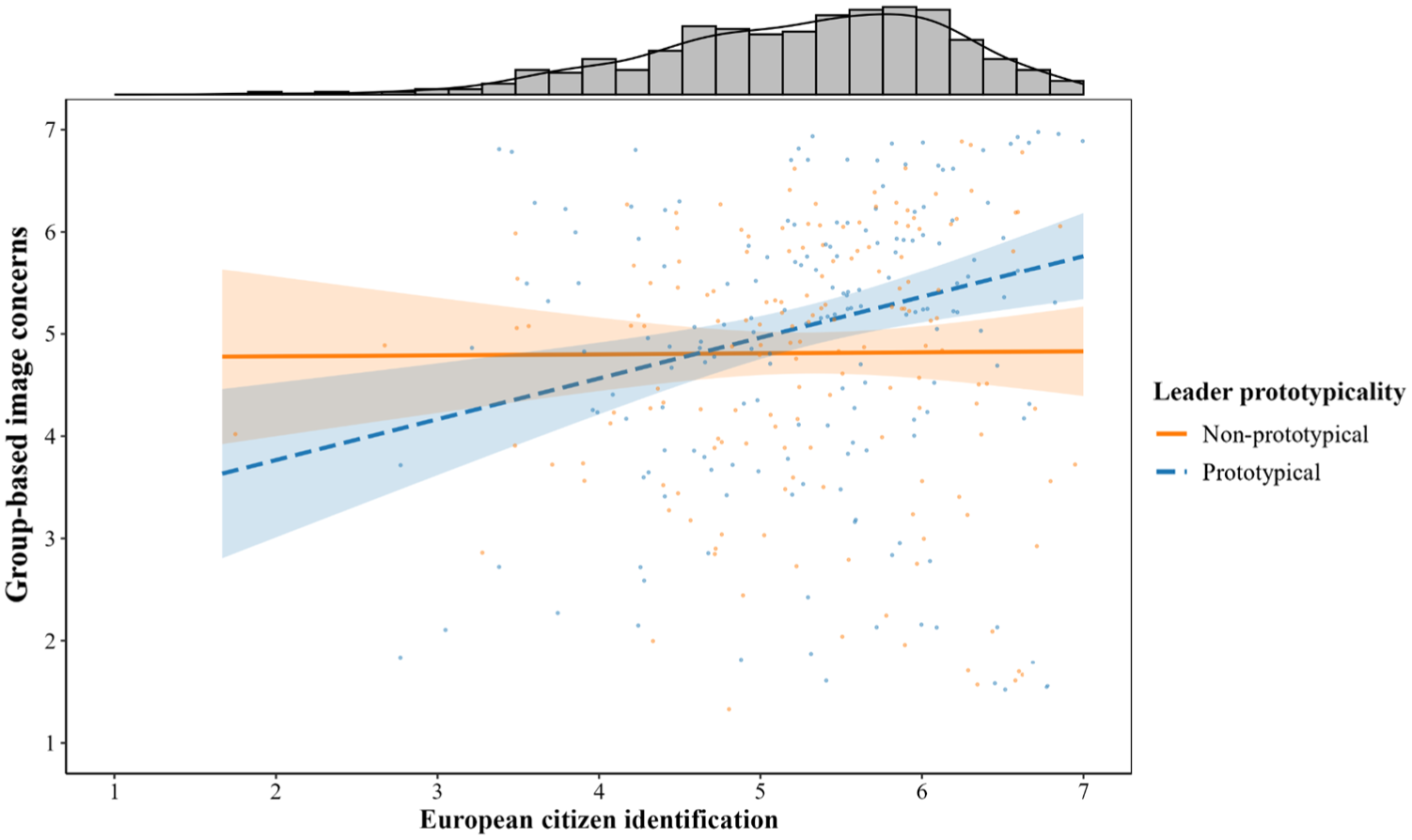
Group-based image concerns as a function of leader prototypicality and identification (Study 1).
We then tested our third and fourth hypotheses, which examined the mediating role of group-based image concerns in the relationship between the experimental manipulation and outgroup solidarity, as well as whether identification moderates this mediational link. Additionally, we explored the role of perceived injustice as a parallel mediating mechanism that may explain low-identifiers’ outgroup solidarity. To do so, we ran moderated mediation models employing the PROCESS macro (Model 58; Hayes, 2017), with the experimental manipulation as the predictor, identification as the moderator, group-based image concerns and perceived injustice as the parallel mediators, political orientation as the control, and either non-radical or radical action intentions as the outcomes. 4 Simple slopes analyses for these models are presented in Figure 3.
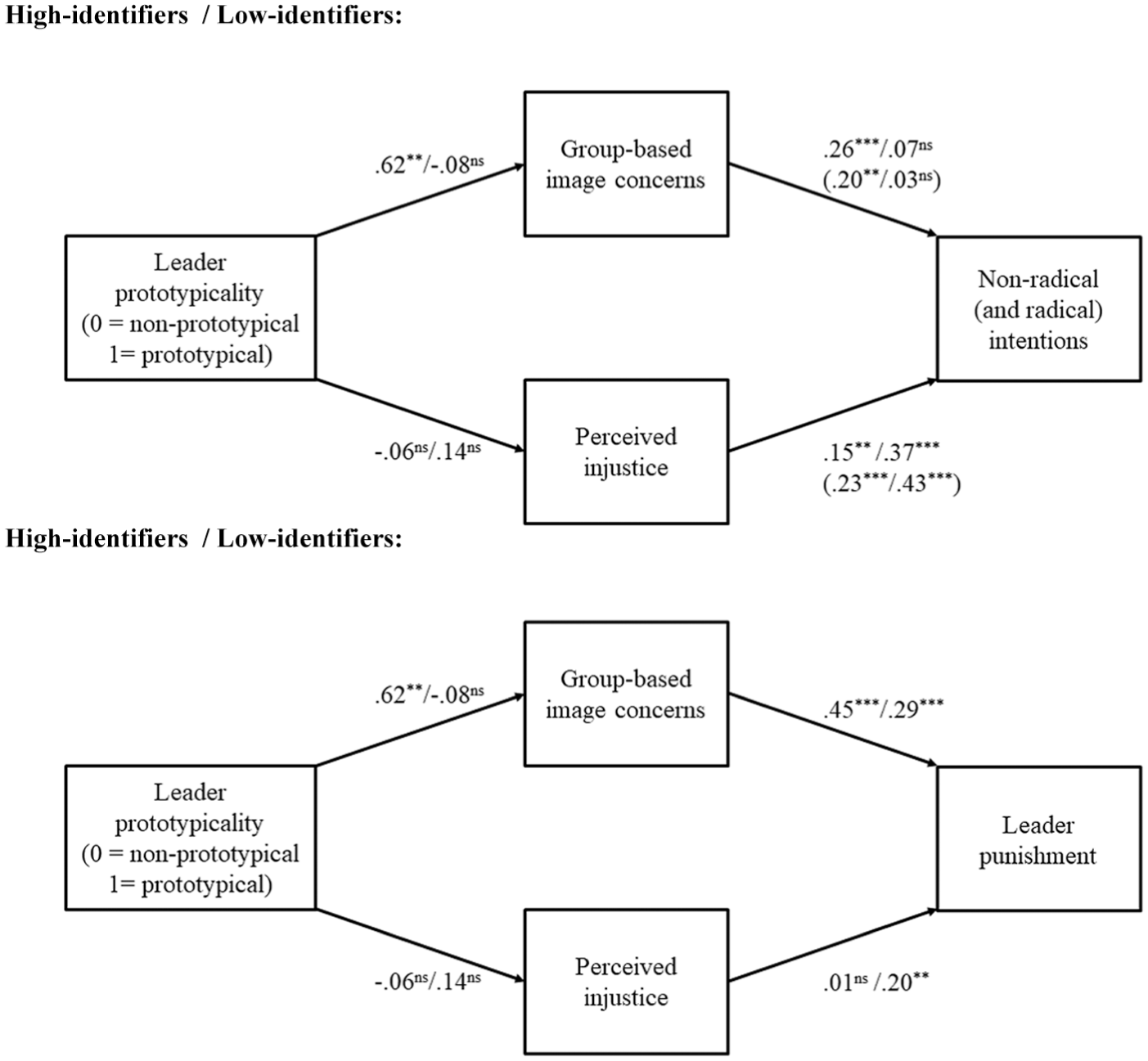
Moderated parallel mediation models with outgroup solidarity and leader punishment as the outcomes (Study 1).
Supporting H3, the relationship between group-based image concerns and non-radical intentions was significant (b = 0.16, SE = 0.04, 95% CI [0.08, 0.25]), and this link was moderated by identification (the interaction between group-based image concerns and identification: b = 0.10, SE = 0.04, 95% CI [0.02, 0.19]). Supporting H4, the conditional indirect effect via group-based image concerns was significant among high-identifiers (b = 0.16, SE = 0.07, 95% CI [0.05, 0.31]), but not among low-identifiers b = −0.01, SE = 0.02, 95% CI [−0.05, 0.03]. Moreover, the relationship between perceived injustice and non-radical solidarity was significant (b = 0.26, SE = 0.05, 95% CI [0.17, 0.35]), and this link was moderated by identification (the interaction between identification and perceived injustice: b = −0.12, SE = 0.04, 95% CI [−0.21, −0.04]). But the conditional indirect effects were non-significant among both high-identifiers (b = −0.01, SE = 0.04, 95% CI [−0.09, 0.06]) and low-identifiers (b = 0.17, SE = 0.07, 95% CI [−0.03, 0.32]). There were also no main effects of the condition (b = −0.06, SE = 0.11, 95% CI [−0.28, 0.16]) and identification (b = 0.16, SE = 0.06, 95% CI [−0.03, 0.29]) on non-radical intentions.
Descriptive statistics across conditions and intercorrelations among main variables (Study 1).
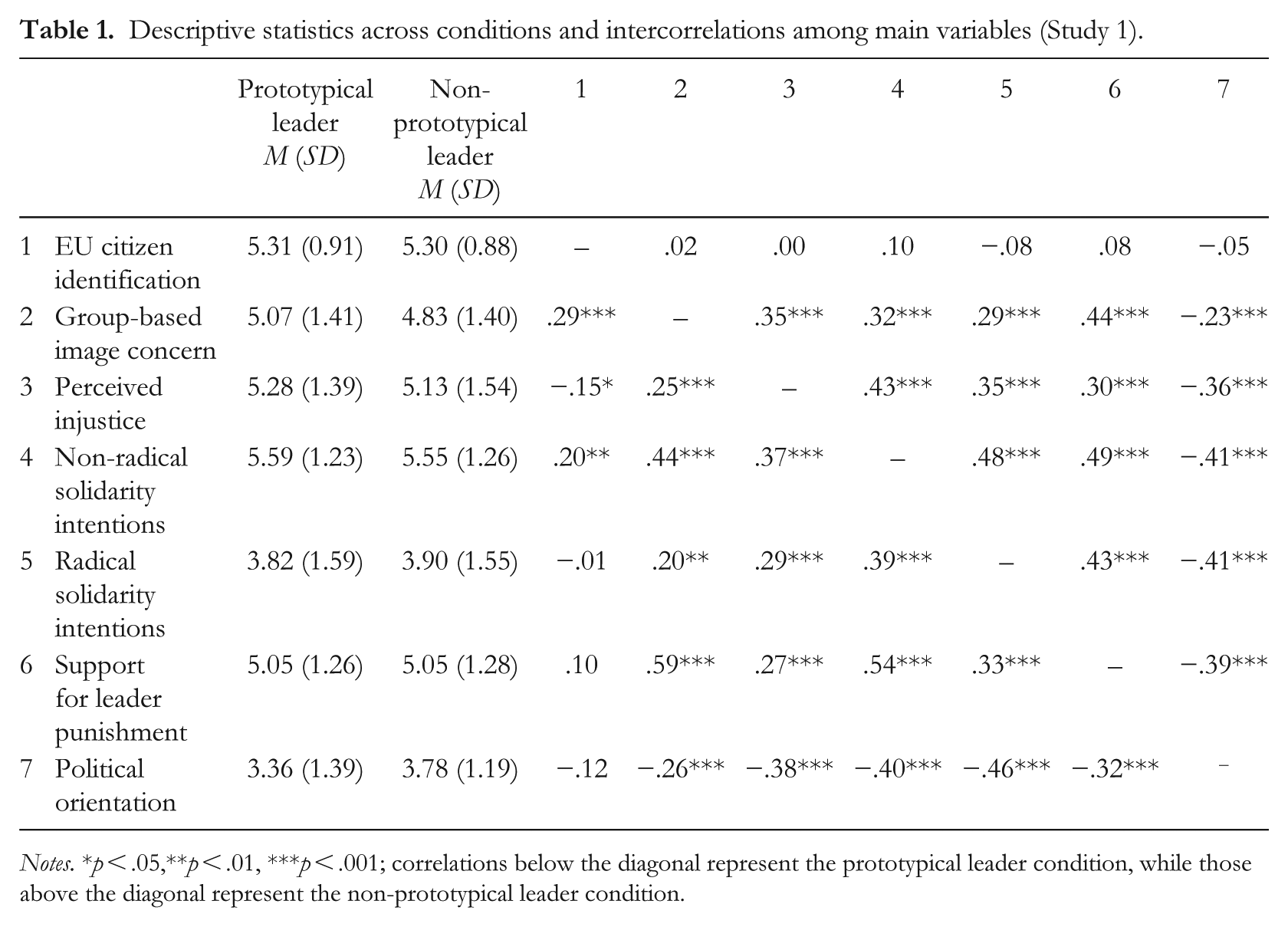
Notes. *p < .05,**p < .01, ***p < .001; correlations below the diagonal represent the prototypical leader condition, while those above the diagonal represent the non-prototypical leader condition.
Supporting H3, the relationship between group-based image concerns and radical intentions was significant (b = 0.11, SE = 0.06, 95% CI [0.11, 0.22]), and this link was moderated by identification (the interaction between group-based image concerns and identification: b = 0.10, SE = 0.05, 95% CI [0.10, 0.21]). Supporting H4, the conditional indirect effect via group-based image concerns was significant among high-identifiers (b = 0.12, SE = 0.07, 95% CI [0.02, 0.27]), but not among low-identifiers (b = 0.00, SE = 0.02, 95% CI [−0.05, 0.03]). Moreover, the relationship between perceived injustice and radical solidarity was significant (b = 0.19, SE = 0.06, 95% CI [0.07, 0.31]), and this link was moderated by identification (the interaction between identification and perceived injustice: b = −0.08, SE = 0.03, 95% CI [−0.21, −0.01]). But the conditional indirect effects were non-significant among both high-identifiers (b = −0.01, SE = 0.03, 95% CI [−0.07, 0.06]) and low-identifiers (b = 0.12, SE = 0.07, 95% CI [−0.01, 0.27]). There were also no main effects of the condition (b = −0.12, SE = 0.15, 95% CI [−0.41, 0.18]) and identification (b = −0.14, SE = 0.09, 95% CI [−0.31, 0.04]) on radical intentions.
Exploratory analyses
As preregistered, we explored the justice-based pathway for low-identifiers’ outgroup solidarity. We ran a similar moderation model to the group-based image concerns model, with the manipulation as the predictor, identification as the moderator, political orientation as the control, and perceived injustice as the outcome. The model yielded a significant main effect of identification (b = −0.18, SE = 0.08, 95% CI [−0.34, −0.02]), but no significant effect of the condition (b = 0.20, SE = 0.16, 95% CI [−0.09, 0.49]) or its interaction with identification (b = −0.28, SE = 0.16, 95% CI [−0.60, 0.04]). This means that when an EU leader made transgressive remarks against vulnerable outgroups, participants perceived the situation as more unjust as they identify less as EU citizens, regardless of their leader’s prototypicality. Note that the link between identification and perceived injustice was not significant without controlling for political orientation (see the Appendix).
Lastly, we explored whether our model predicts leader punishment, as preregistered. The relationship between group-based image concerns and leader punishment was significant (b = 0.37, SE = 0.04, 95% CI [0.28, 0.45]), and this link was moderated by identification (the interaction between group-based image concerns and identification: b = 0.09, SE = 0.04, 95% CI [0.01, 0.17]). The conditional indirect effect via group-based image concerns was significant among high-identifiers (b = 0.28, SE = 0.10, 95% CI [0.09, 0.46]), but not among low-identifiers (b = −0.02, SE = 0.06, 95% CI [−0.14, 0.11]). Moreover, the relationship between perceived injustice and leader punishment was significant (b = 0.11, SE = 0.05, 95% CI [0.02, 0.20]), and this link was was moderated by identification (the interaction between identification and perceived injustice: b = −0.10, SE = 0.04, 95% CI [−0.19, −0.02]). But the conditional indirect effects were non-significant among both high-identifiers (b = 0.00, SE = 0.02, 95% CI [−0.04, 0.03]) and low-identifiers (b = 0.09, SE = 0.04, 95% CI [−0.01, 0.20]). There were also no main effects of the condition (b = −0.12, SE = 0.11, 95% CI [−0.35, 0.10]) and identification (b = 0.03, SE = 0.07, 95% CI [−0.10, 0.15]) on leader punishment.
Overall, Study 1 supported some key hypotheses, showing that the effects of transgressive leader prototypicality on leader punishment may extend to outgroup solidarity indirectly via group-based image concerns, particularly among high-identifiers. Exploratory analyses showed that justice-based solidarity for low-identifiers was observed but only when controlling for political orientation. This could be due to the supranational nature of EU citizenship, the meaning of which differs between political camps. For right-wingers, low identification might reflect euroscepticism (van Elsas & van der Brug, 2015), potentially distorting results. Furthermore, the prototypicality manipulation was operationalized as being an ideal ingroup member for the leadership, following previous research (Chang, 2022). Whether operationalizing leader prototypicality as possessing the average characteristics of the ingroup (Steffens et al., 2021) would produce similar results in reacting to transgressive leaders remains unexplored. Study 2 was thus designed to address these limitations in a different context.
Study 2
In Study 2, the transgressive situation focused on suicide cases among refugees at the Nauru Regional Processing Center. The center was established under the Australian government’s detention policy for maritime refugee arrivals, with the promise that Australia would ensure the welfare of refugees. However, inadequate provisions led to inhumane conditions and reported suicides (Human Rights Watch, 2023). Study 2, therefore, sought to examine whether the prototypicality of an Australian leader influences Australian citizens’ group-based image concerns, outgroup solidarity intentions, and support for leader punishment following the leader’s transgressive remarks about the case, as well as whether Australian national identification moderates these influences. Our hypotheses were as follows:
In the prototypical leader condition, group-based image concerns will be higher than in the non-prototypical leader condition, as the level of Australian national identification increases (H1). Group-based image concerns will mediate the link between experimental manipulation, solidarity-based collective action intentions and support for leader punishment, as the level of Australian national identification increases (H2).
Since the findings from Study 1 regarding the justice-based path for low-identifiers’ outgroup solidarity were unclear due to the confounding role of political orientation, we decided to explore the mediational role of perceived injustice. This time, we explicitly stated in our preregistration that if political orientation correlates at least moderately with other main variables (r > .30), we report the hypothesized models with political orientation included as a covariate.
Method
Participants and design
Based on the same power analysis in Study 1, we recruited 352 Australian nationals through Prolific for £1.20 in July 2024. After applying the preregistered exclusion criteria, five participants were excluded (nsurvey completion < 2 minutes = 3, ncomprehension check = 2). The final sample included 347 participants (nfemale = 162, nmale = 176, nnon-binary = 8, nprefer not to say = 1; Mage = 35.68, SDage = 12.33).
Procedure
The procedure was almost identical to Study 1, with contextual adjustments and a different operationalization of the manipulation. The focal leader was the Australian Commissioner to Nauru, responsible for overseeing refugee issues in Nauru. Prototypicality was operationalized based on whether the leader embodied the average characteristics of Australian citizens. After presenting the leader’s responsibilities in both conditions, the manipulation was introduced. In the (non-)prototypical leader condition (nprototypical = 173; nnon-prototypicality = 174), the leader was portrayed as having been educated in (outside) Australia, spending most of their life and career in (outside) Australia, and enjoying (not being a big fan of) Australian traditions and cuisine. After manipulation, participants rated the leader’s prototypicality. Subsequently, all participants were presented with a case story depicted as evident, with the conclusion of the same transgressive remarks (see the OSF repository for the details). The remainder of the study followed similar measures and a debriefing.
Measures
Measures were contextually adjusted and showed good reliability (Australian national identification: α = .88, group-based image concerns: α = .95, perceived injustice: α = .95, non-radical intentions: α = .93, radical intentions: α = .89, leader punishment: α = .91).
Results and Discussion
Hypothesis testing
To test the first hypothesis regarding the interaction between the experimental manipulation and Australian national identification on group-based image concerns, we ran a similar moderation model in Study 1 (Model 1; Hayes, 2017). Supporting H1, the model yielded a significant interaction between the manipulation and identification (b = 0.30, SE = 0.14, 95% CI [0.03, 0.57]). The simple slopes analysis (see Figure 4) demonstrated that witnessing a prototypical (vs. non-prototypical) leader’s transgressive remarks heightened Australian nationals’ concerns about Australians’ image more when identification as Australian nationals was high (b = 0.70, SE = 0.21, 95% CI [0.29, 1.12]) than when it was low (b = 0.05, SE = 0.21, 95% CI [−0.36, 0.47]). Replicating Study 1, these findings suggest that the transgressive ingroup leader prototypicality is especially crucial for high-identifiers’ concerns about their group’s external image. Furthermore, there were no significant effects of the manipulation (b = 0.18, SE = 0.15, 95% CI [−0.09, 0.67]) or identification (b = 0.09, SE = 0.07, 95% CI [−0.05, 0.23]).
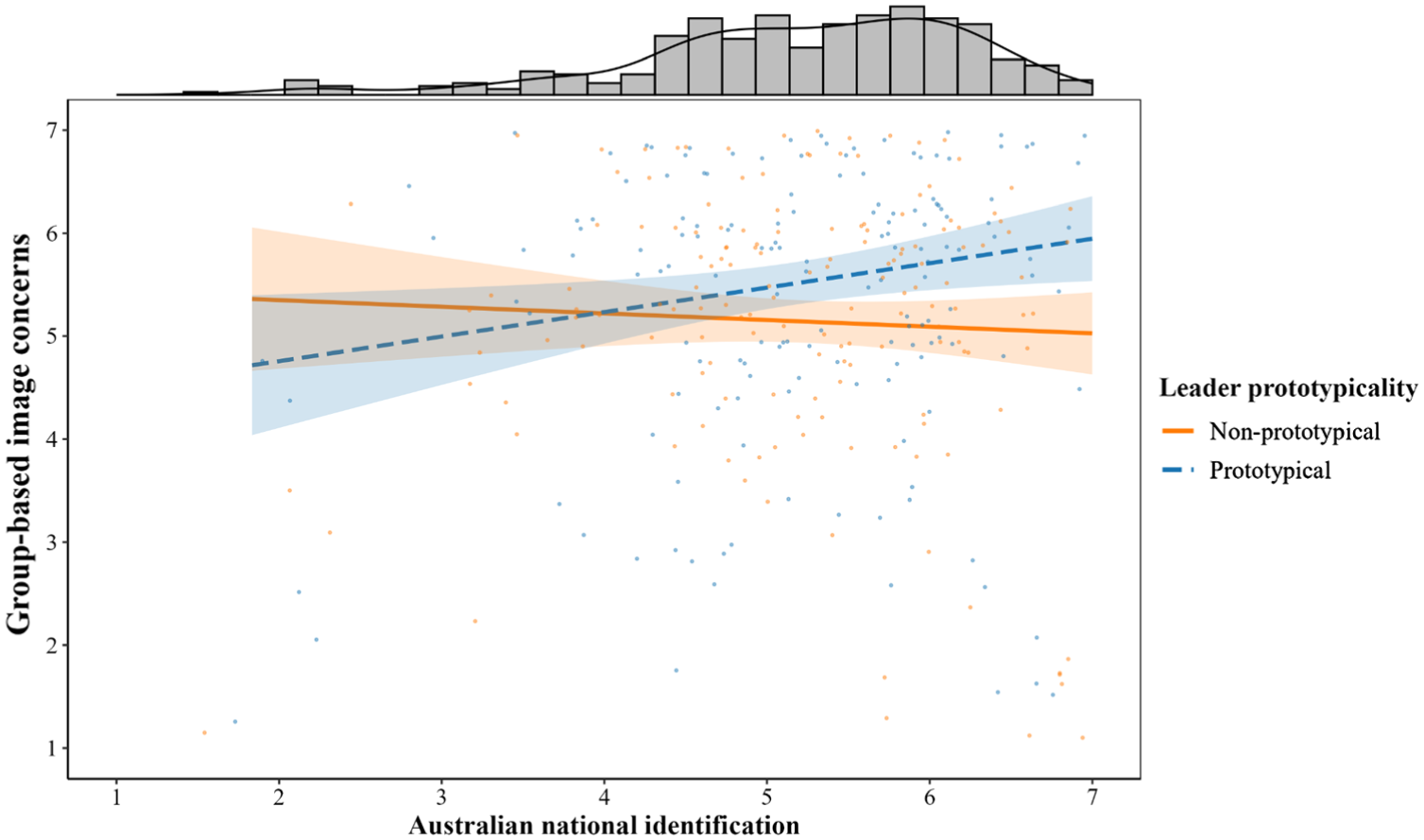
Group-based image concerns as a function of leader prototypicality and identification (Study 2).
We then tested our second hypothesis examining whether group-based image concerns mediates the relationship between the experimental manipulation and outgroup solidarity and leader punishment, as Australian national identification increases. Additionally, we explored the role of perceived injustice as a parallel mediating mechanism that may explain low-identifiers’ outgroup solidarity. We thus ran similar moderated mediation models as in Study 1 (Model 58, Hayes, 2017). Simple slopes analyses for these models are presented in Figure 5.
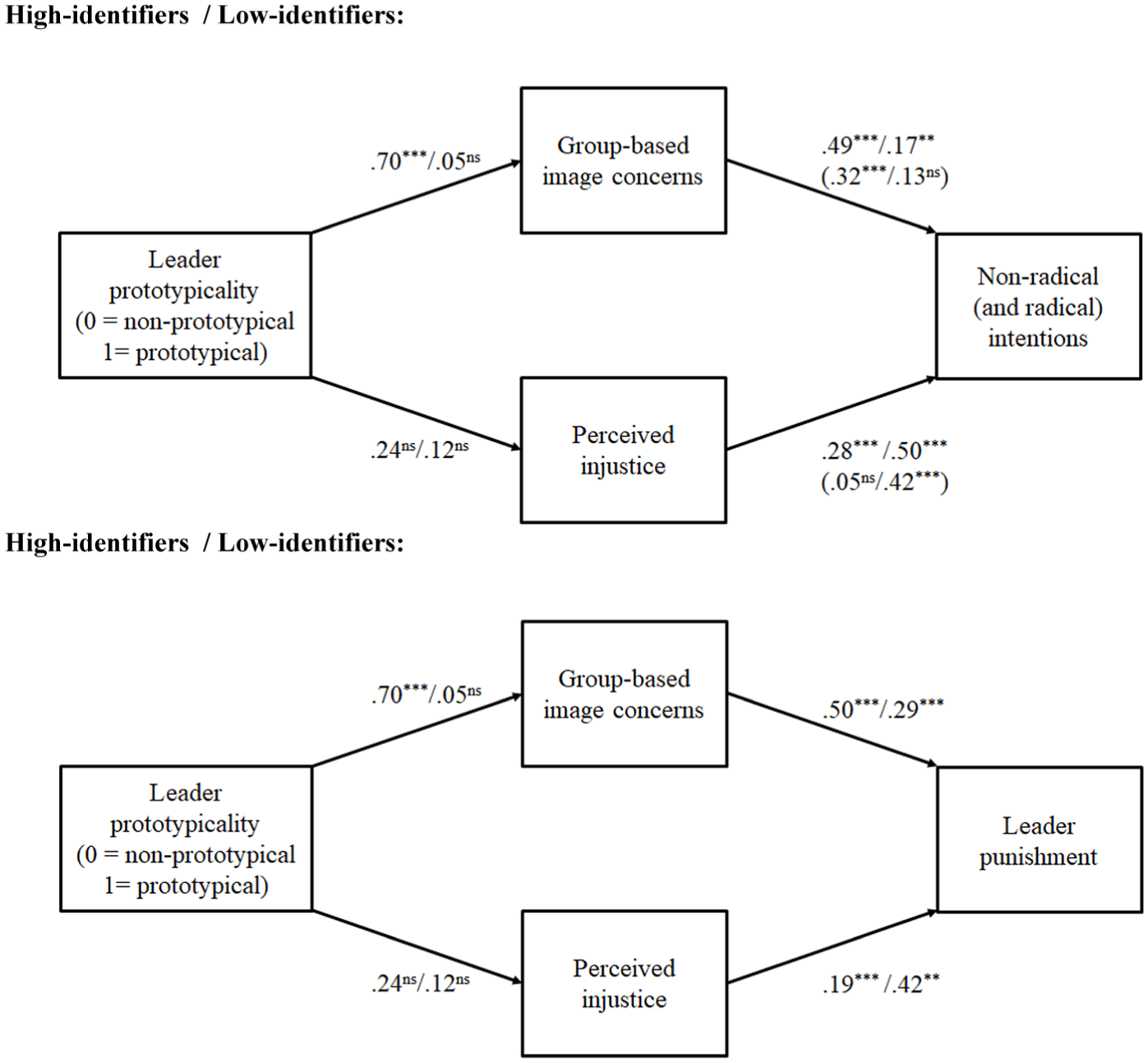
Moderated parallel mediation models with outgroup solidarity and leader punishment as the outcomes (Study 2).
The relationship between group-based image concerns and non-radical intentions was significant (b = 0.33, SE = 0.04, 95% CI [0.24, 0.41]), and this link was moderated by identification (the interaction between group-based image concerns and identification: b = 0.15, SE = 0.03, 95% CI [0.09, 0.20]). Supporting H2, the conditional indirect effect via group-based image concerns was significant among high-identifiers (b = 0.34, SE = 0.13, 95% CI [0.10, 0.62]), but not among low-identifiers (b = 0.01, SE = 0.04, 95% CI [−0.08, 0.10]). Moreover, the relationship between perceived injustice and non-radical solidarity was significant (b = 0.39, SE = 0.05, 95% CI [0.30, 0.48]), and this link was moderated by identification (the interaction between identification and perceived injustice: b = −0.10, SE = 0.04, 95% CI [−0.17, −0.03]). But the conditional indirect effects were non-significant among both high-identifiers (b = 0.04, SE = 0.08, 95% CI [−0.08, 0.22]) and low-identifiers (b = 0.03, SE = 0.09, 95% CI [−0.16, 0.19]). There were also no main effects of the condition (b = 0.09, SE = 0.11, 95% CI [−0.12, 0.30]) and identification (b = 0.09, SE = 0.05, 95% CI [−0.02, 0.19]) on non-radical intentions.
Descriptive statistics across conditions and intercorrelations among main variables (Study 2).
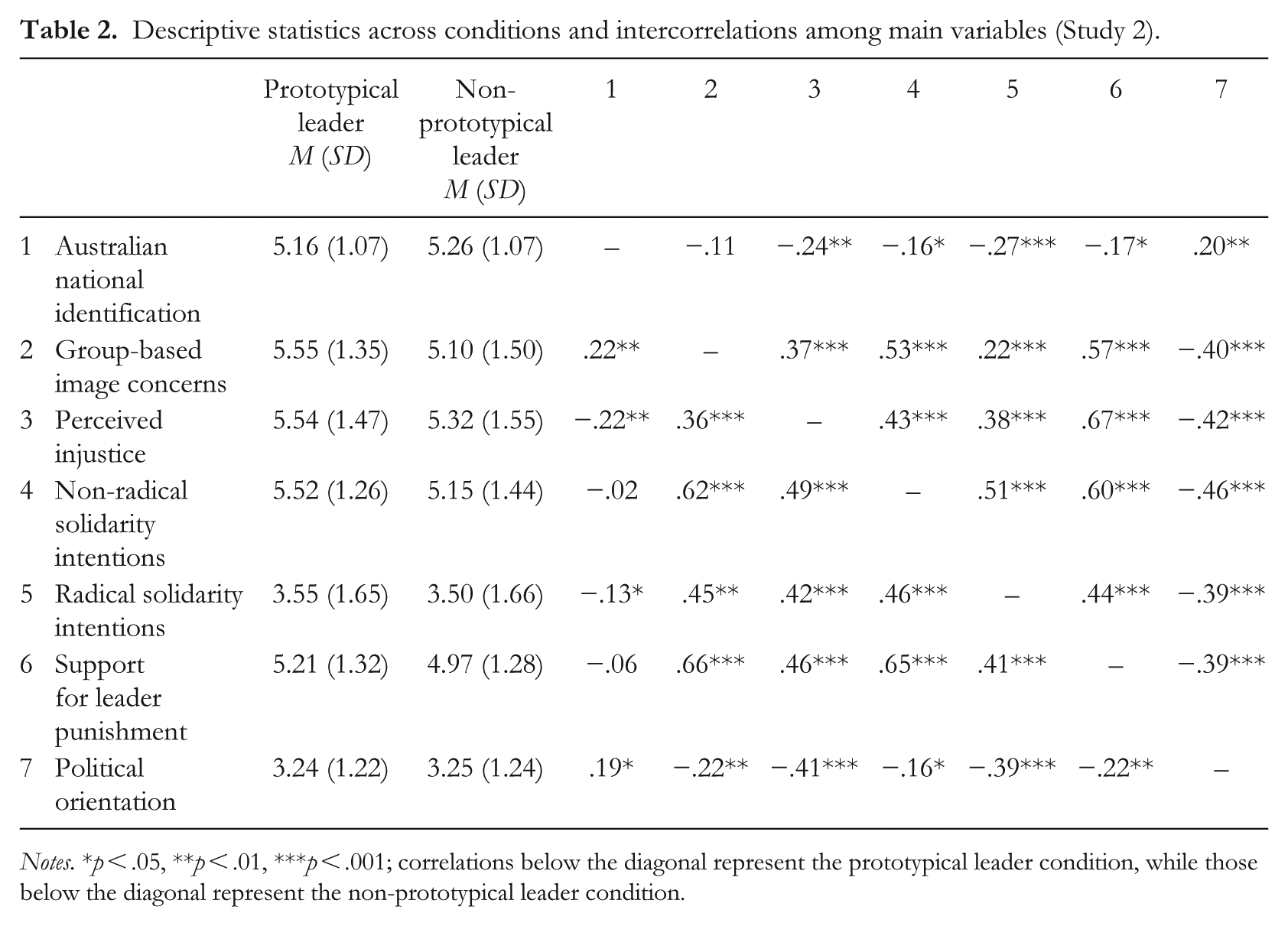
Notes. *p < .05, **p < .01, ***p < .001; correlations below the diagonal represent the prototypical leader condition, while those below the diagonal represent the non-prototypical leader condition.
The relationship between group-based image concerns and radical intentions was significant (b = 0.23, SE = 0.06, 95% CI [0.10, 0.35]), and this link was moderated by identification (the interaction between group-based image concerns and identification: b = 0.09, SE = 0.04, 95% CI [0.01, 0.17]). Supporting H2, the conditional indirect effect via group-based image concerns was significant among high-identifiers (b = 0.22, SE = 0.09, 95% CI [0.07, 0.42]), but not among low-identifiers (b = 0.01, SE = 0.04, 95% CI [−0.07, 0.09]). Moreover, the relationship between perceived injustice and radical solidarity was significant (b = 0.23, SE = 0.07, 95% CI [0.10, 0.37]), and this link was moderated by identification (the interaction between identification and perceived injustice: b = −0.17, SE = 0.06, 95% CI [−0.28, −0.07]). But the conditional indirect effects were non-significant among both high-identifiers (b = 0.01, SE = 0.03, 95% CI [−0.05, 0.06]) and low-identifiers (b = 0.02, SE = 0.07, 95% CI [−0.14, 0.16]). There was also no main effect of the condition (b = −0.22, SE = 0.15, 95% CI [−0.53, 0.08]), but identification (b = −0.30, SE = 0.08, 95% CI [−0.45, −0.15]) had a significant effect on radical intentions.
The relationship between group-based image concerns and leader punishment was significant (b = 0.40, SE = 0.04, 95% CI [0.31, 0.48]), and this link was moderated by identification (the interaction between group-based image concerns and identification: b = 0.10, SE = 0.03, 95% CI [0.05, 0.15]). Supporting H2, the conditional indirect effect via group-based image concerns was significant among high-identifiers (b = 0.35, SE = 0.13, 95% CI [0.12, 0.62]), but not among low-identifiers (b = 0.02, SEl = 0.08, 95% CI [−0.14, 0.16]). Moreover, the relationship between perceived injustice and leader punishment was significant (b = 0.30, SE = 0.05, 95% CI [0.21, 0.39]), and this link was moderated by identification (the interaction between identification and perceived injustice: b = −0.11, SE = 0.04, 95% CI [−0.18, −0.03]). But the conditional indirect effects were non-significant among both high-identifiers (b = 0.03, SE = 0.05, 95% CI [−0.06, 0.15]) and low-identifiers (b = 0.02, SE = 0.07, 95% CI [−0.13, 0.16]). There were also no main effects of the condition (b = −0.04, SE = 0.10, 95% CI [−0.25, 0.16]) and identification (b = 0.00, SE = 0.05, 95% CI [−0.10, 0.11]) on leader punishment.
Exploratory analyses
Similar to Study 1, we also explored the justice-based pathway for low-identifiers by running a moderation model with perceived injustice as the outcome. This model indicated a significant main effect of identification (b = −0.22, SE = 0.07, 95% CI [−0.36, −0.08]), but no significant effect of the condition (b = 0.10, SE = 0.15, 95% CI [−0.19, 0.39]) or its interaction with identification (b = −0.04, SE = 0.14, 95% CI [−0.23, 0.31]). These findings suggest that when an Australian leader made transgressive remarks against vulnerable outgroups, participants perceived the situation as more unjust as they identify less as Australian nationals, regardless of their leader’s prototypicality. This time, this link was significant independently of political orientation.
Overall, Study 2 supported our hypotheses, showing that transgressive leader prototypicality heightened high-identifiers’ group-based image concerns, driving leader punishment and outgroup solidarity. As in Study 1, solidarity emerged in both non-radical and radical forms, indicating that high-identifiers perceived prototypical leader transgressions as severe image threats to the ingroup’s subjective positive validity, warranting even radical means to address. Exploratory analyses found that low-identifiers, regardless of leader prototypicality, were motivated by perceived injustice. This justice-based pathway was clearer in Study 2, independent of political orientation, and predicted both solidarity forms, consistent with previous research (Çakmak, Gordijn, Koc, & Stroebe, 2025). But are there no boundary conditions to these effects? To test this, we designed a third study manipulating the situational ambiguity of transgressions.
Study 3
In Study 3, the transgressive situation focused on mental health issues among UK ethnic minorities following the 2024 riots. The riots began as anti-immigrant attacks in Southport and quickly spread across the country, causing injuries and property damage (Reuters, 2024). While some organizations highlighted the mental health impact on minorities (e.g., National Centre for Diversity, n.d.), the government prioritized policing and prosecution over broader concerns (Human Rights Watch, 2025). This context allowed for manipulating situational ambiguity in the leader’s transgressive remarks. Situational ambiguity was operationalized as to whether there was tentative (i.e., ambiguous) or definitive (i.e., clear-cut) evidence regarding the recognition of the leader’s act as transgressive. Also, prior research links ambiguity to compensatory intentions (Doosje et al., 1998), leading us to hypothesize direct effects on outgroup solidarity and leader punishment.
In the clear-cut transgression condition, group-based image concerns are higher than in the ambiguous transgression condition, as the level of British national identification increases (H1). In the clear-cut transgressional situation, group-based image concerns, solidarity intentions, and support for leader punishment will be higher than in the ambiguous one (H2). Group-based image concerns mediate the links between experimental manipulation, (non-radical and radical) solidarity intentions and support for leader punishment, as the level of British national identification increases (H3). Identification is negatively associated with perceived injustice while perceived injustice will be positively associated with solidarity intentions and support for leader punishment (H4).
As per our preregistration, we report the hypothesized models with political orientation included as a covariate if it correlates at least moderately with other main variables (r > .30).
Method
Participants and design
Based on a power analysis for similar design in the first two studies (i.e., 2 [clear-cut vs. ambiguous transgression situation] × 2 [high vs. low identification]), we recruited 351 ethnically White British nationals through Prolific for £1.20 in October 2024. After applying the preregistered exclusion criteria, eight participants were excluded for failing the comprehension check. The final sample included 343 participants (nfemale = 170, nmale = 172, nnon-binary = 1; Mage = 49.92, SDage = 13.92).
Procedure
The study was advertised similarly to Studies 1 and 2, with some differences and a different manipulation. The focal leader was the UK’s Secretary of State for Health and Social Care, responsible for overseeing mental health issues in the UK. This time, we kept the leader prototypicality condition constant, presenting the leader as prototypical as in Study 2. Participants then rated the leader’s prototypicality, followed by the ambiguity manipulation. Specifically, two conditions included ostensible newspaper articles describing the increasing mental health issues among ethnic minorities in UK following the 2024 riots, concluding with transgressive remarks by the leader as in Studies 1 and 2. However, in the clear-cut (vs. ambiguous) situation (nclear-cut = 172; nambiguous = 171), the mental health issues were presented as (un)verified through (un)official research by international human rights organizations (some activists) (see the OSF repository for details). Participants then rated the trustworthiness of the information (the manipulation check). The remainder of the study followed similar measures and a debriefing.
Measures
Measures were contextually adjusted and showed good reliability (British national identification: α = .90, group-based image concerns: α = .94, perceived injustice: α = .95, non-radical intentions: α = .96, radical intentions: α = .91, leader punishment: α = .92).
Results and Discussion
Hypothesis testing
To test the first two hypotheses regarding the interactive effects of the condition and British national identification on group-based image concerns and the main effects of the condition outgroup solidarity and leader punishment, we ran similar moderation models (Model 1; Hayes, 2017) as in Studies 1 and 2. Supporting H1, the group-based image concerns model yielded a significant interaction between the manipulation and identification (b = 0.29, SE = 0.12, 95% CI [0.05, 0.53]). The simple slopes analysis (see Figure 6) demonstrated that participants in the clear-cut (vs. ambiguous) transgression situation perceived their leader’s remarks as more concerning to their group’s image when identification as British nationals was high (b = 0.69, SE = 0.22, 95% CI [0.26, 1.13]) than when it was low (b = −0.05, SE = 0.22, 95% CI [−0.49, 0.39]). These findings suggest that prototypical leader transgressions are more concerning to the group’s image in clear-cut situations, particularly among high-identifiers. Furthermore, the manipulation (b = 0.32, SE = 0.16, 95% CI [0.02, 0.63]) and identification (b = 0.29, SE = 0.12, 95% CI [0.05, 0.53]) had significant main effects.
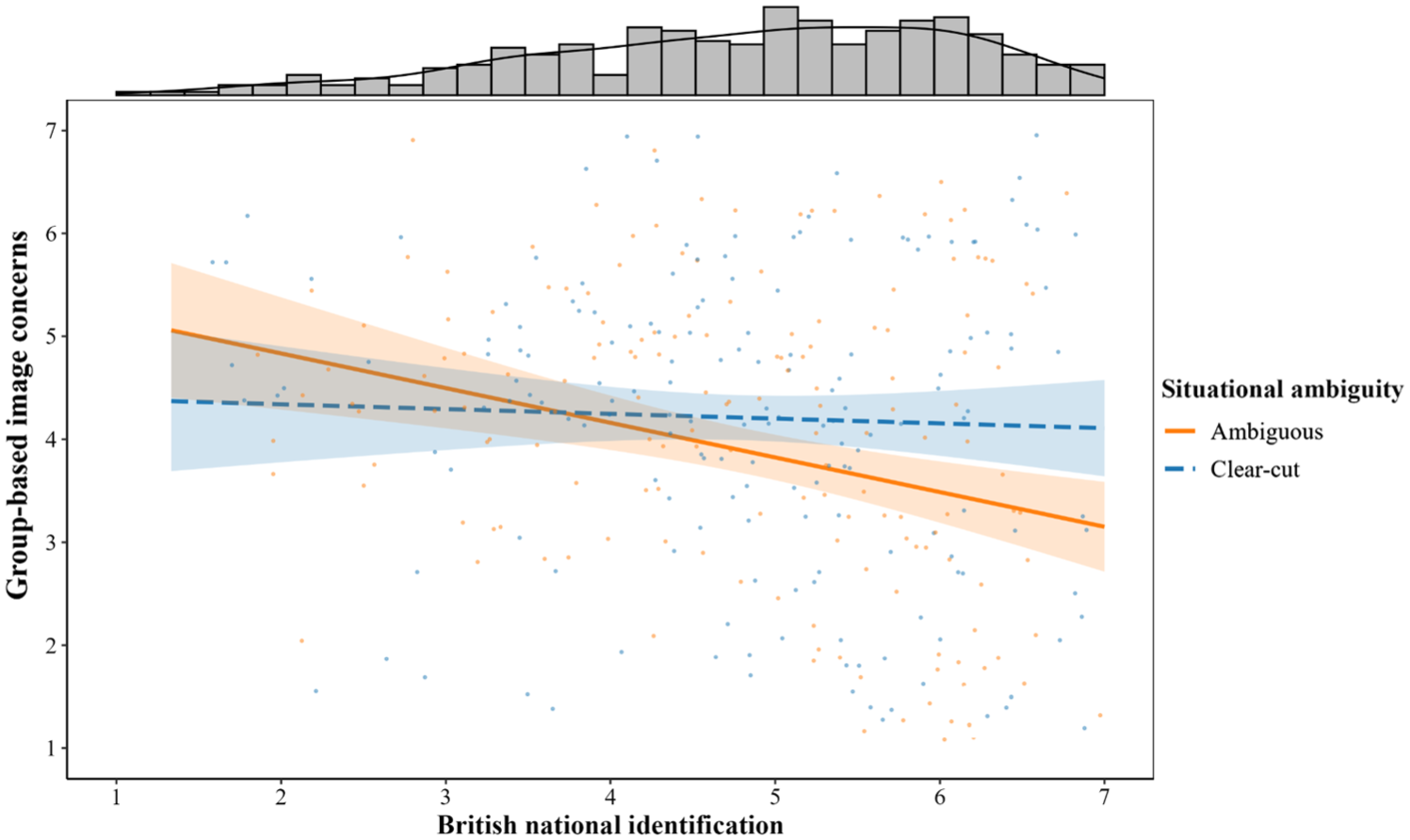
Group-based image concerns as a function of situational ambiguity and identification (Study 2).
Descriptive statistics across conditions and intercorrelations among main variables (Study 3).
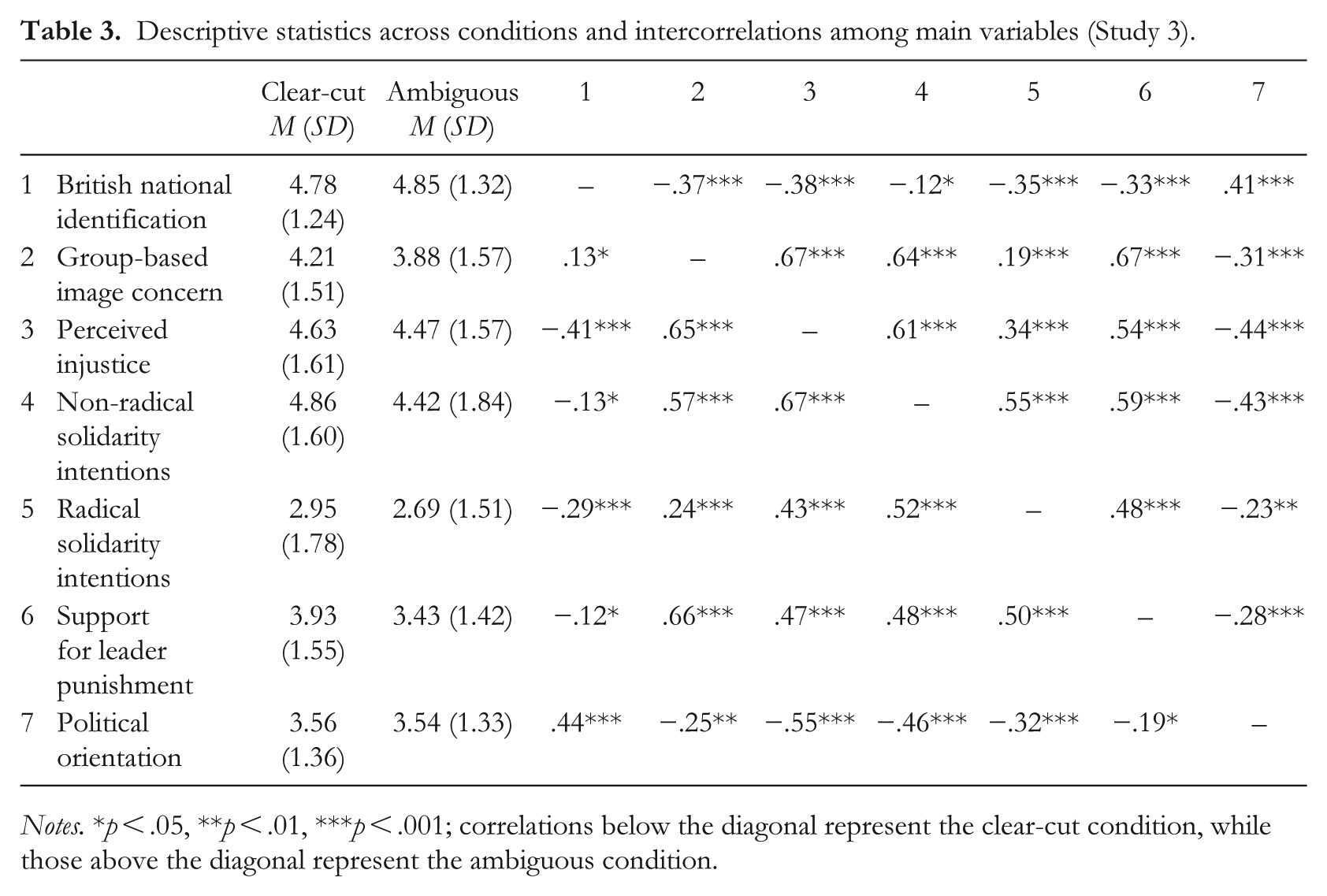
Notes. *p < .05, **p < .01, ***p < .001; correlations below the diagonal represent the clear-cut condition, while those above the diagonal represent the ambiguous condition.
Supporting H2, the non-radical intentions model yielded a significant main effect of the condition (b = 0.44, SE = 0.16, 95% CI [0.12, 0.76]). There were also significant main effects of identification (b = −0.22, SE = 0.07, 95% CI [−0.36, −0.08]) and the interaction between the manipulation and identification (b = 0.32, SE = 0.13, 95% CI [0.07, 0.57]). The simple slopes showed that non-radical action intentions in clear-cut (vs. ambiguous) situations were stronger among high-identifiers (b = 0.85, SE = 0.23, 95% CI [0.39, 1.30]) but not low-identifiers (b = 0.03, SE = 0.23, 95% CI [−0.43, 0.49]). Moreover, failing to support H2, the radical intentions model yielded no significant effect of the condition (b = 0.24, SE = 0.17, 95% CI [−0.09, 0.58]). There was a significant effect of identification (b = −0.22, SE = 0.07, 95% CI [−0.36, −0.07]), while the interaction between the manipulation and identification was non-significant (b = 0.14, SE = 0.13, 95% CI [−0.12, 0.40]). Lastly, supporting H2, the leader punishment model yielded a significant main effect of the condition (b = 0.49, SE = 0.15, 95% CI [0.18, 0.79]). Also, the effect of identification (b = −0.24, SE = 0.07, 95% CI [−0.38, 0.11]) or the interaction between the manipulation and identification (b = 0.09, SE = 0.12, 95% CI [−0.15, 0.33]) were non-significant. Taken together, these findings partially supported H2, demonstrating that the situational ambiguity of prototypical leader transgressions plays a significant role primarily in shaping non-radical outgroup solidarity and leader punishment.
To examine whether only identification negatively predicts perceived injustice, we also ran a similar moderated model with perceived injustice as the outcome. Supporting H4, this model showed that identification negatively predicted perceived injustice (b = −0.28, SE = 0.06, 95% CI [−0.40, −0.16]). Furthermore, there were no significant main effect of the condition (b = −0.15, SE = 0.15, 95% CI [−0.14, 0.44]) or its interaction with identification (b = −0.05, SE = 0.12, 95% CI [−0.27, 0.18]).
Next, we tested our third and fourth hypotheses to examine whether image and justice concerns serve as underlying mechanisms for high- and low-identifiers’ outgroup solidarity and leader punishment. Hence, we ran a similar moderated mediation model (Model 58; Hayes, 2017) as in Studies 1 and 2. Simple slopes analyses for these models are presented in Figure 7. The relationship between group-based image concerns and non-radical intentions was significant (b = 0.30, SE = 0.06, 95% CI [0.18, 0.42]), and this link was moderated by identification (the interaction between group-based image concerns and identification: b = 0.17, SE = 0.05, 95% CI [0.08, 0.26]). Supporting H3, the conditional indirect effect via group-based image concerns was significant among high-identifiers (b = 0.36, SE = 0.15, 95% CI [0.09, 0.69]), but not among low-identifiers (b = −0.01, SE = 0.03, 95% CI [−0.07, 0.04]). Moreover, the relationship between perceived injustice and non-radical solidarity was significant (b = 0.39, SE = 0.07, 95% CI [0.26, 0.52]), and, supporting H4, this link was moderated by identification (the interaction between identification and perceived injustice: b = −0.12, SE = 0.05, 95% CI [−0.21, −0.03]). But the conditional indirect effects were non-significant among both high-identifiers (b = 0.02, SE = 0.06, 95% CI [−0.08, 0.16]) and low-identifiers (b = 0.11, SE = 0.10, 95% CI [−0.07, 0.32]). There were also no main effects of the condition (b = 0.19, SE = 0.13, 95% CI [−0.07, 0.46]) and identification (b = −0.04, SE = 0.06, 95% CI [−0.17, 0.08]) on non-radical intentions.
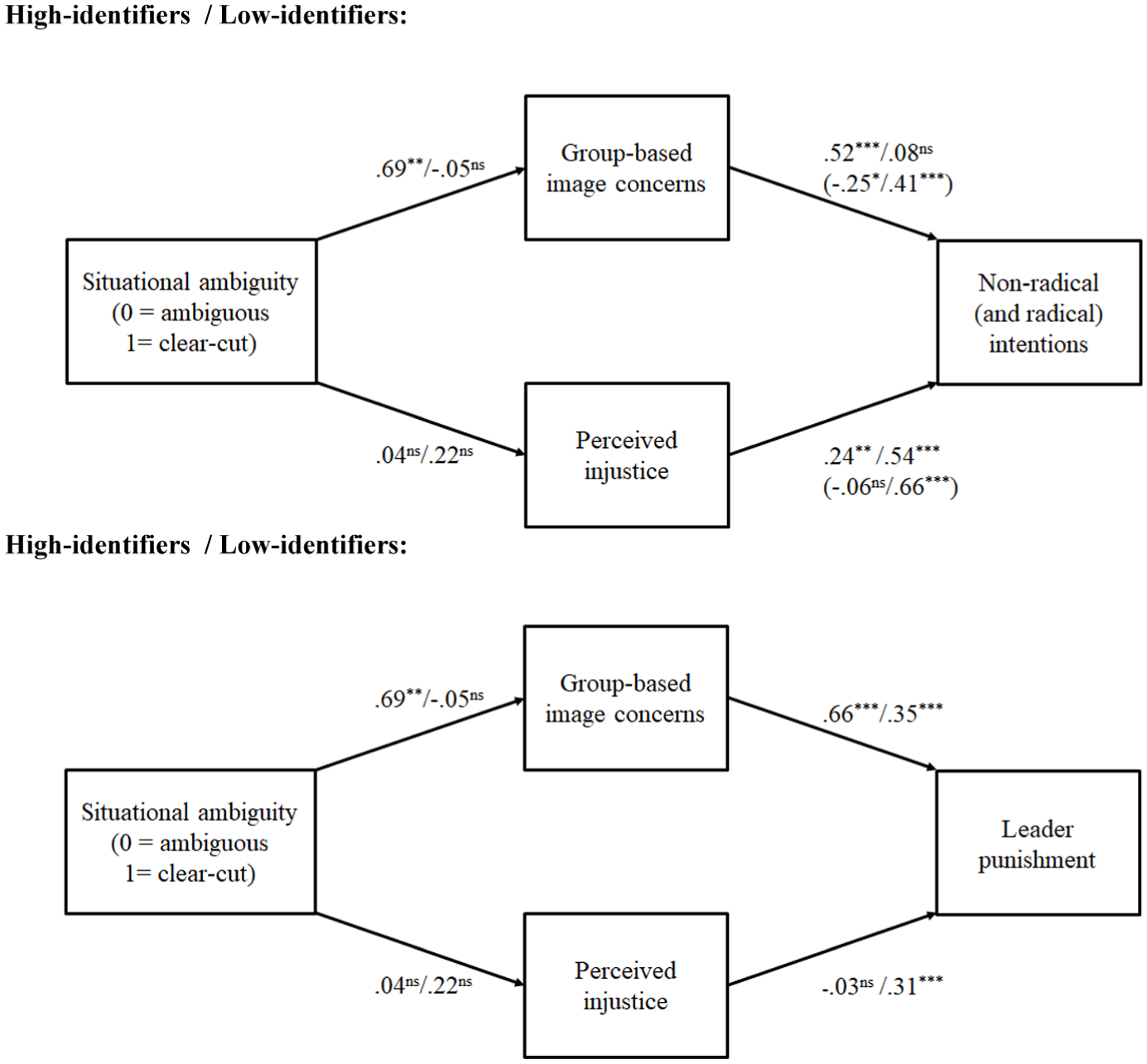
Moderated parallel mediation models with outgroup solidarity and leader punishment as the outcomes (Study 3).
While the relationship between group-based image concerns and radical intentions was non-significant (b = 0.08, SE = 0.07, 95% CI [−0.07, 0.22]), and the link between the two was moderated by identification (the interaction between group-based image concerns and identification: b = 0.26, SE = 0.05, 95% CI [0.15, 0.37]). The conditional indirect effect via group-based image concerns was significant among high-identifiers (b = −0.17, SE = 0.13, 95% CI [−0.07, −0.59]), but not among low-identifiers (b = 0.01, SE = 0.06, 95% CI [−0.10, 0.13]). Note that the link between group-based image concerns and radical intentions among high-identifiers was negative, failing to support H3. Moreover, the relationship between perceived injustice and radical solidarity was significant (b = 0.30, SE = 0.08, 95% CI [0.15, 0.45]), and, supporting H4, this link was moderated by identification (the interaction between identification and perceived injustice: b = −0.28, SE = 0.06, 95% CI [−0.39, −0.17]). But the conditional indirect effects were non-significant among both high-identifiers (b = −0.01, SE = 0.03, 95% CI [−0.07, 0.05]) and low-identifiers (b = 0.14, SE = 0.12, 95% CI [−0.09, 0.39]). Furthermore, there were no main effects of the condition (b = 0.04, SE = 0.16, 95% CI [−0.27, 0.35]) and identification (b = −0.05, SE = 0.07, 95% CI [−0.19, 0.10]) on radical intentions.
The relationship between group-based image concerns and leader punishment was significant (b = 0.51, SE = 0.06, 95% CI [0.40, 0.62]), and this link was moderated by identification (the interaction between group-based image concerns and identification: b = 0.12, SE = 0.04, 95% CI [0.04, 0.20]). Supporting H3, the conditional indirect effect via group-based image concerns was significant among high-identifiers (b = 0.46, SE = 0.18, 95% CI [0.12, 0.83]), but not among low-identifiers (b = −0.02, SE = 0.07, 95% CI [−0.17, 0.13]). Moreover, the relationship between perceived injustice and leader punishment was significant (b = 0.14, SE = 0.06, 95% CI [0.02, 0.25]), and, supporting H4, this link was moderated by identification (the interaction between identification and perceived injustice: b = −0.12, SE = 0.05, 95% CI [−0.21, −0.03]). But the conditional indirect effects were non-significant among both high-identifiers (b = 0.00, SE = 0.02, 95% CI [−0.04, 0.05]) and low-identifiers (b = 0.06, SE = 0.06, 95% CI [−0.04, 0.21]). Moreover, a significant main effect of condition (b = 0.24, SE = 0.12, 95% CI [0.10, 0.47]) was observed, but not of identification (b = −0.07, SE = 0.06, 95% CI [−0.18, 0.04]).
Overall, Study 3 supported most key hypotheses, setting a boundary condition for the prototypical leader transgression effects: High-identifiers’ non-radical (but not radical) outgroup solidarity and support for leader punishment via increased image concerns depended on the clarity of the transgressive situation. Importantly, Figure 6 suggests that under the ambiguity condition, differences between high- and low-identifiers were stronger, reflecting a pattern of leader favoritism and reduced concern for the ingroup’s external image among highly-invested group members when situational cues were unclear. In contrast, low-identifiers were motivated towards non-radical (and radical) outgroup solidarity, as well as leader punishment, via heightened perceived injustice, regardless of situational ambiguity.
General Discussion
Three experimental studies examined how transgressive ingroup leader prototypicality influences group-based image concerns and perceived injustice, shaping outgroup solidarity and leader punishment among high- and low-identifiers. The role of situational ambiguity in the prototypicality effects was also tested. Studies 1 and 2 found that prototypical (vs. non-prototypical) leader transgressions heightened image concerns among high-identifiers, motivating both non-radical and radical solidarity, as well as leader punishment. Low-identifiers, however, acted based on perceived injustice, engaging in both forms of solidarity and leader punishment regardless of leader prototypicality. Study 3 identified a boundary condition: High-identifiers’ image concerns led to non-radical solidarity and leader punishment in clear-cut (vs. ambiguous) situations, while, unexpectedly, image concerns were negatively linked to radical solidarity. Low-identifiers consistently engaged in both types of solidarity and leader punishment, irrespective of situational ambiguity.
Implications
Our research makes several contributions. Replicating Chang’s (2022) findings, we demonstrated that prototypical leader transgressions evoke in-group concerns, which, in turn, lead to ingroup-focused punishment responses. We also extended these findings by showing that this ingroup-focused process also fosters altruistic responses to victimized outgroups. Additionally, our research advances the study of group-based transgressions by identifying a key boundary condition, suggesting that high-identifiers may seek clearer evidence before reacting to wrongdoings by their representatives. More broadly, these findings highlight that highly-invested members of high-status groups are primarily motivated to protect a positive image of their ingroup even when confronted with their leaders’ transgressions. This motivation can lead them to rely on ambiguous or leader-atypical cues to downplay wrongdoing, rather than act directly. On the other hand, when transgressions are presented in psychologically undeniable ways to high-identifiers, they are more likely to support victimized outgroups or sanction their leaders. Therefore, understanding the conditions under which high-identifiers shift from merely psychologically preserving ingroup image to engaging in prosocial action carries pivotal theoretical and societal implications.
Beyond these contributions, our research highlights a neglected aspect of leader transgressions: the responses of weakly identified transgressor group members. Across studies, low-identifiers’ justice-driven outgroup solidarity and support for leader punishment remained stable, unaffected by leader prototypicality or situational ambiguity. These findings suggest that factors shaping high-identifiers’ responses do not similarly influence low-identifiers.
Another aspect of our research concerns the different operationalizations of leader prototypicality. Steffens et al. (2021) discussed whether defining the leader as the ideal or average group member could lead to different responses. Both operationalizations, however, yielded similar results in our studies, suggesting that nuances in prototypicality operationalizations might be less critical in reacting to transgressive leaders.
Moreover, our research is the first to empirically test different modes of outgroup solidarity (i.e., non-radical vs. radical) against leader transgressions. Prior research showed that, because image concerns are ingroup-centric motives aimed at protecting privileged groups’ reputation, highly-invested advantaged group members typically favor only non-radical social change that does not threaten their group status (e.g., Çakmak, Gordijn, Koc, & Stroebe, 2025; Teixeira et al., 2020). Challenging this status concern account, our research showed that this pattern may not hold when mistreatments come from those in power. Similar findings emerged in more recent studies on collective action against government transgressions (Çakmak, Gordijn, Koc, & van der Ham, 2025, Study 1) and solidarity with war victims and large-scale institutional boycotts (Sağlamöz et al., 2025). Adding nuance to these insights, our research suggests that even highly invested advantaged group members may support radical change against their prototypical leader wrongdoings, not necessarily to protect their group’s high-status, but to preserve their subjective sense of ingroup positivity.
Limitations and Suggestions for Future Research
The first limitation concerns the leader prototypicality manipulations. Social identity research originally links perceptions of prototypicality to both intragroup (similarity to ingroup members) and intergroup (difference from outgroup members) dynamics (Turner et al., 1987). However, the prototypicality manipulations in our research focused on intragroup dynamics, omitting explicit intergroup comparisons. Including comparative information could have strengthened effects. Future research should thus use different manipulations.
Second, Study 3’s findings on high-identifiers’ radical actions via image concerns were contrary to predictions: the more they worried about the group’s public image, the less likely they were to engage in radical solidarity. This may reflect an effort to avoid being associated with the transgression itself (e.g., the UK riots), consistent with the motive to maintain positive intergroup distinctiveness (Tajfel, 1974). Future research could directly investigate this mechanism.
Third, although we provided potential explanations based on status concerns versus ingroup-positivity concerns regarding whether the image-based solidarity pathway predicts both non-radical and radical action intentions beyond support for leader punishment, we ultimately linked these accounts to group-based image concerns at the theoretical level. A more refined assessment would involve disentangling these explanations at the measurement level. Given the somewhat conflicting findings on radical action intentions between the first two studies and the third, we consider such an endeavor particularly necessary for future research.
Moreover, other factors beyond transgressor group identification could explain differences in responses. Leader prototypicality might interact with participants’ self-prototypicality (Gómez et al., 2014). Additionally, morality (van Zomeren et al., 2012), values (Ho & Kteily, 2020), or needs (Sağlamöz et al., 2025) could drive compensatory actions. Future research should explore broader dynamics.
One should also consider extending the current research to different intergroup contexts. While we focused on high-status group members’ motives for solidarity with low-status groups, following Radke et al.’s (2020) framework, the dynamics might differ if leaders of low-status groups were depicted as transgressors. In such cases, given the established positive link between low-status group identification and perceived injustice (van Zomeren et al., 2008), high-identifiers of such groups may express outgroup solidarity and leader punishment intentions via both heightened image and justice concerns. Future research should explore such possibilities.
Another point concerns the outgroup solidarity measures in the present research. Although the items capture specific action goals (e.g., providing medical help, raising awareness) and include labels indicating different action types (e.g., disruptive, radical, peaceful, non-violent), they remain somewhat abstract. These items may reflect individuals’ general willingness to adopt (non-)radical intentions, while offering limited insight into the concrete content of such actions. Moreover, given the lack of pre-validated collective action scales in the literature, there is a need for validation efforts and a deeper understanding of different action types, potentially through mixed-method approaches. Future studies should therefore consider these directions.
The last set of limitations pertains to the nature of the transgressive situations. While the realistic cases we used enhanced external validity, transgressions involved other groups. Future research could use clearer examples of intergroup transgressions to balance internal and external validity. Additionally, leaders in our research were indirectly involved in the transgressions by downplaying outgroup victimization, but direct leader involvement remains untested. Moreover, while Study 3 operationalized transgression ambiguity as tentative versus definitive evidence regarding the recognition of the leader’s act as transgressive, its focus could also be on whether the act has a harmful impact on the outgroup. Since low-identifiers are thought to be more vigilant to outgroup needs, such an operationalization might influence their responses differently. Manipulating other dimensions of transgression ambiguity may therefore carry distinct implications. Finally, the leaders held lower-rank positions, similar to past research (Chang, 2022; Frimer & Skitka, 2020). Yet, higher-ranking leader transgressions might elicit different responses. By strategically abusing their power, higher-ranking leaders can rationalize their transgressions in the eyes of their followers. For example, they may frame their decisions as advancing ingroup interests or exaggerate outgroup threats to portray their actions as morally justified, last-resort measures (Davies et al., 2022; Ntontis et al., 2024). Punishing such leaders or showing solidarity with their victims would consequently be perceived as psychologically more costly. Thus, investigating how current findings apply to higher-ranking leader transgressions could be an important avenue for future research.
Conclusion
To conclude, when ingroup leaders harm outgroups, leader prototypicality increased concerns about ingroup image among highly invested transgressor group members. These concerns drove both their punishment of ingroup leaders and solidarity with harmed outgroups. These effects were stronger under unambiguous conditions. Meanwhile, regardless of prototypicality or ambiguity, weakly invested members perceived leader misbehaviors as more unjust and engaged in punishment and solidarity. This research advances our understanding of the motives behind high-status group members’ reactions to leader transgressions.
Supplemental Material
sj-docx-1-gpi-10.1177_13684302261426316 – Supplemental material for When our leaders harm outgroups: How leader prototypicality and situational ambiguity shape outgroup solidarity and leader punishment
Supplemental material, sj-docx-1-gpi-10.1177_13684302261426316 for When our leaders harm outgroups: How leader prototypicality and situational ambiguity shape outgroup solidarity and leader punishment by Hakan Çakmak, Ernestine H. Gordijn and Yasin Koc in Group Processes & Intergroup Relations
Footnotes
Authors’ note
The opinions, findings, and conclusions expressed are those of the authors and do not necessarily represent the views of the institution financially supporting the first author.
Author contributions
Hakan Çakmak, Ernestine H. Gordijn, and Yasin Koc contributed to the conceptualization and methodology. Hakan Çakmak, Ernestine H. Gordijn, and Yasin Koc participated in writing, reviewing, and editing the manuscript. Hakan Çakmak was involved in data curation, formal analyses, funding acquisition, investigation, project administration, and providing resources, as well as writing the original draft. Ernestine H. Gordijn and Yasin Koc supervised the manuscript.
Funding
The authors disclosed receipt of the following financial support for the research, authorship, and/or publication of this article: This research was supported by a postgraduate scholarship awarded to the first author by the Turkish Ministry of National Education. We acknowledge the institution’s support, but note that it had no role in the design or conduct of the studies.

Supplemental material
Supplemental material for this article is available online.
Notes
References
Supplementary Material
Please find the following supplemental material available below.
For Open Access articles published under a Creative Commons License, all supplemental material carries the same license as the article it is associated with.
For non-Open Access articles published, all supplemental material carries a non-exclusive license, and permission requests for re-use of supplemental material or any part of supplemental material shall be sent directly to the copyright owner as specified in the copyright notice associated with the article.
