




Abstract
Identity fusion is a powerful form of social cohesion capable of motivating extreme pro-group action that can result from the sharing of personally transformative memories of a dysphoric event with other group members. However, it is not known whether such experiences need to be shared directly or if indirect sharing via eye-witness accounts would be equally effective. In this study, we examine the impact of the 2002 Bali bombings, a powerful dysphoric event, on group cohesion and morality among Balinese Hindus. We hypothesized that being copresent would predict stronger fusion with ingroup members compared with vicariously shared experiences, and that fusion scores would be more strongly associated with select moral domains compared with social identification. Using a questionnaire, data were collected in person from 340 Hindus in Bali. Our findings confirmed that directly experiencing this dysphoric event was associated with higher levels of fusion—especially with others who were copresent—which were mediated by the experience’s transformative impact and its recall for those present. Nevertheless, indirect experiences also proved to be powerful drivers of group bonding through similar processes. The study provides new insight into the long-term psychological impacts of terrorist atrocities and their wider consequences for societal cohesion.
On October 12, 2002, Bali (Indonesia) was devastated by three simultaneous bombings, two of which targeted the bustling tourist district of Kuta. The orchestrated terrorist attack by an Islamist jihadist group was timed to coincide with one of the peak tourist seasons at Kuta Beach. Its victims encompassed both the local Hindu community and foreign tourists. This horrific event, known as the 2002 Bali bombings, claimed the lives of 202 individuals from over 20 countries, including 38 Balinese Indonesians, and injured many more. This study aims to investigate the lasting effects of this tragedy on the collective identities, social unity, and moral values of Balinese Hindus.
The Bali bombings are a paradigmatic example of an “imagistic” experience: an emotionally arousing and transformative shared experience associated with strong bonding effects, whether caused by unanticipated events such as natural disasters, wars, and terrorist attacks or more regulated forms of violence such as painful rites of passage or extreme sports (Whitehouse, 2021). Imagistic experiences that are highly dysphoric and transformative create a strong and lasting sense of kinship with those who have shared the same experience (Whitehouse, 2004; Whitehouse & Lanman, 2014), in which personal and group identities become “fused” (Swann et al., 2012). Identity fusion (hereafter “fusion”) has been shown to motivate extreme forms of pro-group action, including a willingness to lay down one’s life for the group in order to protect fellow members (Swann, Gómez, Dovidio, et al., 2010; Swann, Gómez, Huici, et al., 2010; Whitehouse, 2018). The question that arises, then, is what catalyzes this fusion of personal and group identities?
Previous research suggests that visceral and emotional memories of a dysphoric event that are highly transformative for personal identity are a powerful driver of identity fusion when shared with others (Muzzulini et al., 2022; Swann et al., 2012; White et al., 2024; Whitehouse et al., 2017). The imagistic pathway to fusion involves rare but emotionally intense experiences (e.g., eliciting fear, pain, etc.) and the imagery they evoke, leading to the formation of flashbulb-like episodic memories (Whitehouse, 2004). Such autobiographical memories can be vividly recalled for the rest of one’s life (Buhrmester et al., 2020; Newson et al., 2016). They thus serve as the foundation for a process of meaning-making (Newson et al., 2018; Richert et al., 2005; Whitehouse, 2000). As individuals reflect upon such experiences, they develop nuanced interpretations, creating a mosaic of thoughts and emotions believed to mirror those of others who endured the same event (Jong et al., 2015; Richert et al., 2005; Whitehouse, 1992). Over time, this meaning-making process results in a sense that the memory is personally transformative (i.e., self-defining) and, crucially, transformative for other group members as well (Buhrmester et al., 2018)—to the extent that the emotional experience has been shared with fellow group members, one tends to assume the event was similarly defining for others, resulting in a feeling of fusion with members of the group (Páez et al., 2015; Swann et al., 2012; Whitehouse, 2018). The degree to which a memory is visceral, vivid, and emotionally arousing, and whether it is coupled with episodic details of the event, will determine how transformative group members perceive it to be (Buhrmester et al., 2020; Kapitány et al., 2020; Whitehouse et al., 2017). As a result, their personal and group identities can become fused together (Whitehouse & Lanman, 2014). Prior studies propose that recognizing these life-altering experiences as shared among group members fosters the development of familial-like bonds, a key feature of identity fusion (Buhrmester et al., 2015; Kavanagh et al., 2020).
The concept of identity fusion through shared experiences is rooted in research on intense initiations and hazing rituals that foster deep bonds through jointly endured experiences (Whitehouse, 1996). Empirical studies have found evidence of such bonding in diverse groups, from tribal communities (Buhrmester et al., 2018) to martial arts groups (Kavanagh et al., 2020) and even among football fans (Newson, 2019). Interestingly, just the belief that others have gone through a similar transformative experience can enhance the sense of fusion. For instance, first-time mothers who have endured painful childbirths often feel a strong connection with other mothers who have had similar experiences, despite not having been physically present with them during labor (Tasuji et al., 2020). There is even some evidence that people can fuse with a member of another species based on the perception of shared experience resulting from material viewed in news feeds (Buhrmester et al., 2018).
However, the extent to which the mode of shared experience impacts fusion has not been thoroughly investigated. A transformative event can be shared directly by those physically present or indirectly, either through news and media reports, and word of mouth during or shortly after the event, or later from eyewitness testimonies of people who experienced the events directly. How do these differing forms of shared experience affect fusion outcomes? Studies with Libyan insurgents have shown that fusion based on directly shared traumatic experiences of frontline combat tends to be stronger than fusion resulting from indirectly shared experiences (Whitehouse et al., 2014). Similarly, the shared disappointment of sports fans appears to have a greater impact on fusion when experienced together at the stadium than remotely via television screens (Baranowski-Pinto et al., 2022). However, little is known about the role of mediating variables that might account for differences in fusion processes relating to directly versus indirectly shared experiences.
One possible reason why in-person shared experiences tend to foster stronger identity fusion is that they more accurately reflect the evolutionary conditions where these psychological bonding mechanisms developed (Whitehouse et al., 2017). Genetic relation could explain the strong associations between fusion and relational ties and psychological kinship (Buhrmester et al., 2015).
In contrast with fusion, social (or group) identification tends to be linked with larger, impersonal groups made up of individuals who are not acquainted with each other (Tajfel and Turner, 1979). This type of connection is based on shared identity markers acquired through social learning and stored as semantic memory. These markers symbolize social categories and are not essential to personal identity in the same way as shared in-person life experiences (Gómez et al., 2011; Whitehouse & Lanman, 2014). This would suggest that fusion and identification are associated with distinct social bonding strategies. Consequently, intensely emotional memories of a traumatic event, such as the 2002 Bali bombings, are expected to promote stronger fusion-like bonds with relevant ingroups than social identification, particularly when the experience is believed to have been shared with members of those groups (Muzzulini et al., 2022; Whitehouse et al., 2014, 2017).
Relatedly, fusion and identification might also be associated with different moral concerns. The theory of “morality as cooperation” (MAC) posits that seven cooperative rules, derived from game theory, are judged morally good in all human societies (Curry, 2016). These behaviors include helping your group and family, returning favors, being brave, deferring to authority, distributing resources fairly, and respecting others’ property, each linked to seven unique moral domains (Curry, Mullins, & Whitehouse, 2019). Since fusion is associated more strongly with perceptions of familial ties and psychological kinship, and identification focuses more on categorical group identities and extrafamilial relationships, we might expect fusion to exhibit a stronger association with moral commitments in the domains of kin altruism and group loyalty. Moreover, fusion is strongly associated with willingness to self-sacrifice for the group, and especially a willingness to fight and die to protect group members (Gómez et al., 2020; Henríquez et al., 2020; Reese & Whitehouse, 2021; Swann & Buhrmester, 2015; Varmann et al., 2024). As such, we might also expect a stronger connection between fusion and endorsements of bravery. However, the link between fusion, identification, and moral structures has not been extensively studied so far.
Aims and Hypotheses
In light of the above, we set out to test the following preregistered hypotheses:
Hypothesis 1. We expect to observe a variation in scores on identity fusion depending on the directness 1 and imagistic properties of the experience.
We differentiated degrees of “directness” by distinguishing between sharing the experience by virtue of being copresent at the event itself (directly shared experience), hearing about it from a distance through a storyteller (vicariously shared experience), or learning about it during or shortly after the event (staggered shared experience).
H1.1. Participants in the direct condition will score higher on fusion than participants in the indirect (i.e., staggered and vicarious) conditions across all fusion targets.
H1.2. Within each condition, participants will score higher on fusion targets when (a) they learned about/experienced the event in the presence of members of the ingroup target, (b) they have an episodic-like recall of those group members being present (for the vicarious condition, of the storyteller sharing their memory), and (c) there are strong relational ties with those who were present.
H1.3. Higher levels of fusion with all target groups will be associated with higher scores on memory measures across all conditions: (a) memory recall: visceralness and emotional arousal, and (b) memory appraisal: personal identity transformativeness.
Hypothesis 2. Scores on identity fusion will be shaped by the effects of (a) memory recall, (b) personal identity transformativeness, and (c) perceived sharedness.
Following Kapitány et al. (2020), a third memory recall measure, “vividness,” was included to account for its potential interaction with other memory recall measures and transformativeness. We predicted that the visceralness, vividness, and emotional arousal associated with recalling the experience, the transformativeness of the experience, and how shared the experience was felt to be with others would be conjointly correlated with fusion scores in the following ways:
H2.1. Memory recall (i.e., visceralness, vividness, and emotional arousal associated with the memory) will positively predict personal identity transformativeness.
H2.2. The relationship between transformativeness and fusion with relevant targets will be mediated by perceived sharedness (matched with respective fusion targets).
H2.3. The pathways highlighted in H2 will be weaker in predicting group identification.
Hypothesis 3. Fusion will have a stronger association with moral commitments to (a) kin altruism, (b) group loyalty, and (c) heroism in all cases compared with social identification.
In testing these hypotheses, our study has two primary objectives. First, we aim to explore the psychological effects of distressing experiences shared with others, both directly and indirectly, on group cohesion and the role that various memory processes play in producing any such effects. Second, we seek to analyze the connections between various forms of group cohesion and the endorsement of different moral concerns. We decided to focus on the 2002 terrorist attack in Kuta, Bali (Indonesia) as an example of a shared distressing event that was both recent enough to be relevant to the Bali population but also distant enough that relevant memory processes had time to produce their effects. We refer to first-hand experiences of the Bali bombings as “direct,” while experiences relayed second-hand are referred to as “indirect.” We further subdivide indirect experiences into two kinds: vicarious (whereby one learned about the event after it happened from the testimony of others who experienced it directly) and staggered in time (whereby one learned about the event as it happened or shortly after via the news or word of mouth). In addition to the group category of Balinese Hindus, we looked at three other ingroup targets we consider especially relevant to this event and to the participants in question: (a) people who were around the participant at the time of their experience (“copresent members” and “storytellers”), (b) the bombing victims, and (c) Indonesian society. A fifth ingroup target served as a control: the participant’s family.
To accomplish our first objective, we examined the effects of direct and indirect (the latter including staggered and vicarious) experiences on the development of fusion (vs. identification) through processes of perceived and evident sharedness, personal identity transformativeness, and memory recall. To meet our second objective, we investigated the relationships between fusion, identification, and the set of moral domains outlined in the MAC theory (Curry, Chesters, & van Lissa, 2019).
Method
Participants
Participants were Balinese Hindus whose memory representations differed according to the way they experienced the event. We aimed to recruit N = 200 for each of the three categories:
Direct: people who experienced the attack at close quarters as it was happening; participants could either have heard the bombing, witnessed the bombing in person, or survived the bombing. They reported on the memory of the event as experienced.
Staggered (indirect): people who learned about the news of the attack as it occurred or shortly after; participants could have first learned about the event from either seeing it reported in the media or hearing about it from another person who did not have direct experience. They reported on the memory of how the news was first learned.
Vicarious (indirect): people who learned about it through the storytelling of another person who experienced the event; participants first learned about the bombing by hearing the eyewitness testimony of someone who had direct experience of it. They reported on the memory of a witness’s testimony of the event.
Due to logistic issues, the sensitivity of the event, and restrictions brought up by the outbreak of COVID-19, our final total sample was N = 340, which was comprised of people who had experienced the event in a direct way (n = 81), a staggered way (n = 82), or vicariously (n = 177). Given the timing of the event, participants in the direct and staggered conditions needed to be above the age of 35, while participants in the vicarious condition could be anyone above the age of 18. For the relevant inclusion criteria, see the supplementary Table 1 in Appendix (Supplemental Material). Power analysis (G*Power) indicated that the sample afforded us 80% power to detect a medium effect (Cohen’s f2 = 0.25, critical z = 1.64) for between-group t and z tests, and a small effect (Cohen’s f2 = 0.05, critical F = 1.86) for regression models with 10 predictors (Faul et al., 2009).
Materials
To obtain the measures necessary to test our hypotheses, we had the participants fill out a survey (for the full list and explanation of items, see supplementary Table 2 in Appendix). All items were measured using a 6-point Likert scale unless specified otherwise (1 = strongly disagree, 6 = strongly agree). For the measure of morality, we also used a 6-point response scale (1 = very inappropriate, 6 = very appropriate). The sections of the survey and the measures used are presented below.
Demographic details
Participants provided demographic details on age, gender, and education.
Narrative account of experience
Participants provided a detailed narrative account (open text) about their direct experience of or learning about the bombings. The prompt’s phrasing varied depending on the group condition (direct, staggered, vicarious).
Memory and appraisal of experience
We collected three measures related to the memory of the event, including vividness (one item: “How vivid is this memory in your mind?” with the response scale ranging from not vivid at all to very vivid); emotional arousal (one item: “How intense are the emotions you associate with this memory?” with response scale ranging from not intense at all to very intense); and visceralness, which was measured based on Talarico and Rubin (2017), with four items introduced by the question, “How do you feel when you think about this memory?” (1 = my heart is beating fast, 2 = I feel nervous, 3 = gives me cold sweat, 4 = I feel nauseous and want to vomit; Cronbach’s α = .83).
Personal identity transformation
Personal identity transformation (henceforth “transformativeness”) gauged the extent to which the event was perceived to have had a transformative impact on the participant’s identity. It was measured using three items from Berntsen and Rubin (2006), introduced by the question, “How do you feel when you look back on the Bali bombings?” “I feel the experience related to the Bali bombings. . .” (1 = has become a part of my identity, 2 = has become a central part of my life story, 3 = has changed my life completely; Cronbach’s α = .78).
Sharedness and episodic-like recall of copresent members
We measured four aspects of evident sharedness, which assesses who was with the participant at the time of the event and the degree to which the participant remembers their presence. This included one open question and one multianswer question on who was present at the time of the experience; one confidence rating of participants’ memory of those present (“Are you assuming that those people were there or do you actually remember those people being there?”); and one item on participants’ episodic recall of those copresent (“How vivid is the image of these people in your mind?”).
Perceived sharedness
Two items measured perceived sharedness, that is, the degree to which participants believed other ingroup members had a similar experience, focusing on copresent people/storytellers and on Balinese Hindus: “To what extent do you think that [the copresent people/the storyteller] share(s) the same experience and memories of the Bali bombing?” and “To what extent do you think that you and other Balinese Hindus share the same experience and memories of the Bali bombing?”
Group cohesion (identity fusion and social identification)
Identity fusion
Identity fusion was measured with a 7-point pictorial scale (Swann et al., 2009) with five ingroup targets: family, copresent people or storytellers, bombing victims, Balinese Hindus, and Indonesian society.
Social identification
Social identification was measured with a social identification single item (SISI; adapted from Postmes et al., 2013) with the five ingroup targets mentioned above: “To what extent do you agree with the following statement? I identify with [ingroup target]” Answers were provided on a 7-point scale (see supplementary Table 2 for note on back-translation).
Morality
We collected the MAC measures based on Curry, Chesters, and van Lissa (2019), assessing participants’ self-perceived moral predispositions towards a given group. We used three items for each of the seven components of the MAC (21 items in total). However, the three components that were the focus of the study were kin altruism (Cronbach’s α = .82), group loyalty (Cronbach’s α = .78), and heroism (Cronbach’s α = .83).
To prepare our measures for analysis, variables measured by multiple items were tested for internal consistency reliability to confirm they were correlated and measured the same construct, using Cronbach’s alpha (α ⩾ .70). We then averaged items’ scores to obtain a single mean score per participant per measure. For the morality measures, a confirmatory factor analysis (CFA) was performed on the 21 items of the MAC corresponding to the seven components (three per latent factor). Additionally, an exploratory factor analysis (EFA) was performed on the items corresponding to memory recall and appraisal related variables: transformativeness, visceralness, vividness, emotional arousal, episodic recall of copresent people, and perceived sharedness with copresent group members and Balinese Hindu people. See tables with the results of the CFA and EFA in the Supplemental Material. Simple correlations between all relevant variables were also examined to verify that our variables were measuring distinct constructs.
Procedure
We received ethical clearance for the study from the Psychological Research Ethics Council of the Nusantara Scientific Psychology Consortium (KPIN No. 002/2019) and from the School of Anthropology and Museum Ethnography’s Research Ethics Committee at the University of Oxford (Reference No. SAME/CUREC1A/17-093). The surveys were translated into Indonesian, checked by native speakers, and adapted so that the language could be easily understood by participants. The survey was then distributed in Bali, Indonesia through the Qualtrics platform. Submitted surveys were anonymized and securely stored with access only available to researchers. During the survey, researchers were assisted by the head of the neighborhood (banjar or kepala lingkungan banjar) to gain access to target population groups, for instance, to grant access to community members residing in the vicinity of the bombing incidents. To enhance effectiveness, data collection was also carried out during Hindu religious celebrations, when a substantial number of Hindu devotees congregated. Additionally, we leveraged network connections within the Bali bombing survivors community to secure participation from the target population. Typically, research enumerators accompanied participants as they completed the online questionnaire to ensure that any issues could be resolved and that all items were completed as intended.
Preregistration
Goals and predictions were preregistered for transparency and integrity of the study. The preregistration document and data are available at the Open Science Framework repository (OSF; https://osf.io/u2z6q).
Results
Only one participant was dropped due to missing answers. As a result, there were 339 participants (182 women), with an average age of 41.71 (SD = 12.44). When looking at the conditions separately, average age was 45.89 (SD = 9.06) for the direct condition, 47.59 (SD = 6.98) for the staggered condition, and 24.72 (SD = 8.80) for the vicarious condition.
For a comprehensive correlation test on all measures investigated in the study, see supplementary Figure 1 in Appendix.
EFA was conducted for transformativeness and memory measures to confirm the underlying structure of the items used to test our hypotheses. Scree plotting and minimum average partial (MAP) suggested three factors should be retained. Items were included for latent factors as follows: transformativeness (three), vividness (one), emotional arousal (one), episodic recall of copresent people (one), and visceralness (four). Factor rotation was applied using the promax method. Results indicated nonrandomness, χ2(17) = 99.66, p < .001, and pointed to a structure confirming our study’s constructs (for the EFA results table and interpretation of factors, see supplementary Table 3).
Hypothesis 1
We expected to observe a variation in scores on identity fusion depending on the directness and imagistic properties of the experience (for the correlation matrix of main variables, see supplementary Figure 2 in Appendix).
Internal consistency reliability tests indicated that the relevant scales had a good validity level (Cronbach’s α ⩾ .70). Correlation tests were performed on all multi-item measures used in the analyses for Hypotheses 1 and 2 (see supplementary Figures 2 and 3 in Appendix). Correlations relevant to the hypotheses were (a) a strong positive correlation between fusion with Hindus and fusion with the Indonesian society (N = 339, r = .70, p < .001), and (b) a medium positive correlation between the memory measure of vividness and that of emotional arousal (N = 339, r = .47, p < .001). We found no strong correlations between the measures of fusion (with the different ingroup targets) and the equivalent measures of social identification (the highest being r = .29). While these two group cohesion measures are related, our results suggested that in this dataset, they represented different constructs that were clearly distinguishable from each other.
Hypothesis 1.1
We expected that participants in the direct condition would score higher than participants in the staggered and vicarious conditions across all fusion targets.
The hypothesis was partially supported. Fusion with copresent people/storytellers was higher in the direct condition compared to the vicarious condition, but not to the staggered condition. Fusion with other ingroup targets was not significant compared to the other conditions.
First, a Shapiro–Wilk test showed that the normality assumption was violated. Therefore, we used the Wilcoxon rank-sum (Mann–Whitney U) nonparametric test (see Figure 2). Fusion with those who were copresent, or with the storyteller for the vicarious condition, was significantly higher in the direct condition compared to the vicarious condition (W = 3901.50, z = 2.17, p = .030), but not to the staggered condition (W = 7482.50, z = 0.61, p = .549). Furthermore, fusion with bombing victims was not significant whether comparing the direct with the staggered condition (W = 8122.00, z = 1.77, p = .076) or with the vicarious one (W = 3703.00, z = 1.45, p = .145), nor was fusion with Balinese Hindus, which was nonsignificant in either comparison: whether with the staggered condition (W = 7530.00, z = 0.68, p = .498), the vicarious condition (W = 3103.00, z = 0.63, p = .528), or fusion with Indonesian society (direct–staggered: W = 7645.00, z = 0.89, p = .376; direct–vicarious: W = 3553.00, z = 0.94, p = .346). As for all subsequent analyses, family fusion was used as a control measure. Finally, fusion with family (control) was significantly higher in the direct condition compared to the staggered condition (W = 8198.00, z = 2.51, p = .012), but not to the vicarious condition (W = 3523.50, z = 1.23, p = .217), possibly due to a ceiling effect. Nevertheless, visual inspection of the data (see Figure 1) indicated the anticipated patterns, with the direct condition displaying the highest mean levels of fusion with copresent people, bombing victims, and Indonesian society, followed by the staggered condition and finally the vicarious one. The only exception was participants in the vicarious condition reporting higher levels of fusion with Balinese Hindus compared to those in the direct condition.
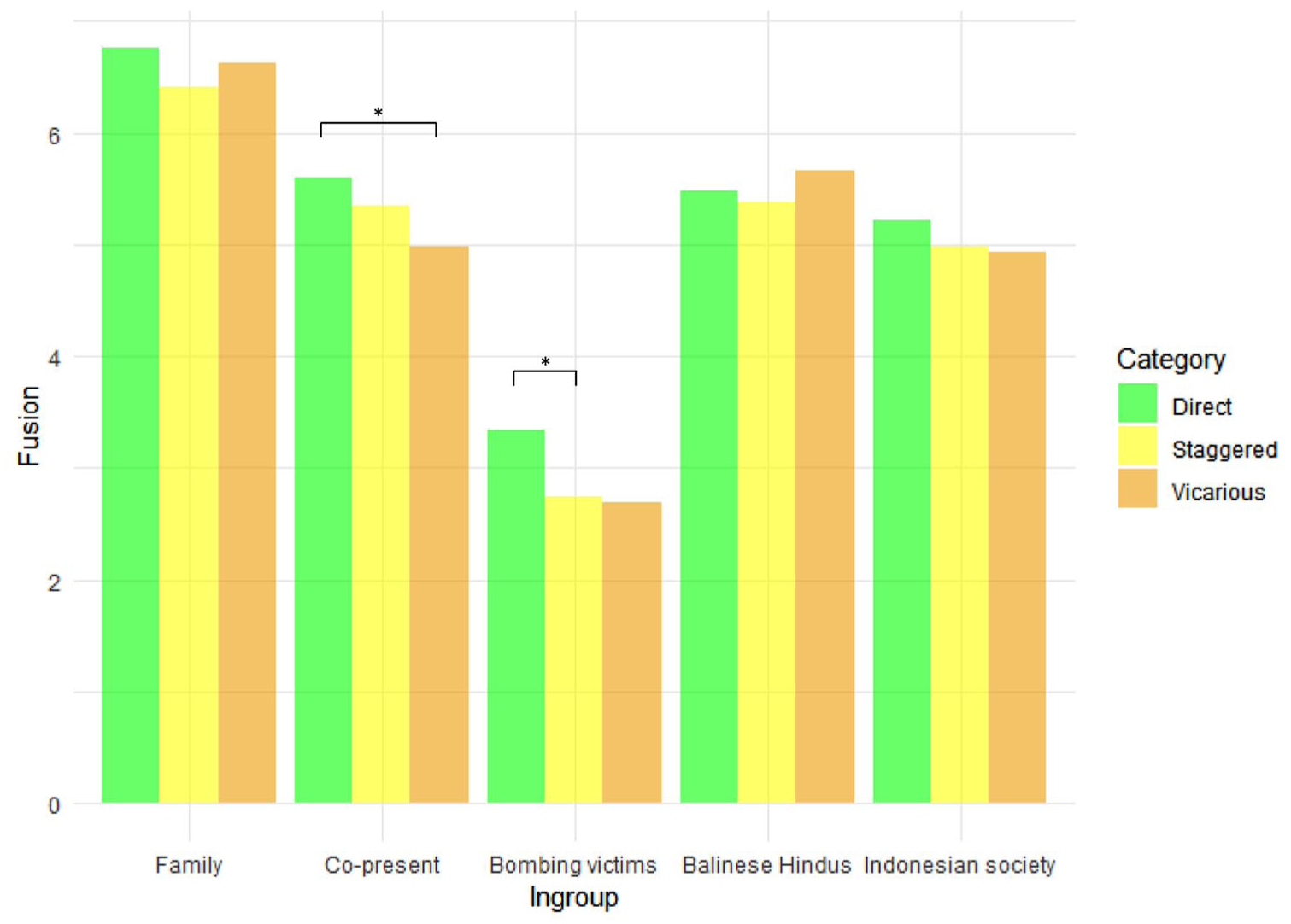
Fusion level with each ingroup as a function of whether the event was experienced directly, in a staggered manner, or vicariously.
Hypothesis 1.2
We expected that within each condition, participants would score higher on fusion targets in the following circumstances:
Hypothesis 1.2a
When they learned about/experienced the event in the presence of members of the ingroup target.
The hypothesis was partially supported: presence (vs. absence) of an ingroup member (Balinese Hindu) during the time of the experience predicted higher fusion with Balinese Hindus; associations were also observed between presence of any ingroup member and fusion with copresent members, but not for other ingroup targets.
The data gathered allowed us to clearly discern the presence (or lack thereof) of Balinese Hindus and family members. After testing for normality and homogeneity of variances, we used the Wilcoxon rank-sum method to test for fusion with Balinese Hindus as a function of the presence of Balinese Hindu members (see Figure 2a). There was a significant difference in fusion scores within and across conditions (W = 2396.00, z = 1.96, p = .025): the presence of Balinese Hindus predicted higher fusion with this group.
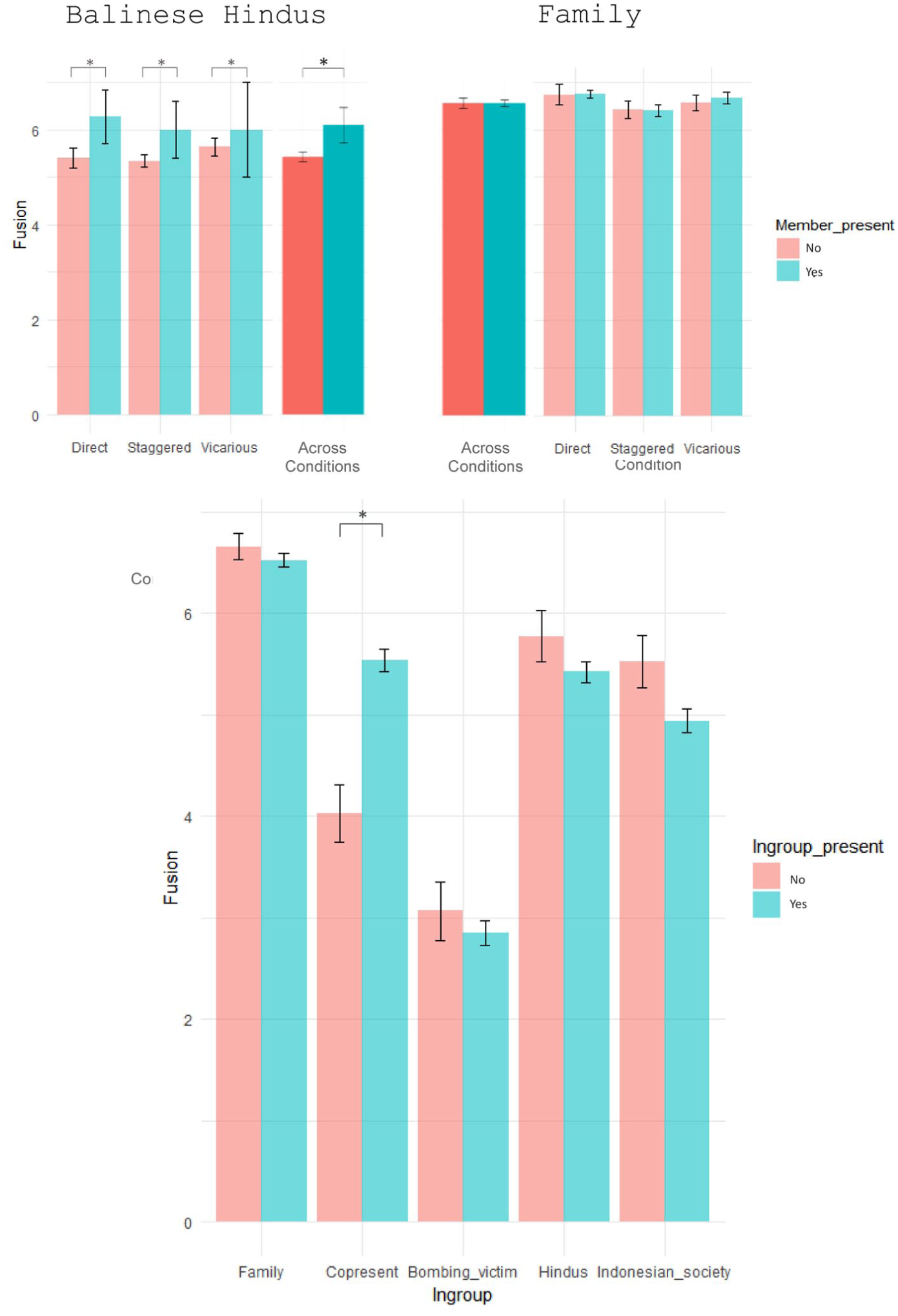
Fusion level with ingroup for participants who had an ingroup member present during the experience versus participants who did not. Panel 2a: fusion with Balinese Hindus as a function of whether Balinese Hindu members were present at the time of the experience, per condition and across conditions. Panel 2b (bottom): fusion level as a function of whether ingroup members were present at the time of the experience, across conditions. Panel 2c (top right): fusion with family (control) as a function of whether family members were present at the time of the experience, per condition and across conditions.
We next compared fusion levels with all ingroup categories between participants who had any ingroup member present and those who did not (see Figure 2, Panel 2b). Results showed that the presence (vs. absence) of an ingroup member during the time of the experience was statistically significant for fusion with copresent members or the storyteller (W = 3670.00, z = 3.49, p < .001), but not for bombing victims (W = 7134.50, z = 1.14, p = .254), Balinese Hindus (W = 7570.50, z = 1.41, p = .158), or Indonesian society (W = 7803.50, z = 1.77, p = .076).
As a control measure for comparison, we conducted the same test for family fusion as a function of the presence of family members across and within conditions (see Figure 2, Panel 2c). Differences in mean fusion scores were not significant across conditions (W = 12616.00, z = 0.90, p = .369) or within conditions for the direct (W = 710.00, z = 1.20, p = .227), staggered (W = 2943.00, z = 0.75, p = .455), and vicarious (W = 818.00, z = 0.68, p = .497) groups.
Hypothesis 1.2b
We expected that participants would have an episodic-like recall of those group members that were present (for the vicarious condition, of the storyteller sharing their memory).
The hypothesis was partially supported: there was an association between level of recall of the present Balinese Hindus and fusion with Balinese Hindus; associations were also observed between episodic-like recall levels and fusion with copresent group members, but not with other ingroup targets.
After testing for linearity and homogeneity of variances, we applied a linear regression model with episodic-like recall level of copresent group members as the independent variable (IV) and fusion as the dependent variable (DV) while initially controlling for sex and age.
We first focused on the ingroup of Balinese Hindus by examining participants who reported having been in the presence of Balinese Hindus at the time of the event. The predictors explained 2.8% of the variance, adjusted R2 = .28, F(6, 332) = 11.91, p < .001. A significant effect was found for the episodic-like recall of present Balinese Hindu group members on fusion with Balinese Hindus in the direct condition (β = .12, p = .047) but not in the staggered (β = .02, p = .181) or vicarious (β = .06, p = .081) conditions.
Additionally, we examined whether an episodic-like recall of those who were present with the participant (of any ingroup) at the time of the event would predict higher fusion levels with all ingroup categories. We found a statistically significant positive correlation between episodic-like recall levels and fusion with copresent members in the direct condition (β = .30, p < .001) but not in the staggered (β = .09, p = .738) or vicarious (β = −.29, p = .334) conditions, F(4, 334) = 9.62, p < .001, R2 = .13. Fusion with all other ingroup targets (family, bombing victims, Balinese Hindus, and Indonesian society) was not predicted by levels of recall of members of any ingroup (see Table 1).
Fusion level as a function of the level of episode-like recall of the present group members within and across conditions.
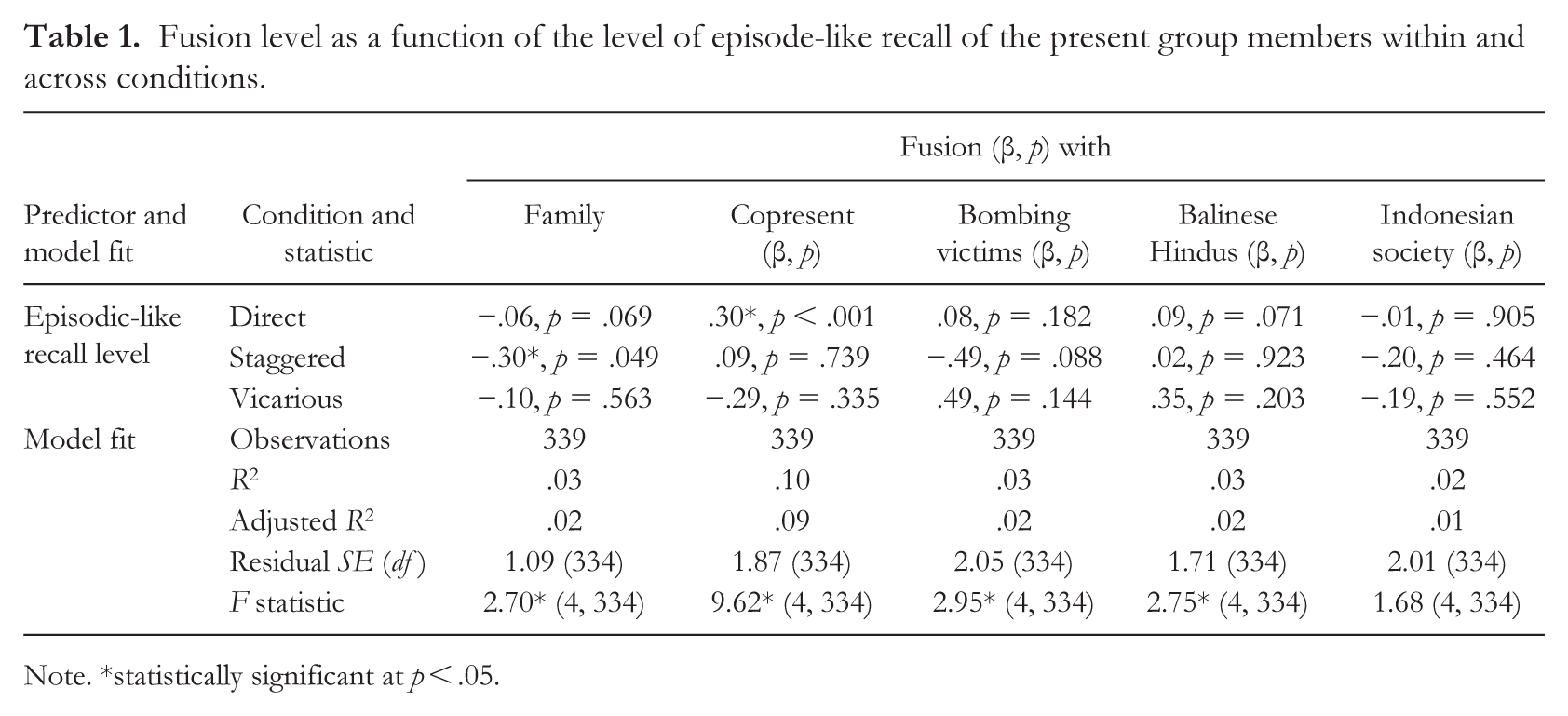
Note. *statistically significant at p < .05.
As a control measure, we conducted the same test for family fusion as a function of the episodic-like recall of family members. As expected, differences in mean fusion scores were not significant, β = .05, p = .077, F(6, 332) = 5.00, p = .072, R2 = .02.
Hypothesis 1.2c
We expected there would be strong relational ties with those who were present during the events (for the vicarious condition, with the storyteller).
The hypothesis was partially supported: the presence of strong relational ties predicted fusion with those copresent during the events, while all other ingroup targets were statistically insignificant.
We considered strong relational ties to include friends and family, while all others were considered weak relational ties. After testing for normality, we conducted five Wilcoxon tests, one for each fusion target separately (see Figure 3). The presence of strong relational ties only predicted a significant statistical level of fusion with copresent people/the storyteller (W = 3927.00, z = 3.29, p < .001), while all other relations were statistically insignificant, including bombing victims (W = 7606.50, z = 1.03, p = .305), Balinese Hindus (W = 7906.00, z = 1.54, p = .124), Indonesian society (W = 8095.50, z = 1.82, p = .068), and the control measure of family (W = 7338.50, z = 0.77, p = .442). Within conditions, again, fusion was only significant with copresent people/the storyteller, and only in the staggered (W = 815.50, z = 3.09, p < .001) and vicarious (W = 224.50, z = 3.38, p < .001) conditions.
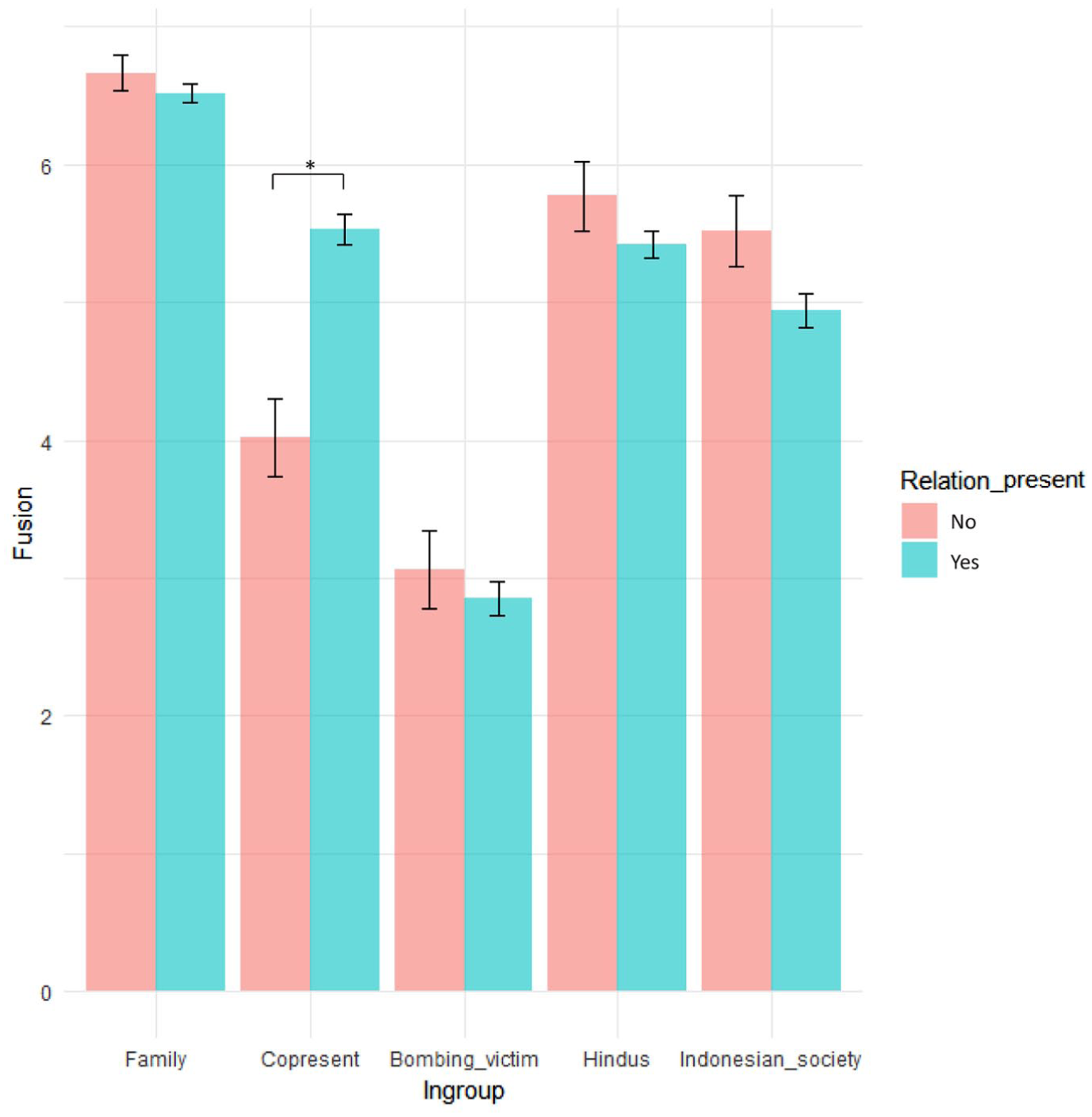
Fusion level across conditions as a function of whether those who were present with the participant at the time of the experience shared strong relational ties with them.
Hypothesis 1.3
We expected higher levels of fusion with all target groups will be associated with higher scores on memory measures across all conditions: visceralness, emotional arousal, and personal identity transformativeness.
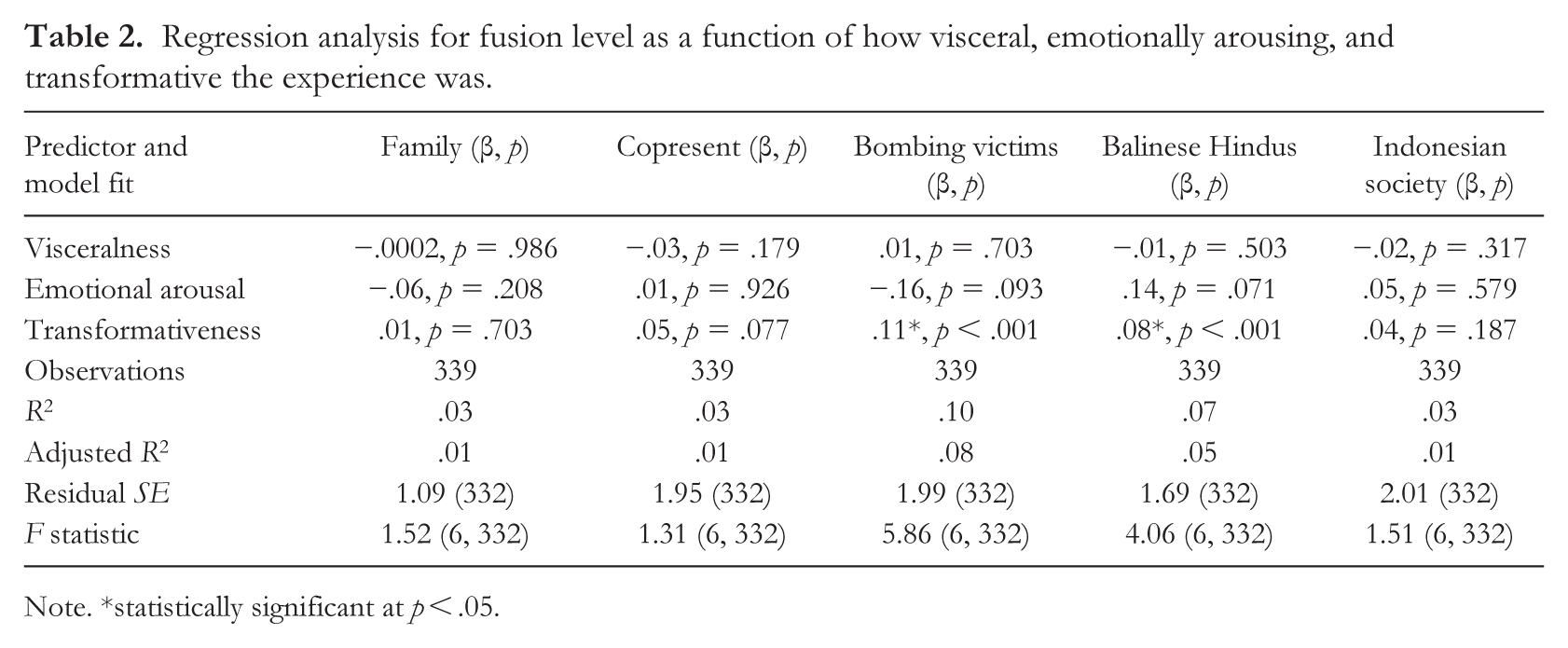
The hypothesis was partially supported: there were associations between transformativeness and fusion with copresent people, bombing victims, and Balinese Hindus, but not with Indonesian society; visceralness and emotional arousal showed no significant association with fusion with any ingroup target.
To account for the interdependence of the three independent variables (visceralness, emotional arousal, and transformativeness), we applied one multivariate linear model per fusion target as the dependent variable, controlling for condition (i.e., direct, staggered, and vicarious), sex, and age (see Table 2).
Regression analysis for fusion level as a function of how visceral, emotionally arousing, and transformative the experience was.
Note. *statistically significant at p < .05.
The results showed a significant correlation between personal identity transformativeness and fusion with Balinese Hindus, β = .08, p < .001, F(6, 332) = 4.06, p < .001, R2 = .05, and bombing victims, β = .11, p < .001, F(6, 332) = 5.86, p < .001, R2 = .08, but not with other ingroup targets. The memory measures of visceralness and emotional arousal did not predict identity fusion with any ingroup.
Hypothesis 2
We expected that scores on identity fusion would be shaped by (a) memory recall, (b) personal identity transformativeness, and (c) perceived sharedness (for the correlation matrix of main variables, see supplementary Figure 3 in Appendix).
Hypothesis 2.1
We expected that memory recall (visceralness, vividness, and emotional arousal associated with the memory) would positively predict personal identity transformativeness.
The hypothesis was partially supported: transformativeness was associated with visceralness, but not with emotional arousal or vividness.
We applied a multivariate regression model for all four variables (visceralness, vividness, and emotional arousal as the IVs, and transformativeness as the DV) while controlling for condition (direct, staggered, and vicarious), sex, and age (see supplementary Table 4 in Appendix). The predictors explained 18.0% of the variance, adjusted R2 = .18, F(7, 331) = 11.91, p < .001. Results indicated that personal identity transformativeness was associated with visceralness (β = .33, p < .001), but not with emotional arousal (β = .01, p = .973) or vividness (β = .329, p = .137).
Hypothesis 2.2
We expected that the relationship between transformativeness and fusion with relevant targets would be mediated by perceived sharedness (matched with respective fusion targets).
The hypothesis was not supported: mediation of perceived sharedness with copresent people was statistically significant but very weak; mediation could not be confirmed for Balinese Hindus due to the fact that no pathway was observed between sharedness and fusion with Balinese Hindus.
To test the mediating effect of perceived sharedness on the relationship between transformativeness and fusion, we conducted mediation analyses following Hayes’s (2017) macro PROCESS via the bootstrapping method to consider a mediator for (a) the indirect effect (IE) of transformativeness on fusion via sharedness with the relevant ingroup (i.e., IE = Path A x Path B, Path A: transformativeness → sharedness; Path B: sharedness → fusion), and (b) the bias corrected 95% CI around the IE from 5,000 bootstrap resamples. We accepted the IE as statistically significant only if its bias corrected 95% CI excluded zero.
When looking at the ingroup target of storyteller/copresent group members, results showed that the total effect between transformativeness and fusion with copresent group members was not significant (β = .03, p = .156), but Path A (i.e., transformativeness on sharedness; β = .09, p < .001) and Path B (i.e., sharedness on fusion; β = .19, p = .002) were both significant. Finally, when sharedness was controlled for, the direct effect of transformativeness on fusion (β = .02, p = .521) was not significant. Furthermore, 95% CI [0.01, 0.04], which excluded zero, indicated that the indirect effect (β = .02) was significant but weak. Thus, sharedness with copresent members is considered a weak mediator for transformativeness on fusion with copresent group members.
When looking at Balinese Hindus, results showed that the total effect between transformativeness and fusion with Balinese Hindus was significant (β = .08, p < .001). While Path A (i.e., transformativeness on sharedness; β = .10, p < .001) was significant, Path B (i.e., sharedness on fusion; β = .02, p = .732) was not. Finally, when sharedness was controlled for, the direct effect between transformativeness and fusion (β = .07, p < .001) was significant. Furthermore, 95% CI [−0.01, 0.02], which included zero, indicated that the indirect effect (β = .002) was not significant. Thus, sharedness with copresent group members is not considered a mediator for transformativeness on fusion with Balinese Hindu members.
Hypothesis 2.3
We expected that the pathway highlighted in H2 would be weaker in predicting group identification.
The hypothesis was partially supported: the relationship between transformativeness and identification with copresent people was not mediated by sharedness, contrary to fusion, though effect sizes were small (but statistically significant) for fusion. No mediation effect of sharedness was found on any group cohesion with Balinese Hindus measure.
This hypothesis was tested using the same method for social identification, comparing both the association between transformativeness and fusion versus identification, and the mediating role of sharedness on these relationships. Instead of fusion, the DV was social identification. Results showed that the total effect between transformativeness and identification with copresent group members was significant (β = .06, p < .001). While Path A (i.e., transformativeness on sharedness; β = .09, p < .001) was significant, Path B (i.e., sharedness on identification; β = .07, p = .064) was not. When sharedness was controlled for, the direct effect between transformativeness and identification (β = .05, p < .001) was significant. Furthermore, 95% CI [−0.0003, 0.02], which included zero, indicated that the indirect effect (β = .01) was not significant. Thus, sharedness with storyteller/copresent group members is not considered a mediator for transformativeness on social identification with storyteller/copresent group members.
When applied to Balinese Hindus, we see that the total effect between transformativeness and identification was significant (β = .03, p = .012). While Path A (β = .10, p < .001) was significant, Path B (β = −.01, p = .729) was not. The direct effect (β = .03, p = .012) was significant. Furthermore, 95% CI [−0.007, 0.004], which included zero, indicated that the indirect effect (β = −.001) was not significant. Thus, sharedness with Balinese Hindus is not considered as a mediator for transformativeness on social identification with Balinese Hindus.
A comparison with the mediation analyses on fusion revealed that the indirect effects of transformativeness on fusion with copresent people through interaction with sharedness (β = .02) were stronger and statistically significant compared to indirect effects of transformativeness on social identification with copresent people (β = .01), meaning that the pathway delineated was weaker in predicting identification with copresent people.
Hypothesis 3
We expected that fusion would display a stronger association with moral commitments to kin altruism, group loyalty, and heroism in all cases compared to social identification.
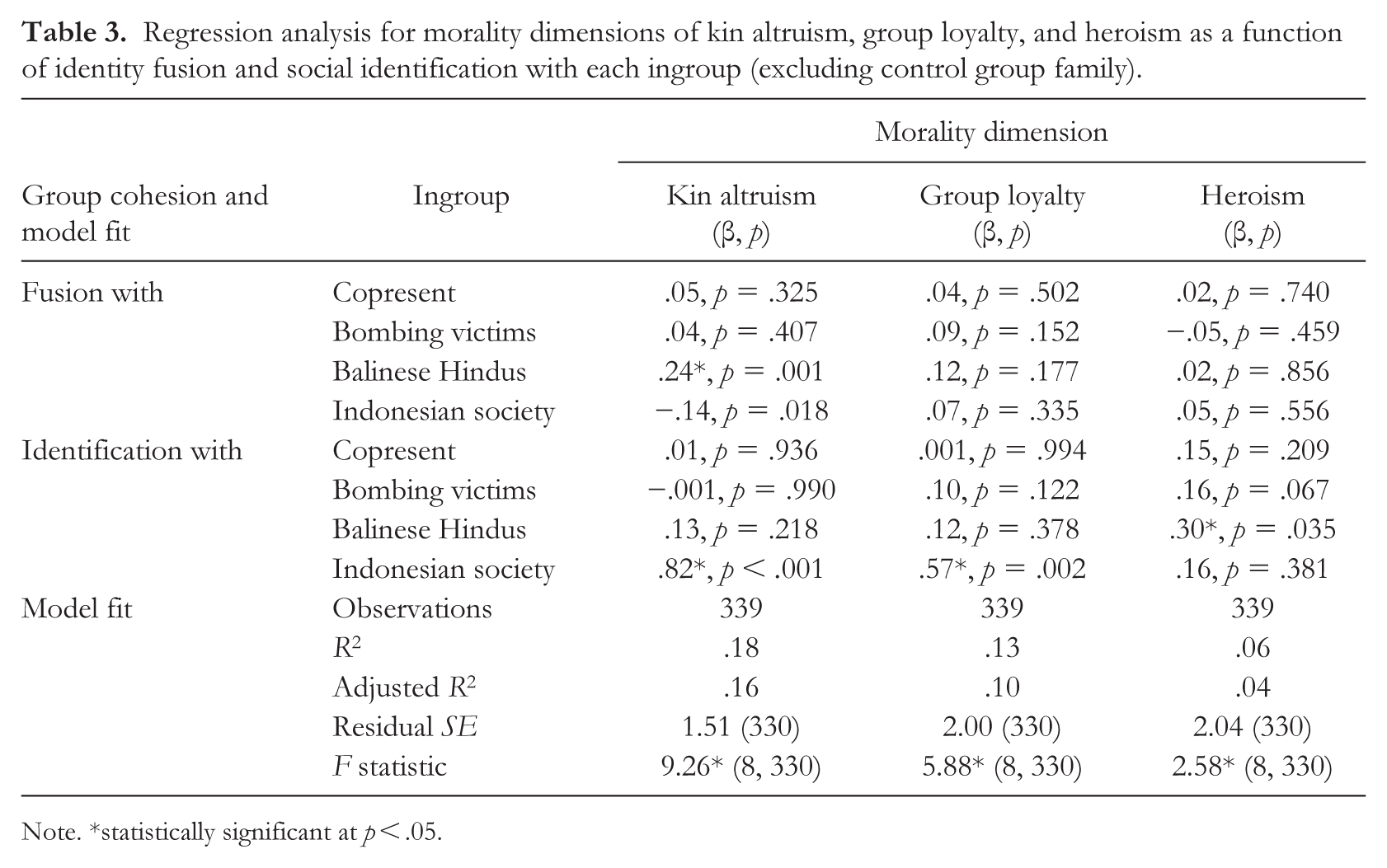
The hypothesis was not supported: identification with Indonesian society was a stronger predictor of kin altruism and group loyalty compared to fusion with the same target; there was an association between kin altruism and fusion with Balinese Hindus. The only relationship with heroism was observed for identification with Balinese Hindus.
To confirm the validity of our measures, we first performed a CFA on all seven MAC variables as latent factors (constructs) and the 21 observable items we measured, three per construct (see supplementary Table 4 in Appendix). Comparative fit index (CFI) showed an adequate fit (CFI = .90, p < .001); root mean square error of approximation (RMSEA) was acceptable, though relatively high (.07, p < .001), as was the standardized root mean square residual (SRMSR, .09), indicating that the constructs were well measured by their respective indicators. Consequently, we applied the recommended seven-factor model and extracted the three variables of interest—kin altruism, group loyalty, and heroism—to test the theoretical structural model.
Correlation tests were performed on all measures used in the analyses for Hypothesis 3 (see supplementary Figures 6 and 7 in Appendix). Among numerous significant correlations, strong positive correlations were found between kin altruism and group loyalty, r(338) = .57, p < .001, and medium positive correlations between heroism and group loyalty, r(338) = .41, p < .001.
Next, we applied a multivariate regression model to the four fusion targets and four identification targets as predictors (eight in total), and each morality measure as outcomes (see Table 3; for the correlation matrix of main variables, see supplementary Figures 4 and 5 in Appendix).
Regression analysis for morality dimensions of kin altruism, group loyalty, and heroism as a function of identity fusion and social identification with each ingroup (excluding control group family).
Note. *statistically significant at p < .05.
Results indicated that for kin altruism, F(8, 330) = 9.26, p < .001, R2 = .18, the strongest predictor was identification with Indonesian society (β = .82, p < .001), while fusion with the matched target displayed a weak negative association (β = −.14, p = .021). The only other significant contributor was fusion with Balinese Hindus, which displayed a positive relationship (β = .24, p < .001). For group loyalty, F(8, 330) = 5.88, p < .001, R2 = .10, only identification with Indonesian society (β = .57, p = .002) contributed significantly as a predictor. Finally, for heroism, F(8, 330) = 2.58, p = .010, R2 = .06, the only significant predictor was identification with Balinese Hindus (β = .30, p = .034).
Discussion
Goals of the Study
The goals of this work were, first, to investigate the psychological impact of a shared dysphoric experience (the Bali bombings in 2002) on group cohesion and related memory processes, and second, to examine the relationships between group cohesion and morality. As an example of a shared dysphoric event, we chose to focus on the terrorist attack carried out in Bali, Indonesia in 2002 and its effect on group cohesion among Balinese Hindus. We were particularly interested in the effects of direct, staggered, and vicarious modes of experience on the pathway to fusion (vs. identification) via sharedness, personal identity transformativeness, and memory recall. In addition, we sought to explore the relationship between group cohesion and various moral concerns. Both objectives sought to shed light on the differences between two forms of group cohesion: identity fusion and social identification.
We hypothesized that the different contexts in which the dysphoric experience of the terrorist attack was shared would have distinct effects on the levels of fusion and identification with Balinese Hindus and other prespecified target groups, subsequently influencing people’s moral concerns with regard to the event. We hypothesized that having directly experienced the terrorist attack by being physically present when the bomb detonated would lead to the strongest effects on fusion. This means that individuals who were physically copresent during the attack would exhibit higher levels of identity fusion with the affected group. We also anticipated that individuals who experienced the attack in this intense manner and thus had higher levels of fusion might show stronger endorsement of moral values related to caring for close others (kin altruism), demonstrating loyalty to the group, and exhibiting heroic behaviors.
Summary of Results
The results partially supported our first hypothesis. A significant difference in responses was observed in relation to the copresent group (including storytellers), with the direct condition having the highest fusion scores. We observed similar levels of fusion among the three experiential conditions across all fusion categories. Fusion levels were the highest with family members, as anticipated, followed by similar elevated levels for Balinese Hindus and Indonesian society, while bombing victim levels were around the midpoint for all conditions. However, while this should be interpreted with caution due to limited comparisons reaching statistical significance, for three of the four collective targets, the pattern of responses followed our predictions: the direct condition displayed the highest average fusion score, and the vicarious condition, the lowest. Supporting Hypothesis 1.2, fusion with Balinese Hindus was stronger when: (H1.2a) Balinese Hindus had been copresent with the participant during the event across all three modes of experience, although it was most pronounced amongst those who had a direct experience; and (H1.2b) the participant had a stronger episodic-like memory of these members being present. Regarding all other ingroup targets, the data only allowed examining fusion with each ingroup target as a function of the presence of any ingroup (rather than the matching ingroup). The presence of any ingroup member, the episodic-like recall of these members, and the relational strength with those present predicted fusion with those who were copresent, but not with other group categories.
Results of the testing of Hypothesis 1.3 confirmed that a primary factor driving the relationship between the dysphoric experience and identity fusion with Balinese Hindus was the event’s transformative effect on the individual’s personal identity. Nevertheless, fusion was not directly associated with the visceral response and emotional arousal evoked by the memory, contrary to our predictions.
Diving deeper into the mediating mechanisms at play, Hypothesis 2.1 was partially confirmed, showing that the event’s transformative impact was predicted by participants’ visceral response to the memory (the former, but not the latter, showing association with fusion, as noted). On the other hand, transformativeness was not predicted by either vividness or the emotional arousal evoked by the memory. Furthermore, the relationship between transformativeness and fusion was not strongly mediated by perceived sharedness of the dysphoric experience (H2.2), except for a weak but statistically significant mediation effect for the copresent ingroup. That said, the mediation pathway did prove weaker when looking at social identification, as predicted (H2.3); and the relationship observed between transformativenes and identification was weaker than that observed with fusion, though both relationships were of a relatively small magnitude. The small indirect effects represented by the mediation pathway suggest that the effect of transformativeness on fusion was not mediated by perceived sharedness in the case of Balinese Hindus and the Bali bombings.
Discussion of Results
Overall, the study’s results confirm that sharing experiences in time and space (directly) appears to be an important factor, though not necessary or sufficient, for the development of a deep and enduring sense of kinship with those who shared the experience, a core component of identity fusion. The elevated levels of fusion with most ingroup categories suggest that the preselected ingroup targets were perceived as relevant to the event and ensuing processes, acting as markers of who may have been similarly impacted by the experience, an impact clearly capable of rippling across various salient spheres of group alignment. The exception of lower fusion levels with bombing victims is understandable given the large number of foreign tourists among the victims. Despite the anticipated patterns we observe in the data, the nonsignificant results and relatively weak effects warrant future reproduction of the findings with larger or related samples to confirm the results and allow for the detection of more subtle distinctions between groups.
We further learned that the impact on fusion was not just strongest for participants who were there at the time and place of the event, but these participants were most strongly fused with the very people who were there with them. One ingroup category consistently stood out: copresent group members. People who directly experienced the dysphoric event had higher levels of fusion with other people who were with them at the time of the experience. When those copresent were Balinese Hindus, this led to higher fusion with this group. This is understandable as these are the people with whom they shared a highly powerful, salient, and memorable experience of the event.
In line with this, the stronger the episodic quality of their memory of those who were present with them during the experience, at the time and place of the bombings, the higher the fusion with them. This accords with the suggestion that fusion is more likely to develop from vivid and detailed memories of the members with whom the dysphoric experience was shared (Whitehouse, 2018, 2021). The role of episodic memory might explain why Hypotheses 1.1 and 1.2c were not supported for the Balinese Hindu group category, as well as most other categories: if members with strong relational ties were present but are not vividly remembered, this might undermine the process of fusion with them.
In addition to the experience itself, its transformative impact proved to be another stepping stone to fusion. The extent to which participants judged that the bombings had transformed their life and identity was associated with their level of fusion with Balinese Hindus. When people recall such an experience, they reflect on its significance and how much it changed their life and identity, capturing the transformative impact of the event.
It is therefore surprising that fusion was not directly associated with visceralness and emotional arousal evoked by the memory, or predictive of the memory’s transformativeness effect on fusion, contrary to our predictions and previous studies pointing to these factors as potential drivers of fusion (Muzzulini et al., 2022; Swann et al., 2012). This is possibly due to the 20-year gap between the atrocity and our survey, which diminished the emotional intensity of recall, and in particular the effects of replay both in interpersonal narratives and media coverage.
Perceived sharedness mediated the transformative impact of the direct experience on fusion with those who were copresent. This makes sense if experiencing the terrorist attack together was a more group-defining experience and thus more likely to drive fusion among those copresent. Nevertheless, the mediation effect observed was weak, and not significant for all other ingroup categories. A possible theoretical explanation for the muted mediating role of perceived sharedness of this event in the fusion with Balinese Hindus is that fusion levels in this community are the result of other more salient shared experiences than that of the bombing event more than 20 years ago. The weak or absent mediation in the current data means that, at least using our current measures, perceived sharedness of the experience among those copresent was not a key driver of fusion, possibly due to the memories of those copresent having faded over the decades since the bombing. One reason for considering this interpretation is that the people who were copresent when the attack took place came from a diverse array of countries, and many never saw each other again or joined a group or institution that could serve as a focus for subsequent strong shared identity formation. Future research is needed to explore how the ephemerality of group identities associated with highly dysphoric events may affect fusion outcomes over time.
A few explanations arise for some of the weaker differences between the three modes of experience and their relationship to fusion and mediating factors. From a methodological point of view, the measure of fusion used in the study might not have been sufficiently sensitive to capture the extent of the differences in effects between directly and indirectly shared experiences on the strength of fusion and its consequences for pro-group action. For instance, a previous study found that fusion among Libyan revolutionaries with their battalions and other battalions was of a similar ceiling level for frontline fighters who shared direct intense dysphoric combat experiences as for the providers of logistical support who only shared intense combat experiences indirectly. However, when confronted with a forced-choice question asking them to select the group they felt most fused to, frontline fighters more often selected their battalion (45.0%) as compared with the providers of logistical support (28.0%; Whitehouse et al., 2014). A similar forced-choice measure in this study might have revealed similar relative distinctions.
Alternatively, indirect modes of experience could also be effective drivers of fusion due to the social sharing of emotions, a form of self-disclosure focused on emotional experiences (Rimé, 2009). Intense emotions, such as those induced by collective traumas, elicit more sharing of emotions among members of the affected community (Rimé et al., 2020). Longitudinal data on Spanish participants’ emotional responses to the 2004 Madrid terrorist attacks showed that higher sharing predicted stronger social integration and posttraumatic growth (Rimé et al., 2010). Similarly, the negative emotional response expressed in French tweets after the 2015 Paris terrorist attacks was followed by a notable long-term increase in the use of verbal indicators of solidarity (Garcia & Rimé, 2019). The very act of sharing emotions (and listening to someone sharing them), as occurred in the vicarious condition of this study, is thus capable of creating and strengthening group bonds.
These findings align with research examining the close relationship between identity fusion (or situated social identity) and emotional synchrony (Rimé & Páez, 2023; Rimé et al., 2020; Zabala et al., 2024). The concept of emotional synchrony during powerful experiences might help explain the effectiveness of direct experiences in fusing present group members—something our study clearly could not measure in real time (“perceived sharedness” being a retrospective measure). However, future studies selecting events that enable comparisons between real-time measures and retrospective assessments could help further explore the emotional and mnemonic mechanisms that guide fusion. Our study contributes to the topic of situated social and emotional synchrony (see Bouchat et al., 2024) by reaffirming the distinction between social identification and identity fusion—the latter being a stronger, more visceral, and emotionally charged form of group cohesion.
Fusion and Morality
As less is known about the relationship between identity fusion and the different aspects of morality, it was necessary to first validate the measures of morality used in the study with the present dataset. Consequently, a confirmatory factory analysis (CFA) was conducted, and it confirmed a suitable fit between the measures used in the study and the latent variables they represented based on the MAC model (Curry, Mullins, & Whitehouse, 2019). The dimensions of moral attitudes towards the group fits well into the seven cooperative principles of kin altruism, group loyalty, reciprocity, heroism, respect, fairness, and property rights.
However, our findings concerning the relationships between group cohesion and morality run counter to the predictions formulated in Hypothesis 3. In the case of the population of Bali, it seems fusion is not a strong predictor of either group loyalty or heroism, based on the MAC model. However, fusion with Balinese Hindus was associated with kin altruism. Furthermore, there were larger and more consistent relationships observed with identification with the broader, categorical ingroup targets of Indonesian society and, to a lesser degree, Balinese Hindus.
This observation is not entirely surprising, as identification processes may be more readily associated with larger and more impersonal groups, and with doctrinal systems emphasizing moral principles (Whitehouse & Lanman, 2014). Moreover, in a study by Kavanagh et al. (2020) exploring fusion and identification amongst Indonesian Muslims, they found that group identification better predicted parochialism, including willingness to carry out extreme pro-group actions, than identity fusion. They argued that when high arousal “imagistic” events are accompanied by an established media narrative, this may hinder their ability to serve as a catalyst for personal reflection and the generation of relational bonds, which are crucial for identity fusion processes. The Bali bombings is clearly an event with strong associated narratives, and although it was undoubtedly a transformative event for those who experienced it directly, it could also be considered an event that has been successfully utilized to generate national identification and a socially transmitted narrative processed in semantic memory rather than fusion based on shared episodic memories (Whitehouse, 2018; Whitehouse & Lanman, 2014). One point to note is that the more participants socially identified with Indonesian society, the more they valued actions that reflect kin altruism and group loyalty, while identification with Balinese Hindus was more strongly associated with heroism.
Limitations
There are a number of limitations to take into account regarding this study. First, due to logistical issues related to the outbreak of COVID-19, the study recruited fewer participants than originally intended. In total, there were 339 participants divided across three conditions, leading to medium–low power, especially in analyses involving further subdivisions of the observations (family present or not present). Moreover, a number of the measures suffered from ceiling effects and therefore violated normality assumptions, with the bulk of data points clustered towards the higher end of scales. Finally, in dealing with complex, historically significant events from decades past, there are always third variables and popular narratives that prevent the drawing of firm causal relationships. Therefore, we recommend that the relationships observed be validated in independent replications with relevant populations.
Conclusion and Future Directions
This study investigated the impact of the different ways a dysphoric event was experienced and remembered on the identity and group cohesion of Balinese Hindus, and potential relations to moral attitudes, offering a window into how social cohesion is shaped by shared experience, in turn motivating group-oriented behavior. The findings point to important patterns, including that experiencing dysphoric events directly, hence sharing them in time and space, is associated with the highest levels of identity fusion with various salient ingroup categories, in particular with people who were also present and with the Balinese Hindu community, especially when they are vividly remembered. The study also provides evidence that an experience’s transformative effect is linked to fusion, while perceived sharedness only played a limited role in mediating this relationship among Balinese Hindus.
Future studies should use larger samples and extend to other case studies of dysphoric experiences to examine if the patterns we observed replicate across cultures and contexts. There is also a need for further examination of the relationships between dysphoric experiences, fusion, identification, and moral values, as here we have taken only a preliminary step. The important relationship observed between group identification and kin altruism and group loyalty is an intriguing outcome and deserves further investigation. Taken together, the findings reported here provide us with a richer understanding of why and how members of a group come to bond and cooperate with each other, and how powerful events are perceived and end up shaping group identity and action, thus offering practical insight into the psychological, social, and political levels related to societal resilience and cooperation in the face of terrorist atrocities.
Supplemental Material
sj-docx-1-gpi-10.1177_13684302261419396 – Supplemental material for The tragedies that bind us: Shared memories, identity fusion, and moral concern among Balinese Hindus following the 2002 Bali bombings
Supplemental material, sj-docx-1-gpi-10.1177_13684302261419396 for The tragedies that bind us: Shared memories, identity fusion, and moral concern among Balinese Hindus following the 2002 Bali bombings by Daniel Revach, Christopher Kavanagh, Barbara Muzzulini, Idhamsyah Eka Putra, Fajar Erikha, Ni Luh Indah Desira Swandi, Rohan Kapitany and Harvey Whitehouse in Group Processes & Intergroup Relations
Footnotes
Funding
The authors disclosed receipt of the following financial support for the research, authorship, and/or publication of this article: This work was supported by an Advanced Grant (“Ritual Modes: Divergent Modes of Ritual, Social Cohesion, Prosociality, and Conflict”; grant agreement No. 694986) from the European Research Council under the European Union’s Horizon 2020 Research and Innovation Programme (granted to HW).
ORCID iDs

Supplemental material
Supplemental material for this article is available online.
Notes
References
Supplementary Material
Please find the following supplemental material available below.
For Open Access articles published under a Creative Commons License, all supplemental material carries the same license as the article it is associated with.
For non-Open Access articles published, all supplemental material carries a non-exclusive license, and permission requests for re-use of supplemental material or any part of supplemental material shall be sent directly to the copyright owner as specified in the copyright notice associated with the article.
