




Abstract
Group and intergroup research often addresses the ways in which people care about a specific group but focuses less on caring about groups in general. Here, we investigate individual differences in how likely people are to join and invest in the groups to which they belong. This idea is related to collectivism, but collectivism measures have been plagued by theoretical and measurement weaknesses. We therefore developed a Group Orientation Scale and a Generalized Identification Scale to measure how much people care about groups, and test the scales’ predictive validity alongside related constructs. Both measures are reliable but the Group Orientation Scale items were found to be easier to comprehend. Furthermore, group orientation predicts identification with real and minimal groups, the intensity of emotional reactions to group concerns, contributions made in a public goods dilemma, intentions to engage in personal sacrifice to limit coronavirus infections, and motivation in group tasks.
Keywords
Deciding on whether to join a group and caring about the groups to which we belong are central to human affairs. However, the extent to which people care about groups is generally investigated in relation to one specific group at a time, and various measures of group identification exist for this purpose (e.g., Leach et al., 2008). People of course differ in which groups they care about: some find ethnic group membership important, while others emphasize professional group membership. Less investigated is whether some people care more than others about groups in general. Are some people more motivated and more likely to join, identify with, and work toward the goals of any group? Such a motivation could underlie different forms of group-related behavior, independent of the specific group concerned. Here, we investigate whether we can measure such a tendency to care about groups, something that we refer to as group orientation.
The Importance of Groups
In our complex social world, weighing up advantages and disadvantages of group belonging is something we do regularly and probably have done since our primate evolution (Van Schaik, 1983). Many theories address the issue of group belonging, attesting to its importance. Factors affecting the motivation to belong to a group include contextual fit (Turner, 1987), distinctiveness (Brewer, 1991; Jetten et al., 2004), uncertainty reduction (Hogg, 2007), need for social attachment (Leary et al., 2013; Valcke et al., 2019), the material benefits groups can provide (Johnson et al., 2006), and group entitativity (Campbell, 1958; Crawford & Salaman, 2012). Other theories focus on distinctions between personal and group-related aspects of the self-concept. For example, self-categorization theory (Turner, 1987) distinguishes personal from social identity, and this is echoed in system justification theory’s distinction between ego and group justification motives (Jost, 2019).
Having decided to join a group, people need to decide how much to invest in the group and how hard to work in its interests. This of course depends on the context and the group. People will invest in groups that are important to them. This is clear from work on intergroup relations (Ellemers et al., 1999), collective action (van Zomeren et al., 2008), and from research in organizational psychology (Christ et al., 2003).
Although joining a group or investing in a group will depend on the context and the specific group, there may be individual differences in how likely people are to generally care about groups. This is a generalized version of perceiver readiness to see the world from a social identity perspective (Turner, 1987). Do the individual differences we investigate contradict the posited flexible nature of self-categorizations? Historically, social identity researchers have emphasized a contextual approach in that specific self-categorizations flexibly change when the context changes. This has been explained as diverging from a personality approach: because identities change, we should expect them to be fixed only when contextual factors are also fixed (Turner & Onorato, 2010). Does our investigation of individual differences contradict this? In fact, the social identity approach also allows for interactionism in which both agent and context play an important role. For example, group identification often interacts with contextual factors in predicting group-based perceptions (Spears et al., 1999). Furthermore, the individual difference we investigate here is not the type of personality that Turner and Onorato (2010) argued against, in which a specific identity has a fixed importance. Rather, we investigate the possibility of individual differences in people’s readiness to self-categorize as a group member across groups and contexts.
We call this generalized version of perceiver readiness group orientation: people’s inclination to belong to a group, invest in ingroups through group attachment, and be concerned about group goals. People high in group orientation will therefore tend to belong to and invest in a larger number of groups, although they are unlikely to care about all groups. For example, there are large individual differences in how much people identify with novel groups, and that are consistent between a novel small interpersonal network and a larger social category (Easterbrook & Vignoles, 2012). In this paper, we investigate whether there are reliable individual differences in group orientation that predict group-related behavior across various contexts, and how we can measure them.
Measuring Group Orientation
Crucial to measuring group orientation is the distinction between caring about other individuals and caring about the groups to which you belong (Brewer & Gardner, 1996). Indeed, there is a fundamental distinction, both empirically and theoretically, between interpersonal relations and group or intergroup processes affected by social identity (see Spears, 2021). One of the key tenets of the social identity approach is that an explanation of (inter)group psychology and behavior cannot be achieved only by referring to individual-level constructs. Following this metatheoretical principle (Abrams & Hogg, 2004), caring about groups cannot be seen separately from social identities and is qualitatively different from interpersonal relations. This is why a measure of group orientation should exclusively address the group level, rather than the interpersonal level (see also Spears, 2021).
There are several individual difference measures that assess how people relate to others, but there are surprisingly few measures that explicitly deal with how people relate to groups (Brewer & Chen, 2007). There are measures of identification with one particular group but few measures assessing people’s relation with groups in general. Below, we discuss whether existing measures related to group orientation satisfactorily address the group orientation concept. If they do, such measures could be used to test our main hypothesis that there are individual differences in the extent to which people care about the group.
The need to belong is a person’s need for interpersonal attachment (Baumeister & Leary, 1995; Leary et al., 2013) and applies both to relations with individual others and to belonging to groups. However, we want to focus on the group exclusively, not on interpersonal attachment, which can evoke issues of interdependence and reciprocity less relevant to the group level of identity. Furthermore, several items in the Need to Belong Scale also measure anxiety about a lack of interpersonal attachment (see also Valcke et al., 2019). As such, this measure seems distinct from group orientation.
In cultural psychology, there are well-known concepts related to the importance of others and of groups: individualism versus collectivism. Some key aspects of collectivist cultures are claimed to be that people (a) define themselves as part of a group rather than as unique individuals, (b) prioritize group goals over personal goals, (c) follow norms and obligations rather than personal preferences, and (d) value relationships even when they derive few benefits from them (Singelis et al., 1995; Triandis, 1995). Although these concepts refer to differences between cultures rather than individuals, they have also been used to predict behavior at the individual level. For example, collectivists exhibit less social loafing than individualists (Earley, 1993), show more organizational citizenship behavior (Moorman & Blakely, 1995), and cooperate more in a public goods dilemma when there is a norm of cooperation (Chen et al., 2007). Some studies find a positive relation between collectivism and group identification (Li & Zhang, 2020), but others find no relation (Capozza et al., 2000).
However, the collectivism construct has been criticized for not distinguishing clearly between interpersonal relations and relations with the group (Brewer & Chen, 2007). A focus on group rather than interpersonal relations is crucial for the group orientation construct given the differences between these two (Spears, 2021). Furthermore, collectivism measures lack validity and reliability (Brewer & Chen, 2007; Oyserman et al., 2002), for example because they are strongly influenced by response styles (Schimmack et al., 2005). Nevertheless, a useful distinction is the one between horizontal and vertical collectivism (Singelis et al., 1995; Triandis & Gelfand, 1998). Horizontal collectivism emphasizes similarities and common goals with others but not submission to authority (Kemmelmeier et al., 2003; Triandis & Gelfand, 1998, p. 119). Vertical collectivism, on the other hand, emphasizes the integrity of the ingroup and competition with outgroups (Triandis & Gelfand, 1998, p. 119). Group orientation, with its emphasis on building bonds with others and working towards group goals, is closer to horizontal collectivism. Thus, horizontal collectivism potentially taps group orientation but, apart from one study examining its relation with organizational citizenship behavior (Rhee et al., 2017), there is no research on whether horizontal collectivism is related to the group-based thinking and behavior that is central to group orientation. Furthermore, most horizontal collectivism items mention individual others, and not the group.
Scales related to individualism–collectivism explicitly aimed at measuring within-culture individual differences have also been developed (Singelis, 1994; Yamaguchi et al., 1995). A popular measure is that of independent and interdependent self-construal (Singelis, 1994), which assesses whether people define themselves as unique individuals or in terms of their relationship and group memberships. However, most interdependent self-construal items refer to relations with others rather than groups.
Another measure potentially tapping group orientation is collective need for inclusion, which is the need to be accepted by social groups (Valcke et al., 2019). Collective need for inclusion focuses exclusively on the group level and was developed together with a measure of the relational need for inclusion, which focuses on interpersonal relations. Some items in the Collective Need for Inclusion Scale measure the motivation to belong to groups (e.g., “Being part of a group is important to me”), which is close to how we define group orientation. However, half the items tap the need for and dependence on groups, for example, “I need to feel connected to groups” and “Groups can be my safe haven.” This focus on motivation for group belonging because it provides something that is otherwise absent is different from actually joining a group and caring about its goals. Several factors (e.g., anxiety) might interfere with the relation between the need to be accepted in a group and joining and working towards a group goal. Furthermore, people might care about group goals without necessarily feeling that the group fills a void for them.
Finally, identification refers to people’s connection to one particular group. Group orientation should predict identification because if people are motivated to belong to and invest in groups, they will end up with strong connections to those groups and become high identifiers. It, therefore, seems plausible to measure how much people care about groups in general by taking a validated identification measure and reformulating the items in terms of groups in general. To our knowledge, such a Generalized Identification Scale has not been used before. Some existing scales contain a few generalized identification items, but (a) they do not offer a balanced or complete measure of all identification aspects, and (b) they have not been validated as a measure of how much people care about groups in general. For example, the Collective Self-Esteem Scale (Luhtanen & Crocker, 1992) has items such as “I feel good about the social groups I belong to” as part of its Private Subscale; and items such as “The social groups I belong to are an important reflection of who I am” as part of its Identity Subscale. However, the Collective Self-Esteem Scale lacks items about commitment or self-stereotyping, which are considered essential aspects of identification. Similarly, many need for identification (Mayhew et al., 2010) items are generalized versions of items that have been used in scales to measure identification with a particular group (e.g., “I enjoy being part of my groups” and “I have a lot in common with other members of my groups”), but the scale does not represent the construct well. For example, six out of 11 items concern how groups inform identity, but there are no items concerning group commitment.
To the best of our knowledge, no extant measure fully captures the group orientation construct, that is, a general tendency to want to belong to and invest in ingroups. How, then, can we measure group orientation? As already noted, items should refer to groups rather than interpersonal relationships (Brewer & Chen, 2007). Another requirement is that the items should refer to groups in general to avoid people’s relation with any particular kind of group unduly affecting the score (this rules out several horizontal collectivism items).
To measure group orientation, one solution could be to ask people to report how they generally feel and act in group situations. We focus on how much people prefer or enjoy three basic aspects of relations with groups: (a) joining or belonging to a group, (b) attachment to the group and its members, and (c) working towards group goals. If people care about groups, they should show a preference and behavioral inclination in relation to all three aspects.
Additionally, we formulate a generalized version of an identification scale and test whether it taps group orientation. As argued above, a generalized identification scale has not been validated, and scales that do contain generalized identification items do not represent the identification dimensions well. We will therefore formulate a generalized version of a well-validated identification scale (Leach et al., 2008). A possible disadvantage of generalized identification items is that it might be unclear to respondents what is meant by “my groups,” and therefore which groups they should be thinking about when responding to items. We will therefore investigate this potential weakness.
Note that we are not claiming that group orientation is a construct that has not been partly measured before (i.e., by some items in some scales). Rather, as discussed above, there are shortcomings in all measures of related constructs in that they do not address a general tendency to care about groups. Therefore, we investigate the validity of (a) a new group orientation measure related to existing constructs but specifically focused on groups in general, and (b) a generalized identification measure.
The Present Paper
We have structured the paper conceptually, with sections on scale development and validity, rather than reporting each sample as a separate study (some samples serve more than one purpose). We first develop the Group Orientation Scale, test its reliability (Study 1; Samples A–H), and explore its relations with conceptually similar constructs (Study 2; Samples C, E–J). We then test its predictive validity by investigating whether group orientation is related to different ways of caring about a group. The extent to which people care about a group is perhaps most clearly seen in situations in which the concerns of the group diverge from their own individual concerns. Therefore, in most cases, we investigate predictive validity using well-validated measures that tap investment in the group over and above people’s personal interests, consistent with our theoretical focus on group psychology and behavior (Turner, 1987). Studies 3, S1 (Supplemental Material), 6, and 7 investigate identification with existing and minimal groups. Studies 4 and S2 (Supplemental Material) measure emotional reactions to group concerns. Study 5 assesses preferences in a public goods dilemma. Study 7 investigates work motivation on group tasks. Study 7 includes both the group orientation and the generalized identification scales.
Instead of using power analyses, we determined sample sizes by the number of people who responded to an email invitation (Samples A and C), the number of available first-year students (Samples B and E), the purpose of the main study to which the group orientation items were added (Samples F, G, H, and I), or the number of participants we could recruit within a specific time frame (Sample D). Sample J is an exception: an a priori power analysis indicated that, in order to detect a correlation of r = .20 with power = .80 and alpha = .05, we needed at least 191 participants. Data and materials for all studies are available at the Open Science Framework repository (OSF; see Data Availability section). We report all manipulations, measures, and exclusions in these studies.
Study 1: Scale Development and Reliability of the Group Orientation Scale
Item Generation
We formulated 18 items that we thought would capture the group orientation concept (see Table S1 in the Supplemental Material). Nine items were positively worded (high scores indicate more group orientation), and nine items were negatively worded. Most items were based on the three elements we believe to be central to group orientation: preferences to (a) belong to groups, (b) feel attached to groups and group members, and (c) work towards group goals. A few items tap closely related concepts and were based on items from related scales. For example, “I don’t like it when I have to accept a collective or group decision” (reversed) and “When I’m in a group, I put the group’s interest before my own” are similar to interdependent self-construal items. Not all items were included in every study.
Method
Participants
We used data from the first eight samples with a total of N = 3,209 participants (characteristics of Samples A–H are shown in Table 1; in Samples I–J we used the final scale items only). Four were student samples, two were community samples, and two samples contained a mix of university staff and students.
Sample characteristics.
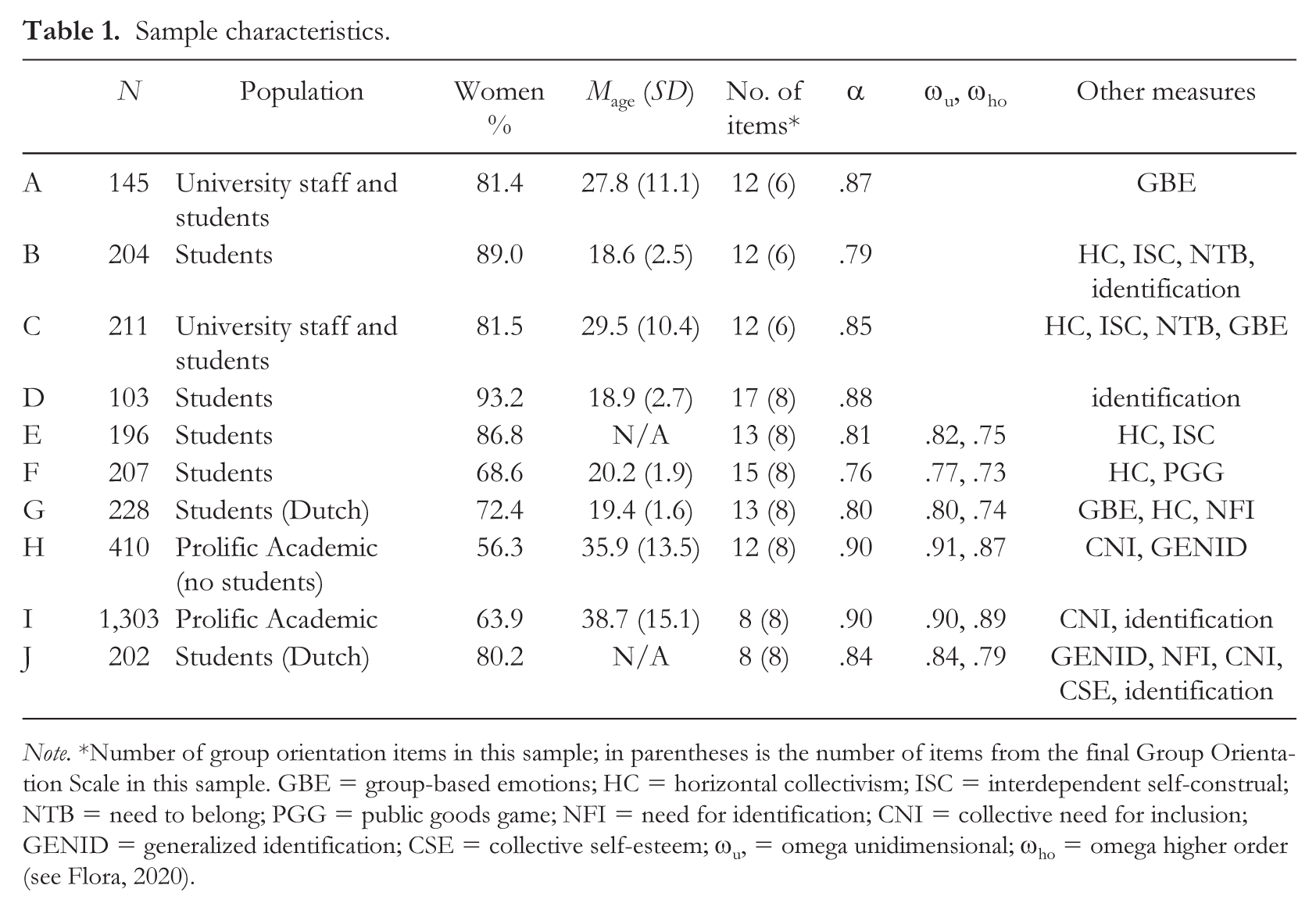
Note. *Number of group orientation items in this sample; in parentheses is the number of items from the final Group Orientation Scale in this sample. GBE = group-based emotions; HC = horizontal collectivism; ISC = interdependent self-construal; NTB = need to belong; PGG = public goods game; NFI = need for identification; CNI = collective need for inclusion; GENID = generalized identification; CSE = collective self-esteem; ωu, = omega unidimensional; ωho = omega higher order (see Flora, 2020).
Group orientation items
Across Samples A–H, we used between 12 and 17 of the items (see Table S1). Samples A, B, and C were pilot studies in which we used 12 items. The wording of four items was changed slightly following Sample C, and from Sample D onwards, the final items were used together with a varying number of other items. The group orientation items were presented together, not interspersed with items from other scales. All items were answered on 7-point scales (−3 = strongly disagree, 0 = neither agree nor disagree, +3 = strongly agree).
Results
Exploratory factor analysis
In Samples A–H, we performed a principal axis factor analysis with oblique (direct oblimin) rotation, and extracted all factors with eigenvalues > 1. The most consistent result across samples was that there was one factor (in all cases except one, this was the first factor) on which the same five items had high loadings. This was the group orientation factor. The content of the other factors was not consistent across studies, so we did not consider these further. By way of an example, in Table 2, we report the pattern matrix of the factor analysis for Samples E and H.
Factor loadings for Samples E and H (pattern matrix after oblique, direct oblimin rotation).
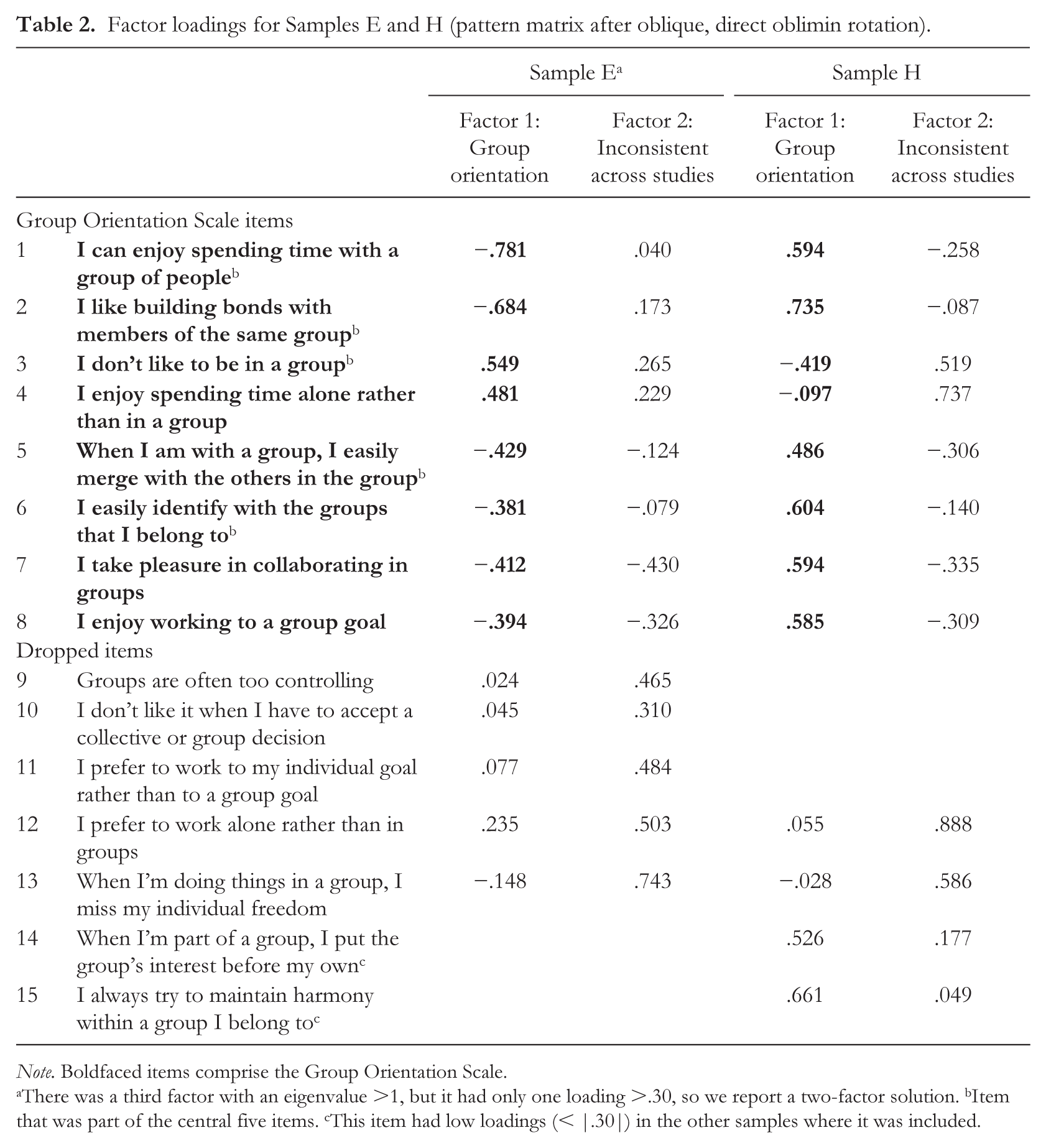
Note. Boldfaced items comprise the Group Orientation Scale.
There was a third factor with an eigenvalue >1, but it had only one loading >.30, so we report a two-factor solution. bItem that was part of the central five items. cThis item had low loadings (< |.30|) in the other samples where it was included.
To determine which other items could be considered part of the group orientation factor, we then used factor loadings from the structure matrix (because additional factors were often correlated and the structure matrix takes this into account in calculating the factor loadings). The five items already identified had loadings that were > |.62| for each item on average, and not a single loading was < |.45|. We decided to add three further items, each of which had average loadings of > |.45| on this factor, and loadings of > |.40| in at least 80% of the samples. Applying these criteria helped to ensure that we had sufficient diversity of item content. Four items were about wanting to be and enjoying being in a group (Items 1–4 in Table 2), two items were about working with others toward a group goal (Items 7–8), and two items were about identification with groups (Items 5–6). Cronbach’s alphas ranged from .76 to .90 in all samples (see Table 1). Thus, we retained eight items for the Group Orientation Scale.
Confirmatory factor analysis
Sample H was the largest sample and the only community one. We therefore selected this sample for a confirmatory factor analysis (CFA) of the eight-item Group Orientation Scale. Given that we measured three aspects of group orientation (wanting to be in a group, identifying with the group, and working towards group goals), an initial question was whether a one-factor or a three-factor model would fit the data better. We therefore fitted one model in which all eight items loaded on one factor, and a second model in which each item loaded on one of three factors that were correlated. The three-factor model had a significantly better fit to the data (chi-squared difference = 46.83, df = 3, p < .001) and lower AIC (difference = 40.83) and BIC values (difference = 28.78). In absolute terms, however, the initial three-factor model did not have a good fit to the data (CFI = .97, TLI = 0.95, RMSEA = .09, SRMR = .03). We therefore decided to permit a covariance between the two negatively worded items. This led to an acceptable fit (CFI = .98, TLI = 0.97, RMSEA = .07, SRMR = .03; see Figure 1).
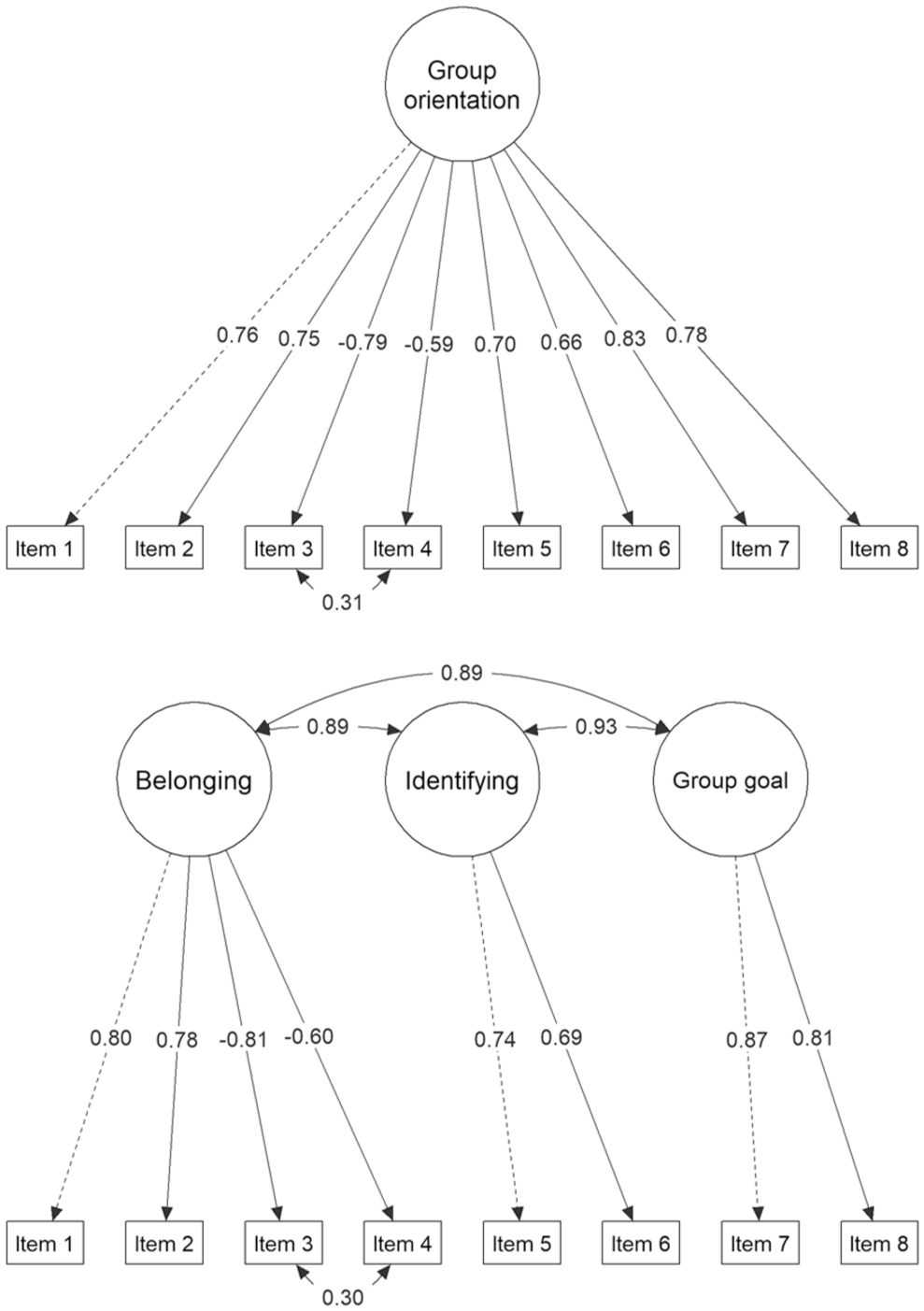
One-factor and three-factor models of group orientation.
This shows that the three aspects of group orientation that we intended to measure can indeed be distinguished from each other. However, the three factors correlated so highly (all > .88) that group orientation measured in this way should be considered to be unidimensional (see John & Benet-Martinez, 2014). We are more interested in the overall group orientation construct than its potential subdimensions, and therefore only report findings using the overall Group Orientation Scale.
Item response theory model
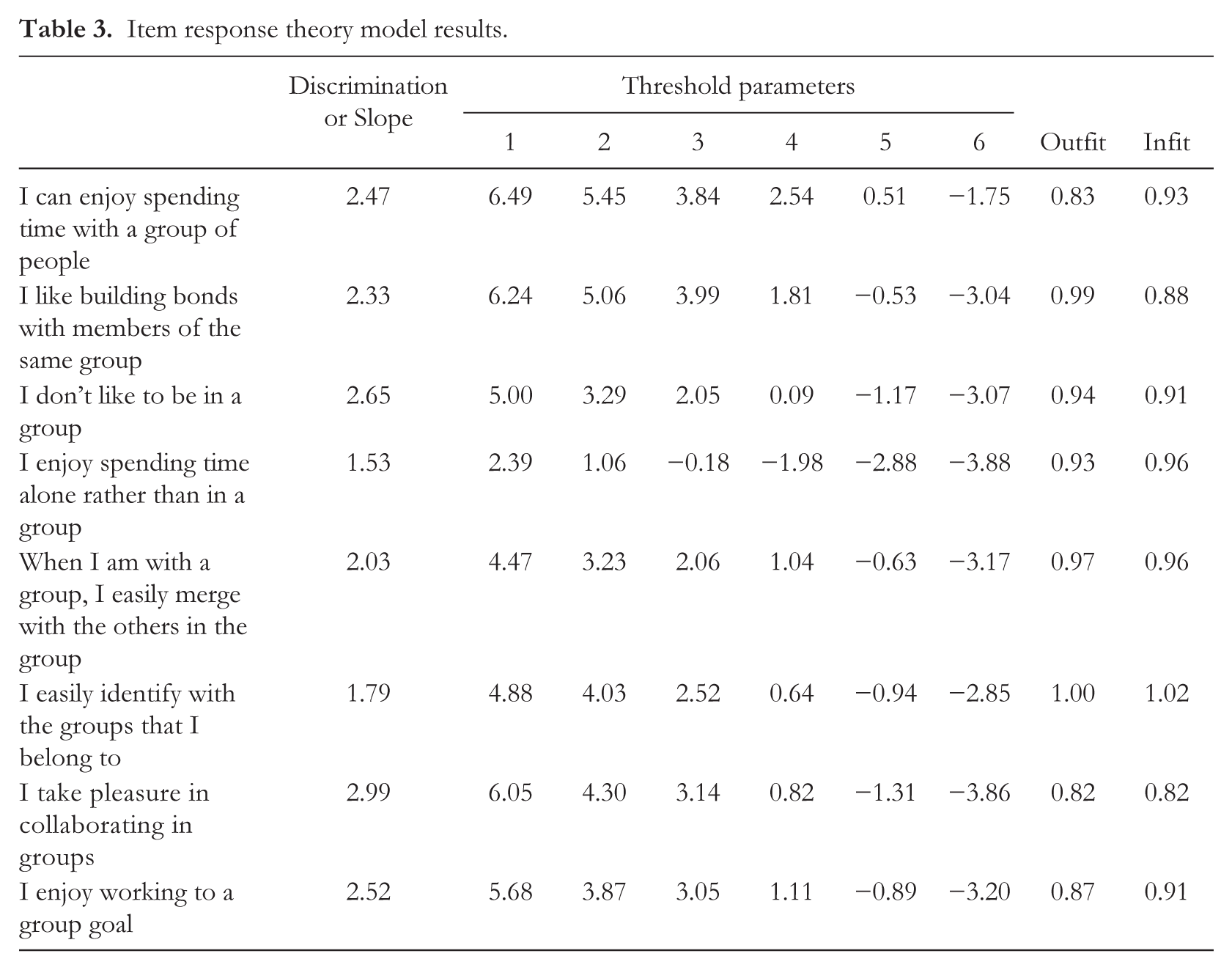
We further evaluated the psychometric quality of the Group Orientation Scale by fitting an item response theory model for graded responses, using the “mirt” package in R (see Table 3). Discrimination parameters for the eight group orientation items were all high, between 1.53 and 2.99 (Baker, 2001). All items showed monotonic changes in threshold values, and none were close to each other. Infit and outfit values were within the [0.8, 1.2] range, which shows that all items fit well to the scale (Smith et al., 2008). When we added the four additional items (that were dropped after the factor analyses) to the model; these indeed had the lowest discrimination parameters. In other words, factor analysis and item response theory methods converged on which items were most suitable. Finally, the test information function had a broad peak, indicating that marginal reliability was > 0.8 for a wide range of theta values [−3.0, 2.0], and > 0.9 for the [−2.4, 1.4] range (Toland, 2013). This means that reliability is weaker for very high levels of group orientation, and the scale will be less precise in distinguishing between people with very high and extremely high group orientation.
Item response theory model results.
Measurement invariance
Sample I was the largest and had the most demographic heterogeneity, so we used it to test measurement invariance for gender (women vs. men) and education (tertiary education degree vs. no tertiary education degree). In both cases, constraining factor loadings to equality led to a decrease in RMSEA and a change in CFI smaller than .002, indicating metric invariance. Similarly, constraining intercepts to equality led to a decrease in RMSEA and a decrease in CFI smaller than .001, indicating scalar invariance.
Test–retest reliability
Samples B and D had a partly overlapping subset of participants who completed the scale twice, with a 2- to 3-month interval (see Study S1). Pearson’s correlation between the group orientation scores at these two time points was r(96) = .59. Correcting for measurement unreliability, using the “scoreItems” function in the “psych” package in R, results in a disattenuated correlation of .74. This demonstrates good test–retest reliability.
Study 2: How Does Group Orientation Relate to Other Constructs?
We investigated the relations between the Group Orientation Scale and other constructs. We included constructs that we believed might be related to group orientation: horizontal collectivism, need to belong, interdependent self-construal, need for identification, and collective need for inclusion. We expected positive correlations with group orientation but not to the extent that group orientation would be redundant with another construct. We also included measures of interpersonal constructs (e.g., the Interpersonal Reactivity Index) and values; these are discussed in the Supplemental Material (Tables S13–S15).
Method
Participants
We used samples C–J (see Table 1).
Measures
Below, we discuss all scales, starting with those used in Sample C.
Group orientation
We used the eight group orientation items previously discussed (although Sample C only had six group orientation items; see Tables 1 and S1).
Horizontal collectivism
Four items were used in Samples C and E (see Singelis et al., 1995). Samples F and G completed seven items (see Table S3). Example items are: “To me, pleasure is spending time with others” and “If a coworker gets a prize, I would feel proud.”
Need to belong
We used the 10-item scale from Leary et al. (2013) in Sample C (e.g., “I want other people to accept me”; see Table S4).
Interdependent self-construal
In Sample E, we included a 12-item Interdependent Self-Construal Scale (Singelis, 1994). An example item is: “It is important for me to maintain harmony within my group.” We used a seven-item scale in Sample C (see Table S5).
Need for identification
In Samples G and J, we measured both subdimensions of need for identification (Mayhew et al., 2010): self-definition (e.g., “I enjoy being part of my groups”) and belonging (e.g., “When I think about myself, I think about the groups I am part of”).
Collective need for inclusion
In samples H, I, and J, we administered the collective subdimension of the Need for Inclusion Scale (Valcke et al., 2019). Example items are: “Being part of a group is important to me” and “I need to feel connected to groups.”
Generalized identification
We reformulated items from Leach et al.’s (2008) Hierarchical Model of In-group Identification scale so that they were about groups in general. In Sample H, we used two items each from the centrality, solidarity, and satisfaction subdimensions; and one item each for self-stereotyping and ingroup homogeneity (α = .90). In Sample J, we used 12 items from the solidarity, satisfaction, centrality, and self-stereotyping dimensions (α = .90). Example items are: “I feel a bond with the groups I belong to” and “I often think about the fact that I’m a member of the social groups I belong to.”
Collective self-esteem
The identity dimension of collective self-esteem was taken from Luhtanen and Crocker (1992) and contained four items (α = .82).
Results
We calculated Pearson’s correlations between all scales available in a sample (see Table 4). When two constructs were measured in multiple samples, we calculated meta-analytic correlations. Although we thought need to belong, interdependent self-construal, and need for identification might be related to group orientation, the correlations were only small to moderate (see Table 4).
Correlations (Pearson’s r) between group orientation and related constructs in Samples C, E, F, G, H, I, and J.
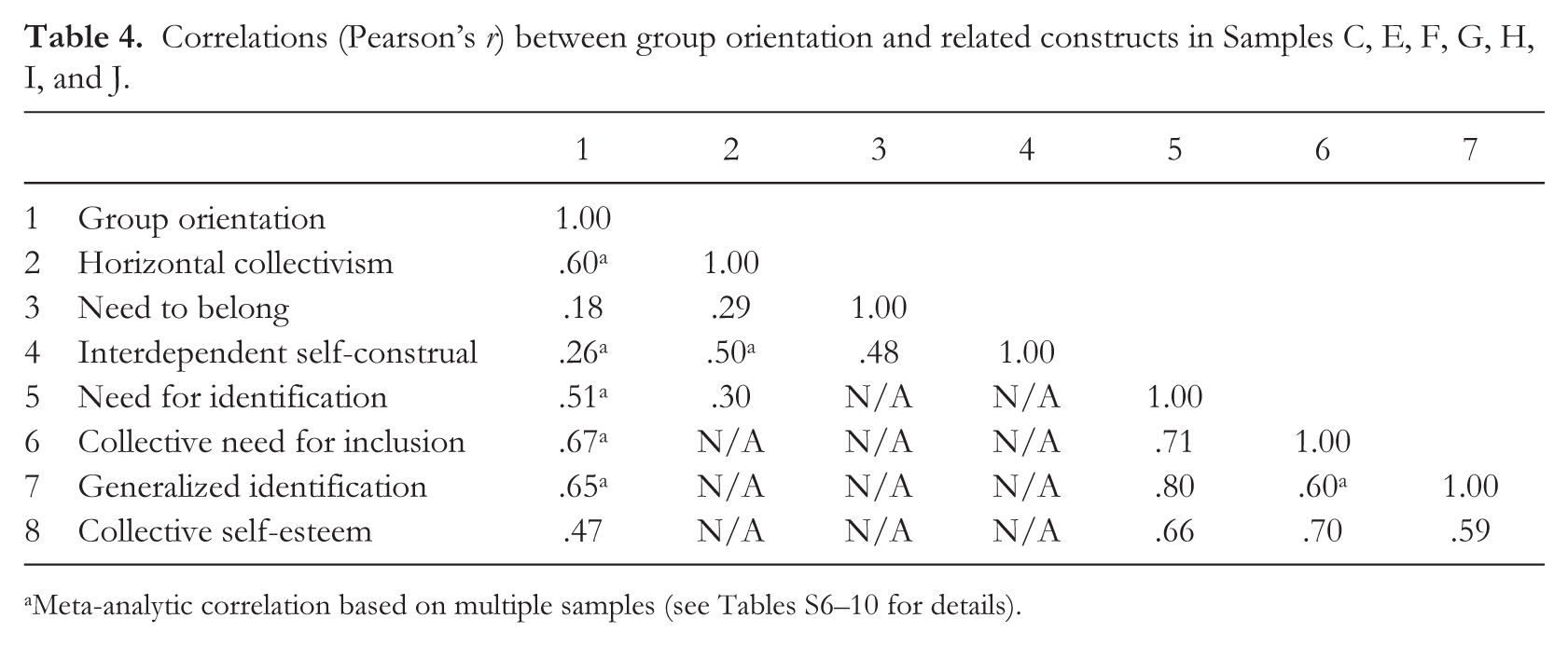
Meta-analytic correlation based on multiple samples (see Tables S6–10 for details).
Group orientation correlated strongly with horizontal collectivism, and we therefore performed exploratory factor analyses to better understand the relation between these two scales. In these analyses, two horizontal collectivism items consistently loaded on the group orientation factor: “To me, pleasure is spending time with others” and “I feel good when I cooperate with others” (see Table S11). The content of these items fits reasonably well with our conceptualization of group orientation. Therefore, when assessing predictive validity in subsequent studies, we will control for this partial overlap between group orientation and horizontal collectivism by allowing these two items to cross-load on both factors in structural equation models. This will better test the independent relations of group orientation and horizontal collectivism with all outcome measures.
We performed similar exploratory factor analyses for collective need for inclusion, which was also strongly related to group orientation (on Samples H, I, and J; see Table S12). These showed that one collective need for inclusion item (“I do not want to belong to groups”) consistently had a cross-loading of > |.25| on the group orientation factor. We will therefore control for this overlap between group orientation and collective need for inclusion by allowing this item to cross-load on both factors in structural equation models in subsequent studies. Overlap between group orientation and generalized identification was only an issue in Study 7, and was dealt with separately (but in a similar way) there. In sum, group orientation is strongly related to other measures, and we will use structural equation models to control for this overlap where appropriate.
Discussion
Group orientation is most strongly related to collective need for inclusion, generalized identification, and horizontal collectivism. However, factor analyses indicate that they all can be seen as separate scales. Only two of the horizontal collectivism items clearly overlapped with group orientation, and we will take this partial overlap into account when assessing the predictive validity of group orientation and horizontal collectivism. There were much smaller correlations with need to belong and interdependent self-construal, which, in the latter case, is surprising given its roots in collectivism.
Predictive validity of the Group Orientation Scale
Studies 1–2 provide evidence of the reliability and construct validity of the Group Orientation Scale. We investigated the predictive validity of the Group Orientation Scale in Studies 3–7. In each study, we included related measures (e.g., horizontal collectivism, collective need for inclusion) as additional predictors to evaluate whether the predictive power of group orientation is unique to the Group Orientation Scale or shared with other, related scales. Where appropriate, we use structural equation modeling to take into account the cross-loadings of items of group orientation and related measures (see Tables S10–S11).
Study 3: Identification With Specific Groups
If group orientation reflects the extent to which people care about groups in general, this should translate into caring about specific groups. People high in group orientation should therefore identify more strongly with the groups to which they belong. To test this, we added group identification measures to Sample B, which contained measures of group orientation, need to belong, horizontal collectivism, and interdependent self-construal (see above). We measured identification with two groups: social class and university students.
Method
Identification
We used a 14-item scale (Leach et al., 2008) to measure identification with social class (α = .90) and with university students (α = .86). Before the identification with social class items, we first asked participants the social class to which they belonged (e.g., working class, middle class).
Results
As expected, group orientation had the strongest correlations with identification with social class and identification with university students (see Table 5). These correlations were not very different from those with horizontal collectivism. However, in a structural equation model in which we allowed cross-loadings for two horizontal collectivism items, it became clear that only group orientation, and not horizontal collectivism, was related to identification (see Figure 2). Need to belong and interdependent self-construal had smaller correlations with the identification scales.
Correlations (Pearson’s r) with identification with specific groups (Sample B).
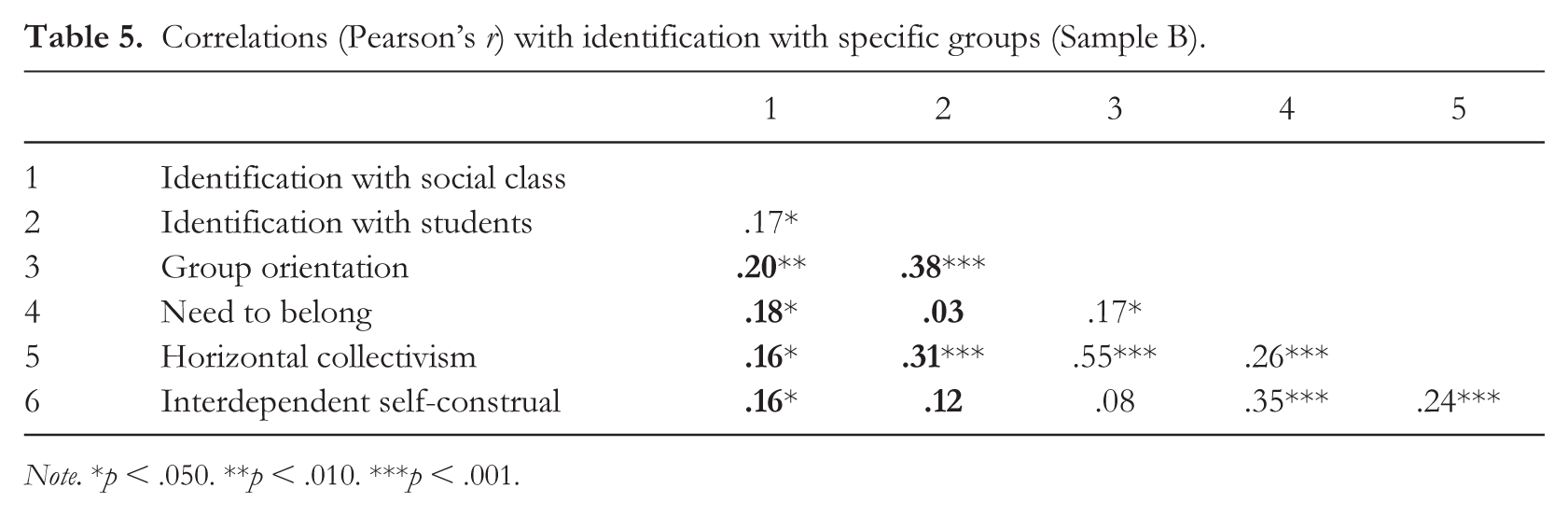
Note. *p < .050. **p < .010. ***p < .001.
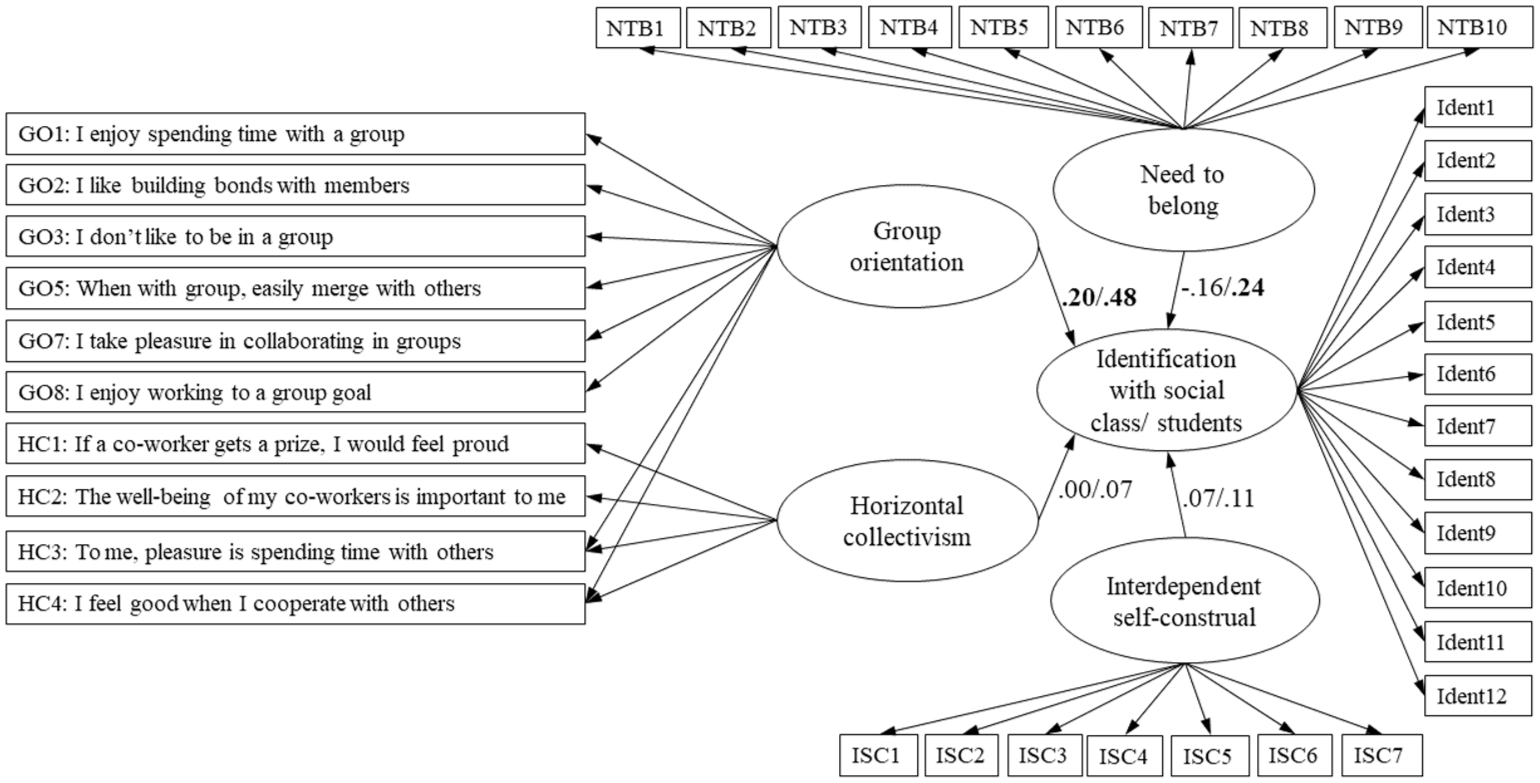
Model predicting identification with social class and with university students.
Discussion
People high in group orientation tend to identify with different, specific groups to which they belong. One limitation is that we only tested this for large social categories, not smaller groups. Although horizontal collectivism had similar bivariate correlations with identification, these relations seem to be primarily due to a partial overlap between group orientation and horizontal collectivism. In Study S1 (reported in the Supplemental Material), we found that group orientation also predicts identification with minimal groups.
Study 4: Emotional Reactions to Group Concerns
Group-based emotions are emotions that people feel on behalf of their group (Doosje et al., 1998; Iyer & Leach, 2008). This occurs through group-based appraisal: people appraise how an event affects their group rather than themselves as individuals. Therefore, group-based emotions are reactions to group concerns (Kuppens & Yzerbyt, 2014). If people high in group orientation care about groups, they should be sensitive to group concerns. We predict that group orientation will be positively related to the intensity of group-based emotions. In the current study, we asked participants to recall and report a situation in which they felt an emotion on behalf of their group, measuring its intensity.
Method
Participants
Two hundred and twenty-eight students at the University of Groningen took part in a lab session and received partial course credits in return (Sample G). Seven participants did not provide a description of a group event (see below) and were excluded from analyses.
Procedure
Participants first took part in a different, unrelated experiment (about attitudes toward immigration). They then completed the need for identification, horizontal collectivism, and group orientation scales. The order of administration of the horizontal collectivism and group orientation measures was randomized. Participants were then asked to describe an emotional group event.
Measures
Group orientation, horizontal collectivism, and need for identification were the measures used in Study 2, Sample G.
Emotional experiences
Participants were asked to describe one emotional event that had affected them as a group member. Full instructions are reported in the Supplemental Material.
Participants rated the intensity of their emotional reaction on a scale from 0 (not intense at all) to 10 (extremely intense). They also rated the intensity of their emotional reaction using 14 emotion words (e.g., admiration, pity, anger, worry), but these ratings are not analyzed here because the situations described by participants varied concerning which emotions were relevant.
Coding of group events
Two judges independently rated the extent to which each event described individual concerns or group concerns on a 7-point scale (1 = only individual concerns, 7 = only group concerns). Ratings were reliable (r = .65) and we therefore averaged the two scores except where there was a discrepancy of at least 3 scale points between the two judges, in which case, a third judge was consulted and his scores were used in the analyses.
Results
We tested whether group orientation predicted the intensity of emotional reactions to group events. First, we selected the 180 participants who described a group event that contained at least a minimal level of group concerns (i.e., received a rating of at least 2, reflecting that there was at least a minimum level of group concerns involved). As predicted, group orientation was positively related to the intensity of group-based emotions (r = .16, p = .034). Horizontal collectivism (r = .24, p = .001) and need for identification (r = .16, p = .030) were also related to group-based emotions. Next, we estimated a similar structural equation model as in Study 3, in which we allowed cross-loadings for two horizontal collectivism items on group orientation. Only horizontal collectivism was significantly related to group-based emotions (β = .34, p = .009), not group orientation (β = −.16, p = .191) or need for identification (β = .12, p = .145).
We further tested whether the relation between group orientation and the intensity of group-based emotions was moderated by the extent to which the event that participants described mentioned group concerns rather than individual concerns. Results were consistent with this idea, but none of the moderations were statistically significant (details are reported in the Supplemental Material).
Discussion
People high in group orientation, horizontal collectivism, and need for identification reported more intense emotional reactions to events that affected a group to which they belonged, suggesting that they cared more about the group. Horizontal collectivism was the strongest predictor, and in a model with these three as joint predictors, only horizontal collectivism had a significant relation with group-based emotion. We also measured group-based emotions in another study (Sample A). However, we did not measure any individual difference measures other than group orientation, so we report those results as Study S2 in the Supplemental Material; in summary, they show that group orientation was related to group-based emotions, even when controlling for the intensity of individual emotions.
Study 5: Public Goods Dilemma
People who care about groups and who value groups’ concerns should be more inclined to cooperate in a group setting. Two items of the Group Orientation Scale tap people’s motivation to work towards a group goal. We therefore tested whether group orientation relates to how much people contribute to achieving a group goal, even if the contribution might not be in their personal interest. Specifically, we tested whether group orientation and horizontal collectivism relate to cooperative behavior in a public goods dilemma. In the analyses, we controlled for social value orientation, which is a motivation to distribute resources equally between self and individual others in allocation decisions, and is positively related to horizontal collectivism (Moon et al., 2018).
Method
This study was embedded in a study about immigration. At the beginning of the study, participants completed the horizontal collectivism and group orientation scales, in counterbalanced order. Then, all manipulations and variables relevant to the other study were presented, which took around 15 minutes. Finally, participants completed a measure of social value orientation and indicated their preference in a public goods game (in counterbalanced order).
Participants
Two hundred and seven psychology students at the University of Groningen (Sample F) started the study but due to a technical error, the first 33 participants did not complete the social value orientation measure or the public goods game. One hundred and seventy-four participants remained (117 female; Mage = 20.2, SD = 1.92).
Measures
The measures of group orientation, horizontal collectivism, and social value orientation were the same as those used in Study 2, Sample F.
Public goods dilemma
Participants were asked to imagine that they belonged to a group of 10 people, who would remain anonymous to each other. Each received €100 at the start of the game and had to decide how to divide the money between themselves and the group. Money given to the group would be doubled and redistributed among all group members. Four examples of contributions and payouts were given, and participants then chose how much to give to the group. No actual payouts were given, and this was explained to participants from the outset.
Results
The public goods dilemma contributions were not normally distributed, Kolmogorov–Smirnov = .24, df = 174, p < .001, so we treated this measure as an ordinal variable. We calculated Spearman’s ρ as a nonparametric correlation. Group orientation was significantly related to size of contribution in the public goods game (ρ = .18, p = .015); this was not true of horizontal collectivism (ρ = .10, p = .196).
For further analyses of the public good contributions as a dependent variable, we recoded them into four categories: 0 to 49 (n = 27), 50 (n = 66), 51 to 99 (n = 21), 100 (n = 60). This four-category variable of contributions in the public goods game was then analyzed as an “ordered” variable using a similar structural equation model to the one reported in Studies 3–4 (see Figure 3). Group orientation was related to investing in the common pool (β = .24, p = .027), but horizontal collectivism was not (β = −.04, p = .684). This effect for group orientation remained marginally significant (β = .19, p = .075) when social value orientation was added to the model. Social value orientation also had a strong positive relation with contributions (β = .29, p < .001).
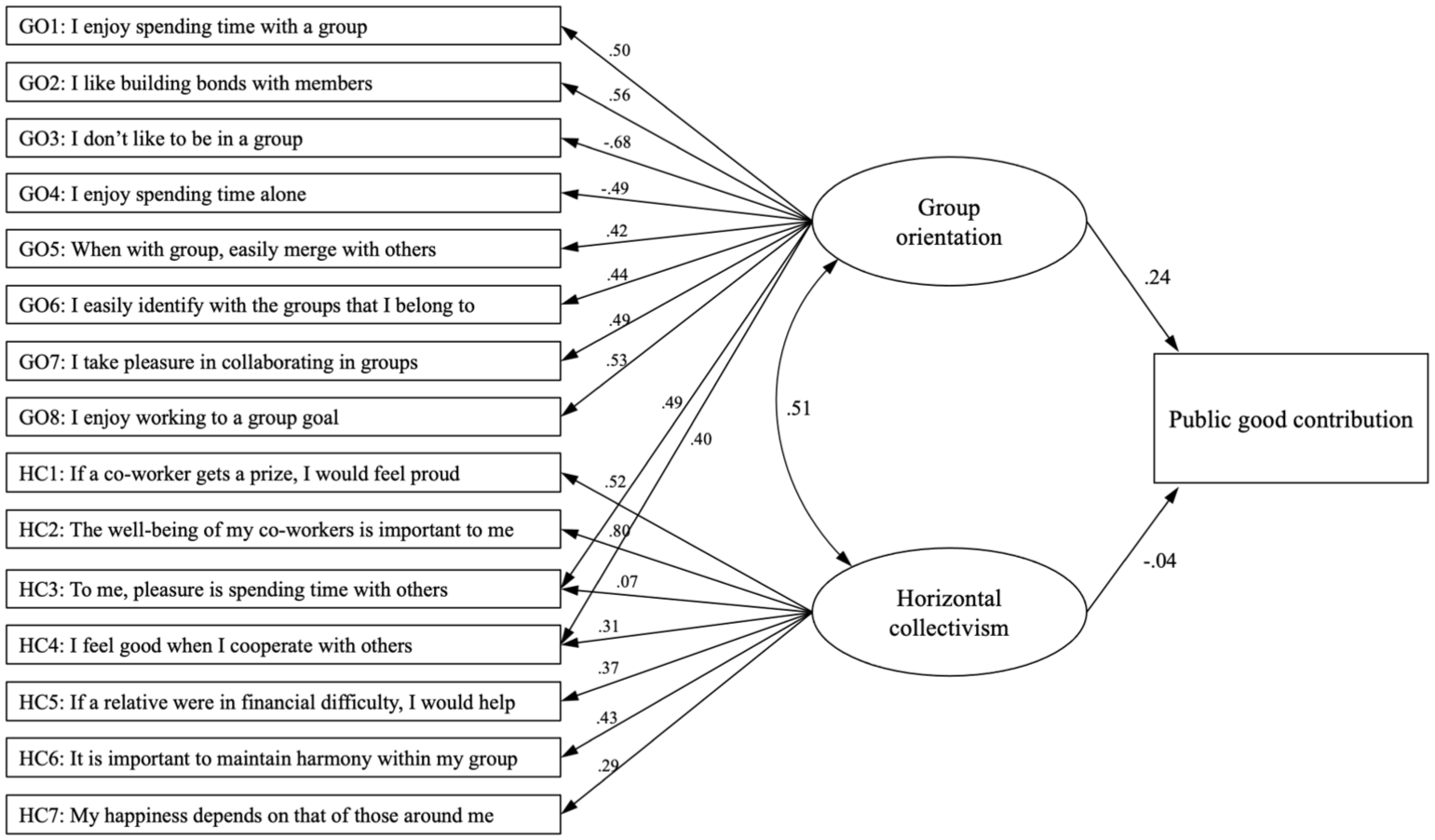
Structural equation model predicting public good contribution.
Discussion
Group orientation was related to higher contributions to the common pool in a public goods game. This relation was independent of a tendency to be generous to individual others. Horizontal collectivism did not have a significant relation to the contributions to the common pool, although the bivariate relation was in the same direction. This means that for four out of five tests (identification with social class, identification with students, identification with minimal groups, and contribution to common pool) there was no relation between horizontal collectivism and the outcome variable when group orientation was also present in the model as a predictor and two horizontal collectivism items were allowed to have cross-loadings on the group orientation factor. Only in the case of intensity of group-based emotions did the relation with horizontal collectivism remain significant. It seems reasonable to conclude that group orientation has better predictive validity than horizontal collectivism.
In Studies 3–5, group orientation predicted the extent to which people seemed to care about the group. A remaining question concerns the kinds of groups for which group orientation is most relevant. Group orientation should be related to caring about ingroups rather than outgroups. We addressed this issue in Study 6 and compared group orientation with collective need for inclusion.
Study 6
In this study, we investigated whether group orientation and collective need for inclusion were related to identification with a range of different groups. We predicted that group orientation would be related to identification with ingroups but not with outgroups, or at least would exhibit weaker correlations. We included collective need for inclusion to explore whether it would exhibit the same pattern of relations as group orientation.
Method
Participants
We recruited 1,303 participants from Prolific Academic (832 women, 467 men, four other; Mage = 38.7, SD = 15.1; Sample I) who lived in the UK and had UK nationality.
Measures
Group orientation was measured as in previous studies (eight items; α = .90). Collective need for inclusion was measured as in Valcke et al. (2019; α = .70). We used a single-item scale (Postmes et al., 2013) to measure identification with seven groups: my family, the town or city I live in, work colleagues (from my current or previous job if unemployed or retired), the UK, Germany, women, and men.
Results
Group orientation had positive, medium-sized correlations with identification with family, town/city, work colleagues, and the UK (see Table 6). The strongest correlation was with work colleagues, and this was significantly stronger than all other correlations. Furthermore, among women, group orientation was positively related to identification with women, r(831) = .33, p < .001; and among men, group orientation was related to identification with men, r(466) = .28, p < .001.
Correlations with identification: Study 6.
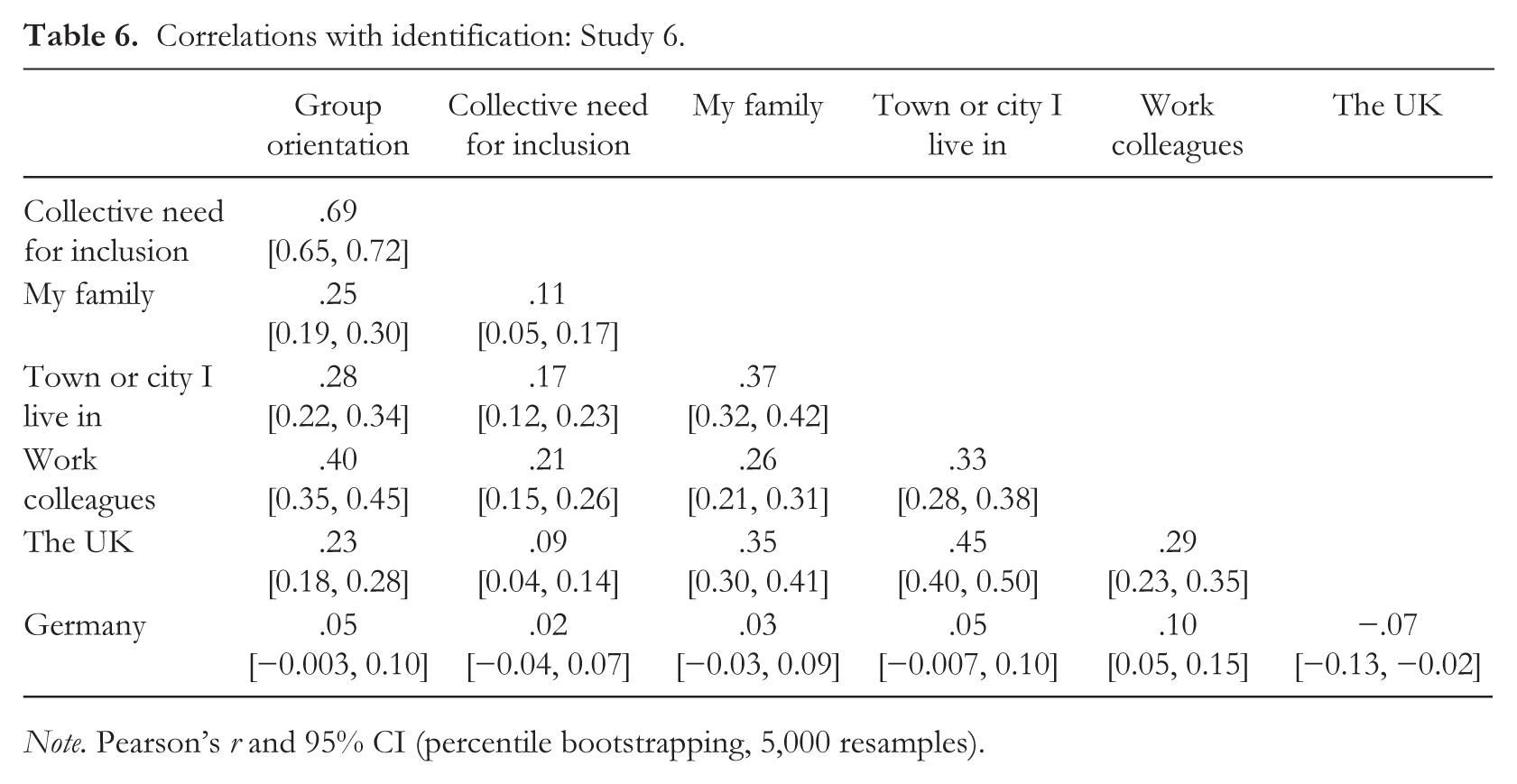
Note. Pearson’s r and 95% CI (percentile bootstrapping, 5,000 resamples).
Collective need for inclusion had significantly weaker associations with identification for every ingroup (see Table 6). Similar to group orientation, collective need for inclusion was related to own gender identification for women, r(831) = .24, p < .001, and for men, r(466) = .17, p < .001. In structural equation models in which both group orientation and collective need for inclusion were included (and a cross-loading for one collective need for inclusion item), collective need for inclusion had negative relations to identification (see Table S16).
As expected, group orientation was not related to identification with outgroups. The relation with identification with Germany (an outgroup) was not significantly different from zero, and was significantly smaller than the relation with identification with the UK (see Table 6). For female participants, group orientation was very weakly related to identification with men, r(830) = .08, p = .025, and for male participants, group orientation was very weakly related to identification with women, r(467) = .08, p = .072.
Discussion
Results provided further support for the validity of the Group Orientation Scale. First, people high in group orientation were likelier to identify with a range of groups, showing medium-sized correlations. Second, group orientation was not related to identification with outgroups. Third, collective need for inclusion had consistently weaker correlations with identification for all ingroups, compared to group orientation.
Thus far, we have evidence supporting the reliability and validity of the Group Orientation Scale. Next, we investigate the validity of a Generalized Identification Scale that we adapted from existing measures. Generalized identification assesses identification with groups in general; here, we investigated whether the question wording involved was clear to participants, compared to the wording of group orientation items, and whether the generalized identification measure would predict similar outcomes to those predicted by the Group Orientation Scale. As in Study 6, we also included collective need for inclusion.
Study 7: Pilot
We ran a pilot study (that was not preregistered) to explore the possibilities of the Generalized Identification Scale. This is reported as Study 7: Pilot in the Supplemental Material. In summary, we found that (a) CFAs suggested that generalized identification, group orientation, and collective need for inclusion are three distinct constructs; (b) generalized identification has good predictive validity in the context of people’s reactions to coronavirus counter-measures; (c) the generalized identification items were less easy to understand than the group orientation and collective need for inclusion items. We addressed these issues again in Study 7.
Study 7: Work Motivation
Study 7 was preregistered (https://osf.io/3fqs5) and had three goals. First, we wanted to compare our generalized identification measure (see Study 7: Pilot) with more established measures that include items about respondents’ groups in general, and we therefore included measures of need for identification and collective self-esteem.
Second, we compared the clarity of the items measuring generalized identification with that of items measuring group orientation and collective need for inclusion. Generalized identification items measure identification with groups in general, and they do so by referring to “my groups” or “the groups I am part of” in the scale items. This wording invites respondents to average across all the groups to which they belong. This is not necessarily a straightforward exercise because respondents first need to figure out all the groups to which they belong. As a result, they may have difficulty responding to such items. We tested this by asking participants how easy it was to understand the generalized identification, group orientation, and collective need for inclusion items. We predicted that participants would find it harder to understand the generalized identification items compared to the group orientation and collective need for inclusion ones.
Our third goal was to use the context of work motivation to test the predictive validity of group orientation further and compare it to that of generalized identification and collective need for inclusion. Specifically, we used a validated measure of (a) group work motivation and (b) identification with the University of Groningen.
Method
Participants
We recruited 204 first-year psychology students (Sample J). Consistent with our preregistered criteria, we excluded two participants who completed the study in less than 5 minutes, leaving 202 for analysis (162 women, 40 men). Age was measured categorically (103 were 19 or less; 67 were 20–21; 31 were older). Most participants were Dutch (112) or German (48).
Measures
Group orientation was measured as in previous studies (eight items; α = .84). Our Generalized Identification Scale was the same as in Study 2, Sample J (α = .90). The main difference between this measure and existing scales including generalized identification items (e.g., need for identification, collective self-esteem) is that there is a good representation of the different identification subdimensions. As noted earlier, the commitment dimension (called “solidarity” by Leach et al., 2008) is not represented in the existing scales. Another difference from existing scales is that we avoided the use of the term “my groups” because we found this wording less clear than “the groups I belong to.” Collective need for inclusion was measured as in Study 6 (α = .88). Need for identification was the same measure as in Study 2, Sample J (α = .89). The identity dimension of collective self-esteem was taken from Luhtanen and Crocker (1992) and contained four items (α = .82). To measure item clarity, we used the same three questions (e.g., “The statements were easy to understand”) as in Study 7: Pilot, and these were asked after the individual difference measures (“Now we would like to ask you to evaluate the questions you have answered on this page and the previous page. We want to know how you, as a respondent, experienced these questions”). We used the same item as in Study 6 to measure identification with the University of Groningen.
Work motivation on group versus individual tasks was measured in two ways. The first was based on Hertel et al. (2018) and (as preregistered) was our main indicator of work motivation. First, participants read about teamwork (“When working on a team, you work together with one or more colleagues on a shared task, and have to arrange and coordinate the subtasks among you”) and working alone (“When working alone, you work independently of others and are solely responsible for the execution of the task. Therefore, you don’t need to arrange and coordinate your work with other colleagues”). Participants were then asked to recall four events or tasks at work that they had worked on as an individual or as a team member. Individual versus team tasks were alternated. Half of the participants started with a team task, and the other half started with an individual task. For each of the four tasks, participants indicated their work motivation on a scale from 0 (not at all motivated) to 10 (extremely motivated). For participants who had not had a job in the past 6 months (25.7%), these questions were asked about coursework they had done.
The second way in which we measured work motivation used imagined rather than recalled events. We described two tasks that participants had to imagine were part of their coursework, and asked how motivated they would be, using the same scale as for the recalled tasks. Each task was described using four bullet points. One was an individual task, and the other was a group task. We also varied the content of the task: it was either a writing assignment for which they could choose the topic and that needed to be completed in 6 weeks, or a presentation on a topic given by the teacher and that needed to be completed in 2 weeks. The content of the task was counterbalanced with the group versus individual nature of the task.
Procedure
Participants first answered questions about imagined tasks, and then about recalled tasks. In both cases, the order of group versus individual tasks was randomized between participants but kept constant between the imagined and the recalled tasks. Participants then rated their identification with the University of Groningen and completed the need for identification, generalized identification, collective self-esteem, group orientation, and collective need for inclusion measures, in randomized order. Each of these scales was followed by the clarity questions, apart from the group orientation and collective need for inclusion items, which were intermixed, so here the clarity questions applied to both the group orientation and the collective need for inclusion items.
Results
We calculated paired-samples t tests to compare item clarity between the group orientation and collective need for inclusion items on the one hand, and each of the three other scales on the other. As predicted, the group orientation and collective need for inclusion items were judged to be clearer and easier to complete (M = 5.09) compared to need for identification (M = 4.91, p < .001, Hedges’s g = 0.27), generalized identification (M = 4.98, p = .028, Hedges’s g = 0.16), and collective self-esteem items (M = 4.82, p < .001, Hedges’s g = 0.32).
For the recalled individual and group tasks, we estimated a mixed analysis of variance (ANOVA) with group versus individual task as a within-subject factor, and task order and whether participants reported on work versus coursework tasks as between-subjects factors. We added each of the individual difference measures as a continuous between-subjects variable in separate models (one model with group orientation, one model with generalized identification, etc.). As predicted, there was an interaction between group orientation and type of task, F(1, 195) = 32.69, p < .001, ηp2 = .14. People high in group orientation (1SD above the mean) reported being more motivated for group tasks (M = 6.55) than for individual tasks (M = 6.00), F(1, 195) = 6.19, p = .014, ηp2 = .03, whereas those low in group orientation (1SD below the mean) reported being more motivated for individual tasks (M = 6.47) than for group tasks (M = 5.41), F(1, 195) = 27.53, p < .001, ηp2 = .12.
For the other individual difference measures, the interactions were also statistically significant but considerably smaller: ηp2 = .06 for generalized identification; ηp2 = .04 for collective need for inclusion; ηp2 = .04 for need for identification; and ηp2 = .02 for collective self-esteem. The patterns were similar to those reported above in that, at low levels of the moderators, participants reported being more motivated for individual tasks than for group tasks (all ps < .004). However, simple effects at high levels of the moderators were not significant (all ps > .330). In a model including all five moderators, only group orientation significantly interacted with type of task, F(1, 190) = 20.15, p < .001, ηp2 = .10 (see Table S20).
For the imagined tasks, we expected motivation in group tasks, relative to individual tasks, to be especially associated with group orientation. This was an additional preregistered hypothesis. We ran the same analysis as that for the recalled tasks, but this time there were no significant interactions between type of task and any of the moderators.
Finally, as expected, all individual difference measures correlated positively with identification with the university, rs = .23 to .37, all ps < .002 (see Table S21). In a multiple regression with all five measures as simultaneous predictors, only need for identification (β = .33, p = .010) and group orientation (β = .20, p = .038) were significantly related to identification (see Table S22).
To control for the conceptual and measurement overlap between the individual difference measures, we also fitted structural equation models in which some items were allowed cross-loadings. Results for work motivation and identification were almost identical to the ones presented above (see Supplemental Material, Table S25).
Discussion
This study provided good support for the validity of the Group Orientation Scale in particular. First, of all five individual difference measures, group orientation was most strongly related to work motivation in recalled group versus individual tasks. This adds predictive validity evidence in a different domain. Second, the group orientation and collective need for inclusion items were clearer to participants than the items about “my groups” or “the groups I belong to” that are used in the generalized identification, need for identification, and collective self-esteem scales. Third, need for identification and group orientation were the strongest predictors of identification with the university, adding to previous evidence on the relation between the Group Orientation Scale and identification with specific groups. Although generalized identification performed well in Study 7: Pilot, it did less well in this study. Group orientation had stronger relations with relevant outcomes. Finally, results concerning the positive relation between group orientation and multiple group memberships are reported in the Supplemental Material because this was an exploratory analysis.
General Discussion
We investigated whether there are valid and reliable individual differences in how much people care about groups in various circumstances. We called this construct group orientation and developed a valid and reliable measure of it by asking people how much they wanted to (a) be part of groups, (b) invest in groups through attachment to the group and its members, and (c) work towards group goals. We also formulated a generalized version of an identification scale as a potential alternative measure of how much people care about groups, a measure that is more similar to some existing ones.
The Group Orientation Scale was related to identification in both naturally occurring and minimal groups, to the intensity of emotional reactions to group concerns, to common pool investments in a public goods game, and to work motivation in group tasks. This suggests that, as predicted, there are individual differences in how much people care about groups.
This research bridges reductionist approaches in group psychology—only considering individual-level constructs—to the social identity perspective that emphasizes social identity as a group-level construct and focuses on contextual flexibility. In each specific situation, whether one ends up joining a group, identifying with it, and/or helping to achieve its goals depends primarily on situational factors such as the kind of group it is, one’s previous relation with the group, and the alternative available options. Individual differences in group orientation simply mean that some people start with a higher probability of caring about the group than others do. It is a generalized readiness to see the world from a group perspective.
Because it is a general measure about group behavior, group orientation can be applied to many situations. It is relevant to how people function at work, how they behave in a group of friends, and the extent to which they care about the social categories to which they belong. One topic for future research would be to investigate whether group orientation works in the same way for large social categories as for smaller, interactive groups.
Reviewers have criticized existing collectivism measures because of their lack of theoretical clarity and focus (Brewer & Chen, 2007; Oyserman et al., 2002; Schimmack et al., 2005). Our focus on the group level in the group orientation measure answers Brewer and Chen’s (2007) call to develop new measures related to specific, well-defined aspects of collectivism. A possible shortcoming of group orientation as a measure of collectivism is that it has been developed as a measure of individual differences in a Western European context. Future research must examine whether it can also be used to assess cultural differences. Another unanswered question is how group orientation develops and changes: does it cause group-based cognition and behavior and/or is it affected by them? For example, people who acquire more (personal) power might become less inclined to invest in the groups to which they belong. But there is probably some stability in group orientation, which likely reflects a combination and interaction of genetic and environmental influences.
Similarity to and Distinctness From Related Constructs
To the best of our knowledge, no other construct measures how much people care about groups in general. A desire for theoretical integration and to avoid the jangle fallacy (e.g., Marsh et al., 2019) led us to compare group orientation with constructs that we thought might be related. We found group orientation to be strongly related to horizontal collectivism, collective need for inclusion, and generalized identification, scales that also measure certain aspects of group orientation, or closely related constructs. There is overlap with these other measures at the conceptual and measurement levels, but each has its own weakness and none assesses precisely what we mean by “group orientation.” Indeed, exploratory and CFA indicated that group orientation is a distinct construct. Items from related scales sometimes cross-loaded on the group orientation factor, indicating that they also measure group orientation, but group orientation items never cross-loaded. We now discuss the differences with each of the other measures.
We formulated and included a Generalized Identification Scale as an alternative measure of group orientation in two studies and found it to be strongly related to the Group Orientation Scale (r = .65). It had similar or superior predictive validity to group orientation in the context of coronavirus counter-measures but was clearly weaker in the context of motivation on group tasks. Study 7 also revealed a disadvantage of the generalized identification items: their meaning was less comprehensible compared to the group orientation items. For these reasons, we conclude that the Group Orientation Scale is a better measure of how much people care about groups.
Both group orientation and horizontal collectivism measure how much people enjoy being and working in a group, although horizontal collectivism items refer to “others” rather than to groups, and horizontal collectivism is a broader construct, referring also to equality and to helping individual others (Singelis et al., 1995). Regarding predictive validity, Studies 3–5 showed that in four out of five cases, horizontal collectivism was no longer related to the criterion variable when group orientation was taken into account. Other advantages of the Group Orientation Scale are that it refers to groups and not interpersonal relations (Brewer & Chen, 2007; Spears, 2021), its intuitive meaning is clearer, and it includes two reverse-scored items, and is therefore less likely to suffer from acquiescence bias.
Collective need for inclusion and group orientation are conceptually different because one (partly) measures a need and the other only assesses reactions in group settings. Future research could test whether collective need for inclusion is a psychological antecedent to group orientation (Valcke et al., 2019). In terms of predictive validity, group orientation consistently outperformed collective need for inclusion. Group orientation was more strongly related to identification with groups, to intentions to make personal sacrifices to limit the overall number of coronavirus infections, and to work motivation in group tasks, compared to collective need for inclusion.
Need for identification was related to the intensity of group-based emotions and to identification with specific groups. However, it was much less strongly related to work motivation on group tasks compared to group orientation, and its items were also considered less easy to comprehend compared to the Group Orientation Scale.
In sum, while the Group Orientation Scale is strongly related to and partly overlaps with horizontal collectivism, collective need for inclusion, and generalized identification, it is distinct from these measures and has specific advantages over each of them, at least for our purpose of measuring the extent to which people care about groups in general. We conclude that group orientation is a distinctive and useful measure. It fills a gap because it is a short, easy to grasp, reliable, and valid measure of how much people care about groups.
Supplemental Material
sj-docx-1-gpi-10.1177_13684302251406210 – Supplemental material for Who cares about groups? The Group Orientation Scale measures differences in the general motivation for group belonging and concern for group goals
Supplemental material, sj-docx-1-gpi-10.1177_13684302251406210 for Who cares about groups? The Group Orientation Scale measures differences in the general motivation for group belonging and concern for group goals by Toon Kuppens, Antony S. R. Manstead, Russell Spears and Joseph Sweetman in Group Processes & Intergroup Relations
Footnotes
Consent to Participate
All participants provided active informed consent.

Ethical Considerations
All studies were approved by the local Ethics Committee. Approval numbers are 14018-N (Sample F), 13180-NE (Sample G), PSY-1920-S-0465 (Sample H), PSY-2021-S-0174 (Sample I), and PSY-2122-S-0089 (Sample J). Approval numbers are not available for Samples A–E as these studies were run at the previous institution (Cardiff University) of the first author in 2012–2013 and we did not foresee that the approval numbers would ever be needed.
Funding
The authors received no financial support for the research, authorship, and/or publication of this article.
Supplemental Material
Supplemental material for this article is available online.
References
Supplementary Material
Please find the following supplemental material available below.
For Open Access articles published under a Creative Commons License, all supplemental material carries the same license as the article it is associated with.
For non-Open Access articles published, all supplemental material carries a non-exclusive license, and permission requests for re-use of supplemental material or any part of supplemental material shall be sent directly to the copyright owner as specified in the copyright notice associated with the article.
