



Abstract
Inclusion experiences are central to an individual’s well-being, but when do individuals feel included? Does it suffice to belong to the larger group (e.g., a work team or society), or do individuals also need to feel unique within that group, as optimal distinctiveness research would suggest? In this paper, we examine whether feeling unique improves an individual’s well-being beyond belonging only. Two correlational studies with Europe-based employees (N = 292, N = 295) show that uniqueness explains well-being when controlling for belonging. An online experiment from a general sample in the US (N = 666) provides indicative causal evidence that feeling unique improves well-being while holding belonging constant. Together, this research indicates that uniqueness plays a vital role in individuals’ inclusion experiences, such that it improves well-being beyond belonging. However, isolating the two components remains intricate, and we discuss avenues for future research to operationalize the two inclusion needs.
People experience exclusion as harmful even if excluded from a group they do not want to belong to (Gonsalkorale & Williams, 2006). It is thus vital to create inclusion experiences that promote well-being. Recent diversification and liberalization (Norris & Inglehart, 2019) further amplify the need to include individuals with increasingly diverse backgrounds in classes, teams, and societies. But when do individuals feel included? Intuitively, someone is included once they belong to a larger group. However, diverging understandings within science (e.g., Dvir et al., 2019; Jansen et al., 2014; Shore et al., 2011; Slepian & Jacoby-Senghor, 2021) and practice (e.g., Kinncaid, 2023; Sands, 2019) indicate it is more complicated.
This paper tests one explanation for why inclusion may be more than just belonging. We examine Shore et al.’s (2011) account of inclusion as the combination of belonging to a group and feeling unique within it. This model builds on Brewer’s (1991) Optimal Distinctiveness Theory and acknowledges that humans have psychological needs for belonging (Baumeister & Leary, 1995; or relatedness, Deci & Ryan, 2008) and uniqueness (Snyder & Fromkin, 1980; or autonomy, Deci & Ryan, 2008). Extant literature shows that individuals seek to satisfy both needs (Leonardelli et al., 2010; Pickett et al., 2002) and feel better when experiencing belonging and uniqueness (e.g., Nishii & Rich, 2014; Randel et al., 2018). But while this literature suggests that belonging would not suffice to feel included, the premise that uniqueness improves well-being (i.e., an individual’s “optimal psychological experience and functioning,” Deci & Ryan, 2008, p. 1) beyond belonging is largely untested.
To address this gap, we ask whether accounting for individuals’ uniqueness need improves their well-being beyond belonging only. If uniqueness is an integral part of the inclusion experience, it should. We test this argument by generalizing Shore et al.’s (2011) definitions of belonging and uniqueness at the workplace to inclusion experiences generally. We define belonging as an individual’s feeling of connectedness and relatedness to the including, superordinate group (Baumeister & Leary, 1995; Deci & Ryan, 2008) and uniqueness as the extent to which they feel valued for their distinct and authentic subgroup background within it (Jansen et al., 2014; Snyder & Fromkin, 1980). As we will review below, these specific definitions reflect other descriptions of belonging, uniqueness, and adjacent concepts (e.g., authenticity; Aday et al., 2024). Nevertheless, we use the optimal distinctiveness-derived definitions to stay close to this theory, allowing us to conceptually distinguish belonging and uniqueness and test our prediction as closely as possible.
The appeal of Shore et al.’s (2011) model is that uniqueness may better reflect the reality of many individuals who hold not one but multiple identities simultaneously (Dovidio et al., 2009). However, belonging and uniqueness are strongly correlated (e.g., Chung et al., 2020) and often considered together (e.g., Strayhorn, 2018), which makes it difficult to determine whether both components add to an individual’s well-being. While Optimal Distinctiveness Theory (Brewer, 1991) has inspired research in various fields (see Leonardelli et al., 2010, for a review), its propositions for inclusion are primarily studied in the organizational context (Shore et al., 2018). Moreover, these studies examine belonging and inclusion in joint scales (e.g., Chung et al., 2020) or show that both correlate with well-being (e.g., Jansen et al., 2014). Though informative, this leaves unclear whether uniqueness still matters for well-being if an individual already belongs.
The present research presents three studies testing uniqueness’ relevance for well-being. Studies 1 and 2 use correlational data from Europe-based employees to show that uniqueness is associated with well-being when controlling for belonging. For certain types of well-being, uniqueness seems to be even more relevant than belonging. Study 3 uses an online experiment in the US to examine the causal effects of uniqueness. Keeping belonging constant by design, we find indicative causal evidence that feeling unique improves well-being beyond belonging only.
Why Inclusion May Be More Than Just Belonging
While social scientists have been interested in diversity and inclusion for a long time (e.g., Mor Barak, 2006), the diversification and liberalization of the last decades (Norris & Inglehart, 2019) exacerbates the need to include individuals of multiple identities and backgrounds. Diversification implies that increasing numbers of, for example, ethnic, religious, and age identities need to be integrated into schools, organizations, and societies. Liberalization leads individuals to express, for instance, their gender, professional, or ideological background more often. Moreover, individuals hold several identities simultaneously (e.g., Adams & Van de Vijver, 2017; Adams et al., 2021; Dovidio et al., 2009). For example, they may simultaneously identify as a woman and a citizen.
Problematically, the intuitive understanding of inclusion as mere belonging (e.g., Dvir et al., 2019) does not reflect the reality that multiple identities matter in the same context. It suggests that an individual is included once they are not excluded from the larger group. We understand this larger group as the one for which all members may share one superordinate identity 1 and seek inclusion in. In society, for example, all citizens can identify with other citizens of this society and likely want to feel included therein. If inclusion would require belonging only, a person would be included in society once they feel connected to citizens and society (e.g., Versteegen, 2023). And while belonging to the larger whole is undoubtedly vital to the inclusion experience (Baumeister & Leary, 1995; Deci & Ryan, 2008; Simonsen, 2021), this view suggests that people’s subordinate 2 identities (e.g., their gender) would not matter for their inclusion experience.
Specifically, this view neglects an individual’s many salient backgrounds that are not necessarily shared by all members of the larger whole. The opportunity to authentically express and be respected with those subordinate identities, which gives the individual subgroup uniqueness in the superordinate group, is as much a human need (Snyder & Fromkin, 1980) as the need to belong (Baumeister & Leary, 1995). It follows that someone caring about their gender, religion, or age would continue to feel excluded from society if they feel that these subgroup backgrounds are being overlooked or not valued—even if they experience belonging to it. This reasoning implies that inclusion interventions may be more successful if they account for an individual’s multiple identities. Shore et al.’s (2011) conceptualization of inclusion building on Optimal Distinctiveness Theory (Brewer, 1991) offers one approach to do so.
The Optimal Distinctiveness Approach to Inclusion
Optimal Distinctiveness Theory (Brewer, 1991, 1993) builds on Social Identity Theory (Tajfel & Turner, 1986). It proposes that two opposing needs shape an individual’s sense of self: their need to belong (Baumeister & Leary, 1995) in opposition to their need to be unique (Snyder & Fromkin, 1980). Previous research shows that both needs matter (see Leonardelli et al., 2010, for a review). For example, both needs can be experimentally evoked by varying group size (e.g., Badea et al., 2010) or by making participants overly assimilated (i.e., emphasizing their belonging over their uniqueness) or differentiated (i.e., emphasizing their uniqueness over their belonging) (Hornsey & Hogg, 1999; Pickett et al., 2002; Slotter et al., 2014). These studies support the notion that individuals prefer to find an optimal balance between their sense of belonging and uniqueness.
Shore et al. (2011) apply this knowledge to conceptualize inclusion experiences in organizations. Consistent with the intuitive understanding of inclusion, they propose that employees need to belong to the larger, superordinate group (i.e., a work team or organization). Adding to this intuition, employees simultaneously need to feel respected and appreciated for what they do not share with others. Hence, employees would feel included when they feel related to their work team or organization and experience uniqueness within it.
We advance this idea by testing whether feeling unique improves inclusion experiences in that it enhances well-being beyond belonging only. The immediate and durable harm of exclusion (e.g., Gonsalkorale & Williams, 2006) suggests that well-being is a critical consequence of inclusion. Moreover, we examine whether uniqueness matters beyond the workplace, such that it improves inclusion and subsequent well-being more generally.
The latter adds complexity, given that belonging and uniqueness presumably have different meanings across contexts and groups. Already in organization research, the terms remain debated (Chung et al., 2020; Jansen et al., 2014; Shore et al., 2011), and various disciplines and methodologies have studied own definitions and related concepts. For example, even though belonging’s core component appears to be relatedness (e.g., Murphy et al., 2020; Strayhorn, 2018; Walton et al., 2012), some belonging definitions entail concepts of uniqueness (see Strayhorn, 2018, for a review). Likewise, Jansen et al. (2014) see uniqueness as the extent to which people think they can show their authentic background; a concept that closely resembles authenticity in Aday et al. (2024). Finally, both the experience of belonging and uniqueness (Versteegen, 2023, 2024) and their consequences (e.g., Murphy et al., 2020) may differ between majority and minority members. 3
We cannot resolve this conceptual diversity and, in fact, appreciate that different contexts require different understandings of belonging and uniqueness. However, to provide a targeted test of uniqueness’ relevance vs. belonging, we conceptualize the former as an individual’s feeling of connectedness to a larger group, and the latter as the extent to which an individual feels valued for their distinct and authentic subgroup background within it. These definitions satisfy relatedness and autonomy as two central prerequisites for well-being (Ryan & Deci, 2000) 4 and reflect that individuals care about many different backgrounds they want to be recognized and appreciated with.
However, while previous research shows that both needs matter, we do not yet know whether feeling unique indeed improves well-being beyond belonging only. Next, we discuss how belonging and uniqueness relate to well-being as a central consequence of inclusion and motivate why their distinct effects justify further investigation.
Belonging, Uniqueness, and Well-Being
Well-being means how good an individual feels and functions, and traditionally, it includes hedonic and eudaimonic elements (Deci & Ryan, 2008). The former describes the experience of feeling well (i.e., maximizing positive and minimizing negative affect, satisfaction); the latter means experiences and expectations of doing well and finding meaning (e.g., self-esteem, self-efficacy; Sheldon, 2018). The breadth of the concept implies that it can be studied in many contexts. That is, even if the specific forms of well-being following inclusion in organizations differ from those in schools or society, well-being is as ubiquitous as inclusion.
Well-being generally deteriorates when individuals feel excluded (e.g., Gonsalkorale & Williams, 2006; Slepian & Jacoby-Senghor, 2021) and improves when they feel included (e.g., Jansen et al., 2014). More specifically to the two inclusion components, research leaves no doubt that belonging (e.g., Kyprianides et al., 2019; Strayhorn, 2018; Walton et al., 2012) and uniqueness (e.g., Harkins & Petty, 1982) correlate with various forms of well-being. Moreover, organization research shows that employees’ belonging and uniqueness experiences are associated with self-esteem, work satisfaction, creativity, and fewer turnover intentions (Chung et al., 2020; Jansen et al., 2014; Randel et al., 2018; Shore et al., 2018).
However, the finding that both needs matter for well-being does not imply that feeling unique within a group can improve an individual’s inclusion experience and subsequent well-being. Current research shows that both dimensions (Chung et al., 2020; Jansen et al., 2014) and their composite correlate with well-being (Chung et al., 2020). However, the high correlation between them (e.g., r = .77 in Chung et al., 2020; r ⩾ .77 in Jansen et al., 2014) makes it difficult to conclude that uniqueness adds beyond mere belonging. That is, support for the optimal distinctiveness understanding of inclusion (Shore et al., 2011) would require that uniqueness improves well-being among individuals who already experience belonging. Such a finding would indicate that uniqueness further improved the inclusion experience. We aim to test this proposition and formulate one hypothesis:
Hypothesis 1: Uniqueness improves well-being beyond belonging only. 5
Of course, Shore et al.’s (2011) derivation of inclusion from optimal distinctiveness (Brewer, 1991), the psychological needs literature (Baumeister & Leary, 1995; Ryan & Deci, 2000), the evidence from organization research (e.g., Chung et al., 2020; Jansen et al., 2014), and individuals’ multiple identities (Adams & Van de Vijver, 2015, 2017; Adams et al., 2021; Dovidio et al., 2009) provide ample motivation for why uniqueness should matter to the inclusion experience. However, only by keeping belonging constant can we evaluate the additional effect of uniqueness. We will do so in the empirical part of this paper. As mentioned above, a subgroup’s status (i.e., minority vs. majority) may moderate the relevance of belonging and uniqueness for well-being (e.g., Murphy et al., 2020). We have no hypotheses on this issue and test these moderations exploratorily.
The Present Research: Three Studies Testing Uniqueness’ Effect on Well-Being
We present three studies testing whether uniqueness improves an individual’s well-being beyond belonging only. This test requires estimating the effect of uniqueness while keeping belonging constant. However, even if the two components are theoretically distinct but related (Brewer, 1991), their high correlation (e.g., Chung et al., 2020; Jansen et al., 2014) implies that their distinct effects are difficult to isolate.
We approach this problem by combining correlational with experimental evidence. Cross-sectional data in Studies 1 and 2 test whether uniqueness correlates with well-being while keeping belonging constant in multiple linear regressions. Our hypothesis is supported when (a) adding uniqueness to the model substantially increases the share of outcome variance explained (global fit), and (b) uniqueness significantly predicts the well-being outcome (local fit). Study 3 leverages an experiment that manipulates uniqueness and keeps belonging at a constant high by design. 6 Support for our hypothesis requires that respondents in the condition where uniqueness was high report, on average, better well-being than respondents in the condition where uniqueness was low.
Besides these design choices, we probe the robustness of our results in three regards. First, we employ two different measures of belonging and uniqueness (Chung et al., 2020; Jansen et al., 2014) to ensure that support for our hypothesis is not limited to one operationalization. Second, we test the effect of various forms of hedonic (i.e., negative and positive affect, life satisfaction) and eudaimonic (i.e., self-esteem, self-efficacy) well-being. We do not expect diverging results for these measures but probe the generalizability of our conclusions. 7 That is, we can more confidently conclude that uniqueness matters for inclusion experiences if it improves several types of well-being. Third, we conduct our studies in an organizational (Studies 1 and 2) and a general context (Study 3). That is, by testing whether uniqueness can improve inclusion experiences even in arbitrary groups (Study 3), we can ensure that inclusion derived from organization-based research (Shore et al., 2011) is not limited to that context.
All data, code, and the pre-registration for the experiment are available at the paper’s OSF site. 8
Study 1: Uniqueness in Work Groups
Study 1 tested the relationship between belonging, uniqueness, and well-being among employees. As most research on optimal distinctiveness inclusion is situated in organizations, we built on this context by examining if employees’ uniqueness experience explains their well-being beyond belonging only.
Methods
Participants and procedure
Upon ethics approval of one of the authors’ institutional review boards (IRB), we recruited Europe-based employees between May 2021 and January 2022. Through online advertisements and snowball sampling, we invited participants to partake in a study about their well-being in the workplace. They approved an informed consent form, took the online survey, and were fully debriefed afterward. Due to the convenience sampling, our data is not representative of the working population, which limits generalizability. However, the study’s primary aim was to evaluate whether uniqueness would be associated with well-being when belonging was held constant.
An a priori power analysis (power = .80, α = .05) required a sample size of N = 200 to detect small to medium effects in ordinary least squares (OLS) regressions. We obtained data from N = 292 participants. The sample was diverse in terms of gender (67.12% female), age (M = 29.61, SD = 10.35), and occupation. Almost all participants worked in the Netherlands (95.89%) and were majority members (73.63%). SI1.1 in the Supplementary Information (SI) summarizes the sample characteristics.
Measures
Belonging
To our knowledge, there currently are two validated measures assessing belonging (Chung et al., 2020; Jansen et al., 2014) based on the optimal distinctiveness conceptualization. Both assess perceived belonging to a work group. For data availability reasons, we operationalized Chung et al.’s (2020) scale in Study 1 and summarized the five items into an index of belonging (α = .89). The response options ranged from 1 (strongly disagree) to 5 (strongly agree). Table 1 (Panel A) gives an overview of all belonging items.
Overview of belonging and uniqueness measures.

Uniqueness
Jansen et al. (2014) and Chung et al. (2020) also provide validated scales to measure uniqueness. We again used the latter for data availability reasons and summarized the five items into a uniqueness index (α = .85). The response options again ranged from 1 (strongly disagree) to 5 (strongly agree). Table 1 (Panel B) lists all items.
Well-being
We captured hedonic and eudaimonic well-being to evaluate the generalizability of uniqueness’ relevance. We operationalized affect as hedonic and self-esteem and self-efficacy as eudaimonic well-being. We measured affect with the Positive and Negative Affect Schedule (Watson et al., 1988), which asks participants how they generally feel (e.g., interested, distressed, excited, upset). Items are grouped into ten items measuring positive affect (α = .78) and negative affect (α = .86). This scale is rated from 1 (very slightly or not at all) to 5 (extremely). We assessed self-esteem with one item stating “I have high self-esteem” (1 (not very true of me) to 5 (very true of me)) and self-efficacy with four items (α = .83) taken from Chen et al. (2001), such as “Even when things are tough, I can perform quite well” (1 (strongly disagree) to 5 (strongly agree)).
Control variables
We assessed seven control variables to ensure that any link between the inclusion and well-being measures was not explained by the participant’s background. This reduces the risk of omitted variable bias in cross-sectional data but does not abolish it. We assessed gender, age, country of work (Belgium, England, Germany, the Netherlands, Other), religious background, highest education, occupational group, and whether the person worked full-time. Below, we show that our results remain robust when controlling for these factors. Moreover, we grouped participants as minority or majority members (1 vs. 0), depending on whether their ethnocultural group represented the majority in the country of work. While this paper is not primarily interested in inclusion experiences by background, it is an asset to assess whether uniqueness’ effects differed depending on an individual’s minority or majority status (e.g., Murphy et al., 2020).
Results
Descriptive statistics
Uniqueness was positively correlated with belonging (r = .62, SI1.2 summarizes all correlations). Both dimensions were positively associated with better well-being (except for belonging and self-efficacy).
Importantly, the high correlation between belonging and uniqueness indicated a high degree of shared variance, suggesting that our research question of whether uniqueness can contribute to well-being is justified. However, an exploratory factor analysis (EFA) replicated the factorial structure by Chung et al. (2020), such that the belonging and uniqueness items loaded on two separate factors, with no cross-factorial loadings. A confirmatory factor analysis (CFA) confirmed that the two-factorial solutions fit the data well (χ2 (34), p < .001, CFI = .96, SRMR = .04, RMSEA = .09, 95%–CI [0.07; 0.10]). This is consistent with the theory that belonging and uniqueness are related but different experiences (Shore et al., 2011), encouraging the argument that uniqueness should improve well-being beyond belonging only.
Hypothesis tests
To test the hypothesis that uniqueness improves well-being beyond belonging only, we ran three OLS regressions per outcome: In Model 1, we regressed the outcome on belonging only. Model 2 additionally included uniqueness as a predictor. Model 3 included all control variables. 9 We recoded all dependent variables from 0 to 1 to facilitate interpretation.
Table 2 shows the regression coefficients for all models. When the well-being measures were regressed on belonging only (Model 1), belonging was negatively associated with negative affect but positively with positive affect and self-esteem. Belonging explained about 1–7% in outcome variance. Adding uniqueness to the model (Model 2) improved the prediction of well-being. It significantly predicted both types of affect, self-esteem, and self-efficacy. These associations were substantially relevant, such that uniqueness explained an additional 5–14% of outcome variance. Strikingly, uniqueness even rendered the relationships between belonging and negative affect, positive affect, and self-esteem non-significant and turned that with self-efficacy negative. While this likely reflects multicollinearity between the two variables, it indicates that some of the associations between belonging and well-being are better accounted for by uniqueness. To illustrate uniqueness’ relevance, moving from minimum to maximum uniqueness was associated with a decrease in negative affect of .39 and an increase in self-esteem of .55 on 0–1 scales, respectively (all ps < .001). Such relationships are not trivial. Importantly, the results remained robust when adding control variables (Model 3), such that accounting for demographic background, country of work, and type of employment did not substantially affect the results (SI1.3 shows a regression table including all covariate estimates).
Results of Study 1.

Note. Models: 1 (Belonging only), 2 (Belonging and uniqueness), 3 (Belonging, uniqueness, and control variables). All dependent variables recoded from 0 to 1. Standard errors in parentheses.
p < .05, ** < .01, *** < .001. SI1.3 shows a regression table including all covariate estimates.
Finally, we explored whether the associations between belonging, uniqueness, and well-being would vary between minority and majority members or by gender. However, when computing interactions between belonging, uniqueness, and subgroup, respectively, we found no indication of moderation by minority status or gender (see SI1.4). 10
Discussion
Study 1 suggests that uniqueness improves well-being beyond belonging only. Uniqueness improved various forms of well-being (i.e., affect, self-esteem, and self-efficacy) and even seemed more important than belonging. These results were substantial in size and remained robust when controlling for demographic background. While these results underline the relevance of uniqueness, we acknowledge that they are limited in scope. Therefore, we present Study 2 to replicate our results.
Study 2: Different Uniqueness Measures
Study 2 was meant to probe the robustness of our results in two regards. First, we aimed to test the replicability of our results with an alternative measure of inclusion. If uniqueness matters substantially, its results should not be limited to one measure of inclusion. Thus, we complemented the previously used measure by Chung et al. (2020) with those of Jansen et al. (2014). Second, we wanted to replicate our results in a different sample and time. Specifically, Study 1 had been conducted while COVID-19 lockdowns had been in place. Remote work, we figured, could reduce belonging and thus limit its relevance for the inclusion experience, thus leading us to overestimate the relevance of uniqueness. Thus, we conducted Study 2 when all COVID-19 regulations had been removed.
Methods
Participants and procedure
An a priori power analysis suggested a required sample size of N = 200, given the same requirements as in Study 1. We recruited participants through online advertisements and snowball sampling, this time in the spring of 2022. The final sample (N = 295) was similarly diverse in gender (53.56% female), age (M = 34.53, SD = 36.89), and occupation. While most employees were again based in the Netherlands (47.80%), a substantial share worked in Germany (25.42%), which contributes to the validity of the results. 55.59% of the sample were majority members. SI2.1 provides sample characteristics.
Measures
Belonging
We measured belonging with the two scales shown in Table 1. Besides Chung et al.’s (2020) five-item scale (α = .85), we additionally used Jansen et al.’s (2014) eight-item (α = .93) scale. Response options ranged from 1 (strongly disagree) to 5 (strongly agree).
Uniqueness
Similarly, we measured uniqueness by using both Chung et al.’s (2020) five-item scale (α = .78) and Jansen et al.’s (2014) eight-item (α = .96) scale. 11 Response options ranged from 1 (strongly disagree) to 5 (strongly agree).
Well-being
We again measured self-esteem and self-efficacy (affect was not measured in this survey). We administered Rosenberg’s (1965) self-esteem scale, which includes ten items (α = .87) such as “I feel that I have a number of good qualities.” For self-efficacy, we used the same four items (α = .82) as before. There was no measure of affect available in the Study 2 data.
Control variables
We measured the same control variables as in Study 1.
Results
Descriptive statistics
The correlation between belonging and uniqueness was r = .48 based on Chung et al.’s (2020) or r = .71 based on Jansen et al.’s (2014) measure (SI2.2 shows all correlations). The correlation between the two belonging measures was r = .70, and the correlation of the two uniqueness measures was r = .50. Both dimensions correlated with more self-esteem and self-efficacy across both measures.
We again replicated the two-factorial structure of the measures by Chung et al. (2020), (χ2 (34), p < .001, CFI = .96, SRMR = .05, RMSEA = .07, 95%–CI [0.05; 0.09]). Likewise, we replicated the factorial structure of the scales by Jansen et al. (2014), attaining good model fit (χ2 (99), p < .001, CFI = .98, SRMR = .03, RMSEA = .06, 95%–CI [0.05; 0.08]). 12 This indicates that across two measures, belonging and uniqueness are highly correlated but separable, suggesting that they could have different functions for well-being.
Hypothesis tests
We again present specifications with belonging as the only predictor (Model 1), with belonging and uniqueness (Model 2), and with control variables (Model 3). Table 3 summarizes the results for both outcomes and both measures of belonging and uniqueness (SI2.3 shows a regression table including all covariate estimates).
Results of Study 2.

Note. Models: 1 (Belonging only), 2 (Belonging and uniqueness), 3 (Belonging, uniqueness, and control variables). All dependent variables recoded from 0 to 1. Standard errors in parentheses.
p < .05, ** < .01, *** < .001.
The results replicated those of Study 1. When belonging was the only predictor (Model 1), it was again related to better well-being. Depending on the measure, belonging explained 2–5% of the variance in self-efficacy and 7% in self-esteem. Adding uniqueness in Model 2 explained an additional 1–3% in self-esteem and 3–6% in self-efficacy. The two inclusion measures produced almost identical effects on well-being, except that uniqueness significantly predicted self-esteem in the measure by Chung et al. (2020), p < .001, but not in the measure by Jansen et al. (2014), p = .128. On average, a one-unit increase in uniqueness was associated with increases of .03–.08 in self-esteem and .06–.10 in self-efficacy on 0–1 scales, depending on the uniqueness measure. This suggests that uniqueness improves well-being while keeping belonging constant. As in Study 1, uniqueness again reduced the relevance of belonging for well-being, such that belonging predicted self-esteem but was no longer significantly associated with self-efficacy. This does not mean that belonging is irrelevant but reflects the high correlation between the inclusion components.
The results were again substantially unaffected when adding control variables in Model 3. Furthermore, there were no interactions with minority or gender subgroups (see SI2.4, except that uniqueness was more strongly related to self-efficacy among men (p = .029) based on the measure by Chung et al. (2020)).
Discussion
Study 2 provided additional evidence that uniqueness improves well-being beyond belonging only, such that uniqueness was related to well-being while holding belonging constant. These results were widely robust to two different measures of inclusion and when controlling for various background variables. Interestingly, uniqueness considerably reduced the relevance of belonging for well-being. While this may be theoretically surprising (Maslow, 1954), the high correlation between the variables explains this finding statistically.
Together, the results of the first two studies underline the relevance of uniqueness for an individual’s inclusion experience. Nevertheless, our results remain limited to cross-sectional evidence. Given the high correlation between belonging and uniqueness, isolating the causal effects of uniqueness seems imperative. Moreover, our evidence remains constrained to inclusion experiences in the organizational context. Of course, the workplace is a crucial inclusion setting because individuals spend much time there. However, Brewer’s (1991) conceptualization of belonging and uniqueness as needs implies that these needs should be ubiquitous. Therefore, Shore et al.’s (2011) inclusion argument should also apply to other contexts. Study 3 addressed these considerations.
Study 3: Effects of Uniqueness in a General Sample
Study 3 tested the internal and external validity of Shore et al.’s (2011) optimal distinctiveness inclusion in two aspects. The first two studies showed that inclusion in the workplace is associated with better well-being while holding belonging constant. However, they did not show whether this association is causal, and they did not tell whether this association is limited to the organizational context.
To test whether feeling unique improves well-being beyond mere belonging, we must vary uniqueness experiences while keeping belonging constant. To our knowledge, however, previous experimental tests of optimal distinctiveness only evoked the needs, such as by manipulating group size (e.g., Badea et al., 2010) or by dissatisfying one need (Hornsey & Hogg, 1999; Pickett et al., 2002; Slotter et al., 2014). Such treatments help to show that both needs exist, but not whether they matter for critical outcomes like well-being. Therefore, we manipulated the degree to which the need was satisfied, that is, whether individuals could or could not feel unique within a group.
Examining whether uniqueness’ relevance generalizes to inclusion experiences outside the workplace requires shifting the context. Previous research has studied various inclusion contexts (e.g., schools, universities, parliaments, or society more broadly). We opted for a context with minimal information for what is, to our knowledge, among the first causal tests of optimal distinctiveness inclusion. Specifically, we manipulated uniqueness in an artificial online design with scarce information about the group. If uniqueness matters for well-being in this setting, uniqueness likely matters for inclusion experiences in many other contexts. Gonsalkorale and Williams (2006) show that exclusion even hurts when individuals are excluded from groups they do not want to belong to. The present study mirrors this by testing whether uniqueness improves well-being even if individuals are unlikely to strive for inclusion in that group.
Methods
Participants and procedure
The experiment received ethics approval from one of the authors’ institutional review boards (IRB). Based on an a priori power analysis for a small to medium effect and accounting for dropouts, we recruited N = 800 respondents from CloudResearch in the US (Litman et al., 2017) for a one-factorial between-subjects design (Uniqueness: low vs. high). While convenience samples do not provide generalizable results, we prioritized a causal over a representative design to challenge the internal validity of uniqueness’ effects on well-being. As pre-registered, we excluded participants who had failed the attention checks and obtained a final sample of N = 666 participants (48.05% female, 45.35% aged 35–49, 71.62% white). SI.3.1 summarizes the sample.
Participants approved an informed consent sheet and were randomly assigned to the experimental conditions described below. Afterward, all participants responded to filler items 13 (to prevent demand effects), a manipulation check, and well-being measures. After a final attention check, participants were fully debriefed. Balance tests did not indicate significant imbalances in demographic compositions across the two conditions.
Experimental design
Based on several pilot studies (total N = 351), we developed a novel paradigm to manipulate uniqueness in an artificial online group. Participants read that they would participate in a study on the perceptions of different groups. Based on their demographic background, they read, they would be automatically assigned to the “Yellow Group” or the “Purple Group,” given that these groups would have different preferences and attitudes. Participants first provided information on nine demographic backgrounds (gender, sexual orientation, age, race, education, occupation, religion, partisanship, and income) and then ranked the order of how much they cared about each. Afterward, they saw a locked screen for ten seconds, on which they read that an algorithm would assign them to a fitting group.
In fact, all participants were assigned to the “Yellow Group” in the next step. However, we varied the reason for the assignment across the two experimental conditions: In the low uniqueness condition, participants read that they were assigned to the “Yellow Group” because their demographic background would fit the group well. This text repeated some of the participants’ demographic backgrounds to signal that their responses had been registered. Participants in this condition were asked to indicate what they shared with others in the group.
In the high uniqueness condition, participants also read that they were assigned to the “Yellow Group” because their demographic background would fit the group well. This was to keep belonging constant. However, they additionally read that they had specific combinations of backgrounds that would be unique to that group. The text repeated some of the participants’ responses and emphasized backgrounds they had indicated to care about in the ranking task. Participants in this condition were then asked to reflect on what additional perspective these backgrounds could add to this group’s survey results.
Together, we kept belonging at a constant high across conditions by informing all respondents that their background would fit the Yellow Group. However, we varied their uniqueness by informing only the second group that their background would provide a unique perspective to the group. Figure 1 shows the manipulation, and SI3.2 shows instructions presented to the participants.
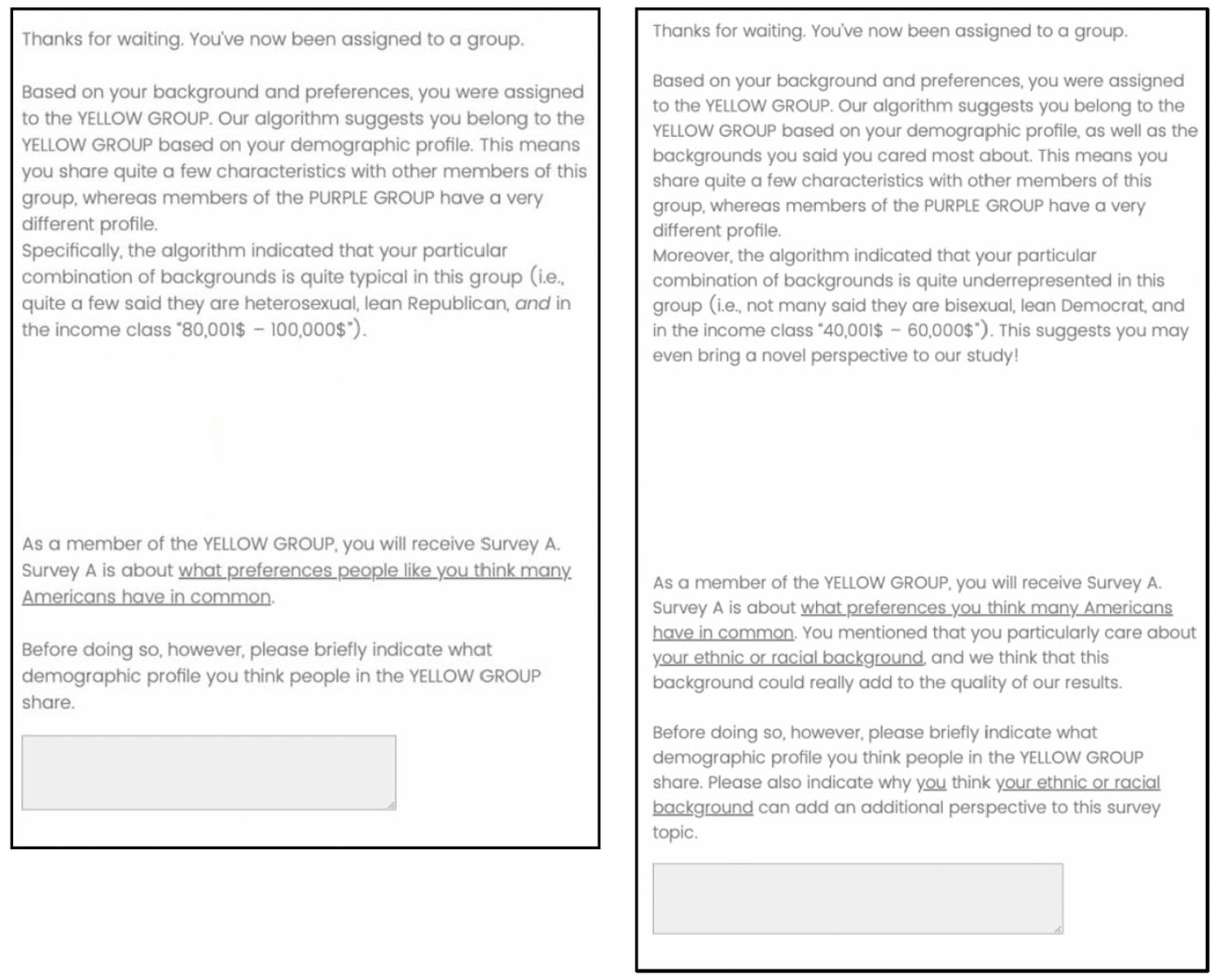
Manipulation texts (left: low uniqueness; right: high uniqueness).
Measures
Belonging
We adapted Chung et al.’s (2020) scales to this context, using rephrased items for belonging (α = .88). An example item read, “I felt connected to the Yellow Group.” We used this scale to ensure that belonging was held constant, as intended by design.
Uniqueness
Similarly, we rephrased Chung et al.’s (2020) items for uniqueness (α = .86), such as “I could share a perspective on issues that were different from other members of the YELLOW GROUP.” We administered this scale to ensure that our treatment had the intended effects. Furthermore, the belonging and uniqueness scales allowed us to explore whether the scales’ two-dimensional structure replicated outside the organizational context in which it had been developed.
Well-being
We assessed affect (αpositive = .94; αnegative = .92) as in Study 1 and self-esteem (α = .93) and self-efficacy (α = .92) with the scales from Study 2. We additionally measured another form of hedonic well-being, life satisfaction, with five items (α = .91) from Diener et al. (1985). An example item read: “I am satisfied with my life” (1 (strongly disagree) to 5 (strongly agree)). 14
Results
Descriptive statistics
SI3.3 provides summary statistics. The manipulation of uniqueness was successful, such that participants in the high uniqueness condition reported higher uniqueness (M(SD) = 3.68 (0.70)) than in the low uniqueness condition (M(SD) = 3.47 (0.70), F(1,664) = 13.84, p < .001, Cohen’s d = .28). In contrast, the high uniqueness condition did not report higher belonging (M(SD) = 3.57 (0.74)) than the low uniqueness condition (M(SD) = 3.49 (0.76), F(1,664) = 1.83, p < .177, Cohen’s d = 0.10). This suggests that we manipulated uniqueness independently of belonging.
Unsurprisingly, self-reported belonging and uniqueness were highly correlated (r = .69). Both were related to better well-being, except for non-significant associations with negative affect (SI3.4). Positive affect, self-esteem, self-efficacy, and life satisfaction were positively interrelated but negatively associated with negative affect.
An exploratory factor analysis (EFA) for self-reported belonging and uniqueness suggested that the two-factorial structure proposed by Chung et al. (2020) would fit the data well. A confirmatory factor analysis (CFA) yielded excellent overall fit (χ2 (30), p < .001, CFI = .98, SRMR = .03, RMSEA = .07, 95%–CI [0.05; 0.08]) and good local fit (λ > .5 for all loadings). This suggests that Chung et al.’s (2020) scales are internally valid even in a controlled and artificial context outside the workplace.
Hypothesis tests
There were no direct treatment effects of uniqueness on any well-being measure. Table 4 summarizes these results. Given the statistically significant manipulation of uniqueness, this result suggests that uniqueness did not improve or generally predict well-being beyond belonging only. 15 However, amid the theoretical rationale, our first two studies’ results and the positive correlations of uniqueness with well-being in the present study, we did not want to prematurely reject the hypothesis.
Results of Study 3.

Note. All dependent variables recoded from 0 to 1. Standard errors in parentheses.
Instead, we conducted another test of our hypothesis, in which we modeled a mediation of manipulated uniqueness (i.e., the experimental treatment) on the well-being measures through self-reported uniqueness (i.e., the manipulation check). We had pre-registered this test as we had anticipated that even statistically significant manipulations may not imply substantially shaped beliefs about one’s capacity to contribute to the group and add value. If uniqueness means to feel that one’s subgroup background is respected and appreciated within the larger group, this experience may be hard to evoke in aggregated experimental treatments. Yet, given the treatment effects on self-reported uniqueness, at least a part of the sample did feel an increase in uniqueness due to the manipulation. We emphasize that a mediation of manipulated through self-reported uniqueness limits the causal interpretability of our results (Imai et al., 2010). Nevertheless, we present these mediations as they exploit the randomly induced experienced uniqueness beyond what the statistically significant but experientially limited uniqueness manipulation may offer.
We used the R-package lavaan (Rosseel, 2012), bootstrapped 5,000 samples, and separately regressed each well-being measure on the uniqueness scale and the experimental treatment. 16
Table 5 and Figure 2 summarize the results, showing that feeling unique within the “Yellow Group” fully mediated an effect of the treatment on all types of well-being but negative affect. The non-significant direct effects of the uniqueness treatment on well-being confirm that the experimental variation in uniqueness did not predict well-being. However, the significant indirect effects suggest that feeling unique after this manipulation improved well-being. The mediator explained between 6% in life satisfaction and 17% in positive affect, suggesting it was practically meaningful. The post-treatment measure of uniqueness does not allow for as firm causal conclusions as direct effects would have, but offers informative evidence for a first causal test of uniqueness’ effects on well-being.
Mediation path coefficients, Study 3.

Note. Standard errors in parentheses. All continuous variables scaled from 0 to 1.
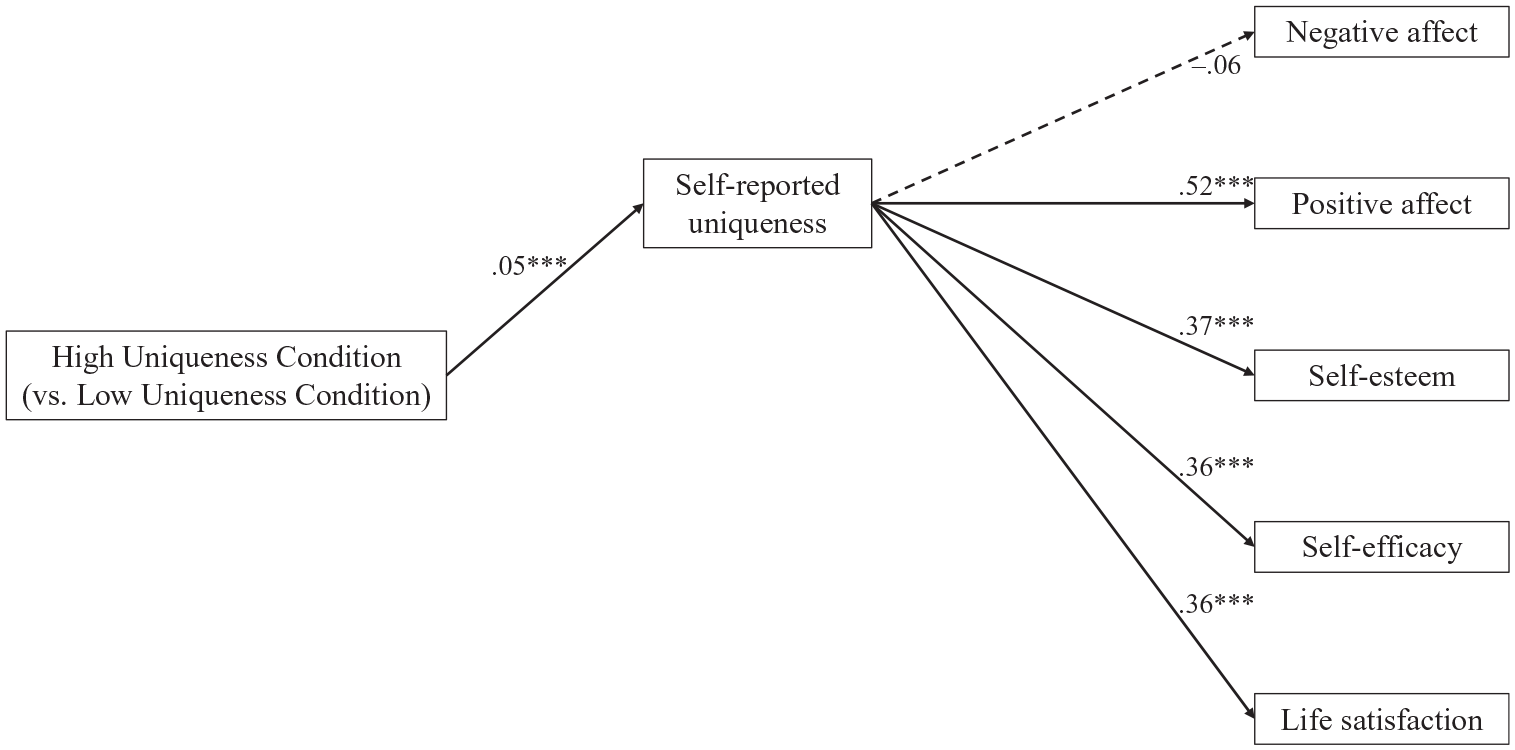
Mediation results, Study 3.
Discussion
This study’s primary aims were to causally test uniqueness’ effect on well-being and evaluate its relevance outside the organizational context. Previous studies manipulated uniqueness by varying group size (e.g., Badea et al., 2010) or promoting one need over the other (Pickett et al., 2002; Slotter et al., 2014). Though helpful contributions, we aimed to isolate uniqueness and its effects on well-being by informing participants that their subgroup background was unique within the larger group.
Despite a statistically successful manipulation of uniqueness, we did not find direct effects on well-being. This may be due to theoretical or methodological reasons. Theoretically, uniqueness may not causally improve well-being beyond belonging only. Even if this contradicts the optimal distinctiveness argument, previous research, and our correlational studies, we urge to keep this option viable: Belonging is highly correlated with uniqueness and relevant to well-being, which makes it hard for uniqueness to add much while keeping belonging constant. Especially in a fictional online group, as in our experiment, a sense of belonging may satisfactorily explain good well-being. In fact, participants in both conditions scored relatively high in belonging, suggesting that it was difficult for uniqueness to improve further. Future research may test whether our non-significant direct effects are due to this particular context.
Methodologically, the treatment may not have been sufficiently strong to make people feel unique enough despite statistically significant differences. The fact that the treatment only explained 2% of the variance in experienced uniqueness suggests that it may have been too weak. We explored this possibility with a pre-registered mediation through experienced uniqueness, highlighting that this mediation limits the causal conclusions we can draw (Imai et al., 2010). This test provided indicative evidence that causally induced uniqueness may improve well-being even when belonging is held constant.
Overall, our takeaway from this experiment is that uniqueness also matters to well-being in non-organizational contexts and that uniqueness may have causal effects beyond belonging only. However, future research needs to develop stronger uniqueness manipulations to extend the evidence on what, to our knowledge, is the first experimental test of this question.
General Discussion
What do people need to feel included and, hence, well? In a diversifying world where many endorse various identities simultaneously, it is vital to facilitate inclusion experiences that allow individuals to find inclusion with one identity in the other. This applies to inclusion in various contexts, such as organizations (e.g., Nishii & Rich, 2014; Shore et al., 2018), education (e.g., Strayhorn, 2018), and society more generally (e.g., Versteegen, 2023, 2024). An optimal distinctiveness conceptualization of inclusion (Brewer 1991; Shore et al., 2011) as the combination of belonging and uniqueness does justice to the reality of many individuals who concurrently identify as part of a larger whole and members of several subgroups. Previous research shows that individuals strive for belonging and uniqueness and that both benefit well-being (Nishii & Rich, 2014; Pickett et al., 2002; Randel et al., 2018; Slotter et al., 2014). However, it remained untested whether accounting for individuals’ need to be unique improves their well-being beyond belonging only.
We addressed this gap not to question the positive consequences of combined belonging and uniqueness documented in previous research but to take a step back and test the internal validity of Shore et al.’s (2011) inclusion conceptualization. We argued that the intuitive understanding of “just belonging” does not match many individuals’ realities of various activated identities. Instead, an optimal distinctiveness approach to inclusion (Shore et al., 2011) could offer a more realistic approach and, if supported, help design better inclusion interventions.
We found that uniqueness experiences among employees were consistently associated with various forms of well-being. These results were robust across the first two studies, various forms of hedonic and eudaimonic well-being, and while controlling for demographic background. While uniqueness may have statistically suppressed the relationship between belonging and well-being, the belonging need likely is primary to the uniqueness need (Maslow, 1954). This means that uniqueness unlikely “replaces” belonging in inclusion experiences. Study 3 added indicative causal evidence from a general sample. While we found no direct effects of the uniqueness treatment on well-being, causally evoked uniqueness experiences mediated the treatment’s effect on all but one form of well-being.
Based on these results, we suggest to conceptualize inclusion as the combination of belonging and uniqueness, rather than belonging only (e.g., Dvir et al., 2019). Because human beings understand themselves on individual, relational, and collective levels (Brewer & Gardner, 1996), incorporating uniqueness may help to make sense of the self. If researchers and practitioners consider the two needs together, they can improve the study and implementation of inclusion experiences.
Interestingly, none of the three studies showed any conditional effects by demographic background. This may be because, on the one hand, historically marginalized groups may be more dependent on experiencing “fitting in,” but, on the other hand, often experience that their subgroup background remains neglected. In sum, both belonging and uniqueness may be less satisfied among minority than majority members, making neither need relatively stronger. However, until future research has shown that the needs function differently for different groups in different contexts, our results suggest that both needs are similarly important across groups, reflecting their conceptualization as fundamental and general needs (Brewer, 1991).
Limitations and Future Research
This paper aimed to draw researchers’ attention to the potential of optimal distinctiveness for inclusion experiences, as well as the necessity to adequately test its premises before applying them to inclusion interventions. Our work is a start toward this aim. However, more conceptual and empirical work is needed. Conceptually, we believe that researchers need to define uniqueness more precisely. While the original optimal distinctiveness argument defines the second inclusion dimension as uniqueness (Brewer, 1991; Shore et al., 2011), Jansen et al. (2014) argue that authenticity may be more realistic (also see Aday et al., 2024; Slepian & Jacoby-Senghor, 2021). On the societal level, being unique could even boil down to feeling recognized (Fukuyama, 2018; Versteegen, 2023). Eventually, the essence of uniqueness will vary across contexts, groups, and status (i.e., minority or majority). Instead of stipulating one definition, future research should define and operationalize the second inclusion dimension by context. Moreover, future research needs to stringently differentiate the single inclusion elements in any given context.
Empirically, we call for more experimental evidence on the effects of inclusion and its single elements. We appreciate qualitative (e.g., Versteegen, 2023), correlational (e.g., Chung et al., 2020), and applied research (e.g., Strayhorn, 2018) as they illustrate what inclusion may feel like. Nevertheless, we expect that only experiments can differentiate the single elements and, therefore, help design inclusion interventions that fit the respective situation. To elaborate, uniqueness’ strong correlation with belonging implies that stronger uniqueness treatments risk also manipulating belonging. Our pilot studies repeatedly created this trade-off between a strong and clean manipulation, such that stronger manipulations increased the overlap between belonging and uniqueness. While our third study showed that belonging and uniqueness can be isolated in experiments, future work should develop these manipulations.
Practical Implications
If individuals need more than just belonging to feel included, this has implications for including individuals into various groups. In the last decades, societies have diversified and liberalized considerably (Norris & Inglehart, 2019), meaning that individuals seek inclusion with their diverse ethnic, religious, and sexual backgrounds. Our results add to previous research suggesting that individuals feel more included when they think that these backgrounds get the space they deserve (e.g., Jansen et al., 2016). What of their various backgrounds one specifically cares about will depend on each individual. Therefore, inclusion interventions will remain incomplete if people in charge (e.g., managers, deans, or politicians) consider only the belonging aspect or try to signal uniqueness in broad strokes (e.g., by saying that everyone is welcome). Instead, they need to understand what subgroup backgrounds an individual cares about and ensure uniqueness for that background.
While we found no conditional effects by minority vs. majority status, qualitative evidence indicates that majority members’ inclusion experience has political implications (Versteegen, 2023). By definition, majorities firmly belong to the respective larger group. However, following diversification and liberalization, some majorities and groups in power (e.g., white people, men) subjectively feel their group is increasingly neglected (e.g., Cundiff et al., 2018; Hodson et al., 2022). This may make them subjectively lack uniqueness. Consistent with this reasoning, explicitly mentioning majority groups improves their inclusion experiences (Jansen et al., 2015) and support for diversification (Plaut et al., 2011). Thus, an optimal distinctiveness conceptualization of inclusion could even help subjectively excluded majority members, potentially reducing minority-targeted animosity (Versteegen, 2023, 2024).
Conclusion
This was a first test comparing inclusion—the combination of belonging and uniqueness—to belonging only (Brewer, 1991; Shore et al., 2011). Consistent with the argument that subgroup uniqueness reflects many individuals’ realities of several simultaneously activated identities, we found that feeling unique improved several types of well-being in various contexts. This knowledge facilitates future theorizing and calls for more empirical research differentiating belonging and inclusion. Until then, inclusion interventions would benefit from recognizing and encouraging the uniqueness of all members to be included. This is because inclusion may be more than just belonging: people feel better when they perceive that their subgroup background is recognized, respected, and appreciated.
Supplemental Material
sj-docx-1-gpi-10.1177_13684302241312675 – Supplemental material for More than just belonging? Uniqueness’ role in inclusion experiences
Supplemental material, sj-docx-1-gpi-10.1177_13684302241312675 for More than just belonging? Uniqueness’ role in inclusion experiences by Peter Luca Versteegen and Byron G. Adams in Group Processes & Intergroup Relations
Footnotes
Acknowledgements
We thank Anne Crafford, Damiano D’Urso, Hillie Aaldering, Kristina Versteegen, Maarten van Bezouw, and Michael Bender for their helpful comments on earlier versions of this paper. We also thank the editor and the anonymous reviewers.
Declaration of Conflicting Interests
The author(s) declared no potential conflicts of interest with respect to the research, authorship, and/or publication of this article.
Funding
The author(s) received no financial support for the research, authorship, and/or publication of this article.
Ethics Approval
This research has been approved by the second author’s institutional review board.
Data Availability
All data and code will be made available on the Open Science Framework.

Supplemental Material
Supplemental material for this article is available online.
Notes
References
Supplementary Material
Please find the following supplemental material available below.
For Open Access articles published under a Creative Commons License, all supplemental material carries the same license as the article it is associated with.
For non-Open Access articles published, all supplemental material carries a non-exclusive license, and permission requests for re-use of supplemental material or any part of supplemental material shall be sent directly to the copyright owner as specified in the copyright notice associated with the article.
