



Abstract
The relationship between work engagement, job satisfaction, turnover intentions, and identity within organisations was investigated. Social identity theory (SIT) proposes that individuals derive part of their self-concept from their group memberships, and previous research has shown that individuals derive a degree of engagement and job satisfaction based on their identification with the organisation where they work. Based on SIT, we propose that identity can be considered a resource in organisations and mediate the relationship between engagement and job satisfaction (Study 1) and turnover intentions (Study 2). Confirming our predictions, group identity, but not organisational identity, was a significant mediator in both studies. The results also showed that organisational identity (the endorsement of the organisation) is relevant but not independently from group identity (the relationships with immediate coworkers). Simply promoting organisational identity has limited effects on the relationship between work engagement and job satisfaction and turnover intentions.
The recent COVID-19 pandemic prevented many individuals from gathering in their workplaces, with “stay home” orders having profound repercussions on in-person social interactions (Ingram et al., 2021; Van Der Feltz-Cornelis et al., 2020). The effect of working from home also affected the identities of individuals within organisations, who often derive an important sense of connection and membership from the people in their workplace, as interaction with fellow members of the group helps to create a sense of continuity as well as promoting well-being (Krug et al., 2021). One effect of the coronavirus pandemic is that it highlighted the importance of relationships with members of different groups, including those at work organisations.
Based on the social identity approach (Tajfel & Turner, 1979; Turner et al., 1987), it has been proposed that individuals can define themselves in terms of their memberships of the organisations they belong to, which is reflected in organisational identification (Mael & Ashforth, 1992), endorsing the norms and values of the organisation, and incorporating aspects of the group into the self-concept. Steffens and Haslam (2017) have suggested that members of a work organisation are also members of other groups within the organisation, some of them formal (e.g., the marketing department), and some of them more informal yet psychologically important (e.g., coworkers). A sense of belonging to these groups changes the perception of the person, from individual entities to members of the group. Once the individual self-categorises as a member of the group, the norms and values endorsed by the group become part of the self-concept of the individual, adopting a view as a member of the group rather than as an individual. There are some important consequences that derive from the identification process, some of them beneficial for the organisation (e.g., commitment; Lam & Liu, 2014), and some of them negative (e.g., ingroup favouritism; for a review, see Ellemers & Rink, 2005). This study aims to explore the independent effects of group and organisational identity on the relationship between work engagement and job satisfaction.
Job Satisfaction
One of the outcomes in organisational settings that is most frequently explored is job satisfaction (JS). It can be defined as “a pleasurable or positive emotional state resulting from the appraisal of one’s job or job experiences” (Locke, 1976, p. 1304), and it has been found to be a very good predictor of many other organisational constructs such as burnout (Faragher et al., 2005), intention to remain in the job, and relationships between coworkers and managers (Alegre et al., 2016). There are reasons to believe that positive identification with the group and the organisation would increase job satisfaction. An individual who incorporates the identity of the organisation into the self-concept will support more the norms of the group, will favour the group more than other groups, and will derive some degree of self-esteem from the sense of belonging to the group and from acting to realise the group’s aims (Van Dick et al., 2004). Therefore, a positive identification with the group and the organisation should predict higher levels of job satisfaction.
Engagement in Organisations
An important aspect of most organisations is related to the way individuals perceive their activities and the way they perform them. Work engagement can be defined as a positive, fulfilling work-related state of mind that is characterised by vigour, dedication, and absorption (Schaufeli et al., 2002). Vigour can be described as high energy and interest at work whilst also being mentally resilient. Dedication refers to when employees feel enthusiastic and like to be challenged at work. Finally, absorption describes when someone is fully immersed in their tasks at work and feel like they lose the perception of time. These three aspects need to be active in a person for them to be engaged at work. This is one of the most widely used definitions of work engagement (Schaufeli et al., 2002). A considerable amount of evidence has shown that high levels of work engagement are associated with positive organisational outcomes. For example, work engagement has been related to higher job satisfaction, lower turnover intentions, and better overall work performance (Lu et al., 2016). In addition, highly engaged individuals also report lower levels of burnout (Schaufeli et al., 2002).
Whilst work engagement is one of many factors that affect organisational outcomes such as job satisfaction and performance, there are other aspects of the organisation that also affect these outcomes. Most organisations have different levels of management, hierarchies, and groups so that decisions at one level would have different impacts at other levels. For example, the decisions of a department manager will impact its members more than the members of other departments (Ellemers & Rink, 2005). Therefore, the relationships with close members or coworkers may be of more relevance than decisions taken at upper levels of the organisation. It is clear that levels of work engagement are affected by workplace conditions, as well as by relationships with other individuals (C. Mascarenhas et al., 2022; Zammitti et al., 2022).
Identity in the Workplace
Work engagement has been researched in organisational psychology and other disciplines for some time. Previous findings have shown that identity, like work engagement, is also a factor that affects organisational outcomes. For example, Van Dick and Wagner (2002) found that teachers who incorporated their group into their identity reported less negative physical health symptoms. In addition, previous studies report a significant relationship between organisational identification and work engagement (Azka et al., 2011), and Haslam, Haslam et al. (2022) reported the beneficial effects of having multiple compatible group identities in organisations. However, the relationship between identity and work engagement has mainly been researched using organisational identity (e.g., Mael & Ashforth, 1992), with the underlying assumption that organisational identity reflects accurately the relationship with other members of the group at the workplace.
There are reasons to suggest differences between organisational identity and group identity. Firstly, interaction with members of the group can give a sense of close relationship that functions as teams. In addition, it has been proposed that communication and relationships with members of the same group are different to those at other levels of the organisation (Flynn, 2005), suggesting that members of a close group establish personal exchanges, whereas communication and relationships with members from other levels of the organisation are perceived as negotiations. However, there has been less research on relationships with other members of the group (e.g., coworkers, members of the same department) within organisations. Although it is possible that organisational identity and other identities greatly overlap, some psychological processes may be affected differently by the identity endorsed. For example, two different departments at a university may have similar levels of organisational identity (“I really feel part of this university”) but different levels of group identity (“I really feel a bond with the people in my department” vs. “I really don’t feel a bond with anyone at my department!”).
The difference between separate organisational identities has been previously analysed (e.g., Balmer, 2008), and different consequences for separate identities have also been reported in cases of organisational failure (Hay et al., 2021), corporate mergers (Giessner et al., 2011), and other conditions in which identities are affected by changes in organisations (Mühlemann et al., 2022).
We propose that group identity within an organisation can provide personal and professional resources that support the activities of the employee. In this view, identity can be considered a job resource as it can be important for establishing and maintaining positive organisational outcomes (e.g., job satisfaction), as well as preventing negative organisational outcomes (e.g., turnover intentions). The job demands and resources model (JD-R; Bakker & Demerouti, 2007) has been used to provide a theoretical frame to investigate the relationship between the job demands and resources an individual has in order to fulfil their job tasks. This framework suggests that instrumental aspects that reduce the perceived demands of the job can be considered job resources (Bakker & Demerouti, 2007).
Identity as a Resource
The well-being and performance of employees have been directly related to the balance between the demands placed on the individual and the resources the individual has to meet such demands (Bakker & Demerouti, 2007). Job demands can be considered those psychological, physical, organisational, and emotional aspects of the job that are required in order to successfully perform the activity. Conversely, job resources are defined as those instrumental aspects that reduce job demands and are necessary to successfully perform the activities required of the individual (Hu et al., 2011). Considerable evidence supports the notion that excess demands and/or lack of resources results in negative organisational outcomes such as burnout, sickness absence, perceived ill-health, and stress (Hu et al., 2011).
Previous research has suggested that even in cases in which demands are high, the presence of resources can buffer negative outcomes and prevent symptoms of depression and anxiety (Santa Maria et al., 2018). In this view, negative organisational outcomes are not due to the amount and difficulty of the demands, but to the imbalance between high demands and low resources. Importantly, these findings report that “shared values” and “social support” are effective buffers against negative outcomes. Therefore, it is expected that identity would also be an effective resource against perceived demands.
The difference between distinct but overlapping identities could have important consequences for individuals as well as organisations. Previous findings (e.g., Haslam, Haslam, et al., 2022; Iyer et al., 2009) revealed a range of positive outcomes derived from the number of different identities individuals have as well as how compatible they are, so that diverse identities may offer support against negative outcomes and difficult times. For example, some undesirable changes at one organisational level (e.g., the managerial decision to reduce the number of staff) may have unexpected and negative consequences at other levels (e.g., extra workload on client-facing staff; Amason, 1996). However, membership of a specific group within the organisation may buffer some of the negative aspects of change, for example by offering collective support. Therefore, it is expected that relationships with close coworkers or members of the team would have a strong impact on identity levels, as well as on other domains such as work engagement and job satisfaction. Importantly, we are not suggesting that group identity replaces organisational identity. We expect a positive relationship between these two distinct constructs, and separate but related effects on job satisfaction (Study 1) and turnover intentions (Study 2). Although previous findings reveal that identity and work engagement can affect organisational outcomes, there has been a lack of research on the relationship between work engagement and the separate constructs of group identity and organisational identity.
Study 1
Study 1 was designed to explore the distinct effects of work engagement, group identity, organisational identity, and job satisfaction. The relationship between work engagement and job satisfaction has been previously established (e.g., Lu et al., 2016; Waltz et al., 2020). However, the separate effects of group and organisational identity on this relationship are yet to be tested. This research aims to explore this relationship; thus, based on the propositions outlined by SIT and self-categorisation theory, we propose the following predictions.
Hypothesis 1: There will be significant correlations between work engagement, identification with the group and the organisation, and job satisfaction, with job satisfaction being significantly predicted by the expected mentioned constructs. The first prediction relies on the close relationship of the constructs analysed and their previous reported associations. More specifically, it is expected that reported work engagement, job satisfaction, and identification levels would result in strong and significant correlations between them. These correlations are important because they would demonstrate that a change in one construct is likely to be associated with changes in the others. Hypothesis 2: Group identity will be more strongly associated with all organisational constructs than organisational identity will. One of the main aims of the analysis is to separate the effects of organisational identity and group identity. Based on SIT and self-categorisation theory, it is expected that levels of group identity and organisational identity will be closely related yet different. More specifically, following predictions based on the compatibility of multiple identities, it is expected that group identity will be a stronger predictor than organisational identity of most organisational outcomes because individuals would identify more strongly with close members of the organisation than with the organisation itself. Hypothesis 3: Group identity will be a mediator on the relationship between engagement and job satisfaction. The final prediction is that level of group identity would mediate the relationship between work engagement and job satisfaction. The proposed mediating effect is based on the premise that job satisfaction is closely related to group membership, so that positive relationships with members of the group, reflected in group identity, are necessary to support and enhance the relationship between work engagement and job satisfaction.
Method
Participants
One hundred and fifty participants were recruited form the online platform Prolific (35 males, 113 females, one nonbinary/third gender, and one participant did not disclose this information). The mean age of the participants was 39 years old (SD = 12.04, range = 20–76). The criteria for participation were to be over 18 years old and have either a full-time or part-time job at the time of data collection. Participants received payment for their participation (approximately 11 GBP per hour). The sample size was determined based on two sources. Firstly, our own meta-analysis investigating the relationship between work engagement and job satisfaction revealed a large effect (r = .58) based on a fixed effects model, and r = .60 based on a random effects model. The second source was the results of Mazzetti et al. (2021), who reported a large effect size (r =.60). Using a conservative power analysis of a large effect (.50) with 80% power and an alpha level of .05 would result in a sample of 28.2 (29 participants). In terms of fulfilling other statistical assumptions, our sample size was more than double the suggested number.
Materials
Work engagement
Work engagement was measured with the Utrecht Work Engagement Scale (UWES-17), which consists of 17 items measured on a 7-point scale (1 = never, 7 = always/everyday), with higher scores indicating higher levels of work engagement (Schaufeli & Bakker, 2004).
Job satisfaction
Job satisfaction was measured with the Minnesota Satisfaction Questionnaire-Short Version (MSQ; Weiss et al., 1977). The scale has subscales for intrinsic and extrinsic satisfaction and was scored on a 5-point scale (1 = not satisfied, 5 = extremely satisfied). Higher values indicate more reported job satisfaction.
Group identity
Group identity was assessed with the identity questionnaire developed by Ellemers et al. (1997), which consists of four items measured on a 7-point scale (1 = not at all, 7 = very much), with higher values indicating a stronger group identification.
Organisational identity
Organisational identity was assessed with an adapted version of the organisational identification measure (OID), developed by Mael and Ashford (1992). This measure has six items and was scored on a 5-point scale (1 = strongly disagree, 5 = strongly agree). Higher numbers indicate more identification with the organisation.
Perceived workload
Perceived workload was assessed with one single item (“How do you think your workload is?”) and was scored on a 7-point scale (1 = extremely low, 7 = extremely high).
Length of service
Length of service was measured by asking participants how long they had been working at the specific organisation in which they were employed at the time of data collection. The scores were transformed into years and months at the job.
Procedure
The study was conducted online. Participants were presented with information about the study and were asked to provide consent to participate. After providing their gender and age, participants were asked to name the organisation they worked for. This information was then embedded in the rest of the questionnaires so that the questions relevant to identity were presented with the name of the organisation the participant mentioned. This procedure ensured that levels of organisational identification were relevant to each participant and the organisation they worked for. Following the demographic questions, participants were presented with the measures of work engagement, group identity, organisational identity, and job satisfaction. Finally, participants were asked to indicate their perceived workload, the length of time they had been at the organisation, and the average number of hours worked per week. After completing the questionnaire, participants were thanked and debriefed. All the materials were revised and approved by the Ethics Committee at the University of Hertfordshire (Protocol No. LMS/PGR/UH/04904).
Results
Preliminary analysis
All the scales were scored according to their individual instructions, creating indexes of intrinsic, extrinsic, and total job satisfaction; group identity; organisational identity; and work engagement. The raw data were screened for missing values, outliers, and statistical assumptions prior to any analysis (Tabachnick & Fidell, 2007). All variables had acceptable values for skewness and kurtosis, and there were no extreme multivariate outliers. Bivariate Pearson correlations of the computed indexes revealed moderate to strong significant correlations between all the constructs, and in the predicted directions (Table 1). As expected (Hypothesis 1), there were strong associations between group and organisational identity, and job satisfaction was strongly and positively associated with all the other relevant variables (all ps < .001). Perceived workload and length of service did not correlate meaningfully to any other measure.
Descriptive statistics of work engagement, group identity, organisational identity, job satisfaction, length of service, and perceived workload: Study 1.
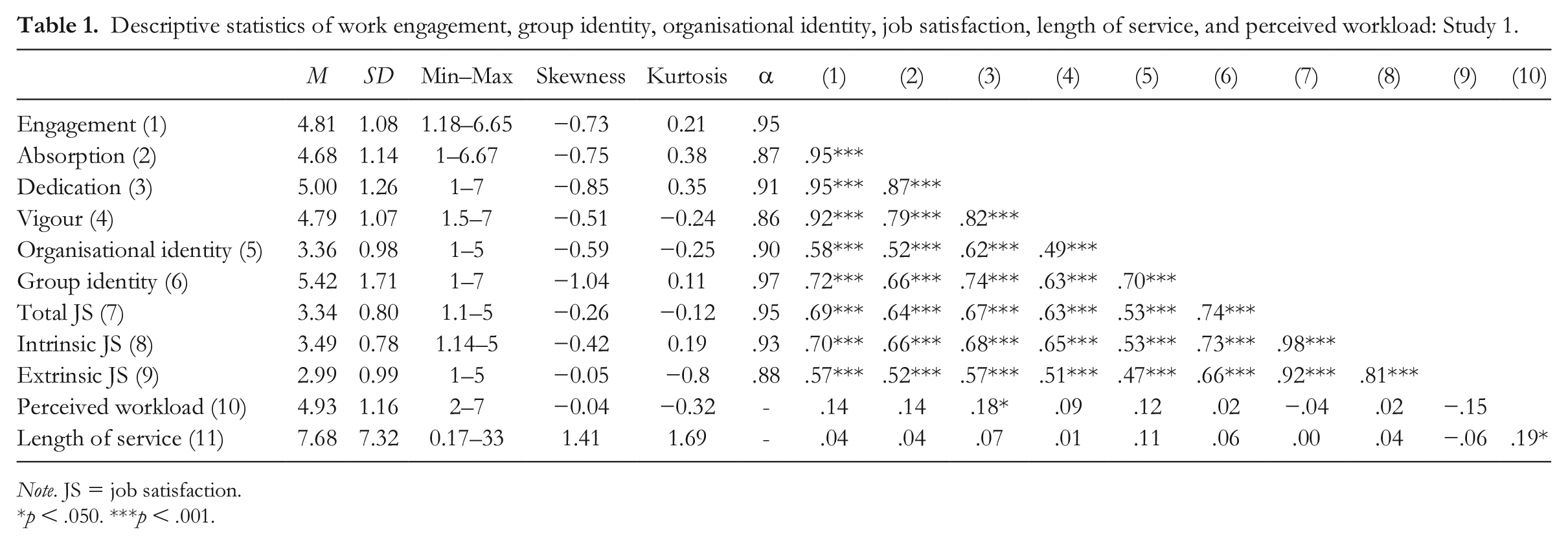
Note. JS = job satisfaction.
p < .050. ***p < .001.
The measures of group identity and organisational identity were highly correlated. Therefore, we initially tested for potential multicollinearity of these constructs when predicting work engagement. Results revealed a small to moderate amount of collinearity (Variance Inflation Factor (VIF) = 1.98, Durbin–Watson test = 1.92, p = .612). When assessing the measures of job satisfaction, work engagement was included in the measures of identity. Results also showed small to moderate amounts of collinearity for the three measures of job satisfaction (intrinsic, extrinsic, and total; VIF group identity = 2.77, organisational identity = 2.03, work engagement = 2.09; Durbin–Watson test = 1.91, p = .536 [intrinsic], 1.95, p = .792 [extrinsic], and 1.89, p = .506 [total]). These results are within the recommended thresholds to proceed with all analyses.
In order to test the prediction that group identity would be a better predictor of work engagement and job satisfaction compared to organisational identity, we first compared the correlation of each identity with the explored outcome. The comparison followed the procedure suggested by Hittner et al. (2003), and was performed using the package “cocor” (Diedenhofen & Musch, 2015) in R Version 4.2.1 (R Core Team, 2021). The value reported represents the difference between the correlation of the two identity measures. Results showed that the correlation of group identity was significantly higher than the correlation of organisational identity for all outcomes: work engagement (.14, Z = 3.05, p < .002), total job satisfaction (.21, Z = 4.52, p < .001), intrinsic job satisfaction (.20, Z = 4.29, p < .001), and extrinsic job satisfaction (.20, Z = 3.93, p < .001).
The second prediction was related to the relationship between the two different identity constructs explored and job satisfaction. More specifically, it was expected that job satisfaction would be predicted more strongly by group identification compared to organisational identification (Hypothesis 2). This hypothesis was analysed by including organisational and group identity as simultaneous predictors of the expected constructs in a multivariate regression analysis. Supporting our prediction, although correlational analysis revealed that organisational identity was a significant predictor of job satisfaction, regression analysis showed that this effect was no longer significant once group identity was included as a predictor. Similar results were found for work engagement (Table 2).
Standardised regression coefficients of group identity and organisational identity on intrinsic, extrinsic, and total job satisfaction and work engagement: Study 1.
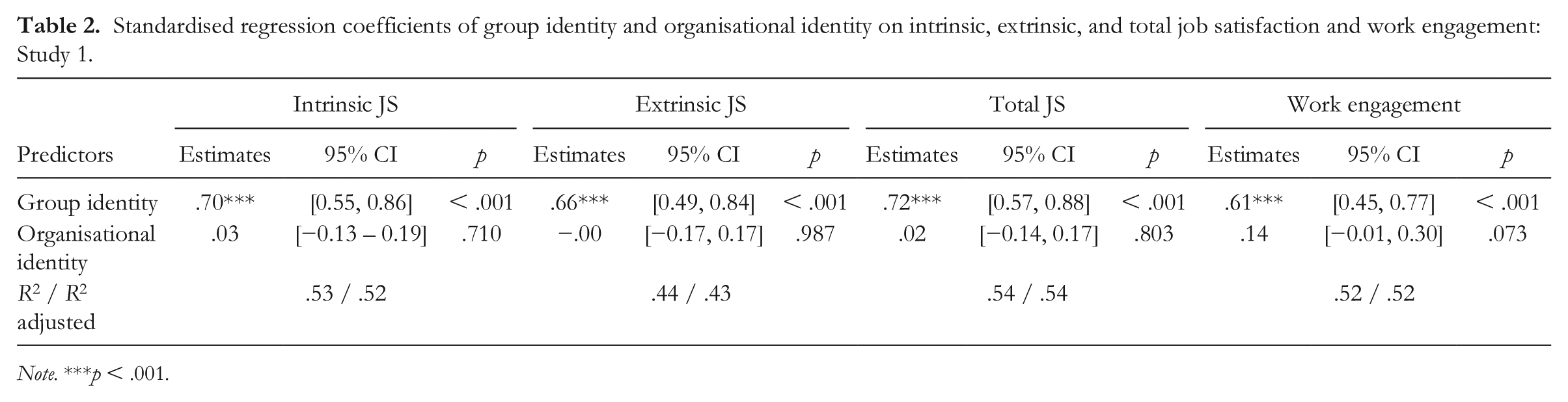
Note. ***p < .001.
Our third prediction (Hypothesis 3) was tested with an analysis of the effects of organisational and group identity as mediators of the relationship between work engagement and job satisfaction, accounting for the potential effects of perceived workload and length of service. A structural equation model was performed with the “lavaan” package (Rosseel, 2012) in R Version 4.2.1 (R Core Team, 2021), using a bootstrap method and 10,000 repetitions for the confidence intervals (95%). Results are reported as standard coefficients (Figure 1).
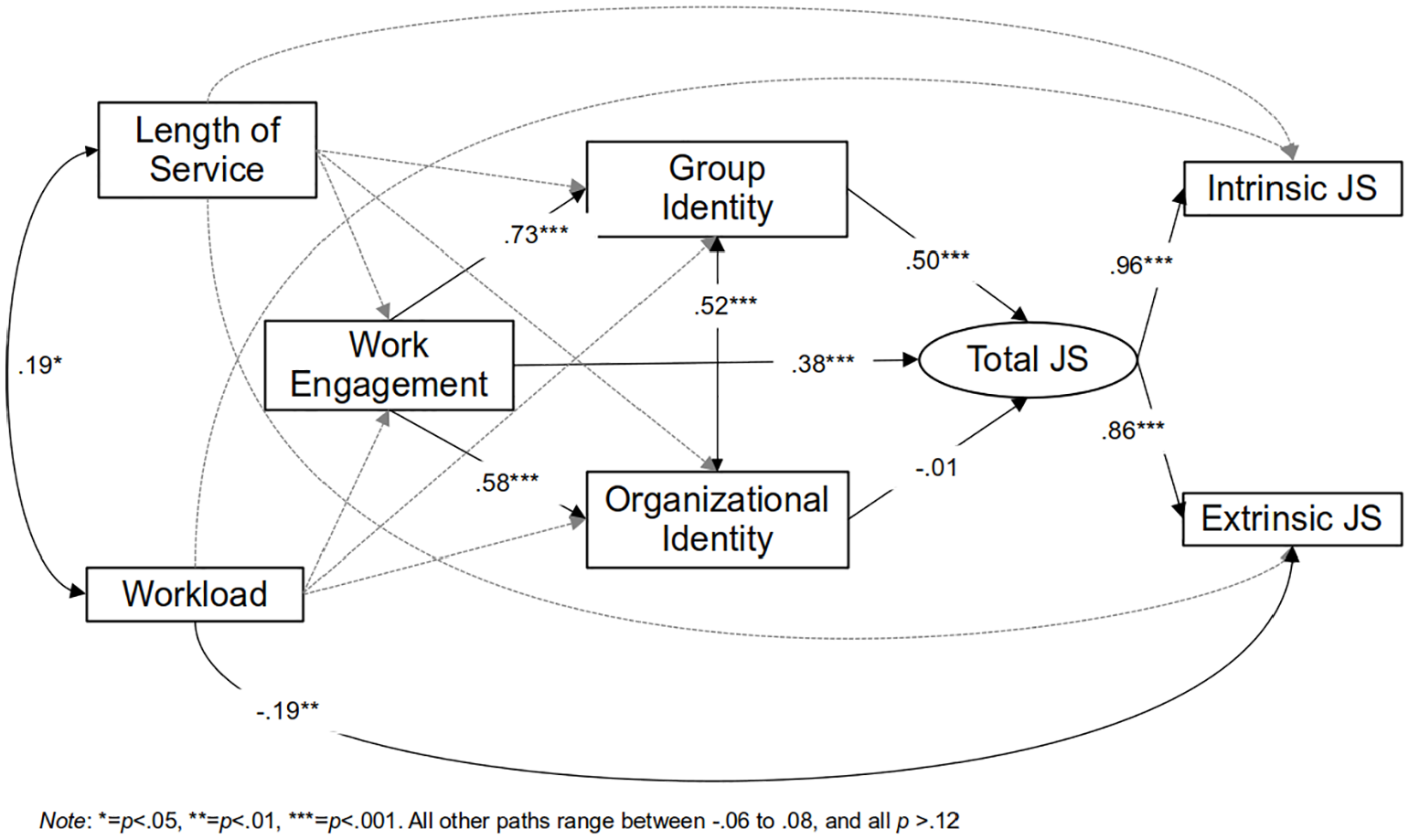
Structural model of the relationship between work engagement and job satisfaction, including the effect of group identity and organisational identity: Study 1.
Results revealed the expected significant relationship between work engagement and job satisfaction (.38, SE = 0.08, Z = 4.68, p < .001, 95% CI [0.23, 0.54]), as well as between group identity (.73, SE = 0.04, Z = 18.52, p < .001, 95% CI [0.64, 0.80]) and organisational identity (.58, SE = 0.06, Z = 9.77, p < .001, 95% CI [0.45, 0.68]). The relationship between group identity and job satisfaction was significant (.50, SE = 0.08, Z = 5.77, p < .001, 95% CI [0.33, 0.66]), but the relationship between organisational identity and job satisfaction was not (−.01, SE = 0.07, Z = −0.14, p = .894, 95% CI [−0.15, 0.13]). Importantly, results confirmed our predictions showing a significant indirect effect of group identity on the relationship between work engagement and job satisfaction (0.36, SE = 0.06, Z = 5.62, p < .001, 95% CI [0.24, 0.49]), whereas the indirect effect of organisational identity turned out nonsignificant (−0.01, SE = 0.04, Z = −0.14, p = .894, 95% CI [−0.09, 0.08]). Results revealed that perceived workload had a significant and negative effect only on extrinsic job satisfaction, but no effect on work engagement or identity. Length of service at the organisation did not have any significant effects on the relevant variables. The proposed model had excellent fitness indices, χ2(2) = 3.30, p = .192, CFI = .99, GFI = .99, NFI = .99, RMSEA = .07, SRMR = .01, and model modifications did not improve the fitness or clarity of the model.
Discussion
The results of the study supported all our predictions. Our first hypothesis suggested a positive relationship between identity, work engagement, and job satisfaction. As with previous findings (e.g., Karanika-Murray et al., 2015), our results confirm the expected significant and strong relationships between these constructs. There is also previous evidence suggesting a clear relationship between work engagement and job satisfaction (e.g., Zammitti et al., 2022), as well as the other relationships explored in the analysis.
Based on the social identity approach, our second hypothesis predicted that group identity would be a better predictor of each of the studied constructs than organisational identity would. SIT suggests that we derive a positive identity from different groups, so it was expected that a close group would provide stronger perceived benefits than organisational identity would. Our results support the prediction that group identity is a better predictor of positive outcomes, such as work engagement and job satisfaction, than organisational identity is. It is important to highlight that work engagement, identity, and job satisfaction are not simply a reflection of perceived workload or time at the organisation. Length of service had no significant effect on any of the outcomes, and perceived workload had an effect only on extrinsic job satisfaction. Our results suggest that a simple reduction in perceived workload would not increase work engagement or job satisfaction meaningfully, but the strongest relationship is that of group identity.
We expected this relationship because it is well established that members of a close group (e.g., coworkers) more commonly provide guidance, support, and a sense of belonging; and, as a source of job satisfaction is based on the positive relationships with other employees (Pincus, 1986), conflict with immediate coworkers has clear detrimental effects on job satisfaction (Arafat et al., 2018). Group identity is a core element of feelings of connection and support in a group (Haslam, Jetten, et al., 2022), affecting several aspects of the individual, from feelings of loneliness to well-being (Becker et al., 2021).
Our main prediction was that group identity, but not organisational identity, would be a mediator between engagement and job satisfaction. Results supported our prediction, suggesting that the relationship between work engagement and job satisfaction is strongly affected by group identity, with a significant indirect effect. Our prediction was not that the effect of work engagement on job satisfaction would be fully accounted for by the mediators. Previous findings and meta-analyses (e.g., Mazzetti et al., 2021) report very strong correlations between work engagement and job satisfaction (r = .60), so it is unlikely to achieve full mediation results with such strong relationships. Importantly, the mediating effect of group identity was significant, accounting for the effects of perceived workload and length of service at the organisation.
Importantly, we do not suggest that organisational identity is not important for these constructs but rather that its effect is less relevant than the effect of group identity. This effect may be because individuals can have a hierarchy of related identities so that those more proximal for everyday interactions (group identity) are better predictors of positive outcomes than more distal identities, such as organisational identity. Identification with the organisation is different from group identification. We propose that group identification within organisations should not be considered the same as organisational identity, and that they may fulfil different aspects of job satisfaction. For example, group identity can be a source of personal support and friendly relationships, whereas organisational identity may be a source of prestige and self-esteem. Our results highlight that relationships between individuals in the organisation can have stronger effects on job satisfaction than just managing the identity of the organisation, for example with “team integration activities.”
Study 2
Results of Study 1 suggest that group and organisational identity can have different effects on organisational processes. Although it has been recognised that social identity plays a crucial role in a variety of organisational processes (Haslam et al., 2022), the specific differences between group and organisational identity are less clear, and their effects less explored. In order to further investigate the relationships between work engagement, identity, and other organisational processes, one of the aims of Study 2 is to replicate and extend the findings of Study 1. The relationship between job satisfaction and identity is expected to be positive because it is expected that positive organisational outcomes are shared with those close to us at work. An important point to investigate is whether the effect of group identity is relevant for negative organisational outcomes such as the desire to leave the organisation. Exploring these relationships is an additional aim of this study.
The final aim of Study 2 is to explore to what extent identity can be considered a useful resource in organisations. Previous research has considered some aspects of work roles as resources that are required to successfully complete and perform an activity at work (e.g., training, professional support). In this view, Study 2 investigates whether identity is an asset that can be considered a resource in the organisation due to its diminishing the effect of turnover intentions.
Turnover Intentions
Constant changes in personnel are an important concern in organisations. It is not only costly to recruit and train new employees, but they also have an effect on the relationships within the work group in question. Employee turnover can be defined as the situation in which an employee ceases to be part of the organisation (Shim, 2010). Of the different definitions of turnover, undesirable turnover is recognised as the most problematic for an organisation. Undesirable turnover is when a capable and engaged employee leaves the organisation due to preventable reasons such as poor support and role conflict (Shim, 2010), with negative implications for the group and the organisation. These negative effects also extend to organisational culture and the effectiveness of the organisation, in part because employees’ shared perceptions regarding the organisation and the departure of capable individuals are affected (Glisson, 2007).
Job Demands and Job Resources
The JD-R model (Bakker & Demerouti, 2007) has been used to provide a theoretical framework to investigate the relationship between the job demands and resources an individual has in order to fulfil job tasks. Empirical evidence suggests that some organisational outcomes are a consequence of the imbalance between the work demands and resources; some of these outcomes are burnout (Bakker et al., 2014), engagement, organisational identity (De Braine & Roodt, 2011), and job insecurity (Hu & Schaufeli, 2011), among others. In this view, positive relationships and perceived support from the group and the organisation can be considered resources. Importantly, we expect that the effects of these two identities will be different, with group identity being stronger than organisational identity.
The main predictions of this study are, firstly, that the main results of the previous study will be replicated so that there will be a positive and significant relationship between group identity and organisational identity. In addition, a similar pattern of correlations is expected, with engagement and identity positively and highly correlated, and job resources negatively correlated to perceived job demands and turnover intentions (H1).
The second prediction (H2) is that group identity, compared to organisational identity, will be a better predictor of positive organisational outcomes. This prediction is similar to H2 in Study 1. The third prediction (H3) is that group identity will be a mediator between engagement and perceived job resources. More specifically, it is expected that group identity will be positively associated with perceived job resources. Conversely, it is predicted that group identity will be a mediator between work engagement and negative organisational outcomes, specifically turnover intentions, so that group identity will be negatively associated with turnover intentions.
Method
Participants
One hundred and thirty participants were recruited from the online platform Prolific (31 males, 97 females, and one participant did not disclose this information). The mean age of the participants was 35 years old (SD = 10.71, range = 19–64). The criteria for participation and compensation were similar to those in Study 1. One participant failed to complete the survey and was removed from the analysis, leaving 129 participants. As with Study 1, the sample size was based on our own meta-analysis, revealing an effect size of r = −.45 (r = −.44 with a random effects model), and on the results of Mazzetti et al. (2021), reporting an effect of r = −.43. Using a conservative power analysis of r = −.40, power = 80%, and alpha = .05, the required sample size was 45.91 (46 participants). As with Study 1, our sample size was larger than the recommended number.
Materials and procedure
Work engagement, group identity, organisational identity, perceived workload, and length of service were measured as in Study 1.
Turnover intentions
Turnover intentions were measured using the Turnover Intention Scale (TIS-6; Bothma & Roodt, 2013). The six items were scored on a 5-point scale (1 = never/highly unlikely, 5 = always/highly likely). Higher scores indicate higher intentions to leave the job or position.
Perceived work demands
Perceived work demands were measured with the Identification of Job Demands Scale (Kubicek et al., 2015). The measure has 19 items scored on a 7-point scale (1 = strongly disagree, 7 = strongly agree), with higher scores indicating higher perceived demands.
Job resources
Job resources were measured using an adapted version of the supervisor support, relationship with colleagues, and shared goals subscales developed by Skaalvik and Skaalvik (2011, 2017). The wording of the items was changed to refer to organisations instead of schools.
The procedure was similar to that in Study 1, and the ethical procedures were also approved by the same institution.
Results
The first aim of the study (H1) was to replicate the main relationships found between the variables in the previous study. Results showed that variables were correlated in the expected direction, replicating the findings of the previous study. Importantly, the relationship between job resources, perceived work demands, and turnover intentions were significantly correlated (Table 3).
Descriptive statistics of work engagement, group identity, organisational identity, job resources, perceived job demands, turnover intentions, length of service, and perceived workload: Study 2.
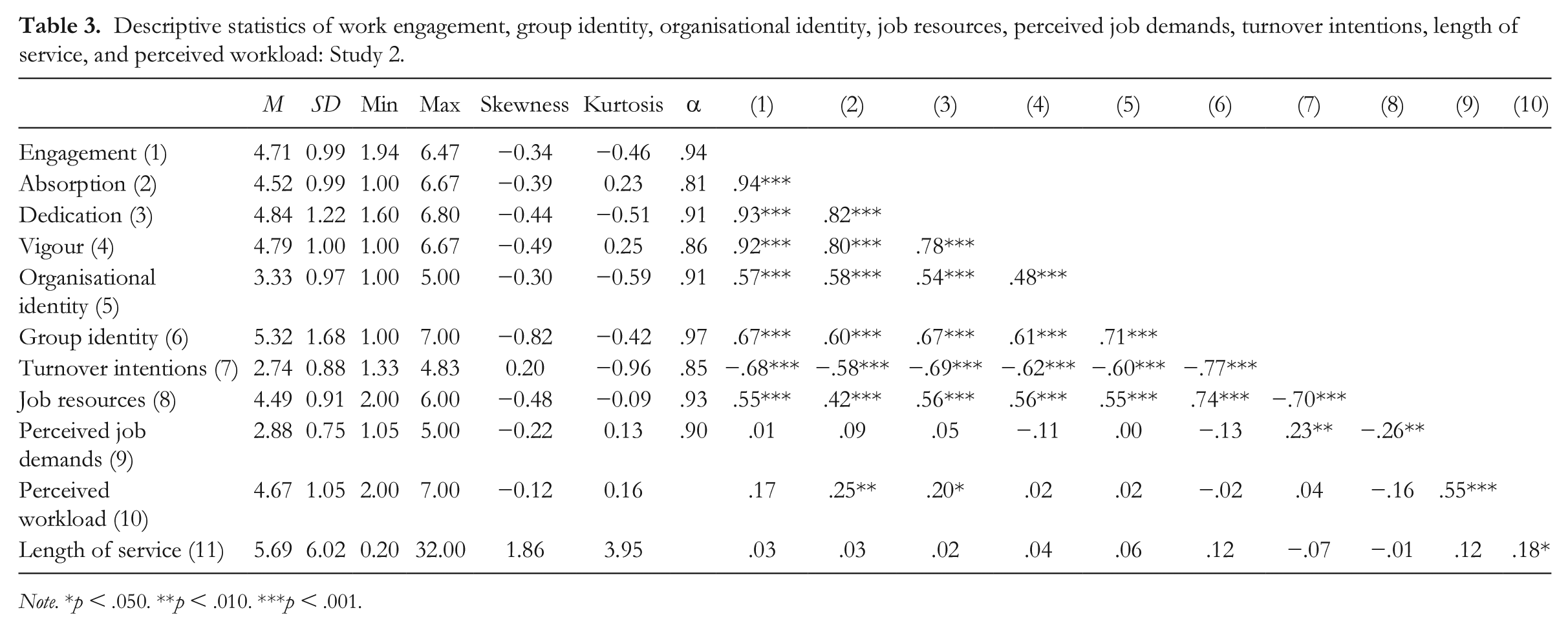
Note. *p < .050. **p < .010. ***p < .001.
Our second hypothesis (H2) was that group identity would be a better predictor than organisational identity of work engagement, job resources, perceived work demands, and turnover intentions.
The correlation between group identity and organisational identity was high and significant(r = .71, p < .001), and similar to that of Study 1 (r = .70, p < .001). As with Study 1, we first compared the correlation coefficients of group identity and organisational identity with each of the explored constructs using the same procedure as in Study 1. Results were similar to those in Study 1, as group identity correlated more strongly than organisational identity with all the explored constructs: work engagement (.10, Z = 2.02, p < .042), turnover intentions (−.18, Z = −3.74, p < .001), job resources (.20, Z = 4.07, p < .001), and perceived job demands (.13, Z = 1.98, p < .047).
We followed the same procedure to test for collinearity between group identity and organisational identity, as in Study 1. Results revealed a small to moderate level of collinearity when predicting work engagement (VIF = 2.04, Durbin–Watson = 2.16, p = .386), as well as with the other constructs using group identity, organisational identity, and work engagement as predictors (VIF group identity = 2.59, organisational identity = 2.11, work engagement = 1.89; Durbin–Watson = 1.96, p = .848 [job resources], 1.69, p = .082 [perceived job demands], 1.78, p = .216 [turnover intentions]). As with Study 1, all the parameters were within the thresholds to perform all analyses.
Results of a multiple regression analysis also supported the predictions, showing that group identity was a stronger predictor of all the investigated constructs and the only significant predictor for most of them. These results also replicated the findings of Study 1 (Table 4).
Standardised regression coefficients of group identity and organisational identity on turnover intentions, job resources, perceived job demands, and work engagement: Study 2.
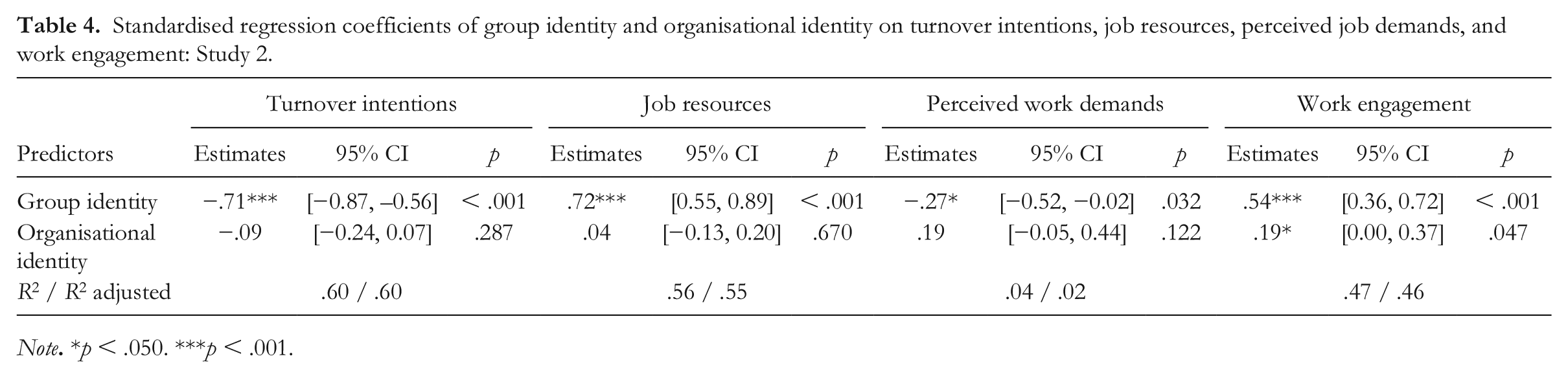
Note. *p < .050. ***p < .001.
The third prediction of the study (H3) was that group identity would have a stronger indirect effect than organisational identity on the relationship between work engagement and the other explored variables. The analysis performed was a series of independent single-step mediational analysis using work engagement as the main predictor of the explored variables, including group identity and organisational identity as simultaneous mediators. The analysis was a single-step parallel mediational analysis using the PROCESS macros and instructions provided by Hayes (2017). A bootstrapping method with 10,000 repetitions was used to determine confidence intervals (95%), and all results are reported as standardised coefficients. Results (Figure 2) showed that work engagement was a positive and significant predictor of group identity (.67, SE = 0.11, 95% CI [0.93, 1.27], t = 10.28, p < .001), as well as organisational identity (.57, SE = 0.07, 95% CI [0.42, 0.70], t = 7.87, p < .001). Results also showed that work engagement was a significant predictor of job resources (.55, SE = 0.07, 95% CI [0.37, 0.64], t = 7.43, p < .001), but this effect was nonsignificant once the indirect effects were included (.09, SE = 0.07, 95% CI [−0.07, 0.23], t = 1.04, p = .299). Of these effects, group identity (.67, SE = 0.05, 95% CI [0.26, 0.46], t = 7.04, p < .001), but not organisational identity (.02, SE = 0.08, 95% CI [−0.14, 0.18], t = 0.24, p = .813) was a significant indirect effect. A similar pattern was found for turnover intentions so that the initial significant effect of work engagement on turnover intentions (−.68, SE = 0.06, 95% CI [−0.72, −0.49], t = −10.34, p < .001) was reduced (−.28, SE = 0.07, 95% CI [−0.37, −0.12], t = −3.77, p < .001) via the indirect effect of group identity (−.56, SE = 0.04, 95% CI [−0.38, −0.21], t = −6.57, p < .001), but not via the indirect effect of organisational identity (−.03, SE = 0.07, 95% CI [−0.17, 0.11], t = −0.44, p = .659). For perceived work demands, results showed a nonsignificant direct effect of work engagement on perceived demands (.01, SE = 0.07, 95% CI [−0.13, 0.14], t = 0.11, p = .915), and remained nonsignificant after the inclusion of the indirect effects (.15, SE = 0.01, 95% CI [−0.06, 0.29], t = 1.27, p = .207). However, group identity was revealed as a significant indirect effect (−.35, SE = 0.06, 95% CI [−0.28, −0.03], t = −2.51, p < .013), whereas the effect of organisational identity was not significant (.17, SE = 0.10, 95% CI [−0.07, 0.32], t = 1.31, p = .191).
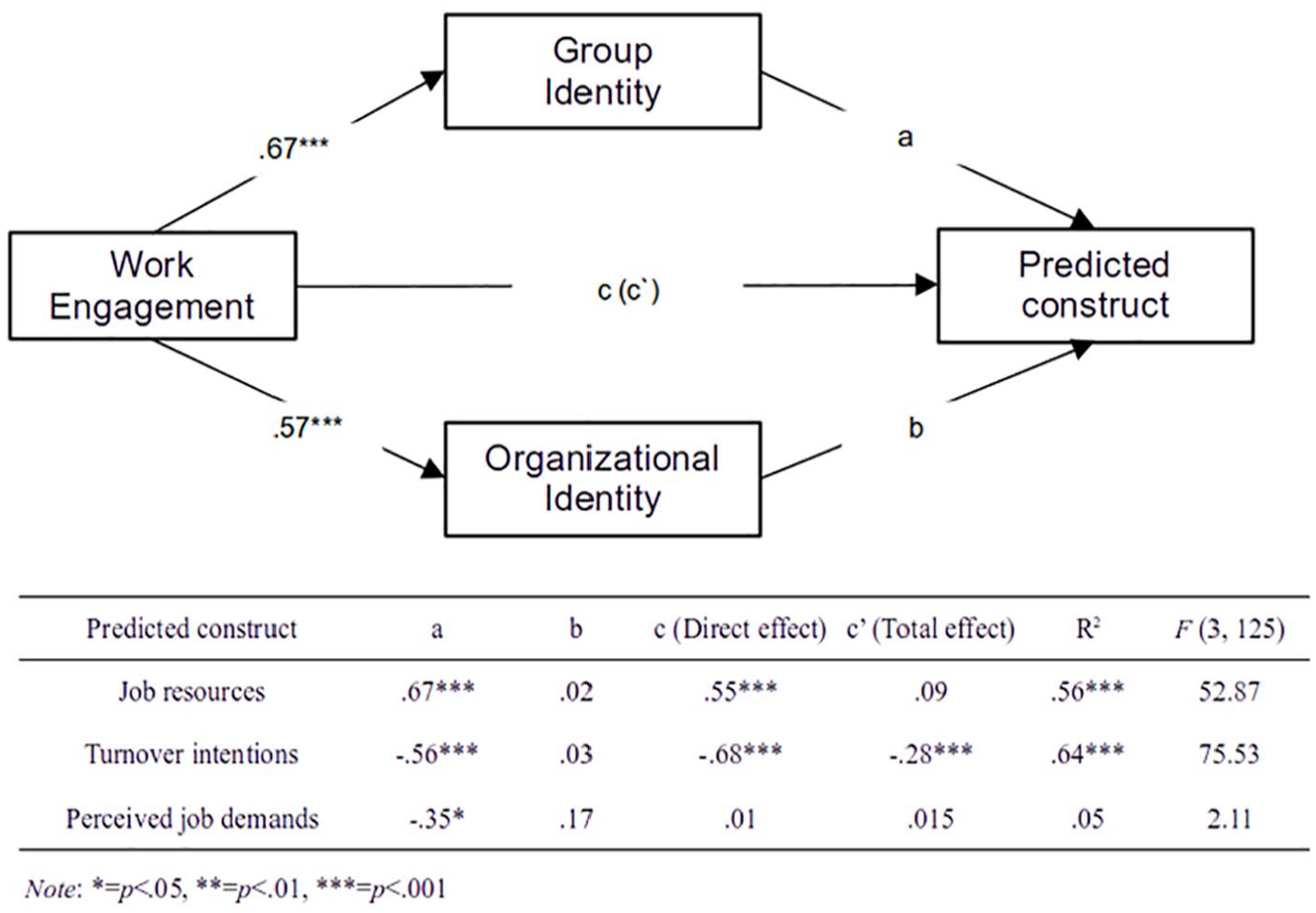
Mediational analysis of group and organisational identity as mediators of work engagement, turnover intentions, job resources, and perceived job demands: Study 2.
Discussion
The results of Study 2 largely supported our predictions and replicated the main results of Study 1. The effect of group identity on the explored outcomes was found in the expected directions and was found to be stronger than the effect of organisational identity. Group identity was associated with variables that are considered positive for organisations, such as work engagement and job resources, while at the same time reducing negative organisational outcomes such as turnover intentions and perceived workload. These effects were largely absent for organisational identity although the correlation between group identity and organisational identity was positive and very strong.
Results also showed that group identity was the only significant indirect effect on the relationship between work engagement and the explored constructs. Although work engagement significantly and strongly predicted organisational identity, only group identity resulted a significant indirect effect in the expected direction, positively associated with job resources and negatively associated with perceived workload and turnover intentions. Results also showed that group identity and job resources were significantly associated with a lower level of turnover intentions.
General Discussion
The JD-R model suggests that assets that make job demands easier and achievable can be considered job resources. In this view, is it clear that group identity can be considered a job resource because a supportive environment in which colleagues share and endorse norms, values, and ideas can make the demands of the job easier. This resource effect suggests that a strong and supportive environment based on positive relationships with colleagues can improve performance and diminish perceived demands. In addition, previous findings have suggested that work-based identity is predicted more strongly by job resources than by job demands (De Braine & Roodt, 2011), making group identity a valuable resource for organisations.
Although organisational identity has been found to be related to positive aspects of the organisation such as job satisfaction (e.g., C. Mascarenhas et al., 2022; D. R. D. Mascarenhas & Smith, 2011), this effect was largely replaced by the positive effects of group identity on all the explored constructs. However, all the outcomes explored were aspects within organisations rather than cases in which organisational identity may be more important. It is plausible that the effect of organisational identity is more relevant in cases that involve all the members of the organisation (e.g., when organisations merge; Giessner et al., 2011), when there is a perceived change in culture (e.g., an organisation that considers itself eco-friendly; Haldorai et al., 2023), or in cases of positive comparisons between organisations (e.g., ethical banking compared to traditional banking; Guzmán et al., 2023). In addition, organisational identity has been shown to lead to ingroup cooperation (Tyler, 1999), the endorsement of the organisation’s perspective (Mael & Ashforth, 1992), and a sense of continuity for individuals even when there are changes in members of the group (e.g., when different departments merge into one; Dutton et al., 1994). Importantly, there is no reason to suggest that the proposed resource effect cannot be extended to organisational identity.
Limitations and Theoretical Implications
The predictions were largely supported by the results obtained. However, it is important to highlight some limitations. Firstly, all the data collected were cross-sectional, so it is not possible to establish how any of these relationships change over time. In addition, the data were collected from participants at different organisations, preventing us from exploring some core aspects of organisational processes. The findings presented here strongly suggest that there is a need to explore the differences between identity related to groups within organisations and organisational identity. Although the relationship between group identity and organisational identity was strong and positively correlated, each identity had different effects on the explored constructs. Therefore, accounting for the difference between these two types of identity is important. Finally, an individual may be part of more than one group within an organisation and fulfil different functions in different groups.
Footnotes
Data Availability
The data that support the findings of these studies are available from the corresponding author upon reasonable request.
Declaration of Conflicting Interests
The author(s) declared no potential conflicts of interest with respect to the research, authorship, and/or publication of this article.
Funding
The author(s) received no financial support for the research, authorship, and/or publication of this article.
