



Abstract
An often overlooked aspect of intergroup relations is how people react to inclusion in a beneficial superordinate category. To examine this issue, we conducted four studies (N = 1,686) in Kosovo about the European Union (EU), using adult (Studies 1, 3, 4) and adolescent (Study 2) samples. We employed experimental designs (Studies 1, 3, 4) and a two-wave longitudinal design (Study 2). In Studies 1–3, we assessed ethnic identification before exposing participants to one of three experimental conditions: inclusion in the superordinate category, exclusion, or a control. Results showed that individuals with low ethnic identification perceived less discrimination (i.e., less unfair treatment), greater metahumanization (i.e., being seen as equal), and less collective victimhood (i.e., lower feelings of being unjustly targeted) in the inclusion condition compared to exclusion or control conditions, whereas those with high ethnic identification exhibited the opposite reactions regardless of condition. In Study 4, we assessed the need to belong to the EU and ethnic identification before exposing participants to similar conditions. Results showed that individuals with a high need to belong to the EU perceived less discrimination, greater metahumanization, and lower collective victimhood in the inclusion condition compared to other conditions, regardless of ethnic identification. This pattern also held for those with a low need to belong to the EU and low ethnic identification. However, it did not appear for those with a low need to belong to the EU and high ethnic identification, whose reactions to inclusion differed from those of participants in other conditions. These effects were mediated by collective victimhood.
Keywords
Social inclusion is widely considered a critical factor for fostering unity and promoting positive, prosocial behaviors among individuals (Asher & Coie, 1990; Mize & Ladd, 1988; Twenge et al., 2001, 2007). According to the common ingroup identity model, intergroup bias can be reduced when members of different groups perceive themselves as part of a more inclusive, superordinate group, leading to more harmonious intergroup relations (Gaertner et al., 1993, 2016). This model suggests that expanding group boundaries through cognitive, affective, and linguistic factors can shift perceptions from “us versus them” to a more inclusive “we” (Gaertner & Dovidio, 2000). This recategorization can occur through forming a single, more inclusive group or through a dual-identity framework, both of which have been shown to improve intergroup attitudes, encourage collective action, and promote humanization (Gaertner et al., 2016; Vezzali et al., 2022).
While the positive impacts of social inclusion are well documented, the complexity of its effects within politically and economically significant superordinate categories, such as the European Union (EU), is less understood. Inclusion in these categories involves crucial considerations of political identity, economic status, and cultural belonging, which can vary significantly among individuals. Although existing research frequently highlights the adverse effects of social exclusion—such as increased feelings of discrimination (Brown-Iannuzzi et al., 2014; Crocker & Major, 1989), dehumanization (Bastian & Haslam, 2010, 2011; Borinca et al., 2023; Cameron et al., 2016), and victimization (Verkuyten & Thijs, 2002)—the impact of inclusion within a common group, particularly for individuals with low (vs. high) ethnic identification remains underexplored, especially in the context of political and economic inclusion. That being said, while inclusion in a superordinate category can be beneficial, it may not lead to uniformly positive outcomes for everyone (Crisp et al., 2006). Instead, it may be perceived as a threat to distinct identities and lead to bias (Hornsey & Hogg, 2000; Vignoles et al., 2006). However, the impacts of social inclusion on perceptions of discrimination (e.g., perceived unfair treatment based on ethnicity; Brown-Iannuzzi et al., 2014), metahumanization (i.e., the belief that one’s group is viewed as equal human beings; Borinca, Tropp, et al., 2021; Borinca, 2024), and collective victimhood (i.e., the perception of intentional and undeserved harm inflicted upon one’s group by another group; Noor et al., 2017; Vollhardt & Bilali, 2015; Vollhardt, 2012) among individuals with low (vs. high) ethnic identification remain unexplored.
In order to bridge these gaps and delve into the specific processes underlying these effects, we conducted four studies in Kosovo to examine the relationship between Kosovo Albanians’ feelings of discrimination, metahumanization, and perceived collective victimhood following inclusion (vs. exclusion) in the European Union as the inclusive common category, while considering the moderating role of ethnic identity (in all studies) and the need to belong to the superordinate category (in Study 4).
The Moderating Role of Ethnic Identity
Identification is the degree to which one integrates a particular group membership (e.g., based on ethnicity, race, etc.) into one’s sense of self or defines oneself in terms of that group (Tropp & Wright, 2001; Turner et al., 1987). A core idea of social identity theory (Tajfel & Turner, 1974) is that the more strongly individuals identify with a group, the more personally relevant the group’s representation becomes (Sim et al., 2014). Research indicates that as the importance of group identity increases, individuals are more likely to report experiencing discrimination and exhibit negative reactions towards outgroup members (Andriessen et al., 2020; Crisp et al., 2006; Lee & Ahn, 2013; Sellers & Shelton, 2003; see also Hornsey & Hogg, 2000). Moreover, Mekawi and Watson-Singleton (2021) argue that individuals with strong group identification are more deeply affected by their group’s dehumanization, which can potentially lead to a reduced perception of metahumanization (Borinca, Tropp, et al., 2021; Pavetich & Stathi, 2021).
Individuals with high levels of ethnic identification may face greater negative consequences, such as increased perceived discrimination, collective victimization, and reduced metahumanization, (Neblett & Roberts, 2013; Szymanski & Lewis, 2016) following either inclusion or exclusion from a superordinate social category. This may be because exclusion can reinforce these negative feelings and discourage them from seeking inclusion (Sacco & Bernstein, 2015), while inclusion in such a category may pose threats to their ethnic identity and lead to bias (Crisp et al., 2006).
Conversely, lower levels of ethnic identification can act as a buffer by distancing the self from the group, allowing for varied interpretations and responses to ethnic-related social situations (Crisp et al., 2006; McCoy & Major, 2003). Research shows that when group identification is low, individuals often prefer individualistic coping strategies to counter disadvantage, such as distancing themselves from the stigmatized group to gain acceptance into a more inclusive group (Ellemers et al., 1997; Wright & Tropp, 2002). Therefore, individuals with low ethnic identification may view others’ dehumanizing perceptions of their group as less personally relevant (Mekawi & Watson-Singleton, 2021). This outlook stems from a weaker attachment to their ethnic group (Szymanski & Lewis, 2016), perhaps enabling a more positive response to social change, including social inclusion in the superordinate category.
Nevertheless, while research has explored how inclusion and ethnic identity interact to influence explicit and implicit intergroup biases (Crisp et al., 2006), there is a notable gap in understanding how this interplay affects other important intergroup outcomes, such as perceived discrimination, metahumanization, and collective victimhood. Additionally, there is limited research on groups such as Kosovo Albanians, who have experienced armed conflict with Serbia, established statehood, and aspire to become members of political and economic entities like the European Union (Borinca et al., 2024; Solana, 1999). Our research addresses these gaps by investigating the moderating role of ethnic identification in the effects of social inclusion (as opposed to exclusion or control) on perceived discrimination, collective victimhood, and metahumanization. Furthermore, since inclusion in a superordinate category and ethnic identification can be influenced by the need to belong to that category, we also examined how the need to belong moderates the relationship between ethnic identification and inclusion (as opposed to other conditions) on these outcomes.
Accordingly, we expected ethnic identification to moderate the effect of social inclusion (vs. exclusion or the control condition) on perceived discrimination and metahumanization. Specifically, we predicted that participants with low (vs. high) ethnic identification would perceive less discrimination, less collective victimhood, and more metahumanization when included in (vs. excluded from or in the control condition) the superordinate identity category.
The Moderating Role of the Need to Belong to the Superordinate Category
The intrinsic need to belong lies at the heart of human nature, reflecting a fundamental drive for acceptance and connectedness (Baumeister & Leary, 1995). Rooted in the core motive of the self to forge meaningful connections with others, the need to belong involves a strong desire to be part of relevant social categories. When this need is salient, individuals actively seek to fulfill it through various social behaviors, including forming connections, engaging in communal activities, and seeking validation and acceptance from relevant groups (Gardner et al., 2000; Steinel et al., 2010; Williams & Sommer, 1997). By satisfying the need to belong, individuals enhance their sense of connectedness and cultivate a deeper understanding of themselves within the broader social fabric. Therefore, the pursuit of belongingness serves as a cornerstone for fostering meaningful relationships and nurturing a sense of identity and accomplishment at both personal and collective levels. This need becomes especially pronounced when people experience exclusion rather than inclusion by others (Carvallo & Pelham, 2006; Leary et al., 1995). Thus, in our research, we observed, for the first time, the moderating role of the need to belong in the superordinate category in the interplay between social inclusion (vs. exclusion and control) and ethnic identification on our investigated outcomes.
We hypothesized that individuals who feel a strong need to belong to a superordinate category would experience beneficial outcomes from inclusion compared to exclusion and control conditions. These outcomes include reduced perceived discrimination, diminished collective victimhood, and increased perceived metahumanization. We expected this to hold true for individuals with both low and high levels of ethnic identification. The rationale behind these expectations is rooted in the fundamental psychological need for belongingness, as proposed by Baumeister and Leary (1995), which drives individuals to seek acceptance and connection within social groups. For those with low ethnic identification, belonging to a desired superordinate category provides social validation beyond ethnic boundaries, enhancing their superordinate identity and reducing perceptions of discrimination. Similarly, individuals with high ethnic identification benefit from inclusion in a superordinate category by experiencing a sense of empowerment and recognition, thereby reducing feelings of marginalization or exclusion based on their ethnic identity.
However, these effects might not emerge for individuals who do not feel a strong need to belong to a superordinate category, as their responses might be driven more by ethnic identification. When individuals with high ethnic identification do not have a strong desire for inclusion in a superordinate category, they may prioritize and find accomplishment and validation from alternative sources or social groups, such as their ethnic identity, which might trigger them to react negatively to the inclusion condition. Conversely, individuals with low ethnic identification may seek belongingness and validation from other sources or social groups that align more closely with their personal identity. For them, inclusion in the superordinate category might still provide more opportunities for belongingness and additional validation and recognition.
Kosovo’s Journey to EU Integration
Kosovo has aspired to become a member of the European Union (EU) ever since declaring independence from Serbia in 2008. Indeed, such aspirations have been present since 1999, when Kosovo was liberated from Serbia following NATO’s intervention (Borinca et al., 2022; Solana, 1999). As part of its future expansion, the EU is currently considering Kosovo as a potential candidate for accession (Demjaha & Sarriá, 2021).
In 2018, according to the Kosovo government, the country fulfilled most of the criteria for traveling freely within the EU; however, the EU Council did not grant the first step of EU accession—that is, visa liberalization—making Kosovo the only country in Europe whose citizens were unable to travel freely within the Schengen Area, a border-free zone of 29 European countries that guarantees free movement of people without internal border checks (European Commission, 2024). Consequently, Kosovo Albanians were only able to travel to five countries without a visa: neighboring Albania, North Macedonia, Montenegro, Turkey, and Haiti (Demjaha & Sarriá, 2021; European Stability Initiative [ESI], 2010). The decision not to include Kosovo in the visa liberalization process disappointed Kosovo Albanian citizens, making them feel isolated and losing hope in the EU (Emini et al., 2021; Taylor & Halla, 2022). Moreover, it sparked a debate in international politics about the EU’s approach to Kosovo, which has been criticized for being unequal compared to the approaches taken with other countries in Europe (Demjaha & Sarriá, 2021; ESI, 2010; Taylor & Halla, 2022).
In 2024, Kosovo finally achieved a breakthrough in its efforts for visa liberalization within the EU. Following extensive negotiations and diplomatic efforts, the EU Council granted Kosovo the right to visa liberalization, allowing its citizens to travel freely within the Schengen Area. This decision marked a significant milestone for Kosovo and represented a step forward in its path toward EU accession. However, according to the EU Council, the full inclusion of Kosovo in the EU will still take a longer time, especially since five EU countries—Spain, Greece, Cyprus, Slovakia, and Romania—do not formally recognize Kosovo as an independent state (Selimi, 2024). The absence of Kosovo’s membership in the EU bears significant political and economic ramifications, including international political isolation, restricted economic access and development, reliance on bilateral agreements, and the potential for political instability arising from grievances over unequal treatment and constrained opportunities.
Therefore, it is crucial to observe these processes with a Kosovo sample because Kosovo’s unique geopolitical situation and ongoing quest for EU integration provide a valuable context for understanding the complexities of social inclusion, ethnic identity, and the need to belong to the EU in a region marked by historical conflict and aspirations for international acceptance.
Overview of the Studies
We conducted four studies with Kosovo Albanian citizens regarding social inclusion (vs. exclusion) in the EU. In Studies 1 to 3, we sought to determine whether ethnic identification moderates the effect of social inclusion (vs. exclusion in Studies 1 and 3, or control in Study 2) on perceived discrimination, metahumanization, and collective victimhood. In Study 4, we examined whether the need to belong to the EU moderated the interaction effect between ethnic identification and social inclusion (vs. exclusion and control) on the investigated outcomes. To this end, we presented the participants with a fictitious press release reporting that the European Union had decided to grant EU membership to Kosovo in the next few years (i.e., the inclusion condition). We compared the inclusion condition with either an exclusion condition (i.e., news that the European Union had decided not to grant EU membership to Kosovo in the next few years; Studies 1, 3, and 4) or a control condition (i.e., a baseline condition in Study 2 or news about Kosovo and the EU not related to Kosovo’s potential EU membership in Study 3).
In Studies 1–3, we expected ethnic identification to moderate the effect of social inclusion (vs. exclusion or the control condition) on perceived discrimination and metahumanization. Specifically, we predicted that participants who scored low on ethnic identification would perceive less discrimination and more metahumanization when they were included in (vs. excluded from or in the control condition) the superordinate identity category. However, we expected that such would not be the case with participants who scored high on ethnic identification, because they would perceive more discrimination and less metahumanization regardless of the type of information that they received regarding the inclusion or exclusion of their ethnic group (H1a; Studies 1–3).
In Study 3, we predicted that inclusion in (vs. exclusion from) the superordinate category would decrease perceived collective victimhood among individuals with low ethnic identification. Conversely, we expected that individuals with high ethnic identification would perceive greater collective victimhood regardless of experimental manipulation (i.e., inclusion vs. exclusion condition) based on an existing baseline, often referred to as a “ceiling effect” (H1b).
Building on prior research indicating that collective victimhood mediates the relationship between group identification based on religion and intergroup beliefs (Mashuri & Zaduqisti, 2014), we investigated whether the interaction between ethnic identity and social inclusion (vs. exclusion) on perceived discrimination and metahumanization is similarly mediated by collective victimhood (H2). In other words, as collective victimhood diminishes, individuals may no longer interpret instances of social exclusion as discrimination. This shift away from a victim-oriented perspective could lead to reduced perceptions of discrimination. Moreover, diminishing the narrative of victimhood may empower individuals to adopt a more assertive stance in advocating for their rights and asserting their sense of perceived humanity and equality. Indeed, when individuals no longer perceive themselves as perpetual victims, they are more likely to expect others to recognize their inherent dignity and worth as equal human beings. Therefore, we expected that social inclusion (vs. exclusion) would reduce collective victimhood, which would then be related to less perceived discrimination and more metahumanization among people who score low (vs. high) on ethnic identification.
In Study 4, we hypothesized a three-way interaction between the need to belong to the EU, ethnic identification, and social inclusion (vs. exclusion and control) on perceived discrimination, metahumanization, and collective victimhood. Specifically, we expected that individuals with a strong need to belong to the EU would respond positively (i.e., experience reduced perceived discrimination and collective victimhood, and increased metahumanization) when included in (vs. excluded from or in the control condition) the superordinate category, regardless of their level of ethnic identification. However, for individuals with a low need to belong to the EU, we predicted that their response would be more influenced by their level of ethnic identification. Specifically, individuals with high ethnic identification and a low need to belong to the EU would react negatively to inclusion (i.e., experience increased perceived discrimination and collective victimhood, and decreased metahumanization), as they may prioritize and find validation from their ethnic identity. Conversely, those with low ethnic identification and a low need to belong to the EU would react positively to inclusion, as it would provide them with additional validation and recognition that align with their broader identity needs (H3). Last, in Study 4, we investigated whether perceived collective victimhood mediates the predicted three-way interaction effect on perceived discrimination and metahumanization (H4).
All studies were conducted in accordance with ethical principles governing research involving human participants. All measures, manipulations, and exclusions in the studies have been disclosed and are reported either in the article or in the supplemental material. The method of determining the final sample size is described in what follows, and data collection did not continue after data analysis.
Study 1
Examining the intergroup relations between Kosovo and the European Union, Study 1 was designed to test H1a, which predicted that ethnic identification moderates the effect of social inclusion (vs. exclusion) on perceived discrimination and metahumanization. Thus, we measured ethnic identification as an individual difference factor and experimentally manipulated social inclusion (vs. exclusion) in the superordinate category (i.e., the EU). The main dependent variables were perceived discrimination and metahumanization.
Method
Participants and design
We invited 148 citizens of Kosovo (inclusion condition: n = 72; exclusion condition: n = 76), all recruited via established Facebook groups, to participate in an online survey. By age, they ranged from 18 to 69 years (Mage = 31.11, SDage = 9.51), and 94 were women. A sensitivity analysis conducted with G*Power Version 3.1.9.2 (Faul et al., 2009) for an ANCOVA model with three predictors (i.e., two main effects and a two-way interaction), assuming an alpha of .05 and a power estimate of .80, revealed that our final sample size was powered enough to detect an effect size of f 2 = .08, which conventionally indicates a small effect size. At the end of each experiment, participants were thanked and fully debriefed on the study’s purpose and asked for their consent to use the data.
Procedure
We presented the experiment as a study on how people perceive different social groups. Participants completed a two-part online questionnaire. The first part asked them to provide their demographic information (i.e., age and gender) and rate a series of statements concerning ethnic identification. Afterwards, the second part described the experimental manipulation (i.e., social inclusion vs. exclusion) and the primary dependent variables.
Measures and experimental manipulation
Ethnic identification
Ethnic identification 1 was measured using the three items of the Identity Centrality Subscale developed by Leach et al. (2008): “I often think about the fact that I am a member of my ethnic group,” “The fact that I am a member of my ethnic group is an important part of my identity,” and “Being a member of my ethnic group is an important part of how I see myself.” Participants rated their agreement with those items on a 7-point Likert scale (1 = strongly disagree, 7 = strongly agree). We calculated the mean of those scores to obtain a global score of ethnic identification for each participant (α = .89; M = 5.09, SD = 1.83) in which higher scores indicated greater ethnic identification.
Experimental manipulation
Each participant was randomly assigned to one of two experimental conditions depending on the questionnaire packet that they completed online. Participants in the inclusion and exclusion conditions read a fictional but ostensibly real press release concerning Kosovo’s membership in the European Union. In both conditions, the first paragraph of the press release stated, “According to BBC News, the EU Parliament is addressing the Balkan states’ inclusion in the European Union.” In the inclusion condition, the press release continued as follows: “Concerning Kosovo, the European Union emphasized that now is the appropriate time for Kosovo to begin the visa liberalization process as well as the membership process. In brief, it was determined during the session that Kosovo will be eligible to join the European Union within the next few years”.
In the exclusion condition, the press release continued differently: “Concerning Kosovo, the European Union emphasized that now is not the appropriate time for Kosovo to begin the visa liberalization process or the membership process. In brief, it was determined during the session that Kosovo will not be eligible to join the European Union within the next few years”.
Dependent measures
Manipulation and attention checks
We introduced two items to assess participants’ perception of the experimental manipulation: “According to the news that you just read, will Kosovo join the European Union?” (M = 3.57, SD = 1.98) and “In your personal opinion, will Kosovo join the European Union?” (M = 3.56, SD = 1.87). Participants rated the items on a 7-point Likert scale (1 = very unlikely, 7 = very likely). Last, as an attention check at the end of the questionnaire, participants had to indicate the type of content in the press release, which they all did correctly.
Perceived discrimination
We assessed perceived discrimination by the European Union with four items adapted from Bourguignon et al.’s (2006) scale, including statements like, “The EU community often despises Kosovo Albanian people” and “Kosovo Albanians are often confronted with discrimination by EU community decisions.” Responses were given on a 7-point Likert scale (1 = strongly disagree, 7 = strongly agree). We calculated the mean of those scores to obtain a global score of perceived discrimination for each participant (α = .78; M = 4.57, SD = 1.23).
Metahumanization
We measured perceived metahumanization using Borinca et al.’s (2024) adaptation of Bastian et al.’s (2013) scale, which included 9 items. Participants indicated how they perceived the European Union attributing a series of human traits to their group members (i.e., ingroups). Traits included “refined, cultured”; “rational, logical”; and “scientifically and technologically advanced,” as well as “capable of self-control,” and “mature and responsible,” with the reverse-scored counterparts being “backward, primitive”; “savage, aggressive”; “lacking in morals”; and “barbaric and cold-hearted.” Participants replied to items on a 7-point Likert scale (1 = not at all, 7 = absolutely). We calculated the mean of those scores to obtain a global score of metahumanization for each participant (α = .83; M = 3.66, SD = 1.20).
Results
Using SPSS, ethnic identification (standardized values) and the experimental manipulation (i.e., inclusion vs. exclusion, coded as −1 and +1, respectively), along with the interaction term between these factors, were entered as independent variables in a full factorial ANCOVA. 2 Perceived discrimination and metahumanization were included as dependent variables (e.g., Borinca, Griffin, et al., 2024). Table 1 provides estimated means and standard errors for the key dependent variables.
Perceived discrimination, metahumanization (all studies), and collective victimhood (Study 3) as a function of ethnic identification and social inclusion (vs. exclusion or control).
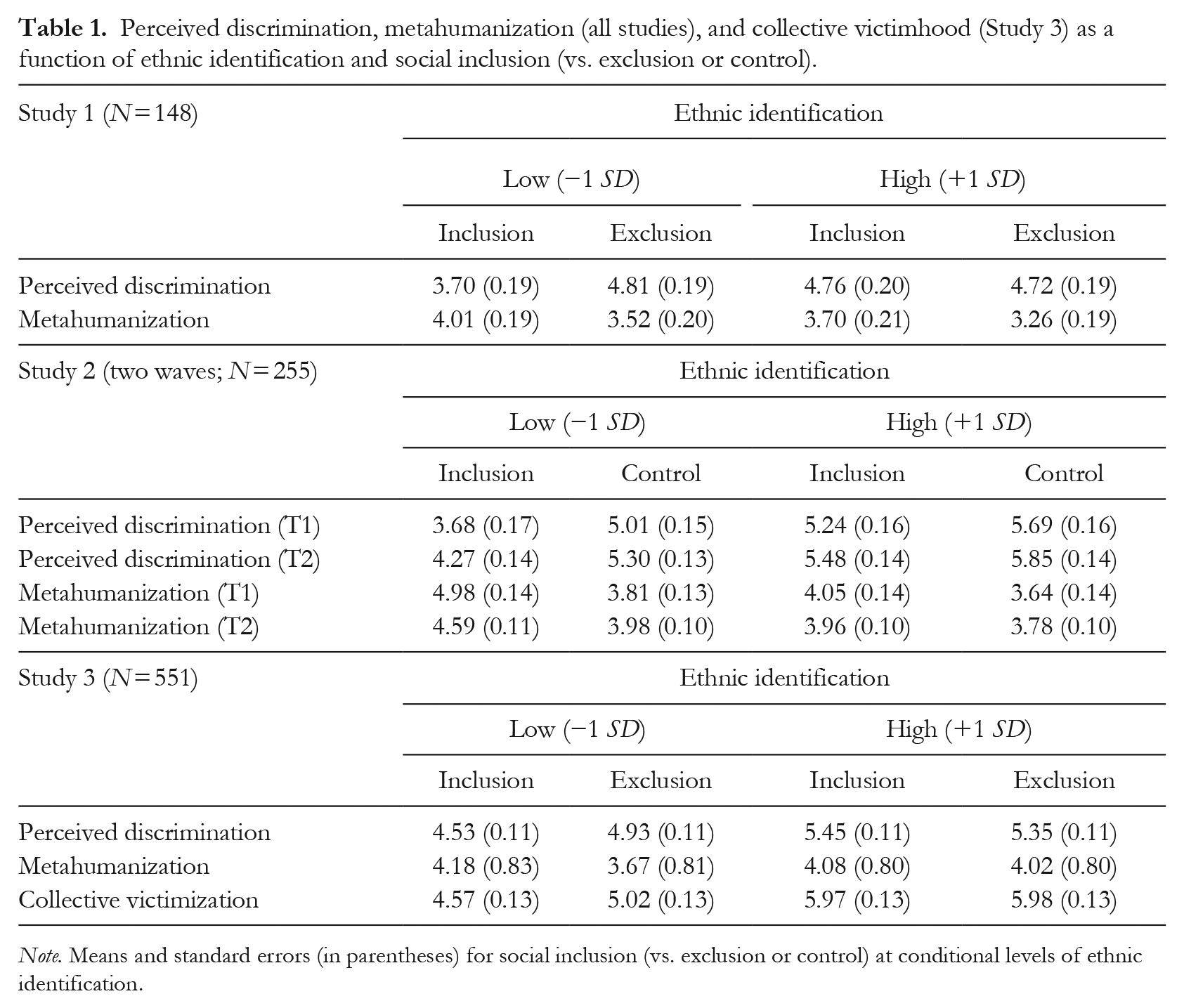
Note. Means and standard errors (in parentheses) for social inclusion (vs. exclusion or control) at conditional levels of ethnic identification.
Manipulation checks
Regarding the perception of the press release, results indicated that the main effect of the experimental manipulation (i.e., social inclusion vs. exclusion) was significant, F(1, 136) = 352.82, p < .001, η2p = .72. Participants in the inclusion condition more strongly indicated that Kosovo would join the EU (M = 5.32, SD = 0.85) than participants in the exclusion condition did (M = 1.94, SD = 1.23). No other effects were significant.
Concerning participants’ perception of Kosovo’s integration into the EU, results indicate that the main effect of the experimental manipulation was significant, F(1, 136) = 344.73, p < .001, η2p = .71. Participants in the inclusion condition more strongly perceived that Kosovo would join the EU (M = 5.21, SD = 0.91) than participants in the exclusion condition did (M = 2.03, SD = 1.06). No other effects were significant.
Perceived discrimination
The main effect of the experimental manipulation was significant, F(1, 136) = 4.68, p = .032, η2p = .03. Participants perceived less discrimination in the inclusion (M = 4.39, SD = 1.27) than in the exclusion condition (M = 4.74, SD = 1.18). The main effect of ethnic identification was not significant, F(1, 136) = 3.59, p = .060. Last, as predicted by H1a, the interaction of experimental manipulation (i.e., inclusion vs. exclusion) and ethnic identification was significant, F(1, 136) = 6.76, p = .010, η2p = .04.
We decomposed this interaction for low and high conditional levels of ethnic identification (see Figure 1). Simple effects indicated that participants with low ethnic identification (−1 SD) perceived less discrimination from the EU in the inclusion condition than in the exclusion condition, F(1, 136) = 11.40, p < .001, η2p = .07, and this difference was not significant for participants with high ethnic identification (+1 SD), F(1, 136) = 0.10, p = .751.
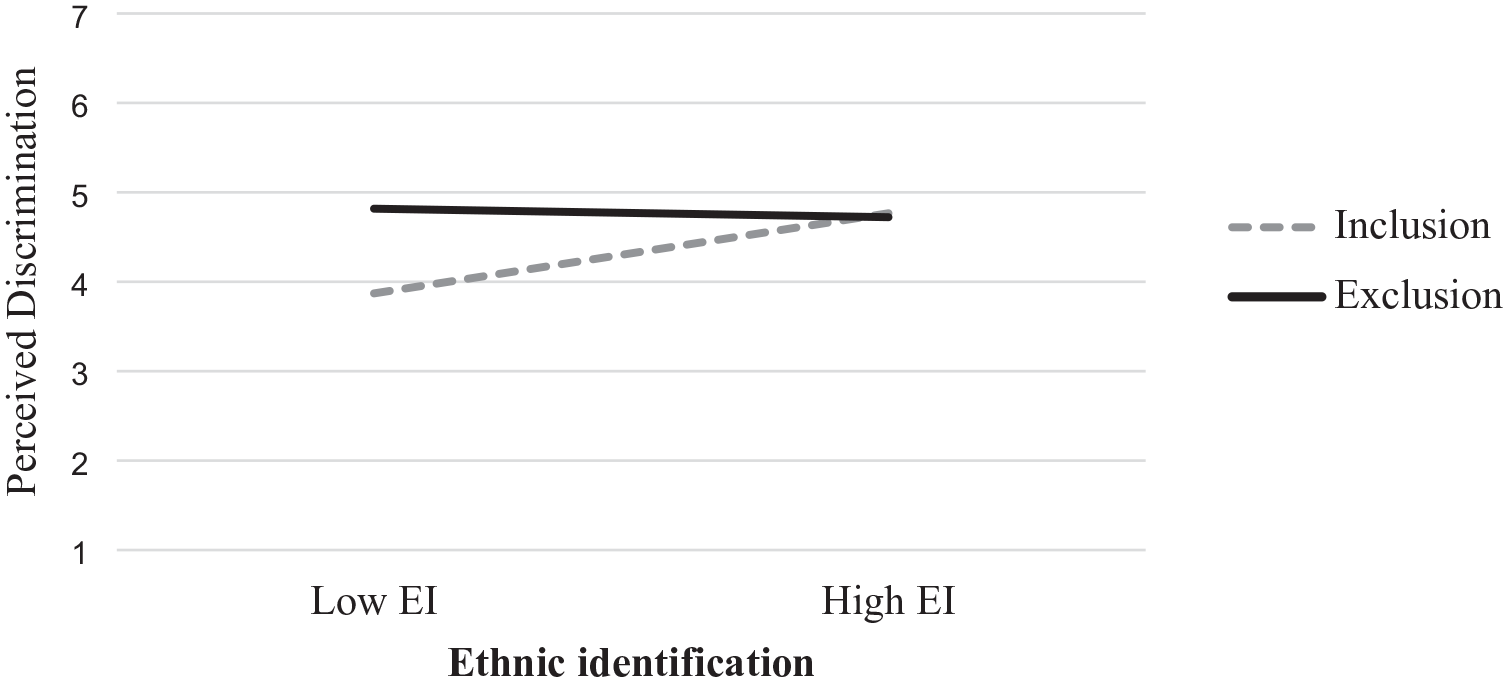
Interactive effect of ethnic identification and social inclusion (vs. exclusion) on perceived discrimination: Study 1.
Metahumanization
The main effect of experimental manipulation was significant, F(1, 136) = 6.92, p = .009, η2p = .04. Participants indicated more metahumanization in the inclusion (M = 3.89, SD = 1.17) than in the exclusion condition (M = 3.44, SD = 1.19). The main effect of ethnic identification, F(1, 136) = 1.86, p = .175, and the predicted interaction of experimental manipulation and ethnic identification, F(1, 136) = 0.02, p = .867, were not significant.
Discussion
The results of Study 1 provided partial support for Hypothesis 1a, which proposed that ethnic identification moderates the effect of social inclusion (vs. exclusion) on both perceived discrimination and metahumanization. While this was true for perceived discrimination, it was not the case for perceived metahumanization. Participants with low ethnic identification perceived less discrimination from the EU in the social inclusion (vs. exclusion) condition. However, those with high ethnic identification perceived discrimination regardless of whether the EU, as the superordinate category, was expected to include or exclude their ingroup. Given these mixed results regarding our hypotheses (i.e., the interaction effect on perceived discrimination and metahumanization), we decided to conduct two additional studies to test them once again.
Study 2 (a Two-Wave Study)
A two-wave experimental study (for a similar procedure, see Falvo et al., 2014) sought to investigate the interaction effect of ethnic identification and social inclusion (vs. the control condition) over time on our two primary dependent variables: perceived discrimination and metahumanization (H1a). We recruited a sample of adolescents in Kosovo to explore their perceptions of the EU, leveraging Kosovo’s distinction as the youngest population in Europe (Sassi & Amighetti, 2018). Including adolescents allowed us to replicate our findings across different generational groups, enhancing the generalizability and ecological validity of our results. By capturing the perspectives of a younger demographic, we reflect the diversity of real-world experiences and ensure that our findings are applicable to a broader audience.
Method
Participants and procedure
We recruited adolescents from a high school in Kosovo after the experimenter (i.e., the school’s psychologist) obtained informed consent from all underage participants’ parents or guardians via the school’s director’s office. Participants were randomly assigned to one of two experimental conditions (i.e., inclusion vs. control) in a design including ethnic identification as an additional continuous factor. We ultimately recruited 250 adolescents native to Kosovo (inclusion condition: n = 125; control condition: n = 125). All participants were 15–18 years old (Mage = 16.44, SDage = 0.73), and 117 were females.
Participants were informed that the study concerned perceptions of social groups and school satisfaction. They were told that after completing the first questionnaire addressing the moderating variable, experimental manipulation, and dependent measures (T1), they would be required to complete another questionnaire a week later, one including only the dependent measures (T2) along with some open-ended questions regarding their satisfaction with the school, in order to reduce the task demands. After they had completed both questionnaires, we debriefed and thanked them for participating (T2). A sensitivity analysis conducted with G*Power Version 3.1.9.2 (Faul et al., 2009) for an ANCOVA model with three predictors, assuming an alpha of .05 and a power estimate of .80, revealed that our final sample size was powered enough to detect an effect size of f 2 = .04, which conventionally indicates a small effect size. 3
Independent measures (T1)
As in Study 1, we first assessed ethnic identification (α = .75; M = 5.02, SD = 1.41).
Experimental manipulation (T1 questionnaire)
Participants in the inclusion condition were assigned to the same experimental manipulation used in Study 1, whereas participants in the control condition were not exposed to a press release.The control condition allowed us to investigate the baseline perception of adolescents in Kosovo regarding the country’s inclusion (vs. exclusion) in the EU. On top of that, because Study 2 had two parts, we did not wish to burden participants with unfavorable information for the week prior to debriefing.
Manipulation and attention check (T1 questionnaire)
Because we introduced a control condition, we performed a manipulation check with a single item previously used in Study 1 that asked participants, “In your personal opinion, will Kosovo join the EU?” (M = 3.62, SD = 1.73). At the end of the questionnaire, participants were asked whether they had read any press release and to identify its content, which they all did correctly.
Dependent measures (T1 and T2 questionnaires)
We utilized measures akin to those employed in Study 1 to evaluate perceived discrimination at T1 (α = .83; M = 4.92, SD = 1.48) and T2 (α = .89; M = 5.23, SD = 1.24) and metahumanization at T1 (α = .77; M = 4.11, SD = 1.21) and T2 (α = .60; M = 4.07, SD = 0.87). We introduced the dependent measures at both T1 and T2 to examine the immediate effect of the expected interaction and the effect over time (i.e., a week later).
Results
Using SPSS, ethnic identification (standardized scores at Time 1) and experimental manipulation (inclusion vs. control, coded as −1 and +1, respectively, at Time 1), as well as the interaction term between those factors, were entered as independent variables in a full factorial ANCOVA. Perceived discrimination and metahumanization at both Time 1 and Time 2 were included as dependent variables. Table 1 provides estimated means and standard errors for the primary dependent variables at Time 1 and Time 2.
Manipulation check
Concerning participants’ perception of Kosovo’s integration into the EU, results indicate that the experimental manipulation’s main effect was significant, F(1, 245) = 65.90, p < .001, η2p = .21. Participants’ perception that Kosovo would join the EU was higher in the inclusion condition (M = 4.41, SD = 1.47) than in the control condition (M = 2.84, SD = 1.58). No other effects were significant.
Perceived discrimination (T1)
The experimental manipulation’s main effect was significant, F(1, 245) = 27.75, p < .001, η2p = .10. Participants perceived less discrimination in the inclusion condition (M = 4.51, SD = 1.36) than in the control condition (M = 5.33, SD = 1.49). The main effect of ethnic identification was also significant, F(1, 245) = 45.24, p < .001, η2p = .15. On that count, perceived discrimination increased along with ethnic identification (B = 0.56). Last, as predicted by H1a, the interaction of experimental manipulation and ethnic identification was significant, F(1, 245) = 6.69, p = .010, η2p = .02.
Simple effects indicated that participants with low ethnic identification (−1 SD) perceived less discrimination from the EU in the inclusion condition than in the control condition, F(1, 245) = 30.48, p < .001, η2p = .11, and this difference was not significant for participants with high ethnic identification (+1 SD), F(1, 245) = 3.55, p = .061.
Metahumanization (T1)
The experimental manipulation’s main effect was significant, F(1, 245) = 31.47, p < .001, η2p = .11. Participants indicated more metahumanization in the inclusion condition (M = 4.49, SD = 1.17) than in the control condition (M = 3.37, SD = 1.12). The main effect of ethnic identification was also significant, F(1, 245) = 15.11, p < .001, η2p = .05. On that count, metahumanization decreased as ethnic identification increased (B = −0.27). Last, as predicted by H1a, the interaction of experimental manipulation and ethnic identification was significant, F(1, 245) = 6.97, p = .009, η2p = .02.
Simple effects indicated that participants with low ethnic identification (−1 SD) felt more humanized by the EU in the inclusion condition than in the control condition, F(1, 245) = 33.58, p < .001, η2p = .12, and the same was true for participants with high ethnic identification (+1 SD), F(1, 245) = 4.34, p = .038, η2p = .01.
Perceived discrimination (T2)
The experimental manipulation’s main effect was significant, F(1, 245) = 23.69, p < .001, η2p = .08. Participants perceived less discrimination in the inclusion condition (M = 4.91, SD = 1.27) than in the control condition (M = 5.56, SD = 1.12). The main effect of ethnic identification was also significant, F(1, 245) = 39.47, p < .001, η2p = .13. On that count, perceived discrimination increased along with ethnic identification (B = 0.44). Last, as predicted by H1a, the interaction of experimental manipulation and ethnic identification was significant, F(1, 245) = 4.99, p = .026, η2p = .02.
Simple effects indicated that participants with low ethnic identification (−1 SD) perceived less discrimination from the EU in the inclusion condition than in the control condition, F(1, 245) = 24.91, p < .001, η2p = .09, and this difference was not significant for participants with high ethnic identification (+1 SD), F(1, 245) = 3.42, p = .065.
Metahumanization (T2)
The experimental manipulation’s main effect was significant, F(1, 245) = 13.48, p < .001, η2p = .05. Participants indicated more metahumanization in the inclusion condition (M = 4.26, SD = 0.80) than in the control condition (M = 3.89, SD = 0.91). The main effect of ethnic identification was also significant, F(1, 245) = 16.20, p < .001, η2p = .06. On that count, metahumanization decreased as ethnic identification increased (B = −0.21). Last, as predicted by H1a, the interaction of experimental manipulation and ethnic identification was significant, F(1, 245) = 3.77, p = .043.
Simple effects indicated that participants with low ethnic identification (−1 SD) felt more humanized by the EU in the inclusion condition than in the control condition, F(1, 245) = 15.58, p < .001, η2p = .06, and this difference was not significant for participants with high ethnic identification (+1 SD), F(1, 245) = 1.47, p = .226. In other words, the inclusion condition was not strong enough for those participants to feel humanized.
Discussion
Using an adolescent sample and a two-wave design, Study 2 provided consistent evidence supporting H1a across all dependent variables. Unlike Study 1, which compared the inclusion condition to an exclusion condition, Study 2 compared the inclusion condition to a control/baseline condition where no information about Kosovo’s potential integration into the EU was provided. Participants with low ethnic identification perceived less discrimination and more metahumanization from the EU in the inclusion (vs. control) condition. By contrast, those with high ethnic identification perceived more discrimination and less metahumanization, regardless of the experimental manipulation. It is worth mentioning that, regarding metahumanization, this was the case only at Time 2. Overall, Study 2 established that the default understanding of the EU’s position toward Kosovo tends to be more exclusive than inclusive, as reflected in the control/baseline condition.
Study 3 was conducted to test whether individuals with low (vs. high) ethnic identification would perceive less discrimination and more metahumanization in the inclusion (vs. exclusion) condition because their inclusion in the superordinate category would reduce their potential perceived collective victimhood.
Study 3
In Study 3, we assessed ethnic identification as an individual difference factor using adult participants similar to those in Study 1. The main dependent variables were similar to those in Studies 1 and 2, but we included a measure of collective victimhood to assess whether participants perceived their ingroup members as collectively victimized due to the EU’s treatment of Kosovo regarding its potential EU membership. In addition to H1a, we hypothesized an interaction effect between ethnic identification and social inclusion (vs. exclusion) on perceived collective victimhood (H1b). We also hypothesized that perceived collective victimhood would mediate the effect of social inclusion (vs. exclusion) on perceived discrimination and metahumanization among individuals with low (vs. high) ethnic identification (H2).
Method
Participants and procedure
Study 3 was preregistered. 4 A priori analysis conducted with G*Power Version 3.1.9.2 (Faul et al., 2009) for an ANCOVA with three predictors (i.e., two main effects and a two-way interaction), based on a small effect size of f 2 = 0.02, α = .05, and a power estimate of .80, indicated that the study would require 550 participants. Furthermore, this number of participants was sufficient to test our mediation model (e.g., Fritz & MacKinnon, 2007). Because the online questionnaire had been completed by 557 participants, that requirement was met, and data collection was terminated. Ultimately, we had to exclude one participant who failed the attention check and five others who did not give consent to use their data. Thus, the final sample included 551 participants (329 women; Mage = 27.58, SDage = 7.82) randomly assigned to one of two experimental conditions: inclusion (n = 286) or exclusion (n = 265). A sensitivity analysis also conducted with G*Power for ANCOVA revealed that with α = .05 and a power estimate of .80, our final sample was sufficiently powered to detect an effect size of f 2 = .01, which conventionally indicates a small effect size (Faul et al., 2009).
Measures and experimental manipulation
We first assessed participants’ ethnic identification (α = .82; M = 4.72, SD = 1.71) using the same scale as in Studies 1 and 2. Next, we exposed participants to the experimental manipulation as in Study 1 and administered the same manipulation check regarding the content of the press release (M = 4.57, SD = 1.92) and their personal opinion about it (M = 4.76, SD = 1.95). We also used the same attention check to observe whether they could recall the content they had read. Participants then completed the same measures of perceived discrimination (α = .83; M = 5.06, SD = 1.37) and metahumanization (α = .69; M = 3.99, SD = 0.98) as in the previous studies, as well as the measure of collective victimhood. For that measure, on a 7-point Likert scale (1 = strongly disagree, 7 = strongly agree), participants indicated the extent to which two items adapted from Jasini et al. (2017; rs = .74; M = 5.42, SD = 1.69) applied to their situation: “Kosovo Albanians have long suffered because of the decisions made by the European Union regarding Kosovo’s EU membership” and “Kosovo is the only country in Europe without freedom of movement due to the European Union’s decisions regarding Kosovo’s EU membership.”
Results
Using SPSS, ethnic identification (standardized values) and the experimental manipulation (i.e., inclusion vs. exclusion, coded as −1 and +1, respectively), along with the interaction term between these factors, were entered as independent variables in a full factorial ANCOVA. Perceived discrimination, metahumanization, and collective victimhood were included as dependent variables. Table 1 provides estimated means and standard errors for the primary dependent variables.
Manipulation checks
Regarding the perception of the press release, results indicate that the experimental manipulation’s main effect was significant, F(1, 546) = 30.50, p < .001, η2p = .05. Participants in the inclusion condition more strongly indicated that Kosovo would join the EU (M = 5.17, SD = 1.76) than participants in the exclusion condition (M = 4.31, SD = 2.05). Although the main effect of ethnic identification was also significant, F(1, 546) = 42.51, p < .001, η2p = .07, no other effects were.
Concerning participants’ perception of Kosovo’s integration into the EU, results indicate that the experimental manipulation’s main effect was significant, F(1, 546) = 43.14, p < .001, η2p = .07. Participants in the inclusion condition more strongly believed that Kosovo would join the EU (M = 4.95, SD = 1.76) than participants in the exclusion condition (M = 3.94, SD = 2.05). The main effect of ethnic identification was also significant, F(1, 546) = 50.69, p < .001, η2p = .08, but no other effects were.
Perceived discrimination
The experimental manipulation’s main effect was not significant, F(1, 546) = 30.50, p = .180, but the main effect of ethnic identification was, F(1, 546) = 35.12, p < .001, η2p = .06. On that count, perceived discrimination increased along with ethnic identification (B = 0.33). Last, as predicted by H1a, the interaction of experimental manipulation and ethnic identification was significant, F(1, 546) = 4.99, p = .026, η2p = .01.
Simple effects indicated that participants with low ethnic identification (−1 SD) perceived less discrimination from the EU in the inclusion condition than in the exclusion condition, F(1, 546) = 6.39, p = .012, η2p = .01, and this difference was not significant for individuals with high ethnic identification (+1 SD), F(1, 546) = 0.40, p = .527, who felt strongly discriminated against by the EU regardless of experimental manipulation.
Metahumanization
The experimental manipulation’s main effect was significant, F(1, 546) = 11.73, p < .001, η2p = .02. Participants indicated more metahumanization in the inclusion condition (M = 4.13, SD = 0.94) than in the exclusion condition (M = 3.85, SD = 1.00). However, the main effect of ethnic identification was not significant, F(1, 546) = 2.24, p = .135. Last, as predicted by H1a, the interaction of experimental manipulation and ethnic identification was significant, F(1, 546) = 7.61, p = .006, η2p = .01.
Simple effects revealed that participants with low ethnic identification (−1 SD) felt more humanized by the EU in the inclusion condition than in the exclusion condition, F(1, 546) = 19.11, p < .001, η2p = .03, and this difference was not significant for individuals with high ethnic identification (+1 SD), F(1, 546) = 0.22, p = .639. In other words, the inclusion condition was not strong enough for those participants to feel humanized.
Collective victimhood
The experimental manipulation’s main effect was significant, F(1, 546) = 5.65, p = .018, η2p = .01. Participants felt less victimized by the EU’s decision in the inclusion condition (M = 5.27, SD = 1.79) than in the exclusion condition (M = 5.59, SD = 1.56). The main effect of ethnic identification was also significant, F(1, 546) = 64.23, p < .001, η2p = .10. On that count, collective victimhood increased along with ethnic identification (B = 0.54). Last, as predicted by H1b, the interaction of experimental manipulation and ethnic identification was significant, F(1, 546) = 5.13, p = .024, η2p = .01.
The decomposition of this interaction indicated that participants with low ethnic identification (−1 SD) felt less victimized by the EU in the inclusion condition than in the exclusion condition, F(1, 546) = 10.77, p < .001, η2p = .01, and this difference was not significant for participants with high ethnic identification (+1 SD), F(1, 546) = 0.05, p = .939.
Mediation analysis
We tested H2 using Model 8 in PROCESS for SPSS (10,000 bootstrapped samples; Hayes, 2018) 5 to run two moderated mediation analyses for the two outcome measures—that is, perceived discrimination and metahumanization. In each analysis, we entered the experimental manipulation (−1 = inclusion condition, +1 = exclusion condition) as the independent variable, and ethnic identification as the moderator. Last, we entered perceived collective victimhood as a mediator (see Figure 2).
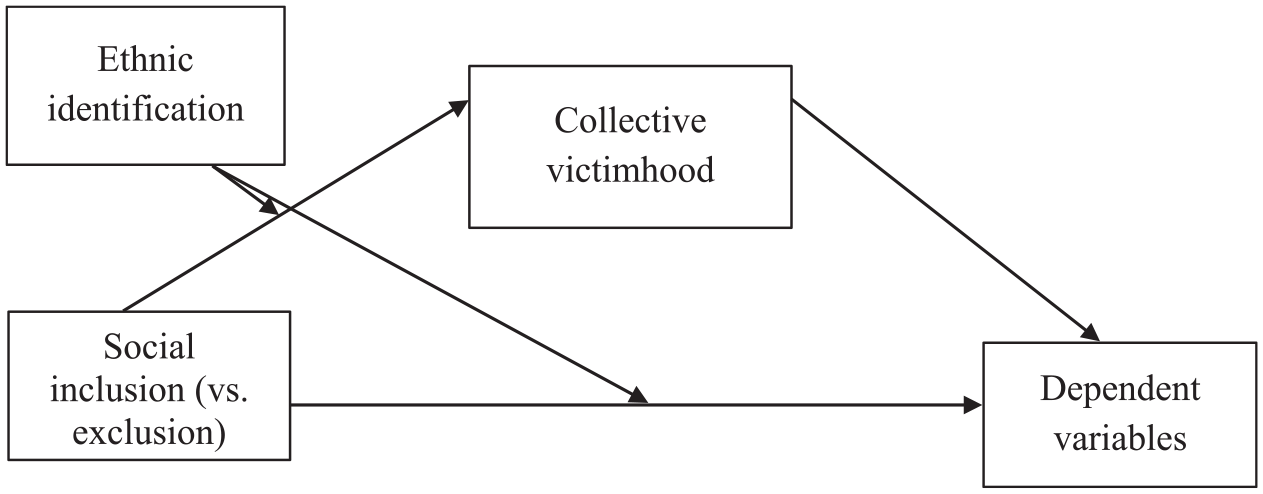
The conceptual path model tested in Study 3.
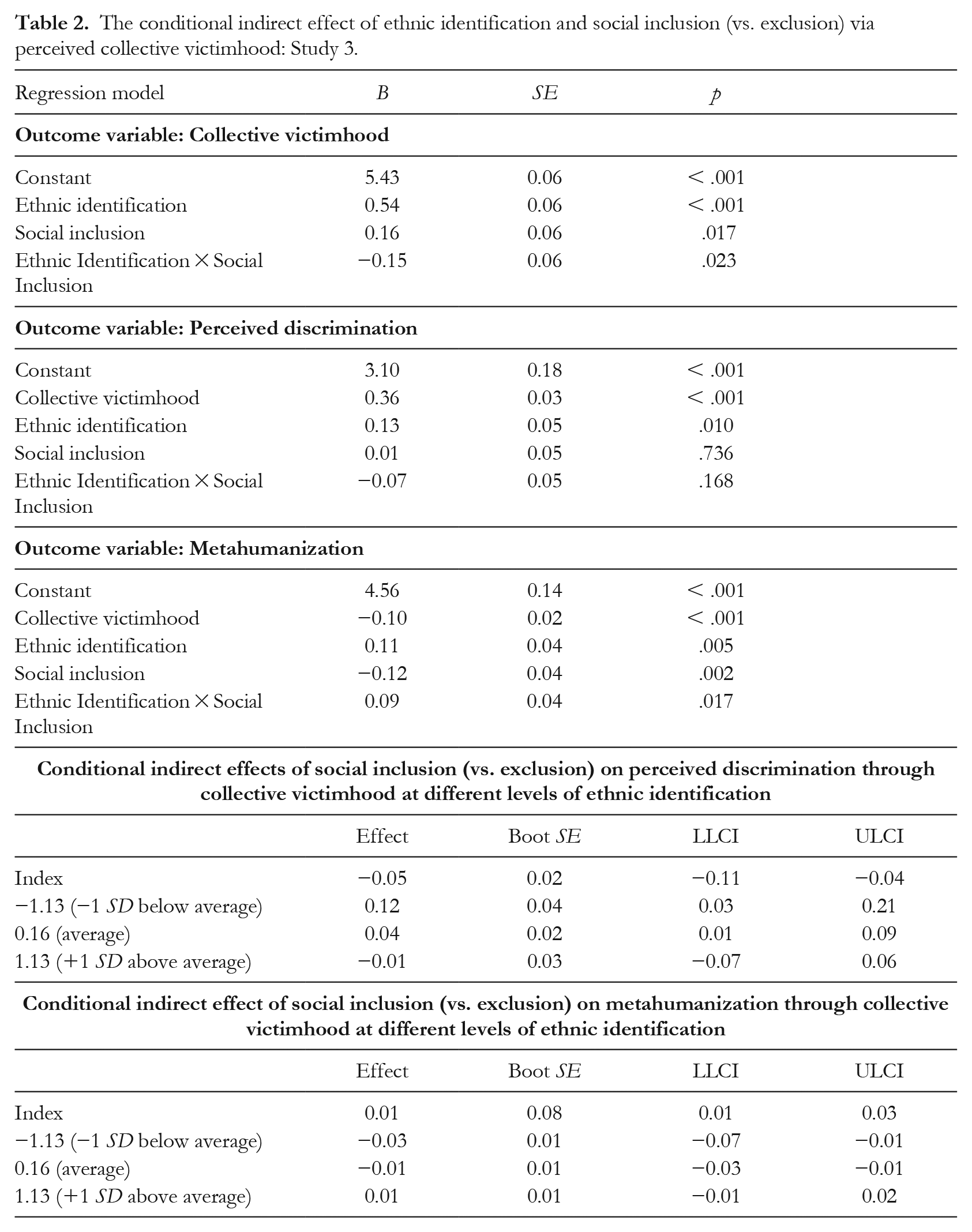
Regarding perceived discrimination, the indirect effect of the inclusion (vs. exclusion) condition via collective victimhood was significant among participants with low ethnic identification, but not among those with high ethnic identification. Regarding metahumanization, the indirect effect of the inclusion (vs. exclusion) condition via collective victimhood was significant among participants with low ethnic identification, but not among those with high ethnic identification (see Table 2).
The conditional indirect effect of ethnic identification and social inclusion (vs. exclusion) via perceived collective victimhood: Study 3.
Discussion
Study 3 provided further evidence in support of H1a regarding both perceived discrimination and metahumanization. Moreover, participants with low ethnic identification perceived less collective victimhood in the inclusion than in the exclusion condition, thus providing support for H1b. However, individuals with high ethnic identification perceived greater collective victimhood regardless of experimental manipulation. Beyond that, Study 3 provided additional evidence supporting H2, according to which perceived collective victimhood mediates the effect of social inclusion (vs. exclusion) on perceived discrimination and metahumanization among individuals with low (vs. high) ethnic identification. We conducted Study 4 to gather more information on whether people feel the need to belong to the EU, in addition to their ethnic identification. This study also aimed to replicate and extend the moderated mediation model and to include a control condition, alongside the exclusion and inclusion conditions.
Study 4
In Study 4, we assessed the need to belong to the EU and ethnic identification as individual differences factors. We then updated our experimental manipulation of inclusion and exclusion conditions due to new developments regarding visa liberalization between Kosovo and the EU (Selimi, 2024). Despite these updates, we continued to highlight the possibility of Kosovo joining or not joining the EU. Additionally, we introduced a control condition that solely focused on the EU’s economic support of Kosovo without providing any information on inclusion or exclusion in the EU. The main dependent variables were similar to those in Study 3, but we also asked participants about their knowledge of Kosovo’s integration into the EU, to examine if our predicted effects go beyond knowledge about such processes.
We anticipated a three-way interaction between the need to belong to the EU, ethnic identification, and social inclusion (vs. exclusion and control) on perceived discrimination, metahumanization, and collective victimhood (H3). Specifically, we expected that individuals expressing a great need to belong to the EU would react positively—experiencing less perceived discrimination and collective victimhood, and more metahumanization—regardless of their level of ethnic identification when exposed to the inclusion condition (vs. exclusion or control conditions. However, for individuals with a low need to belong to the EU, we expected their reaction to be influenced by their level of ethnic identification. Those with high ethnic identification would react negatively to inclusion in the superordinate category as they may prioritize and find validation from their ethnic identity, while those with low ethnic identification would react positively to inclusion in the superordinate category, as it would provide them with additional validation and recognition that align with their broader identity needs. Additionally, we examined whether perceived collective victimhood mediates the predicted three-way interaction effect on perceived discrimination and metahumanization (H4).
Method
Participants and procedure
Study 4 was also preregistered. 6 An a priori analysis conducted with G*Power Version 3.1.9.2 (Faul et al., 2009) for an ANCOVA with three predictors, based on a small effect size of f 2 = 0.02, α = .05, and a power estimate of .80, indicated that the study would require 725 participants. Using a paper-and-pencil methodology at the university campus in Kosovo, we were able to recruit 732 participants (353 women; Mage = 25.39, SDage = 5.36) randomly assigned to one of three experimental conditions: inclusion (n = 249), exclusion (n = 242), or control (n = 241). A sensitivity analysis also conducted with G*Power for ANCOVA, revealed that, assuming α = .05 and a power estimate of .80, our final sample was sufficiently powered to detect an effect size of f 2 = 0.01, which conventionally indicates a small effect size (Faul et al., 2009).
Measures and experimental manipulation
We first assessed participants’ need to belong to the EU using a 10-item scale adapted from Valcke et al. (2020; e.g., “I want to be part of the European Union” and “I need to feel that I belong to the European Union”); response were provided on a 7-point Likert scale (1 = strongly disagree, 7 = strongly agree). We computed an average score to obtain each participant’s global score for the need to belong to the EU (α = .94; M = 4.24, SD = 1.67). Next, we assessed ethnic identification (α = .93; M = 3.68, SD = 1.89) using a similar scale to those used in previous studies.
Experimental manipulation
As in previous studies, each participant was randomly assigned to one of the three experimental conditions based on the questionnaire packet they completed in person. In all conditions, participants read a fictional but ostensibly real press release concerning Kosovo and the EU. Following Kosovo’s receipt of visa liberalization, in the inclusion and exclusion conditions, we explicitly focused on Kosovo’s integration into the EU, while the control condition emphasized the economic support offered by the EU to Kosovo.
In all conditions, the title of the press release stated, “Kosovo and the European Union.” In the inclusion condition, the press release continued as follows: “According to BBC news, the European Union (EU) has declared that, with the recent visa liberalization granted to Kosovo starting from the year 2024, the country (Kosovo) now has significant chances of joining our common international union, that is the European Union, in the near future”.
In the exclusion condition, the press release continued differently: “According to BBC news, the European Union (EU) has declared that, with the recent visa liberalization granted to Kosovo starting from the year 2024, the country (Kosovo) still has no chance of joining our common international union, that is the European Union, in the near future”.
Finally, in the control condition, the press release was not focused on inclusion or exclusion, and thus continued differently: “According to BBC news, the European Union (EU) has acknowledged Kosovo for its natural and cultural heritage. Additionally, the EU has announced that they will donate 1 million euros to Kosovo’s economy in 2024”.
Dependent variables
Since we had three experimental conditions, we introduced only a single manipulation check concerning participants’ personal opinions on Kosovo’s integration into the EU (M = 3.64, SD = 1.78), as in previous studies, along with the same attention check to ensure they could recall the content they had read. Participants then completed similar measures as in Study 3 regarding perceived discrimination (α = .95; M = 4.29, SD = 1.73), metahumanization (α = .89; M = 3.39, SD = 1.29), and collective victimhood. This time, the collective victimhood measure comprised three items, unlike in Study 3, due to the inclusion of an additional item adapted from Schori-Eyal et al. (2014), which reads: “The history of the Albanian population in Kosovo is characterized by a continuous threat to its existence” (α = .95; M = 4.34, SD = 1.75).
Control variable
We also added two items to control for participants’ knowledge about Kosovo and EU processes (e.g., “To what extent are you aware of the process of Kosovo’s integration into the European Union?” and “To what extent do you follow the news about Kosovo’s integration process into the European Union?”). Response were given on a 7-point Likert scale (1 = not at all, 7 = very much; rs = .54, M = 3.63, SD = 1.06).
Results
To test our hypotheses, we employed two orthogonal contrasts. Contrast analysis offers a more precise and robust statistical approach for analyzing variables with more than two modalities (Borinca, Griffin, et al., 2024; Brauer & McClelland, 2005; Furr & Rosenthal, 2003; Valsecchi et al., 2024). Following a linear hypothesis, the first contrast (C1) compared the inclusion condition (+2) with the exclusion and control conditions (−1 and −1, respectively). The second critical contrast (C2) compared the exclusion (+1) and control (−1) conditions, while the inclusion condition coded as 0. Using SPSS, these two orthogonal contrasts, along with the need to belong to the EU (standardized values) and ethnic identification (standardized values), including interactions between these terms (except for the interaction between contrasts), were entered as independent variables in a full factorial ANCOVA. Additionally, we controlled for prior knowledge about Kosovo and EU processes. Perceived discrimination, metahumanization, and collective victimhood were used as dependent variables. Table 3 provides the estimated means and standard errors for the primary dependent variables.
Dependent variables as a function of the need to join the EU, ethnic identification, and inclusion (vs. exclusion and control).
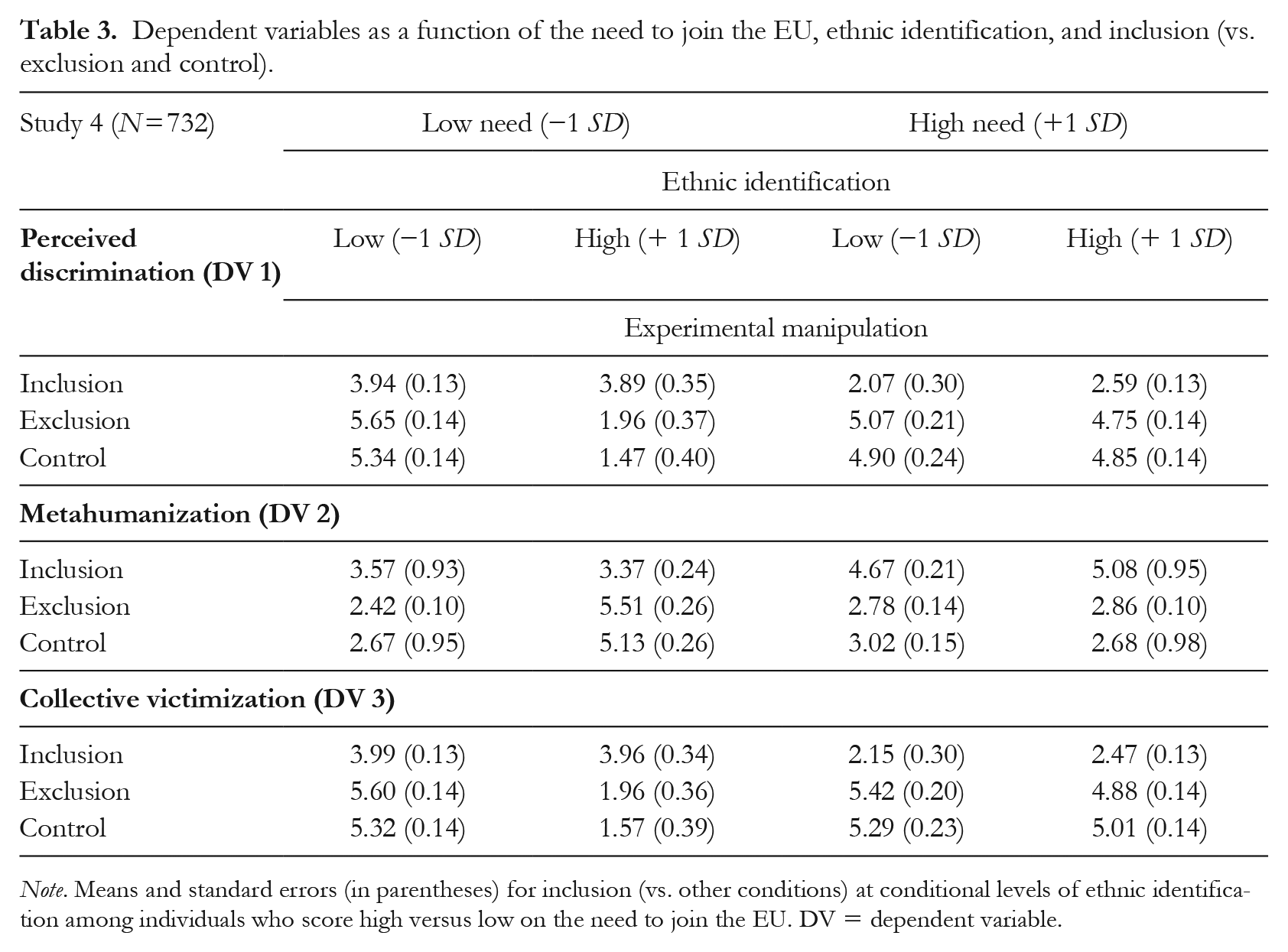
Note. Means and standard errors (in parentheses) for inclusion (vs. other conditions) at conditional levels of ethnic identification among individuals who score high versus low on the need to join the EU. DV = dependent variable.
Manipulation check
Concerning participants’ personal perception of Kosovo’s integration into the EU, results indicate a significant main effect of the need to belong to the EU, F(1, 720) = 11.10, p < .001, ηp2 = .01; the perception that Kosovo will be joining the EU decreased along with the need to belong to the EU (B = −0.29). The main effect of ethnic identification was also significant, F(1, 720) = 40.67, p < .001, ηp2 = .05; the perception that Kosovo will join the EU increased along with ethnic identification (B = 0.56). Both Contrast 1 (C1), F(1, 720) = 15.36, p < .001, ηp2 = .02, and Contrast 2 (C2), F(1, 720) = 5.21, p = .023, ηp2 = .007, were significant. Participants perceived that Kosovo would be joining the EU more when they were exposed to the inclusion condition (M = 4.73, SD = 1.76) than in the other two conditions (Mcontrol = 3.20, SD = 1.55; Mexclusion = 2.95, SD = 1.46). 7 The C1 × Need to Join the EU interaction was significant, F(1, 720) = 35.54, p < .001, ηp2 = .04, as well as the C1 × Ethnic Identification interaction, F(1, 720) = 4.41, p = .036, ηp2 = .01. Also, the Need to Belong to the EU × Ethnic Identification interaction was significant, F(1, 720) = 111.74, p < .001, ηp2 = .13. Most importantly, these two-way interactions were qualified by a C1 × Need to Belong to the EU × Ethnic Identification interaction, F(1, 720) = 56.72, p = .036, ηp2 = .07, while the C2 × Need to Belong to the EU × Ethnic Identification interaction was not significant, F(1, 720) = 1.40, p = .237, ηp2 = .01.
Exploring the three-way interaction for people who scored low on need to belong to the EU, the C1 × Ethnic Identification interaction was significant, F(1, 720) = 41.51, p < .001, ηp2 = .05. Simple effects indicated that those who scored low on need to belong to the EU and scored low on ethnic identification (−1 SD) perceived that Kosovo would join the EU more in the inclusion condition (M = 3.85, SE = 0.13) that in the other conditions (Mexclusion = 2.48, SE = 0.13; Mcontrol = 2.98, SE = 0.13), F(1, 720) = 51.95, p < .001, ηp2 = .09, while those who scored high on ethnic identification (+1 SD) perceived that Kosovo would join the EU more in the exclusion and control conditions (Mcontrol = 6.57, SE = 0.45; Mexclusion = 5.77, SE = 0.39) that in the inclusion condition (M = 4.20, SE = 0.36), F(1, 720) = 8.41, p = .004, ηp2 = .01.
Next, exploring the three-way interaction for people who scored high on need to belong to the EU, the C1 × Ethnic Identification interaction was significant, F(1, 720) = 4.40, p = .036, ηp2 = .01. Simple effects revealed that those who scored high on need to belong to the EU and scored low on ethnic identification (−1 SD) perceived that Kosovo would join the EU more in the inclusion condition (M = 4.81, SE = 0.50) than in the other conditions (Mexclusion = 3.46, SE = 0.26; Mcontrol = 3.78, SE = 0.29), F(1, 720) = −2.43, p = .015, ηp2 = .01, and the same was true among those who scored high on ethnic identification (+1 SD; Minclusion = 5.59, SE = 0.13; Mexclusion = 2.96, SE = 0.14; Mcontrol = 2.87, SE = 0.15), F(1, 720) = −13.65, p < .001, ηp2 = .02.
Perceived discrimination
Results indicate a significant main effect of the need to belong to the EU, F(1, 720) = 14.70, p < .001, ηp2 = .02; perceived discrimination increased along with the need to belong to the EU (B = 0.28). The main effect of ethnic identification was also significant, F(1, 720) = 88.38, p < .001, ηp2 = .10; perceived discrimination decreased along with ethnic identification (B = −0.70). Also, the effect of C1 was significant, F(1, 720) = 50.37, p < .001, ηp2 = .05; participants perceived less discrimination from the EU in the inclusion condition (M = 3.27, SD = 1.68) than in the other two conditions (Mexcluson = 4.86, SD = 1.54; Mcontrol = 4.76, SD = 1.50). The C1 × Need to Belong to the EU interaction was significant, F(1, 720) = 80.72, p < .001, ηp2 = .10, as well as the C1 × Ethnic Identification interaction, F(1, 720) = 50.55, p < .001, ηp2 = .06. Additionally, the Need to Belong to the EU × Ethnic Identification interaction was significant, F(1, 720) = 107.41, p < .001, ηp2 = .13. Most importantly, these two-way interactions were qualified by a C1 × Need to Belong to the EU × Ethnic Identification interaction, F(1, 720) = 31.13, p < .001, ηp2 = .04, while the C2 × Need to Belong to the EU × Ethnic Identification interaction was not significant, F(1, 720) = 0.56, p = .452, ηp2 = .01.
Exploring the three-way interaction for people who scored low on need to belong to the EU, the C1 × Ethnic Identification interaction was significant, F(1, 720) = 62.99, p < .001, ηp2 = .13. Simple effects indicated that those who scored low on need to belong to the EU and scored low on ethnic identification (−1 SD) perceived less discrimination from the EU in the inclusion condition than in the other conditions, F(1, 720) = 75.61, p < .001, ηp2 = .13, while those who scored high on ethnic identification (+1 SD) perceived less discrimination from the EU in the exclusion and control conditions than in the inclusion condition, F(1, 720) = 13.97, p < .001, ηp2 = .02.
Next, exploring the three-way interaction for people who scored high on need to belong to the EU, the C1 × Ethnic Identification interaction was significant, F(1, 720) = 4.01, p = .046, ηp2 =.01. As expected, simple effects revealed that those who scored high on need to belong to the EU and scored low on ethnic identification (−1 SD) perceived less discrimination from the EU in the inclusion condition than in the other conditions, F(1, 720) = 64.23, p < .001, ηp2 = .11, and the same was true among those who scored high on ethnic identification (+1 SD), F(1, 720) = 115.41, p < .001, ηp2 = .19.
Metahumanization
Results indicate a significant main effect of need to belong to the EU, F(1, 720) = 22.35, p < .001, ηp2 = .03; metahumanization decreased along with the need to belong to the EU (B = −0.23). The main effect of ethnic identification was also significant, F(1, 720) = 102.62, p < .001, ηp2 = .12; metahumanization increased along with ethnic identification (B = 0.50). Likewise, the effect of C1 was significant, F(1, 720) = 61.21, p < .001, ηp2 = .07; participants felt more humanized by the EU in the inclusion condition (M = 4.27, SD = 1.29) than in the other two conditions (Mexcluson = 2.94, SD = 1.12; Mcontrol = 2.93, SD = 0.92). The C1 × Need to Belong to the EU interaction was significant, F(1, 720) = 138.162, p < .001, ηp2 = .16, as well as the C1 × Ethnic Identification interaction, F(1, 720) = 34.09, p < .001, ηp2 = .04. Additionally, the C2 × Ethnic Identification interaction, F(1, 720) = 4.72, p = .030, ηp2 = .01, and the Need to Belong to the EU × Ethnic Identification interaction, F(1, 720) = 124.69, p < .001, ηp2 = .14, were significant. Again, these two-way interactions were qualified by a C1 × Need to Belong to the EU × Ethnic Identification interaction, F(1, 720) = 89.03, p < .001, ηp2 = .11, while the C2 × Need to Belong to the EU × Ethnic Identification interaction was not significant, F(1, 720) = 0.23, p = .625, ηp2 = .01.
Exploring the three-way interaction for people who scored low on need to belong to the EU, the C1 × Ethnic Identification interaction was significant, F(1, 720) = 91.53, p < .001, ηp2 = .11. Simple effects indicated that those who scored low on need to belong to the EU and scored low on ethnic identification (−1 SD) felt more humanized by the EU in the inclusion condition than in the other conditions, F(1, 720) = 69.89, p < .001, ηp2 = .12, while participants who scored high on ethnic identification (+1 SD) felt more humanized by the EU in the exclusion and control conditions than in the inclusion condition, F(1, 720) = 35.21, p < .001, ηp2 = .06.
Next, exploring the three-way interaction for people who scored high on need to belong to the EU, the C1 × Ethnic Identification interaction was significant, F(1, 720) = 4.78, p = .029, ηp2 = .01. As expected, simple effects revealed that those who scored high on need to belong to the EU and scored low on ethnic identification (−1 SD) felt more humanized by the EU in the inclusion condition than in the other conditions, F(1, 720) = 52.10, p < .001, ηp2 = .09, and the same was true among those who scored high on ethnic identification (+1 SD), F(1, 720) = 251.67, p < .001, ηp2 = .34.
Collective victimhood
Results indicate a significant main effect of the need to belong to the EU, F(1, 720) = 24.78, p < .001, ηp2 = .03; collective victimhood increased along with the need to belong to the EU (B = 0.36). The main effect of ethnic identification was also significant, F(1, 720) = 97.67, p < .001, ηp2 = .12; collective victimhood decreased along with ethnic identification (B = −0.73). The effect of C1 was also significant, F(1, 720) = 59.06, p < .001, ηp2 = .07; participants felt less victimized by the EU’s decision in the inclusion condition (M = 3.25, SD = 1.63) than in the other two conditions (Mexcluson = 4.93, SD = 1.55; Mcontrol = 4.87, SD = 1.51). The C1 × Need to Belong to the EU interaction was significant, F(1, 720) = 101.61, p < .001, ηp2 = .12, as well as the C1 × Ethnic Identification interaction, F(1, 720) = 50.14, p < .001, ηp2 = .06. Additionally, the Need to Belong to the EU × Ethnic Identification interaction was significant, F(1, 720) = 88.51, p < .001, ηp2 = .11. Once again, these two-way interactions were qualified by a C1 × Need to Belong to the EU × Ethnic Identification interaction, F(1, 720) = 31.43, p < .001, ηp2 = .04, while the C2 × Need to Belong to the EU × Ethnic Identification interaction was not significant, F(1, 720) = 0.79, p = .451, ηp2 = .01.
Exploring the three-way interaction for people who scored low on need to belong to the EU, the C1 × Ethnic Identification interaction was significant, F(1, 720) = 62.54, p < .001, ηp2 = .08. Simple effects indicated that those who scored low on need to belong to the EU and scored low on ethnic identification (−1 SD) felt less victimized by the EU in the inclusion condition than in the other conditions, F(1, 720) = 70.56, p < .001, ηp2 = .07, while the reverse was found for those who scored high on ethnic identification (+1 SD), F(1, 720) = 15.78, p < .001, ηp2 = .03.
Next, exploring the three-way interaction for people who scored high on need to belong to the EU, the C1 × Ethnic Identification interaction was significant, F(1, 720) = 4.14, p = .042, ηp2 = .01. As expected, simple effects revealed that those who scored high on need to belong to the EU and scored low on ethnic identification (−1 SD) felt less victimized by the EU in the inclusion condition than in the other conditions, F(1, 720) = 79.78, p < .001, ηp2 = .07, and the same was true among those who scored high on ethnic identification (+1 SD), F(1, 720) = 150.22, p < .001, ηp2 = .23.
Mediation analysis
We tested H4 using Model 12 in PROCESS for SPSS (10,000 bootstrapped samples; Hayes, 2018) to run two moderated mediation analyses for the two outcome measures—perceived discrimination and metahumanization. In each analysis, we entered either C1 (inclusion vs. exclusion and control) or C2 (exclusion vs. control) as the independent variable, with ethnic identification as the first-stage moderator and the need to belong to the EU as the second-stage moderator. Finally, we entered perceived collective victimhood as a mediator (see Figure 3).
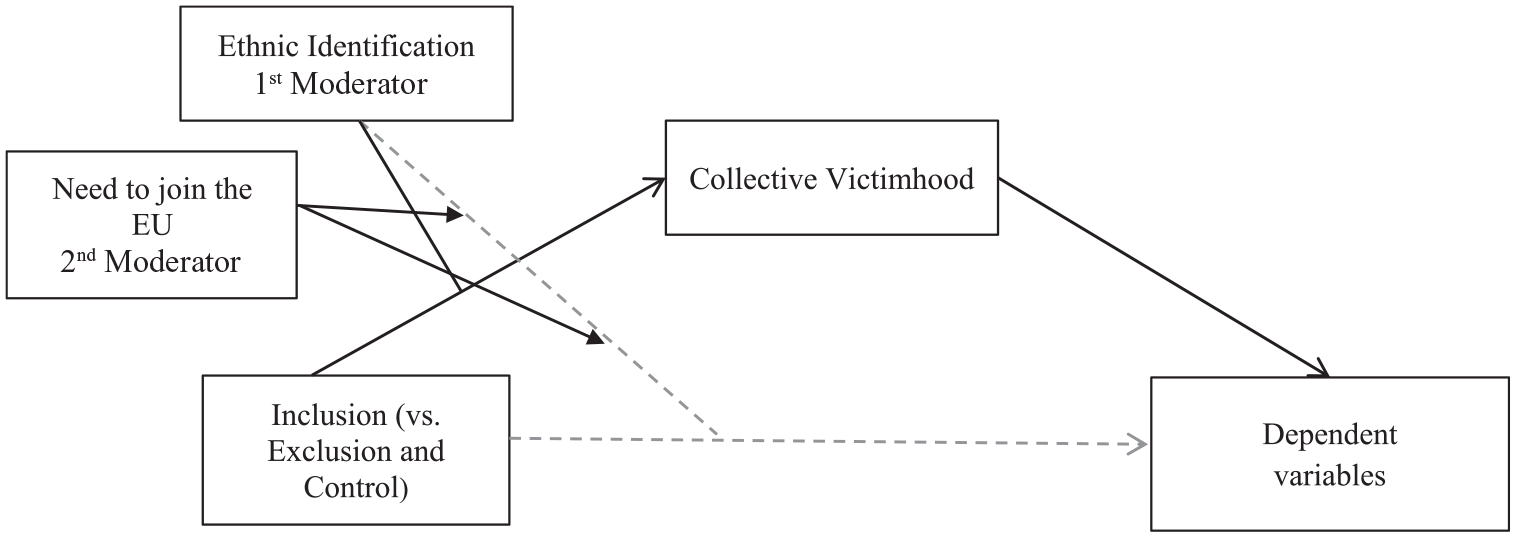
The conceptual path model tested in Study 4.
Results showed that collective victimhood mediated the relationship between social inclusion and perceived discrimination among participants who scored low on need to belong to the EU and low on ethnic identification, as well as among those who scored high on ethnic identification. Moreover, collective victimhood mediated the relationship between social inclusion and perceived discrimination among participants who scored high on need to belong to the EU and low on ethnic identification, as well as among those who scored high on ethnic identification (see Table 4).
The conditional indirect effect of ethnic identification and social inclusion (vs. exclusion and control) on perceived collective victimhood across levels (high vs. low) of the need to belong to the EU: Study 4.
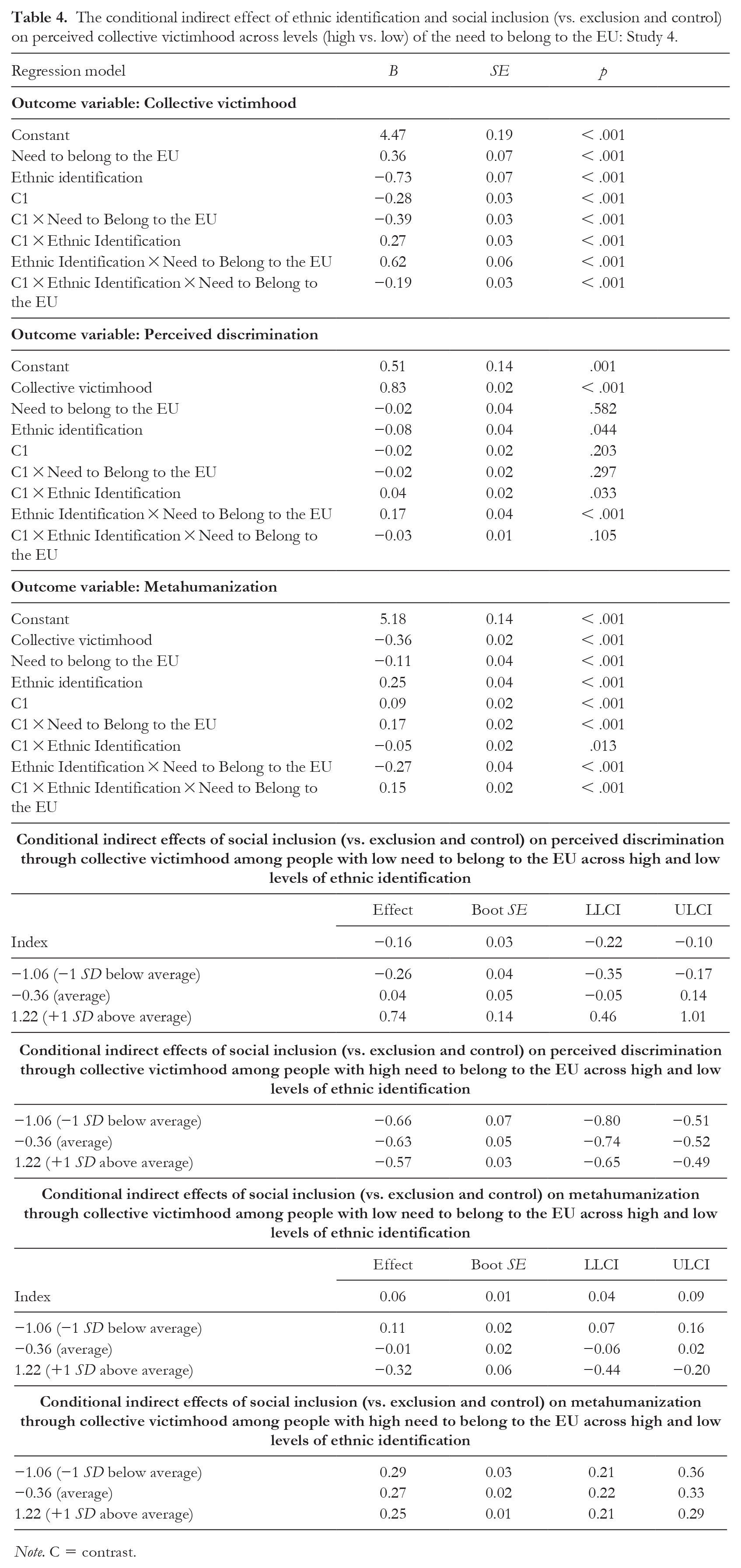
Note. C = contrast.
Results also showed that collective victimhood mediated the relationship between social inclusion and metahumanization among participants who scored low on need to belong to the EU and low on ethnic identification, as well as among those who scored high on ethnic identification. Moreover, collective victimhood mediated the relationship between social inclusion and metahumanization among participants who scored high on need to belong to the EU and low on ethnic identification, as well as among those who scored high on ethnic identification (see Table 4). 8
Discussion
Study 4 contributed novel evidence on the interaction between the need to belong to the EU, ethnic identification, and inclusion (vs. exclusion and control) within the superordinate category, impacting outcomes such as perceived discrimination, collective victimhood, and metahumanization. Consistent with H3, participants who exhibited a strong need to belong to the EU reported experiencing less discrimination and collective victimhood while expressing higher levels of metahumanization in the inclusion condition compared to the exclusion and control conditions. The findings also indicated a similar pattern for participants with a lower need to belong to the EU and weaker ethnic identification. However, this trend did not hold true for individuals with a low need to belong to the EU but a strong ethnic identification, as they responded to the inclusion condition (in contrast to other conditions) with heightened perceived discrimination and collective victimhood, and reduced metahumanization. Finally, aligning with H4, collective victimhood mediated the impact of inclusion (vs. other conditions) among participants across varying levels of the need to join the EU and ethnic identification. These findings were observed while controlling for participants’ knowledge about Kosovo and the EU integration processes.
General Discussion
Our research’s primary goal was to examine how people react to being included in a desired superordinate category following their ingroup’s exclusion, while taking the role of ethnic identification (all studies) and the need to belong to the superordinated category (i.e., EU; Study 4) into account. We manipulated social inclusion (vs. exclusion or control condition with no information about potential inclusion or exclusion) and operationalized ethnic identification and the need to belong as individual differences factors. We included both adult (Studies 1, 3, and 4) and adolescent (Study 2) samples, and we employed both experimental (Studies 1, 3, and 4) and a longitudinal (two-wave) design (Study 2).
Whereas Studies 1–3 showed that ethnic identification moderated the effect of social inclusion (vs. exclusion in Studies 1 and 3, or control in Study 2) on perceived discrimination, Studies 2 and 3 showed that the interaction between ethnic identification and social inclusion (vs. exclusion or control) impacted metahumanization as well. Simple effect analyses indicated that individuals with low ethnic identification perceived less discrimination and more metahumanization when exposed to social inclusion of their ingroup compared to when exposed to social exclusion or a control condition. Conversely, individuals with high ethnic identification perceived more discrimination and less metahumanization regardless of experimental manipulation, indicating that their views regarding the EU’s position toward Kosovo are entrenched and less susceptible to change. These results were consistent even with the two-wave design used in Study 2.
Moreover, in Study 3, we showed that the effect partly derives from collective victimhood. In particular, individuals with low ethnic identification perceived less collective victimhood when included in the EU than when excluded. However, individuals with high ethnic identification perceived more collective victimhood regardless of experimental manipulation, and thus demonstrated a ceiling effect by scoring comparably high on that measure. Specifically, collective victimhood mediated the effect of social inclusion (vs. exclusion) on perceived discrimination and metahumanization among individuals with low ethnic identification. As expected, such was not the case for individuals with high ethnic identification, who perceived greater collective victimhood regardless of their ingroup’s inclusion or exclusion in the superordinate category.
Finally, Study 4 demonstrated that the need to belong to the EU moderated the interaction effect between ethnic identification and social inclusion (vs. exclusion or control) on the investigated outcomes. Simple effect analyses indicated that participants who displayed a strong need to belong to the EU reported less discrimination and collective victimhood while expressed higher levels of metahumanization in the inclusion condition compared to the exclusion and control conditions. Similar patterns were observed for participants with a lower need to belong to the EU and weaker ethnic identification. However, this trend did not hold true for individuals with a low need to belong to the EU but a strong ethnic identification, as they responded to the inclusion condition (in contrast to other conditions) with heightened perceived discrimination and collective victimhood, and reduced metahumanization. Furthermore, Study 4 indicated that collective victimhood mediated the impact of inclusion (vs. other conditions) among participants across varying levels of the need to join the EU and ethnic identification.
The present findings may have implications for several research domains. Past research has shown that individuals with stronger group identification are more sensitive and perceive discrimination due to the stigmatization of their group (Sellers & Shelton, 2003; see also Crisp et al., 2006), whereas those with low group identification may not perceive such stigmatization personally or consider it inappropriate (Mekawi & Watson-Singleton, 2021). Our findings contribute to this research by indicating that individuals with low ethnic identification feel less discriminated against, less victimized, and more metahumanized after their group is included (vs. excluded) in the superordinate category, namely the EU. Conversely, our research suggests that individuals with high ethnic identification report more discrimination and collective victimization, and less metahumanization when their group is excluded, and this pattern remains consistent even when they are included in the desired superordinate category. Study 4 confirmed that participants who scored high on ethnic identification benefited from inclusion only when they felt a need to belong to the superordinate category but not when they did not feel such a need, as inclusion in the superordinate category triggered negative reactions in them.
Our work also contributes to the literature on the consequences of social exclusion versus inclusion (Brown-Iannuzzi et al., 2014). Existing research indicates that social exclusion can lead to feelings of discrimination and dehumanization, both as a group and as individuals (Anderson et al., 2016; Bastian & Haslam, 2011). In our study, however, we observed that individuals with high ethnic identification experienced adverse outcomes not primarily from exclusion but from the dynamics of inclusion. Specifically, for these individuals, inclusion in a desired superordinate category did not mitigate their perceptions of discrimination, dehumanization (i.e., low metahumanization), and collective victimhood. Perhaps inclusion exacerbated their sense of threat to their ethnic identity, leading to heightened feelings of discrimination and collective victimization. These findings suggest a nuanced understanding of the consequences of social exclusion and inclusion. For individuals with high ethnic identification, inclusion in a superordinate category can be perceived as a threat rather than a remedy, potentially due to the perceived pressure to assimilate or weaken their distinct ethnic identity. This nuanced response highlights the complexity of social dynamics in contexts of inclusion, suggesting that the mere act of inclusion, without addressing underlying concerns and acknowledging prior exclusion, may not be sufficient to alleviate feelings of discrimination and dehumanization. Future research should delve deeper into the psychological mechanisms underlying these responses. It would be particularly valuable to explore whether interventions, such as acknowledging ongoing exclusion or offering apologies (Borinca, Falomir-Pichastor, et al., 2021) prior to inclusion, could foster a more positive experience for people who experience exclusion and marginalization. This could help in understanding how to create inclusive environments that genuinely respect and accommodate diverse identities, thereby reducing perceptions of discrimination and collective victimhood. Therefore, our findings contribute to a more comprehensive understanding of social exclusion and inclusion, suggesting that the effects of inclusion are complex and contingent on individuals’ levels of ethnic identification and the broader sociopolitical context.
Our findings are also relevant to literature on the common ingroup identity model. Research has shown that recategorizing excluded members as a part of an inclusive identity improves intergroup relations, even among minority, disadvantaged groups (Gaertner et al., 2016). Specifically, endorsement of a dual identity, highlighting both the common and subgroup identities, among disadvantaged groups is associated with positive attitudes and willingness to engage in collective action and support of social change (Gaertner et al., 2016; Ufkes et al., 2016). Our findings suggest one important, yet overlooked, factor to consider when examining the impact of common identities among minority disadvantaged groups: the inclusion and exclusion of the ingroup from the needed common superordinate category. Our findings indicate that an inclusive identity improves intergroup relations particularly for individuals who do not strongly identify with the original, disadvantaged ethnic group, who after being exposed to the inclusion (vs. exclusion and/or control) condition felt more regarded as group members in light of their reduced negative perceptions (e.g., perceived discrimination, and collective victimhood). That was also the case for people who scored high on ethnic identity and felt the need to belong to a desired common superordinate category. However, that was not the case for those who scored high on ethnic identification and did not feel the need to belong to a superordinated category, as they reacted more negatively in the inclusion condition than in the exclusion or control conditions. These individuals may perceive themselves as victims of the EU’s decision, which could require fulfilling group-based needs for empowerment and status to benefit from inclusion in the superordinate category (Shnabel et al., 2009). Therefore, further research is crucial to comprehensively explore this aspect.
The findings from Studies 3 and 4 also contribute to the literature on collective victimhood (Noor et al., 2017; Vollhardt & Bilali, 2015; Vollhardt, 2012). Study 3 showed that collective victimhood mediated the effect of inclusion (vs. exclusion) on perceived discrimination and metahumanization among individuals with low (vs. high) ethnic identification. In Study 4, considering the need to belong as an additional moderator, collective victimhood mediated the effect of social inclusion (vs. exclusion and control) on these outcomes among individuals scoring both low and high on ethnic identification. Therefore, further research should explore the impact of inclusion and exclusion on collective victimhood and its relationship with other positive and negative intergroup outcomes.
Last, our findings hold significant societal implications. By understanding how individuals perceive and react to inclusion and exclusion within overarching categories such as the European Union, policymakers can tailor policies and interventions to foster social cohesion and mitigate intergroup tensions. For example, initiatives can be designed to acknowledge and alleviate the concerns of individuals with strong ethnic identification, who may feel marginalized or discriminated against even within inclusive frameworks. Furthermore, promoting inclusive identities that embrace diverse ethnic backgrounds while emphasizing shared values can foster positive intergroup relations and societal harmony. Additionally, recognizing the impact of collective victimhood on perceptions of discrimination and dehumanization can inform efforts to address perceived historical injustice and promote reconciliation within and between societies. Ultimately, these findings underscore the critical importance of inclusive policies and collaborative endeavors in cultivating cohesive and resilient societies.
Limitations and Directions for Future Research
Despite the novelty and importance of our findings, we should acknowledge the limitations of our research and propose directions for future studies. First, the effect of the interaction of ethnic identification and social inclusion (vs. exclusion) on metahumanization was not significant in Study 1. This may be because, apart from social exclusion, participants sometimes struggle to acknowledge being perceived as possessing fewer human qualities. This suggestion is consistent with research demonstrating that individuals are less likely to attribute qualities of human nature and uniqueness to outgroups than to themselves (Haslam et al., 2005) and to their ingroup (Bastian & Haslam, 2010; Leyens et al., 2000; Paladino & Vaes, 2009). Therefore, further research is needed to clarify the role of ethnic identification, social inclusion (vs. exclusion), and other factors that may influence people’s perception of metahumanization.
Second, Study 4 demonstrated that inclusion (compared to exclusion and control) did not lead to a reduction in perceived discrimination and collective victimhood, nor did it enhance metahumanization among individuals who did not feel the need to belong to the EU and scored high on their ethnic identity. While their ethnic identity can be sufficient validation for them, this reaction might be due to an identity threat to their ethnic identity. Future research should explore ways to ensure that beneficial common groups are not perceived as risky or unbeneficial when the set intention is beneficial.
Third, while our research primarily focuses on the positive aspects of inclusion and the role of a superordinate or dual identity, we acknowledge that such identities may also come with risks. Research on ingroup projection indeed suggests that individuals may project positive attributes of their ingroup onto the broader superordinate category, potentially leading to biases or unrealistic expectations (Mummendey & Wenzel, 1999; Wenzel et al., 2016). Therefore, while our research highlights the potential benefits of inclusion and dual identity, it is essential to recognize and address the complexities and potential risks associated with these identities. Future research should explore how to mitigate these risks and promote more nuanced understandings of identity dynamics in diverse social contexts.
Last, following previous research, we considered the possibility that perceived collective victimhood might explain the effect of social inclusion (vs. exclusion or control) on perceived discrimination and metahumanization. Nevertheless, we cannot rule out the possibility that other variables influenced the tested relationship. To test whether perceived collective victimhood does in fact explain that effect, future research should experimentally manipulate not only social inclusion (vs. exclusion) but also collective victimhood.
Conclusion
Our research demonstrated that being included, compared to being excluded, in a needed superordinate category (i.e., having inclusive group membership) has positive consequences for intergroup relations, particularly among individuals with low ethnic identification. Additionally, our findings suggest that this positive impact may extend to individuals who score high on ethnic identification and feel the need to belong to the inclusive group, as well as to those who do not feel such a need but score low on ethnic identification. However, this effect was not observed for those who scored high on ethnic identification but did not feel the need to belong to the inclusive group. Thus, while social inclusion plays a significant role in improving intergroup relations, exploring additional strategies for enhancing intergroup relations is essential, especially among individuals who do not feel the need or desire for inclusion in a common ingroup.
Supplemental Material
sj-docx-1-gpi-10.1177_13684302241267982 – Supplemental material for “Ins and outs”: Ethnic identity, the need to belong, and responses to inclusion and exclusion in inclusive common ingroups
Supplemental material, sj-docx-1-gpi-10.1177_13684302241267982 for “Ins and outs”: Ethnic identity, the need to belong, and responses to inclusion and exclusion in inclusive common ingroups by Islam Borinca, Rita Guerra and Fitim Uka in Group Processes & Intergroup Relations
Footnotes
Acknowledgements
We would like to express our gratitude to Rrahim Bektesh and Rrita Qollaku for their assistance with data gathering in Studies 2 and 4. Additionally, we thank Prof. Masi Noor for providing feedback on the first version of the paper.

Declaration of Conflicting Interests
The author(s) declared no potential conflicts of interest with respect to the research, authorship, and/or publication of this article.
Ethical Approval
All procedures performed in studies involving human participants were in accordance with the ethical standards of the institutional research committee and the 1964 Helsinki Declaration and its later amendments or comparable ethical standards. Ethical approval was secured by the first author’s second affiliation.
Funding
The author(s) disclosed receipt of the following financial support for the research, authorship, and/or publication of this article: This research was supported by the Sector Plan for Social Sciences and Humanities 2020-2025 in the Netherlands, involving the first author.
Informed Consent
Informed consent was obtained from all individual participants included in the study. All participants consented to participate in the study and provided consent for their data to be used for research purposes.
Supplemental Material
Supplemental material for this article is available online.
Notes
References
Supplementary Material
Please find the following supplemental material available below.
For Open Access articles published under a Creative Commons License, all supplemental material carries the same license as the article it is associated with.
For non-Open Access articles published, all supplemental material carries a non-exclusive license, and permission requests for re-use of supplemental material or any part of supplemental material shall be sent directly to the copyright owner as specified in the copyright notice associated with the article.
