



Abstract
The study investigates the risk of bullying for immigrants working in Sweden and resources as possible ways to reduce the risk. Based on self-categorization theory, the concept of nonprototypicality, and conservation of resources theory, we test hypotheses about risks and resources to alleviate the risks. The study is based on a longitudinal probability sample drawn from the whole Swedish workforce (N = 921). Country of birth was taken from the Swedish population register and categorized as either Swedish-born or foreign-born. The results showed a higher risk for immigrants to be exposed to person-related bullying behaviours, typically insulting remarks, and rumours, and to being humiliated, excluded, and ignored. A strong conflict management climate reduces the risk for immigrants to be exposed to bullying. Person-related bullying behaviours become the means to push a target away from the group, creating the perception of prototypical clarity. A strong conflict management climate, together with psychosocial safety, may form a resource caravan where one may strengthen the other. They may be seen as parts of informal systems building up an ethical infrastructure. Creating conditions for a well-developed ethical infrastructure could be a way for organizations to reduce the risk of bullying for all employees, but especially for immigrants.
Keywords
Immigrants are particularly vulnerable to workplace bullying (Bergbom & Vartia, 2019; Hogh et al., 2011; Rosander & Blomberg, 2022). Being in a minority at the workplace is in itself connected to an increased risk (Di Marco et al., 2021; Eriksen & Einarsen, 2004; Hoel et al., 2018; Rosander et al., 2023), especially if the person is part of a visible minority and nonprototypical in relation to the work group (Glambek et al., 2020). Resources such as support from coworkers and one’s supervisor may prove vital to protect oneself from the risk of bullying (de Beer, 2014; Gardner et al., 2013), although support from different sources may be related to different areas of mistreatment and types of bullying behaviours (Zapf et al., 1996). At the same time, immigrants may experience discrimination and injustice at work, which can increase the probability of resource loss (Shirmohammadi et al., 2023). The present study investigates which negative behaviours are most commonly experienced by immigrants working in Sweden and, based on a social identity perspective (Tajfel & Turner, 1979; Turner et al., 1987) and the conservation of resources theory (Hobfoll, 1989), we test hypotheses about the role resources, such as support and a conflict management climate, may have for immigrants in relation to workplace bullying.
Workplace bullying is defined as a systematic and prolonged mistreatment at work by other employees, where the target gradually finds it harder to ward off or stop the negative behaviours they are exposed to (Einarsen et al., 2020). Bullying behaviours are behaviours that may be construed as workplace bullying if a target gets exposed to them frequently over time. There is not a set list of behaviours that could constitute bullying, but most often they are person- or work-related (Einarsen & Raknes, 1997). Person-related bullying behaviours attack the personal integrity of the victim directly, for instance, through insulting or offensive remarks, or indirectly by excluding or ignoring them, or by spreading rumours and gossip about them. Work-related bullying behaviours target a person’s work performance by, for example, giving the target too much to do, or too little; removing key areas of responsibility; or by excessively criticizing them for work-related mistakes. Work-related bullying behaviours may be part of a normal variation in workload, but for it to be considered bullying, only the target gets exposed repeatedly while others at the workplace are spared. A previous study on immigrants and bullying has shown the importance of considering different types of bullying behaviours (Rosander & Blomberg, 2022). It showed an increased risk of exposure to person-related bullying behaviours for immigrants.
Social Identity and Nonprototypical Group Members
Being in a minority at work poses the risk of being treated differently, of being categorized as “not us.” A differential treatment of minorities can be understood from a social identity perspective (Tajfel & Turner, 1979), and through self-categorization theory (SCT; Turner et al., 1987) in particular. According to the theory, people categorize themselves and others into social groups based on salience of certain categories in the given situation (Hogg & Terry, 2000). In this process, an individual’s personal identity is connected to a common social identity, becoming a shared idea about the group and a representation of an ideal group member—the group prototype. A driving force behind this process can be explained by the uncertainty reduction hypothesis (Hogg, 2000), which suggests that a common social identity provides stability and predictability. Uncertainty may make a work group strive for a stronger prototypical homogeneity within the group (Hogg & Terry, 2000), making it more probable that visible minorities such as immigrants are regarded as nonprototypical and as deviants. They could be perceived as threatening the distinctiveness and prototypical clarity of the group. Following the social attraction hypothesis (Hogg, 1993), recategorization of nonprototypical group members as “them,” not “us,” can be a way for the group to distance itself from the deviant member and to maintain the coherence of the group’s social identity—often referred to as the “black sheep effect” (Marques et al., 1988). This process also makes it more likely for group members to engage in negative behaviours towards deviant group members (Marques & Paez, 1994).
Based on self-categorization theory and previous findings on immigrants and workplace bullying (Bergbom & Vartia, 2019; Hogh et al., 2011; Rosander & Blomberg, 2022), we propose the following:
Hypothesis 1: Immigrants working in Sweden will experience a higher level of exposure to bullying behaviours, and especially behaviours that contribute to distancing the target from the rest of the group (i.e., person-related bullying behaviours).
Research Question 1: What bullying behaviours are immigrant employees more exposed to compared to employees born in Sweden?
Conservation of Resources Theory and Workplace Bullying
Workplace bullying is regarded as an extreme stressor (Zapf & Einarsen, 2005). Stress is related to both exposure to demands and the resources one has access to (Bakker & Demerouti, 2007). According to conservation of resources theory (COR; Hobfoll, 1989), individuals experience stress when they perceive threats to their resources or feel that their resources are depleted. Individuals strive to protect, maintain, and acquire resources that are of value to them. Resources can be physical, psychological, material, or social, and can for example be self-esteem, status, or support (Hobfoll et al., 2018). To cope with this stress, individuals engage in coping strategies that aim to protect, restore, or increase their resources. Workplace bullying can be seen as a threat to an individual’s resources. A bullied employee may experience it harder to perform their job efficiently, leading to a loss of time and energy resources. Bullying may also damage an individual’s reputation within the organization, leading to a loss of status resources. Depletion of resources leaves fewer still for confronting threats to stop further loss, which could result in a resource loss spiral (Hobfoll, 2001). The theory states that employees who lack resources are more vulnerable to further resource loss and find it harder to gain new resources. Thus, the resources available to an employee at a particular point in time may say something about the risk of bullying at a later time. The present study investigates associations between baseline resources and follow-up exposure to bullying behaviours. One important type of resource is social support, as it “is the major vehicle by which individuals’ resources are widened outside the limited domain of resources that are contained in the self” (Hobfoll et al., 1990, p. 467). The resources in which the present study focuses are social support in the form of psychosocial safety in relation to one’s closest coworkers and to one’s immediate supervisor, and the perception of a conflict management climate.
Psychosocial safety
Psychosocial safety in a work group revolves around the concept of trust. It has been defined as the belief that the work environment among one’s closest coworkers is a safe place for interpersonal risk taking (Edmondson, 1999). Edmondson described psychosocial safety as a “climate characterized by interpersonal trust and mutual respect in which people are comfortable being themselves” (p. 354). This could be an important resource in the context of workplace bullying, as occurrence of bullying has been associated with unclarity regarding roles and expectations, leading to misunderstandings, frustration, and possibly aggression (Salin & Hoel, 2020).
A perception of psychosocial safety may originate from different sources, one of which may be an overall psychosocial safety climate facilitated by a coherent display of concern for the employees’ psychological health from senior management in the organization (Dollard & Bakker, 2010). Such a climate may influence the perception of trust in more ways than merely in relation to one’s closest coworkers. In the present study, we also focus on trust in relation to one’s immediate supervisor. Psychosocial safety in this regard echoes that in relation to one’s closest coworkers, involving interpersonal trust and mutual respect. One’s immediate supervisor may provide support, trustworthiness, and openness that contribute to a perception of psychosocial safety (Newman et al., 2017). Based on social learning (Bandura, 1977), one could argue that the way one’s immediate supervisor acts in this regard models expected behaviours at work, which could foster the idea that honest communication and mutual respect is the norm.
Social support from coworkers and/or supervisors seems to have a positive effect, in general, on the association between bullying and mental health (Nielsen et al., 2020). However, there are indications that support from the supervisor and from coworkers are dependent on each other (Blomberg & Rosander, 2020). Support from one’s supervisor and one’s closest coworkers may also have different effects on exposure to bullying behaviours. Zapf et al. (1996) showed that social support from a supervisor was connected to the level of verbal threats and criticism, while social support from coworkers was associated with less social isolation and not being ridiculed. For immigrant workers, support from one’s supervisor and good coworker relations have a positive impact on subjective well-being (Shirmohammadi et al., 2023), that is, by providing or at least contributing to maintaining important resources, the work environment in one’s closest circle of coworkers could make a difference for immigrants. On the other hand, lack of social support may have more dire consequences for immigrants (Hoppe, 2011). In a study of immigrant workers in Germany, Hoppe showed that immigrant workers lacking coworker support in situations of high uncertainty reported more psychosomatic complaints than all others in the study—native Germans with or without a high level of support, and immigrants with high levels of support. Gardner et al. (2013) investigated the impact of support on outcomes of bullying for ethnic minorities and found that although they reported higher levels of exposure to bullying than the ethnic majority, they also reported lower levels of psychological strain. An explanation for this could be the higher level of support reported by the ethnic minority.
Conflict management climate
There is a strong link between interpersonal conflicts and exposure to workplace bullying (Hauge et al., 2007). S. Einarsen (1999) described a dispute-related origin of exposure to bullying as a major antecedent. Finding ways to successfully handle conflicts at an early stage could be important in reducing the occurrence of bullying (Baillien et al., 2014; Mikkelsen et al., 2011). Knowing or trusting that conflicts, if they occur, will be handled in a good way, that is, in a good conflict management climate, has been shown to have a reducing effect on the occurrence of workplace bullying (Einarsen et al., 2018; Rosander & Nielsen, 2022; Zahlquist et al., 2019). Together with psychosocial safety, a conflict management climate may serve as an important resource at the workplace to preventing isolated conflicts from escalating and turning into bullying—thus contributing to a psychologically safe working environment.
Einarsen et al. (2018) showed that a conflict management climate has a direct reducing effect on the occurrence of bullying as well as a moderating effect on work engagement. Rosander and Nielsen (2022) also showed a direct immediate effect on bullying, an effect on subsequent bullying, and a moderating effect on the association between feeling tired at work and subsequent bullying. Zahlquist et al. (2019) also investigated conflict management climate as a moderator. They studied the association between role stressors and exposure to bullying behaviours, showing the importance of a good conflict management climate. All results point to a conflict management climate as an important resource that could contribute to reducing the occurrence and mitigating the effects of workplace bullying.
Resources and immigrants
Being in a minority, access to important resources could be of the utmost importance in relation to subsequent bullying, as one is at a greater risk of exposure by being different from the majority of the group. This nonprototypicality could make the deviant an easy target for negative behaviours. Experiencing psychosocial safety in relation to one’s closest coworkers and one’s immediate supervisor, and having a strong conflict management climate, could provide buffers against exposure to bullying behaviours. Previous research has shown that immigrants are at greater risk of exposure to workplace bullying (Rosander & Blomberg, 2022). By regarding workplace bullying as an extreme stressor, according to the conservation of resources theory (Hobfoll et al., 2018), there should be an association between one’s resources and stress. In the present study, we test this association and hypothesize that the gain or benefit of having sufficient resources will be greater for immigrants, who are at greater risk of exposure to workplace bullying.
Hypothesis 2: The association between workplace bullying and psychosocial safety in regard to (a) one’s closest coworkers, (b) one’s immediated supervisor, and (c) the perceived conflict management climate is dependent on place of birth, that is, the association will be stronger for the foreign-born than for the Swedish-born worker.
Methods
Design and Sample
The present study is based on a probability sample of the Swedish workforce. Statistics Sweden (a government agency) drew the sample from all employees working in Sweden at workplaces with 10 or more employees, ages 18 to 65. Baseline data (n = 1,853) were collected in the autumn of 2017, and the follow-up data collection was 18 months later, in the spring of 2019 (n = 1,095). Only those who responded at baseline were invited to the follow-up survey. Statistics Sweden handled all aspects of the data collection, including postal invitation letters with all necessary information for an informed consent to participate. Before delivering the data to us, Statistics Sweden added a number of register variables taken directly from the Swedish National Population Register. This included biological sex, age, and country of birth. The latter variable was categorized as follows: if a participant was born in (a) Sweden, (b) the other Nordic countries, (c) the rest of Europe, (d) Africa, (e) Asia, (f) North America, (g) South America, or (h) Oceania. In the present study, all participants were categorized as either Swedish-born or foreign-born. Between baseline and follow-up, 174 employees reported to have changed jobs. They were excluded from all analyses using the prospective data, as changing jobs would have a profound effect on exposure to bullying behaviours (Rosander et al., 2022). The project was approved by the Regional Ethical Review Board at Linköping University (Protocol No. 2017/336-32).
At baseline, there were 57% women. The mean age was 48.18 years (SD = 10.88). Close to half the sample had a university or college education (48%), 42% had 10 to 12 years of education, and the remaining 10% had 9 years or less. They had worked at their current workplace for 12.97 years (SD = 11.51), 14% had a managerial position, 95% had a fixed contract. The majority was born in Sweden (88%).
The Context of the Study
The baseline data were collected in 2017, which is close in time after Sweden and the rest of Europe had to deal with one of the greatest migrations in modern times (Alkopher & Blanc, 2017). Immigration became very salient in Swedish society, and there was an increase in xenophobic tendencies (Christensen & Christensen, 2019) and negative attitudes towards immigrants (Ahmadi et al., 2018). Over the past 2 decades, the number of residents not born in Sweden have increased dramatically, from 11% in 2000 to almost 19% by the end of 2017 (Statistics Sweden, 2018).
Attrition Analysis
In total, 59% of the participants that responded at baseline also responded to the follow-up survey. However, the dropout rate was higher for the foreign-born (50%) compared to the Swedish-born workers (40%), χ2 = 9.77, p = .002. Therefore, it was extra important to investigate possible differences between dropouts and respondents in the foreign-born and Swedish-born groups, respectively. The results showed that there were no significant differences between dropouts and respondents in the foreign-born group in regard to age, income, education, period of employment, exposure to work- or person-related behaviours, psychosocial safety in relation to one’s coworkers or immediate supervisor, or in level of perceived conflict management climate. For the Swedish-born workers, the only difference between dropouts and respondents was age, where the dropouts were significantly younger (46.29 years, SD = 11.88) compared to the respondents (49.29 years, SD = 10.07), t(1623) = −5.46, p < .001. Among the foreign-born workers, 52% of the men dropped out and 50% of the women did, χ2 = 0.08, p = .778, and for the Swedish-born workers, 42% of the men dropped out and 38% of the women did, χ2 = 1.83, p = .176.
Measures
Workplace bullying was measured using the Swedish version of the Negative Acts Questionnaire-Revised (NAQ-R; Einarsen et al., 2009; Rosander et al., 2024). It comprises 22 negative behaviours or situations that, if one is systematically exposed to them, may constitute workplace bullying. The NAQ-R is normally used as a coherent measure of bullying, but there are also two subscales measuring person- and work-related bullying behaviours. The NAQ-R uses a frequency response scale from “never” to “daily.” The internal consistency of the NAQ-R at baseline was .91. To assess the risk of bullying, we used cut-offs for the sum score of the NAQ-R at 35, and 15 for the subscales (Rosander et al., 2024).
Psychosocial safety was measured in relation to one’s closest coworkers and to one’s immediate supervisor. Psychosocial safety-coworkers (PS-C) was measured using three items: “I can be myself when I am with my closest colleagues,” “I can speak my mind to my closest colleagues,” and “I trust my closest colleagues.” Cronbach’s alpha for the PS-C at baseline was .88. Psychosocial safety-supervisor (PS-S) was measured with three similarly worded items, but in relation to one’s immediate supervisor: “I feel comfortable around the supervisor,” “The supervisor listens to me,” and “I trust the supervisor.” The PS-C and PS-S use a 7-point Likert scale. Cronbach’s alpha at baseline for the PS-C and the PS-S were .88 and .94, respectively. All items were taken from the Psychosocial Work Environment Questionnaire (Rosander & Blomberg, 2018).
Perceived conflict management climate (CMC) was assessed using three items based on the Climate for Conflict Management Scale (Einarsen et al., 2018). The items were: “Should a serious conflict arise at our workplace, I am confident that it will be resolved in a good way,” “At our workplace, we are good at solving conflicts,” and “The supervisor is good at resolving conflicts.” The CMC uses a 7-point Likert scale. The internal consistency at baseline was .88.
Statistical Analyses
All analyses were conducted using IBM SPSS Version 29. The first hypothesis was tested using logistic regression and mean comparisons. The research question was investigated using MANOVA, and partial eta squared >.01 was used as a criterion for meaningful differences contributing to an overall significant result. Hypotheses 2a–c were tested using three separate hierarchical regression analyses in which the interaction term was added as a second step in each of them. A significant interaction as well as a significant change in explained variance with the addition of the interaction term was a criterion for considering the interaction as relevant. All analyses involving repeated mean comparisons used a Bonferroni-adjusted p value, where p < .010 was regarded as a significant difference. Age and sex were added as covariates in all regression analyses.
Results
We used the full baseline sample to test Hypothesis 1. Adjusting for sex and age, logistic regression analyses for the cut-off of the full NAQ-R and the subscales for work- and person-related bullying showed an increased risk of exposure to bullying for the foreign-born workers in relation to the full NAQ-R (OR = 1.98, p < .001), and to person-related bullying (OR = 2.91, p < .001), but no increased risk of work-related bullying (OR = 1.30, p = .136). The mean level of exposure to person-related bullying behaviour was significantly higher, t(1845) = 5.80, p < .001, for the foreign-born (M = 1.30, SD = 0.55) compared to the Swedish-born workers (M = 1.14, SD = 0.34). There was no significant difference comparing work-related bullying behaviours. Thus, Hypothesis 1 was supported.
The research question was also addressed using the full baseline sample. A MANOVA investigating differences between the Swedish-born and the foreign-born workers in regard to the bullying behaviours in the NAQ-R showed significant differences, Pillai’s trace = .04, F(22, 1824) = 3.08, p < .001, ηp2 = .04. Separate tests for each of the items showed that five of them contributed more clearly to this difference (see Table 1). There were also 11 more items with significant differences, but with a partial eta squared value below .01.
Means and standard deviations for foreign- and Swedish-born workers for items contributing to group differences*.
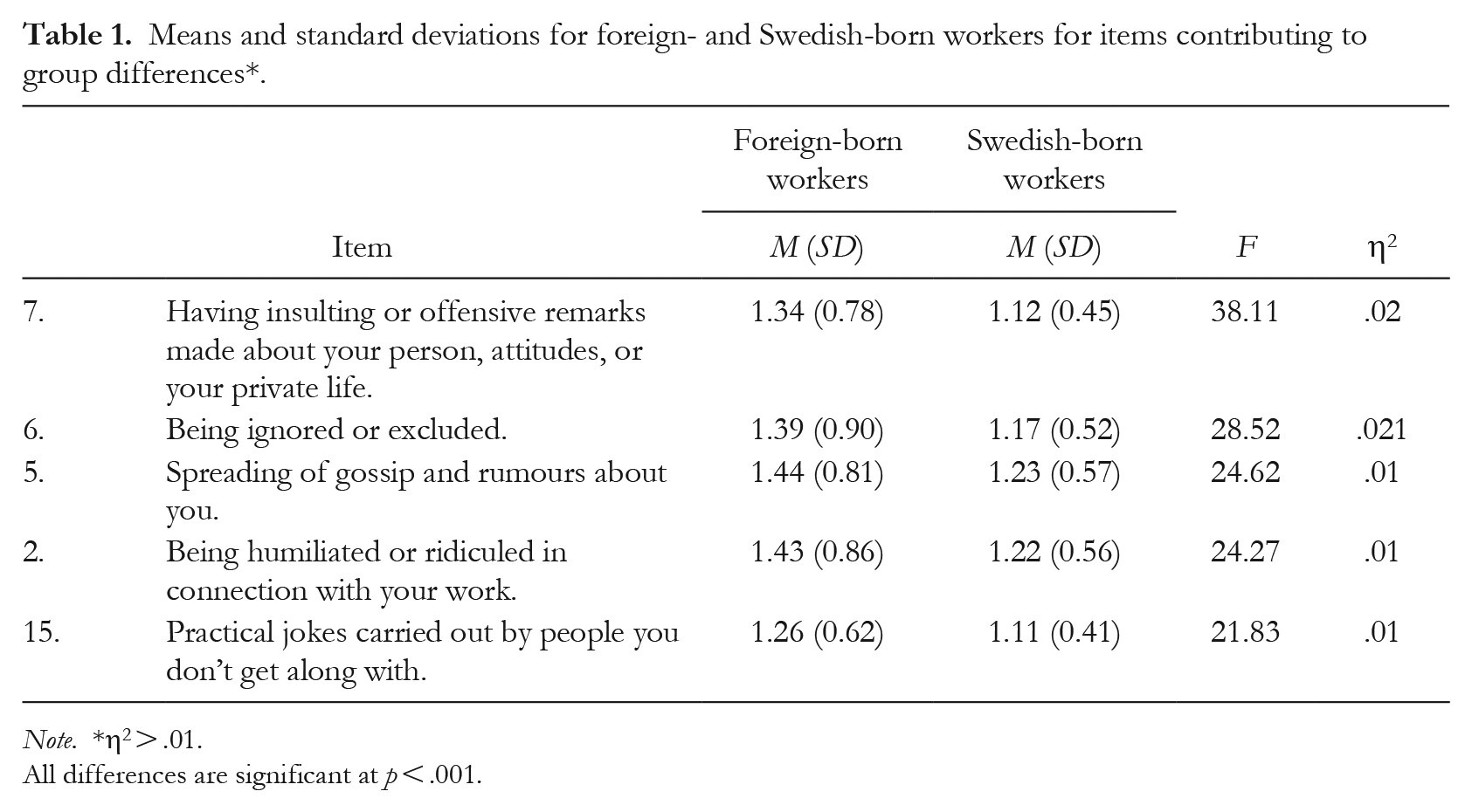
Note. *η2 > .01.
All differences are significant at p < .001.
Typical behaviours foreign-born workers are more exposed to, compared to Swedish-born workers—here referred to as “foreign-born workers’ experienced bullying behaviours”—are all person-related behaviours, including insulting remarks, rumours, and being humiliated, excluded, and ignored. On the other hand, behaviours that showed no difference at all were mainly work-related, in the form of work-related pressures such as unmanageable workload, unreasonable deadlines, and excessive monitoring of one’s work, as well as work-related degradation, including being ordered to do work below one’s competence level and getting key areas of responsibility removed or replaced with more trivial or unpleasant tasks. There were also no difference regarding physically intimidating behaviours in the form of threats of violence, or physical abuse, or actual abuse. Thus, Items 2, 5, 6, 7, and 15 of the NAQ-R showed the clearest difference, while Items 3, 4, 16, 18, 21, and 22 showed no difference at all when comparing the foreign-born to the Swedish-born workers. The five foreign-born workers’ experienced bullying behaviours were used in the continued analyses as a facet of bullying behaviour. It has a good internal consistency—Cronbach’s alphas were .81 and .84 for T1 and T2, respectively. Table 2 presents the means, standard deviations, and intercorrelations for all variables in the study, including the newly created foreign-born bullying behaviours.
Means, standard deviations, and intercorrelations for the study variables.
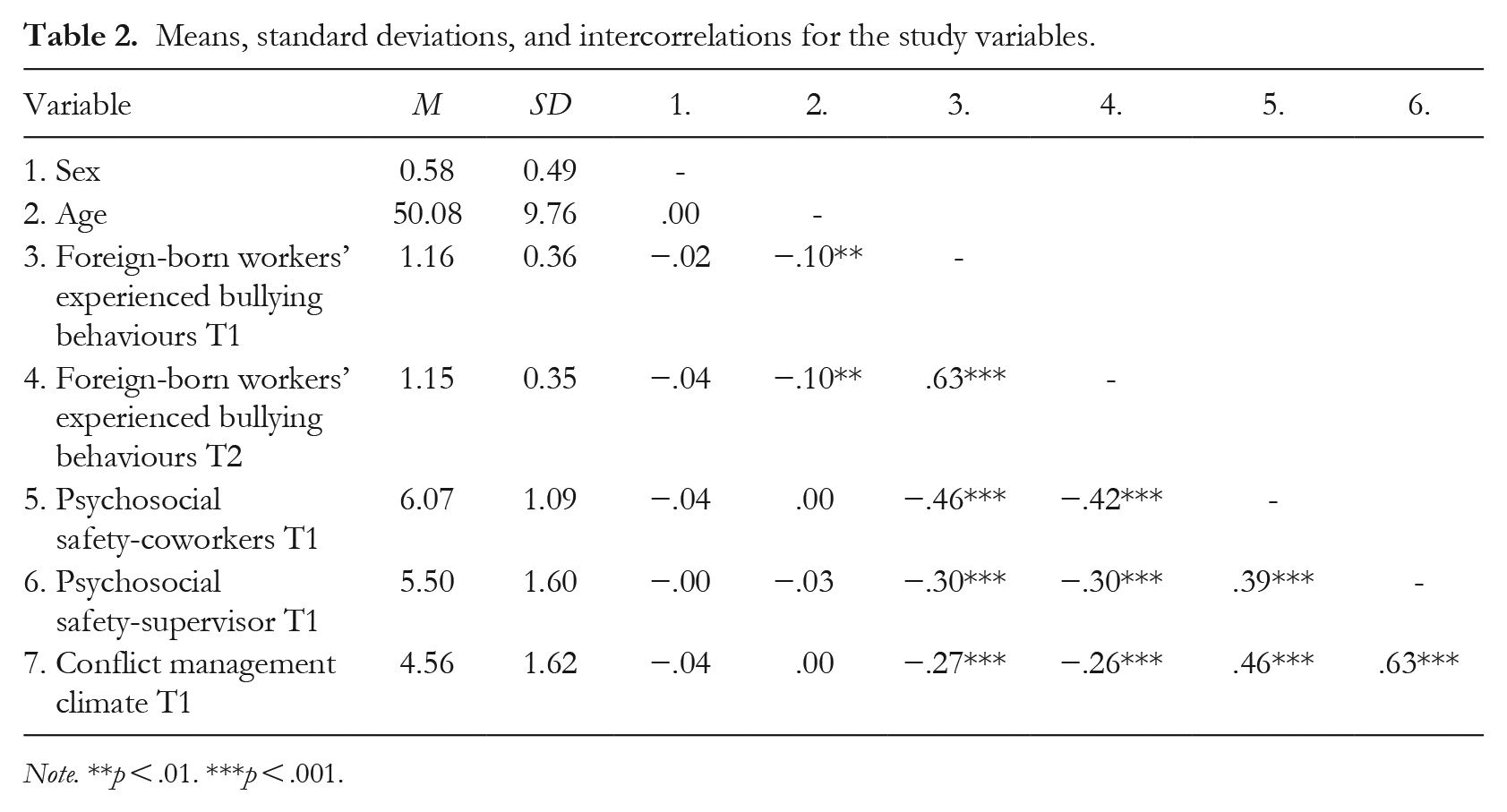
Note. **p < .01. ***p < .001.
There were significant differences when comparing the foreign-born and the Swedish-born in regard to the “foreign-born workers’ experienced bullying behaviours” at baseline and at follow-up, as expected, as they represent the behaviours that most clearly distinguish what the foreign-born workers are exposed to compared to their Swedish-born counterparts. However, there were no significant differences when comparing the foreign-born to the Swedish-born workers in regard to perceived psychosocial safety among one’s closest coworkers or one’s immediate supervisor, nor was there any significant difference in perceived conflict management climate (see Table 3).
Mean comparisons of foreign-born and Swedish-born workers.
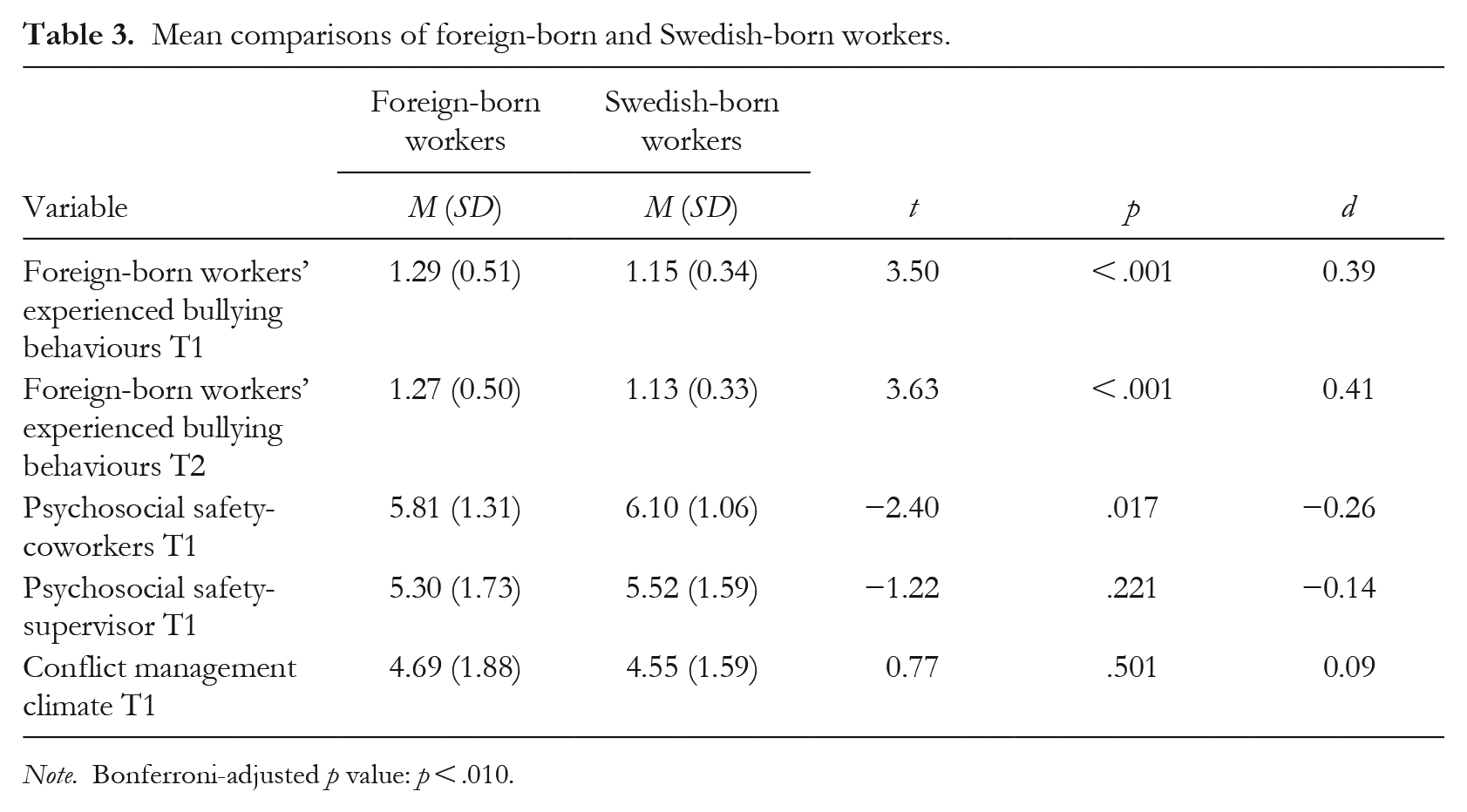
Note. Bonferroni-adjusted p value: p < .010.
To test Hypothesis 2a–c, we conducted three hierarchical regression analyses adding the interaction between place of birth and the independent variable as a second step (see Table 4). Adjusting for age and sex, the results showed that there were no significant interactions with place of birth for (a) the level of psychosocial safety in regard to one’s closest coworkers (b = 0.04, p = .129), or (b) the level of psychosocial safety in regard to one’s immediate supervisor (b = 0.01, p = .663). All simple slopes were significant but close to parallel, except for psychosocial safety in relation to one’s immediate supervisor that was not significant for the foreign-born workers. Zero-order correlations between the independent variables at baseline and bullying at follow-up for both forms of psychosocial safety were significant for the foreign-born (ra = −.54 and rb = −.36) and the Swedish-born workers (ra = −.39 and rb = −.29). There was a significant interaction for perceived conflict management climate (b = 0.05, p = .007). The simple slopes were significant for both the foreign-born (b = −0.06, p < .001) and the Swedish-born workers (b = −0.02, p = .010), but steeper for the foreign-born (see Figure 1). There was a significant difference when comparing the level of bullying for the foreign-born and the Swedish-born workers at low levels of CMC, t(398) = 7.69, p < .001, while there was no significant difference comparing the two groups at high levels of CMC, t(496) = 1.40, p = .164. This means that only Hypothesis 2c was supported.
Main and interaction effects of psychosocial safety and conflict management climate at baseline on foreign-born workers’ experienced bullying behaviours at follow-up.
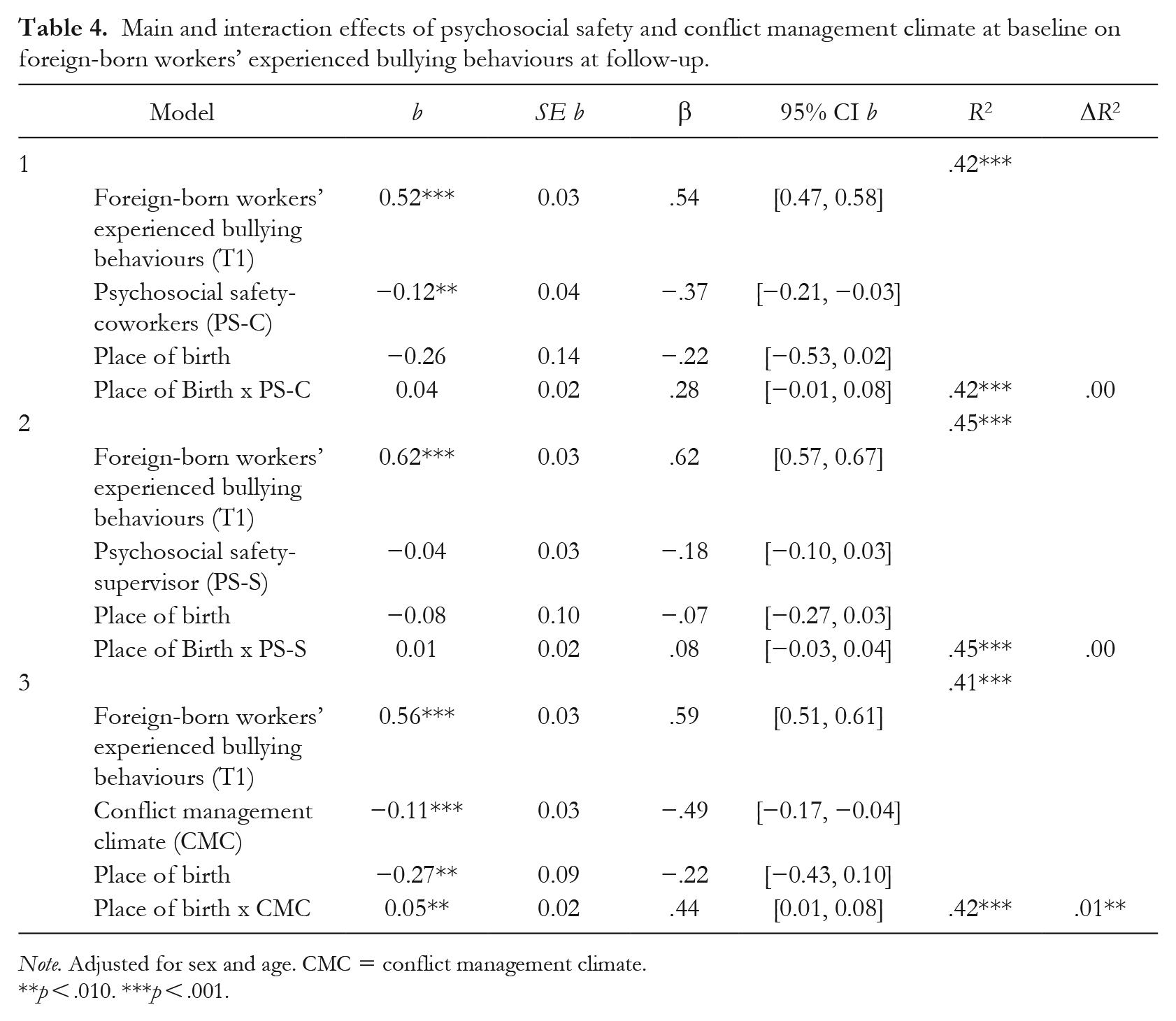
Note. Adjusted for sex and age. CMC = conflict management climate.
**p < .010. ***p < .001.
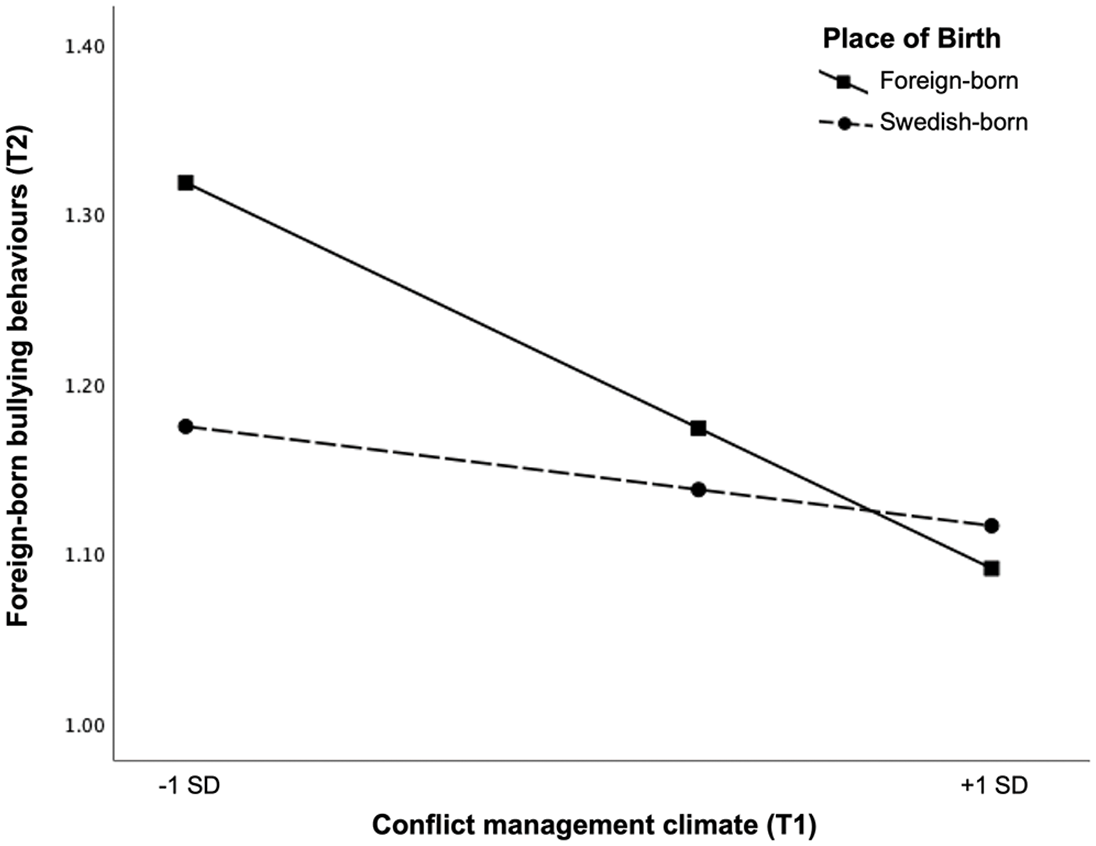
Association between conflict management climate at baseline and foreign-born workers’ experienced bullying behaviours at follow-up for foreign- and Swedish-born workers.
Discussion
The present study showed that the risk of workplace bullying is higher for immigrants than for Swedish-born workers, and that the risk lies in exposure to person-related bullying behaviours. This has been shown previously (Rosander & Blomberg, 2022), but now we can also show the typical bullying behaviours that immigrant workers are exposed to. The behaviours that most clearly differentiate the treatment immigrants are exposed to compared to Swedish-born workers are insulting remarks, rumours, and being humiliated, excluded, and ignored. Being nonprototypical, the foreign-born are at greater risk of exposure to negative behaviours by other group members (Marques & Paez, 1994). Based on self-categorization theory (Turner et al., 1987), it is likely that these behaviours are ones that contribute to distancing the target from the rest of the work group to maintain a coherent social identity (Hogg, 1993) and a prototypical clarity of the group (Hogg & Terry, 2000). The foreign-born workers’ experienced bullying behaviours all attack the integrity of the target and help boost the perceived distinctiveness of the group. Work-related bullying behaviours were just as common among the foreign-born as they were among the Swedish-born workers. As those kinds of behaviours do not contribute in the same way to making the group more prototypically clear, they have no function from a social identity perspective, which could explain the result. Anyone is at risk of being exposed to work-related bullying behaviours—an immigrant minority and employees part of the Swedish-born majority alike. An interesting question is if this pattern of differential treatment based on type of bullying and the function it has from a social identity perspective could be true also for other minorities.
Based on COR theory (Hobfoll, 1989), we hypothesized that access to resources would be extra important in buffering subsequent exposure to workers’ experienced bullying for immigrants. We tested this using “foreign-born workers’ experienced bullying behaviours,” that is, the behaviours that most clearly differentiate what the foreign-born and the Swedish-born workers experience, and three possible resources—psychosocial safety in relation to one’s closest coworkers and one’s immediate supervisor, and the perception of a conflict management climate. The results showed that only the effects of a conflict management climate was dependent on place of birth (Hypothesis 2c). With a weak perceived conflict management climate, the difference in exposure between the foreign-born and the Swedish-born workers was high; however, with increasing confidence and trust that conflicts would be handled in a good way, this difference disappeared. With a perceived strong conflict management climate, there was no longer a difference in exposure between the foreign-born and the Swedish-born workers. For the other two resources in regard to psychosocial safety, there were no such interactions. However, there was a significant change in the level of exposure to bullying behaviours at follow-up (adjusting for baseline bullying) that was dependent on psychosocial safety in relation to one’s closest coworkers for both the foreign-born and the Swedish-born workers. That is, experiencing psychosocial safety among one’s closest coworkers is an important resource for the foreign-born and the Swedish-born workers alike.
As for psychosocial safety in relation to one’s immediate supervisor, the results showed no significant association with exposure to foreign-born workers’ experienced bullying behaviours for the foreign-born, only for the Swedish-born workers. This could be understood in terms of culturally different expectations in relation to social support from one’s supervisor (Glazer, 2006). Many cultures, for example Asian nations, endorse hierarchy values more compared to Western European nations such as Sweden (Schwartz, 1999), which also entails a different relationship to one’s immediate supervisor. A concept of psychosocial safety in this case may be “lost in translation” for many of the foreign-born workers, and it would therefore not provide the same level of perceived social support compared to what Swedish-born workers would experience. Immigrants’ relation to their immediate supervisor from a cultural perspective, and how that might influence the occurrence or protection from exposure to bullying would be of interest for future studies.
Theoretical Implications
The present study contributes new knowledge about the working situation for immigrants, and how their higher risk of exposure to person-related bullying behaviours could be understood. The concept of prototypicality is central in understanding why a certain type of bullying behaviours is experienced more by immigrants than by Swedish native workers. As it has been shown in a previous study, the more different in appearance an immigrant is or the more culturally different—for example, if coming from countries in Asia, Africa, or South America—the higher their risk of exposure to bullying (Rosander & Blomberg, 2022). Coming from another culture may also involve a risk of norm violation, which could trigger an aggressive response from Swedish native workers (Felson, 1992). Violation of work-related expectations and social norms is one track leading to bullying in the three-way model of workplace bullying (Baillien et al., 2009). The mechanism behind exposure to person-related bullying can be understood in terms of self-categorization theory (Turner et al., 1987), in that those types of behaviours have a function to fulfil for the group, by distancing an nonprototypical group member from the group, thus keeping its image of distinctiveness and prototypical clarity. Uncertainty reduction is an important driving force behind self-categorizations (Hogg, 2000) and can be what makes a group strive for prototypical homogeneity. This could be extra important in situations where the working environment in itself contributes to uncertainty in regard to, for example, roles and responsibilities, especially in times of high stress and workload—conditions that also are a breeding ground for workplace bullying (Salin & Hoel, 2020). Work-related bullying behaviours are more common in frequency and have an earlier systematic onset than person-related bullying behaviours (Rosander & Blomberg, 2019), but there is no increased risk of exposure for immigrants. Most targets probably get exposed to a range of different bullying behaviours regardless of type (Rosander & Nielsen, 2023), but as work-related behaviours do not contribute to prototypical homogeneity in the same way as person-related behaviours may do, exposure to them is not dependent on place of birth.
A conflict management climate as an important resource in relation to workplace bullying has started to gain momentum, and the support for its mitigating effects on occurrence of bullying is getting stronger (Einarsen et al., 2018; Rosander & Nielsen, 2022; Zahlquist et al., 2019). The important defining aspect of the concept revolves around trust—trust in the joint ability at the workplace or in one’s work group to manage conflicts in a constructive way. To actually successfully handle the conflicts that arise has been shown to reduce the occurrence of bullying (Baillien et al., 2014; Mikkelsen et al., 2011), but merely creating a climate of trust in this regard plays an important part. This trust could, of course, come from a number of successfully managed conflicts, but it probably also entails more than just repetition—the actions and attitudes of coworkers and supervisors may help set a norm of conduct that is reflected in trust in the management of conflict. As has been shown in the present study, a strong conflict management climate can be an important resource for all employees, but more so for immigrants. In terms of COR theory (Hobfoll, 1989), the perception of a strong conflict management climate together with other resources involving trust, such as psychosocial safety, may form a resource caravan where one may strengthen the other (Hobfoll et al., 2018). For immigrants, this may only be true for psychosocial safety in relation to one’s closest coworkers, as social support from one’s supervisor and one’s closest coworkers may have different effects on the likelihood of exposure to bullying (Zapf et al., 1996). Zapf et al. showed that support from coworkers mainly had an effect on person-related bullying behaviours, such as isolation and humiliation, which are also the typical behaviours immigrants were most exposed to, compared to Swedish-born workers. Another related aspect that may also have a part in the resource caravan is a psychosocial safety climate (Dollard & Bakker, 2010) originating mainly from the way senior management acts. A workplace where employees trust that conflicts can be managed in a good way, where there is interpersonal trust and mutual respect together with a belief that senior management cares about the employees’ psychological well-being, could probably be characterized as a workplace with a sound and healthy ethical infrastructure (Einarsen et al., 2017, 2019).
Practical Implications
The results of the present study have some important practical implications. First, they highlight the need for awareness concerning the increased risk of bullying for immigrant workers. Early interventions are important as workplace bullying easily escalates (Einarsen, 2000), with more far-reaching negative consequences (Rosander & Blomberg, 2019). Exposure to bullying could lead to resource depletion. Following COR theory (Hobfoll, 1989) those who lack resources are more vulnerable to further resource loss and may end up in a resource loss spiral (Hobfoll, 2001)—something that may worsen an already serious situation. Escalation of bullying as a resource loss spiral could help explain why bullying has such devastating and serious consequences (Nielsen & Einarsen, 2018), and why bullying may be regarded as an extreme stressor (Zapf & Einarsen, 2005).
If there are deficiencies in the working environment, such as conflicting or ambiguous roles together with high stress, immigrants will be vulnerable to the black sheep effect (Marques et al., 1988), that is, to be singled out as nonprototypical and perceived as a threat to the social identity of the group. A solution to the “problem” and an apparent easy way out is to regard the odd one out as an outsider, and not as “one of us.” To mitigate or prevent this from happening, one could try to make a superordinate, more inclusive, social identity more salient at the workplace (e.g., “In our company, heterogeneity is our strength”), shifting the focus from the small group to the company as a whole.
Psychosocial safety and a strong conflict management climate can be seen as parts of informal systems building up an ethical infrastructure, or in the least, outcomes of it. Creating conditions for a well-developed ethical infrastructure may be a way for organizations to reduce the risk of bullying for all employees, but especially for immigrants. An ethical infrastructure needs initiation and support from senior management and human resources (HR), influencing both formal and informal systems supporting ethical behaviours among employees (Einarsen et al., 2017). An antecedent to this seems to be high-quality human resource management practices, such as an emphasis on work training and performance appraisals (Einarsen et al., 2019; Salin, 2008).
Strengths and Limitations
A notable strength of the present study is that it is based on a national probability sample of the Swedish workforce, and that background data are taken directly from the Swedish population register. As for limitations, all measures were self-reported, thus susceptible to subjective factors such as social desirability and common method variance (Podsakoff & Organ, 1986). The use of a time lag (18 months) may alleviate the risk of common method variance (Podsakoff et al., 2003).
The use of conflict management climate on an individual level is something in need of discussion. It is a climate variable based on an estimate of the workplace as a whole. Ideally, it would be treated as a group-level variable, however, as the present study uses a probability sample where each participant was randomly sampled from the Swedish workforce, such a treatment was not possible. We do not refer to the variable as an objective measure of the climate, but as the individuals’ perception of a conflict management climate. The items building up the measure have wordings appropriate for capturing the group level, which also is an important requisite to measuring climate variables (Schneider et al., 2013).
Theoretically, a key aspect of the study is the notion of prototypicality (from SCT; Turner et al., 1987). However, we did not measure this construct directly. Instead, we argued that being born abroad would increase the risk of being viewed as nonprototypical in relation to the ingroup, which in turn would increase the risk of being bullied. Future studies should include a measure of prototypicality in relation to one’s work group. This would help better pinpoint the risk of exposure to negative behaviours at work, that is, to compare foreign-born people who feel included in their work group with those who feel or are made to feel different. Combining this measure with a measure of the level of identification with one’s work group would further strengthen such an analysis.
A limitation of the study is that we only had data on first-generation immigrants. This means that all second-generation immigrants were included in the Swedish-born group even though they may share the same nonprototypical visible features as their parents, which could make them targets of bullying in the same way as a first-generation immigrant is. A related limitation is that we do not know if a person born abroad, that is, categorized as foreign-born, also has parents that are foreign-born. As it is a random sample, there is a possibility that a few of the foreign-born workers were not ethnically different from the majority in Sweden, and were born outside of Sweden when their parents, for example, had temporary employment abroad. However, neither of these limitations contribute to overestimations of risks and differences, rather the opposite. Future studies should include information about the country of birth of participants’ parents to allow for inclusion of second-generation immigrants, possibly as a separate group, to be able to contrast first- and second-generation immigrants in relation to natives.
Conclusions
We have investigated the risk of bullying for immigrants working in Sweden as well as resources as possible ways to reduce the risk. The typical behaviours immigrants are exposed to—insulting remarks, rumours, and being humiliated, excluded, and ignored—can be understood using a social identity perspective in which person-related bullying behaviours become the means to push the target away from the group, creating the perception of prototypical clarity and distinctiveness. That work-related bullying behaviours are as common for immigrants and Swedish-born alike is the other side of the coin—they do not distance a nonprototypical group member away from the group and therefore do not have the same function maintaining a group’s social identity.
The most important resource in reducing exposure to bullying in the present study was the perception of a conflict management climate. If strong, the difference between immigrants and Swedish-born workers in exposure to bullying behaviours disappeared. Also, psychosocial safety in relation to one’s closest coworkers had a reducing effect on exposure to bullying, but in the same way for immigrants and Swedish-born workers. Based on COR theory, both could be part of a resource caravan, one strengthening the other. The present study has identified tools to alleviate the working situation in regard to workplace bullying for immigrant employees. Future studies should continue to identify more resources that could help reduce the risk of further resource loss and stop resource loss spirals for immigrants.
Footnotes
Author Contributions
The study conception and design were made by the first author. Data were collected by both authors. Data analysis was performed by the first author. The manuscript was written by the first author. Both authors read, commented on, and approved the final manuscript.
Declaration of Conflicting Interests
The author(s) declared no potential conflicts of interest with respect to the research, authorship, and/or publication of this article.
Ethical Approval
The project was approved by the Regional Ethical Review Board at Linköping University (Protocol No. 2017/336-32).
Funding
The author(s) disclosed receipt of the following financial support for the research, authorship, and/or publication of this article: This work was supported by the Swedish Research Council for Health, Working Life and Welfare under Grant Nos 2019-01232 and 2023-00262). The data that support the findings of this study are available from the corresponding author upon reasonable request.
