



Abstract
Objective:
When task groups depend on all members’ contributions, one poor performer can threaten the entire group’s goal attainment. The model of pro-group intent (M-PGI) stipulates that group responses to such poor performers are primarily determined by the group’s assessment of that person’s willingness to help the group (attributed pro-group intent). Despite supportive evidence, past research has neglected whether model predictions hold under conditions more representative of group life. The current study thus tests the M-PGI in (a) personal interaction, (b) settings beyond the work context, and (c) repeated decisions.
Method:
The current paper reports two experiments using repeated decision scenarios across a range of group situations (i.e., within-participant designs). The main experiment, moreover, manipulated whether two group members discussed their response to a described poor performer (interacting dyads) or decided individually (nominal dyads; between-participant factor).
Results:
Results provide consistent evidence for the M-PGI across contexts. Process analyses provide some evidence that model effects were stronger in interacting (vs. nominal) dyads.
Conclusions:
Interacting groups focus on poor performers’ intent when determining their responses. I discuss the implications of the M-PGI for group dynamics theory and research, as well as a range of applied fields.
Highlights
The current paper tests the model of pro-group intent of reaction to poor performers in an interactive experiment using repeated decisions.
Personal interaction did not constrain the model: Predictions were consistent in interactive and nominal dyads across decision scenarios.
Process analyses highlight that interaction may increase the predicted effects.
Implications
Interacting groups consider a host of information to determine a poor performer’s intent towards the group (pro-group intent).
Groups can and make complex disciplinary decisions in a range of settings.
Much of what humans do, they do in groups. Surgical teams save lives, music bands create smash hits, and families keep our societies going. When groups rely on all their members’ contributions, one poor performer may jeopardize the entire group’s success (Felps et al., 2006). Because of this detrimental impact, one may assume that group members always respond negatively to poor performers (cf. Burnstein & Worchel, 1962; Jones & DeCharms, 1957). But research shows that group responses to poor performers vary considerably across situations (e.g., Jackson & LePine, 2003; LePine & van Dyne, 2001; Liden et al., 1999; Taggar & Neubert, 2004, 2008). For instance, it has been recently proposed that group responses to poor performers largely depend on whether the poor performer apparently intends to help the group (Thürmer & Kunze, 2023).
Specifically, Thürmer and Kunze (2023) developed the model of pro-group intent (M-PGI) that outlines the precursors and consequences of poor performers’ apparent intention to help the group (attributed pro-group intent). They report five experiments that provide consistent support for their proposed model across samples and methodologies (i.e., vignettes as well as an actual work situation with social interdependence). These experiments incorporated key features of group work, but none of them allowed participants to discuss their responses to poor performers. Such social interaction is assumed to play a key role in group processes (e.g., Hinsz et al., 1997), and may well change group response. In the current paper, I therefore test whether the M-PGI holds when group members jointly decide how to respond to a poor performer.
Group Responses to Poor Performers
Group members hinder group task-goal progress (locomotion; Festinger, 1950) when they perform poorly. To predict how groups respond to such poor performers, attribution theory provides a helpful framework. Attribution theory assumes that two factors internal to the individual may cause poor performance: lacking effort or lacking ability (e.g., Weiner, 1972, 1993). A host of past research has consistently observed more negative reactions to poor performance due to lacking effort than due to lacking ability across a range of contexts (e.g., Carless & Waterworth, 2012; Twardawski et al., 2020; Weiner & Kukla, 1970). This effort/ability effect presumably emerges because effort is perceived to be more controllable than ability (Weiner, 1985, 2018). LePine and van Dyne (2001) applied these principles to group responses to poor performers. They argued that groups should reject poor performers whose characteristics indicate low effort (i.e., low conscientiousness) more than poor performers whose characteristics indicate low ability (i.e., low general cognitive ability). In line with this view, several studies have observed this effort/ability effect in group responses to low-performing members (Gupta, 2012; Jackson & LePine, 2003; Taggar & Neubert, 2004).
More recent developments in attribution theory highlight the role of attributed intentionality (Malle, 1999; Malle et al., 2014). This perspective holds that the key attributional dimension for evaluating the actions of others is intentionality. According to this view, reactions to wrongdoers should depend on whether an action was carried out intentionally or not, rather than whether it originated within or outside the person (internal/external). Supporting this view, the degree of blame in response to moral violations largely depends on whether the violation was intentional (Monroe & Malle, 2017; see also review by Malle, 2021). Letting one’s group down may be conceived of as a moral violation, indicating that attributions of intentionality should influence responses to poor performers (Thürmer & Kunze, 2023).
The Model of Pro-Group Intent
Thürmer and Kunze (2023) follow this intentionality logic and provide a model of pro-group intent (M-PGI) of reaction to poor performers (see Figure 1). According to their view, groups are interdependent and thus assess whether a person wants to help the group, a property they refer to as attributed pro-group intent. Although research has only recently begun to test their new idea that ascribed intentions determine group responses to poor performers, this assertion comports well with the well-established effects of prosociality on people’s own behavior (e.g., in terms of pro-social decision preferences, Balliet et al., 2009; prosocial motives, Grant & Shandell, 2022; or the prosocial personality trait honesty-humility, Zhao & Smillie, 2015). The propositions of the M-PGI receive further support from research showing that people spontaneously infer others’ goals (e.g., Moskowitz & Olcaysoy Okten, 2016; Olcaysoy Okten & Moskowitz, 2018) or even project their own goals onto others (Ahn et al., 2015; Kawada et al., 2004; Oettingen et al., 2014). This research jointly supports the assumption that group members can and want to assess a poor performer’s pro-group intent (Thürmer & Kunze, 2023).
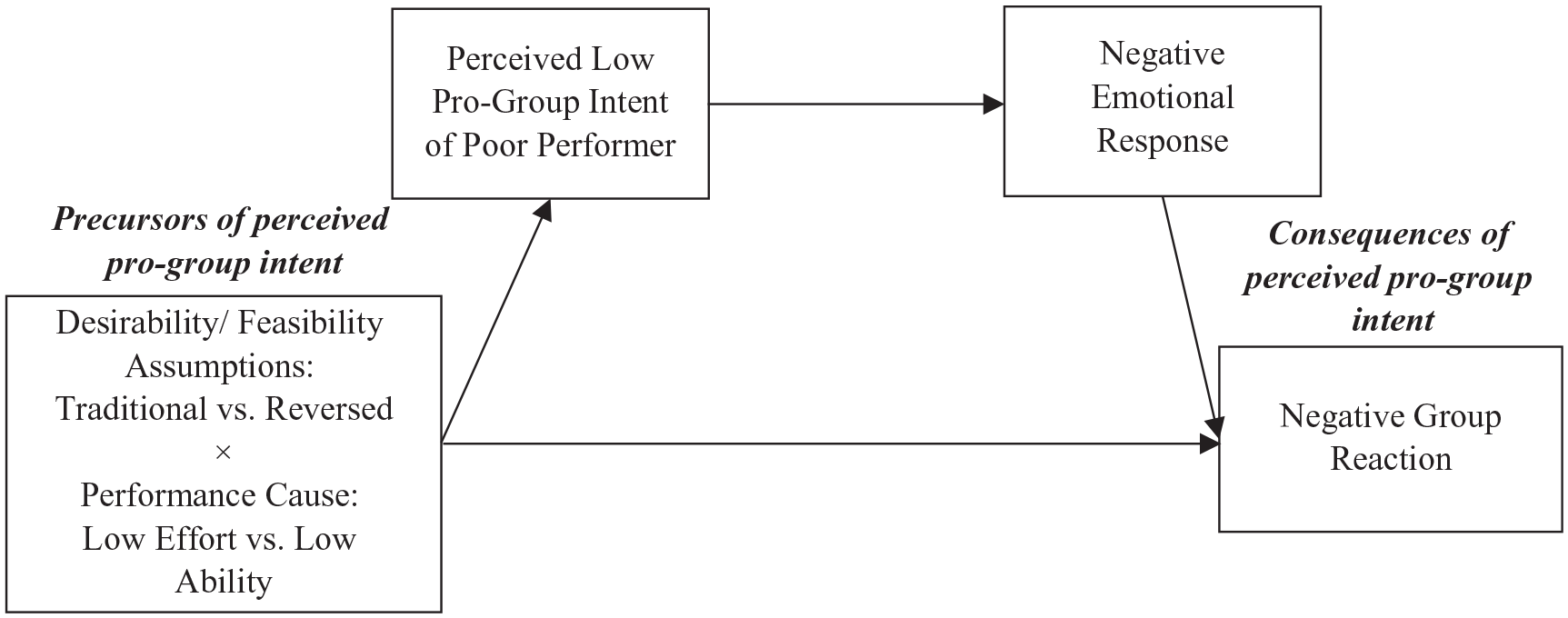
Model of pro-group intent.
To assess pro-group intent, the M-PGI assumes that group members consider the effort/ability dimension put forth by classic attribution theory, as well as the reason underlying the performance deviant’s low effort or low ability. Attribution research (Jackson & LePine, 2003; Taggar & Neubert, 2004, 2008; Weiner, 1985, 2018) traditionally has assumed that observers attribute low effort to the actor’s belief that the goal is not worth attaining (low desirability), and low ability to an intrinsic and unmodifiable lack of skills (low feasibility). According to the M-PGI, this view is overly simplistic. Individuals choose goals based on how attractive they are (desirability) as well as how likely they are to be attained (feasibility; P. M. Gollwitzer, 1990). 1 Moreover, individuals can view their ability as fixed or malleable (Dweck & Yeager, 2019). The M-PGI therefore suggests that group members assume that a poor performer also uses these criteria when setting goals. Observers can therefore attribute low effort to the actor’s belief that the goal is unattainable (low feasibility), and low ability to the actor’s lack of desire to acquire modifiable skills (low desirability). While desirability is indicative of pro-group intent, feasibility is not. If so, then low effort due to lacking desirability should elicit lower attributions of pro-group intent than low ability due to lacking feasibility (traditional assumptions), but reversing these assumptions should eliminate this effort/ability effect. To clarify, the model does not predict that the effort/ability dimension can be replaced by desirability/feasibility assumptions, but rather that desirability/feasibility assumptions represent a confounding factor in classic attribution research. Accordingly, the model predicts an attenuation, rather than a reversal, of the classic effort/ability effect. To sum up, the M-PGI predicts that the effort/ability effect on responses to poor performers is (a) moderated by desirability/feasibility assumptions and (b) mediated by ascriptions of pro-group intent.
Past work on attribution theory has further assumed that cognitive evaluations elicit an emotional response and that these emotions then lead to behavioral reactions (Weiner, 1985, 2018). Although past work has not investigated the relation between attributed pro-group intent and emotional responses, related research indicates that they should be associated. Past attributional theory and research on reaction to poor performers indicates that traditional cognitive evaluations elicit emotional responses in group and team contexts (e.g., Jackson & LePine, 2003; LePine & van Dyne, 2001). Assuming that this also applies to metamotivational assessments, attributed pro-group intent should elicit an emotional response. Support for this assertion comes from motivation science indicating that the monitoring of individual goal progress is governed by emotional responses (Carver & Scheier, 1998; Thürmer et al., 2020). Moreover, lacking regard for one’s group is a moral violation (Levine & Moreland, 2002), and moral violations commonly elicit emotional responses (Dasborough et al., 2019; Hutcherson & Gross, 2011). Accordingly, Thürmer and Kunze (2023) assume that attributed pro-group intent elicits an emotional response towards the poor performer, such that lower attributed pro-group intent is related to more negative emotions. Emotions, in turn, should relate to a negative team reaction (see Figure 1).
Thürmer and Kunze (2023) report five experiments that consistently support the M-PGI. Model predictions were fully supported across four hypothetical vignette experiments and in an individual performance task where participants’ pay depended on the poor performer (who was in fact computer-programmed). Participants responded more negatively to poor performers showing low effort than to poor performers showing low ability when effort was linked to desirability and ability was linked to feasibility (traditional assumptions), and this effect was large and significant across all studies; overall g = 0.94, 95% CI g [0.60, 1.28]. However, when these assumptions were reversed (effort–feasibility, ability–desirability), the effort/ability effect was eliminated; overall g = 0.07, 95% CI g [−0.27, 0.41]. Structural equation modeling analyses indicated that the performer’s perceived pro-group intent and participants’ negative emotions toward the performer sequentially mediated this interaction effect on responses to poor performers; overall indirect effect: B = 0.43, SE = 0.12, p < .001, 95% CI B [0.19, 0.67]. In sum, five experiments fully supported the M-PGI.
Despite this consistent initial evidence, Thürmer and Kunze (2023) tested their model in contexts that may not be fully representative of group life. Most prominently, they only had individual group members indicate what they thought how the team would proceed with a poor performer. In real-life groups, members interact with one another, and this group interaction shapes group experience and outcomes (Levine & Moreland, 1990; Wittenbaum & Moreland, 2008); individual-level experiences and decisions may thus not align with those that emerge at the group level. It is therefore imperative to test group theory in interactive settings (Moreland et al., 2010). Moreover, all experiments in Thürmer and Kunze (2023) were set in a work context. Although work teams are important, group life extends well beyond work (Poole & Hollingshead, 2005). It is therefore important to test the M-PGI in a range of group settings. Finally, Thürmer and Kunze (2023) note that their “focus on a single unambiguous instance of poor performance with one clear cause oversimplifies the reality of many organizational groups and work teams” (p. 140). Indeed, low performance in groups and teams is quite widespread, and it therefore makes sense to assume that group members repeatedly encounter separate instances of poor performance. It therefore remains to be tested if the M-PGI predicts group responses to poor performers in a range of situations that represent group life, especially when members jointly and repeatedly decide how to respond in a variety of settings.
Group Interaction and Responses to Poor Performers
Although the M-PGI has not been tested in studies that allow group members to interact, other studies have observed responses to poor performers in interacting groups. Taggar and Neubert (2004, Study 2) surveyed students working on group projects over the course of a semester and identified the lowest performing member of each group. The characteristics of this lowest performing member predicted group reaction, in line with the assumptions of attribution theory. Specifically, lowest performing members with personality characteristics that indicate lack of effort but having sufficient ability (i.e., low conscientiousness and high general intelligence) elicited fewer prosocial group responses than lowest performing members with any other combinations of conscientiousness and intelligence levels (see also LePine et al., 1997). Assuming that many of the lowest performing members were poor performers, these studies provide an indication that attributional processes influence the responses to poor performers in interacting groups.
In contrast, Gupta (2012) obtained mixed experimental support for the effort/ability effect in interacting groups. Four-person teams jointly completed a work simulation where one member, who was in fact a trained confederate, performed poorly. The poor performer offered low effort or low ability as an explanation. Teams were more likely to compensate for a poor performer expressing low effort rather than low ability, but many of the respective tests of this straightforward prediction did not attain significance. This may indicate that group interaction does alter the attribution process.
This assumption receives support from a study directly comparing individual and joint responses to a poor performer in an attribution framework, albeit not testing the effort/ability effect. Liden et al. (1999) asked work teams and their managers to evaluate hypothetical scenarios that all described a performance episode including one poor performer. Group members as well as their managers first individually worked on eight scenarios describing instances of poor performance. Key to the present discussion, poor performance was described as either caused internally or externally to the poor performer. Following these individual decisions, group members discussed the same eight scenarios and made a joint disciplinary decision. Moreover, the teams’ managers also completed the scenarios and made individual disciplinary decisions. Overall, individual group members (i.e., peers) responded more leniently to poor performers than did managers. Interestingly, this leniency disappeared when members discussed the issue and made a consensual decision: Interacting groups and managers made equally strict disciplinary decisions. Moreover, Liden et al. observed that attributions of poor performance (internal vs. external) had a greater impact on interacting members’ and managers’ evaluations than on individual members’ evaluations. Apparently, individual group members responded more leniently to poor performance because they did not use all the available attributional information (see also Liden et al., 2001).
These findings have implications for the M-PGI. Specifically, the model assumes that groups go beyond the effort/ability dimension to evaluate poor performers’ pro-group intent (e.g., take into consideration the underlying desirability/feasibility assumptions). While effort/ability information may be readily observable, assessing mental states such as the idiosyncratic genesis of effort and ability may involve considerably more complex cognitive processes (cf. Leslie et al., 2004; Perner & Lang, 1999). Groups have more cognitive resources at their disposal than individuals to process complex information (Hinsz et al., 1997). One might therefore expect that, compared to individual members, interacting members will pay even more attention to the desirability/feasibility associated with poor performers’ effort and ability. More consistent and thorough evaluation of the available information should then lead to even more nuanced decisions towards poor performers, as greater effect sizes would indicate.
The Present Research
The primary aim of the present research was to test whether group interaction constrains the M-PGI of reaction to poor performers. Moreover, I sought to assess if the model extends beyond the work context and predicts repeated decisions. To this end, I developed four vignettes describing four group situations that university students may encounter. In each of the vignettes, one member (target) was described as performing poorly, thereby threatening the group’s success. I provided reasons for the target’s poor performance according to a 2 (performance cause) × 2 (assumptions) within design. In two vignettes, I explicated the traditional assumptions, linking low effort to low desirability and low ability to low feasibility. In the other two vignettes, I reversed these assumptions, linking low effort to low feasibility and low ability to low desirability. Participants rated how much effort and ability contributed to the poor performance and indicated whether they would work with that person again.
In the main experiment, I adapted the approach by Liden et al. (1999). Participants worked on the same four vignettes, again following a 2 (performance cause) × 2 (assumptions) within design. After each vignette, participants rated the target’s pro-group intent, their emotional response, and whether they were willing to work with that person again. To assess the influence of group interaction on these evaluations, half of the participants then jointly discussed the vignettes in pairs (interacting dyad condition), again responding to the same questions. The other participants individually reevaluated the vignettes (nominal dyad condition).
Under traditional assumptions (effort–desirability/ability–feasibility), I expected lower willingness to work with the poor performer low in effort than with the poor performer low in ability. Reversing these assumptions (effort–feasibility/ability–desirability) should eliminate this effort/ability effect. I expected that that this interaction would be serially mediated by ascribed intent and emotion, and that all predictions would hold when group members interact.
Preliminary Experiment
I first sought to pretest whether the Performance Cause × Assumptions interaction predicted in the M-PGI would emerge in a repeated measures design with a binary decision to exclude the target in alternative settings. I moreover sought to confirm that the manipulations of effort/ability are independent of the desirability/feasibility assumptions manipulation.
Method
Participants and design
Power analyses assuming a medium effect (f = 0.25) and setting 1 − B = .90 yielded a minimum sample size of N = 61 to detect the within-participant interaction. To account for potential dropouts, I recruited a sample of 72 students (52 female, 13 male, one other; Mage = 23.30 years, SD = 11.66) from a small German university. The experiment followed a 2 (performance cause: low effort vs. low ability) × 2 (assumptions: traditional vs. reversed) within-participants design. The order of the vignettes, the target’s sex, and the order of the conditions were fully counterbalanced.
Procedure
Participants were asked to consecutively read four vignettes and to imagine them vividly. Each of the vignettes contained one of four different situations that students may encounter during their studies: completing group work for a seminar, completing a project during an internship, giving a concert with their band, and organizing a party with flatmates (see Appendix, for translated vignettes). The first paragraph established the teamwork situation and indicated that all group members were interdependent. One group member was then described as performing poorly. For each vignette, the poor performer had a different name commonly used in German. Two of the poor performers had male names and two had female names (Jan [m], Paula [f], Peter [m], and Lara [f]). To counterbalance target gender, I used closely equivalent common German names (Jana [f], Paul [m], Petra [f], and Lars [m]).
The second paragraph of each vignette manipulated the cause of the target’s poor performance (effort or ability) and its underlying reason (desirability or feasibility). The first manipulation (low effort vs. low ability) was adapted from Jackson and LePine (2003; see also Moss & Martinko, 1998). In the low effort conditions, the vignette indicated that the target did not try hard (“hat sich nicht angestrengt”). In the low ability conditions, the vignette indicated that the target did not have a good grasp of the task. To match the content of the respective vignette, I used one of two German expressions in each vignette: One reflected intellectual understanding (“schwer versteht”) and was used in the group work and internship vignettes; the other expression referred to practical skill (“schwer von der Hand gehen”) and was used in the party and band vignettes. In line with the recommendations by Moss and Martinko (1998), the potential “alternative” cause (ability in the case of effort; effort in the case of ability) was described as high to create maximally distinct conditions.
The rest of the paragraph manipulated the reason (desirability vs. feasibility) for the target’s lack of effort or ability. To explicate the traditional assumptions, lack of effort was attributed to the target not caring about the task (“sich nicht darum schert”), and lack of ability, to the target’s perception of not having the capacity to acquire it (“sich außer Stande sieht”). In the reversed assumptions conditions, lack of effort was attributed to the target’s perception of not having the capacity to make their contribution to the group task, and lack of ability, to the target not caring about acquiring the required skills.
Participants then responded to 5-point scales (1 = not at all, 5 = very much) designed to assess the target’s effort (“How important was [target]’s effort in determining their poor performance?”; “To what extent was [target]’s poor performance due to their effort?”; αs = .79–.90) and ability (“How important was [target]’s ability in determining their poor performance?”; “To what extent was [target]’s poor performance due to their ability?”; αs = .75–.90). Two additional items were removed from the scales (“To what extent did [target]’s effort prevent them from performing well?”; “To what extent did [target]’s ability prevent them from performing well?”) because they substantially reduced scale reliability. Participants then indicated whether they would be willing to work with that person again (“yes” vs. “no”), as the main dependent measure. Finally, participants indicated how realistic the scenario was (“To me, the description of [target] seems realistic,” “In my opinion, it is possible that a group might have a member like [target],” “I found it easy to imagine the scenario about [target]”; αs = .80–.87). The scales contained an attention check asking participants to select a specific response (“Please select 4”).
Results
Seven participants failed the attention check (i.e., did not select “4”) and were excluded from analysis (remaining N = 65). To account for the multilevel structure of the data, I estimated generalized linear mixed-effects models (GLMMs) using the “lme4” package Version 1.1-23 (Bates et al., 2015) implemented in R Version 4.0.2 (R Core Team, 2020) using RStudio 1.3.1056 (RStudio Team, 2020). GLMMs therefore lead to more robust and generalizable conclusions (Judd et al., 2012), beyond the carefully implemented counterbalancing. Scales were averaged into single scores. I included performance cause, assumptions, the Performance Cause × Assumptions interaction, and the vignette content as fixed factors, and subjects as random factors.
Manipulation checks
Participants indicated that all scenarios were realistic depictions of what may happen in a group, Ms = 3.78–4.21, SDs = 0.75–0.83. Unexpectedly, participants found the internship scenario (M = 4.21, SD = 0.75) more realistic than the band scenario (M = 3.86, SD = 0.82), t(189) = 3.07, β = .34, SE = 0.11, p = .013, or the party scenario (M = 3.78, SD = 0.82), t(189) = 3.44, β = .38, SE = 0.11, p = .004. I consequently included scenario content as a covariate in subsequent analyses.
I found that participants viewed (a) the poor performer’s effort as more responsible for their poor performance in the low effort conditions than in the low ability conditions (low effort: M = 3.70, SD = 1.29; low ability: M = 2.90, SD = 1.10), t(189) = −5.56, β = −1.03, SE = 0.20, p < .001; and (b) the poor performer’s ability as more responsible for their poor performance in the low ability conditions than in the low effort conditions (low effort: M = 2.42, SD = 1.18; low ability: M = 3.80, SD = 1.18), t(189) = 14.39, β = 1.53, SE = 0.18, p < .001. Moreover, these effects were not constrained by the manipulation of desirability/feasibility (assumptions). For both the effort and ability measures, neither an assumptions main effect, ts(189) < 1.44, βs < 0.26, ps > .150, nor a Performance Cause × Assumptions interaction, ts(189) < 1.93, βs < 0.53, ps > .054, attained significance.
Model test
Regarding the exclusion of the poor performer, I observed main effects of performance cause, β = −2.75, SE = 0.52, p < .001, and assumptions, β = −1.20, SE = 0.50, p = .017, that were qualified by the expected Performance Cause × Assumptions interaction, β = 2.10, SE = 0.63, p = .001. As predicted, under traditional assumptions, participants were more likely to exclude the target from future group work when they were low in effort (89%) than low in ability (40%), β = −3.09, SE = 0.78, p < .001, but there was no significant difference under reversed assumptions (low effort: 71%; low ability: 57%), β = −0.51, SE = 0.38, p = .186.
Discussion
I replicate and extend findings by Thürmer and Kunze (2023). The effort and ability manipulations produced consistent effects on the respective effort and ability scales. These effects were not constrained by the desirability/feasibility (assumptions) manipulation, further corroborating the theoretical distinction between effort/ability and desirability/feasibility (Thürmer & Kunze, 2023).
I moreover observed the predicted Performance Cause × Assumptions interactions on poor performer exclusion in the repeated measures design. The findings substantially extend the generalizability of the M-PGI. The newly developed paradigm contained vignettes about four different social situations, extending beyond the work context. I conducted the study with German participants, extending beyond U.S. populations. Finally, participants made four consecutive decisions, extending beyond single instances of poor performance. The paradigm is thus well-suited for testing the M-PGI in interactive contexts.
Main Experiment
The primary aim of the main experiment was testing the influence of social interaction on responses to poor performers. To this end, I adapted the procedures of Liden et al. (1999): Participants first worked on the four pretested vignettes individually, and then in dyads. To account for the effects of making repeated disciplinary decisions, participants in the nominal dyad 2 condition worked on the vignettes individually during the second round. In addition to the exclusion measure, I also assessed the mediators proposed in the M-PGI: attributed pro-group intent and emotional response.
Method
Participants and design
I obtained a student sample from a large German university. Two hundred and twenty-six participants (Mage = 25.73 years, SD = 7.73; 145 female, 75 male, three n/a) came to the lab in dyads (N = 113) and completed the experiment in return for a total of €10 or equivalent course credit. Participants responded to advertisements to take part in a study on teamwork and were invited to the laboratory in dyads. Three participants indicated they knew the other person, all other participants indicated no acquaintance. Participants first worked on an unrelated study investigating the impact of personality on leadership emergence. The main experiment followed a 2 between (dyadic interaction: yes vs. no) × 2 within (performance cause: low effort vs. low ability) × 2 within (assumptions: traditional vs. reversed) mixed design. While dyads were randomly assigned to a dyadic interaction versus no dyadic interaction condition, all dyads worked on four vignettes each reflecting one of the four conditions of the 2 (performance cause: low effort vs. low ability) × 2 (assumptions: traditional vs. reversed) within-participants design. The order of the vignettes, target sex, and conditions was again counterbalanced.
Procedure
After providing informed consent, participants were seated at separate desks in front of personal computers and learned that this study was on students’ teamwork. Participants worked on the pretested four vignettes, with the following changes: After reading each of the vignettes, participants used 5-point scales (1 = not at all, 5 = very much) to indicate their emotional response toward the poor performer (“angry,” “annoyed,” “irritated,” “sympathetic” [reversed]; αs = .89–.86) and their perception of how strong the target’s pro-group intent was (“[Target name] wanted to help the team,” “[Target name] cared about benefiting the team through his work,” “[Target name] wanted to have a positive impact on the team”; αs = .96–.93). Both scales were adapted from Thürmer and Kunze (2023). As the main dependent measure, participants indicated if they were willing to work with the target again.
After completing the last vignette, participants in the interacting dyad condition were instructed to sit at a separate desk together and work on the four cases again. Instructions stated: “Please discuss the following group situations jointly.” Dyads could take as much or as little time as they wished to discuss the cases. Only one participant was provided with the response scales, so dyads had to agree on their response. Participants in the nominal dyad condition were asked to work on the cases again independently, and the instructions stated: “Please evaluate the following group situations again.” Both participants in the individual condition were presented with the scales and their responses were averaged. All participants were assured that they were allowed to change their initial assessments from Round 1. Finally, participants provided demographic information, and were paid and debriefed.
Results
In 13 dyads, one or both members failed at least one attention check (i.e., they did not select “4”); in one nominal dyad, the members were accidentally assigned different gender orders; and one dyad experienced computer problems, leaving N = 98 dyads for analyses. All measures were averaged to the dyadic level; when nominal dyads made different exclusion decisions, a draw was assigned. 3 Scales were again averaged into single scores. Neither participant nor target gender had an impact on the results reported below.
Round 1: Reaction to poor performer
I included performance cause, assumptions, the Performance Cause × Assumptions interaction, and the dyadic condition as fixed factors; subjects as a random factor; and vignette content as a covariate. I observed the expected Performance Cause × Assumptions interaction, β = 0.39, SE = 0.06, p < .001. As predicted, under traditional assumptions, participants were more likely to exclude the target from future group work when they were low in effort (70% exclude, 28% draw, 2% include) than low in ability (46% exclude, 37% draw, 17% include), β = −0.40, SE = 0.04, p < .001, but there was no significant difference under reversed assumptions (low effort: 21% exclude, 45% draw, 34% include; low ability: 48% exclude, 33% draw, 19% include), β = −0.01, SE = 0.04, p = .918. I did not observe an effect of the nominal versus actual dyad manipulation at this point before the manipulation, β = −0.01, SE = 0.03, p = .834.
Round 1: Structural equation model
To account for the interdependence of the within-person observations in the structural equation model, I followed the recommendations by McNeish et al. (2017) and used clustered-standard errors in “lavaan” 0.6-6 (Rosseel, 2012) implemented in R Version 4.0.2 (R Core Team, 2020) using RStudio 1.3.1056 (RStudio Team, 2020). This procedure can also account for binary and ordered outcomes (i.e., the joint decision whether to exclude the poor performer). Standardized coefficients are reported to give an indication of effect size.
I first tested the model using performance cause, assumptions, the Performance Cause × Assumptions interaction, nominal versus actual dyad condition, and the Performance Cause ×Assumptions × Dyad interaction as initial predictors. The Performance Cause × Assumptions interaction predicting the poor performer’s pro-group intent was significant (two-tailed), β = −0.30, SE = 0.10, p = .003. No effect of dyad, β = −0.01, SE = 0.06, p = .953, or Performance Cause × Assumptions × Dyad interaction, β = −0.06, SE = 0.06, p = .271, emerged at this point before the manipulation. Pro-group intent significantly predicted participants’ emotional response toward the poor performer, β = −0.56, SE = 0.03, p < .001, and this emotional response significantly predicted whether participants decided to work with the poor performer again, β = 1.01, SE = 0.07, p < .001. The indirect effect of the Performance Cause × Assumptions interaction on the exclusion decision was significant (two-tailed), β = 0.17, SE = 0.06, p = .004, and entering the mediators rendered the direct effect of the Performance Cause × Assumptions interaction on the exclusion decision nonsignificant, β = 0.28, SE = 0.17, p = .097. The model fit was good, CFI = .986, SRMR = .026. In sum, the results of Round 1 consistently supported model predictions.
Round 2: Reaction to poor performer
I next included the decisions from Round 2 in the models. I again observed the expected Performance Cause × Assumptions interaction, β = 0.41, SE = 0.07, p < .001. As predicted, under traditional assumptions, participants were more likely to exclude the target from future group work when they were low in effort (80% exclude, 11% draw, 9% include) than low in ability (56% exclude, 20% draw, 25% include), β = 0.45, SE = 0.05, p < .001, but there was no significant difference under reversed assumptions (low effort: 24% exclude, 30% draw, 46% include; low ability: 51% exclude, 23% draw, 27% include), β = 0.04, SE = 0.05, p = .455. I did not observe an effect of the nominal versus actual dyad manipulation, β = −0.02, SE = 0.04, p = .691, indicating that the first prediction of the M-PGI was robust in group interaction. In sum, the results of Round 2 are consistent with previous studies and indicate that reactions to poor performers are not constrained by group interaction.
Round 2: Structural equation model
I next tested the model using performance cause, assumptions, the Performance Cause × Assumptions interaction, nominal versus interactive dyad condition, and the Performance Cause × Assumptions × Dyad interaction as initial predictors (see Figure 2). The Performance Cause × Assumptions interaction predicting the poor performer’s pro-group intent was nonsignificant, β = −0.12, SE = 0.16, p = .454, but a Performance Cause × Assumptions × Dyad interaction emerged, β = −0.30, SE = 0.10, p = .003. To follow up on this three-way interaction, I conducted structural equation model analyses for nominal and interacting dyads separately. Regarding nominal dyads, the Performance Cause × Assumptions interaction predicted the poor performer’s pro-group intent (two-tailed), β = −0.31, SE = 0.05, p < .001. Pro-group intent significantly predicted participants’ emotional response toward the poor performer, β = −0.63, SE = 0.05, p < .001, and this emotional response significantly predicted whether participants decided to work with the poor performer again, β = 0.26, SE = 0.03, p < .001. The indirect effect of the Performance Cause × Assumptions interaction on group reaction was significant (two-tailed), β = 0.05, SE = 0.01, p < .001, and entering the mediators reduced the direct effect of the Performance Cause × Assumptions interaction on the exclusion decision, although a significant effect remained, β = 0.06, SE = 0.02, p = .020, indicating partial mediation. The model fit was good, CFI = .983, SRMR = .052.
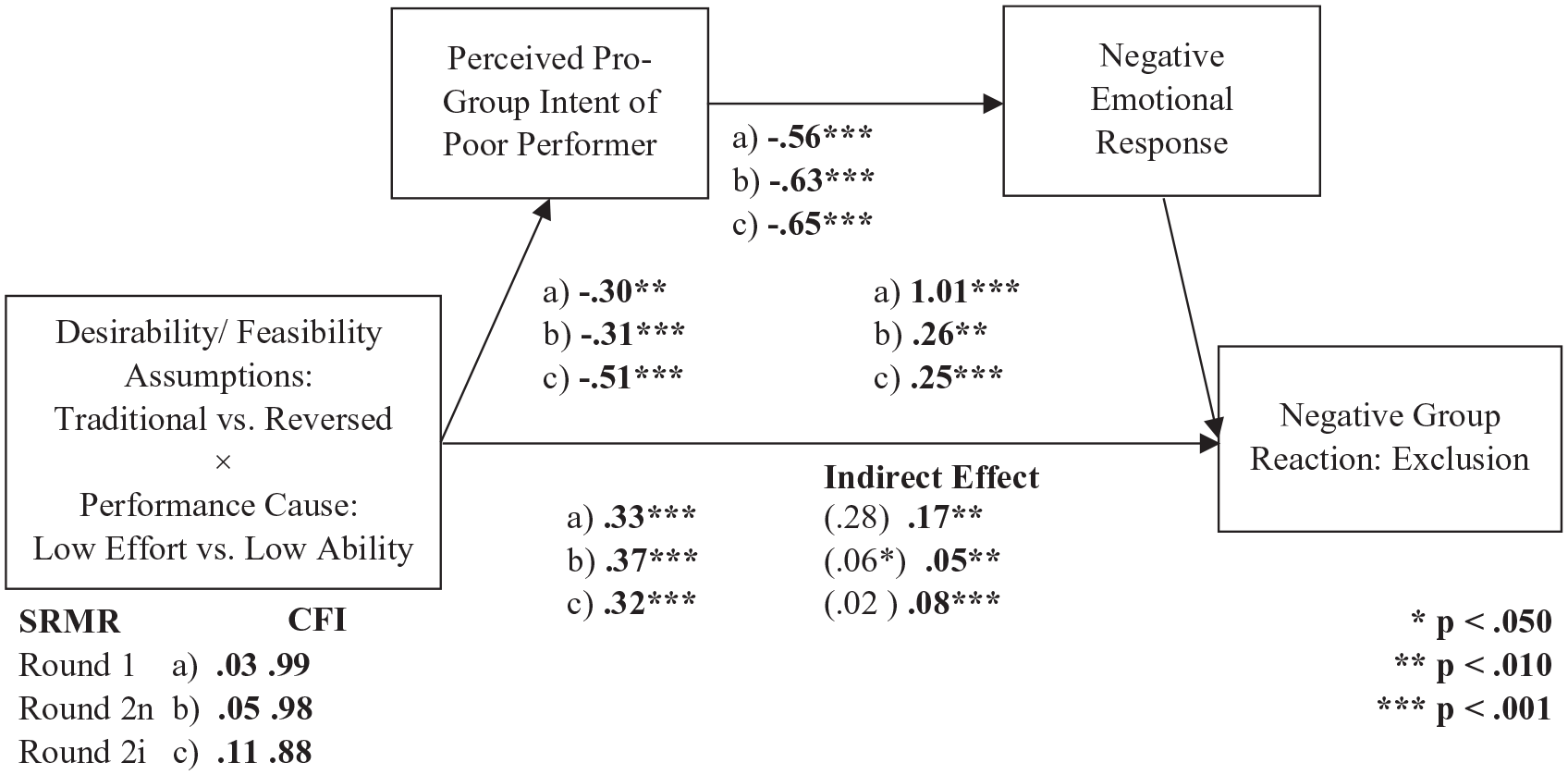
Results of structural equation model analyses for (a) Round 1, (b) Round 2 nominal dyads without interaction, and (c) Round 2 actual dyads with interaction.
Regarding interacting dyads, the Performance Cause × Assumptions interaction predicted the poor performer’s pro-group intent (two-tailed), β = −0.51, SE = 0.06, p < .001. Pro-group intent significantly predicted participants’ emotional response toward the poor performer, β = −0.65, SE = 0.04, p < .001, and this emotional response significantly predicted whether participants decided to work with the poor performer again, β = 0.25, SE = 0.04, p < .001. The indirect effect of the Performance Cause × Assumptions interaction on group reaction was significant (two-tailed), β = 0.08, SE = 0.02, p < .001, and entering the mediators rendered the direct effect of the Performance Cause × Assumptions interaction on the exclusion decision nonsignificant, β = 0.02, SE = 0.04, p = .551, indicating full mediation. It should be noted, however, that the model fit did not meet traditional levels, CFI = .879, SRMR = .110.
Discussion
The M-PGI helped explain the reaction to poor performers in nominal and interacting dyads, as indicated by the separate model tests. While no direct effects of group interaction on exclusion decisions were observed, a significant three-way interaction in SEM analyses provided some indication of more consistent model effects in interacting dyads than in noninteracting participants (nominal dyads). In line with this view, follow-up tests showed that the Performance Cause × Assumptions interaction on attributed pro-group intent was larger in interacting dyads, β = −0.51, SE = 0.06, than in nominal dyads, β = −0.31, SE = 0.05. Moreover, direct model effects were fully mediated by attributed pro-group intent and emotional response in interacting dyads, but a significant direct effect remained in nominal dyads (partial mediation). In sum, results were highly consistent with predictions, and effects tended to be stronger when participants discussed how to respond to the poor performer.
General Discussion
The current research tested the M-PGI under conditions that fulfill many important features of group life. In two experiments, participants made repeated decisions about poor performers in a range of different social situations. To test how group interaction influences group responses, participants in the main experiment either discussed how to respond (interacting dyads) or decided individually (nominal dyads). Despite these many alterations, the M-PGI recently proposed by Thürmer and Kunze (2023) consistently predicted responses to poor performers.
Specifically, group responses towards the poor performer low in effort were more negative (i.e., higher exclusion rates) than responses towards the poor performer low in ability when low effort reflected lacking desirability, and ability reflected lacking feasibility (traditional assumptions). Reversing these assumptions by linking effort to lacking feasibility, and ability to lacking desirability, eliminated this effort/ability effect. These effects were serially mediated by perceptions of the poor performer’s apparent willingness to help the group (attributed pro-group intent) and emotional responses towards this person.
The support for the M-PGI was strong in interacting as well as nominal dyads, with model-consistent effects in both settings. The observed process effects were stronger in interacting dyads, as indicated by a significant three-way interaction in structural equation modelling as well as follow-up tests. This effect was not evident, however, in direct effects of dyadic interaction on exclusion decisions or in serial comparisons within the interactive condition. In sum, the current findings indicate that the M-PGI is well-suited to predict the behavior of interacting groups, potentially even more so than individual behavior.
Contribution
As the main contribution, I show that the M-PGI holds under conditions of social interaction. These findings comport well with observations by Liden et al. (1999) that groups have an increased sensitivity to attributional dimensions. In contrast to earlier studies, interacting dyads in this study considered a host of fine-grained attributional information, including the apparent genesis of the poor performer’s effort and ability. This research thus highlights that groups can and do infer a poor performer’s intent, much like they would form their own intentions.
Apparently, groups primarily seek to assess whether a poor performer was trying to help the group. This conclusion is in line with individual-level theorizing and research on intentionality in attributions and moral judgements (Malle, 2011, 2021). Moving towards interactive settings, M. Gollwitzer and Okimoto (2021) recently suggested a dynamic motive-attribution framework of transgressions, including transgressor and victim motives as predictors. In contrast, the M-PGI highlights the importance of attributed intent in understanding group dynamics.
More broadly, this research highlights the importance of taking into account group as well as individual intent when predicting group dynamics. Traditional accounts of group goal attainment assume that member goals are congruent with group goals (e.g., Nijstad & De Dreu, 2012; Thürmer et al., 2021; Weldon & Weingart, 1993). This need not be the case (cf. Levine & Smith, 2013). In fact, it makes sense to assume the group and individual interests are commonly in conflict (Kerr, 1983). The M-PGI provides a starting point to investigate how groups negotiate and resolve these issues.
Limitations
There are three limitations of the current research that warrant discussion. First, I relied on a scenario methodology where individuals and dyads reacted to descriptions of hypothetical group situations. This methodology does not allow observing interactions with the poor performer but is well-suited for the present research. A host of attributional research has used this methodology successfully, including studies on group responses to poor performers (e.g., Jackson & LePine, 2003; Taggar & Neubert, 2004). Moreover, much of what humans do, they do in groups, and poor performance is quite common. Accordingly, participants likely have little difficulty imagining the described situations. Observed ratings of scenario realism are congruent with this assumption. Likewise, the careful construction of experimental vignettes in the repeated design may have allowed participants to guess what the intended manipulations were. However, the observed effects were highly consistent with experimental tests of the M-PGI using between-designs (Thürmer & Kunze, 2023), indicating that this was likely not the case in the current investigation.
Second, as in previous attribution research (Moss & Martinko, 1998), I created maximally distinct performance cause conditions by describing the alternative cause as high (high effort in the case of low ability; high ability in the case of low effort). Although poor performers in real life may lack effort as well as ability, these two additional conditions leave open why exactly the person performed poorly and are therefore not informative with regard to testing the M-PGI. In line with this view, past research that included other effort/ability combinations has observed inconsistent effects (see also discussions in Jackson & LePine, 2003; Thürmer & Kunze, 2023). Likewise, I only specified desirability or feasibility as an underlying assumption of effort or ability. Again, it is possible that both desirability and feasibility are low. According to this reasoning, one could employ a 2 (ability: high vs. low) × 2 (effort: high vs. low) × 2 (feasibility: high vs. low) × 2 (desirability: high vs. low) design. Beyond representing an empirical challenge (e.g., to attain sufficient power), I believe that such a design would not be theoretically informative. Future research nevertheless should test the M-PGI in field settings where poor performers may exhibit different levels of effort and ability as well as desirability and feasibility.
Third, I used dyads to test the influence of group interaction on the attributional process. Despite the ongoing discussion whether dyads can be considered groups (Moreland, 2010; Williams, 2010), the use of dyads was appropriate in this setting. Participants jointly discussed how to respond to the poor performer described in the vignette, a (hypothetical) third group member. In real life, group members often avoid confronting a poor performer (Jackson & LePine, 2003), and this discussion setting of two members discussing an absent poor performer thus likely represents a common group situation. Accordingly, this setting is likely to occur in group interaction and thus provides a high mundane realism. Nevertheless, future research should investigate whether the M-PGI predicts direct responses to a poor performer in interacting groups. Such settings would also allow observing potential downstream consequences of group responses to poor performers, such as detrimental group dynamics that may ruin the entire group (e.g., Felps et al., 2006). The present research indicates that the M-PGI provides an ideal starting point for these endeavors.
Future Directions
There are many potentially fruitful avenues for future research. First, the M-PGI focusses on the poor performer’s apparent desirability and feasibility considerations of their own contributions. It would also be possible to include their apparent evaluation of the group’s desirability and feasibility. In this way, the M-PGI could shed new light on established group phenomena. For instance, effort withdrawal in group tasks (i.e., social loafing) has been observed to be high when the group’s probability of success is high (e.g., Petty et al., 1980), and a high probability of success represents a high group feasibility. Ascribing such beliefs about the group to other members may well influence how groups respond to these members. For instance, it is plausible that a high group feasibility reduces individual feasibility because it is not possible to contribute any further. If so, ascriptions of high group feasibility could reduce negative reactions to individual low effort. It would moreover be interesting to identify behavioral indicators of low desirability and low feasibility. Social loafing has been linked to behaviors such as apathy and disrupting the team (Jassawalla et al., 2009), and these behaviors may thus distinctly relate to perceptions of desirability and feasibility. Clearly, including the ascriptions of individual-level and group-level beliefs leads to a host of new and nuanced predictions of group behavior.
Second, future research should further investigate the cognitive processes underlying the M-PGI in interactive settings. The predictions that groups would show greater model effects were derived based on the assumptions that (a) inferring mental states, such as desirability and feasibility, requires cognitive resources and (b) groups have more of these resources at their disposal than individuals do. Alternatively, more nuanced group decisions could be the result of less effortful processes, such as using heuristics or group polarization (e.g., Liden et al., 1999). The support for more nuanced group decisions was mixed in the current experiment (i.e., dyadic interaction had no direct effects but indirect effects in SEM analyses), but the M-PGI received consistent support. It is therefore possible that the processes between interactive groups and individuals differ, although they lead to the same outcomes.
Third, the present experiment indicates that groups use the same criteria to evaluate the goals of others as they do to evaluate their own goals. This insight provides a key starting point for the integration of research on goals and motivation with the literature on small groups and teams. For instance, the M-PGI conceptualizes pro-group intent as a continuum from very low to very high. In this taxonomy, very low pro-group intent signifies relative indifference towards the group goal. However, a person may also have intentions to actively harm or exploit the group. The incentive structure of group work commonly resembles a social dilemma such that the individual can maximize their own gain by minimizing their contribution (Kerr, 1983). Such an intention to free-ride by minimizing own contributions can actively harm the group (Albanese & Fleet, 1985), indicating that ascriptions of such antigroup intent may be an additional mediator of reaction to poor performers. Future research along these lines could therefore study a host of other intentions vis-à-vis the group. Apparently, group behavior is best conceptualized as goal-directed (Thürmer et al., 2021; Wieber et al., 2013).
Conclusion
The present research demonstrates that groups consider a host of information when responding to poor performers, including their apparent intentions. These findings highlight that groups are more than information processors; they are goal-directed and evaluate their members’ intentions much like individuals evaluate their own intentions. Beyond demonstrating the value of incorporating ascribed intentionality in models of group dynamics, I hope that this work contributes to renewed efforts to understand how groups attain their goals. At least, the current findings are good news for those who fail despite their good intentions: Groups are likely to grant them a second chance.
Footnotes
Appendix: Vignettes (Translated From German)
Acknowledgements
The author would like to thank John Levine, Florian Kunze, Stefan Schulz-Hardt, and Thomas Schultze as well as their labs for their help, feedback, and input in developing this work.
Funding
The author(s) disclosed receipt of the following financial support for the research, authorship, and/or publication of this article: This project has received funding from the European Union’s Horizon 2020 research and innovation program under the Marie Sklodowska-Curie grant agreement no. 703042.
