




Abstract
Losing an election can be a huge blow. As a result, most elections are associated with a mixture of trepidation and optimism (outgroup vs. ingroup political party winning, respectively). However, we propose that levels of anxiety and future dread in the context of an election are enhanced when society is characterised by deep intergroup divisions and morally charged polarisation. Across two studies spanning two national elections (the 2020 U.S. presidential election and the 2021 Dutch general election; N = 1,079), we examined support for the prediction that projected moral polarisation in the aftermath of an election would be associated with enhanced perceived negative consequences of losing that election (i.e., an outgroup political party winning power). We consistently found that projected moral polarisation when anticipating an election loss predicted enhanced anxiety concerning the future state of society (collective angst), higher perceived likelihood of civil war, and a stronger perceived obligation to fight to overturn the results of the election. Moreover, this association was mediated by the perceived breakdown of leadership in society. The current findings have important implications for understanding the societal and political consequences of moral polarisation, including the potential for enhanced intergroup conflict and threats to democracy.
On January 6, 2021, a group of insurrectionists deeply unsatisfied with the results of the 2020 presidential election in the United States (US), stormed the U.S. Capitol building in a coordinated attempt to overturn the election outcome and reinstate their preferred leader (Lonsdorf et al., 2022). In addition to the crucial role of leadership (Haslam et al., 2022) and weeks of dissent, anger, and the breakdown of trust in the wake of the 2020 U.S. election, this event was potentially triggered by the culmination of heightened polarisation in the weeks and months leading up to the election (French, 2020; Lockhart et al., 2020).
When considering potential mutually exclusive postelection futures (i.e., an ingroup vs. outgroup victory), how the public feels about anticipated election outcomes depends on expectations about how the election will determine long-term consequences for society. For instance, will the election amplify gloom, further inflame ideological divisions, and increase societal tensions (Carothers & O’Donohue, 2019; Rabbie & Bekkers, 1978)? If so, how do groups respond to the prospect of losing an election when they anticipate future society will be characterised by disorder and increased ideological division? We know that moral division in society is linked to reduced trust (Rapp, 2016) and the desire to elect more extreme political leaders (Crimston, Selvanathan, Álvarez, et al., 2022). However, in the context of an election, to what extent does moral polarisation enhance the perceived negative consequences of losing that election, including expectations of violent conflict and the perceived obligation to overturn the election outcome?
On the eve of two elections (the 2020 U.S. presidential election and the 2021 Dutch general election), we asked participants to imagine a future in which the political ingroup or outgroup has won the election and explored how projected moral polarisation was linked to the anticipation of negative intergroup consequences in postelection society. Specifically, we were interested in exploring how projected postelection moral polarisation (outlined below) was linked to the perceived breakdown of society and, in turn, greater angst, conflict, and the perceived obligation to overturn an election outcome in the present. We begin by exploring the concept of moral polarisation and its ties to intergroup relations, election dynamics, and the perceived breakdown of society.
Moral Polarisation
From a social identity perspective (Tajfel & Turner, 1979; Turner et al., 1987), polarisation is a natural consequence of group identification. When an ingroup becomes an important part of one’s self-concept, the process of social categorisation ensures group differences are accentuated, which is turn strengthens an “us versus them” mindset (Ellemers et al., 2002; Jetten et al., 2004; Sherman et al., 2009). Within the social and political psychology literature, polarisation has been investigated in various forms (i.e., perceived and/or objective divisions on the basis of political beliefs, moral values, affect, or group-based prejudice). This growing body of research has found that, in its various forms, polarisation is linked to a range of intergroup and societal consequences (Arvan, 2019; Esteban & Schneider, 2008; Luhan et al., 2009; Myers & Bishop, 1970; Tappin & McKay, 2019). For instance, polarisation has been linked to the erosion of democratic processes (Heltzel & Laurin, 2020; McCoy et al., 2018; Vegetti, 2019), the rise of populism (Norris & Inglehart, 2019), enhanced political engagement (Enders & Armaly, 2019), responses to the COVID-19 pandemic (Crimston & Selvanathan, 2020; Druckman et al., 2021; Hegland et al., 2022; Kerr et al., 2021), reduced trust (Lee, 2022; Rapp, 2016), the perceived breakdown of society (Crimston, Selvanathan, & Jetten, 2022), and an increased desire to elect strong leaders (Crimston, Selvanathan, Álvarez, et al., 2022).
Moreover, morally charged polarisation has been theorised to be a particularly potent form of societal division (Crimston, Selvanathan, Álvarez, et al., 2022; Norris & Inglehart, 2019; Skitka et al., 2021). This is because, more so than standard political attitudes, our moral values are central to how we define ourselves (Ellemers & van den Bos, 2012). Because of this, challenges to a group’s moral values are typically viewed as an existential threat (van der Toorn et al., 2015). Seminal research in moral psychology supports this distinction. Our deeply held moral convictions—fundamental beliefs that distinguish between right and wrong—are psychologically distinct from strong (nonmoral) attitudes, religious beliefs, or political partisanship (Skitka et al., 2021). When our moral convictions clash, we tend to become highly emotional, highly motivated to act to defend those convictions, we refuse to shift our positions, we show greater levels of intolerance, we reduce our cooperation toward those we disagree with, and we increase our acceptance of the use of violence to achieve desired ends (Skitka, 2010). As such, in line with social categorisation theorising, challenges to our moral convictions enhance not only comparative fit but also normative fit (Oakes et al., 1994), whereby more extreme group members will gain in relative prototypicality over those who endorse more moderate values, and the “us versus them” dynamics inherent in group polarisation will translate into “good versus evil” (Crimston, Selvanathan, Álvarez, et al., 2022).
In addition, as a consequence of accentuating intergroup differences and downplaying intragroup differences (i.e., meta-contrast; Oakes et al., 1994; Turner et al., 1987), we have skewed perceptions of what the broader population thinks. Specifically, we frequently believe that outgroup members hold more extreme ideologies than they actually do (Robinson et al., 1995), and we consistently overestimate levels of group polarisation in society (Enders & Armaly, 2019; Westfall et al., 2015). For instance, affiliates of a political party might perceive all affiliates of another party as universally and inherently immoral, and all members of their own party as inherently moral. Such enhanced perceptions of “us/good” versus “them/evil” distinctions may be particularly consequential in the lead up to elections, when group membership becomes increasingly salient and when political parties (and voters) strive to emphasise similarities with their ingroup and distinctiveness from their competition (Alabastro et al., 2013; Christian et al., 2018).
In the current research, we were particularly interested in exploring the concept of projected moral polarisation, defined here as the perceived enduring moral divide between dominant groups in society (i.e., divisions in core and representative moral values; see Measures section). While previous research has shown that perceived moral polarisation in the present can be a powerful predictor of social and political attitudes (Crimston, Selvanathan, & Jetten, 2022), and that our projections about the future of society can shape attitudes in the present (Bain et al., 2013), to our knowledge, there has been no research that had simultaneously examined these concepts in the form of projected moral polarisation. We expected that the prospect of moral divisions in the future would be particularly relevant and important to examine in the context of elections because, depending on the election result, different future outcomes are possible. In this way, our expectations about future divisions are likely to be particularly potent as we consider the alternative pathways society may follow.
From Perceived Division to Anticipated Conflict
We can expect, based on prior literature examining intergroup polarisation (Crimston, Selvanathan, Álvarez, et al., 2022; Crimston, Selvanathan, & Jetten, 2022; Enders & Armaly, 2019; Oakes et al., 1994; Rapp, 2016; Turner et al., 1987), that perceptions of heightened polarisation are likely to amplify the expected consequences of an undesirable election outcome (i.e., an outgroup leader coming to power). Specifically, we know that outgroup leaders can threaten our sense of collective identity. In line with this, it has been found that when an outgroup leader is projected to win an election, those who support the losing political party feel that the national identity has fundamentally changed (“this isn’t who we are”), and this feeling may motivate a desire to withdraw from the national group (Wagoner & Barreto, 2019). Heightened polarisation is likely to increase this threat if it fuels the perception that an outgroup leader does not represent a sense of collective identity.
Moreover, given the heightened stakes of morally charged polarisation, perceiving that the moral fabric of society may be at threat postelection is likely to further increase the impact of losing. This is because opposition to a group’s moral values is typically viewed as an existential threat (van der Toorn et al., 2015), and challenges to moral convictions are associated with increased action potential and an increased acceptance of violence to achieve desired ends (Skitka, 2010). In line with this, in highly polarised settings, such as the 2016 U.S. presidential election, already potent intergroup divisions can translate into the perception that the election itself represents a battle between good (the ingroup) and evil (the outgroup; Schwalbe et al., 2020).
Therefore, in the context of an election loss, there may be a perception that society is doomed to be fragmented with irreconcilable differences and without a leader that speaks “for us.” In addition, there may be a perception that the elected leader won’t resolve moral divisions and will instead further inflame them, thereby enhancing a sense of existential threat. Prior work has also shown that perceived existential threats to a group can lead to outgroup aggression (Wohl et al., 2012), and that when groups fear for their collective future, they will act in ways to ensure a vibrant future is secured (Wohl et al., 2010, 2011). Therefore, in a situation where an outgroup leader is coming to power and groups fear for the collective vitality of their society, heightened polarisation is likely to enhance these fears, the perceived likelihood of conflict, and the perceived responsibility to reject an undesirable election outcome (see Figure 1).
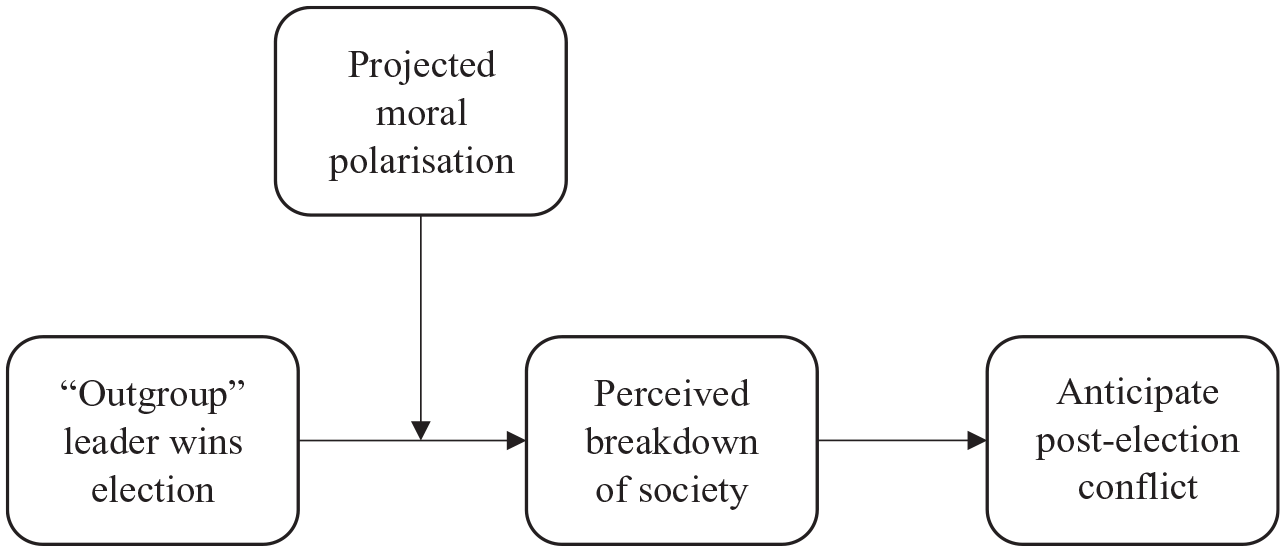
Predicted conceptual model whereby projected moral polarisation in the context of an outgroup leader winning an election is associated with the perceived breakdown of society and, in turn, the anticipation of postelection conflict.
In taking the current approach, this research combines existing psychological theory examining the dynamics of intergroup polarisation and collective perceptions about the future of society (Bain et al., 2013; Wohl et al., 2012). Moreover, we do so within a novel context; exploring anticipated negative consequences in the context of national elections. In doing so, this research has the potential to broaden our understanding of the consequences and underlying psychological processes tied to “us versus them” divisions in society. Consistent with this perspective, we were also interested in examining future-oriented outcome variables that focused on the aftermath of an election. Specifically, given the expected potency of morally charged divisions in the context of elections, we aimed to examine perceptions concerning the future vitality and viability of society, as well as the belief that extreme resolutions might be required postelection. We felt this focus was warranted given that the election context of Study 1 featured a candidate who indicated they would not accept the outcome in the event of an election loss (i.e., Donald Trump, 2020 U.S. presidential election; Kapur, 2020). As such, we chose to examine collective angst, the expectation of violent conflict following the election, and the perceived obligation to overturn an undesirable election result. This sets up our first prediction.
H1: Projected (postelection) moral polarisation will be associated with enhanced perceived negative consequences of losing an election (i.e., Election Outcome x Political Orientation interaction), including increased collective angst, the likelihood of intergroup conflict, and the obligation to fight to overturn an undesirable election outcome.
In addition, we anticipated that the perceived breakdown of society would function as a crucial mediating factor. Prior research has established that heightened perceived moral polarisation can enhance the perception that society is breaking down (Crimston, Selvanathan, Álvarez, et al., 2022). Specifically, the perception that society is morally polarised leads to an enhanced sense that the social fabric within that society is being torn apart, and that current leadership is ineffective and illegitimate (i.e., the two components of social anomie: the breakdown of social fabric and of leadership; see Teymoori et al., 2016). We expected these perceptions and associations would be particularly salient in the context of an election loss, given the anxieties associated with an outgroup leader coming to power (Wagoner & Barreto, 2019). Specifically, that heightened moral polarisation in the context of an election loss will lead to the perception that society is going to break down. In turn, the more people perceive that postelection society will be characterised by reduced social cohesion and that leadership will be illegitimate and ineffective, the more likely they will be to anticipate sustained conflict and a perceived obligation to overturn an undesirable election outcome (see Figure 1). This sets up our second prediction.
H2: The projected Moral Polarisation x Election Loss interaction on negative postelection consequences (perceived angst, intergroup conflict, and the obligation to overturn the election) should be mediated by the perceived breakdown of society (i.e., anomie).
The Present Research
We tested these predictions across two experimental studies spanning two national elections in the United States and the Netherlands. Study 1 focused on the 2020 U.S. presidential election, between Donald Trump (Republican) and Joe Biden (Democrat), at a time of heightened racial tensions and a nation ravaged by the COVID-19 pandemic (Worland, 2020). 1 Data collection took place on November 1st, just a few days prior to the election. Study 2 focused on the 2021 Dutch general election, which took place amidst antilockdown protests (Henley, 2021) and in the aftermath of the resignation of the sitting government following the fallout over a social security scandal (Holligan, 2021). 2 Data collection for Study 2 took place in early February, in the lead up to the 2021 election scheduled for March 17th. To test H1, we ran a series of three-way (Moral Polarisation × Election Prime × Political Orientation) moderated regressions in order to assess whether heightened projected moral polarisation would enhance the perceived negative consequences of losing an election (i.e., Election Prime x Political Orientation interaction). To test H2, we expanded these moderated regressions to include perceived anomie (perceived breakdown of society and of leadership) as a mediating variable. All data are available on the Open Science Framework (https://osf.io/ndyqe/).
Study 1
Participants
Six-hundred and five U.S. participants (54% identified as male, 45% as female, 1% as nonbinary/other; Mage = 35.40, SDage = 12.96) were sourced through Prolific Academic. Equal numbers of Republican and Democrat voters within the United States were recruited, resulting in 301 (49.80%) participants self-identified as Democrats, and 304 as Republicans (50.20%). Twenty-four participants (3.97%) were excluded due to failing an attention check, leaving 581 for analysis. Power analyses using G*Power (Faul et al., 2007) revealed that we required a sample of 395 to have adequate power (80%) to detect a small three-way interaction effect.
Measures
Election prime
Participants were randomly assigned to one of two conditions whereby they were asked to consider a potential future in which Donald Trump or Joe Biden won the 2020 presidential election: “We want you to think about a future in which Donald Trump [Joe Biden] wins the 2020 Presidential Election. Specifically, we want you to imagine it is a week after the election and Donald Trump [Joe Biden] has won.” To further enhance the impact of the manipulation, participants were asked to describe in a few sentences how they felt about Donald Trump or Joe Biden winning the 2020 presidential election.
Projected moral polarisation
We first introduced the concept of moral polarisation as used in prior research (Crimston, Selvanathan, Álvarez, et al., 2022). Specifically, participants were asked to consider the overlap in “core moral values held by Democrats and Republicans in America today . . . the values that determine their attitudes to important issues like immigration, abortion, LGBT+ rights, and gun control.” Participants were then presented with a single item that asked to what extent polarisation would increase in the wake of the 2020 presidential election: “The United States will become increasingly morally polarised in the coming years” (1 = disagree strongly, 5 = agree strongly).
Anomie
Perceived levels of anomie in society following a Biden/Trump election win were examined across two dimensions: the breakdown of leadership (six items; e.g., “Politicians don’t care about the problems of the average person”; 1 = disagree strongly, 5 = agree strongly; α = .87) and the breakdown of social fabric (six items; e.g., “People do not know who they can trust and rely on”; α = .79; Teymoori et al., 2016).
Collective angst
Six items were used to capture the extent to which participants feared for the future of American culture following a Biden/Trump election win (e.g., “I feel anxious about the future of American culture”; 1 = disagree strongly, 5 = agree strongly; α = .90; adapted from Jetten & Wohl, 2012).
Likelihood of civil war
A single item assessed the anticipated likelihood that the US was heading for a second civil war following the 2020 presidential election: “The United States is heading towards a second civil war” (1 = disagree strongly, 5 = agree strongly).
Obligation to overturn the election
A single item assessed the perceived moral obligation of citizens to overturn the results of the 2020 presidential election: “Citizens have a moral obligation to fight to overturn this election outcome” (1 = disagree strongly, 5 = agree strongly).
Political orientation
Two items were used to assess political orientation in the form of attitudes towards economic issues (e.g., social welfare, government spending) and issues of social justice (e.g., immigration, abortion; 1 = left/liberal, 7 = right/conservative). Scores were averaged to form an overall measure of political orientation, where higher scores indicated stronger levels of conservatism (r = .87, p < .001).
Attention check
Finally, an attention check item was randomly embedded within the survey: “To ensure you are a real human being (and not a bot), please select disagree strongly for this item.” As previously mentioned, all participants who failed this check were excluded from analyses.
Results
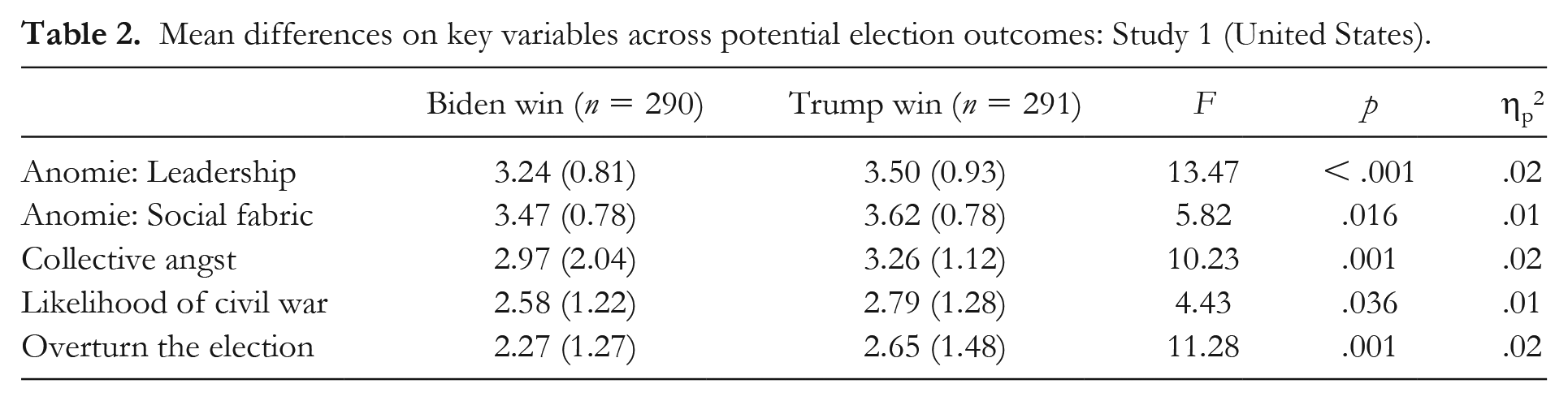
Bivariate correlations between focal variables are presented in Table 1. Collapsing across conditions, the perception that moral polarisation would increase following the 2020 presidential election was associated with the perceived breakdown of leadership (p < .001) and of social fabric in U.S. society (p < .001), higher collective angst (p < .001), the perception that the US was heading for a second civil war (p < .001), and that citizens had a moral obligation to fight to overturn the results of the 2020 election (p < .001). We then examined for potential main effects across our experimental conditions (Biden vs. Trump victory; see Table 2). Main effects were discovered across all focal variables, with an anticipated Trump victory (relative to a Biden victory) associated with higher perceived breakdown of leadership, the breakdown of social fabric, collective angst, the likelihood of civil war, and the obligation to fight to overturn the election outcome. 3
Bivariate correlations between key variables: Study 1 (United States).
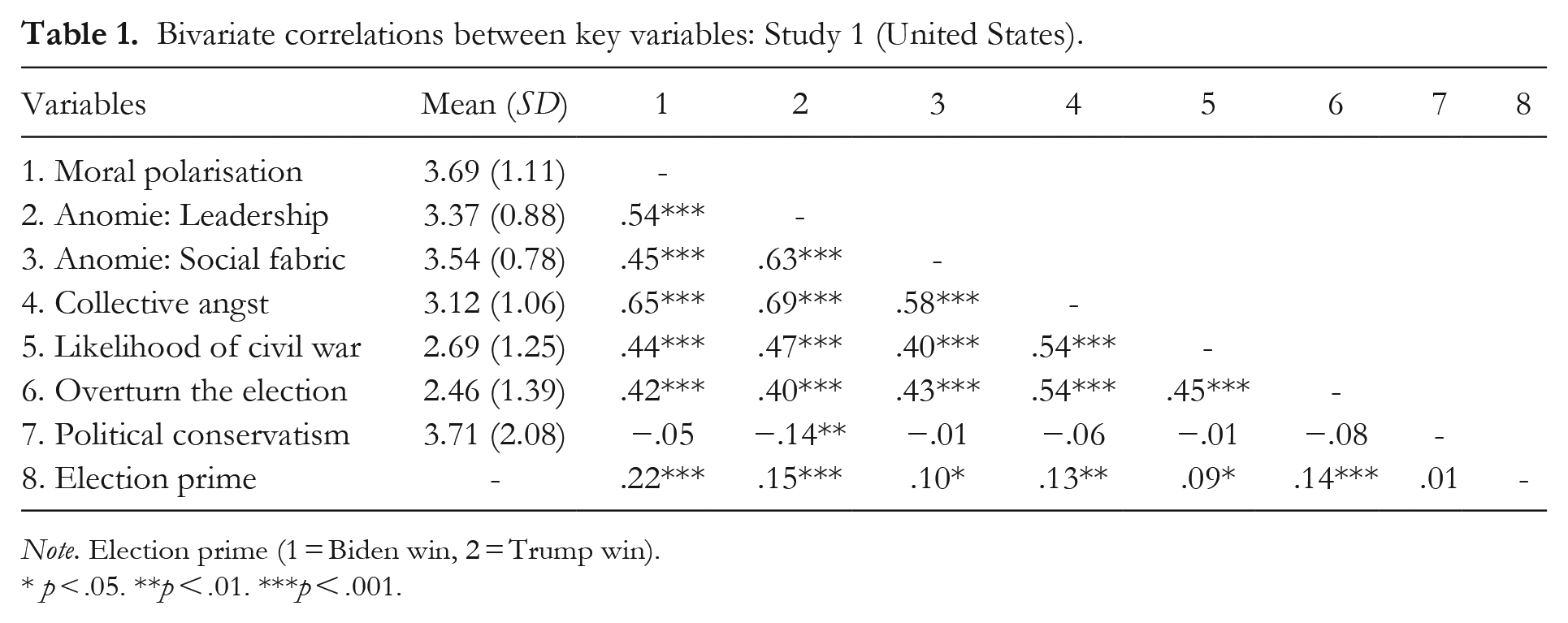
Note. Election prime (1 = Biden win, 2 = Trump win).
p < .05.
p < .01. ***p < .001.
Mean differences on key variables across potential election outcomes: Study 1 (United States).
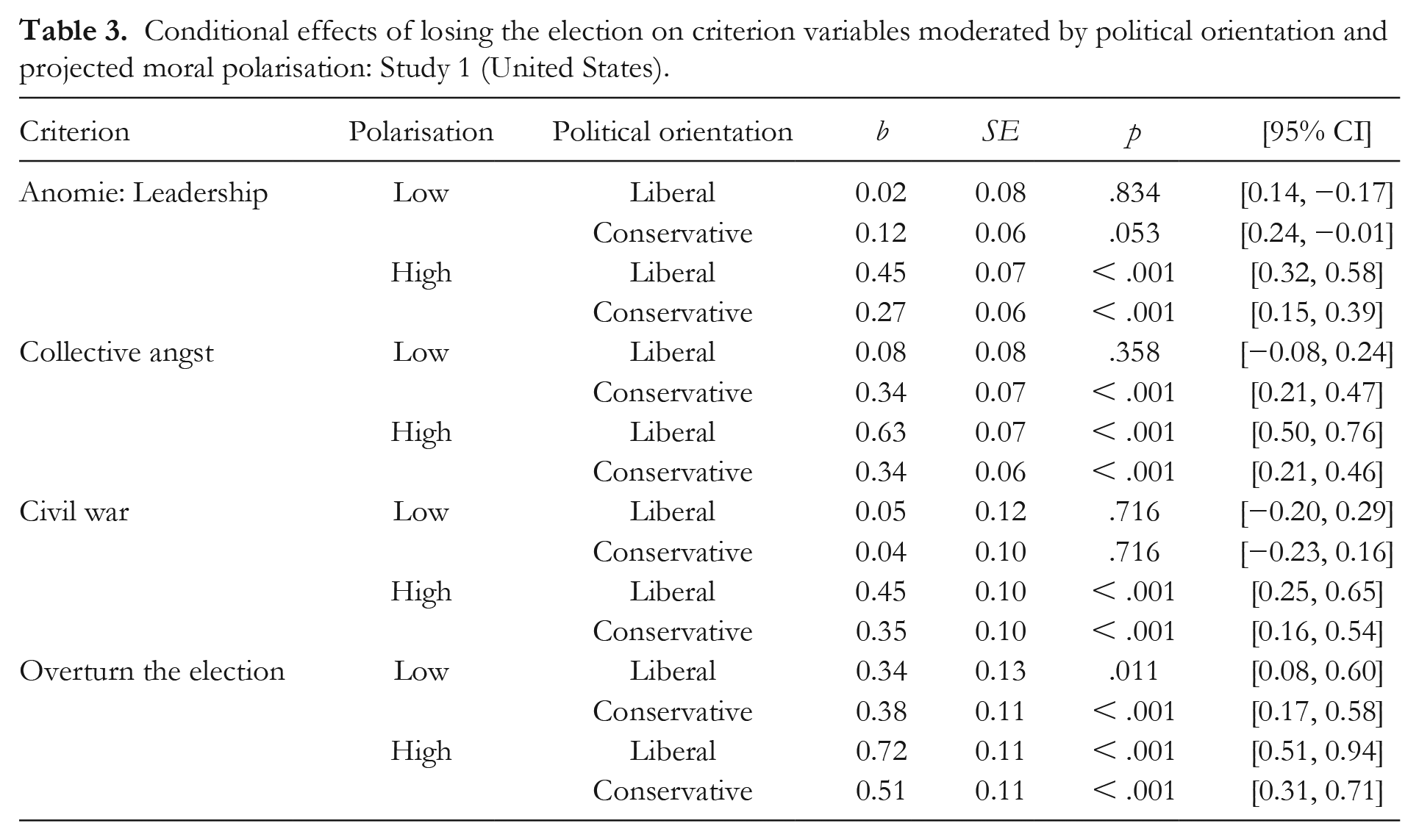
Conditional effects of losing the election on criterion variables moderated by political orientation and projected moral polarisation: Study 1 (United States).
Anomie
The three-way interaction predicting the perceived breakdown of leadership was significant, b = −0.06, p < .001, 95% CI [−0.09, −0.04]. When projected moral polarisation was low (−1 SD from the mean), there was no association between an outgroup candidate winning the election and the perceived breakdown of leadership for liberals or conservatives. However, when projected moral polarisation was high (+1 SD from the mean), the outgroup candidate winning the election was associated with increased breakdown of leadership for those low and high in political conservatism (see Figure 2). In contrast, the three-way interaction predicting the perceived breakdown of social fabric was not significant, b = −0.02, p = .128, 95% CI [−0.05, 0.01].
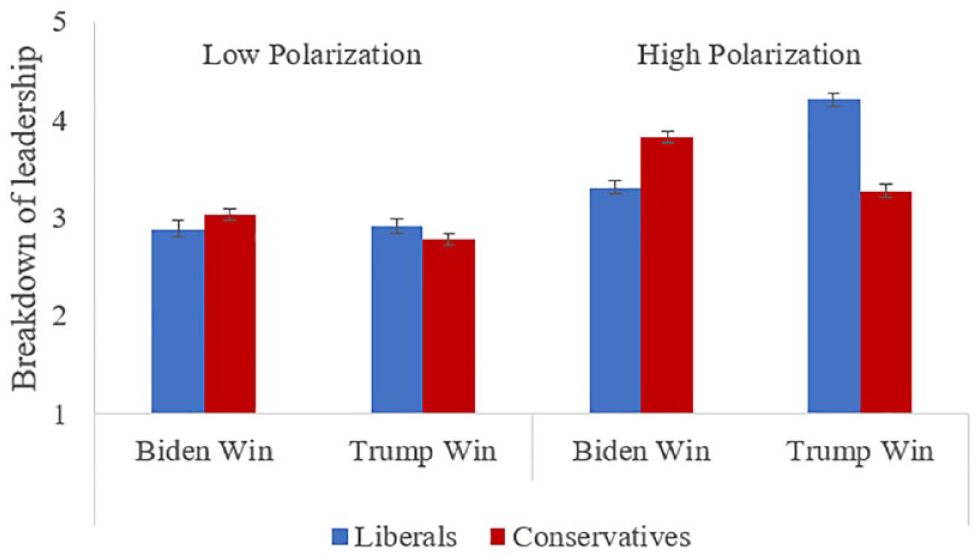
Expected breakdown of leadership in the event of a Biden versus Trump election win moderated by political orientation and projected moral polarisation: Study 1 (United States).
Collective angst
The three-way interaction predicting collective angst was also significant, b = −0.06, p < .001, 95% CI [−0.09, −0.03]. When projected moral polarisation was low, there was no change in collective angst among liberals; however, the prospect of losing the election led to enhanced collective angst among conservatives. In line with predictions, when projected moral polarisation was high, the prospect of losing the election was associated with increased collective angst among both liberals and conservatives (see Figure 3).
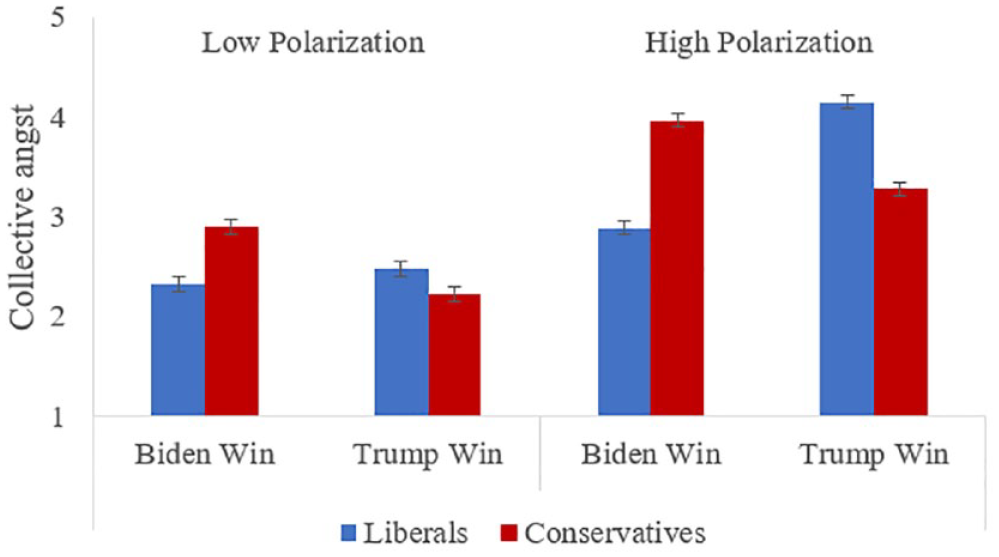
Expected collective angst in the event of a Biden versus Trump election win moderated by political orientation and projected moral polarisation: Study 1 (United States).
Likelihood of civil war
The three-way interaction predicting the likelihood of a second civil war was significant, b = −0.08, p < .001, 95% CI [−0.12, −0.03]. When projected moral polarisation was low, there was no association between losing the election and the perceived likelihood of a civil war. However, both liberals and conservatives reported an increased likelihood of America descending into civil war if the outgroup won the election when projected moral polarisation was high (see Figure 4).
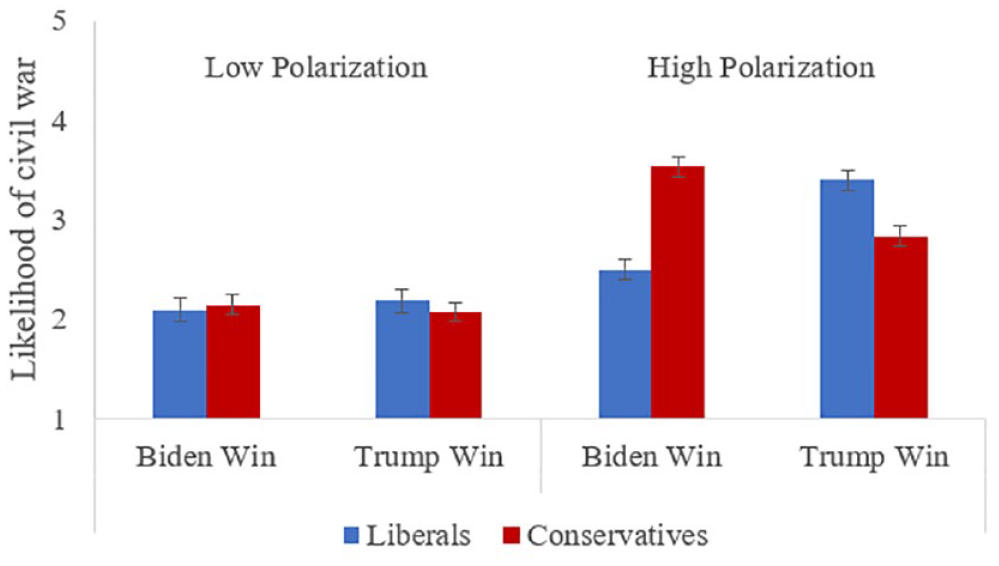
Expected likelihood of civil war in the event of a Biden versus Trump election win moderated by political orientation and projected moral polarisation: Study 1 (United States).
Obligation to overturn the election
Finally, the three-way interaction predicting the perceived obligation to fight to overturn the election outcome was also significant, b = −0.06, p = .017, 95% CI [−0.10, −0.01]. When projected moral polarisation was low, the prospect of losing the election was associated with a perceived obligation to fight to overturn the election outcome among liberals and conservatives. Moreover, when projected moral polarisation was high, the perceived obligation to fight to overturn the election outcome if their side were to lose, strengthened among both liberals and conservatives (see Figure 5).
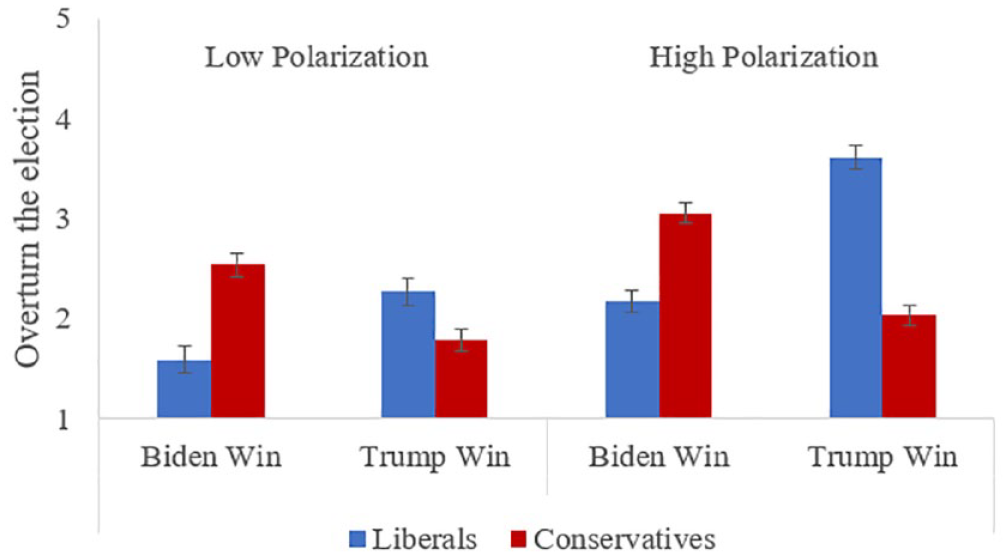
Perceived obligation to fight to overturn the election in the event of a Biden versus Trump election win moderated by political orientation and projected moral polarisation: Study 1 (United States).
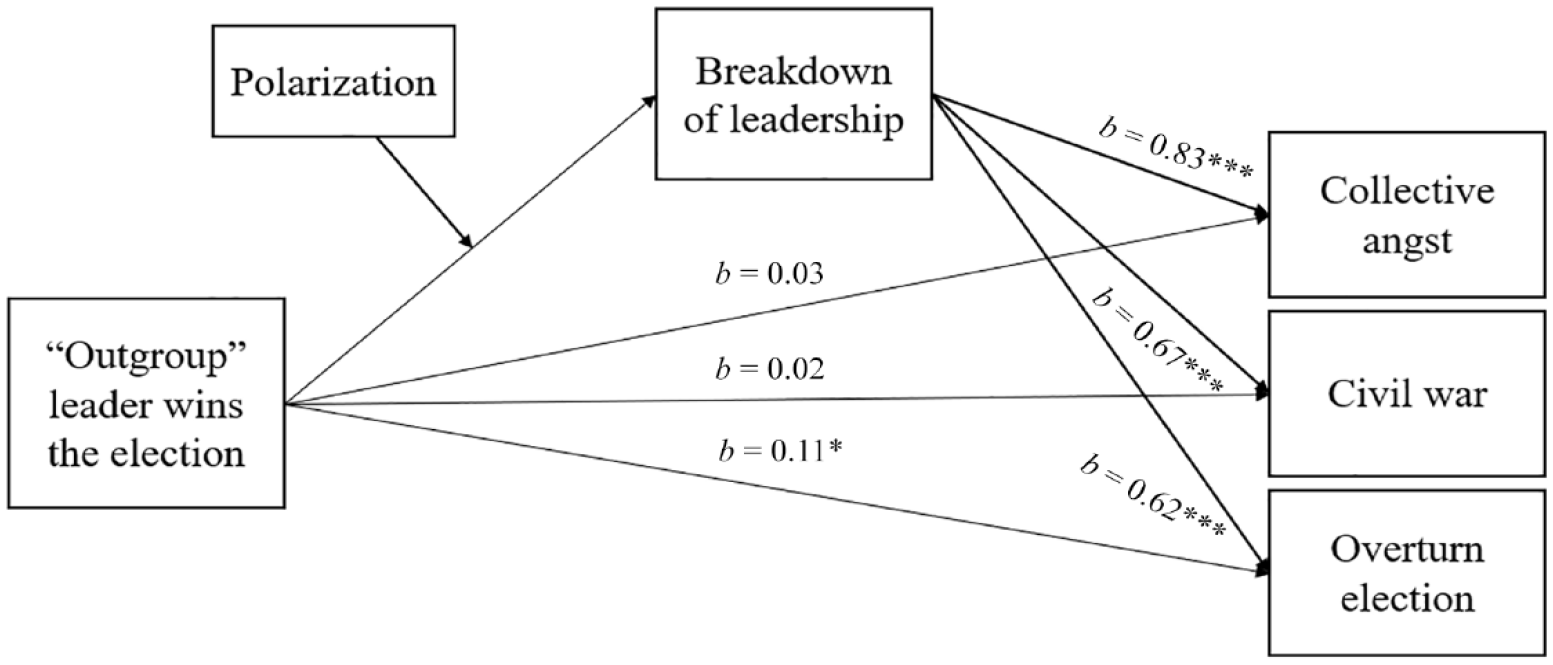
Moderated mediation model in which the prospect of losing the 2020 election (among both liberals and conservatives) predicted increased collective angst, likelihood of civil war, and obligation to overturn the election via the perceived breakdown of leadership in society: Study 1 (United States).
Conditional indirect effects of losing the election on criterion variables via the perceived breakdown of leadership moderated by political orientation and projected moral polarisation: Study 1 (United States).
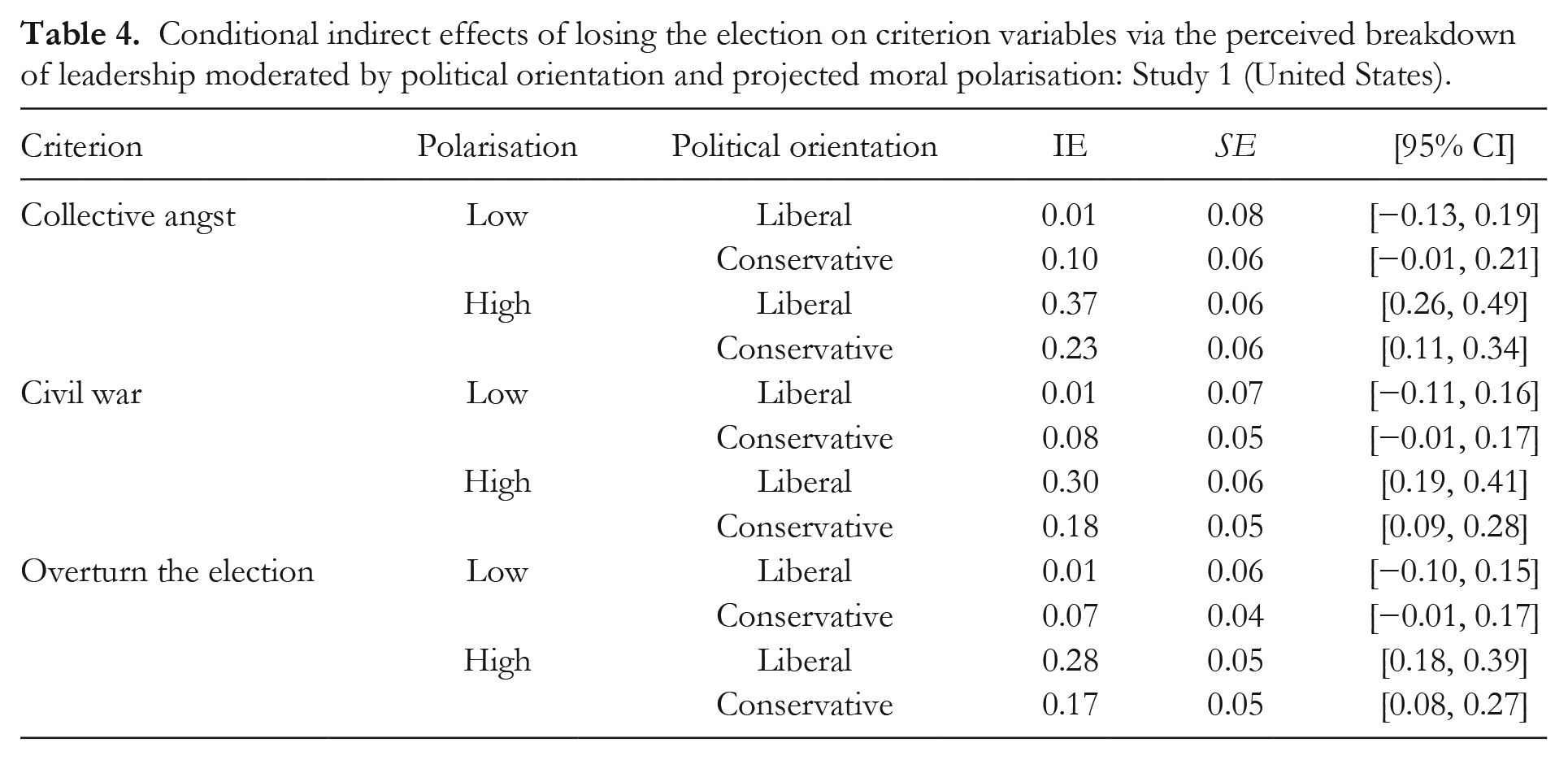
Collective angst
In line with H2, when predicting collective angst, our model indicated significant moderated mediation via the perceived breakdown of leadership, b = −0.05, SEboot = 0.01, 95% CI [−0.08, −0.03]. Specifically, when projected moral polarisation was high, the prospect of losing the election led to heightened perceptions of the breakdown of leadership among both liberals and conservatives, which, in turn, predicted enhanced collective angst. No indirect effects emerged when projected moral polarisation was low. After accounting for these indirect effects, the direct effect between the election prime and collective angst was no longer significant, b = 0.03, SE = 0.03, p = .350, 95% CI [−0.03, 0.09].
Likelihood of civil war
Similarly, our model predicting the likelihood of civil war indicated significant moderated mediation, b = −0.04, SEboot = 0.01, 95% CI [−0.07, −0.02]. When projected moral polarisation was high, the prospect of losing the 2020 election led to increased perceptions of the breakdown of leadership among both liberals and conservatives, which, in turn, predicted heightened perceptions that the US was headed for civil war. No indirect effects emerged when projected moral polarisation was low. After accounting for these indirect effects, the direct effect on the anticipated likelihood of civil war was no longer significant, b = 0.02, SE = 0.05, p = .653, 95% CI [−0.07, 0.11].
Obligation to overturn the election
Finally, the model predicting the obligation to fight to overturn the election outcome also produced significant moderated mediation, b = −0.04, SEboot = 0.01, 95% CI [−0.06, −0.02]. Once again, no indirect effects emerged when projected moral polarisation was low. However, when projected moral polarisation was high, losing the 2020 election enhanced the perceived breakdown of leadership in U.S. society, which, in turn, predicted an increased perceived obligation among both liberals and conservatives that they must fight to overturn the election outcome. The direct effect between election prime and moral obligation to overturn the election was still significant, b = 0.11, SE = 0.05, p = .040, 95% CI [0.01, 0.21].
Discussion
The results of Study 1 provided robust support for our hypotheses. Supporting H1, high projected moral polarisation was tied to enhanced anticipated negative consequences of losing the 2020 presidential election. Specifically, both liberals and conservatives consistently reported the perceived breakdown of leadership in society, as well as feeling enhanced collective angst, increased likelihood of civil war, and a moral obligation to fight to overturn the election when (a) projected moral polarisation was perceived to be higher, and (b) the opposition won the 2020 presidential election. Moreover, in line with H2, the enhanced effects of moral polarisation on collective angst, likelihood of civil war, and moral obligation to fight to overturn the election were all mediated by the perceived breakdown of leadership in society (but not by the breakdown of social fabric).
Moving forward, our aim was to replicate these findings outside of the US, and in a multi-party political system. Therefore, Study 2 examined the same predictions within the context of the Dutch 2021 general election. Unlike the U.S. two-party system, the Netherlands operates under a multiparty system in which a larger number of political parties vie for representative power. Not since the late 19th century has a single political party obtained enough seats in the House of Representatives to govern it its own right as an outright majority. As such, coalitions featuring multiple parties are formed based on ideological and/or policy alignment (e.g., left-leaning coalition, centrist coalition, right-leaning coalition) to secure a parliamentary majority to govern. However, though a distinct political system, we expected similar partisan dynamics to play out between opposing ideological coalitions (i.e., left- vs. right-wing parties). Data collection took place in early February 2021, approximately 1 month prior to the election. At the time of collection, antilockdown protestors were clashing with police in major Dutch cities (Henley, 2021), and just a few weeks prior, the sitting Dutch government resigned in the aftermath of a social security scandal (Holligan, 2021), fuelling additional uncertainty on the eve of the general election.
Study 2
Four-hundred and seventy-four Dutch participants (57.9% identified as male, 41.2% as female, 0.8% as nonbinary/other; Mage = 28.58, SDage = 9.07) were sourced through Prolific Academic. Of this, 115 (24.3%) indicated an intention to vote for the left-leaning Groen Links; 72 (15.2%) for the centre-right People’s Party for Freedom and Democracy; 55 (11.6%) for the central Democrats 66; 18 (3.8%) for the left-leaning Socialist Party; 17 (3.6%) for the centre-right Christian Democratic Appeal; 15 (3.2%) for the right-leaning Party for Freedom; and 181 (38.4%) indicated a preference to vote for a minor party or that they were unable or unwilling to vote at the upcoming election. Six participants (1.27%) were excluded due to failing an attention check, leaving 468 for analysis. Translation of the survey to Dutch was conducted by the authors with the same measures from Study 1 adapted for the Dutch context.
Measures
Election prime
Participants were randomly assigned to one of two conditions whereby they were asked to consider a potential future in which a left-wing or right-wing coalition won the 2021 Dutch general election: Specifically, we want you to imagine it is a week after the election, and a left-wing [right-wing] coalition government is formed including the Socialist Party (SP) and the Green Left (GL) [People’s Party for Freedom and Democracy (VVD) and the Party for Freedom (PVV)].
Following this, participants were asked to reflect, in a few sentences, on how they felt about the prospect of a left or right coalition governing the Netherlands.
Projected moral polarisation
Participants were presented with a single item that asked to what extent moral polarisation would increase in the wake of the 2021 general election: “The Netherlands will become increasingly morally polarised in the coming years” (1 = disagree strongly, 5 = agree strongly).
Anomie
Perceived levels of anomie in Dutch society following a left-/right-wing coalition election win were examined across two dimensions: the breakdown of leadership (using six items; e.g., “Politicians don’t care about the problems of the average person”; 1 = disagree strongly, 5 = agree strongly; α = .81) and the breakdown of social fabric (six items; e.g., “People do not know whom they can trust and rely on”; α = .75; Teymoori et al., 2016).
Collective angst
Six items were used to capture the extent to which participants feared for the future of Dutch culture following a left-/right-wing coalition election win (e.g., “I feel anxious about the future of Dutch culture”; 1 = disagree strongly, 5 = agree strongly; α = .82; adapted from Jetten & Wohl, 2012).
Likelihood of civil war
A single item assessed the anticipated likelihood that the Netherlands was heading for a civil war following the 2021 general election: “The Netherlands is heading towards a civil war” (1 = disagree strongly, 5 = agree strongly).
Obligation to overturn the election
A single item assessed the perceived obligation of citizens to overturn the outcome of the 2021 general election: “Dutch people have to rise up and resist this election outcome” (1 = disagree strongly, 5 = agree strongly). 5
Political orientation
Two items were used to assess political orientation in the form of attitudes towards economic issues (e.g., social welfare, government spending) and issues of social justice (e.g., immigration, abortion; 1 = left/liberal, 7 = right/conservative). Scores were averaged to form an overall measure of political orientation, where higher scores indicated stronger levels of conservatism (r = .63, p < .001).
Attention check
Finally, an attention check item was randomly embedded within the survey: “To ensure you are a real human being (and not a bot), please select disagree strongly for this item.” As previously mentioned, all participants who failed this check were excluded from analyses.
Results
Bivariate correlations between focal variables are presented in Table 5. In line with Study 1, when collapsing across conditions, the perception that moral polarisation would increase following the 2021 general election was associated with the perceived breakdown of leadership (p < .001) and of social fabric in Dutch society (p < .001), higher collective angst (p < .001), the perception that the Netherlands was heading for civil war (p < .001), and that citizens had an obligation to overturn the results of the 2021 election (p < .001). We then examined for potential main effects across our experimental conditions (left vs. right coalition victory; see Table 6). Main effects were again found across all focal variables, with an anticipated right-wing coalition victory (relative to a left-wing coalition victory) leading to higher perceived breakdown of leadership, the breakdown of social fabric, collective angst, and obligation to overturn the election outcome, though no difference emerged on the perceived likelihood of civil war. 6
Bivariate correlations between key variables: Study 2 (the Netherlands).
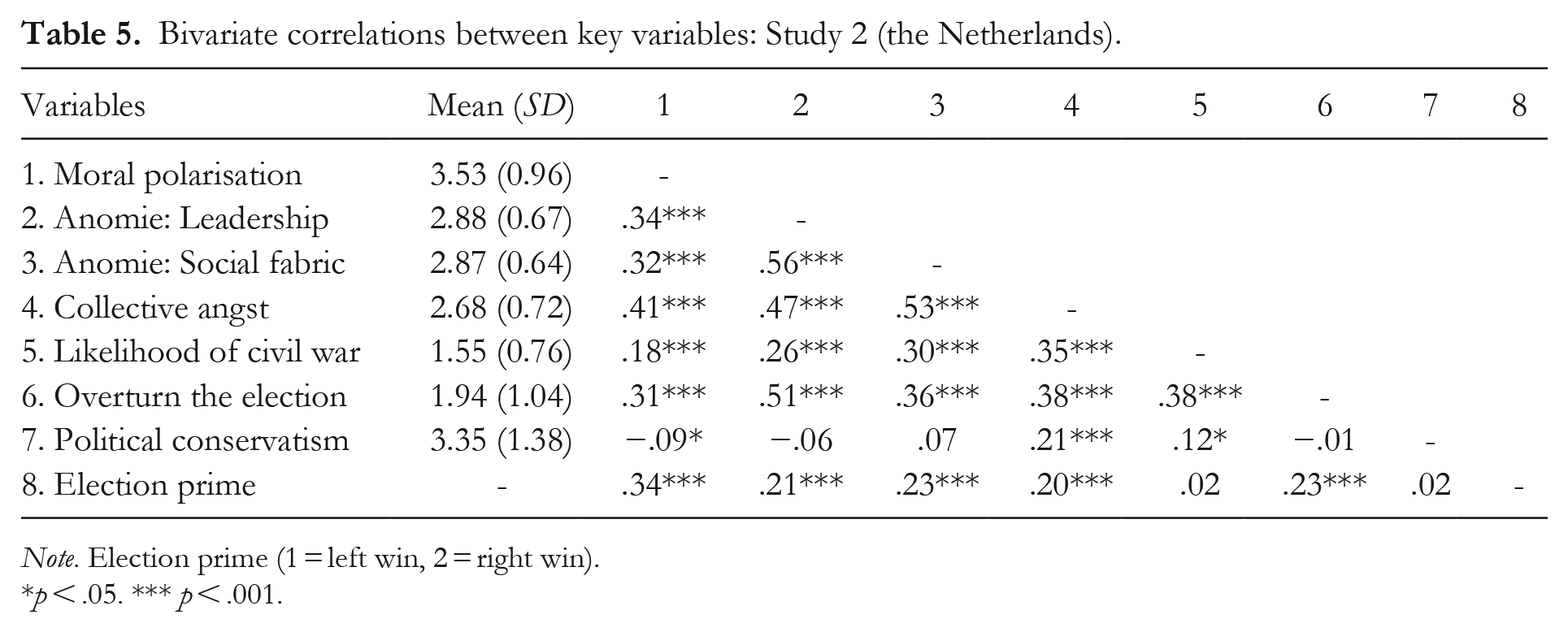
Note. Election prime (1 = left win, 2 = right win).
p < .05. *** p < .001.
Mean differences in key variables across potential election outcomes: Study 2 (the Netherlands).
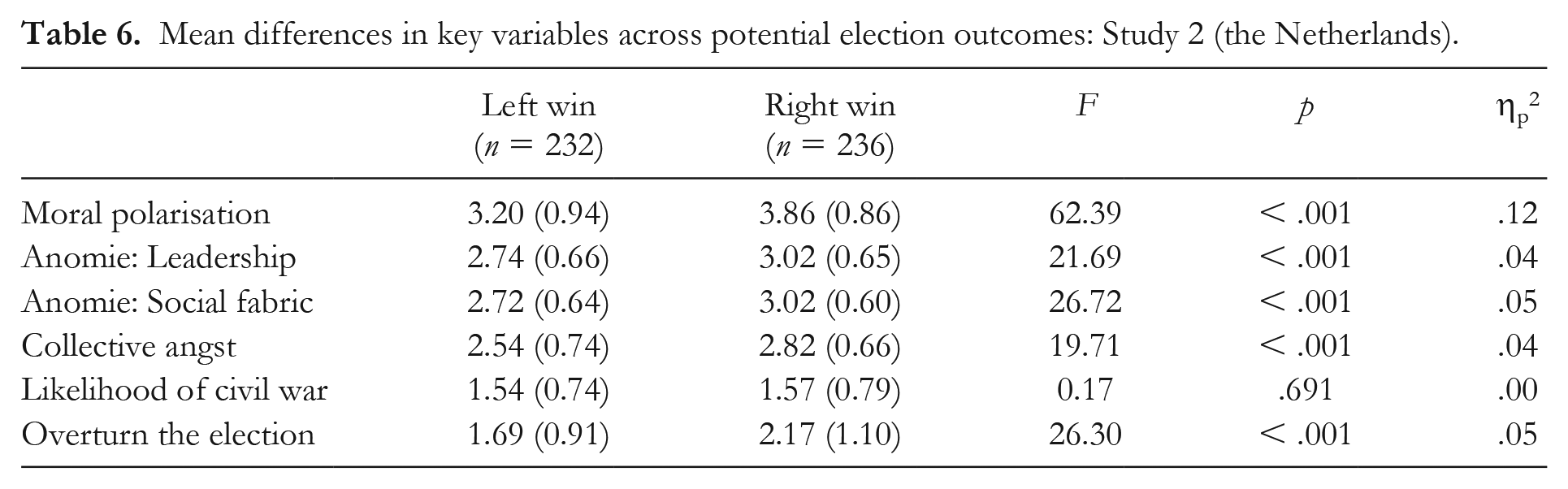
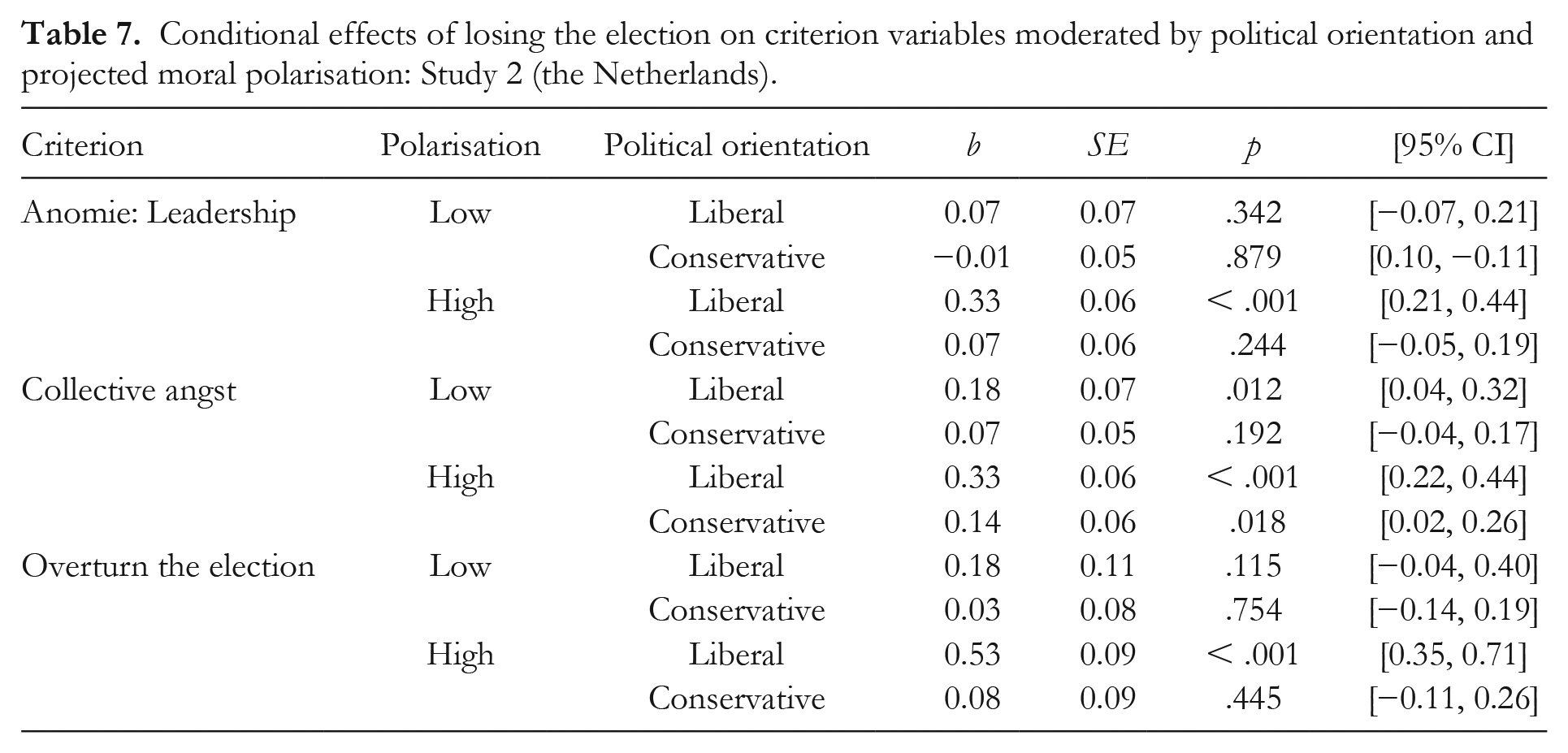
Conditional effects of losing the election on criterion variables moderated by political orientation and projected moral polarisation: Study 2 (the Netherlands).
Anomie
The three-way interaction predicting the perceived breakdown of leadership in Dutch society was significant, b = −0.06, p = .003, 95% CI [−0.11, −0.02]. When projected moral polarisation was low, the prospect of an outgroup winning the election did not predict any changes in the perceived breakdown of leadership in Dutch society. However, when projected moral polarisation was high, an outgroup election victory predicted enhanced perceived breakdown of leadership among those low, but not high, in political conservatism (see Figure 7). In line with Study 1, no three-way interaction emerged for the perceived breakdown of social fabric, b = −0.02, p = .451, 95% CI [−0.06, 0.02].
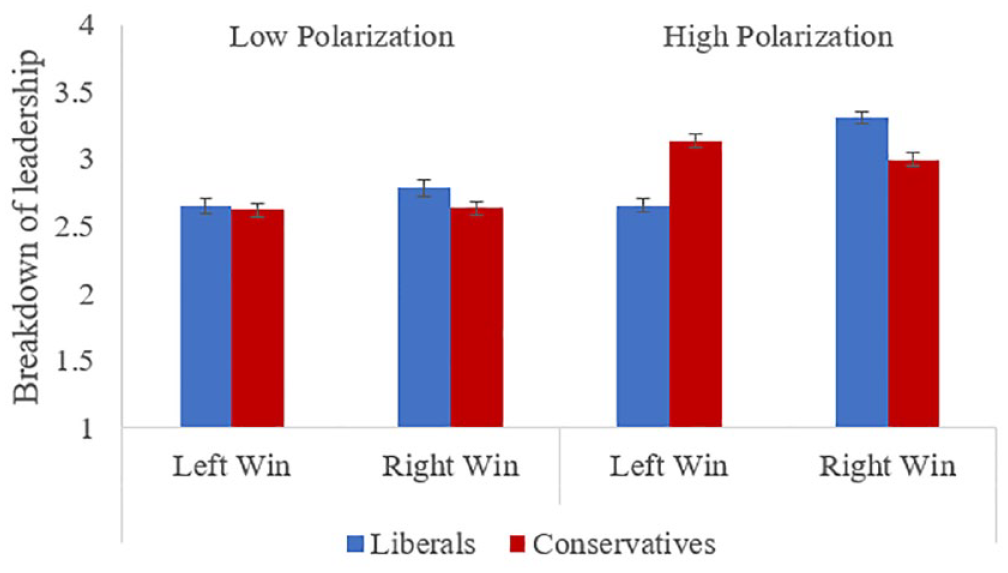
Perceived breakdown of leadership in the event of a left- vs. right-wing coalition election win, moderated by political orientation and projected moral polarisation: Study 2 (the Netherlands).
Collective angst
The three-way interaction predicting collective angst was also significant, b = −0.04, p = .046, 95% CI [−0.08, −0.01]. When projected moral polarisation was low, an outgroup election victory was associated with heightened collective angst for those low, but not high, in conservatism. In contrast, when projected moral polarisation was high, the prospect of losing the 2021 election predicted increased collective angst for both liberals and conservatives (see Figure 8).
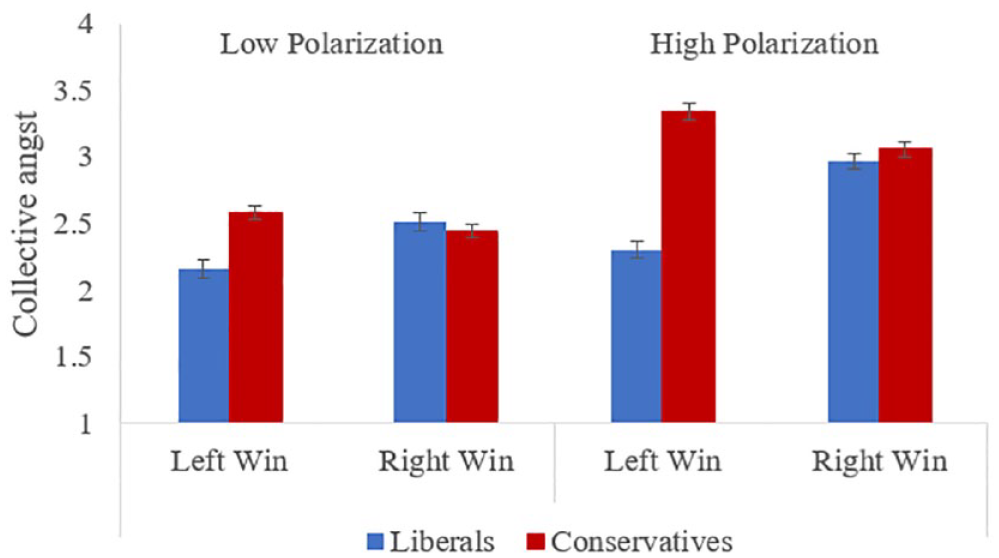
Expected collective angst in the event of a left- vs. right-wing coalition election win, moderated by political orientation and projected moral polarisation: Study 2 (the Netherlands).
Likelihood of civil war
Unlike Study 1, no three-way interaction emerged when predicting the anticipation of a civil war in Dutch society following the 2021 general election, b = −0.02, p = .418, 95% CI [−0.03, 0.07]. However, a two-way interaction between political orientation and moral polarisation did emerge, b = 0.05, p = .029, 95% CI [0.01, 0.10]. Unpacking this interaction, we found there was no change in the perceived likelihood of civil war when projected moral polarisation was low, b = 0.02, p = .492, 95% CI [−0.04, 0.09]; however, when projected moral polarisation was high, the perceived likelihood of civil war in the Netherlands increased for those high in conservatism, b = 0.13, p = .035, 95% CI [0.06, 0.19].
Obligation to overturn election
Finally, the three-way interaction predicting the perceived obligation to fight to overturn the election outcome was also significant, b = −0.08, p = .026, 95% CI [−0.14, −0.01]. When projected moral polarisation was low, the prospect of an outgroup winning the election did not predict changes in the perceived obligation to overturn the election among liberals or conservatives. In contrast, when projected moral polarisation was high, the prospect of losing the election predicted an enhanced perceived obligation among liberals, though not conservatives, to overturn the outcome of the Dutch 2020 election (see Figure 9).
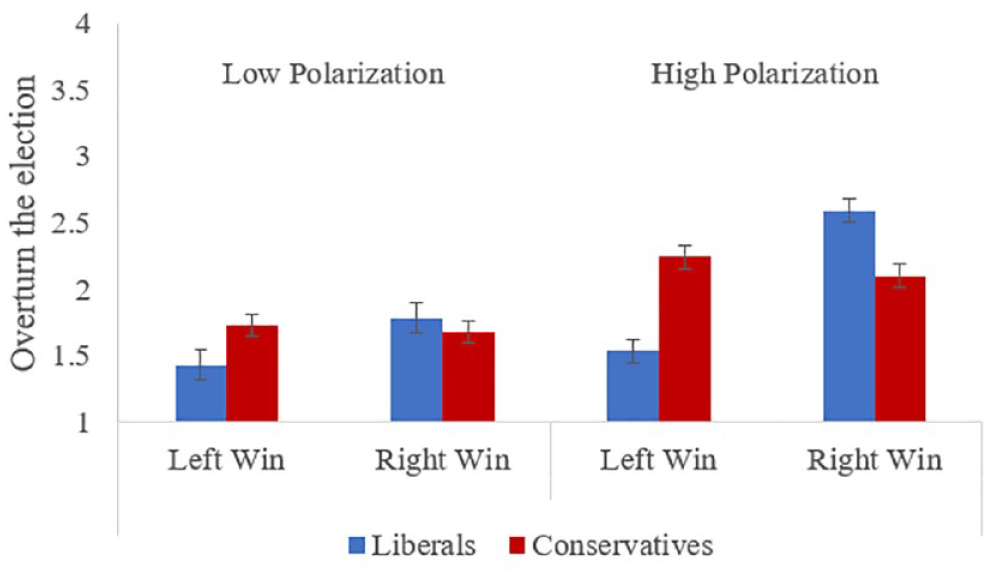
Perceived obligation to resist the election outcome in the event of a left- vs. right-wing coalition win, moderated by political orientation and projected moral polarisation: Study 2 (the Netherlands).
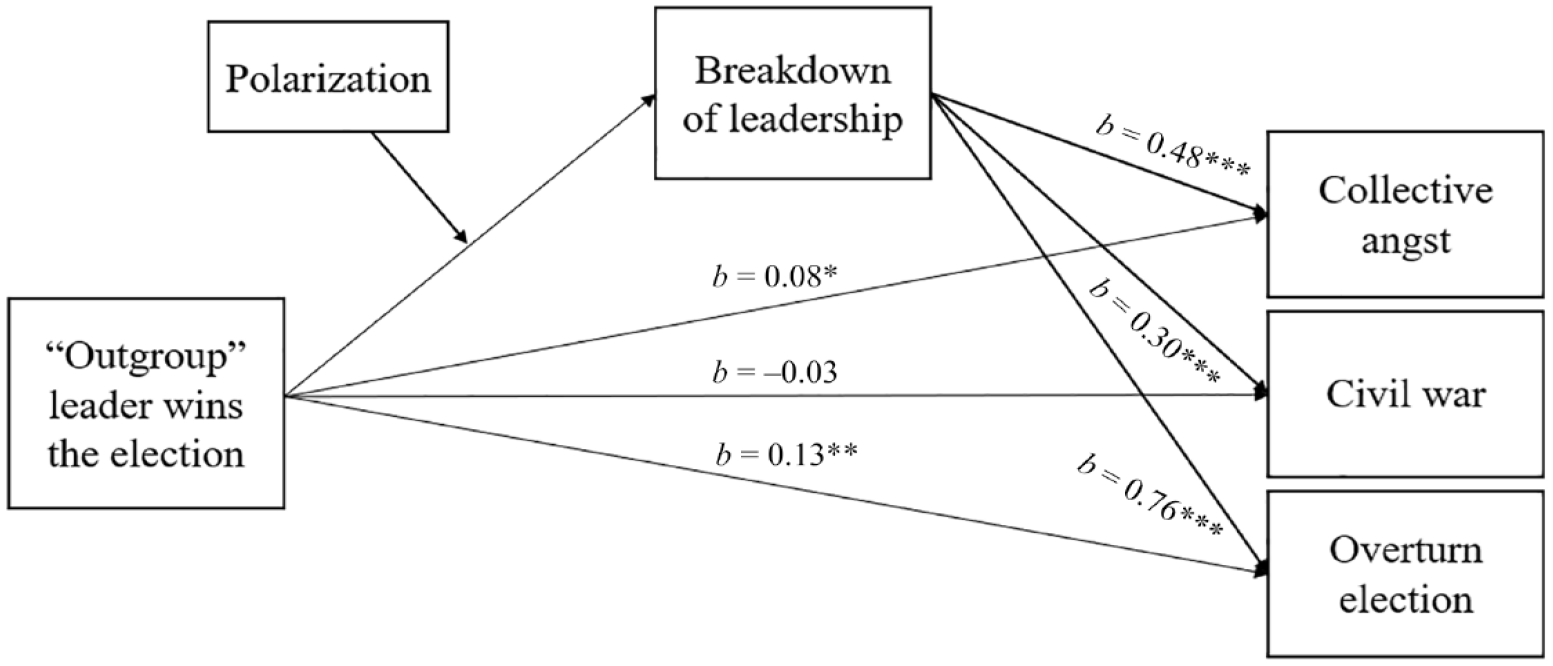
Moderated mediation model in which the prospect of an outgroup leader winning the 2021 general election (among those on the political left and right) predicted increased collective angst, likelihood of civil war, and perceived obligation to overturn the election outcome via the perceived breakdown of leadership in society: Study 2 (the Netherlands).
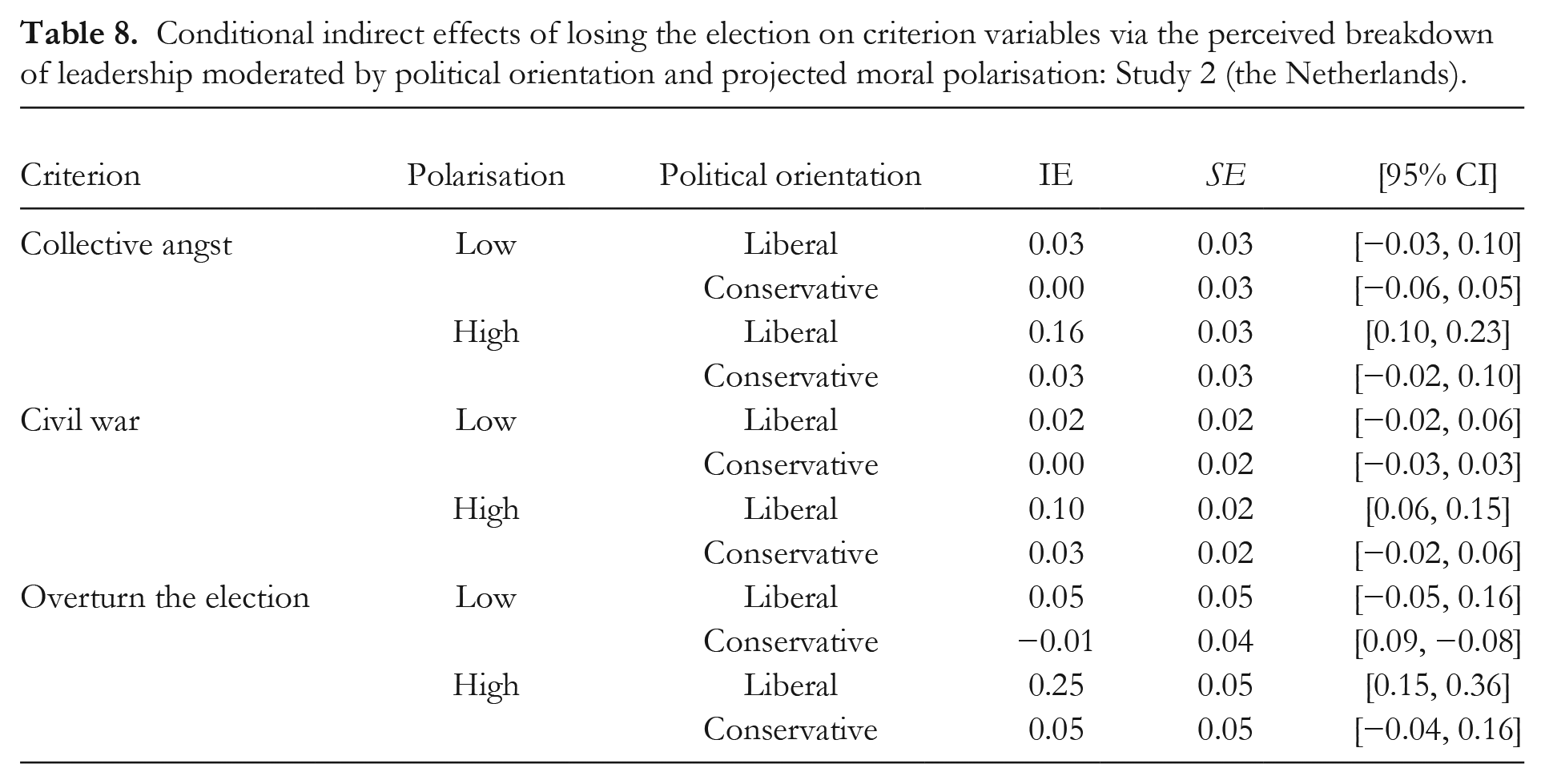
Conditional indirect effects of losing the election on criterion variables via the perceived breakdown of leadership moderated by political orientation and projected moral polarisation: Study 2 (the Netherlands).
Collective angst
In line with predictions, when predicting collective angst, our model indicated significant moderated mediation, b = −0.03, SEboot = 0.01, 95% CI [−0.06, −0.01]. When projected moral polarisation was high, the prospect of losing the 2021 election predicted the perceived breakdown of leadership among liberals; this, in turn, predicted heightened collective angst. After accounting for this indirect effect, the direct effect between election prime and collective angst was still significant, b = 0.08, SE = 0.03, p = .011, 95% CI [0.02, 0.13]. No indirect effects emerged when projected moral polarisation was low, or for conservatives when moral polarisation was high.
Likelihood of civil war
Similarly, our model predicting the likelihood of civil war indicated significant moderated mediation, b = −0.02, SEboot = 0.01, 95% CI [−0.04, −0.01]. Once again, high projected moral polarisation was associated with the perceived breakdown of leadership in society among liberals when confronted with the prospect of losing the 2021 election; in turn, this predicted an enhanced belief that the Netherlands was headed for civil war. After accounting for this indirect effect, the direct effect between election prime and the anticipated likelihood of civil war was no longer significant, b = −0.03, SE = 0.03, p = .424, 95% CI [−0.10, 0.04]. No indirect effects emerged when projected moral polarisation was low, or among conservatives when moral polarisation was high.
Obligation to overturn the election
Finally, the model predicting obligation to resist the election outcome also produced significant moderated mediation, b = −0.05, SEboot = 0.02, 95% CI [−0.09, −0.01]. In line with prior models, when projected moral polarisation was high, the prospect of losing the 2021 election led to the perceived breakdown of leadership among liberals; in turn, this was associated with an enhanced perceived obligation to overturn the results of the 2021 election. After accounting for this effect, the direct effect between election prime and obligation to resist the election outcome was still significant, b = 0.13, SE = 0.04, p = .002, 95% CI [0.05, 0.22], and no indirect effects emerged when projected moral polarisation was low, or among conservatives when projected moral polarisation was high.
Discussion
The results of Study 2 largely replicated the findings from Study 1 and provided additional support for our hypotheses in the Dutch political context. In line with H1, high projected moral polarisation was tied to enhanced anticipated negative consequences of an outgroup winning the 2021 general election in the Netherlands. Specifically, those low in political conservatism reported enhanced perceived breakdown of leadership in Dutch society, as well as feeling heightened collective angst and an obligation to overturn the election outcome when (a) projected moral polarisation was high, and (b) the right-wing coalition had won the election. In contrast, and inconsistent with Study 1, those high in conservatism were more likely to anticipate negative consequences when projected moral polarisation was high, no matter which side had won the election. One potential explanation is that this finding is being driven by centre-right-aligned voters who may anticipate negative consequences at the prospect of far-left or far-right political groups gaining additional power. Moreover, in line with H2 and replicating the findings of Study 1, these enhanced effects of moral polarisation on collective angst, perceived likelihood of civil war, and perceived obligation to overturn the results of the election were all mediated by the perceived breakdown of leadership in society (but not by the perceived breakdown of social fabric).
General Discussion
The present research presents novel evidence that moral polarisation is tied to enhanced anticipated negative consequences following an election loss. Across two studies and two distinct political contexts (United States and the Netherlands), we found that the projected increase in moral polarisation in the wake on an election loss (i.e., an outgroup party being victorious) predicted heightened collective angst, increased anticipation of future conflict, and an enhanced perceived obligation to fight and resist to overturn the results of a democratically decided election (H1). Moreover, the perceived breakdown of leadership (but not the breakdown of social fabric) was found to be a crucial mechanism underlying these relationships (H2). These findings held across the political spectrum in the United States, though they were more prevalent amongst liberals in our Dutch sample, where we found heightened moral polarisation was associated with enhanced negative consequences from losing the election for those low in conservatism, whereas those high in conservatism were more likely to report negative consequences in the context of high moral polarisation, no matter which side had won the election. Taken together, the current findings advance our understanding of the consequences of morally charged “us versus them” dynamics in the context of national elections. Specifically, how even perceived morally charged divisions prior to an election may amplify the anticipated negative consequences of losing that election, and potentially pose threats to peace and democracy postelection.
Contributions and Implications
The current findings hold implications for our understanding of polarisation in society, particularly at times of political uncertainty and change. Moreover, we contribute to the growing body of work highlighting the heightened social and political consequences of morally charged polarisation (Arvan, 2019; Crimston, Selvanathan, Álvarez, et al., 2022; Garrett & Bankert, 2018; Norris & Inglehart, 2019; Rapp, 2016; van der Toorn et al., 2015). In addition, our findings are in line with research exploring the consequences of moral convictions (see Skitka et al., 2021), demonstrating links between moral polarisation in society and the acceptance of violence and conflict, and with prior work linking polarisation to the erosion of democratic processes (Heltzel & Laurin, 2020; McCoy et al., 2018; Vegetti, 2019).
Prior research has also highlighted the negative impacts of perceived relative to objective forms of polarisation. Specifically, we tend to overestimate actual levels of group polarisation (Westfall et al., 2015) and believe outgroup members hold more extreme ideologies than they actually do (Robinson et al., 1995). Perceived polarisation may also be a stronger predictor of negative intergroup consequences than actual polarisation (Enders & Armaly, 2019). Adding to this literature, our research indicates that our expectations about projected levels of polarisation into the future are also tied to current attitudes and associated with negative intergroup outcomes. In addition, we add to research on social identity and leadership in the political arena (e.g., Alabastro et al., 2013; Christian et al., 2018; Wagoner & Barreto, 2019) by demonstrating that the negative consequences of outgroup political leaders coming into power are further enhanced when there is heightened moral polarisation.
The current findings are also in line with past research demonstrating ties between moral polarisation and the perceived breakdown of society (Crimston, Selvanathan, Álvarez, et al., 2022). However, in contrast to this prior research, here we found that only the perceived breakdown of leadership, and not the breakdown of social fabric, emerged as a crucial mediating variable linking moral polarisation and social and political attitudes. Specifically, in the context of heightened moral polarisation and facing the prospect of an outgroup leader coming to power, concerns about a failure of leadership in society (as opposed to a breakdown of trust and cohesion) emerged as the crucial factor predicting subsequent collective angst, anticipated conflict, and the perceived responsibility to overturn the election. This finding is perhaps not surprising given that the current research examined the anticipated consequences of an outgroup political leader gaining power. Specifically, it makes sense that perceptions of leader illegitimacy and ineffectiveness (more so than of reduced societal trust) would underlie concerns about the potential negative consequences of an outgroup leader coming to power, as well as one’s perceived obligation to take matters into their own hands to potentially overthrow that leader. Across both studies, it should also be noted that the perceived negative consequences of right-leaning leaders coming to power consistently exceeded the anticipated consequences of victorious left-leaning leaders across the political spectrum. One possible explanation for this may be heightened anxieties about the rise of far-right ideologies in both the United States and across Europe (Glasser, 2022; Jones, 2023).
In line with this, and perhaps most crucially, the current findings highlight the potential dangers of the amplification of divisive, moralised, aggressive, and existential rhetoric that has become part and parcel of political campaigns in polarised societies (Brady et al., 2019; Feinberg & Willer, 2013; Haslam et al., 2022; McWhorter, 2019). On the eve of the 2020 U.S. presidential election, both left- and right-leaning participants who anticipated heightened moral polarisation postelection reported that they felt a stronger moral obligation to overturn the results of the election should their preferred leader not emerge victorious. As history would later record, just 8 weeks later, on January 6, 2021, Trump loyalists stormed the U.S. Capitol in an attempt to overturn the results of the election. Just 2 years later, a strikingly similar event took place in Brazil following the conclusion of the 2022 Brazilian general election (Marshall, 2023). From a practical perspective, the current findings help us to better understand the psychological processes that may motivate disgruntled citizens to justify within themselves the extreme actions witnessed in Washington DC and Brasília. More specifically, our findings reaffirm the potential threats moral polarisation poses to democracy and, specifically, how it may further inflame intergroup tensions in the context of elections and disrupt expectations and norms that are fundamental to a stable democracy—the notion that citizens will peacefully concede following an election defeat (Carothers & O’Donohue, 2019).
The current findings are also in line with past work highlighting that the consequences of moral polarisation are not just confined to the United States, but extend cross-culturally (Crimston, Selvanathan, Álvarez, et al., 2022; Rapp, 2016). Even though the effects found in our Dutch sample were not as strong as in our U.S. sample, and in general we found relatively small effect sizes, here we have shown that the negative consequences of polarisation extend beyond two-party political systems. However, future research should examine the processes identified here beyond Western liberal democracies. For example, examining the processes and consequences of moral polarisation when it takes the form of divisions between groups pushing for social and political change and dominant national leadership (e.g., Brazil, India, Thailand, and Malaysia). In the present research, we examined the moderating impact of political orientation to assess the negative consequences of an election loss in the context of heightened polarisation. However, future research might consider examining the moderating role of identification with a political candidate or political party, given that past research has found that identification with a political candidate enhances the negative experience of losing an election (Claypool et al., 2020). In addition, here we measured anticipated collective angst and conflict prior to the elections taking place. However, it is unclear to what extent these perceptions might persist over time. Future research might also consider examining longitudinally the extent to which these negative perceptions persist in the weeks and months following an election, to see if people’s expectations about polarisation and intergroup conflict reflect reality after the election. In addition, future work may also look to directly compare the impacts of fight-versus-flight reactions in the context of postelection polarisation. Here, we investigated both fight/confrontational (i.e., desire to overturn the election) versus more flight/avoidant responses (i.e., collective angst). Future research might directly explore when and why these distinct types of responses are more or less likely occur. Finally, while the bulk of our empirical model is correlational, we can have more confidence in the proposed conceptual pathway, given that past research has already established a causal link between moral polarisation and perceived anomie (Crimston, Selvanathan, Álvarez, et al., 2022). However, future research may also consider manipulating perceived moral polarisation to provide a more stringent test of the proposed model.
Concluding Thoughts
Our findings further our understanding of the ways in which the mere perception of moral polarisation within society is tied to enhanced collective angst and may further fuel intergroup tensions, particularly at times of uncertainty and social and political change. There are important lessons to be learned for political leaders who increasingly rely on the fuelling of polarisation, intergroup tensions, and existential angst for short-term political gain. Voters need to become more familiar with the potential negative consequences of such tactics. The current evidence suggests that cohesion within our societies and the future stability of our democracies may depend on it.
Supplemental Material
sj-docx-1-gpi-10.1177_13684302231223896 – Supplemental material for “Fight like hell”: Projected moral polarisation predicts anticipated conflict and the perceived responsibility to overturn an election loss
Supplemental material, sj-docx-1-gpi-10.1177_13684302231223896 for “Fight like hell”: Projected moral polarisation predicts anticipated conflict and the perceived responsibility to overturn an election loss by Charlie R. Crimston, Jolanda Jetten and Hema Preya Selvanathan in Group Processes & Intergroup Relations
Footnotes
Acknowledgements
Special thanks to Frank Mols for assistance with material design and survey translation.
Authors’ note
Charlie R. Crimston is also affiliated to Australian National University, Australia.
Data availability
Data is available on the Open Science Framework (https://osf.io/ndyqe/).
Declaration of conflicting interests
The author(s) declared no potential conflicts of interest with respect to the research, authorship, and/or publication of this article.
Ethics approval
This research received ethics approval from the University of Queensland.
Funding
The author(s) disclosed receipt of the following financial support for the research, authorship, and/or publication of this article: This research was supported by an Australian Research Council Laureate Fellowship (FL180100094).
Informed consent
Participants gave informed consent before taking part in this research.

Supplemental material
Supplemental material for this article is available online.
Notes
References
Supplementary Material
Please find the following supplemental material available below.
For Open Access articles published under a Creative Commons License, all supplemental material carries the same license as the article it is associated with.
For non-Open Access articles published, all supplemental material carries a non-exclusive license, and permission requests for re-use of supplemental material or any part of supplemental material shall be sent directly to the copyright owner as specified in the copyright notice associated with the article.
