




Abstract
Group identification can be both beneficial (a “social cure”) and detrimental (a “social curse”) for performance and well-being, which makes it crucial to explore its boundary conditions. Building on the norm enactment hypothesis and the influence hypothesis, we propose the group’s achievement norms as one such boundary condition. We argue that group identification predicts higher well-being and task performance if achievement norms are average, but lower well-being and task performance if achievement norms are very high. The results of a laboratory experiment (N = 163) partially supported our propositions for task-related stress, but not for task performance and other well-being indicators. Additionally, exploratory analyses showed a moderated indirect effect on task performance such that group identification predicted more task-related stress when achievement norms were very high (but not when they were average), which, in turn, predicted lower task performance. We discuss the theoretical and practical relevance of these findings.
The social identity approach proposes that individuals derive parts of their self-concept from their group memberships and from defining themselves as “we” and “us” instead of “I” and “me” (S. A. Haslam, 2004; Tajfel & Turner, 1979; Turner et al., 1987). This approach has increasingly been used to explain how being part of a group benefits individuals’ group performance (e.g., van Dick et al., 2009) and also well-being (e.g., C. Haslam et al., 2018; Häusser et al., 2012, 2020; Mojzisch et al., 2021; Steffens et al., 2017). Due to these beneficial consequences, group identification has been termed a “social cure” (Jetten et al., 2012, 2017).
However, the exclusive focus on the positive side of group identification is oversimplified (e.g., Jetten et al., 2017; Junker et al., 2022). As such, one third of the studies included in a meta-analysis by Steffens et al. (2017) did not find positive associations between group or organizational identification and well-being. A few studies even showed that higher social identification is related to less, rather than more, well-being. In one of these studies, for instance, Avanzi et al. (2012) revealed a curvilinear effect of identification at work in the form of negative effects not only at low levels of identification but also at very high levels of identification on general health, mediated by workaholism (for a recent replication, see also Avanzi et al., 2022). These findings point to important boundary conditions for when group identification represents a “social cure” that benefits performance and well-being (C. Haslam et al., 2018), and when group identification may even become a “social curse” that hampers performance and well-being (Jetten et al., 2017; Wakefield et al., 2019).
The present research introduces group achievement norms as one such boundary condition and tests its interactive effects with group identification on objective performance and task-related well-being in a preregistered experiment. Building on the norm enactment hypothesis and the influence hypothesis (Jetten et al., 2017), we predict that highly identified group members are more prone to internalize and enact performance norms, even when these norms are very high and thus threaten one’s performance and well-being.
Group Identification and Its Association With Performance and Well-Being
Sharing a social identity, be it at work or in nonwork contexts (e.g., among sports fans or friendship groups), has been associated with improved performance and well-being in numerous correlational (e.g., Frenzel, Junker, et al., 2022; Frenzel, Kaluza, et al., 2022; S. A. Haslam & Reicher, 2006; Mojzisch et al., 2021) and experimental studies (e.g., Frisch et al., 2014; Häusser et al., 2012; Wegge et al., 2012), and it has also been confirmed in meta-analytic overviews (see Greco et al., 2022; Lee et al., 2015; Postmes et al., 2019; Steffens et al., 2017). Accordingly, social identity has been coined a “social cure” (C. Haslam et al., 2018).
Feeling that one is part of a group thereby unfolds its beneficial effects through various mechanisms that partially operate through a shift in the individual’s self-definition and perception, and partially through positive interactions between group members (cf. Häusser et al., 2020; Leach et al., 2008). As such, group identification satisfies the need to belong, elicits more positive appraisal styles, and increases perceptions of being socially supported, in turn relating to the perception of more available collective resources (Avanzi et al., 2015, 2021; Frenzel et al., 2023; Greenaway et al., 2015; Junker et al., 2019; Khan et al., 2015; van Dick & Haslam, 2012). Highly identified group members are also more likely to interpret received support in a benevolent way (Frisch et al., 2014).
Despite typically constituting a social cure, group identification can also decrease performance and well-being (e.g., Steffens et al., 2017), which has been coined a “social curse” (Jetten et al., 2017; Kellezi & Reicher, 2012; Wakefield et al., 2019). For instance, highly identified group members are more strongly affected by threats to their group, such as when outgroups perform better or have a higher status, because this group membership plays a more central role in their self-definitions (Leach et al., 2008). They are also more likely to experience stress contagion, that is, they are more likely to show stress reactions when observing other group members being threatened (Erkens et al., 2019) and to assume that other group members experience such a situation in a similar way to themselves (Kaluza et al., 2022).
Moreover, highly identified group members are likely to protect their fellow group members, which can sometimes make them less likely to share troubling experiences with them. This decreased tendency to reveal problems results in not receiving the necessary support from other group members. This has been shown, for instance, by Kellezi et al. (2019) in a study among immigrants in the UK, and by Chang et al. (2016), who found that Asians are reluctant to enlist social support from fellow group members so as not to burden them.
How Group Identification and Achievement Norms Interact in Predicting Performance and Well-Being
In this paper, we argue that beyond experiencing external threats due to high group identification and dysfunctional interactions within a group, higher internalization and enactment of social norms, particularly achievement norms, should also be a boundary condition underlying the social cure and social curse phenomena, as we outline in the following.
According to the norm enactment hypothesis (Jetten et al., 2017), highly identified group members, compared with less identified ones, aim to enact a group’s norms and values. In other words, they perceive such norms as more prescriptive of appropriate affect (how to feel), behaviors (how to act), and cognition (how to think). Moreover, the influence hypothesis proposes that highly identified group members are more likely to be influenced by other group members (Jetten et al., 2017). This hypothesis thus suggests that highly identified group members are also more strongly affected by other group members’ role-modeling behaviors (such as working hard), which they perceive as a descriptive norm.
Taken together, these two hypotheses suggest that highly identified group members, compared to less identified ones, would be more likely to adopt achievement norms that exist within a group and to act on them. Hence, highly identified group members should aim to conform to these norms and fulfill such performance expectations. Indeed, for health norms, Livingstone et al. (2011) showed that highly identified group members adopt (un)healthy group norms to a greater extent (i.e., heavy drinking; see also Howell et al., 2014; Oyserman et al., 2014).
If norms are perceived as achievable, such as when achievement norms are average, highly identified group members should benefit from the described social cure processes (C. Haslam et al., 2018). In that case, highly (compared to less) identified group members would experience “being in this together” as a shift from experiencing a performance context as a threat to experiencing it more as a challenge (cf. van Dick & Haslam, 2012). In this case, group members can capitalize on their group-related resources (e.g., Avanzi et al., 2015, 2021; Frenzel et al., 2023; Junker et al., 2019), thus feeling more capable because of being part of the group, in turn experiencing more engagement with the task (i.e., more task engagement, more personal accomplishment, better performance) and less task-related strain.
However, if such achievement norms are elite norms that are hard to fulfill, as in the case of very high achievement norms, high identifiers’ stronger desire to fulfill even these norms in order to be seen as exemplary group members might inhibit performance and well-being. More specifically, rather than providing a sense of belonging (“we are in this together”; Häusser et al., 2012) and of collective self-efficacy (“we can do this”; van Dick & Haslam, 2012), we argue that members of such very high achievement norm groups are likely to experience performance pressure and fear that they will not fulfill the other group members’ achievement expectations. As a result, they should show lower task performance, task engagement, personal accomplishment, and more task-related stress. Taken together, we predict that group identification and achievement norms interact in predicting well-being and task performance. More precisely, we hypothesize that:
Hypothesis 1: Group identification increases well-being (i.e., less task-related stress, more task engagement, and more task-related personal accomplishment) when achievement norms are average, but decreases well-being (i.e., more task-related stress, less task engagement, and less task-related personal accomplishment) when achievement norms are very high.
Hypothesis 2: Group identification increases task performance when achievement norms are average but decreases task performance when achievement norms are very high.
Next, we describe our experimental study to test the above hypothesis, using a 2 (group identification: low vs. high) × 2 (achievement norm: average vs. very high) between-subjects design. Ethics approval for this study was obtained from the lastauthor’s institution. In these studies, we report all measures, manipulations, and exclusions. We preregistered our study on aspredicted.org (https://aspredicted.org/h4ps6.pdf). All data, code, and material are publicly available on the Open Science Framework database (https://osf.io/z5aj6/?view_only=932379ddd135497c9d55153f6d37350a).
Method
Participants
We invited psychology students from a German university to participate in a study on diversity in virtual teams. The study was advertised as a two-part study whereby the first part comprised an online survey, and the second part, a group task in the laboratory. Students were rewarded with course credit for both parts.
Overall, 893 individuals clicked on the invitation link, and 248 started answering the questionnaire. Of the 210 who completed the online survey and selected a day to participate in the laboratory experiment, 163 individuals showed up, completed the laboratory experiment, and were included in the present study. 1 An a priori power analysis using G*Power Version 3.1.9.2 (ANOVA: fixed effects, special, main effects, and interactions; Faul et al., 2007) suggested a required sample size of 171 to detect medium-sized (f = .25) interaction effects, α = .05, and an a priori power of .90. A sensitivity power analysis (Faul et al., 2007) showed that a sample size of 163 was sufficient to detect a medium effect (f = .25), with α = .05 and a power of .90.
The majority of participants were women (72.4%; two identified as diverse) and were undergraduate students (96.9%). The average age was 22.54 years (SD = 5.29, range = 18–54), and the majority were employed in addition to studying (66.3%).
Procedure
Participants were invited to an experiment on virtual teamwork with a time-lagged, two-part setup, starting with an online survey. After giving their consent to participate in the study, the students responded to demographic questions and several filler scales (e.g., personality traits, personal values, and well-being). At the end of the online questionnaire, they entered a personal code (to match their Time 1 and Time 2 data) and were then forwarded to a separate web page where they selected a date to take part in the laboratory study. Time slots were offered such that a maximum of five students could participate simultaneously.
On the selected day and time, the students arrived at the laboratory and were again informed that the study was about virtual teamwork and that they would work in a group with three other students in different locations on campus. Hence, they could not talk with their fellow group members, but they could interact using a chat function. To reinforce this cover story, the lab manager pretended to synchronize the start of the experiment with students in other rooms. Then, they started the study participation on a stationary PC.
After giving their consent, we manipulated participants’ group identification (low vs. high). To this end, we adapted a manipulation similar to those used in previous research (e.g., Dreisörner et al., 2021; Häusser et al., 2012) to our study context. In the low group identification condition, participants were informed that they were in the green session and were matched with three other students who were dissimilar from them in terms of their personality, values, and well-being, as assessed in the first part of the experiment. By contrast, in the high group identification condition, we told participants that they were in the green team and were matched with three other students who were very similar to them in terms of these criteria. As a manipulation check, we then asked participants to indicate the degree to which they identified with their fellow members, using the four-item scale by Doosje et al. (1995; 1 = do not agree at all, 7 = fully agree). We adapted these items to the specific study context (e.g., “I’m glad to be part of this group”; Cronbach’s α = .88, McDonald’s ω = .88).
To manipulate the group’s achievement norms (low vs. very high), we simulated a virtual interaction with the other three group members. We informed the participants that they would participate in a performance task (for details of this task, see below) and that the average group would achieve 60 out of 100 possible points in that task. To increase the relevance of the task, they were told that the group members’ performance would be averaged and that they would compete against four other groups (cf. Tajfel et al., 1971). They were then provided the opportunity to indicate how many points they would aim to achieve in turn, and they were told that the order in which the group members would give their answers would be randomized. Upon clicking on the next page, a simulation started whereby the participant was always selected to be the last to give their response. In the average achievement norm condition, the target scores of the other three virtual group members averaged 60. By contrast, in the very high achievement norm condition, the fellow group members’ target scores averaged 90. After the three other group members allegedly provided their target scores, the participant gave their assessment, which served as a manipulation check.
Next, participants completed the performance task and indicated their task-related well-being (i.e., task engagement, task personal accomplishment, and task-related stress). Finally, all participants were fully debriefed and informed that they had in fact not interacted with other participants and that the experimental procedure required this deception.
Measures
Task performance
We used a version of the Serial Seven Test (Hayman, 1942; Kennedy & Scholey, 2000), which we administered online on Inquisit Version 5 (a platform that allows remote psychological testing). Participants were presented with a randomly chosen number between 900 and 999, and they had to subtract in sevens from this number for 2 minutes. They indicated their responses on the screen and, based on our programming, a warning popped up for each wrong answer and the program then automatically restarted from the initial number (while the time count down continued). The highest number of consecutively correct responses within the 2 minutes was used as the measure of task performance.
Task engagement
We adapted the nine-item Utrecht Work Engagement Questionnaire (Schaufeli et al., 2006) to measure task engagement (1 = not at all, 7 = very; e.g., “This task was a challenge for me”). Cronbach’s α = .87, McDonald’s ω = .88.
Task personal accomplishment
An adapted version of the six-item Personal Accomplishment Burnout Subscale (Maslach & Jackson, 1981) was used to operationalize personal accomplishment (1 = never, 6 = very often; e.g., “I felt performing well during the task”). Cronbach’s α = .90, McDonald’s ω = .91.
Task-related stress
We measured task-related stress with the seven-item Perceived Stress Scale (Cohen et al., 1983), adapted to the task context (1 = never, 5 = always; e.g., “During this task, I felt nervous and stressed”). Cronbach’s α = .81, McDonald’s ω = .81.
We also preregistered well-being as a dependent variable. However, due to a programming mistake, the items used to assess well-being incorrectly referred to well-being during the last 2 weeks instead of task-related well-being, which is why we do not present results for this measure.
Results
Descriptives and Randomization Check Results
We present the means and standard deviations for each condition as well as the correlations between variables across conditions in Table 1. All correlations were in the expected direction.
Means, standard errors, and 95% confidence intervals for each condition across dependent variables.
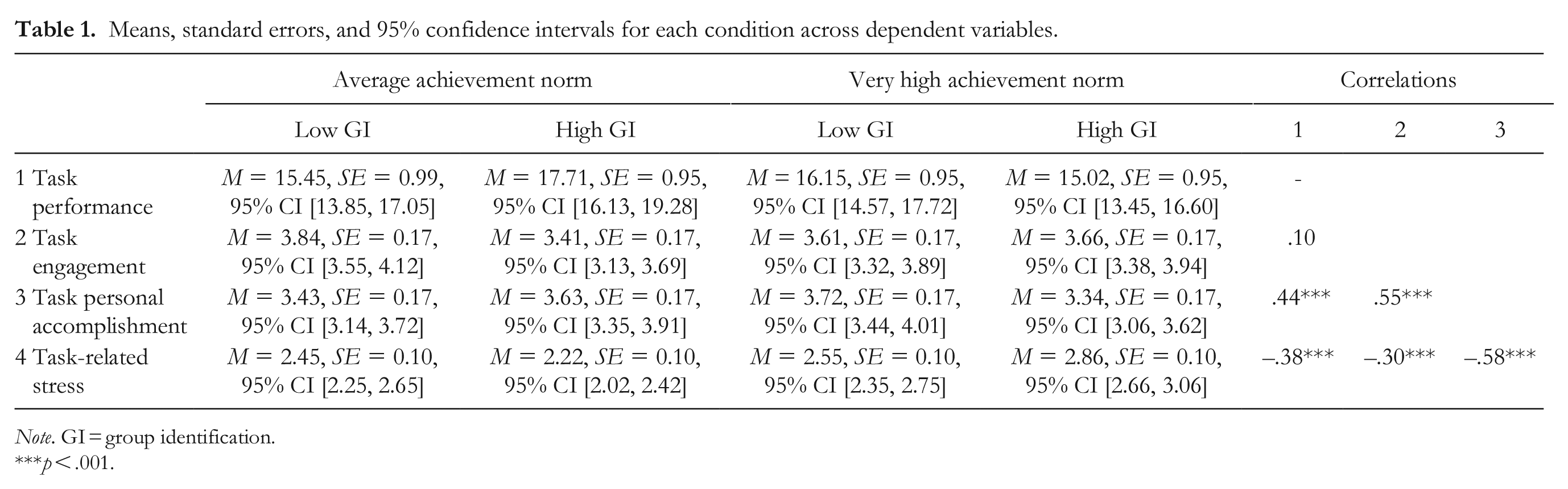
Note. GI = group identification.
p < .001.
The results of the analysis of variance (ANOVA) and chi-square tests in SPSS Version 28 showed that the randomization was successful across the two achievement norm conditions in terms of gender,
Manipulation Check Results
The results of the ANOVA with individuals’ achievement expectations as the dependent variable and the experimentally manipulated achievement norm as the independent variable showed a significant effect, F(1, 160) = 154.14, p < .001, η p 2 = .49. In line with our expectation, participants in the very high achievement norm condition reported a higher achievement expectation (M = 79.96, SD = 10.39) compared with participants in the average achievement norm condition (M = 61.04, SD = 8.94). 2
Likewise, the group identification manipulation was successful, F(1, 161) = 15.67, p < .001, ηp2 = .09. Individuals in the high group identification condition reported more identification with their group (M = 3.67, SD = 1.26) compared with individuals in the low group identification condition (M = 2.89, SD = 1.25). 3
Testing the Predicted Interaction Hypothesis
We predicted an interaction effect of group identification and achievement norms on well-being (Hypothesis 1) and task performance (Hypothesis 2) such that we expected a social cure effect (less stress, more task engagement, task-related personal accomplishment, and task performance) if achievement norms were average, but a social curse effect (more stress, less task engagement, task-related personal accomplishment, and task performance) if achievement norms were very high. The results of the ANOVAs are summarized in Table 2.
Results of hypothesis testing.
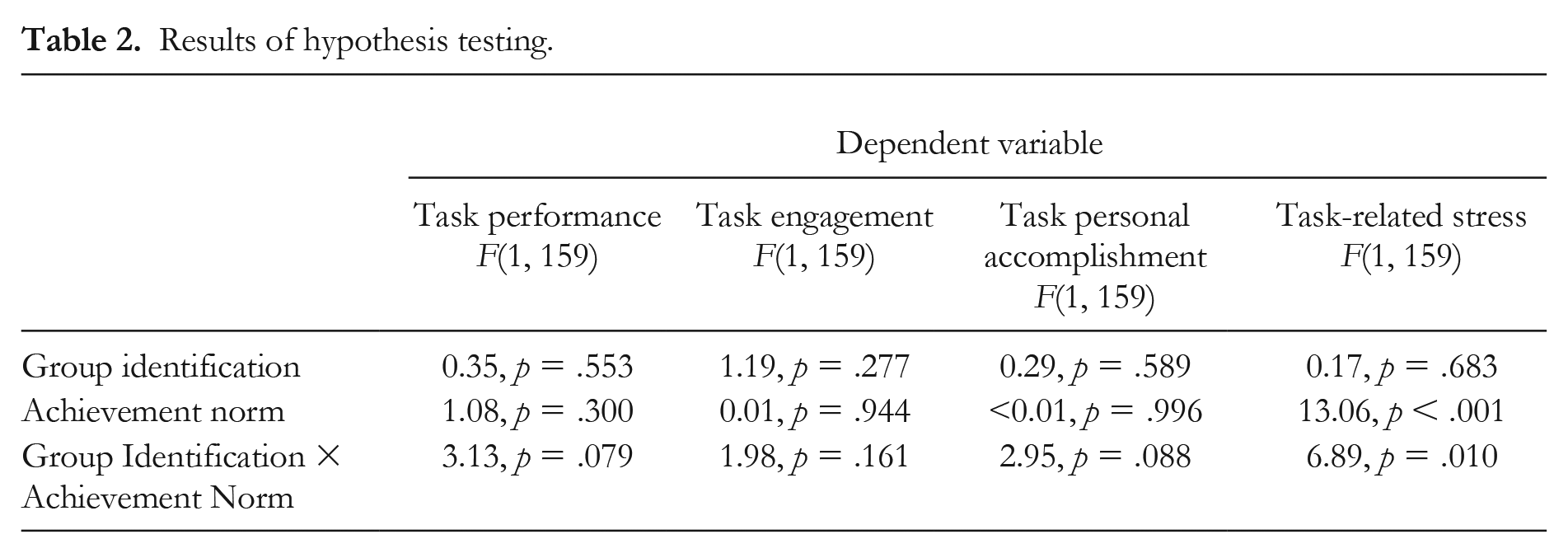
We found partial support for our interaction hypothesis in predicting task-related stress, as the effect of Group Identification × Achievement Norm was significant, ηp2 = .04. Two-tailed post hoc tests showed that, as visualized in Figure 1, if achievement norms were average, there was no difference in task-related stress between those in the high group identification condition and those in the low group identification condition, t(79) = 1.58, p = .236, thus not supporting the social cure assumption. By contrast, when achievement norms were very high, high group identification led to more task-related stress than low group identification, t(69.52) = 2.13, p = .038, Cohen’s d = 0.47, supporting the social curse assumption. There was no main effect of group identification on task-related stress. However, there was a significant main effect of achievement norms, ηp2 = .08, whereby individuals in the very high achievement norms condition reported more task-related stress (M = 2.71, SD = 0.67) compared with individuals in the average achievement norms condition (M = 2.33, SD = 0.65).
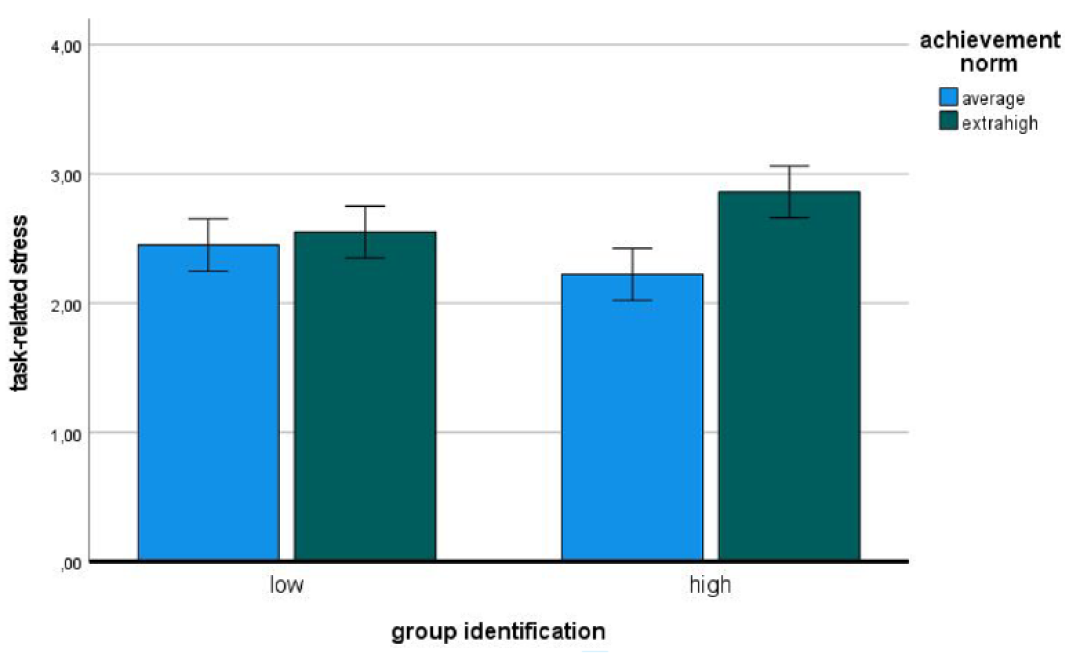
Interaction effects of Group Identification × Achievement Norm on predicting task-related stress.
Our interaction hypothesis was not supported for task engagement, as the interaction effect of Group Identification × Achievement Norm was not significant. The main effects of group identification and achievement norms were also not significant. Likewise, the interaction effect of Group Identification × Achievement Norm was not significant for personal accomplishment as a dependent variable nor did we obtain a main effect of group identification or achievement norms. Taken together, Hypothesis 1 was partially supported for task stress but not for the other well-being indicators. Moreover, we obtained a nonsignificant interaction effect of Group Identification × Achievement Norm on predicting task performance, thus not supporting Hypothesis 2. Likewise, there were no main effects of group identification or achievement norms for task performance.
Exploratory Analysis
In hindsight, we speculated that the very high achievement norms may have resulted in task anxiety, thus resulting in a self-fulfilling prophecy of underperformance for highly identified group members such that, due to being more stressed during the task, they would perform worse. Therefore, we finally tested a moderated mediation model in Mplus Version 8.8 (using estimator = maximum likelihood robust) with group identification as the predictor, task-related stress as the mediator, task performance as the dependent variable, and achievement norms as the first-stage moderator. This model fit the data well, χ2 = 0.85, df = 2, p = .654, CFI = 1.00, TLI = 1.00, RMSEA = <.01, SRMR = .02.
As shown in Figure 2, we found support for this assumption, as the index of moderated mediation was −1.84, SE = 0.78, z = −2.36, 95% CI [−3.36, −0.31]. There was a negative indirect association between group identification and task performance via more task-related stress in the very high achievement condition (−1.99, SE = 0.90, z = −2.20, 95% CI [−3.75, −0.22]), but not in the average achievement condition (−0.15, SE = 0.35, z = −0.42, 95% CI [−0.84, 0.54]).
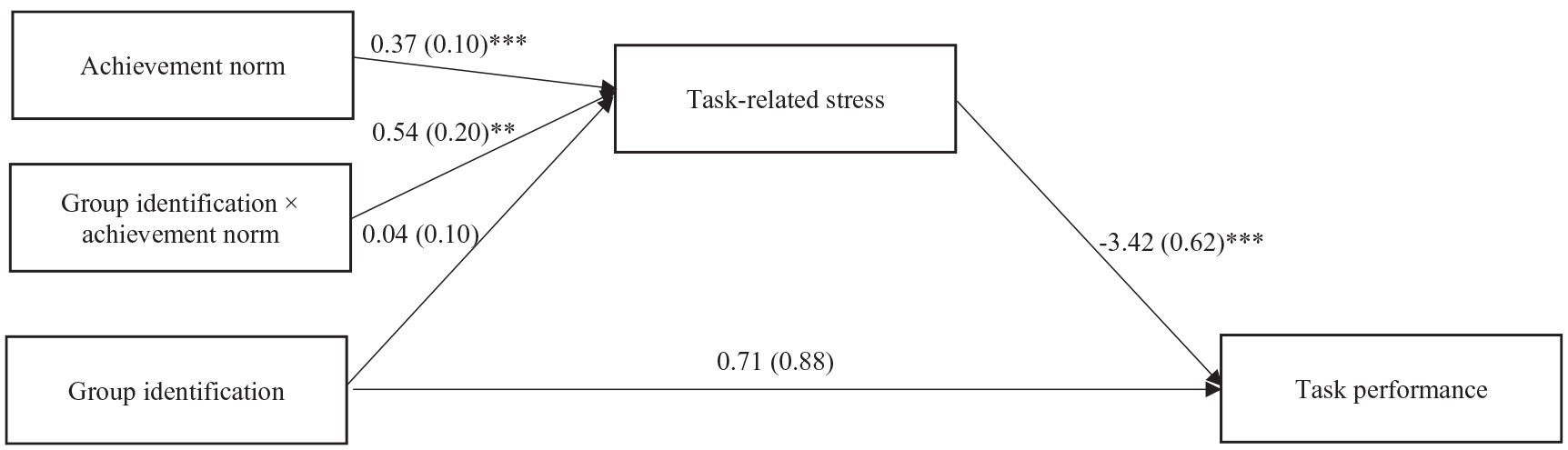
Results of the moderated mediation analysis.
Discussion
In the present study, we argued that high group identification and very high achievement norms form an unholy alliance. This hypothesis rests on the notion that although group identification has the capacity to act as a social cure, it might also act as a social curse, threatening and even harming performance and well-being. Specifically, we predicted that group identification would represent a social cure (i.e., better task performance and task-related well-being) when achievement norms are average but would result in a social curse (i.e., poorer task performance and task-related well-being) when achievement norms are very high. To experimentally test this idea, we manipulated both participants’ group identification and the group’s achievement norms. Task performance was measured objectively with a mental arithmetic task, and task-related well-being was operationalized with self-reports.
We found inconclusive support for our hypothesis as we obtained a social curse effect (if achievement norms were very high) but not a social cure effect (if achievement norms were average) for task-related stress. Although unexpected, the lack of a social cure effect for task-related stress is in line with other experimental research that could not find this effect for self-reported stress (e.g., Häusser et al., 2012). There were no group differences in task performance, engagement, and personal accomplishment. Most importantly, the exploratory moderated mediation analysis showed that the social curse effect of group identification, if achievement norms were very high, extends to hampering task performance. Hence, although high achievement norms are typically implemented to promote performance, by inducing stress, this effect is eroded when group identification is high.
Theoretical Implications and Future Research
With the present study, we identified a relevant boundary condition for finding social curse effects of group identification, namely the group’s achievement norms. Importantly, we demonstrated that self-imposed very high achievement norms—that is, norms that developed within the group—elicited stress among highly identified participants, in line with the norm enactment and influence hypotheses (Jetten et al., 2017), which carried over into poorer performance.
Our research thus complements a study by Scholl et al. (2019), who found that students who were presented with externally imposed high achievement norms (as members of an “elite university”) reported less stress when they were highly identified. Taken together, these findings highlight that group identification protects against pressure originating outside the group, thus serving as a social resource, for instance, by eliciting the feeling that “we can do this together” (van Dick & Haslam, 2012). By contrast, group identification amplifies pressure that originates from within the group itself. Highly identified individuals feel a stronger need to meet these expectations and to show that they are “worthy” group members by aiming at such very high achievement. Future research may explore whether this difference between internally versus externally developed norms indeed distinguishes between a social curse and a social cure effect of group identification (particularly for task-related stress), respectively.
Importantly, we compared average and very high achievement norms in the present study, assuming that these would differentiate between social cure and social curse effects of group identification. We assumed that average norms were easily achievable and, therefore, should have been experienced as a challenge. Conversely, very high achievement norms should have been perceived as difficult to achieve and, therefore, should have been experienced as a threat, particularly among those with a strong desire to meet these norms, that is, individuals who were highly identified with their groups. Future research may want to test this reasoning by explicitly assessing the interpretation of the stressor.
More generally, taking the “too much of a good thing” effect into account, which suggests that good things (such as group identification) turn adverse at too high levels (e.g., Avanzi et al., 2012, 2022; Grant & Schwartz, 2011; Pierce & Aguinis, 2013), might reveal a more complex pattern of the joint effects of group identification and achievement norms. In particular, building on the social cure assumption that higher group identification increases perceptions of social support and collective self-efficacy (van Dick & Haslam, 2012), individuals might benefit from their group identification in terms of better performance and well-being but only up to a certain level of achievement norms. However, once achievement norms pass a threshold (at very high levels), higher group identification might result in a decline in performance and well-being. Following this reasoning, the inconclusive results in the present study might be explained by interindividual differences in thresholds of achievement norms for different outcomes. We encourage future research to study this contingency of finding curvilinear effects of group identification depending on the group’s achievement norms.
In particular, and based on Lazarus and Folkman’s (1984) proposition that individuals take their resources into account when evaluating a stressor, this reasoning suggests that individual characteristics might affect the degree to which highly identified individuals are prone to be affected by their group’s achievement norms. Besides the need to belong, defined as “a need to form and maintain at least a minimum quantity of interpersonal relationships” (Baumeister & Leary, 1995, p. 499), as a factor that might directly affect individuals’ desires to adhere to the group’s norms, self-efficacy (i.e., the “belief in one’s capabilities to organize and execute the course of action required to produce given attainments”; Bandura, 1997, p. 3) might represent such a factor that moves the threshold more to the lower (if the need to belong is high or self-efficacy is low) or the higher end of achievement norms (if the need to belong is low or self-efficacy is high).
Practical Implications
Our results show that individual group members should be alert to negative effects of too high achievement norms, especially when they care for and identify with the group. Whereas strong engagement is good for the group in accomplishing its tasks, it might also produce negative effects on well-being and, as a consequence, reduce performance. Especially those who identify with their groups and want them to be viable should carefully observe tipping points such as the one observed in the present study.
However, above and beyond the individual group members’ responsibilities, it is a key task of group leaders not only to take care of the group’s performance but also of individual members’ well-being (e.g., Kaluza et al., 2021) and the group’s long-term viability. Leaders should therefore pay attention to early signs of employee stress and continuously help to develop group norms that may be challenging but achievable. This is especially important in the organization’s upper echelons, as leaders function as role models and set standards that may not easily be challenged further down the hierarchy even if they are visibly wrong (e.g., Melendez, 2013).
Strengths and Limitations
A strength of the present study is the experimental manipulation of both central study constructs—group identification and the group’s achievement norms—which allows for drawing strong causal inferences regarding the interaction. Moreover, the use of both questionnaire data and objective performance data reduced the risk of common-method bias (Podsakoff et al., 2003). Our findings are in line with previous research (e.g., Howell et al., 2014; Mühlhaus & Bouwmeester, 2016; Oyserman et al., 2014) that showed positive associations between group identification and unhealthy behaviors when norms prescribe such behaviors. However, in these studies, it may also be that those people who are already stressed or live an unhealthy lifestyle report such norms to reduce their own cognitive dissonance. In contrast, our experimental approach allows us to rule out such confounds and self-selection effects.
Despite these strengths, our study is not without limitations. First, we collected data in two phases, interrupted by lockdowns of our lab due to COVID-19 prevention regulations. Although we did not find differences in participant demographics and in our dependent variables between the two cohorts who participated (before versus during the pandemic), it could have been that the second cohort felt less comfortable being in the laboratory together with other people (the other participants and the experimenter). We took care to create a safe and secure experimental environment, but we did not measure participants’ initial stress levels. Measuring initial stress levels, however, would also allow for studying changes in stress and the recovery process.
Second, despite achieving high internal validity, the external validity and thus whether the findings would fully replicate in different contexts in the field—for instance, when using existing groups—is an open empirical question. Future research may want to complement the current study with a field study. For instance, researchers could sample job beginners for a longitudinal study design with repeated measurements of all variables and combine self-report data with other-report data (e.g., from supervisors). Doing so would also allow us to test whether the observed pattern changes over time.
Finally, as outlined above, we argued that if achievement norms are perceived as hard to attain, as in the case of very high achievement norms, high identifiers’ desire to fulfill these norms might give rise to pressure and fear of failure, ultimately resulting in task-related stress and performance decrements. In line with this hypothesis, we found that for high identifiers, very high achievement norms led to more task-related stress and performance decrements. However, we did not assess whether high identifiers confronted with very high achievement norms were indeed stressed because they felt pressure to achieve these norms. Hence, future research is needed to more closely examine the psychophysiological mechanisms underlying our findings.
Conclusion
Although group identification has the capacity to act as a social cure, it may also constitute a social curse that may have harmful consequences for performance and well-being (Jetten et al., 2017; Kellezi & Reicher, 2012). In the present paper, we argued that the level of achievement norms would constitute a relevant boundary condition for finding social cure versus social curse effects. Despite inconclusive support for this hypothesis, we believe that our results contribute to a more nuanced understanding of social identity processes and reveal the importance of being aware of the potentially detrimental effects of very high achievement norms in practice.
