



Abstract
Intragroup and intergroup network creativity were assessed in an experiment varying the degree of access to ideas generated by other groups. In an open-access condition, all members of two concurrent groups had access to the other group’s ideas. In the brokered condition, one member of each group had access to the other group’s ideas. In the control condition, two groups performed independently. Following three phases of idea generation and elaboration, groups developed their final plan for surviving a zombie apocalypse. The brokered condition led to the highest level of intergroup activity, and the final product novelty across all conditions was influenced by the novelty of the ideas and elaborations in the prior session. The effect of experimental condition on the integrative complexity of the final product was mediated by the degree of lexical similarity between the two groups’ documents. Final product novelty was negatively predicted by lexical similarity. Theoretical advances, implications, and future directions are discussed.
Although much creativity occurs at the level of individuals (Kaufman & Beghetto, 2009), the complexity of problems encountered often requires collaboration in groups, sometimes among individuals with different backgrounds or expertise (Horwitz & Horwitz, 2007; Paulus, van der Zee, & Kenworthy, 2019; Van Knippenberg & Schippers, 2007). Research on group creativity and team innovation has demonstrated the potential benefits of such collaborations (Paulus & Nijstad, 2019; Reiter-Palmon et al., 2012). Exchange of ideas among group members can stimulate additional ideas (Nijstad & Stroebe, 2006; Paulus & Brown, 2007) and provide opportunities for the elaboration of and building on those ideas (Hargadon & Bechky, 2006; Harvey, 2014; Kohn et al., 2011). One benefit of group versus individual contexts is that one can be exposed to a greater range of perspectives, which is likely to further stimulate novel approaches and ideas. This is particularly important when a situation requires new solutions or new directions. To be competitive, organizations must constantly assess their practices and processes to find ways to improve (Argote & Levine, 2020; Mumford & Todd, 2020). One way to do this is to learn what other groups, teams, or organizations are doing and to incorporate elements that are potentially applicable and useful to their domain (Argote, 2011; Argote & Ingram, 2000; Darr et al., 1995). This paper tests some components of a theoretical model concerning the exchange of ideas across group boundaries and its effects on creativity.
There are several literatures that have examined intergroup, interteam, or interorganizational collaboration or exchange of information and ideas. However, the issue of intergroup creativity has seen little systematic research. There has been some research at the organizational level examining the extent to which organizations, or their subunits, adopt novel processes from other organizations or units (Argote & Ingram, 2000; Darr et al., 1995). This type of knowledge transfer can be very beneficial for organizational productivity and survival (Argote et al., 2021; Darr et al., 1995). However, often this transfer of knowledge does not occur, in part because of relationship issues or the type of knowledge involved (Argote, 2012; Szulanski, 2000).
Other studies have examined information exchange that occurs as a consequence of group membership change or turnover (e.g., replacing ingroup members with outgroup members), to assess the benefit of new membership composition on creativity. In Choi and Thompson (2005), such membership changes enhanced a group’s creativity in terms of the number of ideas generated and categories used. Similarly, Kane et al. (2005) examined the impact of group member rotation on the adoption of a new member’s routine by the group (constructing an origami product). They found that this routine was accepted by the group only when the groups shared some superordinate identity (group name and color). When there was shared identity, only products superior to those of the group were adopted (Kane et al., 2005). When there was no shared identity, the new member’s routine was seldom accepted regardless of its quality. In Wu et al. (2022), group membership change produced incremental changes to idea generation, which in turn predicted the creativity of groups’ final products (but only when participants were high in prosocial motivation). When groups change membership, high performers in the groups can increase the performance of the other group members (Kenworthy et al., 2023). These findings provide support for the notion that the cross-fertilization of ideas between groups can, under some circumstances, be beneficial to creativity.
In the present endeavor, we aimed to directly assess the creative processes in an intergroup setting that does not involve membership change. We have found only a handful of such studies. These have focused primarily on the role of interteam competition (Baer et al., 2010, 2014; Chen & Chiu, 2016; Le Hénaff et al., 2018). When two or more groups are working on a similar task, there is a natural tendency to compare performances (Festinger, 1954; Seta, 1982). This comparison process may induce a sense of competition, which can in turn lead to enhanced performance and creativity (Paulus & Dzindolet, 2008). Baer et al. (2010) found that competition (induced by competing for a monetary prize) enhanced creative performance both in terms of rated creativity (novelty and usefulness) and of the number of highly creative ideas. Baer et al. (2014) also found a positive effect of competition on creativity, but only for all- or mostly male groups. Le Hénaff et al. (2018) found that when brainwriting groups were told their performance would be compared to that of other groups, they generated more ideas and ideas across more categories than did groups not so instructed (see also Chen & Chiu, 2016). Whereas these studies provide evidence that an intergroup competitive structure can enhance creativity, they do not involve any exchange of ideas across the intergroup boundary.
Except for the limited amount of research on group turnover, the research cited thus far has not examined in detail the creative processes involved in intergroup exchanges or the outcomes of these processes, such as the number of ideas generated, the elaboration of ideas, and the quality of them. In the present paper, we examined these issues in a controlled laboratory study of intergroup creativity. This involved having two groups participate in the laboratory concurrently. We varied the degree of connectivity between the groups and examined the creative processes and outcomes of these groups. At the end of the idea generation and sharing phases, the groups each produced a final product which summarized their creative plan for how to best survive a zombie apocalypse.
Our study was motivated in part by a broad theoretical perspective on intergroup creativity that builds on the group and team creativity literature (Kenworthy, Paulus, Coursey, et al., 2022; Kenworthy, Paulus, Minai, & Doboli, 2022; Paulus & Kenworthy, 2020). According to this perspective, the effectiveness of intergroup creativity will depend on the effectiveness of the intergroup idea exchange process; the intergroup characteristics (e.g., quality of past relationships and degree of overlap in group identities); the motivation to attend to and build on ideas from other groups; group climate or cohesion; cooperative or competitive orientations between the groups; and the interactional or network structure between teams. In this study, we will examine the intergroup idea exchange process and the group or network structure. We will also examine the link between the divergent idea generation process and a subsequent more convergent development of the final creative product.
It is clear from the limited literature thus far that an exchange of ideas across group boundaries may be beneficial for creativity under some circumstances. This is consistent with cognitive/motivational models of collaborative creativity, which emphasize that the task demands, cognitive stimulation from shared ideas, and the motivation level of the group will determine the creative outcomes (De Dreu et al., 2011; Paulus et al., 2002). One of the key factors in both group and intergroup creativity is the degree of attention to the shared ideas (Brown & Paulus, 2002; Paulus & Kenworthy, 2020). This can be a challenge in group settings in which participants have to generate their own ideas as well as attend to the ideas of others. This is why interactive groups often generate fewer ideas than nominal groups (the number of ideas generated by solitary individuals minus redundant ideas; Diehl & Stroebe, 1987). This problem is generally most evident in verbal groups which require turn-taking and can be weakened when ideas are exchanged electronically or on paper (Dennis et al., 2019; Paulus & Yang, 2000).
Another factor that can reduce group and intergroup creativity is social loafing (Diehl & Stroebe, 1987; Paulus & Kenworthy, 2020, 2022). In group contexts, feelings of responsibility for task performance may be reduced since others can “pick up the slack.” However, social loafing can be overcome or mitigated if there is sufficient motivation on the part of group members. One of the best indicators of motivation in creative group settings is the degree of elaboration of shared ideas (Coursey et al., 2019, 2020; Kohn et al., 2011). This elaboration reflects motivated group-level information processing (Hinsz et al., 1997; Nijstad et al., 2019), and its benefits are demonstrated in higher quality creative outcomes.
The focus in this study is on the impact of the degree of attention to ideas of other groups and the structure of the idea exchange process. Ideas exchanged within and across groups can stimulate creativity because exposure to more ideas increases the potential for cognitive stimulation of related associations, and they can make salient additional semantic domains relevant to the task (Paulus & Brown, 2007). The impact of exposure on creativity is determined by the degree to which group members pay attention to shared ideas, build on them, and are motivated to deeply tap their relevant knowledge (Kohn et al., 2011; Nijstad et al., 2019).
Part of what determines the attention and motivation in an intergroup setting is how that intergroup communication structure is set up. Social network analysis (SNA) has been used in a variety of contexts, typically for examining organizational processes and outcomes, and has recently been used for examining creativity in teams and networks. SNA focuses on the relational structure of a network defined by the individuals or nodes making up the network and the connections between them; these connections are often called “ties” (e.g., Granovetter, 1973).
When a particular link or tie connects two or more networks, it can be described as spanning a “structural hole” in the flow of information between groups (Burt, 1992, 2004; Langan-Fox & Cooper, 2014). Brokers (sometimes also called bridges or boundary spanners) are individuals within a larger network or internetwork structure who connect or link two or more contacts when these contacts themselves do not connect to each other (Leenders et al., 2007; Soda & Bizzi, 2012). Brokers have been presumed to be important in facilitating creativity in networks. The argument for their importance comes from the assumption that because within-group information tends to be more homogeneous than between-group information, exposure to outside ideas and perspectives makes unique conceptual combinations more likely (Baer et al., 2010; Perry-Smith, 2014; Perry-Smith & Mannucci, 2017; Zhou et al., 2009).
The potential benefit of brokers is that the other members of each broker-connected team can focus mostly on their own tasks while still receiving relevant input from other teams. If seeking and sharing ideas across group boundaries were the responsibility of all group members, this could potentially reduce the efficiency of the creative process. In particular, the risk of information redundancy would be high, and unnecessary additional team efforts would be required to evaluate the potential utility of new ideas. Thus, while having a broker comes at the potential cost of losing some of the individual contributions of one group member, such a loss is compensated by the greater task focus among the other group members. If this occurs, then group creativity in general should be enhanced.
Most treatments suggest that brokerage will be beneficial (presumably compared to no connections) to the creative process (e.g., Collet et al., 2014; Keszey, 2018; Liu et al., 2013). In a review of two dozen papers examining the role of brokers in professional networks, Long et al. (2013) found that while brokers across networks can lead to effective knowledge transfer, they may reduce productivity if they become a burden or a bottleneck to information flow. It is important to note that with respect to intergroup creativity, there have been relatively few direct examinations of the idea; most of them are correlational rather than experimental. In addition, such treatments examine the importance of brokerage or boundary spanning without also examining an open-access type of network structure. Our expectations with respect to the open-access condition (described below) are thus speculative and warrant caution. In our methodology, we manipulated the intergroup structure to be either open-access or brokered (with a no-access control condition), with the expectation that brokered intergroup structures would yield greater productivity and creativity, compared to open structures.
We also examined the link between the divergent idea generation phase and the more convergent phase of developing a final group product based on shared ideas. Prior research has found that individuals and groups tend to have a bias to feasible ideas relative to novel ones (Rietzschel et al., 2019). However, we have found that novel ideas do have an impact on the final collaborative product, especially when these have been the basis for elaboration by group members (Coursey et al., 2019; Paulus, Coursey, & Kenworthy, 2019). These ideas should be most salient in the memory of group members. This may also be the case for those ideas that occur later in the session.
Creative Outcomes
In collaborative creativity and innovation, there are several key outcomes to choose from when assessing the influence of cross-group idea borrowing. In addition to the standard measures of the number, novelty, and feasibility of ideas and elaborations (defined here as building on, or adding to, an existing idea; see Kohn et al., 2011), we wanted to see if exposure to outgroup ideas would lead to products that were not just mere copies of others’ ideas, but instead were more thorough and complex, reflecting a deeper level of information processing. To assess the extent of intergroup idea borrowing as a potential mediating process, we measured the latent semantic similarity (LSS) of our groups’ final products using latent semantic analysis (Latent Semantic Analysis – Colorado, n.d.). LSA is a method for comparing samples of text based on the contextual meaning of words (Landauer et al., 1998). Several researchers have independently shown a high correlation between computed LSA scores and human judgments about the similarity between two of the same passages or texts (e.g., Jorge-Botana et al., 2010; León et al., 2006; Seifried et al., 2012). A higher LSS score indicates that two texts have greater similarity in word usage and meaning, reflecting increased attention to and usage of the ideas of the other group.
In turn, we assessed the degree to which such a measure of product similarity would be associated with product completeness and complexity. As an indicator of completeness, we assessed word counts across different categories of the final product task (described below), and as a measure of product complexity, we assessed a construct called integrative complexity. This refers to the degree to which written texts acknowledge competing perspectives and integrate or merge them (dialectical complexity), and the degree of elaboration on or multiple complex arguments for a single perspective (elaborative complexity; see Conway et al., 2008). These two types of complexity are combined with indicators of both differentiation of ideas as well as integration between differentiated ideas. Higher integrative complexity scores reflect an increased tendency to show both dialectical and elaborative complexity, as well as showing both differentiation and integration across ideas. Conway et al. (2014; see also Houck et al., 2014) have developed a system of automatic scoring of the variable (https://www.autoic.org/) that has been validated against human judgments of the construct.
Overview
There were four task phases in this study. In Phase 1, participants generated their ideas individually without access to the ideas of the other group members. In the second phase, individuals were assigned to groups of four, and members exchanged ideas electronically within their group. In the third phase, the experimental manipulation occurred. In two conditions, the groups were provided access to the ideas being generated electronically by another group working concurrently. Groups in these conditions had the potential of tapping ideas from other groups to enhance their own effort. In the open-access condition, all participants were able to access the other group’s ideas as they were being generated. In the brokered condition, one group member was a broker who accessed the other group’s ideas and shared those deemed most promising with the group. In the control condition, groups continued to generate ideas and reply to each other without any intergroup exchange of ideas. The fourth phase involved each group (of four) meeting face-to-face to discuss the shared ideas and to come up with a final product (see Figure 1). The four phases were designed to reflect typical sequences in collaborative creativity (e.g., Korde & Paulus, 2017). The major theoretical predictions of interest in this study relate to the third phase and the impact of the overall process on the quality of the final product in the fourth phase. In sum, in this study, we experimentally examine the effects of brokered, open-access, and control conditions on an array of group process and creative outcome measures.
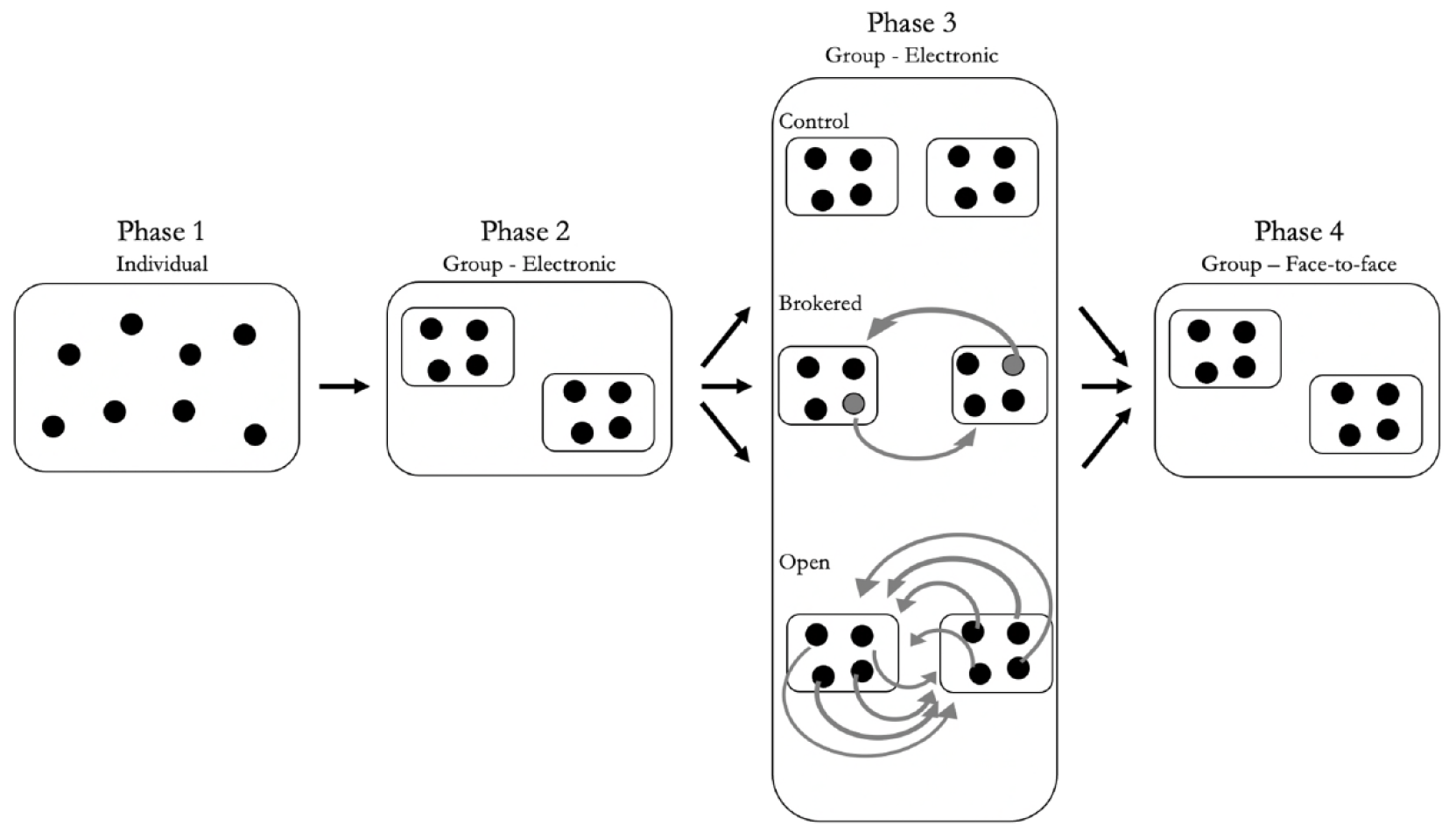
Schematic illustration of the participants’ and groups’ progression through the study phases.
Hypotheses
Based on our review of the relevant literature, we propose several hypotheses. These concern the effects of experimental conditions on idea generation, elaboration (defined as building on or adding to an existing idea), and novelty, as well as the quality of the groups’ final products.
The cognitive/motivational models are most relevant to predictions about the overall performance levels of the three conditions (De Dreu et al., 2011; Nijstad & Stroebe, 2006; Paulus et al., 2002). Competing demands (looking at the other board and generating one’s own ideas) may reduce the number of ideas generated in the idea generation phase for the two intergroup conditions. On the other hand, intergroup exposure should increase the novelty of the ideas generated since there is an exposure to a potentially broader range of ideas. Exposure to the ideas of another group should provide the potential for social comparison, additional cognitive stimulation, and idea and elaboration novelty, compared to the control condition.
Hypothesis 1a: The number of ideas and the number of elaborations in the intergroup exposure conditions (viz., open-access and brokered) will be lower than in the control condition because of the additional task demands in the former conditions compared to the latter.
Hypothesis 1b: The novelty of ideas and elaborations should be greater in both intergroup conditions compared to the control condition.
When comparing the intergroup access conditions (excluding the control condition), we expect a diffusion of responsibility or a degree of social loafing in the open-access condition, limiting the motivation of group members to access the ideas of the other group’s members (Karau & Williams, 1993). There is also an increased likelihood of effort redundancy, resulting in multiple group members sharing the same outgroup ideas. When a single broker is responsible for accessing the other group’s ideas, by contrast, this group member should be more motivated to attend to the shared ideas and pass on the best ones to the group.
Hypothesis 2: The number and novelty of outgroup elaborations will be higher for the brokered condition compared to the open-access condition.
Our prior research suggests that the quality of the divergent creative process will influence the convergent process. Ideas that have been elaborated or occur in the later phases of the divergent process will be most influential (see Coursey et al., 2019).
Hypothesis 3: The average novelty of ideas and elaborations (group Phases 2 and 3) will predict final product novelty.
Hypothesis 4a: Groups in the intergroup exposure conditions, compared to controls, should produce solutions with higher latent semantic similarity (an indicator of idea borrowing, which occurs before the final product session).
Hypothesis 4b: Latent semantic similarity should mediate the link between condition and the final product outcome variables. Specifically, integrative complexity, completeness, and feasibility should increase as a function of higher levels of semantic similarity. However, novelty should decrease as a function of higher semantic similarity because of the overlap in ideational content.
Methodology
Participants and Design
We recruited 416 undergraduates to participate in exchange for course credit. Each experimental session, comprising two groups of four participants, was randomly assigned to one of three conditions in this single-factor design: brokered (k = 43), open-access (k = 34), and control (k = 29). 1 One hundred seven groups completed the study. However, data were lost for one group in the brokered condition, leaving a total of 106 groups. The sample included 253 (61%) females and 161 (39%) males (two did not report sex). The demographic composition included 29.0% White/Anglo-American, 22.4% Asian, 16.0% Black/African American, 24.3% Hispanic/Latino, and 6.7% other (1.6% declined to answer). The age of the participants ranged from 16 to 54, with a mean age of 20.5 years.
Procedures
Phase 1: Individual brainstorming
Upon arrival, participants were randomly assigned to separate four-person groups (12 groups had three members only; they were nearly equally distributed across conditions). 2 Participants were asked to generate creative ideas for the assigned topic and were given Osborn’s (1957) brainstorming “rules” (e.g., generate as many ideas as possible without concern for quality; offer all ideas that come to mind; build on others’ ideas; do not criticize during the exchange process). Participants were prelogged into an online discussion board at their respective computer workstations; they were instructed to generate as many ideas as possible for surviving a zombie apocalypse. In Phase 1 (15 min), participants generated as many ideas as possible as individuals (not in groups; see Figure 1), entering their ideas separately into an online message board available only to the individuals themselves, and not to anyone else (using Simple Machines Forum software, version 2.0; simplemachines.org).
Phase 2: Group brainstorming
In Phase 2 (20 min), the four-person groups were separated into two different laboratory rooms, with each person working on a separate computer. To increase a sense of team identity, groups were told that they were put together based on their previous responses (although it was actually random assignment) and were instructed to discuss and generate a team name. They were then provided a group message board with all of their team members’ individual ideas (from Phase 1) merged together. They were instructed to read the ideas generated by their group members in Phase 1, to reply to and elaborate on each other’s ideas, and to continue generating new individual ideas. Ideas were posted on the discussion board immediately and were visible to all group members in real time.
Phase 3: Intergroup brainstorming
In Phase 3 (20 min.), group activity differed by experimental condition (see Figure 1) as they continued to work on separate computers. In the control condition, participants continued to access their own group’s discussion board as in Phase 2; they were instructed to continue generating ideas and building on each other’s ideas. In the brokered condition, one group member volunteered to act as a broker; that person was given access to the other group’s discussion board in a separate browser tab. In the open-access condition, all group members had access to the other group’s board. They were instructed to keep building on other ideas and to generate new ideas. In the latter two conditions, they were encouraged to copy ideas from the outgroup board and paste them into the ingroup board for consideration; when pasted in, they were clearly marked as having been generated by an outgroup user.
Phase 4: Convergence on final product
Finally, participants from all conditions met face-to-face (all interactions prior to this phase were electronic via the discussion board) with their group members for 20 minutes to discuss their plans and designate one member (a volunteer) to type their final group product in a Word document on a laptop computer. Participants were given written instructions to develop their final plan for survival and told: “Include issues that your group finds relevant to the plan such as securing food/water, safety, shelter, transportation, health/sanitation, and any other concerns that may arise.” Verbal instructions echoed this, including an incentive that groups whose products scored the highest on creativity, feasibility, and completeness would receive $25.00 Amazon gift cards for each group member. Upon completion, participants were debriefed, thanked, and excused.
Dependent Variables
Outgroup exposure
For participants with access to the other board (viz., those in the brokered and open-access conditions), we used CamStudio (Simple Machines Forum software, Version 2.7.2; camstudio.org) to record their screen activity. Trained coders later viewed the recorded screen activity and logged time spent (in seconds) accessing both the ingroup and outgroup boards (clearly identified by team names; teams were in separate browser tabs) during Phase 3. These logs were used to create group-level aggregate values (averaged across members) of time spent on each board, which were then used to report the proportion of time spent on the outgroup board compared to the overall time spent in Phase 3.
Total number of ideas and elaborations
Each discussion board post/reply was split into discrete ideas (originating from independent posts to the discussion board) and elaborations (originating from replies to posts by ingroup or outgroup members). The splitting procedure was required because sometimes participants put multiple ideas (e.g., about getting weapons, then about securing transportation, then about preventing infections, etc.) in the same post before sending it to the board. Irrelevant posts (e.g., posts consisting of only an emoji, “lol”, agreement, etc.) were removed. Our research team, consisting of undergraduate and graduate research assistants and faculty members, discussed and were trained on when to split or remove a post. Then, at least two team members processed each discussion board independently. Once completed, we met to discuss and resolve any discrepancies between coders until agreement was reached. In total, there were just over 11,000 ideas and elaborations generated across all participants after removing irrelevant posts. Ideas were counted using the Excel “=countif()” function, which yields a count of how many times a certain value appears in a column.
The total number of individual ideas and elaborations was then calculated at the group level for Phases 1 to 3. In Phase 3, the total number of elaborations was further subdivided into ingroup versus outgroup elaborations for the brokered and open-access conditions. The number of outgroup elaborations provided an index of outgroup engagement. The final product in Phase 4 was also split into individual ideas, with 1,600 ideas across the 106 groups. Two independent judges counted the number of ideas in each final product, and absolute agreement between judges was required.
Novelty and feasibility
Each idea and elaboration from the discussion board (Phases 1–3) was coded for novelty and feasibility on 5-point scales (1 = a very common idea; not feasible, 5 = a very original/unique idea; very feasible). Two independent raters, unaware of conditions, rated 25% of the total ideas to establish reliability; different raters were used to rate novelty and feasibility (intraclass correlation coefficient [ICC] two-way random, consistency: ICCnovelty = .80; ICCfeasibility = .60). One coder rated the remaining ideas for novelty and a separate coder rated them for feasibility. Average novelty and feasibility scores were then calculated at the group level by dividing the group’s sum novelty/feasibility score by the total number of ideas/elaborations generated. Group average novelty and feasibility scores were calculated for Phases 1 to 3. Average group-level novelty and feasibility for elaborations in Phase 3 were further subdivided into ingroup versus outgroup elaboration novelty and feasibility for the brokered and open-access conditions. Outgroup elaboration novelty and feasibility provided measures of creativity relating directly to outgroup stimulation.
Final product coding
Coders separated the final product into discrete ideas that were each rated for novelty by two independent raters who each coded 100% of the ideas (ICC = .66). Novelty scores were averaged across the total number of ideas for the final product, and across the two independent raters. Novelty of final product ideas was considered solely within the context of the final documents, and the coders who evaluated the novelty of the final products were not the same as the coders who rated novelty for the discussion board ideas from Phases 1 to 3. Furthermore, the raters of final product novelty were not exposed to the ideas from Phases 1 to 3. Feasibility of each of the final product ideas was also rated by two independent raters (ICC = .70) whose ratings were averaged across raters and then across the number of ideas for each group.
Additionally, two independent coders rated the final products for completeness across the categories that were noted in the instructions (food/water, safety, shelter, transportation, health/sanitation, and other) by first assigning each idea into one of the categories and counting the number of words per category (ICC = .98). The completeness score was an equally weighted combination of the total number of words (standardized, plus a constant of 5 to ensure no negative numbers) summed with the distribution of words across categories (using an inverse standard deviation of words per category, standardized, plus a constant of 5), so a team that had used an equal number of words addressing each of the categories would receive a higher score than a team that used the same number of words but only focused on one category.
Latent semantic similarity
The text of the final product was used to evaluate both the semantic similarities between the groups that had access to each other’s discussion boards as well as the integrative complexity of those final products. Final products were compared for latent semantic similarity using latent semantic analysis (Latent Semantic Analysis – Colorado, n.d.) between the groups of participants that participated concurrently; the group in the brokered condition whose discussion board data were lost did produce a final product for comparison. For groups in the control condition, random pairs of groups were compared. After 28 groups were paired with each other, the remaining group in that condition was paired with the group in the brokered condition whose data from the divergent phases were lost, but which did produce a final product, which was not lost. Similarity scores ranged from 0 to 1, with higher numbers indicating greater overlap in word usage and passage meaning.
Integrative complexity
Final products were uploaded to the website Automated Integrative Complexity (http://www.autoic.org; Conway et al., 2014), which provides an automated-IC score on a scale from 1 to 7, which incorporates the different types of complexity as well as both differentiation and integration. A low score (1) indicates no differentiation, whereas medium scores (2–3) indicate differentiation without integration; high scores (4–7) indicate differentiation and integration. We also had two independent coders rate a random set of 40 of the final products on integrative complexity, using the training instructions by Baker-Brown et al. (1992). This was done as a test of validation of the automated scores compared to human ratings. The two independent judges’ scores obtained good reliability (ICC = .68), and their averaged IC score correlated strongly, r(40) = .71, p < .001, with the automated scores yielded by the system. Automated-IC scores for all groups’ final products are used in the analyses below.
Results
Descriptive statistics for the primary dependent variables are presented in Table 1. The models and tests for each hypothesis are presented sequentially below.
Intercorrelations and descriptive statistics for key study variables.
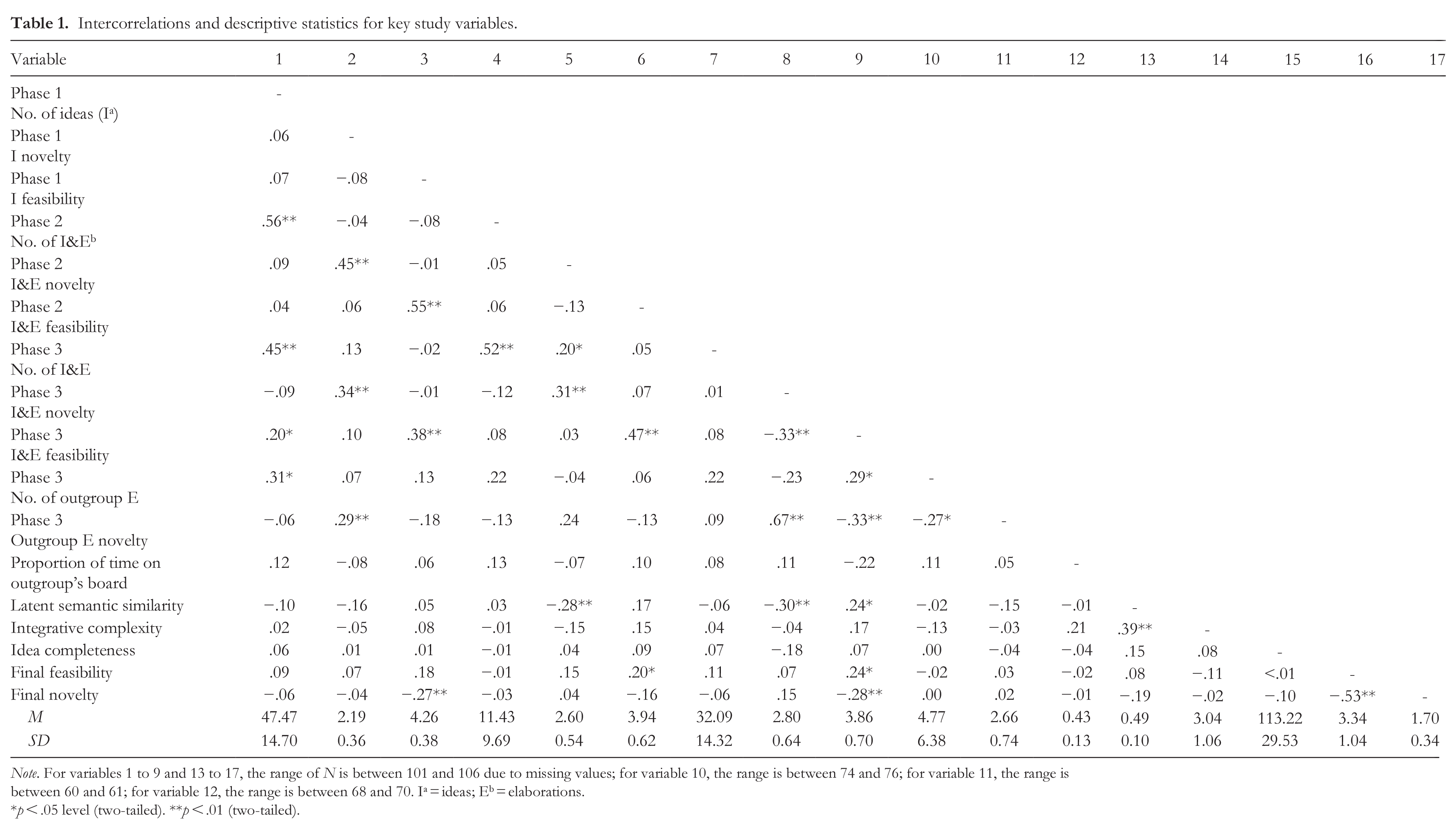
Note. For variables 1 to 9 and 13 to 17, the range of N is between 101 and 106 due to missing values; for variable 10, the range is between 74 and 76; for variable 11, the range is between 60 and 61; for variable 12, the range is between 68 and 70. Ia = ideas; Eb = elaborations.
p < .05 level (two-tailed). **p < .01 (two-tailed).
Hypotheses 1a and 1b
A MANCOVA was conducted to examine the effects of the experimental conditions on the activity level (number of ideas and elaborations), novelty of ideas, and novelty of elaborations in Phase 3. The separate coding of these two measures of novelty was based on prior findings that these two measures may have a differential impact on the final product (e.g., Coursey et al., 2019). 3 Only the intergroup exposure conditions (viz., open-access and brokered) could elaborate on another group’s ideas. Elaborations for the control condition were for ingroup ideas only. We predicted that the number of ideas and elaborations in the intergroup conditions exposure (viz., open-access and brokered) will be lower (H1a) and the novelty will be higher (H1b) than in the control condition.
The multivariate effect of condition was significant, Wilks λ = .82, F(6, 168) = 2.90, p < .010, η2p = .09. The between-subjects effects of activity level and elaboration novelty were significant: F(2, 86) = 4.96, p = .009, η2p = .10 and F(2, 86) = 4.43, p = .015, η2p = .10, for activity and elaboration novelty, respectively. In partial support of Hypothesis 1a, the control condition (M = 35.30, SE = 2.46) had significantly higher activity than the open-access condition (M = 26.50, SE = 2.37), p = .036, 95% CI [0.44, 17.15], but not the brokered condition (M = 35.34, SE = 1.93), p = .999, 95% CI [−7.71, 7.78]. Contrary to Hypothesis 1b, the control condition (M = 2.99, SE = 0.12) also had significantly higher elaboration novelty compared to the open-access condition (M = 2.55, SE = 0.11), p = .022, 95% CI [0.05, 0.84]. The brokered and control conditions did not significantly differ on either activity level or elaboration novelty. Idea novelty did not differ among conditions.
Hypothesis 2
For Hypothesis 2, we expected the number and novelty of outgroup elaborations to be higher for the brokered condition compared to the open-access condition. A MANCOVA to compare the two experimental conditions on the number and novelty of outgroup elaborations from Phase 3 was significant, Wilks λ = .73, F(2, 56) = 10.16, p < .001, η2p = .27. The between-subjects effects for number of outgroup elaborations and outgroup elaboration novelty were significant: F(1, 57) = 16.10, p < .001, η2p = .22 and F(1, 57) = 7.47, p = .008, η2p = .12, for number of elaborations and novelty, respectively. Although the open
An ancillary analysis of the proportion of time spent in the outgroup’s discussion board showed that groups in the brokered condition spent a greater proportion of time in the outgroup board (M = 0.46, SD = 0.16) compared to the average across group members in the open-access condition (M = 0.39, SE = 0.09), t(69) = 2.04, p = .046. The open-access condition thus generated a greater number of outgroup elaborations, but, overall, groups in this condition spent less time in the outgroup’s discussion board and produced fewer novel elaborations.
Hypothesis 3
For Hypothesis 3, we expected the novelty of ideas and elaborations from Phases 2 and 3 to predict the final product novelty. To test Hypothesis 3, a hierarchical linear regression was conducted in which Phase 1 idea novelty was entered on Step 1; idea and elaboration novelty from Phase 2 were entered on Step 2; and idea and elaboration novelty from Phase 3 were entered on Step 3. The final product average novelty ratings served as the dependent variable. The overall regression model did not significantly predict final product average novelty. Only Phase 3 idea novelty significantly predicted final product average novelty, β = .11, SE = 0.05, t(78) = 2.19, p = .032, 95% CI [0.01, 0.21]. Hypothesis 3 was only partially supported, and the significant findings are consistent with prior findings (Coursey et al., 2019).
Hypotheses 4a and 4b
An analysis was performed in which experimental condition predicted final product outcomes via the mediation of LSS. The two experimental conditions (brokered and open-access) were collapsed, 4 and the dummy-coded condition effect (experimental condition coded = 1 vs. control condition coded = 0) was entered in the model as a single predictor variable. LSS was entered as a mediator, and the final product outcomes of completeness, integrative complexity, and average novelty were entered as criterion variables. A model with feasibility as a fourth outcome variable resulted in poor fit, χ2(10) = 38.83, p < .001, GFI = .89, TLI = 0.42, RMSEA = .17, 90% CI [0.11, 0.22], p < .001, and it was excluded from the model. Without feasibility included, the overall fit of the model was good, χ2(6) = 2.07, p = .913, GFI = .99, TLI = 1.00, RMSEA < .001, 90% CI [0.01, 0.05], p = .952. Bootstrapped confidence intervals using 1,000 resamples and a 95% confidence interval were constructed to test direct and indirect effects. Consistent with Hypothesis 4a, there was a significant direct effect of condition on LSS. In partial support of Hypothesis 4b, the indirect effects of condition on integrative complexity and novelty, but not completeness, via LSS were significant.
As shown in Figure 2, there was a positive direct effect of condition on LSS, β = .27, p = .007, 95% CI [0.09, 0.43], supporting Hypothesis 4a. There was also a positive indirect effect of condition on integrative complexity via LSS, β = .11, p = .005, 95% CI [0.04, 0.19]. Groups in the experimental conditions had higher LSS, which, in turn, predicted higher final product integrative complexity. There was a negative indirect effect of condition on average novelty via LSS, β = −.05, p = .038, 95% CI [−0.13, −0.003]. Groups in the experimental condition, again, had higher LSS; but LSS, in turn, predicted lower final product novelty. Because feasibility was excluded and there was no indirect effect on completeness, Hypothesis 4b was only partially supported.
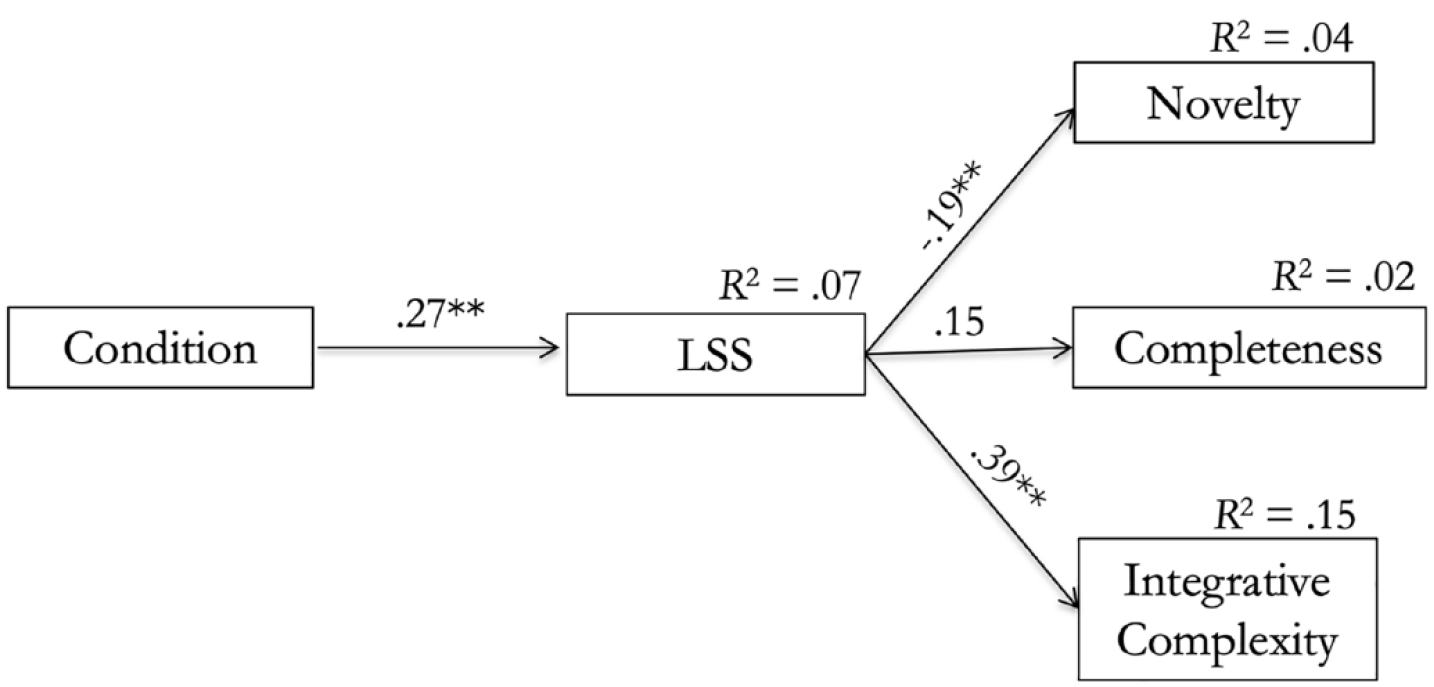
Mediation model predicting final product novelty, completeness, and integrative complexity as a function of experimental condition via latent semantic similarity (LSS).
Discussion
There has been much interest in multiteam systems recently (Zaccaro et al., 2020), and it has been suggested that this should include examination of the innovation process (Shuffler et al., 2015). However, thus far, there has been no systematic research on processes involved in intergroup creativity and its potential benefits. To our knowledge, this study is the first to experimentally vary intergroup structure and relate this to creative outcomes based on predictions derived from the cognitive information processing and network elements of our intergroup creativity model (e.g., Kenworthy, Paulus, Coursey, et al., 2022).
The results of this study suggest that the benefits of intergroup idea exchanges may be limited in short-term sessions. For example, the control condition, in which there was no intergroup access, generated a higher activity level (number of ideas and elaborations) but also higher elaboration novelty than the open-access condition, in which all group members had intergroup access; the control condition also performed as well as the brokered condition. Thus, having a broker in intergroup ideation appears to be beneficial relative to giving members open access to the ideas of another group. However, it remains to be seen in future research under what conditions the benefits of intergroup idea exchange can yield better creative outcomes than solitary group ideation. It is likely that longer sessions will result in more benefit for intergroup conditions. For example, Nijstad et al. (1999) found that with longer idea generation sessions the performance gap between group conditions and nominal conditions is greatly reduced. The intergroup process provides potential for enhanced stimulation, but attention to the ideas of the other group also limits the ability to generate additional ideas and elaborations based on such exposure in short-term sessions. Longer term sessions would be more typical in real-world intergroup contexts. Research in such settings or in laboratory experiments using longer sessions is likely to demonstrate more clearly the benefits of intergroup idea sharing. As groups inevitably slow down their idea generation process after tapping the most accessible ideas and categories (Brown & Paulus, 2002), there will be more motivation to attend to ideas generated by other groups and to build on them or integrate them with their own ideas.
Thus, there can be process loss associated with the extra demands of intergroup access just as may occur in group idea generation, depending on the paradigm (see Diehl & Stroebe, 1987). These same process losses may occur in real-world intergroup experiences. Group members may become overloaded with the dual task of tapping the creative potential of their own and of other groups. Thus, it is not surprising that intergroup transfer of innovations may be limited (Darr et al., 1995). On the other hand, in real-world creative teams, the creativity process is likely to allow more time for reflection than a relatively brief experimental session in the laboratory. Practitioners and organizational managers should certainly be mindful of such processes and allow time for both intragroup and intergroup idea exchanges and elaborations.
We found mixed support for Hypothesis 2; the open-access condition yielded over twice as many outgroup elaborations on average compared to the brokered condition, but the brokered condition produced outgroup elaborations that were significantly more novel. The brokered condition also spent considerably more time on average in the outgroup’s discussion board. A simple mathematical analysis illuminates these findings. Although the open-access condition yielded an average of 11.00 outgroup elaborations, that is an average that derives from the activity of all four group members, each of which was a potential broker. On a per broker basis, that yields only 2.75 outgroup elaborations per broker in the open-access condition, compared to 5.34 elaborations per broker in the brokered condition. It thus appears that diffusion of responsibility or social loafing occurred in the open-access condition. Apparently, having one person focused on accessing the ideas of the other group and sharing the ones deemed of value may have allowed for a narrower focus on high-quality ideas and their elaboration. Therefore, a brokered arrangement may be particularly beneficial for developing novel ideas.
The generation of novel ideas (but not elaborations) in the final idea generation stage was related to a higher level of novelty of the final product, partially supporting Hypothesis 3. This finding is consistent with prior research suggesting that the more recent ideation sessions will have the most impact on the final product, in part because they will be more salient in the group members’ memories (Coursey et al., 2019). It appears from our study that a fuller discussion of ideas does allow for the more novel content to filter into the final product. Echoing our recommendation above, practitioners should allow for and encourage collective reflection and discussion about the novel ideas that emerge during the divergent phases of group creativity.
The degree of semantic overlap of the ideas in the two intergroup conditions was higher than in the control condition, supporting Hypothesis 4a. This, in turn, was related to a less novel (perforce) but a more integratively complex final product, partially supporting Hypothesis 4b (as feasibility was excluded, and the indirect effect on completeness was not significant). The fact that the intergroup exchange process increased the semantic overlap between the groups suggests that in subsequent sessions, these two groups would have functioned more effectively in integrating their two plans into one high-quality plan. This is in line with theorizing on the importance of “social sharedness” or shared task representations (Tindale & Kameda, 2000) in group processes and decision making. The concept of shared task representations emphasizes the importance of common preferences, understanding, or mental models (Cannon-Bowers et al., 1993). In the present study, this involved shared semantic representations related to the task. Some past research on group creativity has found that exposure to common ideas can be more stimulating than exposure to novel ideas, because of the greater potential overlap (of common ideas) with associative networks of the various group members (Dugosh & Paulus, 2005).
We found no significant differences between the brokered and open-access conditions in terms of their final products (integrative complexity, feasibility, completeness, or novelty), but there was evidence that information flow is more efficient with only a single broker. The brokered condition seems to be better for intragroup engagement, for lower social loafing, and for more average time spent in the outgroup discussion board.
The group creativity literature and theoretical models provide a strong base for research on intergroup creativity. It has outlined the factors that limit and enhance collaborative creativity. These are likely to be important in intergroup idea exchange as well (Paulus & Kenworthy, 2020). For example, exposure to the ideas of others can result in fixation on a limited range of idea categories rather than on a broader range of divergent thinking (Kohn & Smith, 2011; Larey & Paulus, 1999; Smith, 2003). Fixation is likely to be a problem primarily in short-term settings in which there is no motivation to build or go beyond what has already been suggested. To counter the fixation problem, a good procedure may be to have participants first generate their own ideas before being exposed to the ideas of others. After the individual phase, the contrast between their own ideas and those of the group will be stimulating (Paulus & Kenworthy, 2019). That is what was done in our experiment. To enhance motivation to attend to the ideas of other groups, some degree of competitive motivation among the groups might also be beneficial (e.g., Baer et al., 2010).
Our study represents a test of some of the components of our intergroup creativity model, supporting the idea that a brokered intergroup network structure can be beneficial for the efficiency of intragroup creative processes. We have proposed other factors (see Kenworthy, Paulus, Coursey et al., 2022; Paulus & Kenworthy, 2020) that are likely to enhance the intergroup creative process, such as friendly, open contact between the groups in a multigroup network; a shared superordinate identity to mitigate against fault line effects; and a healthy sense of competition between groups to motivate higher performance. Future research should address these proposals.
Future studies can examine the role of the different factors we have suggested as potentially influential in the effectiveness of the intergroup creativity process. It will also be interesting to investigate the use of artificial intelligence programs or agents that can provide an additional source of stimulation. These could potentially play the role of an additional group as the ideas shared with such a platform and its output become available to the group. This may be particularly beneficial in asynchronous settings in which groups tap each other’s ideas and those of an AI platform periodically (e.g., Park et al., 2023). They may also be useful in the idea selection and final product development phases (Huang & Rust, 2022).
In practical terms, it will also be important to explore the benefits of training teams for effective interteam creativity. Brief training sessions have been useful for group creativity (Baruah & Paulus, 2008) and have been shown to be effective for enhancing creative teamwork (Marlow et al., 2018). Effective tapping of creative potential in group and intergroup settings requires a high level of motivation, careful information processing, and also group- and intergroup-level skills (Weidmann & Deming, 2021). Intergroup exchange of information and ideas for creative purposes is a reality in today’s innovation-focused world. Hopefully, future studies will continue to explore the factors that are important for enhancing the outcomes of this process.
Our study supports the importance of two elements of our intergroup creativity model (Kenworthy, Paulus, Coursey, et al., 2022): the role of attention to shared ideas and the impact of the intergroup structure. This study is also the first (to our knowledge) to examine in detail the various processes related to intergroup creativity in experimental, ad hoc groups. It also presents a novel test of a theoretical model of different phases of group creativity. Across 2-hour sessions, we examined three divergent idea generation phases and a convergent decision phase. In addition to the goal of testing components of the model of different phases of group creativity (Coursey et al., 2019; Paulus, Coursey, & Kenworthy, 2019), this study was also designed to be a simulation of intergroup creativity in real-world settings, where obtaining this kind of data is typically not feasible. We used a compelling task to increase the engagement level. The fact that we obtained more than 11,000 ideas and their elaborations, and meaningful relationships between the divergent phases and the convergent phase, suggests that we were successful.
Limitations and Theoretical Contributions
This project represents a controlled examination of intergroup creativity and related network characteristics. Real-world intergroup creativity would typically involve multiple sessions over extended periods of time with groups of diverse expertise; would very likely lack any random assignment to conditions; and would therefore be correlational at best. On the other hand, our participants were not selected for their expertise and were most likely not as motivated as those in settings where organizational or team success is dependent on effective intergroup exchanges. The brokers volunteered for the position but did not have specific training or talent for this role. Future experimental studies that involve the careful selection and training of brokers in a controlled setting would be of value.
Our measure of product “completeness” is somewhat limited. In many studies of creativity, there is a focus on persistence and depth of idea generation within categories, but also cognitive flexibility or the use of multiple categories (see De Dreu et al., 2010). Because we were interested in the effects of intergroup idea exposure on breadth of idea generation, we focused our participant instructions on novelty and completeness of category usage. One might argue that this came at the expense of potential depth of exploration within ideational categories. Indeed, both depth and category completeness could have been assessed. In Choi and Thompson (2005), the groups with member replacement (somewhat similar to our brokered groups) produced more ideas as well as ideas drawn from a greater number of idea categories, compared to closed groups and yoked controls (who had exposure to another group’s ideas without member replacement and interaction).
Another feature of our methodology that warrants experimental examination in future research is whether idea generation, evaluation, and elaboration should take place at the same time or in a more serial or linear process. Some research suggests that the linear process of generating, elaborating, and evaluating needs to be done in a specific sequence, such as idea generation first and evaluation later (Puccio et al., 2020; Rosing et al., 2018). For example, whereas in Choi and Thompson (2005) participants generated ideas first, then had exposure to other ideas, then had a subsequent idea generation phase, in our methodology (especially Phase 3), participants were asked to generate ideas; reply and elaborate; as well as evaluate, borrow, and build on ideas from the outgroup (experimental conditions). Such a methodology is consistent with a dialectical perspective which suggests that the phases can effectively occur in various orders and through multiple cycles (Bledow et al., 2009). This may be too much to effectively manage in short-term sessions. Future theory and experimental designs might examine under what conditions a serial process (e.g., Choi & Thompson, 2005) versus a parallel process (e.g., ours, here) is more effective at enhancing collaborative creativity (for a detailed discussion of this issue, see Kenworthy, Paulus, Minai, & Doboli, 2022).
That in the present study the control condition outperformed the intergroup conditions in terms of number of novel ideas is consistent with the productivity loss problem in the group creativity literature (Diehl & Stroebe, 1987). The subsequent literature demonstrated that group interactions on creativity tasks can lead to better outcomes than the collective performance of a similar number of individuals on tasks that allow for more effective exchange of ideas (e.g., electric brainstorming and brainwriting; see reviews for practitioners by Paulus & Kenworthy, 2019; Paulus et al., 2023). The benefits of group and intergroup interactions may be most evident in subsequent efforts to build on ideas (Kohn et al., 2011; Korde & Paulus, 2017). Although there may be short-term costs, difficulties, and barriers in intergroup idea exchange processes, it is likely that future research on intergroup creativity will find that intergroup exchanges involving effective processes will demonstrate significant benefits. The present study has revealed the importance of various elements of the creative interaction process for the quality of the outcomes during both the divergent and convergent stages, and contributes to our theoretical understanding of intergroup creativity and related concepts from the network literature.
Footnotes
Acknowledgements
We would like to thank the undergraduate research assistants who helped in processing and coding the data, including Nasheha Baset, Lourdes Borunda, Kayley Estes, Arianna Gomez, Sha’Niya Jacobs, Bahareh Momeniabdolabadi, Farley Morris, Thi Nguyen, Kayla Ramirez, Cortni Smith, Eric Stahl, Channing Wells, and Jacqueline Williston. We also thank graduate students Adrian Abellanoza, Jade C. Chacon, Ryan Gertner, Abu Jaed, Joel Roberts, and Belinda Williams.
Funding
The author(s) disclosed receipt of the following financial support for the research, authorship, and/or publication of this article: This research and manuscript preparation were supported by the National Science Foundation (NSF; Grant BCS-1247971, “INSPIRE: The Hunting of the Spark: A Systematic Study of Natural Creativity in Human Networks”). The ideas expressed in this paper are not those of NSF or its employees. Manuscript preparation was also supported by the Army Research Office (Grant W911NF-20-1-0213). The views and conclusions contained in this document are those of the authors and should not be interpreted as representing the official policies, either expressed or implied, of the Army Research Office or the U.S. government. The U.S. government is authorized to reproduce and distribute reprints for government purposes notwithstanding any copyright notation herein.
