



Abstract
Socioecological crises, such as the climate crisis, place a heavy burden on young and future generations. However, these generations have less influence on political and economic decisions. Older generations will be less affected by most socioecological crises but have a greater impact in terms of contribution and resolution. Therefore, young and future generations depend on older generations to act in solidarity. In a preregistered online survey study, we examined the political solidarity of older adults with young people in three countries (US, N = 399; Germany, N = 401; and Brazil, N = 403). Results show that affinity with young people and legacy motivation directly explained intergenerational political solidarity in all three countries. In the US and Brazil, quantity and quality of intergenerational contact with young people indirectly explained political solidarity through affinity. These findings suggest that increasing the closeness between generations may be a promising lever for intergenerational solidarity.
The world is currently facing multiple large-scale crises, including the climate crisis and the COVID-19 pandemic (Wallis et al., 2022). In addition to other characteristics, for example place of residence, generational affiliation influences how strongly one is affected by these crises. Young and future generations are expected to be among the most vulnerable in the climate crisis (Intergovernmental Panel on Climate Change [IPCC], 2022). Belonging to a particular generation also determines how much influence one has on issues related to coping with and addressing the respective crisis. The effect of generational affiliation on vulnerability to crises and on power is often inverse. While young adults will be among the groups most affected by the impact of future climate crises such as droughts and extreme weather events, they have relatively little say in political decisions to mitigate these crises (Hartmann, 2021; IPCC, 2022). On the other hand, older generations, who are likely to experience fewer negative climate crisis impacts, are more numerous in the electorate and occupy most of the critical positions in politics and businesses (Hartmann, 2021). For these older adults, there is a lack of immediacy between their behavior and its consequences, both socially (consequences may affect others) and temporally (consequences may unfold in the future; Hurlstone et al., 2020; Wade-Benzoni, 2008, 2019). This social and temporal distance can lead to what is known as intergenerational discounting, an underestimation of the benefits and harms of today’s phenomena, and of actions that are left to future others (Syropoulos & Markowitz, 2021; Wade-Benzoni, 2008, 2019). In our understanding, this would also entail undervaluing future consequences that will affect today’s younger generations.
Overcoming this barrier of intergenerational discounting is crucial to managing large-scale crises. Today’s generations must act now and behave in the best interest of young and future generations, potentially sacrificing rather than benefitting personally. In short, they must act in intergenerational solidarity. There are different understandings and definitions of both solidarity and intergenerational solidarity.
Intergenerational solidarity can be considered a subtype of intergroup solidarity (Sánchez et al., 2010). Early research on intergenerational solidarity focused on the micro-social level, that is, families and individuals (Bengtson & Oyama, 2010). Within this approach, Bengtson et al. define intergenerational solidarity as cohesiveness among different generations within a family (Bengtson et al., 1976).
The second level of analysis of intergenerational solidarity examines society and groups. It focuses on different age groups, understood as age cohorts (e.g., the youth, the elderly; Ryder, 1965). McQuilkin’s Intergenerational Solidarity Index falls within this approach, defining intergenerational solidarity as “investments or sacrifices that are intended to increase or sustain the well-being of future generations” (McQuilkin, 2018, p. 5), and measuring indices such as carbon footprint and forest degradation rate. Accordingly, Wade-Benzoni (2019) understands intergenerational beneficence (or solidarity, as we call it) as making sacrifices in the present for the benefit of future others (p. 4).
This study examines political solidarity, which can be understood as “allyship with a minority outgroup, a connection to their cause, and a commitment to working with them to achieve social change” (Neufeld, Starzyk, & Gaucher, 2019, p. 726). Our focus is on older people, hereafter understood as people of age 55 and older, who have an undeniable impact on many crises, both in terms of contribution and resolution. The goal was to identify factors that could motivate these older people to advocate and act in the interest of younger generations. To this end, we drew on theories and empirical evidence on how to reduce the psychological distance and increase the closeness between actors and both recipients and consequences of their behaviors. We aimed at studying intergenerational political solidarity and potential motivators across countries that differ on their social, cultural, economic, and environmental framework conditions.
Theory
One of the most prominent research lines on how to reconcile different groups’ positions is Allport’s (1954) intergroup contact theory. It postulates that, under optimal conditions, contact between groups can improve intergroup attitudes and behaviors. A large body of evidence supports the theory, showing for example that intergroup contact can yield an increased willingness to help members from other groups (e.g., Johnston & Glasford, 2018). The concept of affinity, which combines empathic concern, perspective-taking, and perceived oneness, has the potential to reduce the perceived psychological distance between today’s actors and potentially affected persons (Wade-Benzoni, 2008). Several studies suggest that affinity with future others enhances intergenerational beneficence and solidarity. To increase the perceived immediacy of consequences of one’s behavior that could unfold and affect future others, the motivation to leave a positive legacy is a promising concept (Hurlstone et al., 2020; Wade-Benzoni, 2019; Zaval et al., 2015). In the following section, the concepts of intergroup contact, affinity, and legacy motivation, and their potential role in motivating intergenerational solidarity are presented in more detail.
Intergroup contact
Intergroup contact is considered one of the key mechanisms for improving intergroup attitudes and behaviors, and promoting prosocial behavior between groups (e.g., Allport, 1954; Pettigrew & Tropp, 2006; Williams, 1947). Allport’s (1954) intergroup contact theory posits that under optimal conditions, such as equal group status, contact between groups has the potential to reduce intergroup prejudice. In their meta-analytical test of the theory, Pettigrew and Tropp (2006) combined 515 studies from a variety of contact settings and samples. The results suggest that intergroup contact tends to reduce intergroup prejudice (mean r = −.22), and that this positive effect generalizes to the entire outgroup. Intergroup contact has been shown to improve not only attitudes but also behaviors between groups. In a large-scale test of the relationship between intergroup contact and support for social change, Hässler et al. (2020) found that intergroup contact was positively related to the willingness to work in solidarity across both advantaged and disadvantaged groups. Accordingly, two studies from Johnston and Glasford (2018) suggest that high-quality intergroup contact is associated with an increased commitment to help an outgroup.
Their study shows an important distinction between the quality (“the degree to which contact is positive and cooperative”; Johnston & Glasford, 2018, p. 1186) and quantity (“the frequency with which a person comes into contact with an outgroup”; p. 1186) of intergroup contact. Researchers agree that the quality of contact is more important than its sheer frequency or quantity for improving intergroup attitudes and behaviors (e.g., Islam & Hewstone, 1993). While some studies show a positive (albeit smaller) effect of quantity of contact on intergroup attitudes and behaviors (see e.g., Brown et al., 2007; De Coninck et al., 2021; Islam & Hewstone, 1993), others found no effect of quantity on, for example, helping behavior toward the outgroup (e.g., Johnston & Glasford, 2018; Schwartz & Simmons, 2001).
Intergroup contact theory has already been tested in an intergenerational context. Pettigrew and Tropp’s (2006) meta-analytic study revealed that contact with older adults reduced prejudice toward them, with a mean effect size of r = −.18. In an experimental study, Meshel and McGlynn (2004) examined the effect of a cross-age program on attitudes and stereotypes toward members of another generation. After the 6-week contact program, both adolescents and older adults from the experimental group reported improved attitudes toward the other generation, whereas the control group showed no change in attitudes. Consistent with findings from research on other target groups (Johnston & Glasford, 2018), Bousfield and Hutchison’s (2010) cross-sectional study showed that quality, but not quantity, of intergenerational contact was positively associated with young people’s attitudes and behavioral intentions (e.g., to help in a situation of need) toward older people. In three studies, Drury et al. (2016) provided further evidence that the quality, but not quantity, of intergenerational contact has the potential to improve attitudes towards older adults. Accordingly, Kwong and Yan (2023) reported that high-quality intergenerational contact led to improved attitudes and more prosocial behavioral intentions toward older people among young adults.
Based on the intergroup contact theory and the empirical results presented, we hypothesize that both quality and quantity of contact with young adults should be positively associated with participants’ political solidarity toward younger people, although the effects of quantity may be smaller and more difficult to find.
Affinity
Several scholars have explored possible pathways through which contact between different groups improves intergroup attitudes and behaviors. Variables such as empathy (e.g., Johnston & Glasford, 2018; Pettigrew & Tropp, 2008), perspective-taking (e.g., Aberson & Haag, 2007; Pettigrew & Tropp, 2008), identification with a shared social group (Römpke et al., 2019), and inclusion of the outgroup in the self (Cadieux et al., 2019) have been shown to be relevant mediators. These variables have in common that they reduce the perceived psychological distance between members of different groups. Wade-Benzoni and Plunkett Tost (2009) combine these variables under the concept of affinity, which they define as the extent to which a person feels empathetic and connected to others. Affinity combines the variables of empathy (capacity to resonate with the feelings of others; Singer & Klimecki, 2014), perspective-taking (“cognitive capacity to draw inferences about other peoples’ beliefs, intentions and thoughts”; Singer & Klimecki, 2014, p. R875), and perceived oneness (or perceived self–other overlap, the extent to which an individual perceives someone else as a part of him or herself; Aron et al., 1992). We are aware of the extensive research on these variables and their interrelationships (e.g., Coke et al., 1978; Davis, 1980; Galinsky & Moskowitz, 2000). In the present study, however, we focus on affinity as a combination of these constructs, in accordance with Wade-Benzoni and Plunkett Tost (2009), and its role in intergenerational solidarity.
When an individual feels affinity with, and thus closer to, another person, that person’s interests are assumed to be in alignment with the individual’s self-interests. In turn, psychological distance and discounting are said to decrease the likelihood of intergenerational beneficence or, as we call it, solidarity (Wade-Benzoni, 2019; Wade-Benzoni & Plunkett Tost, 2009). This hypothesis is supported by results from an experimental study on intergenerational decision-making (Wade-Benzoni, 2008). Results show that the more affinity decision-makers expressed for future generations, the more willing they were to reduce their hypothetical fish consumption for the benefit of future generations of fishers, even if that decision reduced their personal benefits.
In addition, several studies have examined the role of the three individual components of affinity in prosocial behaviors. Empathy was shown to promote prosocial behaviors even when they were associated with personal costs (for a review, see e.g., Davis et al., 1994) or were directed toward an outgroup (Batson et al., 2002; Taylor & Glen, 2020). Perspective-taking has been shown to be a predictor of sustainable decision-making (Shahen et al., 2021) and the willingness to help outgroup members (Mashuri et al., 2013). Perceived oneness has repeatedly been shown to positively predict willingness to help (Cialdini et al., 1997; Maner et al., 2002) and actual helping behavior (Ahn et al., 2013).
Based on the theories and empirical evidence discussed, we expect participants’ affinity with young people to be positively related to their intergenerational political solidarity. We furthermore anticipate that affinity partially mediates the effects of quality and quantity of intergenerational contact on intergenerational political solidarity.
Legacy motivation
As people age, they are more likely to include in their view of the future the question of what to pass on to young and future generations (Erikson, 1963). This desire to have an impact that will outlast one’s lifespan and to build a positive legacy is defined as legacy motivation (Hurlstone et al., 2020; Wade-Benzoni, 2019). Legacy motivation has been shown to be a key mechanism for reducing intergenerational discounting and promoting intergenerational beneficence by making the consequences of one’s behavior for future others more immediate and relevant to oneself (Wade-Benzoni et al., 2010). The role of legacy motivation is often studied in environmental contexts, as nature conservation can be viewed as an act for future generations (Zaval et al., 2015). Zaval et al. (2015) confirmed the relationship between domain-general legacy motivation and pro-environmental beliefs, intentions, and behavior. They primed participants’ legacy motivation through an essay-writing task, and discovered positive effects of legacy motivation on pro-environmental beliefs, intentions, and behaviors. Accordingly, activating legacy motivation (e.g., by promoting death awareness) has been shown to reduce intergenerational discounting, leading to increased intergenerational cooperation in a climate change public goods game (Hurlstone et al., 2020).
We therefore hypothesize that participants’ legacy motivation might reduce intergenerational discounting and therefore should be positively related to their intergenerational political solidarity. See Figure 1 for the postulated structural model.
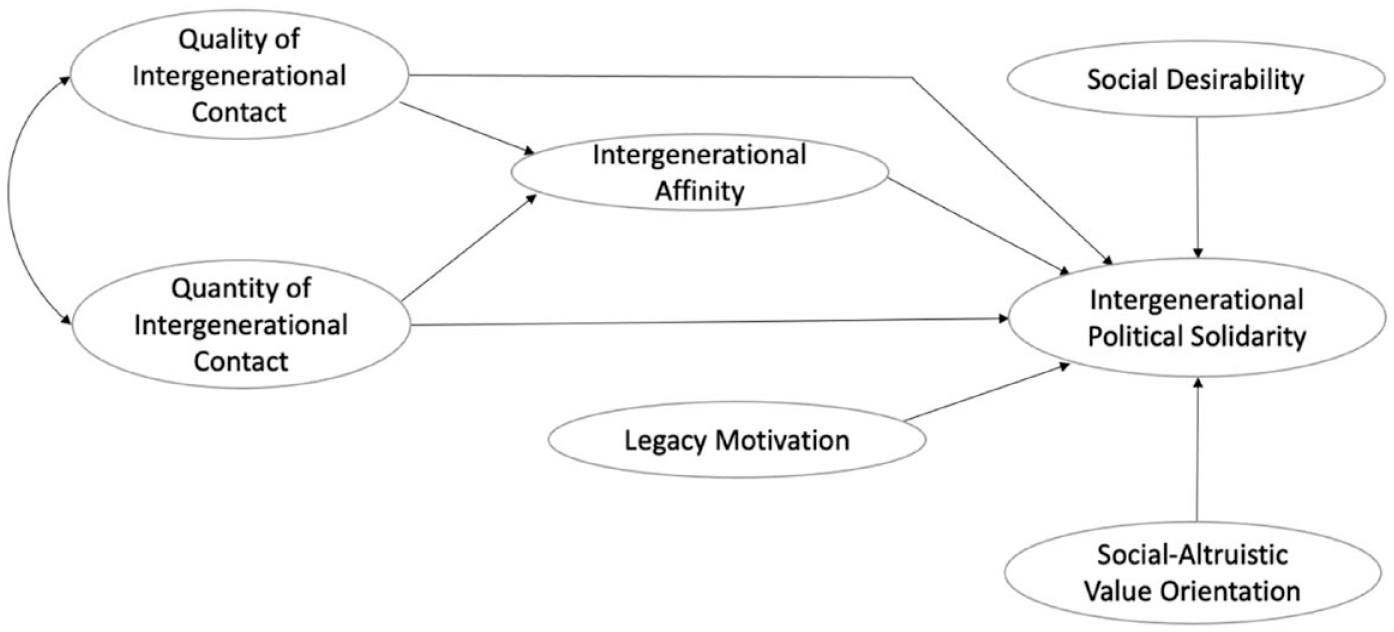
Postulated structural model.
Control Variables
Social desirability
The construct of social desirability refers to “the tendency to give overly positive self-descriptions” (Paulhus, 2017, p. 50), and is of particular relevance when assessing behaviors that are considered as socially desirable through self-reports, such as the present concept of intergenerational solidarity. Therefore, we controlled for a possible effect of participants’ social desirability on their self-reported intergenerational political solidarity.
Social-altruistic value orientation
Based on Stern et al.’s (1999) value–belief–norm theory of support for social movements, we assume that intergenerational political solidarity may also be guided by a person’s values and, in particular, motivated by his/her social-altruistic values; we therefore controlled for these. A large body of research confirms the role of social-altruistic values in prosocial and pro-environmental behavior (e.g., Cameron et al., 1998; Hilbig et al., 2014; Stern et al., 1999).
Methods
The present study was designed and conducted in accordance with the APA guidelines for the ethical conduct of research. According to German law, survey studies do not require ethical approval if anonymity is guaranteed and no sensitive contents are assessed. Furthermore, informed consent was obtained from all participants. The study was preregistered (see https://aspredicted.org/JG5_TKF).
Pretest
Prior to the main survey, a pretest was carried out with members of the target group (>54 year olds from the US, Germany, and Brazil) to evaluate reliability and validity of the scales. Pretest data were collected online from August 16 to October 5, 2022, using a convenience sample. Of the N = 60 participants who finished the survey, 39 lived in Germany, eight in the United States of America, and 13 in Brazil. Participants’ age ranged from 54 to 80 years (M = 65.28, SD = 6.57); 48.3% were male, 51.7% female. Based on the results, reverse-coded items were excluded from three scales to increase scale reliability.
Data Collection and Participants
Data for the main study were collected online by the access panel provider CINT (https://www.cint.com/) (SoSciSurvey) from November 9 to December 30, 2022 in the United States, Germany, and Brazil. Participants were financially compensated by the panel provider (they received about €2.00 for their participation).
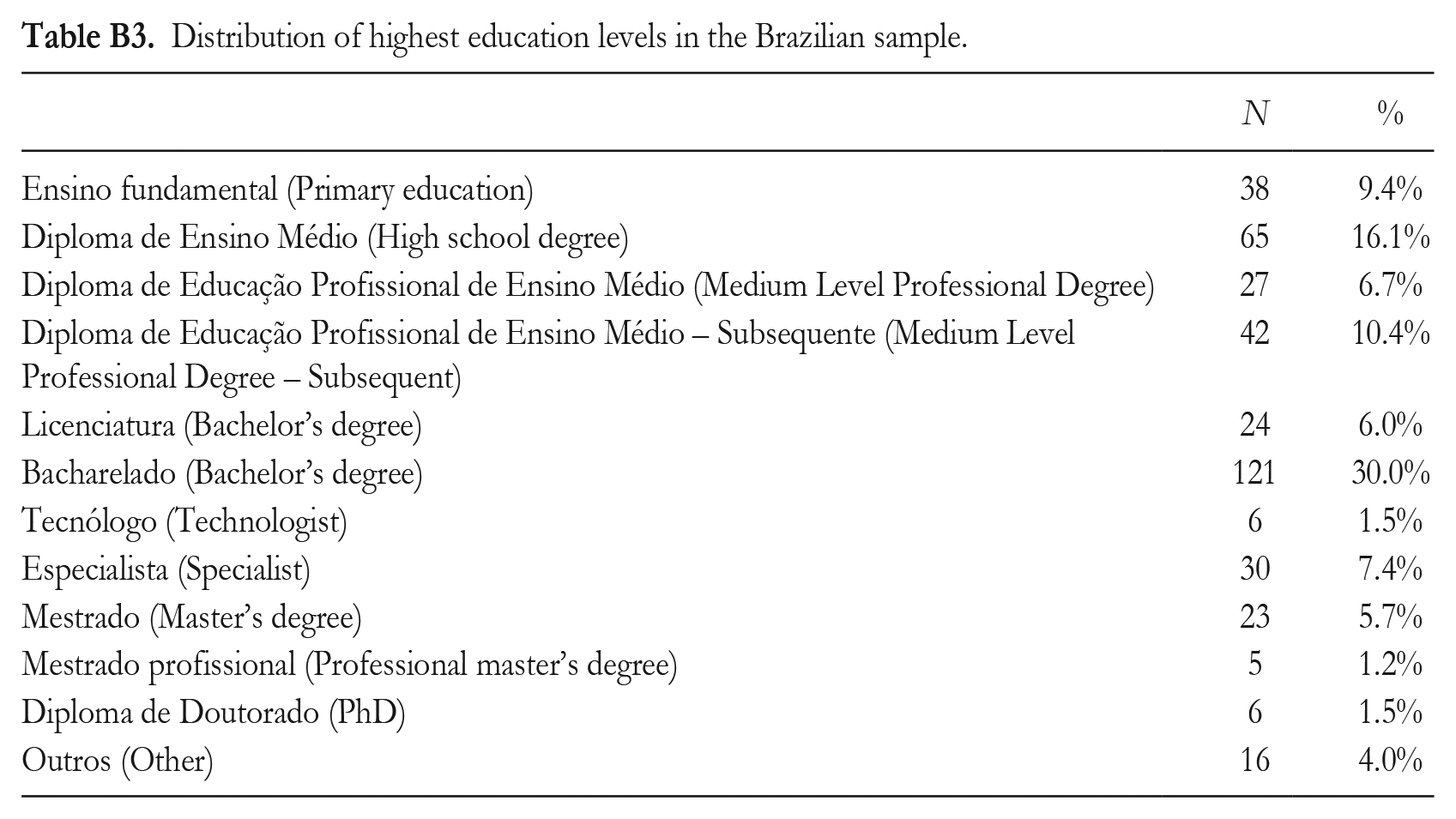
Since the postulated models were to be tested using structural equation modeling, we aimed to double the minimum sample size of N = 200 per country suggested by Kline (2011). One thousand four hundred and four people completed the survey; 186 participants were excluded due to incorrect responses to the screen question (“This is a test question. Please tick 1: ‘strongly disagree’”); nine were excluded based on mechanical answer tendencies; and one person was excluded based on answers to open-ended questions. Average answer time was 8.96 minutes (SD = 3.83; US: M = 8.70, SD = 3.65; Germany: M = 7.24, SD = 2.86; Brazil: M = 10.93, SD = 3.96). The final sample consisted of N = 1,203 persons aged 55 and older: N = 399 were from the US; N = 401 from Germany; and N = 403 from Brazil. To achieve representativeness for each country, we drew on public records regarding the assessment and distribution of age, gender, and education: USA, National Center for Education Statistics (2021); Germany, Statistisches Bundesamt (2020); Brazil, Organisation for Economic Co-operation and Development (OECD, 2022). For the variables age and education, we merged the answers into groups, for example, low, medium, and high education. We only allowed for minor deviations from the reported representative distributions. The samples were representative of each country’s population in terms of gender and age. An attempt was made to obtain samples representative in terms of education as well. However, for all three countries, and especially for Brazil, the lowest level of education (i.e., primary/elementary education) was not sufficiently represented (in Brazil, almost half of those aged 54 and older have no secondary education; see Tables B1–B3 in Appendix B for the distribution of highest education levels in each sample).
The US sample consisted of 186 males and 213 females. Age ranged from 55 to 88 years (M = 65.12, SD = 6.18). The German sample consisted of 185 males and 216 females. Age ranged from 55 to 87 years (M = 65.06, SD = 6.10). The Brazilian sample consisted of 187 males and 214 females; two participants chose the option “diverse.” Age ranged from 55 to 87 years (M = 64.03, SD = 6.31).
Measures
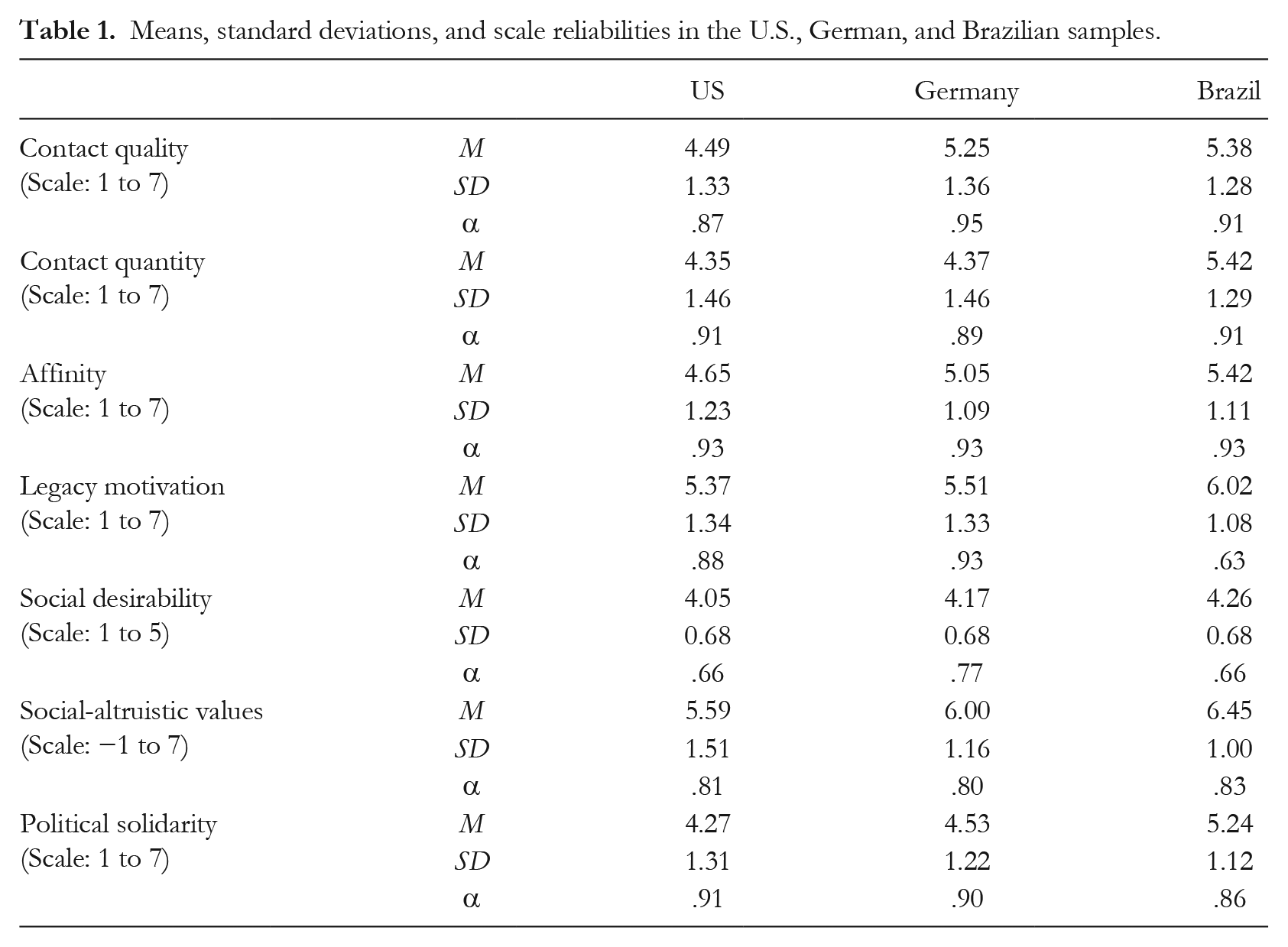
All items and answer scales can be found in Appendix A (Table A1). Separate scale reliabilities for each country can be found in Table 1.
Means, standard deviations, and scale reliabilities in the U.S., German, and Brazilian samples.
Predictor variables
Quality of intergenerational contact
Quality of intergenerational contact was measured with five items adapted from Islam and Hewstone (1993) and Lolliot et al. (2015). Participants were asked to what extent they experienced contact with young people in certain ways (e.g., as equal). Answers were assessed on a 7-point Likert scale (1 = not at all, 7 = very). Scale reliability: Cronbach’s α = .89.
Quantity of intergenerational contact
Quantity of intergenerational contact was measured with seven items adapted from Islam and Hewstone (1993) and Lolliot et al. (2015). Participants were asked how much contact they had with young people in various settings (e.g., as neighbors, as family members). Answers were assessed on a 7-point Likert scale (1 = none at all, 7 = a great deal). Participants were given the option “not applicable.” The item inquiring about contact quantity at work had to be excluded since 194 participants from Germany, 206 from the US, and 124 from Brazil chose the option “not applicable.” Scale reliability: Cronbach’s α = .89.
Affinity toward young people
Affinity toward young people was assessed based on the construct definition by Wade-Benzoni (2008) and included three scales: empathic concern, perspective-taking, and perceived oneness. Scale reliability: Cronbach’s α = .93.
Empathic concern
Empathic concern was assessed using six items from Batson (1987). Participants were asked to describe how strongly they felt six emotions toward young people (e.g., sympathetic, compassionate). Answers were assessed on a 7-point Likert scale (1 = not at all, 7 = a great deal).
Perspective-taking
Perspective-taking was assessed with three items (e.g., “It is easy for me to put myself in the shoes of young people”) adapted from Batson and Ahmad (2009), on a 7-point Likert scale (1 = strongly disagree, 7 = strongly agree).
Perceived oneness
Perceived oneness was assessed with two items. Participants were presented with the Inclusion of Other in the Self Scale from Aron et al. (1992) depicting seven Venn diagrams, and they were asked to select the graph that best described their relationship with young people. They were furthermore asked to indicate the extent to which they would use the term “we” to describe themselves and young people (Cialdini et al., 1997). Answers were assessed on a 7-point Likert scale (1 = not at all, 7 = extremely).
Legacy motivation
Legacy motivation was assessed with four items adapted from Wade-Benzoni et al. (2010) and Zaval et al. (2015). An example of the items is, “It is important to me to leave a positive legacy for young generations.” Answers were assessed on a 7-point Likert scale (1 = none at all, 7 = a great deal). Scale reliability: Cronbach’s α = .83. The reliability would have increased to .92 if the item “It is important to me to avoid leaving a negative legacy for young generations” would have been dropped. However, the item was not excluded because it covers an important aspect of legacy motivation (Wade-Benzoni et al., 2010).
Criterion
Political solidarity with young people
Political solidarity with young people was assessed with items adapted from Hässler et al. (2020); Neufeld, Gaucher, et al. (2019); Shnabel et al. (2016); and Stern et al. (1999), and supplemented with two new items. Items were, for example, “Young people should obtain more power in the decision-centers of our society” and “I would be willing to accept cuts in my standard of living to ensure a good future for young people.” Answers were assessed on a 7-point Likert scale (1 = strongly disagree, 7 = strongly agree). Scale reliability: Cronbach’s α = .90.
Control variables
Social desirability
Social desirability was measured with three items adapted from Kemper et al. (2012). Participants were asked to indicate the extent to which the statements applied to them (e.g., “In an argument, I always remain objective and stick to the facts”). Answers were assessed on a 5-point Likert scale (1 = doesn’t apply at all, 5 = applies completely). Scale reliability: Cronbach’s α = .70.
Social-altruistic value orientation
Social-altruistic value orientation (hereafter social-altruistic values) was measured using three items from Stern et al.’s (1998) Brief Inventory of Values. Participants were asked to which extent they considered three values (e.g., social justice, correcting injustice, care for the weak) as guiding principles in their lives. Answers were assessed on a 9-point Likert scale (−1 = opposed to my values, over 0 = not important, 7 = of supreme importance). Scale reliability: Cronbach’s α = .82.
Planned Statistical Analyses
Prior to analyzing and comparing the postulated model in the three countries, measurement invariance was tested using multigroup confirmatory factor analysis (MG-CFA). A multiple-group structural equation model was then computed to test the predicted model in the three countries using the “lavaan” package in R (Rosseel, 2012). Since the criterion (intergenerational political solidarity) was not normally distributed, maximum likelihood with robust (MLR) Huber–White correction of standard errors and a Yuan–Bentler equivalence test statistic was used as a robust estimator. Given the use of a robust estimator, no bootstrapping technique was used. Missing values were excluded case-wise (only existent for the variable quantity of intergenerational contact). Because we had a fairly large sample, we report chi-squared values for descriptive purposes only, as they are sensitive to small deviations in large samples (Bentler & Bonett, 1980; Fischer & Karl, 2019). Instead, we use goodness-of-fit indices to assess model fits (Chen, 2007; Fischer & Karl, 2019).
Results
Descriptive Statistics and Bivariate Correlations
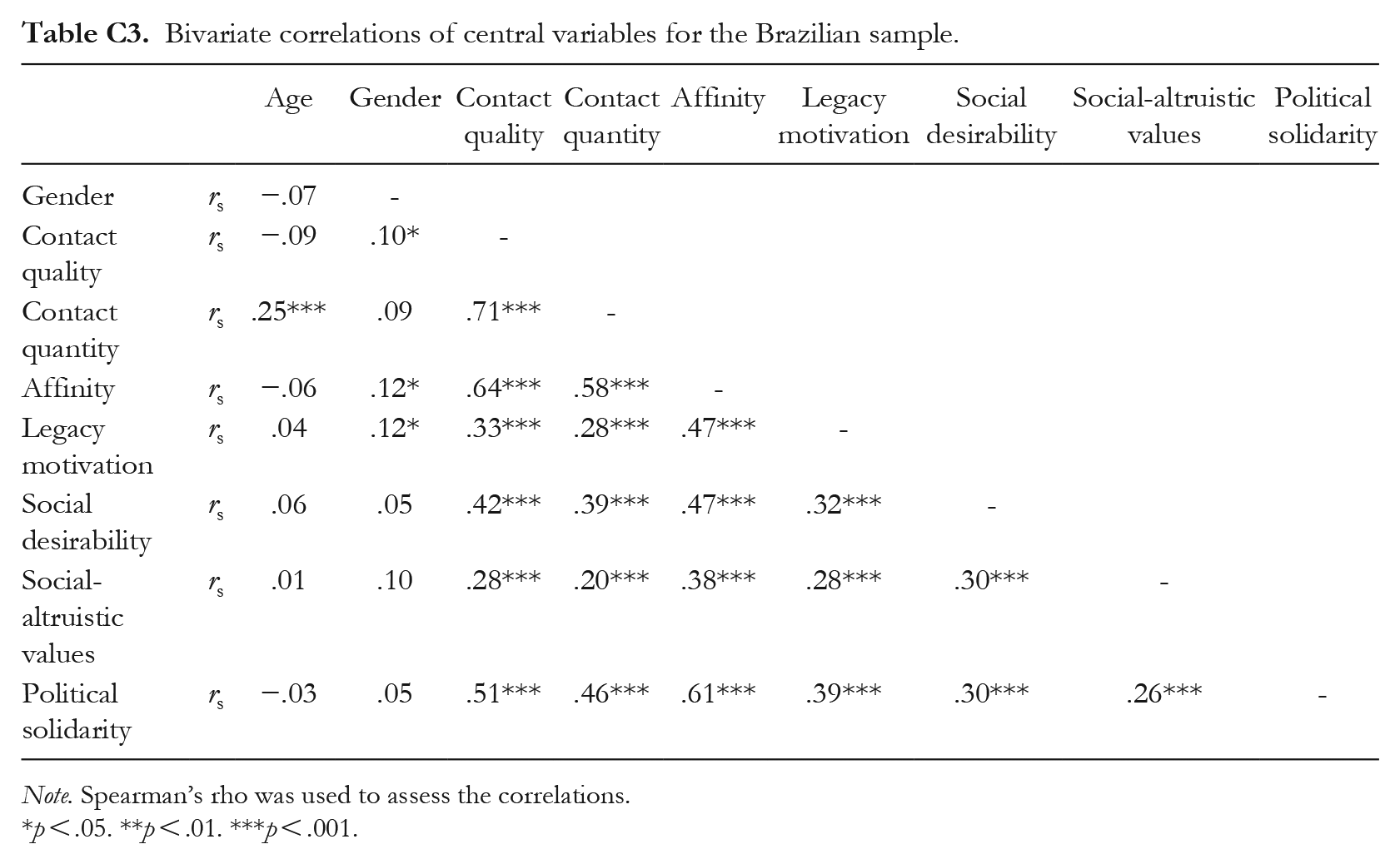
Table 1 shows the means, standard deviations, and scale reliabilities of the central variables for each country. Means, standard deviations, and bivariate correlations for the three countries combined can be found in Table 2. Separate bivariate correlations for each country can be found in Appendix C (Tables C1–C3). Because the scales of interest (predictor variables, control variables, criterion) were not normally distributed, Spearman’s rho was used to assess bivariate correlations.
Means, standard deviations, and bivariate correlations in the three countries combined.
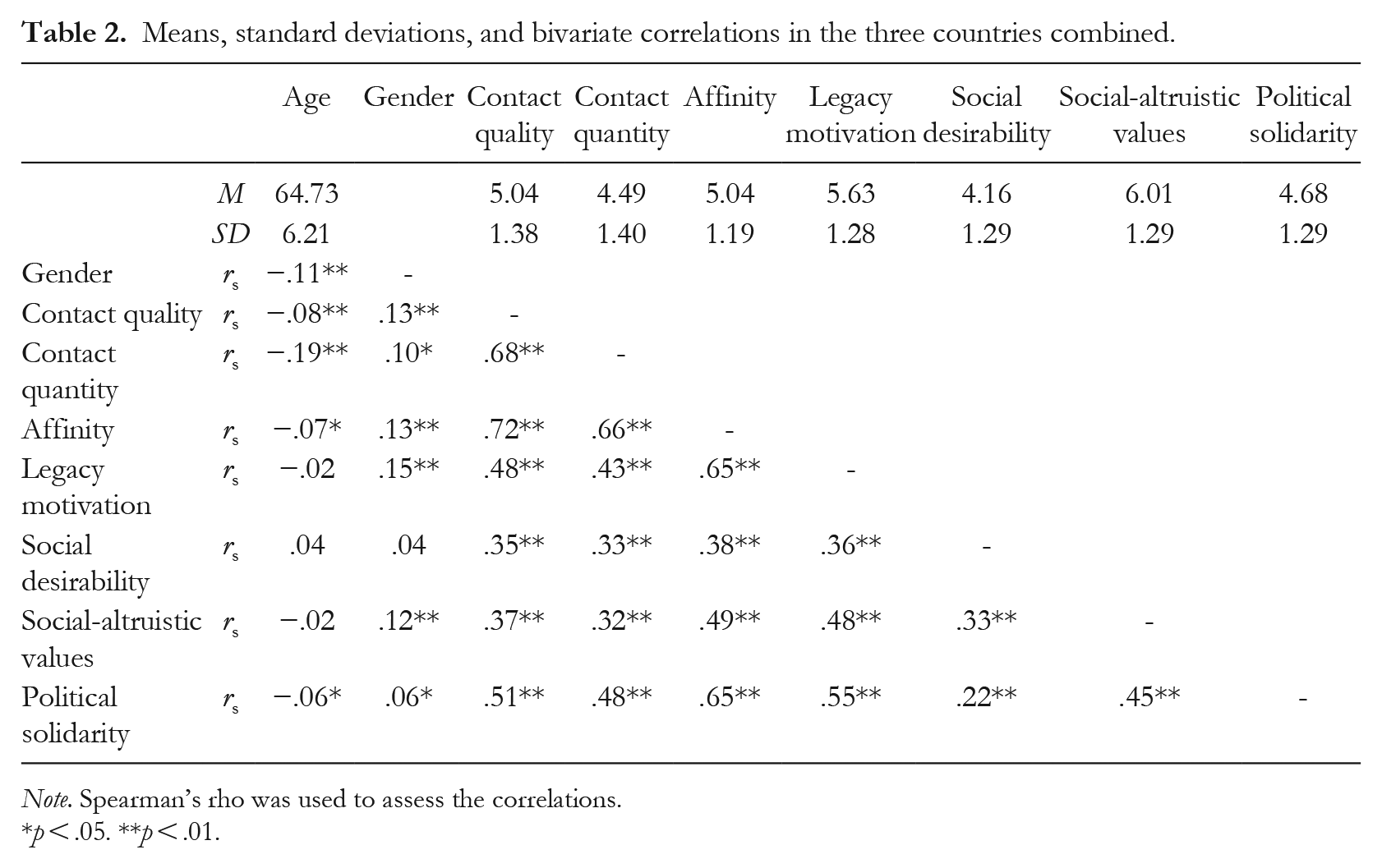
Note. Spearman’s rho was used to assess the correlations.
p < .05. **p < .01.
When examining the descriptive statistics and comparing them across the three countries, the pattern of mean values stands out the most. For all variables, mean values were the lowest for U.S. participants, and highest for Brazilian participants (see Figure C1 in Appendix C for a visual representation of the means and standard errors of the means for each country). Social-altruistic values were relatively high in all three countries.
Correlations between the potential motivators (quality and quantity of contact, affinity, legacy motivation), the control variables (social desirability, social-altruistic value orientation), and the criterion intergenerational political solidarity, all pointed in the predicted directions (see Table 2). When considering the three countries together, age was, as one could expect, negatively related to reported quality and quantity of contact and affinity with younger people. It showed no significant relation to legacy motivation, but a negative one to intergenerational political solidarity. Identifying as female was positively associated with all variables studied. The strongest bivariate correlations of intergenerational political solidarity were found with affinity and legacy motivation.
Measurement Invariance Test
First, we checked for measurement invariance across the three countries using multigroup confirmatory factor analysis (MG-CFA). We used the delta-fit heuristic to identify potential losses in model fit performances when applying configural, metric, and scalar measurement invariance. We compared the fit indices of three models that assumed different levels of measurement invariance: (a) configural measurement invariance (imposing the same factor structure on all three countries, but not equal factor loadings and item intercepts); (b) metric measurement invariance (imposing same factor structure and equal factor loadings, but not item intercepts); (c) scalar measurement invariance (imposing same factor structure, and equal factor loadings and item intercepts). Results indicated that metric measurement invariance was present (ΔRobust CFI = .01, ΔRobust RMSEA = −.000, ΔSRMR = −.02).
In a next step, we tested for partial scalar measurement invariance by freeing only certain item intercepts (based on modification indices) while retaining fixed factor loadings and the same factor structure for the three countries. By freeing four of the 42 item intercepts (see boldfaced items in Table A1, in Appendix A), the model fit improved from Robust CFI = .88 to .90; Robust RMSEA = .063 to .057; and SRMR = .082 to .075, reducing the differences in fit indices below the acceptable threshold suggested by Chen (2007; ΔCFI ⩽ .01, ΔRMSEA ⩽ .015, ΔSRMR ⩽ .01). We therefore consider the model to be partially scalar measurement invariant across the three countries, allowing for intergroup comparisons (Borsboom, 2006; Steenkamp & Baumgartner, 1998).
Structural Equation Model
Multigroup structural equation modeling (MG-SEM) with MLR estimator was used to test the postulated model. Across the three countries, the postulated model had a decent fit (Robust CFI = .90, Robust TLI = 0.90, Robust RMSEA = .06; Hu & Bentler, 1999).
United States of America
The model explained 59.1% of the variance in the criterion intergenerational political solidarity among U.S. participants (see Figure 2 below and Figure D1 in Appendix D for the measurement and structural models). Participants’ intergenerational affinity was explained by the quality (β = .66, 95% CI [0.54, 0.77], p < .001) and quantity (β = .17, 95% CI [0.05, 0.29], p = .007) of the intergenerational contact they reported to have with young people. When inspecting the confidence intervals of the standardized regression coefficients, one can see that the association of affinity with contact quality was significantly higher than its association with contact quantity. The two intergenerational contact measures were significantly correlated (r = .58, 95% CI [0.50, 0.67], p < .001). Participants’ affinity with young people significantly explained their intergenerational political solidarity (β = .43, 95% CI [0.26, 0.59], p < .001) and emerged as the strongest predictor. Neither quality (β = .01, 95% CI [−0.16, 0.18], p = .918) nor quantity (β = −.04, 95% CI [−0.17, 0.08], p = .477) of intergenerational contact significantly explained the criterion directly, but indirectly explained it through affinity (quality: β = .28, 95% CI [0.15, 0.41], p < .001; quantity: β = .07, 95% CI [0.02, 0.11], p = .010). Legacy motivation significantly explained the criterion with β = .28 (95% CI [0.13, 0.41], p < .001).
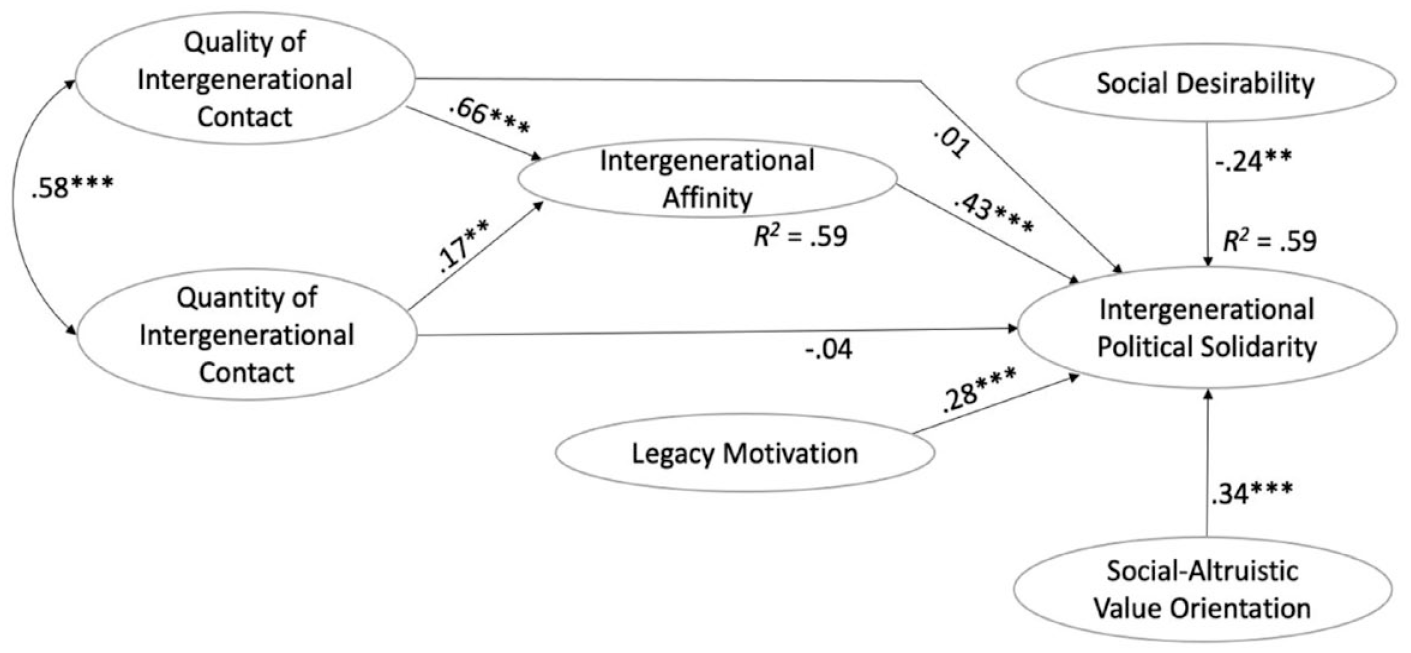
Structural model predicting intergenerational political solidarity in the US sample.
The control variables significantly explained the criterion (social desirability: β = −.24, 95% CI [−0.38, −0.10], p = .001; social-altruistic value orientation: β = .34, 95% CI [0.20, 0.48], p < .001), with the effect of social desirability in the opposite direction to the one predicted.
Germany
The model explained 52.5% of the variance in the criterion political solidarity in the German sample (see Figure 3 below and Figure D2 in Appendix D for measurement and structural models). Participants’ affinity with young people was significantly explained by the quality (β = .74, 95% CI [0.65, 0.84], p < .001) but not quantity (β = .10, 95% CI [−0.02, 0.22], p = .088) of intergenerational contact. Quality and quantity of intergenerational contact were positively related (r = .63, 95% CI [0.55, 0.72], p < .001). Neither of the two intergenerational contact measures had a direct effect on intergenerational political solidarity (quality: β = .04, 95% CI [−0.13, 0.20], p = .644; quantity: β = −.08, 95% CI [−0.20, 0.05], p = .219). Quality of intergenerational contact indirectly explained the criterion through affinity, whereas quantity of contact did not (quality: β = .28, 95% CI [0.11, 0.44], p = .001; quantity: β = .04, 95% CI [−0.01, 0.08], p = .112). As hypothesized, participants’ intergenerational political solidarity was predicted by their affinity with young people (β = .37, 95% CI [0.16, 0.59], p = .001) and their legacy motivation (β = .40, 95% CI [0.22, 0.57], p < .001). Neither of the control variables explained the criterion (social desirability: β = −.05, 95% CI [−0.20, 0.11], p = .560; social-altruistic value orientation: β = .06, 95% CI [−0.07, 0.18], p = .401).
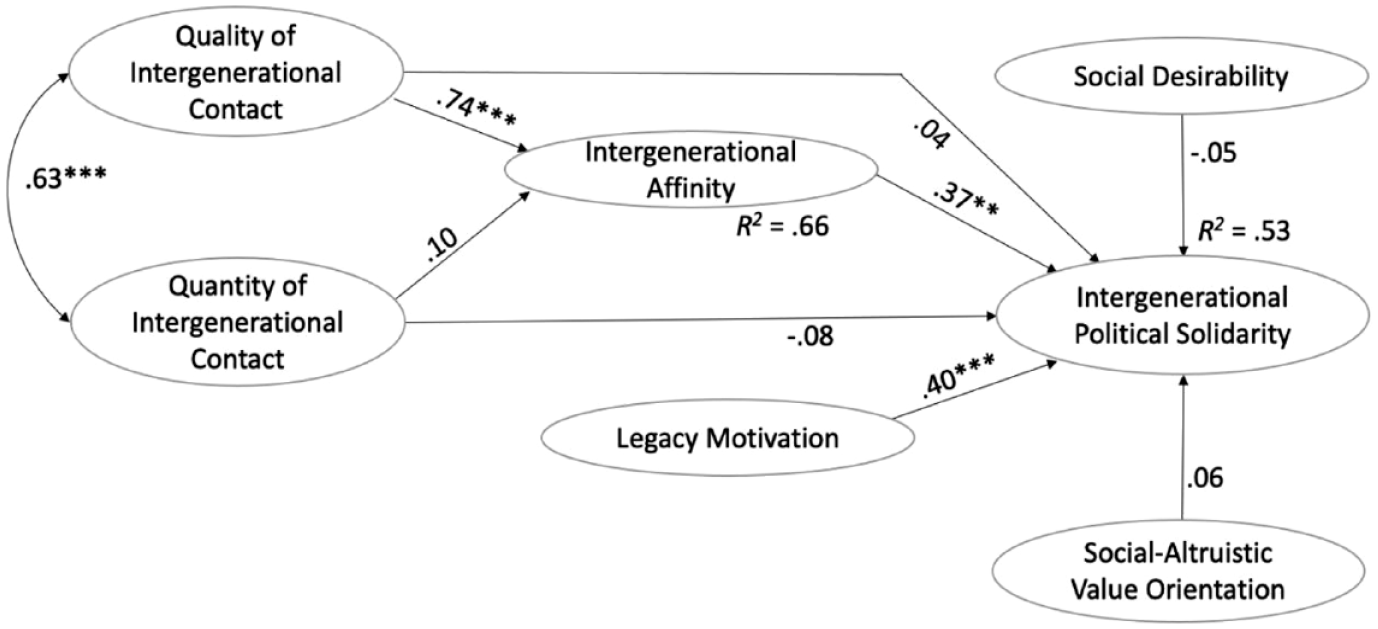
Structural model predicting intergenerational political solidarity in the German sample.
Brazil
The model explained 38.9% of the variance in the criterion political solidarity in the Brazilian sample (see Figure 4 below and Figure D3 in Appendix D for measurement and structural models). The quality (β = .42, 95% CI [0.26, 0.58], p < .001) and quantity (β = .20, 95% CI [0.03, 0.37], p = .018) of intergenerational contact significantly explained participants’ affinity with young people. Quality and quantity of intergenerational contact were again positively related (r = .82, 95% CI [0.76, 0.88], p < .001). Neither of the contact measures directly explained the criterion (quality: β = .12, 95% CI [−0.04, 0.28], p = .149; quantity: β = −.07, 95% CI [−0.20, 0.06], p = .291). However, both quality (β = .19, 95% CI [0.10, 0.28], p < .001) and quantity (β = .09, 95% CI [0.01, 0.17], p = .032) of intergenerational contact indirectly explained the criterion through affinity. Intergenerational political solidarity was again predicted by participants’ affinity with young people (β = .45, 95% CI [0.30, 0.60], p < .001) and legacy motivation (β = .19, 95% CI [0.001, 0.38], p = .048). While social desirability was not related to the criterion (β = −.05, 95% CI [−0.18, 0.08], p = .462), social-altruistic value orientation did significantly explain participants’ intergenerational political solidarity (β = .10, 95% CI [0.004, 0.20], p = .041).
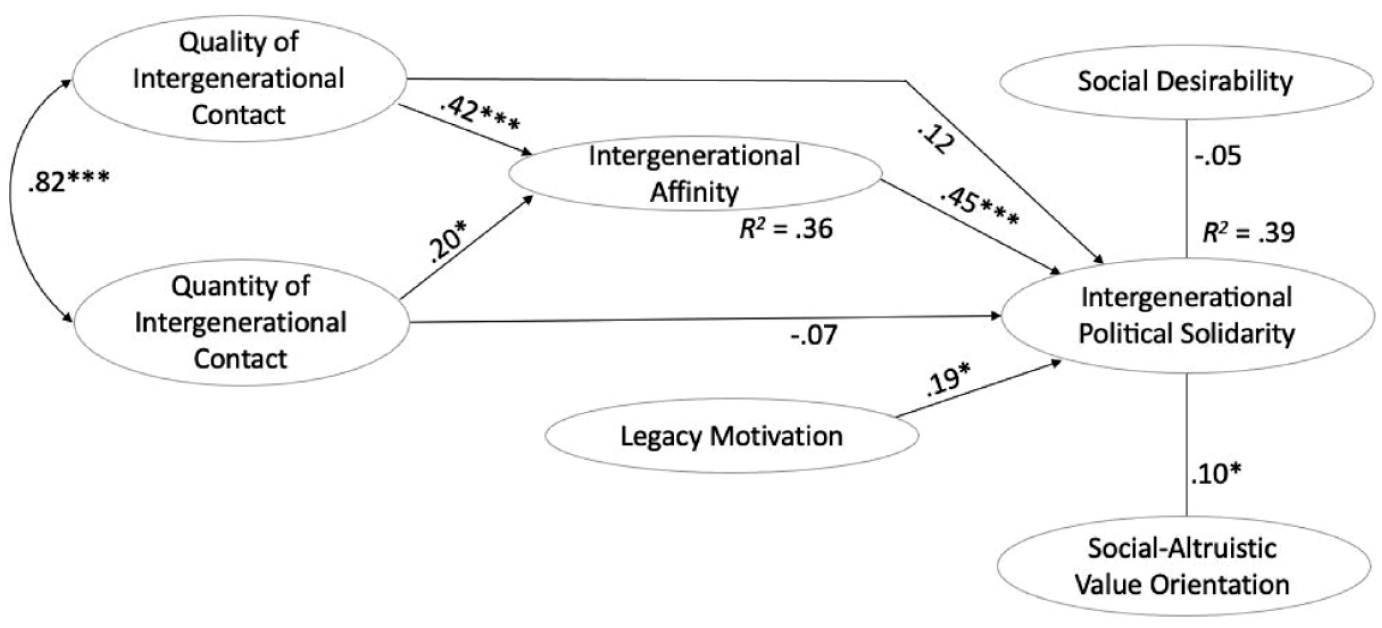
Structural model predicting intergenerational political solidarity in the Brazilian sample.
Discussion
The world is currently facing a multitude of large-scale crises. Although the full consequences of some of these crises will only unfold in the future, it is essential that today’s generations take action. Groups with greater influence need to lend their voices to those more affected and less heard. Our aim was to postulate a model that could successfully explain older adults’ intergenerational political solidarity in different countries.
Predicting Intergenerational Political Solidarity
When conducting cross-national research, it is crucial that cross-country comparisons are actually valid. Since partial scalar measurement invariance was ensured, we were able to interpret and compare the results of the structural equation model test across the three countries.
The postulated model had a decent fit across the three countries, and explained between 38.9% (Brazil) and 59.1% (US) of the variance in the criterion of intergenerational political solidarity. As hypothesized, and consistent with previous evidence on the facilitating role of intergenerational affinity in intergenerational beneficence (Wade-Benzoni, 2008), affinity with younger people significantly explained intergenerational political solidarity among U.S. Americans, Germans, and Brazilians. We therefore assume that higher levels of empathy, perspective-taking, and perceived oneness with young people could be negatively associated with psychological distance and intergenerational discounting, and in turn positively related to behaviors that benefit young people without entailing personal benefits or even sacrifices for older people.
Furthermore, our results confirm the mixed evidence on the role of intergroup contact. Quality of intergenerational contact showed a consistent positive and strong relation with affinity with younger people across the three countries, and thus might be a promising lever to increase connectedness between different generations. However, our results on the role of contact quantity are mixed. Although quantity of contact was positively related to intergenerational affinity among U.S. Americans and Brazilians, this relation was significantly smaller than the relation between affinity and contact quality. Moreover, the relationship between contact quantity and affinity did not prove significant among Germans.
In the US and Brazil, the indirect effects of contact quality and quantity on the criterion, mediated through affinity, turned out significant. The indirect effects of contact quality were considerably larger than the indirect effects of contact quantity. In Germany, only quality of intergenerational contact showed an indirect effect on participants’ intergenerational political solidarity through affinity. These findings are consistent with previous research, which unanimously points out the dominant role of quality of intergroup contact in improving intergroup attitudes and behaviors, and the mixed evidence on the role of quantity of contact (see e.g., Drury et al., 2016 for intergenerational contact; Islam & Hewstone, 1993 for interreligious contact). We can therefore confirm that an increase in particularly the quality of contact with younger people is related to an increase in the affinity experienced with them, which in turn is positively associated with intergenerational political solidarity among older adults. However, when interpreting the indirect effects of both quality and quantity of intergenerational contact, one has to keep in mind their high intercorrelation in all three countries.
As initially discussed, intergenerational solidarity can be hindered both by the social distance between decision-makers and the people affected by their decisions, as well as by the temporal distance between them and the consequences of their decisions. Consistent with previous research (e.g., Hurlstone et al., 2020), legacy motivation was associated with higher levels of intergenerational political solidarity in all three countries. While our study focuses on solidarity with younger people, this finding is also promising for the promotion of solidarity behaviors with people in a more distant future, for whom leverage points such as contact are not available since recipients are not yet born.
As desired, our variables predicted intergenerational political solidarity even when controlling for social desirability and social-altruistic value orientation. We wanted to ensure that our results were not guided by participants’ socially desirable answers. Moreover, our results suggest that, while social-altruistic values were relevant predictors in the U.S. and Brazilian samples, it takes more than these values to explain and promote intergenerational political solidarity. It is also worth noting that the only significant relationship we found between social desirability and intergenerational political solidarity (in the US) was negative. According to Crowne and Marlowe (1964), social desirability is motivated by an individual’s need to respond in culturally sanctioned ways. However, cultural norms about what is appropriate vary greatly across cultures and countries (Johnson & van de Vijver, 2003). Intergenerational political solidarity might have been perceived as more or less socially desirable across the three countries, and perhaps as not socially desirable in the US.
Limitations
The present study has several shortcomings that must be held in mind when interpreting the results. The correlational design of the study does not allow for causal inferences. Future research should therefore examine the causal relationships between intergenerational contact, affinity and legacy motivation, and intergenerational solidarity.
Great efforts were made to draw samples that are representative in terms of education. Yet, the panel provider did not succeed in drawing samples representative of the different education levels. While the distribution of education was nearly representative for the U.S. American and German samples, the same cannot be said for Brazil. According to the OECD, nearly 60% of Brazilians aged 55 to 64 have not completed upper secondary education (i.e., high school), and only about 15% of this age group have completed tertiary education (OECD, 2022). Despite multiple survey rounds, individuals from the lower educational group were not sufficiently represented.
Combining the three variables of empathy, perspective-taking, and perceived oneness into the variable of affinity can be critically discussed, particularly against the background of existing research on the causal relationship between these variables (see e.g., Coke et al., 1978; Galinsky & Moskowitz, 2000) and the overarching issue of in- and outgroups (e.g., Dovidio et al., 2010; Turner, 1975). However, the good internal consistency of the scale and the factor matrix from the CFA support the proposed unidimensionality of the affinity construct as proposed by Wade-Benzoni (2008). Future research, however, could further examine the interaction of these three variables in relation to intergenerational solidarity.
Implications for Future Research and Practice
The present study applied established theories on how to reduce social and temporal distance and improve intergroup attitudes and behaviors to examine solidarity between generations. While the present study provides preliminary insights into potential motivators of intergenerational political solidarity, further research is needed to examine the causal relationships between the variables of intergenerational contact, affinity, legacy motivation, and political solidarity. Future research should investigate additional pathways through which affinity might be increased. Research from Wade-Benzoni et al. (2008) suggests that thinking of future others as one’s offspring or progenies might increase affinity with these future others, indicating a potential positive relationship between affinity and legacy motivations.
Furthermore, the role of parenthood should be examined in this context, since transitioning into parenthood has been shown to motivate environmental engagement through the activation of legacy motives (green parenthood effect; Shrum et al., 2023).
To measure political solidarity directed at younger generations, we combined well-established scales of political solidarity and policy support and actions. Future research could test the scale in other contexts and target groups, as this study shows partial scalar measurement invariance in three different countries.
Our results suggest that, across different countries, there is such a thing as political solidarity with younger generations and a certain willingness to forego personal benefits for the sake of younger people. In all three countries, both affinity with young people as well as legacy motivation emerged as relevant predictors. They could therefore be considered as potential levers to promote intergenerational solidarity, for example, by initiating intergenerational perspective exchange or by appealing to individuals’ awareness of their impact on future others.
It appears that particularly high-quality intergenerational contact may improve affinity with younger generations, which in turn may promote intergenerational solidarity. While further research is needed on the causal role of contact in the intergenerational setting, enabling intergenerational encounters could reduce the perceived distance between generations and increase affinity and thus solidarity.
Conclusion
To our knowledge, the present study is one of the first to explicitly examine intergenerational political solidarity. In the face of crises such as the climate one that involve and affect different generations, it is of the utmost importance to promote solidarity with the most affected and least influential generational groups. Findings from three countries suggest that older people are more willing to show political solidarity with younger people when they feel affinity with them and when they express a higher legacy motivation. High-quality intergenerational contact seems promising for increasing intergenerational affinity and might indirectly promote intergenerational political solidarity.
Footnotes
Appendices
Appendix B
Distribution of highest education levels in the Brazilian sample.
| N | % | |
|---|---|---|
| Ensino fundamental (Primary education) | 38 | 9.4% |
| Diploma de Ensino Médio (High school degree) | 65 | 16.1% |
| Diploma de Educação Profissional de Ensino Médio (Medium Level Professional Degree) | 27 | 6.7% |
| Diploma de Educação Profissional de Ensino Médio – Subsequente (Medium Level Professional Degree – Subsequent) | 42 | 10.4% |
| Licenciatura (Bachelor’s degree) | 24 | 6.0% |
| Bacharelado (Bachelor’s degree) | 121 | 30.0% |
| Tecnólogo (Technologist) | 6 | 1.5% |
| Especialista (Specialist) | 30 | 7.4% |
| Mestrado (Master’s degree) | 23 | 5.7% |
| Mestrado profissional (Professional master’s degree) | 5 | 1.2% |
| Diploma de Doutorado (PhD) | 6 | 1.5% |
| Outros (Other) | 16 | 4.0% |
Appendix C
Bivariate correlations of central variables for the Brazilian sample.
| Age | Gender | Contact quality | Contact quantity | Affinity | Legacy motivation | Social desirability | Social-altruistic values | Political solidarity | ||
|---|---|---|---|---|---|---|---|---|---|---|
| Gender | r s | −.07 | - | |||||||
| Contact quality | r s | −.09 | .10* | - | ||||||
| Contact quantity | r s | .25*** | .09 | .71*** | - | |||||
| Affinity | r s | −.06 | .12* | .64*** | .58*** | - | ||||
| Legacy motivation | r s | .04 | .12* | .33*** | .28*** | .47*** | - | |||
| Social desirability | r s | .06 | .05 | .42*** | .39*** | .47*** | .32*** | - | ||
| Social-altruistic values | r s | .01 | .10 | .28*** | .20*** | .38*** | .28*** | .30*** | - | |
| Political solidarity | r s | −.03 | .05 | .51*** | .46*** | .61*** | .39*** | .30*** | .26*** | - |
Note. Spearman’s rho was used to assess the correlations.
p < .05. **p < .01. ***p < .001.
Appendix D
Acknowledgements
We thank Lukas Engel for his statistical advice and Laura Kockhans for her assistance with formatting of the manuscript.
Funding
The author(s) disclosed receipt of the following financial support for the research, authorship, and/or publication of this article: This work was supported by the Deutsche Bundesstiftung Umwelt (DBU; Grant No. 20020/692).
