



Abstract
Why are people willing to denounce or, contrarily, to keep silent on others’ misconduct? We hypothesized that people would be more likely to cheat, and consequently less likely to blow the whistle, when among an ingroup (vs. outgroup). In two experiments, participants witnessed a same nationality or a different nationality group member cheating during a group task. Participants either had the opportunity to cheat themselves before witnessing this cheating act (Experiments 1 and 2) or did not have this opportunity (Experiment 2). In the ingroup condition, participants cheated more and denounced others’ cheating less than in the outgroup condition (Experiments 1 and 2). However, when participants were not allowed to cheat themselves, they equally denounced ingroup and outgroup cheaters (Experiment 2). This provides evidence that cheating mediates the group effect on whistleblowing and is reminiscent of omertà, that is, the code of silence among criminals. We provide suggestions for future research.
Let’s suppose that you witness an office mate doing something illegal; you can choose to report this to the authorities or to let it slide. Which would you choose? Would it make a difference if the wrongdoer was visiting from a different branch of your organization? Or would it make a difference if you yourself had done something similar? We argue, from the perspective of social identity theory (SIT; Tajfel, 1974, 1978; Tajfel & Turner, 1979), that whistleblowing—the act of externally reporting any person’s misconduct to stop illicit activity (Jubb, 1999)—can be inhibited when individuals themselves have broken the rules (e.g., by cheating), which itself can be more likely when individuals are in the company of ingroup rather than outgroup members. Such a general hypothesis resonates with the Italian concept of omertà, the code of silence (Cutrera, 2015) that appears to be a widespread phenomenon in organizations where members protect each other notwithstanding their wrongdoings, from omertà in organized crime (Travaglino & Abrams, 2019), to the protection afforded to sexual harassers (e.g., Smith, 2018), to the “blue wall of silence” in many police departments (Nolan, 2009).
Moral Social Identity
If you were to ask people about valuable personal characteristics, both for themselves and for others, they would likely mention moral values like sincerity and honesty (Graham et al., 2013). For this reason, people more often fall to the temptation to act unethically in their self-interest if they can avoid negative updates of their positive self-concept (Ayal & Gino, 2012; Mazar et al., 2008). Beyond personal identity, morality is also a very important aspect of the groups with which one identifies. SIT (Tajfel & Turner, 1979) proposes that people derive a great part of their self-concept from their groups, and thus prefer to belong to positive groups that reflect positively on their self-concept. For instance, identifying as a member of a moral group can lead people to use their group membership as a source to feed (moral) aspects of their self-concept (Leach et al., 2007). Likewise, observing outgroup transgressions increases the salience of injunctive ethical norms, motivating people to maintain a different, and positive, social identity (Brewer, 1993b; Tajfel & Turner, 1986) by engaging in ethical behaviors (Gino, Ayal, & Ariely, 2009).
Consequently, people can be motivated to act according to moral norms of their own groups in order to earn respect as an ingroup member (Ellemers et al., 2008; Pagliaro et al., 2011) and to preserve the moral value of their social identity in comparison with other groups (Gausel et al., 2012; Iyer & Leach, 2008; Täuber & van Zomeren, 2012). Not all research, however, presents such a rosy picture of the group effect on morality. Consider, for instance, ingroup favoritism: when individuals identify themselves and similar others as members of the same social group (e.g., religion, language; Abrams et al., 2000), they tend to favor those members more than outgroup members (Tajfel & Turner, 1979). Moreover, people tend to forgive (Otten, 2009) and discount ingroup moral transgressions more than outgroup transgressions, especially when they benefit the group (Hofmann et al., 2018; van der Toorn et al., 2015) or when they no longer represent a threat to the group’s identity (Rullo et al., 2017). However, research on the black sheep effect has also shown the opposite effect: ingroup members who violate salient prescriptive norms are judged more harshly than outgroup members who commit the same violation (Castano et al., 2002; Marques & Yzerbyt, 1988; Marques et al., 1988; Rullo et al., 2015). In other words, shared membership may not always result in more favorable views of norm violators mainly because they can represent a threat to the positive social identity of the group, especially in an intergroup setting, inducing people to distance themselves from the violator in order to restore the threatened positive identity of the group.
In sum, people want to be moral and be part of groups that they perceive as moral, but also they can disregard morality in some situations. What predicts which path will be followed? On one hand, based on research that has argued that social identity (Hewstone, 1996) loses some of its normative influence as groups become less salient, self-categorization as a group member also becomes less salient when people are solely among their ingroup (e.g., Messick & Brewer, 1983). Consequently, people could rely more heavily on their self-interest to guide their behavior when group identity is less salient—for instance, they could be more likely to break group accepted rules and help create an environment in which these rules can be broken without penalty. On the other hand, when people are confronted with an outgroup, self-categorization as group members may become more salient (Brewer, 1991, 1993a; Deaux, 1996; Morrison et al., 2009) and lead them to feel responsible for the positive image of their ingroup. This, in turn, may lead them to maximize the group’s reputation to “outsiders”—in the present case, by following the rules and blowing the whistle on rule-breakers.
Cheating, Whistleblowing, and Social (Im)moral Behavior
Whistleblowing is a precious means to detect corruption and restore justice, holding a crucial role in moral and legal regulation (Brown et al., 2008; Miceli & Near, 1988; Near & Miceli, 2016). For this reason, the question of why and when people report others’ misconduct to an external party has received considerable research interest, especially in the organizational literature (e.g., Mesmer-Magnus & Viswesvaran, 2005; Watts & Buckley, 2017). In order for whistleblowing to occur, there of course needs to be some kind of rule-breaking that is known to at least one other person. These circumstances are at least fairly typical; numerous studies have found that cheating is not most common when people are alone, and presumably safe from witnesses, but instead when they are in groups that are full of potential witnesses (Conrads et al., 2013; Gino et al., 2013; Kocher et al., 2017; see Leib et al., 2021 for a meta-analysis). Research rooted in SIT (Gino, Gu, & Zhong, 2009) argues that this phenomenon is related to the presence of “bad apples” who are psychologically close to these potential witnesses and who normalize unethical behavior. An implication of this research is that people can feel comfortable breaking the rules in the presence of their ingroup, even if this opens the possibility of whistleblowing.
Researchers have fairly recently begun to investigate when people blow the whistle, including against fellow group members. There are clearly varied motivations that could increase whistleblowing, for instance, monetary rewards or other extrinsic incentives (Miceli & Near, 2013; Near & Miceli, 2008). In contrast, some scholars cast a group-based perspective on whistleblowing. For example, Misch et al. (2018) found that children were less likely to blow the whistle on ingroup mates, at least for nonsevere offenses. Clearly, group membership could provide at least some protection for rule-breakers.
Other recent sociopsychological research has explicitly cast the decision to blow the whistle in moral terms: that people are motivated to blow the whistle—or to not—by concerns for the well-being of specific others (Cailleba & Petit, 2018; Dungan et al., 2019; Lindblom, 2007; Lopez et al., 2014; Miceli et al., 2009; O’Sullivan & Ngau, 2014; Sekerka & Bagozzi, 2007; Watts & Buckley, 2017). In particular, these scholars have focused on two moral principles: fairness, or the requirement for equal treatment, and loyalty, or the preferential treatment of special groups (Dungan et al., 2015; Uys & Senekal, 2008). Fairness motivations, unsurprisingly, can predict increased whistleblowing (Dungan et al., 2019; Waytz et al., 2013). Loyalty, conceived as a feeling towards group members, has instead been found to predict decreased whistleblowing (Waytz et al., 2013). The sum of this research can provide two important implications: People can be more likely to cheat when among their ingroup (e.g., Gino, Ayal, & Ariely, 2009), and can be more likely to remain silent about this cheating when they feel loyal to a (cheating) group member (e.g., Waytz et al., 2013).
Omertà and the Mediating Role of Cheating
According to this research, there could be two different but congruent main effects of group membership: One effect on the willingness to cheat and another on the (reduced) willingness to blow the whistle. In the present research, we propose that these three variables—group membership, cheating, and whistleblowing—can be articulated in the same model whereby willingness to cheat should mediate the group membership effect on willingness to blow the whistle. This hypothesis is supported by two sets of results. On the one hand, research has shown that loyalty to the ingroup increases cheating (Pulfrey et al., 2018). On the other hand, several studies showed that the amount of past cheating behaviors among students decreases their tendency to speak up on other students’ cheating, and increases their tendency to perceive whistleblowing as a disloyal practice (Bernardi et al., 2011, 2012, 2016). However, these lines of research did not investigate whether ingroup membership, actual cheating, and reduced whistleblowing are indeed associated. Moreover, up to now, the effect of shared membership on dishonesty was investigated in terms of normative influence, that is, when people were aware of the presence of another ingroup member behaving dishonestly (e.g., Gino, Gu, & Zhong, 2009); to our knowledge, this is the first study to explore the effect of the mere presence of ingroup members on dishonesty (i.e., even when people are not aware of other ingroup members’ dishonest behavior).
These three variables should be linked in the following sequence. First, people will feel more comfortable cheating when among their group—that is, the mere presence of ingroup members could facilitate cheating, even if group members do not see other members cheat. Second, cheaters would be strategically less likely to blow the whistle on fellow ingroup cheaters when eventually they do see them cheat. This can create an environment in which rules can be broken without penalty, specifically because the witnesses to rule-breaking are themselves rule-breakers who benefit from this environment. However, people should be less likely to cheat, and more likely to blow the whistle, when they are among an outgroup. In these situations, people can be less motivated by self-interest and more so by a desire to maximize their own group’s reputation, that is, by acting as a moral exemplar.
The ingroup membership–cheating–reduced whistleblowing association is reminiscent of omertà, where people who categorize themselves as members of a criminal organization are motivated to not blow the whistle on their criminal group mates (Cutrera, 2015). Noncheaters, on the other hand, would not be bound by this type of loyalty and could be more likely to blow the whistle—whistleblowers should recognize the observed unethical behaviors as unacceptable, even if they are committed by someone close to them, and would not stain themselves with the same wrongdoing.
The Present Research
Thus, we hypothesize that group interaction with ingroup members, as opposed to outgroup members, should lead to increased cheating (H1) and decreased whistleblowing (H2). Moreover, we hypothesize that group interaction with ingroup members, as opposed to outgroup members, should lead to decreased whistleblowing because people tend to cheat themselves (H3). In other words, we predict that the effect of interacting with ingroup members on reduced whistleblowing is mediated by the increased tendency to cheat. That is, we expect that it is the increase in cheating behavior when interacting with ingroup members—and not with outgroup members—that reduces whistleblowing, rather than the mere tendency to cover up ingroup members more than outgroup members. To the best of our knowledge, the latter hypothesis is the first attempt to connect personal cheating with reduced whistleblowing.
To investigate our predictions, we conducted an online marketplace task with three-person groups. We simulated partners’ cheating by inflating their performance for greater pay. We built two experiments by varying two factors: (a) matching participants with partners that had either the same versus a different national identity (Experiments 1 and 2); (b) providing or not participants with the opportunity to cheat before observing their (ingroup vs. outgroup) partner’s cheating behavior (Experiment 2).
Alternative Hypotheses
Although we propose a mediational model between group membership, cheating, and whistleblowing, previous research could also support alternative hypotheses. For the sake of exhaustivity and fairness, we also present such hypotheses. For instance, Anvari et al. (2019) proposed that identification with a group that disapproves of cheating predicted increased whistleblowing. If this is thought of as a kind of loyalty towards group ideals, instead of towards group members, then group membership could also predict whistleblowing against group members. Further, not all research is as bullish on the influence of social identity processes, as in the case of Gross and De Dreu (2020), who recently argued that the essentially person-based tendency to follow the rules could lead to what could be called “honesty contagion.” This could imply that cheating, and consequently whistleblowing, among the outgroup and ingroup would be equal insofar as there is an equal number of rule-followers in each group. Furthermore, it is possible that people could be more trusting of their ingroup (e.g., Brewer, 2008) and, consequently, that it is trust and not group membership per se that increases willingness to cheat and inhibits whistleblowing. We will analyze the possibility of these alternatives as we assess our proposed hypotheses.
Experiment 1
To test our predictions, in Experiment 1, participants were given the opportunity to cheat for self-interest by misreporting their final payoff after having performed an online group task in groups of people sharing the same or a different nationality. Moreover, they were later given the opportunity to report the misreporting provided by another (simulated) group partner. We predicted that when working with same, as opposed to different, nationality group members, participants would be more likely to misreport their final payoff (i.e., cheating) and less likely to report cheating from other partners.
Method
Participants and design
A sample of 108 UK participants was recruited through Prolific Academic for £3.00 plus a bonus according to their performance at the task. From this original sample, two participants were removed because they failed to correctly answer more than three of seven questions about their understanding of the experimental task. 1 We arbitrarily set this cut-off because it represents more than half of the answers wrong (i.e., 3.5). Moreover, three participants claimed, in the comments section after the experimental task was completed, that they did not believe that the other group members were real. Accordingly, we did not include these participants. Thus, the final sample consisted of 103 participants (51 women; mean age M = 24.4, SD = 7.65). The experiment was programmed with JATOS (Lange et al., 2015). Sample size was determined by recruiting approximately 50 participants per cell (Simmons et al., 2013).
Procedure
We told participants they would take part in a decision-making task within three-person groups. Participants first self-rated their degree of national identification by using a six-item scale adapted from Mael and Ashforth (1992; e.g., “I feel proud to be English”). Internal reliability of this measure was adequate (α = .78).
Membership manipulation
Participants then read that, to perform the group task, they had been matched with two other online participants having the same (UK) or different nationalities as them (randomized as either Spanish or French, to avoid the effect of specific stereotypes attached to a specific nationality); in reality, the other participants were computer-generated. They were randomly assigned to the same national identity condition (N = 50) or to a different national identity condition (N = 53), and then reported the perceived trustworthiness of the other two participants by responding to an eight-item scale taken from Jarvenpaa et al. (1998; e.g., “The people in this group are very trustworthy”). Internal reliability was satisfactory (α = .88).
Task functioning
Afterwards, participants read the instructions to carry out the task. Participants were asked to imagine that they were partners in a company operating in the stock market. The purpose of the task was to invest in order to increase personal and company earnings. Participants received 10 university units (1 UU = £0.10) as their “personal capital” that they could use to buy market stocks. The instructions announced that the task would involve two rounds, but in fact all data collection occurred in the first round, given that the second round was not actually performed due to a simulated error. In each round, they could choose among five stocks that had a cost varying from 1 to 5 UU. Each stock could either result in a loss, equal to its cost, or in a gain equal to twice the value of its cost. For example, a stock with a cost of 3 UU could provide a gain of 6 UU or a loss of 3 UU. The task was described as a lottery in which the chance to gain or lose value was 50%, although the task was designed so that each stock gained value. Any funds not spent on stocks remained with the participant as personal capital. To justify engaging a group of participants in the task, participants were informed that they could double their personal earnings by achieving a “company bonus” if, in the group, the sum of individual winnings was equal to or greater than eight. The task was designed so that the group bonus threshold was always reached in order to avoid any confounding effect of the desire to cheat to benefit the group. In other words, even if the individual winnings varied, the group bonus remained the same. After reading the instructions and doing a test trial, the participants performed the first round. At the end of the first round, participants were allowed to see each player’s gains or losses.
Cheating behavior
After completing the first round, participants were displayed an error screen (“Error 404 Not Found”) and, a few seconds later, they were redirected to a new screen informing them that a connection interruption caused the loss of the data concerning their performance. Participants were thus asked to manually report the value of their gains; they were free to cheat by reporting higher than actual gains. When participants reported their actual gains, their behavior was coded “no cheating,” and given the value of 0; when they reported higher than actual gains, their behavior was coded as “cheating,” and given the value of 1. To confirm their earnings, participants were also presented a table summarizing the reported earnings of all players in the session. The table displayed that one of the players (P2-cheater) reported a higher than actual payout while another player (P3-honest) reported the true amount.
Whistleblowing
After having seen the table, participants read that they had to wait for the researcher to process their payments; in the meantime, a chat room appeared and they had the opportunity to chat with the researcher or with the two other partners. In order to underline the intentional cheating behavior of P2, we simulated a chat message in which P2 wrote to have purposely misreported his gains and was sure that their cheating would go undetected: “Good! They lost their data! I said I won more than I really did. You?” Participants could reply to this message, end the session, or chat with the experimenter. There were also two other opportunities to actively report the cheating by sending a further message to the experimenter or using the comments and suggestions box at the end of the experiment. If participants either informed the researcher or left a message in the comments box to report P2’s cheating, we coded this behavior as “direct whistleblowing,” with the value of 1. If participants did not take either of these steps, we coded this behavior as “omertà”—the absence of whistleblowing—with the value of 0. Before leaving the experiment, participants were also asked to confirm or disconfirm the information provided in the earnings table (Did the table accurately report your(nationality)/P2’s (nationality)/P3’s(nationality) earnings? Yes/No). In order to maintain the salience of the partners’ group, each question indicated the partners’ nationality. When participants replied “No” and thus signaled an error in the table, we coded this behavior as “indirect whistleblowing,” with the value of 1. When participants replied “Yes” and thus actively “covered” the cheating, we coded this behavior as “omertà,” with the value of 0. We relied on the indirect whistleblowing measure in order to deeply explore the tendency to report wrongdoing over and above the individual cost associated with the act of writing down a message. Indeed, participants might not send a message to report the misconduct out of laziness.
Thus, by providing them with the opportunity to report misconduct by simply disconfirming the wrong information (rather than actively writing a message), we believe participants may be encouraged to blow the whistle. On the other hand, by giving them the possibility to cover up a wrongdoing by confirming an incorrect information (rather than simply skipping the possibility to send a message to the experimenter), we were able to collect an additional measure of their motivation to cover up the cheater.
Partner evaluation
Before indicating their demographic information, be thanked, and fully debriefed, participants evaluated the two other participants on four items: loyal (reversed), fair (reversed), pleasant (reversed), and immoral. Participants responded to these items for both participants. Internal reliability was adequate for both partners: (cheating) Partner 2 (α = .84) and (noncheating) Partner 3 (α = .82).
Results
Preliminary analyses
Descriptive statistics and zero-order correlations are reported in Table 1. No correlations were found between age, gender, and our dependent variables so we did not consider these factors in our analysis.
Descriptive statistics and bivariate correlations: Experiment 1
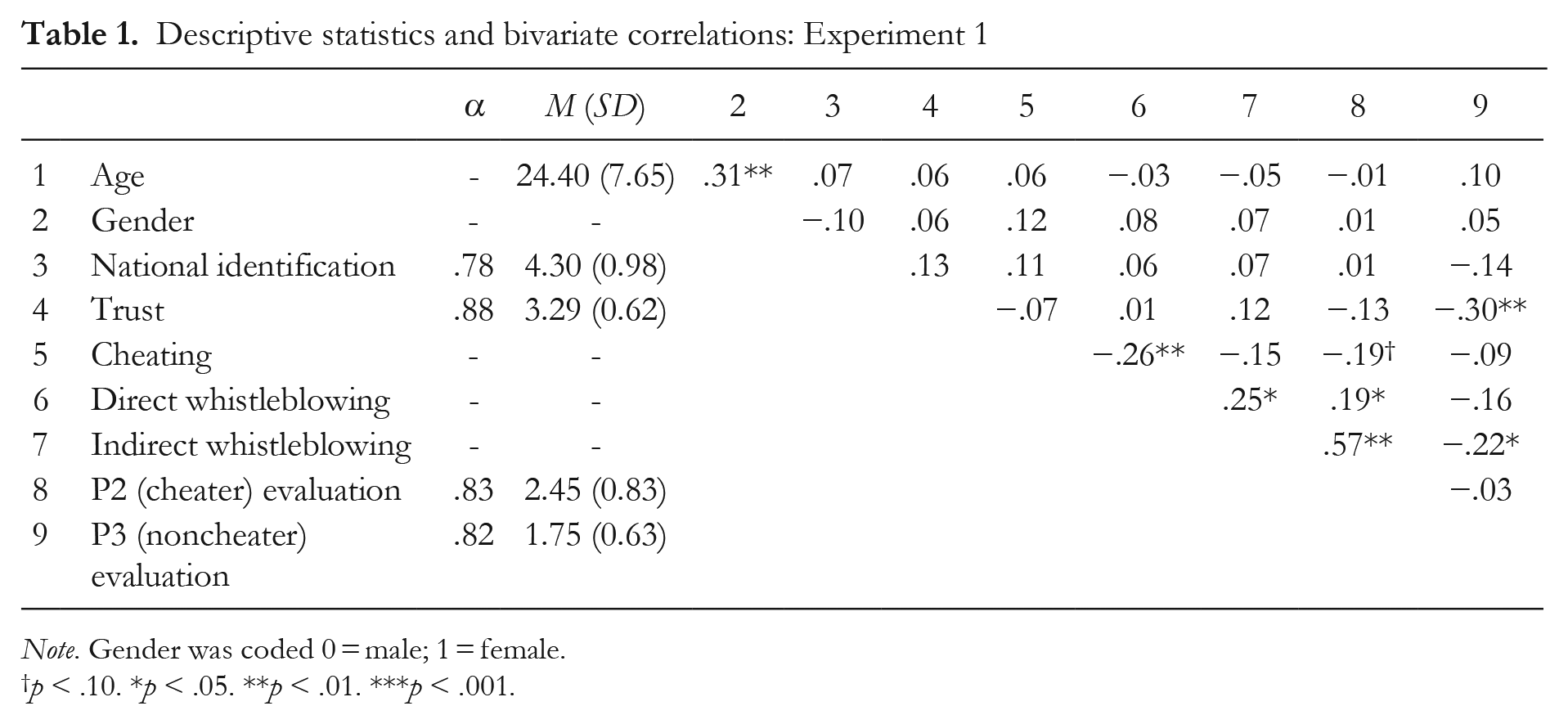
Note. Gender was coded 0 = male; 1 = female.
p < .10. *p < .05. **p < .01. ***p < .001.
National identification
A one-way ANOVA was performed to test for differences in national identification between the two experimental groups. The results did not show any statistically significant differences in identification, F(1, 101) = 1.89, p = .17, η2p = .02. Furthermore, we conducted a one-sample t test comparing the mean identification score of all participants to the midpoint of the response scale (3.5). Our results indicated that participants identified with their nation significantly above the midpoint, M = 4.30, SD = 0.98; t(102) = 8.26, p < .001, d = 0.81. This represents a large effect size, and consequently we have evidence that our participants felt national identification.
Partner evaluation
We performed a 2 (partners’ identity: same nationality, different nationality) x 2 (partner: P2 [cheater], P3 [noncheater]) mixed-model ANOVA, with repeated measures on the second factor. The main effect of partners’ identity was not significant, F(1, 101) = 0.31, p = .57, η2p = .00, while the main effect of partners’ cheating behavior was significant, F(1, 101) = 44.83, p < .001, η2p = .31, f = .67, showing that the cheater (P2) was evaluated more negatively (M = 2.45, SD = 0.83) than the noncheater (P3; M = 1.75, SD = 0.63). The interaction effect was nonsignificant, F(1, 101) = 1.32, p = .25, η2p = .01.
Cheating behavior (H1)
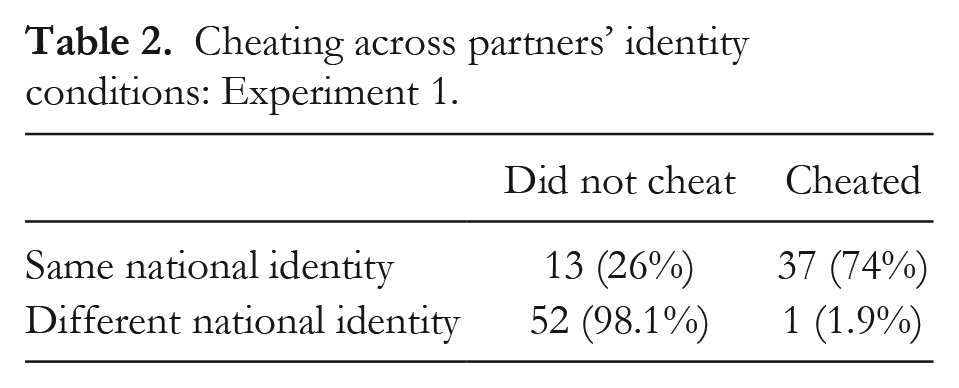
We computed the difference between the amount of gains won during the task and the amount manually reported by participants after the simulated loss of data. When participants reported gains equal to the actual gains, their behavior was coded 0 (no cheating), while when they reported higher gains than the actual ones, their behavior was coded 1 (cheating). One participant reported lower than actual gains, which was coded as 0. Results are displayed in Table 2. Thirty-seven of the 50 participants (74%) in the same nationality condition cheated, as opposed to just one participant of the 53 (1.9%) in the different nationality condition. A chi-square test showed that participants’ cheating behavior was not equally distributed across group composition conditions, χ2(1) = 57.46, p < .001, w = .75.
Cheating across partners’ identity conditions: Experiment 1.
Direct whistleblowing (H2)
Results are displayed in Table 3. Four of the 50 participants (8%) in the same nationality condition directly blew the whistle, as opposed to 15 of the 53 (28.3%) who did so in the different nationality condition. A chi-square test showed that direct whistleblowing in the same nationality and in the different nationality condition was not equally distributed between the two groups, χ2(1) = 7.04, p = .008, w = .26.
Omertà and direct whistleblowing across partners’ identity: Experiment 1.

Indirect whistleblowing (H2)
Results are displayed in Table 4. Thirty of the 49 participants (61.2%) in the same nationality condition indirectly blew the whistle, as opposed to 36 of the 45 (80%) who did so in the different nationality condition. A chi-square test showed that the written report of the cheating behavior in the same nationality and in the different nationality condition was not equally distributed between the two groups, χ2(1) = 3.95, p = .04, w = .20.
Omertà and indirect whistleblowing across partners’ identity: Experiment 1.

In order to control for the possibility that our participants were generally likely to accuse the different nationality partner of cheating, we also assessed indirect whistleblowing towards the noncheating Partner 3 as a function of experimental condition. Eight of the 49 participants (16.3%) in the same nationality condition indirectly blew the whistle, as opposed to three of the 45 (6.7%) who did so in the different nationality condition. A chi-square test did not provide any evidence that indirect whistleblowing was not equally distributed between the two groups, χ2(1) = 2.11, p = .14.
Relationship between cheating and whistleblowing
The test of H3 was beyond the scope of Experiment 1, but in order to provide a preliminary assessment of the relationship between cheating and whistleblowing, we tested if either direct or indirect whistleblowing was equally likely across participants who either did or did not cheat. Results are shown in Table 5. Seventeen of the 65 participants (26.2%) who did not cheat directly blew the whistle, as opposed to two of 38 participants (5.3%) who cheated. A chi-square test showed that direct whistleblowing was not equally distributed between groups of cheating and noncheating participants, χ2(1) = 6.95, p = .008, w = .26.
Omertà and whistleblowing across cheaters and noncheaters: Experiment 1.
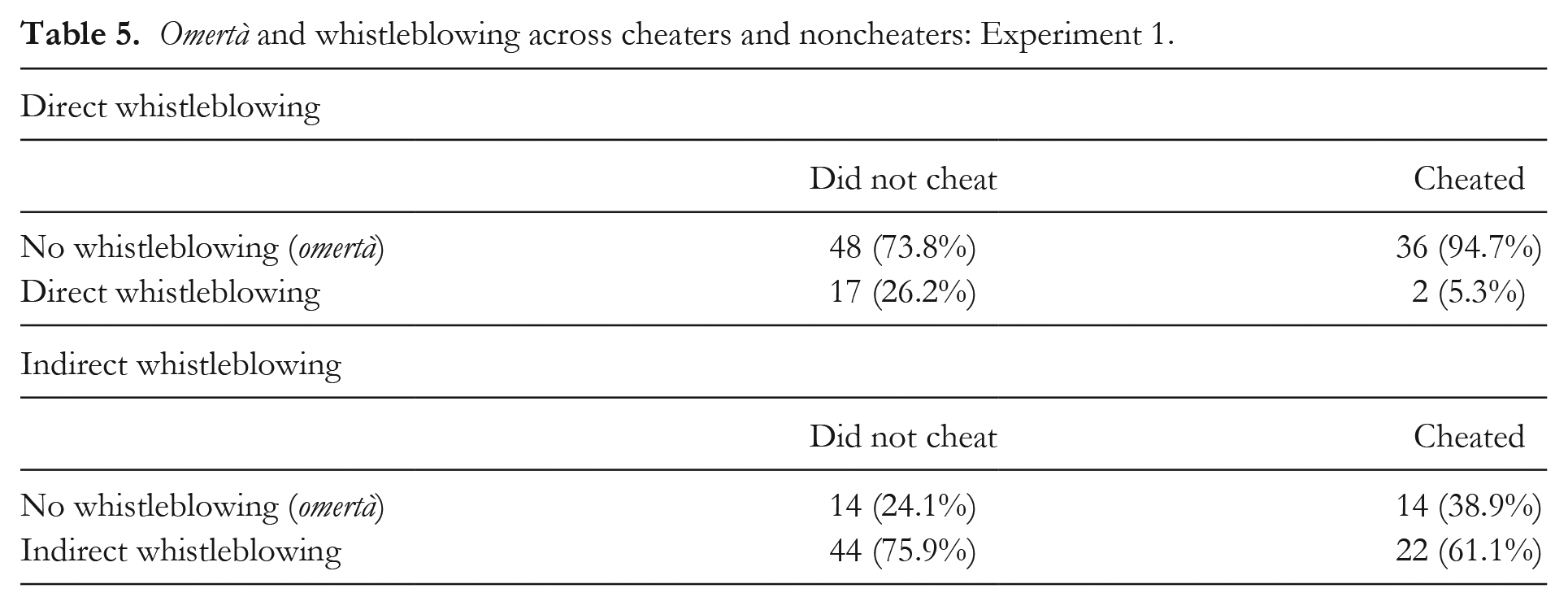
We then assessed if indirect whistleblowing was equally likely across participants who either did or did not cheat. A total of nine participants abandoned the experiment before the end; thus, we did not collect the last measures of indirect whistleblowing for them. Thus, the final sample available for this analysis consists of 94 participants. Forty-four of the 58 participants (75.9%) who did not cheat indirectly blew the whistle against the cheating Partner 2, as opposed to 22 of 36 participants (61.1%) who cheated. However, a chi-square test did not provide evidence that indirect whistleblowing was not equally distributed between cheaters and noncheaters, χ2(1) = 2.31, p = .12. Likewise, there were no significant differences in indirect whistleblowing towards the noncheating Partner 3 across cheaters and noncheaters, χ2(1) = 1.39, p = .23; five of the 58 participants (8.6%) who did not cheat indirectly blew the whistle against the cheating Partner 2, as opposed to six of 36 participants (16.7%) who cheated.
Trust of partners between nationality conditions
Differences in direct whistleblowing between the same and different nationality groups could be influenced by differences in trust of partners in these groups, as mentioned in the Alternative Hypotheses section. Thus, we performed a one-way ANOVA to assess if participants had more trust in their partners in the same nationality condition. Trust was measured with eight items (e.g., “Overall, the other partners are very trustworthy”); internal reliability was adequate (α = .88). Trust was similar across groups (same nationality: M = 3.21, SD = 0.63; different nationality: M = 3.37, SD = 0.61); this small difference was not significant, F(1, 101) = 1.62, p = .20, η2p = .02. Hence, we do not report any further analysis concerning the role of trust in explaining the relationship between shared national identity and whistleblowing.
Discussion
Results supported our hypotheses in that participants who were among others that shared their national identity were much more likely to cheat (i.e., H1), and less likely to directly or indirectly blow the whistle on others’ cheating behavior (i.e., H2). Although our design in this experiment did not allow us to test if cheating mediates the shared national identity effect on whistleblowing, we observed that participants who cheated were also less likely to directly blow the whistle against fellow cheaters.
There are some caveats to these conclusions. First, if participants in the same nationality condition felt safe cheating, then, ideally, we should have observed higher trust among participants in this condition. Since we did not observe this effect, it is possible that we placed our trust measure too early, before participants were aware that their partners could cheat, and before they had a reason to doubt their partners’ trustworthiness. If we had placed this measure later in the design, we could have been able to observe if participants in the same nationality condition had higher levels of trust after having a reason to doubt their partners’ trustworthiness. It could also be possible that our trust measure was too general to capture the specific kind of trust that we were interested in—that is, trust that your fellow group members will not denounce your improper behavior.
Second, and most importantly, our current results cannot disambiguate between two possible interpretations. The interpretation more connected to omertà is that cheaters could be less willing to blow the whistle against fellow cheaters, and that common identity is associated with whistleblowing only insofar as participants are more likely to cheat when they are among an ingroup. However, it could also be possible that the shared identity effect directly explains both cheating and whistleblowing, and that cheating does not motivate a tendency to protect fellow cheaters.
In order to address these caveats and to replicate the results of Experiment 1, we designed a second experiment in which participants would either be able or not able to cheat when among partners of either the same or a different nationality. If participants who were not able to cheat were more likely to blow the whistle against their fellow nationals, we would have evidence of a mediation—that individuals inhibit whistleblowing in order to protect fellow cheaters, and not merely those who share their same group membership. We also placed the trust measure before and after cheating occurred, and used this experiment to provide a deeper look at the relationship between cheating and indirect whistleblowing.
Experiment 2
In Experiment 2, we examined whistleblowing among participants that either were or were not able to cheat themselves. We used the same experimental manipulation as in Experiment 1 (same national identity vs. different national identities) to test whether the differences in whistleblowing among same and different nationality conditions were due to the differences in participants’ own cheating behaviors (H3) or remained even among honest participants due to loyalty demands.
Method
Participants and design
A sample of 223 U.K. participants recruited through Prolific.ac took part in this research for £3.00 plus an extra bonus for their performance. Three participants were removed from the final sample because they failed to answer more than three of seven questions about their understanding of the experimental task. An additional eight participants expressed doubt about the veracity of the other participants. Thus, the final sample consisted of 212 participants (118 female; mean age M = 25.70, SD = 7.98). As in Experiment 1, we determined sample size by recruiting approximately 50 participants per cell.
The design of this study was a 2 (partners’ identity: same nationality vs. different nationality) x 2 (cheating: possible vs. impossible) between-participants factor design. Hence, participants were randomly assigned to one of four experimental conditions: same nationality–impossible cheating, N = 53; same nationality–possible cheating, N = 59; different nationality–impossible cheating N = 47; different nationality–possible cheating N = 53. 2
Procedure
The procedure was identical to that used in Experiment 1 with the exception of the impossible cheating condition. Participants in this condition were informed that their data were correctly saved and that only the other partners were asked to manually report their gains. The procedure in the possible cheating condition was identical to that in Experiment 1. All participants saw the reported gains provided by the other two players and received the chat message by the cheating partner (P2). As in Experiment 1, we also assessed national identification (α = .81) and trust in the other participants; however, trust was measured both before the task started (i.e., as in Experiment 1; α = .85) as well as near the end of the experiment (α = .83), after partner evaluation. We operationalized and coded participants’ cheating and whistleblowing measures as in Experiment 1.
Results
Preliminary analyses
Descriptive and zero-order correlations of the main variables are reported in Table 6. Age and gender did not affect our dependent variables and for this reason we did not consider them in the following analysis.
Descriptive statistics and bivariate correlations: Experiment 2.
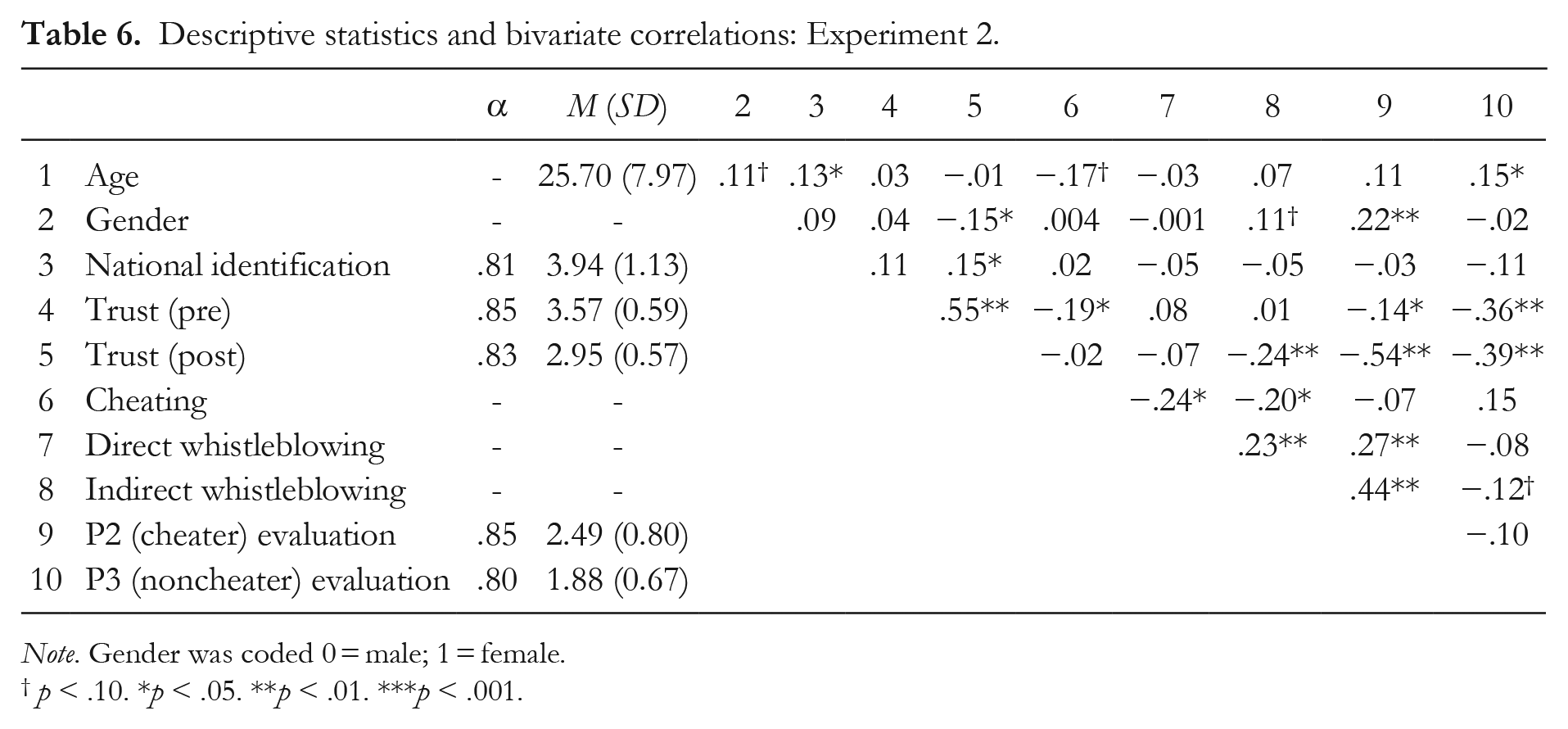
Note. Gender was coded 0 = male; 1 = female.
p < .10. *p < .05. **p < .01. ***p < .001.
National identification
We first assessed whether national identification differed between conditions. We performed a 2 (partners’ identity: same nationality, different nationality) x 2 (cheating: possible, impossible) between-participants ANOVA. Results did not show any statistically significant main effects of either identification between group conditions, F(1, 208) = 1.25, p = .265, η2p = .006, cheating conditions, F(1, 208) = 0.99, p = .32, η2p = .00, or the two-way interaction, F(1, 208) = 0.22, p = .635, η2p = .00. As in Experiment 1, we conducted a one-sample t test comparing the mean identification score of all participants to the midpoint of the response scale (3.5). Our results indicated that participants were identified with their nation significantly above the midpoint (M = 3.94, SD = 1.13), t(211) = 5.74, p < .001, d = 0.38. Consequently, we have evidence that our participants felt national identification.
Partner evaluation
We performed a 2 (partners’ identity: same nationality, different nationality) × 2 (cheating: possible, impossible) × 2 (partner: P2 [cheater], P3 [noncheater]) mixed-model ANOVA, with repeated measures on the third factor. There was a significant main effect of partners’ identity (i.e., same vs. different nationality), F(1, 208) = 6.09, p = .014, η2p = .03, f = .17. An analysis of the estimated marginal means revealed that participants in the same nationality condition were slightly more negative towards their partners (same nationality: M = 2.26, SE = 0.04; different nationality: M = 2.10, SE = 0.04). There was an additional main effect of partner (i.e., cheater vs. noncheater), F(1, 208) = 63.97, p < .001, η2p = .23, f = .55. An analysis of the observed means revealed that the cheater (M = 2.49, SD = 0.80) was evaluated more negatively than the noncheater (M = 1.88, SD = 0.67). Moreover, neither the two-way interactions (ps > .25) nor the three-way interaction (p = .12) were significant.
Cheating behavior (H1)
In a replication of results from Experiment 1, we assessed cheating behavior among participants in the cheating possible condition across the two partners’ identity conditions (n = 111; one participant in the different nationality group did not complete the cheating measure). Results are shown in Table 7. Fifty-one of the 59 participants (86.4%) in the same nationality condition cheated, as opposed to eight participants of the 52 (18.4%) in the different nationality condition. A chi-square test showed that participant cheating behavior was not equally distributed across national identity conditions, χ2(1) = 56.04, p < .001, w = .71. This supports our results from Experiment 1 as well as H1.
Cheating across partners’ identity conditions: Experiment 2.

Direct whistleblowing (H2 and H3)
As in Experiment 1, we first assessed direct whistleblowing across partners’ identity conditions among participants in the cheating possible condition (n = 112; results are shown in Table 8). Three of the 59 participants (5.1%) in the same nationality condition directly blew the whistle, as opposed to 11 of the 53 (20.8%) who did so in the different nationality condition. A chi-square test showed that direct whistleblowing in the same nationality and in the different nationality condition was not equally distributed between the two groups, χ2(1) = 6.26, p = .01, w = .24. Thus, this effect supported the results from our initial experiment as well as H2.
Omertà and direct whistleblowing across partners’ identity: Experiment 2.
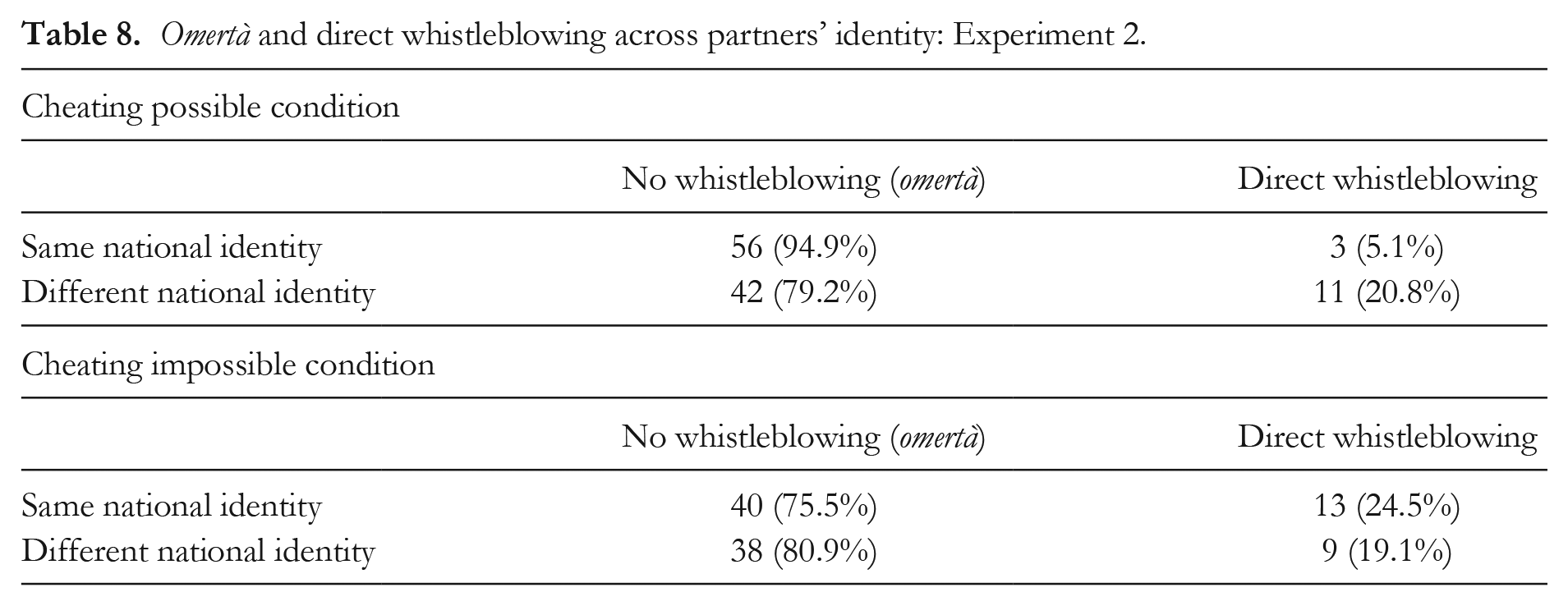
In the cheating impossible condition (n = 100), on the other hand, 13 of the 53 participants (24.5%) in the same nationality condition directly blew the whistle, compared to the nine participants of the 47 (19.1%) who did so in the different nationality condition. A chi-square test did not show evidence that direct whistleblowing was not equally distributed between groups, χ2(1) = 0.42, p = .51. Thus, participants seemed to be equally likely to report others’ cheating both when they shared and when they did not share national identity with their partners—as long as they could not cheat. In sum, the fact that more participants blew the whistle on the different nationality partner than on the same nationality partner when they could cheat (and cheated), but not when they could not cheat, lends support to H3.
Indirect whistleblowing (H2 and H3)
As in the previous analysis, we first assessed indirect whistleblowing across the same and different nationality conditions among participants in the cheating possible condition (n = 111), as a direct replication of Experiment 1. Results are displayed in Table 9. Thirty-seven of the 59 participants (62.7%) in the same nationality condition indirectly blew the whistle against the cheating Partner 2, as opposed to 42 of the 52 participants (80.8%) who did so in the different nationality condition. A chi-square test showed that indirect whistleblowing in the same nationality and in the different nationality condition was not equally distributed between the two groups, χ2(1) = 4.39, p = .03. Very little effect was observed towards the noncheating Partner 3: seven of the 59 participants (11.9%) in the same nationality condition indirectly blew the whistle, as opposed to three of the 52 (5.8%) who did so in the different nationality condition. There was no evidence that indirect whistleblowing was not equally distributed between the two groups, χ2(1) = 1.25, p = .26. As in the previous analysis, we found support for our results from Experiment 1 and for H2.
Omertà and indirect whistleblowing across partners’ identity: Experiment 2.
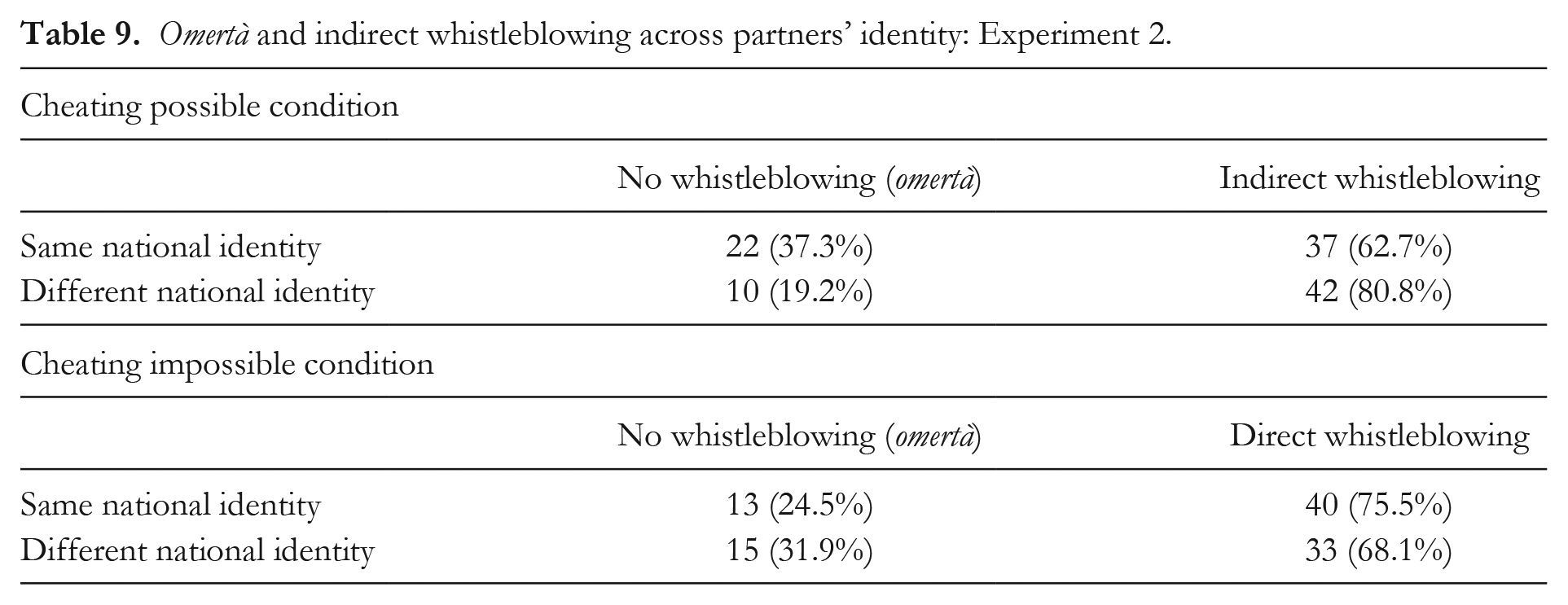
In the cheating impossible condition (n = 100), 40 of 53 participants (75.5%) indirectly blew the whistle against cheating Partner 2 in the same nationality condition, as compared to 33 of 47 (68.1%) who did so in the different nationality condition; there was no evidence that indirect whistleblowing was not equally distributed between the two groups, χ2(1) = 0.67, p = .41. Again, the fact that more participants blew the whistle on the different nationality partner than on the same nationality partner when they could cheat (and cheated), but not when they could not cheat, lends support to H3.
Finally, six of 53 participants (11.3%) indirectly blew the whistle against noncheating Partner 3 in the same nationality condition, compared to six out of 47 (12.8%) who did so in the different nationality condition; this difference was again not significant, χ2(1) = 0.04, p = .82. As with the analysis of direct whistleblowing, people who cannot cheat can blow the whistle against others whether or not they share an identity.
Trust in partners between nationality conditions
As in Experiment 1, and to test alternative hypotheses, we assessed whether participants in the same nationality condition would feel more trust in their partners; unlike the initial experiment, we assessed trust both before and after participants witnessed (and/or participated in) cheating.
Trust at the first data collection was nearly identical across groups (same nationality: M = 3.55, SD = 0.59; different nationality: M = 3.60, SD = 0.60); F(1, 210) = 0.40, p = .52, η2p = .002. However, trust at the second data collection was actually higher in the different nationality condition (same nationality: M = 2.87, SD = 0.53; different nationality: M = 3.03, SD = 0.60); F(1, 209) = 4.28, p = .04, η2p = .02, f = .14. Although there is a significant difference, it cannot explain why cheating was higher, and whistleblowing lower, in the same nationality condition, as trust was assessed after these measures.
Supplementary analysis for Experiments 1 and 2
Although results from both Experiments 1 and 2 supported the hypothesis that cheating may represent a mediator in the relationship between partners’ identity and whistleblowing, these experiments did not allow us to statistically test for a mediation effect, as both samples were too small. However, after excluding participants assigned to the cheating impossible condition of Experiment 2, we merged the two samples (n = 215) as they shared the same setting, procedure, and measures. In this supplementary analysis, we found that shared national identity significantly increased the probability to cheat, and that people who cheated had a significantly lower probability to blow the whistle. This mediation analysis summarizes the causal relationships we found among national identity, cheating, and whistleblowing in both experiments.
In order to estimate the mediation effect derived from hypotheses H1 and H2, we considered methods developed by Winship and Mare (1984) and MacKinnon et al. (2007) for estimating mediation effect when both the mediator (cheating) and the outcome (whistleblowing) are binary. We estimated the mediation effect by the product of fully standardized regression coefficients (MacKinnon et al., 2007; Winship & Mare, 1984). We also estimated the difference of fully standardized coefficients to show that the two estimates of indirect effects are consistent. We considered bootstrap bias corrected 95% confidence interval estimates, obtained from 10,000 sample draws, as a test of significance. All analyses were performed with R (R Core Team, 2020) and the package “boot” for bootstrap estimates (Canty & Ripley, 2020; Davison & Hinkley, 1997).
As shown in Table 10, same (as opposed to different) national identity significantly increased the probability to cheat (b = 0.72, bootstrap SE = 0.04, 95% bootstrap corrected bias CI [0.63, 0.79]). Moreover, cheating significantly decreased the probability to blow the whistle (b = −0.29, bootstrap SE = 0.14, 95% bootstrap corrected bias CI [−0.56, −0.05]). Finally, same (as opposed to different) national identity no longer affected the probability to blow the whistle (b = −0.20, bootstrap SE = 0.12, 95% bootstrap corrected bias CI [−0.40, −0.08]). Both estimates of indirect effects (i.e., difference in coefficients and product of coefficients) support H3, as results show that same (as opposed to different) national identity significantly reduced the probability of whistleblowing (difference coefficient: b = −0.20, bootstrap SE = 0.09, 95% bootstrap corrected bias CI [−0.37, −0.03]; product coefficient: b = −0.21, bootstrap SE = 0.10, 95% bootstrap corrected bias CI [−0.41, −0.04]).
Total, direct, and indirect effects of partners’ identity and cheating on whistleblowing: Experiments 1 and 2.
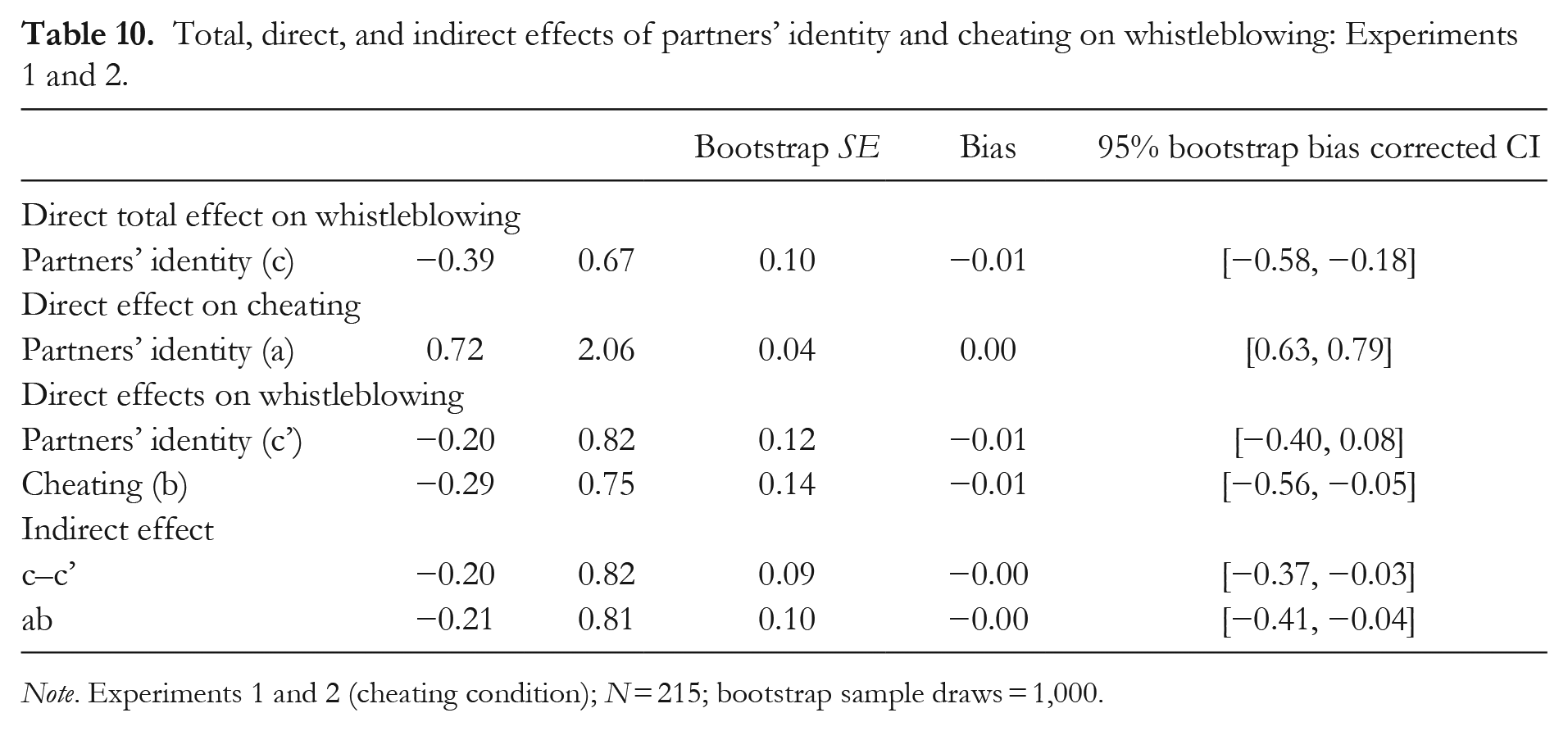
Note. Experiments 1 and 2 (cheating condition); N = 215; bootstrap sample draws = 1,000.
Discussion
Experiment 2 provides convergent support for our predictions. Through manipulating the possibility or impossibility of cheating, we were able to test our prediction on the role of shared identity in decreasing whistleblowing due to increased cheating. People in the same nationality condition were less likely to blow the whistle, either directly or indirectly, if they could cheat (and cheated). Moreover, the supplementary analysis carried out on the merged samples of Experiments 1 and 2 supported the hypothesis that cheating represents a mediator in the relationship between partners’ identity and whistleblowing (H3).
Experiment 2 also addressed a major caveat from Experiment 1: did participants in the same nationality condition blow the whistle less out of loyalty to the group or because cheaters, more common in this condition, were less likely to blow the whistle? As the group effect disappeared when cheating was not possible, we can preliminarily conclude that the second possibility is more likely. However, as we argued in Experiment 1, the lack of a trust effect could have been the result of the measure having been placed too early in our research design. This cannot be the solution, as we did not find a trust effect even when the measure was placed after participants had the opportunity to cheat. It is possible that our trust measure was not sufficiently specific to capture participants’ feelings of security in the same nationality condition.
General Discussion
In two experiments, we addressed the question of whether, and under which circumstances, people engage in protection or in whistleblowing of unethical group members according to their social identity. Previous researchers have also addressed this question. For instance, Waytz et al. (2013) concluded that loyalty towards group members inhibited whistleblowing; given our research design, we could expect that people would protect group members regardless of their own cheating behavior. If loyalty is instead conceived of as loyalty towards group ideals, consistent with Dungan et al. (2015), we could expect that people could be more likely to blow the whistle against ingroup members. In a more recent work, Gross and De Dreu (2020) concluded that people were less likely to cheat when they were paired with an honest group member. Based on these results, we could expect that cheating would be approximately equal across groups, which could influence whistleblowing.
However, our analysis based on social identity theory led us to hypothesize that group interaction with ingroup members, as opposed to outgroup members, should lead to decreased whistleblowing when people tend to cheat themselves. Our design allowed us to investigate the interplay between cheating and whistleblowing across groups composed of different social identities, and the results of both experiments are supportive of our hypotheses.
In Experiment 1, we found that when people were surrounded by others sharing their same social identity (as opposed to others having a different social identity), they were more prone to both engage in unethical behaviors and protect unethical group members. Experiment 2 replicated these findings and disambiguated the role of cheating in whistleblowing in an experimental mediation design. We found that when participants were not allowed to cheat, the differences in whistleblowing on a cheater with the same or a different social identity were no longer present. The same percentage of participants in the same and different social identity conditions reported the cheating behavior to the experimenters, both directly and indirectly. The latter results confirmed the role of shared social identity in favoring dishonesty in various forms, as for instance cheating and omertà, and helped to clarify the role of loyalty demands toward ingroup cheaters.
Previous research argued that ingroup members are less willing to denounce an ingroup member’s misconduct as compared to an outgroup member’s, due to higher loyalty (Misch et al., 2018). Here, we do not have enough elements to clearly disconfirm this suggestion but advance the idea that people will keep silent on ingroup members’ misconduct when their positive social identity is threatened, for instance, because they have cheated. The role of social identity protection in an intergroup context has largely been connected with how people self-regulate their behavior in social situations (Abrams, 1994; Abrams & Brown, 1989) and how they try to regulate other people’s behaviors that can put their positive social identity at risk (Abrams et al., 2000). We thus stressed the idea that people’s morality is largely connected to social identity, which has a crucial role in their individual self-concept.
As a matter of fact, when people can reduce the negative impact of immorality on their moral self-concept, they mostly pursue this road, sometimes even questioning the meaning of what is moral (Gino et al., 2013; Shalvi et al., 2015; Wiltermuth, 2011). For this reason, people are able to behave badly but also to provide moral motivations for their actions (Ayal & Gino, 2012; Bénabou & Tirole, 2006; Mazar et al., 2008). However, in an intergroup context, people tend to act as interchangeable members of their group, and their actions are more likely driven by the social representation than by the personal self; in these situations, people are often motivated to represent their group in the best light possible and to monitor threat to the social image of their group whether it is negatively or positively represented (Ashokkumar et al., 2019; Pacilli et al., 2022; Rullo et al., 2019). Hence, social comparison might help to extend personal moral concerns to group moral concerns, motivating people to maintain a moral posture. When people’s social identities are not saliently activated, they could instead pursue self-interests by engaging in immoral behaviors. In regard to people’s reactions to others’ unethical behavior, we built our hypothesis on the idea that when people perceive themselves as having no sins, they can “cast the first stone” and are able to denounce unethical behaviors carried out by other people. On the other hand, people are more likely to “sin” when among their own group and, consequently, less likely to denounce fellow sinners, consistent with the definition of omertà.
Limitations
This study has several limitations that we hope to address in future studies. First, the manipulation of group composition considered only national social identities. Further studies using minimal group or different social identities from nationality could be useful to generalize our results. Moreover, even though the online context allowed us to provide participants an anonymous setting that usually favors the emergence of dishonesty (Kiesler et al., 1984), a more ecological setting to replicate our findings is needed.Also, our experiments produced some noisy effects, for instance, when participants indirectly blew the whistle on a noncheating partner; this should be addressed in future studies. Such a noisy effect was probably due to the design of our measure of indirect whistleblowing that was too sensitive to mistakes due to attention issues. Indeed, we still believe that measuring whistleblowing by relying on multiple measures to explore participants’ motivation to blow the whistle or to cover up violators, over and above the effect of the individual cost associated with the action of signaling misconduct, is crucial and needs further attention. Our measures of indirect whistleblowing designed to assess whether participants would avoid (or increase their tendency) to blow the whistle when encouraged by the experimental design was a first attempt to observe people’s reluctance to blow the whistle in a diversified way. Another limitation concerns the fact that we did not directly assess the perceived salience of social identity after the group manipulation, thus we could only speculate on its role in influencing moral concerns. We were concerned that assessing saliency could alert participants to the nature of our experiments; however, future research could use a longitudinal design in which saliency of social identity is assessed at the first time point (e.g., 1 week before the experimental task). Further, some of our effects had relatively low p values and we would be more confident in these specific results if they were tested in replication studies.
Notwithstanding the limitations of the present experiments, we believe that this study could strongly contribute to the literature on the role of social identity in dishonesty and whistleblowing. For instance, this phenomenon could be studied in the context of groups that encourage criminal behavior in order to maintain the safety of group members. Members of these groups could feel more confident that fellow members will not blow the whistle, specifically because those members also believe that others will not blow the whistle on them.
Footnotes
Acknowledgements
We are grateful to Dr Emilio Visintin, University of Ferrara, for his thoughtful comments on the first version of the paper.
Data availability

Funding
The author(s) disclosed receipt of the following financial support for the research, authorship, and/or publication of this article: This work was supported by one of the Swiss Government Excellence Scholarships (ESKAS-No. 2016.1167).