




Abstract
Academic cheating is a prevalent problem in all educational institutions. Finding solutions for cheating requires an understanding of who is more likely to engage in these behaviors. In this pre-registered study (including an a priori power analysis), we investigated the relationship between the four facets of psychopathy, boredom-proneness, and academic cheating in undergraduate university students (N = 161) while controlling for demographic factors (age, sex, and socioeconomic status) and attitudes supportive of cheating. Students were asked whether they had cheated in the fall 2021 term (yes/no) and about the different types of cheating behaviors they engaged in. Overall, 57% of students admitted to cheating, with online cheating being the most frequently reported behavior. Participants scoring higher on the antisocial facet of psychopathy and endorsing more positive attitudes towards cheating were more likely to report cheating in fall 2021 and engaged in a higher number of different types of cheating behaviors. Those scoring lower on the affective facet of psychopathy (i.e., more emotional) were also more likely to engage in a higher number of cheating behaviors. Boredom-proneness was correlated to both cheating outcomes in the bivariate analyses, but this effect disappeared once controlling for psychopathy and other known correlates. Understanding the features of students who engage in cheating behaviors allows for a critical examination of the potential effectiveness of anti-cheating policies and the development of more preventative classroom practices.
Introduction
Academic cheating can be defined as a violation of academic conduct, in which students engage in behaviors such as plagiarism (e.g., inventing and altering data), collaborative cheating (e.g., allowing copying), exam collusion (e.g., sharing answers), and lying (e.g., lying for extensions; Newstead et al., 1996). Research has demonstrated that at least 50% of students usually report engaging in cheating behaviors (Davis et al., 1992; Raines et al., 2011), that cheating can be found at all levels of education (Jensen et al., 2002), and that it has been reported in multiple cultures around the world (Adebayo, 2011; Ljubin-Golub et al., 2020; Williams et al., 2010; Zhang et al., 2019). Understanding who is more likely to engage in cheating behaviors is necessary to determine if proposed solutions to reduce cheating would actually be effective for different types of students. Existing research has found relationships between cheating and age and sex (younger students and male students more likely to cheat; Hendy, 2017; Jensen et al., 2002), socioeconomic status (SES; those with lower income more likely to cheat; Kerkvliet, 1994; Newstead et al., 1996), and attitudes supportive of cheating (more positive attitudes related to more cheating; Jordan, 2001; Yu et al., 2017). When examining individual differences in general personality, academic cheating is most consistently associated with low conscientiousness (e.g., disorganized, lazy) and low agreeableness (e.g., selfish, unempathetic; Giluk & Postlethwaite, 2015).
Given the antisocial nature of cheating, research has also examined the role of more antagonistic personality traits such as psychopathy. While research has indicated a positive relationship between psychopathy and cheating (Cheung & Egan, 2021; Williams et al., 2010), these studies have not always assessed psychopathy at the facet level, which limits the ability of these findings to inform specific solutions to cheating behaviors. Furthermore, given that personality is relatively stable (Ferguson, 2010) and that psychopathic traits may be particularly difficult to change (Lewis, 2018), it is also worth exploring related constructs that may be easier to address within the classroom. Many students experience boredom in academic contexts (Daschmann et al., 2011), and susceptibility to boredom has been positively linked to procrastination (Vodanovich & Rupp, 1999) and cheating in single-player games (Passmore et al., 2020). However, boredom-proneness has not been empirically examined in relation to academic cheating. The purpose of the current study was therefore to conduct a pre-registered assessment of the relationship between psychopathy facets, boredom-proneness, and academic cheating among university students, while controlling for the potential confounding effects of age, sex, socioeconomic status, and positive attitudes towards cheating.
Subclinical psychopathy
Although psychopathy is often defined as a personality disorder (Buckels et al., 2013), it can also be understood as a subclinical spectrum of more extreme and antagonistic personality traits (Lilienfeld & Andrews, 1996). Psychopathy can further be considered as an overarching construct (e.g., Azizli et al., 2016; Cheung & Egan, 2021), and can also be broken down into more specific traits or facets. Patrick et al. (2009) have conceptualized psychopathy along the three dimensions of boldness, meanness, and disinhibition; however, this model has been criticized for not fully capturing the nature of psychopathy given that boldness has shown weak associations with other psychopathy facets and positive associations with more adaptive behaviors and outcomes (Lilienfeld et al., 2018). Others have considered psychopathy along four, rather than three, facets (interpersonal, affective, lifestyle, and antisocial; Hare & Neumann, 2009). The four-facet model defines psychopathy as a failure to engage in honest and trustworthy interpersonal relationships (Facet 1), experience well-developed feelings such as love and guilt (Facet 2), follow sociocultural norms and criterions relating to safety (Facet 3), and obey societal laws (Facet 4; Neumann et al., 2007). Neumann et al. (2007) tested several psychopathy models and found that the four-facet model yielded the best definition of psychopathy.
Despite several studies confirming a positive relationship between psychopathy and cheating (e.g., Cheung & Egan, 2021; Nathanson et al., 2006; Williams et al., 2010), the majority of these studies have failed to evaluate the underlying facets of psychopathy. In one notable exception, Ljubin-Golub et al. (2020) examined the relationship between the three-facet model of psychopathy and cheating, controlling for the general trait of honesty-humility and attitudes supportive of cheating. Results generally supported that psychopathy was more relevant than honesty-humility in understanding cheating; however, this was only true for the boldness and disinhibition facets. While these results advance our understanding of psychopathy and cheating, given the limitations associated with the facet of boldness, further examination of competing psychopathy models is warranted.
When thinking about the four facets of psychopathy, there is good reason to expect that some psychopathy facets, and not others, would be related to academic cheating. For example, there is evidence that impulsivity (referred to as disinhibition in the three-facet model), a feature of the lifestyle facet in the four-facet model, is positively related to academic cheating (Anderman et al., 2010; Ljubin-Golub et al., 2020). It is also reasonable to assume that the antisocial facet will correlate with cheating since it is associated with other delinquent behaviors (e.g., school absenteeism and shoplifting; Pechorro et al., 2014). The interpersonal and affective facets may be less related to cheating given that previous research has shown that only the lifestyle and antisocial facets are correlated with antisocial behaviors such as institutional violence (Chakhssi et al., 2014) and substance use (Walsh et al., 2007). Identifying the specific facets associated with cheating would result in better and more tailored interventions to reduce cheating behaviors among people with psychopathic traits.
Boredom-proneness
Boredom is a negative experience that commonly arises in situations lacking in meaning, interest, and challenge, and is thought to motivate us to modify our behaviors or situations in order to resolve that experience (Sansone et al., 1992; Smith et al., 2009). The function of boredom is to regulate our behaviors and inspire us to seek more meaningful goals (Bench & Lench, 2013; Elpidorou, 2014). Some individuals, however, are more likely to experience boredom than others, which means that they are more prone to being bored (Struk et al., 2017). Boredom-proneness is linked to multiple adverse behaviors such as pathological gambling (Mercer & Eastwood, 2010), delinquent behaviors (Newberry & Duncan, 2001), procrastination (Vodanovich & Rupp, 1999), and cheating in single-player games (Passmore et al., 2020). In academic settings, the experience of boredom is associated with poorer motivation and achievement (Tze et al., 2016). Given these associations, it seems probable that boredom-proneness would be related to academic cheating; however, to our knowledge, no previous research has empirically investigated the relationship between the trait of boredom-proneness and academic cheating.
Objectives and hypotheses
Despite findings that point to psychopathy having four distinct facets, and boredom-proneness having a positive association with procrastination and poorer academic achievement, no previous research has investigated the association of psychopathy (at the facet level) and boredom-proneness with academic cheating while also controlling for other known correlates (e.g., age, sex, SES, and attitudes). Conducting such research has two main benefits. First, it provides important foundational knowledge about the relationship between these variables and cheating, which can then be used to build causal models (e.g., the possibility that boredom-proneness mediates the relationship between psychopathy facets and cheating, as people with psychopathic traits are more susceptible to boredom; Cleckley, 1964; Poythress & Hall, 2011). As Rohrer et al. (2022) argue, prediction models are important pre-cursors to establishing the evidence needed for building future causal models. Second, it allows for the critical examination of current measures meant to prevent cheating to determine if they are effective for different types of students.
Hypothesis 1: Established correlates
We hypothesized that younger students, male students, those coming from lower socioeconomic status households, and those with more positive attitudes towards cheating would engage in more academic cheating.
Hypothesis 2: Psychopathy facets
Based on the relationships between psychopathy and cheating generally and between impulsivity and cheating specifically, as well as the antagonistic and delinquent nature of the antisocial facet, we hypothesized that higher scores in the lifestyle facet (Facet 3) and antisocial facet (Facet 4) of psychopathy would be related to more academic cheating. We further expected that the interpersonal and affective facets (Facet 1 and 2, respectively) would be unrelated to academic cheating, consistent with past research on general adverse behaviors.
Hypothesis 3: Boredom-proneness
Based on previous research linking boredom-proneness with procrastination, cheating in single-player games, we expected that students who were more prone to being bored would be more likely to engage in academic cheating.
Methods
Participants
Participants included 161 undergraduate university students from a Canadian university recruited through an extra credit-point attainment system. The sample comprised 133 women and 28 men, with a mean age of 20.4 (SD = 3.5, range of 17–54), and the majority describing their financial situation as average (52.2%). The participants were predominantly White (75.2%), followed by Chinese (8.1%), Arab (4.3%), and Indigenous (4.3%). The majority were in the third year of their undergraduate degree (33.5%) and majoring in psychology (40.7%), followed by neuroscience (13.6%) and medical sciences (8.0%). When reporting on the fall 2021 semester, participants were completing an average of 4.5 courses (SD = 1.0) with an average of 2.1 courses being taken online (SD = 1.7).
An a-priori power analysis was conducted using G*Power (Faul et al., 2007) for multivariate regression using the following information: 9 predictors (4 controls, 5 personality constructs), f value of .20 (based on a past study with similar outcomes; [Blais et al., 2023]), alpha of .05 and 95% power. The recommended sample size for this analysis was 124. A total of 181 participants originally clicked on the link provided to participate in the study. Twenty participants were removed from the initial sample: 13 participants chose to complete the study as observers, which requires that we delete their data; six participants either failed the attention check question (n = 1) or did not provide an answer (n = 5); and one participant was removed because the unique identifier created in Qualtrics indicated that they had completed the survey twice (their first attempt that indicated 100% completion was retained vs. their second attempt of 70% completion). The final sample size was therefore 161.
Measures
Demographics
The participants were asked to provide their age, sex, gender identity, racial/cultural background, family financial situation (i.e., SES; recoded: below average vs. average/above average), major program of study, how many credits they completed in the fall 2021 term, how many of their courses were delivered online, their estimated grade point average (GPA), current year of study, and to indicate whether it was their last year of study.
Attitudes towards cheating
Five items adapted from Jordan (2001) and Raines et al. (2011) were used to measure positive attitudes towards cheating. The items were measured using a 10-point Likert scale ranging from 1 (completely disagree) to 10 (completely agree). Example items include: “It’s only considered cheating if you get caught” and “Cheating in university is sometimes justified.” Scores represent the mean of available items (Newman, 2014; Parent, 2013) and range from 1 to 10. The scale demonstrated good internal consistency (Cronbach’s alpha = .88).
Subclinical psychopathy
The Self-Report Psychopathy Scale 4th Edition (SRP 4; Paulhus et al., 2017) was used to measure subclinical psychopathy. The SRP 4 is a 64-item self-report scale that is derived from the Psychopathy Checklist – Revised (PCL-R; Hare, 1991) and captures the four facets of psychopathy: interpersonal, affective, lifestyle, and antisocial. Example items include: “I purposely flatter people to get them on my side” (interpersonal), “Most people are wimps” (affective), “I have taken illegal drugs (e.g., ecstasy)” (lifestyle), and “I have tricked someone into giving me money” (antisocial). Each item is measured on a 5-point Likert scale ranging from 1 (disagree strongly) to 5 (agree strongly). Facet scores were calculated using the mean of available items and range from 1 to 5. The facet scales demonstrated acceptable internal consistency (range of Cronbach’s alpha = .61–.88).
Boredom-proneness
The Short Boredom Proneness Scale (SBPS; Struk et al., 2017) was used to measure boredom-proneness. The SBPS contains eight items measured on a 7-point Likert scale ranging from 1 (strongly disagree) to 7 (strongly agree). Example items include: “I find it hard to entertain myself” and “Much of the time, I just sit around doing nothing.” Scores represent the mean of available items and range from 1 to 7. The scale demonstrated good internal consistency (Cronbach’s alpha = .90).
Academic cheating
Several questions were used to assess engagement in academic cheating behaviors. The participants first read the following definition of cheating (the exact items can be found in the Supplemental Materials, S1, p. 1): “Cheating can have many different meanings. We are interested in both dishonest behaviours and cheating behaviours. Examples include plagiarizing a written assignment from the internet, copying work from another student and handing it in as your own, looking up answers on tests, quizzes or exams when it is not allowed, etc. This can also include helping others cheat. For example, giving someone an old essay to hand in as their own, letting someone copy your answers on a test, quiz, or exam, etc. We are interested in all of these behaviours.”
After reading this definition, participants were again reminded of the anonymity of the survey. Additionally, we employed a face-saving measure by prefacing the cheating question with the following phrase: “Even though you wouldn’t usually cheat…”. Participants were then asked whether they had engaged in any cheating behaviors in the fall 2021 semester (yes/no).
Afterwards, they were asked about their engagement in specific cheating behaviors in the fall 2021 semester using 14 items adopted from King et al. (2009), Ljubin-Golub et al. (2020), and Simic Sasic and Klarin (2009). Combining the items used in these studies ensured we included most cheating behaviors reported in Newstead et al. (1996), including plagiarism, collaborative cheating, exam collusion, etc. Responses to the 14 items were measured using a 5-point Likert scale ranging from 0 (never) to 4 (many times [almost always]). Example items included: “Having another person take an online exam/test/quiz for me” and “Plagiarizing homework/essay/assignment from the internet (includes using websites to purchase homework/essays/assignments).” A full list of all items can be found in the supplemental materials (S1, pp. 1–2). Consistent with the pre-registration plan, each of the 14 items was recoded as 0 (never) or 1 (from 1 to 2 times to many times [almost always]). Total scores were then calculated by taking the mean of available items across the 14 items (range between 0 and 1). This procedure created a continuous cheating outcome where higher scores represent engaging in more cheating behaviors. The scale demonstrated good internal consistency (Cronbach’s alpha = .84). 1
Missing data
For continuous variables that are composed of several individual items, we followed recommendations from Newman (2014) and Parent (2013) to employ available item analysis (AIA) which calculates the average of the included items for each variable, given that AIA produces similar results to both mean and multiple imputations, especially when item-level missingness is minimal. We calculated the rate of missingness (i.e., n x k, where k = number of scale items) for each continuous variable made up of individual items (i.e., SBPS, the facets of the SRP 4, and the mean of the 14 cheating behaviors), and rates of missingness ranged from 0.1% to 0.8%. Given that SPSS calculates Cronbach’s alpha levels using listwise deletion, syntax provided by Parent (2013) to calculate alphas when using AIA was used for any composite variable with missing data. We further identified any participant with at least one missing item on either age, sex, SES, attitudes supportive of cheating, boredom-proneness, and the four facets of psychopathy (n = 11) and compared them to participants with complete information (n = 150) on both cheating outcomes; no significant differences were found.
Procedure
The study received approval from the Dalhousie University Research Ethics Board (file #2021-5875). The study was fully administered online through Qualtrics and was posted on the extra-credit website. The study was also completely anonymous. Participants who consented completed the survey questionnaires in the following order: demographics; SRP 4 and SBPS (order of questionnaires randomized and order of item presentations randomized within each scale); cheating questionnaire; attitudes towards cheating questionnaire. One attention check was included between the survey questions. All participants were presented with a debriefing form at the end of the study. The study took approximately 20 minutes to complete, and participants received 0.5 extra-credit points as compensation for their time. The full methodology, hypotheses, and proposed analyses were pre-registered on the Open Science Framework (OSF) prior to data collection (https://doi.org/10.17605/OSF.IO/UQRES).
Results
Bivariate analyses
Zero-order correlations for all study variables (N = 161).
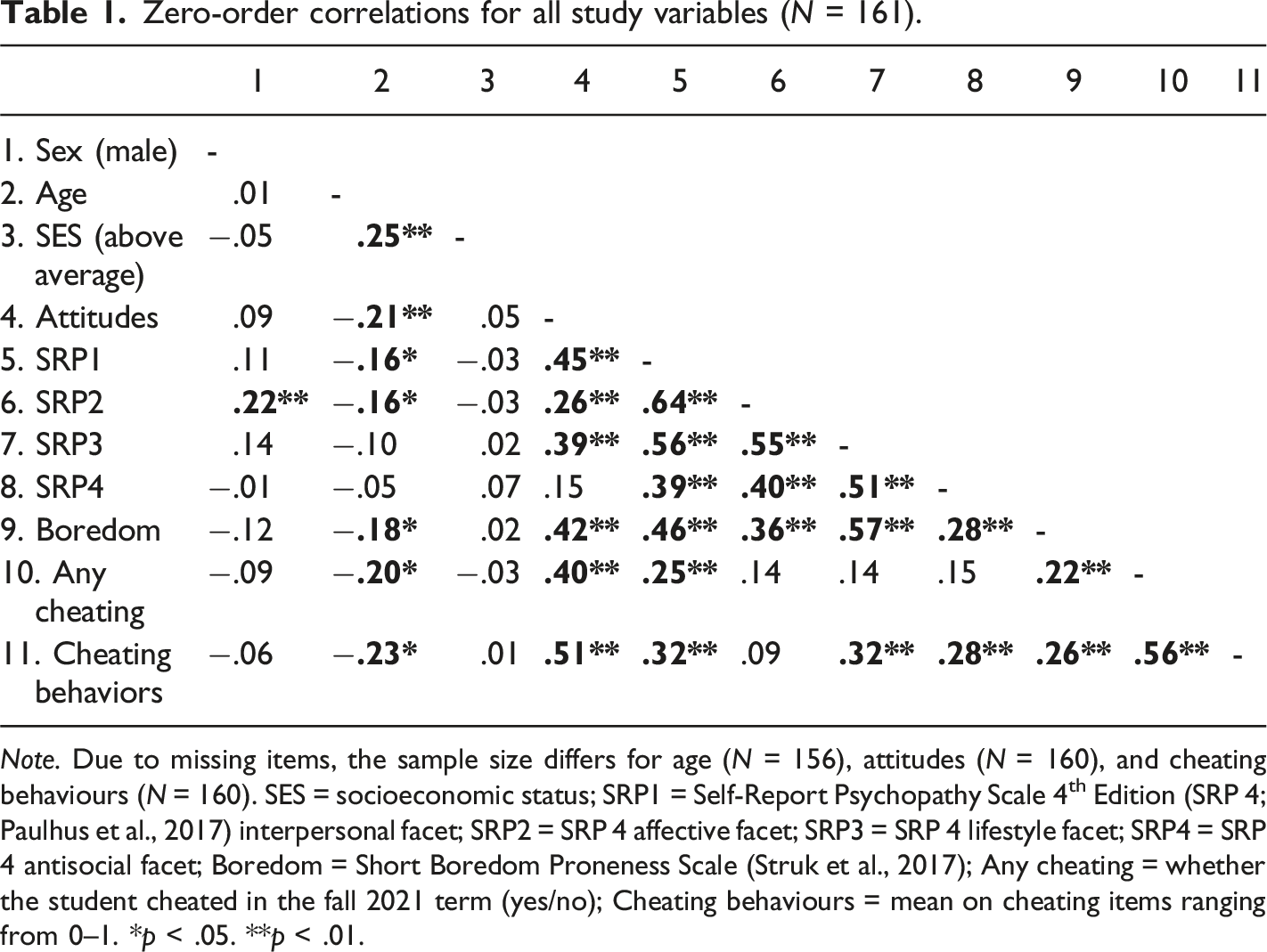
Note. Due to missing items, the sample size differs for age (N = 156), attitudes (N = 160), and cheating behaviours (N = 160). SES = socioeconomic status; SRP1 = Self-Report Psychopathy Scale 4th Edition (SRP 4; Paulhus et al., 2017) interpersonal facet; SRP2 = SRP 4 affective facet; SRP3 = SRP 4 lifestyle facet; SRP4 = SRP 4 antisocial facet; Boredom = Short Boredom Proneness Scale (Struk et al., 2017); Any cheating = whether the student cheated in the fall 2021 term (yes/no); Cheating behaviours = mean on cheating items ranging from 0–1. *p < .05. **p < .01.
Dichotomous cheating outcome
Binary logistic regression assessing the effects of age, sex, socioeconomic status, attitudes towards cheating, the four facets of psychopathy, and boredom-proneness on the binary cheating outcome (N = 155).
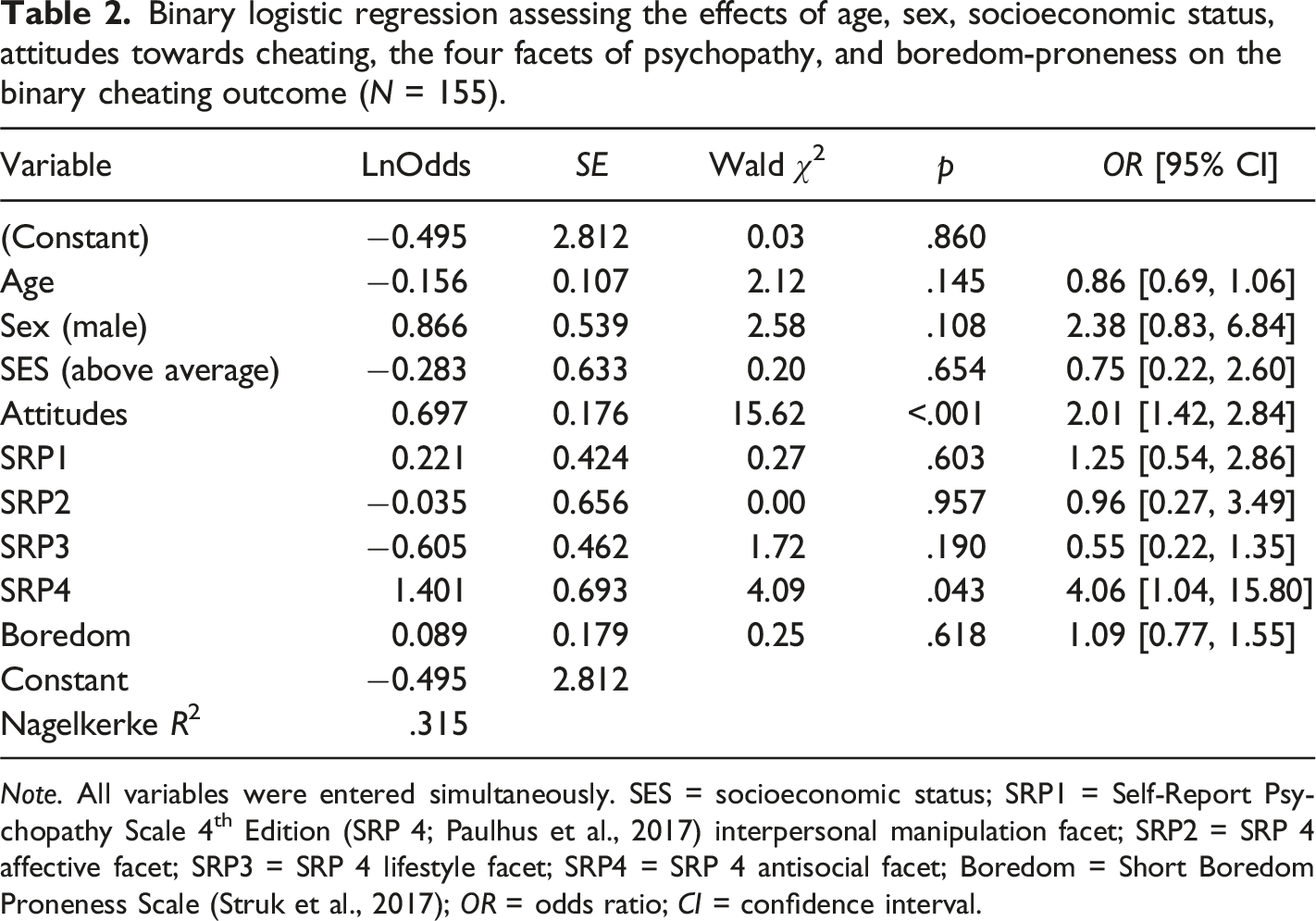
Note. All variables were entered simultaneously. SES = socioeconomic status; SRP1 = Self-Report Psychopathy Scale 4th Edition (SRP 4; Paulhus et al., 2017) interpersonal manipulation facet; SRP2 = SRP 4 affective facet; SRP3 = SRP 4 lifestyle facet; SRP4 = SRP 4 antisocial facet; Boredom = Short Boredom Proneness Scale (Struk et al., 2017); OR = odds ratio; CI = confidence interval.
Specific cheating behaviors
When examining the specific cheating behaviors that students reported across the 14 cheating items, the most common behavior reported was accessing resources or notes during an online quiz or exam when this action was prohibited (M = 0.70, SD = 0.46). Other common cheating behaviors included consulting with others during exams, tests, or quizzes (M = 0.48, SD = 0.50), helping others cheat on exams, tests, or quizzes (M = 0.49, SD = 0.50), and working with others for assignments and essays when the work should be completed independently (M = 0.54, SD = 0.50; see Table S2, p. 3 of supplemental materials). The overall mean of cheating behaviors across all 14 items was 0.24 (SD = 0.19).
Linear regression analysis assessing the effects of age, sex, socioeconomic status, attitudes towards cheating, the four facets of psychopathy, and boredom-proneness on the continuous cheating outcome (N = 154).
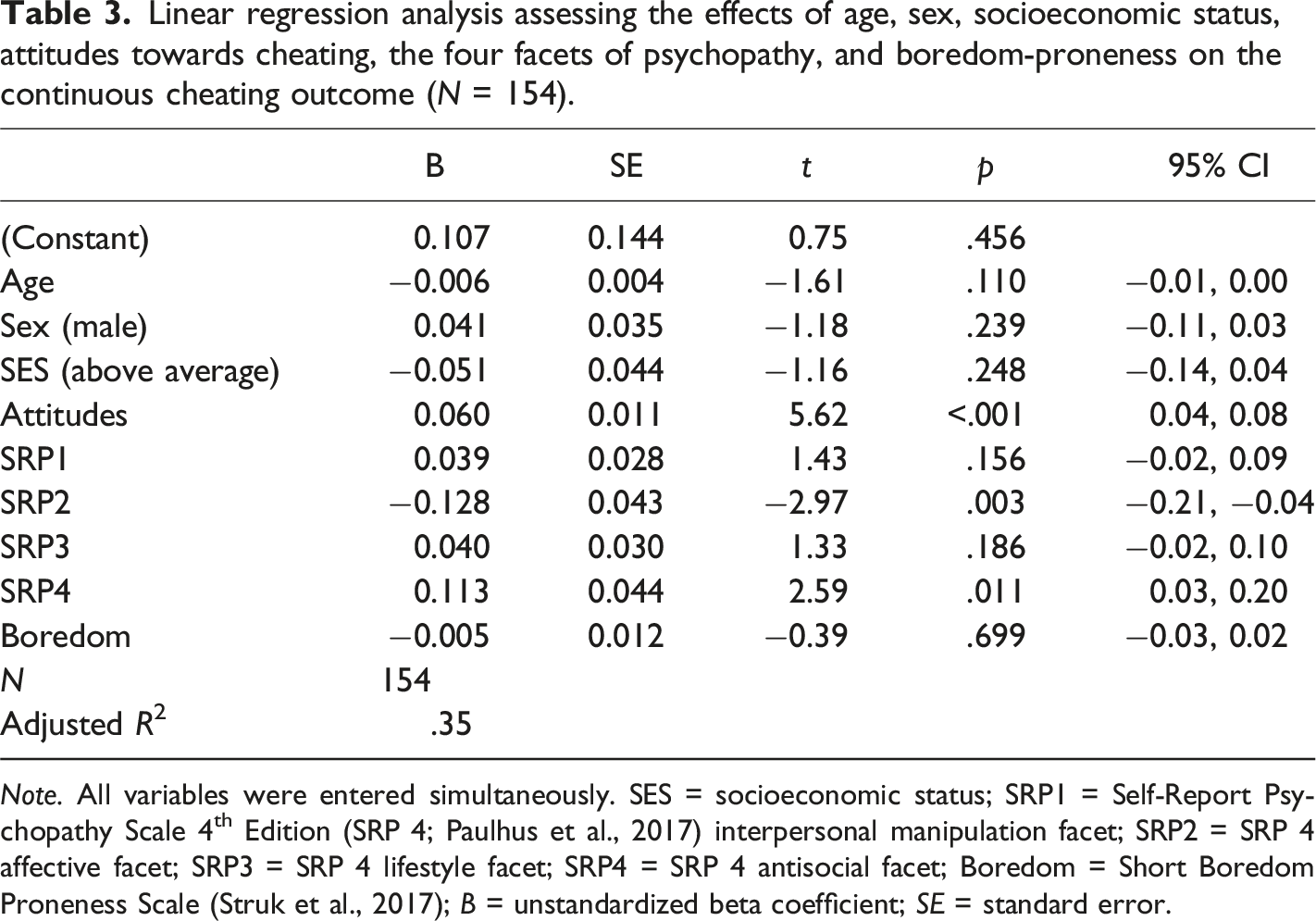
Note. All variables were entered simultaneously. SES = socioeconomic status; SRP1 = Self-Report Psychopathy Scale 4th Edition (SRP 4; Paulhus et al., 2017) interpersonal manipulation facet; SRP2 = SRP 4 affective facet; SRP3 = SRP 4 lifestyle facet; SRP4 = SRP 4 antisocial facet; Boredom = Short Boredom Proneness Scale (Struk et al., 2017); B = unstandardized beta coefficient; SE = standard error.
Discussion
The current study examined the effects of the four facets of psychopathy (i.e., interpersonal, affective, lifestyle, and antisocial; Hare & Neumann, 2009) and boredom-proneness on university-level cheating while controlling for age, sex, socioeconomic status (SES), and attitudes towards cheating. Overall, positive attitudes towards cheating and the antisocial facet of psychopathy were positively associated with any cheating and specific cheating behaviors during the fall 2021 semester. While boredom-proneness was correlated with both cheating outcomes at the bivariate level, these effects disappeared once controlling for psychopathy and other well established cheating correlates. Unexpectedly, participants scoring lower on the affective facet of psychopathy were more likely to report engaging in cheating behaviors.
Psychopathy
The antisocial facet had a positive relationship with cheating, which is not surprising considering its relationship with other adverse behaviors such as problematic drug use and breaking the law (Hare & Neumann, 2009; Pechorro et al., 2014). However, contrary to our expectations, the affective facet of psychopathy had a negative relationship with cheating. The affective facet is characterized by callousness and a general lack of emotion (Hare & Neumann, 2009), which could mean that students who score lower on this facet – and are thus more emotional – might be more anxious about maintaining a high grade-point average, especially during the COVID-19 pandemic. There is evidence that both stress and cheating rates among students increased during the pandemic (Ebaid, 2021; Khan et al., 2020), which could mean that students who are more emotional may have experienced more stress and pressure to engage in cheating behaviors. Also contrary to our hypotheses, the lifestyle facet did not correlate with cheating. This could indicate that cheating is less impulsive and requires more planning and forethought.
Boredom-proneness
Another surprising result is the non-significant association between boredom-proneness and cheating when controlling for psychopathy and other well-known correlates. Since boredom-proneness was positively related to all psychopathy facets at the bivariate level, this could mean that the variance of boredom-proneness was accounted for by one or more of the facets of psychopathy. Biolcati et al. (2016) demonstrated that boredom-proneness was associated with other antisocial behaviors such as binge-drinking in adolescence, and that this relationship was mediated by disinhibition — a trait of the lifestyle facet (Hare & Neumann, 2009). Furthermore, Passmore et al.’s (2020) research found that players in single-player games were more likely to cheat when disinhibited. It is possible, therefore, that the relationship between boredom-proneness and cheating was accounted for by the lifestyle facet of psychopathy. Regardless, given the bivariate associations between boredom-proneness and academic cheating, increasing engagement in the classroom could still be a useful strategy for reducing cheating behaviors.
Implications for research
The current study has several implications for research. Given that psychopathy facets show both positive (antisocial), negative (affective), and non-significant (interpersonal manipulation; lifestyle) associations with cheating, future studies should ensure to use psychopathy measures that can capture underlying facets; reporting the relationship between cheating and total psychopathy scores is likely to miss these nuanced results. Furthermore, given the bivariate associations between boredom-proneness and academic cheating, further empirical investigations into this relationship are important considering boredom-proneness’ relationship with poor methods of studying and cheating in single-player games, as well as reports from students and teachers that students cheat more when bored (Mechner, 1977; Çalıkoğlu, 2018). Finally, this is the first study to examine these variables and be pre-registered; further replications and examinations should likewise strive to adopt more open science practices.
Practical implications
One thing is clear from this study: many students cheat. Given the high prevalence of cheating and the growing number of technologies that can be used to facilitate cheating, it seems futile to try to identify and punish individual students who cheat; such efforts are likely to be a waste of time and resources (Barthel, 2016). Instead, our results support adopting general classroom policies that are more preventative in nature and that are likely to work for many different types of students. For example, the quick and haphazard shift to online learning during the COVID-19 pandemic may have created uncertainties for students about what was and wasn’t considered cheating, a common problem in online courses (Burrus et al., 2007; Raines et al., 2011). Our results certainly indicated that the most common form of cheating was done online. One recommendation to solve this issue is to include a clear definition of what constitutes cheating, combined with a warning message of the consequences to engaging in cheating prior to students accessing online assessments (Corrigan-Gibbs et al., 2015). Also, since we know that most students cheat collaboratively, providing an open-access space on the course website where students can freely share resources and notes could potentially reduce collaborative cheating behaviors.
We also identified a strong and consistent association between positive attitudes towards cheating and engaging in cheating behaviors, indicating that reducing these positive attitudes would likely result in reduced cheating. Rather than trying to identify students who endorse these attitudes, time would be better spent emphasizing the consequences of cheating to the entire class, such as the possibility of failing the course or undergoing a disciplinary hearing; this in turn could decrease students’ positive opinions about cheating overall (Gallant, 2008). We also identified that students experiencing more emotions (lower in facet 2) were more likely to cheat. One general strategy to address negative emotions in the classroom would be to reduce competition between students by abandoning practices like grade-curving (Bilen & Matros, 2021). This is in line with Anderman et al.’s (2010) study, where students were less likely to cheat in educational settings that emphasized effort and improvement rather than grades and competition.
While these strategies are likely to be effective for most students, addressing cheating behaviors among students scoring higher on the antisocial facet of psychopathy will be more difficult. This facet is a measure of general rule breaking and law violations; people scoring higher on this facet behave badly in many different aspects of their life. However, there’s also evidence in the treatment literature on psychopathy in forensic settings that emphasizing the hassle that comes with rule-breaking, and identifying an alternative, more prosocial way of achieving a desired goal, can help people with psychopathic traits adjust their behavior (Wong et al., 2012; Wong & Hare, 2005). In a classroom setting, this could mean identifying the hassles associated with cheating (e.g., failing the class; participating in disciplinary hearings) and providing evidence for a better, more efficient route to higher grades (e.g., studying smarter, not longer; Brown et al., 2014). Overall, since different types of students cheat for different reasons, adopting a number of different preventative approaches is likely the best solution for reducing cheating.
Limitations and future directions
A few limitations to this study should be noted. First, the study’s sample consisted primarily of White female students, which limits the study’s generalizability. Second, all the measures used in this study were self-reported; self-report measures may be susceptible to response distortions including careless, extreme, and desirable responding (Paulhus & Vazire, 2007); however, Williams et al. (2010) have shown that both self-report questionnaires and behavioral observation methods of cheating yield similar results. It should also be noted that more than 50% of our sample reported cheating in fall 2021, which is a similar rate to other studies (Davis et al., 1992; Raines et al., 2011). Regardless, we advise future studies to capture naturalistic cheating, such as Turn-It-In (see Williams et al., 2010), to reduce the potential limitations associated with self-reported cheating behaviors. Finally, in addition to replicating the current findings, future studies could include other variables that may be relevant to understanding academic cheating such as cognitive ability, peer influences, and characteristics of the online learning environment, given the increase in online courses since the pandemic and the ease of cheating in online assessments.
Supplemental Material
Supplemental Material - A Pre-Registered Examination of the Relationship Between Psychopathy, Boredom-Proneness, and University-Level Cheating
Supplemental Material for A Pre-Registered Examination of the Relationship Between Psychopathy, Boredom-Proneness, and University-Level Cheating by Julie Blais, George R. Fazaa and Luke R. Mungall in Psychological Reports
Footnotes
Declaration of Conflicting Interests
The author(s) declared no potential conflicts of interest with respect to the research, authorship, and/or publication of this article.
Funding
The author(s) received no financial support for the research, authorship, and/or publication of this article.
Author’s Note

Supplemental Material
Supplemental material for this article is available online.
Notes
Author Biographies
References
Supplementary Material
Please find the following supplemental material available below.
For Open Access articles published under a Creative Commons License, all supplemental material carries the same license as the article it is associated with.
For non-Open Access articles published, all supplemental material carries a non-exclusive license, and permission requests for re-use of supplemental material or any part of supplemental material shall be sent directly to the copyright owner as specified in the copyright notice associated with the article.
