




Abstract
Politicians’ uncivil behaviors violate social and moral norms yet seem to be on the rise. We investigated under which circumstances politicians’ uncivil behavior towards their peers and opponents is tolerated by their supporters. We hypothesized that public support would depend on the context in which incivility is used (i.e., if it is targeted at political opponents vs. peers) and on the individuals’ moral beliefs. In two studies, we asked Democrats and Republicans to evaluate a politician who belonged to their preferred party and engaged in uncivil communication with either a member of the same or the opposing party. As expected, uncivil communication was condoned more when it was directed at the opponents. In the context of intergroup conflict, binding foundations predicted more approval among Republicans, and surprisingly more disapproval among Democrats. However, differences in (dis)approval between parties were not significant across both studies. Theoretical and practical implications are discussed.
Introduction
Public opinion polls and research on political behavior suggest that uncivil and disrespectful behavior among politicians is on the rise in the context of U.S. politics (Frimer et al., 2023; Walter & Lipsitz, 2021). Politicians’ aggressive behavior in the public sphere violates the moral norms that regulate human relationships (Rai & Fiske, 2011), tends to be perceived as immoral (Mölders et al., 2017), and is often met with public disapproval (Frimer & Skitka, 2018, 2020; Gervais, 2015; Hopp, 2019; Masullo Chen & Lu, 2017; Stryker et al., 2016). Thus, the popularity of politicians like Donald Trump, who insulted and mocked his Republican colleagues and Democratic opponents alike (Lee & Quealy, 2019), stands at odds with the findings in the literature. Drawing upon the insights from social identity theory (Tajfel & Turner, 1979) and moral foundations theory (MFT; Graham et al., 2013), we examine when and why individuals tolerate and support politicians’ aggressive and immoral behaviors.
We propose that politicians’ immoral behavior is tolerated when the target is a political opponent rather than a colleague (i.e., a member of the same party). According to social identity theory, people have a general motivation to protect their group from outside threats (Spears et al., 1997; Tajfel & Turner, 1979), and therefore may be tolerant of a politician’s aggressive behavior towards a political opponent if it is perceived as defending the group’s goals. In contrast, aggression towards a political colleague violates the social and moral norm of ingroup cooperation (Haidt, 2007; Tomasello, 2014), which may be met by stronger public disapproval. To put it differently, Trump’s attacks on his Democratic opponents may have gained him a lot of points, but his reputation may have suffered because of his repeated attacks on fellow Republicans. In addition to the social context in which political aggression may occur, we consider how individual differences in endorsement of individualizing and binding moral values (Graham et al., 2009) affect public responses. Some research finds that people who value not doing harm and fairness are more likely to condemn uncivil political behavior irrespective of the context in which it occurs (Walter & Lipsitz, 2021). However, given that political conflicts can be seen as serving or violating the group’s goals, we suspect that binding foundations, which include loyalty to the group (Graham et al., 2009), may moderate the strength of public approval. We examine public approval of politicians’ aggressive and immoral behaviors in two preregistered online experiments with Democratic and Republican Party supporters.
Political Conflicts, Incivility, and (Im)morality
In psychology, civility is defined as verbally showing respect to other people (Brown & Levinson, 1987; Frimer & Skitka, 2018). Being civil is often equated with being polite and respectful (Frimer & Skitka, 2018), which functions to preserve social order and human cooperation (Brown & Levinson, 1987). In contrast, incivility or impoliteness disrupts social harmony and is contrary to collaboration. Previous works found that political incivility is costly, not perceived well, and generally harmful to an official’s reputation. For instance, supporters evaluated their leaders more favorably if they responded in a civil manner to an uncivil attack (Frimer & Skitka, 2018). Moreover, potential voters indicated that they were less likely to vote for a disrespectful candidate and their party after an uncivil action because it was considered immoral (Mölders & van Quaquebeke, 2017; Mölders et al., 2017). Generally, uncivil disagreements between politicians have negative effects on public trust and evoke negative emotions (Hopp, 2019; Masullo Chen & Lu, 2017).
However, these studies did not consider the context in which incivility is used. Political incivility may occur in the contexts of conflict between members of different political groups, but also among members who belong to the same group. According to social identity theory (Tajfel & Turner, 1979), people derive part of their self-concept from their social group and are consequently motivated to defend their group against those who may threaten it, especially if those threats come from individuals outside of the group. Intergroup conflicts in the political domain are unique because rivalry and open expression of hostility are expected and welcomed (e.g., Pacilli et al., 2016), even though outgroup denigration goes against general fairness and social justice norms (Jetten et al., 1996; Pacilli et al., 2016). For example, group members prefer a leader who seeks confrontation with outgroup members when the outgroup is forthrightly opposing the ingroup (Blackwood & Louis, 2017). If an outgroup communicated unwillingness to cooperate with the ingroup, ingroup members preferred a repelling leader over one who seeks negotiation (Blackwood & Louis, 2017). In other words, in the context of political conflicts, individuals may condone immoral behaviors by politicians to the extent they perceive them as acts of standing up for the ingroup.
On the other hand, political conflicts that happen within one’s group may be perceived more negatively because ingroup cooperation is expected as a social norm (Tomasello, 2014) and precedes ingroup success (De Dreu et al., 2016). Particularly when the group’s aim is to protect against an outgroup aggression, the imperative is to defend the ingroup collectively (De Dreu et al., 2016). Ingroup disagreements go against the principle of “united we stand” (Janis, 1982; Kelman, 1995), which is particularly important in times of broader intergroup conflict. For example, research on ingroup criticism finds that ingroup members who engage in conflict especially in front of the adversary tend to be penalized for their behavior (Ariyanto et al., 2010; Elder et al., 2005; Hornsey et al., 2005).
Taken together, we expect more public approval of politicians’ uncivil behavior targeting an outgroup member or a political opponent because it aligns with the social norm to defend the group, while we expect more public disapproval of the same behavior if directed at a colleague because it violates the social norm to collaborate with group members (Hypothesis 1). Moreover, we examine whether public (dis)approval of political incivility can be explained by perceptions of politicians’ sociability and competence, and/or emotional reactions to uncivil behaviors. Frimer and Skitka (2018) found that politicians who engage in uncivil as opposed to civil behaviors are perceived as less warm and evoke more negative emotions. We extend this work in several ways. First, considering the work that emphasizes morality as a separate dimension of social judgment from warmth (Brambilla et al., 2011; Leach et al., 2007), we investigate whether public approval of incivility in the context of intergroup versus ingroup conflict will be driven by positive stereotypes across all three dimensions of social judgments. Second, in addition to investigating general positive or negative affective reactions to political incivility (Frimer & Skitka, 2018), we inquire about people’s feelings of anger, shame, and pride. These three emotions are central to intergroup conflicts (Iyer & Leach, 2008) and arise as a consequence of appraising behavior as transgressing a group’s moral standards (Lickel et al., 2005) or upholding them (Maitner et al., 2006). Lastly, we explore the extent to which uncivil behavior is perceived to be motivated by the intention to hurt the opponent (Amira et al., 2021) or as a sign of loyalty to the group (Frimer & Skitka, 2020). In this way, we provide a comprehensive test of public reactions to incivility that includes cognitive, affective, and conative components.
Individual Difference, Moral Values, and Tolerance of Incivility
Moral foundations theory (Graham et al., 2013) provides insights into tolerance or approval of aggressive action like incivility MFT states that judgments are made along the five moral foundations of harm/care, fairness/cheating, loyalty/betrayal, authority/subversion, and sanctity/degradation. The foundations are rooted in evolutionary mechanisms and prepare humans to react to stimuli according to how much they value each dimension intuitively (Haidt & Graham, 2007), and they are derived from two moral systems that regulate human relations: an individualizing system, which encompasses foundations of care and fairness and centers on the protection of individual rights against harm; and a binding system, which centers on the protection of the community.
Previous research finds that people who endorse different political ideologies have different moral priorities (though the strength of these relationships may vary; see Kivikangas et al., 2021). Political conservatives (typically supporters of the Republican Party) prioritize ingroup loyalty and respect to authority more than liberals (typically supporters of the Democratic Party), who are primarily concerned for the well-being and rights of individuals (Graham et al., 2009). Given that uncivil political behavior may be seen by some as violating moral standards of fairness, and by others as protecting the group (Pacilli et al., 2016), we examine how individual differences in moral beliefs shape public approval of incivility.
We derive two related hypotheses. First, we propose that people who identify as political liberals (i.e., Democratic Party supporters) will be more likely to condemn uncivil behaviors than political conservatives (i.e., Republican Party supporters; Hypothesis 2). Second, the strength of the (dis)approval will be determined by the extent to which Democratic and Republican parties’ supporters endorse individualizing and binding foundations respectively (Hypothesis 3). For instance, Walter and Lipsitz (2021) found that people who scored highly on individualizing foundations reported stronger negative emotional reactions towards politicians who engaged in uncivil behaviors, whilst binding foundations were unrelated to the public’s emotional reactions. Thus, we expect Democrats who score highly on individualizing foundations to react more harshly to politicians who engage in uncivil behaviors irrespective of the context. For Republican Party’s supporters, on the other hand, respect for authority and ingroup loyalty are as relevant as perceptions of harm and fairness (Graham et al., 2009). Sheldon and Nichols (2009) found that to Republicans, values like party image are more important than they are to Democrats. Similarly, reputational concerns are important in honor cultures found in the southern United States and are linked to approval of violence if used to defend one’s individual or collective honor (Cohen & Nisbett, 1994). This suggests indeed that Republicans who endorse binding foundations may condone incivility to the extent it serves to defend and protect the group’s goals (in the case of intergroup conflict), but they may also condemn it if it threatens the group’s image (in the case of an ingroup conflict).
Overview of the Studies
The aim of this research was to investigate whether political supporters are more inclined to overlook political incivility if it serves to defend the ingroup against outgroup threats. Likewise, we examine whether ingroup-targeted political incivility is judged more harshly because it violates the social norm to cooperate within the group. Also, we consider whether political conservatives (i.e., Republican Party supporters) and liberals (i.e., Democratic Party supporters) differ in their (dis)approval of incivility due to diverging moral priorities. In two studies, Democratic and Republican parties’ supporters were presented with fictitious uncivil tweets by representatives of their parties, which were either targeted at a member of the same or of the opposing party. In Study 1, we examined the impact of context (intergroup- vs. ingroup-targeted incivility) and partisanship; in Study 2, we looked at the role of individualistic and binding moral foundations in public (dis)approval. Both studies were preregistered and approved by the ethics committees at Osnabrück University, Germany (Study 1) and Durham University, UK (Study 2). All materials, datasets, and analyses are available at the Open Science Framework (OSF; https://osf.io/6z8gd/?view_only=4f15779d3734489b8a878f5e7ef33365).
Study 1
Overview of the Study and Hypotheses
In an online experiment, we exposed Democratic and Republican parties’ supporters to a fictitious exchange between two politicians on Twitter regarding a Republican proposal from 2019 to increase the military budget to $750 billion, while the Democrats argued for a budget increase in line with the inflation to $733 billion (Tankersley & Tackett, 2019). The participants were told that the two officials clashed on Twitter over this issue.
Prior to this study, we conducted a pilot study to find a relatively neutral issue on which the supporters of the two parties do not have large disagreements (see Appendix A in the supplemental material). We manipulated the context by changing the identities of the two politicians: in the ingroup context, the uncivil tweet exchange occurred between two members of the same party, whereas in the intergroup context, the exchange occurred between members of the opposing parties. Moreover, we explored whether uncivil behavior was perceived differently if it was used as a response to an attack versus to attack a political opponent/colleague. We reasoned that responding to a provocation in an uncivil manner should be tolerated more because it satisfies a desire for retaliation (Böhm et al., 2016), and aligns with the goal of defending oneself and one’s group’s goals (Blackwood & Louis, 2017). In contrast, an unprovoked uncivil attack should be disapproved of more because it violates social justice norms (Graham et al., 2009; Jetten et al., 1996). Thus, this study included an additional hypothesis that assumed more public approval of uncivil political behavior when it is used as a response to a provocation than when it is used to attack.
Methods
Participants
American participants above the age of 18 were recruited in June 2019 online through Amazon’s Mechanical Turk (MTurk). In total, 1,024 participants took part in the study. Samples recruited on MTurk tend to be inattentive for a variety of reasons (Hauser et al., 2018; Webb & Tangney, 2022). Therefore, to review our data conservatively, we specified criteria to exclude participants from statistical analysis. Participants were excluded from analysis if they did not pass all attention/manipulation checks, completed the study in less than 2 minutes, took part multiple times (as indicated by the same IP address and demographics), provided uninterpretable answers (e.g., participants responded in a different language, gave nonsensical answers, guessed the purpose of the study), and if they identified as neutral in terms of their political affiliation even after being probed whether they leaned towards the Democratic or Republican party. We excluded 545 participants, some of them for multiple reasons, with the largest number being excluded because they mistook the ingroup conflict for the intergroup conflict; 479 participants were included in the final analysis. However, we repeated the analyses including the participants who failed the attention checks, and the results remained the same (see the Analysis on Participants Who Misinterpreted the Context section).
Demographics
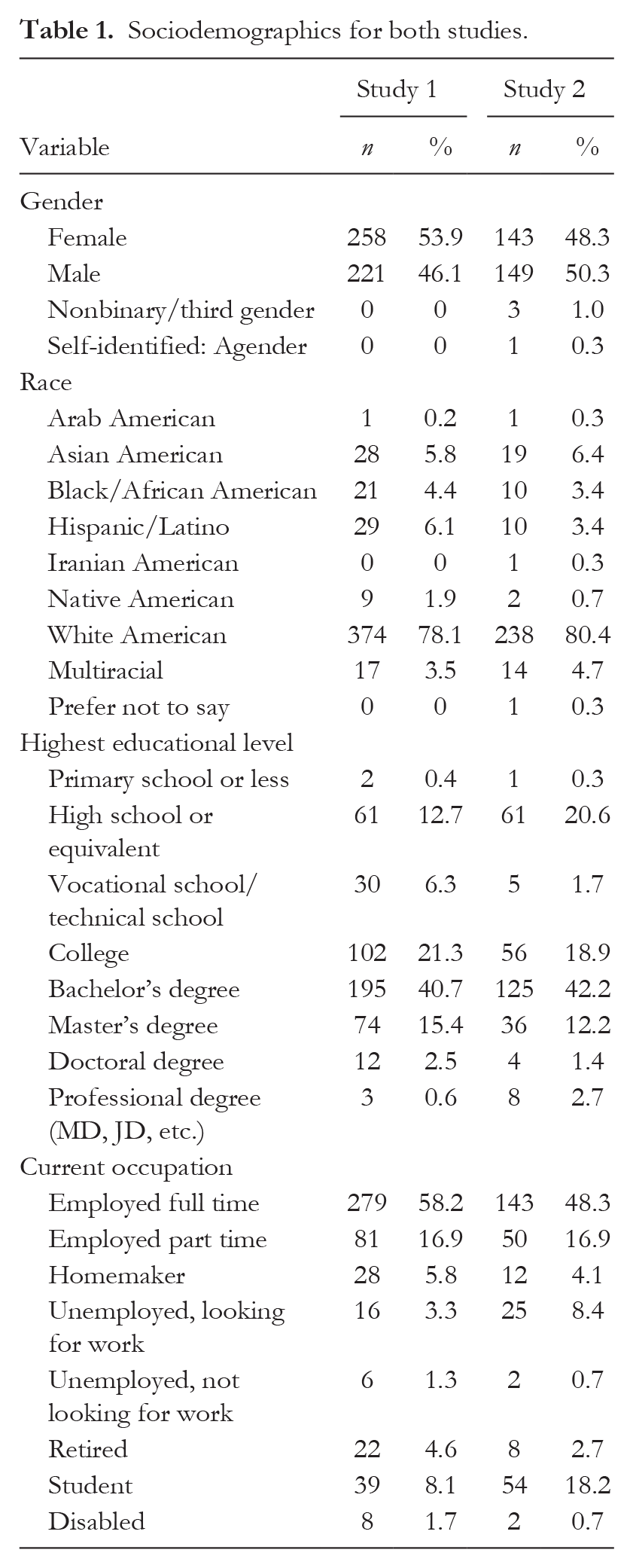
The age of our participants ranged from 18 to 83. The majority of participants identified as female (53.9%). The sample was predominantly White (78.1%), educated (40.7% had at least a bachelor’s degree), and employed full time (see Table 1). We aimed to recruit a similar number of Democratic and Republican parties’ supporters; 217 (53.9%) identified as Democratic Party’s supporters, 196 (40.9%) as Republican Party’s supporters; 66 (13.8%) participants who did not identify with either party were included because they leaned towards the Democratic Party (n = 41; 8.6% of the final sample) or the Republican Party (n = 25; 5.2%). We excluded those who identified as neutral after probing if they leaned towards either party. Overall, Democratic Party’s supporters were more politically liberal (M = −1.62, SD = 1.09) than Republicans (M = 1.43, SD = 1.05), t(477) = −31.03, p < .001, Cohen’s d = −2.84, as indicated by the mean over political orientation in general, regarding social issues, and regarding economic issues ranging from −3 (very liberal) to +3 (very conservative). Identification with the party was similar among Democrats (M = 2.70, SD = 1.02) and Republicans (M = 2.63, SD = 0.99), t(411) = 0.69, p = .492, Cohen’s d = 0.07 (see Table B1 in Appendix B, supplemental material).
Sociodemographics for both studies.
Manipulation
After stating sociodemographic information, control variables, and political identification, participants were randomly assigned to one of the four experimental conditions; 2 (conflict: intergroup/ingroup) × 2 (action: attack/react). Participants were presented with a tweet exchange by either Democratic or Republican party officials, depending on their own party affiliation. The tweets were designed with a tweet generator. To clarify the party affiliation of the tweet’s author, we used party symbols (donkey for Democrats, elephant for Republicans) as profile pictures. To bypass any influence of race and ethnic background, we anonymized the officials’ names. However, we used male pronouns in the instructions. The profile pictures indicating party affiliation were presented in different ways according to the experimental condition (same logos for ingroup setting, different logos for intergroup setting).
In the ingroup conflict condition, participants read a tweet exchange between two politicians who belonged to the party they supported. The politicians clashed about whether to compromise or not with the opposing party. In the intergroup condition, they read an exchange between two politicians from opposing parties who clashed because they wanted to pursue their respective party’s goals. In both conditions, participants evaluated the politician who belonged to the party they supported.
Furthermore, we manipulated whether the uncivil tweet was used to attack the (ingroup or intergroup) opponent or as a reaction to an attack by another politician. Importantly, participants in the attack and react conditions evaluated the same tweet, we only changed the order in which the tweet appeared. In the attack condition, the key tweet appeared first as the participants were told that their party representative insulted the opponent on Twitter calling them “a lunatic who should not be trusted,” adding that they “have no respect for him and his foolish views.” Participants then saw that the opponent responded to the official by calling them “a moron who doesn’t deserve the attention.” In the react condition, the second tweet was shown first, and participants were told that their party representative responded to a politician who called them a moron, by calling them a lunatic who cannot be trusted. For a depiction of the tweets, please see Appendix C (supplemental material).
Dependent variables
Approval of the tweet
Participants responded to four items asking whether they (a) approve of the tweet (−100 = strongly disapprove, +100 = strongly approve), (b) support the official (−100 = strongly oppose, +100 = strongly support), (c) intend to vote for the official (−100 = extremely unlikely, +100 = extremely likely), and (d) perceived the tweet to be justified (−100 = extremely unjustified, +100 = extremely justified). Approval as a scale was computed as the mean of the items (Cronbach’s α = .91).
Stereotypes
Participants responded to six items from the stereotype content model scales (Brambilla et al., 2011). We used two items for each dimension: (a) morality (honesty and trustworthiness; Spearman–Brown coefficient = .82), (b) competence (competence and intelligence; Spearman–Brown coefficient = .92), and (c) warmth (warmth and friendliness; Spearman–Brown coefficient = .93; 1 = not at all, 5 = extremely).
Emotions
Participants were also asked to what extent the tweet they read made them feel (a) angry at, (b) proud of, and (c) ashamed by their party representative (1 = not at all, 5 = extremely).
Perceived motivations to use incivility
To examine whether the participants perceived the uncivil behavior as hurtful or as a sign of loyalty, we inquired what the participants believed were the reasons behind their politician’s behavior using 7-point Likert scale items (−3 = very unlikely, 3 = very likely). Using two items for each dimension, we explored whether the motives were to hurt the opponent (e.g., “How likely is it that [the official] just wanted to hurt the opponent’s feelings?”; Spearman–Brown coefficient = .76) and their party (Spearman–Brown coefficient = .78; this question was only included in the intergroup condition because it did not fit the within-party context), or to show loyalty to their party (Spearman–Brown coefficient = .74) and defend themselves (Spearman–Brown coefficient = .85).
Manipulation and attention checks
To assess the extent to which the tweets were perceived as uncivil, we asked the participants to rate (a) the perceived civility of the tweet (−100 = extremely uncivil, +100 = extremely civil) and (b) the perceived respect (−100 = extremely disrespectful, +100 = extremely respectful). The items were later averaged in an incivility scale (Spearman–Brown coefficient = .88). To ensure that the participants understood the manipulation correctly, we asked them (a) whether the politician they evaluated was Democrat or Republican and (b) whether that politician attacked a political opponent, reacted to an attack by a political opponent, reacted to an attack by a copartisan, or attacked a copartisan. We also included a general attention check question that required participants to choose an “I cannot remember” option.
Procedure
The study took about 10 minutes to complete. Participants were informed that this was a study on social interaction between politicians. They were asked to provide their consent and reported their demographics before being assigned to one of the four conditions. Next, participants filled out the questions about their approval of the tweet, followed by the stereotypes, emotions, and perceived motivations to use incivility. We asked manipulation and attention checks at the end. To exclude participants who might have seen through the purpose of the study, we also solicited them to openly state what they thought the study was about. Finally, participants were debriefed and received a code which rewarded them with US$0.50 that could be collected on MTurk.
Results
Manipulation check
The manipulation was successful: The tweets were perceived as very disrespectful (M = −53.39, SD = 39.54) and very uncivil (M = −44.74, SD = 45.20). An ANOVA on the perception of the tweet as the mean over both items revealed a significant effect of context, F(1, 470) = 14.86; p < .001; ηp² = .03. Participants in the intergroup context perceived the tweet to be less uncivil (MIntergroup = −43.34, SEIntergroup = 2.20) than participants in the ingroup context did (MIngroup = −57.69, SEIngroup = 3.00). Additionally, there was a significant effect of action, F(1, 470) = 6.15; p = .013; ηp² = .01. Participants in the attack condition perceived the tweet to be more uncivil (MAttack = −55.14, SEAttack = 2.59) than participants in the reactive condition did (MReaction = −45.90, SEReaction = 2.68). Finally, there was a significant effect of party, F(1, 470) = 14.98; p < .001; ηp² = .03. Generally, Democrats evaluated the tweet to be more uncivil (MDemocrats = −57.71, SEDemocrats = 2.53) than Republicans did (MRepublicans = −43.32, SERepublicans = 2.73). For a summary of all the dependent variables from Study 1, see Table 2. For correlation matrices of all scales from Study 1 and Study 2, see Appendix D (supplemental material).
Summary of dependent variables and mediators by experimental condition and party: Study 1.
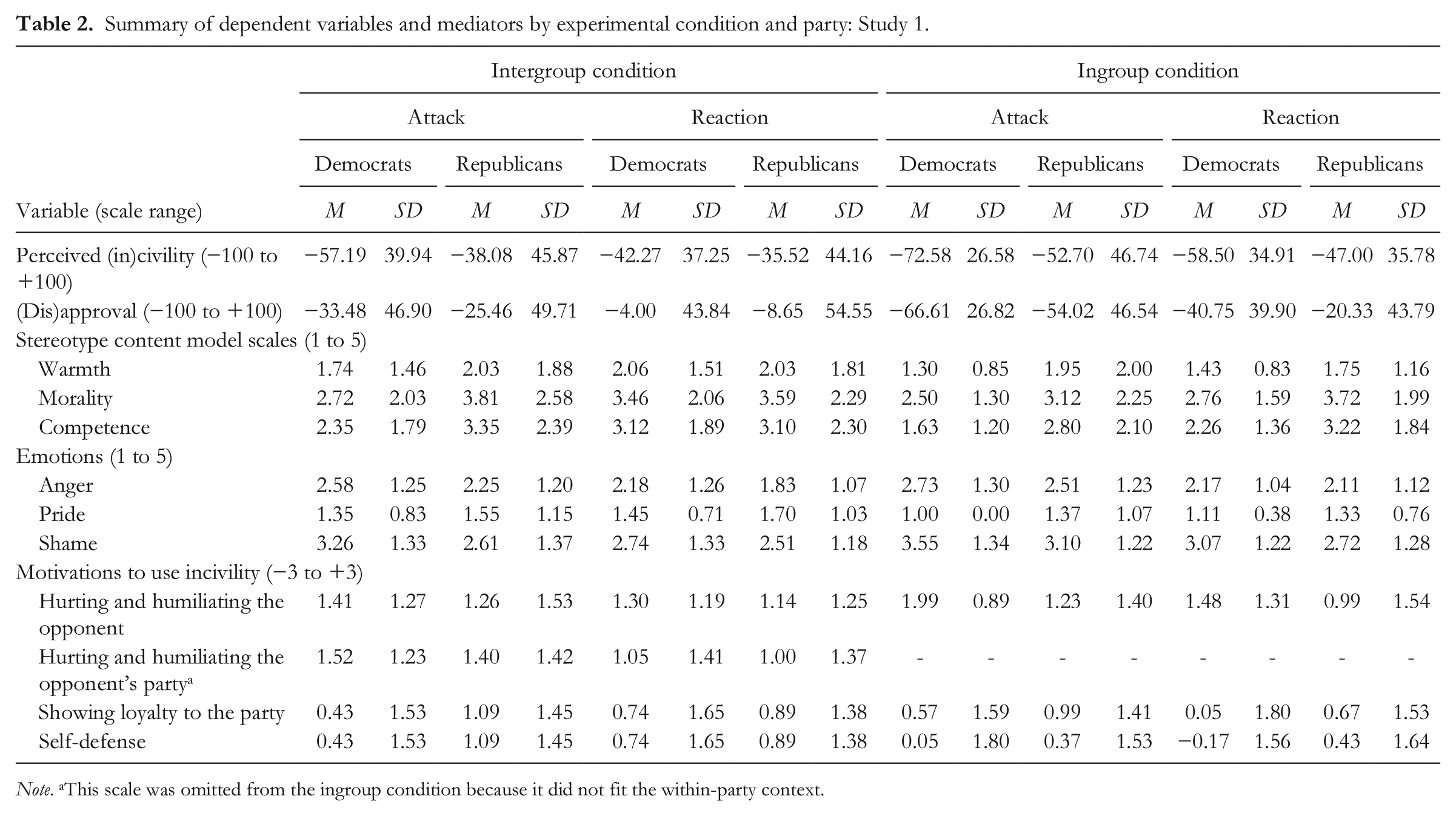
Note. aThis scale was omitted from the ingroup condition because it did not fit the within-party context.
Main analysis
Approval
We conducted a univariate analysis of variance (ANOVA) on approval with the three factors (a) context (intergroup vs. ingroup), (b) action (attack vs. reaction), and (c) participant’s party (Democrats vs. Republicans).
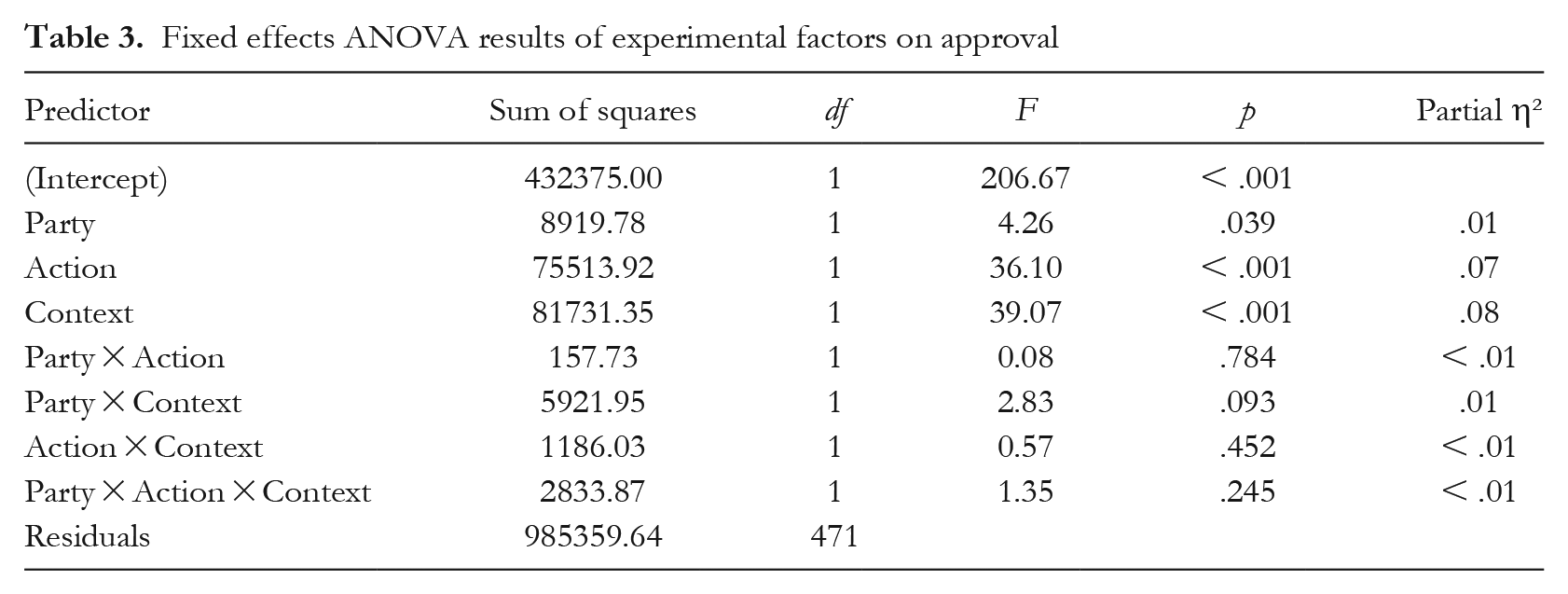
Firstly, the ANOVA showed a significant effect of context, F(1, 471) = 39.07; p < .001, ηp² = .08. In line with Hypothesis 1, participants in the intergroup context condition generally disapproved less of incivility (MIntergroup = −17.90, SEIntergroup = 2.60 vs. MIngroup = −45.43, SEIngroup= 3.56). There was also an effect of action, F(1, 471) = 36.10; p < .001; ηp² = .07. As predicted, participants were more disapproving in the attack condition (MAttack = −44.90, SEAttack = 3.06) than in the reactive condition (MReaction = −18.43, SEReaction = 3.17). Lastly, the analysis also revealed a significant effect of party on approval, F(1, 471) = 4.26, p = .039; ηp² = .01. Confirming Hypothesis 2, Democrats weregenerally more disapproving of incivility (MDemocrats = −36.21, SEDemocrats = 2.99) than Republicans (MRepublicans = −27.12, SERepublicans= 3.23). No other effects were significant. A summary of the ANOVA is shown in Table 3.
Fixed effects ANOVA results of experimental factors on approval
Stereotypes
Using the same factors, we also conducted a multivariate analysis of variance (MANOVA) on the stereotype content variables. The MANOVA revealed a significant multivariate effect of context, F(3, 468) = 2.62, Pillai V = .02, p = .050, ηp² = .02; and party, F(3, 468) = 6.57, Pillai V = .04, p < .001, ηp² = .04. No other effects were significant (full outputs of all MANOVA and follow-up analyses can be found in Appendix E, supplemental material).
Then, post hoc ANOVAs revealed that participants in the intergroup condition perceived the uncivil politician to be warmer, F(1, 471) = 5.89, p = .016, ηp² = .01 (MIntergroup = 1.97, SEIntergroup = 0.09 vs. MIngroup = 1.61, SEIngroup = 0.12); and more competent, F(1, 470) = 7.04, p = .008, ηp² = .02 (MIntergroup = 2.98, SEIntergroup = 0.11 vs. MIngroup = 2.48,SEIngroup = 0.15). Moreover, the politician who attacked was perceived as less competent (MAttack = 2.53, SEAttack = 0.13) than the politician who reacted to an uncivil attack (MReact = 2.93, SEReact = 0.14), F(1, 470) = 5.81, p = .016, ηp² = .01. Lastly, Democratic Party’s supporters thought the representative was less warm, F(1, 471) = 4.15, p = .042, ηp² = .01 (MDemocrats = 1.64, SEDemocrats = 0.10 vs. MRepublicans = 1.94, SERepublicans = 0.11); less competent, F(1, 470) = 17.29, p < .001, ηp² = .04 (MDemocrats = 2.34, SEDemocrats = 0.13 vs. MRepublicans = 3.12, SERepublicans = 0.14); and less moral, F(1, 470) = 12.07, p = .001, ηp² = .03 (MDemocrats = 2.86, SEDemocrats = 0.14 vs. MRepublicans = 3.56, SERepublicans = 0.15).
Emotions
A MANOVA on the emotion variables shame, pride, and anger revealed a significant multivariate effect of context, F(3, 468) = 5.89, Pillai V = .04, p = .001, ηp² = .04; action, F(4, 468) = 5.40, p = .001, ηp² = .03; and party, F(3, 468) = 6.12, Pillai V = .03, p < .001, ηp² = .04. No other effects were significant. Following, post hoc ANOVAs revealed significant main effects of context on shame, F(1, 470) = 7.77, p = .006, ηp² = .02, as participants in the ingroup condition, in contrast to the intergroup condition, were more ashamed (MIngroup = 3.11, SEIngroup = 0.10 vs. MIntergroup = 2.76, SEIntergroup = 0.07). They were also less proud, F(1, 470) = 14.01, p < .001, ηp² = .03 (MIngroup = 1.20, SEIngroup = 0.07 vs. MIntergroup = 1.51, SEIntergroup = 0.05) of their politician. Also, significant main effects of action were found, as participants in the attack condition were angrier, F(1, 470) = 15.31, p < .001, ηp² = .01 (MAttack = 2.52, SEAttack = 0.08 vs. MReaction = 2.07, SEReaction = 0.08); and more ashamed, F(1, 470) = 10.34, p = .001, ηp² = .02 (MAttack = 3.12, SEAttack = 0.09 vs. MReaction = 2.73, SEReaction = 0.09). Lastly, Democratic Party’s supporters reported being significantly angrier, F(1, 470) = 4.49, p = .035, ηp² = .01 (MDemocrats = 2.42, SEDemocrats = 0.08 vs. MRepublicans = 2.18, SERepublicans = 0.08); more ashamed, F(1, 470) = 13.03, p < .001, ηp² = .03 (MDemocrats = 3.15, SEDemocrats = 0.09 vs. MRepublicans = 2.71, SERepublicans = 0.09); and less proud, F(1, 470) = 9.91, p = .002, ηp² = .02 (MDemocrats = 1.23, SEDemocrats = 0.06 vs. MRepublicans = 1.49, SERepublicans = 0.06).
Motivations to use incivility
A MANOVA on perceived motivations (i.e., to hurt the opponent, show loyalty to the party, and defend themselves) to behave in an uncivil manner again revealed a main effect of context, F(3, 469) = 6.01, Pillai V = .04, p = .001, ηp² = .04; action, F(3, 469) = 37.01, Pillai V = .19, p < .001, ηp² = .19; and party, F(3, 469) = 5.52, Pillai V = .03, p = .001, ηp² = .03. No other effects were significant. Post hoc ANOVAs revealed a main effect of context, as participants in the intergroup condition, in contrast to the ingroup condition, were more likely to assume that the politician was acting to show loyalty to their party, F(1, 471) = 17.07, p < .001, ηp² = .04 (MIntergroup = 0.79, SEIntergroup = 0.09 vs. MIngroup = 0.17, SEIngroup = 0.12), and/or to defend themselves, F(1, 471) = 4.70, p = .031, ηp² = .01 (MIntergroup = 1.16, SEIntergroup = 0.08 vs. MIngroup = 0.86, SEIngroup = 0.11). Participants in the react condition were more likely to assume that the politician was defending themselves than participants in the attack condition were, F(1, 471) = 91.59, p < .001, ηp² = .16 (MAttack = 0.35, SEAttack = 0.10 vs. MReaction = 1.70, SEReaction = 0.10). Lastly, Democrats were more likely to assume that the politician’s intentions were to hurt the opponent, F(1, 471) = 9.46, p = .002, ηp² = .02 (MDemocrats = 1.54, SEDemocrats = 0.09 vs. MRepublicans = 1.16, SERepublicans = 0.09), whereas Republicans were more likely to assume that the politician’s intentions were to show loyalty to their party, F(1, 471) = 8.42, p = .004, ηp² = .02 (MDemocrats = 0.26, SEDemocrats = 0.10 vs. MRepublicans = 0.69, SERepublicans = 0.11).
Additionally, we conducted a separate ANOVA on the perceived motivation to hurt the opponent’s party since that motivation could not be included in the previous analysis because it did not fit the ingroup context. The ANOVA revealed a significant main effect of action, F(1, 308) = 9.43, p = .002, ηp² = .03. Participants in the attack, in contrast to react, condition were more likely to assume such an intention (MAttack = 1.55, SEAttack = 0.12 vs. MReaction = 1.02, SEReaction = 0.13).
Analysis on participants who failed the attention checks
Given the disproportionate number of dropouts (see Table 4), we reran the analyses using the attention checks as indicators of the condition participants believed to be in (see Appendix G in the supplemental material). We replicated all our findings. Given that the largest number of mistakes was in the ingroup context (75.84%), we ran additional analyses comparing the participants who mistook the ingroup for the intergroup context with those in the ingroup condition who understood the manipulation correctly. Overall, there were no significant differences between the two groups in terms of demographics, except that the participants who misinterpreted the context were, on average, significantly more conservative (MCorrect = −0.19, SDCorrect = 1.83 vs. MIncorrect = 0.34, SDIncorrect = 1.79), t(419) = 2.88, p = .004, Cohen’s d = 0.29. In conclusion, there was no specific subgroup of participants who failed the attention check.
Number of participants taken out in each experimental condition in the second manipulation check.
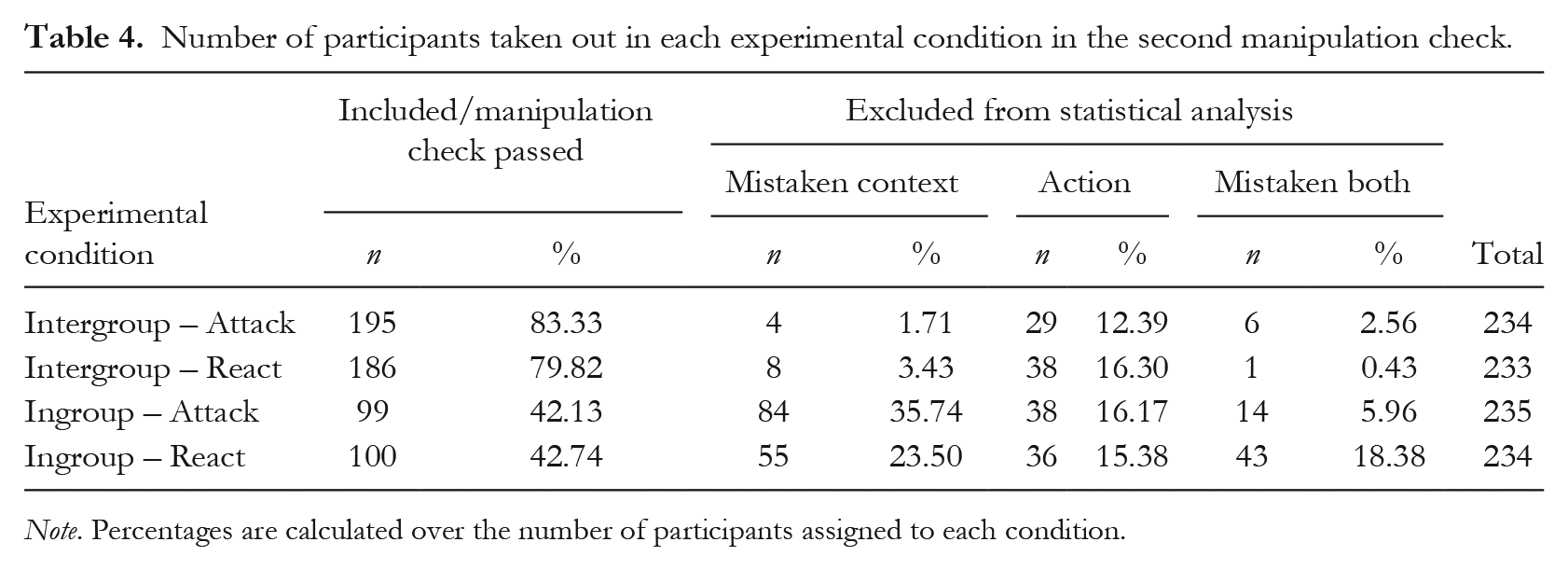
Note. Percentages are calculated over the number of participants assigned to each condition.
Discussion
Study 1 provided initial support for our hypotheses. In line with Hypothesis 1, participants were less likely to withdraw their support for a politician who acted in an uncivil manner towards their political opponent than towards a colleague. They perceived them to be more competent and warmer, and felt more pride and less shame. Moreover, they assumed that the politician did not have malicious intentions but rather acted out of loyalty to their party and/or need to defend themselves. In line with Hypothesis 2, Democratic Party’s supporters were across the board more likely to condemn uncivil behavior by their party representatives than Republican Party’s supporters were: they perceived the politician as less warm, moral, and competent, reported more anger and shame, and felt less pride. Similarly, they were more likely to assume that the politician was intending to hurt the (ingroup or outgroup) opponent, whilst Republican Party’s supporters assumed that their party representative was trying to demonstrate loyalty to their party. Finally, using uncivil rhetoric to attack, in contrast to respond to an attack, was tolerated less by the public and was seen as a sign of lack of competence.
Even though the findings of Study 1 were promising, they have to be interpreted with caution given the high number of participants who failed attention checks and the resulting imbalance between the intergroup and ingroup conditions. Thus, the goals of Study 2 were to replicate the key findings using clearer instructions to emphasize the intergroup versus ingroup contexts, to improve our measurements using additional items to gauge into stereotypes and emotions, and to simplify the design by excluding the reaction condition. Across the board, participants generally approved of incivility when it was used as a response, and there were no significant interactions between context, partisanship, and type of action. Therefore, we reasoned that it is more important to understand when and why the public may support politicians who engage in uncivil attacks. Study 2 also tested whether the presumed differences between the Democratic and Republican parties’ supporters were driven by different moral priorities.
Study 2
Methods
Participants
Four hundred U.S. participants above the age of 18 were recruited in November 2021 on the survey platform Prolific. We excluded 104 participants based on preregistered criteria that were also applied in Study 1. Finally, 296 participants were included in the analysis. Participants’ age ranged from 18 to 74 years (M = 33.19, SD = 13.21; 48% female). Regarding most characteristics, participants in Study 2 were like those in Study 1. However, this time around, Democrats were somewhat more strongly identified with their party than Republicans (MDemocrats = 2.67, SDDemocrats = 1.07 vs. MRepublicans = 2.35, SDRepublicans = 1.16), t(265) = 2.44, p = .015, Cohen’s d = 0.29.
Moral foundations
We administered the 30-item version of the Moral Foundations Questionnaire (MFQ-30; Graham et al., 2009) before the manipulations. We ran a confirmatory factor analysis using Mplus Version 8.6 fitting both five- and two-factor solutions. Both solutions had an acceptable, though not ideal, fit (see Appendix H in the supplemental material). We opted for the two-factor solution because of the high correlations between the subscales (rs > .85) and the higher reliabilities: individualizing foundations (α = .76) and binding foundations (α = .91).
Manipulation
In Study 2, we simplified the design by only looking at the evaluations of politicians who engaged in unprovoked uncivil attacks. Participants were randomly assigned to one of two experimental conditions (intergroup vs. ingroup conflict). We adjusted the framing of the military budget issue to reflect the positions of the parties at the time. Additionally, we added a sentence to the instruction presented with a tweet to remind our participants of the intergroup/ingroup context (“Please keep in mind that this is an interaction between a Democratic/Republican Party and a Democratic/Republican Party official”).
Dependent variables
We used the same four items from Study 1 (α = .88) to assess public approval and motivations to engage in uncivil communication. In contrast to Study 1, we included three items to assess each dimension of the stereotype content model (morality: α = .75; competence: α = .90; warmth: α = .91), and an additional four items to assess participants’ emotional reactions (e.g., contempt, disgust, amusement, and inspiration). An exploratory factor analysis with oblimin rotation extracted two factors explaining 61.88% of variance. Negative and positive emotion items loaded on separate factors (factor loadings between .55 and .93). Thus, we calculated two scores for positive (α = .76) and negative emotions (α = .86).
Manipulation and attention checks
We used the same manipulation and attention checks as in the previous study. We modified the check to screen for inattentive responses by asking participants to choose “Moderately agree” on an item hidden among the moral foundation scales.
Results
Manipulation check
Again, our manipulation was successful. Our participants perceived the tweet at hand to be disrespectful and uncivil (for an overview of all dependent variables from Study 2, see Table 5). A two-way ANOVA to assess differences in perceived incivility between contexts and parties revealed no significant effects.
Summary of dependent variables and mediators: Study 2.
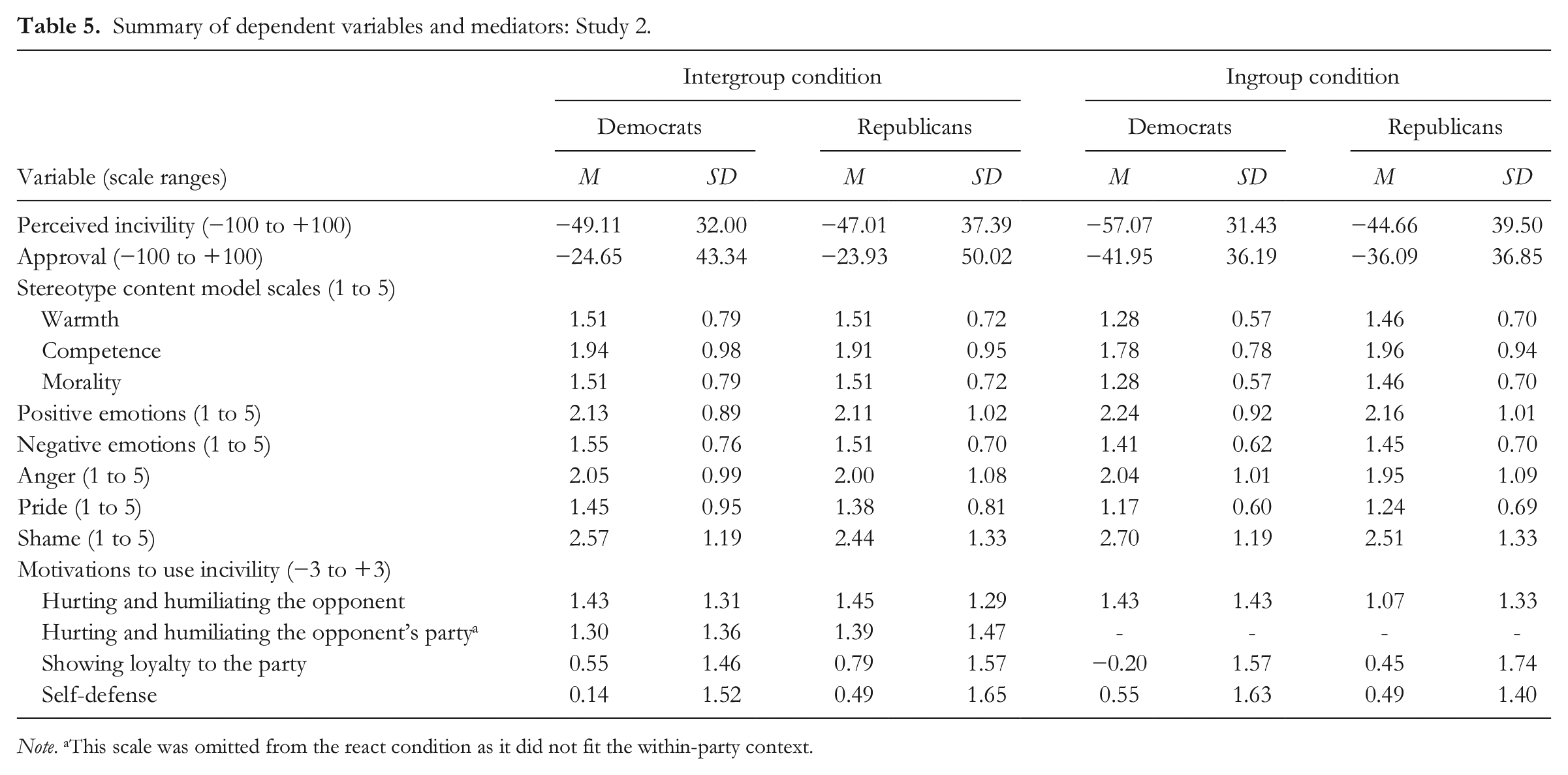
Note. aThis scale was omitted from the react condition as it did not fit the within-party context.
Dependent variables
Approval
A two-way ANOVA on approval with context (intergroup vs. ingroup) and party revealed only a significant main effect of context, F(1, 292) = 9.26, p = .003, ηp² = .03 (for a summary of all analyses, see Appendix F, supplemental material). However, the effect of party was not significant, F(1, 292) = 0.46, p = .497, ηp² <.01, nor was the interaction effect, F(1, 292) = 0.28, p = .596, ηp² < .01. Replicating the findings of Study 1, participants in the intergroup condition generally disapproved of incivility less (MIntergroup = −24.29, SEIntergroup = 3.54) than participants in the ingroup condition (MIngroup = −39.02, SEIngroup = 3.30; Figure 1).
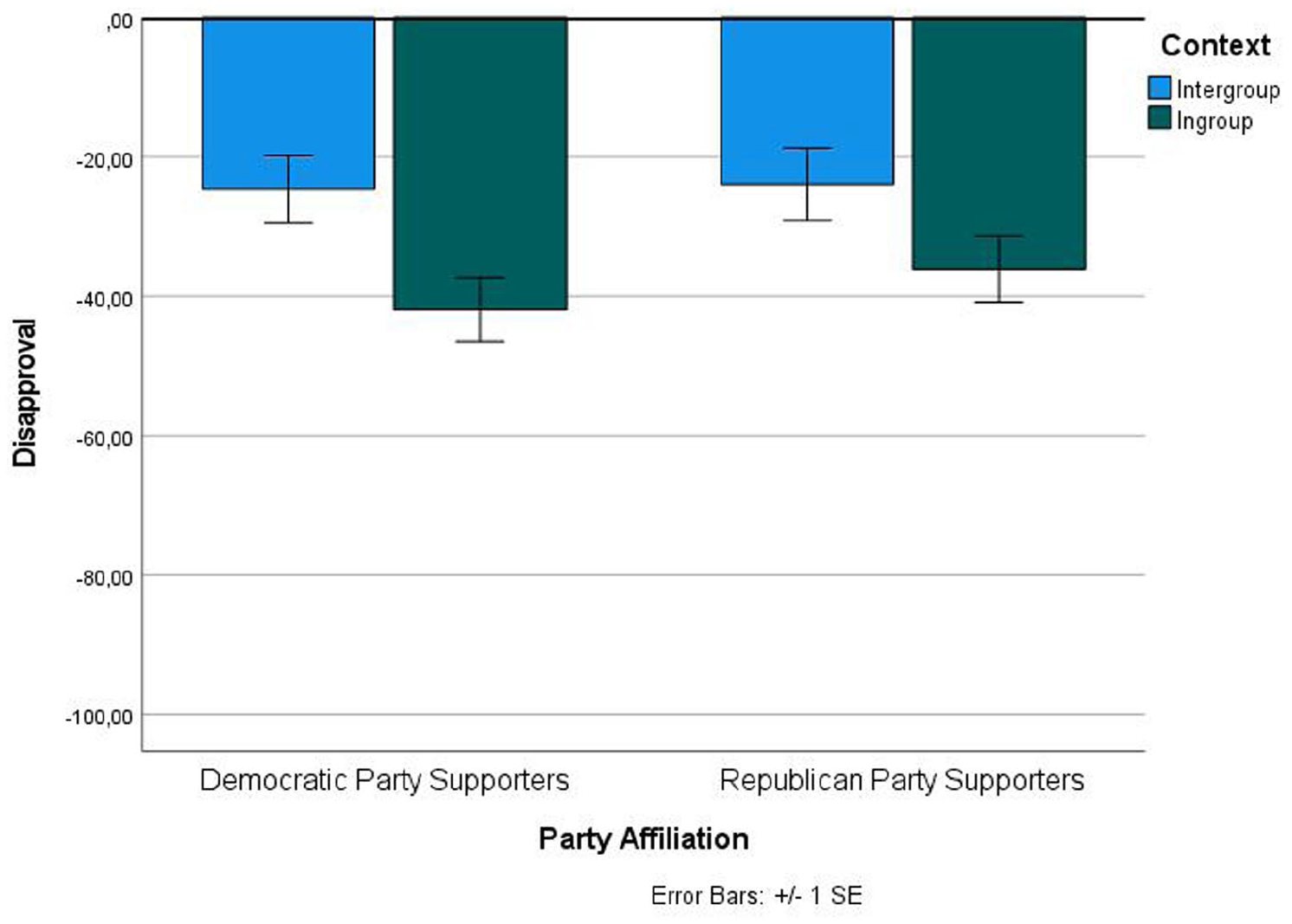
Disapproval by context and party affiliation: Study 2.
Stereotypes
We conducted a multivariate analysis of variance on the stereotype content model scales. The MANOVA revealed no significant main or interaction effects. We did not replicate the effects of party or manipulation on participants’ stereotypical impressions.
Emotions
A MANOVA on the positive and negative emotion scales produced no significant main or interaction effects. Implementing the aggregated emotion scales, we were unable to replicate our findings from Study 1. Additionally, a MANOVA on the three emotion variables from Study 1 also yielded no significant differences between Democrats and Republicans (see also Table 5 and Table F8).
Motivations to use incivility
For motivations to use incivility, the MANOVA revealed a significant main effect of context, F(3, 290) = 5.50, Pillai V = .05, p = .001, ηp² = .05. No other effects were significant. Replicating Study 1, follow-up analyses revealed an effect of context on the perceived loyalty motivation, as participants in the intergroup condition were more likely to assume such an intention, F(1, 292) = 8.61, p = .004, ηp² = .03 (MIntergroup = 0.67, SEIntergroup = 0.14 vs. MIngroup = 0.12, SEIngroup = 0.13). They also showed a main effect of party, F(1, 292) = 5.74, p = .017, ηp² = .02. Specifically, Republicans were more likely to assume a loyalty motivation (MRepublicans = 0.62, SERepublicans = 0.14) than Democrats were (MDemocrats = 0.17, SEDemocrats = 0.13).
Finally, a t test on the perceived motivation to hurt the opponent’s party between Democrats and Republicans yielded no significant difference, t(136) = −0.42, p = .675, Cohen’s d = −0.07.Individual differences in moral beliefs.
Overall, Democratic Party’s supporters endorsed individualizing foundations significantly more than Republicans did, t(294) = 6.24, p < .001, Cohen’s d = 0.73 (MDemocrats = 4.83, SDDemocrats = 0.56 vs. MRepublicans = 4.39, SDRepublicans = 0.65). On the other hand, Republicans were more likely to endorse binding foundations, t(294) = −13.43, p < .001, Cohen’s d = −1.56 (MDemocrats = 2.92, SDDemocrats = 0.77 vs. MRepublicans = 4.09, SDRepublicans = 0.71).
To assess the impact of individualizing and binding moral foundations on approval, we regressed approval on party, context, foundations, and included all two-way and three-way interactions. Moral foundations were centered; party affiliation and experimental conditions were dummy-coded. A summary of the regression is shown in Table 6.
Regression summary of support on predictors and moral foundations
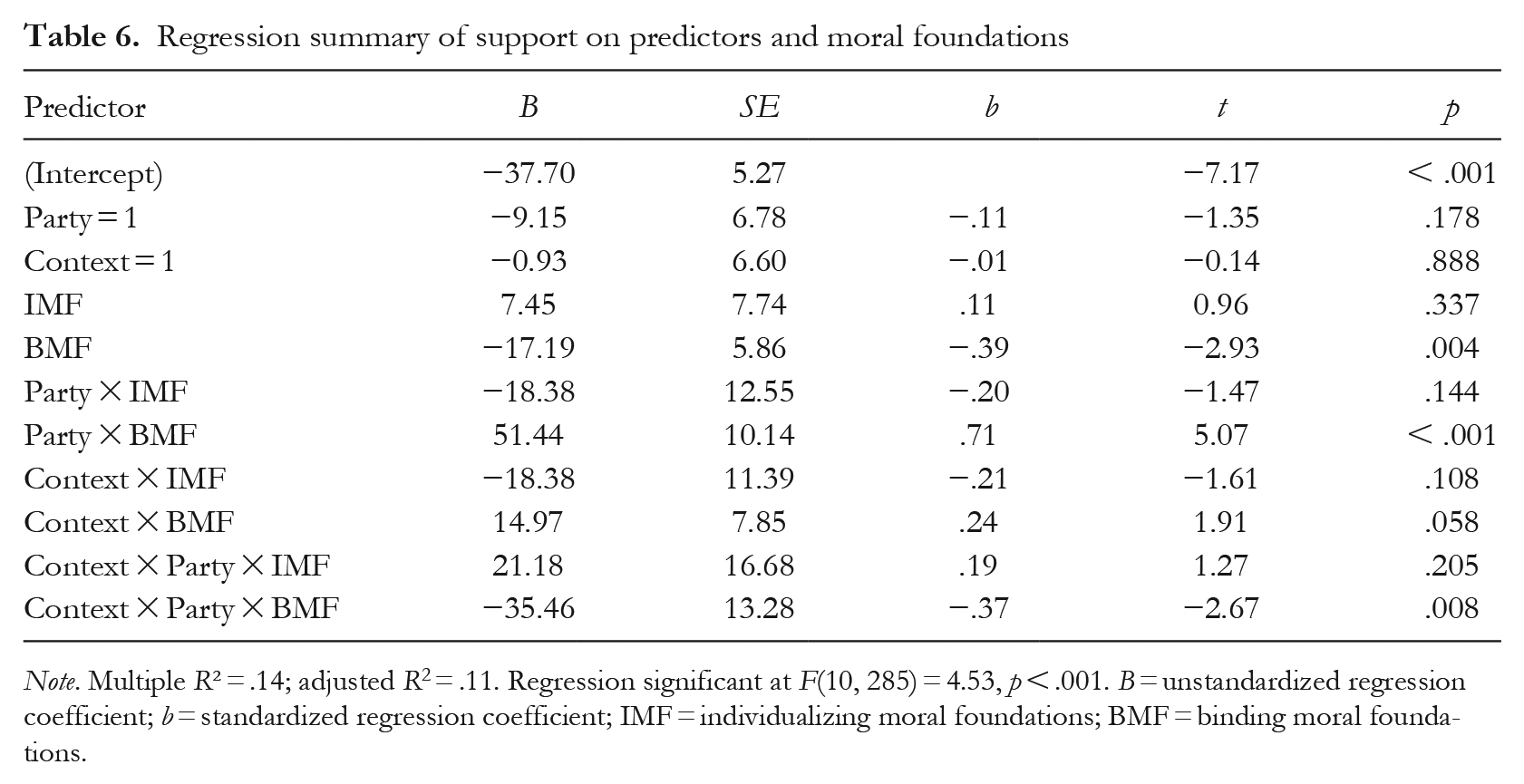
Note. Multiple R² = .14; adjusted R2 = .11. Regression significant at F(10, 285) = 4.53, p < .001. B = unstandardized regression coefficient; b = standardized regression coefficient; IMF = individualizing moral foundations; BMF = binding moral foundations.
The regression model was significant, F(10, 285) = 4.53, p < .001, with an R² = .14 and an adjusted R² = .11. There were three significant effects: a main effect of binding foundations (B = −17.19, SE = 5.86), an interaction between party and binding foundations (B = 51.44, SE = 10.14), as well as a three-way interaction between context, party, and binding foundations (B = −35.46, SE = 133.28). We calculated the simple slopes for each condition and group as described in Dawson (2014). Contrary to our expectations, in the context of ingroup conflict, binding foundations did not predict approval among Republicans (B = 11.04, t = 1.62, p = .107), nor among Democrats (B = −3.83, t = −0.67, p = .505), However, and partially supporting Hypothesis 3, stronger endorsement of binding foundations predicted higher approval among Republicans in the context of intergroup conflict (B = 39.60, t = 4.57, p < .001). Unexpectedly, binding foundations predicted less approval among Democrats in the context of intergroup conflict (B = −15.43, t = −2.56, p = .011). The interaction effect is shown in Figure 2.
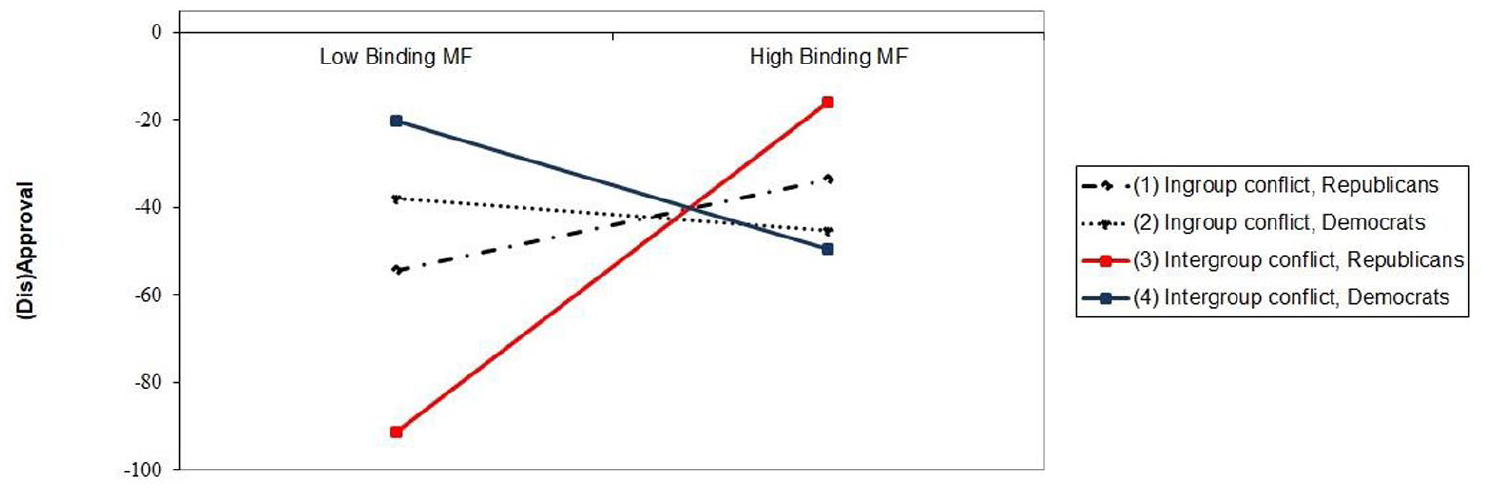
Three-way interaction of context, party, and binding moral foundations on approval.
Analysis on participants who misinterpreted the context
As in Study 1, we had a disproportionate number of attention check dropouts in our ingroup condition (see Table 7). Again, we ran additional analyses including the participants who failed attention checks. We replicated all the findings. We also compared the participants who misunderstood the ingroup context for the intergroup one, and we did not find any differences. Again, the extended analyses can be found in Appendix G in the supplemental material.
Number of participants by party who (in)correctly identified their condition and official’s party.
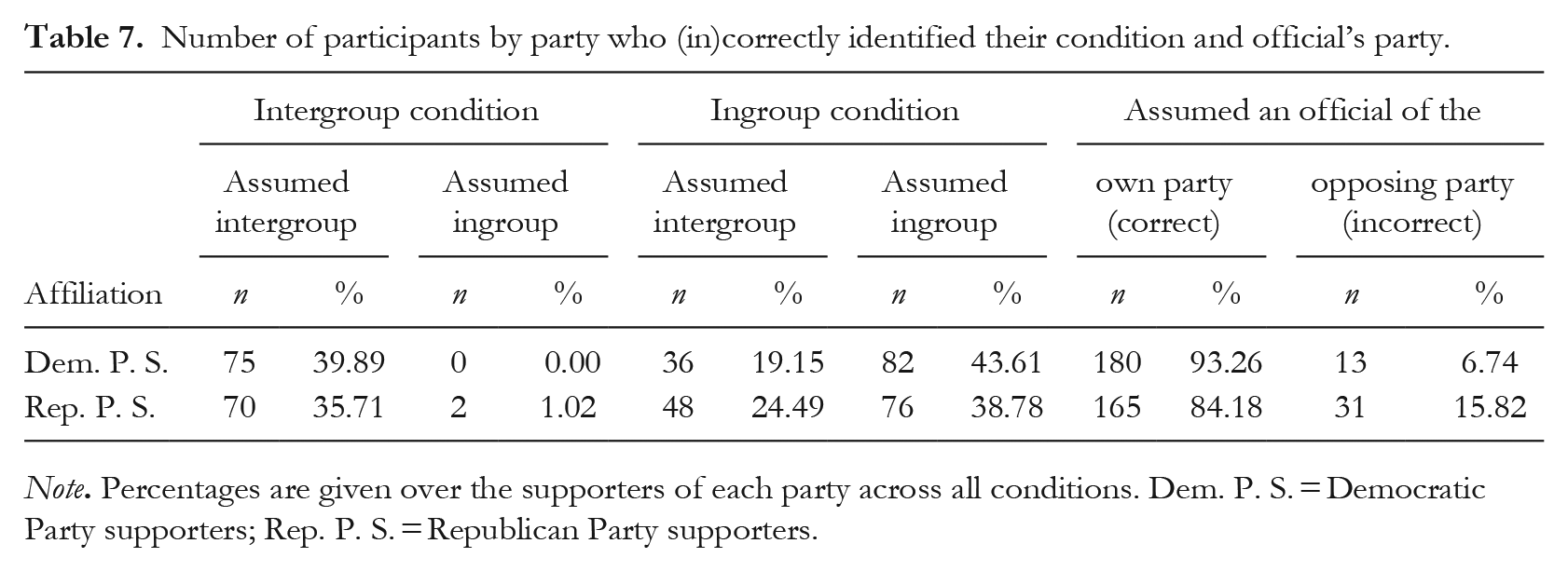
Note. Percentages are given over the supporters of each party across all conditions. Dem. P. S. = Democratic Party supporters; Rep. P. S. = Republican Party supporters.
Discussion
Study 2 replicated the key finding from Study 1 by showing that the context in which incivility is used matters: Supporters were more lenient and less disapproving if the uncivil attack was directed at political opponents. The key reason seems to be that in the intergroup context, supporters assumed more benevolent motivations, such as showing loyalty to the group. However, we did not replicate the effects on stereotypes or emotions. Moreover, we did not find support for Hypothesis 2: Democratic Party’s supporters were somewhat more disproving of incivility than Republicans; however, the differences were not statistically significant. Yet, we did find partial support for Hypothesis 3: higher endorsement of binding foundations among Republican supporters was correlated with higher approval of incivility in the context of intergroup conflict. Interestingly, the opposite was true for Democrats, for whom binding foundations were related to more disapproval. In contrast to previous work (Walter & Lipsitz, 2021), we did not find any relations between individualizing moral foundations and approval.
General Discussion
The aim of the paper was to broaden the understanding of when and why the public may tolerate politicians who violate social norms. Overall, in line with previous findings (e.g., Frimer & Skitka, 2018), the public generally disapproved of politicians who behaved in aggressive and uncivil ways. However, both Study 1 and Study 2 found that incivility was met with less public disapproval when the politicians targeted party opponents but not colleagues (supporting Hypothesis 1). Extending previous work, we showed that the public may condone uncivil behavior by justifying it as a sign of loyalty to the group, which fits broadly with the social identity approach (Tajfel & Turner, 1979). Interestingly, we found mixed support for Hypotheses 2 and 3. In Study 1, we found that Democratic Party’s supporters more strongly condemned politicians’ uncivil behaviors than Republicans did. However, the differences in Study 2 were smaller and not significant. One exception is that Republicans, in contrast to Democrats, were more likely to see the behavior as a sign of loyalty to the party’s goals in both studies. Moreover, as expected, we found that placing importance on binding values is linked to higher approval of incivility among Republicans at least in the context of intergroup conflict, but not among Democrats. Surprisingly, we found that binding foundations were also important for Democrats, although they were linked to less approval. In contrast to our expectations, we did not find any effect of individualizing foundations. Altogether, the findings of the two studies underline the importance of context and moral values in shaping public (dis)approval.
Theoretical Implications
This project contributes to the literature on immoral behaviors in the political domain by showing that public (dis)approval is context-dependent. Existing literature on political incivility disregarded the contextual information in which uncivil communication takes place (Frimer & Skitka, 2018; Gervais, 2014; Mölders et al., 2017). Our findings show that context may dampen the negative impact of incivility and in some circumstances, it might even be beneficial for a politician to (re)act in an uncivil manner. In line with work on social identity theory (Tajfel & Turner, 1979), we found that politicians are less likely to be judged for their uncivil behavior in the context of intergroup conflicts. Whilst supporters assumed that politicians had immoral and malicious intentions to hurt the opponent, those were outweighed by the assumption that aggressive behaviors are displays of loyalty to the group. These findings align with previous work showing that aggression directed at outgroups is welcomed as long as it serves the group’s interest (Blackwood & Louis, 2017; Pacilli et al., 2016). We fear that if incivility is not punished and politicians do not face public scrutiny, this may have further negative effects on relations between political opponents and may contribute to polarization.
In contrast, political aggression directed at one’s own party is not likely to be tolerated, according to our findings. In both studies, supporters were sensitive to in-party fighting and made harsh evaluations, which corroborates previous work on more negative evaluations of ingroup critics in times of conflict (Ariyanto et al., 2010). Interestingly, in both studies, many participants mistook the ingroup for the intergroup conflict, which further supports the notion that ingroup fighting is not acceptable. We suspect that the mistakes were not only due to inattentiveness and/or difficulty with understanding the materials, but rather a sign of biased and motivated reasoning (Kunda, 1999). The desire to defend and protect the group and its image may override the motivation to be accurate, and lead people to overlook ingroup disagreements (Leeper & Slothuus, 2014). Future research should pay closer attention to the effects ingroup conflicts have on supporters.
Our findings also speak to the work on ideological (a)symmetry and the role of individual moral beliefs (Jost, 2017). We initially assumed that Democratic Party’s supporters would be more judgmental of incivility than Republicans, primarily because they prioritize individualizing over binding foundations (Graham et al., 2009). However, the findings from the two studies are inconclusive: whilst we did find some differences in line with our hypothesis in Study 1, those did not replicate. Moreover, we did not find much support that individualizing foundations matter when it comes to incivility judgments (Walter & Lipsitz, 2021), at least not in terms of public approval. A possible explanation is that, in contrast to previous work, we emphasized the context in our manipulations, which pitted moral beliefs about harm and group loyalty against each other. Importantly, we found that binding foundations mattered more and, interestingly, seemed to be driving ideological opponents towards different conclusions. In the context of intergroup conflict, binding foundations amongst Republicans predicted higher approval of uncivil politicians, which aligns with work on the role of violence in honor culture (Cohen & Nisbett, 1994). However, the opposite pattern was found for Democrats, who reacted harsher towards uncivil politicians the more they endorsed binding foundations. Perhaps Democrats also care about the party’s image, but in different ways than Republicans (Sheldon & Nichols, 2009); namely, they may be fearful that uncivil behaviors may stain the party’s image. The observed patterns are preliminary and warrant further investigation.
Nevertheless, these findings point out that research on the impact of moral beliefs needs to take into consideration the broader political and ideological context. MFT assumes that individual differences in moral value preferences are stable and largely context-independent (Graham et al., 2009). In contrast, work on relational model theory supports the idea that individuals apply moral values differently depending on the context (Simpson & Laham, 2015; Simpson et al., 2016). For example, Simpson et al. (2016) found that people deem actions that violate purity norms as more transgressive if they occur between individuals of different ranks (i.e., student–professor) than between two siblings. Likewise, we found that moral foundations and showing loyalty to the group mattered more when judgments were made in the context of intergroup rather than ingroup conflict. Therefore, future research should examine more closely when context may or may not override individuals’ moral beliefs.
Limitations
Even though a lot of political conflicts are fought online, incivility is not only present on social media. Instead, it is often found in interviews, at campaign rallies, or during TV debates (Coffey et al., 2015; York, 2013). TV and audio media (e.g., radio or podcasts) also allow the audience to gain more information about the impact that uncivil communication has on the target by, for instance, showing their emotions and nonverbal reactions. If the audience is more aware of the negative effects aggressive behaviors have on political opponents, perhaps they are less likely to condone them. Additionally, we had an issue with many participants failing attention checks, especially in Study 1. While this points towards an interesting psychological phenomenon, which appears to be a defensive reaction, we agree with previous work that it is important to check whether participants are understanding the instructions correctly (Hauser et al., 2018). Moreover, it would be interesting to compare whether uncivil communication has different effects during less versus more intense political conflicts (e.g., before elections or when important laws are voted in). We suspect that during more intense political conflicts, supporters may be more likely to condone this behavior as it serves the group’s goals more directly, while they may condemn it more when intergroup conflict is less salient.
Supplemental Material
sj-docx-1-gpi-10.1177_13684302231156719 – Supplemental material for Tolerance of political intolerance: The impact of context and partisanship on public approval of politicians’ uncivil behavior
Supplemental material, sj-docx-1-gpi-10.1177_13684302231156719 for Tolerance of political intolerance: The impact of context and partisanship on public approval of politicians’ uncivil behavior by Leon Walter and Maja Kutlaca in Group Processes & Intergroup Relations
Footnotes

References
Supplementary Material
Please find the following supplemental material available below.
For Open Access articles published under a Creative Commons License, all supplemental material carries the same license as the article it is associated with.
For non-Open Access articles published, all supplemental material carries a non-exclusive license, and permission requests for re-use of supplemental material or any part of supplemental material shall be sent directly to the copyright owner as specified in the copyright notice associated with the article.
