




Abstract
What factors underlie judgments of cultural appropriation? In two studies, participants read 157 scenarios involving actors using cultural products or elements of racial/ethnic groups to which they did not belong. Participants evaluated scenarios on seven dimensions (perceived cultural appropriation, harm to the community from which the cultural object originated, racism, profit to actors, extent to which cultural objects represent a source of pride for source communities, benefits to actors, and celebration), while the type of cultural object and the out-group associated with the object being appropriated varied. Using both the scenario and the participant as the units of analysis, perceived cultural appropriation was most strongly associated with perceived greater harm to the source community. We discuss broader implications for integrating research on inequality and moral psychology. Findings also have translational implications for educators and activists interested in increasing awareness about cultural appropriation.
In 2020, a group of White lawmakers entered the Capitol Building dressed in kente stoles, which has deep historical resonance in the African American community. Around the same time, White entrepreneurs sold luxury tiles based on Mahjong, a game that originated in China and maintains ties with the Chinese diaspora (Garcia Navaro, 2021). Whereas some have argued that these acts reflect cultural appropriation (e.g., Cohen, 2017), others have labeled them acts of intergroup solidarity and celebration.
This research examines factors that predict perceptions of cultural appropriation: the use, imitation, or possession of cultural elements from an out-group or “source community” (Ziff & Rao, 1997). Prototypical acts of cultural appropriation involve members of dominant cultures taking aspects of subordinated cultures (Katzarska-Miller et al., 2020; Rogers, 2006). Mosley and Biernat (2020) asked White and Black participants to judge White actors taking from Black culture (e.g., wearing dreadlocks) or Black actors taking from White culture (e.g., wearing blonde weaves). Black participants viewed the dominant-group (White) actors as more culturally appropriative than the subordinated (Black) actors, but White perceivers often did not distinguish between these cases. Other scholars have focused on conditions that amplify views of culturally appropriative actions as problematic, including unequal power relations and actor profit (Lenard & Balint, 2020).
This research asks what features of actions matter most for perceptions of appropriation. We examined the extent to which various dimensions predict judgments of cultural appropriation: Harm to source community, degree of actor profit, degree of actor benefit, extent to which used objects contribute to source community pride, and extent to which actions are seen as racist and celebratory.
Avoiding harm is a core moral value (Gray et al., 2014; Haidt et al., 2009). Cultural appropriation may harm vulnerable source communities in a variety of ways (Buescher & Ono, 1996; Rogers, 2006; Scafidi, 2005). For example, the appropriated products may lose symbolic value and can deprive the source community of financial benefit (Scafidi, 2005). Appropriation can reinforce stereotypes, as when White institutions use Native American mascots portrayed as “warrior chiefs,” thereby prompting biased treatment and constraining source community members’ self-views (Fryberg et al., 2008).
Racism is one particularly potent form of harm relevant to cultural appropriation. Similar to racist acts, appropriation takes advantage of a system of asymmetric race-based power relations to reinforce intergroup inequality (J. M. Jones, 1997). But racism and cultural appropriation are not synonymous: Appropriation refers specifically to the use, imitation, or possession of out-group cultural elements (e.g., Ziff & Rao, 1997), whereas racism refers more broadly to “a historically derived cultural ethos . . . that reflects a belief in and tendency towards racial dominance by Anglo Americans” (J. M. Jones, 1997, p. 505). In two studies using several scenarios, Mosley and Biernat (2020) found correlations of .43 and .63 between judgments of cultural appropriation and racism. Some appropriative acts were viewed as highly racist (e.g., White actors wearing Blackface), but others were not (e.g., White chefs serving soul food). Cultural appropriation may also be more likely to threaten the distinctiveness of groups, whereas racism threatens group value and esteem (Branscombe et al., 1999). Nonetheless, given some relation between these constructs, perceiving an action as racist likely increases perceptions of appropriation.
Actions involving out-group cultural use may also differ in the extent to which they profit actors, or increase their material wealth as a result of selling/using out-group products (Lenard & Balint, 2020). People may see profit as immoral because actors can gain financially without due compensation for source communities (Scafidi, 2005). Perceptions of profit may therefore predict perceptions of appropriation because perceivers may view the actor as unjustly reaping rewards from the cultural products at the expense of members of the source community—who are often marginalized for engaging with those same products (Lenard & Balint, 2020).
Cultural products often provide a source of community pride. For example, wearing dreadlocks can symbolize African liberation and Black power (Kuumba & Ajanaku, 1998). For Black perceivers, seeing White people wearing dreadlocks might stifle community pride as the hairstyle becomes decontextualized and diluted when paired with an out-group member. Black perceivers experience threats to in-group distinctiveness when they read about White actors imitating Black culture, which contributes to greater perceptions of cultural appropriation (Mosley & Biernat, 2020). The extent to which perceivers view cultural objects as a source of community pride should predict perceiving its use by an out-group as appropriative (see also Lenard & Balint, 2020).
The factors highlighted thus far emphasize negative aspects of appropriation, which people often view as immoral (Young, 2010). Thus, we expect that perceptions regarding these factors will predict increased perceptions of appropriation. However, it is also possible to view out-group cultural use positively. Actor benefit refers to positive outcomes that accrue to actors from multicultural experience and out-group cultural use, such as enhanced creativity (Maddux et al., 2010) and increased psychological richness (Oishi et al., 2020). Appraisals of actor benefit may negatively predict judgments of cultural appropriation.
Participants may also appraise out-group cultural use as celebratory, with actors honoring rather than taking from source communities. In a multicultural world, people may become curious about out-group cultural products and seek to explore their use in the spirit of cultural exchange (J. M. Jones et al., 2014). Interpersonal imitation can indicate flattery and increase interpersonal attraction (Chartrand & Bargh, 1999). The perception that actors are celebrating out-group cultures should be negatively associated with viewing their actions as appropriative.
We investigated these six factors, namely, harm, racism, profit, pride, benefit, and celebration, as predictors of perceived appropriation in contexts highlighting dominant (White) and subordinated (Black, Asian, Hispanic, and Native) source communities. Studies 1a and 1b captured variability across actions by asking participants to rate 157 scenarios on just one of the dimensions. We then computed each scenario’s mean perceived standing on each dimension and analyzed relations among dimensions with scenario as the unit of analysis. This approach allowed us to identify the most important factors explaining variation in judgments of cultural appropriation across a wide set of scenarios. Study 2 examined variability across perceivers to make more meaningful inferences about the individual psychology of perceiving cultural appropriation.
Study 1a
Method
Participants
We recruited 498 participants from Amazon’s Mechanical Turk, with a goal of 60 participants per condition (based on norms of other research that treats stimulus as unit of analysis; for example, Biernat & Ma, 2005; Crandall & Moriarty, 1995). Although the original preregistration (anonymized Open Science Framework [OSF] version submitted as supplement) mentioned a goal of 50 participants per condition, we over-sampled slightly to 60 participants to account for possible exclusions. Participants ranged in age from 18 to 89 years (M = 38.09 years, SD = 12.40 years). Participants self-identified as male (40%) or as female (33%); the remaining participants did not respond to this item. Participants reported their racial group membership as White (53%), Black (7%), Hispanic (3%), Asian (8%), multiracial (2%), and Native American (1%); the remaining participants did not respond to this item. Although we assessed screener questions (e.g., reporting distraction), we made the decision to exclude no participants from this study because doing so would have reduced our sample size considerably.
Scenarios
Participant read 157 scenarios depicting actors engaging in out-group cultural use. Scenarios varied the race of the actor and source community (57 White Actor–Black Culture scenarios, 21 White Actor–Native Culture scenarios, 13 White Actor–Hispanic Culture scenarios, 30 White Actor–Asian Culture scenarios, and 36 Black Actor–White Culture scenarios). We chose these pairings based on previous literature comparing White Actor–Black Culture and Black Actor–White Culture scenarios (Mosley & Biernat, 2020), then including other source communities representing major racial groups in the United States (Zou & Cheryan, 2017). Consistent with theoretical and lay definitions of cultural appropriation (Katzarska-Miller et al., 2020), the majority of scenarios (n = 121) depicted White actors using out-group cultural products. The list of scenarios and means for each dependent measure appear in the supplementary materials.
Procedures
After giving consent, participants learned that they would read 157 brief scenarios depicting individuals engaging in out-group cultural use. We randomly assigned participants to answer one of seven questions, namely, the extent to which they considered (a) each scenario to be an act of cultural appropriation, (b) the source community in each scenario to be harmed by the act, (c) each scenario to be an act of racism, (d) the actor in each scenario to have profited from the act, (e) the object in each scenario to elicit community pride, (f) the actor in each scenario to benefit from the act, or (g) each scenario to be an act of cultural celebration. 1 Participants made each judgment on a scale of 1 (indicating the lowest perceptions, for example, “this is NOT cultural appropriation”) to 7 (indicating the highest perceptions, for example, “this IS cultural appropriation”). Participants completed demographics and were debriefed.
For each dimension, we calculated each scenario’s mean ratings across participants. Scenario (N = 157) is therefore the unit of analysis. Because each rating represented roughly 60 independent responses, using the mean response provides a stable point estimate (Biernat & Ma, 2005; Crandall & Moriarty, 1995; Feldman & Crandall, 2007).
Results
We first computed bivariate correlations among all dimensions (Table 1). Perceptions of appropriation were positively correlated with perceptions of harm, source community pride, racism, and—to a lesser extent—actor profit. Multiple regression results, with all six predictors included simultaneously, appear in Table 2. Scenarios were more likely to be perceived as appropriative to the extent that the cultural products involved facilitated pride for source communities, the actions harmed source communities, and the actors involved did not benefit.
Means and Correlations Among Dimensions, Study 1a
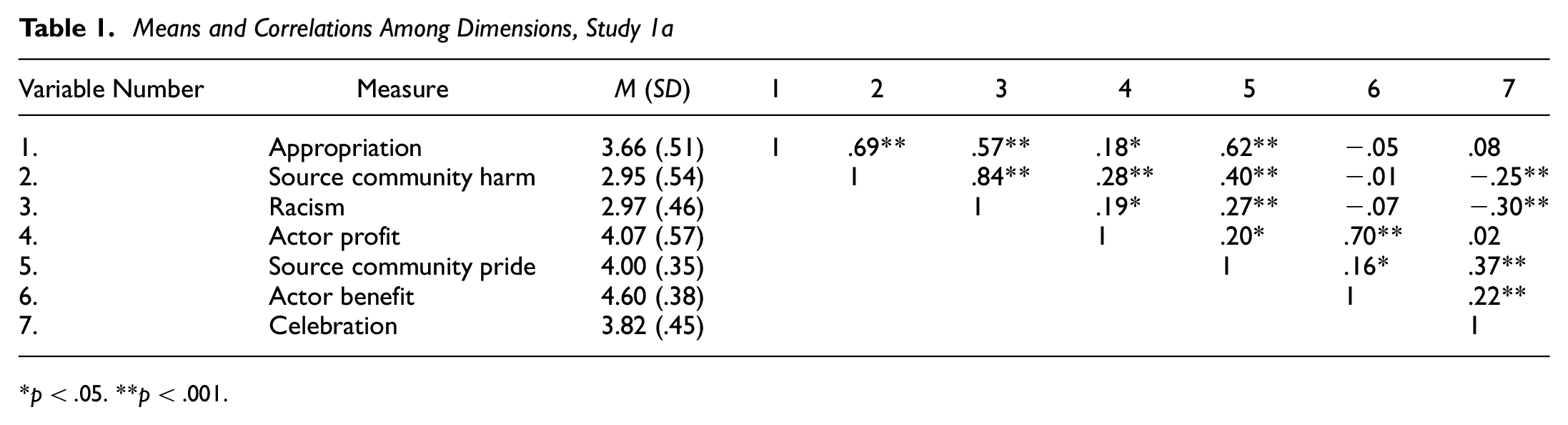
p < .05. **p < .001.
Multiple Regression Results (Standardized) Predicting Perceived Cultural Appropriation, Study 1a, R2 = .64, p < .05
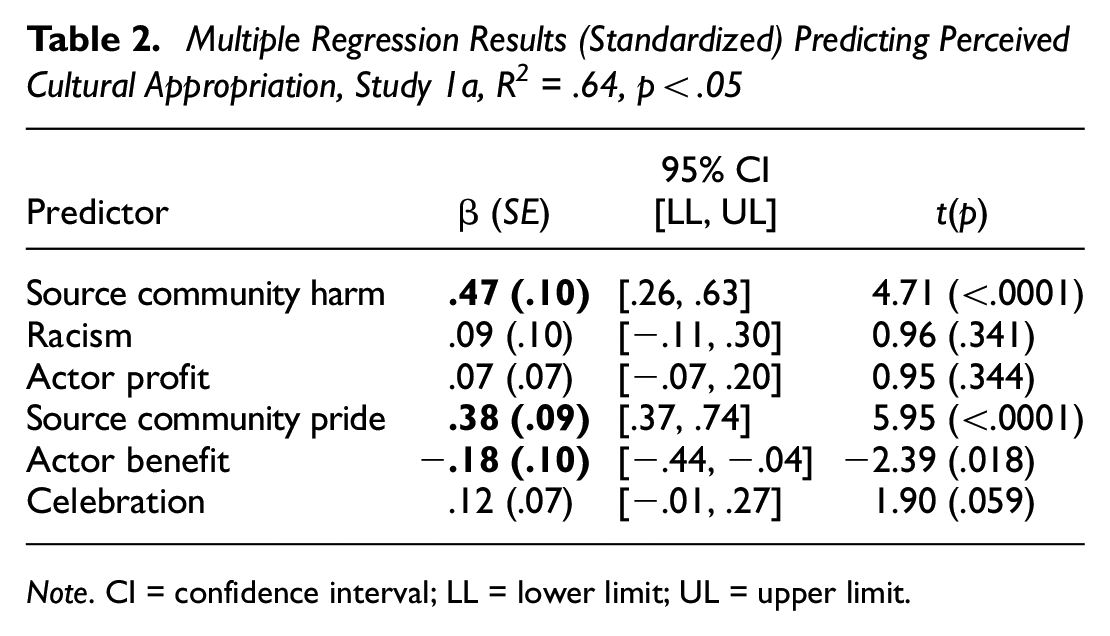
Note. CI = confidence interval; LL = lower limit; UL = upper limit.
The list of 157 scenarios included five types of actor–source combinations: White Actor–Black Culture, White Actor–Native Culture, White Actor–Hispanic Culture, White Actor–Asian Culture, and Black Actor–White Culture. These were not equated in number (ns were 57, 21, 13, 30, and 36, respectively), nor on any other dimensions, so direct comparisons among them are not meaningful.
However, scenarios that depicted White actors engaged with Black culture and Black actors engaged with White culture were the most closely comparable in content, and 25 scenarios of each type were direct mirror images of each other (e.g., “An African American writes an article on how to understand the White experience in America,”“A White American writes an article on how to understand the Black experience in America”). A two-sample t test indicated that actions involving White actors (M = 3.77, SD = .55) were judged more appropriative than actions involving Black actors, (M = 3.43, SD = .41), t(48) = 2.47, p = .0173, d = .70, 95% confidence interval (CI) [.12, 1.27]. These two types of cases did not differ in perceived harm, racism, profit, benefit, or celebration (ps > .21), but greater source community pride in the appropriated object was perceived when White actors used Black cultural products (M = 3.98, SD = .34) than when Black actors used White cultural products (M = 3.79, SD = .26), t(48) = 2.25, d = .64, CI [.06, 1.20], p = .0290.
Discussion
Across 157 scenarios, the strongest predictors of perceptions of cultural appropriation were perceived harm, source community pride, and actors not benefiting from actions. Although perceived profit and benefit were themselves positively correlated, actor benefit was distinguishable from profit, likely capturing nontangible benefits such as psychological growth (Maddux et al., 2010; Oishi et al., 2020).
Although perceptions of appropriation and racism were strongly correlated, racism did not emerge as a significant predictor of appropriation when all predictors were included in the multiple regression. This result suggests that people see a connection between cultural appropriation and racism; however, perceiving actions as racist does not primarily drive perceiving them as appropriative.
Focusing only on the subset of scenarios that had directly comparable content, we also found that perceptions of cultural appropriation were higher when White actors used Black cultural objects than when Black actors used White cultural objects. This finding is consistent with prior theory (Rogers, 2006) and data (Katzarska-Miller et al., 2020; Mosley & Biernat, 2020). However, these two forms of out-group cultural use did not differ in perceived racism or perceived celebration, further distinguishing these constructs from each other.
Study 1b
Study 1b is a replication of Study 1a with one change: participants were not provided a definition of cultural appropriation prior to rating scenarios. Reading the definition in Study 1a may have increased participants’ knowledge about appropriation, heightened the salience of appropriation, or prompted a different construal of appropriation than otherwise existed.
Participants
We recruited 700 participants from Prolific, with a goal of 60 participants per condition. As in Study 1a, we over-sampled from our preregistration (https://osf.io/xpsrg/?view_only=a64b5f9ee17243fdb6be96592a1df634) to account for possible exclusions. We excluded 147 respondents for reporting confusion or difficulty understanding materials, 69 for requesting to have their data excluded in an honesty check (where they indicated that their data should not be used after being told about the importance of the research), 28 for reporting distraction, five for not reading instructions, three for completing the study in more than one sitting, and two for reporting that they completed the study in a non-private location, resulting in a total of 446 participants. 2
The remaining 446 participants ranged in age from 18 to 62 years (M = 26.64 years, SD = 8.93 years). Participants self-identified as male (48%) and female (28%), whereas the others did not respond to the gender question. Participants reported their racial group membership as White (48%), Black (1%), Hispanic (6%), Asian (<1%), multiracial (2%), Pacific Islander (<1%), and “other” (11%); the remaining participants did not respond.
Procedures
Study 1b was identical to Study 1a, with one exception: Study 1b participants did not see a definition of cultural appropriation unless they were randomly assigned to the condition where they indicated the extent to which the act reflected appropriation. 3 This design allowed for greater independence between judgments of cultural appropriation and predictors (e.g., perceived harm).
Results
Means and correlations appear in Table 3. As in Study 1a, perceptions of appropriation were positively correlated with perceptions of harm, perceptions of racism, and—to a lesser extent—actor profit. Unlike Study 1a, perceptions of appropriation were also positively correlated with perceptions of celebration and uncorrelated with perceptions of source community pride. The multiple regression analysis (Table 4) confirmed these patterns, with perceived harm, lack of actor benefit, actor profit, and celebration independently predicting perceived appropriation.
Means and Correlations Among Dimensions, Study 1b
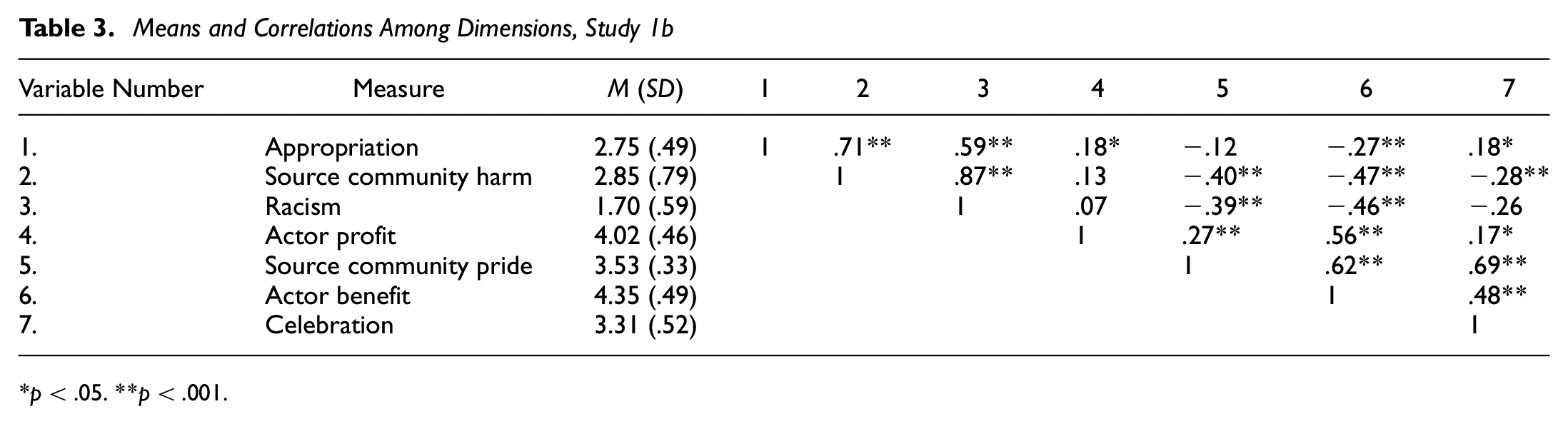
p < .05. **p < .001.
Multiple Regression Results (Standardized) Predicting Perceived Cultural Appropriation, Study 1b, R2 = .68, p < .05
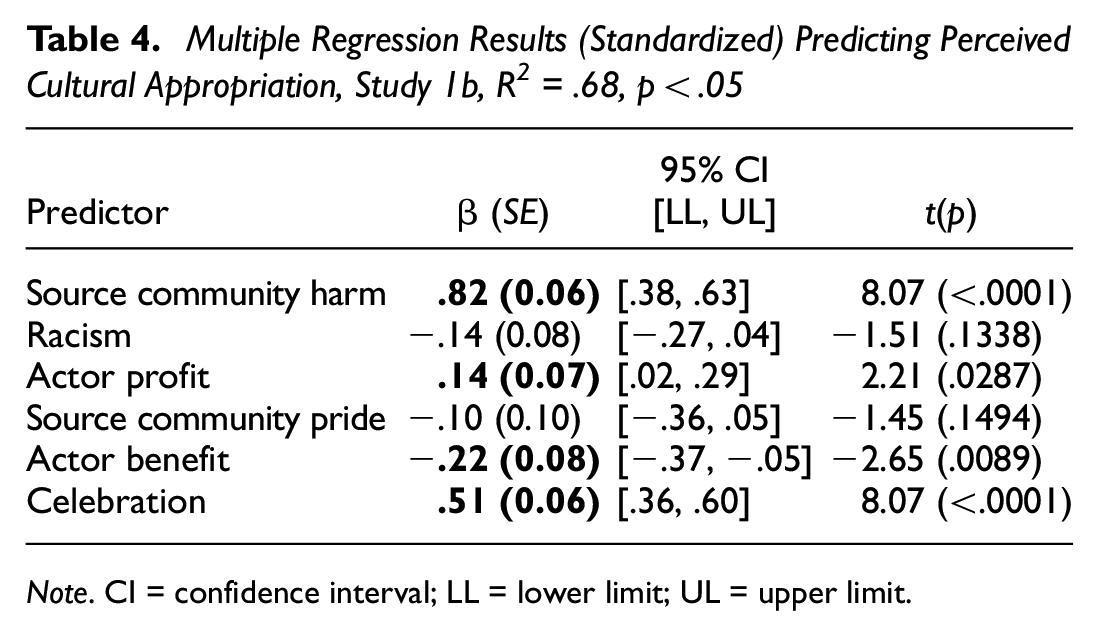
Note. CI = confidence interval; LL = lower limit; UL = upper limit.
As in Study 1a, we also compared judgments of the 25 scenarios depicting White actors using Black cultural products with matched scenarios of Black actors using White cultural products. Once again, scenarios depicting White Actor–Black Culture (M = 2.78, SD = .43) were judged more appropriative than the comparable Black Actor–White Culture scenarios (M = 2.42, SD = .32), t(48) = 3.33, p = .002, d = .94, 95% CI [.35, 1.52]. These scenarios did not differ in perceived racism, celebration, actor benefit, or actor profit (ps > .31). Unlike Study 1a, they also did not differ in perceived pride (p > .68). New to this study, the White–Black scenarios were judged to cause more harm to the source community (M = 3.11, SD = .96) than the Black–White scenarios (M = 2.59, SD = .78), t(48) = 2.10, p = .041, d = .59, CI [.02, 1.16].
Discussion
Study 1b largely replicated Study 1a’s findings, even without the provision of a definition of cultural appropriation to all participants. In both studies, scenarios prompting greater perception of harm to source communities and lower perceptions of benefits to actors were more likely to be perceived as appropriative. These results are consistent with frameworks from moral psychology, emphasizing the importance of avoiding harm to others in socio-moral judgments (e.g., Gray et al., 2014).
Comparing the two studies, the biggest difference lies in the relation between perceived pride and the other dimensions. In Study 1a, perceived pride correlated positively with all other dimensions; in Study 1b, pride was negatively correlated with racism and harm. Perhaps Study 1a’s definition of appropriation—which highlighted cultural products, such as music, art, and language—led participants to think about pride differently than they otherwise would, ultimately heightening the association between pride and appropriation. The overall mean for perceived pride across scenarios was significantly lower in Study 1b than 1a, but so were judgments of appropriation, racism, actor benefit, and celebration, ps < .0001. Because participants rated each dimension in isolation, we cannot describe the individual psychology of associations among them. We remedy this shortcoming in Study 2.
Study 2
In the first two studies, we assigned each participant to rate all 157 scenarios on just one dimension, and we aggregated judgments to treat scenario as the unit of analysis. This approach is informative but is subject to the ecological fallacy, using aggregate data to make inferences about individual psychology. In Study 2, we used a within-individuals approach by asking each respondent to rate a subset of scenarios on all eight dimensions.
Method
Participants
We recruited 500 participants from Prolific.com. In accordance with our preregistration (https://osf.io/5pu7y?view_only=350822fd646e45b7a7550916de0b4c53), we excluded one respondent for failing the honesty check. The remaining 499 respondents ranged in age from 19 to 92 years (M = 41.99, SD = 14.04). Participants self-identified as male (45%), female (53%), or another gender (3%). Seventy percent were White, 6% Black, 4% Hispanic, 10% Asian, 7% multiracial, and the remaining 3% were of another race.
Procedures
Participants were randomly assigned to respond to a subset of 20 of the 157 scenarios from Studies 1a and 1b. This roughly equated the total number of judgments made in Study 2 (20 scenarios × 8 judgments = 160) to the number of judgments made in Study 1 (157 scenario × 1 judgment = 157). Ten sets of 20 scenarios were randomly generated and participants were randomly assigned to one of these sets. Scenarios were presented in random order, one at a time; participants made eight judgments about each scenario before moving to the next. Respondents then answered demographic questions, including their political orientation on a 1 (very liberal) to 7 (very conservative) scale. All data files and materials are available at https://osf.io/a65h9/?view_only=dd38ff5a8c0340cb96dd2485a09b6564.
Results
We preregistered our hypotheses that we would replicate the associations found in Study 1: Cultural appropriation positively associated with perceived harm and negatively associated with perceived actor profit. The unit of analysis was participant-trial, with 9,980 observations (499 participants × 20 scenarios). Perceived appropriation was regressed on the seven predictor variables and an indicator variable for whether or not the actor was White in a crossed mixed-effects model. We allowed intercepts to vary by participant as well as by scenario. We also allowed the two slopes we were predicting as significant—perceived harm and actor benefit—to vary by respondent. Each predictor was significantly and positively related to perceived appropriation; standardized regression coefficients are plotted in Figure 1. We standardized numeric variables by mean-centering and dividing by two times their SD, while binary predictors were mean-centered; this was done so that the coefficients could be directly compared with one another (Gelman, 2008). Counter to predictions and the prior studies, perceived benefit positively—not negatively—predicted perceived appropriation.
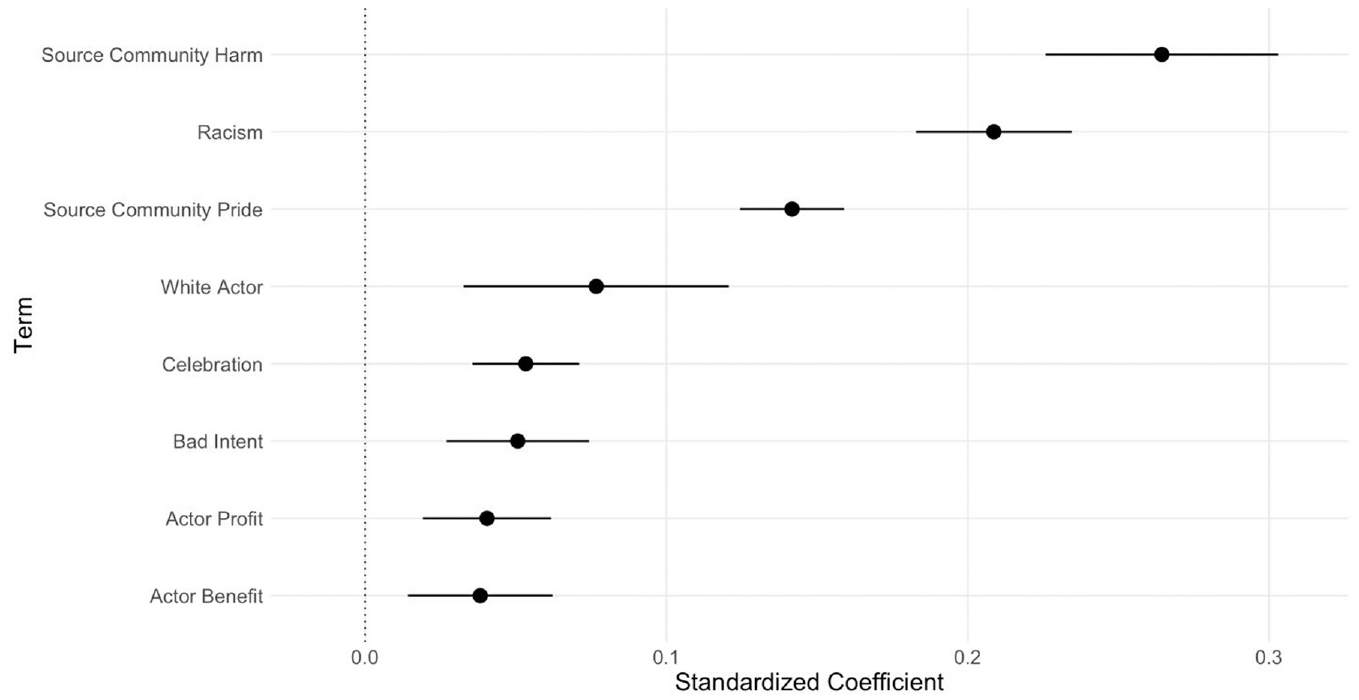
Standardized Regression Coefficients and 95% Confidence Intervals Predicting Perceived Cultural Appropriation, Study 2
Exploratory Analyses
Source community harm was a key predictor of appropriation perceptions across all three studies; removing this predictor from the random-effects variance-covariance matrix in this study worsened model fit, χ2(3) = 1333.2, p < .0001. To explore whether demographic characteristics of respondents moderated the harm slope, we kept harm as a random-effect and allowed it to interact with political ideology, age, race of the respondent (White vs. non-White), gender (male vs. non-male), and education (college-educated vs. noncollege). Only the interaction with political ideology was significant, β = −.13, SE = .03, t(452.13) = −4.05, p < .001 (see supplemental materials for full coefficients table). The more conservative respondents were, the weaker was the relationship between source community harm and perceived appropriation.
Aggregated Analyses
For a direct comparison with Studies 1a and 1b, we also analyzed data at the scenario level (averaging each variable by scenario), regressing perceived appropriation on all predictors (see Table 5; Nakagawa et al., 2017). 4 In this analysis, harm was again the key predictor of perceived appropriation (along with community pride, as in Study 1a) and actor benefit negatively predicted appropriation.
Aggregated Analysis, Multiple Regression Predicting Perceived Cultural Appropriation, Study 2, R2 = .70 (Standardized Coefficients Table)
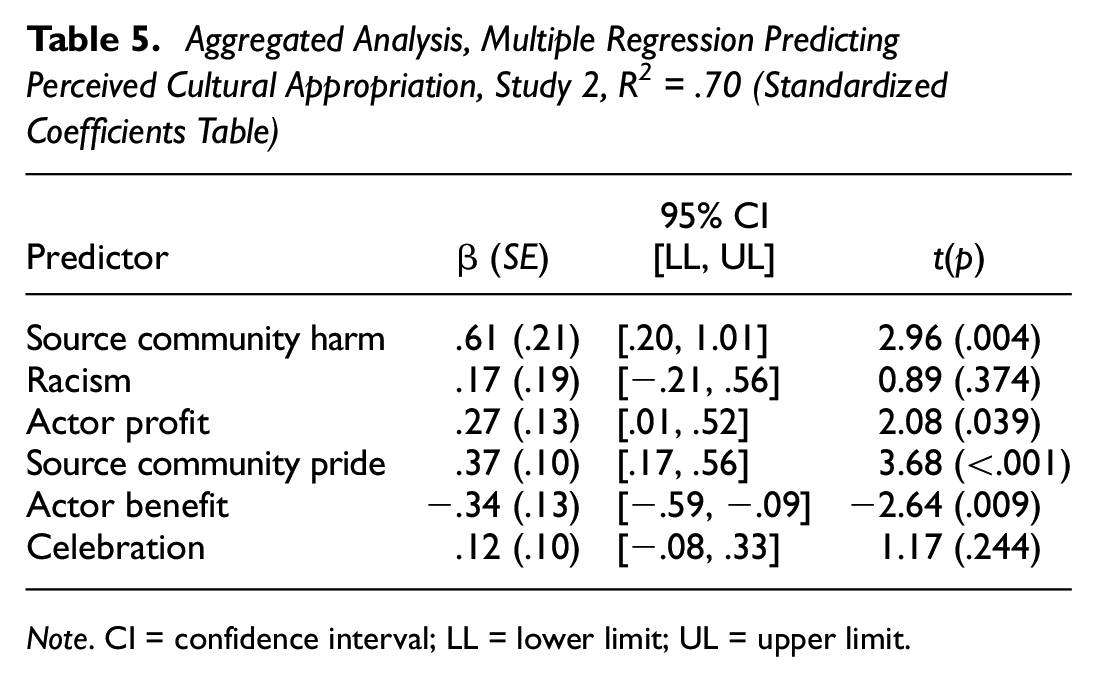
Note. CI = confidence interval; LL = lower limit; UL = upper limit.
Discussion
Using both participant-level and scenario-level analyses, Study 2 replicated the key finding that perceived harm is a strong predictor of cultural appropriation perceptions. Scenarios judged more harmful to the source community were more likely to be judged appropriative, and participants who saw actions as harmful also tended to see them as appropriative. In the participant-level analysis, all of the assessed dimensions were significantly positively related to perceived appropriation.
The participant-level analysis in Study 2 replicated the perpetrator prototypicality effect—scenarios depicting White actors using out-group cultural products as more appropriative than those depicting Black actors using White cultural products (Mosley & Biernat, 2020). Study 2 also identified one moderator of the relationship between perceived harm and appropriation: The more politically conservative participants were, the weaker was the link between perceived harm to the source community and perceived appropriation. This finding adds nuance to prior work in moral psychology, showing that both liberals and conservatives view harm as immoral (Graham et al., 2009) by indicating that perceptions of harm may have different correlates depending on political orientation.
General Discussion
People disagree about what constitutes cultural appropriation (Garcia Navaro, 2021). Prior research has indicated that prototypical cases of cultural appropriation include dominant-group members (e.g., White people) using cultural products stemming from subordinated groups (e.g., Black people; Katzarska-Miller et al., 2020; Mosley & Biernat, 2020). Minority group members’ use of dominant-group cultural products (termed “cultural dominance” by Rogers, 2006) is less likely to receive that label. However, even in prototypical cases, considerable variability in perceptions exists across actions (Mosley & Biernat, 2020). Furthermore, some perceivers—especially highly racially identified White Americans—view Black actors’ use of White cultural products as equally or more appropriative than White actors’ use of Black cultural products (Mosley et al., 2022).
These studies build on extant work by examining how features of out-group cultural use might contribute to construals of appropriation. We created a large set of scenarios, extending beyond the case of White–Black relations to include a greater diversity of racial groups (Native American, Hispanic, and Asian cultures). In all three studies, scenario-level analyses indicated that actions perceived to cause harm to the source community were also likely to be seen as appropriative, and those actions perceived to bring benefits to actors were less likely to be seen as appropriative. The strong connection between perceived source community harm and judgments of cultural appropriation corroborates research on the importance of harm to morally relevant judgments (Gray et al., 2014; Rozin & Royzman, 2001). At the same time, scenarios perceived to benefit actors—at least among the particular set of scenarios used here—were those that elicited a lower appropriation essence. However, at the level of individual perceivers, actor benefit (along with actor profit and some other measures) positively predicted appropriation perceptions. Perceiving benefit to an actor may contribute to a sense that the action is problematic to the source community (i.e., appropriative). Our findings are akin to findings on smoking and life expectancy: At the aggregate level, countries with higher rates of cigarette consumption have longer population life expectancies, but at the individual level, the more one smokes, the lower their life expectancy (Krause & Saunders, 2010). Scenarios that bring more benefit to actors are judged less appropriative, but individuals who see actor benefit in scenarios view them as more appropriative.
In all studies, participants perceived actions as more appropriative when White actors engaged with cultural products from Black communities, rather than the reverse pattern. This provides further evidence that the prototypical perpetrator of cultural appropriation is a high-status group member (Mosley & Biernat, 2020), where high-status actors have greater power and resources to exploit, marginalize, and cause harm to low-status source communities (Rogers, 2006).
Perhaps surprisingly, perceived appropriation and perceived celebration were positively correlated. Appropriation and celebration might be conceptualized as alternative, opposing construals of the same event. But this positive correlation may attest to the ambiguity, subjectivity, and disagreement about perceiving cultural appropriation: The same action may be construed as appropriative and (not or) celebratory. However, these construals were nonetheless distinct: Appropriation was positively correlated with perceived racism and harm, but celebration was negatively correlated with these factors. To the extent that actors benefited from their actions, celebratory construals were higher but appropriation construals were lower. This finding has novel implications for theoretical work on interpersonal imitation and attraction (Chartrand & Bargh, 1999) by suggesting that some forms of out-group cultural use may be viewed as having a positive purpose in an increasingly multicultural world (e.g., communicating respect, honor).
Finally, this work advances research in both intergroup relations and moral psychology that exist largely apart from each other. The two fields are conceptually aligned: If one views morality as relevant to how different groups treat one another, then knowledge from moral psychology can inform understanding of intergroup relations and vice versa. Our findings speak to this connection by demonstrating the central importance of perceptions of source community harm to perceptions of cultural appropriation. Appropriation has negative connotations, including the perception that it is immoral (Young, 2010). Harm is a central component of moral evaluation, and individuals from diverse demographic groups perceive harmful acts as wrong (Graham et al., 2009, 2012; Gray et al., 2014). Harm is also an element of proscriptive morality (something people should avoid doing). Adherence to proscriptive norms is seen as obligatory but adherence to prescriptive norms (the good things people should do), as supererogatory (Janoff Bulman et al., 2009). Thus, perceiving that an act violated an injunction against harm could serve as a particularly powerful cue that that act falls under the umbrella of cultural appropriation.
Our findings may also have translational implications for educators seeking to promote awareness about cultural appropriation. Appropriation has been an important topic on college campuses, where administrators are increasingly concerned about creating inclusive environments (Van Voorhis, 2018). During holidays, such as for Halloween and Cinco De Mayo, campus officials warn students about their choice of costumes and the potential for cultural appropriation (Garcia, 2019). Highlighting the harm that some actions may cause to source communities may be an effective pedagogical tool for those trying to lead diverse communities.
Limitations and Future Research
We sought to be broad and inclusive in creating the set of potential cultural appropriation scenarios used in this research, but our findings are nonetheless limited by the particular set of scenarios we selected. In the scenario-level analyses, associations among dimensions may have differed considerably had we used a different set of scenarios (e.g., if all were focused on Native American actors’ use of “White” cultural products). Given the consistent effects across our three studies, we suspect that the relationship between harm and appropriation is robust; however, replication attempts are needed.
Future research could more fully probe the role that perceptions of racism play in judgments of cultural appropriation. In all studies, perceived racism was positively correlated with perceived appropriation, but in the aggregate analyses, racism did not independently predict appropriation judgments. When making their judgments, participants may have focused on how much each scenario represented blatant racism characterized by hostile attitudes and beliefs about out-group inferiority (J. M. Jones, 1997). Blatant racism is prototypical, while disagreement exists regarding whether subtle racism constitutes racism at all (Dovidio & Gaertner, 2004). Cultural appropriation may be more closely associated with subtle racism as individuals may not perceive appropriation as hostile. Future work could test this hypothesis by drawing participants’ attention to subtle racism.
Assessing whether the actions of others are appropriative (as in this research) may also differ from judging one’s own behaviors. Self-serving biases may lead us to attribute potentially appropriative actions to our good intent (e.g., cultural appreciation) and, as a result, see less culpability for causing harm and less appropriation (Schein & Gray, 2018). Considering the actor–observer difference in appropriation perceptions may be theoretically and practically informative (E. E. Jones & Nisbett, 1971).
Conclusion
Perceptions of cultural appropriation are linked to other perceptions, including perceived racism, actor profit, and source community pride in cultural objects. The strongest and most consistent finding from these studies—in both scenario-level and participant-level analyses—was that perceptions of harm predicted heightened perceptions that acts of out-group cultural use were appropriative. Perceived actor benefit also predicted greater perceived appropriation at the individual level although actions judged to benefit actors were judged less appropriative overall. These findings contribute to scholarship on cultural appropriation and intergroup relations and make connections to theory and research in moral psychology.
Supplemental Material
sj-docx-1-spp-10.1177_19485506231162401 – Supplemental material for Perceptions of Harm and Benefit Predict Judgments of Cultural Appropriation
Supplemental material, sj-docx-1-spp-10.1177_19485506231162401 for Perceptions of Harm and Benefit Predict Judgments of Cultural Appropriation by Ariel J. Mosley, Larisa Heiphetz, Mark H. White II and Monica Biernat in Social Psychological and Personality Science
Footnotes
Acknowledgements
The authors thank members of the Social and Moral Cognition Lab at Columbia for feedback.
Handling Editor: Robyn K. Mallett
Declaration of Conflicting Interests
The author(s) declared no potential conflicts of interest with respect to the research, authorship, and/or publication of this article.
Funding
The author(s) disclosed receipt of the following financial support for the research, authorship, and/or publication of this article: This publication was made possible through the support of grant no. 61808 from the John Templeton Foundation awarded to L.H. The opinions expressed in this publication are those of the authors and do not necessarily reflect the views of the John Templeton Foundation.

Supplemental Material
The supplemental material is available in the online version of the article.
Notes
Author Biographies
References
Supplementary Material
Please find the following supplemental material available below.
For Open Access articles published under a Creative Commons License, all supplemental material carries the same license as the article it is associated with.
For non-Open Access articles published, all supplemental material carries a non-exclusive license, and permission requests for re-use of supplemental material or any part of supplemental material shall be sent directly to the copyright owner as specified in the copyright notice associated with the article.
