




Abstract
Although dominance is a common strategy for attaining high social rank, it often entails exploitative behavior, bringing leaders into conflict with followers. Anthropological work suggests that a long evolutionary history of such conflict has set the stage for moral systems designed to reduce exploitation from powerful people. Here we establish links between dominance (and prestige) and moral leadership, reporting three studies (total N = 1246) demonstrating that, in response to dominant leaders, followers band together in collective opposition aimed at resisting, and even toppling, incumbent leaders. These studies also identify specific social psychological pathways through which dominant leaders elicit moral opposition—low levels of trust and gossip both mediated effects of leader dominance on collective opposition by followers. While dominance may allow people to rise through the ranks of a social hierarchy, the long-term durability of dominance as a leadership strategy may be undermined by collective moral opposition from followers.
On the early evening of July 15, 2016, social media began reporting sightings of rogue military jets and helicopters taking to the skies over Turkey’s capital, Ankara. Three hundred and fifty kilometers away, two arterial bridges were seized and closed in Istanbul, bringing the city to a state of chaos. An hour later, the chief-of-staff of the Turkish military was taken hostage by troops representing a faction that identified themselves as the Peace at Home Council. These actions were part of an orchestrated attempt to topple the government of Turkish President Tayyip Erdogan. In the preceding months, Erdogan had taken control of media outlets, quashed peaceful citizen demonstrations, and purged governmental bodies of opposition, in what was seen by many as a corrupt leader’s attempt to secure a position of unchecked political dominance over the country. Although the coup ultimately failed, it was founded on the Kemalist principle of populism—the transfer of political power to citizenship through the strength of collective action.
Any hierarchy involves a type of moral contract between leaders and followers. Followers bestow on their leaders relatively high levels of power and social influence and, in exchange, leaders agree to wield their power in ways aimed at enhancing the group’s interests (Price & van Vugt, 2014). But sometimes leaders, be they politicians, chief executive officers (CEOs), line managers, or tribal chiefs, abuse their power and, in so doing, break the implicit moral contract regulating leader–follower relations. Violation of such implicit contracts can trigger collective opposition (Boehm, 2000) and elicit “leveling mechanisms”—criticism, ridicule, disobedience, desertion, removal, or even assassination—designed to level the hierarchy and limit the power of leaders (Boehm, 1997; 1999; J. T. Cheng, 2020). Because there is strength in numbers, people may seek to initiate collective opposition aimed at overcoming the power gap between leaders and followers. Ultimately, those mechanisms can result in efforts aimed at toppling a leader entirely. The current work examines this phenomenon in organizational contexts and is the first to do so from a rigorous psychological perspective. Our primary goals were to: (a) identify the types of leaders most likely to elicit collective opposition; (b) pinpoint specific psychological processes (i.e., trust) in followers that potentiate collective opposition; and (c) elucidate social mechanisms (i.e., negative gossip) followers might use to establish collective opposition aimed at replacing a leader.
We make four theoretical contributions to the morality and leadership literature with this work. First, by drawing on Kohlberg’s (1976, 1981) cognitive moral development theory, we integrate research on two specific leadership strategies—dominance versus prestige—and research on moral leadership. Since its introduction, the dominance–prestige distinction has received widespread attention in psychology, anthropology, and management (for reviews, see J. T. Cheng, 2020; Maner, 2017). However, despite their moral underpinnings, dominance and prestige have not yet been linked to moral leadership. Such integration is needed to stimulate the development of unique knowledge in the leadership literature.
Second, research on dominance versus prestige has presented dominance as a successful way to obtain social rank and influence (e.g., J. T. Cheng et al., 2013; Halevy et al., 2012; Kakkar & Sivanathan, 2017). One problem with this interpretation is that extant research has focused primarily on the short-term utility of dominance- and prestige-based leadership strategies, while overlooking any temporal dynamics that may be at play (for exceptions, see Redhead et al. 2019 and McClanahan et al., 2022). Our study therefore contributes to the leadership literature by examining the longer-term stability of these strategies for maintaining rank and influence across time. Specifically, we position the presence of an overly dominant leader as an antecedent factor in moral opposition and the formation of collective opposition.
Third, we contribute to the literature on moral systems in organizations (Haidt, 2007, 2008, 2012). Most initiatives to spur change in moral systems have been conceptualized as a top-down process (e.g., D. M. Mayer et al., 2009; Schaubroeck et al., 2012). However, following Haidt (2008), who defined moral systems as “interlocking sets of values, virtues, norms, practices, identities, institutions, technologies, and evolved psychological mechanisms that work together to suppress or regulate selfishness and make social life possible,” change in moral systems can also be the outcome of a bottom-up process. To the best of our knowledge, the effectiveness of bottom-up moral regime change has never been tested (Solinger et al., 2020; see also Haslam & Reicher, 2012). Hence, our study offers an important contribution to the literature by offering a rigorous psychological test of the effectiveness of collective opposition in suppressing and regulating the selfishness of dominant leaders.
Finally, our investigation connects with a social identity approach to leadership and followership (Ellemers et al., 2004; Haslam et al., 2011, 2020). This theoretical perspective suggests that leaders will be endorsed and supported by followers to the extent that they prototypically embody the values and broader identity of an ingroup and are perceived to advance the interests of their ingroup’s collective identity. To the extent that dominance is endogenously employed as a tool in the service of self-interest at the expense of followers (Ronay et al., 2020), a social identity approach suggests the conditions necessary for follower support will be violated and so we might expect to see resistance.
Dominance and Prestige as Morally Based Leadership Strategies
A burgeoning literature in evolutionary psychology suggests that people use two distinct strategies (dominance and prestige) for rising through the ranks of social hierarchies. On one hand, we share common ancestry with other primates who employ dominance as a social regulatory tool (Barkow et al., 1975; de Waal, 2007). Dominance entails the use of intimidation and coercion to attain one’s personal goals (J. T. Cheng et al., 2013; Henrich & Gil-White, 2001), sometimes at the expense of the larger group (Maner & Case, 2016; Ronay et al., 2020). Dominance can serve as a tool for regulating conflict between leaders’ and followers’ goals through the suppression of followers’ goals.
On the other hand, humans rely immensely on cultural learning and shared knowledge, which are facilitated by attention to group members who possess valued expertise, wisdom, or skill (Henrich & Gil-White, 2001). Such group members gain social status through prestige. Unlike dominant leaders, prestige-based leaders are followed freely, because they are recognized as possessing valued traits and abilities (J. T.Cheng et al., 2013; Maner, 2017). Prestige can serve as a tool for regulating conflict between leader’s and followers’ goals by facilitating followers’ goals.
We draw on Kohlberg’s (1976, 1981) cognitive moral development theory to link the dominance versus prestige distinction to moral leadership, defined as “leader’s behavior that demonstrates superior personal virtues, self-discipline, and unselfishness” (B. S. Cheng et al., 2004, p. 91). Kohlberg’s theory suggests that there are different levels of cognitive moral development: preconventional, conventional, and postconventional. We argue that dominance and prestige operate at the preconventional and conventional levels of cognitive moral development, respectively (note that postconventional levels are rarely reached; Kohlberg, 1981).
Individuals at the preconventional level are guided by self-interest, without taking into consideration the impact of their behaviors on others (Trevino, 1992). As dominant leaders prioritize their power over group goals and tend to resort to behaviors that harm their followers (e.g., coercion, threats, intimidation) (Maner, 2017; Maner & Case, 2016), such leaders are characterized by relatively low cognitive moral development. In contrast, individuals operating at the conventional level use social expectations, norms, and rules to guide their behavior. They have respect for the concerns of others and care about how others perceive them (Trevino, 1992). This is in line with the cognitive moral development of prestige-based leaders, who are granted status by displaying knowledge and skills that are valued by the group (J. T. Cheng et al., 2013), and at times even prioritize social approval over specific group interests (Case et al., 2018). Although the dominance versus prestige distinction has not yet been integrated in the moral leadership literature, there are some hints in the literature that support our conceptual framework. For example, dominance is positively correlated with socially aversive personality traits like narcissism, Machiavellianism, and psychopathy (J. T. Cheng et al., 2013; Davis & Vaillancourt, 2022), and prestige is positively correlated with moral concerns (Suessenbach et al., 2019) and moral traits like agreeableness, conscientiousness, and prosociality (Cheng et al., 2013).
Although intuition might suggest that dominance is a less effective means of gaining social influence than prestige, the extant literature suggests both serve as viable ways of gaining high social rank (Cheng et al., 2013; Halevy et al., 2012; McClanahan et al., 2022; von Rueden et al., 2010). One problem with that interpretation, however, is that the existing psychological literature has focused almost exclusively on the role dominance and prestige play in the initial formation of hierarchies in relatively short-term groups. In contrast, Boehm (1997, 2012; see also Boehm & Boehm, 1999) has written extensively in the anthropological literature on the use of follower-based collective opposition aimed at reducing exploitation by dominant leaders (see also J. T. Cheng, 2020; Wiessner, 2005). Boehm et al.’s (1993) analysis of 48 small-scale societies revealed evidence for the use of collective opposition, aimed at removing an overly dominant leader, occurring in 80% of cases. Indeed, Boehm’s field work led him to identify within-group conflict in response to dominance as the likely seed of human morality—“the first behavior to be decisively outlawed and controlled by a human group may well have been the expression of dominance” (Boehm, 2000, p. 97).
One possible reason for the link between dominant leadership and moral opposition is that dominance exerted toward one’s followers is a clear signal that the leader’s goals and interests diverge from those of their group. As such, the social identity model of leadership (Haslam et al., 2020) also predicts that dominant leaders are more likely to experience collective opposition than are prestige-based leaders. Exerting dominance over others to extract personal gains is unlikely to foster the sense of “we-ness” necessary for a shared sense of identity between leaders and followers (Ellemers et al., 2004). In contrast, prestige-based leaders typically possess skills, abilities, and attributes that are desired by other group members and, as such, they are by definition more prototypical of their ingroup and so more likely to be supported as leaders (Ellemers et al., 2004; Haslam et al., 2020; van Knippenberg & Hogg, 2003). Furthermore, as prestige-based leaders tend to prioritize the interests of the group (Case & Maner, 2014), they are more likely to create a shared sense of social identity, which makes group members want to contribute to shared goals (Steffens et al., 2014).
Surprisingly, although dominance has been associated with less “likeability” (J. T. Cheng et al. 2013), and more severe punishment by third-party individuals who see the dominant person as lacking in moral credentials (Kakkar et al., 2020), especially with regard to the moral foundations of harm/care and reciprocity/fairness (Khanipour et al., 2021), the use of collective opposition as a bottom-up approach to change moral regime has never been tested by rigorous psychological research.
Hypothesis 1: Followers will seek to use collective opposition to replace their leader when that leader exercises dominance-based (compared with prestige-based) leadership strategies.
Low Levels of Trust as a Psychological Mechanism Potentiating Collective Opposition
Trustworthiness is universally prioritized in group members (Cottrell et al., 2007) and nowhere is trust more important than in leadership (Dirks & Ferrin, 2002). Among the most common antecedents of trust in leaders are perceptions of ability, integrity, and benevolence (R. C. Mayer et al., 1995). When a leader displays dominant behavior, either via self-aggrandizement, threats and bullying, or the expression of self-interest at the expense of the group, group members may experience decreased perceptions of integrity and benevolence, and so lose trust in the leader. For example, members of nations with steeper hierarchies, which potentiate the use of dominant leadership, experience lower levels of generalized trust than do members of more egalitarian nations (Knack & Keefer, 1997). Thus, loss of trust in a dominant leader, we suggest, represents a psychological process that sparks motivations to band together as a means of addressing conflict between leaders’ and followers’ goals.
Hypothesis 2: Followers’ trust in their leader will be lower when that leader exercises dominance-based (compared with prestige-based) leadership strategies.
The Role of Gossip in Collective Opposition
Dominant leaders do not respond favorably to opposition (Maner & Mead, 2010), sometimes taking steps to eliminate challenges from followers (Case & Maner, 2014). In the context of establishing collective opposition, this creates a “first mover” problem for any individual motivated to challenge a dominant leader. One solution might be for followers to engage in negative gossip about their leader (Diermeier et al., 2008). Gossip refers to the exchange of social-evaluative (both positive and negative) comments about someone not present in the current conversation (Foster, 2004). Gossiping (especially negatively) allows one to gauge the level of moral opposition, and thus the extent of support one might have in banding together against a dominant leader. Consequently, negative gossip reflects a relatively safe and low-cost way of assessing the potential efficacy of collective opposition. Gossip also serves as a means of generating a sense of shared identity, which tends to precede followers’ attempts at leader resistance (Haslam & Reicher, 2012). Thus, we predicted that, in response to dominant leaders, followers will show an increased tendency to gossip negatively about the leader.
Hypothesis 3: Followers will be more likely to engage in negative gossip about a leader who exercises dominance-based (compared with prestige-based) leadership strategies.
Hypotheses 1–3 are integrated into our full model (see Figure 1), which we specify in Hypothesis 4.
Hypothesis 4: The relationship between leader dominance and collective opposition to replace a leader will be sequentially mediated by trust in the leader and negative gossip about the leader.
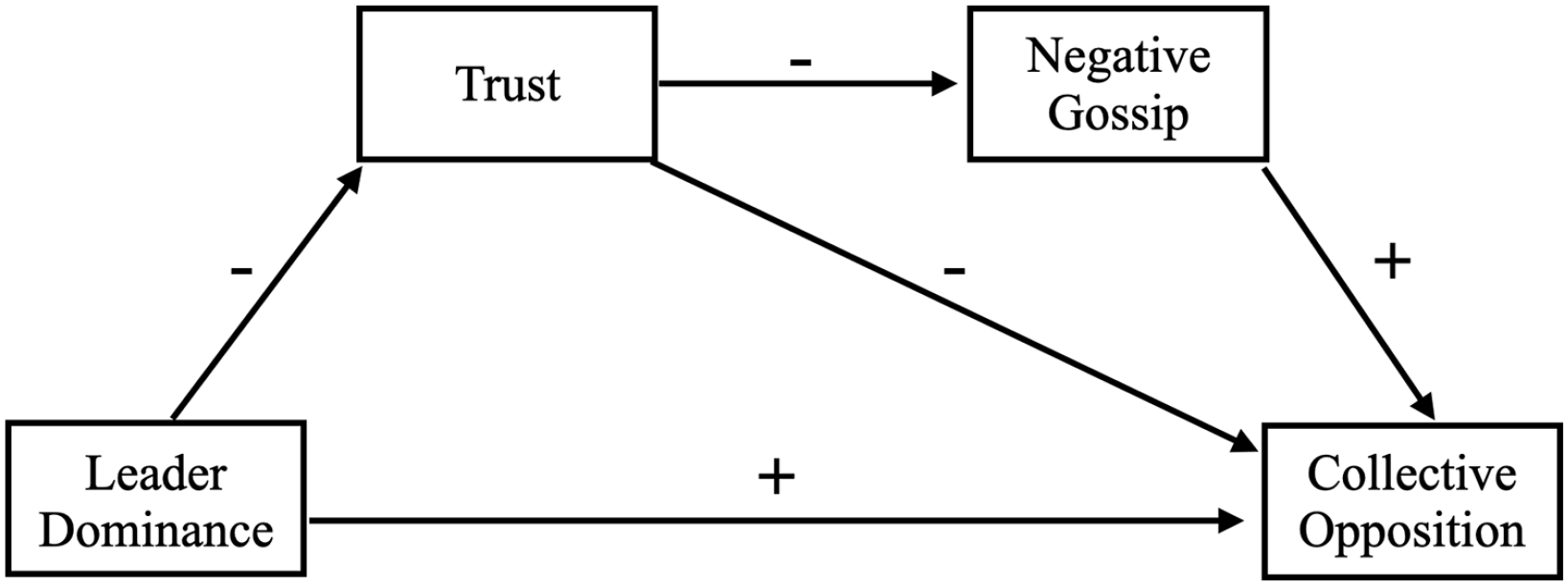
Hypothesized pathways from leader dominance to collective opposition via trust and gossip.
The Current Research
We test our hypotheses in three studies. Study 1 examined whether naturally occurring, dispositional levels of dominance versus prestige would be differentially associated with collective opposition among followers. Study 2 used an experimental design to capture the processes leading up to collective opposition at the individual level. In Study 3, we used a group-level dependent variable to directly test how these processes feed into collective opposition aimed at replacing the leader. Studies 2 and 3 also allowed us to directly test the relationships between perceptions of leaders’ dominance versus prestige and perceptions of moral leadership. Because power asymmetries are often keenly experienced in the context of organizational hierarchies (Collinson, 2003), we contextualize each of our studies as proxies for organizational environments.
Study 1
We predicted that members of groups with more dominant leaders would display higher levels of resistance and collective opposition to their leader than would members of groups with more prestige-based leaders. Data were collected in the context of a classroom role-play exercise.
Method
Participants and procedure
We gathered data from four successive student cohorts of master and third-year bachelor students from a large Dutch university who participated in a role-play as part of a classroom exercise (“Tompkins-Bowden”; Ames, 2008). We achieved a total N of 352 (131 male), which gave us 99.9% power to detect a small to medium-sized effect (f2 = .10), with alpha set at .05. Participants were divided into 58 groups, ranging in size from four to seven people. 1
The role-play simulates workplace conflict between leaders and followers and was designed to provide opportunities for students to practice the negotiation skills required for forming coalitional arrangements via the process of both group and private discussions. Participants first read general information that described them as being one of the members of an executive committee in a medium-to-large advertising firm headed by a managing partner. The managing partner has proposed that their firm should merge with a smaller firm, but, in order for the merger to go ahead, the leader must secure a favorable majority vote from the committee.
The managing partner and one proxy vote are secured but support for the merger among the remaining five committee members is uncertain, with votes being contingent on the ensuing collaborative negotiations between the participants during the role-play (see online Supplemental Materials for an overview of possible coalitional activity). The interests of the committee members are interdependent, insofar as individuals’ specified goals (e.g., promotion opportunities, preferred work assignments) can be realized only via the formation of coalitions. For instance, one role represents the protégée of the managing partner whose primary interest is the pursuit of career advancement. Career advancing opportunities may follow from continued alignment with the managing partner, or alternatively by siding with another rising star within the committee who is in a position to offer a lead role on a recently secured high-profile project. In turn, the protégée might agree to vote in support of the rising star’s suggestion to impose term limits on both the executive committee and managing partner.
These coalitions need not include the managing partner to be effective, making support for the merger dependent on the effectiveness of the managing partner’s leadership strategies and his/her ability to block collective action that might also satisfy the interests of committee members. The outcome of interest is the number of votes against the leaders’ proposal, representing the intention of committee members to collectively oppose the leader’s proposed merger.
Participants were given 10 minutes to read and prepare for their roles, followed by 15 minutes for dyadic communications, 15 minutes for group discussion, a 10-minute break in which further private channels of communication could be pursued, and then a final 15-minute group discussion. At the end of the group discussion, votes for or against a merger were cast in the context of a secret ballot. These votes constituted the dependent variable.
To ensure adequate variability in leaders’ dispositional levels of dominance and prestige, we assigned to the role of managing partner participants who were relatively high in dominance and relatively low in prestige, or, conversely, relatively high in prestige and relatively low in dominance. To facilitate this, early in the course we pre-measured individual differences in dominance (M = 4.95, SD = 0.83) and prestige (M = 4.97, SD = 0.76) using Cassidy and Lynn’s (1989) achievement motivation scale (AMS). Dominance was measured using seven items (e.g., I enjoy planning things and deciding what other people should do; I think I would enjoy having authority over other people) (α = .84). Prestige was also measured with seven items (e.g., I would like an important job where people look up to me; I like to be admired for my achievements) (α = .74). Participants responded on a 7-point Likert scale anchored by 1 = Strongly disagree, 7 = Strongly agree. These measures have been used extensively to measure individual differences in motivations underlying dominance and prestige (Case et al., 2018). In our sample the two scales correlated at r = .53, p < .001.
To minimize the conflation of dominance and prestige within leaders, we identified dominance-based leaders as those participants who scored higher on dominance (M = 5.94, SD = 0. 52) than on prestige (M = 4.68, SD = 0.63), t(27) = 12.13, p < .0001, d = 2.15; these made up 28 of the managing partner roles in the simulation. Prestige-based leaders were identified as those participants who scored higher on prestige (M = 5.82, SD = 0.49) than on dominance (M = 4.85, SD = 0.78), t(29) = 9.63, p < .001, d = 1.34, and these made up the remaining 30 managing partner roles in the simulation. As we had self-reported scores on both dominance and prestige for all leaders, we used these continuous variables as the predictors in our analyses.
Dependent measure
The dependent variable was the number of votes cast in opposition to the leader’s proposed merger. All participants cast a vote either in favor of, or in opposition to, the merger at the conclusion of negotiations. Independently opposing the leader’s proposed merger involved some risk. For instance, in doing so, another role-player in the exercise might forego their long-desired opportunity to chair the company’s recruitment and promotion committee, an appointment which could be granted by the leader. However, collective opposition to the leader also had the potential to secure the desired chair, if the right agreement were to be reached in advance of the vote. Votes cast against the merger thus represented the strength of the collective action in opposition to the leader. Votes were cast in the context of a secret ballot. We controlled for the total number of votes cast by each group (see note 1).
Results
Table 1 presents the means, standard deviations, and intercorrelations of all variables on the group level. In about half of the groups (56.9%) a majority of votes was cast against the leader’s proposed merger. The mean number of no votes cast by group members (excluding leaders’ votes) was 2.43 (SD = 1.39) of a possible 5.
Means, standard deviations, and intercorrelations of all group-level variables in Study 1.
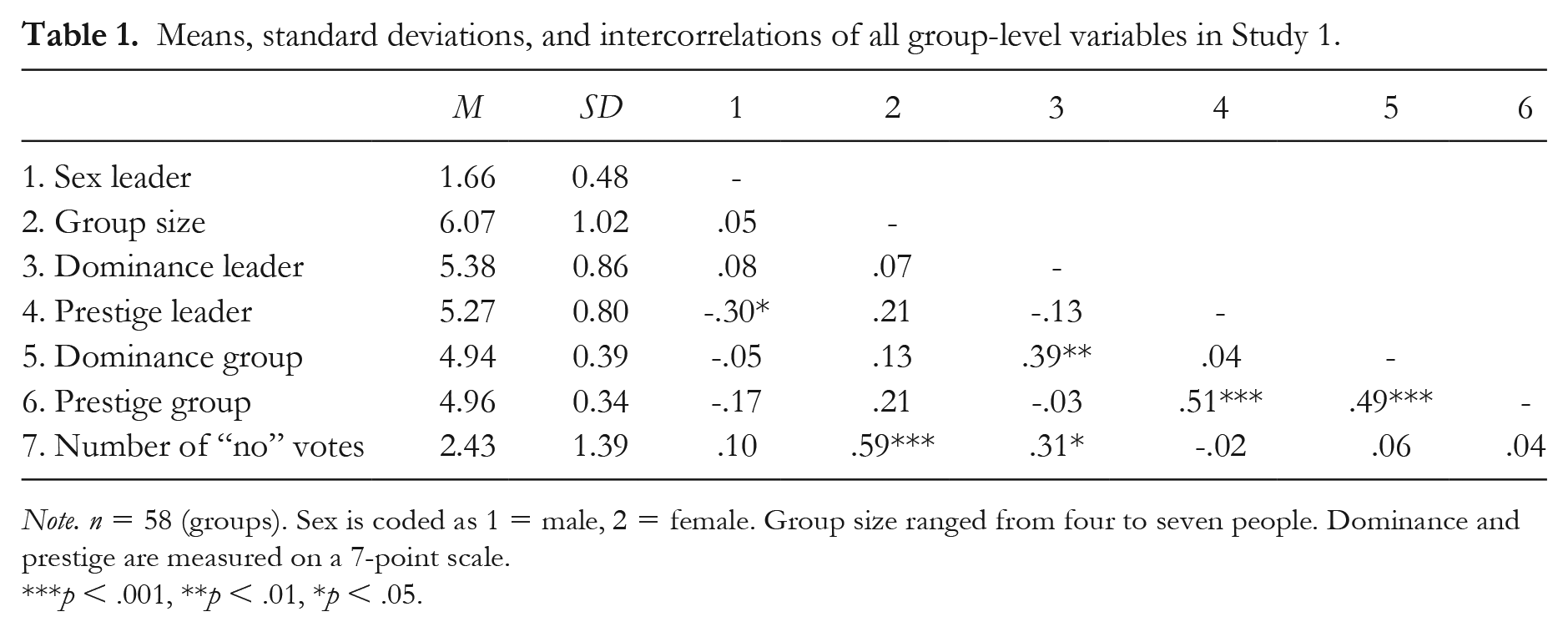
Note. n = 58 (groups). Sex is coded as 1 = male, 2 = female. Group size ranged from four to seven people. Dominance and prestige are measured on a 7-point scale.
p < .001, **p < .01, *p < .05.
To test the hypothesis that high levels of leader dominance would be associated with a greater number of votes cast against the leader’s proposed merger, we used a linear mixed model to account for the nested nature of the data and entered the number of “no” votes as the dependent variable (i.e., the number of votes cast in opposition to the leader) and leaders’ dominance and prestige scores as predictor variables. To account for variance in group size, we controlled for total votes cast per group. This analysis confirmed that participants were more likely to vote against leaders high in dominance than those low in dominance, b = 0.34, 95% CI [0.07, 0.61], t(81.06) = 2.51, p = .01, ηp2 = .07. We also observed a non-significant negative relationship with prestige, b = -0.24, 95% CI [-0.52, 0.04], t(93.71) = -1.69, p = .10, ηp2 = .03. We observed no interaction between dominance and prestige in predicting votes cast against the leader’s proposal, b = -0.04, 95% CI [-0.51, 0.42], t(82.29) = -0.17, p = .85, ηp2 = .00.
We performed exploratory analyses to examine possible associations between followers’ levels of dominance and prestige (aggregated across group members) and the outcome variable. Neither group dominance, b = -0.63, 95% CI [-1.54, 0.28], t(53.83) = -1.38, p = .17, ηp2 =.03, nor prestige, b = 0.37, 95% CI [-0.70, 1.45], t(55.39) = 0.70, p = .49, ηp2 = .01, showed a significant association with the number of “no” votes in this model. Notably, including aggregated group-level means for dominance and prestige as covariates in our primary analyses bolstered the relationship between leader dominance and number of “no” votes, b = 0.44, 95% CI [0.13, 0.75], t(72.68) = 2.83, p = .01, ηp2 = .10.
Discussion
Study 1 provides preliminary evidence that dominant leaders may be more likely than prestige-based leaders to elicit collective opposition as a means to initiate moral regime change. Committee members’ own goals were interdependent and achievable only via coalitional agreements. Thus, votes against the merger represented collective action in opposition to leaders that are guided by self-interest. We found initial support for our primary hypothesis—followers collectively opposed dominant leaders more readily than prestige-based leaders. These findings are consistent with Boehm’s (2020) anthropological work highlighting group-level regulation of dominance as a seminal point in the evolution of human morality.
This study included leaders who were high in dispositional levels of dominance or prestige. Because we cannot be sure that those dispositional levels were directly translated into behavior during the course of the session, the study served as a relatively conservative initial test of our hypotheses. The fact that we observed the hypothesized association, despite relying on dispositional levels of dominance and prestige, speaks to the strength with which dominance versus prestige may elicit different responses from followers.
Study 2
We pre-registered the design and hypotheses of Study 2 online with OSF 2 (https://osf.io/vwzfx/?view_only=96f599ea28434a69a4dfadb0aa9b872b).
Method
Participants and procedure
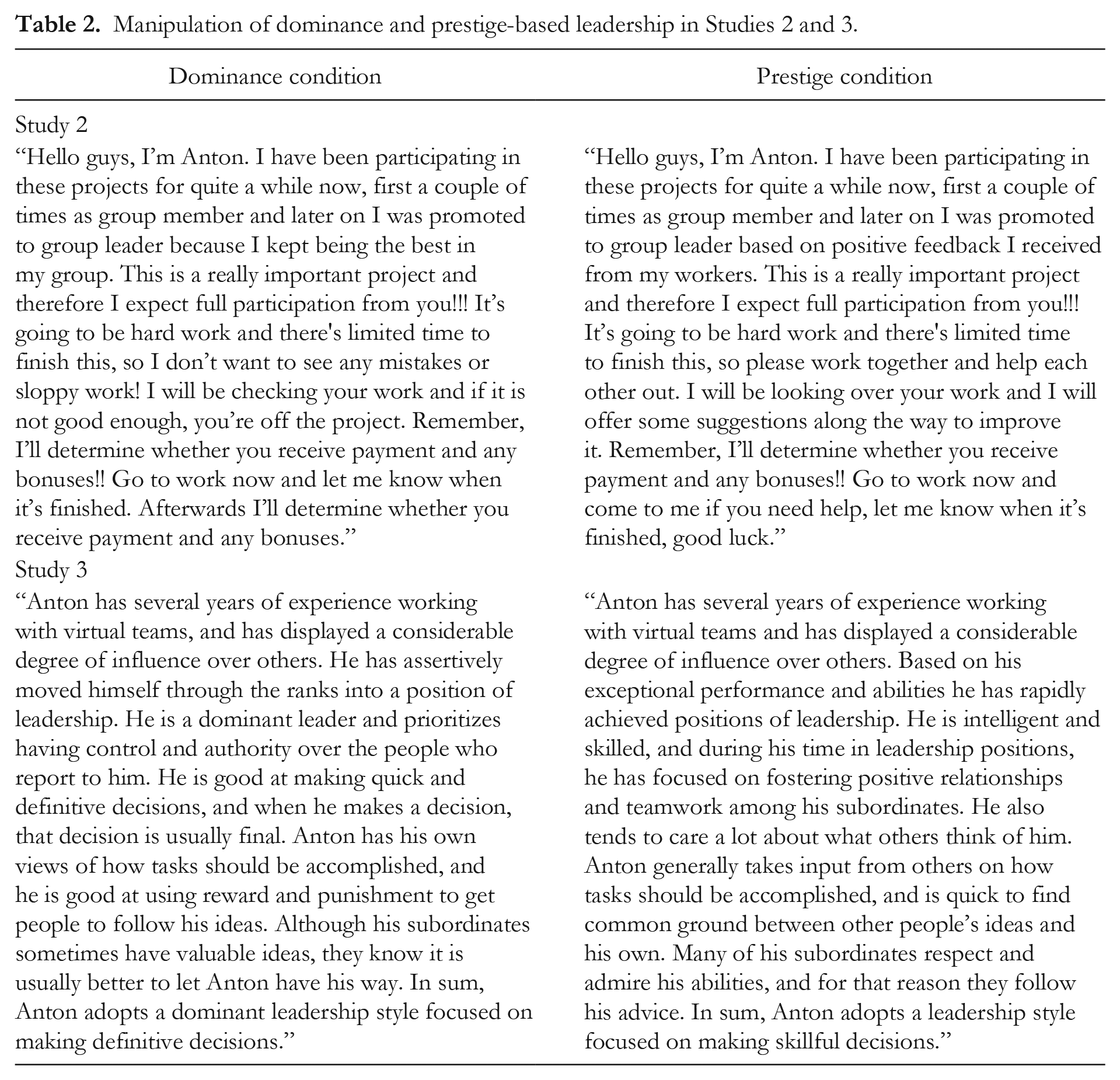
Power analysis suggested a sample size of 341 to achieve power of .90 to detect the smallest effect size (path) in the hypothesized model (R2 = .03). A total sample of 400 Mturk workers (204 dominance condition; 186 women; Mage = 38.23, SDage = 11.28) were recruited and told they would be joining an online group of 3 workers and one leader, for the purpose of a brainstorming task. They were told that the leader would determine any bonus payments, based on the quality of the completed work. Next, they read that we had “asked each group leader to write a short note to introduce himself to his team” (see Table 2 for the manipulated introduction texts). We based the text of the dominance/prestige-based leader introductions on the items of Cheng et al. (2010).
Manipulation of dominance and prestige-based leadership in Studies 2 and 3.
Manipulation pre-test
We pre-tested our manipulation to ensure the two versions of our leader text differentiated between perceptions of dominance and prestige. In addition, pre-testing allowed us to evaluate perceptions of three underpinnings of moral leadership—ethical, authentic, and servant leadership (Lemoine et al., 2019). To do so, we presented 99 participants with our manipulation text and then asked them to evaluate the introduced leader in terms of perceived dominance and prestige (Cheng et al., 2010), ethical leadership (Brown et al., 2005), authentic leadership (Neider & Schriesheim, 2011), and servant leadership (Liden et al., 2015).
Results of this pre-test indicated the dominant leader to be rated higher on dominance than the prestige-based leader, Mdom = 5.85, SDdom = 0.94, Mpres = 4.44, SDpres = 1.09, t(97) = -6.92, p < .001, d = 1.39. Conversely, the prestige-based leader was rated higher on prestige than the dominant leader, Mpres = 4.34, SDpres = 1.16, Mdom = 2.94, SDdom = 1.08, t(97) = 6.23, p < .001, d = 1.25. As expected, we also observed differences between conditions on all three dimensions of moral leadership: ethical leadership, Mdom = 3.37, SDdom = 1.15, Mpres = 4.73, SDpres = 0.97, t(97) = 6.34, p < .001, d = 1.28; authentic leadership, Mdom = 3.55, SDdom = 0.89, Mpres = 4.67, SDpres = 0.84, t(96) = 6.40, p < .001, d = 1.29; servant leadership, Mdom = 2.47, SDdom = 0.89, Mpres = 4.11, SDpres = 0.97, t(97) = 7.33, p < .001, d = 1.76.
After reading the leader’s introduction, participants reported their perceptions of the leader’s dominance (α = .79) and prestige (α = .93), based on the scales developed by Cheng et al. (2010). Confirming the effectiveness of the manipulation, leaders in the dominance condition were perceived as more dominant than leaders in the prestige condition. Conversely, leaders in the prestige condition were perceived as more prestigious than leaders in the dominance condition (see Table 3 for statistics). Trust in the leader was assessed with two items: “To what extent do you trust the group leader?” and “To what extent do you trust that the group leader will be fair when determining bonus payment for this job?” (α = .93).
Means, standard deviations, and intercorrelations of all variables in Study 2.
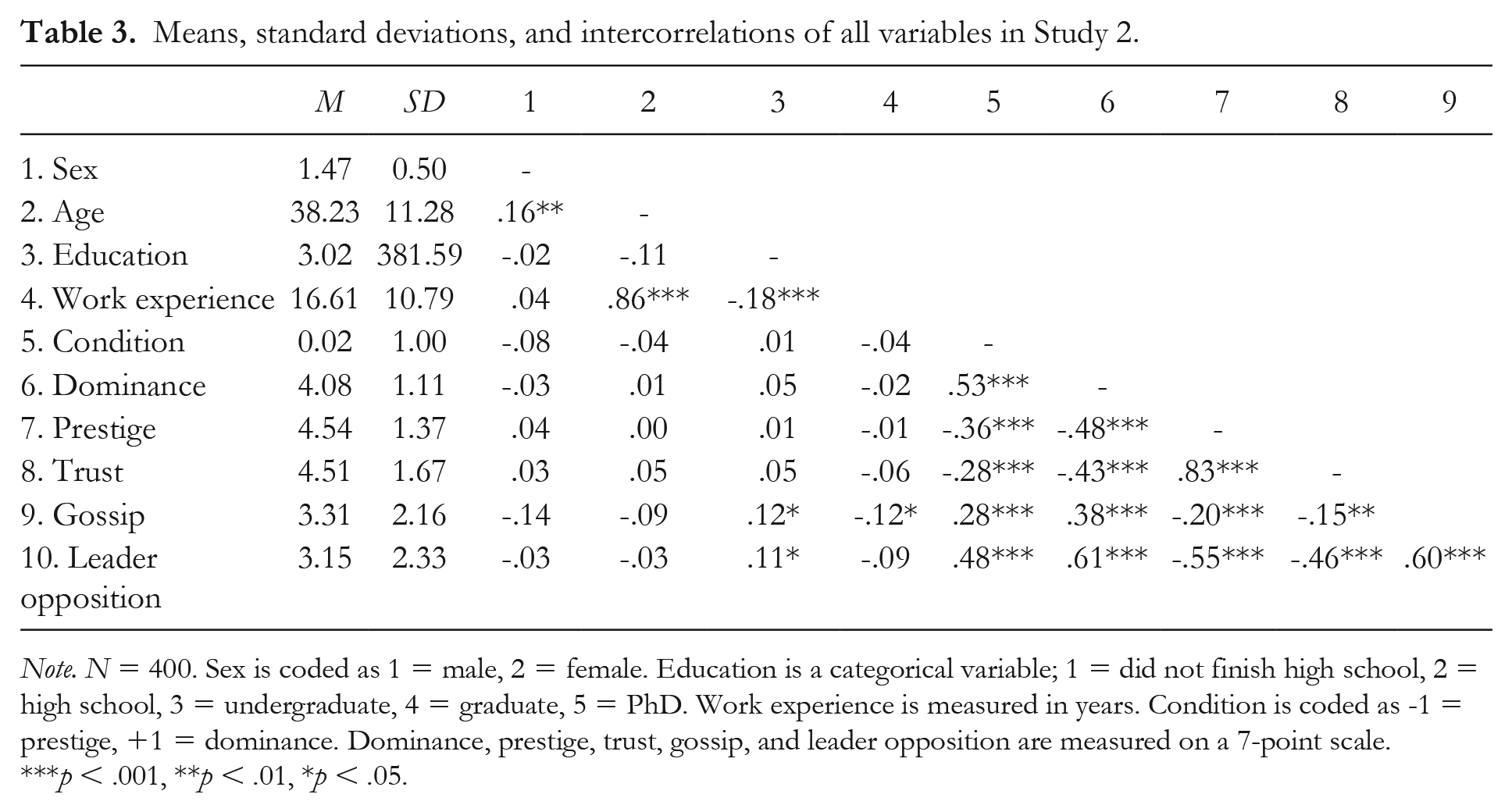
Note. N = 400. Sex is coded as 1 = male, 2 = female. Education is a categorical variable; 1 = did not finish high school, 2 = high school, 3 = undergraduate, 4 = graduate, 5 = PhD. Work experience is measured in years. Condition is coded as -1 = prestige, +1 = dominance. Dominance, prestige, trust, gossip, and leader opposition are measured on a 7-point scale.
p < .001, **p < .01, *p < .05.
They were then informed that if they felt the leader was poorly suited for the role, they could oppose the leader. However, they were also told that if all three followers did not express opposition, the existing leader would remain in place and would “be able to see who had indicated that the leader should be reassigned and they may use this information as they choose when assigning bonuses at the end of the task.” This contingency was intended to disincentivize opposition to the leader by highlighting the risks inherent to individually opposing a powerful leader.
Participants were then informed that they had the opportunity to send a private message to the other group members (i.e., gossip). Participants were first asked to respond in binary fashion—“I would like to send a private message to the other workers regarding the leader”—and then on a 7-point scale (1 = not at all; 7 = very much): “Based on what I know about the leader, I would like to communicate with the other workers.”
We then invited participants to send a private message to the other group members via a text box. The first two authors individually coded these messages for expressions of trust in the leader (-1 = mistrust, 0 = neutral, 1 = trust), negative versus positive gossip about the leader (-1 = negative, 0 = neutral, +1 = positive), and explicit references to a desire to work together to replace the leader (-1 = no opposition initiation, 0 = no mention of oppositions, 1 = opposition initiation). Coders were blind to experimental condition. Agreement was high for all three measures: trust = 98.22% (κ = .91), gossip = 94.00% (κ = .89), and coalition initiation = 97.21% (κ = .91). Any points of disagreement were discussed to generate a final determination.
Following their message,
3
a response screen displayed: “Please wait a few moments while the server exchanges messages.” After 15 seconds they received the following two messages: RESPONSE 1: “Nice attitude . . . tells us from the start that ‘he’s the best’ and threatens us! (We will work together and help each other out [prestige condition].)” RESPONSE 2: “Reminds me of a boss I once had.”
Response 1 was intended to maintain the deception required for the manipulation and so varied between the dominant and prestige conditions. Response 2 was intended to support the cover story. Participants were then told: “If you think the leader is poorly selected for the role of group leader, you can indicate that you would like to replace the current leader.” They were again informed that successful opposition would require unanimity and that in the event of an unsuccessful challenge, the leader would be informed who the challengers were.
Participants were then asked to respond to the request “Please submit your preference regarding acceptance of the current leader, or desire for the leader to be reassigned” in a binary format (1 = I accept the existing leader; 2 = I think a new leader should be reassigned). We also asked participants to respond to the statement: “Based on what I know about the leader, I would like the leader to be reassigned” (1 = not at all; 7 = very much). Finally, participants were provided with an opportunity to express any suspicions. 4 Immediately following this, participants were debriefed and dismissed.
Results
Table 3 presents means, standard deviations, and intercorrelations of all variables. Table 4 presents means, standard deviations, and score differences across conditions.
Means, standard deviation, and score differences across conditions (Study 2).
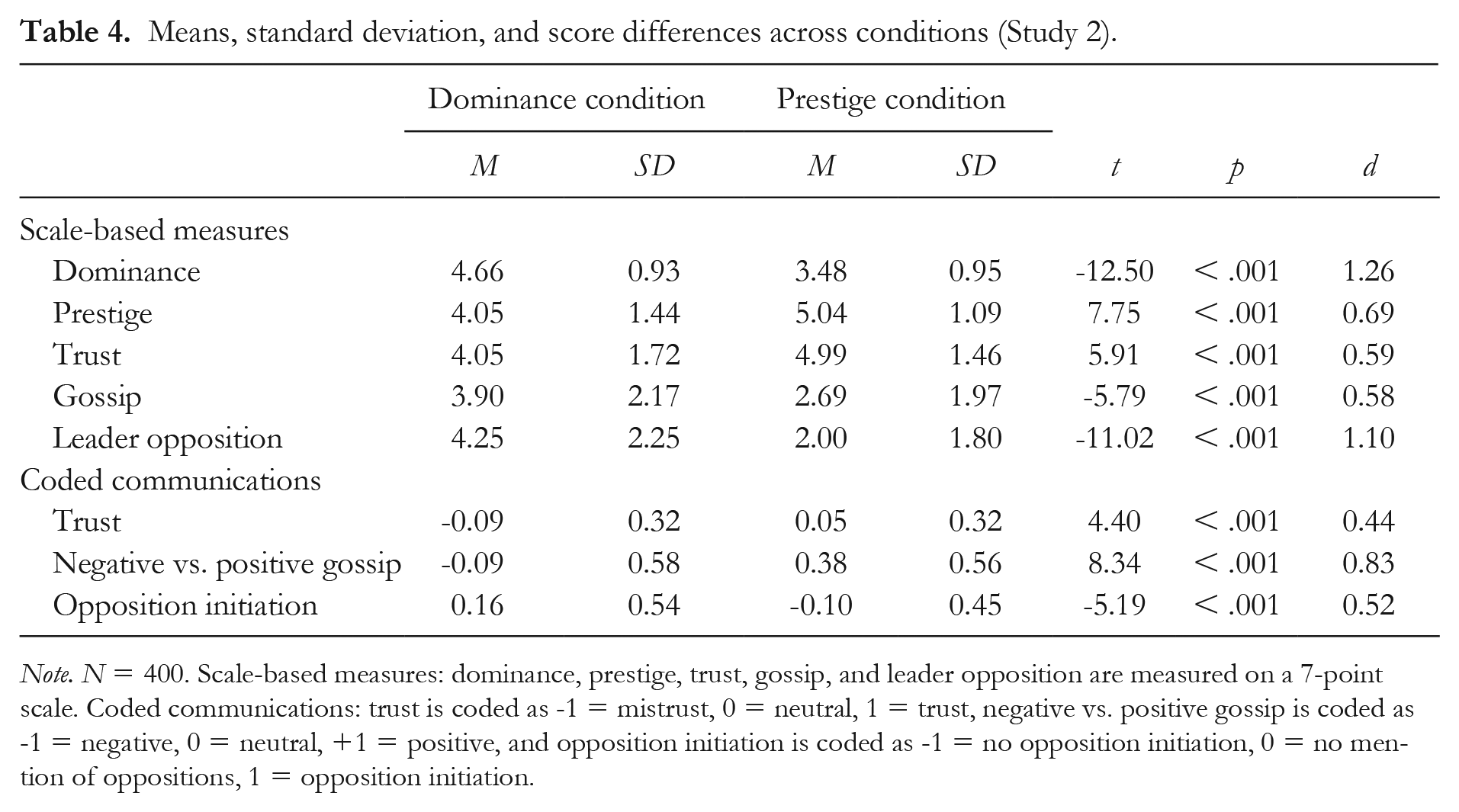
Note. N = 400. Scale-based measures: dominance, prestige, trust, gossip, and leader opposition are measured on a 7-point scale. Coded communications: trust is coded as -1 = mistrust, 0 = neutral, 1 = trust, negative vs. positive gossip is coded as -1 = negative, 0 = neutral, +1 = positive, and opposition initiation is coded as -1 = no opposition initiation, 0 = no mention of oppositions, 1 = opposition initiation.
Compared to participants in the prestige condition, participants in the dominance condition expressed a stronger preference to oppose the leader, t(398) = -11.02, p < .001, d = 1.10, lower levels of trust, t(398) = 5.91, p < .001, d = 0.59, and stronger preferences to gossip, t(398) = -5.79, p < .001, d = 0.58. We repeated these analyses based on the coding of participants’ messages and found similar effects. Furthermore, logistic regressions of the binary options to replace the leader (b = 1.21, Z = 7.81, p < .001) and to send a message to the other followers (b = 0.41, Z = 3.40, p = .001) revealed the same effects. Thus, Hypotheses 1–3 were supported.
As shown in Figure 2, all paths of our hypothesized model were significant, revealing the predicted indirect pathway from leader dominance to leader opposition, via trust and gossip, IE = 0.11, SE = 0.02, 95% CI [0.07, 0.15]. To test the robustness of our model, we compared the fit of our model to the fit of four alternative models. In each case, our model out-performed the alternatives (see Supplemental Materials).
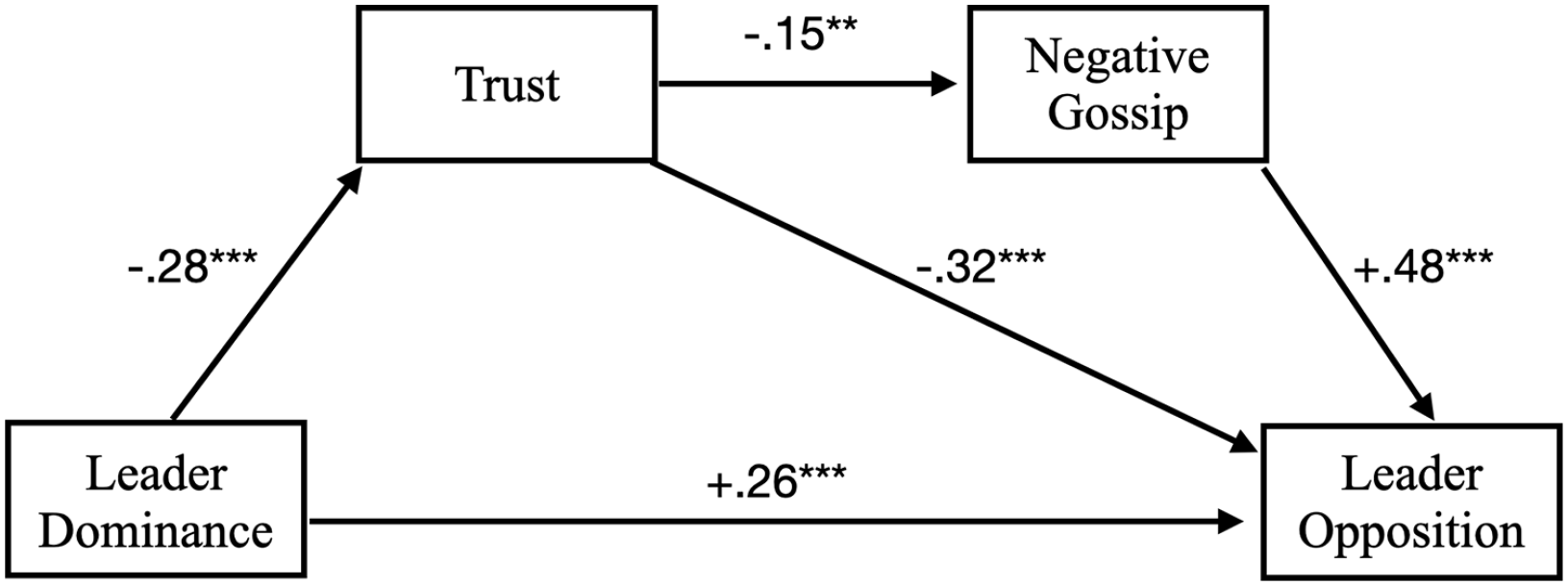
Direct and indirect pathways from dominance to collective opposition via trust and gossip (Study 2).
We also tested an overall model that included the text-coded expressions of trust, negative gossip, and expressed attempts to initiate collective opposition as an additional proximate mediator of leader opposition. The additional pathway from opposition initiation to leader opposition was significant, b = 2.47, SE = 0.19, 95% CI [2.10, 2.85], and we again observed a significant indirect pathway from the dominant leader to leader opposition, via our proposed mediators, IE = 0.20, SE = 0.06, 95% CI [0.07, 0.32]. See Supplemental Materials for a visual depiction of this model. Based on these results, Hypothesis 4 was supported.
Discussion
Study 2 illustrated the overall process by which followers may band together to resolve conflict with morally questionable, dominant leaders. Dominant leadership was negatively related to moral leadership, undermined trust, and was associated with a tendency to gossip negatively about the leader, which in turn predicted preferences for collective opposition to the leader. This model held whether it relied on Likert-scale ratings or the texts that were (ostensibly) exchanged between participants. It is also worth noting that Study 2 provided opportunities for participants to engage in positive gossip, as well as negative gossip, about the leader. While dominant leaders elicited negative gossip, prestige-based leaders were more likely to prompt positive gossip. This is consistent with the notion that positive gossip may act as a mechanism that cements the status of prestigious leaders.
To mimic the risks involved with leadership challenges in real life, we disincentivized attempts to dislodge the leader. Participants were informed that, should collective action prove unsuccessful, they would be subject to potential retribution by the leader, including the loss of bonus money they might otherwise receive. The higher levels of negative gossip in the dominant condition may then reflect attempts to safeguard against this risk prior to casting one’s vote. Importantly, although none of the messages they received from (ostensible) fellow group members directly indicated voting intentions, many participants still took the risk and voted to work together to replace the dominant leader. These findings speak to the strength of people’s motivations to cooperate with others to constrain the power of dominant leaders.
In Study 2, participants’ communications and decisions to replace the leader were made under the assumption that they were part of a group, and that the outcomes that followed their decision would be contingent on other group members’ decisions. However, because data were captured at the individual level, we were unable to test how many of those individual decisions to act against a dominant leader combine to represent a “successful collective action” (i.e., one in which followers move in coordinated fashion to replace the leader). We addressed this limitation in Study 3.
Study 3
We pre-registered the design and hypotheses of Study 3 online with Open Science Framework (OSF) 5 (https://osf.io/wv672/).
Method
Participants and procedure
As per our pre-registered design, power analysis suggested a sample size of 341 to achieve power of .90 to detect the smallest effect size in the hypothesized model (R2 = .03). A total of 494 Prolific workers (205 women; Mage = 36.05, SDage = 11.60) were recruited, who were then re-directed to SoPHIE Labs, an online interactive environment, to take part in our group-level experiment. Our group-level sample size (n = 247, 129 dominance condition) gave us 79% power to detect an R2 of .03.
Experimental context
Participants were recruited in dyads to take part in a seven-round economic game (a commons dilemma task). They were informed that at each round, the leader would receive 10 tokens and each follower three tokens, with each token being worth 10c. At each round, they would have the choice to contribute their tokens to the “commons” (a shared resource), with no minimum, and a maximum of three tokens from followers and 10 tokens from the leader. 6 Participants were informed that following each round, the sum of all players’ contributions to the commons would be tripled and the resulting amount would be distributed equally between the two followers and the leader. However, they were also informed that during three critical rounds (rounds 3, 5, and 7), the leader would decide how to distribute the commons between the two followers, and themself.
They were also informed that a Prolific worker had been selected to act as leader of their group, and that following a brief introduction to the leader, they and the other follower would have an opportunity to discuss how to proceed. Specifically, they were informed that if they were dissatisfied with their appointed leader, they would have four options: (a) accept the leader; (b) exit the group and be reassigned to a new group; (c) message the leader directly; or (d) reject the leader. Notably, options (b) and (c) represent common courses of action in response to abusive supervision within organizations (Schyns & Schilling, 2013; Webster et al., 2016). They were informed that if both followers chose to reject the leader, they could then select a new leader from among the two followers and be joined by another follower. However, to disincentivize independent action against the leader (as per Study 2), they were also informed that if only one follower voted to replace the leader, the leader would remain, would be able to see who voted to have them replaced, and may use this information when deciding how to distribute the commons during the critical rounds.
Manipulation
Participants were then introduced to their ostensible leader. To rule out any idiosyncratic text-based effects, and to test the robustness of our manipulation, we modeled a new leadership manipulation after previous text-based procedures used to manipulate dominance (e.g., Kakkar et al., 2020; Laustsen & Petersen, 2020). The manipulation was designed to capture central facets of dominance (e.g., reliance on authority, being assertive, and making definitive decisions) and prestige (e.g., reliance on skill, relationship-building) (see Table 2).
We again pre-tested our manipulation to ensure the two new versions of our leader text differentially influenced participants’ perceptions of dominance and prestige. Once again this also allowed us to evaluate perceptions of moral leadership—ethical, authentic, and servant. We presented 100 participants with our revised manipulation text and asked them to evaluate the introduced leader using the following scales: dominance and prestige (Cheng et al., 2010), ethical leadership (Brown et al., 2005), authentic leadership (Neider & Schriesheim, 2011), and servant leadership (Liden et al., 2015).
Results of this pre-test indicated the dominant leader to be rated higher on dominance than the prestige-based leader, Mdom = 5.72, SDdom = 1.07, Mpres = 3.38, SDpres = 1.11, t(98) = -10.77, p < .001, d = 2.15. Conversely, the prestige-based leader was rated higher on prestige than the dominant leader, Mpres = 5.70, SDpres = 0.91, Mdom = 3.56, SDdom = 1.15, t(98) = 10.28, p < .001, d = 2.06. We again observed differences between conditions on all three dimensions of moral leadership: ethical leadership, Mdom = 3.50, SDdom = 1.37, Mpres = 5.68, SDpres = 0.84, t(98) = 9.65, p < .001, d = 1.92: authentic leadership, Mdom = 3.81, SDdom = 1.03, Mpres = 5.63, SDpres = 0.72, t(98) = 10.27, p < .001, d = 2.05; servant leadership, Mdom = 3.00, SDdom = 1.23, Mpres = 5.19, SDpres = 0.90, t(98) = 10.16, p < .001, d = 2.03.
Participants then reported perceptions of their leader’s dominance and prestige (i.e., manipulation check), as well as their trust in the leader. To measure perceptions of the leader, we again used the dominance (α = .90) and prestige (α = .76) scales developed by Cheng et al. (2010). Consistent with pre-testing, leaders in the dominance condition were perceived as more dominant than leaders in the prestige condition, whereas leaders in the prestige condition were perceived as more prestigious than were leaders in the dominance condition (see Table 5). Trust in the leader was assessed via an established scale (R. C. Mayer et al., 1995) that assesses three antecedents of trust—ability (α = .93), benevolence (α = .97), integrity (α = .83)—as well as trust per se (α = .70).
Means, standard deviations, and intercorrelations of all variables in Study 3.
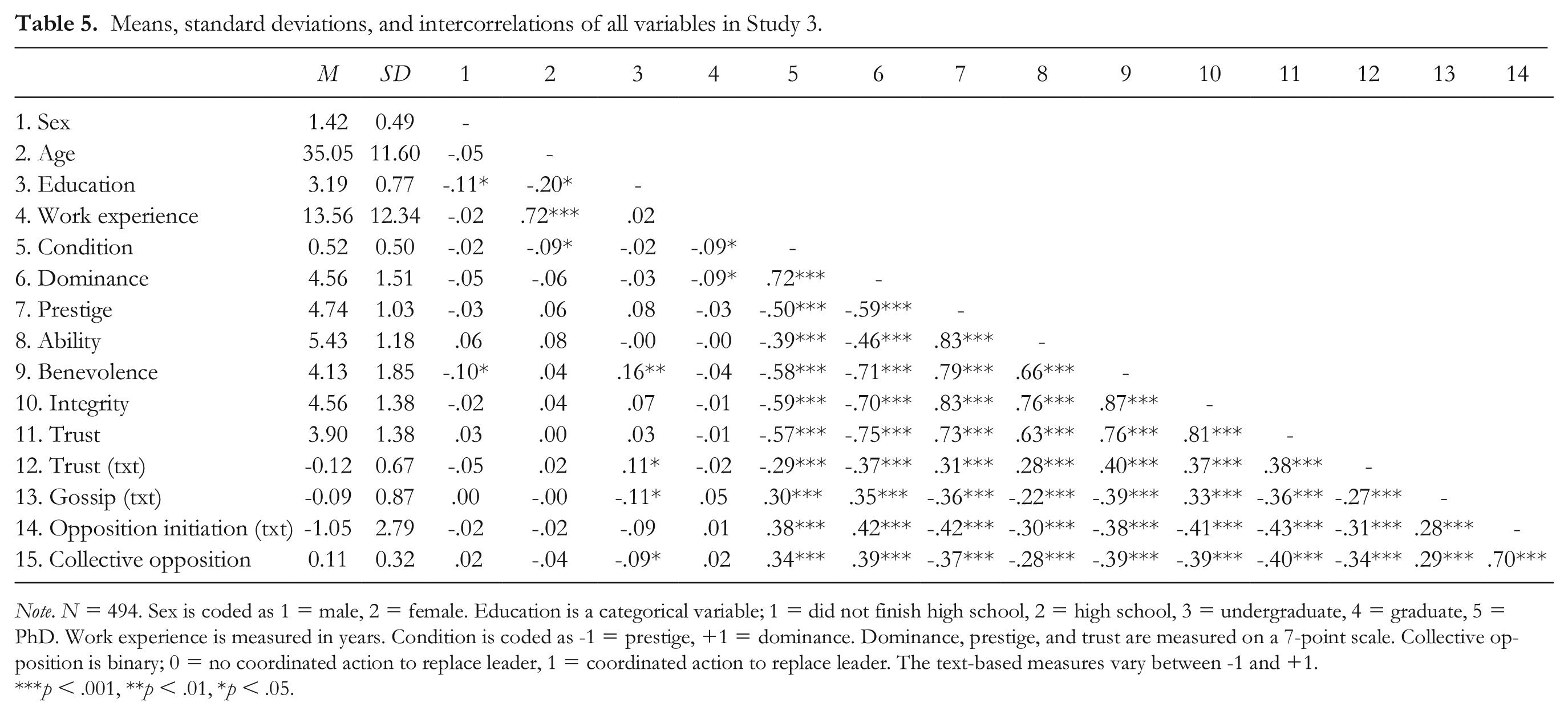
Note. N = 494. Sex is coded as 1 = male, 2 = female. Education is a categorical variable; 1 = did not finish high school, 2 = high school, 3 = undergraduate, 4 = graduate, 5 = PhD. Work experience is measured in years. Condition is coded as -1 = prestige, +1 = dominance. Dominance, prestige, and trust are measured on a 7-point scale. Collective opposition is binary; 0 = no coordinated action to replace leader, 1 = coordinated action to replace leader. The text-based measures vary between -1 and +1.
p < .001, **p < .01, *p < .05.
Participants were then transferred in dyads to an online chat room, where they were given 5 minutes to discuss their options before making a decision regarding the leader. We later coded those discussions for our focal variables of gossip (positive/negative), trust/distrust, suggestions to accept/reject the leader, intentions to leave their group, and intentions to message their leader.
The first author coded each line of the text-based chats into one of five categories of interest – trust(+1)/distrust(-1), gossip negative(+1)/positive(-1), opposition initiation(+1)/no opposition initiation(-1), intention to leave group(+1), intention to message leader(+1) – and one neutral category for all remaining comments. To assess the reliability of the coded chats, two other authors also coded the text-based chats of 20 dyads. The average absolute agreement among the three coders was high, intraclass correlation coefficient (ICC) (2, 3) = .90; ICC (2, 1) = .73. All coders were blind to experimental condition.
After 5 minutes in the chat room, participants indicated their preference for each of the four options – accept leader, reject leader, exit group, message leader – first on a series of 5-point scales (1 = strong preference against; 5 = strong preference for), and then in forced-choice format. If both participants selected “reject leader” when presented with this forced-choice format, we coded this as collective opposition (i.e., coordinated action by both participants in each dyad). We used this as our outcome variable in testing our model. In all cases, the experiment then concluded and participants were debriefed.
Results
Table 5 presents the means, standard deviations, and intercorrelations of all variables. Table 6 presents means, standard deviations, and score differences across conditions.
Means, standard deviation, and mean score differences across conditions (Study 3).
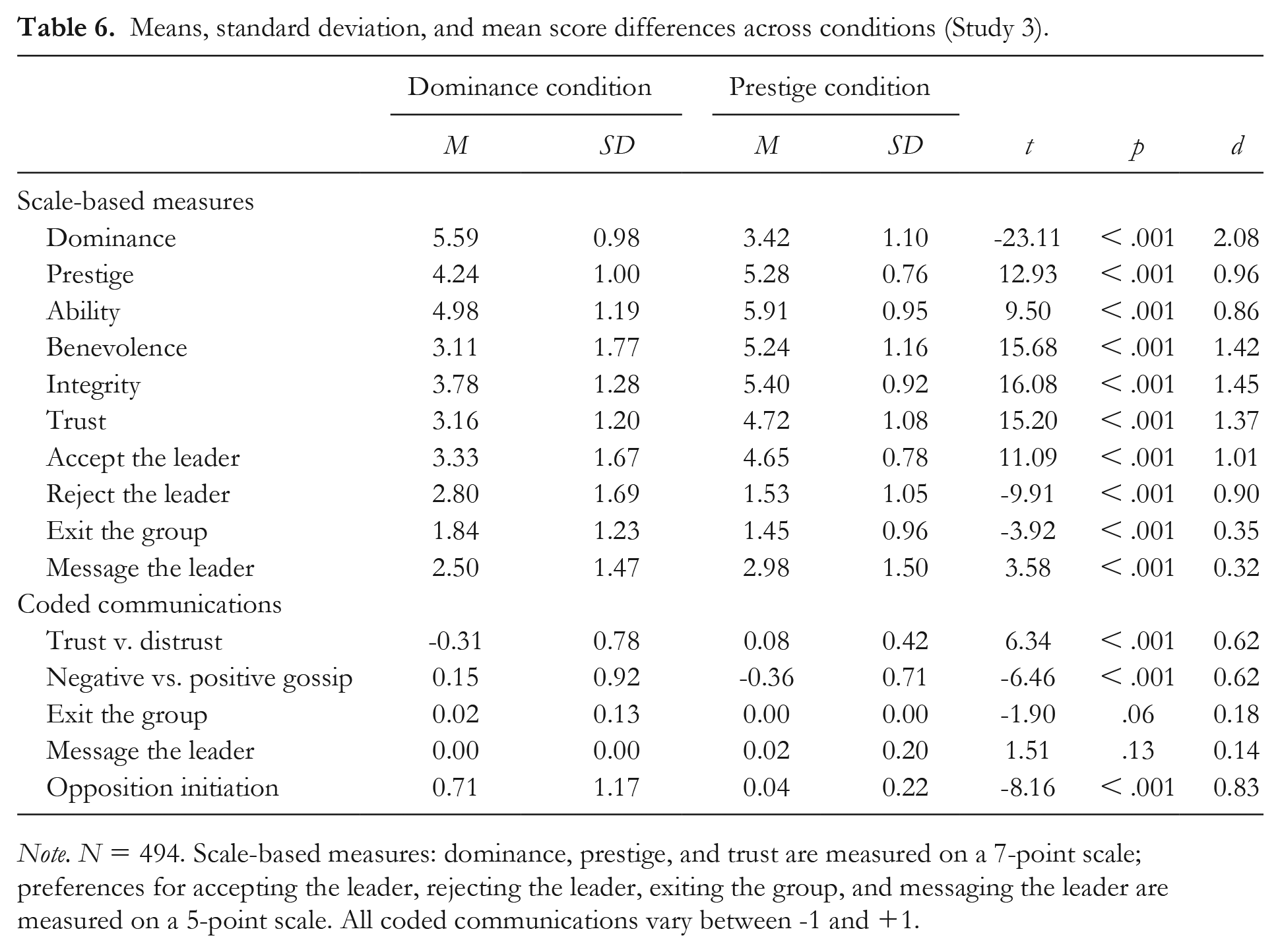
Note. N = 494. Scale-based measures: dominance, prestige, and trust are measured on a 7-point scale; preferences for accepting the leader, rejecting the leader, exiting the group, and messaging the leader are measured on a 5-point scale. All coded communications vary between -1 and +1.
In line with Hypothesis 1, 27 of the 129 groups in the dominance condition expressed collective opposition (i.e., both participants voted to replace their leader), compared to 0 of the 118 groups in the prestige condition, X2(1) = 27.73, p < .001 (see Supplementary Materials for the results of the other binary outcomes). The majority (n = 22) of these cases were preceded by explicit agreement to replace the leader, expressed during the online chat, X2(1) = 117.10, p < .001. Seventeen additional dyads included a single vote to replace the leader (16 in the dominance condition), 5 of which involved breaking an agreement arrived at in the chat room. In line with Hypothesis 2, the dominant leader was rated as less trustworthy than the prestige-based leader, t(492) = 15.20, p < .001, d = 1.37. Hypothesis 3 was tested based on participants’ coded messages. As expected, participants in the dominance condition engaged in more negative gossip than participants in the prestige condition, t(434) = -6.46, p < .001, d = 0.62.
As our primary outcome variable concerned collective opposition, we tested our hypothesized model at the group level. We constrained this analysis to include only those groups who used the chat function to communicate with each other (n = 216). To model trust, we averaged ratings within each dyad. To model gossip we averaged mean frequencies of negative minus positive expressions from the coded text. As shown in Figure 3, all hypothesized paths were significant, including the indirect pathway from leader dominance to collective opposition, via trust and gossip, IE = 0.23, SE = 0.04, 95% CI [0.15, 0.31].
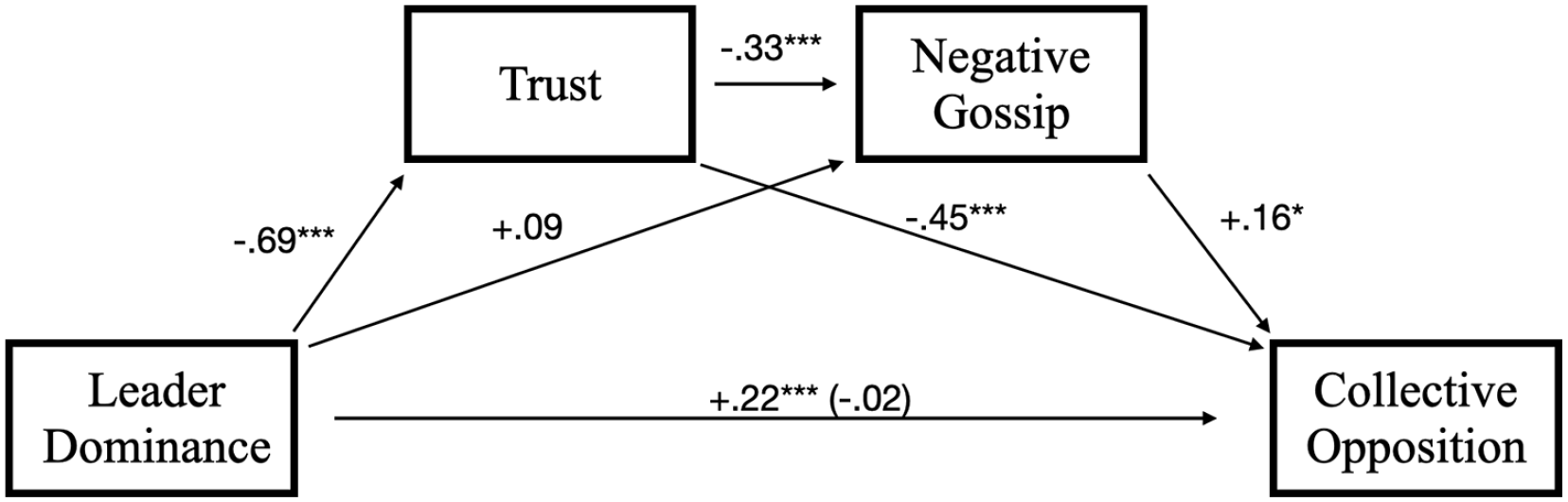
Standardized pathways from dominance to collective opposition via dyad-level scale mean scores (trust) and frequencies from coded text (gossip) (Study 3).
We also tested an extended version of our full model using the within-dyad mean frequencies of trust, gossip, and collective opposition, coded from the group chat. As per Figure 4, estimation of this model again revealed the predicted indirect pathway from leader dominance to collective opposition of the leader, via the proposed mediators, IE = 0.19, SE = 0.03, 95% CI [0.13, 0.25]. Thus, Hypotheses 4 was confirmed.
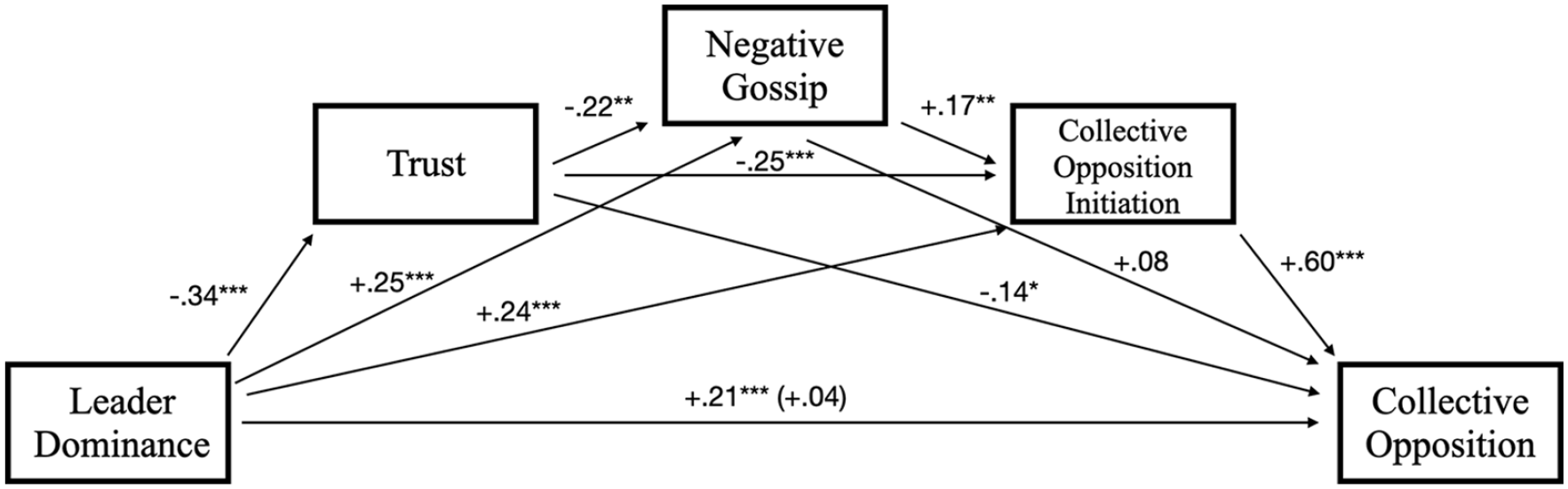
Standardized pathways from dominance to coup success via dyad-level coded mean frequencies of trust, gossip, collective opposition initiation and collective opposition (Study 3).
Lastly, we simultaneously fitted each of the putative mediators—ability, benevolence, integrity—between leader dominance/prestige and trust, and examined the effect from each antecedent to trust. We observed significant effects for integrity, b = 0.56, 95% CI [0.44, 0.67], p < .001, and benevolence, b = 0.19, 95% CI [0.11,0.27], p < .001, though not ability, b = 0.03, 95% CI [-0.06, 0.13], p = .46. Thus, while differences in perceptions of integrity and benevolence appeared to underlie lower levels of trust in dominant (versus prestige-based) leaders, differences in perceptions of leaders’ abilities did not.
Discussion
Study 3 advanced the investigation in several important ways. First, using a new manipulation that embodied key characteristics of dominant versus prestige-based leadership, we replicated the pattern observed in Study 2. Second, in measuring antecedents of trust, we observed that perceptions of integrity and benevolence, but not ability, explained differences in negative responses to dominant (versus prestige-based) leaders. Third, to reduce the possibility of demand, we provided participants with a range of response options that could reflect dissatisfaction with the dominant leader, including leaving the group or communicating with the leader. Despite the availability of those options, many participants chose to coordinate their interactions with a partner in order to reject the leader. Fourth, we captured and coded the real-time interactions of participants’ discussions, allowing us to demonstrate that dominant (versus prestige-based) leaders were associated with more frequent expressions of distrust, more negative gossip, and ultimately a greater tendency to initiate coalitions aimed at rejecting dominant leaders.
As was the case in Study 2, voting to replace the leader was inherently risky, because that action would be successful only if one’s partner acted in unison, and there was no way to know for sure how one’s partner would act. In that sense, participants’ situation resembled a prisoner’s dilemma in that cooperation would result in the best outcome for both subordinates, but defection could result in greater individual gains because the defector could potentially receive more of the common good. Nevertheless, cooperation was a common response to dominant leaders, illustrating the strength of people’s motivations for collective action in response to dominant leadership. 7
General Discussion
These studies provide a detailed portrait of the social psychological processes through which dominant leaders prompt collective moral opposition, leading followers to defend themselves and their group against the possibility of abuse and exploitation. In doing so, our findings integrate research on dominance and prestige with that on moral leadership. We provide the first empirical test of the role of dominance and prestige in perceptions of morality, and one of the first tests of whether dominance serves as a durable leadership strategy (see also; McClanahan et al., 2022; Redhead et al., 2019). While prestige offers an effective long-term strategy, the benefits of dominance may be less durable. Furthermore, we extend the nascent literature on the durability of dominance and prestige by identifying specific social psychological processes that potentiate change in moral systems through a bottom-up process—collective opposition to a dominant leader. More broadly, while the majority of the morality and leadership literature has focused on leaders as initiators of moral system changes, the current work is some of the first to provide insight into the role that followers can play in such processes (see also Haslam et al., 2022).
The studies reported here illustrate the process by which followers may seek to band together to oppose morally questionable leaders: dominant leadership undermined trust, which was associated with a tendency to gossip negatively about the leader, which in turn predicted preferences to replace the leader. Those preferences were experienced in response to leaders’ dispositional levels of dominance and prestige (Study 1), at the individual level following a manipulation of dominance versus prestige (Study 2), which translated into group-level collective action (Study 3). To mimic the risks inherent to challenging a leader and mitigate demand effects, we disincentivized attempts to dislodge the leader by informing participants that, should an attempted challenge prove unsuccessful (i.e., not collectively voted for), the challengers would be subject to potential retribution by the leader, including the loss of bonus money they might otherwise receive. Despite these risks, many participants still voted to replace the dominant leader, even when provided with clear alternative courses of action (Study 3). This finding speaks to the strength of people’s motivations to constrain dominant leaders.
Distilling trust into its constituent components (Study 3) provided evidence that dominance may lead to collective resistance by undermining perceptions of benevolence and integrity, but not perceptions of ability. Future research might examine other ways in which these antecedents of trust differentially trigger negative gossip and collective opposition. The current work is the first to directly assess the role that strategic forms of gossip play in helping followers band together to collectively oppose dominant leaders. Because gossip allows people to identify like-minded others (Feinberg et al., 2012), negative gossip may help overcome the “first-mover” problem, wherein people are initially reluctant to seed the formation of collective opposition, lest they find themselves taking a lone stand against a disproportionately powerful adversary.
Notably, gossip also provides an important opportunity for followers to converge on a shared identity (via mutually expressed opposition), which typically precedes people’s willingness to trade personal risk for the sake of their ingroup (Haslam et al., 2020). For instance, Haslam and Reicher (2012) describe how inmates at “The Maze”—a notorious penitentiary in Northern Ireland—began speaking and teaching one another Gaelic (Irish language) in order to crystalize their identity, isolate the (English) prison guards, and coordinate resistance in a series of hunger strikes and escapes. From this perspective, the current studies also speak to the central tenets of the dual-agency model of leadership—leader recognition and support is contingent on the extent to which leaders appear to be “one of us” and “in it for us” (Haslam et al., 2020; Haslam et al., 2022; Steffens et al., 2014).
Limitations and Future Directions
While our opening recount of the 2016 Turkish uprising against Erdogan highlights dominant-leader opposition in a real-world political context, the current studies used a classroom simulation and experimental settings to evaluate collective opposition. These situations involved relatively clear routes toward alliance formation—although we did offer two alternative routes in Study 3 (leaving the group or talking to the leader). Nonetheless, social hierarchies outside the laboratory involve a more wide-ranging and complex set of group contexts and, thus, future work should assess how readily the current findings generalize to a broader range of situations outside the laboratory. For example, some group contexts might involve psychological barriers (e.g., low shared group identity; see Haslam et al., 2020), social barriers (e.g., low proximity or limited communication channels between followers; King et al., 2013), or cultural barriers (e.g., inequalities; Ronay et al., 2020, 2022) that constrain the ability to cooperate and thus reduce the likelihood of collective opposition (Thomas et al., 2014). Under such constraints, groups may be unlikely to effectively coordinate to curtail problematic leaders and might instead pursue alternative strategies. While gossip may be one way in which collective opposition is achieved, other types of low-risk reactions to dominant leaders, such as public criticism and ridicule, may serve a similar function (Boehm et al., 1993; see also J. T. Cheng, 2020). It may then be fruitful for future work to explore social media as a channel for individuals to signal and consolidate followership as a means of opposing (or supporting) their leaders (see Haslam et al., 2022).
There may also be group contexts in which dominance-based leadership fares well, such as when operating in dyads (Ridgeway, 2017), when groups are large and fragmented (Magee & Galinsky, 2008), when the use of dominance is relatively normative (McClanahan et al., 2022), when there is a high level of intergroup competition (Laustsen & Petersen, 2015; Ronay et al., 2020), or during conditions of economic uncertainty (Kakkar & Sivanathan, 2017). Contextual features might also influence the negative relationship between dominance and moral leadership uncovered in our pre-testing. Dominance might be seen as morally justified to the extent that it serves the interests of one’s ingroup or protects those interests from external challenges (Kakkkar & Sivanathan, 2017). Indeed, dominance can be seen as a constituent of the co-constructed (by leader and followers) social identity of the US Capitol Hill rioters in 2021 (Haslam et al., 2022). Couched within the dual agency model of identity leadership and engaged followership, Trump and his followers can be viewed as simultaneously influencing each other in the creation of a shared identity and shared agenda (Haslam et al., 2022). Future work might then examine how dominance and prestige feature in the emergence of a shared moral identity that connects followers to leaders.
Another avenue for future research pertains to the distinction and interplay between dominance and prestige. Although some theories inadvertently cast dominance and prestige as mutually exclusive, the behavior of many leaders is more complex and most people adopt some blend of the two strategies. For example, dominance is likely to be facilitated by having an assembly of allies, or institutional legitimation, so dominance as a leadership strategy might depend on the ability to garner prestige. Conversely, dominant tactics might be employed by prestige-based leaders for the sake of curtailing free-riding or accelerating coordination, and thus prestige as a leadership strategy may be situationally dependent on the selective use of dominance (von Rueden et al., 2014). To the extent that dominance is expressed toward outgroup institutions and members, it may serve to crystalize ingroup identity and so amplify active follower engagement (Haslam et al., 2022). The ways in which leaders strategically integrate dominance and prestige, as well as how followers perceive and react to such leaders, provide several interesting questions for future research.
Conclusion
Sometimes leaders behave in abusive or exploitative ways and, in doing so, break the implicit moral contract they hold with followers. Although numerous historical examples of follower-based coalitions in response to abusive leaders have been documented, the scientific literature has yet to identify the social psychological factors underlying this phenomenon. Our findings highlight the specific social psychological processes that facilitate the emergence of collective opposition, as well as the specific types of leaders most likely to trigger moral indignation and elicit collective action. These studies provide the first rigorous experimental evidence for hierarchy “leveling mechanisms” aimed at ensuring the well-being of groups and their members.
Supplemental Material
sj-docx-1-gpi-10.1177_13684302231151942 – Supplemental material for Banding together to avoid exploitation: Dominant (but not prestige-based) leaders motivate collective moral opposition from followers
Supplemental material, sj-docx-1-gpi-10.1177_13684302231151942 for Banding together to avoid exploitation: Dominant (but not prestige-based) leaders motivate collective moral opposition from followers by Richard Ronay, Janneke K Oostrom, Minnie She and Jon Maner in Group Processes & Intergroup Relations
Footnotes

References
Supplementary Material
Please find the following supplemental material available below.
For Open Access articles published under a Creative Commons License, all supplemental material carries the same license as the article it is associated with.
For non-Open Access articles published, all supplemental material carries a non-exclusive license, and permission requests for re-use of supplemental material or any part of supplemental material shall be sent directly to the copyright owner as specified in the copyright notice associated with the article.
