




Abstract
The United States is highly divided along party lines, and this partisan divide has a tremendous impact on social relationships and even health-related behavior. Although group members frequently reject criticism from individuals outside their own group relative to criticism from within the group (intergroup sensitivity effect), it remains unclear whether this effect holds for calls for unity across party lines. Additionally, the democratic process may itself help to mend intergroup sensitivity. Our high-powered experiment with self-identified U.S. Democratic or Republican voters across three time points during the 2020 U.S. presidential election demonstrates consistent rejection of calls for unity across party lines, which differentially affected consequent reconciliatory behavior. While the ascription of unconstructive motives decreased reconciliatory behavior, heightened threat perceptions increased reconciliatory behavior. Effects were consistent across time and party affiliation, indicating that the democratic election process and the determination of the election outcome were unable to mend intergroup sensitivity across the partisan divide. Calls for unity affected the reported emotional experience of pride but these self-reports had no consistent impact on behavior. We discuss how understanding these psychological mechanics of partisanship helps to prevent democratic backsliding and promote reconciliation.
Dana Perino: “There is a strange divide between the country: People in Trump World cannot believe that he did not beat Biden by 15 Points. And people in the Biden world cannot believe that 71 million people would actually vote for that guy. And I agree we need to come together. But I also think you can’t just wait until someone magically appears to bring people back together. You just have to start in your own life.” Greg Gutfeld: “Yeah, that’s what I’m doing.” Jesse Watters: “Noooo, you’re not!!!”
The United States is highly divided by political affiliation, segregating the country into “Trump World” and “Biden World.” This segregation has culminated in violent pro-Trump protesters storming the Capitol on January 6, 2021 in an effort to prevent the U.S. Senate’s confirmation of the election result, leaving five people dead and many injured. Emerging evidence suggests that the partisan divide among constituents no longer hinges on ideological disagreements that may be resolved by public debate, but entails a strong element of fundamental identification with one subgroup or the other (Finkel et al., 2020; Iyengar et al., 2019). Members of one side do not only disagree with, but also deeply distrust, members on the other side of the aisle. Partisanship not only has consequences in terms of political preferences and actions (Brader et al., 2020; Rothschild et al., 2021) but even impacts high-stakes real-world behaviors, as seen in the rejection of COVID-related facts (Calvillo et al., 2020; Druckman, Ognyanova, et al., 2021) and health measures (Druckman, Klar, et al., 2021). It is therefore crucial to understand the psychological processes propelling and perpetuating the partisan divide of U.S. society.
A large and growing literature highlights how partisanship impacts psychological and political processes at the individual level (Diermeier & Li, 2019; Van Bavel & Pereira, 2018), in particular focusing on the perception of candidates, news-media, or political consequences (e.g., Boydstun et al., 2017; Ehret et al., 2018; Zell et al., 2021). Less is known about the social processes between constituents involved in creating and perpetuating this divide, especially when it comes to costly behavioral responses (e.g., investing time and effort to reconcile). This is unfortunate. Direct social interactions may yield a greater impact on behavior than mobilization messages by political parties (Bond et al., 2012). How individual members of political groups engage with each other and the consequences of these interactions for behavior is of great interest, exemplified by the increasingly important role of social media in political discourse. Moreover, experimental research on the partisan divide has almost exclusively used inconsequential self-reports (e.g., West & Iyengar, 2020; but see Carlin & Love, 2013; Iyengar & Westwood, 2015). Attitudes and intentions have only moderate relations to actions (Kruglanski et al., 2015; Sheeran & Webb, 2016), and inconsequential self-reports therefore only provide a poor proxy for actual behavior (Baumeister et al., 2007). We examine these issues in the context of group-based criticism.
Intergroup Sensitivity Effect
Social psychological research indicates that it is difficult to have constructive debates when people strongly identify with different groups. Although group members tolerate critical comments from fellow group members, they defensively reject the same criticism when it is voiced by a member of an outgroup (intergroup sensitivity effect [ISE]; Hornsey & Esposo, 2009). Group members reject outgroup criticism because they view it as less constructive than the same criticism from the ingroup (Hornsey & Imani, 2004). What is more, recent research indicates that group members actively punish critical outgroup commenters, even investing their own time and money to do so (Thürmer & McCrea, 2018; Thürmer et al., 2019, review by Thürmer & McCrea, 2023). Two recent large-scale registered reports attest to the robustness of the behavioral rejection of outgroup criticism (McCrea et al., 2022; Thürmer & McCrea, 2021). Mediational analyses in these studies also demonstrated that criticism from outgroup commenters is perceived to be less constructive and well intended than criticism from ingroup commenters, leading to a higher reported experience of threat. Experience of threat in turn predicted punishment behavior.
Much of the work on the ISE has examined the effects of criticism that the group is racist (e.g., Hornsey et al., 2002) or narrow-minded (e.g., Thürmer et al., 2019). Calls for unity may function differently, even when they are voiced across party lines. Such calls reference a shared identity between groups and criticize one subgroup for engaging in collectively detrimental behavior (i.e., partisanship). Moreover, rather than addressing general group character, calls for unity concern concrete efforts towards a valued and shared goal held by the superordinate group. However, assuming that the ISE represents a general process, even calls by opposing partisan groups to promote unity may be viewed as less constructive, more threatening, and result in less cooperative or prosocial behavior.
Although the role of cognitive evaluations of criticism in the ISE are well researched, less is known about the role of emotion in these effects. Researchers have assumed that defensive reactions to criticism are emotional and hot (Hornsey & Esposo, 2009), but little research has directly investigated the emotional responses of group members to criticism. This is surprising, given that attribution research has long established a cognition-emotion-action link (Thürmer & Kunze, 2023; Weiner, 1980, 2018). It is therefore plausible that emotions may serve as a subsequent process variable between attributions of constructiveness and behavioral responses.
Specifically, we assume that behavioral responses to outgroup criticism are at least in part motivated by the desire to protect group identity from mal-intended attacks (Adelman & Dasgupta, 2019). If so, responses to critical outgroup messages likely include social emotions related to status, particularly pride, when message recipients attribute malicious motives to the commenter (Tracy et al., 2020). Pride has the motivational function to increase perseverance (Williams & DeSteno, 2008) and, along with other moral emotions, motivate action (Dasborough et al., 2019). Pride has two psychological facets commonly called authentic pride and hubristic pride (Tracy & Robins, 2007). Whereas authentic pride leads to persistently striving for prestige, hubristic pride leads to defensively showing off, impressing and dominating others, and acting aggressively (Cheng et al., 2010). Hubristic pride may reduce prosocial behavior, delay of gratification, and efforts to adjust to another person, in comparison to authentic pride (Carver et al., 2010; Ho et al., 2016; Wubben et al., 2012; Yeung & Shen, 2019). Consequently, we assume that authentic pride is associated with adaptive reconciliatory responses to outgroup criticism but hubristic pride is related to the defensive rejection of attempts to reconcile.
An additional limitation of past work on the ISE is that it has examined the effects of group criticism irrespective of dynamic changes in the social environment. For example, the democratic process has institutionalized competition between parties as well as the peaceful transfer of power through elections (Dahl, 2020). Past research indicates that the ISE may increase or decrease as a result of actual group conflict, competition, and threat (Adelman & Dasgupta, 2019; Ariyanto et al., 2010; Packer, 2014). One may therefore argue that calls for unity from members of the competing party should elicit defensive responses before and during the election, but that these defensive responses should be reduced afterwards. In line with this view, elections spur partisanship (Singh & Thornton, 2019) but the willingness to discriminate against supporters of the opposing party decreases significantly shortly after an election (Sheffer, 2020). Constituents may thus reject outgroup calls for unity before the election but increase their acceptance of such calls after the election. Contrary to these observations, political scientists have recently raised concerns over the erosion of democratic institutions, called democratic backsliding (Waldner & Lust, 2018). In the context of the 2020 U.S. presidential elections, doubts were cast whether the result would be accepted (e.g., Solender, 2020). It is currently unknown whether calls for unity from members of the competing party are more effective after an election, especially in the 2020 U.S. political climate.
Finally, it is debated whether Democrats and Republicans display different patterns or degrees of partisanship (Brandt & Crawford, 2020; Newman & Sargent, 2020; Rothschild et al., 2021; Zmigrod, 2020), potentially suggesting that supporters of different parties exhibit different levels of intergroup sensitivity. While we contend that the rejection of outgroup criticism (intergroup sensitivity) is a general psychological process, we explored party affiliation as a potential moderator. It is possible, for example, that the winning side of an election is more willing to consider calls for unity.
The Present Research
In the present research, we investigate the ISE in the context of calls for unity and reconciliatory behavior between voters supporting different parties. As our main contributions, we observe costly behavioral responses to statements from constituents, and explore the role of emotions of pride and the democratic process. In our large-scale online experiment, participants read a critical comment calling to their own partisan group (i.e., Republicans or Democrats) to increase efforts to unite the country. We attributed this critical comment either to a person supporting the same political party (ingroup condition) or the other party (outgroup condition). Participants then indicated the motive of the commenter regarding the United States, how threatening the message was, and their feelings of authentic and hubristic pride. Participants then had the opportunity to learn about a non-government organization (NGO) dedicated to promoting bi-partisan cooperation. We measured engagement with a message from this group (time watching their video and requesting additional information) as behavioral indicators as well as reported support for the respective NGO’s mission. We moreover assessed peoples’ identification with the United States as well as identification with their political party as potential moderators.
We predicted that calls for unity would result in an ISE, such that criticism from voters supporting a different party would elicit less-positive motive ratings and higher threat ratings than within-party calls for unity. We also expected to observe a behavioral ISE, such that calls for unity from a member of the opposition party would lead to reduced reconciliatory behavior (i.e., lower NGO rating, less time watching the videos, lower likelihood to ask for additional information). We sought to extend past work documenting the mediational role of cognitive evaluations of the criticism (motive and threat; Thürmer & McCrea, 2021) on behavioral outcomes by including emotional responses (i.e., pride). Finally, we explore whether the stage of the election or party affiliation moderate the strength of the ISE.
Method
Participants and Design
Sample size was determined a-priori by a power analysis using G*power 3.1 (Faul et al., 2009; Faul et al., 2007), setting 1-β = .95 and α = .05 and assuming an ISE of d = .27 (Thürmer & McCrea, 2018) in a paired-samples t-test (two-tailed). The analysis resulted in a minimum sample size of n = 182 to detect a behavioral effect of message source at each time point. We report all measures, manipulations, and participant exclusions.
Past work has revealed robust ISE effects with Amazon’s Mechanical Turk (MT) participants (e.g., Thürmer & McCrea, 2021), and so we used a similar recruitment strategy. We collected data on three consecutive Fridays at 9:30 p.m. GMT, once before the election (October 30, 2020), directly after the election (November 6, 2020), and once the election result had been announced by the news media (November 13, 2020). For each data collection wave, we recruited 250 Amazon’s MT workers located in the United States with an 80% approval rate and at least 100 completed human interaction tasks (HITs) in return for a base-pay of 1$. We increased our target sample size in comparison to our power analysis to account for potential participant exclusions. We used the service CloudResearch (Litman et al., 2017) that implements these and additional quality checks on their include-list for high-quality workers (Chandler et al., 2019). Specifically, CloudResearch was set up to block suspicious geocode locations, workers on its universal exclude list, and duplicate Internet Protocol (IP) addresses, as well as verify worker country location and micro-batch our HIT. A total of 763 workers completed our study (380 male, 379 female, 4 other; 483 Democrat, 280 Republican; Mage = 41.11, SD = 13.63; our dataset contains 155 incomplete study entries; 130 independent voters were not allowed to continue the survey). 1 Eighty participants were excluded for failing one or more attention checks (see below) and one participant took more than one day to complete the study, leaving n = 682 for analysis (T1 n = 215; T2 n = 226; T3 n = 241).
The experiment followed a 2 Source Identity (ingroup vs. outgroup) within-subjects design, with the order of the conditions, the comment content, and the video content counterbalanced (see below). The stage of the election was a between-participant variable (i.e., different participants were recruited at each time point). Materials, data, and analyses are available at https://osf.io/fqryw/.
Materials and Procedure
Participants responded to our HIT entitled “American Study: Republicans vs. Democrats.” All measures were presented in a web-based survey in formR (Arslan et al., 2020). Participants were told that we needed their help in rating comments by previous participants in a study on people’s thoughts about Republican versus Democratic voters as well as videos from political initiatives. Participants read critical comments describing their own political group as lacking initiative to help the United States reunite, thereby undermining U.S. values (Supplementary 1). Both comments were designed to convey the same core message while being sufficiently different to stem from different previous participants. Each participant read one comment that was supposedly made by a participant from their own political group (ingroup condition) and one from the other political group (outgroup condition). After reading each comment, participants indicated the political affiliation of the commenter and the target of the comment, as a manipulation check, and responded to the comment. Specifically, participants rated message motive towards the entire United States (three items: To what extent do you think. . .the comments were constructive; . . .the person who wrote these comments cares about the US; . . .the comments were made in America’s best interest?), the message threat (eight items: To what extent do you think this comment is: threatening, disappointing, irritating, offensive, insulting, hypocritical, judgmental, arrogant), and their feelings of hubristic pride (seven items: To what extent does this comment make you feel: snobbish, pompous, stuck-up, conceited, egotistical, arrogant, smug) as well as authentic pride (seven items: To what extent does this comment make you feel: accomplished, successful, achieving, fulfilled, self-worth, confident, productive). All scales were answered on 7-point scales (1 = not at all to 7 = very much). Motive and threat scales were directly adapted from Hornsey and Imani (2004); 2 hubristic and authentic pride scales were adapted from Tracy and Robins (2007).
After these ratings, participants watched a video by a bi-partisan NGO (braverangels.org or bringit2thetable.org). Both NGOs host events across the United States to bring Democratic and Republican voters together and facilitate a productive exchange to mend the partisan divide. Watching the videos was thus a good opportunity to learn about how to mend the partisan divide. To ensure that video watching reflected the voluntary investment of personal time, we made it clear that participants could watch for as long as they wished to have an idea what the NGO was about. Viewing time is a well-validated behavioral measure of interest in a stimulus (see Silvia, 2005) and time investment has been used as a behavioral measure of the ISE (Thürmer et al., 2019). After the video, participants indicated their support for the described NGO (five items: To what extent do you think this NGO is: helpful, interesting, important, worthy of your support, friendly; 1 = not at all to 7 = very much) and indicated if they wanted to receive more information on the NGO (yes/no). The amount of time participants watched the video, their indicated support of the NGO, and their request for further information served as behavioral dependent measures.
After completing these measures, the second comment with the second video followed. As indicated above, the order of the conditions (ingroup vs. outgroup), comments (Comment 1 vs. Comment 2), and videos (braverangels.org or bringit2thetable.org) was fully counterbalanced. After completing all measures for the second comment, participants indicated their identification with the United States (Overall, being US-American has very little to do with how I feel about myself [reverse coded]; Being US-American is an important reflection of who I am; Being US-American is unimportant to my sense of what kind of a person I am [reverse coded]; In general, being US-American is an important part of my self-image; adapted from Leach et al., 2008) again on 7-point scales (1 = not at all to 7 = very much), and identification with their party (same scales, target replaced with “Democrats” or “Republicans” depending on reported affiliation). Finally, participants provided their voting decisions in 2016 (Trump, Clinton, other/did not vote) and 2020 (Trump, Biden, other/will not vote) as exploratory moderators, their age, gender, and nationality, 3 and were debriefed. Participants who requested additional information were sent the link to the respective NGO’s website via MT.
Data Preparation
We used R (R-Core-Team, 2020) including the packages psych (Revelle, 2020), schoRsch (Pfister & Janczyk, 2016), lmerTest (Kuznetsova et al., 2017), and lavaan (Rosseel, 2012) to analyze our data. We computed single indexes for message motive (α = .87 & α = .86), message threat (α = .93 & α = .93), hubristic pride (α = .98 & α = .98), authentic pride (α = .96 & α = .97), NGO endorsement (α = .94 & α = .96), identification with the United States (α = .86), and identification with the indicated party affiliation (Democratic Party α = .87, Republican Party α = .86). 4 Video time was highly skewed and we accordingly Winsorized scores by replacing more extreme values with a score of +/- 3SD from the mean. Hubristic and authentic pride, message threat, and message motive were z-transformed within each comment; NGO support and video watching time were z-transformed within each video.
Results
ISE Effects
We first investigated whether an ISE was observed by testing the effect of message source on responses to calls for unity. To this end, we performed paired-samples t-tests with message source as the predictor, including the full sample across all three time points. In line with our predictions, opposing-party (vs. own-party) calls for unity lead to ascribing less constructive motives and experiencing greater threat (Table 1, Figure 2), as well as more hubristic pride and less authentic pride (Table 1). Contrary to our prediction, comment source had no direct impact on participants’ support for the presented bi-partisan NGOs, the time participants spent watching the NGO videos, or their request for further information on the NGO (Table 1). Results were consistent when analyzing each time point separately, except for the comment source effect on authentic pride, which was not significant in Wave 3, t(240) = 1.58, p = .115, d = 0.14. Results were also consistent when analyzing Republicans and Democrats separately, except for the comment source effect on authentic pride, which was not significant for Repulicans, t(246) = 1.90, p = .059, d = 0.17.
Mean comment ratings and behavioral responses by comment source (collapsed across time points).
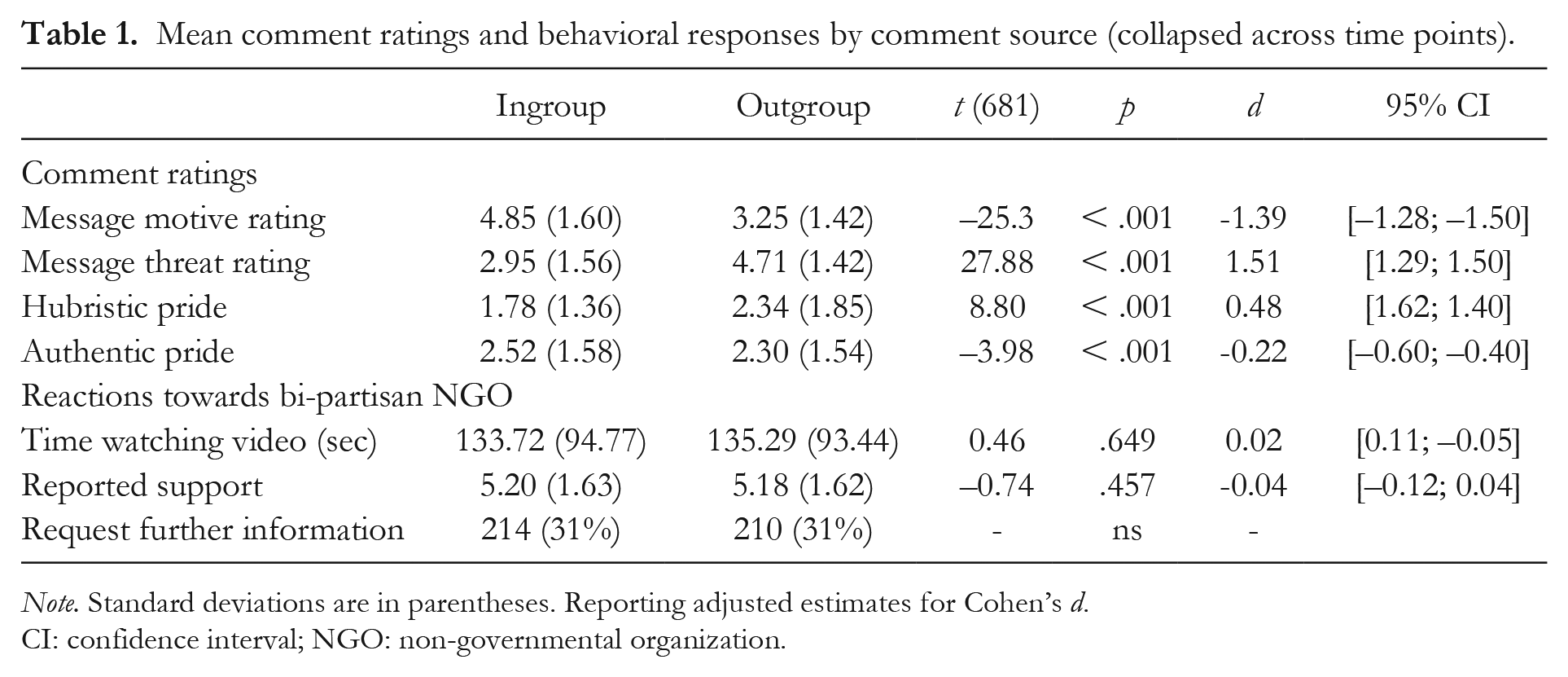
Note. Standard deviations are in parentheses. Reporting adjusted estimates for Cohen’s d.
CI: confidence interval; NGO: non-governmental organization.
Indirect Effects
We next tested potential indirect effects of the comment source on reconciliatory behavior using a structural equation modelling approach (Rosseel, 2012). Since attributed motive (constructiveness) seems to be the key process driving the ISE (Hornsey & Imani, 2004), we included constructive motive as the first intervening variable, directly linked to comment source. We included threat and pride as subsequent parallel mediators of the relation between message source and behavior. The motive-threat-action link is consistent with past research (Thürmer & McCrea, 2021). We also included a direct path from motive to behavior. 5 We first calculated repeated-measures correlations (Table 2) using the package rmcorr (Bakdash & Marusich, 2017). We then used serial robust cluster structural equation model analysis (McNeish et al., 2017) in the lavaan 0.6-6 package (Rosseel, 2012) to test our model with each behavioral measure in turn. Our analyses account for the dependency of observations (in our case: within participants) by estimating the respective variances. We again included all three time points and manifest constructs (i.e., included the calculated scale values). Partisan rejection of calls for unity had two opposed indirect effects on reconciliatory behavior (Figure 1).
Repeated-measures correlations and corresponding p-values.
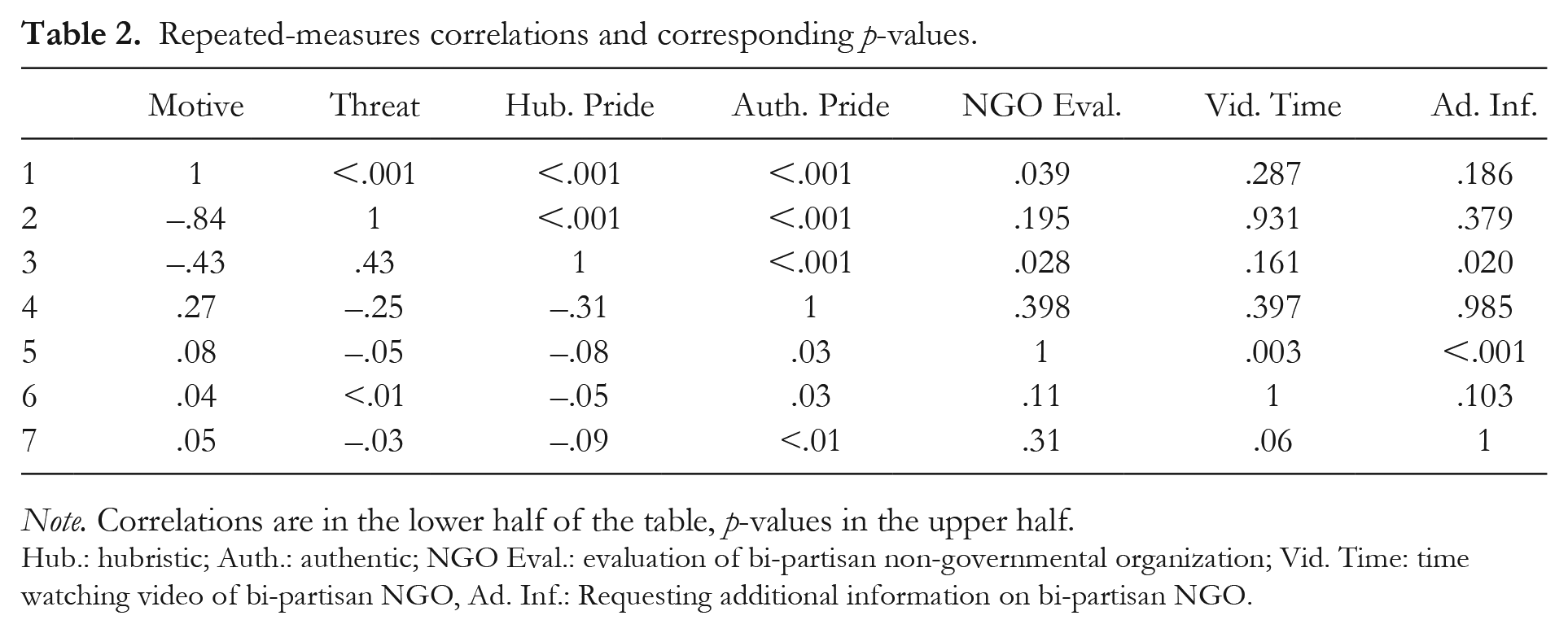
Note. The lower half of the table contains correlation coefficients and the upper half contains p-values.
Hub.: hubristic; Auth.: authentic; NGO Eval.: evaluation of bi-partisan non-governmental organization; Vid. Time: time watching video of bi-partisan NGO, Ad. Inf.: Requesting additional information on bi-partisan NGO.
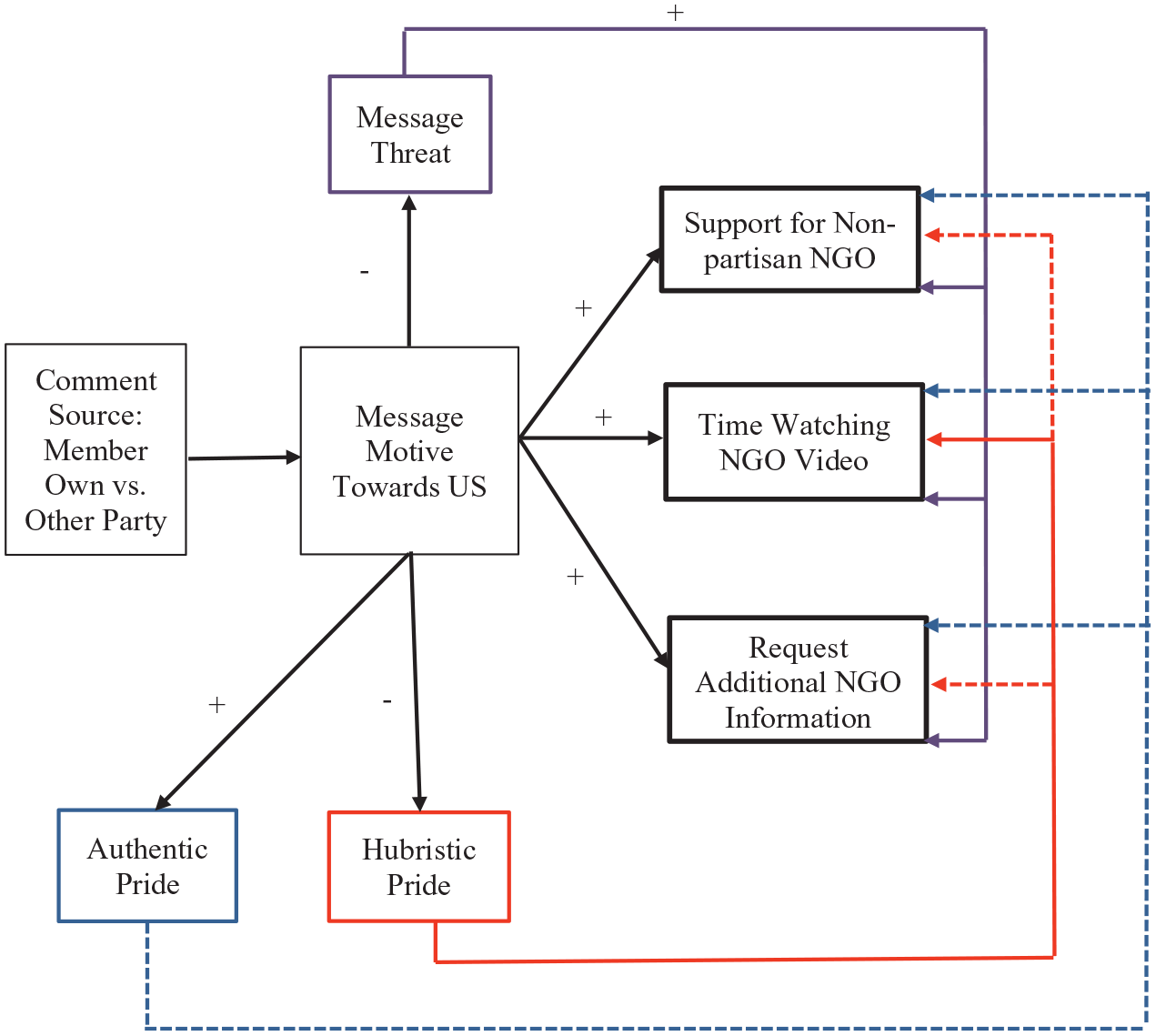
Results of structural equation model analyses.
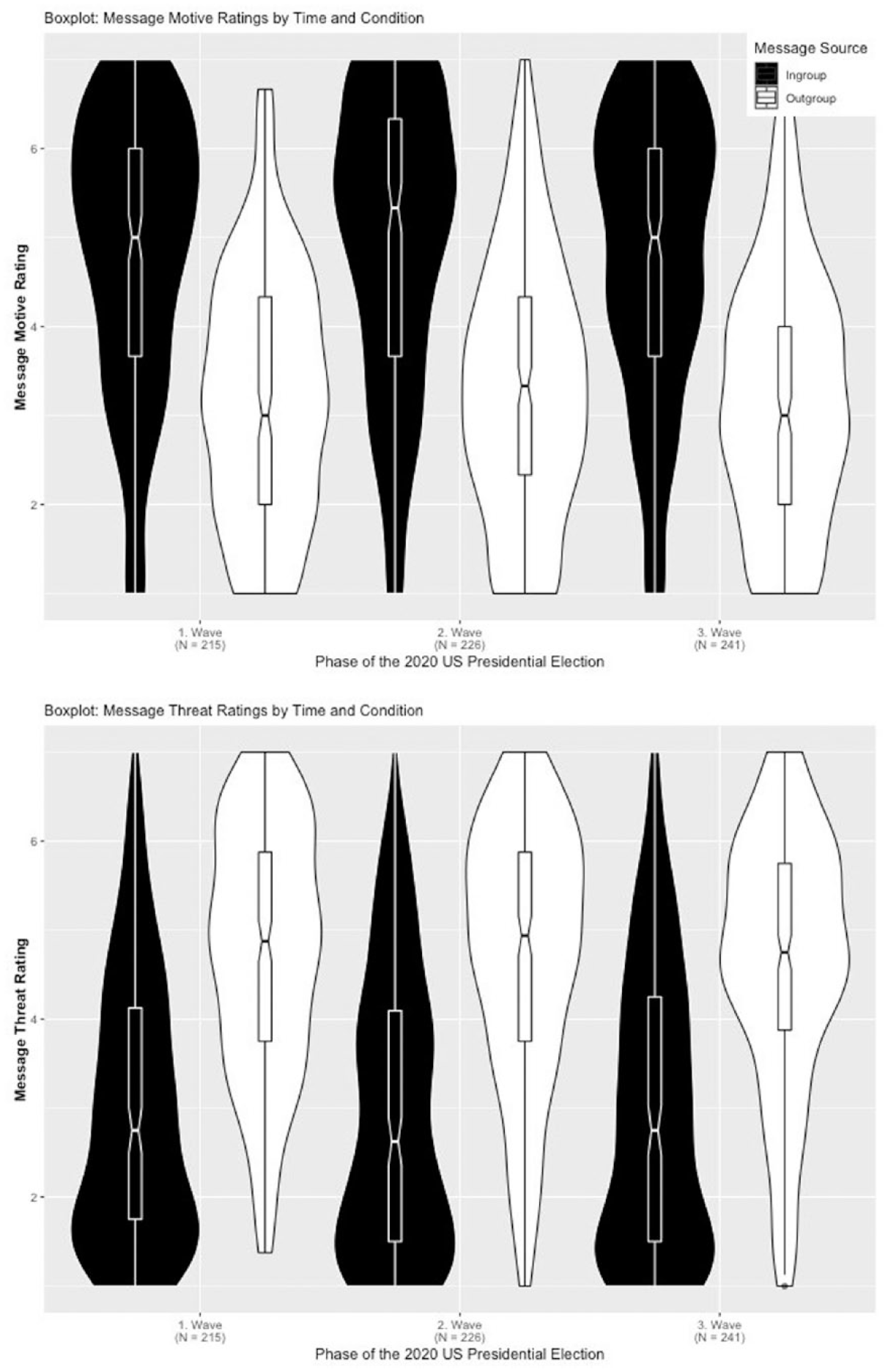
Boxplots with Violin-Plots for message motive and message threat by message source (ingroup vs. outgroup; within-participant) and time (before election, after election, after results known; between-participant).
Comment source predicted attributed comment constructiveness (motive), B = –0.93, SE = 0.05, p < .001, which in turn negatively predicted comment threat, B = -0.70, SE = 0.02, p < .001, and hubristic pride, B = –0.21, SE = 0.03, p < .001, and positively predicted authentic pride, B = 0.22, SE = 0.03, p < .001. Contrary to our predictions, higher message threat consistently predicted more reported NGO support, B = 0.15, SE = 0.08, p < .001 (indirect effect: B = 0.10, SE = 0.03, p < .001), more time watching the NGO video, B = 0.09, SE = 0.04, p = .038 (indirect effect: B = 0.06, SE = 0.03, p = .04), and higher odds that participants requested further information, B = 0.20, SE = 0.09, p = .019 (indirect effect: B = 0.17, SE = 0.07, p = .021). In line with our predictions, more constructive message motive consistently predicted more reported NGO support, B = 0.44, SE = 0.05, p < .001 (indirect effect: B = -0.41, SE = 0.05, p < .001), more time watching the NGO video, B = 0.16, SE = 0.05, p = .002 (indirect effect: B = -0.15, SE = 0.05, p = .002), and higher odds that participants requested further information, B = 0.38, SE = 0.09, p < .001 (indirect effect: B = –0.41, SE = 0.10, p < .001). In sum, the indirect effects from comment source on reconciliatory behavior via message motive and message threat were both significant—but in opposite directions. While outgroup comments decreased reconciliatory behavior via lower attributed constructive motive, outgroup comments increased reconciliatory behavior via increased threat perceptions. In line with this interpretation, we did not observe direct effects of comment source on reconciliatory behavior, Bs = –0.03 to –0.22, SEs = 0.04 to 0.07, ps = .456 to .815, but consistent effects when including the mediators in the model, Bs = 0.12 to 0.24, SEs = 0.05 to 0.09, ps = <.001 to .016. Interestingly, this indirect effect indicates that outgroup calls for unity indeed increased reconciliatory behavior when controlling for these mediating variables. We return to this finding in the general discussion.
Hubristic pride only predicted the time watching the NGO video, B = -0.13, SE = 0.03, p < .001, with a significant indirect effect, B = -0.03, SE = 0.01, p < .001. No other effects of hubristic or authentic pride on reconciliatory behaviors emerged, Bs = –0.02 to 0.03, SEs = 0.03 to 0.03, ps = .324 to .847, indirect effects, Bs = –0.03 to 0.03, SEs = 0.01 to 0.04, ps = .336 to .847. SRMRs = .06, .06, .07 generally indicated a satisfactory model fit but CFIs = .86, .85, 81 were somewhat low. In sum, our exploratory analysis suggests that the outgroup calls for unity indirectly decreased people’s reconciliatory behavior via the attribution of unconstructive motives but increased reconciliatory behavior via heightened threat perceptions.
Moderation
We next investigated the role of the election (Figure 2) as well as party affiliation on responses to inter-partisan calls for unity (Figure 3). To this end, we computed generalized linear models including participants as a random effect and comment source, time, and party affiliation, as well as all their interaction terms as fixed effects, and each dependent measure in turn (message motive, message threat, hubristic pride, authentic pride, time watching the NGO video, and reported NGO support) using the R-package lmerTest (Kuznetsova et al., 2017). For the request for additional NGO information, we performed parallel analyses using binomial modeling. We neither observed any main effects of Time, ts = -1.04 to 1.30, ps = .193 to .998, nor any Comment Source × Time interactions, ts = -0.41 to 0.67, ps = .375 to .911. This indicates that the democratic process did not reduce partisan rejection of inter-group calls for unity.
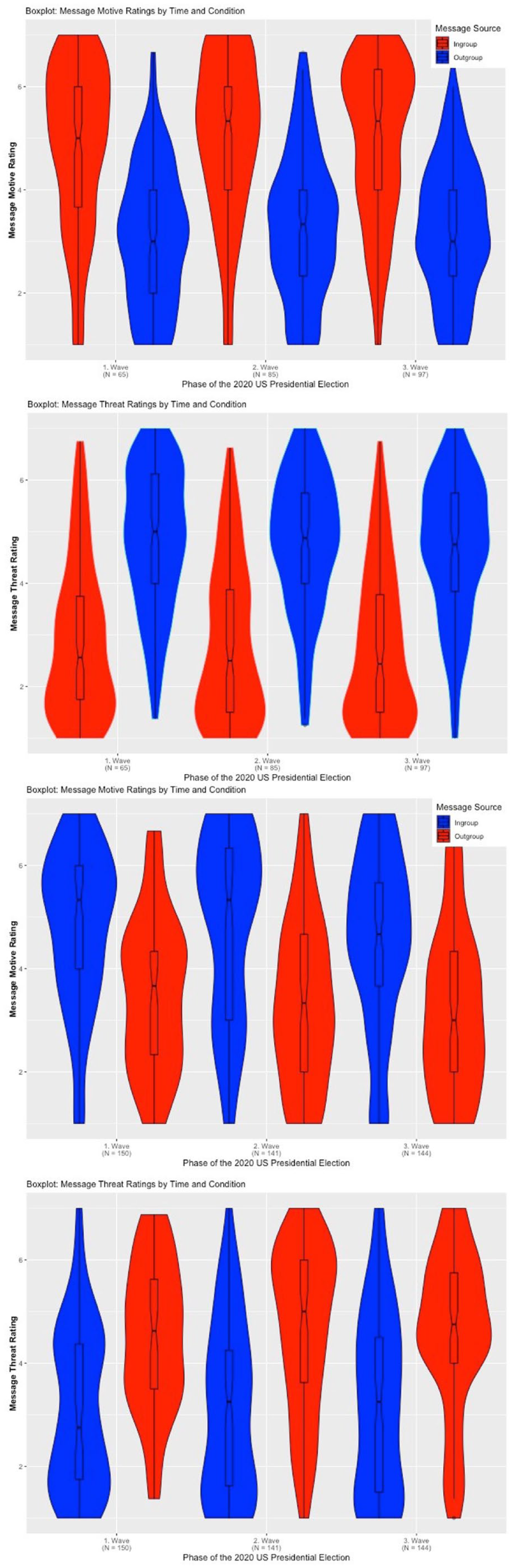
Boxplots with Violin-Plots for message motive and message threat by message source (ingroup vs. outgroup; within-participant), time (before election, after election, after results known; between-participant), and indicated party affiliation (Democrat vs. Republican; between-participant). Note: Boxplot notches indicate 95% CIs.
We also did not observe any effects of party affiliation, ts = 0.11 to 1.24, ps = .217 to .910, Party Affiliation × Comment Source interactions, ts = –1.13 to 1.30, ps = .187 to .644, or Party Affiliation × Comment Source × Time interactions, ts = –1.18 to 0.38, ps = .237 to .867. The rejection of inter-partisan calls for unity was thus ubiquitous across party lines and independent of the election outcome. It is important to note that our sample included more Democrats than Republicans.
We finally sought to explore potential moderators of the relationship between rejection of inter-partisan calls for unity and reconciliation. Moderation analyses using the Johnson-Neyman technique indicated that the rejection of inter-partisan calls for unity was robust across levels of identification with the United States as well as identification with participants’ own party. We observed a Comment Source × Party Identification interaction on support for the bi-partisan NGO, t = −2.00, p = .046, such that greater party identification was associated with a smaller Comment Source effect. However, Johnson-Neyman analyses indicated that there were no transition points within the scale range. We did not observe any other Comment Source × Identification interactions, ts = - 1.76 to 1.62, ps = .079 to .874, or transition points.
Discussion
A deep and increasing partisan divide between Democrats and Republicans presents a formidable problem for the United States. Beyond hostile interactions between politicians, partisanship runs through families and communities, dividing our society and undermining the effectiveness of government policies. We investigated whether the rejection of outgroup criticism (intergroup sensitivity) qualifies as a process perpetuating this divide. Indeed, calls for unity across party lines during the 2020 U.S. presidential election elicited a robust classic ISE: Calls for unity by members of the opposing party led participants to ascribe substantially less-constructive motives to the commenter and report substantially higher threat experience, compared to identical calls from members of their own party. Outgroup comments also lowered feelings of (effort-related) authentic pride and increased feelings of (defensive) hubristic pride. No direct effect of comment source on reconciliatory responses emerged.
In line with our reasoning and past findings, ascribed constructive motive positively predicted reconciliatory responses (i.e., reported support for, time invested in, and requesting more information about a bi-partisan NGO). Surprisingly, elevated threat perceptions also had a positive effect on reconciliation, leading to two opposed indirect effects. In fact, after including the mediators in our model, we observed a positive effect of outgroup comments on reconciliation. Party affiliation and the stage of the election had no discernable impact on the partisan rejection of calls for unity or reconciliatory behavior.
Limitations and Interpretation
We observed mediational processes that are unique to calls for unity. Past research on intergroup criticism and behavioral responses has observed that threat positively and motive negatively predicts costly punishment of the commenter (Thürmer & McCrea, 2018, 2021). In line with past research, we observed a positive relation between constructive motive and reconciliation; contrary to past research, we also observed a positive relation between threat and reconciliation. An ascribed constructive motive towards the United States may increase the expectation that reconciliation across partisan lines will be successful, increasing the effort towards this goal. Threat, on the other hand, may signal that one has made insufficient progress towards mending the partisan divide, thereby also increasing effort towards that important goal (Carver & Scheier, 1998; Thürmer et al., 2020). In all, our findings would thus suggest that constituents are receptive to calls for unity but that the ascription of malicious motives undermines this effect. Expressing constructive motives should thus be key for the success of bi-partisan calls for unity.
Contrary to our predictions, we did not observe a direct effect of comment source on reconciliatory behavior and, after partialing out threat and motive, we observed a remaining positive path from outgroup messages to reconciliation behavior. This is surprising, given recent evidence of a robust effect of outgroup criticism on increased aggressive punishment (McCrea et al., 2022; Thürmer & McCrea, 2018, 2021; Thürmer et al., 2019). Key differences in our investigation may be that we: (a) focused on criticism relevant to the superordinate group’s shared goal (the unity of U.S. society) rather than one’s ingroup’s character; and (b) assessed a reconciliatory behavior rather than aggressive punishment. Outgroup calls for unity may imply a general willingness of the outgroup to reconcile, leading recipients to match these efforts. Moreover, unlike defensive aggressive responses studied in previous research, reconciliation directly supports a valued superordinate goal of recipients rather than deterring the commenter. At the same time, past evidence would indicate that critical calls for unity across party lines may backfire by increasing hostilities between constituents.
Related to this, one may argue that the costs for reconciliatory behavior were small in this experiment. However, participants invested an average of 2:15 min into watching each video, although they were explicitly instructed that they could quit whenever they wanted and were paid a fixed incentive. Assuming an hourly rate of $10, this time investment equals foregone remuneration of 38 cents. Moreover, our manipulation used minimal changes in calls for unity. In reality, debates across party lines may become quite heated and thus well evoke even more costly behavioral responses. Future research should investigate these and other costly responses to critical political exchanges.
The two key mediators of our model, comment threat and motive, were highly correlated in our sample. However, confirmatory factor analyses supported the assumed latent variables, and past research typically does not observe such high correlations between message threat and motive. The magnitude of the correlation in our sample may therefore be specific to the political realm. Future research is therefore needed on the relation of threat and motive ascriptions in political contexts.
Finally, we oversampled Democratic voters. However, since Democrats won the election, it can be expected that they are more likely to show reconciliatory behavior, representing a conservative test of our hypotheses. Moreover, intergroup sensitivity has been observed in a range of cultural and group contexts. We therefore expect that our findings generalize to representative U.S. samples and other divided societies, such as the post-Brexit United Kingdom or growing right-wing movements in Germany.
Contribution and Implications
We focus on criticism, motives, and reconciliation behaviors among constituents belonging to one superordinate group. We show that the ISE holds for motive ascriptions towards the entire country and that these ascriptions then hamper reconciliatory behavior. To enable productive bi-partisan debate, it is therefore key to clarify the constructive motive, especially when calling for the other side to change their behavior. As a case in point, bi-partisan debates on Wikipedia substantially improve the quality of the encyclopedia articles (Shi et al., 2019). Engaging constituents in cooperative platforms, such as the bi-partisan NGOs braverangels.org or bringit2thetable.org, should therefore be a first step towards uniting the country. Our data indicate that clarifying one’s constructive motives could make bi-partisan calls for unity more effective, especially when heightened threat perceptions signal the urgency for reconciliation.
Past research on intergroup sensitivity has largely neglected the role of emotions. We demonstrated effects of message source on facets of pride. While outgroup calls for unity increased hubristic pride, outgroup calls reduced authentic pride. These findings extend the literature on intergroup sensitivity that has traditionally focused on more cognitive measures. However, contrary to predictions, these reported emotions had no consistent impact on reconciliatory behavior. Potentially, pride with regard to party affiliation and ideology could have a more complex relation to behavior (Costello & Lilienfeld, 2020). Likewise, intergroup criticism may well evoke other social emotions such as guilt and shame (Tangney & Dearing, 2003). Our research represents a first step towards including such additional social emotions into ISE research.
Our study included the stage of the 2020 election as a natural experimental factor, a first attempt to study the impact of a real-world institutionalized competition on the ISE. Past research used hypothetical experimental procedures to induce conflict (Ariyanto et al., 2010) or threat (Adelman & Dasgupta, 2019), and consistently observed moderating effects on the ISE. In contrast, we did not observe any effects of the election stage, with outgroup calls for unity eliciting substantial sensitivity before, during, and after the election. The 2020 election cycle was highly unusual in terms of the style and intensity. For instance, the incumbent questioned whether he would even accept the election results (Solender, 2020). We would thus hope that our setting remains unique, with greater willingness to reconcile after “normal” elections. Unfortunately, the 2016 U.S. election already had many of the features of the 2020 election, pointing to a general trend. In line with this more pessimistic view, political scientists have observed an increasing erosion of democratic institutions, called democratic backsliding (Waldner & Lust, 2018). Our study setting may thus be quite informative with regard to future election cycles and real-world group competition.
Future Directions
A key open question concerns how the defensive rejection of outgroup calls for unity can be reduced. Generally, merely telling people about their biases in information processing does not seem to be effective (e.g., Salvatore & Morton, 2021; Thürmer et al., 2015), suggesting that alternative interventions may be necessary. In this regard, recent research suggests that activating the concept of friendship may be a promising alternative (Simonsson et al., 2021). Participants who engaged in a brief friendship meditation (i.e., focusing on bringing kindness and compassion to themselves and others) reported reduced emotional partisanship in comparison to participants engaging in mindfulness meditation (i.e., focusing on the current thoughts) or an active control exercise (i.e., listening to a lecture on the science of mindfulness). Directly focusing on intergroup sensitivity, other recent research has observed that outgroup comments criticizing lacking competence elicited less defensiveness than outgroup comments criticizing moral shortcomings (Rösler et al., 2021). Investigating these and other interventions with regard to bridging the partisan divide is clearly a fruitful avenue for future research.
In the current research, we focused on party affiliation as a relevant group membership. Recent research indicates that belonging to multiple different groups (i.e., intersectionality) may have nuanced effects on group processes (Nicolas et al., 2017). For instance, race deferentially impacted Democrats’ and Republicans’ willingness to engage in race-related political discussions (Appiah et al., 2021). Future research should thus investigate whether intersectionality qualifies as a moderator of the partisan ISE.
Finally, the discourse between political groups is also not limited to critical remarks but extends to critical actions. Outgroups engaging in flag burning (Marinthe et al., 2021) or telling group-based jokes (Thai et al., 2019) have been observed to elicit considerable defensiveness, although we are not aware of research including behavioral measures. Outgroup activism may instill an even greater urgency to act in recipients, increasing aggression and undermining reconciliatory behavior.
More than ever, constructive debate between constituents is key to the success of democracy. Understanding the psychological mechanics of the partisan divide is thus crucial to preventing democratic backsliding and bringing our societies back together. We observed considerable rejection of outgroup calls for unity in self-reports but effects on behavior were fortunately nuanced: threat increased reconciliation but the attribution of malicious motive dampened this effect. Our research thus encourages outgroup commenters to call for unity with urgency while emphasizing their good intentions. We hope that our contribution will thereby help mend the partisan divide of U.S. society.
Supplemental Material
sj-docx-1-gpi-10.1177_13684302221147005 – Supplemental material for Intergroup sensitivity in a divided society: Calls for unity and reconciliatory behavior during the 2020 U.S. presidential election
Supplemental material, sj-docx-1-gpi-10.1177_13684302221147005 for Intergroup sensitivity in a divided society: Calls for unity and reconciliatory behavior during the 2020 U.S. presidential election by J. Lukas Thürmer and Sean M. McCrea in Group Processes & Intergroup Relations
Footnotes
Author Note
This research was supported by the first author’s home university. The authors do not have any interests that may be interpreted as influencing the reported research and American Psychological Association (APA) ethical standards were followed in conducting the experiment. Materials, data, and analyses are available at 
Funding
The author(s) disclosed receipt of the following financial support for the research, authorship, and/or publication of this article: The authors received financial support for the research by the Department of Psychology at Paris-Lodron University Salzburg
Notes
References
Supplementary Material
Please find the following supplemental material available below.
For Open Access articles published under a Creative Commons License, all supplemental material carries the same license as the article it is associated with.
For non-Open Access articles published, all supplemental material carries a non-exclusive license, and permission requests for re-use of supplemental material or any part of supplemental material shall be sent directly to the copyright owner as specified in the copyright notice associated with the article.
