



Abstract
In the spring and summer of 2020, police in the United States killed Breonna Taylor, George Floyd, and other unarmed people of color. In one of the largest social movements in the nation’s history, thousands engaged in public protests and called to defund or abolish the police. Debate about police racism and the need for reform intensified, with public opinion polls showing how polarized public attitudes were along traditional political lines. Analyzing data from a cross-sectional quota sample survey of 1,500 U.S. residents conducted in summer 2020, our findings confirmed the proposition that opposition and support for defunding the police was related to not only political views and superordinate identification with the group that the police prototypically represent, but also polarized intergroup identification with the police and the Black Lives Matter movement, as well as people’s perceptions of police procedural justice and systemic racism.
Keywords
Introduction
In the United States, the idea of “defunding” the police came to the forefront of public consciousness as a movement and debate in the wake of the police killings of Breonna Taylor, George Floyd, and other Black and indigenous people of color (BIPOC) in 2020. Advocates of defunding called for the movement of police resources toward public services that are better placed to deal with chronic social problems that generate crime (Buchanan et al., 2020). Conservative commentators pushed back at the idea of defunding the police, which they often took to mean abolition, rather than the reallocation of resources that some advocates meant—a call from the left to reduce the violent excesses of systemically racist police forces through reform rather than elimination.
In this paper, we examine public attitudes toward defunding the police through a social identity lens. The past few years have seen divergent public attitudes toward police reform that map onto opposing positions on each side of the political divide (Chudy & Jefferson, 2021; Horowitz & Livingston, 2016; Parker et al., 2020; Updegrove et al., 2020). Polarization can be observed in various intergroup tensions, perhaps best exemplified by Black Lives Matter (BLM): a social and political movement that campaigns, among other things, against violence and discrimination toward Black people, particularly in the form of police brutality (see Bonilla & Tillery, 2020; Garza, 2014; Hunter, 2020; Vaughn et al., 2022); Worthan, 2016;) versus Blue Lives Matter: a pro-police counter-movement that advocates, among other things, for the sentencing of the murderers of police officers under hate law statutes (see Blue Lives Matter, 2017; Mason, 2022; Shanahan & Wall, 2021; Solomon & Martin, 2019).
Yet, while the public’s support for defending or defunding the police—and calls for police reform more generally—warrants examination from a group-processes perspective, to date this has not been attempted. Scholars are beginning to study the roles of racial threat and racial resentment in public attitudes toward the BLM movement (Baranauskas, 2022; Miller et al., 2021; Morris & LeCount, 2020; Silver et al., 2022; Updegove et al., 2020). Work exploring support for different forms of reshaping the police is also emerging, for example, Vaughn et al.’s (2022) investigation of people’s support for, or opposition to, abolition, defunding, and reform. However, despite the fact that social identity dynamics seem important in understanding the political divide in attitudes toward the reform and reshaping of the police in the United States, we lack empirical data.
We aimed to fill this gap in the literature. According to social identity theory, people are motivated to behave in ways that are consistent with the norms of, and to express support for, groups with which they identify (Giles et al., 2021). Blader and Tyler’s (2009) group engagement model (see also Tyler & Blader, 2000, 2003) holds that people in hierarchical group settings are especially sensitive to fairness concerns, both in terms of how group authorities treat people and make decisions (i.e., procedural justice) and how finite group resources are allocated across aggregate groups (i.e., distributive justice). To the degree that individuals feel their group (especially authority figures in the group) is fair toward them, especially in terms of procedural justice, they are more likely to feel that their standing and status within the group has been recognized and enhanced. Recognition of standing encourages the adoption of group goals and values via social identification, and to the extent that individuals have adopted group norms, people are more likely to cooperate to realize group goals. Integrating the group into their self-definition means they are concerned about its welfare and viability, with cooperation with group authorities being one way to help produce and sustain such outcomes.
While the group engagement model was developed within the context of organizational settings, its basic principles can be used to understand the relationship between the police and those policed (Bradford, 2014; Bradford et al., 2014). How might such thinking apply to public attitudes toward defunding the police? First, as a prototypical group authority, the police represent a superordinate group that we define here as “law-abiding U.S. citizenry.” They also represent an enmeshed subordinate group (“the police”), a social category in and of itself that exemplifies law-abiding U.S. society, crime control, and institutional status quo. Second, when people identify with the “group(s)” that the police represent, they see group success as individual success—they are motivated to meet group needs and advance group goals (Giles et al., 2021). Identifying as a law-abiding member of U.S. society and, therefore perhaps, identifying with the police, motivates people to defend the welfare, values, and viability of the police as an important group authority (Blader & Tyler, 2009; Bradford et al., 2014, 2017). They believe that the police are “good,” appropriate, and well-intentioned, precisely because the police are powerful prototypical representatives of the group, and the superordinate group is itself seen in these terms. So, as a proposal to reshape policing, defunding the police is by definition viewed as a threat, in part because it seeks to disempower an institution that exemplifies “law-abiding” societal values. Because of their identification with the police as a representative of “law-abidingness,” people with such deep-seated group connections may be more likely to define defunding as elimination rather than reform, and more likely to oppose the movement because of its threat to the institution and therefore to their identity.
Moreover, membership of groups implies differentiation, even exclusivity (Kelly, 1998; Taşdemir, 2011). Those that identify with a group are motivated to differentiate themselves from those in other groups in a manner that puts their own group in a positive light. This feature of group identification may help explain the strength of the partisan divide over the police and the BLM movement that scholars have found (Silver et al., 2022; cf. Riley & Peterson, 2020). Those that identify with the police and see themselves and the police as exemplars of the law-abiding community may be motivated to interpret BLM’s calls for defunding in abolition terms and reject the movement’s goals and ethos. Conversely, identification with BLM may motivate individuals to interpret defunding calls as reforms to restore and repair societal and community values.
Given the plausibility of the above ideas, it is surprising that a social identity perspective has not yet been leveraged to explore public attitudes toward defunding the police. Similar to some core tenets of the group engagement model (Blader & Tyler, 2009; Tyler & Blader, 2000, 2003), social identity theory argues that one’s identification with a superordinate group motivates one to behave in ways that support the group and/or are consistent with its norms (Giles et al., 2021; Radburn et al., 2018). Analyzing the issue through this theoretical framework could help explain polarized opinions across the political divide. Our goal in this paper is to do just that. Drawing on a large sample of U.S. residents, we documented views on the defund issue, including how people define defunding the police. We also examined the roles played by political views, social identity, and perceptions of police activity, specifically procedural justice, distributive justice, bounded authority, and the under- and over-policing of Black communities.
In part to try to explain divergent views across the political spectrum, we first explored the links between superordinate identification with the group that the police, as a prototypical authority, represent (which we operationalized as “law-abiding U.S. citizen”; see Bradford et al., 2014, 2017), definitions of defunding the police, and support for—or opposition to—the idea of defunding. We then considered the relevance of identification with the police versus identification with the BLM movement. A starting assumption was that the police and BLM represent two fundamentally oppositional groups, both of which are subsumed under the superordinate group. Building on this premise, we tested whether identification with these two groups had divergent statistical effects on attitudes toward defunding, and accounted for some of the statistical effect of superordinate identification on attitudes toward defunding the police. For instance, people who strongly identify as a member of the law-abiding U.S. citizen group may tend to identify with the police as the exemplification of law-abidingness and crime control, and by extension may tend to push back (e.g., construe defunding as abolition rather than reform) against a social movement (BLM) that represents a fundamental threat to the police and the identity-relevant social categories the police represent. Such subordinate identification with one group versus the other may partly be the route through which superordinate identification shapes attitudes toward defunding the police.
In addition to assessing whether identification with the police versus BLM partially explains the statistical effect of identification with the superordinate group on attitudes toward defunding the police, we also addressed people’s perceptions of the fairness of police activity. Part of the reason why social identity may be important in explaining divergent attitudes toward police reform is that people who identify with certain groups may take opposing views on whether the police are fair in general (in terms of procedural fairness, distributive fairness, and respecting the limits of their own rightful authority) as well as whether they are fair when policing Black communities. A key goal of defunding is to reduce some of the violent excesses of the police, especially those directed toward Black communities, and it follows that if people believe the police are fair (in general and in particular toward Black communities), they are more likely to both oppose the movement and to define defunding as abolition rather than reform (see also Fine & Del Toro, 2022). They are likely to reject the idea that the police need to be reformed in the ways that BLM supporters have proposed, and are likely to see the movement as a threat to their conception of the police and their identity as a law-abiding U.S. citizen who respects, and feels solidarity with, the police.
Breaking down perceptions of police activity into procedural justice, distributive justice, boundaries, and the under-and over-policing of Black communities is an important feature of our study. There is a good deal of evidence (e.g., Jackson, Bradford, et al., 2022) that public perceptions of police activity can be divided into, among other things, procedural justice (perceptions of how police interact with, and make decisions regarding, citizens on a one-to-one, or few-to-one, or one-to-few basis, specifically the quality of interaction and decision-making in terms of neutrality, voice, participation, respect, and so forth), distributive justice (perceptions of the fair allocation of scarce resources across aggregate social groups, i.e., the appropriate allocation of the goods and burdens of policing across groups), and bounded authority (perceptions of whether officers act in ways that signal to citizens a respect for the limits of their rightful authority). For instance, tests of procedural justice theory find that the constructs are distinct (albeit correlated) and show the utility of estimating whether perceptions of procedural justice, distributive justice, and bounded authority (alongside perceptions of effectiveness and lawfulness) each explain unique variance in perceived police legitimacy (see Huq et al., 2017; Murphy, 2021; Trinkner et al., 2018; Tyler & Jackson, 2014; Williamson et al., 2022). In line with a key prediction of the group engagement model (Blader & Tyler, 2009; Tyler & Blader, 2000, 2003), such studies typically find that procedural justice is the most important source of legitimation (for an overview of the literature see Jackson, 2018).
We also focused on perceptions of the under- and over-policing of Black communities. As is typical in tests of procedural justice theory, our measures of procedural justice, distributive justice, and bounded authority do not mention specific social groups that the police interact with. But as Jackson, McKay et al. (2022) argue, one cannot directly assess the role of perceived systemic racism among general population samples if one does not ask about the policing of racial groups. 1 To integrate perceptions of systemic racism into procedural justice theory, they added perceptions of the under- and over-policing of Black communities to the framework. Building on the premise that the under- and over-policing of Black communities is a key manifestation of systemic racism (Dixon et al., 2008; Prowse et al., 2020; Rios, 2011; Rios et al., 2020), their findings were consistent with the idea that over- and under-policing tap into the racially inflected, identity-relevant signals (of neglect, under-protection, stigmatization, and control) that the targeted application of procedural and distributive injustice and the unrestrained use of authority produce and transmit toward Black communities (through under- and over-policing). 2 We used the same indicators of perceived under- and over-policing of Black communities in our study. This allowed us to examine the potential role that this conception of perceived systemic racism plays in explaining variation in attitudes toward defunding.
Finally, we assessed whether social identity and perceptions of police activity help explain any identified differences in views about defunding the police between liberals and conservatives. Building on the idea that identification with salient social groups shapes how people experience, understand, and react to policing (Radburn et al., 2018; Radburn & Stott, 2019; Tyler, 1997), we argued that in the United States, and specifically in the context of the BLM movement, these groups are in an important sense defined by two dichotomous categorizations—conservative versus liberal; Blue Lives Matter versus BLM—that are themselves strongly interrelated. Conservatives are more likely to identify with the police, we reasoned, while liberals are more likely to identify with BLM. Such identification may both mark and motivate oppositional stances to the relevant outgroup. For example, conservatives may be more likely to feel threatened by BLM and the defund movement precisely because they believe that the police act fairly, and to see the movement as threatening their two connected ingroups (i.e., law-abiding U.S. citizenry and, subsumed within this, the police as an embodiment of the law-abiding nation). This, in turn, implies that conservatives may be more likely to attribute to the defund movement what—to them—is the radical aim of abolition. It also implies that liberals are more likely than conservatives to view the police as unfair in general (in terms of procedural justice, distributive justice, and bounded authority) and unfair in particular toward Black communities (in terms of under- and over-policing).
Current Study
First, we examined differences according to political views (liberal versus conservative) in (a) levels of support or opposition to defunding the police as an idea and (b) people’s definition of defunding. 3 It was hypothesized that:
Second, we assessed the bivariate correlations between political views and three types of group identification: superordinate (law-abiding U.S. citizen), police, and BLM. We predicted that people who identify as a law-abiding U.S .citizen are also likely to identify with the subordinate group of the police; seeing oneself first and foremost as a law-abiding U.S. citizen motivates one to also identify with the police, precisely because the police represent law-abidingness in U.S. society to such people. We also predicted that conservatives are more likely than liberals to identify with the superordinate group and the police, and less likely to identify with BLM, and that liberals are more likely to identify with a social justice movement that questions traditional formal social control practices and institutions. It was hypothesized that:
Turning to the potential predictors of attitudes toward defunding the police, the next set of hypotheses relates to the idea that the police are prototypical representatives of wider superordinate social categories, and that identification with this category motivates support for the police (Bradford et al., 2017) and their empowerment and use of force (Jackson et al., 2013; Sunshine & Tyler, 2003). We also investigated whether superordinate identification helps explain different views of defunding across the political spectrum. It was hypothesized that:
Third, we tested whether variation in subordinate group identification helps to explain some of the observed pattern of associations between political views, superordinate identification, and attitudes toward defunding the police. Building on the premise that the summer of 2020 saw increased polarization between BLM versus Blue Lives Matter, we predicted that more conservative people who also identify strongly as a law-abiding U.S. citizen are more likely to identify with the police, less likely to identify with BLM, and that this is a key dynamic in understanding their attitudes toward defunding the police. Conversely, people with liberal views who also identify less strongly as a law-abiding U.S .citizen may be more likely to identify with BLM, less likely to identify with the police, and that this too may be important in explaining divergent political views.
Part of the assumed rationale here is that identifying with U.S. law enforcement flows from identifying as a law-abiding U.S. citizen, and that identifying with BLM is to merge into one’s self-definition a movement that calls for the reduction of some of the violent excesses of the police. Given the intensity of the debate, it seems almost axiomatic to suggest that, for people who identify strongly with BLM, the excesses of policing symbolize a systemically racist state’s utilization of force and control, and that this partly explains liberal views on defunding the police. Conversely, for people who identify strongly with the police, the notion of defunding the police represents a fundamental threat to a key value-bearing institution in society, which may partly explain conservative views on defunding the police (including defining it as abolition). For this latter group, being against a call for fundamental reform may be consistent with their identity and the motivations to support the group that flow from identification.
Indeed, one could view intergroup differentiation to be partly expressed through views on defunding, a rallying call for change in policing. If people are motivated to differentiate between groups, generating positive identity from positive distinctiveness vis-à-vis an outgroup, then they are more likely to define defunding in opposing ways and be strongly for or against the idea according to their group positions (Fine & Del Toro, 2022). If stances on the defund issue become caught up in intergroup dynamics, a site of contestation used to help define in- and outgroup categories, then aiming for a positive sense of in-group distinctiveness (intergroup differentiation that enhances self-esteem) may lead people who identify with the police to “push back” against BLM (and consistent with this, oppose defunding the police), while people who identify with BLM may push back against the police (and consistent with this, support defunding), with these stances taken at least in part because conflicting viewpoints represent conflicting groups (Sherif, 1966; Taşdemir, 2011). It was hypothesized that:
Finally, we considered people’s perceptions of police activity, that is, the degree to which people believe officers are procedurally just, distributively just, recognize the boundaries of their authority, and under- or over-police Black communities. There were two goals here. On the one hand, we wanted to assess the extent to which the statistical effects of political views and social identification on attitudes toward defunding the police could be explained by perceptions of police activity. It may be, for instance, that liberals who identify strongly with BLM (and at best only weakly identify with the police and as a law-abiding U.S. citizen) also tend to believe that the police generally act in unfair ways (procedural injustice, distributive injustice, and failing to respect the limits of their rightful authority) and believe that they under- and over-police Black communities. People with such views may thus respond more favorably to a movement that seeks to reduce police unfairness, in part because the movement aligns with their views of the police.
On the other hand, we wanted to assess which dimensions of police activity are uppermost in people’s minds when it comes to their positions on the question of defunding, and which particular perceptions of police activity help explain some of the variation across different political ideologies and identities. We predicted that people who believe that the police are procedurally just, distributively just, and respect the limits of their rightful authority (boundaries), and who also believe that Black communities are not under- and over-policed, would be more likely to define defunding as abolition rather than reform and therefore, partly, to oppose defunding the police. People who believe that officers act in fair and appropriate ways may not only push back against the idea of defunding, they may also define the idea as especially threatening to the institution and all it represents (the converse also applies, of course). We acknowledge, however, that our hypotheses are speculative and exploratory, given the lack of prior research (Vaughn et al., 2022 addressed perceptions of police effectiveness and safety but did not look at police fairness). It was hypothesized that:
Method
Sample
The ability to quickly and relatively cheaply collect data often involves a trade-off, with the representativeness of the sample typically being a function not just of cost but also time. We interviewed a broad section of the U.S. population just after the police killing of George Floyd as the BLM debate was heightening. We used the online platform Prolific Academic (www.prolific.co) to recruit 1,500 research participants via a non-probability convenience quota sample stratified to resemble the country based on age, gender, and race. Prolific Academic drew the sample from an online panel. They screened participant eligibility using self-reported age, gender, and race, where participants were invited to take part in the survey to fill each stratification level. They calculated the age × gender × racial group proportions using the 2015 population group estimates from the U.S. Census Bureau. Studies are advertised on their platform where users can decide whether they want to participate. All users are paid for their participation with Prolific requiring a minimum payment of the equivalent of $6.50 per hour. The study was published on June 15th, 2020, 3 weeks after George Floyd was killed. Participants were paid the equivalent of $8.42 per hour (on average).
Research is still emerging, but there is some evidence that Prolific Academic participants are more engaged and attentive and less dishonest than participants in Amazon Mechanical Turk surveys (MTurk) and may produce relatively high quality data (Adams et al., 2020; Peer et al., 2017). There is also some evidence that Prolific produces better quality data than other online data platforms, for example Mturk, CloudResearch, Qualtrics, and Dynata (Peer et al., 2021). Attention checks are crucial when using online data collection methods (Arechar & Rand, 2020; Aronow et al., 2020; Aronow et al., 2019) and we dropped 37 people from the final analytical sample (n = 1,463) because they failed at least one of the four attention checks we included in the survey.
Measures
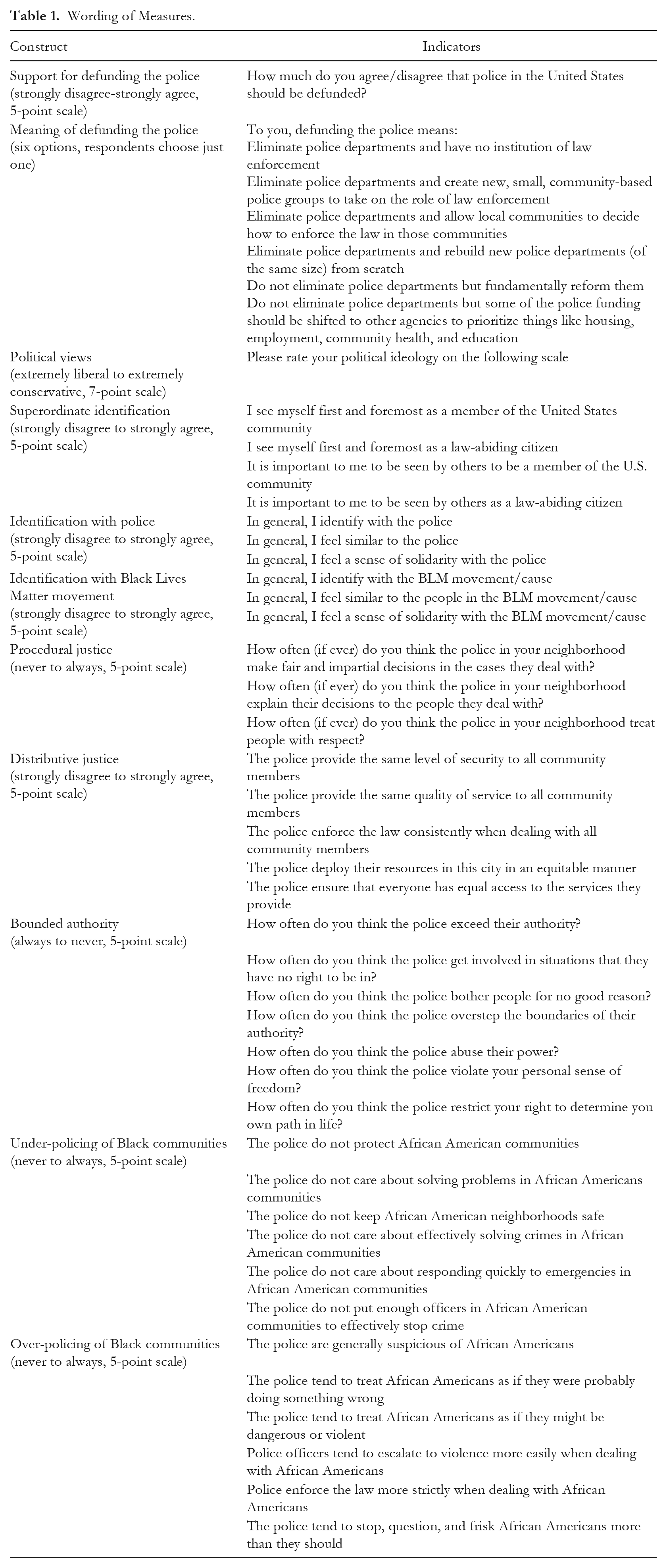
Table 1 details the measures used in this study.
Wording of Measures.
Attitudes toward defunding the police
To capture levels of support for, or opposition to, the notion of defunding the police, we asked study participants the extent to which they agreed or disagreed (on a 5-point scale) with the idea that the police should be defunded. We also measured participant’s definition of defunding the police by asking “What does defunding the police mean to you?” (see Table 1 for response alternatives). Respondents were asked to choose just one definition.
Political views
We measured political views by asking “Please rate your political views on the following scale” with a 7-point scale ranging from “extremely liberal” to “extremely conservative.” We collapsed the variable into three categories: liberal (“extremely liberal” and “liberal”); centrist (“sort of liberal,” “centrist,” and “sort of conservative”); and conservative (“extremely conservative” and “conservative”).
Social identity
Measures of social identity focused on solidarity and value alignment with three plausibly related groups. The indicators of identification with the superordinate group that the police represent (adapted from Bradford et al., 2014, 2017) addressed the importance of seeing oneself, and being seen by others, as a law-abiding U.S. citizen. Indicators of identification with the police focused on the extent that one feels a sense of solidarity and value alignment with officers (adapted from Kyprianides et al., 2021). Similar measures of identification with BLM, which were also based on solidarity and value alignment, were taken from Bradford and Jackson (2022).
Perceptions of police activity
We fielded measures of perceptions of procedural justice, distributive justice, and bounded authority (e.g., Posch et al., 2021; Trinkner et al., 2018). Measures of procedural justice were adapted from Round 5 of the European Social Survey (Jackson & Bradford, 2019). Drawn from Tyler and Jackson (2014), the measures of distributive justice focused on the degree to which people thought police forces generally allocate finite resources (that determine who receives the benefits and burdens of policing) fairly across aggregate social groups (see also Fine et al., 2022). Measures of bounded authority were adapted from Huq et al. (2017) and Trinkner et al. (2018); they captured the extent to which people believe that the police respect the boundaries of their rightful authority and therefore people’s sense of autonomy.
We also fielded measures of under- and over-policing of Black communities, aimed at operationalizing perceptions of systemic racism in policing. Measures of under-policing were adapted from prior measures of effectiveness to focus on police activity, but here the sentiments concerned how the police deal with Black communities. Measures of over-policing of Black communities built on prior work by Tyler et al. (2015) and covered the belief that the police tend to treat Black community members as objects of suspicion and people to regulate, as well as investigating perceptions of aggressive policing.
Controls
Finally, we also measured gender, race, education, age, income, and prior experience of arrest.
Plan of Analysis
We used Stata 16.1 to analyze the data. We first used principal component analysis to assess the scale properties of the three social identification constructs and the five perceived police activity constructs (the other constructs were measured using single indicators). Having found reasonably good scale properties, 4 we then calculated principal component scores from each separate model to create the various indices.
Second, we fitted a series of binary logit models with the dependent variable being a dichotomous transformation of people’s answers to the question “What does defunding the police mean to you?” (0 = one of the two types of reform, and 1 = one of the four types of elimination). Third, we fitted a series of ordinal logit models, with the dependent variable being the level of support or opposition to defunding the police (5-point scale). In addition to the controls, independent variables were added in the following sequential steps for each of the two sets of models:
Political beliefs (included initially for both the binary and ordinal logit models, then dropped and brought back in the binary logit models, and included in the proceeding sequential steps for the ordinal logit models);
Social identification: superordinate, police, and BLM movement (added one at a time, then all together); and
Perceptions of police activities: procedural justice, distributive justice, bounded authority, under-policing of Black communities, and over-policing of Black communities.
For the ordinal logit models we tested the parallel odds assumptions using the Brant test 5 and we compared relevant substantive results with those from multinomial models. We found that the results from the ordinal regression were reasonably robust. 6
Results
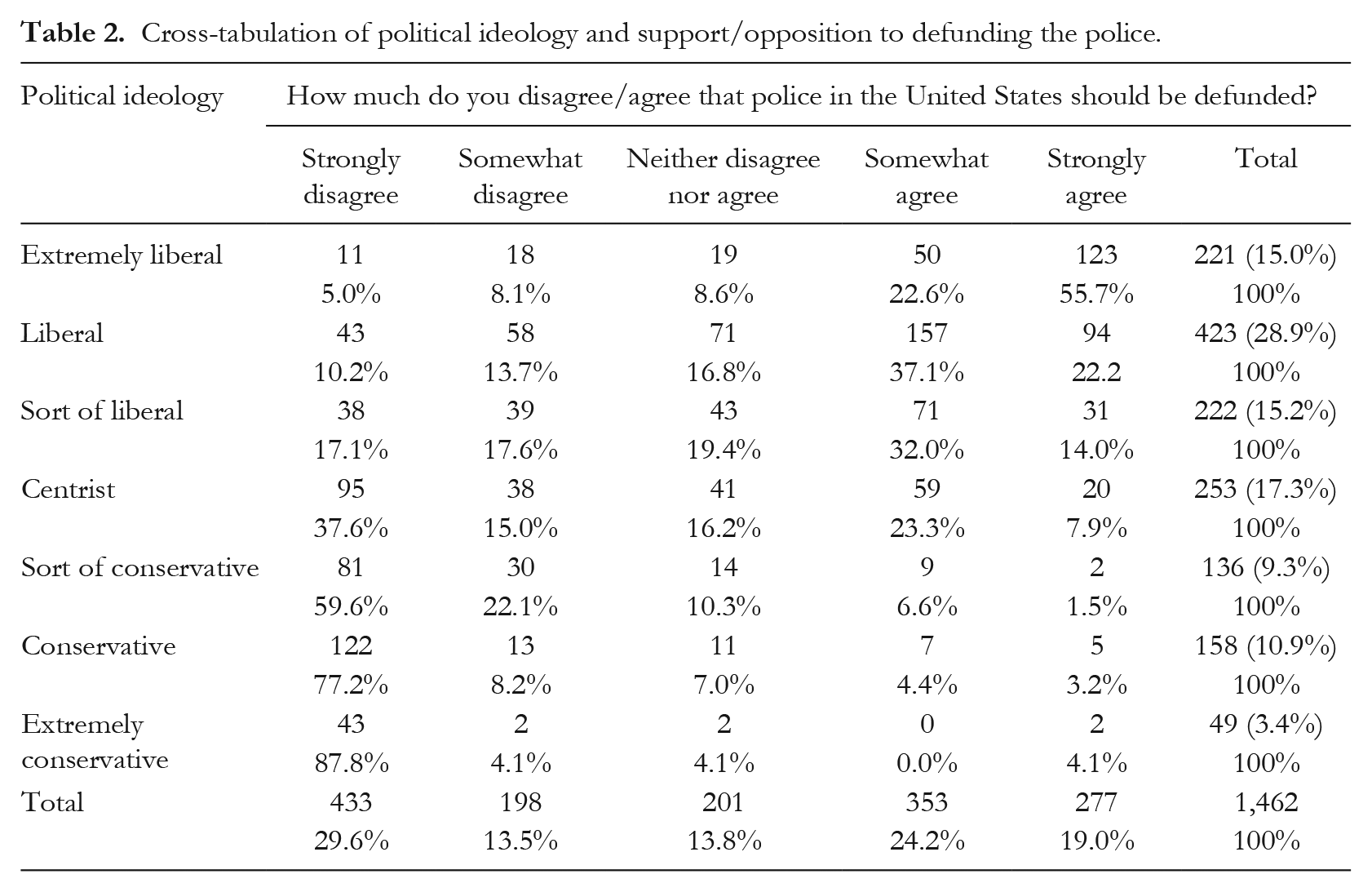
Starting with some basic descriptive statistics, we found that just under 45% of research participants agreed that the police should be defunded and just under 45% disagreed with the proposition (Table 2). Reflecting the bias of online samples drawn by platforms such as Prolific and Mturk (Clifford et al., 2015; Levay et al., 2016), a majority of respondents said they were liberal (just less than 60% saying they were “extremely liberal” or “liberal”), just under 25% said they were “extremely conservative” or “conservative,” and the remaining 17% said they were “sort of liberal,” “centrist,” or “sort of conservative.” Liberals were more likely to agree that the police should be defunded than conservatives (66% compared with 7%). We saw an even bigger contrast when looking at the ideological extremes, with 78% of people who said they were extremely liberal also saying that they agreed or strongly agreed that the police should be defunded, and 92% of people who said they were extremely conservative also saying that they disagreed or strongly disagreed that the police should be defunded. This provided support for H1a.
Cross-tabulation of political ideology and support/opposition to defunding the police.
When asked “What does defunding the police mean to you?” (Table 3), 12% of the total sample chose the “eliminate police departments and have no institution of law enforcement” definition, 13% said “eliminate police departments and create new, small, community-based police groups to take on the role of law enforcement,” 10% said “eliminate police departments and allow local communities to decide how to enforce the law in those communities,” 5% said “eliminate police departments and rebuild new police departments (of the same size) from scratch,” 21% said “do not eliminate police departments but fundamentally reform them,” and 39% said “do not eliminate police departments but some of the police funding should be shifted to other agencies to prioritize things like housing, employment, community health, and education.” Overall, liberals (68%) were more likely than conservatives (36%) to say that defunding meant reform to them (collapsing the two reform categories into one), and conservatives (64%) were more likely than liberals (32%) to say that defunding meant elimination to them (collapsing the four elimination options into one).
Cross-tabulation of political ideology and definition of defunding the police.
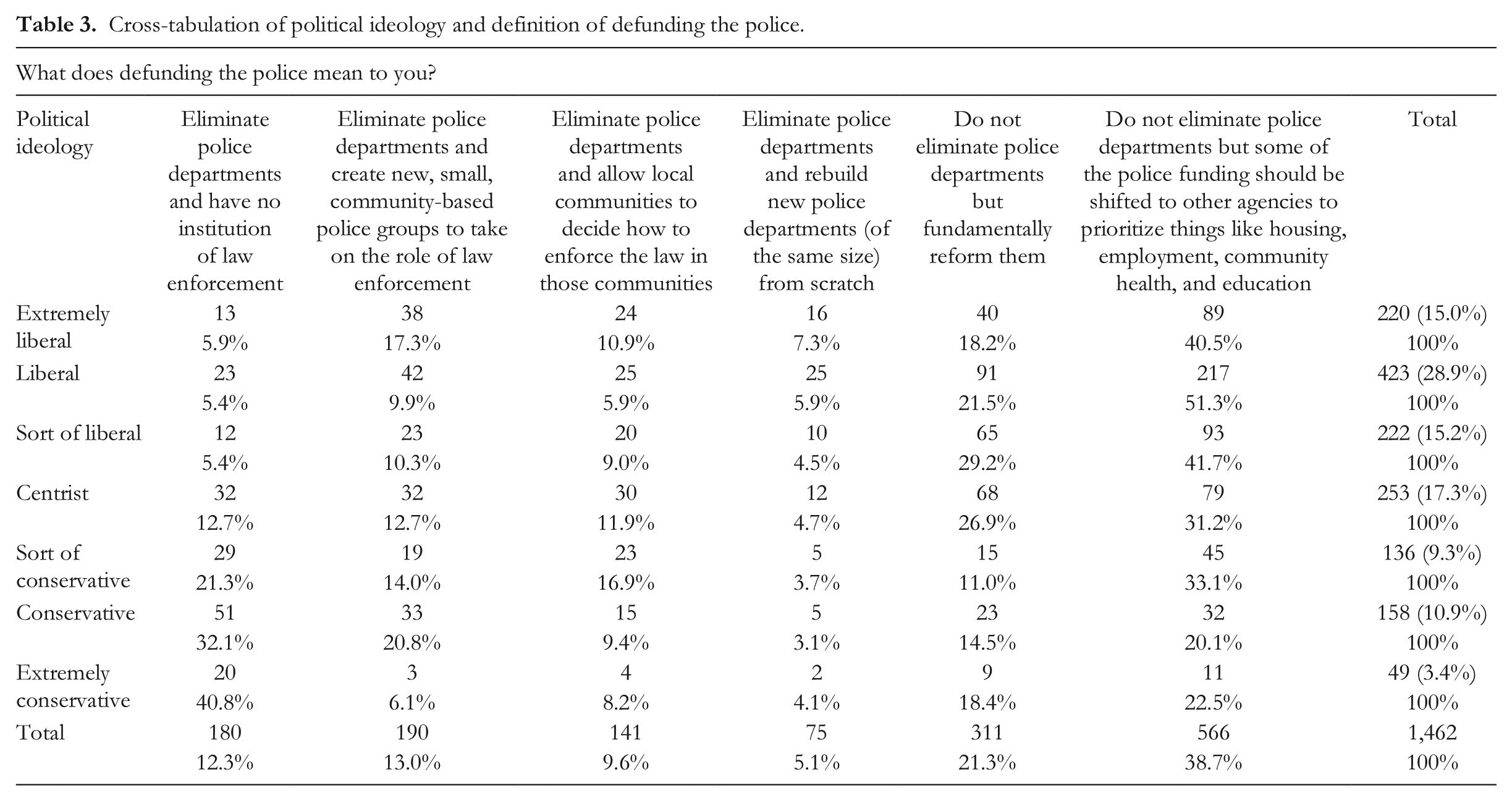
A chi-square test of independence indicated that the association between political views and definitions of defunding the police (Table 3) was statistically significant χ2 (30) = 223, p < .001. As with support for defunding, the contrast was even stronger when one compared people who said they were extremely liberal with people who said they were extremely conservative. For example, of those who said they were extremely liberal, 41% said that defunding the police means “do not eliminate police departments but some of the police funding should be shifted to other agencies to prioritize things like housing, employment, community health, and education.” This compares to the 41% of people who said they were extremely conservative who also said that defunding the police means “eliminate police departments and have no institution of law enforcement.” These findings supported H1b.
Next, and by way of preparation for the regression modeling, we examined the bivariate associations between political views and the three forms of identification. The correlations (all of which were statistically significant) among the three forms of identification were positive for superordinate and police (r = .45) and negative for superordinate and BLM (r = –.24) and for police and BLM (r = –.46): people who identified strongly with the superordinate group were more likely to identify with the police than those who did not identify with the superordinate group, and less likely to identify with BLM; and people who identified strongly with BLM were less likely to identify with the police than those who did not identify with BLM. Political views was positively correlated with superordinate identification (r = .39) and identification with police (r = .50), and negatively correlated with identification with BLM (r = –.61). This supported H2a and H2b.
The next step in the analysis focused on the potential predictors of people’s definitions of defunding (Table 4). We fitted a series of binary logit models, with the dependent variable being defining defunding as elimination (1) versus reform (0). Table 4 shows that adjusting for various controls (i.e., gender, race, education, age, income, and prior experience of arrest), liberals were less likely than centrists and even less likely than conservatives to define defunding as elimination. Models 2, 3, and 4 dropped political views and added each of the three social identification factors one at a time. We found that people who identified with the superordinate group and who identified with the police were more likely to define defunding as elimination, adjusting for the other factors in the model, and people who identified with BLM were less likely to define defunding as elimination (i.e., more likely to define it as reform). Model 5 included political views and all three social identification factors. The liberal versus centrist contrast shrunk toward a value of 1 once the social identity factors were added, and the conservative versus centrist adjusted odds ratio moved from just less than 2.7 to around 2 (i.e., movement from an increase of 170% in the expected odds to an increase of 100%). Identification with BLM was the only social identity factor that was statistically significant once all three were included in the same fitted model.
Logistic regression modeling of assigned definition of defunding the police (0 = reform, 1 = elimination).
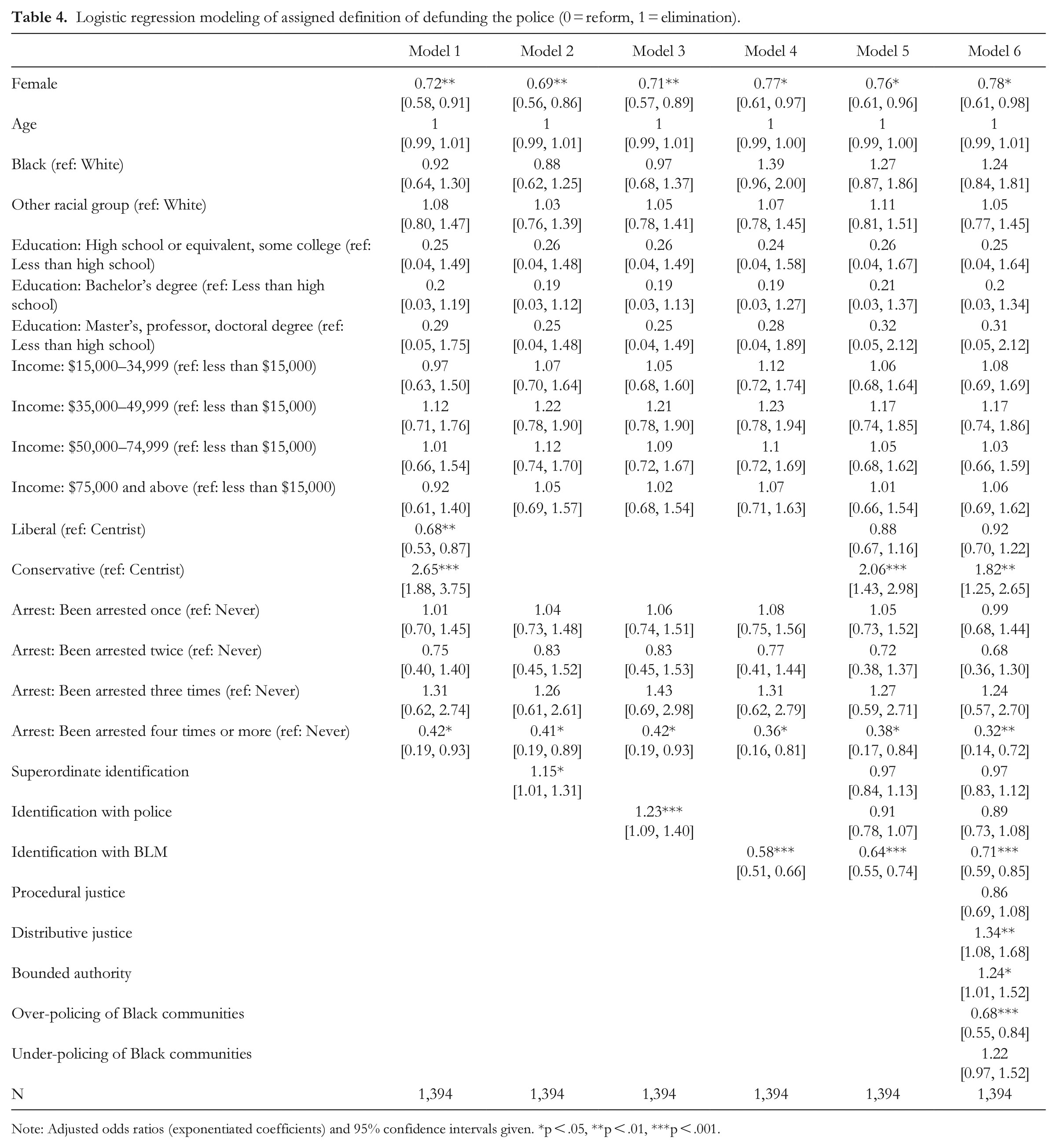
Note: Adjusted odds ratios (exponentiated coefficients) and 95% confidence intervals given. *p < .05, **p < .01, ***p < .001.
Model 6 added perceptions of police activity. We found that distributive justice, bounded authority, and over-policing of Black communities were significant predictors: people who believed the police generally distributed their finite resources fairly and respected the limits of their rightful authority were more likely to define defunding as elimination, and people who believed that the police did not over-police Black communities were also more likely to define defunding as elimination.
The final step focused on predicting support or opposition to defunding the police (Table 5). Model 1 included political views and controls, and Models 2, 3, and 4 added the three social identification factors one at a time. We found a negative conditional correlation (Model 2) between superordinate identification and support for defunding the police, a negative conditional correlation (Model 3) between police identification and support for defunding the police, and a positive conditional correlation (Model 4) between BLM identification and support for defunding the police. When all three were included in Model 5, all the identification group factors were statistically significant. Model 6 added procedural justice, distributive justice, bounded authority, and perceptions of the under- and over-policing of Black communities. We found that procedural justice was a negative predictor of support for defunding the police, and the under- and over-policing of Black communities were both positive predictors of support for defunding the police.
Ordinal regression modeling of assigned definition of support for defunding the police (0 = reform, 1 = elimination).
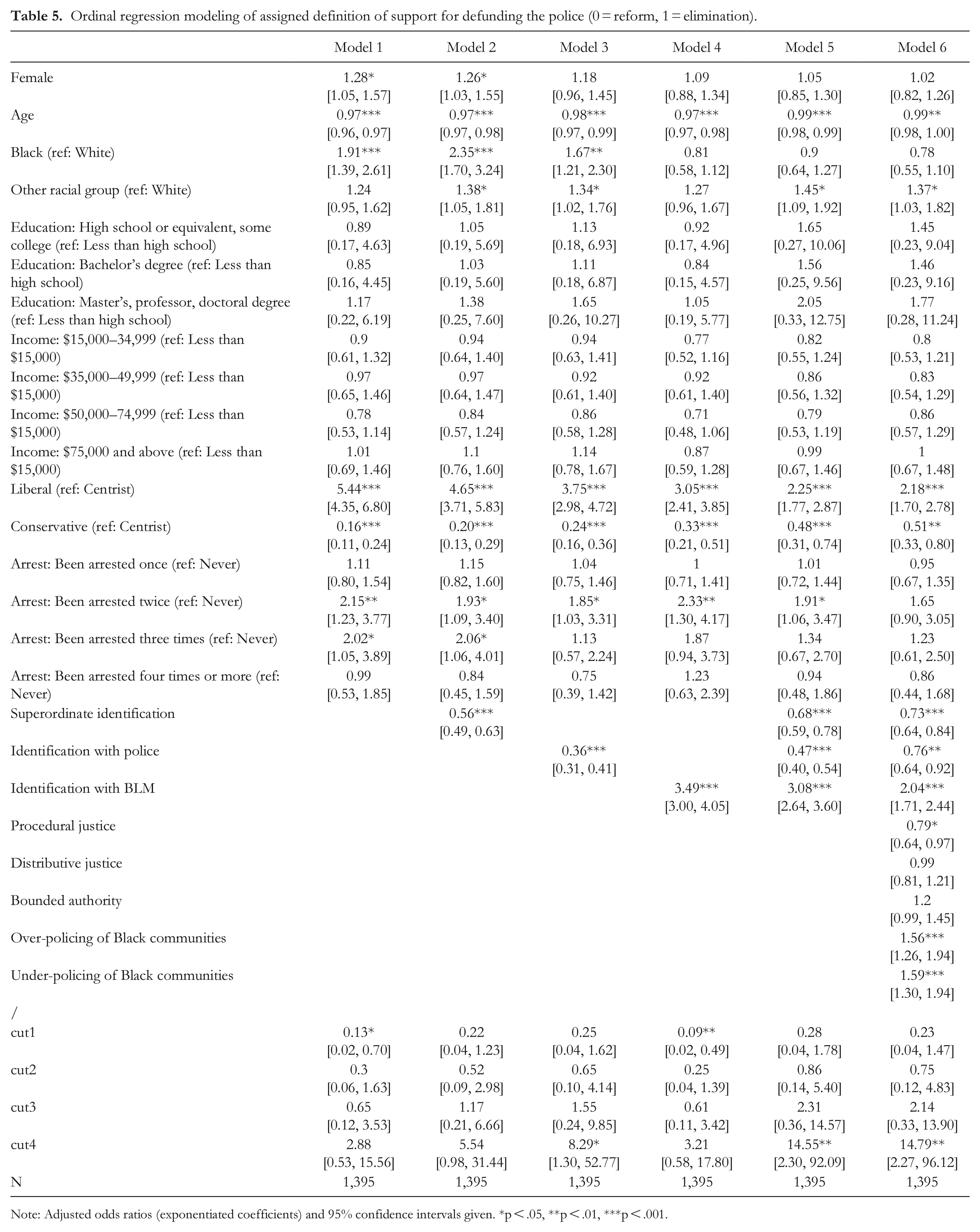
Note: Adjusted odds ratios (exponentiated coefficients) and 95% confidence intervals given. *p < .05, **p < .01, ***p < .001.
Looking across the various fitted models (Tables 4 and 5), we found that the strong liberal–conservative contrast (where liberals were much more likely to support defunding the police than conservatives) got weaker as social identity was taken into account, especially when BLM identification was included. Notably, the statistical effect of political views did not change much when perceptions of police activity were included. Overall, our findings largely supported H3a, H3b, H4a, H4b, H4c, and H4d. For definitions of defunding the police, we found support for H5b, H5c, and H5e and only weak support for H5f. For support of/opposition to defunding the police, we found support for H5a, H5d, and H5e, but only weak support for H5f.
Discussion
In the United States, the police killings of Breonna Taylor, George Floyd, and other unarmed people from the BIPOC community in 2020 spurred one of the largest social movements in the nation’s history. Of particular focus was the defund the police movement, which in addition to discussion over the existence and extent of systemic racism in the police, became a semantic debate over what “defund” meant (i.e., to eliminate versus reform police departments). 7 Yet, despite the social, political, and historical significance, little research has been devoted to applying a social identity and group-processes perspective to understand divergent attitudes toward police reform in the United States.
Drawing on a large sample of U.S. residents just weeks after the police killing of George Floyd, our study’s descriptive statistics should be useful for social scientists interested in understanding police–community relations. While the sample as a whole was equally split on the issue of defunding the police (45% agreed and 45% disagreed), clear political differences emerged. Strikingly, 66% of liberals agreed that the police should be defunded compared with just 7% of conservatives, and there were stark differences in how the political groups actually interpreted the meaning of defunding the police. Liberals were far more likely than conservatives to say that defunding meant reform, whereas conservatives typically believed that defunding meant elimination—almost half of those who identified as extremely conservative reported that, to them, defunding the police meant to “eliminate police departments and have no institution of law enforcement.” To our knowledge, this is the first study to provide such descriptive statistics, though it must be noted that this was undertaken within a single non-probability sample (albeit a national quota-panel sample).
This study also contributes to the literature by applying social identity theory (Tajfel, 1974) and the group engagement model (Blader & Tyler, 2009; Tyler & Blader, 2000, 2003) to understand people’s attitudes toward defunding the police. According to social identity theory (Tajfel, 1974), people’s identification with superordinate groups motivate them to behave in ways that are either consistent with the norms of the group or in support of the group (Giles et al., 2021; Radburn et al., 2018). Blader and Tyler’s (2009) group engagement model positions fair policing as a means to promote solidarity and cohesion among community members and encourage identification with the law-abiding sectors of society, which the police ostensibly represent. Stronger ties and identification with both the police and society motivates the legitimation of the law via the acquisition of conventional legal norms (Bradford et al., 2014, 2017; Kyprianides et al., 2021, 2022; Tyler & Huo, 2002). That is, people who identify with the group that the police represent (i.e., society) are likely to believe that the police are fair and appropriate because they represent society (the superordinate group). As expected, we found that political views were associated positively with superordinate identification and identification with the police, and, as some have argued (Bradford et al., 2014; Murphy et al., 2022), identifying as a law-abiding national citizen appeared to motivate people to defend the welfare and viability of the police as an important group authority.
Extending its contribution to the literature (see also Kyprianides et al., 2021; Radburn & Stott, 2019), our study builds on the premise that individuals hold multiple identities simultaneously, each of which comprises various social views (Roccas & Brewer, 2002). We tested whether the association between superordinate identification and attitudes toward defunding the police reduced once we accounted for other aspects of one’s social identity and social views. We proposed that the police and BLM plausibly represent two fundamentally oppositional groups (i.e., both subordinate to the superordinate category of the law-abiding citizen) with which people may identify. In particular, people who strongly identify as a member of the law-abiding U.S. community group should also identify with the police as they exemplify law-abidingness and crime control. By extension, they should not identify with a social movement like BLM that they plausibly see as representing a fundamental threat to the police and the social categories the police represent. Indeed, we found that subordinate identification partly explained how superordinate identification shapes attitudes toward defunding the police.
In terms of how people defined defunding the police, we found that identification with the BLM movement was the only social identity factor that was statistically significant once all social identity factors were included. When we added perceptions of police activity to the model, we found that defining defunding as elimination was associated with believing that the police generally distribute their finite resources fairly and equally, respect the limits of their authority, and believe that the police do not over-police Black communities. How one treats outgroup members communicates their status and standing with respect to in-group membership and identification (Taşdemir, 2011), and to the extent that people perceived the police to engage in distributive injustice, to not respect the boundaries of their rightful authority, and to over-police Black communities, they were more likely to identify with BLM and to think of defunding as reforming that institution (Fine & Tom, 2022; Giles et al., 2021; Tajfel & Turner, 1986).
When it came to support for, or opposition to, defunding the police, we found that all three social identity factors explained unique variance in public attitudes. Some of the statistical effects of political views and a smaller amount of the statistical effects of superordinate identification were explained by subordinate identification (i.e., police and BLM identification). A fair amount of the statistical effect of BLM identification was also explained by perceptions of police activity, particularly procedural justice and the under- and over-policing of Black communities. Defunding the police in part aims to respond to what advocates see as the violent excesses of the police and the police’s inability to protect and serve communities, especially Black communities, so it makes sense that perceptions of procedural justice and systemic racism (i.e., under- and over-policing) were important.
Some limitations to the study should of course be acknowledged. First, the data were correlational, so no causal claims can be made. Second, the sample was not nationally representative—there is often a trade-off between speed and representativeness, and we wanted to quickly capture salient moments of the spring and summer 2020. Third, our defunding attitudes measures were single items rather than scales. Fourth, a qualitative component to the study would have allowed us to drill into the issues in more detail, potentially drawing out issues of racial resentment and intergroup perceptions.
What, then, are some future lines of empirical inquiry? Prior work has shown correlations between racial resentment and threat, racialized policing beliefs, and support for BLM (Baranauskas, 2022; Drakulich et al., 2021; Miller et al., 2021; Morris & LeCount, 2020; Silver et al., 2022; Updegove et al., 2020). These scholars measured racialized policing beliefs by asking questions like “To what extent do you think racism is a problem in policing?” We drew on existing work into under- and over-policing (Bell, 2017; Prowse et al., 2020) to operationalize racialized policing beliefs via indicators that tapped into the under- and over-policing of Black communities. It is for future research to extend the current study to explore the risks that racial threat and resentment may play.
Future developments of a social identity approach to public attitudes toward police reform could also draw from aspects of Vaughn et al.’s (2022) study. They examined people’s attitudes toward the supporters in society of each of these ideas (e.g., do people believe that supporters of abolition view the destruction of property to be a valid form of protest?). They found, among other things, that Republicans tended to attribute to the supporters of abolition, defunding, and reform the desire to reduce the number of police on the streets and reduce spending on police services. They also found that both Republicans and Democrats tended to believe that reducing the number of police on the street would increase crime levels and make them feel personally less safe. Vaughn et al. (2022, p. 128) argue that: “it is possible that the resource reductions or reallocations explicit in politically salient proposals to reshape policing were perceived as too extreme and potentially threatening to the roles police play in crime control and order maintenance.” Extensions of our study could include public perceptions of police effectiveness and their ability to manage crime and secure safety, alongside perceptions of police fairness. They could also capture people’s construal of the “other side” of the polarized divide. This might involve capturing people’s attitudes toward protestors/supporters and the movements associated with them—potentially in terms of outgroup denigration in the context of violence, disruption, and unrest on the one side, and the maintenance of an unjust and racist status quo on the other.
Finally, we should acknowledge that the magnitude of some of the statistical effects and group differences in findings may be somewhat to do with the fact that the fieldwork took place just after the police killing of George Floyd. Feelings and intergroup tensions were running high at this time. Parker et al. (2020) reported that around two-thirds of Americans supported BLM in June 2020, which was more than the levels of support found in 2016 and 2017 polls. But there are clear indications that this effect was relatively short-lived. Chudy and Jefferson (2021) found that support for BLM was just under 50% (see also Jones, 2021). It is for future work to examine the plausibility of the idea that high-profile police killings partly fuel the mobilization of social movements, the resulting heightening of debate and feeling, and potential shifts in policing policy and practice. Taking a longitudinal approach would be especially powerful, because by following people’s attitudes over time, one could see not only how sentiment ebbs and flows in the context of before, during, and after landmark events, but also the role that group-identity processes play in varying the levels of polarization in public opinion.
