




Abstract
How do English majority members’ national culture maintenance and immigrant culture adoption (i.e., globalisation-based proximal-acculturation) predict their acculturation expectations (i.e., how they think immigrants should acculturate) and intergroup ideologies (i.e., how they think society should manage diversity)? Cross-sectional results (N = 220) supported hypothesised relationships using a variable- and person-centred approach: welcoming expectations/ideologies related positively to immigrant culture adoption (or an integration/assimilation strategy) and negatively to national culture maintenance (or a separation strategy), whilst the reverse was true for unwelcoming expectations/ideologies. Notably, colourblindness showed only weak correlations with/differences across acculturation orientations/strategies. In longitudinal analyses, adopting immigrants’ cultures increased the intergroup ideologies polyculturalism and multiculturalism whilst reducing support for assimilation over time, whereas national culture maintenance had the opposite effect. Meanwhile, the expectation integration-transformation was especially related to higher odds of following an integration rather than separation strategy over time. Overall, results advance the psychological study of multiculturalism, providing first longitudinal insights on majority members’ acculturation.
Keywords
As a native person, why should I adapt my principles to the ones of an immigrant . . . I think maybe it should be the opposite, that they should adapt their views and behaviour, because they are the ones to come here, to the strange culture, in the end.
A common misconception among cultural majority-group members exists that only cultural minority-group members (e.g., immigrants) experience cultural change, as illustrated in the quoted statement of a Finnish majority member. However, this misconception is also present in the acculturation literature (Dandy, 2009; Dinh & Bond, 2008). Here, research on immigration-based acculturation assumes that individuals who physically move to another cultural context and thus experience proximal contact with another mainstream culture(s) can experience psychological changes regarding their identity, values, and behaviours (Graves, 1967; Safdar et al., 2013). Moreover, immigrants’ preferred acculturation orientations (i.e., cultural maintenance and/or adoption) and strategies (e.g., integration through maintaining one’s heritage culture whilst adopting the mainstream culture) have been found to relate to psychological and sociocultural adjustment outcomes (Nguyen & Benet-Martínez, 2013; Stogianni et al., 2021), although the role of acculturation for adaptation has recently been questioned (Bierwiaczonek & Kunst, 2021). Meanwhile, we do not know much about majority-group members’ acculturation preferences regarding their own culture (Kunst et al., 2021)—that is, members of the culturally dominant group within a specific geographical region due to status, demographic strength, and/or institutional support (Berry et al., 1977; Brown & Zagefka, 2011; Giles et al., 1977).
Indeed, Maddux et al.’s (2021, p. 346) systematic review stresses how multicultural experiences, that is “exposure to or interactions with elements or members of a different culture(s),” have implications for both majority and minority members. Yet within the acculturation literature, past research has been mainly limited to examining majority-group members’ expectations (i.e., their preference for what acculturation strategy minority members should follow) and personally held intergroup ideologies (i.e., their preference for how their group or policies should manage cultural diversity; Berry, 2019; Horenczyk et al., 2013). This focus of past research may be explained by the recurrent findings that ideologies and expectations are strong determinants of whether or not immigrants are given the option to successfully settle in a society (Brown & Zagefka, 2011; Guimond et al., 2013). Recent research even explored these concepts’ relationships with majority members’ psychological adjustment, reporting that more welcoming attitudes relate to better subjective well-being (Inguglia et al., 2020; Lebedeva et al., 2016; Verkuyten, 2009). Yet, mostly, the purpose of such work is to understand minority members’ acculturation, rather than considering changes to the majority culture per se (Prilleltensky, 2008).
Addressing this lack of research on majority members’ acculturation preferences regarding their own culture, Lefringhausen and colleagues (Lefringhausen et al., 2020, 2021; Lefringhausen & Marshall, 2016) as well as Kunst et al. (2021, see also Haugen & Kunst, 2017) provided the first quantitative insights into majority members’ psychological acculturation or globalisation-based proximal-acculturation: the extent to which majority members adopt elements of various minority-group cultures and/or maintain their national culture due to living in the same country. For example, an English majority member may adopt some of the values or behaviours of their international colleagues who have settled in the UK and who are thus geographically proximal as residents of the same country within a shared societal context. This initial research has demonstrated that proximal-acculturation orientations (cultural maintenance and/or adoption) and strategies (e.g., integration) relate to majority members’ psychological (e.g., self-esteem), sociocultural (e.g., intercultural sensitivity), and intercultural adjustment (e.g., perceived ethnic discrimination and cultural threat; Kunst et al., 2021).
Given the shared role of expectations, ideologies, and majority members’ proximal-acculturation in fostering or hindering harmonious intergroup relationships as well as majority members’ well-being, we therefore asked in this present research: what is the association between these three conceptualisations of majority members’ acculturation—especially over time? To answer this question, we used three-wave panel data from English majority members, addressing the need for more longitudinal studies within acculturation research (Bierwiaczonek & Kunst, 2021; Brown & Zagefka, 2011; Kunst, 2021). Moreover, to gain nuanced insights into this novel field of research, we employed two operationalisations of majority members’ proximal-acculturation: a variable- (i.e., acculturation orientations) and a person-centred approach (i.e., acculturation strategies).
The Theory of Acculturation
Acculturation occurs when people from different cultural groups come into contact. At the psychological level, acculturation can result in behavioural, identity, attitudinal, and value changes (Graves, 1967). It is a continuous process rather than a unitary event, but it does not require consistent or direct contact (Ferguson, 2013; Safdar et al., 2013). Berry (1980, 1997) proposed two independent underlying cultural orientations that describe people’s different ways of dealing with acculturation: the desire to maintain one’s heritage culture and/or to engage in the mainstream culture. These orientations result in four acculturation strategies which are “not merely attitudinal preferences but consciously chosen in order to achieve a particular goal” (Berry, 2019, p. 21; Bourhis et al., 1997; see Table A.1 in the Appendix): assimilated individuals reject their heritage culture whilst seeking interaction with/adopting the host culture; separated individuals maintain only their heritage culture; marginalised individuals have either little possibility to or interest in maintaining their heritage culture and interacting with/adopting the host culture; whilst integrated individuals maintain aspects of their heritage culture and engage in/adopt the host culture.
Notably, the original four acculturation strategies have been differently operationalised over the years (Berry, 1997, 2019; Ward & Geeraert, 2016; Ward & Rana-Deuba, 1999): (a) some measured the two cultural orientations independently on two continuous scales to investigate their interaction; (b) others split the scores for both orientations into four quadrants using the mean, median, or scale midpoint; (c) meanwhile, Berry (1997) proposed to assess each orientation with his four-statement method. However, using a mean/median split method depends on the score distribution of the sample; a midpoint split faces the problem of its interpretive ambiguity (i.e., does it indicate disagreement with the statement or is it unclassifiable?); finally, a four-statement method employs double negations, making the item formulations too complex for participants and thus tending to have stronger impact on the measurement outcomes and more factor loading variability (i.e., poorer construct validity; Arends-Tóth & van de Vijver, 2007; Rudmin, 2009). Thus, most acculturation research follows the first approach (i.e., variable-centred; Demes & Geeraert, 2013).
Rudmin (2009) among others (Grigoryev & van de Vijver, 2018; Haugen & Kunst, 2017; Schwartz & Zamboanga, 2008), however, has recommended a person-centred approach for acculturation research. This is because it provides a more objective and statistically sound method to split the sample into acculturation profile groups than the methods mentioned before. Moreover, such a bottom-up investigation is particularly insightful in the less developed field of majority members’ acculturation, enabling the exploration of whether similar acculturation strategies emerge as those commonly reported for minority members, or whether different or only a limited number of strategy groups occur for majority members.
Returning to the two underlying acculturation dimensions, Berry (1974) originally proposed a third dimension: the power of individuals to choose their preferred cultural orientation. Indeed, whilst some scholars rejected or ignored the idea of acculturation as a reciprocal process (Foster, 1960; Graves, 1967), we outline in what follows how others (Berry, 1980; Bourhis et al., 1997; Wolsko et al., 2000) postulated majority members’ acculturation as a supporting or hindering force for minority groups’ acculturation.
Majority Members’ Intergroup Ideologies and Acculturation Expectations
Often, minority groups do not have the freedom to follow their preferred acculturation strategy due to constraints imposed by the more powerful majority group (Brown & Zagefka, 2011; Giles et al., 1977). Specifically, when immigrants perceive majority members to reject their heritage culture or rights for equal status, they are less likely to make efforts to integrate (Bastug & Akca, 2019; Brown & Zagefka, 2011; Christ et al., 2013). Thus, a vast body of research conceptualised majority members’ acculturation in terms of “gatekeeper” attitudes that either support or hinder minority members’ integration and recognition as full members of a given society (see Table A.1 in the Appendix).
In particular, intergroup ideologies refer to a set of individually held beliefs about the ways in which plural societies should be managed via policies to reduce prejudice and ensure harmonious intergroup relations (Vorauer et al., 2009; Whitley & Webster, 2019; Wolsko et al., 2000). Accordingly, ideologies are more likely to be antecedents of prejudice than consequences of it (Zagefka et al., 2009). Multiculturalism describes majority members’ supportive attitudes towards the integration of minority members into the larger society (Berry & Kalin, 1995). By contrast, assimilation relates to the belief that minority members should replace their heritage culture with the majority culture because culturally homogeneous societies are seen as a desirable outcome (Berry & Kalin, 1995; Guimond et al., 2013). Yet, as this ideology devalues and discourages minorities’ cultural maintenance, it strongly relates to higher levels of prejudice and ethnocentrism, whilst multiculturalism shows the opposite pattern (Plaut et al., 2009; Whitley & Webster, 2019).
However, a multicultural ideology has recently been criticised for promoting essentialism by exaggerating cultural in-group homogeneity and out-group distinctiveness (Wilton et al., 2019). Thus, colourblindness and polyculturalism were proposed as alternatives in fostering positive intergroup relationships. Colourblindness refers to the idea that because prejudice is based on emphasising one’s cultural group membership, people should ignore them to treat everyone equally as unique individuals (Rosenthal & Levy, 2010; Wolsko et al., 2000). Thus, colourblindness is purported to reduce prejudice because it focuses on intergroup equality and personalisation of minority members; but multiculturalism still reduces prejudice more because ignoring cultural group membership in societies with structural inequalities diminishes majority members’ ability to recognise and acknowledge such mistreatment (Bonilla-Silva, 2010; Hahn et al., 2015; Whitley & Webster, 2019). Polyculturalists, on the other hand, acknowledge that cultures constantly interact and influence each other, which is why polyculturalists are less likely to endorse prejudice and are more likely to show greater comfort with diversity (Grigoryev et al., 2018; Rosenthal & Levy, 2010). However, findings are inconsistent on whether polyculturalism is more efficient in reducing prejudice than multiculturalism (Osborn et al., 2020; Pedersen et al., 2015).
Meanwhile, other scholars proposed majority members’ acculturation to be conceptualised as their personal expectations of what acculturation strategy immigrants should follow (Navas et al., 2005; Piontkowski et al., 2002). Specifically, Bourhis et al.’s (1997; see also Bourhis, 2001, 2017) interactive acculturation model proposes six expectations, including assimilationism, exclusionism, and integration-transformation. 1 Assimilationists expect immigrants to reject their heritage culture while adopting the mainstream culture, whilst exclusionists impose the marginalisation of minority groups. Integration-transformation relates to majority members’ acceptance of minorities’ cultural maintenance as well as willingness to adapt some aspects of their own culture and institutional practices to better incorporate immigrants within the host society (Bourhis, 2001). With data from Germany, Belgium, and England, Zagefka et al. (2014) further demonstrated that there are mutual longitudinal influences between majority members’ acculturation expectations and prejudice: expecting immigrants to maintain their culture was negatively related to prejudice, whilst expecting them to adopt the mainstream culture related positively to prejudice. Despite these efforts to conceptualise ideologies and expectations as majority members’ psychological acculturation processes, recent work proposes an alternative.
Globalisation-Based Proximal-Acculturation and the Present Study
Although mutual acculturation was proposed decades ago (e.g., Berry et al., 1977), only recently has majority members’ psychological acculturation been investigated. Specifically, globalisation-based acculturation refers to cultural changes experienced due to globalisation (trade and media) and immigration influx, and may imply a more voluntary incorporation of other cultural elements than immigration-based acculturation (Chen et al., 2008), especially for majority members who are embedded in their dominant national culture (see Table A.1 in the Appendix). Chen et al. (2016) demonstrated that minority and majority members experience psychological acculturation to a global international or third culture (not specified as proximal or remote) through increased direct or mediated intercultural contact. By contrast, Ferguson and Bornstein (2012, 2015) demonstrated that majority members (e.g., Jamaican youth) acculturate to specific geographically distant national cultures (e.g., USA) via indirect and intermittent exposure such as through food and media (i.e., remote-acculturation).
Yet, how do majority members acculturate towards multiple minority cultures that are present in a shared society? Using a qualitative approach, Dandy and colleagues investigated the application of Berry’s (1997) bidimensional acculturation model for Anglo-Australians and their proximal-acculturation orientations towards refugees (Rauchelle & Dandy, 2015), immigrants, and Indigenous Australians (Dandy et al., 2018), showing that some participants expressed interest and willingness to learn about these minority groups’ cultures. Extending these findings via a variable-centred approach, Lefringhausen and Marshall (2016) found support across three continent groups for a bidimensional proximal-acculturation model, consisting of majority members’ national culture maintenance and immigrant culture adoption. Notably, majority members who preferred immigrant culture adoption reported greater intercultural sensitivity. Using a person-centred approach, past work identified up to five proximal-acculturation strategies followed by majority members (Kunst et al., 2021): integration by endorsing both cultural orientations; separation by tending towards their national culture only; a diffuse group who scores around the midpoint on both cultural dimensions; marginalisation by rejecting both cultural orientations; and even assimilation, yet rarely, by endorsing only the adoption of immigrant cultures but not national culture maintenance. Majority members who follow a separation strategy are more likely to experience higher cultural threat and less cultural enrichment by immigrants, and perceive more ethnic discrimination relative to integrated, diffuse, or assimilated individuals. Moreover, assimilated and integrated majority members are more likely to recognise cultural differences whilst not being culturally embedded relative to separated majority members (i.e., constructive marginalisation, Bennett, 1993; Lefringhausen et al., 2021).
Building on the reviewed literature, we tested various predictions in the present research. National culture maintenance was expected to relate positively to unwelcoming acculturation expectations (assimilationism and exclusionism) and to assimilation as an intergroup ideology (Hypothesis 1), but negatively to welcoming acculturation expectations (integration-transformation) and intergroup ideologies (polyculturalism and multiculturalism; Hypothesis 2). These predictions were made because the former concepts all share the focus on maintaining an unchanged majority culture, and are positively related to prejudice; the latter expectations and ideologies (i.e., integration-transformation, polyculturalism, and multiculturalism) share the premise of accepting diversity and the potential change within the larger society, relating negatively to prejudice. Immigrant culture adoption should therefore relate negatively to unwelcoming acculturation expectations and an assimilationist ideology (Hypothesis 3) but positively to welcoming acculturation expectations and intergroup ideologies (Hypothesis 4).
Meanwhile, colourblindness as an ideology may be positively related to immigrant culture adoption and negatively related to national culture maintenance, yet less strongly (i.e., effect size) than the welcoming/unwelcoming expectations and ideologies mentioned before (Hypothesis 5). This is because, on the one hand, colourblindness shares with the welcoming attitudes the emphasis on intergroup equality, whilst on the other hand, this ideology stresses to individualise people rather than recognising their cultural group membership, and thus, ignores existing inequalities (Rosenthal & Levy, 2010, 2012).
Notably, we combined a variable- and person-centred approach to maximise empirical insights into this underdeveloped research area. As outlined in Kunst et al. (2021), up to five acculturation strategies have emerged in past research when using a person-centred, and thus, data-driven method. Nevertheless, the most common strategies reported across samples constitute separation and integration. Therefore, we outline here our preregistered hypotheses for these two proximal-acculturation strategies in relation to the previously stated expectations when using a variable-centred approach (see also our supplemental material, https://osf.io/ws9e6/):
Relating to Hypotheses 1 and 3: English majority members who follow a separation strategy will be significantly more likely to support assimilationism and exclusionism than those following an integration strategy.
Relating to Hypotheses 2 and 4: Majority members who follow an integration strategy will be significantly more likely to support polyculturalism, multiculturalism, and integration-transformation than those following a separation strategy.
Relating to Hypothesis 5: Because of the expected contradictory relationships between colourblindness and immigrant culture adoption/national culture maintenance, we hypothesise that majority members following an integration strategy will be significantly lower or not significantly different in their support of colourblindness relative to those who follow a separation strategy.
Expectations Over Time
We were specifically interested in how these three conceptualisations of majority members’ acculturation relate to each other over time. Current research suggests that intergroup ideologies predict acculturation orientations for minority members and acculturation expectations for majority members (Hui et al., 2015; Inguglia et al., 2020; Lebedeva et al., 2016). For example, Lebedeva and Tatarko (2013) reported that multicultural ideology was positively related to Russian majority members’ expectations of integration/minority members’ integration and negatively to Russian majority members’ expectations of assimilation/minority members’ preference for assimilation. Thus, one could expect that intergroup ideologies predict majority members’ proximal-acculturation, whereas their acculturation expectations and proximal-acculturation may mutually influence each other over time.
However, this previous work was based on cross-sectional data, limiting insights into longitudinal relationships. Moreover, past research does not consider the possibility that self-relevant social cues or issues—such as majority members’ proximal-acculturation—can receive more attention from individuals than cues relevant mostly to others, such as expectations of and ideologies towards minority groups (Conty & Grèzes, 2012). Similarly, based on social identity theory (Tajfel & Turner, 1979), Ward et al. (2018), who proposed normative multiculturalism to predict personally held intergroup ideologies (see also Guimond et al., 2013), acknowledge the influential role of group membership in their integrative framework for the psychological study of multiculturalism. Specifically, considering oneself to be part of the majority versus minority group “not only directly affects personal cultural ideologies, but also perceived multicultural norms, intergroup relations and subjective well-being” (Ward et al., 2018, p. 841). Given that proximally integrated and assimilated majority members reported less identification with their national culture (Lefringhausen et al., 2021), we can assume that their proximal-acculturation can change their perceived group membership, which, in turn, is likely to influence their personally held intergroup ideologies.
For the same reasons, we expect majority members’ personal acculturation preferences (i.e., their proximal-acculturation) will influence what they want minority members to do regarding their minority culture (i.e., acculturation expectations). For example, majority-group youth who endorsed a bicultural Spanish and Catalonian identity (i.e., a self-relevant issue) were more likely to expect Moroccan and Romanian minorities to linguistically integrate to Spain than those who identified monocultural (i.e., an other-relevant issue; Sáenz- Hernández et al., 2020). Lastly, majority members enjoy a more privileged status in the larger society, with stronger institutional and demographic power; this allows them to change policies and their associated ideologies and expectations (Bourhis et al., 1997), as exemplified by the UK’s EU membership referendum. Thus, we assumed that English majority members’ proximal-acculturation will predict their ideologies and expectations over time rather than vice versa (Hypothesis 6; Figure 1).
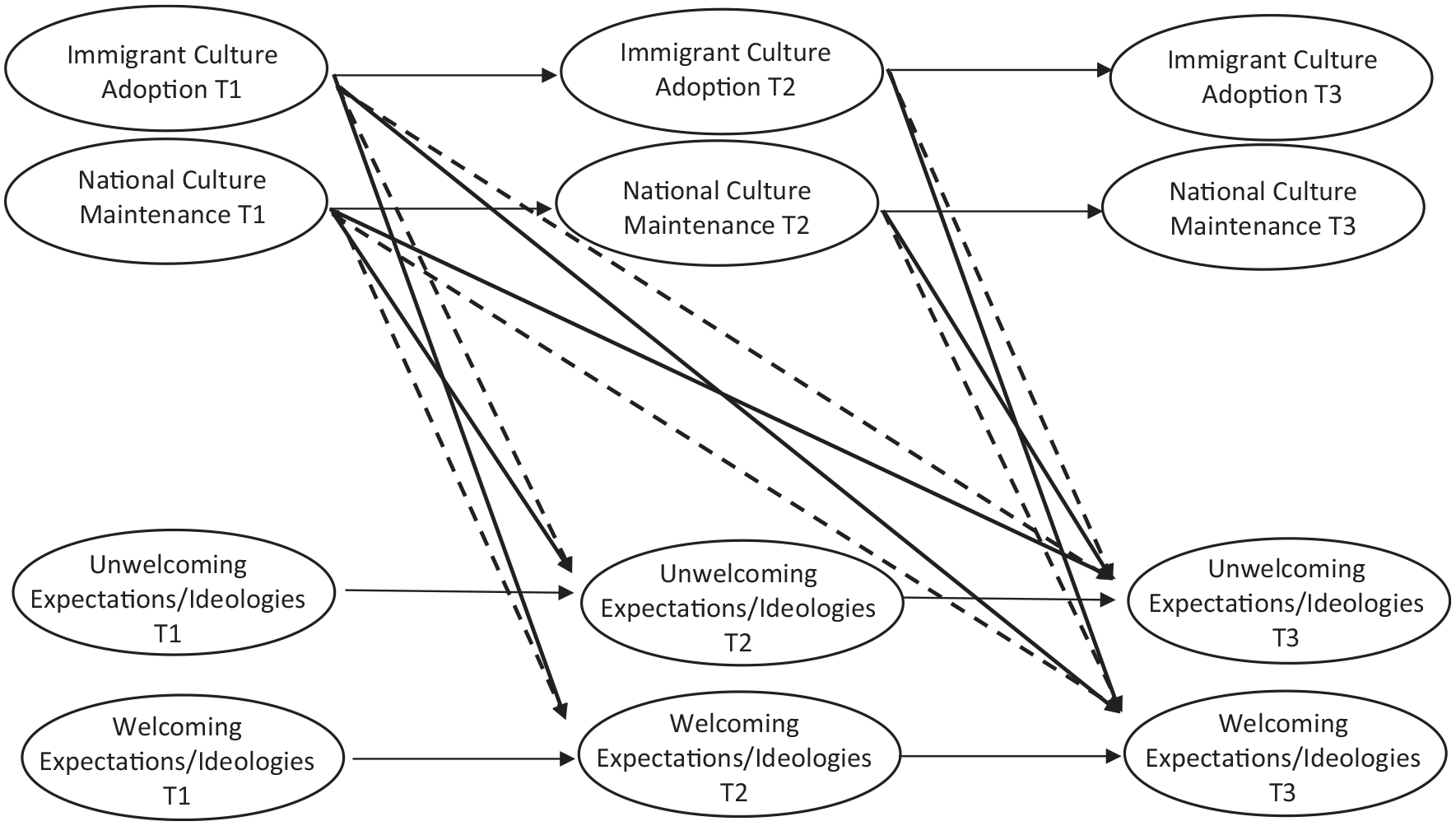
Model 1: Proximal-acculturation orientations relating to welcoming acculturation expectations (integration-transformation) and unwelcoming acculturation expectations (exclusionism and assimilationism) over time. Model 2: Proximal-acculturation orientations relating to welcoming intergroup ideologies (polyculturalism, multiculturalism) as well as colourblindness and an unwelcoming intergroup ideology (assimilation).
Method
We specifically focused on England as our research context because English voters showed high levels in anti-immigration, antiglobalisation, and antimulticulturalism attitudes (Ashcroft, 2016). Nevertheless, the U.K. government still endorses multiple policies to support the integration of immigrants (Solano & Huddleston, 2020), with long-term international migration continuing to grow (U.K. Office for National Statistics, 2020). The present study was preregistered as part of a multistudy project on English nationals’ proximal-acculturation processes (see Studies 2 and 3: https://osf.io/jqub8; https://osf.io/b2etq), and data from T1 was analysed with regard to different research questions in Lefringhausen et al. (2021).
Procedure and Design
This study had a longitudinal design with data collected at three Brexit-related time points: Time 1, March 15–29, 2019; Time 2, June 23–July 7, 2019; Time 3, October 31–November 13, 2019. 2 We used the online platform Prolific for data collection. After providing a clarification of the term migrant (“Here we talk about migrants—that is, people who were born outside of the UK [from the EU and non-EU countries] and who are legally living in the UK. Thus, we are not talking about refugees, asylum seekers, or illegal migrants”), we asked for demographic details. Scales within the questionnaire appeared in random order. Each participant received £5 upon completion of the survey at T1 and T2 and £1.50 at T3, given that the survey was shorter at this time point. Consistent with our preregistered exclusion criteria, 27 participants were dropped from T1 due to failing attention check questions and/or showing a too short response time (for details, see Lefringhausen et al., 2021), and new participants were recruited. The final 220 participants from T1 were then invited to participate again at T2, and all T2 participants were invited to take part in T3.
Participants
To be included in this study, participants had to be at least 18 years of age, identify as White English, be born in the UK, have British citizenship, and live in the UK during the time of the survey as well as consider English as their primary language. At T1, we collected data from 220 respondents, 189 at T2 (14% attrition), and 158 at T3 (28% attrition). To assess selective attrition, we used Little’s missing completely at random (MCAR) test, as indicated in our preregistration. Selective attrition describes the tendency of some participants to be more likely to drop out of a study, and therefore causes a threat to validity. For T2, we included all continuous variables as well as social desirability, positive affect towards immigrants, and all demographic variables, χ2(199) = 221.21, p = .134. The same procedure was repeated for data from T3, yet without social desirability, which was not measured at T3, χ2(72) = 89.71, p = .077. A last test included all outlined variables per time point for T1, T2, and T3, χ2(838) = 889.05, p = .108. In sum, across T2 and T3, the test revealed MCAR. Given this result, we used full information maximum likelihood (FIML; Enders & Bandalos, 2001) to impute missing observations for our variable-centred approach, as indicated in the preregistration.
Respondents’ demographic backgrounds can be found in Table 1. In summary, most participants at T1 were female, employed, had a bachelor’s degree, had never lived abroad themselves, had no parent who was born outside of the UK, lived in less culturally diverse local area districts, and voted to remain in the European Union on the 23rd of June 2016. Participants’ age ranged between 18 and 68 years.
Demographic and control variables at T1.
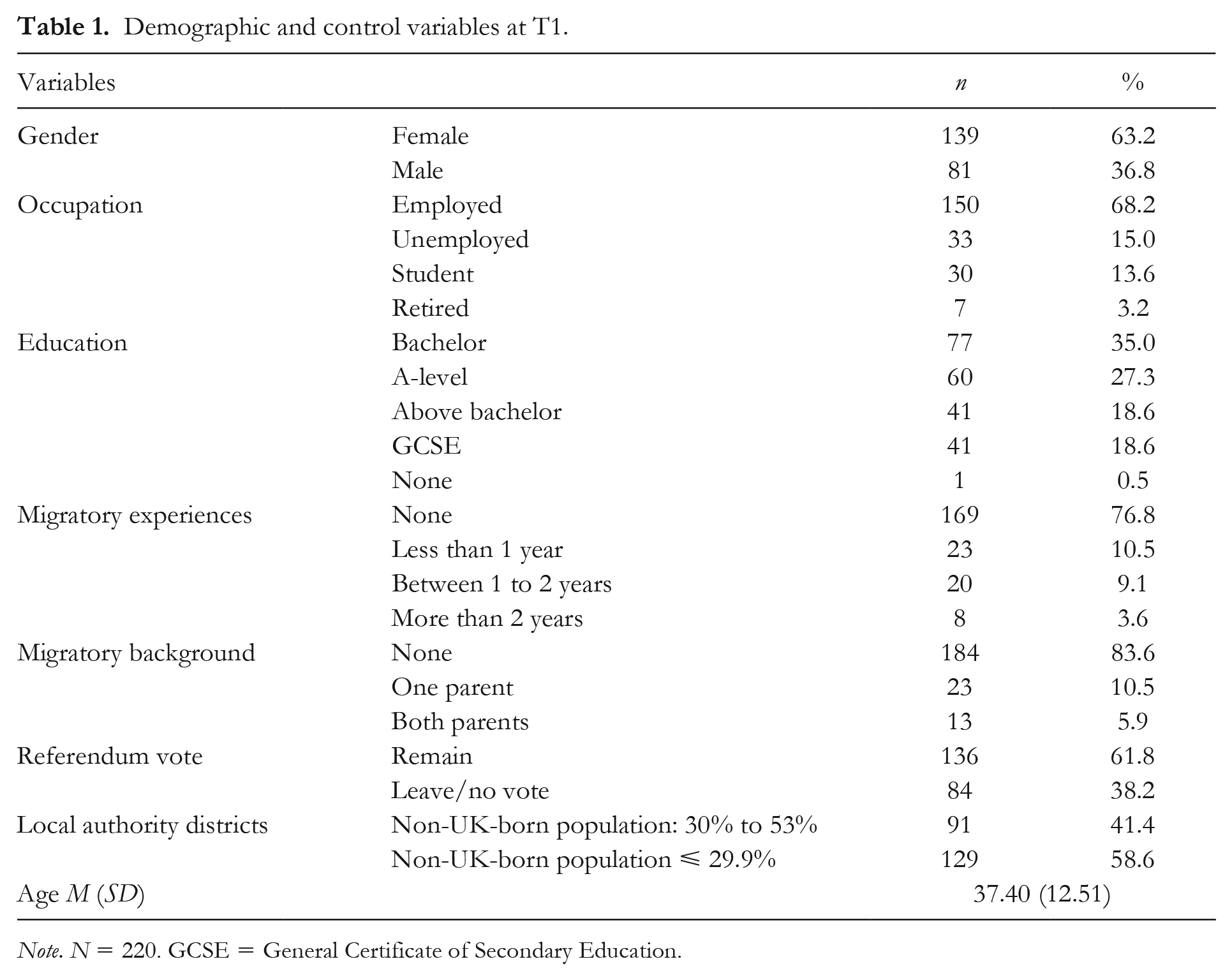
Note. N = 220. GCSE = General Certificate of Secondary Education.
Materials
Cronbach’s alphas are reported in Table 2. Attention check questions were included in all three waves (https://osf.io/jqub8; https://osf.io/b2etq). To reduce the survey’s length, we assessed demographic variables only at T1, social desirability only at T1 and T2, and we used shortened versions of most scales. Unless stated otherwise, all continuous variables were measured using a 6-point Likert scale (1 = strongly disagree, 6 = strongly agree) to force participants to choose a tendency (Table 3; Chomeya, 2010).
Descriptive statistics of proximal-acculturation orientations, acculturation expectations, and intergroup ideologies.
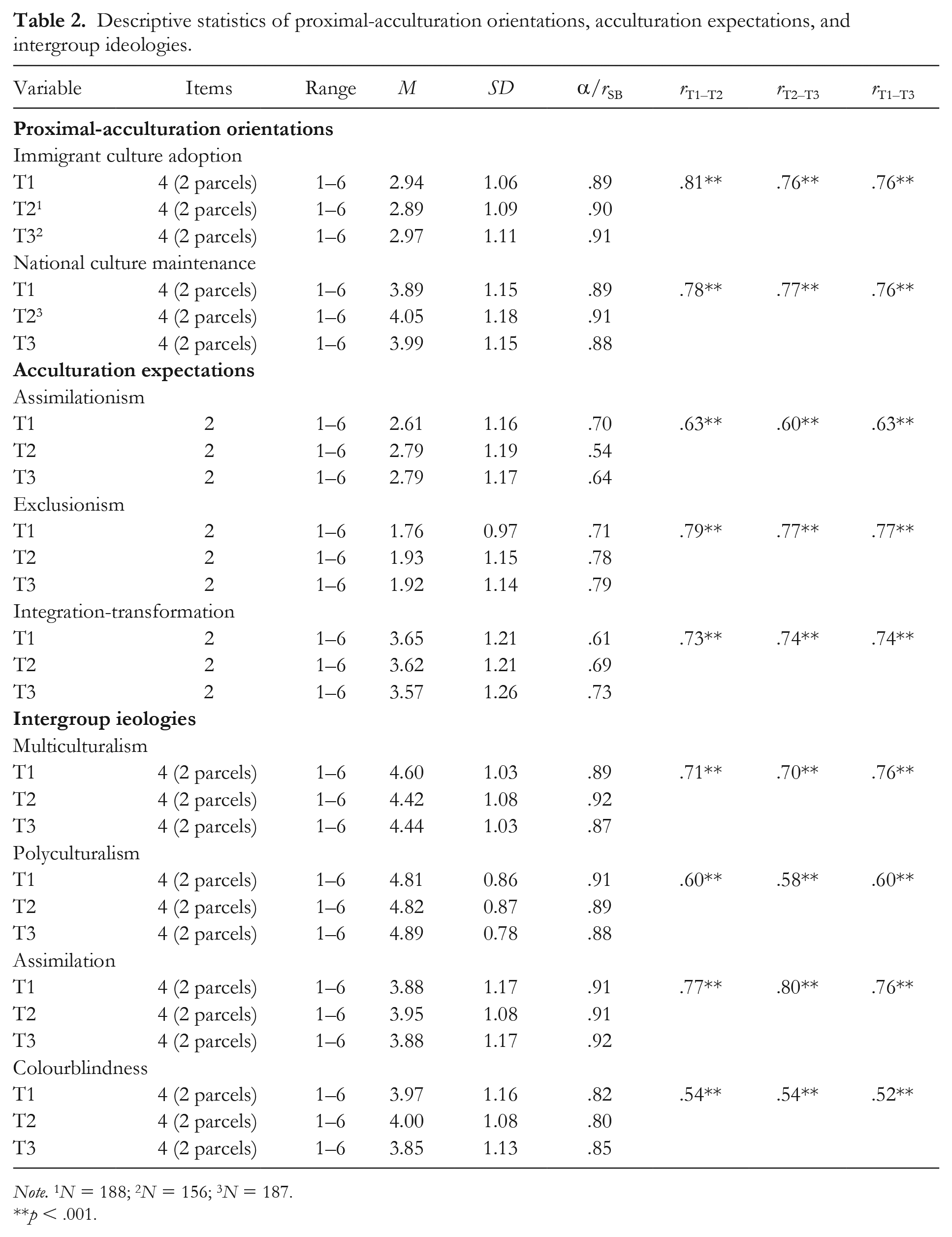
Note. 1N = 188; 2N = 156; 3N = 187.
p < .001.
Correlation matrix for all main continuous variables at Times 1–3.
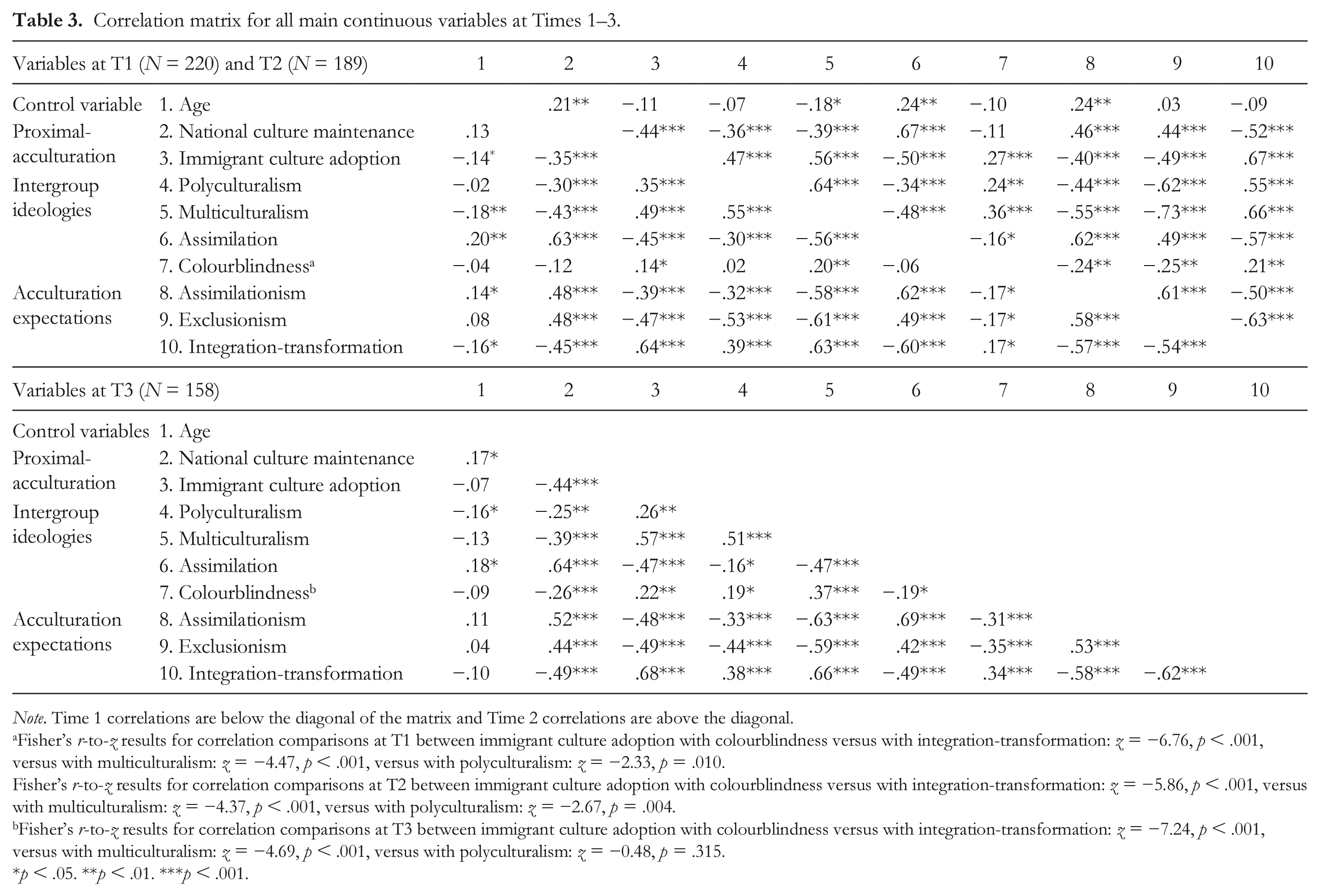
Note. Time 1 correlations are below the diagonal of the matrix and Time 2 correlations are above the diagonal.
Fisher’s r-to-z results for correlation comparisons at T1 between immigrant culture adoption with colourblindness versus with integration-transformation: z = −6.76, p < .001, versus with multiculturalism: z = −4.47, p < .001, versus with polyculturalism: z = −2.33, p = .010.
Fisher’s r-to-z results for correlation comparisons at T2 between immigrant culture adoption with colourblindness versus with integration-transformation: z = −5.86, p < .001, versus with multiculturalism: z = −4.37, p < .001, versus with polyculturalism: z = −2.67, p = .004.
Fisher’s r-to-z results for correlation comparisons at T3 between immigrant culture adoption with colourblindness versus with integration-transformation: z = −7.24, p < .001, versus with multiculturalism: z = −4.69, p < .001, versus with polyculturalism: z = −0.48, p = .315.
p < .05. **p < .01. ***p < .001.
National culture maintenance and immigrant culture adoption
We adapted the eight-item Brief Acculturation Scale to assess English majority members’ level of immigrant culture adoption (four items) and their national culture maintenance (four items; e.g., “It is important for me to take part in English traditions/traditions of migrants”; Demes & Geeraert, 2013). To enhance comprehensibility, we changed the wording for one item of the Culture Adoption Subscale from “Develop my host culture characteristics” to “Become more similar to migrants.”
Intergroup ideologies
To assess the different personally held intergroup ideology beliefs, we employed different scales. For polyculturalism (e.g., “There are many connections between different cultures”) and colourblindness (e.g., “Racial and ethnic group memberships do not matter very much to who we are”), we adapted four items of the five-item instruments by Rosenthal and Levy (2012), respectively. To measure multiculturalism (e.g., “We must appreciate the unique characteristics of different ethnic groups in order to have a cooperative society”) and assimilation (e.g., “People from all ethnic backgrounds should embrace the English culture”), we adapted four items of the six-item scales developed by Wolsko et al. (2006), respectively. For all scales, we further changed the wording to English/England where required.
Acculturation expectations
To assess assimilationism and exclusionism, we used two items across two domains (Bourhis & Montreuil, 2010): cultural heritage and employment. An example item for exclusionism reads, “When a job is available, employers should refuse to hire migrants,” and for assimilationism it reads, “When a job is available, employers should hire migrants only if the latter conform to the work habits of English citizens.” The two items for integrationism-transformation across cultural heritage and employment domains were retrieved from Andrighetto et al. (2008; e.g., “When a job is available, employers should be as likely to hire a migrant as an English candidate, even if this implies adapting to the cultural habits of the migrant”). Where required, we changed the mainstream culture to English.
Data Analysis Plan
For our variable-centred approach, we first inspected the cross-sectional correlations between our main variables (Hypotheses 1–5). To inspect the hypotheses across time (Hypothesis 6), we then conducted structural equation modelling (SEM). To enhance model parsimony and indicator quality, we tested the relationships between proximal-acculturation and proximal-acculturation orientations (Model 1; Figure 1) separately from the relationships between proximal-acculturation orientations and intergroup relationships (Model 2; Figure 1). Moreover, items of all proximal-acculturation orientations and intergroup ideologies were parcelled using a factorial approach to increase the stability of the parameter estimates (https://osf.io/ws9e6/; MacCallum et al., 1999).
We then tested (a) a baseline model with autoregressive paths, (b) our predicted model with autoregressive paths and proximal-acculturation orientations predicting acculturation expectations (Model 1)/intergroup ideologies (Model 2) at a later time point, (c) a reverse model with autoregressive paths and acculturation expectations/intergroup ideologies predicting proximal-acculturation orientations at a later time point, and (d) a fully cross-lagged model with the autoregressive effects and both proximal-acculturation orientations and acculturation expectations/intergroup ideologies predicting each other simultaneously over time. Thus, Step 2 tested our predictions over time (Hypotheses 1–6), Step 3 tested whether the opposite relationships fitted the data better than our predictions, and Step 4 tested whether bidirectional relationships fitted the data better than our predictions or the opposite relationships to our predictions over time. To assess the fit of the measurement model, we inspected the χ2 statistics (should be nonsignificant), the ratio of χ2 statistics to the degrees of freedom (χ2/df should be between 1 and 3), the root mean square error of approximation (RMSEA; should be below .08; Byrne, 2000), and the comparative fit index (CFI; should be greater than .90; Kline, 2016).
For our person-centred approach, we conducted latent profile analysis (LPA) to identify proximal-acculturation strategy profiles. To explore Hypotheses 1–5, we first tested for differences across strategy profiles on the variables of interest at each time point. On the basis of our variable-centred outcomes, we then only tested the following longitudinal models including the same control variables: how acculturation expectations endorsed by participants predict their proximal-acculturation strategies (reversed Model 1; Figure 1) and how proximal-acculturation strategies followed by participants predict their endorsed intergroup ideologies (Model 2; Figure 1).
Results
Preliminary Analysis
First, Table 2 shows the descriptive statistics and constructs’ reliability over time. Participants endorsed their national culture more than immigrants’ cultures, preferred the intergroup ideology polyculturalism more than multiculturalism, followed by colourblindness, and then assimilation. Participants also showed the highest average endorsement of the acculturation expectations integration-transformation, followed by assimilationism, and then exclusionism.
Second, and as indicated in our preregistration, we further examined for potential control variables to be included in our analyses (https://osf.io/ws9e6/).
3
Several of the main variables showed significant differences across genders. Most notably, multiculturalism at T1 revealed a medium effect size, with women (M = 4.80, SD = 0.93) scoring significantly higher than men (M = 4.25, SD = 1.11), t(218) = −3.95, p < .001, g = 0.55. Colourblindness at T2 showed a medium strong effect size across educational qualifications, indicating A-level holders (M = 4.42, SD = 0.93) to endorse this ideology significantly more than bachelor’s degree holders (M = 3.60, SD = 1.06), F(3, 184) = 6.22, p < .001, ηp
2
= .09, with no differences found for those with higher degrees than a bachelor’s degree or General Certificate of Secondary Education
Finally, additional confirmatory factor analyses (CFA) supported construct independence of acculturation expectations/intergroup ideologies and proximal-acculturation orientations at T1 (https://osf.io/ws9e6/).
Variable-Oriented Approach
We first inspected the cross-sectional relationships between our main variables (Table 2). As expected (Hypotheses 1 and 2), national culture maintenance related positively to unwelcoming acculturation expectations and assimilation as an intergroup ideology, and negatively to welcoming expectations and intergroup ideologies. Similarly, immigrant culture adoption showed the expected reverse relationships (Hypotheses 3 and 4). Additionally, the positive relationship of immigrant culture adoption with colourblindness was weaker across time points relative to the associations with integration-transformation, multiculturalism, and polyculturalism (with the exception of T3), as shown in Table 2 (Hypothesis 5).
Measurement model and invariance across time
We tested whether the measurement models for proximal-acculturation orientations correlating with acculturation expectations/intergroup ideology provided a good fit for the data at each time point. We then inspected two levels of sequential measurement invariance (configural and metric invariance). We used a CFA with FIML to handle our missing data at T2 and T3. Covariance paths were included between proximal-acculturation orientations (exogenous variables) as well as between the residuals of the endogenous variables (acculturation expectations/intergroup ideology). Measurement model fit was supported within each time point, and configural as well as metric invariance were supported across time (https://osf.io/ws9e6/)—that is, our latent factors of proximal-acculturation and acculturation expectations/intergroup ideology had the same structure and item loadings on their respective factors over time.
Baseline model
We then tested our baseline models for proximal-acculturation with acculturation expectations/intergroup ideologies by specifying only first-order autoregressive effects between the same constructs over time as well as covariances between all endogenous variables, residuals of all variables at T2 and T3, as well as between residuals of corresponding indicators from T1 to T2, and T2 to T3 (Little et al., 2007). We also included our control variables gender and education. As shown in Table 4, both baseline models for proximal-acculturation with acculturation expectations (Model 1a)/intergroup ideologies (Model 2a) fitted the data well.
Summary of model fit indices: Proximal-acculturation and acculturation expectations/intergroup ideologies.
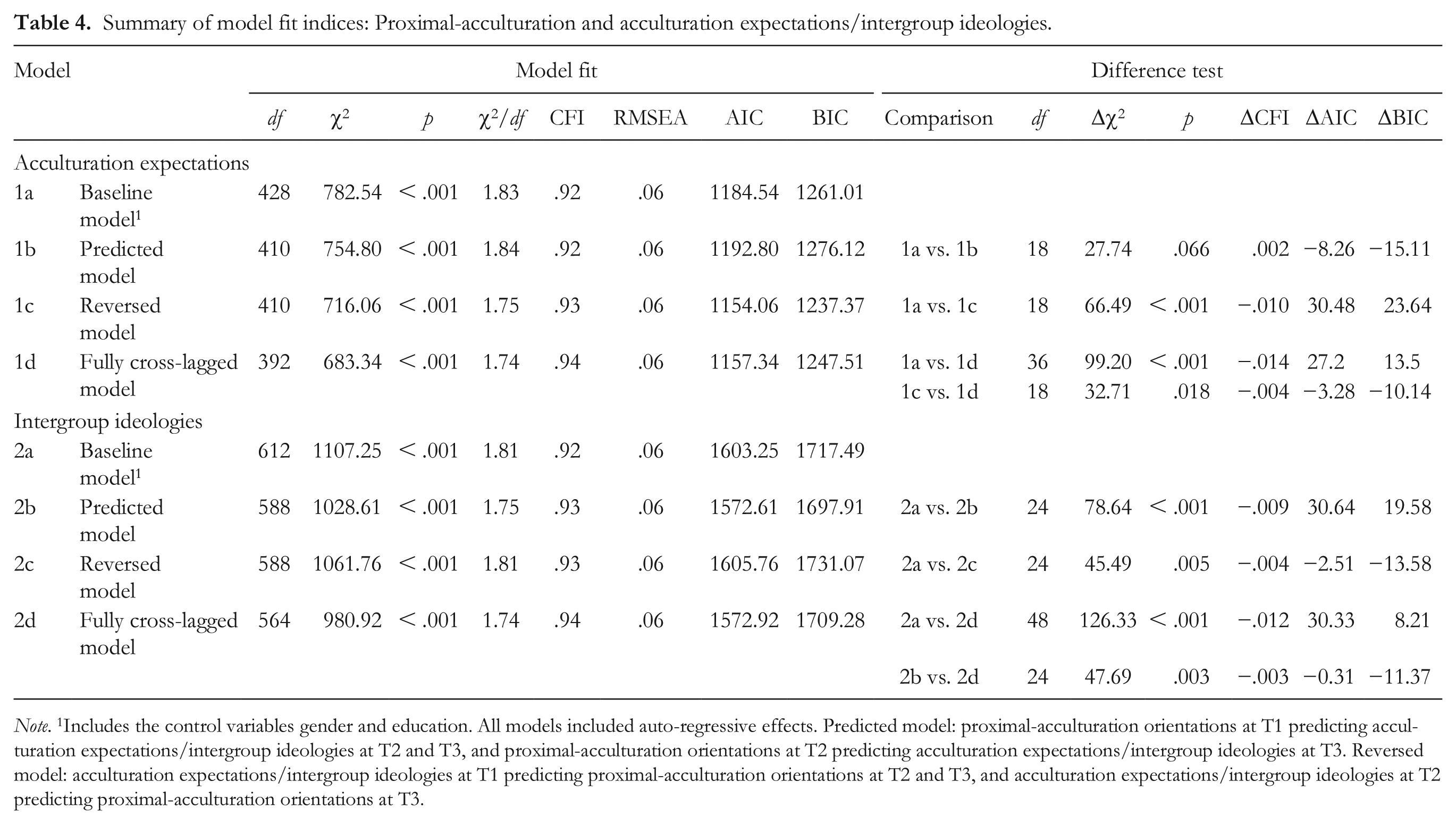
Note. 1Includes the control variables gender and education. All models included auto-regressive effects. Predicted model: proximal-acculturation orientations at T1 predicting acculturation expectations/intergroup ideologies at T2 and T3, and proximal-acculturation orientations at T2 predicting acculturation expectations/intergroup ideologies at T3. Reversed model: acculturation expectations/intergroup ideologies at T1 predicting proximal-acculturation orientations at T2 and T3, and acculturation expectations/intergroup ideologies at T2 predicting proximal-acculturation orientations at T3.
Cross-lagged models
We employed SEM using latent constructs (AMOS 27) to explore the longitudinal associations of proximal-acculturation orientations (national culture maintenance and immigrant culture adoption) with the endogenous variables of acculturation expectations (assimilationism, exclusionism, and integration-transformation; Model 1) and of intergroup ideologies (multiculturalism, polyculturalism, assimilation, and colourblindness; Model 2) over time (see Figure 1). Specifically, additionally to the autoregressive paths, we added structural paths between our exogenous variables at T1 and our endogenous variables at T2 and T3, as well as between our exogenous variables at T2 and our endogenous variables at T3 to test our predicted Models 1 and 2, reversed Models 1 and 2, and fully cross-lagged Models 1 and 2. Because standardised data yield inaccurate parameter estimates and standard errors, we reported only unstandardised parameters for our final models (Cole & Maxwell, 2003). To interpret competing model fits, we inspected Δχ2, ∆CFI (> −0.01 indicating noninvariance), ∆AIC (Akaike information criterion) and ∆BIC (Bayesian information criterion). For the latter two, larger difference scores indicate stronger evidence for one model fitting the data better than the other.
For acculturation expectations, our predicted model (Table 4, Model 1b) was invariant to our baseline model. Yet our reversed and fully cross-lagged models fitted the data significantly better than the baseline model (Models 1c and 1d). When comparing the reversed and fully cross-lagged models, the fully cross-lagged model indicated a better fit to the data according to the chi-square difference test; however, the small ∆CFI, which is less sensitive to sample size, as well as the small ∆AIC and ∆BIC values questioned the meaningfulness of this difference. Thus, we report the reversed model (Model 1c) and its unstandardised parameters in Figure 2a (measurement weights, B = 0.76–1.11). Although the cross-sectional covariances between proximal-acculturation orientations and acculturation expectations at each time point echo our Hypotheses 1–4, there were no significant structural pathways over time.
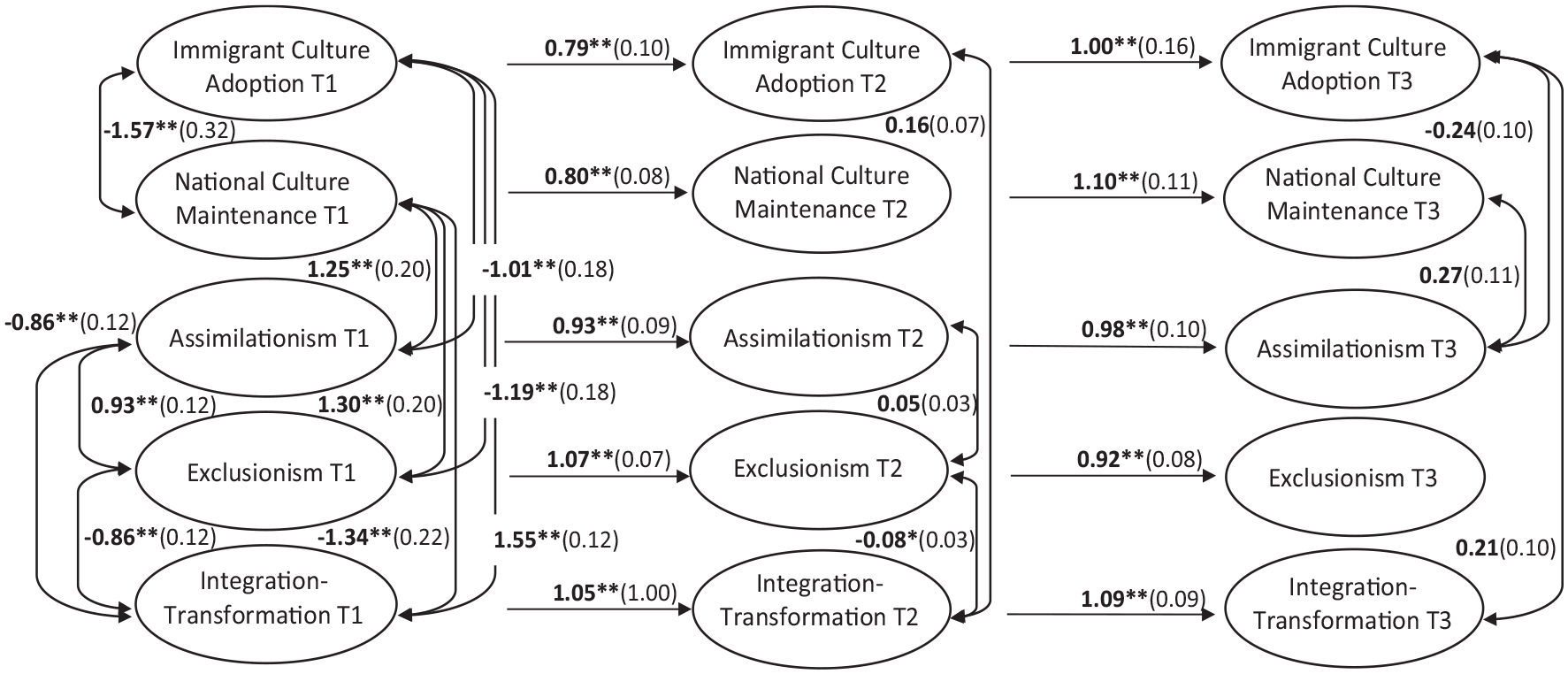
Model 1c.
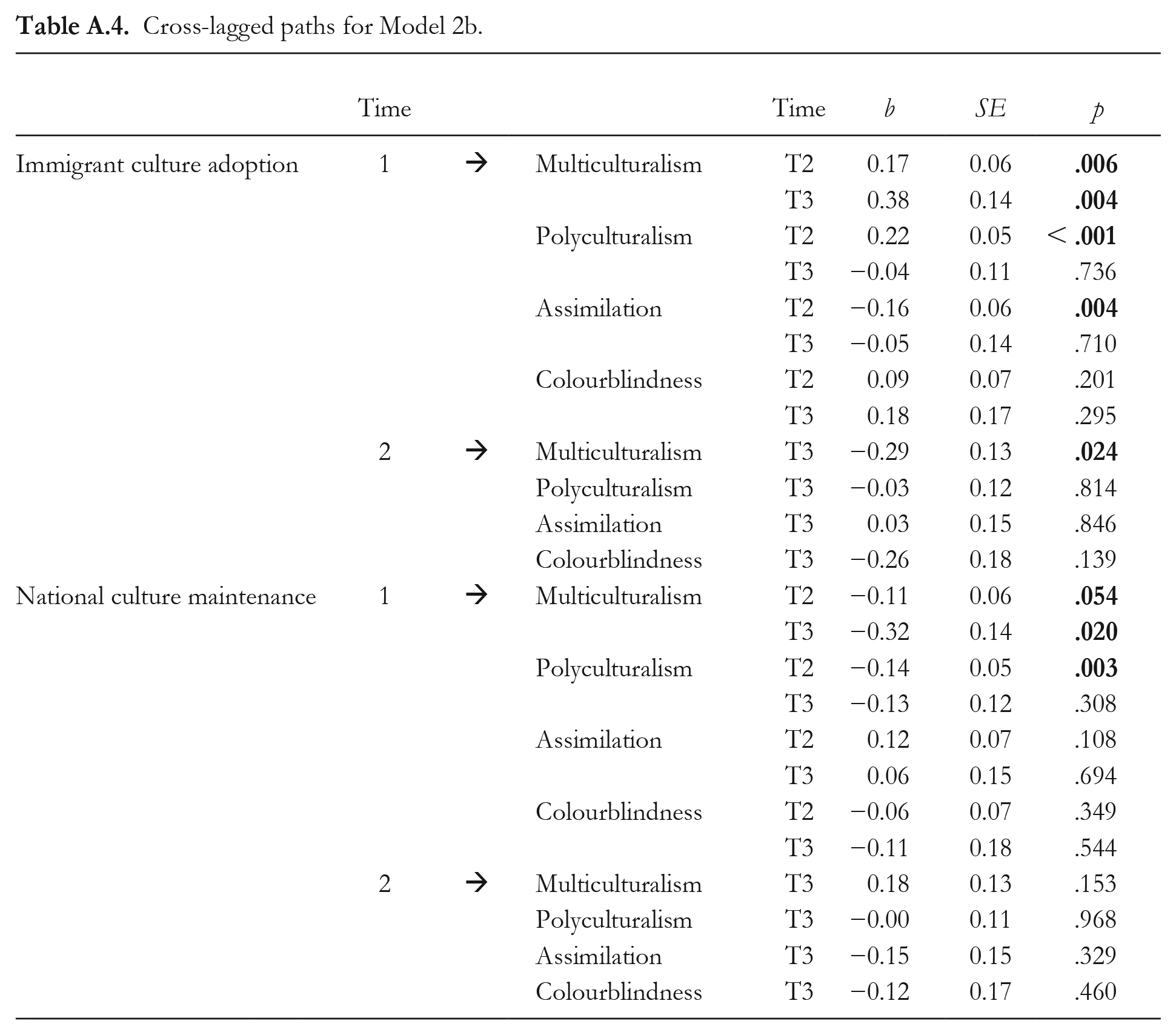
For intergroup ideologies, all three models demonstrated significant noninvariance to our baseline model when inspecting the chi-square difference test (Table 4, Models 2b, 2c, and 2d); yet, when considering ∆CFI, our predicted and the fully cross-lagged models met our −0.01 threshold more than the reversed model. When comparing our predicted and the fully cross-lagged model, no meaningful difference could be detected with regard to ∆CFI, ∆AIC, and ∆BIC. Consequently, we are reporting our predicted model (Model 2b) in Figure 2b, which supported our Hypothesis 6 (measurement weights, B = 0.93–1.28). In sum, as expected (Hypotheses 3 and 4), high scores on immigrant culture adoption at T1 predicted less support for assimilation and more support for polyculturalism and multiculturalism at T2. Immigrant culture adoption at T1 also predicted more support for multiculturalism at T3, but immigrant culture adoption at T2 was unexpectedly associated with lower support for multiculturalism at T3. Also as expected (Hypothesis 2), national culture maintenance at T1 related to less support for multiculturalism at T2 and T3, as well as less support for polyculturalism at T2. Interestingly, immigrant culture adoption as well as national culture maintenance showed no relationship to colourblindness over time.
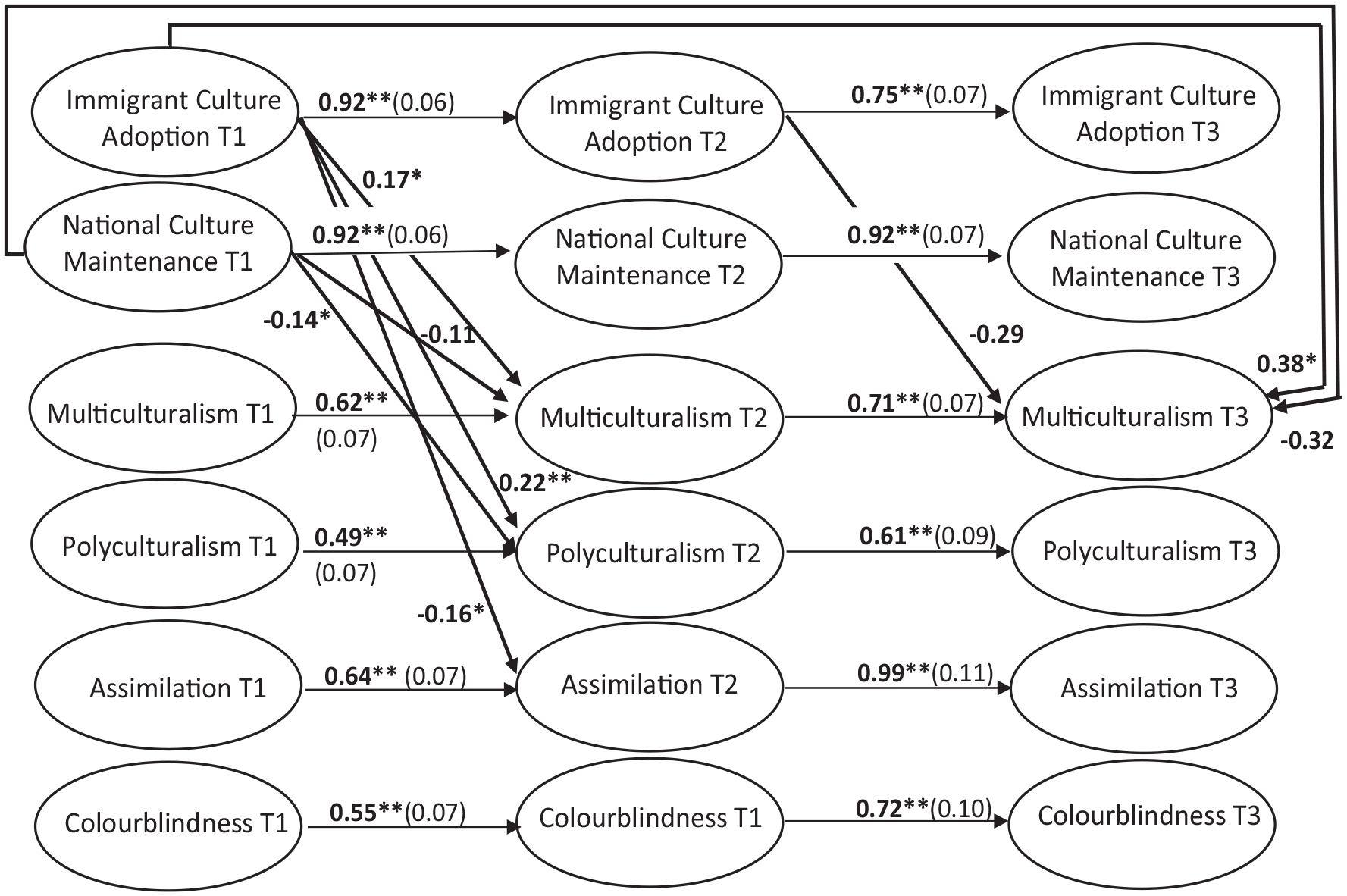
Model 2b.
Overall, a variable-centred approach partially supported our hypotheses in that all the expected relationships were found within each time point, as well as proximal-acculturation orientations were associated with intergroup ideologies over time rather than vice versa; however, no relationships over time were revealed between proximal-acculturation orientations and acculturation expectations.
Person-Centred Approach
Proximal-acculturation strategies
First, we used the R package missForest (Stekhoven, 2013) for data imputation. We then followed a stepwise procedure to create proximal-acculturation strategy profiles, conducting LPA in R with the tidyLPA package (Rosenberg et al., 2018). Specifically, one additional class (k) was added to the model at a time, and the fit of the more parsimonious model was compared with the model with one additional class. To decide on the number of classes, the following indices were inspected: AIC, BIC, and sample-size adjusted BIC (SSBIC), which should all be lower when compared to the k − 1 class solution; entropy, which should be higher than 0.70, indicating good overall classification accuracy (Reinecke, 2006); and the bootstrapped likelihood ratio test (BLRT) that indicates, when significant, that a k-class solution fits the data better than a k − 1 class solution. Finally, a class size of less than 1% of the total sample (or less than 25 cases) should be rejected (Lubke & Neale, 2006) whilst considering the theoretical meaning of all classes identified.
We used the two underlying dimensions of majority members’ proximal-acculturation in LPA to identify majority members’ proximal-acculturation strategy profiles. Results for T1 are reported in Lefringhausen et al. (2021), revealing a three-class solution: integration (n = 142, 64.6%), separation (n = 52, 23.6%), and assimilation (n = 26, 11.8%). A model containing a two-class solution fitted the data best at T2 (Table 5); although a three-class solution fitted the data best at T3, the smallest class included less than 25 cases, which would challenge the robustness of further analyses. Thus, we maintained the more parsimonious alternative of a two-class solution for T3. Follow-up analyses supported our proximal-acculturation strategy profiles, suggesting majority members follow integration (with a tendency towards diffusion, with mean scores being close to the scale midpoint) and separation at T2 and T3 (Figure 3).
Proximal-acculturation strategy profiles for T2 and T3.
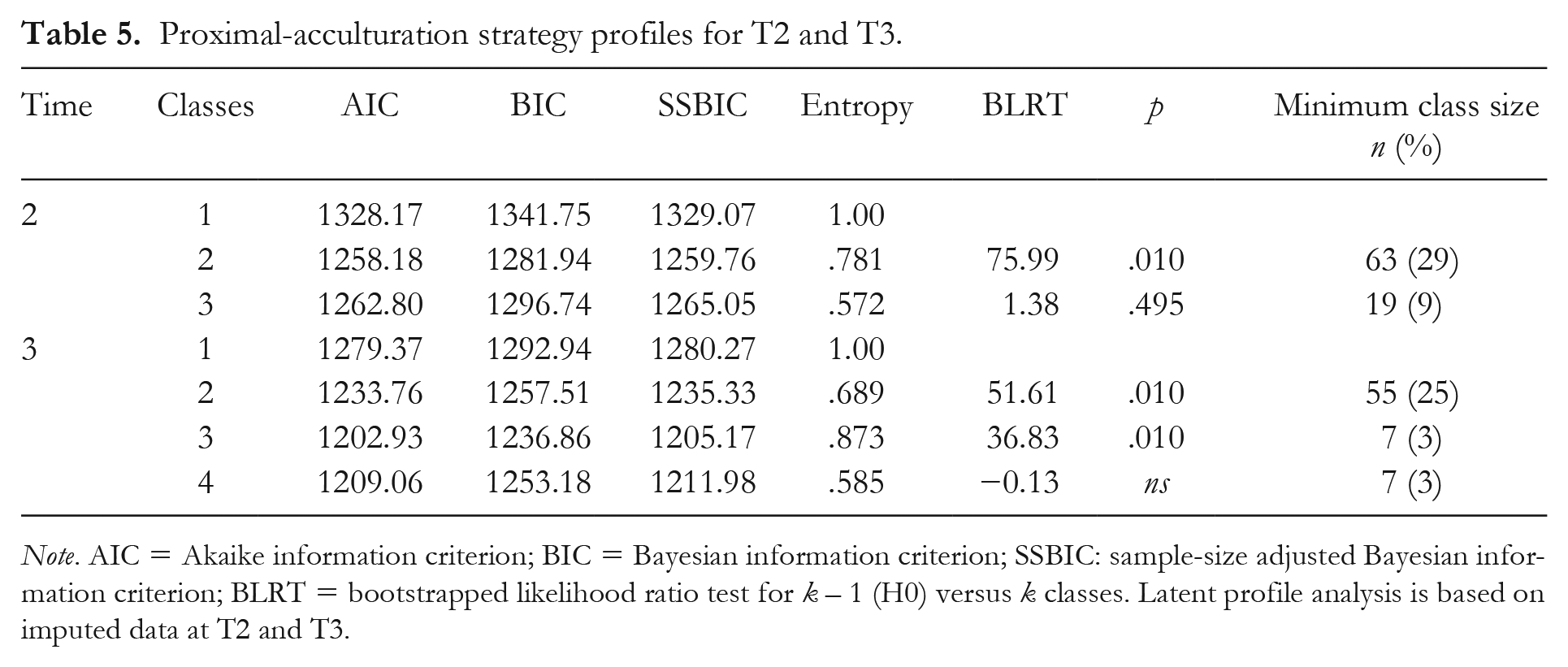
Note. AIC = Akaike information criterion; BIC = Bayesian information criterion; SSBIC: sample-size adjusted Bayesian information criterion; BLRT = bootstrapped likelihood ratio test for k – 1 (H0) versus k classes. Latent profile analysis is based on imputed data at T2 and T3.
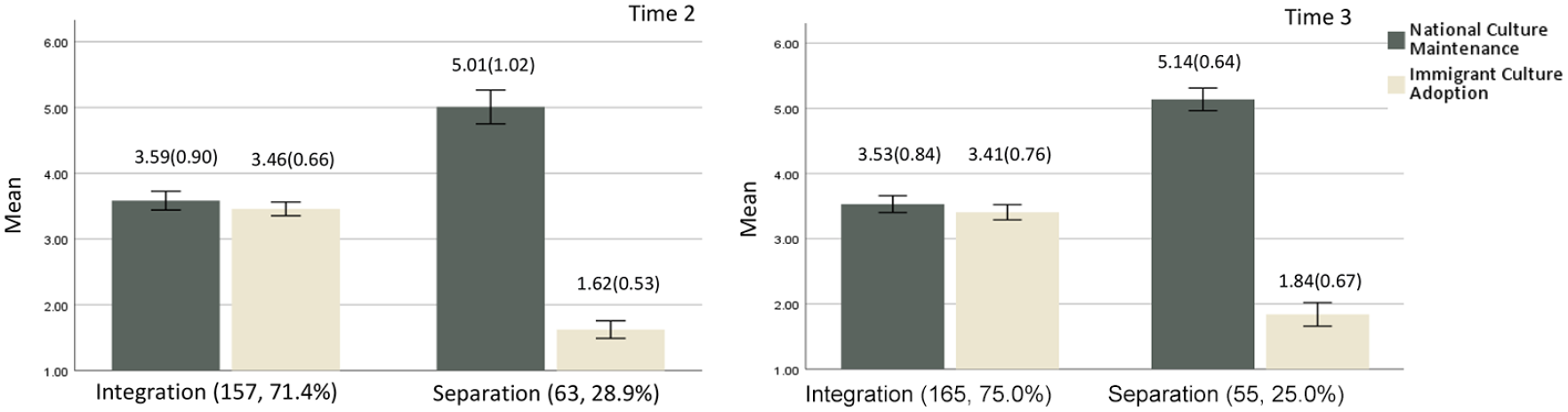
Proximal-acculturation strategy profiles based on imputed data at T2 and T3.
Comparisons within time points
To test our Hypotheses 1–5, we first conducted one-way ANOVAs and independent-samples t tests with our proximal-acculturation strategies as independent variables (at T1 having three levels, and at T2 and T3 having two levels) and acculturation expectations/intergroup ideologies as continuous outcome variables for each time point separately. As can be seen in Table 6 and Figure 4, our Hypotheses 1–5 were supported within each time point—that is, those who only maintained their national culture (i.e., separation) supported unwelcoming acculturation expectations and intergroup ideologies more than those who adopted immigrants’ cultures (i.e., integration and assimilation). In the same vein, those who adopted immigrant cultures supported welcoming acculturation expectations and intergroup ideologies more than those who only maintained their national culture. Also as expected (Hypothesis 5) and shown in Table 6, colourblindness showed the weakest effect size within each time point, with a nonsignificant difference across groups at T1, whereas integration-transformation revealed the highest effect sizes across time.
Mean differences across proximal-acculturation strategies for all main variables (T1–3).
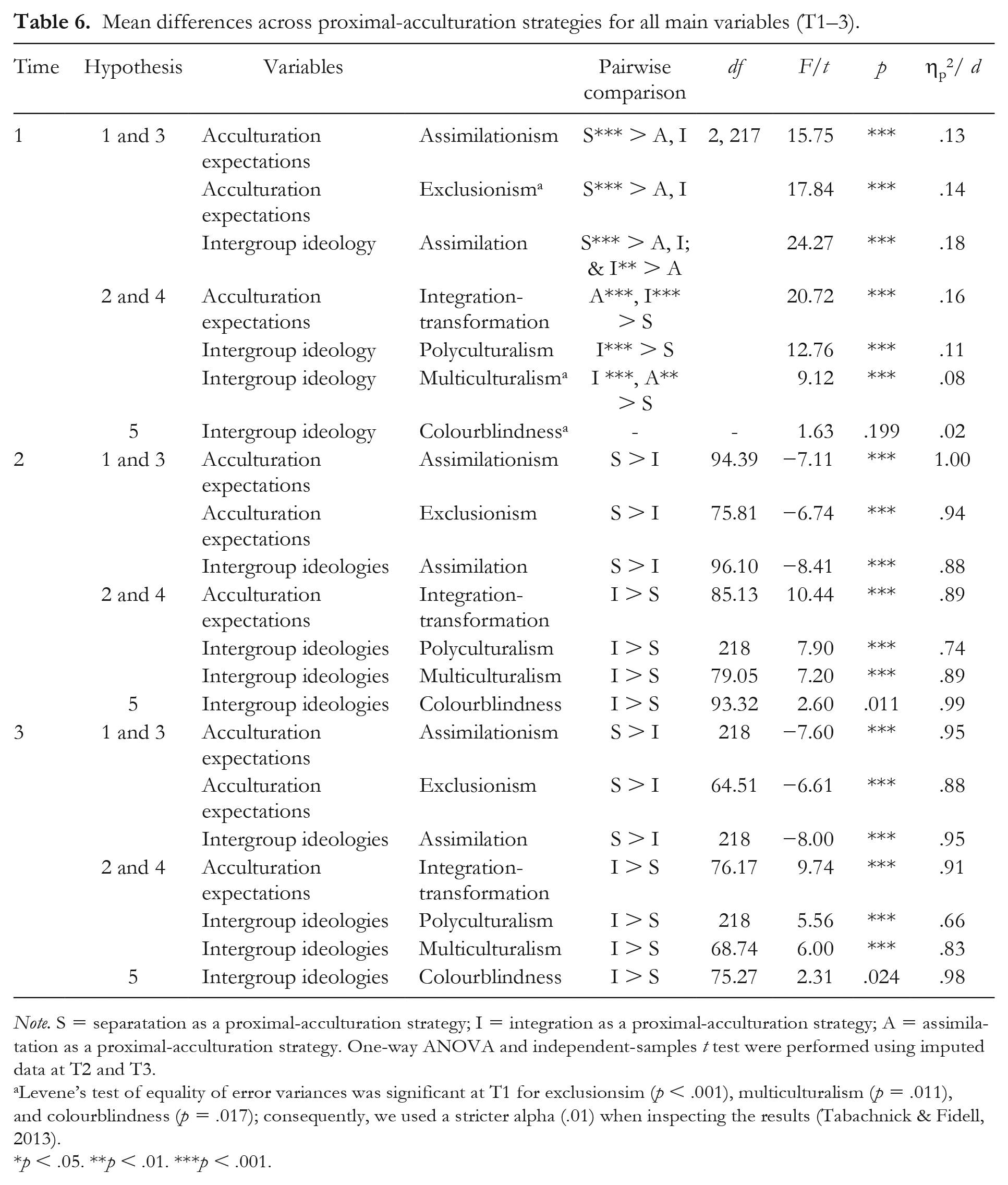
Note. S = separatation as a proximal-acculturation strategy; I = integration as a proximal-acculturation strategy; A = assimilatation as a proximal-acculturation strategy. One-way ANOVA and independent-samples t test were performed using imputed data at T2 and T3.
Levene’s test of equality of error variances was significant at T1 for exclusionsim (p < .001), multiculturalism (p = .011), and colourblindness (p = .017); consequently, we used a stricter alpha (.01) when inspecting the results (Tabachnick & Fidell, 2013).
p < .05. **p < .01. ***p < .001.
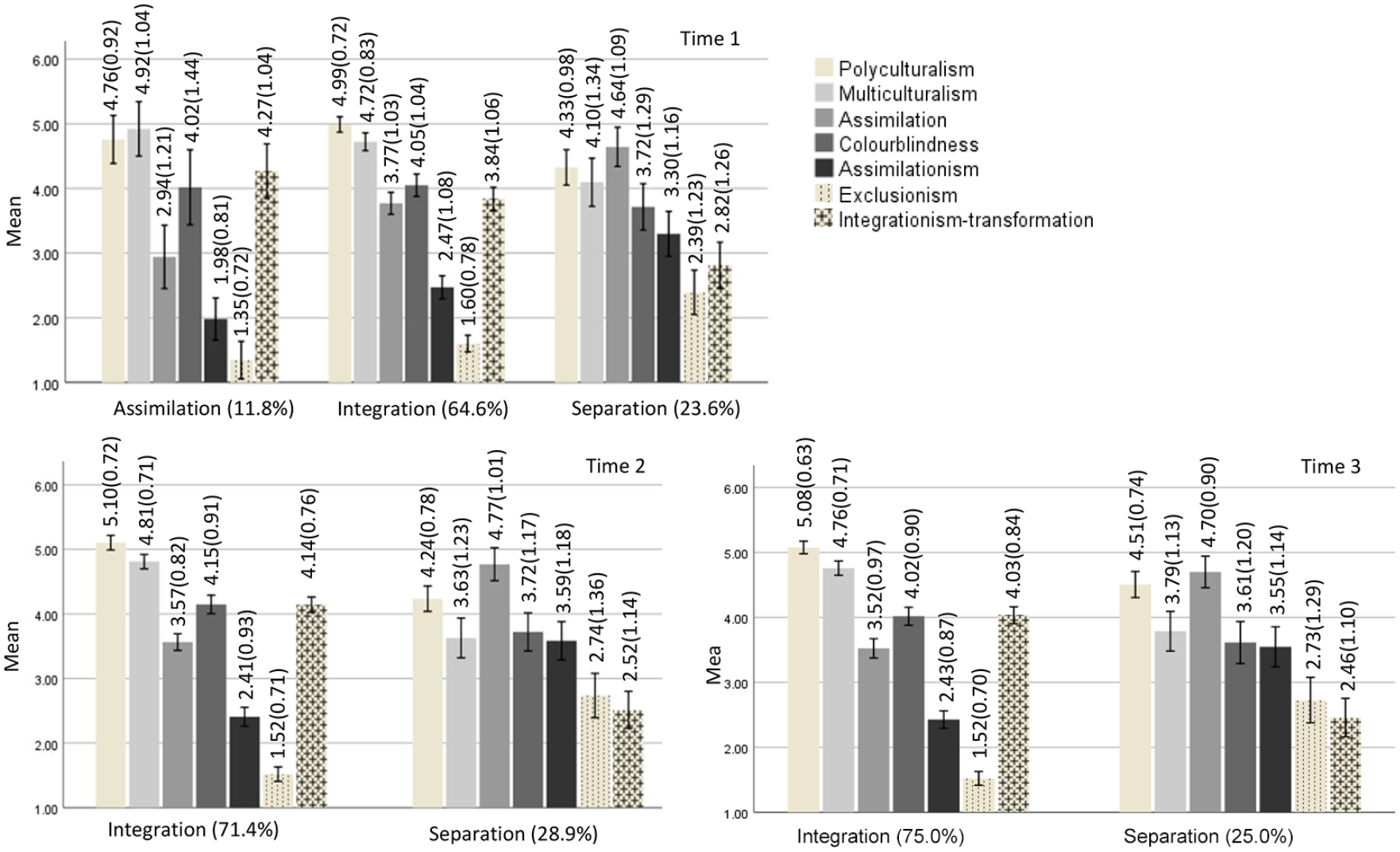
Proximal-acculturation strategy profiles across acculturation expectations and intergroup ideologies within each time point.
Predictions across time
Using our imputed data set for T2 and T3, we first employed hierarchical binary logistic regression to investigate how acculturation expectations at T1 predicted majority members’ proximal-acculturation strategies at T2 and T3, as well as how acculturation expectations at T2 predicted majority members’ proximal-acculturation strategies at T3 (reversed Model 1 in Figure 1). In doing so, we included gender and education (dummy-coded) as control variables in Step 1. We also controlled for proximal-acculturation strategies at T1 when testing the relationship between acculturation expectations at T1 and proximal-acculturation strategies at T2 and T3, as well as for acculturation strategies at T2 when testing the relationship between acculturation expectations at T2 and proximal-acculturation strategies at T3 (added to Step 1). Then, in Step 2, we added integration-transformation, exclusionism, and assimilationism (Table 7a). Overall, findings support our Hypotheses 1–5. Most noticeably, a one-unit increase in integration-transformation at T1 and T2 related to a 0.34–0.46 times decrease in the odds to follow a separation strategy at a later point in time. Meanwhile, a one-unit increase in supporting exclusionism at T1 increased the odds to follow a separation strategy at T2 1.85 times and at T3 2.63 times. Lastly, a one-unit increase in assimilationism at T1 and T2 increased the odds 1.72 and 1.75 times for majority members to follow a separation strategy at T3.
Hierarchical binary logistic regression with acculturation expectations predicting majority members’ proximal-acculturation strategies over time.
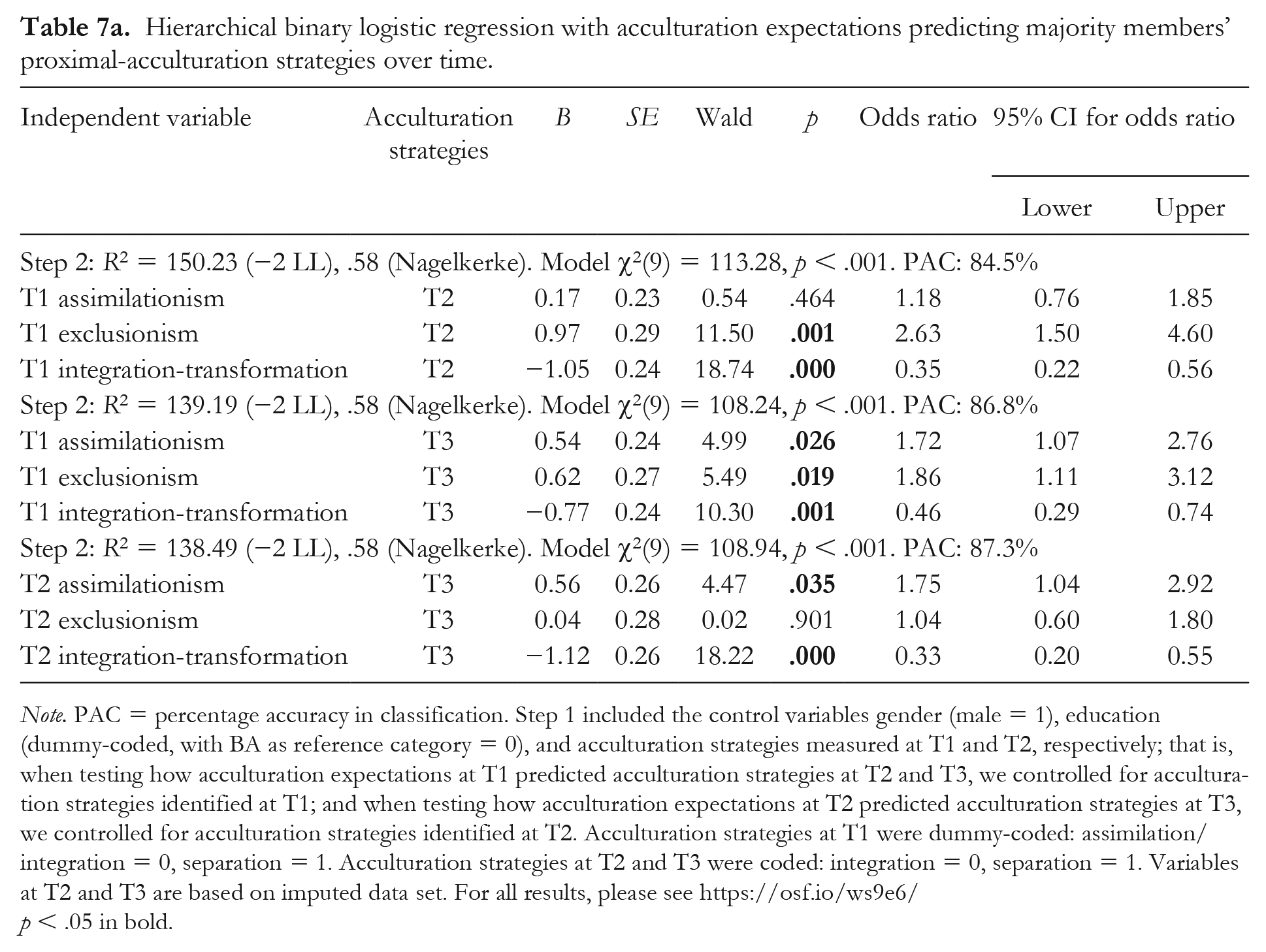
Note. PAC = percentage accuracy in classification. Step 1 included the control variables gender (male = 1), education (dummy-coded, with BA as reference category = 0), and acculturation strategies measured at T1 and T2, respectively; that is, when testing how acculturation expectations at T1 predicted acculturation strategies at T2 and T3, we controlled for acculturation strategies identified at T1; and when testing how acculturation expectations at T2 predicted acculturation strategies at T3, we controlled for acculturation strategies identified at T2. Acculturation strategies at T1 were dummy-coded: assimilation/integration = 0, separation = 1. Acculturation strategies at T2 and T3 were coded: integration = 0, separation = 1. Variables at T2 and T3 are based on imputed data set. For all results, please see https://osf.io/ws9e6/
p < .05 in bold.
We then used one-way ANCOVAs to test how majority members’ proximal-acculturation strategies at T1 predicted intergroup ideologies at T2 and T3, as well as how proximal-acculturation strategies at T2 predicted intergroup ideologies at T3 (Model 2 in Figure 1). Once again, we controlled for gender and education as well as for intergroup ideologies measured at T1 and T2, respectively (Table 7b) —that is, when inspecting the relationships between proximal-acculturation strategies at T1 and intergroup ideologies measured at T2 and T3, we controlled for intergroup ideologies measured at T1; and when examining the relationships between proximal-acculturation strategies at T2 and intergroup ideologies at T3, we controlled for intergroup ideologies measured at T2. Our findings mostly support Hypotheses 1–5. English majority members who followed an assimilation or an integration acculturation strategy at T1 were more likely to endorse polyculturalism at T2 and T3, multiculturalism at T2 and T3, as well as colourblindness at T3 than those who followed a separation strategy at T1. Additionally, when majority members followed an integration strategy at T2, they were more likely to support colourblindness at T3. No differences across proximal-acculturation strategies were detected for assimilation as an ideology.
One-way ANCOVAs with majority members’ acculturation strategies predicting intergroup ideologies over time.
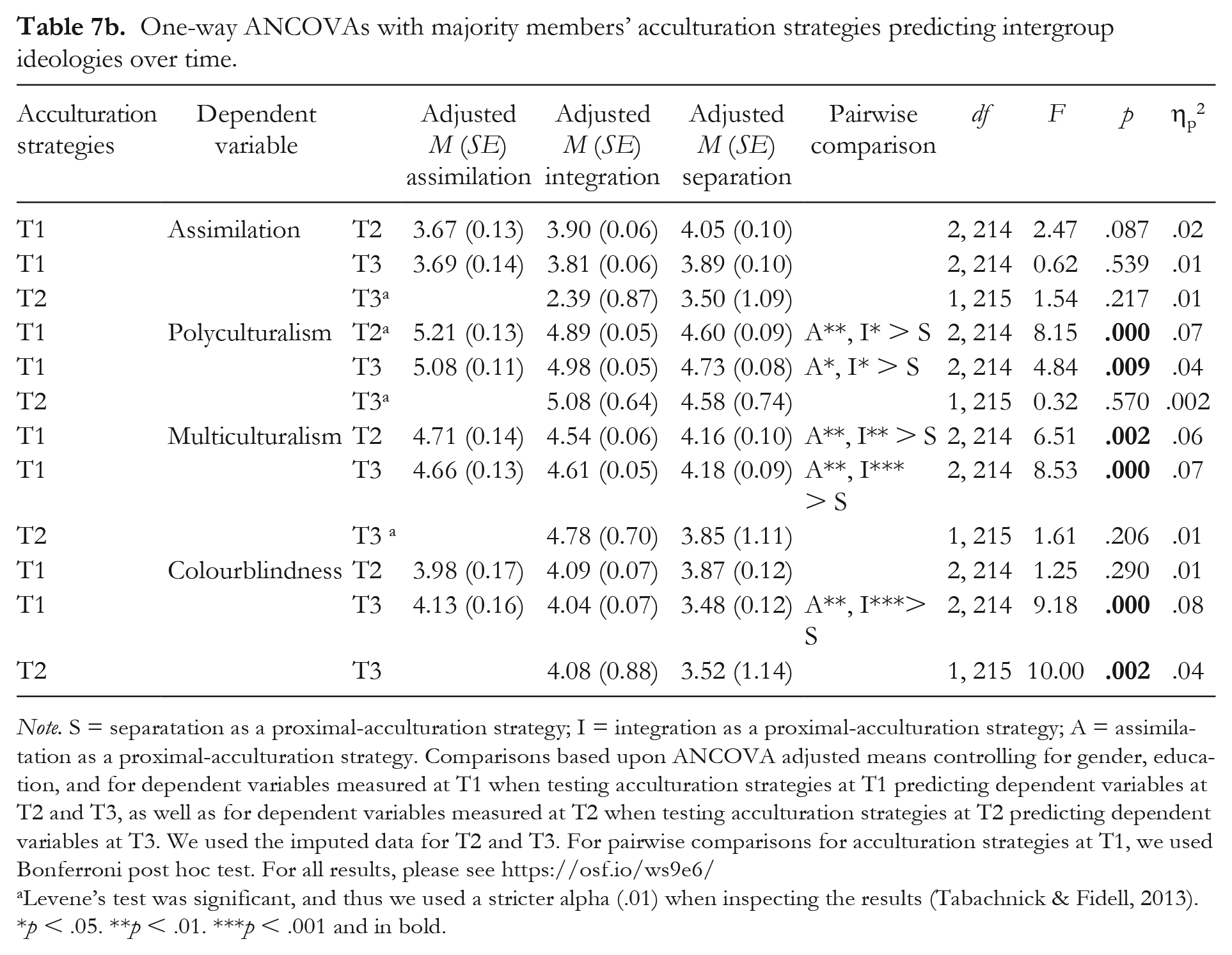
Note. S = separatation as a proximal-acculturation strategy; I = integration as a proximal-acculturation strategy; A = assimilatation as a proximal-acculturation strategy. Comparisons based upon ANCOVA adjusted means controlling for gender, education, and for dependent variables measured at T1 when testing acculturation strategies at T1 predicting dependent variables at T2 and T3, as well as for dependent variables measured at T2 when testing acculturation strategies at T2 predicting dependent variables at T3. We used the imputed data for T2 and T3. For pairwise comparisons for acculturation strategies at T1, we used Bonferroni post hoc test. For all results, please see https://osf.io/ws9e6/
Levene’s test was significant, and thus we used a stricter alpha (.01) when inspecting the results (Tabachnick & Fidell, 2013).
p < .05. **p < .01. ***p < .001 and in bold.
In sum, most of our hypotheses were supported in that those adopting immigrant cultures showed more support for welcoming attitudes towards immigrants; however, we revealed mixed results for unwelcoming attitudes and their relationships to majority members’ proximal-acculturation strategies.
Discussion
The purpose of this research was to gain deeper insights into the relationships between three different conceptualisations of majority members’ acculturation towards cultural minority-group members in a White English sample—that is, their intergroup ideologies, acculturation expectations, and their proximal-acculturation orientations (e.g., immigrant culture adoption) and strategies (e.g., integration; Berry et al., 1977; Bourhis et al., 1997; Kunst et al., 2021). Therefore, we addressed the need for more longitudinal investigations within the field of acculturation (Brown & Zagefka, 2011; Kunst, 2021). Overall, our cross-sectional and longitudinal results mostly supported our Hypotheses 1–6. Yet, by employing a person-centred approach, we gained a more nuanced understanding, especially regarding the relationships between majority members’ acculturation strategies and their acculturation expectations.
Three Related Yet Distinct Concepts of Majority Members’ Acculturation
For English majority members, our cross-sectional findings demonstrated that national culture maintenance related positively to unwelcoming acculturation expectations (assimilation and exclusionism) and assimilation as an intergroup ideology (Hypothesis 1), but negatively to the welcoming expectation of integration-transformation and the intergroup ideologies polyculturalism and multiculturalism (Hypothesis 2). Meanwhile, the reverse was true for immigrant culture adoption (Hypotheses 3–4). We expected these relationships because the more unwelcoming expectations, ideologies, and national culture maintenance all share the goal of maintaining the status quo of the majority culture. Contrarily, the more welcoming expectations, ideologies, and immigrant culture adoption share the premise to accept cultural diversity and its influence on some aspects of the majority culture. However, this acceptance of majority culture change varies among the welcoming attitudes, in that integration-transformation asks for individual cultural change, being the most demanding expectation (Bourhis, 2001); colourblindness, by contrast, rejects any change to the status quo of the majority culture to accommodate minority-group members (Rosenthal & Levy, 2010). This was reflected in our results (Hypothesis 5): the correlations between immigrant culture adoption and colourblindness were the weakest within each time point, whilst a significant negative correlation of colourblindness and national culture maintenance was only revealed for T3.
We also identified three proximal-acculturation strategies through latent profile analyses: integration, separation, and assimilation (only at T1). Unsurprisingly, acculturation strategies converged with our variable-centred findings for each time point, with mostly medium to large effect sizes when inspecting group differences. Notably, our preliminary and correlation analyses supported our assumptions in that expecting immigrants to culturally change as well as supporting policies/societal initiatives to accommodate minority members within the larger society are strongly related yet distinct concepts from acculturating towards minority cultures per se. This echoes the calls for an explicit change in research and public discourse to lift the common misconception that majority members do not experience cultural changes towards minority members’ cultures (Dandy, 2009; Kunst et al., 2021).
The Predictive Power of Majority Members’ Proximal-Acculturation
In line with Hypothesis 6, proximal-acculturation orientations predicted English majority members’ support for intergroup ideologies over time. These longitudinal associations were in the same directions as our cross-sectional results. Thus, this finding supports the proposed central positioning of group membership in the integrative framework for the psychological study of multiculturalism for majority members (Ward et al., 2018). Although we did not test for other relationships proposed in the framework, our findings provide a glimpse into how majority members’ group membership can change due to their level of proximal-acculturation towards minority cultures.
Yet, some nuances need to be discussed. First, when using a person-centred approach, no significant effects were revealed for assimilation as an intergroup ideology, whereas small- to medium-sized effects were found for polyculturalism, multiculturalism, and colourblindness. Thus, English majority members’ acculturation strategies seem to be relevant for intergroup ideologies that are more likely to foster rather than hinder the integration of minority members into the larger society. However, adopting immigrant cultures as an orientation at T1 was associated with reduced support for assimilation as an ideology at T2. Potentially, with a larger sample, we could have identified an assimilated English majority group at T2, which then could have reproduced the variable-centred finding for our person-centred approach, too.
Third, whilst the variable-centred approach detected immigrant culture adoption at T2 to predict less support for multiculturalism at T3, the person-centred approach revealed that following an assimilation or integration strategy at T1 predicted more support for multiculturalism at T2 and T3. These results may reflect a historical influence during data collection—that is, at T1 and T3, the UK Parliament discussed and then ratified the Brexit withdrawal agreement (Walker, 2021), whereas T2 encompassed the historic Brexit referendum date (23rd of June). We remember that a multicultural ideology supports both wanting minority members to maintain their heritage culture as well as adopting the majority culture. Then, English majority members who strongly embraced immigrants’ culture adoption at T2 may have rejected the idea of immigrants to culturally adopt an English majority culture, which, at T3, represented a culture in support of anti-immigration attitudes. Given that we did not detect an assimilation acculturation strategy profile at T2, this historical factor could only be revealed with our variable-centred approach.
Fourth, colourblindness not only showed the weakest correlations with proximal-acculturation orientations within each time point, but also no significant correlations across time points when using a variable-centred approach. However, when inspecting the results of a person-centred approach, English majority members following an integration or assimilation strategy at T1 or T2 were more likely to support colourblindness at T3 relative to those who followed a separation strategy. This opposes our preregistered hypotheses where, due to the conflicting conceptualisation of colourblindness which embraces equality yet disregards the importance of cultural group membership, we had expected that those who follow an integration strategy would show no difference or lower support for colourblindness than separated majority members. It may be that the simultaneous endorsement of multiculturalism and polyculturalism with colourblindness counterbalances the negative aspects of a colourblind ideology (e.g., Plaut et al., 2018). Alternatively, there may be two possible understandings of an assimilation and integration strategy for majority members—that is, majority members remain embedded in their dominant majority culture when experiencing proximal-acculturation and thus may approach other cultures from a higher power status. Then, an integration as well as assimilation strategy would entail for some only a “surface” level of cultural learning or adoption (Shaules, 2019) by voluntarily picking products and practices from immigrants’ cultures without considering its consequences for the minority group (i.e., cultural appropriation; Rogers, 2006), thus maintaining structural inequalities, which results in support for clourblindness over time. For other majority members, however, integration as well as assimilation may entail deep cultural learning (Shaules, 2019) based on the willingness to share power and regarding other cultures as equal (i.e., multiculturalism). This echoes past findings in which an integration and assimilation strategy for majority members was associated with constructive marginalisation, which entails an understanding of other worldviews as equal to the one majority members were socialised in (Lefringhausen et al., 2021).
For acculturation expectations, although an exploratory model fitted our data better, a variable-centred approach did not support our assumptions (Hypothesis 6), in that no longitudinal associations of expectations with English majority members’ proximal-acculturation orientations were revealed. Our person-centred approach, however, could shed some light on this finding in that especially integration-transformation was a consistent predictor of the odds of following an integration or separation strategy over time. This may be because this variable assessed English participants’ expectation not of immigrants but of their own cultural group to change towards immigrants’ cultures in general and at work. In other words, it implied a behavioural intention, which, as suggested by the theory of planned behaviour, precedes one’s personal actions (Ajzen, 1991). Taken together, to foster multiculturalism and polyculturalism as intergroup ideologies, policy initiatives should focus also on majority members’ own acculturation towards cultural plurality experienced in a shared society. More specific initiatives could include intercultural competence trainings for majority and minority members to foster their mutual cultural adoption whilst considering their power inequalities.
Limitations, Future Research, and Conclusion
This study is not without limitations. First, the findings are socioculturally embedded in a UK context, and future work should explore whether they can be replicated across contexts with various immigration histories and policies. Second, our time intervals were rather short (about 3 months), with most variable-centred relationships shown for variables assessed at T1 relating to outcome variables assessed at T2. Moreover, although we had collected data on all six acculturation expectations across all time points, half of them showed low reliabilities and had to be dropped from the analyses (see Endnote 1); additionally, several of our scales were shortened to reduce participant fatigue. Future work should consider including multi-item instruments that displayed high reliability in prior longitudinal work. In so doing, further construct specificity for majority members’ acculturation is needed, inspecting whether acculturation strategies would vary towards valued/devalued minority groups as has been reported for acculturation expectations (Montreuil & Bourhis, 2001). Third, globalisation-based acculturation is a complex process with further investigations needing to consider the interplay between proximal- and remote-acculturation of majority members towards immigrants’ cultures (Eales et al., 2020).
Fourth, we did not include majority members’ perception of descriptive multicultural norms to inspect its relationship with majority members’ acculturation over time (i.e., perceived rather than personally held multicultural ideology, multicultural policies and practices, and multicultural contact; e.g., Guimond et al., 2013; Ward et al., 2018). Yet, Zárate et al. (2019) demonstrated that especially majority members usually resist cultural change, unless such change is already in motion (i.e., cultural inertia). Whether cultural change is perceived to be occurring depends on majority members’ observed in-group norms towards minority members’ cultures as well as their level of identification with the majority group. This further ties in with recent work by Danbold and Huo (2022), who reported that majority members accept temporary social change and cultural difference in the larger society if they perceive minority members to assimilate in the future, therefore maintaining a stable mainstream culture over time. Thus, inspecting cultural inertia in relation to majority members’ acculturation would shed further light on the psychological processes of multiculturalism for majority members.
Nevertheless, the present study provides first insights into the longitudinal relationships between three conceptualisations of majority members’ acculturation—their personally endorsed intergroup ideologies, their acculturation expectations, as well as their proximal-acculturation towards immigrants and their cultures. Moreover, we found additional support for integration and separation being prominent acculturation strategies for majority members across time. Finally, our results stress the need to consider the power imbalance between majority and minority members more explicitly when investigating majority members’ proximal-acculturation (e.g., as a third dimension). Indeed, current instruments may perpetuate these power inequalities by positing change towards other cultures as an obligation for immigrant/minority populations and as a laudable courtesy for majority members.
Taken together, the present study hopefully inspires future psychological work on multiculturalism that takes a more nuanced approach to acculturation among majority members.
Supplemental Material
sj-docx-1-gpi-10.1177_13684302221096324 – Supplemental material for Majority members’ acculturation: How proximal-acculturation relates to expectations of immigrants and intergroup ideologies over time
Supplemental material, sj-docx-1-gpi-10.1177_13684302221096324 for Majority members’ acculturation: How proximal-acculturation relates to expectations of immigrants and intergroup ideologies over time by Katharina Lefringhausen, Tara C. Marshall, Nelli Ferenczi, Hanna Zagefka and Jonas R. Kunst in Group Processes & Intergroup Relations
Footnotes
Appendix
Cross-lagged paths for Model 2b.
| Time | Time | b | SE | p | |||
|---|---|---|---|---|---|---|---|
| Immigrant culture adoption | 1 | ➔ | Multiculturalism | T2 | 0.17 | 0.06 | . |
| T3 | 0.38 | 0.14 | . |
||||
| Polyculturalism | T2 | 0.22 | 0.05 |
|
|||
| T3 | −0.04 | 0.11 | .736 | ||||
| Assimilation | T2 | −0.16 | 0.06 | . |
|||
| T3 | −0.05 | 0.14 | .710 | ||||
| Colourblindness | T2 | 0.09 | 0.07 | .201 | |||
| T3 | 0.18 | 0.17 | .295 | ||||
| 2 | ➔ | Multiculturalism | T3 | −0.29 | 0.13 | . |
|
| Polyculturalism | T3 | −0.03 | 0.12 | .814 | |||
| Assimilation | T3 | 0.03 | 0.15 | .846 | |||
| Colourblindness | T3 | −0.26 | 0.18 | .139 | |||
| National culture maintenance | 1 | ➔ | Multiculturalism | T2 | −0.11 | 0.06 | . |
| T3 | −0.32 | 0.14 | . |
||||
| Polyculturalism | T2 | −0.14 | 0.05 | . |
|||
| T3 | −0.13 | 0.12 | .308 | ||||
| Assimilation | T2 | 0.12 | 0.07 | .108 | |||
| T3 | 0.06 | 0.15 | .694 | ||||
| Colourblindness | T2 | −0.06 | 0.07 | .349 | |||
| T3 | −0.11 | 0.18 | .544 | ||||
| 2 | ➔ | Multiculturalism | T3 | 0.18 | 0.13 | .153 | |
| Polyculturalism | T3 | −0.00 | 0.11 | .968 | |||
| Assimilation | T3 | −0.15 | 0.15 | .329 | |||
| Colourblindness | T3 | −0.12 | 0.17 | .460 |
Funding
The author(s) received no financial support for the research, authorship, and/or publication of this article.

Supplemental material
Supplemental material for this article is available online.
Notes
References
Supplementary Material
Please find the following supplemental material available below.
For Open Access articles published under a Creative Commons License, all supplemental material carries the same license as the article it is associated with.
For non-Open Access articles published, all supplemental material carries a non-exclusive license, and permission requests for re-use of supplemental material or any part of supplemental material shall be sent directly to the copyright owner as specified in the copyright notice associated with the article.
