



Abstract
Research on group dehumanization has focused largely on the perpetrators of dehumanization or on its negative emotional and cognitive effects on targets. We theorized that people would also reassert their humanness in response to dehumanizing portrayals of their group. Experiment 1 showed that Black individuals responded to a dehumanizing representation of their racial group by emphasizing their experience of more complex, uniquely human emotions versus emotions more associated with other animals. Experiment 2 and a supplemental experiment showed that Black, but not White, individuals responded to group-based dehumanization by depicting more complex self-portrayals. Taken together, these studies begin to illustrate that targets of group-based dehumanization are not simply passive victims but respond actively, resisting negative representations of their group by reasserting their humanness.
For centuries, Black people have been told we can’t feel. That we are not allowed to feel. That’s why we have been maimed, poked and prodded, used as guinea pigs, denied necessary treatment and medications. We’ve died in childbirth or lost children at alarming rates, and we’ve lost our children in the street. The most revolutionary thing we can do right now is the one thing we have always been denied: to feel, act and react as a whole human being.
Black Americans have long been dehumanized (Haslam & Loughnan, 2014). In the United States Constitution, enslaved Africans were counted as three fifths of a human being. They were bought and sold as property and subjected to physical and psychological trauma that stripped them of their human dignity. This dehumanization did not disappear with the abolition of slavery. Representations of Black Americans as violent and ape-like persist to the present and contribute to myriad forms of biased treatment, sometimes even costing people their lives (Goff et al., 2008; Haslam & Loughnan, 2014; Turner, 2002). As we began to write this paper, yet another Black man was shot by law enforcement during a traffic stop just a few miles from where George Floyd had been killed by police a year earlier (Bogel-Burroughs & Paybarah, 2021).
Less blatant forms of dehumanization are also felt by Black Americans. As the opening quotation illustrates, Black people are often treated by others as if they lacked uniquely human experiences, such as more complex emotions uniquely associated with humans (Boccato et al., 2007; Leyens et al., 2007). How might people respond? As Chiles says, rather than passively accepting dehumanizing portrayals of their group, people might actively resist these representations by engaging in rehumanization: reasserting the very human qualities that they are posed as lacking. We examine whether people would take up opportunities to reassert their humanity in response to group-based dehumanization, such as by casting a more human portrait of their emotional experiences (i.e., emphasizing their experience of distinctly human emotions and de-emphasizing their experience of emotions associated with other animals) or by emphasizing the complexity of their self-identity.
Black Americans’ Resistance to Dehumanization
Although many groups experience dehumanization (Haslam & Stratemeyer, 2016; Kunst et al., 2017), our focus in this research is on the dehumanization of Black Americans and how they may respond, in part because we were inspired by acts of resistance in the Black community. For example, Black Lives Matter activist Ashley Yates said, “[A]t the very core of this is humanity . . . Black lives matter because they are lives. Because we are human” (Harris, 2015). Activist Joshlyn Copes said, “That’s what the protest is for, so that people know that we are human just like they are” (Kyles, 2020). Black Lives Matter founder Patrisse Cullors said, “Black Lives Matter reminds people that black people are human, but more importantly, it reminds black people that we are human” (Martin, 2015). As Cullors emphasizes, people may reassert their humanness to communicate their humanness both to others and to themselves.
The reassertion of Black humanness in the face of dehumanization is not new. In the late 1780s, the logo for the abolitionist movement in England depicted a Black man in chains with the slogan “Am I not a man and a brother?” (see Figure 1), emphasizing the humanness of Black people in a call to end slavery (Kaye, 2011). Here, and in many of the modern examples noted before, Black people assert their basic humanity directly. Yet, as Chiles suggests, people can also reassert their humanity by emphasizing attributes that exemplify what it means to be human. In other historical cases, Black people have cultivated positive expressions of their humanness by emphasizing the multitude of identities that Black people have, thus providing a versatile and complex depiction of their group (Brauer & Er-rafiy, 2011; Er-rafiy & Brauer, 2012). For example, during the Harlem Renaissance—a period in the 1920s characterized by outpourings of creativity in the Black community—Black artists created works that showcased the multifaceted nature of Blackness in the face of intense racism. Langston Hughes’s poem “My People” (Hughes, 1922) is one of many examples: Dream-singers, Story-tellers, Dancers,
Loud laughers in the hands of Fate—
My People.
Dish-washers, Elevator-boys, Ladies’ maids, Crap-shooters, Cooks, Waiters, Jazzers, Nurses of babies, Loaders of ships, Porters, Hairdressers,
Comedians in vaudeville
And band-men in circuses—
Dream-singers all,
Story-tellers all.
Dancers—
God! What dancers!
Singers—
God! What singers!
Singers and dancers,
Dancers and laughers.
Laughers?
Yes, laughers. . ..laughers. . ...laughers—
Loud-mouthed laughers in the hands of Fate.
Was this glorious depiction of the humanity of a group a coincidence? Or was it, at least in part, a response to the ever-present threat of dehumanization? In the present research, we sought to assess whether, in the face of group-based dehumanization, Black Americans respond by emphasizing their humanity and depth in self-portrayals. To do so, we adopt the view that one essence of humanity is complexity. To be human can mean many things—whether to be rational or experience complex mental states (Bain, 2014); to experience complex emotions (Demoulin et al., 2004); to be prosocial, kind, or culturally sophisticated (Haslam, 2006); or to be forgiving (Schumann & Walton, 2021), among many other possibilities. As Walt Whitman writes in Song of Myself, “I am large, I contain multitudes.” Thus, a person or group can also be dehumanized in many ways, whether by being denied autonomy, by being denied intrinsic motivation, by being treated as immoral, or by being ostracized, among others (Bastian & Haslam, 2011). Resisting this dehumanization could then take many forms. Accordingly, we assess the complexity of participants’ self-representations in two different ways, by the degree to which people assert experiencing more complex emotions identified with humans in Experiment 1, and by the degree to which they provide complex self-portrayals in Experiment 2 and the supplemental experiment.

Logo adopted as the seal of the Society for the Abolition of Slavery in England in the 1780s.
From Passive Victims to Active Resistors
The current literature on dehumanization does not explore how people may resist dehumanizing representations of their group. Without doing so and without showcasing the variety of forms that this resistance may take, research risks casting targets of dehumanization as passive victims. Indeed, research highlights how “victims of interpersonal harm may feel that their humanity has been reduced due to their own maltreatment” (Bastian et al., 2014, p. 207); that is, research has focused on how targets may react to dehumanization by coming to see themselves as less human (e.g., Moller & Deci, 2010). Such representations can cause harm. When people are portrayed as passive victims, they may seem helpless and less competent (Reeves et al., 2022), limiting their own confidence, agency, and growth (Bauer et al., 2021; Hernandez et al., 2021; Thomas et al., 2020).
Instead, the focus of past research has been on the perpetrators of dehumanization (for a review, see Waytz et al., 2014). This research has explored the motivations that lead people to dehumanize others and the different forms this dehumanization can take (Schroeder & Epley, 2020; Schroeder & Fishbach, 2015) as well as the effects of dehumanizing representations, including increased aggression toward dehumanized targets (Bandura et al., 1975), implicit forms of dehumanization increasing the endorsement of violence against Blacks in criminal justice contexts (Goff et al., 2008), or how these effects vary as a function of whether perpetrators deny people attributes which distinguish them from animals (e.g., refinement, morality) or attributes that are core to human nature (e.g., emotionality, cognitive flexibility; Bastian et al., 2011; Haslam, 2006; Pereira et al., 2009).
Less explored has been targets’ experience of dehumanization (Haslam et al., 2007). Some research has examined the negative cognitive and emotional effects among victims of dehumanizing interpersonal transgressions. For example, being likened to animals can lead people to experience aversive self-awareness, shame, and guilt, while being likened to objects or machines can lead people to experience deconstructive states, sadness, and anger (Bastian & Haslam, 2011). Some research suggests that blatant experiences of group-based dehumanization can provoke agentic responses. For example, perceiving that one’s social group is dehumanized by others prompts strong reactions (e.g., hostility, support for violence; Kteily & Bruneau, 2017; Kteily et al., 2016).
We theorize that, when confronted with group-based dehumanization, people can also respond by reasserting the very humanness that they have been depicted as lacking. Drawing in part on the historical examples referenced before, we suggest that, if given the opportunity, people might rehumanize by emphasizing their complexity. Dehumanization involves simplifying a group and its members in a manner that denies them the full range of human experience. To resist this, we propose that people may create complex self-representations, including to depict their emotional experience as more complex and uniquely human or to describe their self-concept in more multifaceted ways.
This reasoning is consistent with past research examining how people respond to other group-image threats. For example, Asian Americans whose American identity has been called into question (e.g., by being asked if they speak English) may respond by communicating a love for American TV shows or by consuming more American foods (Cheryan & Monin, 2005; Guendelman et al., 2011), thus reasserting their American identity. Other work examines threats rooted in stereotypes (Steele et al., 2002). When faced with a negative stereotype about their intellectual ability, Black people may disavow stereotypically African American activities (e.g., rap music, jazz) and traits (e.g., being lazy, aggressive), presumably to distance themselves from a negative stereotype (Steele & Aronson, 1995). Similarly, women invested in math and faced with stereotypes that impugn women’s math ability may distance themselves from feminine characteristics seen as incompatible with math (e.g., being flirty, wearing make-up, planning to have children) while maintaining their commitment to characteristics not seen as incompatible (e.g., being sensitive, nurturing, and empathic; Pronin et al., 2004).
These lines of research show that people actively manage their self-image in response to potential threats that issue from the “spotlight” of a stereotype (Steele, 1997). They distance themselves from potential caricatures of their group in an attempt to mitigate or counteract potential negative representations of themselves (e.g., “They might think I’m ‘just a dumb girl’ but I’m not”). Similarly, we propose that people actively resist dehumanizing portrayals of their group through their self-representations (“They might think I’m less than human, but I’m not”). Yet because the threat of dehumanization is so broad-based, we expect people’s response to be similarly broad. Not merely reasserting a particular identity (Cheryan & Monin, 2005) or the compatibility of their identity with a domain of achievement (Pronin et al., 2004), people may respond to group-based dehumanization by depicting their experiences and their selves in complex, distinctly human ways.
Research Overview
To study responses to dehumanization, we created an advertisement that paired an image of a Black man with an ape. Many cases of dehumanization liken Black Americans to apes (Goff et al., 2008). Sometimes, this association is explicit (Kteily et al., 2015). For example, Michelle Obama was mocked by a tweeter who claimed that she was “tired of seeing a [sic] Ape in heels” (“Major Resigns for Response,” 2016), while a prominent entrepreneur commented on a radio show that Ms. Obama should be “let loose in the outback of Zimbabwe” to live “in a cave with Maxie, the gorilla” (Helmore, 2016). Soccer player Mario Balotelli was portrayed in a cartoon as King Kong, pictured as batting away soccer balls while clinging to Big Ben (“Euro 2012: Gazzetta Sorry for Cartoon,” 2012).
However, sometimes this association is less overt: strongly implicated, but not explicit. For instance, a football commentator described a Black athlete as “getting his paw up there” to block a pass (Estes, 2014). Basketball player LeBron James was pictured on the cover of Vogue in the position of King Kong, with supermodel Gisele Bundchen in his arms mimicking Fay Wray (Chideya & Cox, 2008; see Figure 2). Some found this image offensive. Commenting on the picture, one woman said, Well, he looks beastly. You know, he’s snarling, he looks very angry, and then, you know, she sort of looks like, hey, I’m on my way to a great party or high-class affair, and he just looks kind of like an animal, and if anyone has studied on the history of King Kong or seen any of the imagery that was from the movie . . . this picture looks exactly like a huge percentage of the pictures they used to put out about King Kong. (Chideya & Cox, 2008)
A journalist wrote that the cover “reinforces the animalistic stereotypes frequently associated with Black athletes. A Black athlete being reduced to a savage is, sadly, nothing new” (Hill, 2008).

(A) The cover of Vogue (April 2008) likening LeBron James to (B) King Kong (Shea, 2008).
Given this context, we theorized that less overt representations, which simply imply a link between Black Americans and apes, would be sufficient to provoke the threat of group-based dehumanization. In fact, less overt instances of threat are often more troubling to people (see Mendoza-Denton et al., 2009; Salvatore & Shelton, 2007; Shih et al., 2002), perhaps because less overt threats are more difficult to recognize and thus reject. In this sense, using an implied rather than explicit form of dehumanization provides a relatively conservative test of the hypothesis that Black Americans actively resist instances of dehumanization by emphasizing their own complexity.
In three experiments, we varied whether participants viewed an advertisement with dehumanizing aspects (e.g., including an image of a Black man paired with an ape) or not. Experiment 1 examined whether Black participants would respond by representing their emotional experience in more uniquely human terms. In Experiment 2 and a supplemental experiment, we examined whether Black participants would respond by creating more complex self-representations. Additionally, the latter two studies included White participants as a comparison group, as we predicted the reassertion of self-humanity would be limited only to Black people whose humanity had been threatened by the dehumanizing cue.
Data and scripts for analyses for all experiments are available at the Open Science Framework (https://osf.io/q2h5w/). Experiment 2 is a preregistered replication of the supplemental experiment (see preregistration at https://osf.io/ah837). Experiment 1 and the supplemental experiment were conducted prior to the widespread establishment of preregistration practices in the field, and thus were not preregistered. However, all conditions to which participants were assigned are reported in the current manuscript, all measures are reported, no participants or outliers were excluded from analyses, and data were not analyzed prior to the completion of data collection. All study procedures were approved by the Stanford University Institutional Review Board. We considered effects with p < .05 to be statistically significant.
Experiment 1: Uniquely Human Emotional Experiences
In Experiment 1, we explored whether Black individuals might respond to a dehumanizing threat to their racial group by taking up an opportunity to cast a more uniquely human portrait of their emotional experience, namely simultaneously asserting a greater experience of uniquely human emotions and downplaying their experience of emotions that would link them with nonhuman animals. Research on infrahumanization, or the tendency to consider one’s ingroup as fully human and outgroup members as less human and more animal-like, has found that people attribute human-specific emotions to ingroup members over outgroup members (Demoulin et al., 2004; Leyens et al., 2001; Vaes et al., 2003). This research illustrates the role that specific emotions play in capturing the essence of humanity and distinguishing people from animals. We reasoned that targets of group-based dehumanization might, then, reassert their humanness by emphasizing their experience of more uniquely human emotions (e.g., hope, regret) while distancing themselves from less uniquely human emotions (e.g., surprise, fear).
Method
Participants
Seventy-five Black/African American students from a West Coast university (Mage = 21.90, SD = 3.92; 34 men, 41 women) were recruited via university email to participate in a study about “People and Media.” The study involved a between-subjects factor (type of ad: control, stereotypical portrayal, dehumanizing) and a within-subjects factor (12 emotions: MTurk-rated extent to which emotion is uniquely human, see following lines). A sensitivity analysis conducted with G*Power (Faul et al., 2007) indicated that, with an alpha of .05 and our mixed design, assuming a lack of correlation between repeated measures, this sample size afforded 80% power to detect an effect of approximately η2 = .02, generally considered a small to medium effect size (J. Cohen, 1988).
Procedure
Pilot study of uniquely human emotions
First, a separate sample of 40 adults was recruited through Mechanical Turk (MTurk; 20 men, 20 women; Mage = 30.78, SD = 10.66) to rate the extent to which 12 emotions (ambition, anger, fear, hope, joy, lust, nostalgia, optimism, pride, regret, romance, surprise) are more or less uniquely human. This list of emotions was developed based on past research on infrahumanization (Demoulin et al., 2004), with the goal of including emotions that would span from less to more uniquely human. Participants were asked “How well does each of the following emotions exemplify what it means to be human as compared to other animals?” (1 = not at all, 5 = very much so; see Table 1 for means and standard deviations). We used this pretest to create an average score for each emotion’s level of human uniqueness, which we then used in analyses in the main study as a measure of the extent to which participants represented their emotional experience in uniquely human terms. To account for emotion valence in our analyses, MTurk participants were also asked “How positive or negative do you think these emotions are?” (1 = very negative, 5 = very positive). We again created an average score for each emotion’s valence, which we used as a control variable in the main study.
Ratings of the extent to which specific emotions are more or less uniquely human: Pilot study for Experiment 1.
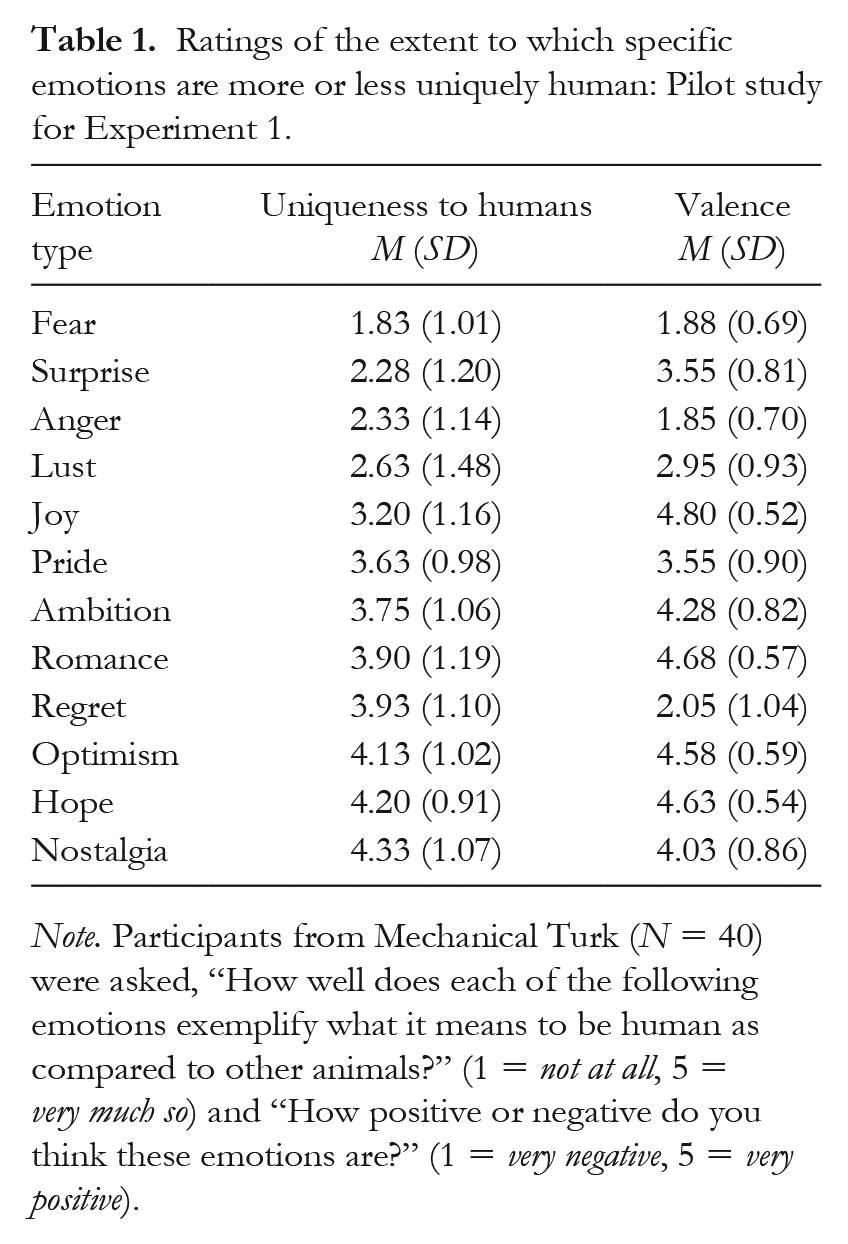
Note. Participants from Mechanical Turk (N = 40) were asked, “How well does each of the following emotions exemplify what it means to be human as compared to other animals?” (1 = not at all, 5 = very much so) and “How positive or negative do you think these emotions are?” (1 = very negative, 5 = very positive).
Main study
Participants read that the study had two ostensibly unrelated parts: (a) rating advertisements, and (b) reporting information about their everyday life. First, participants were asked to review advertisements and were randomly assigned to one of three conditions (see Figure 3).

Manipulation in Experiment 1 (A, B, and C) and Experiment 2 (A and C).
We varied whether the advertisement depicted a dehumanizing portrayal of a Black American, drawing on real-world examples (see Bongiorno et al., 2013). Given that dehumanization can be evoked through both images (e.g., the Vogue cover presented in Figure 2) and words (e.g., referencing a Black person’s “paws”), and given our goal to create a robust manipulation, we varied both the images in the ads and the words. The dehumanizing advertisement implicitly linked Black people to apes: it juxtaposed an image of a Black security guard with an image of an ape, and used a tagline (“It’s a jungle out there”) and company name (“JungleSource”) to evoke this dehumanization (e.g., vs. “It’s tough out there” and “PeopleSource”). The primary comparison condition was a control advertisement, which featured an abstract logo and a picture of a video camera. On an exploratory basis, we also included a third condition, a stereotypical advertisement in which the image of the Black security guard was juxtaposed with the abstract logo. This condition provides a stereotypical image of a Black man—it portrays him as aggressive, tough, and stoic (Maddox & Gray, 2002); but it does not implicitly link Black people to apes. We reasoned that this advertisement could be threatening by communicating stereotypes about Black men. Indeed, the stereotype of toughness communicated in the ad has been linked in past research to the dehumanization of Blacks (e.g., “Black people are tough because they suffered through slavery”; Hoffman et al., 2016). However, given that this representation does not evoke dehumanization as directly as the dehumanizing advertisement, we predicted that it would not produce the reassertion of humanity to the same extent.
Participants were asked to respond to a few filler questions about the ad, primarily to ensure they looked at it (e.g., “How easy to read is it?”; “How much do you like the font used in it?”). The manipulation did not affect these responses, all Fs < 1.13, all ps > .328.
Finally, in the ostensibly unrelated second part of the study, we asked participants, “Thinking in general about your day-to-day life, how much do you typically experience each of the following qualities and feelings?” Participants rated the 12 emotions that were pilot-tested on MTurk (see previous lines) on a 5-point scale (1 = not at all, 5 = very much so). Emotion order was randomized across participants.
Participants were debriefed at the end of the study through a funnel debriefing process (Bargh & Chartrand, 2000) that included several additional steps aimed at identifying and mitigating any threat participants may have experienced in the study. Participants first reported in an open-ended text box what their experience was like in the study and, then, on the next page in another open-ended text box, whether anything was suspicious or strange. Then, the purpose of the study was explained and participants were informed that they may have viewed a dehumanizing advertisement. Next, participants were provided extensive information on research about dehumanization to contextualize the study and describe what we hoped to learn from it. Finally, participants were asked to share any thoughts about the study and reflections about their experience after having learned more about its purpose in an open-ended text box. Reviewing the responses of participants who viewed the dehumanizing ad, we found that while some mentioned finding the ad inappropriate or strange, none reported intense feelings of distress or expressed intense emotions at the researchers (e.g., anger). Finally, participants were given the email contact address for the principal investigator, whom they could contact directly with any concerns (none did).
Results
Data analysis
We used a mixed-effect linear model to predict participants’ ratings of the extent to which they reported feeling each of the 12 emotions with a variable representing the ad condition (dummy-coded to compare the dehumanizing ad and stereotypical portrayal ad to the control ad), the degree to which each emotion had been rated as uniquely human, and the interaction between these variables. Models included a random intercept for each participant to account for correlated responses across participants, and a random intercept for each emotion to account for correlated responses across emotion types. Models including a random slope for the degree to which each emotion had been rated as uniquely human did not converge, so we did not include a random slope in the analysis. We chose this analysis over other possible approaches because it captures the degree to which people represent their emotional experience as a whole in uniquely human terms. The key interaction tests whether in the dehumanization condition people report, simultaneously, greater experience of uniquely human emotions and less experience of emotions linked more to nonhuman animals. Alternative approaches, such as creating mean scores for groups of more uniquely human emotions and less uniquely human emotions, would entail dichotomizing the continuous variable of rated emotions’ human uniqueness, which is problematic (MacCallum et al., 2002). The approach we chose also most effectively accounts for systematic variation between participants in their responses to each particular emotion (Judd et al., 2012).
Primary analyses
As predicted, the interaction between the type of ad viewed and the degree to which each emotion had been rated as uniquely human was significant, F(2, 801) = 4.34, p = .013 (see Figure 4). When examining the dummy code comparing the control ad to the dehumanizing ad, the interaction between the type of ad viewed and the extent to which an emotion was uniquely human was significant, B = 0.29, 95% CI [0.10, 0.49], SE = 0.10, t(801) = 2.94, p = .003, η2 = .03. Decomposing this interaction, when exposed to the dehumanizing ad, the more uniquely human an emotion was, the more frequently participants reported feeling this emotion; simple slope of an emotion’s level of human uniqueness in the dehumanizing condition: B = 0.56, 95% CI [0.15, 0.96], SE = 0.21, t(11.71) = 2.65, p = .021. By contrast, when exposed to the control advertisement, an emotion’s level of human uniqueness did not predict participants’ ratings of the frequency with which they felt these emotions on a daily basis; simple slope in the control condition: B = 0.26, 95% CI [−0.14, 0.67], SE = 0.21, t(11.71) = 1.26, p = .23. Thus, when faced with a threat of group-based dehumanization, Black participants tended to report feeling more emotions that were uniquely human and less emotions that would link them to nonhuman animals. But in the absence of this threat, the extent to which an emotion was uniquely human did not predict participants’ reported frequency of feeling this emotion.
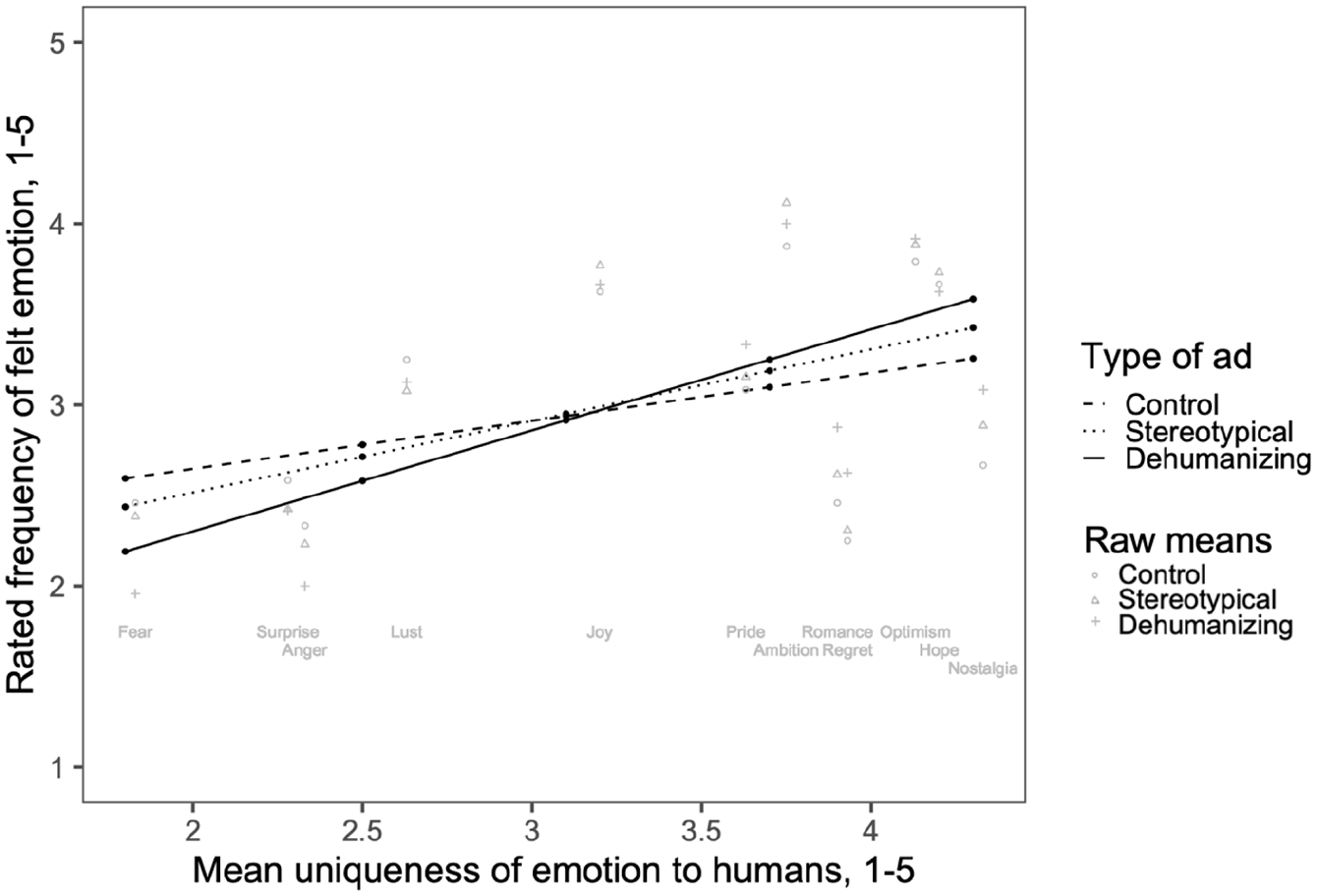
Black participants’ ratings of how frequently they experienced more versus less uniquely human emotions by condition: Experiment 1.
How did participants respond to the stereotypical (but not dehumanizing) portrayal of the Black man? When comparing the control ad to the stereotypical ad, the interaction was not significant, B = 0.13, 95% CI [−0.06, 0.32], SE = 0.10, t(801) = 1.34, p = .18, η2 = .01. Similarly, the interaction comparing the stereotypical ad to the dehumanizing ad also did not reach significance, B = 0.16, 95% CI [−0.03, 0.35], SE = 0.10, t(801) = 1.66, p = .097. We also examined the slope indexing the relationship between the extent to which an emotion was more uniquely human and the frequency with which Black participants reported feeling this emotion in the stereotypical ad condition. It also did not reach statistical significance, B = 0.40, 95% CI [−0.01, 0.80], SE = 0.21, t(11.51) = 1.89, p = .084. Thus, the stereotypical ad fell in between the control and the dehumanizing ad, without significantly differing from either.
Results did not differ substantially when we controlled for the valence of the emotion. The interaction between the type of ad viewed and the degree to which each emotion had been rated as uniquely human remained significant, F(2, 801) = 4.34, p = .013. Further, although emotion valence predicted reported emotion frequency, F(1, 801) = 6.27, p = .034, such that participants tended to report feeling positive emotions more frequently than negative emotions, there was no interaction between emotion valence and condition, F(2, 801) = 1.43, p = .24. Thus, in line with our theory, Black participants specifically emphasized their experience of uniquely human emotions relative to emotions more associated with other animals in response to a dehumanizing threat, but not more positive versus negative emotions.
Discussion
Experiment 1 provides initial evidence that Black people respond to dehumanizing threats by shifting their self-representation to emphasize their humanness. In this case, they did so by emphasizing their experience of uniquely human emotions, both positive and negative, and by de-emphasizing their experience of emotions that would link them more to animals. Thus, when threatened with group-based dehumanization, Black people cast a more uniquely human portrait of their emotional experience.
Experiment 2: Self-Complexity
Experiment 2 offered participants a different way to reassert their humanity: by providing a more complex depiction of their self-representations. To do so, Experiment 2, a preregistered replication of the supplemental experiment, gave participants an opportunity to create self-concept maps, which could vary in their complexity.
In addition, Experiment 2 included both Black and White participants to test whether the motivated reassertion of one’s humanity is specific to people whose group has been threatened by dehumanization. We predicted that only Black participants would display greater self-complexity after exposure to the dehumanization of their group.
Method
Participants
As preregistered (https://osf.io/ah837), we posted 800 openings for the study on Prolific Academic, including 400 openings for adults who had submitted demographic information indicating that they were White, and 400 openings for adults who had submitted demographic information indicating that they were Black. A total of 782 adults (389 Black, 394 White; 386 men, 386 women, 10 nonbinary, one not reported; Mage = 34.74, SD = 12.51) completed the online study and were included in analyses. A sensitivity analysis conducted with G*Power (Faul et al., 2007) indicated that, with an alpha of .05, this sample size afforded 80% power to detect an effect of approximately η2 = .01, generally considered a small effect size (J. Cohen, 1988).
Procedure
Experiment 2 employed a 2 (ad type: control ad, dehumanizing ad) × 2 (participant race: Black, White) design. As with Experiment 1, participants were told that the study was about “People and Media” and had two parts. They completed the study online via a survey administered by Qualtrics. First, participants were randomly assigned to view either the control ad or the dehumanizing ad from Experiment 1 (see Figures 3A and 3C) and responded to the same two filler questions. Unexpectedly, there was a significant effect of condition on ratings of how easy it was to read the advertisement (1 = very difficult, 7 = very easy), F(1, 780) = 19.12, p < .001, η2 = .02. Participants reported that it was more difficult to read the dehumanizing ad (M = 4.76, SD = 1.56) than the control ad (M = 5.24, SD = 1.49), Cohen’s d = 0.31. 1 All other effects were nonsignificant (all Fs < 2.11, all ps > .14).
Next, participants were told they would complete the second part of the study, which involved creating a self-concept map. Participants were first given a definition of a self-concept map: a diagram that “shows you and aspects of yourself (such as feelings, likes and dislikes, activities, strengths and weaknesses)” (for past use as an independent variable, see Gresky et al., 2005). They were provided an example of a simple self-concept map and then presented with text entry boxes into which they could list words that they would like to use to create their own self-concept map. The primary outcome was the number of words participants provided. Participants were told that they could include as many or as few words as they liked. They were first shown one empty text box and could add up to 50 words, one at a time, by clicking an “Add Word” button at the bottom of the list. See Figure 5 for screenshots of the task.
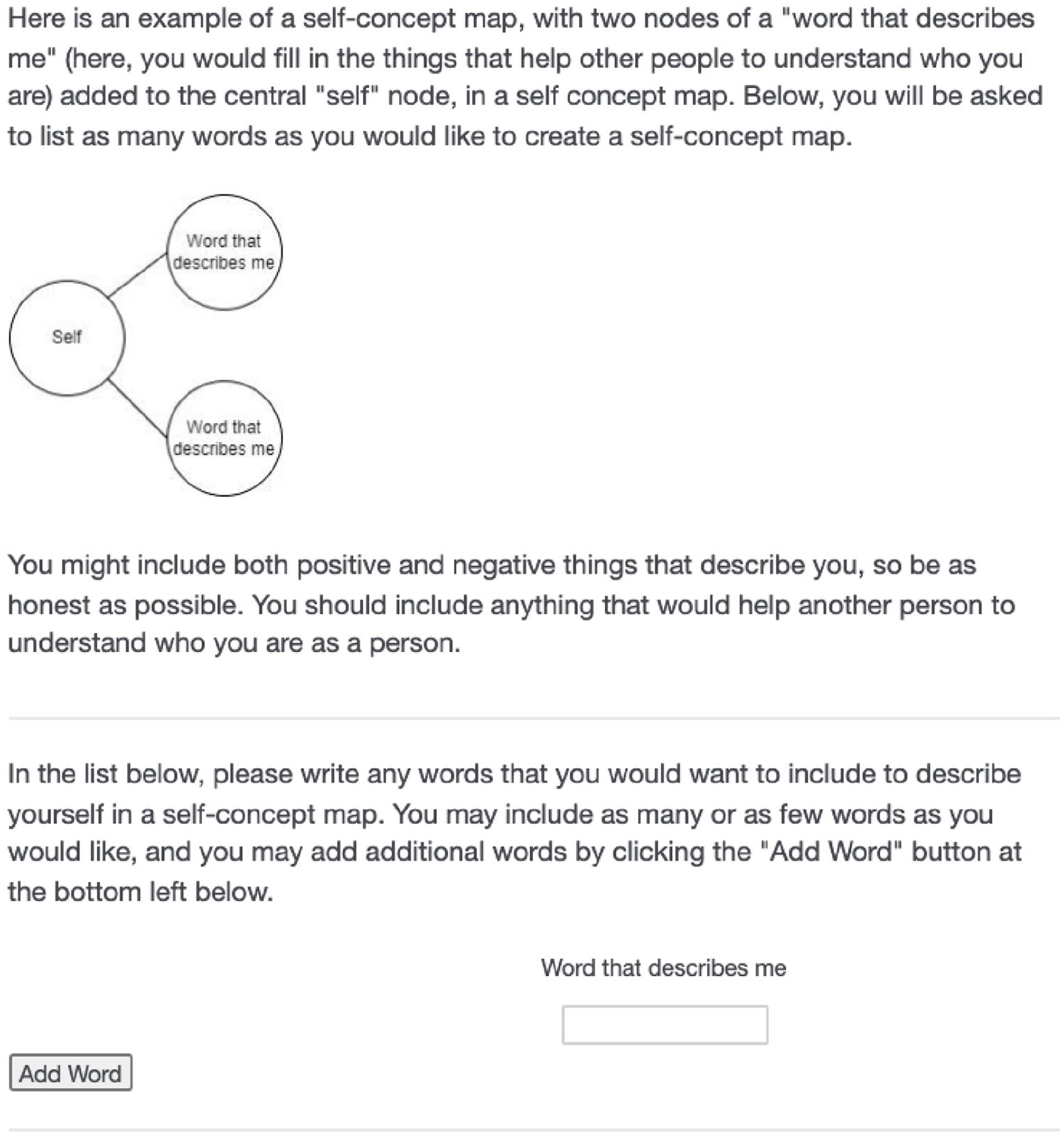
Instructions for creating a self-concept diagram: Experiment 2.
As in Experiment 1, participants were debriefed at the end of the study to help identify and mitigate any threat they may have experienced in the study. Again, some participants mentioned finding the ad inappropriate or strange, but none reported intense distress or emotions at the researchers (e.g., anger). Some instead reported learning something positive from the experience.
Results
As preregistered, participants were included in analyses only if they listed at least one word in their self-concept maps. Five participants did not list any words in their self-concept maps and were thus omitted from analyses. The number of words participants listed ranged from one to 18 (M = 4.18, SD = 2.57).
We conducted a 2 (ad type: control ad, dehumanizing ad) × 2 (participant race: Black, White) ANOVA on the number of words participants listed. There was a significant interaction, F(1, 779) = 4.46, p = .035, η2 = .01 (see Figure 6). Black participants used more words to describe themselves after having viewed the dehumanizing ad (M = 4.53, SD = 2.81) than after having viewed the control ad (M = 3.80, SD = 2.45), F(1, 779) = 7.85, p = .005, Cohen’s d = 0.28. By contrast, White participants did not differ on the number of words they included by condition (dehumanizing ad: M = 4.16, SD = 2.43; control ad: M = 4.21, SD = 2.55), F(1, 779) = 0.03, p = .86, Cohen’s d = 0.02. 2
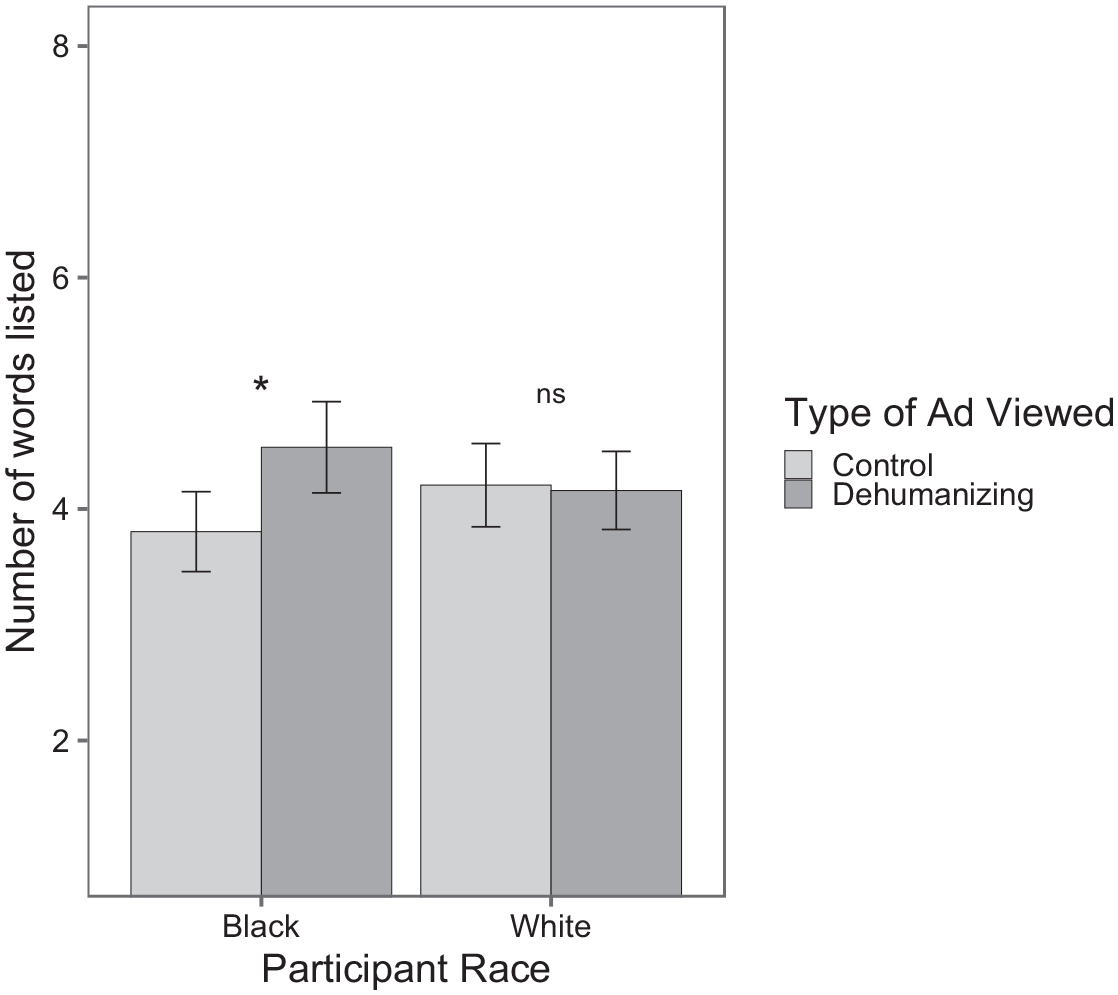
Number of words participants listed in self-descriptions by participant race and condition: Experiment 2.
Discussion
Extending Experiment 1, Experiment 2 found that Black participants depicted greater complexity in their selves in response to group-based dehumanization. Further, this effect did not surface among White participants. It emerged as a response to the dehumanization of one’s own group, highlighting its role in responding to threat rather than as a more general response.
Supplemental Experiment
Experiment 2 was a preregistered replication of a prior in-person laboratory experiment in which participants drew their own self-concept maps. Ninety-two adults (34 Black, 58 White; 35 men, 56 women, one not reported; Mage = 27.94, SD = 15.51) recruited through a university paid participant pool as well as advertisements on Craigslist took part. A sensitivity analysis conducted with G*Power (Faul et al., 2007) indicated that, with an alpha of .05, this sample size afforded 80% power to detect an effect of approximately η2 = .08, generally considered a medium effect size (J. Cohen, 1988). The sample was smaller, especially of Black adults, given the challenges in recruiting for this in-lab study. However, the in-person format may support greater engagement and thus power. Regardless, the study yielded the same pattern observed in Experiment 2.
As in Experiment 2, the supplemental study employed a 2 (ad type: control ad, dehumanizing ad) × 2 (participant race: Black, White) design. First, participants were randomly assigned to view either the control ad or the dehumanizing ad from Experiment 2, and then completed the second part of the study, which was said to involve testing an online diagramming tool by creating a self-concept map. Participants were provided with the same example of a self-concept map as in Experiment 2. Then, they were given an opportunity to practice using the tool (available at www.draw.io), could ask any questions to the research assistant, and then used the tool to create a self-concept map, which they uploaded once they were finished. Finally, they completed two filler questions about the tool (e.g., “How easy to use was the diagramming tool?”). Later, a research assistant who was blind to condition and participant race counted the number of nodes contained in each diagram. A node was defined as any circle representing an aspect of the self (i.e., the central “self” node counted as one node, and each additional circle attached to the central “self” node counted as an additional node). See Figure 7 for examples of participants’ self-concept maps. Participants’ self-concept maps ranged in complexity (Mnodes = 9.71, SD = 5.76; range: 2–29).
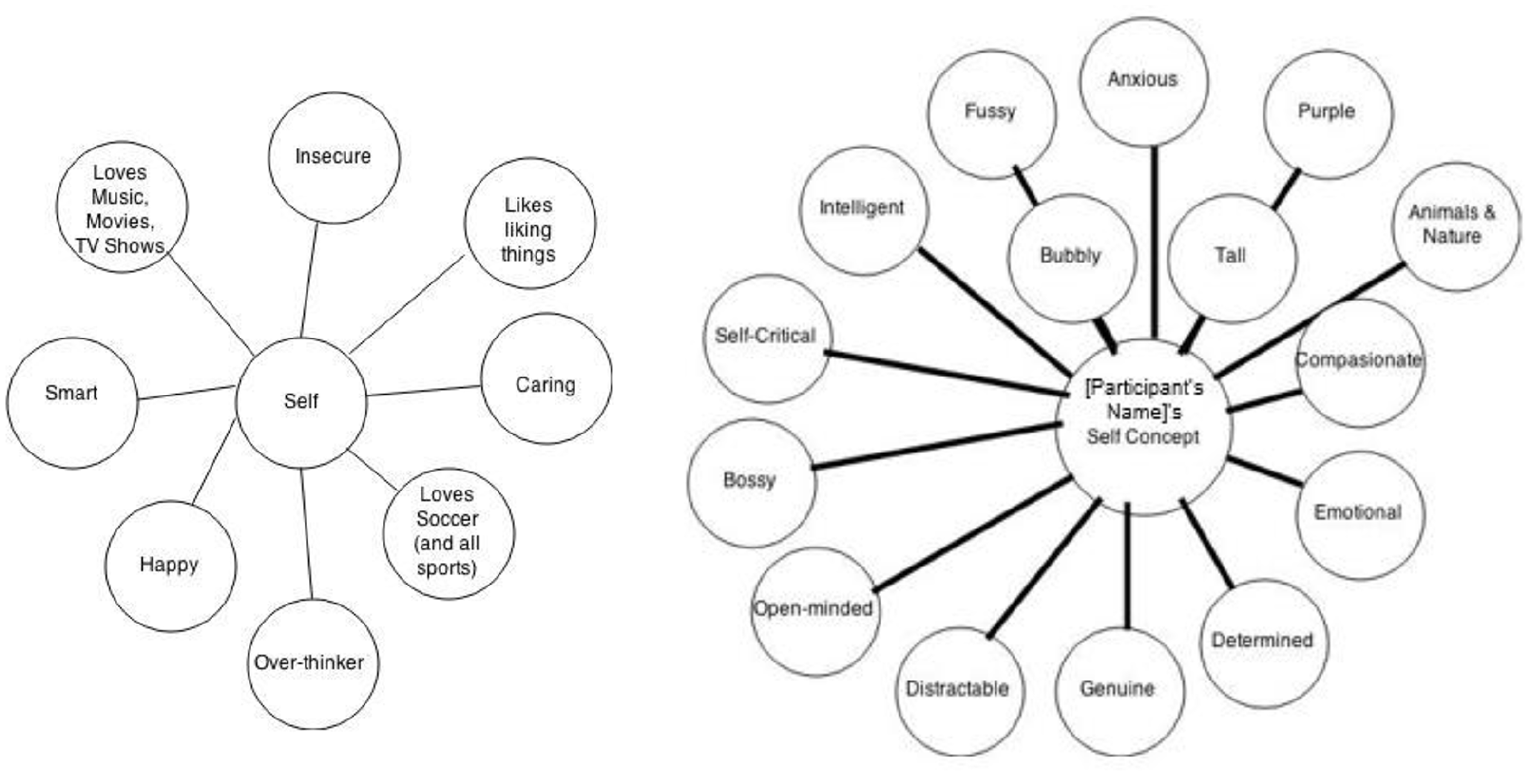
Sample self-concept maps created by participants in the supplemental experiment, including a less complex map (top, nine nodes) and a more complex map (bottom, 16 nodes).
We conducted a 2 (ad type: control ad, dehumanizing ad) × 2 (participant race: Black, White) ANOVA on the number of nodes in each participant’s diagram. There was a significant interaction, F(1, 88) = 4.05, p = .047, η2 = .04 (see Figure 8). Black participants created diagrams with more nodes after having viewed the dehumanizing ad (M = 13.41, SD = 6.96) than after having viewed the control ad (M = 8.82, SD = 5.27), F(1, 88) = 5.70, p = .019, Cohen’s d = 0.74. By contrast, White participants did not differ on the number of nodes they created after viewing the dehumanizing ad (M = 8.78, SD = 5.27) compared to the control ad (M = 9.08, SD = 5.24), F(1, 88) = 0.04, p = .84, Cohen’s d = 0.06.
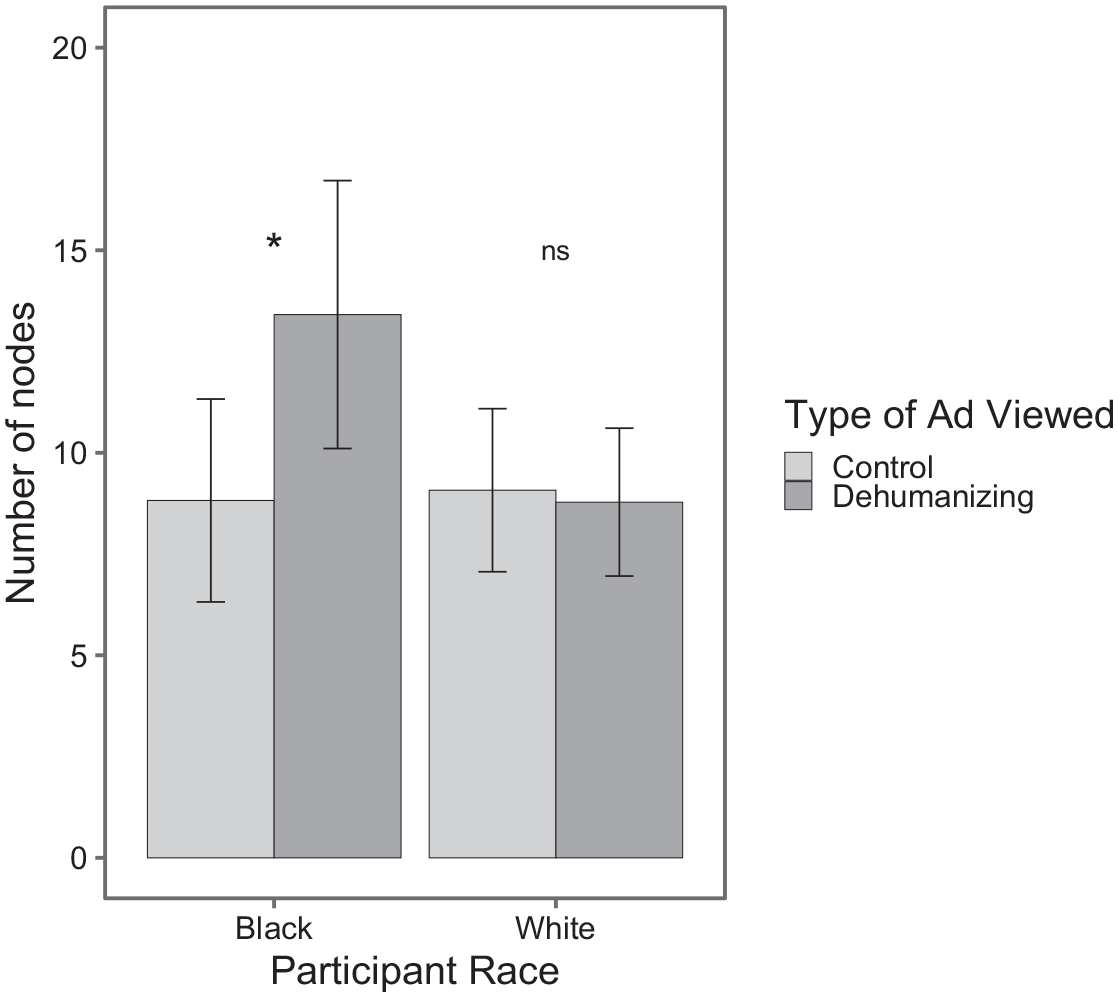
Number of nodes in participants’ self-concept diagrams by participant race and condition: Supplemental experiment.
General Discussion
In three experiments, we found evidence that Black people reassert their self-humanity—creating a more uniquely human portrait of their emotional experience (Experiment 1) and emphasizing their self-complexity (Experiment 2 and the supplemental experiment)—following exposure to an instance of group-based dehumanization. Thus, group-based dehumanization does not only prompt negative cognitive and emotional responses (Bastian & Haslam, 2011), but also assertions that illustrate the agency of targets of dehumanization to resist dehumanizing threats.
These findings join research demonstrating that people threatened with dehumanization in interpersonal contexts can actively resist this threat, for instance, by engaging in prosocial behavior (Bastian et al., 2013; Schumann & Walton, 2021). Here, in the context of group-based dehumanization, we show that people respond actively too by representing their own humanity.
Our theorizing was inspired by historical and contemporary examples of Black activists and artists who emphasized Black humanity in the face of gross dehumanization, including slavery and police brutality. Yet our studies tested a less overt, everyday instance of dehumanization—an advertisement that merely juxtaposed an image of a Black man with that of an ape and referenced a “jungle.” Thus, the results suggest that people may reassert their humanness in response to a broad range of common dehumanizing experiences.
Limitations and Future Research
In demonstrating that people reassert their self-humanity in response to group-based dehumanization, a major contribution of the present research is to point the way toward a wide range of future research that explores the nature and consequences of this agency.
Audience effects on the motivation to reassert self-humanity
The present studies were conducted in relatively private settings with no clear audience for either the dehumanizing experience or for participants’ reassertion of their humanity. Perhaps, then, this response was mostly inwardly directed, to represent oneself as human first for oneself.
In the real world, however, people attempt to rehumanize themselves in both private and highly public contexts, such as in interviews, protests, and artistic representations (e.g., “My People”). How does the motivation to reassert one’s humanity change when people have an audience for their efforts? How does it change as a function of the nature of this audience? For example, might people be motivated to emphasize their humanness deliberately to shape outgroup members’ perceptions of them? Steele (2011) discusses how Brent Staples, an African American editorialist for The New York Times would “whistle Vivaldi” as a graduate student on the south side of Chicago to deflect stereotypical perceptions of him as a menacing Black man. Perhaps dehumanized individuals might emphasize their humanity to outgroup audiences in an effort to foster positive perceptions of and behavior toward themselves and their group. But they might also emphasize their humanity with fellow group members to strengthen ingroup ties and call people to action—as captured by Black Lives Matter founder Patrisse Cullors, who said, “more importantly, it reminds black people that we are human.” Given these distinct goals, are people more motivated to reassert their humanity, or does this reassertion take a different form, in public compared to private contexts where either dehumanization or one’s response to it is visible to ingroup or outgroup members?
Downstream consequences
What effects does reasserting one’s self-humanity in response to group-based dehumanization have with regard to people’s own self-concept, emotions, or cognitive functioning, or for how they are viewed or treated by others?
Limitations of the present research for exploring downstream consequences for the self
In conducting Experiment 2, we originally assumed that people who were dehumanized and had reasserted their humanity might experience benefits for the self. However, we have come to believe that the present studies were ill-equipped to explore these consequences. If people are able to counter the threat of dehumanization by reasserting their humanity, they may not differ on downstream measures from people not exposed to such dehumanization. If so, what is needed to explore the restorative benefits of the reassertion of humanity is a condition in which people are exposed to dehumanization but have not (yet) had the opportunity to reassert their humanity.
Nevertheless, Experiment 2 included several additional measures to begin to explore potential downstream consequences. Following the primary self-concept map measure, Experiment 2 assessed (a) authentic pride (Carver et al., 2010) and (b) self-integrity (Sherman et al., 2009). There was no effect of condition on either outcome for either Black or White participants (see the supplemental material). That is, exposure to dehumanization caused no negative or positive effect on these outcomes after Black participants had been given the opportunity to reassert their humanity, as compared to Black participants who were not exposed to dehumanization. There was also no correlation between the number of words participants included in their self-concept maps and these outcomes for either Black or White participants, in either condition.
Although it is possible that there simply is not a causal relationship between the reassertion of humanity and such outcomes, it is also possible that this null effect obscures a complex dynamic. If the degree of effort people put into creating complex self-concept maps reflects, in part, the degree of threat they felt, and this response has a restorative effect, then engaging in rehumanization would leave the person back at baseline. Future studies that aim to understand the functionality of the reassertion of humanity for the self may need to expose people to dehumanization and vary whether they have had the opportunity to reassert their humanity or not. One approach would be to manipulate the order in which the opportunity to reassert one’s humanity and downstream measures are assessed. It could also be necessary to take steps to (temporarily) prevent people from reasserting their humanity.
Consequences for the self
Does reasserting one’s humanity carry benefits for the self? If so, what kinds of benefits should we predict, whether reduced negative self-directed thoughts and behaviors; greater efficacy, agency, and positive identity; or restored feelings of self-humanity? There are reasons to anticipate these benefits. First, self-complexity theory posits that, in general, possessing a greater number of independent self-aspects serves self-protective functions (Linville, 1985), including to strengthen one’s ability to cope with harmful events (Koch & Shepperd, 2004). Indeed, many psychological interventions may function by restoring a “broader working self” in circumstances where the self has been defined and narrowed by threat (Walton et al., 2012, p. 142). Perhaps, then, reasserting one’s humanity in the face of dehumanization, an assertion that calls to mind the richness and complexity of one’s self and one’s group, would serve a broadening and self-protective function. Consistent with this theorizing, past research using self-concept maps as an independent variable finds that experimentally varying whether people create complex (vs. simple) self-concept maps can buffer them against stereotype threat, improving academic performance (Gresky et al., 2005). Relatedly, inviting people to consider diverse aspects of their individual identity (Ambady et al., 2004) and priming them with positive aspects of their culture (Brannon et al., 2015) can buffer against group-based threats, enhancing intellectual performance and creativity.
Such benefits may arise once a broader representation of the self or one’s group is complete. Yet the process of having to engage in rehumanization could also have negative cognitive consequences, for instance, if doing so poses a burden or psychological tax, one that may be evident using measures of cognitive depletion (Salvatore & Shelton, 2007) or manifest in reduced cognitive performance (Logel et al., 2009).
Second, the threat people experience in response to dehumanization may be to both their sense of control in the world and their sense of deep and genuine social connection to others, both basic human needs in many psychological theories (e.g., Dweck, 2017). Past research shows that when people are treated in ways that honor the agency and strength of their identities, they feel more efficacious and show greater academic persistence and success (e.g., among refugees: Bauer et al., 2021; low-income students: Hernandez et al., 2021; aid recipients: Thomas et al., 2020). In the context of group-based dehumanization, does reasserting one’s humanness in service to one’s group restore this sense of control and connection and thus confer benefits?
Third, in the context of interpersonal offenses that threaten people’s self-humanity, past research finds that people reassert their humanity both as perpetrators and as victims. For instance, after having harmed others, people choose to behave prosocially, perhaps as a way to reconnect to a moral, human community (Bastian et al., 2013). Likewise, when victims forgive interpersonal offenses they can restore a sense of humanity, in part, it seems, because this helps them feel they have acted in line with moral values fundamental to being human (Schumann & Walton, 2021). Would reasserting one’s humanness in the context of group-based threats, such as by representing the complexity of one’s self, also restore this sense of self-humanity? Would the audience for such self-assertions matter, or how others (in- or outgroup members) respond?
In exploring all these outcomes, it may be valuable to consider both explicit and implicit measures, and whether these converge or diverge.
Consequences for social perception and treatment
In public contexts, when might efforts to rehumanize oneself succeed in the eyes of others and when might they not? If a member of a dehumanized group describes their complex emotional experiences in an interview or reads a poem that evokes the multifaceted identity of their group, are they or is their group rehumanized in the eyes of the audience? And if they are, what positive consequences might that rehumanization have, such as in attitudes or behavior toward members of the group? Or are there cases where such reassertions could elicit a form of reactance? Certainly, real-world examples suggest that members of frequently dehumanized groups can be rehumanized in consequential ways. During the trial over George Floyd’s murder, The New York Times noted how the prosecution presented George Floyd as a “full person” throughout the process, calling witnessing who described Floyd’s love for his family and using the word human more than a dozen times in their closing arguments (Arango et al., 2021). An alternate juror noted that the prosecution put “a face of a human being to the name of George Floyd” in ways that provoked a profound sense of empathy. As this example suggests, could reasserting humanity increase empathy and affect sentencing in criminal justice contexts?
The nature of the dehumanization
How people are dehumanized varies widely. Another direction for future research is to explore this variability and how it affects the agency people take in responding.
Robust versus minimal cues
Drawing from real-world examples and past research (e.g., Bongiorno et al., 2013), we manipulated dehumanization via an advertisement, varying multiple aspects of the stimuli (i.e., both words and images) to create a robust manipulation. Future research could explore which elements are most powerful, and whether a minimal manipulation (e.g., only images) could be sufficient to motivate people to reassert their self-humanity.
Diverse forms of dehumanization
In the present research, we examined a form of dehumanization that linked Black people to apes. We then gave Black participants opportunities to reassert their self-humanity by showing how they were not like apes—that is, by showcasing their emotional and self-complexity. However, we theorize that the specific form dehumanization takes shapes how people respond (Bastian & Haslam, 2011). In general, we presume that people will reassert their humanity in ways that respond best to the threat at hand. If a dehumanizing portrayal implies that a group lacks morality, would people reassert humanity by emphasizing uniquely human moral emotions? If presented with dehumanization that discredits one’s thinking or cognitive abilities, might people emphasize their rationality or intelligence (Tipler & Ruscher, 2014)? If portrayed as robot-like, might people emphasize their creativity, a skill that sets humans apart from machines (Puccio, 2017)?
Agency in diverse groups, potential boundary conditions, and intersectionality
Relatedly, it will be interesting to explore the agency diverse groups beyond Black Americans take in response to dehumanization (Haslam & Stratemeyer, 2016). This might include Asians, who might be seen as machines or robots (Bain et al., 2009); immigrants, who might be seen as “vermin” (Marshall & Shapiro, 2018) or “aliens” (Epps & Furman, 2016); religious groups, such as Muslim refugees who might be seen as “wild beasts” (Bruneau et al., 2018); people with certain mental illnesses, who might be seen as lacking restraint (Martinez et al., 2011); professional groups, such as service personnel who might feel used only as a tool (Fisk & Neville, 2011); gender groups, such as women who might feel reduced to sexual objects (Moradi & Huang, 2008); and certain social class groups, such as low-SES individuals who might be called “White trash” or “deplorables” in the US (Loughnan et al., 2014). What agency do these groups express in responding to the dehumanization they face? How does this vary? What effects does it have?
In addition to the nature of the dehumanizing threat a group faces, it may be important to consider the role of group identity in understanding whether and how people reassert their humanity. Perhaps collective efforts to raise consciousness about group-based dehumanization (as in the Black Lives Matter movement, among others) equip individuals to respond more efficiently to reassert their self-humanity in response to such threats (see Sullivan et al., 2021), rather than experiencing self-dehumanization passively. If this is the case, perhaps people who are more identified with a group that resists such threats may show a greater rehumanization response: They may be more threatened by group-based threats (Schmader, 2002; see also King, 2003), feel a stronger need to resist these threats, and be better equipped to do so.
Another potentially important factor involves intersectionality (Rosenthal, 2016). Because the dehumanizing ad in our studies portrayed a Black man, the threat could be particularly potent for Black men. However, there was no consistent evidence for moderation by gender; for instance, in the preregistered Experiment 2, the three-way interaction between ad type, race, and gender was nonsignificant, F(1, 764) = 0.49, p = .49, η2 = .00. Future research designed specifically to explore intersectionality may probe when and how different sociodemographic categories including race, gender, and socioeconomic status interact to motivate people to reassert their humanity in response to group-based dehumanization.
Rehumanization over time in real-world settings
Another important direction involves going beyond laboratory studies and immediate outcomes to explore how people reassert their humanity in the real world and over time, such as in field studies using daily diary methods. For instance, in response to naturally occurring dehumanizing events, might people seek out opportunities to express their uniquely human emotions or their multifaceted selves in disclosing to friends or self-expressing on social media? What consequence would such responses have?
Additionally, field experiments could test strategies to equip people to respond effectively to instances of dehumanization, such as through raising consciousness of a toxic aspect of the culture, offering adaptive ways of making sense of and responding to these events, and helping people internalize and commit to these responses such as by giving advice to others (cf. Strahan et al., 2008; for a review, see Walton & Wilson, 2018). Would such strategies help people reassert their humanity in response to naturally occurring dehumanization and, thus, improve their experience in response to such events?
Conclusion
Throughout history, members of groups that have faced dehumanization at the hands of others have responded by showcasing the very humanity they were denied. The impulse to reassert one’s humanness in light of oppression appears in the words of activists protesting excessive police force against the Black community, in the writing of novelists and poets, and in the slogans adopted by abolitionists. Inspired by such examples, the current research provides initial empirical evidence that members of dehumanized groups reassert their humanness by emphasizing the complexity that makes them human.
Supplemental Material
sj-docx-1-gpi-10.1177_13684302221095730 – Supplemental material for “Am I not human?”: Reasserting humanness in response to group-based dehumanization
Supplemental material, sj-docx-1-gpi-10.1177_13684302221095730 for “Am I not human?”: Reasserting humanness in response to group-based dehumanization by Cristina Baldissarri, Stéphanie Demoulin, Nour Kteily, Lauren C. Howe, Karina Schumann and Gregory M. Walton in Group Processes & Intergroup Relations
Footnotes
Acknowledgements
The authors would like to thank Lauren Aguilar for contributions to the development of this research and members of the Dweck–Walton Lab for valuable feedback. The authors would also like to thank Jacob Elder and Christopher Gantan for invaluable support with data collection.
Funding
The author(s) received no financial support for the research, authorship, and/or publication of this article.

Supplemental material
Supplemental material for this article is available online.
Notes
References
Supplementary Material
Please find the following supplemental material available below.
For Open Access articles published under a Creative Commons License, all supplemental material carries the same license as the article it is associated with.
For non-Open Access articles published, all supplemental material carries a non-exclusive license, and permission requests for re-use of supplemental material or any part of supplemental material shall be sent directly to the copyright owner as specified in the copyright notice associated with the article.
