




Abstract
People who eat meat generally expect vegan food to taste bad. We theorize that this expectation stems in part from the perception that veganism is symbolically threatening; devaluing vegan food may enable meat-eaters to defend in-group values and defuse symbolic threat. We conducted four studies (total N = 1,563) on meat-eaters residing in the US. In Studies 1a and 1b, participants who most strongly endorsed carnism—the ideology that humans have a right to eat animals and their byproducts as food—were most likely to expect vegan food to taste bad. In Study 2, perceptions of veganism as symbolically threatening explained the relationship between carnism and taste expectations. In Study 3, experimentally increasing the salience of symbolic threat worsened taste expectations. Attachment to dominant group values and perceptions of intergroup threat may be barriers to the acceptance of veganism.
Increased consumption of vegan food products can promote a healthier and more sustainable future: Replacing traditionally animal-derived products with vegan alternatives would combat many chronic diseases (e.g., heart disease, diabetes) while leaving a lower environmental footprint (Tilman & Clark, 2014; Willett et al., 2019). For example, switching from a typical omnivorous diet to a vegan diet yields more than a 50% reduction in expected carbon dioxide emissions (Meier & Christen, 2013). The potential for veganism to benefit health and sustainability, however, is undermined by expectations that vegan food products taste far worse than traditional products (Sekhon et al., 2019). Based on intergroup threat theory (Stephan & Stephan, 2000; Stephan et al., 2015), we posit that vegan food may be unappealing in part because it poses symbolic threat. To the extent that people ideologically support meat consumption, and in turn perceive veganism as a threat to their way of life, they may devalue vegan food and render it unappealing.
Underlying the consumption of meat, dairy, and eggs is a dominant ideology that philosophers and psychologists have termed carnism: a system of moral beliefs that condones the consumption of certain animals and their byproducts as food (Joy, 2010). Carnism is a latent ideology in most cultures, where consuming animal products is a default behavior. It explains why dogs are human companions whereas cows are human food, even though both species have the capacity to suffer (Joy, 2010). Humans have eaten animals as meat throughout much of our species’ evolution, and carnism provides an ideological system that legitimizes and normalizes the consumption of certain nonhuman animal species—and, in doing so, validates notions of human dominance and encourages system-justifying moral disengagements (Monteiro et al., 2017). People who strongly value carnism are likely to perceive this ideology as being under threat when animal products are challenged as a dietary default, which can strengthen ideological defenses that secure the status quo endorsing meat consumption (Graça et al., 2016; Monteiro et al., 2017; Piazza et al., 2015; Rothgerber, 2020).
The divide between veganism and carnism is not simply an ideological difference but also a conflict of social identities. In deciding to avoid animal products, vegans represent a distinct social group that categorically opposes the omnivorous majority (Nezlek & Forestell, 2020; Rosenfeld & Burrow, 2018). The term “vegan” itself was created for social identity purposes as a group of vegans in the 1940s sought to describe themselves concisely and uniquely (The Vegan Society, n.d.). Veganism as a behavior lacks psychological significance without inherently considering the people who practice this behavior. Vegans constitute a social group imbued with ideological significance as a campaign for animal rights (De Groeve & Rosenfeld, 2022), and the proliferation of vegan food throughout society represents the expansion of this social group. By rejecting vegan food, meat-eaters directly oppose the suitability of vegan food and thus can indirectly reject the status of vegans as a social group—whether or not meat-eaters perceive vegans as a salient out-group in the moment.
Intergroup threat theory (Stephan & Stephan, 2000; Stephan et al., 2015) posits that symbolic threats—threats to an individual’s values and belief systems—are central sources of intergroup hostility. Veganism can be symbolically threatening, as it challenges carnism’s rank as a morally embedded status quo condoning animal-product consumption (Dhont & Hodson, 2014; MacInnis & Hodson, 2017; Stanley, 2022). According to intergroup threat theory, perceiving symbolic threats can prompt individuals to derogate the source of threat, developing intolerance for and hatred toward the out-group (Stephan et al., 2015). Indeed, meat-eaters appear to be reactive to symbolic threats that challenge the moral status of carnism, as they are particularly inclined to derogate vegans who eschew animal products for animal rights reasons versus health or environmental reasons (MacInnis & Hodson, 2017). Most people who follow a vegan diet do so as a moral stance supporting animal rights, rather than for health or environmental reasons (Janssen et al., 2016), underscoring the ideological contrast between carnism and the mainstream vegan movement. Veganism as a concept challenges long-standing values and traditions surrounding human–animal intergroup relations, which may drive stigmatization of individuals who consume vegan foods (Dhont & Hodson, 2014; MacInnis & Hodson, 2017).
Much evidence based on intergroup threat theory supports a link between intergroup threat and negative out-group attitudes (Riek et al., 2006; Rios et al., 2018; Stephan et al., 2015), especially among individuals who identify strongly with the group under threat (Rios et al., 2018). Drawing from this empirical foundation, we theorize that individual differences in carnism may explain attitudes toward veganism. Because vegans are inherently defined by what they eat, we reason that having negative attitudes toward vegans as a social group involves devaluing veganism’s group identity symbol: its food. In other words, we suggest that perceiving intergroup threat may influence attitudes toward not only out-group members but also out-group customs.
In effect, the prospect that vegan alternatives could become more mainstream poses a threat to carnism, and consumers endorsing this ideology may defend it from symbolic threat by rejecting vegan alternatives. We propose that people who strongly endorse carnism may be particularly likely to devalue vegan food in order to defuse its greater perceived symbolic threats.
Overview of the Current Studies
Through four studies, we investigated whether meat-eaters who endorse carnism most strongly and perceive veganism to be symbolically threatening are most inclined to reject vegan food. In Studies 1a and 1b, we tested whether expectations that vegan food products taste worse than conventional food products are amplified among meat-eaters who endorse carnism most (vs. least) strongly. If high-carnism meat-eaters reject vegan food especially intensely, then it may be the case that veganism seems highly symbolically threatening to these meat-eaters and that this perceived threat underlies taste rejection. In Study 2, thus, we tested perceived symbolic threat as a mediator of the relationship between carnism and expectations of vegan foods’ tastiness. In Study 3, we sought causal evidence for a path from perceived symbolic threat to taste rejection. Thus, in this last study, we experimentally tested whether meat-eaters’ expectations about the tastiness of vegan food would worsen when symbolic threat became salient. All studies conducted in this series of studies are reported here. Materials for all studies are available at the Open Science Framework (OSF; https://osf.io/5fpt4/?view_only=cd2f5edcfe224777a91a366f275e3b2e).
Studies 1a and 1b
In Studies 1a and 1b, we hypothesized that expectations about the tastiness of vegan food products compared to conventional food products would be particularly unfavorable among meat-eaters who score higher (vs. lower) in carnism. We tested this hypothesis using between-subjects designs wherein one half of participants reported their attitudes toward vegan products, whereas the other half reported attitudes toward conventional animal-based products. Through these designs, we sought to reduce biased responses that might emerge if one sample of people were to compare vegan and animal-based products directly. To rule out potential confounds and isolate the unique effect of carnism, we accounted for two factors that appear to covary with both carnism and attitudes toward veganism: gender and political ideology. Men (vs. women) and conservatives (vs. liberals) tend to exhibit more pro-carnism sentiments and more negative attitudes toward veganism (De Groeve & Rosenfeld, 2022; Graça et al., 2018; Judge & Wilson, 2018; MacInnis & Hodson, 2017; Monteiro et al., 2017). Accordingly, we partialled out variance in taste ratings from gender and political ideology effects so as to test whether individual differences in carnism account independently for variance.
Across Studies 1a and 1b, we tested our hypothesis using two data sets that we had previously collected. Given that we planned these analyses after data collection was complete, we took two considerations to minimize the chance of reporting a false positive effect. First, Study 1b served as a conceptual replication and extension of Study 1a, which allowed us to evaluate reliability across different samples and materials. Second, in Study 2, we conducted a preregistered direct replication of the primary effects tested in Studies 1a and 1b, whereby higher carnism is theorized to predict worse expectations about vegan food.
Study 1a
In Study 1a, we investigated participants’ expectations of how vegan burgers taste. We examined expectations among a sample of meat-eaters who had tasted a conventional burger but had never tasted a vegan burger. We excluded participants who reported having already tasted a vegan burger in order to examine uninformed expectations about vegan foods’ tastiness. In doing so, we sought to focus our analysis on identifying a potential effect of carnism—rather than an effect of previous eating experiences—on people’s judgments about vegan food.
Participants were randomly assigned to report either (a) how much they like the taste of most burgers or (b) how much they expect they would like the taste of a vegan burger. We hypothesized that expectations about a vegan burger’s tastiness would be worse than reported tastiness of conventional burgers, and that this effect would be amplified among participants who endorse carnism most strongly.
Method
Participants
Participants were 700 adults from the US, recruited via Amazon Mechanical Turk (MTurk). After excluding 413 participants who had tried a vegan burger, seven who self-identified as vegetarian/vegan, one who self-identified with a nonbinary gender, and four who failed an attention check in the survey, 275 participants (149 men, 126 women) between the ages of 18 and 75 (Mage = 39.76, SD = 13.16) were retained for analyses.
Findings from previous research suggest that the difference in expected tastiness of vegan versus conventional food is very large (Sekhon et al., 2019). In evaluating this study’s sample size, we accounted for a large effect of burger type on taste. A power analysis using G*Power 3.1 (Faul et al., 2007) specifying a medium effect of d = 0.80 revealed that a total sample of 52 participants would provide 80% power at α = .05, two-tailed. Under full support for our carnism moderation hypothesis, we would observe that high-carnism participants expect vegan burgers to taste worse than conventional burgers, whereas low-carnism participants report no taste difference by burger type. Based on guidelines by Giner-Sorolla (2018), which suggest multiplying the estimated main-effect sample size by 4 to detect this type of interaction effect, we estimated an optimal minimum sample of 208. Thus, our sample of 275 participants provided adequate power for our predicted effect.
Materials
Carnism
Endorsement of carnism was assessed by the eight-item Carnism Inventory (α = .82; Monteiro et al., 2017). An example item on this scale is, “Humans should continue to eat meat because we’ve been doing it for thousands of years.” Responses ranged from 1 (strongly disagree) to 7 (strongly agree).
(Expected) tastiness
Tastiness of conventional burgers was assessed by the following four-item scale (α = .94): “Most burgers taste. . .”; “The flavor of most burgers is. . .”; “The texture of most burgers is. . .”; and “The juiciness of most burgers is. . .” (1 = very bad, 7 = very delicious). Expected tastiness of vegan burgers was assessed by an analogous four-item scale (α = .96) capturing forecasted liking: “Vegan burgers probably taste. . .”; “The flavor of a vegan burger is probably. . .”; “The texture of a vegan burger is probably. . .”; and “The juiciness of a vegan burger is probably. . . .”
Procedure
After providing informed consent, participants complete the measure of carnism, indicated their political ideology on a scale from 1 (very liberal) to 7 (very conservative), and indicated their gender in a randomized order. Next, participants were randomly assigned to report tastiness (or expected tastiness) of either a conventional burger or a vegan burger.
Results and discussion
Data, analysis scripts, and codebook are available at the OSF (https://osf.io/89yz3/?view_only=9d38a4a26c634a72b6e7c5b1d25b694b).
On average, participants expected vegan burgers to taste mediocre (M = 3.34, SD = 1.43) but enjoyed the taste of conventional burgers very much (M = 5.99, SD = 1.01). Participants tended to endorse carnism weakly to moderately (M = 3.35, SD = 1.00). On average, participants were moderate in political ideology (M = 3.78, SD = 1.82). Bivariate correlations between variables are reported in Table 1.
Bivariate correlations between variables, stratified by study condition: Study 1a.
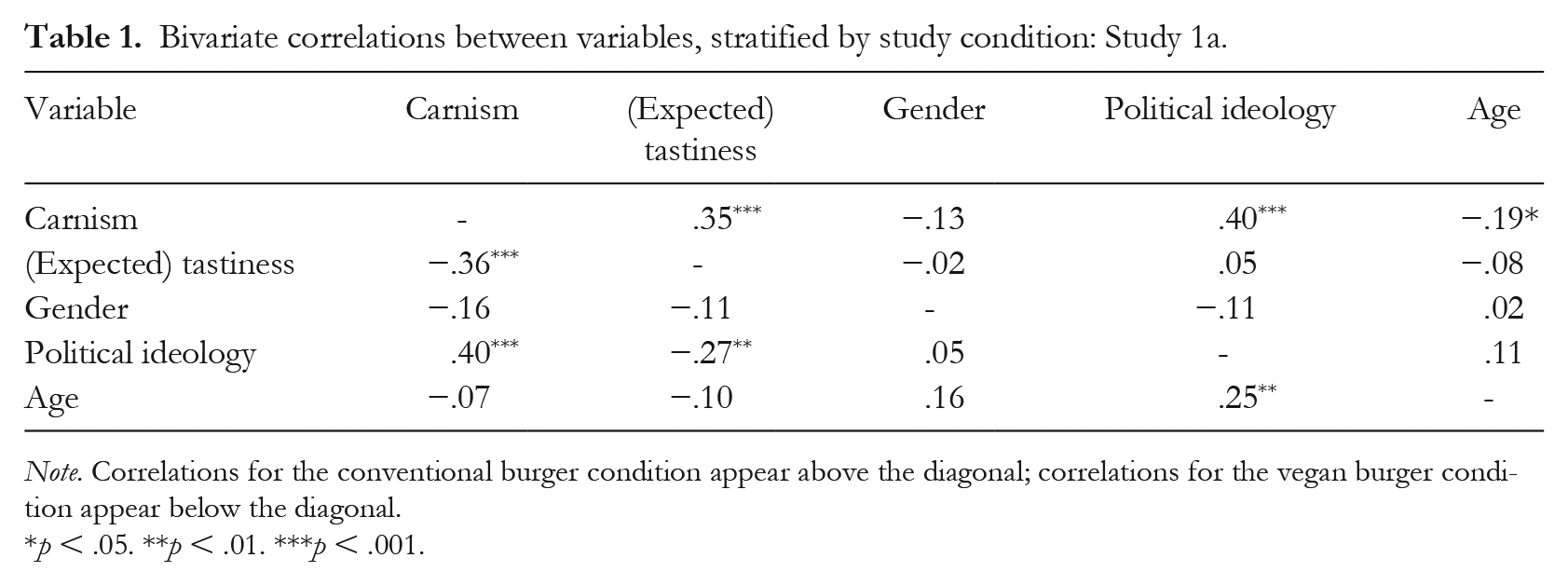
Note. Correlations for the conventional burger condition appear above the diagonal; correlations for the vegan burger condition appear below the diagonal.
p < .05. **p < .01. ***p < .001.
We conducted a hierarchical ordinary least squares (OLS) regression to test whether the expectation that vegan burgers would taste worse than conventional burgers was amplified among participants who endorsed carnism most (vs. least) strongly. In the first step, we regressed (expected) tastiness on burger type, carnism, and their interaction term. Condition was dummy-coded such that the conventional burger condition was assigned a value of 0, and the vegan condition a value of 1; carnism was centered at its mean. This analysis revealed support for our hypothesis (see Figure 1 and Table 2): Carnism moderated the effect of burger type on (expected) tastiness at a medium effect of β = −.24. In a second step of the regression, we accounted for our two covariates—gender and political ideology—by adding their interaction terms with burger type and their lower order terms into the previously tested regression model. Gender was dummy-coded such that status as a man was assigned a value of 0, and as woman a value of 1; political ideology was centered at its mean. In this model, carnism remained a significant moderator of the effect of burger type on (expected) tastiness at the same magnitude as observed without adjusting on any covariates, β = −.24.
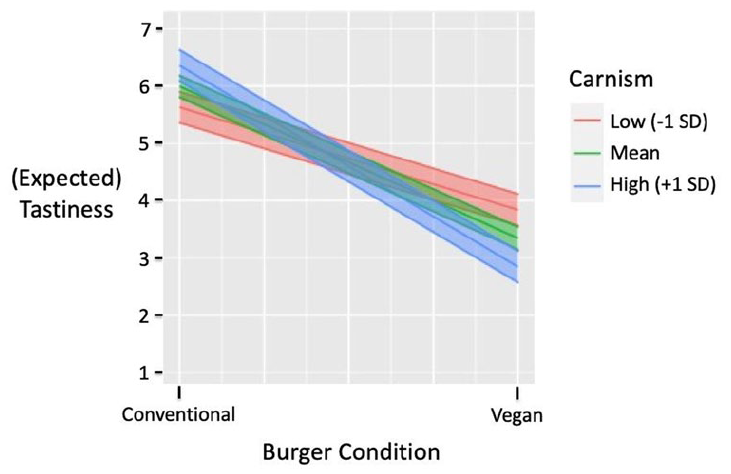
Interaction effect between burger type and carnism on (expected) tastiness: Study 1a.
Hierarchical OLS regression testing whether the expectation that vegan burgers would taste worse than conventional burgers was amplified among participants who endorsed carnism most (vs. least) strongly: Study 1a.
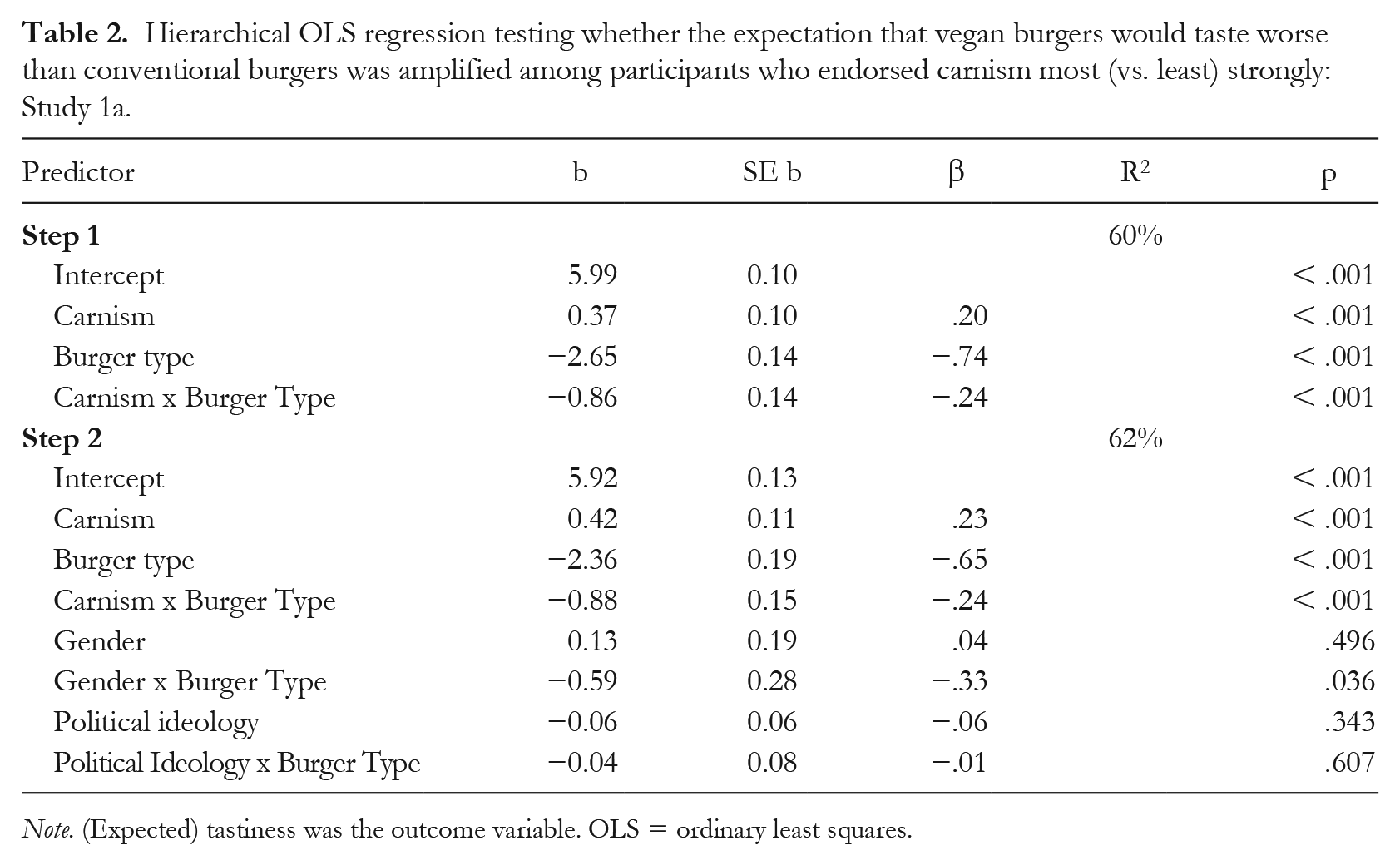
Note. (Expected) tastiness was the outcome variable. OLS = ordinary least squares.
Simple slopes analyses revealed that the effect of burger type on (expected) tastiness was larger for participants who endorsed carnism most strongly (1 SD or more above the mean), b = −3.74, SE = 0.37, 95% CI [−4.47, −3.00], β = −.84, t(42) = 10.23, p < .001, than it was for participants who endorsed carnism least strongly (1 SD or more below the mean), b = −1.41, SE = 0.37, 95% CI [−2.17, −0.65], β = −.50, t(43) = 3.76, p < .001. For participants in the conventional burger condition, carnism was positively associated with tastiness, b = 0.37, SE = 0.08, 95% CI [0.20, 0.53], β = .35, t(142) = 4.49, p < .001. Meanwhile, for participants in the vegan burger condition, carnism was negatively associated with expected tastiness, b = −0.50, SE = 0.11, 95% CI [−0.72, −0.27], β = −.36, t(129) = 4.39, p < .001.
These findings suggest that meat-eaters who endorse carnism more strongly are most inclined to expect that vegan burgers will taste most inferior to conventional burgers.
Study 1b
In Study 1a, ratings of (expected) tastiness were far lower in the vegan burger condition than conventional burger condition, suggesting that consumers expect vegan burgers to taste worse than their animal-derived counterparts. Stronger endorsement of carnism was associated with worse expectations about a vegan burger’s tastiness.
Notably, burgers are a form of meat, and of all types of animal products legitimized for consumption by carnism (e.g., meat, seafood, eggs, dairy), meat would likely be considered the most symbolic and prototypical. Meat is excluded not just from a vegan diet, but also from less strict vegetarian and pescatarian diets, and the consumption of animal flesh as meat is the clearest enactment of carnism (Joy, 2010). Contrasting perceptions of vegan food with perceptions of meat as we did in Study 1 thus posed a direct, liberal test of our theorizing. To test our hypothesis more conservatively in Study 1b, we asked: Is this effect specific to meat, or is it generalizable to another animal product—dairy—as well? Study 1b served as a conceptual replication of Study 1a focusing on ice cream instead of burgers. All hypotheses mirrored those set in Study 1a.
Method
Participants
Participants were 500 adults from the US, recruited via MTurk. After excluding 53 participants who had tried vegan ice cream, 39 who self-identified as vegetarian/vegan, one who self-identified with a nonbinary gender, and three who failed an attention check in the survey, 404 participants (196 men, 208 women) between the ages of 20 and 72 (Mage = 40.50, SD = 11.95) were retained for analyses. Based on our power analyses outlined in Study 1a, this sample provided at least 80% power to detect our theorized interaction effect, with a large condition effect, at α = .05, two-tailed.
Materials
Carnism
Carnism (α = .84) was assessed as in Study 1a.
(Expected) tastiness
Tastiness of typical dairy ice cream was assessed by the following four-item scale (α = .92): “The taste of ice cream is. . .”; “The flavor of ice cream is. . .”; “The texture of ice cream is. . .”; and “The consistency of ice cream is. . .” (1 = very bad, 7 = very delicious). Expected tastiness of vegan ice cream was assessed by an analogous four-item scale (α = .95) capturing forecasted liking: “The taste of vegan ice cream would probably be. . .”; “The flavor of vegan ice cream would probably be. . .”; “The texture of vegan ice cream would probably be. . .”; and “The consistency of vegan ice cream would probably be. . . .”
Procedure
The procedure mirrored that of Study 1a.
Results and discussion
Data, analysis scripts, and codebook are available at the OSF (https://osf.io/mazve/?view_only=c4cf5db833f041e4b1d9e210eefa01b4).
On average, participants expected vegan ice cream to taste mediocre (M = 3.86, SD = 1.47) but enjoyed the taste of conventional ice cream very much (M = 6.44, SD = 0.74). Participants tended to endorse carnism weakly to moderately (M = 3.15, SD = 1.02). On average, participants were fairly moderate in political ideology, with a slight liberal leaning (M = 3.61, SD = 1.76). Bivariate correlations between variables are reported in Table 3.
Bivariate correlations between variables, stratified by study condition: Study 1b.
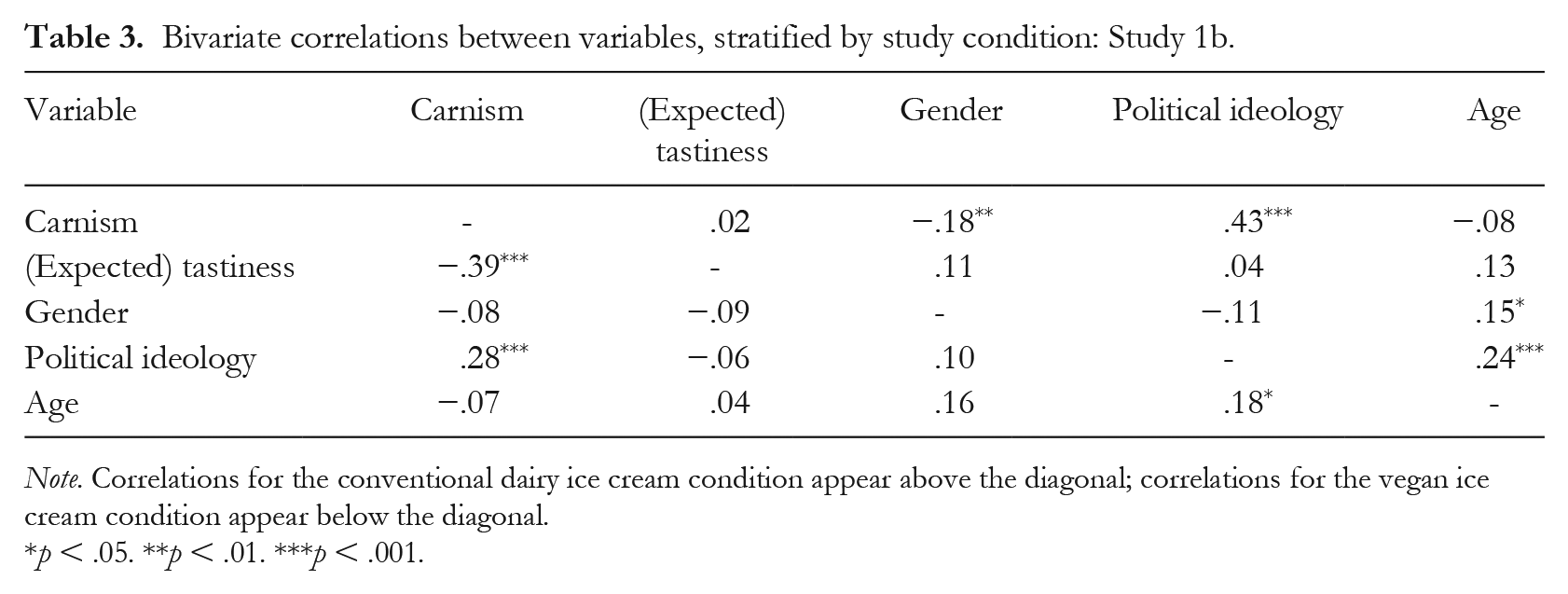
Note. Correlations for the conventional dairy ice cream condition appear above the diagonal; correlations for the vegan ice cream condition appear below the diagonal.
p < .05. **p < .01. ***p < .001.
Conceptually replicating our analyses in Study 1a, we conducted a hierarchical OLS regression to test whether the expectation that vegan ice cream would taste worse than conventional ice cream was amplified among participants who endorsed carnism most (vs. least) strongly. In the first step, we regressed (expected) tastiness on ice cream type, carnism, and their interaction term. Condition was dummy-coded such that the conventional condition was assigned a value of 0, and the vegan condition a value of 1; carnism was centered at its mean. This analysis revealed support for our hypothesis (see Figure 2 and Table 4): Carnism moderated the effect of ice cream type on (expected) tastiness at a small–medium effect of β = −.16. In a second step of the regression, we accounted for our two covariates—gender and political ideology—by adding their interaction terms with ice cream type and their lower order terms into the previously tested regression model. Gender was dummy-coded such that status as a man was assigned a value of 0, and as a woman a value of 1; political ideology was centered at its mean. In this model, carnism remained a significant moderator of the effect of ice cream type on (expected) tastiness at the same magnitude as observed without adjusting on any covariates, β = −.17.
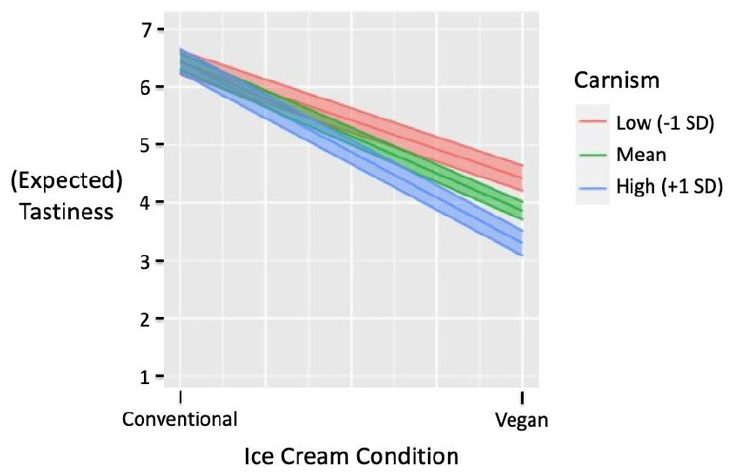
Interaction effect between ice cream type and carnism on (expected) tastiness: Study 1b.
Hierarchical OLS regression testing whether the expectation that vegan ice cream would taste worse than conventional ice cream was amplified among participants who endorsed carnism most (vs. least) strongly: Study 1b.
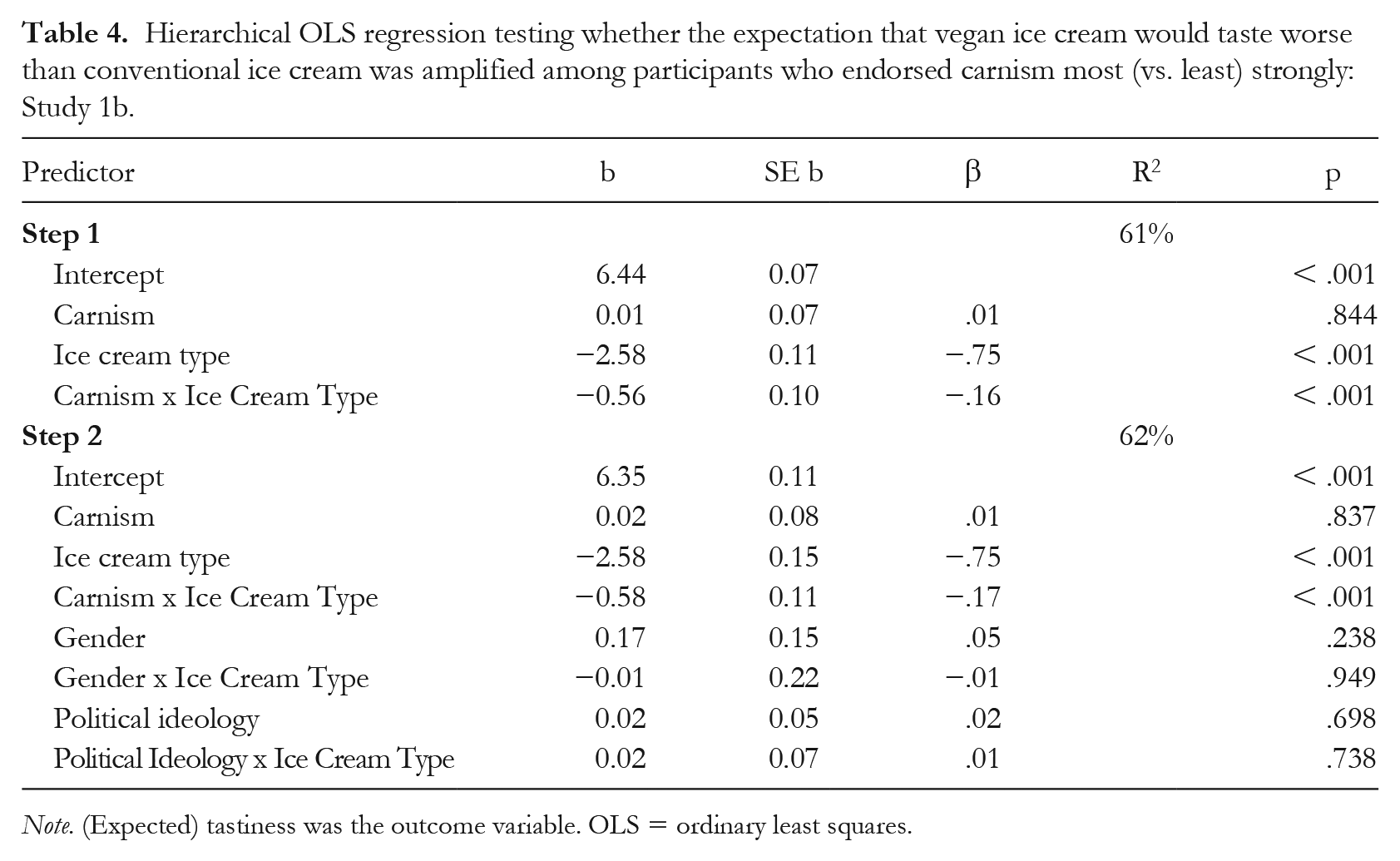
Note. (Expected) tastiness was the outcome variable. OLS = ordinary least squares.
Simple slopes analyses revealed that the effect of ice cream type on (expected) tastiness was larger for participants who endorsed carnism most strongly (1 SD or more above the mean), b = −3.68, SE = 0.28, 95% CI [−4.24, −3.13], β = −.86, t(63) = 13.21, p < .001, than it was for participants who endorsed carnism least strongly (1 SD or more below the mean), b = −2.09, SE = 0.25, 95% CI [−2.58, −1.59], β = −.74, t(60) = 8.46, p < .001. For participants in the conventional ice cream condition, carnism was not associated with tastiness, b = 0.01, SE = 0.05, 95% CI [−0.08, 0.11], β = .02, t(216) = 0.28, p = .777. Meanwhile, for participants in the vegan ice cream condition, carnism was negatively associated with expected tastiness, b = −0.55, SE = 0.10, 95% CI [−0.74, −0.36], β = −.39, t(184) = 5.71, p < .001.
Study 1b replicated the significant moderating effect of carnism observed in Study 1a, suggesting that subscription to this ideology is reliably associated with expectations that vegan food products taste worse than their animal-based counterparts. Of note, the effect of carnism was significant over and above the effects of gender and political ideology, for which we controlled as covariates. Previous research has documented associations between these two covariates and attitudes toward carnism and veganism (e.g., De Groeve & Rosenfeld, 2022; Graça et al., 2018; Judge & Wilson, 2018; MacInnis & Hodson, 2017; Monteiro et al., 2017), and the present findings rule out these covariates as alternative explanations for the observed relationship between carnism and bias against vegan food: Higher support for carnism independently predicted devaluation of vegan food. This dominant group ideology condoning the consumption of animals as food thus appears to be a unique and central correlate of bias against vegan food. In Studies 2 and 3 that follow, we sought to unravel this effect by focusing on the potential role of perceived symbolic threat.
Study 2
Results of Studies 1a and 1b highlight that meat-eaters who endorse the ideology of carnism most strongly have the most unfavorable expectations about how vegan food will taste. Based on intergroup threat theory (Stephan et al., 2015), we theorize that the more strongly meat-eaters endorse carnism, the more symbolically threatening they perceive veganism to be, and thus the more motivated they are to derogate veganism. By devaluing the expected tastiness of vegan food, meat-eaters presumably can lessen the symbolic threat veganism poses to carnism’s place as a dominant ideology. In Study 2, accordingly, we investigated whether perceived symbolic threat mediates the relationship between carnism and expected tastiness of vegan foods. Following the foci of Studies 1a and 1b, we examined vegan burgers and ice cream. This study allowed us to test whether the main findings of Studies 1a and 1b—higher carnism being associated with worse expectations about vegan food—would replicate in a new sample within a preregistered setting. We hypothesized that higher carnism would predict lower expected tastiness of vegan foods through higher perceived symbolic threat.
Method
This study’s sample size, materials, conditions, exclusion criteria, hypotheses, and analyses were preregistered at the OSF (https://osf.io/tm74z/?view_only=656090bf203e4ea5a408e47f24f9ca1e).
Participants
Participants were 500 adults from the US, recruited via MTurk. After excluding 111 participants who self-identified as vegetarian/vegan and seven who failed an attention check in the survey, 382 participants (197 men, 184 women, one reported another gender) between the ages of 19 and 76 (Mage = 39.95, SD = 12.54) remained. Within this sample, 162 participants who had not tried a vegan burger were retained for analyses on vegan burgers, and 293 participants who had not tried vegan ice cream were retained for analyses on vegan ice cream. This sample provided 80% power to detect small–medium mediation effects at α = .05, two-tailed (Fritz & MacKinnon, 2007).
Materials
Carnism
Carnism was assessed as in Studies 1a and 1b (α = .83).
Perceived symbolic threat
Perceived symbolic threat of veganism was assessed by an eight-item scale (α = .92) adapted from a Perceived Symbolic Threat of Vegetarianism Scale by Dhont and Hodson (2014); we adapted scale items directly to focus on veganism instead of vegetarianism (e.g., “The rise of veganism poses a threat to our country’s cultural customs”; 1 = strongly disagree, 7 = strongly agree).
Expected tastiness of vegan burgers
Expected tastiness of vegan burgers was assessed as in Study 1a (α = .95).
Expected tastiness of vegan ice cream
Expected tastiness of vegan ice cream was assessed as in Study 1b (α = .95).
Procedure
After providing informed consent, participants completed the measure of carnism. Next, participants completed the measure of perceived symbolic threat. Lastly, participants reported their expected tastiness of vegan burgers and vegan ice cream, in a randomized order.
Results and Discussion
Data, analysis scripts, and codebook are available at the OSF (https://osf.io/tmnj6/?view_only=4781ea600d2c4c2a95c851fff2f2fc2e).
The main findings of Studies 1a and 1b were replicated: For both foods examined, higher endorsement of carnism was associated with more negative expectations about the tastiness of vegan food. This effect was medium in size for vegan burgers (r = −.25) and medium–large (r = −.35) for vegan ice cream (see Table 5).
Bivariate correlations between variables and descriptive statistics: Study 2.
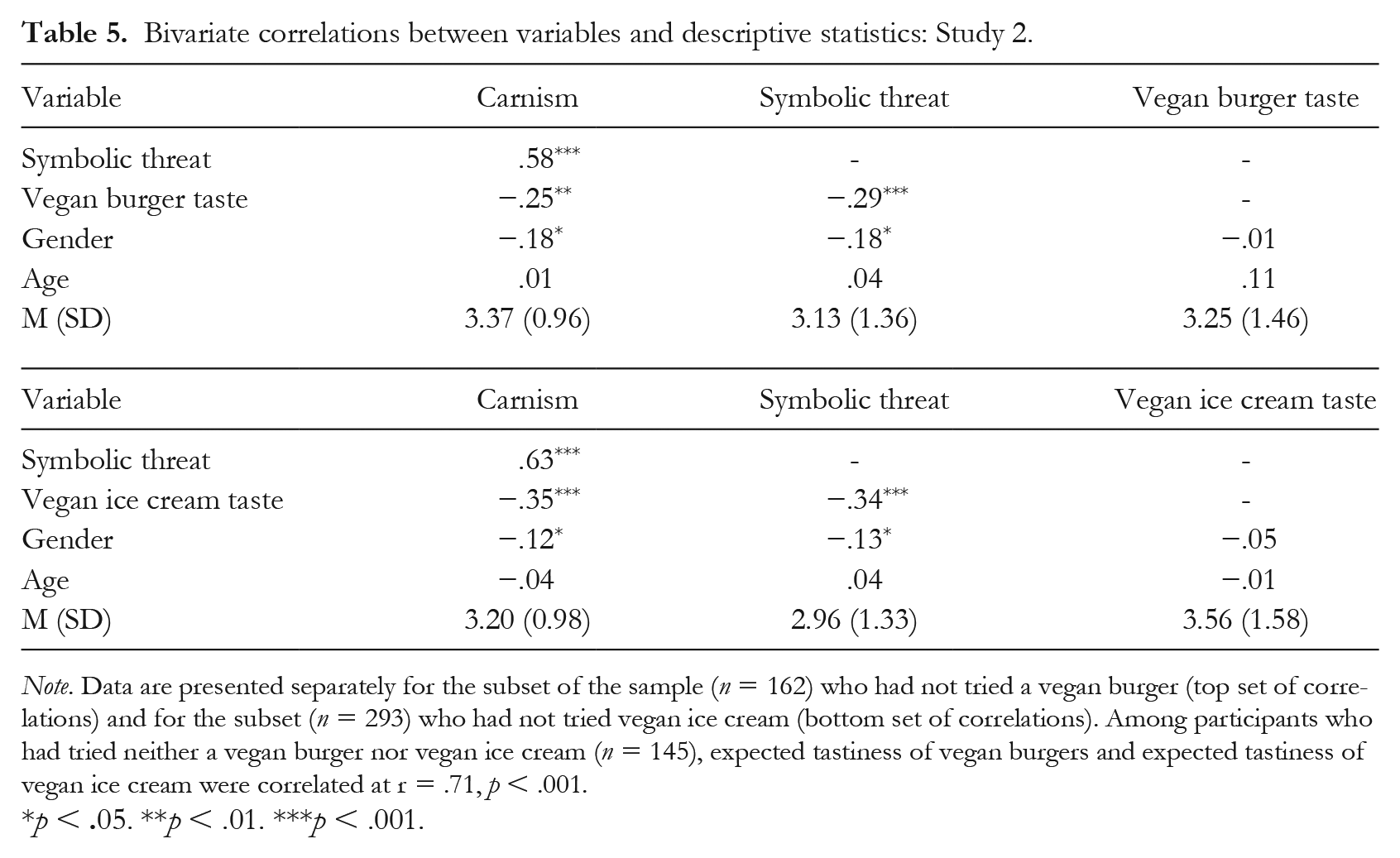
Note. Data are presented separately for the subset of the sample (n = 162) who had not tried a vegan burger (top set of correlations) and for the subset (n = 293) who had not tried vegan ice cream (bottom set of correlations). Among participants who had tried neither a vegan burger nor vegan ice cream (n = 145), expected tastiness of vegan burgers and expected tastiness of vegan ice cream were correlated at r = .71, p < .001.
p < .05. **p < .01. ***p < .001.
As hypothesized, perceived symbolic threat mediated the relationship between carnism and expected tastiness of vegan burgers: indirect effect 95% CI [−0.36, −0.03], p = .021 (see Figure 3). Symbolic threat explained 51% of the total effect of carnism on expected tastiness, reducing the effect from b = −0.38 (β = −.25, p = .001) to b = −0.19 (β = −.12, p = .184), indicating full mediation.
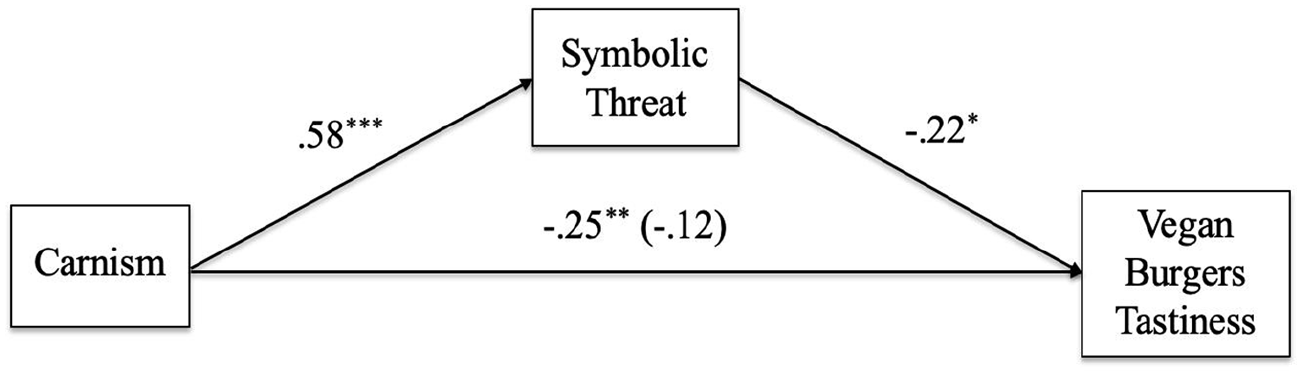
Mediation model for the relationship between carnism and expected tastiness of vegan burgers through perceived symbolic threat: Study 2.
Similarly, perceived symbolic threat mediated the relationship between carnism and expected tastiness of vegan ice cream: indirect effect 95% CI [−0.34, −0.05], p = .007 (see Figure 4). Symbolic threat explained 34% of the total effect of carnism on expected tastiness, reducing the effect from b = −0.57 (β = −.35, p < .001) to b = −0.38 (β = −.23, p = .001), indicating partial mediation.
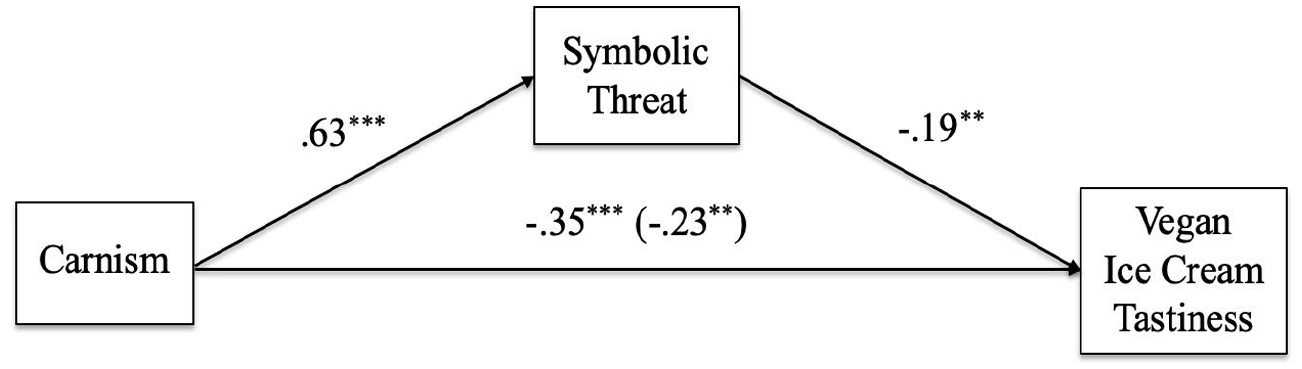
Mediation model for the relationship between carnism and expected tastiness of vegan ice cream through perceived symbolic threat: Study 2.
Study 3
Results of Study 2 suggest that perceptions of veganism as symbolically threatening can largely explain why meat-eaters who strongly endorse carnism tend to have worse expectations about how vegan food will taste. In Study 3, we sought to test a causal path from awareness of symbolic threat to devaluation of vegan food. Specifically, we experimentally tested whether making the potential for symbolic threat salient would directly decrease meat-eaters’ expectations about the tastiness of vegan food. We investigated this research question within a culturally valued context that affirms carnism through ritual meat consumption: Thanksgiving. Within the US, Thanksgiving is an annual celebration in which the centerpiece of the meal is turkey; to many meat-eating Americans, veganism likely poses a symbolic threat to this tradition that becomes especially salient each year. We would expect that ideological attachments to carnism are heightened when people anticipate and experience the Thanksgiving holiday. Thus, to maximize our study’s internal validity, we collected data on November 21–22, 2020, which immediately preceded the week of that year’s Thanksgiving holiday.
To enhance generalizability of effects across types of food, we assessed expectations about the tastiness of vegan food in general, instead of referencing specific foods (burgers, ice cream) as in all studies heretofore. We hypothesized that priming the salience of symbolic threat would decrease the expected tastiness of vegan food.
Method
This study’s sample size, materials, conditions, exclusion criteria, hypotheses, and analyses were preregistered at the OSF (https://osf.io/s7gp4/?view_only=aac87d95d29f451ea106d03a9ea29210).
Participants
We noted the correlation between perceived symbolic threat and expected taste of vegan burgers as r = −.22, and of vegan ice cream as r = −.19 in Study 2. This lower figure of r = −.19 converts to d = 0.39. A power analysis using G*Power 3.1 specifying an effect of d = 0.39 revealed that a total sample of 210 participants would provide 80% power at α = .05, two-tailed. We expected, though, that manipulating the salience of symbolic threat would have an attenuated effect on taste expectations, relative to the strength of the association between baseline perceived threat and taste expectation, and thus we recruited a larger sample size for this study that allowed us to detect a small effect of d = 0.25 at α = .05, two-tailed.
Participants were 600 adults from the US, recruited via MTurk. After excluding 90 participants who self-identified as vegetarian/vegan and 10 who failed an attention check in the survey, 500 participants (222 men, 275 women, three reported another gender) between the ages of 18 and 76 (Mage = 39.34, SD = 12.49) were retained.
Materials
Symbolic threat salience prime
The salience of symbolic threat was primed via completion of a four-item Perceived Symbolic Threat of Veganism Scale (α = .94), based on the scale used in Study 2 with items reworded to capture threat related to Thanksgiving (e.g., “The rise of veganism poses a threat to the customs of Thanksgiving”; 1 = not at all, 7 = very much).
Expected tastiness of vegan food
Expected tastiness of vegan food was assessed by the following five-item scale (α = .94): “The taste of most vegan food is probably. . .”; “The flavor of most vegan food is probably. . .”; “The texture of most vegan food is probably. . .”; “The visual appearance of most vegan food is probably. . .”; and “The smell of most vegan food is probably. . .” (1 = very bad, 7 = very delicious).
Procedure
After providing informed consent, participants were randomly assigned to complete one of two study conditions: (1) a symbolic threat salience condition in which participants completed the symbolic threat salience prime before reporting expected tastiness of vegan food, or (2) a control condition in which participants reported expected tastiness of vegan food at the start of the survey, in the absence of any threat prime (and then completed the threat scale at the end of the survey).
Results and Discussion
Data, analysis scripts, and codebook are available at the OSF (https://osf.io/gqmjc/?view_only=6891d7b9198b407cb1d603949f866a00).
An independent samples t test indicated that, as hypothesized, participants primed with symbolic threat salience expected vegan food to taste worse (M = 3.91, SD = 1.29) than did participants for whom threat was not primed (M = 4.18, SD = 1.40), t(497) = 2.22, p = .027, 95% CI [−0.51, −0.03], d = 0.20. Supporting predictions derived from intergroup threat theory (Stephan et al., 2015), these results suggest that awareness of veganism’s symbolic threats can cause meat-eaters to reject the palatability of vegan food.
General Discussion
We investigated, using an intergroup lens, expectations about the tastiness of vegan food among people who eat meat. Our findings suggest that carnism—the ideology that humans have a right to eat animals and their byproducts as food (Joy, 2010)—explains a great deal about why meat-eaters expect vegan food to taste worse than animal-based food. Supporting predictions of intergroup threat theory (Stephan et al., 2015), the relationship between carnism and expected tastiness of vegan food was mediated by perceived symbolic threat of veganism. Moreover, having participants reflect on the idea that veganism might be symbolically threatening caused them to report more unfavorable expectations about the tastiness of vegan food, relative to participants who completed no task prior to reporting their taste expectations. Veganism’s opposition to dominant group values can seem symbolically threatening, and these perceptions of threat might undermine consumer interest in vegan products, potentially widening dietary intergroup divides. These processes, in turn, may restrict the potential of vegan products to improve nonvegans’ health and to make all individuals’ future more sustainable.
The current findings add to an emerging body of research at the intersections of group processes, intergroup relations, and moral psychology, documenting how meat-eaters respond to symbolic threats by defending human dominance beliefs and morally justifying meat consumption (Graça et al., 2016; MacInnis & Hodson, 2017; Monteiro et al., 2017; Piazza et al., 2015; Rothgerber, 2020; Stanley, 2022). These phenomena may become increasingly relevant should vegan alternatives rival their animal-derived counterparts in mainstream food systems (e.g., Mazzoni, 2020). Denying the palatability of vegan food may be a means by which dominant group members (meat-eaters) defuse threat to their group values that legitimize the consumption of animals and their byproducts as food.
Given that expectations about taste largely drive people’s food choices and explain people’s resistance to giving up meat (Rosenfeld & Tomiyama, 2020; Sobal & Bisogni, 2009), understanding group processes tied to taste expectations can ultimately guide efforts to change consumer behavior. By making vegan food products seem less symbolically threatening, marketers may be able to make these products more appealing to meat-eating consumers. Research on intergroup relations suggests that fostering perceptions of optimal distinctiveness between vegans and meat-eaters—emphasizing fundamental similarities between members of these groups while maintaining that each group has a unique identity—can help to reduce perceptions of symbolic threat (Rios et al., 2018). In this vein, instead of framing vegan products as replacements for animal-based products, it may be more effective to market vegan products as additions to consumers’ typical eating patterns; whereas replacement framing may heighten symbolic threat, addition framing may dampen it by emphasizing coexistence.
Our studies also contribute to the broader literature on intergroup threat and out-group attitudes (e.g., Riek et al., 2006; Rios et al., 2018; Stephan et al., 2015), situating these phenomena within the purview of eating behavior. The intergroup relations literature has focused principally on implications of threat for attitudes toward members of out-groups. Our research highlights that symbolic threat is relevant for attitudes toward not only members of out-groups (e.g., vegan people; MacInnis & Hodson, 2017) but also the customs of out-groups (e.g., consumption of vegan food). Understanding the ties between moral values and eating behavior through an intergroup threat lens may provide insights into cases where dietary consumption serves to maintain dominant belief systems and distinct intergroup boundaries.
To improve consumer acceptance of vegan food products, much investment has centered on developing vegan alternatives that successfully mirror the taste of their traditional nonvegan counterparts (e.g., by creating plant-based protein substitutes and lab-grown meat). However, even if such alternatives offer 100% equivalent taste properties on “objective” indexes such as protein structure comparisons or blind taste tests, meat-eaters’ preconceived biases of veganism might still lead them to devalue vegan food’s tastiness and to avoid purchasing it. Targeting perceptions of intergroup threat may be one potential way to combat these biases and improve consumer acceptance. To the extent that vegan food can be framed as congruent with other core values that meat-eating consumers have (e.g., sustainability), veganism may seem less saliently threatening to carnism and instead seem more consistent with a defined in-group norm. An avenue for future research to manipulate perceived threat in this way may be to compare whether different labels, such as “plant-based” or “vegetarian,” evoke less defensive responses in meat-eaters relative to “vegan” labels.” Another avenue is to consider alternative mediators beyond symbolic threat that could explain why endorsing carnism is associated with expecting vegan food to taste bad, such as beliefs that veganism may be unnatural, abnormal, or—especially for men—feminine (Piazza et al., 2015; Thomas, 2016).
Our research suggests that perceived threat can worsen expectations about the taste of vegan food, and a hypothesis open for future testing is that perceived threat may also cause people to experience vegan food as tasting worse when they actually eat it. In previous research, people reported liking a food more when they were led to believe that the food aligned with their moral values (Allen et al., 2008). This finding suggests that preexisting beliefs like carnism and their associated perceived threats could influence actual taste perception. If this effect were not the case, and if instead meat-eaters were to acknowledge that vegan food tastes good, might this acknowledgement shift their beliefs about carnism and threat? We posit that links between carnism, threat, and taste beliefs may operate dynamically and regulate one another to maintain ideological homeostasis. Unless meat-eaters become willing to accept veganism in place of carnism, they will likely be driven to construe threat and construct taste beliefs in ways that defend and legitimize carnism.
Strengths and Limitations
Strengths of this research include its highly powered designs and its use of preregistration for Studies 2 and 3. Throughout all four studies, we sought to maximize power by recruiting large samples and screening out distracted participants through attention checks. Each study provided at least 80% power to detect smaller than medium effects.
One limitation is that inferences about the directionality of effects in Studies 1 and 2 are restricted, given that links between these variables and taste expectations were correlational. These studies demonstrated that individual differences in carnism were reliably related to taste expectations as theorized, and while it seems unlikely that the latter could have driven the former, direct causal inferences are limited from our data. There are also limitations that should be noted with regard to the link between perceived symbolic threat and taste expectations. We have theorized that expectations about the taste of vegan food are intertwined with attitudes toward vegans as a social group. While our experimental Study 3 provides evidence suggesting that perceiving symbolic threat causes meat-eaters to derogate vegan food, it could also be the case that meat-eaters who dislike vegans say that veganism is threatening in order to justify their existing negative out-group attitude; these two effects are not mutually exclusive. Indeed, research on political psychology suggests that the relationship between perceived threat and political preference is bidirectional (Brandt & Bakker, 2022), and a similar trend may characterize the current effects.
A second limitation concerns the internal validity of Study 2, in which we examined perceived symbolic threat as a mediator of the cross-sectional link between carnism and expected tastiness of vegan food. Given that a modified version of this threat scale successfully served as a manipulation to worsen expectations about vegan food in Study 3, it is likely that completion of the threat scale in Study 2 likewise influenced reported taste expectations. This phenomenon may have unintentionally inflated the indirect effect of perceived threat and thus lowered the internal validity of this study. An additional limitation of our use of this perceived threat scale in Study 2 is that this scale may be better conceptualized as a measure of perceived intergroup threat overall, rather than symbolic threat specifically, given that some items focused on perceptions of realistic threat.
A third limitation is that all participants resided in the US and were recruited via MTurk, limiting our confidence in the generalizability of the current findings to other cultures and populations. We expect that the same psychological processes occur elsewhere but that the meaning of specific foods and human–animal relations may vary from place to place.
A fourth potential limitation is that much of our data were collected during periods of significant social distancing restrictions due to the COVID-19 pandemic, which may present obstacles to the generalizability of effect sizes (Rosenfeld et al., 2022). For example, the U.S. Thanksgiving holiday was largely disrupted in 2020 due to social distancing guidelines, and thus many participants in Study 3 likely refrained from gathering with extended family. As this change may have made 2020’s Thanksgiving less symbolically significant, the effect size we observed in Study 3 might be considered a more conservative estimate of how symbolic threats can motivate devaluation of certain foods.
Conclusion
Compared to animal-based diets, diets centered on vegan foods are more conducive to human health and environmental sustainability. However, people who eat meat expect vegan foods to taste much worse than animal-based foods. A plausible reason why meat-eaters expect vegan food to taste bad is that veganism runs counter to mainstream moral values legitimizing the consumption of animals as meat, making veganism seem symbolically threatening to dominant group norms. Devaluing vegan food may enable meat-eaters to defuse this symbolic threat. By minimizing and counteracting impositions of symbolic threat, efforts to promote consumption of vegan food products may become more effective. These findings invite new inquiry into the interplay of intergroup relations and eating behavior, with potential for positive broader impacts on societal well-being.
Supplemental Material
sj-docx-1-gpi-10.1177_13684302231153788 – Supplemental material for When meat-eaters expect vegan food to taste bad: Veganism as a symbolic threat
Supplemental material, sj-docx-1-gpi-10.1177_13684302231153788 for When meat-eaters expect vegan food to taste bad: Veganism as a symbolic threat by Daniel L. Rosenfeld, Hank Rothgerber and A. Janet Tomiyama in Group Processes & Intergroup Relations
Footnotes
Funding
The author(s) disclosed receipt of the following financial support for the research, authorship, and/or publication of this article: This material is based upon work supported by the National Science Foundation Graduate Research Fellowship Program under Grant No. DGE-2034835. Any opinions, findings, and conclusions or recommendations expressed in this material are those of the authors and do not necessarily reflect the views of the National Science Foundation.

Supplemental material
Supplemental material for this article is available online.
References
Supplementary Material
Please find the following supplemental material available below.
For Open Access articles published under a Creative Commons License, all supplemental material carries the same license as the article it is associated with.
For non-Open Access articles published, all supplemental material carries a non-exclusive license, and permission requests for re-use of supplemental material or any part of supplemental material shall be sent directly to the copyright owner as specified in the copyright notice associated with the article.
