




Abstract
To explore the interrelationship between terrorist acts, terrorist ethnicity, and observer gender and cultural background in Israel, we recruited 211 participants aged 19–75 years. The majority were male (63%). As for the ethnic and religious cultural background, 40% were Jewish, 40% Druze, and 20% Muslim. The participants answered questions about their demographic characteristics, read three scenarios of terrorist acts, addressed attitudes toward terrorists, and suggested the length of imprisonment. We manipulated the type of act (shooting and killing/burning religious institutions/throwing stones at cars) and terrorist ethnicity (Arab/ Jewish). The results indicate significant main effects of the manipulated variables regarding attitudes toward terrorists. Also, Muslim Arab participants expressed more negative attitudes in cases of Jewish terrorists than Arab terrorists, whereas Jewish participants expressed more negative attitudes toward Arab terrorists than Jewish terrorists. Druze participants did not differentiate between Arab and Jewish terrorists. Furthermore, in cases of Arab perpetrators, Jewish participants suggested imprisonment terms 2.4 times longer than in cases of Jewish perpetrators. The discussion addresses the findings in the context of social identity theory and dual social identification. Regarding practical implications, the findings imply the need for education and training on ethnic bias among policymakers and practitioners.
Introduction
In the post 9/11 world, there has been a growing interest in research related to terrorism (Carmel et al., 2020; Cohen-Louck, 2019; Demir & Guler, 2021; Hasisi et al., 2020). Terrorist acts are extremely violent and their victims random. In addition to harming its direct victims, terrorism harms the general public’s sense of safety (Cohen-Louck & Shechory-Bitton, 2019; LaFree et al., 2015). In Israel, a chronic state of terrorism is the norm (Cohen-Louck & Levy, 2020). Israeli society has dealt with a variety of terrorist attacks, including acts by the primary terror groups such as Hamas and Islamic Jihad as well as by lone, unaffiliated attackers (S. Perry & Hasisi, 2015; S. Perry et al., 2018). Furthermore, Israel experiences terrorism from both Arab (Carmel et al., 2020) and Jewish attackers (Shalhoub-Kevorkian & David, 2016). In recent years, there have been terror attacks committed by Jewish citizens against Arabs, including violent attacks that caused injuries and property damage (see Shalhoub-Kevorkian & David, 2016). During the recent riots in 2021, there were even cases of attempted lynching against Arabs (Peleg, 2021). However, the research on differences in Israeli public opinion toward terrorists based on perpetrator’s ethnic identity is scant, and this study intends to expand the knowledge on this issue.
Studies on public attitudes toward offenders tend to address various aspects such as support for community correction (Levy et al., 2021), support for capital punishment (Cohen-Louck et al., 2021), and crime severity (Einat & Herzog, 2011; Herzog, 2017). To focus on the multidimensional nature of attitudes toward terrorists, this study adopted Holtfreter et al.’s (2008) and Dodge et al.’s (2013) conceptualizations of attitudes toward offenders, addressing such aspects as perceived severity of the crime, suggested length of imprisonment, suggested severity of punishment, and support for governmental investment of resources to combat terrorist acts. The current study aims to identify the relationship between Israeli public attitudes towards terrorists and such factors as crime type as well as offender ethnicity and observer gender and ethnicity.
Crime Type
Studies in the US and Israel show that crime type and its seriousness significantly influence public perceptions toward offenders. Most of these studies indicate that the public perceives offenders more negatively in violent than in nonviolent crimes (Adriaenssen et al., 2020; Herzog, 2017). In general, people tend to assign harsher punishments to offenders of severe crimes such as violent offenses, rape, and murder than to offenders of less severely perceived crimes such as white-collar and victimless crimes (Adriaenssen et al., 2019, 2020; Einat & Herzog, 2011). People tend to express support for the death penalty for serious crimes such as murder, terrorism, and even sexual abuse (Cohen-Louck et al., 2021; Dierenfeldt et al., 2020; Qi & Oberwittler, 2009). Therefore, we hypothesized that,
H1: There is a significant difference in attitudes toward terrorists based on the severity of their acts of terrorism: In cases of more harmful acts (e.g., shooting, killing), the public will express more negative attitudes than regarding less harmful acts (e.g., burning religious institutions, throwing stones at cars).
Offender Ethnicity
Attitudes toward terrorists may also be affected by perpetrator ethnicity. Studies in the United States have found that offenders affiliated with minority groups, such as African Americans and Latinos, are judged more harshly than White offenders (Beck & Blumstein, 2018; Steffensmeier et al., 2017; Ulmer et al., 2020). In line with this pattern, people support harsher punishments for minority-group offenders than for majority-group offenders (Brown & Socia, 2017; Dotson & Carter, 2012; Lehmann et al., 2020). Thus, citizens from the US tend to hold more punitive attitudes toward African American offenders than toward their White counterparts (Baker et al., 2018; Brown & Socia, 2017; Unnever & Cullen, 2007). With regard to counterterrorism policies, people who typify terrorists as Middle Eastern are more likely to support punitive antiterror policies (Welch, 2016). Also, people tend to be more supportive of punitive policies when the terrorist is motivated by Islamic extremism (Williamson & Murphy, 2020).
Studies regarding Arab offenders in Israel also support the notion of out-group discrimination, as the public and practitioners tend to judge Arab offenders more harshly than Jewish offenders (e.g., Fishman et al., 2006; Rahov et al., 2015; Rozmann & Nahari, 2021). Based on the findings regarding punitive public attitudes toward out-group members, we hypothesized that,
H2: There is a significant difference in attitudes by terrorist ethnicity: In the case of terrorist acts involving Arab terrorists, the public will express more negative attitudes than toward terrorist acts involving Jewish terrorists.
Observer Characteristics
Research on extralegal factors related to attitudes toward offenders (e.g., Diamond-Welch et al., 2017; Levy & Reuven, 2017, 2018; Rozmann & Levy, 2019; Rozmann & Nahari, 2020; Shechory Bitton & Zvi, 2018) suggests that attitudes toward perpetrators of terrorist acts may be affected by observer characteristics. One of the most studied extralegal factors is observer gender (Rozmann & Levy, 2021). Research has shown that men are usually more punitive than women (Applegate et al., 2002; Chen & Einat, 2015; Lambert et al., 2007; Unnever & Cullen, 2007). Thus, a meta-analysis (Devine & Caughlin, 2014) showed that male jurors, compared with female jurors, were likely to render guilty verdicts for three common types of criminal offences: homicide, violent crimes, and property-related crimes. The same pattern exists regarding terrorism (Elechi et al., 2020; Lambert, 2003). In a U.S. study, men were more in favor of punishment, whereas women were more in favor of rehabilitation (Lambert, 2003). This pattern of gender differences in attitudes and punitiveness may be related to biological differences in aggression, with men being generally more aggressive (Björkqvist, 2018), as well as traditional gender role socialization in early childhood that supports a nurturing ethos among girls (Eccles et al., 1990). Be that as it may, based on research on the gender gap, we hypothesized that,
H3: There is a significant difference in attitudes toward terrorists by observer gender: Men will express more negative attitudes than women.
Additionally, studies have focused on the link between observer ethnicity and attitudes towards offenders and their punishment (e.g., Baker et al., 2018; Rozmann & Levy, 2019; Steffensmeier et al., 2017). Most research indicates that, compared to minority-group members, majority-group members such as Whites tend to be more punitive (Bobo & Johnson, 2004; D. Johnson, 2008; Secret & Johnson, 1989). Contrary to this pattern, In Israel, studies show that Arab teachers and parents who belong to an ethnic minority are more punitive than Jewish teachers and parents who belong to an ethnic majority (Shavit & Blank, 2012; Shechory-Bitton et al., 2015). This difference between studies in the US and Israel is related to the cultural differences between the Jewish majority and Arab minority in Israel. Thus, the punitive gap can derive from the traditional patriarchal Arab culture, which is linked to the tendency to support harsher social control policies (see Haj-Yahia, 2000; Ne’Eman-Haviv, 2020, 2021). However, the finding that fear of terrorism is, in fact, slightly higher in Israel’s larger cities inhabited mainly by Jews (Hasisi et al., 2009; Shechory-Bitton & Cohen-Louck, 2018) might be related to more punitive attitudes regarding terrorist cases. Therefore, we hypothesized that,
H4: There is a significant difference in attitudes toward terrorists by observer ethnicity: Jewish observers will express more negative attitudes than Arabs.
Social Identity Theory
Social identity theory (Tajfel, 1982) claims that people need to view the group they belong to in a positive way. According to the black sheep effect, one way to preserve a positive view of one’s group is to reject deviant in-group members, manifested in a negative bias against them (Rozmann & Nahari, 2020). Thus, studies show that people judge deviant in-group members more harshly than out-group members (Marques & Paez, 1994; Marques et al., 1988). A contrary notion is that people tend to view their in-group peers more positively than they view out-group members (Hogg & Ridgeway, 2003; Hornsey, 2008). Accordingly, the ethnic similarity between the observer and the offender influences verdict and blame attribution (Rozmann & Levy, 2019; Rozmann & Walsh, 2018). Offenders belonging to ethnic minorities in the US are judged more harshly by White judges than White defendants are (Hauser & Peck, 2017; Sweeney & Haney, 1992). Consistent with social identity theory, minority judges were less likely to incarcerate Black and Hispanic offenders than their White colleagues were (B. D. Johnson, 2006), and European American jurors rendered more guilty verdicts for Mexican American defendants than for European American ones (Esqueda et al., 2008). Similarly, Halabi et al. (2015) found that Jewish participants suggested less punitive sanctions for Jewish drivers in a car accident in which an innocent pedestrian was injured compared to their Arab counterparts. Therefore, we hypothesized that:
H5: There is a significant interaction by observer and offender ethnicity regarding attitudes toward terrorists: Arab and Jewish observers will express more negative attitudes toward terrorists who belong to their out-group (Jewish and Arab, respectively) than toward terrorists who are their in-group peers (Arab and Jewish, respectively).
The Current Research
The current study aims to identify patterns in Israeli public attitudes toward terrorists and is significant in several ways. First, the comparison between Arab and Jewish terrorists allows us to explore whether the attitudes toward terrorists are related to perpetrator ethnic minority affiliation. Secondly, we compared Muslim and Druze participant attitudes. Muslims and Druze belong to the Arab ethnic minority in Israel. However, the Druze are a unique community in Israel (Kaufman, 2016). They express solidarity and close affiliation with the Jewish population, serve in the Israeli Defense Forces (IDF), and distance themselves from the Israeli-Arab sector (Abbas, 2020; Nisan, 2010). Thus, the comparison between Muslims and Druze may uncover whether the differences between Jews and Arabs are related to ethnic affiliation or absence of solidarity.
Furthermore, attitudes toward offenders and crimes differ by cultural context (Levy & Adam, 2018; Levy & Kerschke-Risch, 2020); however, research on crime seriousness and punitive attitudes has focused on the American and European populations (Adriaenssen et al., 2019, 2020; Saucier et al., 2010). Hence, there is a need to explore attitudes toward crimes and terrorist acts in other cultural contexts. The present research on attitudes toward terrorists in the Israeli society addresses such understudied cultural groups as Arabs, Druze, and Jews. Moreover, this research on the Israeli society also allows for the exploration of attitudes toward terrorists in the context of chronic terrorism that characterizes the Israeli experience (Cohen-Louck & Levy, 2020). Additionally, this study employed a factorial design, which examines the combined effects of crime severity and offender and observer characteristics (Jasso, 2006). Such a methodological design identifies factors that people consider more significant regarding their attitudes (Levy et al., 2021). We also addressed Levi and Jones’s (Levi & Jones, 1985) criticism of a one-dimensional approach to public attitudes toward offenders that tends to focus on a single aspect (e.g., offender blaming, support for harsh punishments; e.g., Cohen-Louck et al., 2021; Rozmann & Levy, 2019). This study included multiple indicators of attitudes toward terrorists (e.g., perceived severity of a crime, suggested severity of a punishment, and support for governmental investment of resources).
Methods
Participants
This study included 211 participants. The age range was 19–75 years (M = 33.22, SD = 11.68) and the majority were male (63%). The majority were married or lived with a partner (61.6%), 36% were single, and 2.4% divorced. More than half (52.1%) of the participants defined themselves as secular, 34.6% as traditional, and 13.3% as religious. As for ethnicity, 40% were Jews, 40% Druze, and 20% Muslim Arabs. As for education level, 48.8% reported graduate or postgraduate level (BA, MA, or PhD), and the rest (51.2%) high school level.
Measures
Demographic characteristics
This part of the questionnaire gathered information about gender, age, ethnicity (Arab, Jew), religion (Jewish, Muslim, Druze), level of religiosity, marital status, and level of education.
Vignettes
To examine the effect of perpetrator ethnicity and type of terrorist act, we created six vignettes: two types of perpetrator ethnicity (Arab, Jewish) and three types of terrorist act (shooting causing injuries and death, arson of a religious institution, throwing stones at vehicles). According to previous research on crime type and severity (Herzog, 2017; Levy et al., 2021), shootings causing injury or death are associated with a higher severity level than arson of a religious institution and throwing stones at cars causing only property damage. Since the vignettes included the consequences of the acts (injuries, property damage), we assumed that a shooting causing injury and death would represent a more severe type of terrorist act than arson and stone-throwing causing property damage. Each vignette version stated the name of the terrorist and the nature of his terrorist act. To represent perpetrator ethnicity, we used Arab and Jewish names. All terrorists in the scenarios were men (see the scenarios in Appendix A, supplemental material).
Attitudes toward terrorists
To examine attitudes toward terrorists, we used three indicators of perception of crime seriousness and suggested offender punishment (Dodge et al., 2013). The first two items were as follows: “What, in your opinion, is the severity of the offense described in this scenario?”; “How severe should the punishment be for the individual who committed this crime?” Participants ranked each scenario regarding these questions on a 5-point Likert scale (1 = not severe, 5 = very severe). The third indicator was participants’ open answer to the question, “In your opinion, in the case of imprisonment, how long should the imprisonment be in years?” Additionally, we used an indicator of public support for governmental resource allocation (Holtfreter et al., 2008) through the question, “To what extent would you agree with the claim that the government should devote more resources to combat crimes like this?” Answers were given on a 5-point Likert scale (1 = completely disagree, 5 = completely agree). Similar to previous studies (Dodge et al., 2013; Holtfreter et al., 2008), as well as to identify the complex nature of attitudes toward terrorists, this study addressed each of the indicators separately.
Procedure
Data collection
The Ariel University’s Ethics Committee approved this study. The questionnaire stated that (a) participants did not have to answer questions that made them uncomfortable, and could withdraw from participation at any time, and (b) participation was anonymous and confidential. We performed a pretest of the vignettes to examine the effect of the manipulations. Each questionnaire included three scenarios. Since we addressed each scenario as a separate case, the total number of scenarios was 633 (N participants x 3), with even division by type of terrorist act. The division by offender ethnicity was: 56% (n = 357) scenarios with Jewish terrorists and 43% (n = 276) with Arab terrorists. Research assistants distributed the different versions randomly and almost equally between shoppers in different shopping malls in cities of central and northern Israel. Participants needed approximately 5 minutes to complete the questionnaires.
Statistical analyses
All analyses were carried out using SPSS Version 25. We used descriptive statistics to assess the study variables and conducted MANOVAs, univariate ANOVAs, and Pearson correlations to explore the effects of background variables such as age, relationship status, and education. Based on the results, we decided to control for family status (not in a relationship = 0, in a relationship = 1) and education (0 = high school level, 1 = graduate or postgraduate level). We conducted MANCOVA and ANCOVA to examine the hypotheses regarding crime type (H1), offender ethnicity (H2), and observer gender (H3) and ethnicity (H4). We present the results of ANCOVA only for the interactions (H5) that were significant according to MANCOVA.
Results
Descriptive Findings
The sample mean of perceived severity of the offense was 4.58 (SD = 0.79, range = 1–5), the mean of the suggested severity of the punishment was 4.50 (SD = 0.82, range = 1–5), and the mean of agreement with the statement that the government needs to invest resources in measures against such crimes was 4.70 (SD = 0.81, range = 1–5). These means indicate that participants perceived terrorism as a very severe crime. Hence, the mean suggested time of imprisonment was 22.24 years (SD = 36.48, range = 0–500). There was a significant, positive, and weak correlation between age and perceived severity of the offense, r(633) = .12, p = .002, and suggested severity of the punishment, r(633) = .15, p < .001. There was no significant correlation between age and agreement with the statement that the government needs to invest resources in measures against terrorist acts, r(633) = .07, p = .11, and length of suggested imprisonment, r(633) = .05, p = .11.
MANOVA indicated a significant main effect of education, F(3, 629) = 5.79, p = .001, η2 = .03. Univariate ANOVAs showed that participants with graduate or postgraduate education perceived terrorism as significantly more severe, F(1, 631) = 5.86, p = .02, η2 = .01; M = 4.66, SD = 0.66, and were significantly more supportive of government investment of resources in measures against terrorism, F(3, 631) = 11.98, p = .001, η2 = .02; M = 4.68, SD = 0.62, than participants with a high school level of education (M = 4.51, SD = 0.89 and M = 4.46, SD = 0.96, respectively). There was no significant difference in suggested severity of the punishment, F(1, 631) = 0.85, p = .37, η2 = .00. Univariate ANOVA also showed no significant difference in suggested length of imprisonment by education, F(1, 631) = 0.14, p = .71, η2 = .00.
Additionally, MANOVA indicated a significant main effect of family status, F(3, 629) = 3.76, p = .011, η2 = .02. Univariate ANOVAs showed a significant main effect of family status on perceived severity of the terrorist act, F(1, 631) = 7.92, p = .01, η2 = .01, suggested severity of the punishment, F(1, 631) = 9.09, p = .002, η2 = .01, and support for government investment of resources in measures against terrorism, F(1, 631) = 9.64, p = .02, η2 = .02. Participants who were in a relationship (married or living with a spouse) perceived terrorist acts as significantly more severe (M = 4.66, SD = 0.72) than participants who were not in a relationship (single or divorced; M = 4.48, SD = 0.85). Similarly, participants who were in a relationship suggested more severe punishment (M = 4.58, SD = 0.77) than participants who were not in a relationship (M = 4.39, SD = 0.85). Finally, participants who were in a relationship were more supportive of government investment of resources in measures against terrorism (M = 4.66, SD = 0.77) than participants who were not in a relationship (M = 4.45, SD = 0.86). Considering a significant, positive, and relatively strong correlation between family status (not in a relationship = 0, in a relationship = 1) and age, r(633) = .56, p < .001, we examined the hypotheses controlling for family status (0 = single/divorced, 1 = married/living with a partner) and educational level (0 = high school level, 1 = graduate or postgraduate level). As for suggested length of imprisonment, ANOVA showed that there was no significant effect of family status, F(1, 631) = 0.04, p = .84, η2 = .00. In absence of a significant effect of family status and education on suggested length of imprisonment, we examined this measurement’s hypotheses without controlling for these variables.
Attitudes Toward Terrorism
The results of the MANCOVA (controlling for family status and educational level; see Table 1) support all our hypotheses and show that there was a significant main effect of type of crime (H1), offender ethnicity (H2), and observer gender (H3) and ethnicity (H4) on all three measures of attitudes toward terrorist acts. Furthermore, there were significant interactions between offender ethnicity and observer ethnicity (H5). Additionally, there were significant interactions between offender ethnicity and observer gender, between observer ethnicity and observer gender, as well as between offender ethnicity, observer ethnicity, and observer gender.
MANCOVA and ANCOVA results for main effects and interaction regarding attitudes toward terrorists.
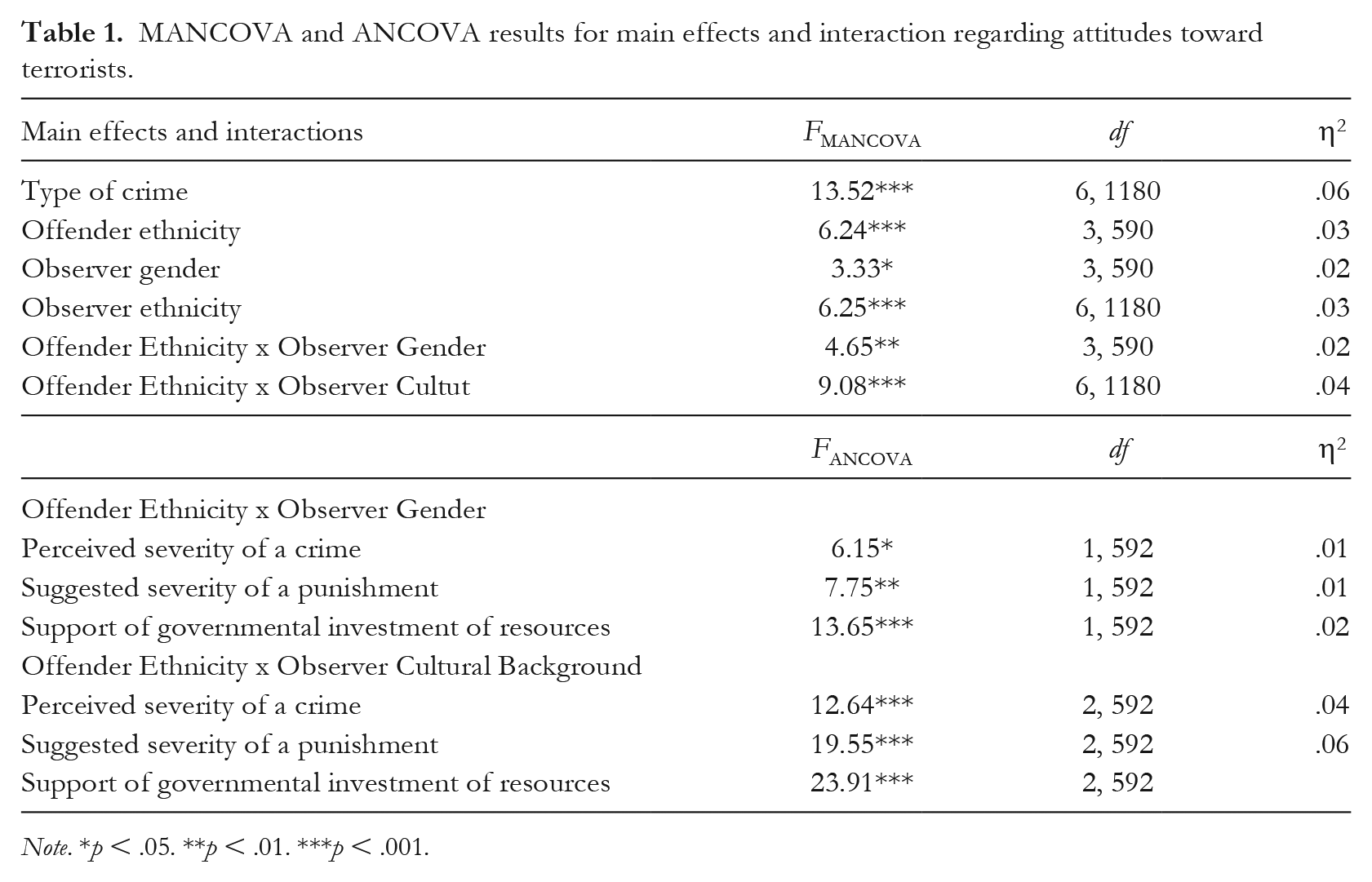
Note. *p < .05. **p < .01. ***p < .001.
Main effects
ANCOVA results (see Table 2) indicated that differences by crime type were significant regarding all three aspects of attitudes toward terrorists: perceived severity of the crime, suggested severity of punishment, and support for governmental investment of resources in measures against terrorism. In cases of shootings, the main effects of offender ethnicity were significant only for suggested severity of punishment and support for governmental investment of resources, with scores higher in cases of Jewish terrorists than in cases of Arab ones. There was no significant effect of offender ethnicity on perceived severity of terrorist acts. Also, there were no significant main effects of gender on the measurements of attitudes toward terrorists, and the main effect of observer cultural background was significant only regarding support for government investment in measures against terrorism. Jewish and Druze participants expressed significantly higher support for governmental investment in measures against terrorism than Muslim Arabs.
ANCOVA results for main effects regarding the specific aspects of attitudes toward terrorists.
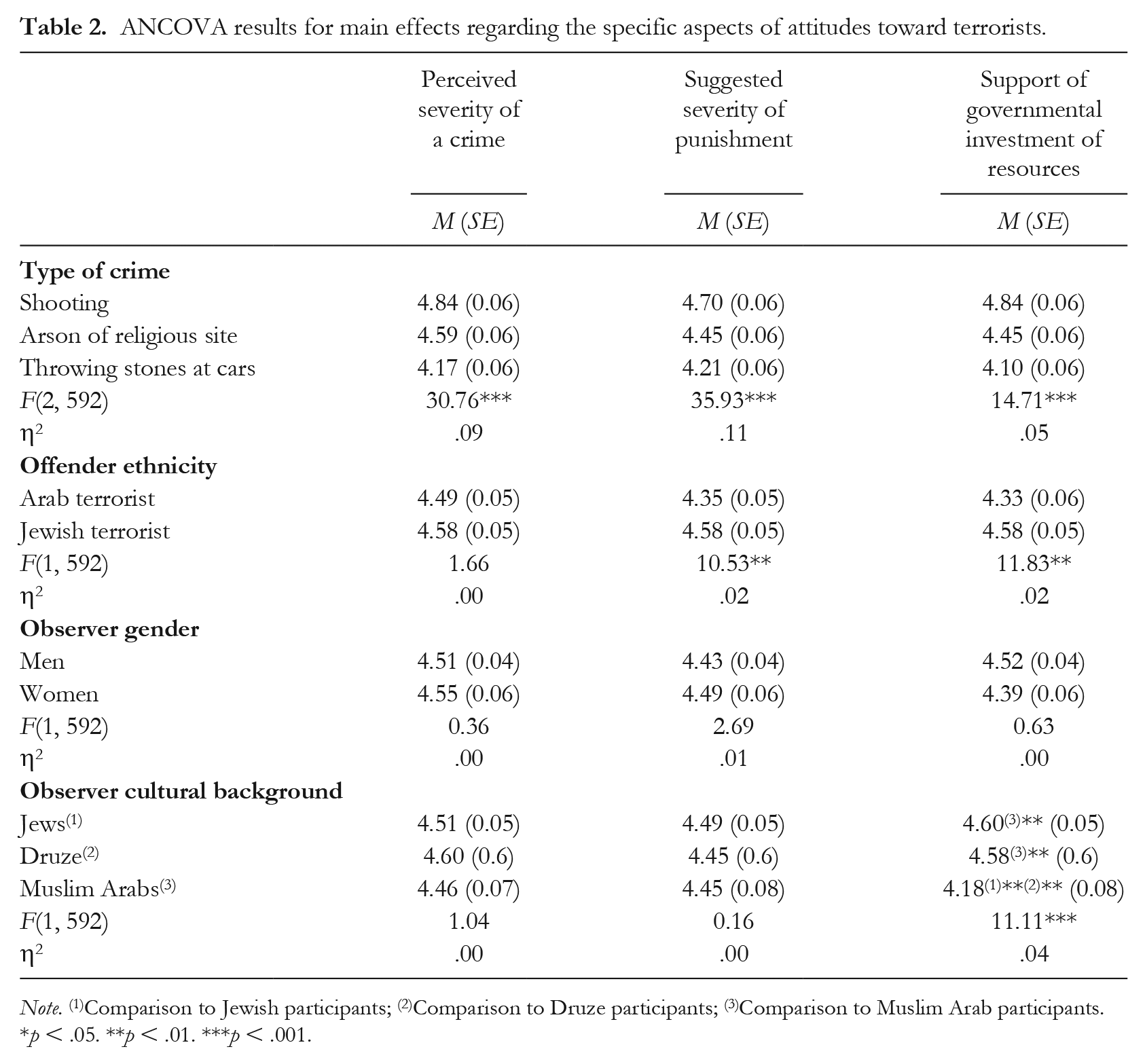
Note. (1)Comparison to Jewish participants; (2)Comparison to Druze participants; (3)Comparison to Muslim Arab participants.
p < .05. **p < .01. ***p < .001.
Interactions
ANCOVA findings (see Table 1) indicated a significant interaction between offender ethnicity and observer gender regarding all three aspects of attitudes toward terrorists. Figure 1A shows a similar pattern of interactions across all three measurements of attitude toward terrorists. Men did not differentiate between Jewish and Arab terrorists regarding perceived severity of the act, F(1, 594) = 2.51, p = .11, η2 = .00, while women perceived acts by Jewish terrorists as significantly more severe than acts by Arab terrorists, F(1, 594) = 5.39, p = .02, η2 = .01. Similarly, men did not differentiate between Arab and Jewish terrorists in suggested severity of punishment, F(1, 594) = 0.00, p = .99, η2 = .00, while women suggested the severity of punishment should be significantly higher in the case of Jewish terrorists, F(1, 594) = 13.62, p = .000, η2 = .02. Finally, men did not differentiate between Arab and Jewish terrorists regarding support for government investment in measures against terrorist acts, F(1, 594) = 0.91, p = .34, η2 = .00. Women expressed significantly more support for governmental investment in measures against acts by Jewish terrorists than by Arab terrorists, F(1, 594) = 18.82, p < .001, η2 = .03.
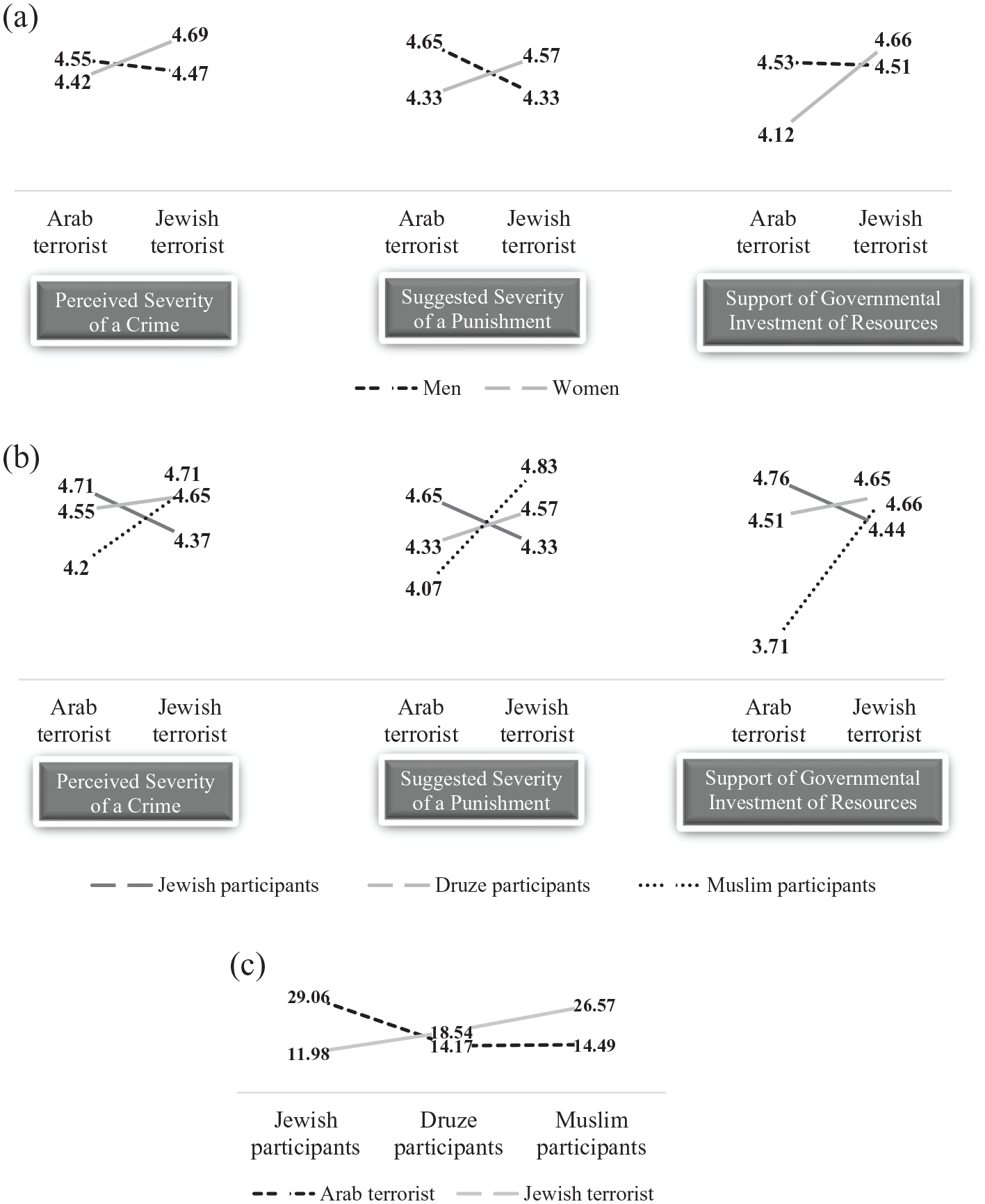
Patterns of interactions between (a) offender ethnicity and observer gender, (b) offender ethnicity and observer cultural background (ethnicity and religion) regarding perceived severity of crime, suggested punishment, and support for governmental investment of resources, and (c) offender ethnicity and observer cultural background (ethnicity and religion) regarding suggested length of imprisonment.
The interaction patterns (see Figure 1B) between offender ethnicity and observer cultural background (ethnicity and religion) were also similar across all measured attitudes toward terrorists. Jewish participants expressed significantly more negative attitudes toward cases of Arab terrorists than toward cases of Jewish terrorists, F(3, 590) = 4.65, p = .01, η2 = .02. Druze participants expressed similar attitudes toward Jewish and Arab terrorists, F(3, 590) = 1.57, p = .01, η2 = .01, and Muslim Arabs expressed significantly more negative attitudes toward cases of Jewish terrorists than toward cases of Arab terrorists, F(3, 590) = 14.57, p < .001, η2 = .02.
Suggested Length of Imprisonment
Univariate ANOVA indicated a significant main effect of terrorist act type on suggested length of imprisonment, F(2, 594) = 45.43, p = .001, η2 = .13. Participants suggested the most extended imprisonment term for cases of shooting (M = 39.60, SD = 2.69), and for cases of stone-throwing, the shortest (M = 5.23, SD = 2.69), with burning of a religious site in the middle (M = 12.59, SD = 2.69). There was also a significant main effect for gender, F(1, 594) = 13.68, p = .001, η2 = .02, with men suggesting much longer imprisonment terms for terrorists (M = 24.87, SD = 1.76) than women (M = 13.40, SD = 2.69). There were no significant main effects for offender ethnicity, F(1, 594) = 0.05, p = .95, η2 = .00, and observer ethnicity, F(2, 594) = 0.86, p = .42, η2 = .00, and no significant interaction between offender ethnicity and observer cultural background (ethnicity and religion), F(2, 594) = 0.44, p = .51, η2 = .00. There was a significant interaction between offender ethnicity and observer ethnicity, F(2, 594) = 9.22, p = .001, η2 = .03. Figure 1C shows that for cases of Arab terrorists, Jewish participants suggested significantly (2.4 times) more extended imprisonment than for cases of Jewish terrorists, F(1, 594) = 16.36, p = .001, η2 = .03. The opposite pattern characterized the answers of Arab and Druze participants. The mean length of imprisonment suggested by Arab participants in the case of Arab terrorists was shorter than in cases of Jewish terrorists; however, among Arab, F(1, 594) = 3.57, p = .06, η2 = .01, and Druze, F(1, 594) = 0.69, p = .41, η2 = .00, participants, the difference in suggested imprisonment length was statistically nonsignificant.
Discussion
The current study aimed to identify the interrelationship between type of terrorist act, offender ethnicity, and observer ethnicity and gender. We focused on three types of terrorist acts (shooting, burning of a religious site, and stone-throwing), and addressed aspects such as perceived severity of the act, severity of suggested punishment, support for government measures against such crimes, and suggested length of imprisonment. Our findings support social identity theory (Tajfel, 1982) by underlining the significance of the interrelationship between attitudes toward terrorists and aspects of observer characteristics such as ethnicity. Furthermore, our findings suggest the existence of a dual type of social identification in addition to the in-group and out-group types of identification.
Offender Ethnicity and Observer Cultural Background
Contrary to our hypothesis and the notion that public opinion is more hostile toward ethnic minority perpetrators than toward ethnic majority perpetrators (Baker et al., 2018; Brown & Socia, 2017; Unnever & Cullen, 2007), there were no significant differences in perceived severity of the act and the suggested length of imprisonment. Moreover, the suggested severity of punishment and support for governmental action were significantly higher regarding Jewish terrorists (majority perpetrators) than regarding Arab terrorists (minority perpetrators). This pattern implies an ambivalence regarding majority and minority perpetrators. On the one hand, there is an absence of differentiation regarding severity of the act and imprisonment length. On the other hand, the stance of participants regarding the suggested severity of punishment and support for government actions against such acts is much more punitive toward Jewish than toward Arab terrorists. It may represent a public concern that the Israeli establishment does not address Jewish terrorists as effectively as it should. Another possibility refers to Shichor’s (2007) claim that the current cultural atmosphere of political correctness supports and legitimizes terrorists’ claims of victim status and considers some terrorists as victims and underdogs. In that context, the described ambivalence may be associated with an assumption that minority-group terrorists are underdogs who have some reasons, at least subjective, for their acts. Such an assumption, of course, does not justify terrorism.
Nevertheless, it can be argued that the public does not consider majority-group terrorists as victims. Therefore, participants expressed more negative views on some of the measures of attitudes toward terrorists in the cases of Jewish terrorists. In Israel, this ambivalence is an “ethnic-majority terrorist paradox” since the public expresses more negative attitudes toward Jewish terrorists, who are significantly less prevalent than Arab terrorists (Asher, 2020; Pedahzur & Perliger, 2009)
Observer cultural background (ethnicity and religion) had a significant main effect only on one dimension—support for government investment in measures to counter acts of terrorism. Thus, Druze and Jewish participants expressed significantly stronger support for governmental actions than Muslim Arabs. The absence of effect of observer cultural background on severity of crime and punishment as well as on suggested length of punishment may indicate that the significant differences in support of governmental action represent not just attitudes toward terrorists but also level of trust in the government. Since Muslim Arabs are a discriminated minority (Fishman et al., 2006) who feel overpoliced (Hasisi & Weitzer, 2007), they may not be inclined to trust and support the government (G. Perry & Hasisi, 2020).
One of the most intriguing findings of the current research refers to the interrelation between terrorist ethnicity and observer cultural background. This significant interaction further clarifies the effect of in-group and out-group identification on attitudes toward terrorists. As we hypothesized, our findings are in line with social identity theory (Tajfel, 1982), and indicate that attitudes toward in-group members are more favorable than toward out-group members. Thus, Muslim Arab participants expressed more negative attitudes toward Jewish terrorists than toward Arab terrorists. Jewish participants expressed more negative attitudes toward Arab terrorists than toward Jewish terrorists. Jewish participants suggested 2.4 times longer imprisonment terms for Arab terrorists than for Jewish terrorists. These findings indicate differences in attitudes toward terrorists and support the notion of prejudice against Arabs, and even imply discrimination.
Intriguingly, Druze participants did not differentiate between Jewish and Arab terrorists. This pattern may indicate a dual social identity in the case of Druze participants. On the one hand, they belong to the Arab minority in Israel but, on the other hand, they identify with the Jewish majority (Kaufman, 2016; Nisan, 2010). Future research should explore whether additional types of dual social identity exist and how they relate to offender punishment.
Terrorist Ethnicity and Observer Gender
Partially supporting prior research findings that women express less punitive attitudes toward offenders (Applegate et al., 2002; Chen & Einat, 2015; Lambert et al., 2007; Unnever & Cullen, 2007), there were no gender differences in any of the measures of attitudes toward terrorists except for suggested length of imprisonment, in which men were more punitive and suggested longer imprisonment terms than women. Thus, the data only partially supported our hypothesis regarding gender differences. Suggested length of imprisonment represents a more behavioral aspect of attitudes—the translation of perception into actions. Thus, although women consider terrorist acts as severe as men, women are not as punitive and vindictive as them. This pattern corresponds with claims that women are less aggressive (Björkqvist, 2018) and more nurturing (Eccles et al., 1990) than men. The interaction between perpetrator ethnicity and observer gender sheds further light on gender differences in attitudes toward terrorists. The interaction indicates that women expressed more negative attitudes toward Jewish terrorists, whereas men did not significantly differentiate between Arab and Jewish terrorists. This pattern may indicate that gender is related to different attribution modes. Thus, in general, women’s judgments regarding terrorists are characterized by modularity (affected by perpetrator ethnicity), while men’s attitudes match a fixed mode (not affected by perpetrator ethnicity). As for the nature of the modularity expressed in women’s attitudes, future studies should explore the factors that may explain why women express more negative attitudes toward majority-group than toward minority-group perpetrators
As for type of terrorist act, similar to research on crime type and seriousness (Herzog, 2017; Levy et al., 2021), and as we hypothesized, there was significant difference in all measures of attitudes toward terrorists depending on type of terrorist act. As expected, participants expressed the most negative attitudes toward terrorists and suggested the most extended imprisonment terms in shooting cases that caused injuries and death. Regarding the comparison between burning of a religious site and stone-throwing, participants perceived the burning of religious institutions as more negative and suggested more extended imprisonment terms than in cases of stone-throwing. This indicates that participants consider acts that harm religious feelings as more serious (Shalhoub-Kevorkian & David, 2016) than throwing stones.
Research Limitations
This study is not without limitations. Firstly, its external validity may be limited because the sample is not random nor representative of the Israeli society. However, since Druze and Muslim Arabs are minorities, a representative sample would not allow sufficient comparison. Secondly, most of the sample were male and married, characteristics that may lead to more negative views than those prevalent in the general population. However, many were secular and with graduate or postgraduate education, characteristics that lead to less punitive views. Also, since participants expressed more negative attitudes toward Jewish terrorists, the uneven distribution between scenarios with Jewish terrorists and Arab terrorists may have somewhat increased the general level of punitiveness toward terrorists in this study. Furthermore, the questionnaires were in Hebrew, which means that Israeli citizens who do not read Hebrew (e.g., some members of the Arab community, immigrants) could not participate. Thus, this study’s findings on attitudes toward terrorists may not characterize the social groups in Israel that do not speak Hebrew. Thirdly, some responses may have been affected by social desirability, considering the self-report nature of our data. Furthermore, our findings are relevant to the Israeli society. Cultural characteristics tend to be associated with attitudes toward offenders (Levy & Adam, 2018; Levy & Kerschke-Risch, 2020); therefore, future studies should explore attitudes toward terrorists in other cultural settings. Finally, there is a need to explore Druze dual identity in the context of conventional crimes.
Conclusions
This research identified interrelationships between offender ethnicity and observer cultural background and gender. Our study’s findings make contributions that are both theoretical and practical. Theoretically, this study emphasizes the complexity of social identification and suggests a dual identification pattern. Our findings also uncover an ethnic majority terrorist paradox and differences in attribution modes between men and women. From the practical point of view, there is a need to make practitioners and policymakers aware of a possible ethnic bias that may decrease sentencing and punitiveness toward in-group terrorists and increase punitiveness toward out-group terrorists.
Supplemental Material
sj-docx-1-gpi-10.1177_13684302211040112 – Supplemental material for Differences in attitudes toward terrorists: Type of terrorist act, terrorist ethnicity, and observer gender and cultural background
Supplemental material, sj-docx-1-gpi-10.1177_13684302211040112 for Differences in attitudes toward terrorists: Type of terrorist act, terrorist ethnicity, and observer gender and cultural background by Inna Levy and Nir Rozmann in Group Processes & Intergroup Relations
Footnotes

References
Supplementary Material
Please find the following supplemental material available below.
For Open Access articles published under a Creative Commons License, all supplemental material carries the same license as the article it is associated with.
For non-Open Access articles published, all supplemental material carries a non-exclusive license, and permission requests for re-use of supplemental material or any part of supplemental material shall be sent directly to the copyright owner as specified in the copyright notice associated with the article.
