



Abstract
We examined how collective narcissism (a belief in ingroup greatness that is underappreciated by others) versus ingroup identification predicts treatment of ingroup members. Ingroup identification should be associated with favorable treatment of ingroup members. Collective narcissism, however, is more likely to predict using ingroup members for personal gain. In organizations, collective narcissism predicted promoting one’s own (vs. group) goals (prestudy: N = 179), and treating coworkers instrumentally (Study 1: N = 181; and longitudinal Study 2: N = 557). In Study 3 (N = 214, partisan context), the link between collective narcissism and instrumental treatment of ingroup members was mediated by self-serving motives. In the experimental Study 4 (N = 579, workplace teams), the effect of collective narcissism on instrumental treatment was stronger when the target was an ingroup (vs. outgroup) member. Across all studies, ingroup identification was negatively, or nonsignificantly, associated with instrumental treatment. Results suggest that not all forms of ingroup identity might be beneficial for ingroup members.
Leaders often promote a strong sense of identity among members of their groups. For example, UK Prime Minister Boris Johnson tweeted during the pandemic: “We’ve got a fantastic, strong, united country. We’re going to bounce forward together, stronger together” (Johnson, 2020). This is hardly surprising. Identifying with an ingroup implies that one feels part of the group and evaluates it positively (e.g., Leach et al., 2008; Tajfel, 1978). According to a vast literature, strong ingroup identification should go hand in hand with caring for the group and its members (e.g., Brewer, 1999). In this project, we challenge this long-lasting idea and show that not all forms of positive sentiments towards the ingroup are conducive to treating other members of the group positively. Some—like collective narcissism—might in fact be associated with exploiting ingroup members for personal gains.
Benefits of Ingroup Identification
Social psychological research highlights multiple benefits of identifying with one’s social groups (Haslam et al., 2018), including mutual trust and cooperation with other group members (Brewer, 1999; Putnam, 2000). Identification with the nation has been linked to greater political engagement (Huddy & Khatib, 2007). Similarly, identification with a group that is socially disadvantaged is associated with involvement on behalf of the group (Bilewicz & Wójcik, 2010; Tajfel, 1978; van Zomeren et al., 2008). Benefits of ingroup identification seem particularly conspicuous in the organizational context (Meyer et al., 2002). People meaningfully derive their identity from their workplace and, for some, organizational identity is even more important than their other identities, such as nationality (Hogg & Terry, 2000; see also Ashforth & Mael, 1989). Research shows that identifying with one’s organization is linked to positive outcomes for the employees as well the organization, including greater job satisfaction, citizenship, or lower turnover intentions (Abrams et al., 1998; Lee et al., 2015; Randsley de Moura et al., 2009; van Knippenberg & van Schie, 2000).
It is then not surprising that people seem to value strong ingroup identities. Political leaders, such as Johnson, tend to promote national identification, while companies often seek to promote organizational identification among their employees. Even if ingroup identification becomes excessive and bears the risk of resulting in outgroup hostility, the implicit assumption is that it would at least turn out advantageous for ingroup members. For example, identity fusion—feelings of “oneness” with a group—is thought to predict extreme progroup behavior and sacrificing oneself for the group (Swann et al., 2010). But is strong ingroup identity always beneficial for fellow ingroup members?
There is some evidence pointing to potentially problematic consequences of strong ingroup identity. Glorifying one’s nation has been linked to avoiding responsibility for undesirable ingroup actions (e.g., Roccas et al., 2006). Also, organizational identification sometimes promotes resistance to change (Bouchikhi & Kimberly, 2003), or seemingly pro-organizational yet ultimately unethical behavior (Chen et al., 2016). Few studies, however, have examined the links between ingroup identity and adverse treatment of ingroup members. We argue that it is especially likely when ingroup identity is defensive.
Ingroup Identification Versus Collective Narcissism
Research conducted in the context of various social groups, such as nations or ethnicities, suggests that there are different ways in which people can construe ingroup identity. Researchers often distinguish the more secure and constructive forms of national identity (e.g., constructive patriotism) from the more defensive and destructive ones (e.g., nationalism or blind patriotism; Schatz et al., 1999; see also Adorno et al., 1950; Kosterman & Feshbach, 1989). One approach that can be applied beyond the context of nationality differentiates between narcissistic (i.e., defensive) and nonnarcissistic (i.e., secure) forms of ingroup identity (Cichocka, 2016; Golec de Zavala, Cichocka, & Bilewicz, 2013).
Collective narcissism is a belief in the greatness of one’s ingroup, accompanied by a conviction that others do not appreciate the ingroup enough (Golec de Zavala et al., 2009). It is characterized by demands of special treatment and recognition from members of other groups. Collective narcissism is considered defensive as it serves as a compensation for frustrated needs (Cichocka, 2016). For example, in past experimental studies, it increased in response to threats to personal control (Cichocka et al., 2018), perceived ingroup disadvantage (Marchlewska et al., 2018), and exclusion of ingroup members (Golec de Zavala et al., 2020). Collective narcissism tends to be associated with convictions that others aim to harm the ingroup and conspire against it (Cichocka et al., 2016; Golec de Zavala & Cichocka, 2012; Marchlewska et al., 2019), and with hostility in response to threats to the ingroup (Golec de Zavala, Cichocka, & Iskra-Golec, 2013; Gries et al., 2015).
When measured in reference to the national group, collective narcissism is usually positively correlated with measures of excessive national identity such as nationalism (Kosterman & Feshbach, 1989), blind patriotism (Schatz et al., 1999), or glorification (Roccas et al., 2006). However, collective narcissism is a broader construct, which can be studied in relation to any social group, including ethnic and religious groups (e.g., Cichocka et al., 2021; Golec de Zavala et al., 2009; Marchlewska et al., 2019), college peers (e.g., Golec de Zavala, Cichocka, & Iskra-Golec, 2013), gender (Marchlewska et al., 2021), sports teams (Larkin & Fink, 2018), political parties (Bocian et al., 2021), or extremist organizations (Jasko et al., 2020). Collective narcissism can be seen as an underlying attitudinal orientation which, depending on context, can manifest as more dominating (e.g., nationalistic) or more aggrandizing (e.g., glorifying) beliefs about the ingroup (Cichocka & Cislak, 2020). Furthermore, the intergroup effects of collective narcissism are usually observed over and above the effects of other variables typically associated with intergroup outcomes (e.g., Golec de Zavala, Cichocka, & Iskra-Golec, 2013), including social dominance orientation (SDO; Pratto et al., 1994), right-wing authoritarianism (RWA; Altemeyer, 1981), or ingroup identification (Cameron, 2004; Leach et al., 2008).
In fact, ingroup identification without the narcissistic component tends to be associated with more positive intergroup attitudes (Cichocka et al., 2016; Golec de Zavala, Cichocka, & Bilewicz, 2013). Both collective narcissism and ingroup identification assume a positive evaluation of the ingroup and, thus, are usually positively correlated. However, once we covary out their shared variance, we observe the effects of nonnarcissistic ingroup identity that is secure and confidently held. Such ingroup identification is independent of the recognition of the group in the eyes of others, and is resilient to threats and criticism (Cichocka, 2016). It increases in response to satisfied—rather than frustrated—needs (e.g., higher personal control; Cichocka et al., 2018). While collective narcissism is related to outgroup hostility, ingroup identification (net of collective narcissism) predicts greater intergroup tolerance (Golec de Zavala, Cichocka, & Bilewicz, 2013).
Does Collective Narcissism Benefit Ingroup Members?
While there is robust evidence that collective narcissism predicts hostile outgroup attitudes (e.g., Cai & Gries, 2013; Golec de Zavala, Cichocka, & Bilewicz, 2013; Golec de Zavala et al., 2009; Lyons et al., 2013), little is known about the attitudes towards other ingroup members that collective narcissism might be associated with. The intergroup hostility associated with collective narcissism may be perceived as an unavoidable or acceptable price to pay for ingroup cohesiveness allegedly associated with strong ingroup commitment. Yet, although there is evidence that people might benefit from strong ingroup identification of other ingroup members, it is still unclear whether they gain or lose from other members’ collective narcissism. We seek to address this gap by investigating what kind of treatment of ingroup members is associated with collective narcissism.
One could make two contrasting predictions. The first possibility is that collective narcissism benefits ingroup members, even if it is linked to negative attitudes towards other groups. Collective narcissism is associated with a strong conviction about the greatness of the ingroup. Thus, it may promote even stronger willingness to support ingroup members than ingroup identification. One could then assume that collective narcissism should be associated with treating other group members well.
Yet, a different prediction can be derived from recent research and theorizing on collective narcissism. Collective narcissism seems to compensate for the frustration of individual needs (Cichocka et al., 2018; Fromm, 1973; Golec de Zavala et al., 2020). Therefore, it is likely associated with perceiving the social group as an entity that serves the self: a strong and respected ingroup might reflect well on the individual. Indeed, collective narcissism has been linked to seeking personal rewards, prestige, and recognition from group membership (Eker & Cichocka, 2019; see also Amiot & Sansfaçon, 2011). Thus, for those high in collective narcissism, using the ingroup for personal gains might take priority over benefiting other members. In line with this reasoning, we predict that collective narcissism should be associated with treating ingroup members instrumentally. These effects should be observed over and above any effects of individual predispositions for self-serving behaviors, such as individual narcissism. Paradoxically then, rather than expecting positive intragroup outcomes of collective narcissism, we expect those high in collective narcissism to treat ingroup members as if they were mere tools for their own purposes (LaCroix & Pratto, 2015; Nussbaum, 1995).
Past research provides some indication that collective narcissism does not always benefit the ingroup (Cichocka & Cislak, 2020). For example, Marchlewska et al. (2020) found that collective narcissism measured in reference to one’s own nation (net of ingroup identification) was associated with greater readiness to leave the ingroup for personal gains. Thus, collective narcissism seems to be linked to lower ingroup loyalty. In the context of the COVID-19 pandemic, collective narcissism has also been linked to selfish behaviors such as hoarding supplies (Nowak et al., 2020) and reluctance to show solidarity with victims of the virus (Federico et al., 2021; see also Górska et al., 2020). Further, research shows that collective narcissism predicted support for anticonservation policies (e.g., subsidizing coal mining), which can potentially indirectly harm ingroup members by creating health hazards. This effect was driven by a desire to make the ingroup look strong by resisting external pressures to protect the global environment (Cislak et al., 2018). Similarly, collective narcissism positively predicted support for loosening vaccination policies thereby undermining national public health (Cislak et al., in press). However, none of these studies directly examined how those scoring high on collective narcissism would treat other ingroup members. In the current research, we hypothesized that collective narcissism would be associated with readiness to treat ingroup members instrumentally, as means to an end.
Of course, as we have outlined, not all forms of identity will be associated with negative intragroup outcomes. Ingroup identification is intrinsically motivated, meaning it allows the individual to reach valued goals and is endorsed for its own sake (rather than for external rewards; Amiot & Sansfaçon, 2011; Eker & Cichocka, 2019). It should predict less concern about how the group would benefit the self. Thus, we hypothesized that ingroup identification would be associated with lower readiness to treat ingroup members instrumentally, but only to the extent that this identification is not narcissistic.
Overview
To maximize the validity of our work, we sought to test our hypotheses in the context of social groups, in which relations with other group members tend to be salient and easy for participants to describe. Thus, rather than focusing on abstract categories such as nationality or ethnicity, we decided to examine people’s identities in the context of organizations, workplace teams, and political parties. We also recruited participants in different countries: the UK, Poland, and Iceland. In the prestudy, we measured collective narcissism and identification in the organizational context, and explored intentions they were associated with. Study 1 directly examined organizational collective narcissism and identification as predictors of instrumental treatment of coworkers, accounting for potentially confounding effects of individual narcissism and self-esteem. Study 2 examined these associations in a longitudinal survey. Study 3 tested self-serving motives as a potential mechanism behind the observed effects in a partisan context. In Study 4, we compared how those high in collective narcissism and ingroup identification treat ingroup versus outgroup members.
In the prestudy and Studies 1 and 3, we aimed for a sample size that would provide 80% power to detect the typical effect size in social/personality psychology (r = .21; Richard et al., 2003). Using G*Power, we estimated the target sample size to be at least 173. For the longitudinal Study 2, we aimed for this sample size in the final wave. In Study 4, we conducted a separate power analysis (see Study 4, Method section). Full measures used in the studies, additional analyses, and information about any additional relevant measures included in the surveys are reported in the supplemental material. We obtained the required approvals from research ethics committees at the SWPS University of Social Sciences and Humanities (Studies 1-2) and the University of Kent (Studies 3-4).
Prestudy
In the prestudy (reported in detail in the supplemental material), we examined workplace decisions and behavioral intentions associated with collective narcissism measured in relation to the organization. The distinction between narcissistic and secure identity can easily apply to the organizational context. Narcissistic characteristics, such as inflated visions of greatness combined with the need for recognition, are often found in the corporate world. These can be manifest in the individual narcissism of leaders and employees (e.g., Grijalva & Harms, 2014), but also in narcissistic beliefs about the organization itself. People can be narcissistic about their organization as much as they can be narcissistic about their ethnic or national groups (Duchon & Drake, 2009; Galvin et al., 2015; Müller, 2017). In the prestudy, we measured collective narcissism (Golec de Zavala et al., 2009) and identification (Cameron, 2004) in relation to the organization among 179 employees of one of the branches of a large international corporation. Participants read three vignettes discussing a possible workplace situation. Then, they were asked to what extent they would engage in different behaviors if they were acting in the imaginary situation.
Those scoring high on organizational collective narcissism were more likely to declare competitive intentions such as keeping important information to themselves, hoping to take over their colleague’s position, or reporting a colleague (who broke company rules) for personal benefit. Thus, collective narcissism predicted higher willingness to engage in actions that placed individual needs over those of other ingroup members. Organizational identification without the narcissistic component was mostly negatively associated with this strategy. This study provided initial evidence that collective narcissism can be meaningfully measured in the organizational context, and that it might be associated with perceiving the group and its members as a means to benefit one’s own goals. Encouraged by these findings, we proceeded to systematically examine the associations between collective narcissism (vs. identification) and instrumental treatment of ingroup members.
Study 1
In Study 1, we examined the associations between collective narcissism versus ingroup identification and instrumental treatment of ingroup members. Following Gruenfeld et al. (2008), we operationalized instrumental treatment as objectification, that is, treating others as means to an end. In Study 1, conducted in the organizational context, we expected collective narcissism to positively predict instrumental treatment of coworkers. We expected ingroup identification, measured here as satisfaction with group membership (e.g., Golec de Zavala et al., 2020; Smith et al., 2012), to negatively predict instrumental treatment.
We also sought to account for potential confounds. Exploiting others is one of the characteristics of individual narcissism (Raskin & Terry, 1988). Narcissists tend to be manipulative, dominant, and self-serving in their social interactions (Back et al., 2013; Bushman & Baumeister, 1998; Campbell et al., 2002; Krizan & Herlache, 2018), even within their own groups (Bizumic & Duckitt, 2008). Because individual and collective narcissism are often positively correlated (Cichocka, 2016; Golec de Zavala et al., 2009), we aimed to show the unique effect of collective narcissism on instrumental treatment of coworkers over and above the effect of individual narcissism. We also adjusted for self-esteem, which has been linked to positive interpersonal outcomes (Paulhus et al., 2004).
Method
Participants and procedure
We used data from a larger survey conducted among 181 Polish adults working in various organizations. Participants were recruited by an external research agency to take part in computer-assisted personal interviews (CAPI). We used a nonprobability sample, with quotes ensuring recruitment of participants employed at varied positions in the organization (62 = assistants/line employees, 60 = low-/medium-level managers, 59 = higher level/top managers). The study was completed by 91 women and 90 men, aged 21–65 years (M = 40.50, SD = 8.92). Participants completed measures of collective narcissism and identification in reference to the organization that employed them, instrumental treatment of their workplace colleagues, self-esteem, and individual narcissism, using a 7-point scale (1 = definitely disagree, 7 = definitely agree).
Measures
Collective narcissism
We used the five-item version 1 (Golec de Zavala, Cichocka, & Bilewicz, 2013) of the Collective Narcissism Scale (Golec de Zavala et al., 2009), adapted to the organizational context (e.g. “My organization deserves special treatment”; α = .85, M = 4.50, SD = 1.19).
Ingroup identification
We used the four-item Satisfaction Subscale from the Leach et al.’s (2008) Ingroup Identification Scale, adapted to the organizational context (e.g., “I am glad to be an employee of my company”; α = .90, M = 5.55, SD = 1.03).
Self-esteem
We used the single-item, “I have high self-esteem,” by Robins et al. (2001; M = 4.85, SD = 1.47).
Individual narcissism
We used the six-item Narcissistic Admiration and Rivalry Questionnaire (Back et al., 2013; e.g., “I deserve to be seen as a great personality”; Admiration Subscale: α = .88, M = 4.22, SD = 1.34; or “I want my rivals to fail”; Rivalry Subscale: α = .74, M = 3.48, SD = 1.31).
Instrumental treatment
Participants were asked to think about and describe a coworker, and respond to four items adapted from Gruenfeld et al. (2008) capturing objectification of the coworker (e.g., “I tend to contact this person only when I need something from him/her,” “The relationship is important to me because it helps me accomplish my goals”). Analyses reported next excluded four participants who did not provide a description and failed to respond to the scale items (either by skipping them or by providing the same response for all items; α = .64, M = 3.18, SD = 1.23).
Results
Zero-order correlations are presented in Table 1. In line with the hypotheses, organizational collective narcissism was positively, and ingroup identification was negatively, correlated with instrumental treatment.
Correlations between continuous variables: Study 1.
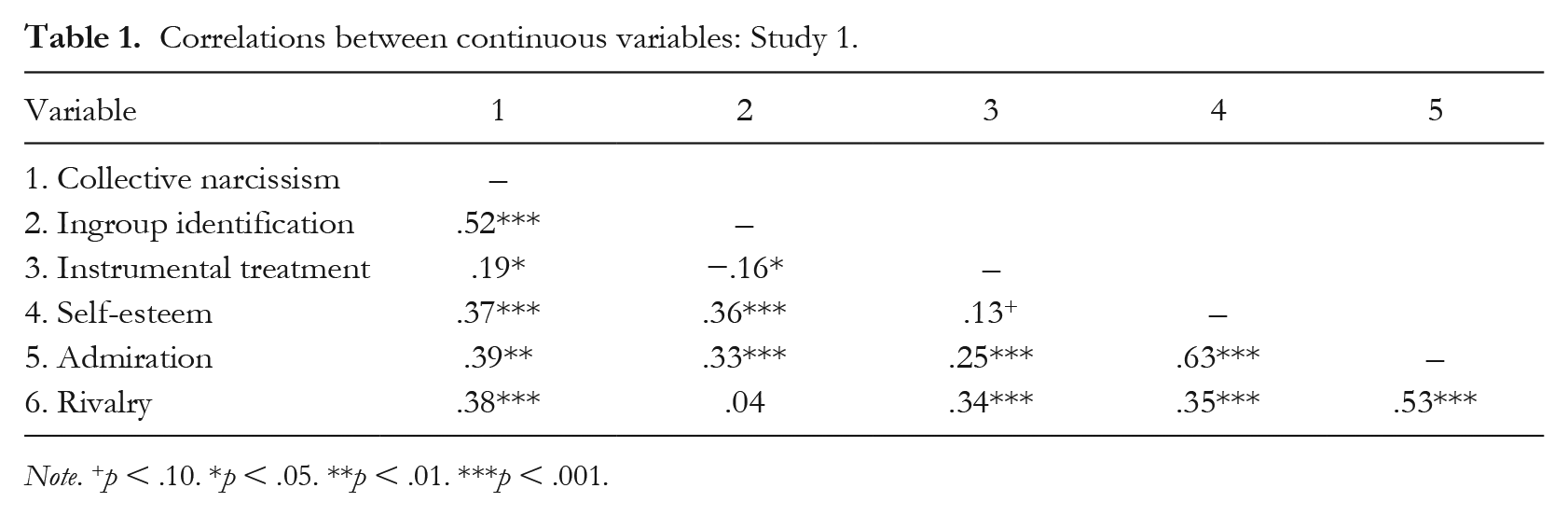
Note. +p < .10. *p < .05. **p < .01. ***p < .001.
We then included collective narcissism and identification together as predictors of coworker instrumental treatment in a regression model (Table 2, Step 1). Both effects remained significant: the effect for collective narcissism was positive, and the effect for ingroup identification was negative. The effects remained similar after adjusting for narcissistic admiration and rivalry as well as self-esteem (Table 2, Step 2). We also tested the same model adjusting for age, gender, and because the study was conducted in the organizational context, position in the organization. The pattern of results remained the same when we included these variables as covariates.
Summary of hierarchical regression analysis with instrumental treatment of coworkers as criterion: Study 1.
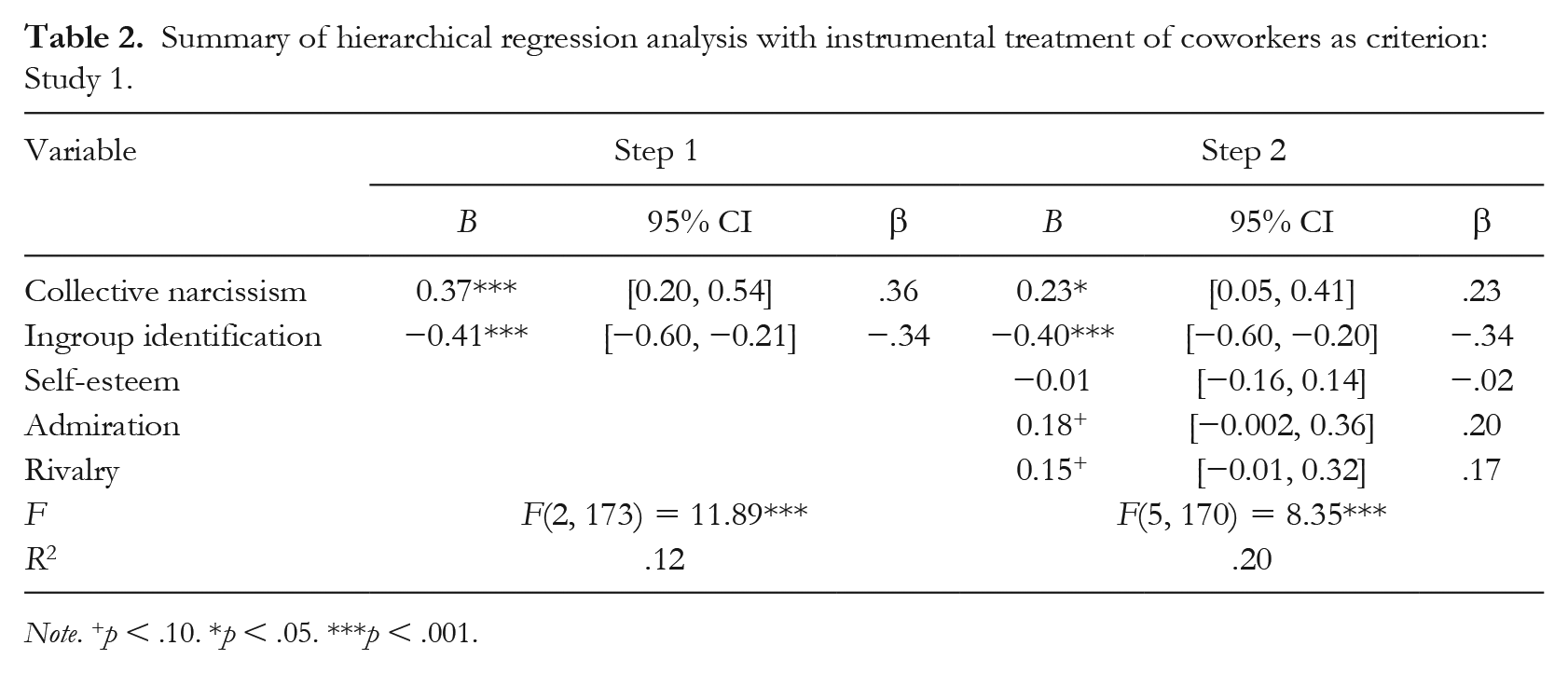
Note. +p < .10. *p < .05. ***p < .001.
Discussion
In Study 1, collective narcissism and ingroup identification had different relationships with treatment of ingroup members. Organizational collective narcissism was associated with greater likelihood of treating colleagues instrumentally, which is in line with our theoretical proposition that those scoring high on collective narcissism would exploit ingroup members for self-serving motives. Ingroup identification, in contrast, was associated with lower likelihood of treating coworkers instrumentally. This is in line with research demonstrating that organizational identification is associated with desirable outcomes in the workplace (e.g., Meyer et al., 2002; van Dick et al., 2006). The results held even when we adjusted for personality predispositions such as narcissism and self-esteem, suggesting that the observed findings are not due to the overlap between collective and individual narcissism. They point to an important role of identity processes in shaping interpersonal relations within the group.
Study 2
In Study 2, we sought to replicate the results of Study 1 using data from a longitudinal survey, which measured collective narcissism and identification with the organization as well as instrumental treatment of coworkers at three points in time. We expected organizational narcissism and identification measured at Times 1 and 2 to be associated with tendencies to treat coworkers instrumentally at Times 2 and 3.
Method
Participants, procedure, and measures
We used data from a larger survey of Polish adults working in various organizations recruited, as in Study 1, by an external research agency. Wave 1 included 557 participants: 2 284 women and 273 men, aged 19–67 years (M = 39.89, SD = 9.47), at various positions (194 = assistants/line employees, 201 = low-/medium-level managers, 162 = higher level/top managers). We recruited 239 participants in Wave 2, and 158 participants in Wave 3. Waves were separated by 6-month intervals. Participants completed the same measures of collective narcissism (αT1 = .85, M T1 = 4.53, SD T1 = 1.20; αT2 = .83, M T2 = 4.47, SD T2 = 1.22; αT3 = .84, M T3 = 4.47, SD T3 = 1.20), ingroup identification (αT1 = .94, M T1 = 5.41, SD T1 = 1.13; αT2 = .94, M T2 = 5.33, SD T2 = 1.27; αT3 = .92, M T3 = 5.36, SD T3 = 1.10), and instrumental treatment (αT1 = .57, M T1 = 3.34, SD T1 = 1.27; αT2 = .64, M T2 = 3.35, SD T2 = 1.39; αT3 = .46, M T3 = 3.15, SD T3 = 1.12) as in Study 1, with 7-point scales (1 = definitely disagree, 7 = definitely agree). Fifteen people were excluded from the analyses based on the same criteria applied to the instrumental treatment variable in Study 1.
Results
Zero-order correlations are presented in Table 3.
Correlations between continuous variables across the three waves: Study 2.
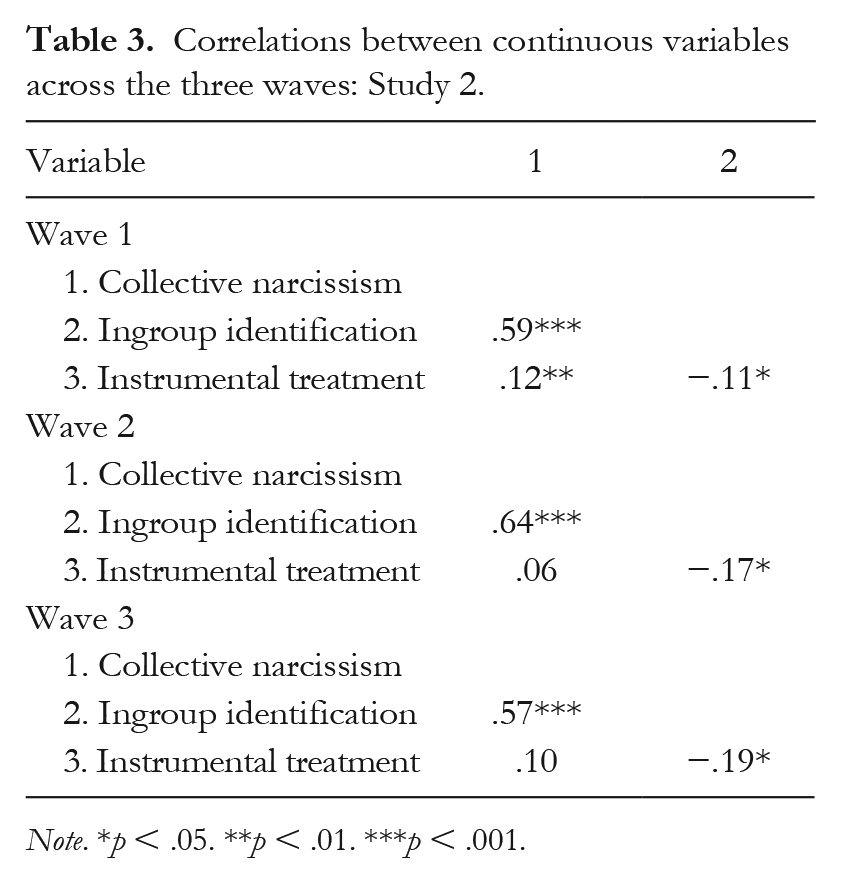
Note. *p < .05. **p < .01. ***p < .001.
Cross-lag model
Using Mplus (Version 7.11), we estimated a structural equation model, which allows for examining longitudinal data and correcting structural paths for any measurement issues. To estimate the goodness-of-fit, following Schreiber et al. (2006), we report chi-square statistics and three fit indices: the Tucker–Lewis index (TLI), the comparative fit index (CFI), and the root mean square error of approximation (RMSEA). We used a robust maximum likelihood estimator and the Satorra–Bentler scaled χ2 deltas.
We first tested a measurement model, with scale items as indicators of the latent variables, at each of the three time points. The model showed acceptable fit in each wave, T1 (N = 527): χ2(62) = 175.20, p < .001, TLI = 0.95, CFI = .96, RMSEA = .06, 90% CI [0.05, 0.07]. T2 (N = 227): χ2(62) = 129.70, p < .001, TLI = 0.93, CFI = .95, RMSEA = .07, 90% CI [0.05, 0.09]. T3 (N = 152): χ2(62) = 88.56, p = .02, TLI = 0.95, CFI = .96, RMSEA = .05, 90% CI [0.02, 0.08]. We then tested a full confirmatory factor analysis (CFA) model, which included all observed and latent variables from each time point, with freely estimated parameters. Residuals of the same indicators at each time point were allowed to covary. Missing data were imputed with Mplus defaults. Again, the model showed acceptable fit, χ2(627) = 955.20, p < .001, TLI = 0.94, CFI = .96, RMSEA = .03, 90% CI [0.03, 0.04].
We then proceeded to establish measurement invariance. To ensure that the same attributes were being measured at the three time points, we compared the freely estimated CFA model to a metric invariance model, in which factor loadings of corresponding indicators across time were constrained to be invariant. This model did not fit worse than the less restrictive measurement model, χ2(647) = 983.74, p < .001, TLI = 0.94, CFI = .95, RMSEA = .03, 90% CI [0.03, 0.04], Δχ2(20) = 28.82, p = .09, indicating sufficient metric invariance. We further compared this model with a scalar invariance model, in which intercepts of corresponding indicators across time were constrained to be invariant. This model did not fit worse than the less restrictive model, χ2(673) = 1,016.83, p < .001, TLI = 0.94, CFI = .94, RMSEA = .03, 90% CI [0.03, 0.04], Δχ2(26) = 32.69, p = .17.
We first tested an autoregressive longitudinal measurement model with freely estimated parameters in which all T1 latent variables predicted all T2 latent variables, and all T2 latent variables predicted all T3 latent variables. At T1, the latent variables were allowed to covary, and at T2 and T3, the latent variable residuals were correlated at each time point. Again, the model had acceptable fit, χ2(694) = 1,075.50, p < .001, TLI = 0.94, CFI = .94, RMSEA = .03, 90% CI [0.03, 0.04]. Because the time lag between the waves was approximately equal, we also tested assumptions of stationarity with a more restricted model, where we constrained the paths between T1 and T2 to be equal to the paths between T2 and T3. This model did not fit worse than the less restrictive model, χ2(697) = 1,082.55, p < .001, TLI = 0.94, CFI = .94, RMSEA = .03, 90% CI [0.03, 0.04], Δχ2(3) = 7.01, p = .07.
We then proceeded with testing cross-lagged models in which all T1 latent variables predicted T2 latent variables, and T2 latent variables predicted T3 latent variables. The model fit the data well, χ2(685) = 1,057.14, p < .001, TLI = 0.94, CFI = .94, RMSEA = .03, 90% CI [0.03, 0.04]. We then constrained the paths between T1 and T2 to be equal to the paths between T2 and T3. This model did not fit worse than the less restrictive model, χ2(691) = 1,064.51, p < .001, TLI = 0.94, CFI = .94, RMSEA = .03, 90% CI [0.03, 0.04], Δχ2(6) = 7.59, p = .27.
We next examined the patterns of bidirectional relationships. Due to the equality constraints we imposed, the pattern of relationships between T1 and T2 is the same as between T2 and T3. In line with our hypotheses, collective narcissism measured at T1/2 significantly positively predicted instrumental treatment measured 6 months later, at T2/3, B = 0.34, 95% CI [0.07, 0.61], p = .01. T1/2 instrumental treatment did not predict T2/3 collective narcissism, B = 0.06, 95% CI [−0.01, 0.13], p = .10. Further, T1/2 identification significantly negatively predicted T2/3 instrumental treatment, B = −0.34, 95% CI [−0.58, −0.10], p = .01. T1/2 instrumental treatment did not predict T2/3 identification, B = −0.004, 95% CI [−0.07, 0.07], p = .91 (see Figure 1 for standardized coefficients; note that these will vary even if unstandardized coefficients are constrained to be equal). The model explained 17% of variance in T2 and 28% of variance in T3 instrumental treatment. 3 As in Study 1, we controlled for T1 age, gender, and position in the organization. The pattern of results was similar. 4
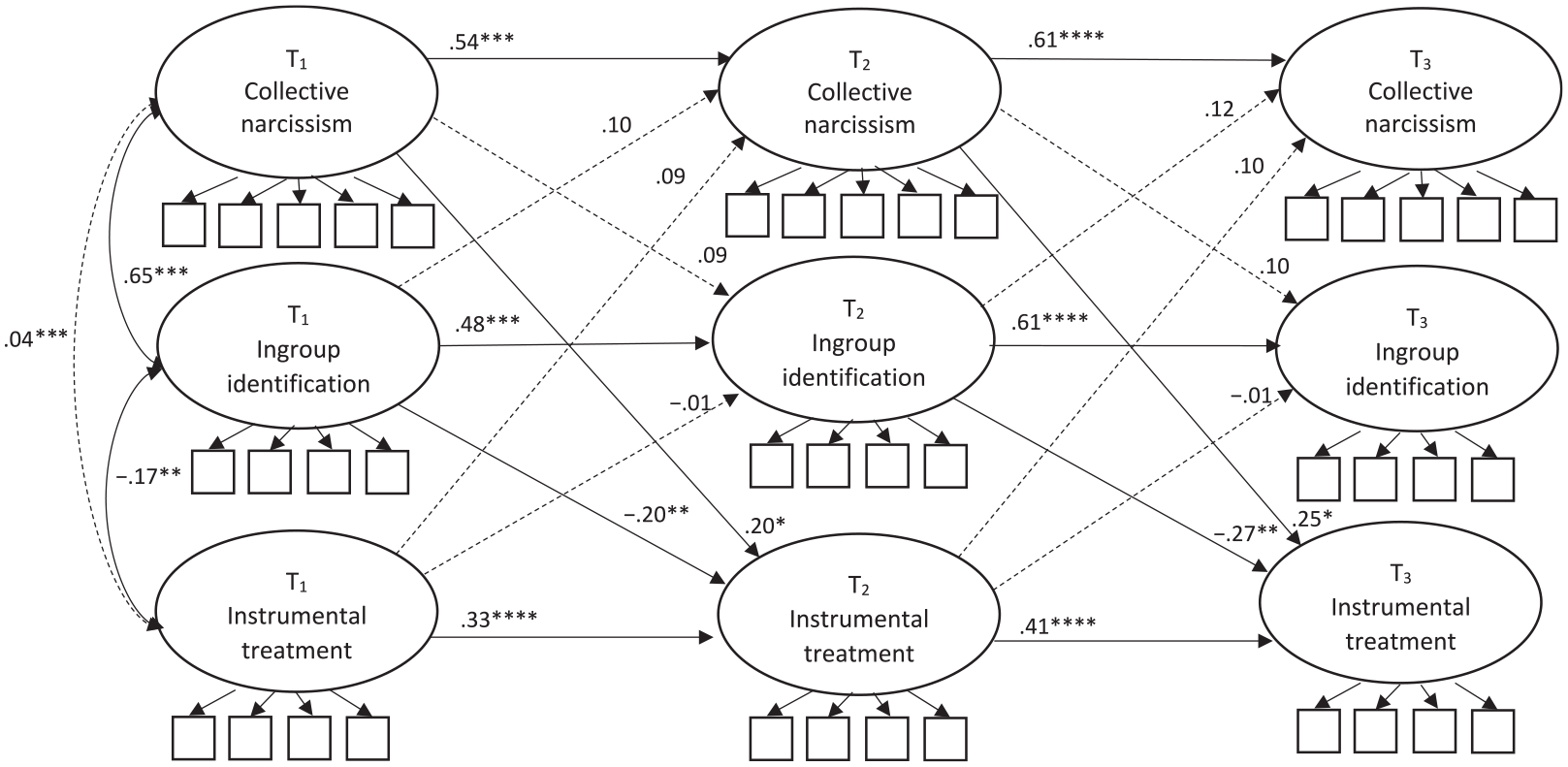
Cross-lagged model of collective narcissism, ingroup identification, and instrumental treatment of coworkers: Study 2.
Discussion
In Study 2, we corroborated the results observed in Study 1 with a longitudinal design. We found that those higher in collective narcissism were more likely to report treating coworkers instrumentally 6 months later. In contrast, those higher in ingroup identification were less likely to do so. At the same time, we did not observe the opposite relationships: instrumental treatment was not significantly associated with the two types of identity measured 6 months later. In this study, we observed rather poor reliability coefficients of the Instrumental Treatment Scale. One reason could have been that we relied only on a shortened, four-item measure. We therefore decided to use the full scale by Gruenfeld et al. (2008) in the next study.
Study 3
In Study 3, we sought to replicate our findings in a different context: politics. We examined partisan identities and relations with other party members. Again, we predicted that partisan collective narcissism would be associated with a greater likelihood of treating other party members instrumentally. We further sought to examine the potential mechanism behind this association. We theorized that collective narcissism would predict treating ingroup members instrumentally insofar as it is associated with self-serving motives. We examined this prediction by investigating people’s motivations to become involved in ingroup activities. We relied on the concept of political will, originally used to study organizational behavior. Political will has two dimensions (Kapoutsis et al., 2017). Self-serving political will focuses on building personal power and promoting self-interests within the organization. Benevolent political will is characterized by political participation for the common good—no return is expected for the investment one makes in the organization.
In Study 3, we investigated whether the two types of political will mediate the associations between collective narcissism versus ingroup identification and instrumental treatment. Insofar as collective narcissism is associated with motivations to satisfy personal needs (Cichocka, 2016), it should motivate partisans to engage in politics for the self, not for others. Hence, it should be linked with self-serving political will, which should further predict instrumental treatment of other party members. Conversely, we would expect partisan identification to predict political engagement out of genuine motivation to serve the common good. Hence, partisan identification should predict benevolent political will, which should further predict lower likelihood of treating others instrumentally.
Method
Participants and procedure
Study 3 involved party members of the Left-Green Movement of Iceland. We contacted 364 active members (i.e., those who were on party lists in parliamentary and municipal elections). The survey was completed by 214 participants: 110 women and 94 men (10 missing), aged 20–78 years (M = 48.68, SD = 14.01), who reported their partisan narcissism, identification, benevolent and self-serving political will, and instrumental treatment of other party members, 5 using 7-point scales with higher scores indicating stronger agreement.
Measures
Collective narcissism
We used the nine items of the Collective Narcissism Scale (Golec de Zavala et al., 2009), adapted to refer to fellow partisans (e.g., “The true worth of the Left-Greens is misunderstood,” “The Left-Greens deserve special treatment”; α = .81, M = 3.92, SD = 0.97).
Ingroup identification
We used Cameron’s (2004) 12-item Social Identification Scale, which measures ties to other ingroup members (e.g., “I have a lot in common with other members of the Left-Greens”), centrality of ingroup identification (e.g., “I often think about the fact that I am a member of the Left-Greens”), and ingroup affect (e.g., “In general, I’m glad to be a member of the Left-Greens” 6 ; α = .81, M = 5.10, SD = 0.84).
Political will
We used the Political Will Scale (Kapoutsis et al., 2017), adapted to the political context. The scale captures benevolent 7 (e.g., “I would engage in politics to serve the common good”; α = .67, M = 5.81, SD = 0.89) and self-serving (e.g., “Engaging in politics is an attractive means to achieve my personal objectives”; α = .75, M = 2.95, SD = 1.26) political will.
Instrumental treatment
As in Studies 1–2, participants were asked to describe another member of the Left-Green Party. They responded to all 10 items of the Gruenfeld et al.’s scale (2008). Thirty-seven people were excluded from the analyses reported next based on the criteria used in Studies 1–2 (α = .61, M = 3.08, SD = 0.82).
Results
We first examined zero-order correlations between variables (see Table 4). Instrumental treatment of other party members was positively correlated with collective narcissism, but it was not significantly correlated with ingroup identification. We then tested collective narcissism and ingroup identification as joint predictors of instrumental treatment. The regression model was significant, F(2, 174) = 8.62, p < .001, R2 = .09. Instrumental treatment was positively related to collective narcissism, B = 0.24, 95% CI [0.11, 0.36], β = .29, p < .001. When the overlap with collective narcissism was accounted for, ingroup identification emerged as a negative predictor of instrumental treatment, B = −0.20, 95% CI [−0.34, −0.06], β = −.21, p = .01.
Correlations between continuous variables: Study 3.
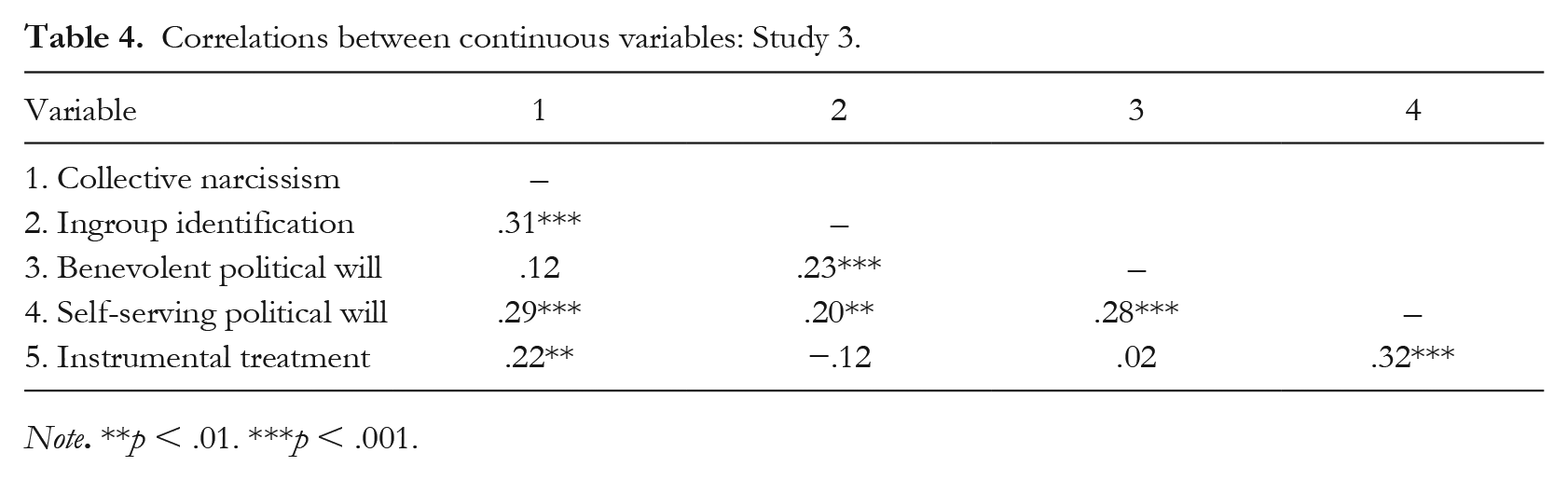
Note. **p < .01. ***p < .001.
We next examined whether collective narcissism was positively associated with instrumental treatment of other party members via self-serving political will, and whether identification was negatively associated with instrumental treatment of other party members via benevolent political will. Because of a small sample size, we tested a path model with manifest variables using Mplus (Version 7.11), with the robust maximum likelihood estimation. As illustrated in Figure 2 (which presents standardized coefficients), collective narcissism was positively related to self-serving political will, B = 0.34, 95% CI [0.15, 0.53], p = .001, but not to benevolent political will, B = 0.04, 95% CI [−0.09, 0.17], p = .460. In contrast, partisan identification was positively related to benevolent political will, B = 0.21, 95% CI [0.06, 0.36], p = .012, but not to self-serving political will, B = 0.17, 95% CI [−0.05, 0.46], p = .141. Instrumental treatment of other party members was positively related to both self-serving political will, B = 0.20, 95% CI [0.11, 0.29], p < .001, and collective narcissism, B = 0.17, 95% CI [0.05, 0.29], p = .005, while it was negatively related to identification, B = −0.23, 95% CI [−0.36, −0.09], p = .001, and unrelated to benevolent political will, B = −0.04, 95% CI [−0.17, 0.10], p = .622. The model explained 17% of variance in instrumental treatment, 10% of variance in self-serving political will, and 5% of variance in benevolent political will. Results were very similar when we controlled for age and gender.
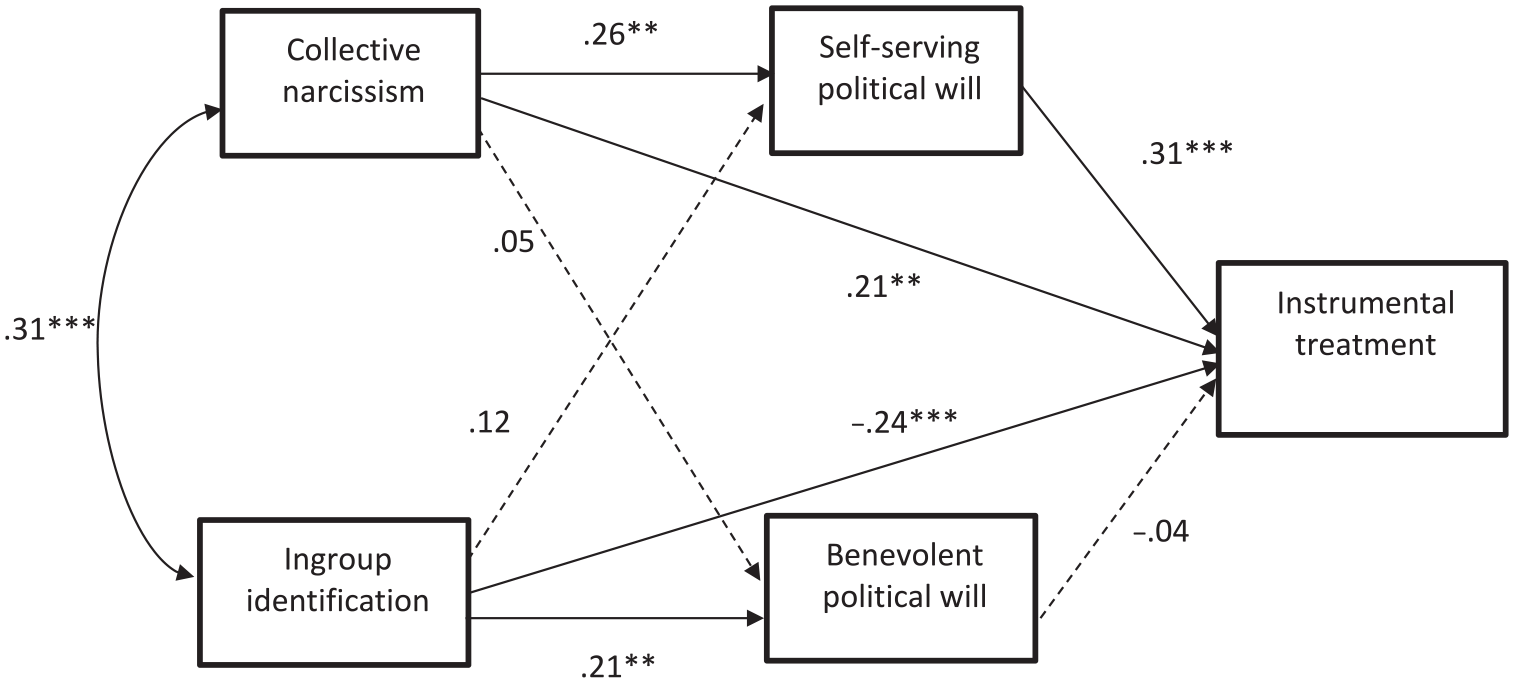
Benevolent and self-serving political will as mediators of the effect of collective narcissism and ingroup identification on instrumental treatment of other party members: Study 3.
We also examined the indirect effects using bootstrapping with 10,000 resamples, with 95% bias-corrected confidence intervals. Collective narcissism was positively associated with instrumental treatment via self-serving political will (estimate = 0.07, 95% CI [0.02, 0.13]), but not via benevolent political will (estimate = −0.002, 95% CI [−0.02, 0.01]). The indirect effects of identification on instrumental treatment via self-serving (estimate = 0.03, 95% CI [−0.01, 0.09]) and benevolent (estimate = −0.01, 95% CI [−0.05, 0.02]) political will were not significant. 8
Discussion
Study 3 provided the opportunity to corroborate our results in the context of a different social group—active party members in Iceland. We found that partisan collective narcissism was associated with treating other party members instrumentally, and this effect was mediated by self-serving motives. Although the cross-sectional nature of this study does not allow for establishing causality, this indirect effect suggests that the link between collective narcissism and instrumental treatment of ingroup members can at least partially be explained by self-interest. Partisan identification, in contrast, was associated with more benevolent motives for political activity, and with a lower likelihood of treating other party members instrumentally. However, we did not find the hypothesized indirect effect of identification on lower instrumental treatment via benevolent political will. It seems that for high identifiers, the more subjective treatment of other members is separate from the more general benevolent motivation for engaging in partisan activities.
Study 4
In Study 4, we wanted to directly compare instrumental treatment of ingroup and outgroup members. To this end, we employed an experimental design in which we manipulated targets of instrumental treatment. We conducted this study in an organizational context, this time focusing on workplace teams (Smith et al., 2012) rather than the whole organizations as in Studies 1–2. We measured collective narcissism and identification with one’s team and asked about instrumental treatment of colleagues, who were either members of the same team (ingroup targets) or a different team that participants sometimes interacted with (outgroup targets). We predicted that team collective narcissism will be associated with instrumental treatment of both ingroup and outgroup members, but that the effects will be stronger for outgroup members (this hypothesis was preregistered at http://aspredicted.org/blind.php?x=8v4jr5).
Method
Participants and procedure
We used available Prolific Academic prescreening to include British participants who work in small or large teams, and either always or sometimes work in their central place of work. We also asked participants whether they ever interact with members of other teams. If they responded no, they were redirected to take part in a different study. We assumed a large effect size for collective narcissism predicting outgroup instrumental treatment (f2 = .35) and power of .80. Using G*Power for R2 increase, we determined the desired sample size to be 25. Because we assumed that the effect for ingroup instrumental treatment would be weaker, we increased the sample size 14 times (suggested when 50% attenuation is expected; Giner-Sorolla, 2018). Therefore, we aimed to collect data from at least 350 participants. A total of 711 participants agreed to take part in the study, out of which 579 participants indicated they interacted with members of other teams. These participants formed the final sample, which included 403 women and 175 men (one missing), aged 19–70 years (M = 38.91, SD = 10.64). Participants filled out measures of team identification and collective narcissism, and were then randomly allocated to fill out a measure of instrumental treatment in relation to either an ingroup (n = 289) or an outgroup member (n = 290).
Measures
All measures used a 7-point scale (1 = definitely no, 7 = definitely yes).
Collective narcissism
We used the five-item version of the Collective Narcissism Scale (Golec de Zavala, Cichocka, & Bilewicz, 2013) referring to participants’ own teams (e.g., “My team deserves special treatment”; α = .70, M = 4.32, SD = 0.99).
Ingroup identification
We used Cameron’s (2004) 12-item Social Identification Scale referring to participants’ own team (e.g., “In general, I am glad to be a member of my team”; α = .90, M = 5.02, SD = 0.95).
Instrumental treatment
Similarly to Studies 1–3, participants were asked to think of a person that they worked with either in their own team (ingroup target) or another team (outgroup target), and briefly describe their relationship with that person and respond to the items measuring instrumental treatment (Gruenfeld et al., 2008). We again used four items from the full scale used in Study 3 (e.g., “I think more about what this person can do for me than what I can do for him/her,” “I tend to contact this person only when I need something from him/her”). Note we changed some of the items compared to Studies 1 and 2 (see supplemental material for details; α = .64, M = 3.82, SD = 1.09). Four participants were excluded from the analysis based on the same criteria we used in Studies 1–3.
Results
We first computed zero-order correlations. Collective narcissism was significantly positively correlated with instrumental treatment, r(573) = .18, p < .001, while ingroup identification was not, r(572) = −.02, p = .562. Collective narcissism and identification were positively correlated, r(572) = .27, p < .001.
We then included team collective narcissism and identification as well as the experimental manipulation together as predictors of instrumental treatment in a regression model. Collective narcissism was a significant, positive predictor of instrumental treatment, B = 0.22, 95% CI [0.13, 0.31], β = .20, p < .001. The effect of ingroup identification was not significant, B = −0.09, 95% CI [−0.19, 0.01], β = −.08, p = .07. The effect of the manipulation was not significant, B = 0.00, 95% CI [−0.09, 0.09], β = .001, p = .998; F(3, 570) = 7.36, p < .001, R2 = .04.
In Step 2, we included the interaction between collective narcissism and the condition, which was significant, B = 0.10, 95% CI [0.01, 0.19], β = .09, p = .026; F(4, 569) = 6.81, p < .001, R2 = .05, ΔR2 = .01. The effect of collective narcissism on instrumental treatment was positive and significant when the target was an ingroup member, B = 0.32, 95% CI [0.19, 0.45], β = .29, p < .001, and not significant when the target was an outgroup member, B = 0.12, 95% CI [−0.01, 0.25], β = .11, p = .064. The pattern of results remained the same when we adjusted for age and gender.
Discussion
Study 4 further corroborated our model, demonstrating that collective narcissism is associated with instrumental treatment of others. In contrast to our preregistered predictions, we found the effect to be stronger for ingroup members, and only marginal for outgroup members. It is possible that ingroup members are sometimes easier to objectify than members of other groups. This may have been the case in the context (i.e., workplace teams) of the current study. As participants probably interact more often with members of their own team, they have more opportunities for using them for personal gains. In fact, treating ingroup members instrumentally may prove more profitable, because members of one’s own team are more likely to have expertise in the areas that are meaningful to one’s job. Finally, making use of own group members may also prove easier, as they are more likely to trust fellow ingroup members and expect altruistic and fair behavior from them (Foddy et al., 2009). Future research should directly investigate these possibilities.
Interestingly, we did not observe a main effect of target on instrumental treatment. We also observed a nonsignificant effect of identification. Thus, it seems that it was only those who were high in team collective narcissism that were likely to take advantage of ingroup members they interact with. This finding extends previous theorizing and research which showed that collective narcissism was associated with negative attitudes toward members of lower status groups within the group. For example, past research showed that national narcissism is related to prejudice towards lower status members of the national group, such as women or sexual and ethnic minorities, who might be seen as less representative of the overarching ingroup (Golec de Zavala & Bierwiaczonek, 2020; Golec de Zavala, Cichocka, & Bilewicz, 2013; Górska & Mikołajczak, 2015; see also Hadarics et al., 2020). Here, we found that collective narcissism might be related to exploitative tendencies toward ingroup members of equal status.
General Discussion
In four studies, conducted in three different countries and across three different group contexts, we demonstrated that collective narcissism is associated with an outcome that can be considered problematic for intragroup relations: treating other ingroup members instrumentally. We observed similar effects in the context of whole organizations (prestudy, Studies 1–2), workplace teams (Study 4), and political parties (Study 3). Overall, these results suggest that collective narcissism is associated with willingness to exploit ingroup members, and this readiness seems even stronger than the readiness to exploit members of other groups (Study 4). This work contributes to the growing literature on intragroup concomitants of collective narcissism (Cichocka, 2016; Cichocka & Cislak, 2020; Marchlewska et al., 2020), while past work largely focused on the intergroup consequences of collective narcissism. Despite seeming strongly invested in the ingroup, those scoring high in collective narcissism tend to exhibit attitudes and behaviors that are potentially detrimental to ingroup members. Our findings are in line with past theorizing about collective narcissism in organizations: Galvin et al. (2015) as well as Müller (2017) argued (although did not test empirically) that organizational narcissism should be associated with self-serving and exploitative organizational behaviors (cf. Rousseau & Duchon, 2015).
In most of our studies, ingroup identification predicted lower likelihood of treating ingroup members instrumentally (Studies 1–3). This finding is consistent with previous literature demonstrating that strong ingroup identification is associated with positive outcomes, both in the organizational (Riketta, 2005; van Knippenberg & van Schie, 2000) and national (Huddy & Khatib, 2007) contexts. We demonstrate that these positive outcomes can only be expected when one identifies with the ingroup in a secure, nonnarcissistic way, thereby providing new insights into the role social identity plays in ingroup functioning.
We observed similar effects even after adjusting for the individual difference variable typically linked to exploitative behavior, namely individual narcissism (Back et al., 2013; Krizan & Herlache, 2018). Thus, we cannot attribute our findings merely to the overlap between individual and collective narcissism (Golec de Zavala et al., 2009). This suggests that interpersonal relations within the ingroup are not only a product of the personality of its members, but also of the way these members identify with the ingroup as a whole.
Theoretical Implications
Our studies have important implications for understanding intragroup processes. Despite their seemingly strong commitment to the ingroup, those scoring high in collective narcissism are willing to exploit ingroup members. We argue that this is because collective narcissism predicts greater concern about how the image of the ingroup reflects on the self than about being a dedicated ingroup member (cf. Galvin et al., 2015). This was also illustrated in the study by Marchlewska et al. (2020), where collective narcissism predicted willingness to defend the ingroup image, but also readiness to leave the ingroup for personal gains.
Our work advances emerging literature showing that sometimes ideological commitment to the ingroup can be accompanied by egoistic behavior (Gaertner et al., 2018; Halali et al., 2018). We argue that collective narcissism is associated with instrumental treatment of ingroup members because of self-serving motives. Similarly, Müller (2017) theorized that organizational narcissism develops as a consequence of excessive positive evaluation of an organization stemming from a self-enhancement (rather than self-enrichment) motivation. Interestingly, the compensatory nature of collective narcissism might mean that it is self-defeating. If exploitative behaviors harm ingroup functioning in the long run, this might end up reflecting badly on those scoring high in collective narcissism. Their strategies resemble self-defeating behaviors of individual narcissists, who tend to prioritize short-term self-aggrandizing strategies, which harm their long-term social relations (e.g., Morf & Rhodewalt, 2001; Vazire & Funder, 2006).
In contrast, ingroup identification showed the typical positive correlates. In line with past research demonstrating positive concomitants of identification with social groups be it nations (Huddy & Khatib, 2007), ethnic groups (Bilewicz & Wójcik, 2010), or organizations (Abrams et al., 1998; Randsley de Moura et al., 2009; see also Jetten et al., 2012), we found that ingroup identification (especially after accounting for its overlap with collective narcissism) was associated with lower likelihood of treating others instrumentally. Thus, it had opposite implications for intragroup relations than collective narcissism.
Practical Implications and Future Directions
The current work also has practical implications of particular interest to leaders seeking to promote strong group identities. We argue that they should be careful not to overemphasize positive attributes of their groups, especially if these are not always recognized externally. Such strategy risks creating a narcissistic narrative of unappreciated greatness. Our findings further suggest that, paradoxically, groups attempting to promote a strong image may be in danger of attracting individuals who seek to strengthen their own standing, even at the expense of the ingroup and their fellow group members. This does not imply that leaders should never strive to support strong identification with the ingroup. For example, research in the organizational context suggests that promoting the image of the organization as supportive might foster more constructive commitment to the organization (Meyer et al., 2002; Panaccio & Vandenberghe, 2009). We hope that future research will test these possibilities directly and identify specific risk factors that might lead to the development of collective narcissism as opposed to a secure and constructive ingroup identity.
Our set of studies focused on a specific outcome, mostly capturing the tendency to use others for self-serving purposes. However, we would expect that if exploiting other group members could harm the ingroup image, a different pattern of results would emerge. In contexts when the ingroup image is at stake, collective narcissism might be associated with at least superficial declarations of more positive attitudes towards other group members and willingness to put their well-being first (see also Cislak et al., 2021). In fact, we would expect those high in collective narcissism to go to great lengths to protect the ingroup image, even if it would involve taking actions that are ethically questionable (see also Chen et al., 2016; Leavitt & Sluss, 2015; Umphress et al., 2010) or punishing ingroup members who violate ingroup norms (see Marques et al., 2001). Future research should examine the boundary conditions of the observed effects as well as other possible intragroup outcomes associated with collective narcissism.
Conclusion
In the opening paragraph, we referred to leaders’ attempts to promote a strong sense of ingroup identity. However, our studies suggest that not all forms of ingroup identity might be conducive to maintaining positive social relations within the group. We demonstrated that those who identify with their ingroup in a secure way are likely to treat other ingroup members favorably, which might benefit the group in the long run. However, those high in collective narcissism are more likely to end up exploiting members of their group for their own benefits.
Supplemental Material
sj-pdf-1-gpi-10.1177_13684302211038058 – Supplemental material for Can ingroup love harm the ingroup? Collective narcissism and objectification of ingroup members
Supplemental material, sj-pdf-1-gpi-10.1177_13684302211038058 for Can ingroup love harm the ingroup? Collective narcissism and objectification of ingroup members by Aleksandra Cichocka, Aleksandra Cislak, Bjarki Gronfeldt and Adrian Dominik Wojcik in Group Processes & Intergroup Relations
Footnotes
Acknowledgements
Study 3 was part of the master’s dissertation of the third author. The authors would like to thank Konrad Bocian, Katarzyna Byrka, Karen Douglas, Giacomo Marchesi, Robbie Sutton, Eduardo Vasquez, Mikołaj Winiewski, and Maddy Wyatt for their advice and comments on earlier versions of this manuscript, and Arnold Maciejewski for his help in collecting the prestudy. We also thank Ilan Roziner for his help with data analysis and access to his wine collection.
Funding
The author(s) disclosed receipt of the following financial support for the research, authorship, and/or publication of this article: Preparation of this article was supported by the Polish National Science Center (Grants 2014/13/B/HS6/03137 and 2018/29/B/HS6/02826).

Supplemental material
Supplemental material for this article is available online.
Notes
References
Supplementary Material
Please find the following supplemental material available below.
For Open Access articles published under a Creative Commons License, all supplemental material carries the same license as the article it is associated with.
For non-Open Access articles published, all supplemental material carries a non-exclusive license, and permission requests for re-use of supplemental material or any part of supplemental material shall be sent directly to the copyright owner as specified in the copyright notice associated with the article.
