




Abstract
Much research has shown that intergroup contact is associated with a reduction in prejudice. Far less attention has been paid to the conditions that promote intergroup contact. This research explored the role of normative social influence in predicting contact engagement (total N = 1,538). Cross-sectional Study 1 found that individuals’ perception of descriptive levels of intergroup contact amongst the ingroup predicted their own contact engagement whilst controlling for outgroup attitudes. Study 2 and Study 3 demonstrated that an experimental manipulation of descriptive norms promoted outgroup approach intentions, and actual approach behaviour. Participants were more open to future intergroup contact when they learnt of the high prevalence of this behaviour amongst the ingroup. Study 4 then considered how normative techniques could be used when intergroup contact is not commonplace. Together, the findings provide a new understanding of the antecedents of intergroup contact and new techniques for encouraging greater inclusion and integration.
Intergroup contact theory states that bringing groups together under favourable conditions can reduce prejudice and improve intergroup relations (Allport, 1954; Brown & Hewstone, 2005; Pettigrew & Tropp, 2011). More than 60 years of supportive research have led to the widely shared recognition that contact “works” for reducing prejudice (Pettigrew & Tropp, 2006). An important question that remains is how to encourage greater interest in, and positive inclination towards, intergroup contact. Previous research has focused on the consequences of intergroup contact at the individual level. Far less attention has been paid to understanding how intergroup contact comes about in the first place, and the group processes that are involved (Paolini et al., 2018). This present research adopts a normative approach to intergroup contact by exploring how individuals’ willingness to engage in intergroup contact is impacted by the contact they perceive is occurring around them, and how normative manipulations can be used to promote contact-seeking behaviour.
There is a rich tradition in psychology that suggests that social norms powerfully influence behaviour (Asch, 1951; Sherif, 1936). Norms that characterise the perception of what most people do are known as descriptive norms. Individuals generally prefer to behave in a certain way when they know that other people behave similarly. The hallmark of a social norms intervention is the dissemination of a message documenting the high incidence of the desirable behaviour (Miller & Prentice, 2016). A classic example is provided by Goldstein et al. (2008), who sought to encourage hotel guests to reuse their towels during their stay. A standard informational request was placed in half of the rooms in the hotel stating, “Help save the environment by reusing towels during your stay.” The other half received an alternative message that additionally evoked a social norm, stating, “Join your fellow guests in helping to save the environment. Almost 75% of guests reuse their towels during their stay.” Communicating that the majority of fellow guests had reused their towels in this way, successfully reduced the number of towels washed by 26%. Such norms-based interventions have become a prominent part of behavioural change toolkits, or “nudges,” which aim to provide subtle, simple, low-cost, and effective ways to alter behaviour in a predictable fashion. Social norms interventions have been successfully applied to promote a wide array of desirable behaviours including healthy eating (e.g., Robinson et al., 2014), tax compliance (e.g., Hallsworth et al., 2017), charitable giving (e.g., Agerström et al., 2016), voter turnout (e.g., Gerber & Rogers, 2009), savings behaviour (e.g., Yoon et al., 2016), and proenvironmental behaviours such as energy conservation (e.g., Schultz et al., 2007), water conservation (e.g., Lede et al., 2019), and proenvironmental driver behaviour (e.g., Player et al., 2018).
Social norms interventions are embedded in processes related to social identification and social influence. Social identity theory seeks to explain how individuals’ attitudes, emotions, and behaviours are shaped by the groups to which we belong. According to the social identity approach, social influence operates on the basis of salient group identities (Abrams & Hogg, 1990; J. C. Turner et al., 1987, 1989). When we self-categorise as members of a particular group, we answer the question, “Who am I?” in terms of the characteristics that we share with other group members. We also answer the question, “What should I do?” with reference to the ingroup stereotype. The process of depersonalisation assimilates the self to the group prototype and, thus, an individual’s behaviour becomes group-based and guided by the norms of the social category or group. Moreover, because the norms are internalised as part of the individual’s self-concept and are linked to his or her membership to that group, the norm may exert influence over their behaviour even in the absence of other group members (Abrams & Hogg, 1990).
Social Norms, Intergroup Relations, and Intergroup Contact
Research has previously recognised the importance of social norms in the context of intergroup relations, particularly norms surrounding the expression of prejudice. Studies have shown that the amount of prejudice that people express towards different groups is highly correlated with the social approval of that expression (Crandall et al., 2002; Wittenbrink & Henly, 1996) and is affected by manipulations of social approval (Blanchard et al., 1991, 1994; Monteith et al., 1996). Crandall et al. (2002), for instance, indexed the acceptability (normality) of negative feelings towards over 100 outgroups and found that normative disapproval of outgroups predicted the perceived acceptability of discrimination against them. Blanchard et al. (1994) similarly found that participants expressed significantly stronger antiracist attitudes after being exposed to a confederate posing as a fellow student who condemned racism compared to participants exposed to a confederate who condoned racism. Theories such as that of aversive racism also recognise that the steady decline of overt expressions of racial prejudice over recent decades is likely due to adherence to social norms proscribing open expressions of prejudice and discrimination (Dovidio & Gaertner, 2004; Gaertner & Dovidio, 1986).
However, despite calls for intergroup contact to be considered from a normative perspective (Pettigrew, 1991, 1998, 2008), research on the contact hypothesis and research on social norms have usually remained disconnected. In the extended contact hypothesis, Wright et al. (1997) introduced for the first time the influence that the contact of other ingroup members has on one’s own outgroup attitudes. It is argued that knowing that other ingroup members have outgroup members as friends can reduce prejudice, even in the absence of direct intergroup contact. This hypothesis has now received considerable support in a variety of intergroup settings and with different methodologies (for recent meta-analysis, see Zhou et al., 2018). When Wright et al. (1997) first introduced the extended contact hypothesis, it was argued that this type of indirect contact could generate changes in perceived norms about the acceptability of positive intergroup relationships, and that these changes in norms would be a key mechanism by which extended contact would have an impact on prejudice reduction. Evidence supports this idea demonstrating that perceived ingroup norms serve as a significant mediator of extended contact effects (for review, see Vezzali et al., 2014; White et al., 2020).
Whereas research on extended contact has typically focused on individuals who personally know other ingroup members who have outgroup friends, a recent extension of this approach suggests learning that ingroup members in general have outgroup friends can encourage more positive intergroup attitudes (Gómez et al., 2018). Gómez et al. operationalise depersonalised extended contact as information about the number of outgroup friends that most ingroup members have. Five studies showed that learning about high levels of depersonalised extended contact amongst unknown ingroup members (i.e., more than two immigrant friends vs. one or two immigrant friends vs. no immigrant friends) promoted more positive intergroup orientations. In contrast, outgroup norms surrounding cross-group friendships did not influence intergroup attitudes, with findings suggesting that participants attribute outgroup members’ interest in contact to utilitarian motives (e.g., to access resources and jobs) rather than genuine desire for integration.
Social Norms as an Antecedent of Intergroup Contact
Research surrounding the extended contact hypothesis paves the way for a normative perspective on the study of intergroup contact. It is our contention that the perception of favourable norms surrounding intergroup interactions is not just a potential mechanism underlying extended contact effects, but is suggestive of the wider importance of normative social influence in relation to contact. In the extended contact approach, individuals infer ingroup and outgroup norms about intergroup contact on the basis of exemplars who maintain outgroup friendships. In other words, extended contact promotes positive outgroup attitudes because it changes perceptions of what is normative among the ingroup (and outgroup) in general. Clearly, extended contact is just one of many factors that can lead to the development of social norms, which represent a much broader construct of central importance in social psychology. The importance of normative social influence in its own right is currently underappreciated in the context of intergroup contact. The current research sought to directly manipulate ingroup norms surrounding intergroup contact by providing feedback on the number of other ingroup members who engage in this behaviour (i.e., a descriptive norm), and to explore how such techniques could be used to promote intergroup contact engagement.
Widespread evidence demonstrates that despite ever growing levels of social diversity, opportunities for intergroup contact are not always taken up, and micro-level segregation persists even in mixed social environments (Dixon & Durrheim, 2003; Durrheim & Dixon, 2013; McKeown & Dixon, 2017). It is therefore imperative to understand the factors that motivate contact engagement, and to design intervention strategies to ensure that opportunities for, and benefits of, intergroup contact are fully enjoyed. Initial empirical explorations of the antecedents of intergroup contact have identified several factors that may promote greater contact engagement. Longitudinal studies have shown a bidirectional association between intergroup contact and outgroup attitudes in which intergroup contact predicts reduced prejudice over time, and more positive outgroup attitudes predict greater intergroup contact (e.g., Binder et al., 2009), although evidence of the latter path is mixed (Brown et al., 2007). Paolini et al. (2016) found that higher self-expansion motivation predicted more and higher quality interactions across group boundaries. Meanwhile, Meleady et al. (2020) recently demonstrated that intercultural competence was dynamically associated with intergroup contact quality, with positive contact predicting improvements in intercultural competence over time, and higher intercultural competence predicting a reduction in future negative contact.
It seems likely that willingness to engage in intergroup contact is also influenced by normative factors. Several recent theoretical explorations of the antecedents of intergroup contact suggest that if individuals observe other ingroup members engaging in positive and frequent interactions with outgroup members, they will seek to behave in a way consistent with these observations (see Kauff et al., 2020; Paolini et al., 2018; Ron et al., 2017; R. N. Turner & Cameron, 2016). Ron et al. (2017), for instance, suggest that in conflict settings, separation norms may hinder individuals’ willingness and opportunities to engage in encounters with the outgroup, while more tolerant norms may predict increased intergroup contact when conflict is less violent. Meanwhile, R. N. Turner and Cameron (2016) conceptualise social norms as a key predictor of “confidence in contact,” which describes a state of readiness for contact whereby individuals have the necessary confidence, skills, and abilities they need to successfully navigate intergroup encounters.
Empirical evidence of the association between norms and actual contact engagement is still relatively limited, especially with adult samples. In one supportive study, Tropp et al. (2014) found that perceptions of inclusive peer norms predicted children’s (aged 9–13) interest in cross-group friendship (see also Tropp et al., 2016). McKeown and Taylor (2018) also found that positive perceived peer norms towards intergroup contact predicted more frequent and better quality outgroup contact amongst youths (aged 14–16) in Northern Ireland. More recently, Murrar et al. (2020) tested an intervention targeting perceptions of social norms by communicating to participants, in six randomised controlled trials at a university in the United States, that their peers engaged in inclusive behaviours. Results showed nonmarginalised students exposed to the interventions reported more positive attitudes towards outgroups and greater appreciation of diversity, while marginalised students reported an increased sense of belonging and reported being treated inclusively by their peers.
Importantly, the literature on social norms also provides insights into how normative techniques can be used even when the desired behaviour is not commonplace. Whilst descriptive norms have traditionally been conceptualised as the current prevalence of a behaviour, recent research suggests that this is not the only form of descriptive normative information that may be valuable. The environments in which we are embedded are changing and dynamic, and communicating information about behavioural trends may alert us to new strategies that could prove beneficial. Instead of highlighting the current state of a behaviour (i.e., X% of a reference group show the “static norm”), dynamic norms interventions communicate information about how a social norm is changing over time in the desired direction (Sparkman & Walton, 2017, 2019; regarding trending norms, see also Mortensen et al., 2019). A series of experiments and field studies have shown that communicating that the number of people engaging in a behaviour is increasing—even if it is only among a minority of people—successfully increased participants’ interest in reducing their meat consumption, made participants more likely to order a meatless lunch, and more likely to conserve water while doing laundry (Sparkman & Walton, 2017). The current research sought to extend the evidence base surrounding the impact of social norms on contact engagement, and to explore how normative manipulations can also be used when intergroup contact is not (yet) normative.
The Present Research
Normative messages conveying information about the behaviour of relevant others have been shown to provide subtle, simple, low-cost, and effective ways to encourage behaviour change across a range of sectors including health, finance, and environmental decision-making. This research represents the application of this approach to the domain of intergroup relations. The main argument developed in this project is that individuals’ interest and engagement in intergroup contact is influenced by the contact they perceive to be occurring around them. Four studies tested this hypothesis. Study 1 was a cross-sectional investigation of the association between perceived norms and British adults’ contact with immigrants. Study 2 and Study 3 explored the impact of an experimental manipulation communicating the high proportion of British people who regularly interact with immigrants on contact approach tendencies (Study 2) and actual approach behaviour (Study 3). Study 4 then went on to consider how normative manipulations could be used when existing intergroup contact levels are low, by using a dynamic norms manipulation to communicate information about how a social norm is changing in the desired direction.
Study 1
Study 1 aimed to provide initial cross-sectional evidence of the association between perceived norms and contact engagement. Participants were White British adults, and the target outgroup was immigrants to Britain. Individuals’ perceptions of descriptive levels of positive cross-group contact amongst other British people were measured. It was expected that individuals would be more likely to engage in contact with immigrants when they perceive more others to be doing the same. Importantly, demographic factors (i.e., age and gender) and geographic factors (i.e., perceived levels of neighbourhood diversity) that may predict contact engagement were also measured and controlled for, as well as outgroup attitudes. It was expected that normative levels of contact would predict contact engagement over and above individuals’ personal attitude towards the outgroup.
A second aim of Study 1 was to explore the comparative influence of outgroup norms. It was expected that the perceived behaviour of other ingroup members would shape individuals’ own contact engagement, as we often look to fellow ingroup members as guides for our intergroup attitudes and behaviour (Abrams & Hogg, 1990; Jetten et al., 1997). Perceived outgroup norms may further contribute to contact engagement, with some research suggesting our own interest in intergroup contact is predicted by the extent to which we believe outgroup members are willing to engage with members of our group (Shelton & Richeson, 2005; Stathi et al., 2020; Tropp & Bianchi, 2006). Other findings suggest, however, that outgroup norms are most likely to influence decision-making and behaviour when the outgroup has coercive power over the ingroup (Louis et al., 2005), and that outgroup norms do not modify ingroup members’ attitudes when compliance is not associated with punishments or rewards (Mackie et al., 1992; Terry & Hogg, 1996). Accordingly, in this context, where the aim is to predict advantaged majority group members’ contact with disadvantaged minority group members, ingroup norms were expected to be more important in predicting contact engagement than outgroup norms.
Participants
A power analysis was conducted in G*Power 3.1 (Faul et al., 2007) using the linear multiple regression R2 increase option to specify a model with four control variables and two predictor variables. We wished to have .90 power for obtaining statistical significance with alpha = .05 if the R2 change was large enough to add .03 beyond an anticipated R2 of .30 produced by the first four control variables. The minimum recommended sample size was 299. The sample size obtained exceeded the estimated required number, to allow for unusable data. Data were collected from a total of 400 participants from an online participant panel, Prolific. Only White British participants were eligible to participate. Five participants indicated they did not want their data to be used. No further exclusions were made. The final sample included 151 males and 244 females aged between 18 and 75 (M = 40.07, SD = 12.31).
Procedure
Collection of all responses was done via online survey software. All items were measured on appropriately anchored 7-point scales. Perceived ingroup norms were measured with three items designed to assess perceptions of descriptive levels of intergroup contact amongst other British people: “In general, I think British people like to spend time with immigrants,” “In general, I think British people maintain close social relations with immigrants,” and “In general, I think British people do not like to have much contact with immigrants” (reverse-coded) 1 (α = .88). Perceived outgroup norms were measured with the same three items, this time assessing immigrants’ contact with British people (α = .84). 2
Contact engagement was measured with two items adapted from Voci and Hewstone (2003). Participants were asked, “How many immigrants do you know?” and “How frequently do you have contact with immigrants?” (Spearman–Brown coefficient = .85). Outgroup attitudes were measured with the General Evaluation Scale (Wright et al., 1997). Participants indicated their feelings towards immigrants in general on six bipolar scales (1–7; warm–cold, negative–positive, friendly–hostile, suspicious–trusting, respect–contempt, admiration–disgust). Items were coded so that higher scores corresponded to more positive outgroup attitudes (α = .96). Perceived levels of neighbourhood diversity were measured with a single self-report item, “How many immigrants are living in your neighbourhood” (1 = none, 7 = many).
Results and Discussion
Two outliers more than 3 standard deviations from the mean were observed on outgroup attitudes. These scores were winsorised to the next acceptable value. 3 The correlations amongst all variables are presented in Table 1, along with means and standard deviations. Contact engagement was positively associated with levels of perceived neighbourhood diversity, outgroup attitudes, ingroup norms, and outgroup norms. There was no significant association between age and gender with contact engagement.
Means, standard deviations, and correlations for all variables: Study 1.
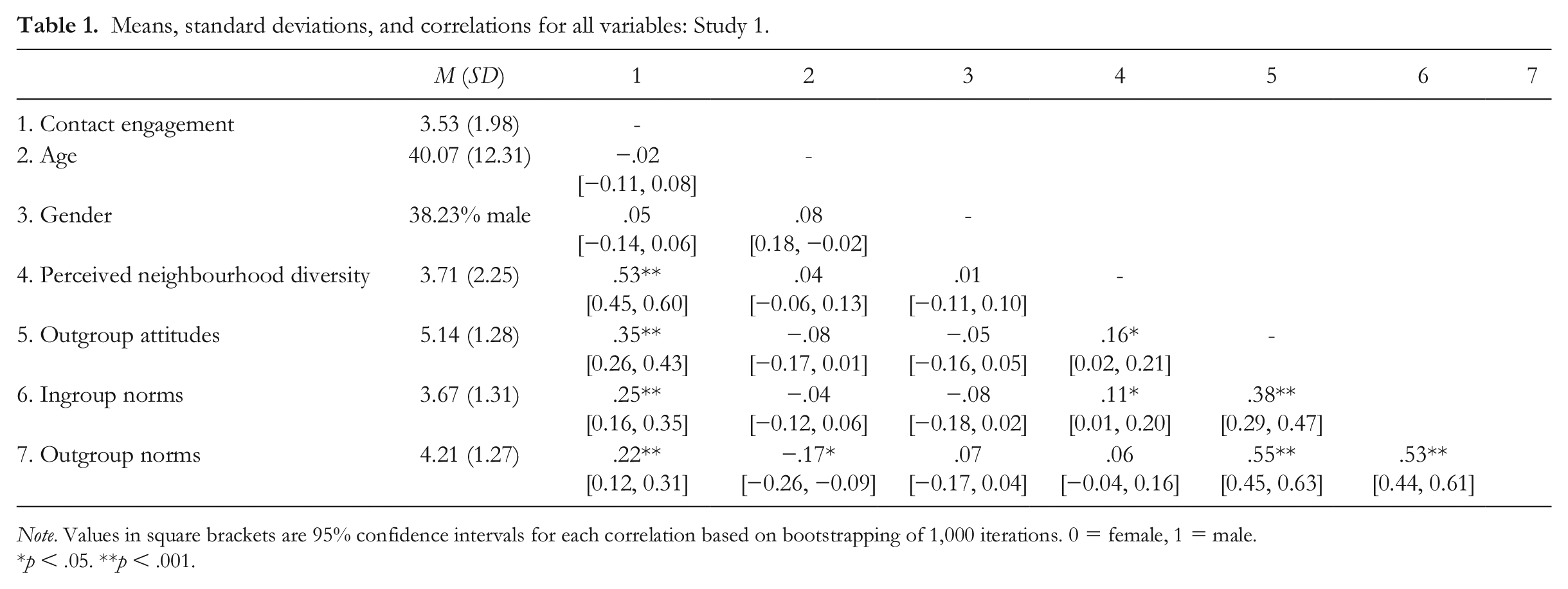
Note. Values in square brackets are 95% confidence intervals for each correlation based on bootstrapping of 1,000 iterations. 0 = female, 1 = male.
p < .05. **p < .001.
A hierarchical regression was then conducted to examine the extent to which perceived ingroup norms and outgroup norms predicted contact engagement after controlling for levels of perceived neighbourhood diversity and outgroup attitudes. As age and gender did not show a significant bivariate correlation with intergroup contact engagement, they were not included in the regression analysis. Perceived neighbourhood diversity and outgroup attitudes were included as control variables in Step 1, and perceptions of ingroup and outgroup norms surrounding contact were entered in Step 2. The final regression equation was statistically significant, F(4, 390) = 55.00, p < .001. The control variables explained a significant amount of variance in contact engagement in Step 1 (see Table 2). Both outgroup attitudes (β = .27, p < .001) and perceived levels of neighborhood diversity (β = .49, p < .001) were associated with greater contact engagement. Importantly, the inclusion of the normative variables in Step 2 provided a significant amount of additional explained variance. As expected, perceptions of positive ingroup norms surrounding intergroup contact were positively associated with contact engagement (β = .11, p = .19). There was no significant independent association between outgroup norms and contact engagement (β = .003, p = .948).
Hierarchical regression analysis exploring the association between perceived norms and intergroup contact engagement: Study 1.
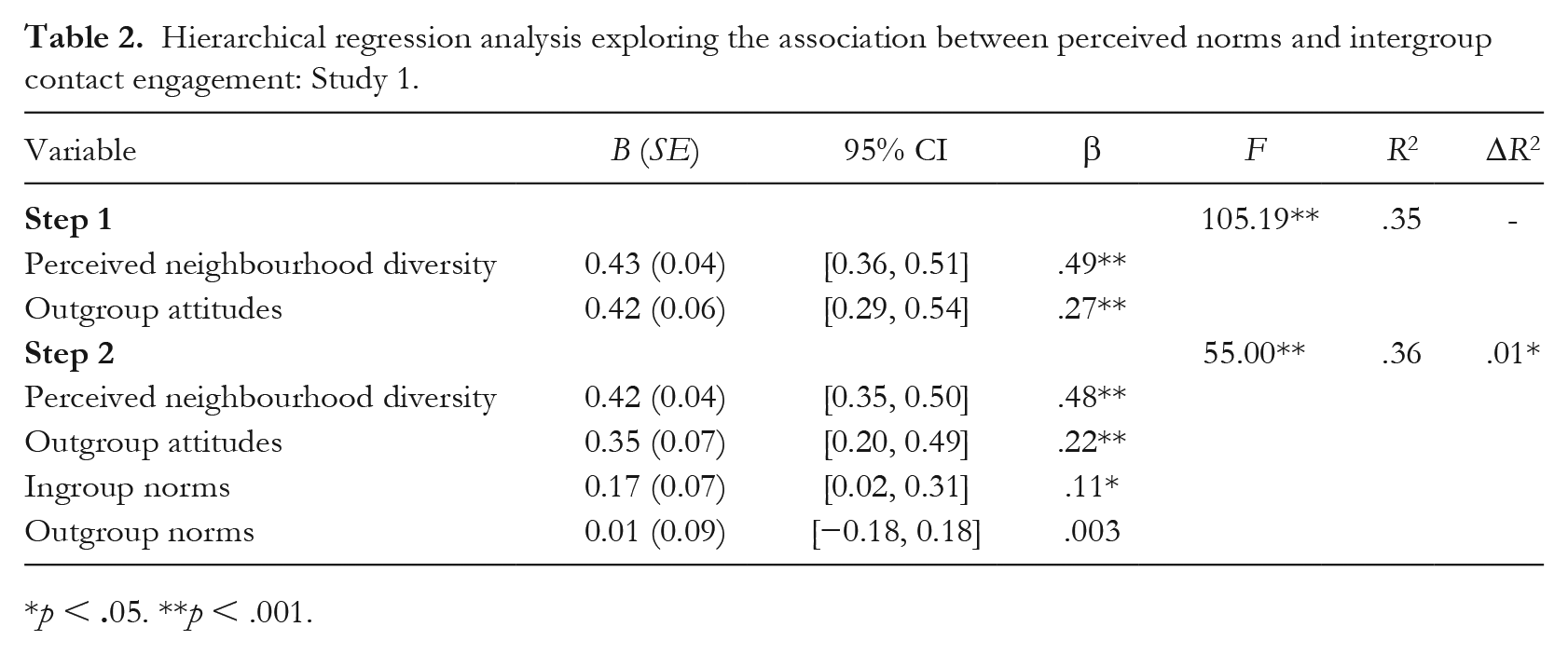
p < .05. **p < .001.
The results of Study 1 provide initial evidence of the association between social norms and intergroup contact engagement. Individuals are more likely to personally engage in intergroup contact when they perceive high levels of intergroup contact engagement amongst fellow ingroup members. Both perceived neighborhood diversity and outgroup attitudes were positively related to contact engagement, but perceived ingroup norms explained additional variance in this outcome. There was no significant association, however, between perceived outgroup norms and contact engagement. This finding is consistent with the idea that individuals are most strongly influenced by the norms of the groups with which they identify (Terry & Hogg, 1996; J. C. Turner, 1991), and suggests that normative interventions aimed at encouraging intergroup contact engagement should focus on the prevalence of intergroup contact amongst other ingroup members.
Study 2
Study 2 tested the impact of a social norms manipulation on outgroup approach tendencies. The experimental manipulation communicated information about the high number of other British people who regularly engage in contact with immigrants (high-contact norm). The impact of this manipulation on outgroup approach tendencies was assessed in comparison to a message suggesting that normative levels of contact were low (low-contact norm), and to a no-treatment control condition. Prior research demonstrates that communicating that only a numerical minority of people perform a desirable behaviour does not encourage conformity and can even backfire and establish a norm of not engaging in the behaviour (Cialdini et al., 2006). Accordingly, it was expected that intentions to approach the outgroup would be higher in the high-contact norm condition compared to both the low-contact norm condition and the control. A backfire effect may also be expected whereby outgroup approach tendencies are decreased in the low-contact norm condition compared to baselines.
Participants
A power analysis in G*Power 3.1 (Faul et al., 2007) for a between-subjects, one-way ANOVA with three conditions and a desired power of .90 showed that, for a small to medium effect (f = 0.20), a minimal sample size of N = 321 would be needed. The full sample consisted of 390 participants recruited via Prolific. Only White British participants were eligible to participate. The sample included 113 males and 277 females aged between 18 and 79 (M = 35.89, SD = 13.07). No exclusions were made. Participants were randomly assigned to either a high-contact norm (n = 129), low-contact norm (n = 131), or control condition (n = 130).
Procedure
Participants were presented with a fictitious newspaper article entitled, “Do Brits Have Immigrant Friends?” (title adapted from Gómez et al., 2018). The newspaper article described a research project that had been conducted with a representative sample of British adults to determine the proportion of British people who maintained friendships with immigrants. To enhance credibility of the article, the survey was said to have been conducted by a well-known public opinion polling company in collaboration with several British universities. Participants were randomly assigned to read one of two versions of the newspaper article. Ostensibly according to the results of the study, either 3 in 4 (75%, high-contact norm) or 1 in 4 (25%, low-contact norm) Brits reported regularly interacting with people born outside of the UK (for full manipulation, see the supplemental material). Participants in the no-treatment control condition went straight to the dependent measures.
As a manipulation check, participants indicated their agreement with two items, “In general, I think British people like to spend time with immigrants” and “In general, I think British people maintain friendships with immigrants” (1 = strongly disagree, 7 = strongly agree; Spearman–Brown coefficient = .91). Approach behavioural tendencies towards the outgroup were measured with three items adapted from Mackie et al. (2000). When thinking about immigrants, participants were asked to indicate how likely they were to want to “talk to them,” “find out more about them,” and “spend time with them” (1 = not at all, 7 = very much; α = .96). To conclude the experiment, participants provided demographic information and were thanked and debriefed.
Results and Discussion
The manipulation check indicated that the conditions were significantly different in terms of perceived norms, F(2, 387) = 45.53, p < .001, partial η² = .19. Post hoc tests with a Bonferroni adjustment indicated that perceived normative levels of contact were significantly higher in the high-contact norm condition (M = 5.04, SD = 1.17) compared to both the control condition (M = 3.89, SD = 1.45), p < .001, and the low-contact norm condition (M = 3.62, SD = 1.19), p < .001. There was no significant difference between the low-contact norm condition and the control condition (p = .262).
A second ANOVA tested the difference in outgroup approach tendencies between conditions. A significant omnibus effect was observed, F(2, 387) = 4.40, p = .013, partial η² = .02. Again, post hoc tests with a Bonferroni adjustment revealed that approach behavioural tendencies were significantly higher in the high-contact norm condition (M = 5.13, SD = 1.29) compared to both the control condition (M = 4.70, SD = 1.54), p < .001, and the low-contact norm condition (M = 4.68, SD = 1.35), p < .001. There was no difference between the low-contact norm condition and the control condition (p = 1.00).
The results of Study 2 demonstrate that exposure to a message documenting the high incidence of intergroup contact amongst other ingroup members can successfully increase outgroup approach tendencies. Participants who learned that a large proportion of British people regularly interact and socialise with immigrants were more inclined to approach the outgroup themselves compared to participants who learned that only a small proportion of British people regularly engage in intergroup contact, and compared to a no-treatment control. There was no evidence of a backfire effect whereby those in the low-contact norm condition reported lower approach tendencies compared to those in the control. This is likely because perceptions of normative levels of contact were already low at baseline and did not differ significantly from the low-contact norm condition. Importantly, conveying that many people do engage in contact can increase outgroup approach tendencies accordingly.
Study 3
The results of Study 2 relied on a measure of intended behaviour. It is possible that participants may report a positive orientation towards intergroup contact, but not necessarily engage in contact when the opportunity arises. Study 3 therefore aimed to confirm the effects of social norms manipulations on a behavioural measure of outgroup approach/avoidance. Specifically, participants’ intergroup anxiety, contact avoidance intentions, and approach/avoidance behaviour in the context of an upcoming intergroup interaction were measured. Having established the effect of the high-contact norm condition in comparison to the low-contact norm condition in Study 2, Study 3 focused only on the comparison between the high-contact norm condition and the control condition. Success is indicated if the experimental manipulation not only improves self-reported outcomes, but also contact approach at the behavioural level.
Participants
The sample consisted of 260 participants recruited via Prolific. Sample size aims were held consistent with Study 2 (n = 130 per cell). The data of two non-British participants were excluded. No further exclusions were made. The final sample included 68 males and 190 females aged between 18 and 79 (M = 34.58, SD = 12.34). Participants were randomly assigned to either the high-contact norm experimental condition (n = 129) or the no-treatment control condition (n = 129).
Procedure
As a cover story for the experiment, participants were told that the study was investigating interpersonal interactions and that the data would be used to inform scientific research on human communication. To begin, participants in the experimental condition read the same newspaper article manipulation as in Study 2. All participants were then told that they would shortly be transferred to a virtual chatroom to complete a conversation task with another participant. All participants were ostensibly assigned to an immigrant partner. Participants received basic demographic information about their alleged partner (“Andrius [Regina]: a 35-year-old male [female] originally from Lithuania who likes reading and wildlife photograph”). Partners were matched to the participant’s gender.
Participants were asked to complete some questions prior to the alleged interaction, adapted from MacInnis and Hodson (2012). Stephan and Stephan’s (1985) Intergroup Anxiety Scale was modified to refer to the upcoming interaction. Participants indicated the extent to which they anticipated feeling “awkward,” “self-conscious,” “happy,” (reverse-coded) “confident,” (reverse-coded) and “relaxed” (reverse-coded) during the interaction (1 = not at all, 7 = very much; α = .88). Participants then rated, on the same scale, their (a) desire to avoid the interaction and (b) preference to not interact with their partner (Spearman–Brown coefficient = .91). Finally, participants were given the choice of whether to continue with the planned interaction (i.e., approach) or select a new partner (i.e., avoid). This method ensured that avoidance behaviour purely reflected avoidance of their specific contact partner, not other contact partners or the experiment generally (MacInnis & Hodson, 2012). To conclude the experiment, participants were debriefed where they learnt that there would be no upcoming interaction.
Results and Discussion
Independent samples t tests were conducted to examine differences in self-reported intergroup anxiety and contact avoidance intentions between the experimental and control conditions. Results showed that intergroup anxiety in anticipation of the interaction was significantly lower in the high-contact norm condition (M = 3.52, SD = 1.36) compared to the control (M = 3.85, SD = 1.25), t(256) = 2.04, p = .042, d = 0.25. Contact avoidance intentions were also significantly lower in the high-contact norm condition (M = 2.99, SD = 1.70) compared to the control (M = 3.47, SD = 1.60), t(256) = 2.35, p = .020, d = 0.29.
A chi-squared test was then conducted to assess differences in contact approach/avoidance behaviour between conditions. The test showed that the proportion of participants choosing to continue with the planned interaction with the immigrant partner was significantly higher in the experimental condition (72.1%) than in the control condition (60.5%), χ2(1, N = 258) = 3.90, p = .048, Cramer’s V = .12. 4
The results of Study 3 provide important evidence that social norms manipulations can improve contact approach on a behavioural level. The key dependent variable was whether the participant chose to continue with a planned interaction with an immigrant partner (i.e., approach) or to select a new partner (i.e., avoid). Results demonstrated that participants who were exposed to information about the high incidence of contact engagement amongst other ingroup members not only reported improved contact expectations and intentions, but were also more likely to engage in an intergroup encounter when presented with the opportunity. The results attest to the potential for normative manipulations to have a meaningful impact on individuals’ contact behaviour, beyond self-reports.
Study 4
In the two experimental studies reported so far, the normative manipulation consisted of a message conveying that a high proportion of ingroup members engage in frequent and positive contact with outgroup members. However, normative levels of intergroup contact will not always be high. Study 4 went on to consider how normative manipulations could be used to encourage contact engagement even when descriptive levels of contact are low. To do so, a recently introduced intervention procedure known as dynamic norms was employed (Sparkman & Walton, 2017, 2019; in reference to trending norms, see Mortensen et al., 2019). Instead of highlighting the current state of a behaviour (i.e., X% of a reference group show the “static norm”), a dynamic norms intervention communicates information about how a social norm is changing over time in the desired direction. Effects are mediated by a process of “preconformity” whereby people anticipate ongoing change and a future world in which that behaviour is normative, and then conform to the emerging norm as if it were current reality (Sparkman & Walton, 2017). Study 4 applied this approach to increase intergroup contact engagement. It was expected that communicating that levels of intergroup contact were low but rising would increase interest in engaging in future intergroup contact above communicating a static low-contact norm, and that this effect would be mediated by perceptions that intergroup contact will continue to increase in prevalence in the future (i.e., “preconformity”).
Participants
Five hundred and one White British participants were recruited via Prolific. Sample size was increased from Study 2 and Study 3 because a smaller difference between variants of a low-contact norms condition (static vs. dynamic) was expected compared to differences between low-contact and high-contact norm conditions. Six participants indicated they did not want their data to be used. No further exclusions were made. The final sample consisted of 354 females and 140 males (one participant did not indicate their gender) aged between 18 and 76 (M = 35.85, SD = 11.94). Participants were randomly assigned to a control (n = 168), static norm (n = 164), or dynamic norm condition (n = 163). A post hoc power analysis indicated that with an alpha of .05, three conditions, and the effect size detected (f2 = 0.18), the power was .86 (Faul et al., 2007).
Procedure
In Study 4, the target outgroup was ethnic minorities. To create the norms statement, a pretest survey of White British adults was conducted via Prolific (N = 100). Participants were asked whether they regularly interact and socialise with ethnic minorities. Approximately 40% of participants reported making some effort to interact with ethnic minorities. The norms statement in each condition used this figure. The manipulation text was based on that of Sparkman and Walton (2017). In the static norms condition, participants read, “Recent research has shown that 40% of White British people make an effort to regularly interact with people from ethnic minority backgrounds. This means that 4 in 10 people regularly socialise with people from ethnic minorities.”
In the dynamic norms condition, they read: More and more people are making an effort to interact with people from ethnic minority backgrounds. Recent research has shown that 40% of White British people have started to make an effort to regularly interact with people from ethnic minorities. This means that, in recent years, 4 in 10 people have changed their behaviour and begun to regularly socialise with people from ethnic minorities.
After reading the normative information, participants in each condition were asked, “Why do you think this is?” and were given space to respond. This question was designed to ensure that participants had read and reflected on the norms statement. Participants in the control condition went straight on to complete the dependent measures. The dependent variable was interest in future contact, measured with two items adapted from Sparkman and Walton (2017): “How interested are you in interacting with people from ethnic minority backgrounds” and “If you were free to choose, would you like to have more contact with people from ethnic minority backgrounds?” (1 = not at all, 7 = very much; Spearman–Brown coefficient = .84). Participants also responded to a single item assessing the potential mediator, preconformity, “In the foreseeable future, to what extent to do you think that many other people will make an effort to interact with people from ethnic minorities?” (1 = not at all, 7 = very much).
Results and Discussion
A one-way ANOVA tested the difference in interest in future intergroup contact between conditions. A significant omnibus effect was observed, F(2, 492) = 5.46, p = .005, partial η² = .02. Post hoc tests with a Bonferroni adjustment revealed that participants expressed more interest in intergroup contact in the dynamic norms condition (M = 5.75, SD = 1.22) than in the control condition (M = 5.34, SD = 1.18), p = .007, and the static norms condition (M = 5.41, SD = 1.23), p = .030. The static norms condition did not differ significantly from the control condition (p = 1.00).
There was also a significant effect of condition on preconformity scores, F(2, 492) = 9.69, p < .001, partial η² = .04. Participants in the dynamic norms condition had a greater level of anticipation that many people would make an effort to engage in intergroup contact in the future (M = 5.15, SD = 1.35) compared with those in both the control (M = 4.52, SD = 1.21), p < .001, and the static norms condition (M = 4.77, SD = 1.21), p = .027. There was no significant difference in preconformity between the static norms and the control condition (p = .245).
A mediation analysis was then conducted to test whether the impact of the dynamic norms condition on interest in future intergroup contact was driven by the belief that this behaviour would increase in prevalence in the future (i.e., preconformity). The analysis was conducted using bootstrapped tests of the indirect path (based on 5,000 bootstrapped resamples), with effects calculated using Hayes’s (2013) PROCESS macro (Model 4). Condition was entered as a multicategorical independent variable and dummy-coded accordingly, with the control group as the reference group. The first dummy variable examined the effect of the dynamic norms condition relative to the control condition, and the second compared the effect of the static norms condition relative to the control (see Figure 1). The analysis revealed a significant indirect effect through preconformity in the dynamic norms condition (b = 0.20, SE = 0.05, 95% CI [0.10, 0.32]), but not in the static norms condition (b = 0.09, SE = 0.05, 95% CI [−0.01, 0.19]).
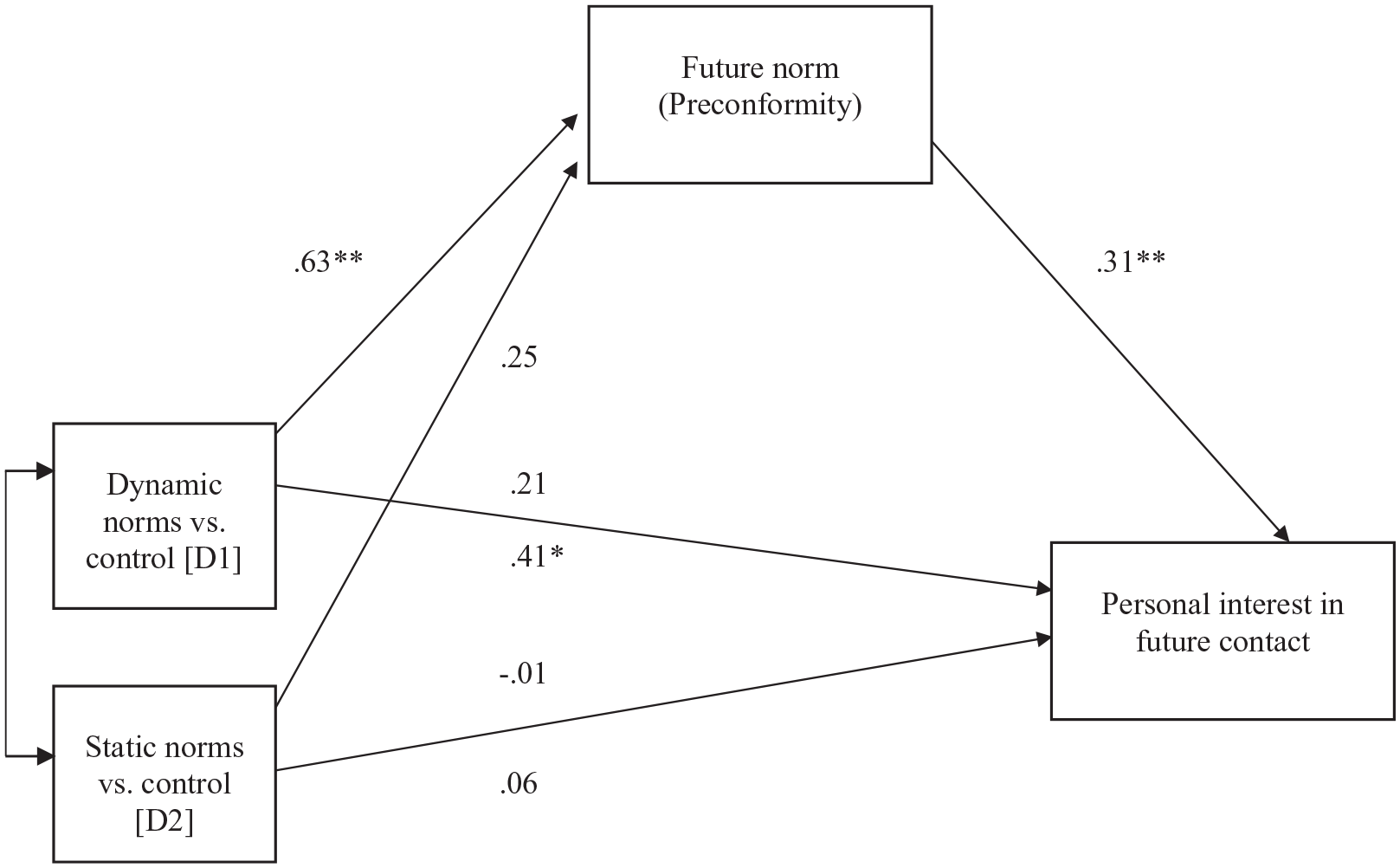
Mediational model of the relationship between normative condition and interest in future contact through preconformity: Study 4.
The results of Study 4 suggest that normative manipulations can be used to encourage intergroup contact even when it is not (yet) normative. As expected, when participants learnt that only a small number of fellow ingroup members (40%) regularly engage in contact with outgroup members, this information did not increase personal interest in contact. However, the same low percentage of people engaging in the desired behaviour was motivational when it was presented as an upward trend. In other words, communicating that intergroup contact was practiced by a numerical minority but increasing in prevalence heightened interest in intergroup contact over and above communicating a static low-contact norm only. Consistent with prior research (Mortensen et al., 2019; Sparkman & Walton, 2017), the effect of the dynamic norms condition was mediated by a process of preconformity whereby participants predicted the increase in prevalence of intergroup contact to continue, and conformed to a future norm state as if it were the present. Interestingly, the direct effect of the dynamic norms condition on interest in future contact remained significant even after controlling for preconformity. Thus, it is likely that other psychological processes also play a role in dynamic norms’ effects such as the perceived importance of target behaviour and the perceived ability to engage in the target behaviour (Sparkman & Walton, 2019). Future research should go on to explore these processes in relation to intergroup contact.
General Discussion
With the positive effect of intergroup contact on prejudice now well documented, the natural next step is to look at intergroup contact as the dependent variable. This research explored the antecedents of contact, focusing on normative factors affecting people’s intergroup contact engagement. The novelty of this work stems from its combined focus on intergroup contact as the dependent variable and on normative social influence as a relatively understudied independent variable in contact research. Four studies explored the role of normative social influence in predicting intergroup contact engagement, and how normative techniques can be used to promote future contact intentions.
Study 1 provided initial evidence of the predictive power of social norms in a cross-sectional study. British adults were more likely to engage in intergroup contact with immigrants when they perceived higher normative levels of intergroup contact amongst other ingroup members. This effect held when controlling for preexisting outgroup attitudes and perceived levels of neighborhood diversity. There was no significant association between perceived outgroup norms and contact engagement. As such, the subsequent experimental studies focused on manipulations of ingroup norms surrounding contact. Study 2 found that participants reported higher outgroup approach tendencies when they were told that a significant proportion of fellow ingroup members have regular contact with immigrants. Study 3 replicated the effect of this manipulation on a behavioural outcome measure. Participants in the experimental condition reported improved contact expectations and intentions, and were more likely to continue with a planned intergroup encounter compared to those in the control condition. Study 4 went on to consider how normative techniques can be used to encourage intergroup contact even when descriptive levels of contact are low. Results demonstrated that portraying intergroup contact as increasing in prevalence can spur compliance with even minority norms. This effect was partially mediated by a process of “preconformity” whereby portraying intergroup contact as increasing in popularity created a perception of greater future popularity.
Previous research on extended contact has shown that knowing ingroup members who have outgroup friendships (i.e., extended contact) can vicariously reduce hostility and prejudice (for review, see Vezzali et al., 2014), an effect which is mediated by positive ingroup norms regarding cross-group friendships (e.g., De Tezanos-Pinto et al., 2010; R. N. Turner et al., 2008). Gómez et al. (2018), for instance, previously showed that learning about high levels of depersonalised extended contact amongst unknown ingroup members promoted more positive intergroup orientations. While the key manipulation in Gómez et al.’s research was the number of outgroup friends that ingroup members were said to have (none, one or two, two or more), here, we manipulated social norms directly by providing information about the number (or proportion) of ingroup members who were said to engage in contact with the outgroup (e.g., 25% vs. 75%). Learning of the high (or rising) number of ingroup members who regularly engage in intergroup contact, successfully increased both contact intentions and contact approach behaviour.
Social norms play an important role in predicting attitudes and behaviour in general (Cialdini et al., 1991). The current results provide support for recent theoretical models which suggest that social norms may predict contact-seeking and intergroup contact engagement specifically (Kauff et al., 2020; Paolini et al., 2018; Ron et al., 2017; R. N. Turner & Cameron, 2016). Social norms are a key driver of behaviour and produce norm-consistent behaviour when they are made salient or focal in a specific situation (Cialdini et al., 1991). When applied to intergroup contact, we find that individuals are more likely to engage in such contact when they perceive many others to be doing so, and we can capitalise on this normative influence with intervention strategies that highlight the prevalence of intergroup contact amongst other ingroup members.
Limitations and Future Research
With the exception of Study 4, the figures used in the experimental materials were artificial and devised by the researcher. Of course, descriptive levels of intergroup contact will not always be so high. Dynamic norms provide one solution but, in some contexts, even dynamic norms will not be plausible and reflective of reality. With Britain leaving the European Union, for instance, it may not be plausible to suggest that British people’s contact with immigrants is increasing. Communicating injunctive support for intergroup contact may provide another means to remedy a negative descriptive norm (Cialdini et al., 2006; see also Gómez et al., 2018). While descriptive norms convey information about what is commonly done, injunctive norms convey what is commonly approved or disapproved of (Cialdini et al., 1991). In this context, the injunctive norm would refer to whether ingroup members are said to approve of intergroup contact and cross-group friendships. However, in hostile intergroup contexts, both descriptive levels of intergroup contact and injunctive support for contact are likely to be low. Future research must therefore go on to explore the boundary conditions of this approach, and whether or not normative interventions will be efficacious in the face of intractable intergroup conflicts.
In all the studies reported in this investigation, participants were recruited via a commercial participant panel, Prolific. Such participants are likely to routinely participate in psychological studies, increasing the potential for demand characteristics. It is possible that participants in the experimental condition guessed the experimental hypotheses and adjusted their responses in accordance with what they believed the experimenter expected of them, rather than with norms of the group per se. It will now be important for preregistered future studies to attempt to replicate the current results employing additional steps to try to conceal the research question, such as using the “two-study technique” so participants believe the procedures containing the normative manipulations and those containing the dependent measures are two separate studies. Future research should also implement a delay between the experimental manipulation and the dependent measures to confirm how long-lasting effects are, and to increase confidence that the results reflect genuine internalisation of the group norm rather than surface compliance (see Mols et al., 2015). What is more, the effect sizes observed here (particularly in Studies 2 and 4) were relatively small. It is likely that intervention effects will be stronger with repeated exposure, or when the message is received through one or more media (Hornik, 2002).
The results in Study 1 demonstrated that perceived ingroup norms predicted contact engagement over and above existing outgroup attitudes and perceived levels of neighbourhood diversity. Results relied, however, on a subjective measure of perceived diversity that is likely to be confounded by participants’ interest in contact. Participants who are not interested in engaging in intergroup contact are likely, for instance, to ignore contact opportunities and, hence, underestimate the number of immigrants in the neighbourhood. Future research should therefore aim to replicate these results using more objective data on the proportion of foreign-born residents or ethnic diversity by area.
The current results demonstrate how manipulations of contextual-level social norms can predict contact engagement at the individual level. Future research should explore how such manipulations interact with person-based predictors of prejudice. Prior research suggests that group norms influence the behaviour of group members most strongly for people for whom the salient social identity forms an integral part of their self-concept (Abrams & Hogg, 1990). The effect of learning of high levels of intergroup contact amongst other ingroup members on one’s own interest in intergroup contact is likely to be stronger for participants higher in ingroup identification. Political identification and ideological factors (e.g., right-wing authoritarianism, social dominance orientation) may also be relevant. Research exploring the use of a social norms intervention to reduce household electricity consumption showed that the impact of intervention was different for politically liberal versus conservative households (Costa & Kahn, 2013). For households that were politically conservative and that used more electricity than the norm, their electricity usage increased upon receiving a normative message, rather than being reduced. For these households, the norm of conservation presumably pertained to an outgroup from which they wanted to distance themselves. Similarly, for ideologically intolerant people, learning of favourable contact norms may be ineffective because such norms are attributed to a political outgroup or, worse, still may elicit contrast effects whereby individuals report reduced contact intentions in order to differentiate themselves from groups to which they do not belong (e.g., Doosje et al., 1998; Rabinovich et al., 2012).
Future research should also go on to explore how normative techniques can be used to promote intergroup contact amongst minority group members. All studies presented in this investigation focused on increasing majority group members’ willingness to engage in contact with minority group members. Consistent with the idea that individuals are most strongly influenced by the norms of the groups with which they identify, Study 1 found that individuals were more strongly influenced by ingroup contact norms compared to outgroup contact norms. Some findings suggest that outgroup norms are most likely to influence decision-making and behaviour when the outgroup has coercive power over the ingroup (Louis et al., 2005). Accordingly, we may expect that when it comes to promoting disadvantaged minority group’s contact with the advantaged majority group, outgroup norms may prove more influential than ingroup norms.
Conclusion
“Nudges” can make us healthier, wealthier, and more environmentally friendly. This research drew on experiences from across these sectors to design new techniques to promote intergroup contact engagement. The intergroup contact literature has traditionally considered contact to be the “starting point,” with the key outcome being a reduction in prejudice. As well as exploring the consequences of intergroup contact, there is also a need for research that treats intergroup contact as the dependent variable. Four studies showed that perceptions of descriptive levels of intergroup contact among one’s peers predict contact engagement, and manipulations of social norms can promote contact approach behaviour. Effects replicated with both self-reported and behavioural outcome measures. These findings provide a new understanding of the antecedents of intergroup contact and new techniques for encouraging greater inclusion and integration.
Supplemental Material
sj-pdf-1-gpi-10.1177_13684302211016047 – Supplemental material for “Nudging” intergroup contact: Normative social influences on intergroup contact engagement
Supplemental material, sj-pdf-1-gpi-10.1177_13684302211016047 for “Nudging” intergroup contact: Normative social influences on intergroup contact engagement by Rose Meleady in Group Processes & Intergroup Relations
Footnotes
Data availability
The data that support the findings of this study are available from the corresponding author upon request.
Funding
The author disclosed receipt of the following financial support for the research, authorship, and/or publication of this article: This research was funded as part of a Research Fellowship from the Leverhulme Trust (RF-2019-263).

Supplemental material
Supplemental material for this article is available online.
Notes
References
Supplementary Material
Please find the following supplemental material available below.
For Open Access articles published under a Creative Commons License, all supplemental material carries the same license as the article it is associated with.
For non-Open Access articles published, all supplemental material carries a non-exclusive license, and permission requests for re-use of supplemental material or any part of supplemental material shall be sent directly to the copyright owner as specified in the copyright notice associated with the article.
