




Abstract
Fostering inclusive attitudes among children in host classrooms is key to integrating refugee children. A field experiment tests the prejudice reduction effects of a teacher-led activity integrating imagined intergroup contact and normative influence. To enhance the effectiveness of imagined contact, scenarios include supportive ingroup norms. In 29 classes, 545 children (Mage = 10.88, SD = 0.96) were randomly assigned to one of five conditions: standard imagined contact, imagined contact encouraged by family, class peers, or religious ingroups, or a control. Children in all norm-framed imagined contact conditions had significantly less antirefugee bias compared with the control. The class-peer norm frame significantly reduced affective and cognitive facets of bias. The family norm frame reduced affective bias, and the religious norm frame reduced cognitive bias. Standard imagined contact did not differ from the control. Potential mediating pathways are explored. These findings illustrate the utility of incorporating norms into imagined contact interventions to reduce antirefugee bias among schoolchildren.
Keywords
Introduction
The global refugee crisis has given rise not only to increased international diversity but further provoked the burgeoning anti-immigrant sentiment which has been growing since the beginning of the century. Perceptions of discrimination can present a barrier to the societal integration of immigrants such as refugees (Berry, 1997). Though intergroup relations between refugees and the host society may not be characterised by explicit derogation, ingroup favouritism may nonetheless be prevalent and experienced as discrimination by refugees, impacting their sense of inclusion in society. In recent years, Irish schools have been rapidly diversifying. As children confront a rise in the presence of refugees in the classroom, it is pertinent to identify measures which can be implemented in schools to combat the tendency towards intergroup bias. The present research integrates theories of normative influence and imagined intergroup contact to test a novel intervention with school children: norm-framed imagined contact.
Intergroup Contact Theory
Intergroup contact theory outlines a well validated strategy for the promotion of positive intergroup relations (Allport, 1954; Brown & Hewstone, 2005) whereby positive interactions with outgroup members can improve attitudes towards those involved in the interaction, and generalise this prejudice reduction effect to the group as a whole (Pettigrew, 1998). This effect has been demonstrated across a variety of outgroups, from ethnic groups (e.g., Tropp et al., 2016) to people with schizophrenia (K. West et al., 2014), and has gained meta-analytic support (Pettigrew & Tropp, 2006). Furthermore, the extended contact effect (Wright et al., 1997) has even demonstrated that it is not necessary for an individual to have direct contact in order to experience the prejudice reduction effects of contact. The mere knowledge that those in one’s social networks have positive intergroup contact experiences can be sufficient to facilitate positive intergroup attitudes (e.g., R. N. Turner et al., 2008).
Although the contact hypothesis has now been repeatedly substantiated, interventions based on direct and extended contact are not viable in contexts where the outgroup is largely known only through media, and physically absent from mainstream society. Despite the growing numbers of asylum seekers arriving in Ireland, the country’s punitive asylum process is slow and segregates those seeking refugee status from the local public in remote centres for many years before they can fully integrate and engage in the community (Irish Refugee Council, 2020). Furthermore, those who have or are seeking refugee status in Ireland do not display distinct visual markers that identify them as refugees or asylum seekers. As such, they are not greatly visible in the community. Since the economic recession in 2008, attitudes towards immigration in Ireland have become more negative, and were shown to be more negative in comparison to the average attitudes in 10 Western European countries in the years following the recession (McGinnity et al., 2018). Considering this growth in negative attitudes and the reduced opportunity for direct or even extended contact that stems from the housing system for those seeking international protection during the asylum process, other forms of contact must be utilised.
Imagined contact, or the “mental simulation of a social interaction with a member or members of an outgroup category” (Crisp & Turner, 2009, p. 234), has garnered some support in recent years. Research in various domains has shown that visualisation of behaviours can evoke the same emotional and cognitive responses as the behaviour itself (e.g., Dadds et al., 1997). Imagining being in a crowded room, for example, has been shown to reduce helping behaviour, suggesting a bystander apathy effect (Garcia et al., 2002). Indeed, it has been shown that merely imagining interacting with an outgroup member can effectively reduce prejudicial attitudes towards a variety of groups such as older persons (Crisp & Husnu, 2011), immigrants and other ethnic outgroups (Stathi et al., 2014; Vezzali et al., 2012), and people with disabilities (Cameron, Rutland, Turner, et al., 2011). Imagined contact has been shown to effectively influence the intergroup attitudes of both adults (Kuchenbrandt et al., 2013) and children (Stathi et al., 2014; Vezzali et al., 2012). In a meta-analysis of imagined contact, effects appeared stronger among children, perhaps due to the more elaborate instructions often used with child samples (Miles & Crisp, 2014). It has also been noted, however, that the effects of imagined contact are often small or unreliable (Brown & Paterson, 2016), and effects have rarely been studied outside of a laboratory setting (Lemmer & Wagner, 2015). In order to ensure that school-based interventions using imagined contact are effective, we must identify factors which can enhance its effects.
Some research has recently tested whether modifications to the imagined contact task can increase its efficacy. These modifications have often drawn on cognitive research concerning mental simulation, identifying, for example, perceptual fluency (K. West & Bruckmüller, 2013) and elaborated instructions (Husnu & Crisp, 2010) as beneficial alterations to the imagined contact intervention. Other studies have taken inspiration from social psychological literature. Vezzali et al. (2015), for example, demonstrated that framing imagined contact as occurring as part of a common ingroup enhanced its prejudice reduction effects. Kuchenbrandt et al. (2013) drew from Allport’s (1954) original conception of intergroup contact theory and incorporated cooperation into the imagined scenario: one of the four facilitating conditions proposed to enhance contact effects. Despite the growing trend towards investigating contextual factors that facilitate contact effects, the imagined social context has not yet been incorporated into imagined contact scenarios. The current study addresses this gap by presenting the first test of imagined contact framed in a supportive normative context.
Normative Influence on Intergroup Attitudes
The role of social norms in predicting outgroup attitudes has been often studied in relation to direct and extended contact. When ingroup members and significant others are perceived to hold positive attitudes towards outgroups, we are motivated to align our attitudes with theirs, as a means to maintain social belonging and self-esteem (Abrams et al., 2014; Cialdini & Goldstein, 2004). As such, the perception that ingroup members support contact with refugees may encourage children’s positive attitudes and the reduction of ingroup favouritism. In fact, previous research has indicated that children’s prejudice towards minority groups is predicted by the perceived norms of family and peers (e.g., Brenick & Romano, 2016; Jasinskaja-Lahti et al., 2011). Additionally, R. N. Turner and Cameron (2016) propose a model for encouraging positive cross-group relationships where social norms are suggested as key factors for promoting confidence in intergroup contact. Supportive social norms among other factors such as intergroup anxiety, shared identity, similarity, and self-efficacy can promote a readiness for positive contact and confidence in intergroup situations. R. N. Turner and Cameron argue that contact-based interventions can be fruitful means to promote confidence in contact by drawing on these factors.
There have been repeated suggestions that the effects of contact on outgroup attitudes may be facilitated by social norms. Authority support—the sanction and encouragement of contact by relevant groups—is presented as one of the facilitating conditions by which contact is efficacious (Allport, 1954; Pettigrew, 1998). Though few studies have tested this hypothesis directly, it has been previously demonstrated that the context in which contact occurs can impact the influence of contact on prejudice. Christ et al. (2014), for example, have illustrated a contextual effect of intergroup contact on adults’ prejudice through positive social norms. That is, contact at a macro level was consistently stronger than contact at an individual level. Furthermore, norms in contexts characterised by more frequent positive contact were more tolerant. These tolerant norms contributed to the more positive intergroup attitudes found in these contexts, over and above the influence of contact at the individual level. Similarly, De Tezanos-Pinto et al. (2010) demonstrated that greater classroom-level contact predicted positive outgroup attitudes in part through more positive perceptions of support for contact by classroom members. In addition, the efficacy of extended contact to reduce bias and promote intergroup contact has been shown to be underpinned in part by an increase in perceived positive social norms (e.g., Cameron, Rutland, Hossain, & Petley, 2011; Mazziotta et al., 2015). The observation that others have positive intergroup encounters promotes a sense that intergroup contact is desirable and normative, which can facilitate prejudice reduction.
It is evident, then, that norms may play a vital role in the effectiveness of intergroup contact. Such contact does not typically occur in a social vacuum. The behaviours and attitudes displayed by others in one’s social context impact the extent to which intergroup experiences produce less prejudiced attitudes, and a willingness to engage in further contact. In standard imagined contact interventions, however, imagined contact generally takes place in an individual setting, with no information provided about the social context in which it occurs. Despite the growing body of research evidencing the importance of the normative climate for other forms of contact, it is yet to be seen whether a supportive normative context can also play a role in enhancing the effects of imagined contact. We present the first test of norm-framed imagined contact, and examine whether framing imagined contact in the context of supportive ingroup norms can provide greater prejudice reduction than standard imagined contact. A pertinent question remains, however, regarding which social context may best facilitate the effects of norm-framed imagined contact. We examine various groups as a basis for framing supportive ingroup norms in the imagined contact scenario.
Normative Influence of Proximal and Distal Groups
Research examining normative influence among children and adolescents has tended to examine the influence of proximal groups such as family, peers, and school authorities (Ata et al., 2009; Brenick & Romano, 2016; Jasinskaja-Lahti et al., 2011; Tropp et al., 2016). As older children begin to engage in the wider society, however, they are increasingly exposed to intergroup attitudes of broader, distal groups which can influence their own intergroup bias. Considering the relevance of religion to issues of moral concern such as equality and social exclusion, as well as the particular focus placed on religious instruction in Irish primary schools, children may perceive their religious ingroup as powerful authorities on such issues. Religious ingroups may then be a reliable source of normative influence for children’s intergroup bias. Previous research has in fact illustrated that perceptions of support for interethnic contact from religious ingroup members uniquely predict children’s antirefugee bias over and above the contributions of other group norms (Smith & Minescu, 2021). In addition to framing imagined contact with family and class-peer norms, we also include a religious ingroup norm-framed scenario.
Mechanisms of Norm-Framed Imagined Contact
In addition to investigating whether norm-framed imagined contact effectively reduces antirefugee bias, it is pertinent to also investigate potential mechanisms of its effects. Specifically, we examine whether intergroup anxiety and perceived individual and intergroup similarity account for the effectiveness of norm-framed imagined contact.
Intergroup anxiety involves a sense of apprehension and uncertainty when anticipating intergroup interactions, and is a common predictor of intergroup attitudes (Stephan & Stephan, 1985). R. N. Turner and Cameron (2016) identify low intergroup anxiety as a component of confidence in contact, as the absence of anxiety can facilitate and encourage positive intergroup encounters. Both direct and indirect contact have been repeatedly shown to reduce prejudice by lowering intergroup anxiety (Pettigrew & Tropp, 2008; R. N. Turner et al., 2007; Wölfer et al., 2019). Intergroup anxiety has also been previously identified as a mediator of the effects of imagined contact (R. N. Turner et al., 2013). Self-categorisation theory suggests that the attitudes of ingroup members influence our own attitudes and behaviour in part by reducing uncertainty in novel situations (J. C. Turner et al., 1987). As such, a positive normative context may additionally reduce intergroup anxiety and enhance the prejudice reduction effects of imagined contact. A recent study illustrated the role of intergroup anxiety in mediating normative influence on antirefugee bias among primary school children in Ireland (Smith & Minescu, 2021). We anticipate that intergroup anxiety may be a key mechanism of the effects of norm-framed imagined contact on antirefugee bias.
Imagining contact in a supportive normative context may also enhance children’s perceptions of their own similarity with refugees, or that of their ingroups. Research on extended contact, for example, illustrated that perceiving members of one’s social network engaging in intergroup contact reduces prejudice in part by increasing a sense of inclusion of the other in the self (R. N. Turner et al., 2008). Members of groups we include in the self tend to be considered more similar to us then those we do not (Doyle & Aboud, 1995). Perceived similarity with the outgroup is an important predictor of the formation of cross-group friendships among young people (Verkuyten & Steenhuis, 2005). T. V. West et al. (2014) found that experimentally manipulating perceived similarity with a cross-race target was associated with greater willingness to engage in future contact with the target. We therefore examine whether norm-framed imagined contact may reduce antirefugee bias in part by increasing perceived similarity of refugees to the self, and to the family, class-peer, or religious ingroups.
The Current Research
In the present study, we employ an experimental cross-sectional design to investigate social norm-framing of family, class-peer, and religious ingroups as an enhancement of the effects of imagined contact to reduce antirefugee bias among children. In order to present an intervention that can be efficiently conducted in schools, the intervention is facilitated by class teachers. As previous research has demonstrated the effectiveness of elaborated imagined contact instructions (Husnu & Crisp, 2010, Experiment 2), we compare norm-framed scenarios with a standard elaborated scenario, as well as a control scenario.
We hypothesise that imagined contact framed in the context of supportive family, class-peer, or religious ingroup norms will reduce children’s antirefugee bias compared to the control group to a greater extent than the standard elaborated imagined contact condition. Differences in perceived norms of family, class-peer, and religious ingroups following the imagined contact activity are tested as manipulation checks. In addition, we expect that intergroup anxiety, and individual and ingroup-specific similarity, may explain some of the direct effects of the intervention on both aspects of antirefugee bias. We also test the robustness of norm-framed imagined contact when additionally controlling for other relevant variables such as age, gender, school type, number of intergroup friends, and clarity of the imagined scenario.
Method
Participants and Design
An a priori power analysis was conducted using G*Power 3 (Faul et al., 2007) to calculate an optimal sample size necessary to detect differences between the five conditions with a power of .80, given an alpha level of .05. An estimated effect size of Cohen’s d = 0.35 was used, which is the average effect of imagined contact on intergroup bias found in a meta-analysis by Miles and Crisp (2014). This power analysis yielded a recommended sample size of 395. As the estimated effect size was largely based on studies that compared imagined contact to a control group rather than comparing modified versions of imagined contact to a standard version, which was additionally tested in the current study, we used 395 as a minimum target sample size.
In 29 classes across 11 primary schools in Ireland, 545 children aged 9–13 (Mage = 10.88, SD = 0.96) were randomly assigned to one of five conditions in a between-subjects design: standard elaborated imagined contact (N = 109), family (N = 114), class-peer (N = 109), or religious ingroup (N = 110) norm-framed imagined contact, or a control scenario (N = 103). The average class size was 20. The sample was 54.1% male, 82.9% Irish, and 83.9% Catholic. Children were considered Irish nationals if at least one of their parents were born in Ireland. All other children were labelled “not Irish.” Of the non-Irish children (17.1%), the majority had Eastern European background (50.5%), 15.2% had South Asian background, 13.1% had African background, 9.1% had East Asian background, and 12.1% had other or mixed backgrounds. Based on self-reported religion, children were categorised as Catholic (83.9%), having a minority religion (6.7%), or having no religion (9.4%). Furthermore, 21.6% of the sample attended nondenominational schools, with the remaining attending typical schools of Catholic ethos. Of the children attending Catholic schools, 17.9% attended schools that teach through the medium of the Irish language.
Procedure
As a meta-analysis by Ülger et al. (2018) found that interventions conducted by school teachers were not always effective at reducing bias, it was necessary to ensure that teachers were fully informed of the process involved in implementing the intervention. Ülger et al. recommended collaboration between teachers and researchers in order to design an intervention that can be effectively conducted by teachers as a class-based activity. As such, teachers were first consulted in advance of the participation of their class. They were informed of the general purpose of the study and what the participation of their class would involve. The teachers were also given a copy of the questionnaire so that they could familiarise themselves with the materials and identify whether certain items may challenge the level of understanding of their class. If problematic items were identified, an alternative wording was proposed which would maintain the underlying psychological construct.
After obtaining informed consent from both children and their parents, children were given an activity booklet to complete in class, containing demographic questions, one of five experimental scenarios, perceived norms, mediators, covariates, and outcome variables. A definition of refugees was given at the beginning of the booklet, stating “Refugees are people who leave their own country because of things like floods or war.” Previous research indicated that over 90% of children from this sampling population had prior understanding of the term “refugees” (Smith & Minescu, 2021). The teacher was advised to ensure that the children understood the term before continuing with the booklet. Teachers were encouraged to facilitate children’s comprehension of the questionnaire by reading each question aloud to the class and ensuring that each child understood the questions and instructions before progressing. The teachers were also advised to answer any clarification questions the children had, but not to provide prompts that may influence the children’s responses, and to refrain from walking between children’s desks or viewing their responses while the booklets were being completed.
To randomly assign each child within each class to a condition, booklets were randomly arranged. After demographic variables were completed, teachers instructed the children to read the scenario in their booklet and ensure they understood the instructions. They then closed their eyes for 2 minutes and imagined the scenario. After 2 minutes, the teacher instructed the class to open their eyes and continue with the booklet. The standard imagined contact scenario was adapted from Husnu and Crisp (2010, Experiment 2), who used an elaborated variant in which participants were specifically asked to imagine when and where the contact took place. The instructions for all four imagined contact conditions used a similar format, specifying a different context for each. In the norm-framed conditions, children were to imagine that an ingroup member who supported friendly contact introduced them to the refugee child, and that the interaction took place in a context related to the ingroup. Participants in the control condition were given instructions to imagine an outdoor scene. This style of control scene is typically used in imagined contact research (e.g., Crisp & Husnu, 2011). Table 1 outlines the complete instructions given to children in each condition.
Imagined contact scenarios per condition.
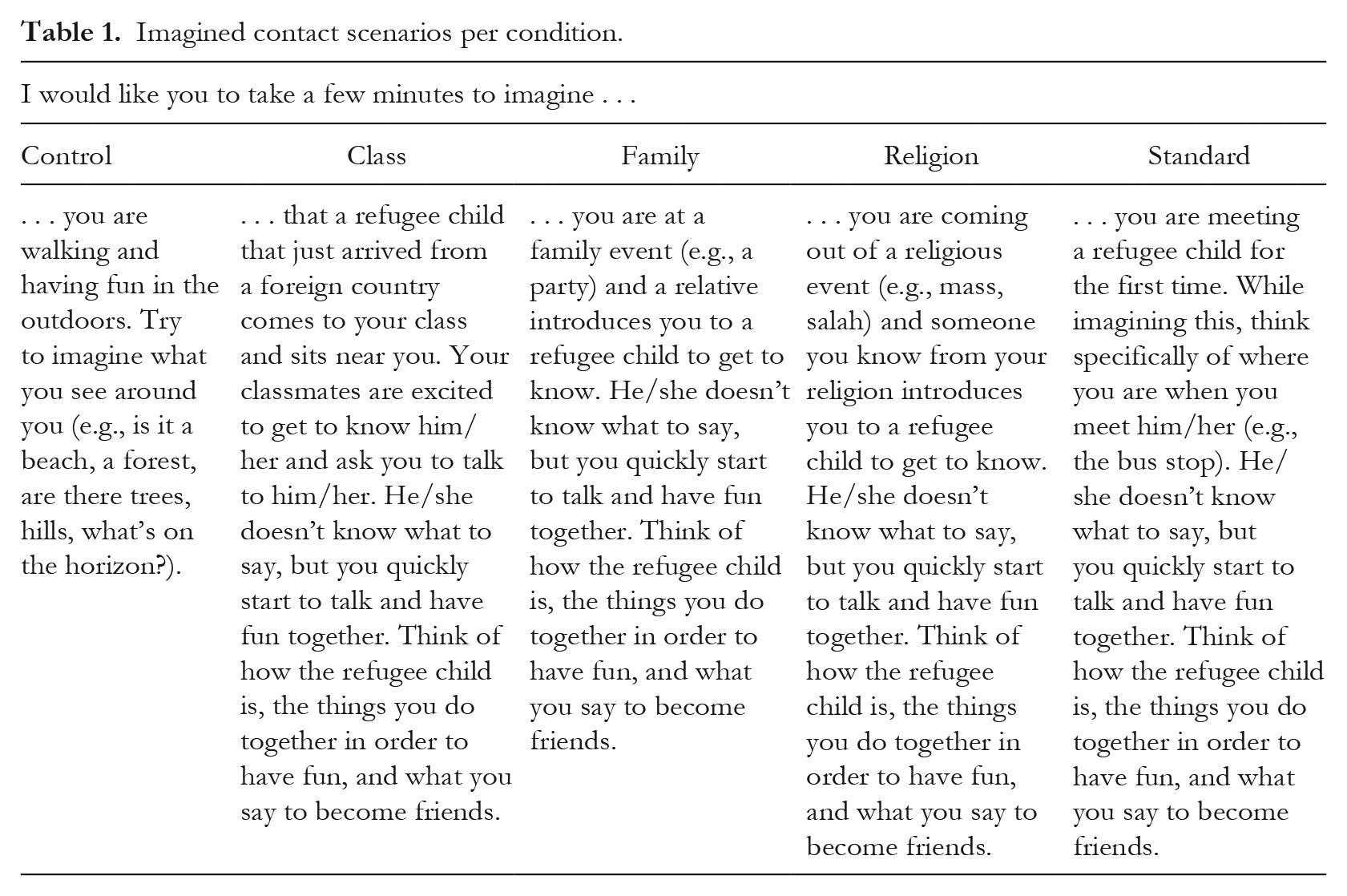
To reinforce the intervention effects, participants in all conditions were asked to describe what they imagined. In the imagined contact conditions, they were asked to describe the person they imagined, what they did together, what they talked about, and what interesting things they found out about their new friend. Participants in the control condition were asked to describe what they imagined, what they did, and what interesting things they saw.
Materials
Dependent variables
Intergroup warmth bias (affective)
To capture children’s affective intergroup bias, children completed two feeling thermometers, indicating on a 10-point scale how warmly they felt towards refugees and towards Irish people. Warmer feelings were reflected by higher scores. Scores on the refugee thermometer were subtracted from scores on the Irish thermometer such that higher scores reflect a greater warmth towards Irish people than refugees.
Stereotyping bias (cognitive)
Children were asked to rate the extent to which 12 traits applied to both Irish and refugee people. This measure was adapted from Cameron et al. (2006). On a scale from 1 (none) to 5 (all), they were asked to indicate how many Irish and how many refugee people they think display each characteristic. Six positive traits (smart, honest, friendly, clean, happy, and hard-working) and six negative traits (dirty, sad, lazy, dishonest, stupid, and unfriendly) were included in the measure. For each positive trait, the refugee item was subtracted from the Irish item. For each negative trait, the Irish item was subtracted from the refugee item. This resulted in 12 items capturing bias in trait attribution in favour of Irish people relative to refugees. As such, both outcomes measure ingroup favouritism. Principal component analysis with direct oblimin rotation did not demonstrate the formation of two distinct factors differentiating between positive and negative trait bias. An average of these 12 items was therefore obtained to capture general stereotyping bias (Cronbach’s α = .74).
Mediators
Intergroup anxiety
To measure intergroup anxiety (Stephan & Stephan, 1985), a scale was adapted from R. N. Turner et al. (2007). Participants were first presented with a scenario: “Imagine you meet a group of refugee children your age, and you are the only person there who is not a refugee.” They were then asked to indicate how they would feel, using three semantic differential items: happy/unhappy, comfortable/tense, and pleased/worried, each rated on a 5-point scale (Cronbach’s α = .82). Responses were averaged, and higher scores indicate greater anxiety.
Perceived individual similarity
Two items measured the extent to which children perceived refugees as similar to themselves. Using a 4-point scale (1 = strongly disagree, 4 = strongly agree), children were asked to rate their agreement with the following statements: “I have a lot in common with the average refugee person” and “I am similar to the average refugee person.” These items were averaged, and higher scores indicate greater perceived similarity (Cronbach’s α = .74).
Perceived intergroup similarity
Children’s perception of the similarity between refugees and each ingroup was measured with two items for each group. Using the same 4-point scale, children rated their agreement with the following: “[My family/My class/People with my religion] and refugee people have a lot in common with each other” and “[My family/My class/People with my religion] and refugee people are very similar to each other.” Both items were averaged and, again, higher scores indicate greater perceived similarity (Cronbach’s α = .76 [family]; .79 [class-peers]; and .77 [religious ingroup]).
Manipulation and robustness checks
Perceived norms
Children’s perceptions of normative support for contact with refugees from family, classmates, and religious ingroup members were assessed with two items. For each group, children were asked to rate on a 4-point scale (1 = strongly disagree, 4 = strongly agree) the extent to which they agreed that “[My family/My classmates/People from my religion] would be happy if I had a good friend who was a refugee” and “[My family/My classmates/People from my religion] would be happy if I married someone who was a refugee.” Both items were averaged so that higher scores indicated more positive perceived norms (Cronbach’s α = .76 [family]; .79 [class-peers]; and .82 [religious ingroup]).
Clarity of the imagined scenario
A single item measured how clearly the scenarios were imagined. Children were asked, “How clear or unclear was the scenario in your mind?” (1 = very unclear, 4 = very clear).
Results
Effects of norm-framed imagined contact
A MANCOVA was conducted to examine the effects of imagined contact on intergroup warmth bias and stereotyping bias, controlling for nationality and religion. In order to control for religion, two dummy variables were constructed with Catholics as the comparison group, compared with those with a minority religion (non-Catholic) and no religion, respectively.
As predicted, results indicated a significant effect of imagined contact on antirefugee bias, λ = .94, F(8, 1072) = 4.25, p < .001, ƞ2p = .03. A significant main effect was found for intergroup warmth bias, F(4, 537) = 3.18, p = .013, ƞ2p = .02. Bonferroni post hoc tests revealed that, compared with the control condition (M = 3.56, SE = 0.27), children in the family norm-framed condition (M = 2.46, SE = 0.25) and the class norm-framed condition (M = 2.45, SE = 0.26) demonstrated significantly less antirefugee bias (p = .027 and .029, respectively). Neither the standard condition (M = 2.68, SE = 0.26) nor the religion condition (M = 3.01, SE = 0.26) differed significantly from the control (p > .05). This lends support to our hypothesis (see Figure 1).
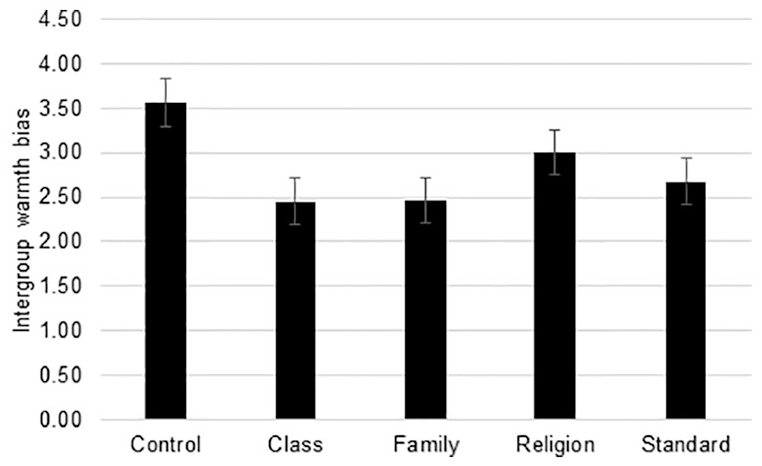
Mean intergroup warmth antirefugee bias for norm-framed imagined contact, standard imagined contact, and the control condition, controlling for nationality and religion.
For stereotyping bias, a significant main effect was also found, F(4, 537) = 6.16, p < .001, ƞ2p = .04. Bonferroni post hoc analyses showed significant effects of the religion norm-framed (M = 0.22, SE = 0.05) and class norm-framed (M = 0.15, SE = 0.05) conditions in comparison to the control (M = 0.46, SE = 0.05; p = .005 and p < .001, respectively). Additionally, those in the class condition showed significantly less antirefugee bias than those in the family condition (M = 0.35, SE = 0.05, p = .03). Again, the standard condition (M = 0.31, SE = 0.05) did not differ significantly from the control, and nor did the family condition (p > .05). Support is therefore given to our hypothesis once again (see Figure 2).
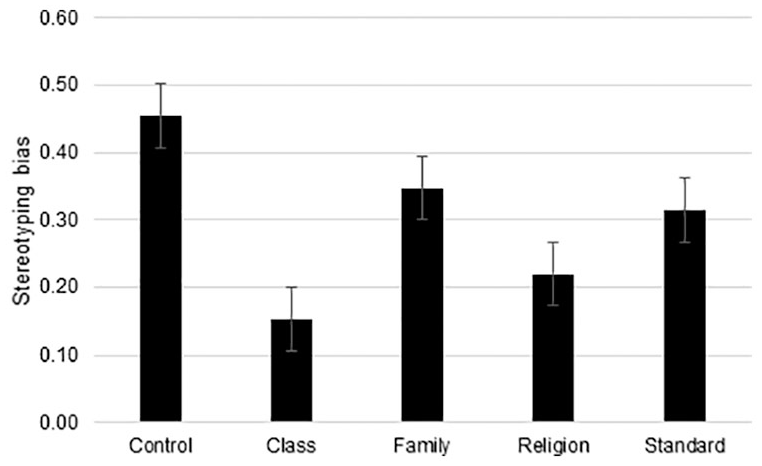
Mean stereotyping antirefugee bias for norm-framed imagined contact, standard imagined contact, and the control condition, controlling for nationality and religion.
Robustness checks
These patterns of results remained when additionally controlling for children’s number of non-Irish friends, gender, age, school type (nondenominational vs. Catholic), and clarity of the imagined scenario, with the exception that the pairwise comparison between the family and control conditions on intergroup warmth bias became marginally significant when all covariates were included simultaneously (p = .085). Furthermore, interactions between the experimental conditions and each of these covariates were additionally tested using MANOVA models. Age, clarity, and non-Irish friends were transformed into dichotomous variables for these analyses. No significant interactions were found (p > .05 for all).
As data were nested within 29 classes, the intraclass correlation coefficients (ICC) were calculated for both outcomes to determine between-class variance. For intergroup warmth bias: ICC = .04, and for stereotyping bias: ICC = .01. As such, it was determined that the variance in antirefugee bias explained by class groupings was not of sufficient magnitude to require multilevel modelling.
Manipulation check
As a manipulation check, the effects of the imagined contact scenarios on perceived family, class, and religious group norms were examined using MANCOVA. Controlling for nationality and religion as before, a significant main effect of the scenarios was found on perceived norms, λ = .95, F(12, 1262.32) = 1.94, p = .026, ƞ2p = .02. Univariate ANOVAs revealed that only perceived class norms were significantly affected by imagined contact, F(4,479) = 2.80, p = .026, ƞ2p = .02. Specifically, those in the class condition (M = 3.01, SE = 0.07) showed significantly more positive perceived class norms compared to those in the control (M = 2.74, SE = 0.07, p = .049). Additionally, there was a marginally significant main effect of imagined contact on perceived religious norms, F(4,479) = 2.14, p = .075, ƞ2p = .02.
Estimated marginal means and standard errors of all variables per condition arising from the MANCOVAs are provided in Table 2.
Estimated marginal means of mediator and outcome variables as a function of condition (standard errors are in parentheses).
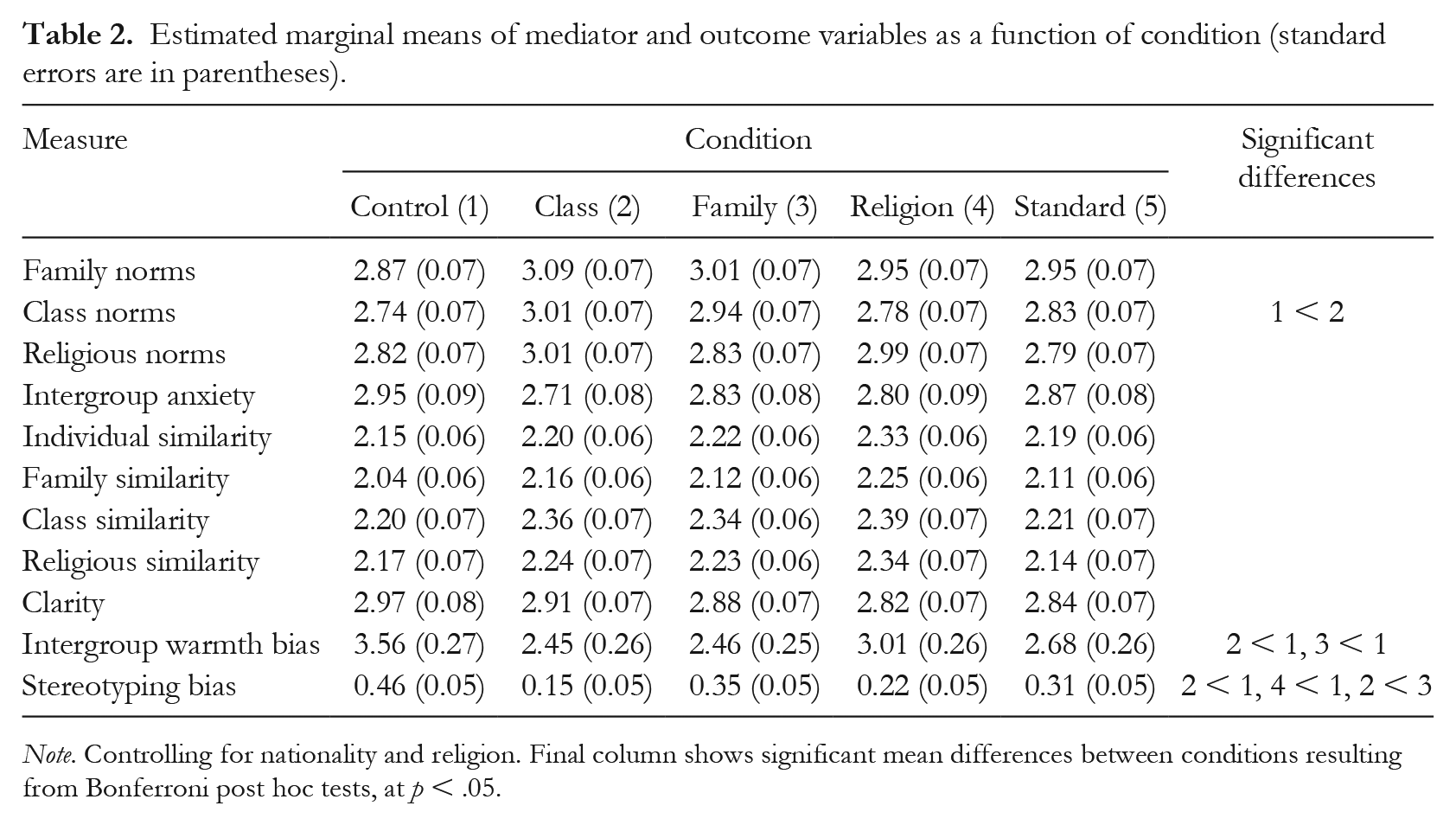
Note. Controlling for nationality and religion. Final column shows significant mean differences between conditions resulting from Bonferroni post hoc tests, at p < .05.
Mechanisms of imagined contact effects
To investigate the significance of specific mediational pathways of the intervention effects, two mediation analyses were conducted using the PROCESS macro for SPSS (Model 4; Hayes, 2018). For each facet of prejudice, a parallel mediation analysis was conducted in which intergroup anxiety; individual similarity; and similarity of family, class, and religious groups to refugees were analysed as mediators of the relationship between imagined contact and antirefugee bias. The indirect effects were calculated using 5,000 bootstrapped samples. The five conditions were included simultaneously as a multicategorical independent variable using four dummy-coded variables, with the control as the comparison group. Nationality and religion were included as covariates in all analyses.
A significant partial indirect effect of the class condition, relative to the control, on intergroup warmth bias was observed through intergroup anxiety (relative indirect effect: B = −0.18, SE = 0.09, 95% CI [−0.37, −0.01]). Both the total effect (B = −1.05, SE = 0.40, 95% CI [−1.84, −0.26]) and the direct effect (B = −0.74, SE = 0.36, 95% CI [−1.45, −0.03]) of the class condition were significant. Similarly, a partial indirect effect of the class condition on stereotyping bias was also found through intergroup anxiety (relative indirect effect: B = −0.02, SE = 0.01, 95% CI [−0.05, −0.00]). Again, both the total effect (B = −0.30, SE = 0.07, 95% CI [−0.44, −0.16]) and the direct effect (B = −0.25, SE = 0.07, 95% CI [−0.38, −0.12]) were significant.
No significant relative indirect effects of family or religious norm-framed imagined contact were observed. Additionally, no significant paths were found through perceived individual similarity or similarity of the respective ingroup to refugees. The religion condition did, however, significantly predict increased individual similarity (p = .034), family similarity (p = .016), and class similarity (p = .047) in both models. Furthermore, family and religious similarity significantly predicted intergroup warmth bias (p = .035 and .001, respectively), and class similarity predicted stereotyping bias (p = .002). All path estimates for both mediation models are provided in Tables 3 and 4.
Estimated paths, direct effects, and significance values for the intergroup warmth bias mediation model.
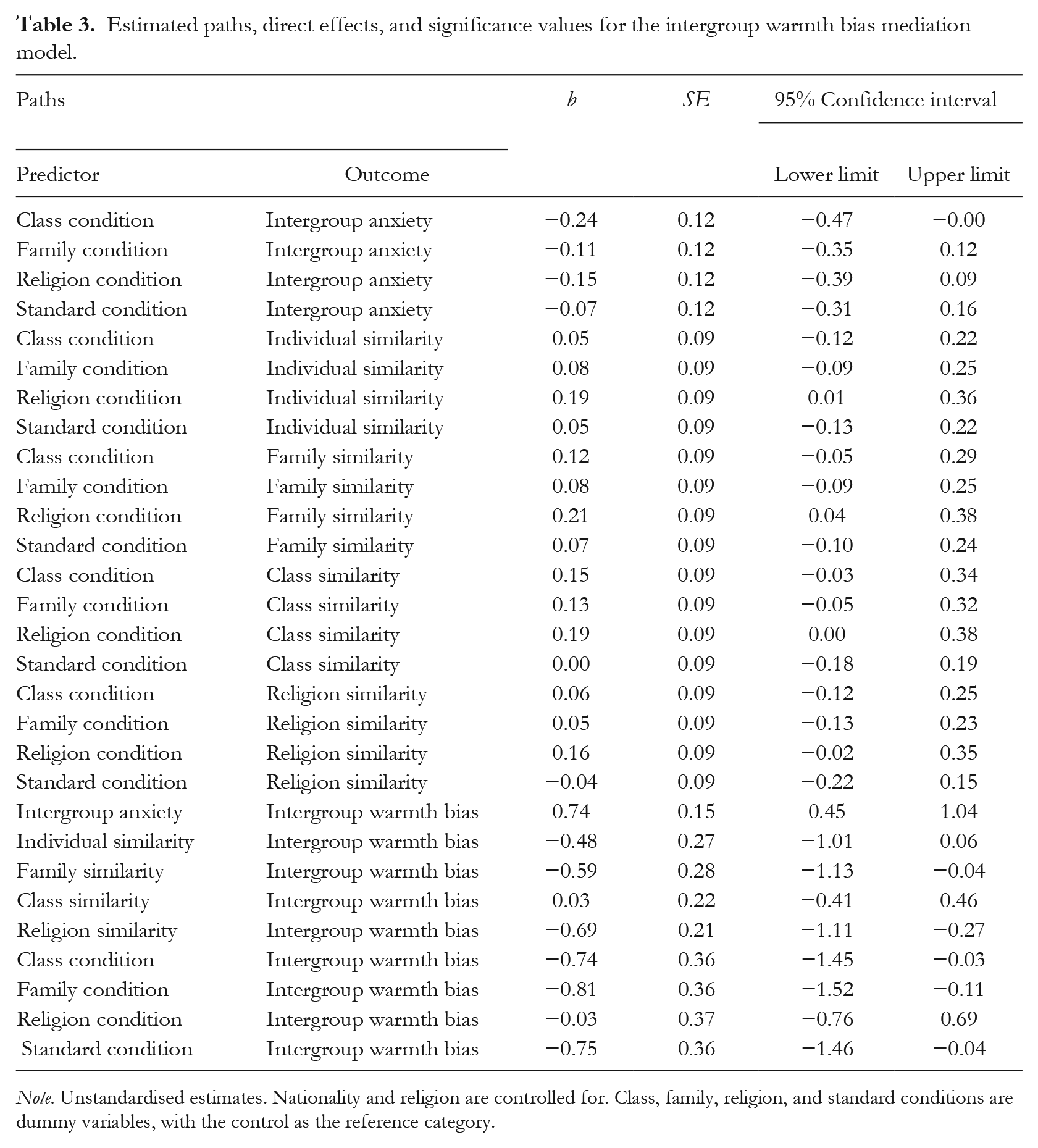
Note. Unstandardised estimates. Nationality and religion are controlled for. Class, family, religion, and standard conditions are dummy variables, with the control as the reference category.
Estimated paths, direct effects, and significance values for the stereotyping bias mediation model.
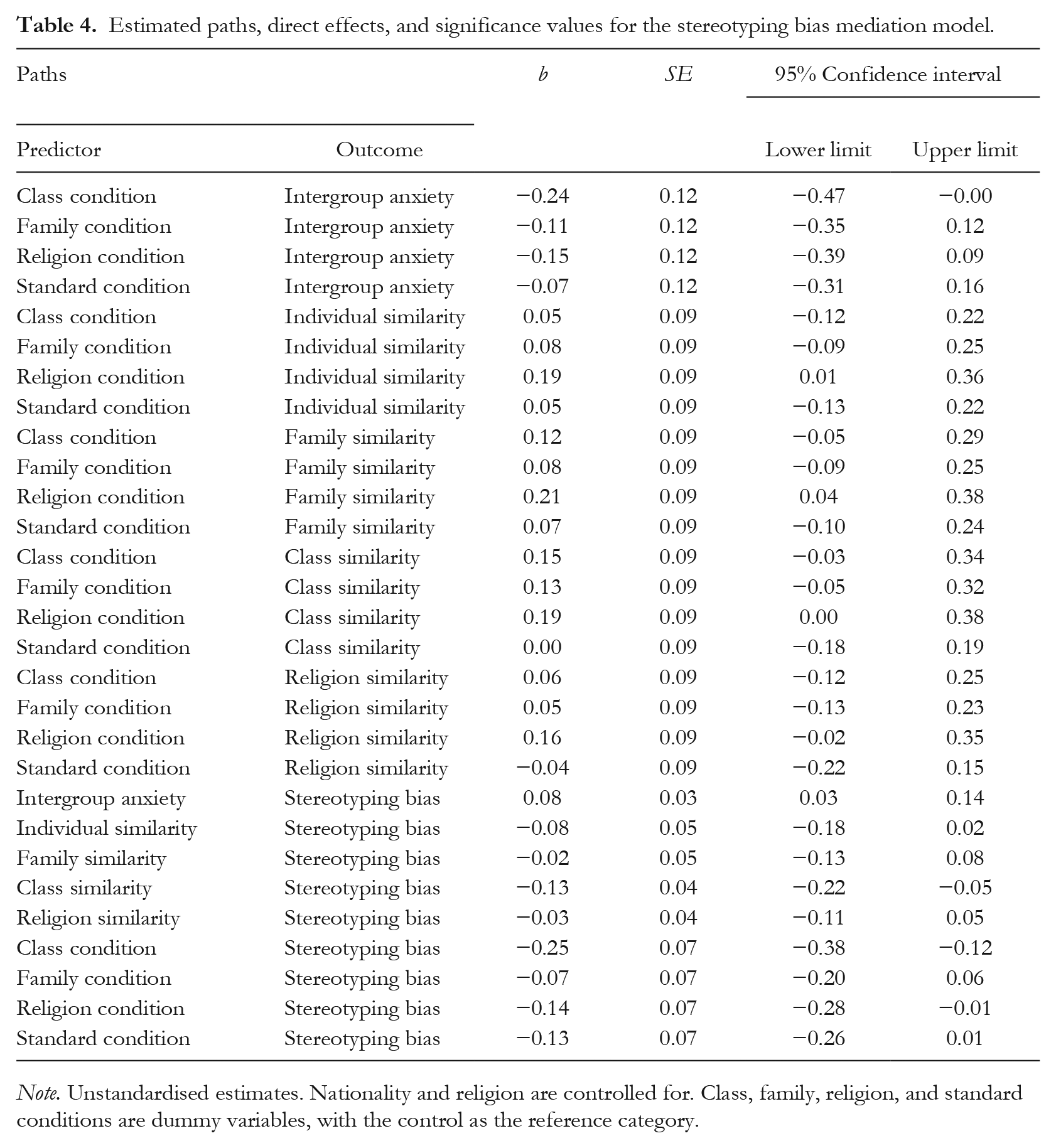
Note. Unstandardised estimates. Nationality and religion are controlled for. Class, family, religion, and standard conditions are dummy variables, with the control as the reference category.
Discussion
This study presented the first test of norm-framed imagined contact, and demonstrated that imagining contact with a refugee as taking place in the presence of ingroup members who support contact significantly reduced intergroup bias compared to an outdoor scene. In contrast, the standard elaborated imagined contact scenario, in which children imagined contact as taking place in an individual context in which there were no supportive ingroup members, did not lead to a significant reduction in intergroup bias compared to the control. This indicates that in the present intergroup setting, imagined interactions alone are insufficient to reduce bias. Similar to research demonstrating that direct contact can be more effective in supportive normative climates (Christ et al., 2014; De Tezanos-Pinto et al., 2010), these findings suggest that a supportive normative context can also enhance the prejudice reduction effects of imagined contact. Despite the lack of significant differences between the standard and norm-framed conditions with respect to children’s antirefugee bias, these results nonetheless suggest that incorporating supportive family, class-peer, and religious ingroup norms into the imagined contact paradigm may enhance its effectiveness.
It is interesting to note that the class norm-framed condition reduced antirefugee bias for both affective and cognitive aspects, whereas the family and religion conditions each significantly reduced only one facet of bias. Furthermore, mean affective and cognitive bias reduction was greater in the class condition than in the family and religious conditions, though not always significantly. This is consistent with the results of the manipulation check whereby only the class condition resulted in significantly more positive perceived class norms compared to the control group. Although those in the family or religion norm-framed conditions did not show a significant change in perceived family or religious ingroup norms, these conditions were associated with a significant reduction in antirefugee bias. It may be that the norm-framing instructions given in these conditions were not strong enough to enhance perceptions of positive ingroup norms, but nonetheless effectively made a supportive ingroup normative context salient, which facilitated bias reduction to a certain degree. Future research may wish to examine alternate, less subtle norm-framing instructions to increase the effects of norm-framed imagined contact.
Another potential explanation of the more consistent impact of the class norm-framed scenario is that it likely invoked other moderators of the efficacy of contact. In a classroom setting, all children are implied to have equal status—a facilitating condition of contact (Allport, 1954; Pettigrew, 1998). Additionally, the class group may be more malleable, and more easily include diverse others. Imagining a refugee child as part of the class may better facilitate the development of a common-ingroup identity in which refugee children are considered ingroup members by the children in the class condition. Vezzali et al. (2015) have indeed demonstrated the effectiveness of a common-ingroup frame for imagined contact. It should be noted, however, that in the current study there was no significant indirect effect of the class condition through perceived similarity, as might be expected if the class norm-framed scenario had induced identification with a common ingroup.
It may also be that the adoption of a field experiment method in which the teacher was instructed to facilitate the intervention with their class accentuated the effects of the positive normative context for the classroom scenario by providing an additional source of authority support in the class context (Allport, 1954). This points to the need to investigate imagined contact interventions in a natural setting (Lemmer & Wagner, 2015). Prejudice reduction interventions conducted in a laboratory setting may overlook contextual factors present in the natural environment which can enhance or impair the efficacy of the intervention. It is worthwhile to note that unlike Ülger et al. (2018), who found that antibias interventions conducted by teachers were not reliably effective, we found significant effects of norm-framed imagined contact facilitated by class teachers. This may be a result of the preparatory discussions between the researchers and the teachers involved, which ensured teachers were adequately equipped to conduct the intervention and follow the indicated procedures. This may have helped to improve standardisation and implementation fidelity across classes.
Mechanisms of Norm-Framed Imagined Contact
We demonstrated that although the ability of norm-framed imagined contact to reduce antirefugee bias is largely independent of the influence of other variables tested, the effects of the class condition were partially mediated by intergroup anxiety for both facets of antirefugee bias. This is consistent with previous studies of imagined contact (R. N. Turner et al., 2013), and with research demonstrating an indirect relationship between social norms and antirefugee bias through intergroup anxiety (Smith & Minescu, 2021). The absence of significant indirect effects of family or religion conditions through intergroup anxiety may be attributable to the weaker total effects of these conditions.
Although perceived individual and intergroup similarity were not significant mediators of the effects of norm-framed imagined contact, the religion condition did significantly increase perceived individual similarity, as well as perceived similarity with class-peer and family groups, compared to the control. This may indicate that this scenario has the potential to act as a common-ingroup manipulation, facilitating the perception of similarity between participants and refugees, perhaps by encouraging children to imagine a refugee child with similar values as themselves and their family and peers. Although the class can also constitute a common ingroup, religious teachings are strongly characterised by an emphasis on equality and condemnation of discrimination, which better reinforce the ideal that people are individuals with similar hopes and dreams, irrespective of their group categorisations. While these features may also be present in the class or family, they are not inherent in these groups. Future studies may wish to explore these effects further.
Implications for Future Research
It should be noted that children may not necessarily have imagined distinct ingroup members in the family, religion, and class-peer conditions. While we can assume children in the family and class conditions indeed imagined real family members and classmates as supportive of contact with the refugee child, we do not know precisely who was imagined as the religious ingroup member. As children’s family and, to some extent, classmates tend to belong to the same religion as the child, it may be that children imagined individuals from these proximal groups as their supportive religious ingroup members. If so, perhaps the norm-framed scenario may have served as a lens through which the same influential figures are viewed. Alternatively, children may have mentally constructed a prototypical religious ingroup member who did not exist in their real lives but embodied the normative attitudes of their religion. A third possibility is that children imagined a priest or a neighbour who they regularly see in a religious context. Further research should investigate these qualitative aspects of norm-framed imagined contact in order to illuminate these concerns.
Future studies should also consider investigating the age at which norm-framed imagined contact is most effective. While the age range in the current sample did not vary sufficiently to allow for a thorough examination of a developmental approach, previous research has found mixed evidence for children’s age as a moderator of the effectiveness of contact interventions. Cameron, Rutland, Turner, et al. (2011) found that imagined contact was more effective among young children (5–6 years) than older children (7–10 years), though this was partly due to the reduction in intergroup bias as children age. R. N. Turner et al. (2013), however, demonstrated that imagined contact was also effective among British adolescents (aged 16–17). In addition, the importance of social norms may be stronger for particular age groups, as some research suggests social norms are internalised during middle or older childhood (e.g., Rutland et al., 2005).
Lastly, despite the promising results observed in the current study, cross-sectional experimental designs fail to indicate whether effects are likely to endure beyond the experimental session. Longitudinal designs should be implemented in order to determine whether prejudice reduction effects prevail weeks or even months after imagined contact activities are undertaken.
Despite these limitations, the finding that framing imagined contact in the context of supportive ingroup norms effectively reduced antirefugee bias where standard imagined contact did not, is not only of theoretical interest but also of potential benefit to educators. In particular, as the class condition significantly impacted both facets of bias, encouraging children to imagine themselves in contexts in which their classmates are supportive of intergroup contact may be usefully and easily incorporated into pedagogical practice. Additionally, the large and varied sample, spanning 29 classrooms from rural, urban, nondenominational, and mainstream schools across Ireland, lends certain added generalisability to the findings of this field experiment.
As people continue to flee persecution in search of international protection, our societies continue to diversify. Considering the impracticality and unsustainability of hosting direct contact interventions with refugee and asylum seeker children in schools, indirect forms of contact can be a valuable alternative in a field setting. Moreover, we show that the flexibility of imagined scenarios enables the incorporation of other prejudice reduction strategies such as social norm-framing, which can enhance the effectiveness of imagined contact interventions. In short, this research reinforces the argument that the social context, whether real or imagined, can be effectively utilised to change intergroup attitudes. Relatively simple exercises such as those presented in this study can not only effectively reduce children’s prejudice towards refugees but can be easily incorporated into everyday school activities. As we strive for an inclusive society for the next generation, we should begin by encouraging a climate of inclusivity in the minds of children, aided by structured, purposeful activities.
