




Abstract
Limited research has examined disadvantaged group members’ evaluations and support for allies who engage in collective action on their behalf. Across two studies (Study 1 N = 264 women; Study 2 N = 347 Black Americans) we manipulated an ally’s communication style and group membership to investigate whether these factors play a role in how allies are perceived and received. We found that participants evaluated allies less positively and were less willing to support them when they communicated their support in a dominant compared to a neutral way. Heightened perceptions that the ally was trying to take over the movement and make themselves the center of attention explained these results. However, we found no effect of whether the ally belonged to another disadvantaged group or not. Our findings contribute to the growing literature which seeks to understand the complexities associated with involving allies in collective action.
White Americans who participate in the Black Lives Matter movement, heterosexual people who advocate for marriage equality, and men who protest for women’s rights – allies have been involved in both historical and current political movements. While there is some research to suggest that advantaged group allies are evaluated positively (Cihangir et al., 2014; Dickter et al., 2012; Drury & Kaiser, 2014; Eliezer & Major, 2012; Kutlaca et al., 2019) and may be effective at facilitating social change (Czopp & Monteith, 2003; Drury & Kaiser, 2014; Gulker et al., 2013; Rasinski & Czopp, 2010), their participation in political movements can become misguided (Droogendyk et al., 2016; Radke et al., 2020). As a result, disadvantaged group members (such as women and Black Americans) may evaluate allies less positively and be less willing to support their participation in action on their behalf.
Yet to date, research examining how allies are perceived and received by the disadvantaged group is largely absent from the psychological literature (cf. Brown, 2015; Brown & Ostrove, 2013; Ostrove & Brown, 2018). This is striking given that allies participate in action which is ostensible for and directly affects the disadvantaged group (for a related discussion, see Shelton, 2000). In this article, we investigate whether the way in which allies communicate their support for a political movement (in either a dominant or neutral way), and the group membership of the ally (i.e., whether they are a member of another disadvantaged group or not) influences disadvantaged group members’ evaluations and support for allies.
Allies in Collective Action
Collective action was initially defined as any action taken by a group member who is acting as a representative of their group with the goal of improving the conditions of their group (Wright et al., 1990). More recently this definition has been expanded to include people who do not belong to the disadvantaged group but participate in these behaviors on their behalf (Ashburn-Nardo, 2018; Becker, 2012; Droogendyk et al., 2016; Leach et al., 2002; Louis et al., 2019; Radke et al., 2020; Saab et al., 2015; Stewart et al., 2016; Subašić et al., 2008; Thomas & McGarty, 2018; Van Zomeren & Iyer, 2009; Van Zomeren et al., 2011; Van Zomeren et al., 2018). These people are often referred to as allies who engage in allyship or ally behavior. While the definition of allies is contested within the psychological literature (see Radke et al., 2020, for a discussion), in this article we refer to allies as people who engage in collective action for a disadvantaged group (e.g., women, Black Americans) but are not a member of the group (e.g., men, White and Hispanic Americans).
While there is some evidence that allies can facilitate social change (Czopp & Monteith, 2003; Drury & Kaiser, 2014; Gulker et al., 2013; Rasinski & Czopp, 2010), not all disadvantaged group members are receptive to including allies in political movements. This is because allies can undermine a movement if they act in ways that maintain and reinforce the oppression of the disadvantaged group which the collective action seeks to dismantle (Droogendyk et al., 2016; Radke et al., 2020). We propose that the way in which allies communicate their support for the disadvantaged group, and their group membership, is critical to understanding how they are perceived and received.
Communication Style
Allies’ participation in collective action for a disadvantaged group can become misguided when they make themselves the center of attention, act only when they have something to gain, fail to consider how disadvantaged group members are affected by their participation, push the disadvantaged group to include their voice in the movement, and expect that the disadvantaged group owes them something for supporting their cause (Droogendyk et al., 2016). Allies might act in these ways for a variety of different reasons; they may be oblivious to the privileges afforded to them as allies (Droogendyk et al., 2016) or their motivation to engage in collective action might be driven by a desire to maintain the status of their own group or for personal reasons (Radke et al., 2020). Regardless of their motivations, these behaviors might signal to the disadvantaged group that the ally is attempting to take over the political movement and make themselves the center of attention, resulting in them being evaluated more negatively and receiving less support from the disadvantaged group. The broader psychological literature supports this argument: previous research has found that people evaluate others more negatively when they display dominance (Carli, 1990; Carli et al., 1995; Driskell et al., 1993; Driskell & Salas, 2005; Yukl & Tracey, 1992).
We therefore propose that allies who communicate their support for the disadvantaged group in a dominant (compared to neutral) way will be evaluated less positively and will receive less support from disadvantaged group members. Furthermore, we expect that heightened perceptions that the ally is trying to take over the movement and make themselves the center of attention will explain this relationship. Note here that we are not discussing an assertive communication style, which may be necessary when communicating the demands of a political movement, but rather a dominant communication style which indicates that the ally (whether intentionally or unintentionally) desires to take over the movement and make themselves the center of attention.
Group Membership
In addition to communication style, we also explore how disadvantaged group members perceive and receive allies who belong to another disadvantaged group or not. For example, an ally can belong to only advantaged groups (e.g., a heterosexual male feminist; White Americans who participate in the Black Lives Matter movement) or they can belong to another disadvantaged group (e.g., a gay male feminist; Hispanic Americans who participate in the Black Lives Matter movement). The majority of the psychological literature on the topic of allyship has focused on advantaged group allies, not taking into account that allies’ identities can intersect with membership in other disadvantaged groups.
It is often assumed that disadvantaged groups will come together to support one another because they both experience prejudice and discrimination, but examples from the real world (e.g., hostilities between Black and Korean Americans during the 1992 Los Angeles protests; Kim, 2012) and the psychological literature (Craig et al., 2012; Craig & Richeson, 2014, 2016), indicate that this is not necessarily the case. Positive intraminority intergroup relations, however, can be facilitated by making the shared experience of discrimination salient among disadvantaged group members (Craig & Richeson, 2012) or by encouraging disadvantaged group members to adopt a similarity-seeking mindset (Cortland et al., 2017). This finding suggests that disadvantaged group members might evaluate allies more positively and be more willing to support them when they belong to another disadvantaged group, because these allies may activate the perception that they are motivated by the shared experience of discrimination to take action on their behalf.
The Current Research
The current research examines disadvantaged group members’ evaluations and support for allies who engage in collective action on their behalf. We manipulated an ally’s communication style (i.e., dominant or neutral) and group membership (i.e., belonging to another disadvantaged group or not) to investigate whether these factors play a role in how allies are perceived and received. Across two studies, disadvantaged group members (women in Study 1, and Black Americans in Study 2) read a newspaper article about an ally who gave a speech at a protest for their group (women’s rights in Study 1, and the Black Lives Matter movement in Study 2).
Participants indicated the extent to which they evaluated the ally positively and perceived effectiveness of the ally for achieving the goals of the movement, as well as their willingness to exclude the ally from the movement and engage in collective action with them. These outcome variables were chosen because they are relevant to understanding allies’ participation in political movements: They provide a snapshot of how allies are evaluated, examine whether the participation of allies in political movements is perceived to be a help or a hindrance, identify when disadvantaged group members want (and do not want) allies to be involved, and whether their support translates into them being willing to participate in collective action with the ally.
We predict that allies who communicate their support for the disadvantaged group in a dominant (compared to neutral) way will be evaluated less positively and will receive less support from disadvantaged group members. Furthermore, we expect that heightened perceptions that the ally is trying to take over the movement and make themselves the center of attention will explain this hypothesized relationship. We also explored whether disadvantaged group members evaluated allies more positively, and were more willing to support them, when they belonged to another disadvantaged group compared to those allies who do not. It is also possible that an interaction will emerge, such that participants will evaluate allies less positively and be less willing to support them when they communicate their support in a dominant compared to neutral way, especially when they do not belong to another disadvantaged group (compared to those allies who do).
Study 1
In Study 1 we examined female participants’ evaluations and support for a male ally who spoke at a rally for women’s rights. We manipulated whether the ally communicated his support in a dominant or neutral way, and the group membership of the ally by exposing participants to either a heterosexual or gay male ally.
Participants
The original sample consisted of 497 participants. Thirty-two participants were removed because they clicked on the link to the survey but did not continue to see the manipulation. Thirty-three participants were removed because they did not indicate their gender and 49 participants were removed because they indicated that they were not female. Due to recent concerns over data quality from Amazon Mechanical Turk (Kennedy et al., 2018), we took a conservative approach and decided to exclude participants from the data analysis who did not pass the manipulation checks and the attention check. As a result, 119 participants were removed from the dataset. The findings remained largely unchanged when data from participants who did not pass the second manipulation check and attention check were included in the analysis (see supplemental material online).
The final sample size consisted of 264 female Amazon Mechanical Turk workers (www.mturk.com) located in the US. Power analysis using G*Power (Faul et al., 2007) indicated that a total sample of 199 participants would be needed to detect a small to medium effect ( f = .20) with 80% power and an alpha of .05. Participants were paid US$0.50 for taking part in the study. Their ages ranged between 18 and 92 years old with a mean of 38.65 years (SD = 13.66; two participants reported their age as being three and four years old so their response to this question was excluded). The sample was comprised mostly White (71%; 188 participants), followed by Black (11%; 30 participants), Hispanic/Latina (8%; 21 participants), and Asian participants (7%; 19 participants). Six participants were from another racial/ethnic group. The majority of participants reported that they were heterosexual (84%; 222 participants).
Design, Manipulation, and Procedure
The study employed a 2 (communication style: dominant, neutral) × 2 (group membership: heterosexual, gay) between-subjects design. The independent variables were manipulated by exposing participants to a newspaper article about a male feminist called Matthew Smith who spoke at a rally on International Women’s Day in Washington Square Park, New York (see supplemental material online for the manipulation).
In the dominant communication style condition, Smith was described as having a loud voice and talking in a dominant way, speaking during the time allocated to another speaker, interrupting the other speaker, and dismissing a comment made by a member of the audience who contributed to the discussion. The manipulation was based on characteristics of a dominant communication style identified by previous research (Carli, 1990; Carli et al., 1995; Driskell et al., 1993; Driskell & Salas, 2005; Yukl & Tracey, 1992). In the neutral communication style condition, Smith was described as having a voice that was neither too loud nor too soft and talking in a neutral way, speaking for his allocated time, not interrupting the other speaker, and listening to a comment made by a member of the audience who contributed to the discussion. Pilot testing revealed that participants (N = 47 German students) perceived the dominant condition (M = 4.83, SD = 1.44) to be more dominant than the neutral condition (M = 2.21, SD = 1.56), t(45) = 5.98, p < .001, 95% CI [1.74, 3.50], d = 1.75. Perception of dominance was measured using one item (“I felt that Lukas was trying to dominate the movement”). 1
Group membership of the ally was manipulated by identifying Smith as either a heterosexual or gay man. We included information about Smith attending the rally with his partner in the manipulation for Study 1. This was done to reinforce the sexual orientation of the ally (i.e., he attended the event with either his male or female partner), and to prevent participants from speculating that the heterosexual ally was motivated to attend the rally because he was looking for a romantic interaction/partner.
After reading the newspaper article, participants were asked to complete the four dependent variables (positive evaluations and perceived effectiveness of the ally, willingness to exclude the ally from the movement and engage in collective action with him) before completing the attention check, demographic variables, and the manipulation checks. Additional measures (e.g., the perception that the ally was trying to take over the movement and make themselves the center of attention) were included in the study.
Measures
The following variables were measured on a 1 (strongly disagree) to 7 (strongly agree) Likert-type scale.
Manipulation Checks
We included three manipulation checks in the study. The first manipulation check measured whether participants correctly identified the ally’s sexual orientation (“What was Matthew’s sexual orientation?”; gay, heterosexual). The second manipulation check measured whether participants remembered that Matthew attended the rally with his partner (“Did Matthew attend the rally with his partner?”; yes, no). Participants who incorrectly answered these questions were excluded from the data analysis.
The third manipulation check measured whether the participants perceived the ally’s communication style to be more dominant in the dominant compared to neutral condition (“How would you describe Matthew’s communication style?”; 1 = neutral, 7 = dominant). A 2 (communication style: dominant, neutral) × (group membership: gay, heterosexual) between-subjects ANOVA was conducted to determine whether participants perceived the ally to be more dominant in the dominant compared to the neutral condition. As expected, there was a significant main effect communication style where participants perceived the ally to be more dominant in the dominant (M = 6.28, SD = 1.13) compared to the neutral condition (M = 2.97, SD = 1.87), F(1, 260) = 301.80, p < .001, 95% CI [2.93, 3.69], ηp2 = .54. There was no main effect of group membership, F(1, 260) = 1.47, p = .227, 95% CI [–0.14, 0.61], ηp2 < .01, and no interaction between communication style and group membership, F(1, 260) = 0.14, p = .704, ηp2 < .01. These findings indicate that communication style was successfully manipulated.
Attention Check
After completing the collective action measure, we asked participants to respond to the following statement: “I would be willing to attend a sit-in with Matthew. Please ignore this statement and choose somewhat agree below”. Only participants who correctly answered this question were included in the data analysis.
Results and Discussion
Means, standard deviations, and correlations between the variables are summarized in Table 1. A 2 (communication style: dominant, neutral) × 2 (group membership: heterosexual, gay) between-subjects MANOVA was conducted for the dependent variables (positive evaluations and perceived effectiveness of the ally, willingness to exclude and engage in collective action with the ally; see Figure 1). No significant multivariate interaction effect between communication style and group membership was found, F(4, 257) = 1.41, p = .232, ηp2 = .02; Wilks’ Λ = .98. There was a significant multivariate main effect of communication style, F(4, 257) = 31.63, p < .001, ηp2 = .33; Wilks’ Λ = .67. A significant multivariate main effect of group membership was also found, F(4, 257) = 2.94, p = .021, ηp2 = .04; Wilks’ Λ = .96. 2 We conducted four univariate ANOVAs for each of the dependent variables to follow-up the results of the MANOVA.
Means, standard deviations, and correlations for Study 1.
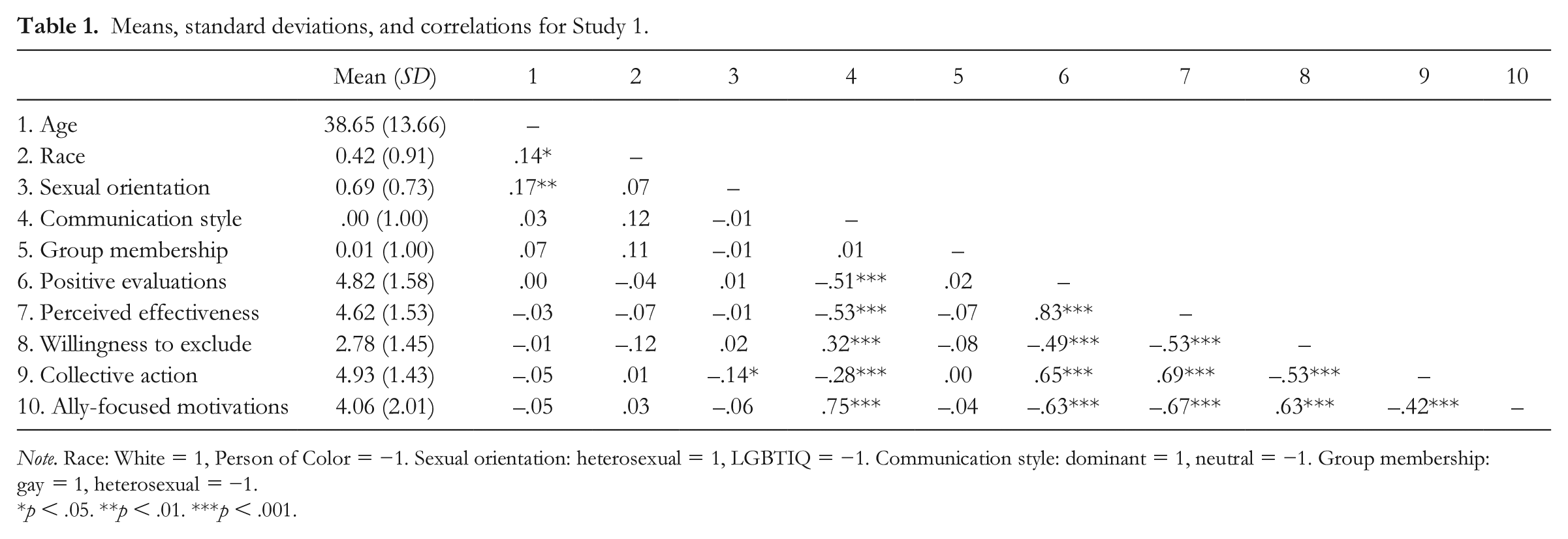
Note. Race: White = 1, Person of Color = −1. Sexual orientation: heterosexual = 1, LGBTIQ = −1. Communication style: dominant = 1, neutral = −1. Group membership: gay = 1, heterosexual = −1.
p < .05. **p < .01. ***p < .001.
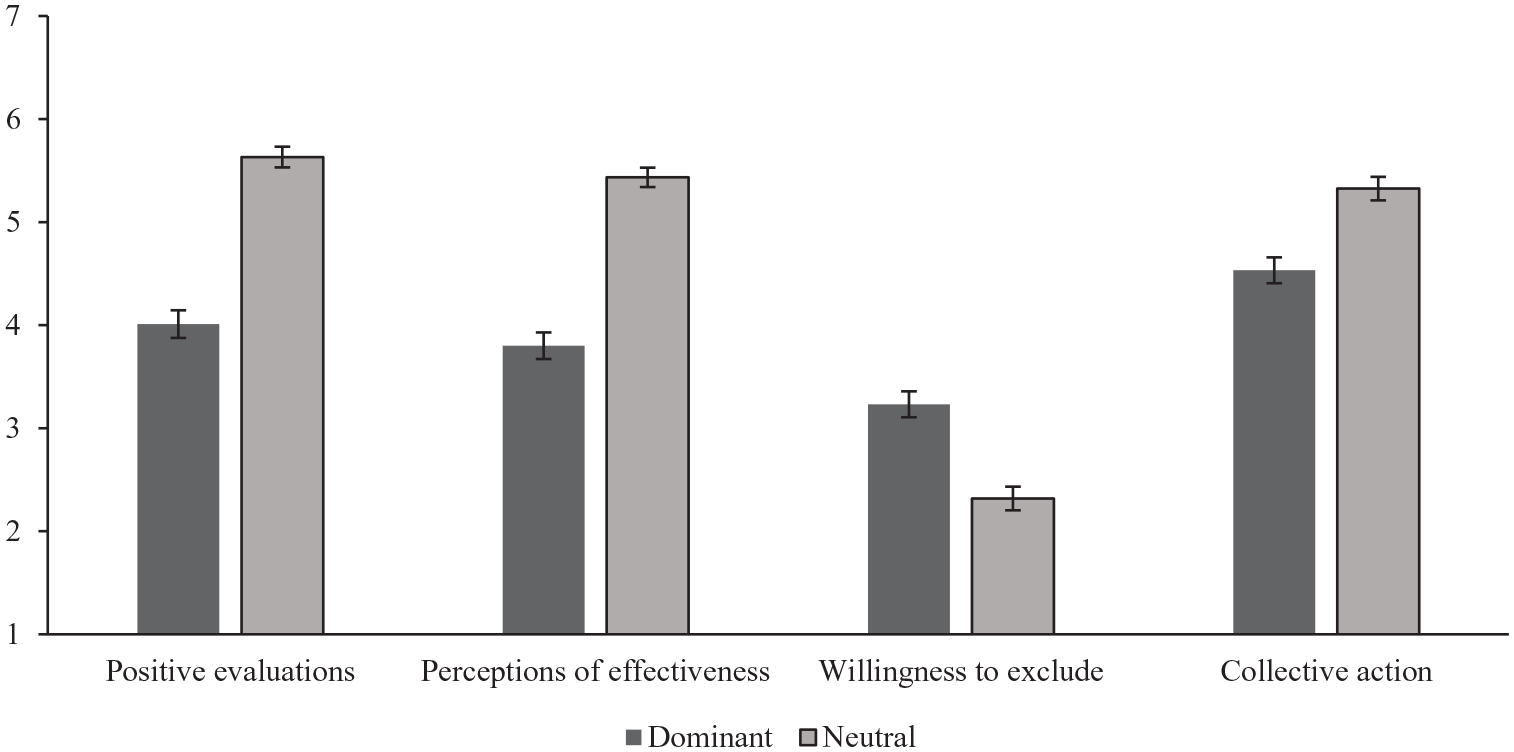
Main effect of communication style on the dependent variables (all differences are significant at ps < .001; Study 1; standard errors reported).
Positive Evaluations of the Ally
As predicted, we found a significant main effect of communication style such that participants evaluated the ally more positively when he communicated his support in a neutral (M = 5.63, SD = 1.16), compared to a dominant way (M = 4.01, SD = 1.54), F(1, 260) = 93.02, p < .001, 95% CI [1.29, 1.95], ηp2 = .26. We did not find a main effect of group membership, F(1, 260) = 0.18, p = .675, 95% CI [–0.26, 0.40], ηp2 < .01, or an interaction between communication style and group membership for positive evaluations of the ally, F(1, 260) = 0.23, p = .632, ηp2 < .01.
Perceived Effectiveness of the Ally
As predicted, we found a significant main effect of communication style such that participants perceived the ally to be more effective when he communicated his support in a neutral (M = 5.43, SD = 1.08) compared to a dominant way (M = 3.80, SD = 1.48), F(1, 260) = 104.39, p < .001, 95% CI [1.32, 1.95], ηp2 = .29. We did not find a main effect of group membership, F(1, 260) = 1.76, p = .186, 95% CI [–0.10, 0.53], ηp2 < .01, or an interaction between communication style and group membership for how effective the ally was perceived to be, F(1, 260) = 0.14, p = .707, ηp2 < .01.
Willingness to Exclude the Ally
As predicted, we found a significant main effect of communication style such that participants were more willing to exclude the ally when he communicated his support in a dominant (M = 3.23, SD = 1.44) compared to a neutral way (M = 2.32, SD = 1.32), F(1, 260) = 29.05, p < .001, 95% CI [0.58, 1.25], ηp2 = .10. We did not find a main effect of group membership, F(1, 260) = 2.18, p = .141, 95% CI [–0.08, 0.59], ηp2 < .01, or an interaction between communication style and group membership for willingness to exclude the ally, F(1, 260) = 0.17, p = .684, ηp2 < .01.
Willingness to Engage in Collective Action with the Ally
As predicted, we found a significant main effect of communication style such that participants were more willing to engage in collective action with the ally when he communicated his support in a neutral (M = 5.33, SD = 1.31) compared to a dominant way (M = 4.53, SD = 1.44), F(1, 260) = 21.70, p < .001, 95% CI [0.46, 1.13], ηp2 = .08. We did not find a main effect of group membership, F(1, 260) = 0.01, p = .920, 95% CI [–0.32, 0.35], ηp2 < .01, or an interaction between communication style and group membership for willingness to engage in collective action with the ally, F(1, 260) = 1.66, p = .199, ηp2 < .01.
Controlling for Demographic Variables
It is also possible that the results may be affected by whether participants themselves belong to another disadvantaged group (e.g., lesbian participants, Black women; Craig & Richeson, 2016), and/or the age of the participants (where younger people might have more exposure to allies than older people). However, controlling for participants’ age, race, and sexual orientation using a MANCOVA did not change the results (see supplemental material online).
Mediation by Ally-Focused Motivations
Mediation analysis using bootstrapping procedures (SPSS PROCESS macro; Hayes, 2017) was used to examine the indirect effect of communication style (coded as 1 = dominant, –1 = neutral) on the outcome variables via ally-focused motivations. We used 5,000 bootstrap samples to estimate 95% confidence intervals for the indirect effect. As can be seen in Figure 2, a significant indirect effect was found between communication style via ally-focused motivations on positive evaluations of the ally (B = −0.67, BSE = 0.10, 95% CI [–0.88, –0.50]), perceived effectiveness of the ally (B = −0.69, BSE = 0.10, 95% CI [–0.91, –0.53]), willingness to exclude the ally (B = 0.95, BSE = 0.10, 95% CI [0.78, 1.16]), and willingness to engage in collective action with the ally (B = −0.52, BSE = 0.10, 95% CI [–0.75, –0.34]). In other words, when an ally communicates their support in a dominant (compared to a neutral) way, disadvantaged group members perceive that they are motivated to take over the movement and make themselves the center of attention, resulting in less positive evaluations and willingness to support the ally.
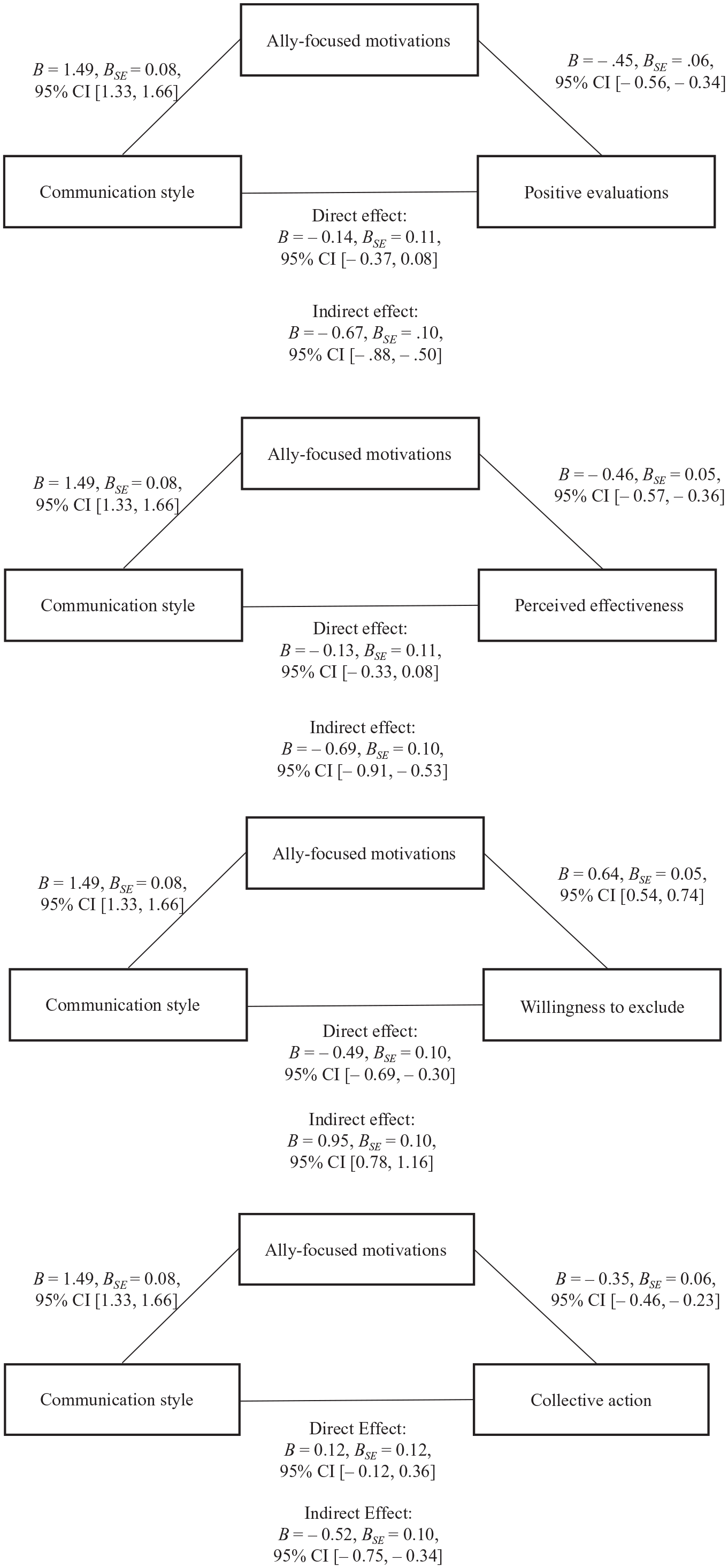
Mediation analysis for the effect of communication style on the outcome variables via ally-focused motivations (Communication style: dominant = 1, neutral = −1; Study 1).
As predicted, we found that women were less positive towards and less likely to support a male ally who communicated his support for the women’s rights movement in a dominant compared to a neutral way. Moreover, heightened perceptions that the ally was trying to take over the movement and make themselves the center of attention explained these results. This finding is in line with previous theorizing which argues that disadvantaged group members might withdraw their support for allies who act in a dominant way, because this behavior signals to the disadvantaged group that they are acting for other reasons besides improving the status of the disadvantaged group (Droogendyk et al., 2016; Radke et al., 2020). While the multivariate analysis suggested that there was an effect of group membership, the univariate analyses revealed that this was not the case. We did not find that group membership, both on its own and in an interaction with communication style, affected how disadvantaged group members perceive and receive allies. We will discuss this result in more detail together with the findings from Study 2 in the general discussion.
Study 2
Study 2 sought to replicate and extend Study 1 by examining disadvantaged group members’ evaluations and support for allies in the context of race relations. In doing so, we are able to confirm our results from Study 1 and show that our findings generalize to other movements where allies are involved. Specifically, we examined how Black Americans perceived and received a White or Hispanic American ally who attended a Black Lives Matter rally, and either communicated their support in a dominant or a neutral way. We also included an additional condition with a Black American so that we could examine the findings relative to another ingroup member. This allowed us to test whether allies – both who belong to the advantaged and another disadvantaged group – are preferred compared to ingroup members.
Participants
The original sample consisted of 749 participants. Seventy-four participants were removed because they clicked on the link to the survey but did not continue to see the manipulation. Forty-four participants were removed because they did not indicate their race/ethnicity and 135 participants were removed because they indicated that they were not Black American. Due to recent concerns over data quality from Amazon Mechanical Turk (Kennedy et al., 2018), we took a conservative approach and decided to exclude participants from the data analysis who did not pass the manipulation and attention check. As a result, 149 participants were removed from the dataset. The final sample size consisted of 347 participants. The findings remained largely unchanged when data from participants who did not pass the second manipulation check and attention check were included in the analysis (see supplemental material online).
Participants were 347 Black American Amazon Mechanical Turk workers (www.mturk.com) located in the US. Power analysis using G*Power (Faul et al., 2007) indicated that a total sample of 244 participants would be needed to detect a small to medium effect ( f = .20) with 80% power and an alpha of .05. Participants were paid US$1 for participating in the study. Their ages ranged between 19 and 93 years with a mean of 33.91 years (SD = 10.86; one participant reported their age as being two years old so their response to this question was excluded). The sample comprised 188 men and 159 women. The majority of participants reported that they were heterosexual (84%; 292 participants).
Design, Manipulation, and Procedure
The study employed a 2 (communication style: dominant, neutral) × 3 (group membership: White American, Hispanic American, Black American) between-subjects design. Group membership was manipulated by exposing participants to a newspaper article about a White American called Matthew Smith, a Hispanic American called José Lopez, or a Black American called Joshua Taylor who spoke at a Black Lives Mater protest in Washington Square Park, New York. Communication style was manipulated as described in Study 1 (see supplemental material online for the manipulation). We removed the information about the speaker’s relationship status in this study because this information is less relevant to this context, and refer to the speaker rather than ally because an ingroup member condition was included. The procedure was the same as in Study 1 and the study was preregistered (http://aspredicted.org/blind.php?x=9e4sw2). 3
Measures
Positive evaluations of the speaker (α = .93), perceptions that the speaker was effective at achieving the goals of the movement (α = .88), willingness to exclude the speaker (α = .94), willingness to engage in collective action with the speaker (α = .94), and ally-focused motivations (α = .95) were measured the same way as in Study 1 except the items indicated the speaker’s race/ethnicity and their name. Principal components analysis with oblimin rotation again revealed that the items measuring the perception that the ally was trying to take over the movement and make themselves the center of attention loaded onto one factor (eigenvalue = 4.22; 84% explained variance; see supplemental material online for the factor loadings).
Manipulation Checks
We included two manipulation checks in the study. The first manipulation check measured whether participants correctly identified the speaker’s race/ethnicity (“What was Matthew’s/José’s/Joshua’s race/ethnicity?”; Black, White, Hispanic). Participants who incorrectly answered this question were excluded from the data analysis.
The second manipulation check measured whether the participants perceived the speaker’s communication style to be more dominant in the dominant compared to the neutral condition (“How would you describe Matthew’s/José’s/Joshua’s communication style?”; 1 = neutral, 7 = dominant). A 2 (communication style: dominant, neutral) × 3 (group membership: White American, Black American, Hispanic American) between-subjects ANOVA was conducted. As expected, there was a significant main effect of communication style where participants perceived the ally to be more dominant in the dominant (M = 6.18, SD = 1.19) compared to the neutral condition (M = 3.63, SD = 2.11), F(1, 341) = 189.31, p < .001, 95% CI [2.18, 2.91], ηp2 = .36. There was no main effect of group membership, F(2, 341) = 0.68, p = .507, ηp2 < .01, and no interaction between communication style and group membership, F(2, 341) = 0.11, p = .898, ηp2 < .01. These findings indicate that communication style was successfully manipulated.
Attention Check
After completing the collective action measure, we asked participants to respond to the following statement: “I would be willing to attend a sit-in with Matthew/José/Joshua. Please ignore this statement and choose somewhat agree below”. Only participants who correctly answered this question were included in the data analysis.
Results and Discussion
Means, standard deviations, and correlations between the variables are summarized in Table 2. A 2 (communication style: dominant, neutral) × 3 (group membership: White American, Black American, Hispanic American) between-subjects MANOVA was conducted for the dependent variables (positive evaluations and perceived effectiveness of the speaker, willingness to exclude and engage in collective action with the speaker; see Figure 3). No significant multivariate interaction effect between communication style and group membership was found, F(8, 676) = 0.54, p = .824, ηp2 = .01; Wilks’ Λ = .99. There was a significant multivariate main effect of communication style, F(4, 338) = 10.25, p < .001, ηp2 = .11; Wilks’ Λ = .89. A significant multivariate main effect of group membership was also found, F(8, 676) = 2.56, p = .009, ηp2 = .03; Wilks’ Λ = .942. We conducted four univariate ANOVAs for each of the dependent variables to follow-up the results of the MANOVA.
Means, standard deviations, and zero-order intercorrelations for Study 2.
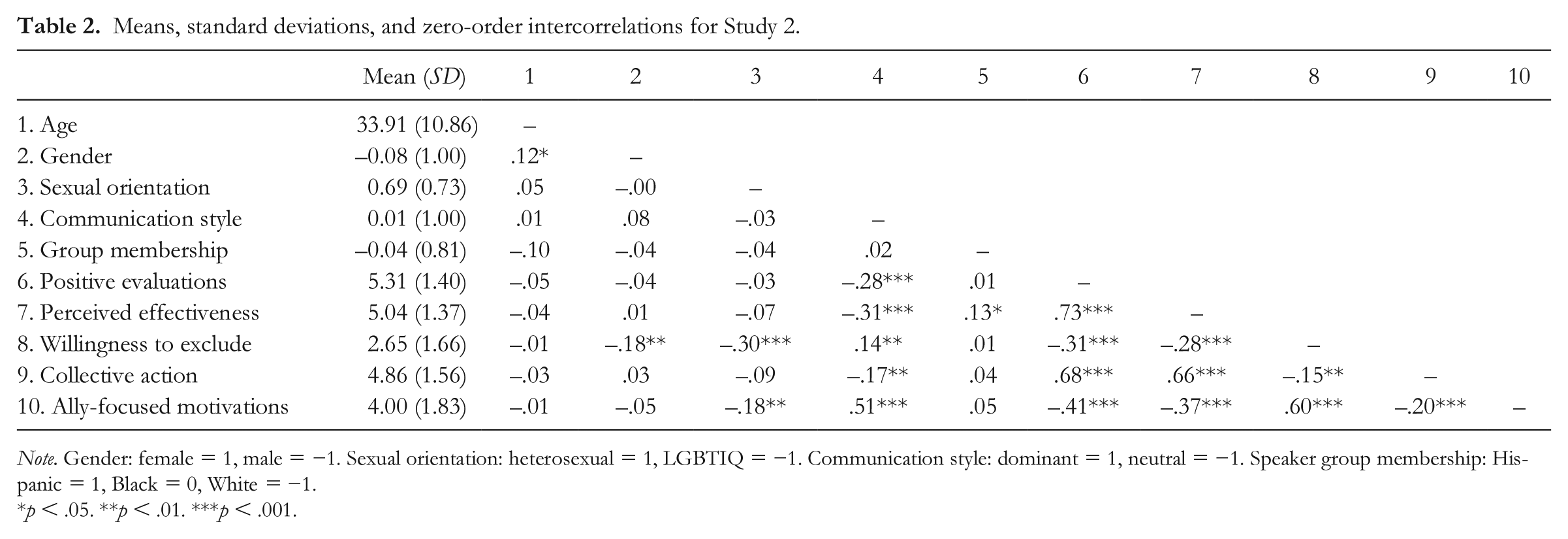
Note. Gender: female = 1, male = −1. Sexual orientation: heterosexual = 1, LGBTIQ = −1. Communication style: dominant = 1, neutral = −1. Speaker group membership: Hispanic = 1, Black = 0, White = −1.
p < .05. **p < .01. ***p < .001.
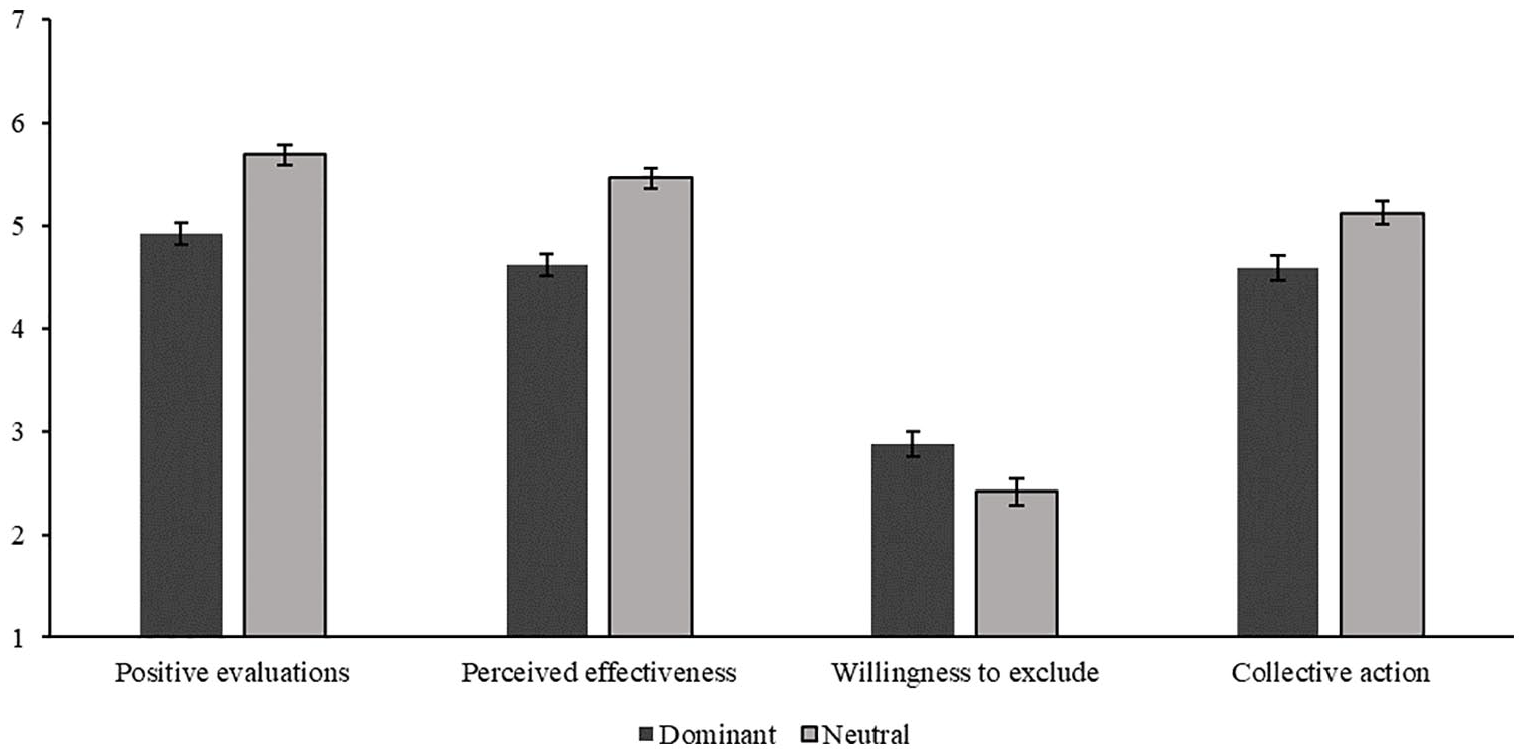
Main effect of communication style on the dependent variables (all differences are significant at ps < .008; Study 2; standard errors reported).
Positive Evaluations of the Speaker
As predicted, we found a significant main effect of communication style such that participants evaluated the speaker more positively when he communicated his support in a neutral (M = 5.70, SD = 1.32) compared to a dominant way (M = 4.93, SD = 1.38), F(1, 341) = 27.71, p < .001, 95% CI [0.48, 1.05], ηp2 = .08. We did not find a main effect of group membership, F(2, 341) = 0.06, p = .942, ηp2 < .01), or an interaction between communication style and group membership for positive evaluations of the ally, F(2, 341) = 0.95, p = .387, ηp2 < .01.
Perceived Effectiveness of the Speaker
As predicted, we found a significant main effect of communication style such that participants perceived the speaker to be more effective when he communicated his support in a neutral (M = 5.47, SD = 1.27) compared to a dominant way (M = 4.62, SD = 1.34), F(1, 341) = 35.86, p < .001, 95% CI [0.56, 1.11], ηp2 = .10.
We also found a main effect of group membership, F(2, 341) = 3.95, p = .020, ηp2 = .02. Participants perceived the Black American (M = 5.20, SD = 1.28; p = .020; 95% CI [0.06, 0.72]) and the Hispanic American speaker (M = 5.18, SD = 1.32; p = .013; 95% CI [0.09, 0.77]) to be more effective compared to the White American speaker (M = 4.76, SD = 1.47). There was no difference in perceived effectiveness of the speaker between the Black and Hispanic American (p = .811; 95% CI [–0.30, 0.38]). We did not find an interaction between communication style and group membership for how effective the speaker was perceived to be, F(2, 341) = 1.13, p = .326, ηp2 < .01.
Willingness to Exclude the Speaker
As predicted, we found a significant main effect of communication style such that participants were more willing to exclude the speaker when he communicated his support in a dominant (M = 2.88, SD = 1.57) compared to a neutral way (M = 2.41, SD = 1.72), F(1, 341) = 7.31, p = .007, 95% CI [0.13, 0.83], ηp2 = .02. We did not find a main effect of group membership, F(2, 341) = 2.31, p = .101, ηp2 = .01, or an interaction between communication style and group membership for willingness to exclude the speaker, F(2, 341) = 0.47, p = .626, ηp2 < .01.
Willingness to Engage in Collective Action with the Speaker
As predicted, we found a significant main effect of communication style such that participants were more willing to engage in collective action with the speaker when he communicated his support in a neutral (M = 5.13, SD = 1.52) compared to a dominant way (M = 4.59, SD = 1.56), F(1, 341) = 10.01, p = .002, 95% CI [0.20, 0.86], ηp2 = .03. We did not find a main effect of group membership, F(2, 341) = 0.94, p = .392, ηp2 < .01, or an interaction between communication style and group membership for willingness to engage in collective action with the speaker, F(2, 341) = 0.34, p = .715, ηp2 < .01.
Controlling for Demographic Variables
We again tested whether the results were affected by whether participants themselves belong to another disadvantaged group and their age. However, controlling for participants’ age, gender, and sexual orientation using a MANCOVA did not change the results (see supplemental material online).
Mediation by Ally-Focused Motivations
Mediation analysis using bootstrapping procedures (SPSS PROCESS macro; Hayes, 2017) to examine the indirect effect of communication style (coded as 1 = dominant, –1 = neutral) on the outcome variables via ally-focused motivations was conducted. Because we were only interested in the perception of ally motivations, we excluded the Black American condition from the data analysis (N = 227). We used 5,000 bootstrap samples to estimate 95% confidence intervals for the indirect effect. For perceived effectiveness we controlled for group membership because a main effect for this variable was previously found. As can be seen in Figure 4, a significant indirect effect was found between communication style via ally motivations on positive evaluations of the ally (B = −0.28, BSE = 0.07, 95% CI [–0.43, –0.16]), perceived effectiveness of the ally (B = −0.25, BSE = 0.06, 95% CI [–0.39, –0.15]; controlling for group membership), willingness to exclude the ally (B = 0.56, BSE = 0.08, 95% CI [0.42, 0.74]), and willingness to engage in collective action with the ally (B = −0.15, BSE = 0.07, 95% CI [–0.31, –0.02]). In other words, when an ally communicates their support in a dominant (compared to a neutral) way, disadvantaged group members perceive that they are motivated to take over the movement and make themselves the center of attention, resulting in less positive evaluations and less willingness to support the ally.
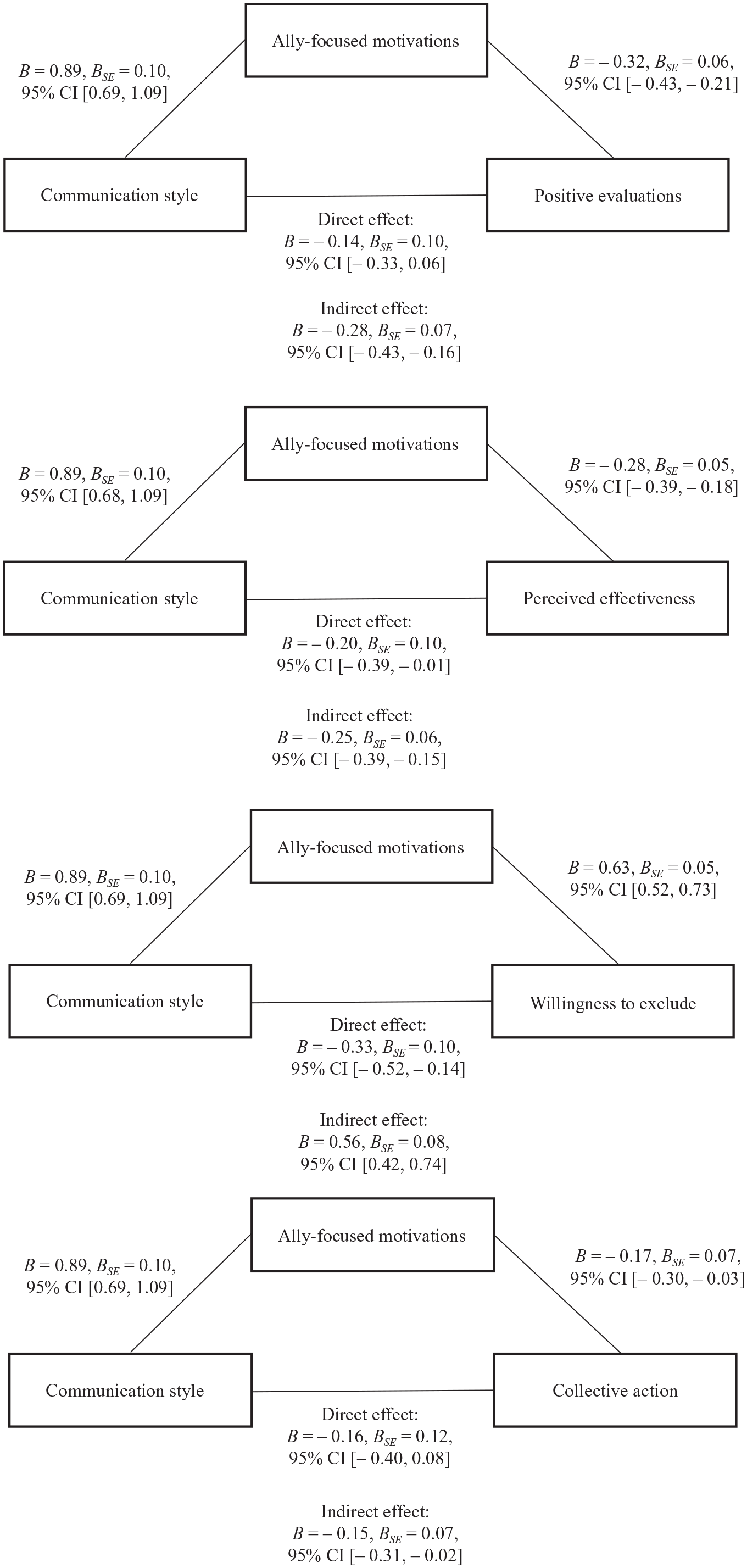
Mediation analysis for the effect of communication style on the outcome variables via ally-focused motivations (Communication style: dominant = 1, neutral = −1; Study 2; controlling for group membership for perceived effectiveness).
Providing support for our hypotheses and replicating the results from Study 1, we found that Black Americans were less positive towards and less likely to support a speaker who communicated his support for the Black Lives Matter movement in a dominant compared to a neutral way. We also found that participants perceived the Hispanic American speaker (who was rated equally effective as the Black American speaker) to be more effective at achieving the goals of the Black Lives Matter movement compared to the White American speaker. We propose that this finding is due to the perception that Hispanic and Black Americans have a shared experience of discrimination (Cortland et al., 2017), and that it is possible that participants saw the Hispanic American speaker as a member of a superordinate ingroup with Black Americans that is disadvantaged and oppressed by White Americans. More research is needed to investigate this possibility. However, this finding was not replicated across the other variables or in Study 1 so we are cautious to not overinterpret this result. Furthermore, although the multivariate analysis suggested that there was an effect of group membership, the univariate analyses for the dependent variables revealed that this was not the case. We again did not find an interaction between communication style and group membership for how the speaker was perceived and received.
General Discussion
In this article we have investigated disadvantaged group members’ evaluations and support for allies who engage in collective action on their behalf. Specifically, we have examined whether the way in which allies communicate their support (in either a dominant or neutral way), and whether they are a member of another disadvantaged group or not, influences how allies are perceived and received. Across two studies in the context of the women’s rights and Black Lives Matter movements, we found that disadvantaged group members (women in Study 1; Black Americans in Study 2) were less positive towards the ally, perceived the ally to be less effective, were more willing to exclude the ally, and less willing to engage in collective action with the ally when their support for the movement was communicated in a dominant compared to a neutral way. Moreover, heightened perceptions that the ally was trying to take over the movement and make themselves the center of attention explained these results. These findings support our hypotheses. However, we did not consistently find that the group membership of the ally, both on its own and in an interaction with communication style, had an effect on how the ally was perceived and received by the disadvantaged group. We discuss why this might be the case below.
The finding that disadvantaged group members evaluate allies less positively and are less willing to support them when they communicate their support in a dominant way aligns with previous theorizing. Droogendyk and colleagues (2016) propose that allies’ participation in collective action can become (whether intentionally or unintentionally) misguided, which may signal to the disadvantaged group that an ally is not solely motivated to improve the status of their group (Radke et al., 2020). This might result in them being evaluated less positively and receiving less support from the disadvantaged group.
We also expected that disadvantaged group members would evaluate allies more positively and be more willing to support them when they belong to another disadvantaged group (i.e., a gay male feminist, a Hispanic American who participates in the Black Lives Matter movement). We argued that the presence of an ally from another disadvantaged group may be more positively perceived and received by disadvantaged group members because they are seen to be motivated by the shared experience of discrimination when acting on their behalf. Previous research has found that highlighting shared experiences of discrimination among disadvantaged groups promotes positive intraminority intergroup relations (Cortland et al., 2017). However, we did not consistently find that disadvantaged group members evaluated the ally differently depending on the other groups they belonged to.
These results suggest that when and how disadvantaged group members come to evaluate and support allies who do and do not belong to another disadvantaged group is a complex question which requires further research to tease apart. How allies are perceived and received is likely dependent upon a range of different factors such as the relative status of the groups they belong to, whether they can be combined to form a superordinate ingroup identity through their shared experience of discrimination, and their collective histories which can be both adversary and amiable. For example, other research has found that exposure to discrimination across identity dimensions can lead disadvantaged group members to turn away from one another. Craig and Richeson (2014) found that when Black Americans and Latinos were exposed to discrimination towards their own group they expressed more negative attitudes towards and less support for sexual minorities, and when sexism is made salient among White women they reported more racism towards Black Americans and Latinos (Craig et al., 2012). The authors argue that perceived discrimination triggers a social identity threat which leads people to distinguish and distance themselves from other disadvantaged groups in order to maintain the positive distinctiveness of their own group (Branscombe et al., 1999; see also Ball & Branscombe, 2019, for an overview).
At the same time, allies who only belong to an advantaged group might be seen to be selflessly acting on behalf of the disadvantaged, while allies who belong to another disadvantaged group might be perceived to be acting in their own interests by seeking to reduce discrimination more generally, which would benefit their own group (Drury & Kaiser, 2014). Likewise, the greater status and power afforded to advantaged group members could motivate disadvantaged group members to include them in the movement. These allies could be strategically used to help bring more attention to the plight of the disadvantaged group and convince decision makers to take their demands seriously. However, disadvantaged group members might also be suspicious of allies who only belong to advantaged groups because they know that by acting on behalf of the disadvantaged group they risk losing the privileges and status afforded to them.
Given these possibilities, we would encourage future research to examine whether making salient the motivations allies have for participating in collective action determines how they are perceived and received by disadvantaged groups. For example, recent theorizing suggests that allies who are focused on the disadvantaged group might be perceived and received more positively than allies who are focused on maintaining the status of their own group or take action for personal reasons (as captured by the ally-focused motivations; Radke et al., 2020).
In addition, we did not consistently find that the disadvantaged ingroup speaker was evaluated differently compared to the advantaged and disadvantaged ally participants were exposed to in Study 2. We propose that this is due to the different psychological processes which are elicited when someone is exposed to an ingroup member. People generally favor ingroup members (Tajfel & Turner, 1979), but this is not always the case (Garcia et al., 2005; Kutlaca et al., 2019; Marques & Paez, 1994). Furthermore, ally-focused motivations did not explain the relationship between communication style and intentions to engage in collective action with the Black American speaker, 4 providing support for our argument that these different psychological processes were at play when participants evaluated the Black American compared to the Hispanic or White American speaker. These findings also indicate that ingroup members are not necessarily an adequate comparison condition when examining participants’ responses to outgroup members, especially when it is possible that the outgroup member (e.g., a Hispanic American) could be perceived to be an ingroup member of a superordinate group that is disadvantaged and oppressed by White Americans through their shared experiences of discrimination (Cortland et al., 2017).
Moreover, it is possible that allies pose a threat to those disadvantaged group members who have not participated in the movement. For example, Black Americans who did not highly identify as a supporter of the Black Lives Matter movement were more positive towards the Black American (but not Hispanic or White American) when he communicated his support in a neutral compared to a dominant way (see the supplemental materials online). However, we are reluctant to overinterpret this result given that the same pattern of results was not found for intentions to engage in collective action with the speaker. We encourage future research to further explore this possibility.
This article contributes to the psychological literature by examining how allies are perceived and received by the disadvantaged group depending on how they communicate their support and the other groups they belong to. This is a strength of the article, given that much of the allyship literature has focused on the role of advantaged group allies, not taking into account that allies’ identities can intersect with membership in other disadvantaged groups. Moreover, an examination of allyship from the perspective of the disadvantaged group is largely absent from the psychological literature (cf. Brown, 2015; Brown & Ostrove, 2013; Ostrove & Brown, 2018). We also explored the complexity of involving allies in political movements by experimentally manipulating factors which are theorized to affect how they are perceived and received in a controlled manner, with a clear experimental manipulation, an adequate sample size, and across two contexts.
We took steps in our experimental design to rule out other explanations for our findings. For example, we deliberately referred to the nationality of the ally in Study 2 to prevent participants from thinking that the Hispanic ally was not an American, thereby avoiding the creation of another intergroup distinction between Americans and non-Americans which could have affected the results. Likewise, in Study 1 we deliberately referred to the male ally as attending the rally with either his male or female partner to reinforce the manipulation of group membership but also to rule out the possibility that the heterosexual ally was motivated to attend the rally because he was looking for a romantic interaction/partner.
Nevertheless, we do acknowledge some of limitations of the present work. First, we relied on perceptions and behavioral intentions. Future research could seek to replicate our findings at a real-life demonstration. It is possible that the effects found in our research could be stronger if disadvantaged group members are confronted with an ally who behaves in a dominant way in this situation. Second, we focused on single allies. However, at real-life demonstrations there are often more than one ally present – if a group of allies behave dominantly, the effects found in the present research should be even stronger.
In conclusion, we examined how allies are perceived and received by disadvantaged group members. We found that when allies communicate their support for the movement in a dominant way they are evaluated less positively and their participation in the movement garners less support from disadvantaged group members because these allies are perceived to not be acting in the best interests of the disadvantaged group. We believe that this work is an important first step to understanding the nuances and complexities associated with involving allies in political movements.
Supplemental Material
sj-pdf-1-gpi-10.1177_13684302211010932 – Supplemental material for Disadvantaged group members’ evaluations and support for allies: Investigating the role of communication style and group membership
Supplemental material, sj-pdf-1-gpi-10.1177_13684302211010932 for Disadvantaged group members’ evaluations and support for allies: Investigating the role of communication style and group membership by Helena R. M. Radke, Maja Kutlaca and Julia C. Becker in Group Processes & Intergroup Relations
Footnotes
Funding
The author(s) disclosed receipt of the following financial support for the research, authorship, and/or publication of this article: This research was funded by the Deutsche Forschungsgemeinschaft (German Research Foundation; DFG BE 4648/4-1).

Supplemental material
Supplemental material for this article is available online.
Notes
References
Supplementary Material
Please find the following supplemental material available below.
For Open Access articles published under a Creative Commons License, all supplemental material carries the same license as the article it is associated with.
For non-Open Access articles published, all supplemental material carries a non-exclusive license, and permission requests for re-use of supplemental material or any part of supplemental material shall be sent directly to the copyright owner as specified in the copyright notice associated with the article.
