



Abstract
Prosocial peer relationships, such as defending against victimization, are beneficial for integration. Using the concept of multiple categorization, this study considers the extent to which similarity in gender, being in the same classroom, and similarity in network position regarding bullying or victimization contributes to the formation of cross-ethnic defending relationships among children. Longitudinal social network models were applied to complete school-level networks of 1,325 children in eight multi-ethnic elementary schools. Although same-ethnic peers were more likely to defend each other than cross-ethnic peers, similarity in gender, being in the same classroom, and similarity in network position in bullying fostered cross-ethnic defending. Moreover, being in the same classroom increased the likelihood of cross-ethnic defending even more than it did same-ethnic defending. A better understanding of how multiple categorization contributes to positive relationships between peers of different ethnic backgrounds may help to promote interethnic integration in multi-ethnic classrooms.
Defending relationships are important to children’s well-being in the context of bullying in schools (Sainio et al., 2011). Defending is defined as comforting, supporting, and standing up for victims of bullying. An important social category on which relationships are based is children’s ethnic background (Boda & Néray, 2015; Leszczensky & Pink, 2015; Smith et al., 2014a). In bullying, ethnicity has been found to divide in- and out-groups, highlighting the prevalence of cross-ethnic bullying (Fandrem et al., 2009; Monks et al., 2008; Thijs & Verkuyten, 2014; Tolsma et al., 2013; Verkuyten & Thijs, 2002), where bullies victimize children who belong to different ethnic backgrounds than their own. However, little is known about the role ethnicity plays in defending relationships. Considering the strength of the preference for same-ethnic peers in social relationships (McPherson et al., 2001) and in-group favoritism in prosocial behavior (Renno & Shutts, 2015; Zinser et al., 1981), it is possible that ethnic boundaries might also exist in children’s defending relationships, with defending happening primarily between same-ethnic peers.
Children, however, belong to several different social categories salient to their social identity (Nesdale, 2004; Nesdale & Flesser, 2001; Tajfel, 1982; Tajfel & Turner, 1979). Theories of multiple categorization suggest that people judge other individuals differently if they belong to several of their in-groups, or several of their out-groups, or both (Nicolas et al., 2017). For example, if an individual has two partially overlapping in-groups, such as peers of the same gender and peers of the same ethnicity, then the peers who belong to both of these in-groups might be judged more positively than those who belong to only one (e.g., peers of the same gender but a different ethnicity than the focal individual). Similarly, peers who belong to both an in-group and an out-group on salient dimensions might be evaluated more positively than those who belong to various out-groups without sharing any in-group with the focal individual (Crisp & Hewstone, 2000). Like multiple categorization theory, studies of homophily in social networks have highlighted the importance of similarity in various social categories, called multidimensional similarity. Among both children and adolescents, multidimensional similarity was found to affect the likelihood of a social relationship emerging between two individuals (Block & Grund, 2014; Hooijsma et al., 2020). This research suggests that having different ethnic backgrounds might not prevent the formation of a relationship between two children if they are similar in other salient categories.
We examined to what extent shared membership in three different types of in-group decreased in-group bias in defending relationships among children aged eight to 12 years, and enabled children to form and maintain cross-ethnic defending relationships, where children defend peers from different ethnic backgrounds than their own. First, we investigated the influence of gender similarity, a salient ascriptive category on which children base friendship choices and prosocial behavior (Mehta & Strough, 2009; Renno & Shutts, 2015; Shutts, 2015). Second, we examined how a formally created institutional in-group, being in the same classroom, affects the likelihood of defending relationships. Finally, we investigated whether sharing a similar position in the informal structure of peer relationships, as signaled by similarity in network position in bullying or victimization, plays a role in defending (Huitsing & Monks, 2018; Huitsing et al., 2014). Our aim was to investigate how shared membership in these categories, as well as the interaction of these similarities with ethnicity, affected defending relationships in multi-ethnic Dutch primary schools.
Ethnic Similarity in Defending Relationships
People are more likely to relate to similar than to dissimilar others (referring to homophily; Lazarsfeld & Merton, 1954; McPherson et al., 2001). There are two main sources of homophily. First, it is caused by social structure and opportunity, because similar peers are more likely to meet than dissimilar peers (Rivera et al., 2010). Similar children are, for example, likely to meet each other during out-of-school activities, such as sports. Second, homophily is caused by individuals’ preference for similarity as it facilitates agreement and understanding, whereas dissimilarity might lead to strain and tension. Similarity makes others’ behavior predictable, which facilitates the initiation and maintenance of relationships (Hamm, 2000; Ibarra, 1992).
Although ethnic preferences emerge later in childhood than do gender-based preferences (Shutts, 2015), ethnicity is a common characteristic on which children base relationship choices. Research on interethnic friendships has provided evidence for ethnic homophily across countries (e.g., America, England, Germany, Hungary, the Netherlands, Sweden), age groups (referring to elementary and secondary schools), and contexts (referring to classrooms, grades, and schools; Boda & Néray, 2015; Currarini et al., 2010; Fortuin et al., 2014; Leszczensky & Pink, 2015; Rodkin et al., 2007; Smith et al., 2014b; Stark & Flache, 2012; Windzio & Bicer, 2013).
Considering the strength of ethnic homophily in peer relationships and the observed in-group bias in prosocial behavior (Dunham et al., 2011; Fehr et al., 2008; Renno & Shutts, 2015; but see also Sierksma et al., 2018), crossing ethnic boundaries may be even more difficult in relationships that require prosocial acting, such as defending. Defending behavior in bullying situations is risky, as defenders have been found to be at risk of being victimized themselves in childhood and early adolescence (Gini et al., 2008; Huitsing et al., 2014). Forming and maintaining peer relationships which require high-risk prosocial acting is more likely between peers who are similar to each other, such as same-ethnic peers (Leszczensky & Pink, 2015; Windzio & Bicer, 2013). Therefore, we expected that most defending relationships would be ethnically homogeneous.
Crossing Ethnic Boundaries
Ethnicity is important but it is not the only relevant social category children take into account when forming relationships. Multiple categorization suggests that people evaluate in-group members more positively if they belong to more than one in-group (e.g., ethnicity and gender) and evaluate out-group members more negatively if they belong to more than one out-group. Consequently, out-group members who belong to an in-group based on another psychologically significant social category might be evaluated more positively than out-group members who do not belong to any salient in-group (Crisp & Hewstone, 2000). It is unknown, however, whether the joint effects of the similar social categories can lead to the overcoming of barriers to relationships between individuals who also have different social categories (Nicolas et al., 2017).
In line with non-algebraic models of multiple categorization (Nicolas et al., 2017), studies of multidimensional homophily suggest that similarity in different categories may have different impacts on relationship formation. More precisely, studies on multidimensional similarity in social network research suggest an interaction effect (Block & Grund, 2014; Hooijsma et al., 2020). Analyzing the formation of friendships among adolescents, Block and Grund (2014) found that similarity in a social category may have less additional impact for peers who are already similar than for peers who are dissimilar. For example, similarity in socio-economic background was found to be a strong predictor of cross-gender friendships among adolescents, but not same-gender friendships (Block & Grund, 2014). The question is whether shared membership in other social categories can help children cross ethnic boundaries when it comes to defending relationships, too. To investigate this, we examined whether cross-ethnic versus same-ethnic defending relationships were affected by shared membership in three different types of in-groups: gender, classroom context, and network position in bullying.
Gender
Children show gender-based in-group favoritism in their social preferences and prosocial behavior (Renno & Shutts, 2015; Shutts, 2015). Moreover, gender is a salient ascriptive category on which children and early adolescents base relationship choices (e.g., Dijkstra et al., 2010; Dijkstra et al., 2007; Mehta & Strough, 2009; Smith-Lovin & McPherson, 1993). A possible reason is that boys and girls often differ in their interests and activities. Within the context of activities which are typical for boys or girls, dissimilarity in another social category, such as ethnicity, may become less salient for same-gender peer relationships (Block & Grund, 2014). Being same-gender indeed increased the likelihood of cross-ethnic friendships among middle-school students in the US, even more than for same-ethnic peers (Block & Grund, 2014). Therefore, we expected that being of same-gender would increase the likelihood of cross-ethnic defending.
Classroom Context
In-group favoritism in prosocial behavior has been observed along institutional boundaries among seven to eight-year-old children (Fehr et al., 2008). Furthermore, a minimal group condition was sufficient to induce in-group bias among five-year-old children (Dunham et al., 2011). It is thus reasonable to expect that an in-group–out-group categorization emerges among children along formally created institutional group boundaries such as classrooms. The classroom is an important network boundary for peer relationships too, among both children and adolescents (Leszczensky & Pink, 2015; Valente et al., 2013). Despite this boundary, a substantial proportion of defending occurs between elementary school classrooms (Huitsing et al., 2014). Forming and maintaining peer relationships between classrooms is more difficult because of fewer contact opportunities. Peer relationships between children in different classrooms therefore require stronger individual preferences, such as a preference for affiliating with same-ethnic peers. In contrast, within-classroom relationships are easier to establish and maintain because of frequent contact opportunities. As a result, individual preferences are expected to have a smaller effect on relationships between peers in the same classroom than on those between peers in different classrooms (Leszczensky & Pink, 2015). In other words, relationships within classrooms may be more likely to deviate from these preferences than relationships across classrooms. Therefore, we expected that cross-ethnic peers who were in the same classroom would be more likely to defend each other than cross-ethnic peers who were in different classrooms. That is, being in the same classroom would increase the likelihood of cross-ethnic defending. This assumption is also suggested by the common in-group identity model (Gaertner et al., 1993; Gaertner et al., 1989; Gaertner et al., 1994), which proposes that a feeling of belonging in the classroom promotes positive interethnic relations (Thijs & Verkuyten 2014).
Similar Network Position in Bullying
Defending is part of a complex group process. Children’s defending relationships are influenced by their bullying relationships, as victims who are victimized by the same bullies are more likely to defend each other among preschoolers and school-aged children (Huitsing & Monks, 2018; Huitsing et al., 2014). Similarly, bullies targeting the same victims can also support each other. Bullies’ supportive behavior may be the result of similarity in norm-deviating behavior, the need for reinforcement of their behavior, and peer contagion (Dishion & Tipsord, 2011). Moreover, grouping together with other bullies is likely to benefit children’s visibility and status in the peer group. Also, bullies targeting the same victims are more likely to defend each other because they belong to the same “coalition” in the competition for status in the peer group (Faris & Felmlee, 2011). Both victims and bullies are at risk in bullying situations and will look for support from peers. Therefore, both victims of the same bullies and bullies targeting the same victims are especially likely to support each other (Huitsing & Monks, 2018; Huitsing et al., 2014). We assumed that sharing a similar position in the informal structure of peer relationships could contribute to the emergence of a sense of an in-group. Therefore, similarity in the network position in either bullying or victimization would positively impact the likelihood of cross-ethnic defending.
Current Study
Our aim was to examine to what extent sharing membership in other social categories fosters children aged eight to 12 years to have cross-ethnic defending relationships. Positive cross-group contact may reduce children’s short and long-term prejudices toward other groups (Allport, 1954; Emerson et al., 2002; Pettigrew & Tropp, 2006). Prosocial peer relationships, such as defending or friendships, are assumed to contribute to positive intergroup attitudes (Feddes et al., 2009; Munniksma et al., 2013; Pettigrew, 1998; Powers & Ellison, 1995). The influence of multiple categorization on children’s peer relationships is potentially relevant for fostering integration between groups. Although ethnic homophily is assumed to be a main driver of social segregation in peer relationships in contexts such as schools (McPherson et al., 2001), sharing membership in multiple in-groups might allow for the formation of cross-ethnic relationships.
Our research question was whether similarity in gender, classroom, or network position in bullying or victimization contributes to cross-ethnic defending relationships. First, we hypothesized that children would be more likely to form and maintain same-ethnic defending relationships than cross-ethnic defending relationships (H1). Second, we hypothesized that similarity in other social categories would increase the likelihood of children’s defending relationships crossing ethnic boundaries. Specifically, we hypothesized that gender similarity (H2a), being in the same classroom (H2b), and similarity in network position in bullying or victimization (H2c) would increase the likelihood of cross-ethnic defending ties. Moreover, based on the principle of decreasing marginal effects of additional forms of similarity, we also expect (H3) that any form of similarity other than ethnicity increases the likelihood of cross-ethnic defending ties more than of same-ethnic defending ties, as the latter occur between peers who already share the category of ethnicity.
Given the value of social network analyses in examining the full complexity of positive and negative intergroup contact (Wölfer et al., 2019; Wölfer et al., 2017) and the dynamics of the relationships considered in this study, we tested our hypotheses using longitudinal social network models (stochastic actor-based models: Snijders et al., 2010). Stochastic actor-based models account for relationship dynamics by examining the creation, maintenance, and dissolution of defending and bullying relationships over time. In addition, these models account for the interdependence of defending and bullying relationships by examining their simultaneous development and their interplay with ethnicity.
Method
Sample
We used data from the first three waves of the Dutch KiVa anti-bullying program. Data were collected in May 2012, October 2012, and May 2013 among children in grades 3 to 6 in elementary schools (Dutch grades 5 to 8). After the pre-assessment in May 2012, schools were randomly assigned to either the control condition (33 schools) or the intervention condition (66 schools). Control schools were asked to continue their “care as usual” anti-bullying approach. Parents’ passive consent was requested prior to the pre-assessment (and for new students prior to the other assessments). When parents objected to participation or when students themselves did not want to fill in the questionnaire, students did not participate. The participation rate exceeded 98% in all waves.
Students filled in internet-based questionnaires during regular school hours. The process was administered by the teachers, who were given detailed instructions concerning the procedure. In addition, teachers were offered support via phone or email prior to and during the data collection. Teachers distributed individual passwords to the students, who needed to log in to the questionnaire. Teachers were present to answer questions and to assist students when necessary. The order of the questions and scales was randomized so that the order of presentation would not affect the results. Detailed information on the data collection can be found elsewhere (see Huitsing et al., 2020; Kaufman et al., 2018; Veenstra et al., 2020).
We selected schools in which at least 80% of the children participated in one or more waves, at least 20% of the children were of non-Dutch origin, and in which there were at least 40 bullying ties in each of the three waves to be able to estimate the statistical models. Eight of the 16 eligible schools were left out because of convergence problems (for several reasons; e.g., there was low stability in relationships between the waves, as indicated by a low Jaccard index in the bullying network, or there was a low number of bullying relationships). Testing the hypotheses required that a sufficient number of cases were present in the data with the particular configuration of bullying roles and ethnicities for which a particular effect on defending was hypothesized. However, because of a relative sparseness of bullying networks, this was not the case in some schools, making it impossible to analyze the effects necessary to test our hypotheses. Consequently, we were unable to examine all 16 schools. The eight included and excluded schools did not differ in terms of size, proportion of bullying ties, or ethnic diversity. The eight included schools, two control and six KiVa schools, enabled us to implement time-consuming estimations while investigating variation across schools. The final sample consisted of 1,325 students in grades 2 to 5 (Dutch grades 3 to 8) at T1 and grades 3 to 6 (Dutch grades 4 to 8) at T2 and T3 (M age = 10 years, SD = 13 months in wave 1). Boys and girls were equally represented (49.3% boys).
Measures
Defending and bullying relationships were measured at school level: children could nominate peers within their own classroom and in other classrooms that participated in the study.
Defending
Children were first asked whether they were being victimized using Olweus’ (1996) 11 self-reported bully/victim items (concerning physical, verbal, relational, material, cyber, racist, and sexual victimization). If they indicated that they had been victimized at least once on any item, they were asked “Which classmates defend you when you are victimized?” (classroom-level nominations). Defending was explained as “helping, supporting, or comforting victimized students”. For the classroom-level nominations, children were presented with a roster showing the names of all classmates. To measure defending at the school level, all victimized children were asked “Which children from other classrooms defend you when you are victimized?”. Children could type the name of any student in school, using a search function to select the names of students from the database. Children could nominate an unlimited number of class and schoolmates.
Bullying
To measure similarity in network position in bullying, we used networks of bullying, in which all children who indicated that they had been victimized at least once by classmates (similar to the defending questions) were asked “Who starts when you are victimized?” (classroom-level nominations). If children were (also) victimized by children from other classrooms, they were asked “By which students are you victimized?” (school-level nominations). The approach was similar to the way defending relationships were obtained.
Ethnicity
Children’s ethnicity was constructed using the country of birth of the parents. Children were presented with six answering categories: the Netherlands, Morocco, Turkey, Suriname, the Dutch Antilles/Aruba, or other, which reflect the major non-Western immigrant groups in the Netherlands. If one parent was born in a foreign country or if both parents were born in the same foreign country, the child was assigned the ethnicity of that foreign country; if both parents were born in foreign, but different countries, the child was assigned the ethnicity of the mother. In line with the categorization used by Statistics Netherlands (2016), we defined seven ethnic groups: (1) Dutch, (2) Moroccan, (3) Turkish, (4) Surinamese, (5) Dutch Antillean, (6) other Western (European, North American, and Oceanian countries, Japan, and Indonesia), and (7) other non-Western (African, Latin American, and Asian countries, excluding Japan and Indonesia). Descriptive statistics can be found in Table 2.
Gender and Age
Boys were coded as 1 and girls as 0, and children’s ages were coded in months.
Analytical Strategy
Stochastic Actor-Based Models
The defending networks were analyzed using stochastic actor-based models with the software SIENA (Simulation Investigation for Empirical Network Analyses, version 1.2.4) in R (see Snijders et al., 2010). The RSiena package is software for estimating the evolution of (multiple) social networks over time, accounting for individual characteristics of behaviors (Ripley et al., 2020). RSiena models predict changes between subsequent observed states of the networks and uses simulation to infer which social mechanisms have contributed to the observed tie changes. Similar to an agent-based model, the simulation consists of many small micro-steps. In each step, randomly selected actors have the opportunity to decide to maintain, create, or dissolve a network tie one by one. In the simulations, actors’ decisions are based on so-called effects, representing the properties of network contacts and local relational structures which are assumed to lead actors to create, dissolve, or maintain ties. Which effects are included in a model is based on what a researcher deems theoretically important for network formation in a particular application (Ripley et al., 2020). The statistical model then estimates the combination of effect sizes that, according to the simulated network changes, yields the best approximation of the observed data. Convergence statistics are used to test the reliability of the estimation process (Ripley et al., 2020). The parameters in the models express the mechanisms (e.g., reciprocity, gender homophily) which may, or may not, influence individuals’ decisions in the networks according to the theoretical assumptions researchers make.
Stochastic actor-based models can be estimated for networks of a size ranging from a relatively low number of actors (e.g., 15–20) to a few hundred actors. The school-level networks we used in this study count as large networks in this framework and can be assumed to be networks in which pupils know at least each other’s names, ethnicity, and gender. To further increase the statistical power (Stadtfeld et al., 2018) and generalizability of our analyses, we estimated the models for eight schools. First, the networks were examined per school using the same model specification. The results for the separate schools were then summarized using the R-package metafor (Viechtbauer, 2010). Each parameter in the network model was treated separately in the meta-analysis. We tested whether control and intervention schools differed in the parameters of interest for our hypotheses. The fundamental social mechanisms investigated here did not differ between control and intervention schools. Therefore, we report parameter estimates using standard errors for all schools. Average parameter estimates with standard errors were obtained using a restricted maximum likelihood estimator.
The default method of RSiena was used to handle missing data; that is, missing values were imputed for the simulations but were not used in the calculation of the target statistics in the estimation (Ripley et al., 2020, p. 35).
Model Specification
Our models included multiple predictive effects which reflect network dynamics on multiple levels. That is, we included unique classroom dynamics as well as school-level dynamics. Moreover, effects on the individual, dyadic, and triadic levels were included to capture dynamics even within classrooms. In the presentation of the results, we focus on the effects that are relevant for our hypotheses: namely, the effects for ethnicity, gender, classroom, and similarity in network position in bullying or victimization, in the defending network. All models control for a set of general structural effects which reflect basic mechanisms underlying the formation of defending and bullying networks, such as outdegree, reciprocity, and transitivity. The set of control effects we used is similar to those used in previous studies of defending and bullying (Huitsing et al., 2014; Rambaran et al., 2020). Table A1.1 in Appendix A1 gives an overview of all effects, including graphical representations (see supplemental material online).
The same ethnicity effect captured whether defending ties were more likely to be formed and maintained between same-ethnic than between cross-ethnic children. Similarly, we included the same gender and same classroom effects.
We added two effects that reflect the mechanisms of similarity in network position in bullying and victimization. We tested whether nominating the same peers as bullies made defending between victims more likely (shared bullies) and whether being nominated as a bully by the same peers made defending between bullies more likely (shared victims).
To examine the influence of multiple categorization on children’s defending ties, we included interactions between same ethnicity and the other four similarity effects (same gender, same classroom, shared bullies, and shared victims). By combining the results on the main effects and interaction effects in schools when all three effects were estimated, we were able to examine whether similarity in gender, classroom, or network position in bullying or victimization contributed to the crossing of ethnic boundaries. For that reason, we compared the likelihood of the formation and maintenance of defending ties for cross-ethnic peers who were similar in another relevant category with that for cross-ethnic peers who were not similar in that relevant category.
We calculated conditional parameter estimates for each type of dyad (e.g., ethnicity and another relevant category). These conditional parameter estimates consisted of the effects that applied specifically to the actors of interest. For example, we can elaborate on the likelihood of a defending relationship for same-ethnic actors who share the same victims, compared with the likelihood of this for cross-ethnic actors who do not share victims. This difference can be tested by combining the same ethnicity effect, the shared victims effect, and the interaction between these two effects into a conditional parameter estimate using pairwise comparison tests for linear combinations of parameters. We had to test whether the conditional parameter estimate for the first set of actors (PEsame ethnicity) was different from the conditional parameter estimate for the second set of actors (PEsame ethnicity + PEshared victims + PEsame ethnicity * shared victims). That is, we tested whether the linear combination of the parameters (PEshared victims + PEsame ethnicity * shared victims) was significantly different from 0. Comparison tests were carried out by testing the joint parameters and joint variances of the relevant variables using the metafor package (Viechtbauer, 2010). Joint variances given to metafor were calculated by summing the variances and two times the covariances of the variables. Joint parameters were calculated by summing the parameter estimates of the variables. Using the default restricted maximum likelihood estimator, metafor fits a random effects model to test the pairwise comparisons.
Model Selection
We tested four models. Model 1 tested the main effects of similarity in ethnicity (Hypothesis 1), gender, classroom, and network position in bullying or victimization. In the remaining three models we tested the second and third hypotheses by adding interaction effects. Because of the complexity of the models, the interactions between ethnic homophily and gender homophily, same classroom, and similarity in network position in bullying and victimization were included in three separate models, Models 2, 3, and 4, respectively. Table 1 specifies the parameter estimates in the specific models used to test our hypotheses. Each school-level network was estimated using the same model specification. When configurations were absent in the observed network, related parameters were fixed and tested using a score-type test to examine the added value of the parameter to the model estimation.
Specification of the effects used to test the hypotheses.
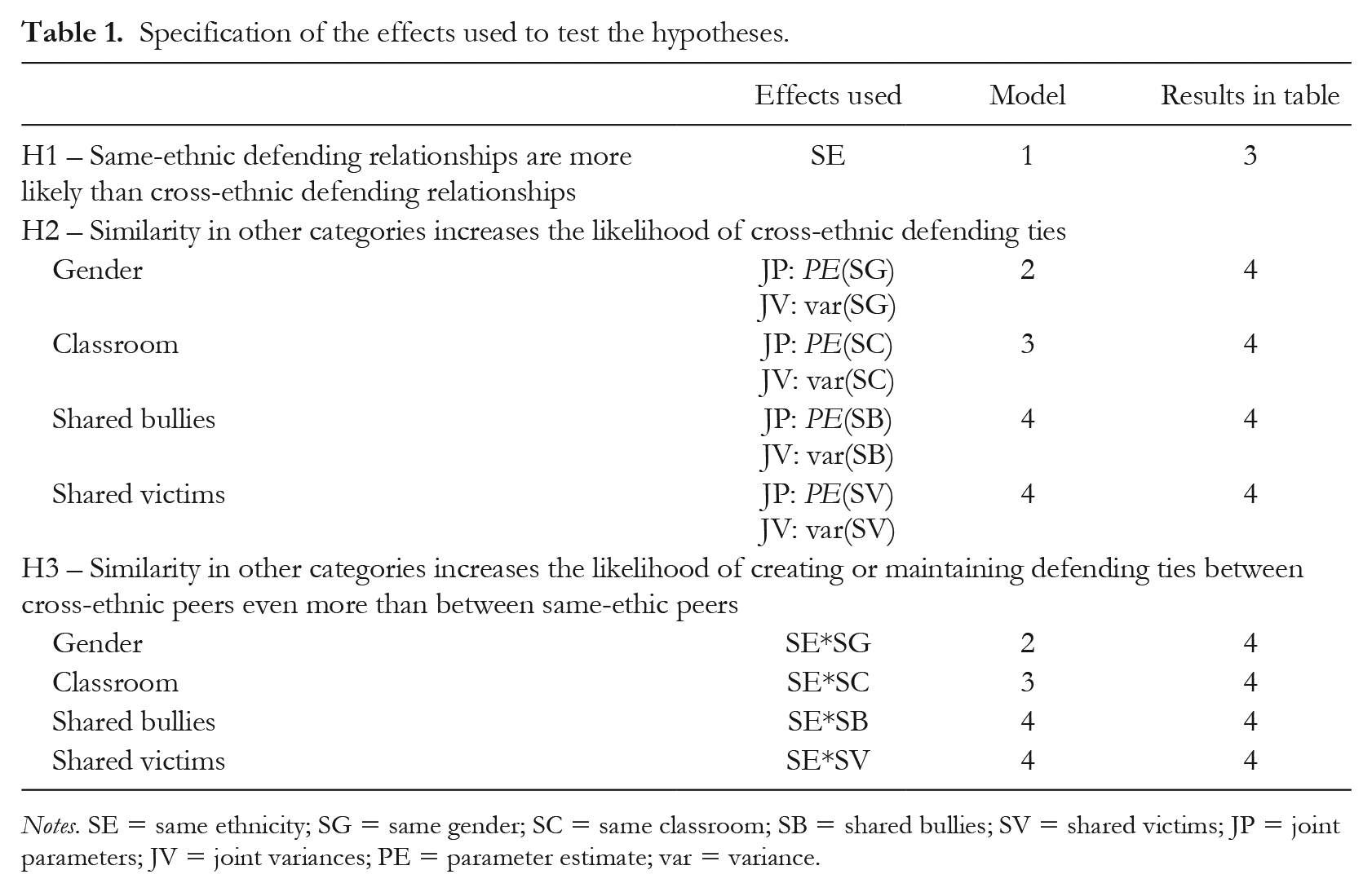
Notes. SE = same ethnicity; SG = same gender; SC = same classroom; SB = shared bullies; SV = shared victims; JP = joint parameters; JV = joint variances; PE = parameter estimate; var = variance.
Results
Table 2 provides the descriptive results. On average, 44.3% of the children in these ethnically diverse schools were Dutch. The second largest group was Moroccans, with on average 16.2% per school.
Descriptive statistics across eight schools.
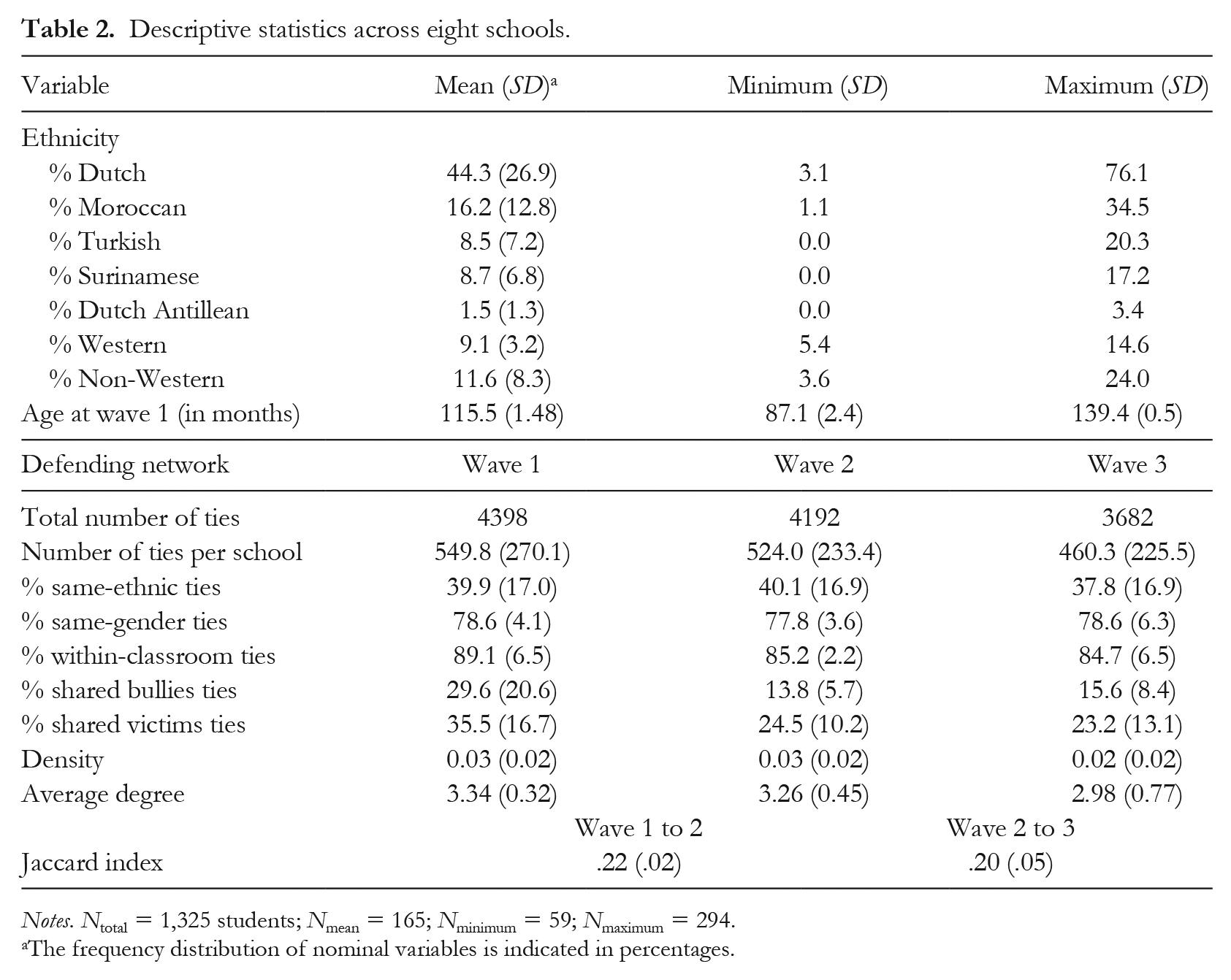
Notes. Ntotal = 1,325 students; Nmean = 165; Nminimum = 59; Nmaximum = 294.
The frequency distribution of nominal variables is indicated in percentages.
Across the three waves, around 40% of defending relationships were same-ethnic. Almost 80% of the defending ties occurred between same-gender peers. The proportion of ties within classrooms, relative to the total number of ties, was on average between 84.7% and 89.1%. Of all peers who had a defending relationship, on average around 30% were victims sharing the same bullies in the first wave, and around 14.5% shared bullies in the second or third wave. Similarly, between 23.2% and 35.5% of defending ties occurred between bullies who targeted the same victims. The density reflects the proportion of actual defending ties to the total number of possible defending ties, which was on average around .03 per wave. The Jaccard index indicates the stability in the networks (Snijders et al., 2010). The proportion of stable relationships was on average at least 20% of the total number of ties between two waves.
Defending Dynamics
Tables 3 and 4 are limited to the effects used to test the hypotheses. Appendix A2 provides the complete table, and Appendix A3 provides a discussion of the goodness of fit (see online supplemental material). In line with our first hypothesis, Model 1 in Table 3 shows that same-ethnic peers were more likely to maintain or create, and less likely to dissolve a defending relationship than were cross-ethnic peers (same ethnicity, PE = 0.15, p < .001). Similarly, same-gender peers were more likely to defend each other than were cross-gender peers (same gender, PE = 0.70, p < .001), and defending relationships were more likely to be formed and maintained within than between classrooms (same classroom, PE = 1.00, p < .001). Bullies targeting the same victims were more likely to defend each other (shared victims, PE = 0.18, p < .001), but victims sharing the same bullies were not more likely to defend each other than non-victims or victims not sharing bullies (shared bullies, PE = 0.06, p = .25).
Multiplex RSiena meta-analysis for defending.
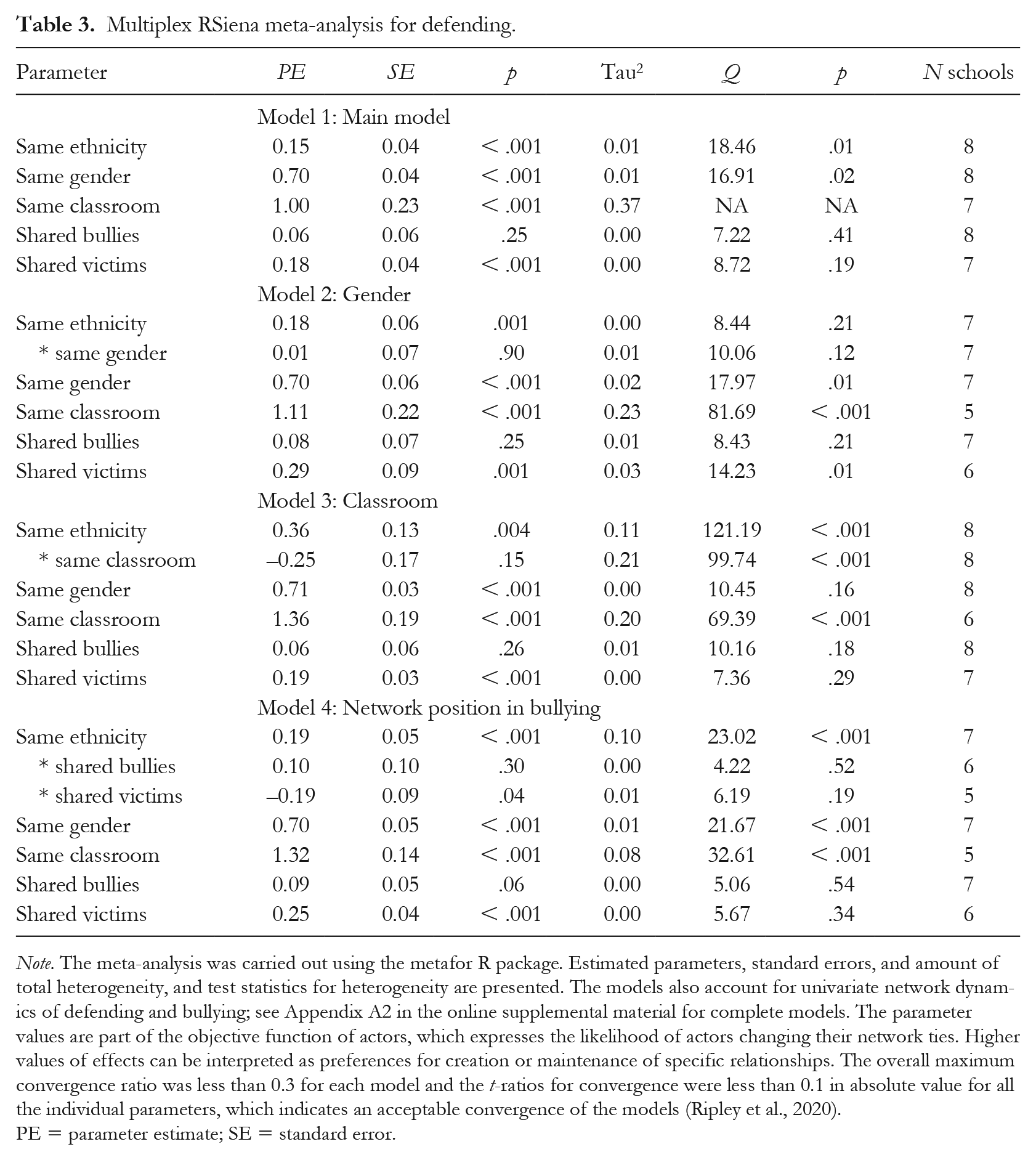
Note. The meta-analysis was carried out using the metafor R package. Estimated parameters, standard errors, and amount of total heterogeneity, and test statistics for heterogeneity are presented. The models also account for univariate network dynamics of defending and bullying; see Appendix A2 in the online supplemental material for complete models. The parameter values are part of the objective function of actors, which expresses the likelihood of actors changing their network ties. Higher values of effects can be interpreted as preferences for creation or maintenance of specific relationships. The overall maximum convergence ratio was less than 0.3 for each model and the t-ratios for convergence were less than 0.1 in absolute value for all the individual parameters, which indicates an acceptable convergence of the models (Ripley et al., 2020).
PE = parameter estimate; SE = standard error.
Conditional parameter estimates of different combinations in interactions.
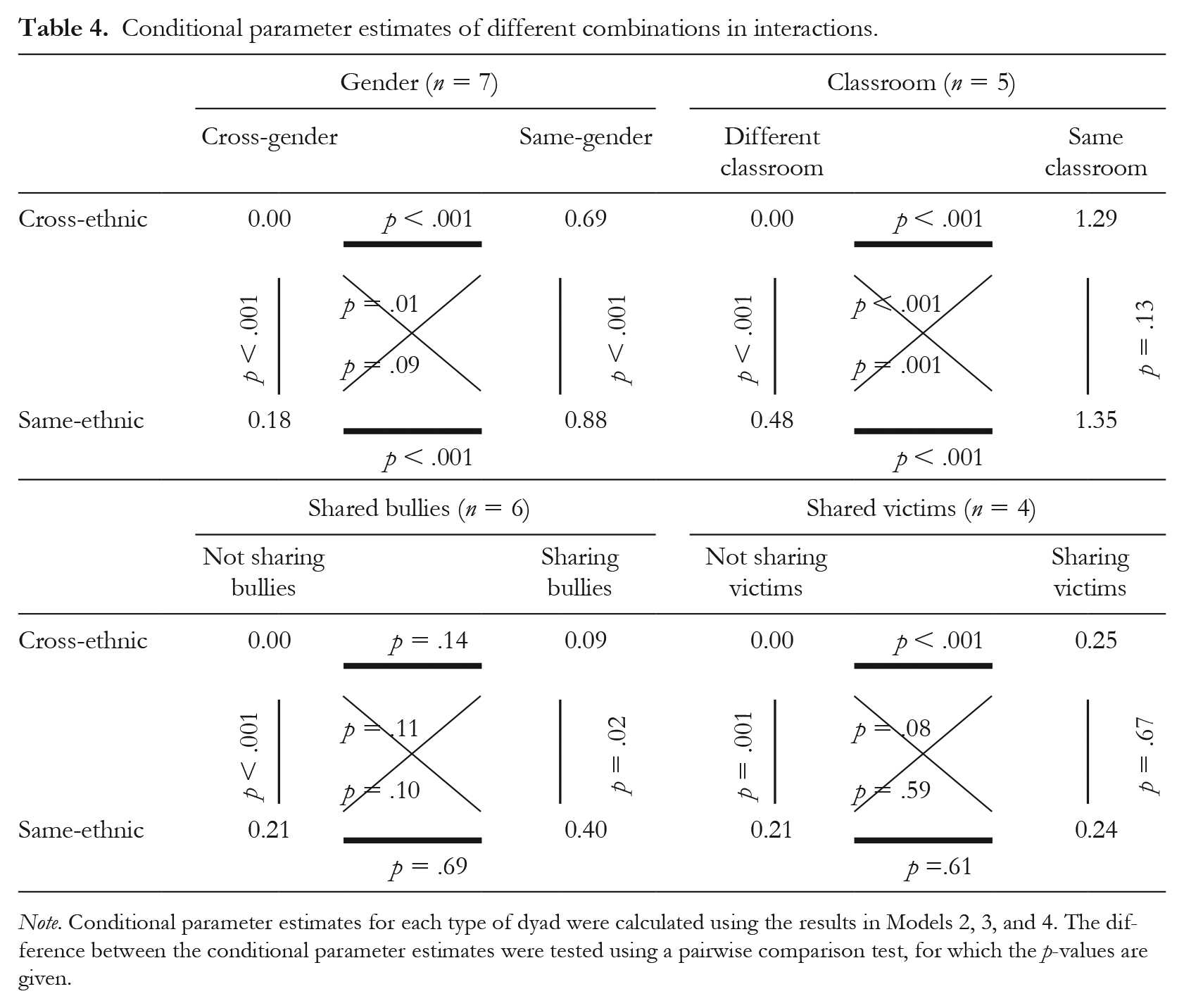
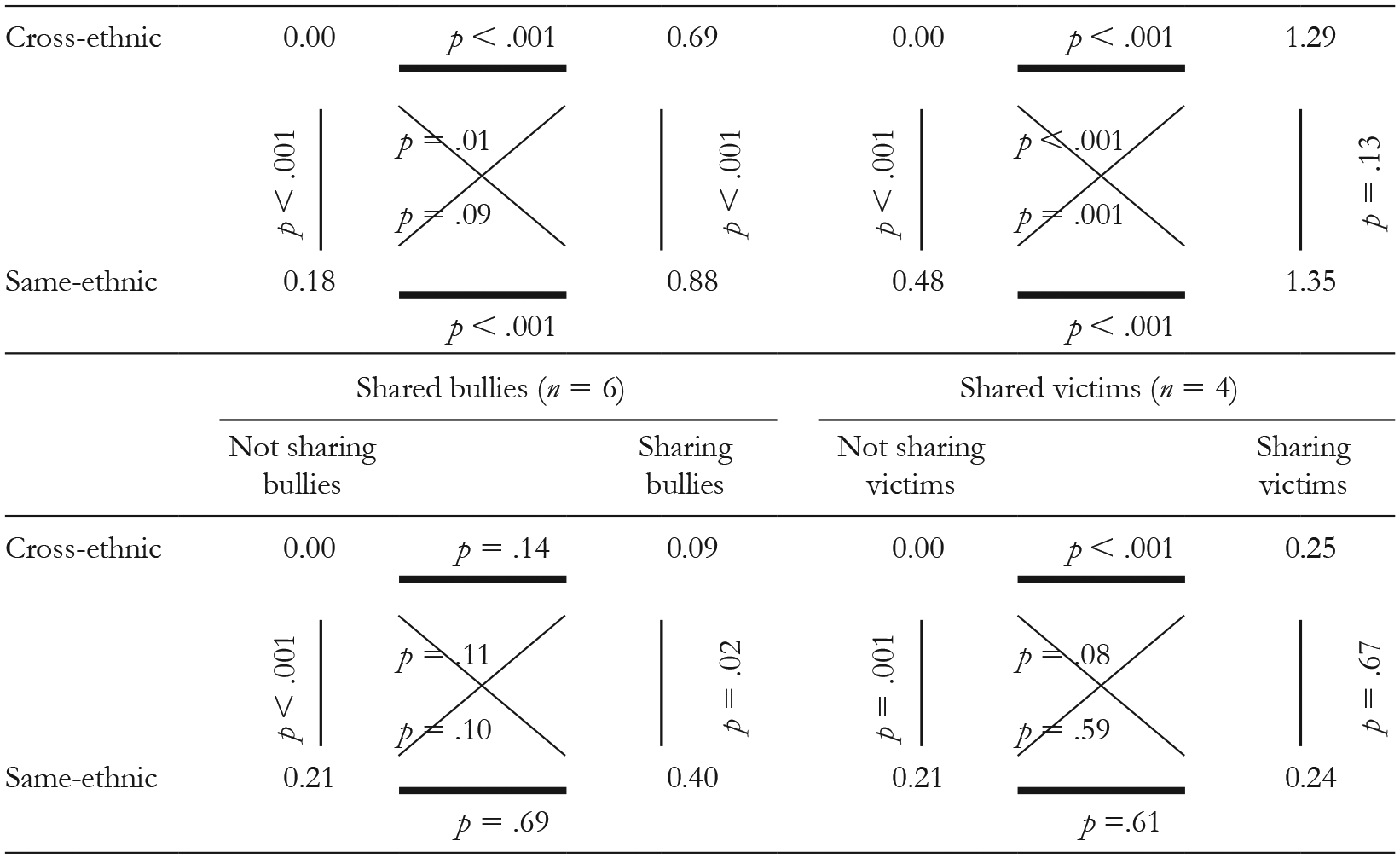
Note. Conditional parameter estimates for each type of dyad were calculated using the results in Models 2, 3, and 4. The difference between the conditional parameter estimates were tested using a pairwise comparison test, for which the p-values are given.
Crossing Ethnic Boundaries
To test our second and third hypotheses, we used the effects in Models 2, 3, and 4 to calculate the conditional parameter estimates of forming or maintaining defending relationships for the different dyads in the interaction in Table 4. Hypothesis 2 posed that similarity in gender, being in the same classroom, and similarity in network position in bullying would increase the likelihood of cross-ethnic defending ties. We tested this hypothesis by comparing the conditional parameter estimates of cross-ethnic peers who were not similar in another category with those of cross-ethnic peers who were similar in another category (the upper horizontal lines in Table 4).
Table 4 shows that, in most cases, cross-ethnic defending ties were more likely to be formed or maintained when cross-ethnic peers were similar in an additional category, too. The likelihood of creating or maintaining a cross-ethnic defending tie was higher when cross-ethnic peers were same-gender (PE = 0.69, z = 11.52, p < .001), when cross-ethnic peers were placed in the same classroom (PE = 1.29, z = 5.84, p < .001), and when cross-ethnic bullies targeted the same victims (PE = 0.25, z = 5.49, p < .001) compared with cross-ethnic peers who were not similar in these categories (reference category). Only for cross-ethnic victims sharing bullies were our findings different: the likelihood of defending for these was not higher than for cross-ethnic victims who did not share bullies (PE = 0.09, z = 1.51, p = .14) – although the effect was in the expected direction. Thus, similarity in gender and being in the same classroom increased the likelihood of cross-ethnic defending ties, in line with Hypotheses 2a and 2b. Similarity in the network position in bullying, but not victimization, also increased the likelihood of cross-ethnic defending ties, which is partially consistent with Hypothesis 2c.
Hypothesis 3 posed that the increase in the likelihood of defending would be larger for cross-ethnic peers than for same-ethnic peers. For that reason, we tested whether the change in the conditional parameter estimates caused by similarity in another category differed for cross and same-ethnic peers (comparison of the upper and lower horizontal lines in Table 4). In line with Hypothesis 3, we found that being in the same classroom increased the likelihood of defending ties for cross-ethnic peers even more than for same-ethnic peers. Although being in the same classroom increased the likelihood of both same-ethnic (PE = 1.35 compared to PE = 0.48, z = 4.13, p < .001) and cross-ethnic (PE = 1.29 compared to the reference category, z = 5.84, p < .001) defending, the effect of being in the same classroom was larger for cross-ethnic peers (z = 6.07, p < .001). Among bullies, the change in the conditional parameter estimates as a result of targeting the same victims differed only marginally between cross and same-ethnic peers (z = 1.75, p = .08) and did not differ as a result of similarity in gender (z = 0.12, p = .91).
Discussion
Prosocial peer relationships, such as defending, can be expected to contribute to positive intergroup attitudes (Feddes et al., 2009; Munniksma et al., 2013; Pettigrew, 1998; Powers & Ellison, 1995). Nevertheless, considering the strength of ethnic homophily in peer relationships and prosocial behavior (Boda & Néray, 2015; Fortuin et al., 2014; Leszczensky & Pink, 2015; Smith et al., 2014a), ethnic boundaries are likely to exist in children’s defending relationships. Our research question was to what extent similarity in other social categories salient to children’s social identity (Nesdale, 2004; Nesdale & Flesser, 2001; Tajfel, 1982; Tajfel & Turner, 1979) can contribute to the crossing of ethnic boundaries in defending relationships.
Regarding our first hypothesis about the role of ethnicity in defending, we found that same-ethnic peers were more likely to defend each other than were cross-ethnic peers: children were more likely to defend victims of the same ethnic background as themselves. This finding is in line with previous research into the role of ethnicity in other positive peer relationships, such as friendships (Boda & Néray, 2015; Currarini et al., 2010; Leszczensky & Pink, 2015; Smith et al., 2014b; Stark & Flache, 2012).
Although same-ethnic defending relationships are more likely, cross-ethnic defending relationships occur as well. We tested whether the existence of these relationships can be explained by shared membership in other relevant social categories. Our findings revealed that gender similarity, being in the same classroom, and similarity in network position in bullying increased the likelihood of the formation and maintenance of cross-ethnic defending relationships. These results are in line with the additive model of multiple categorization. Examining the concept of multiple categorization might, therefore, yield understanding of how integration between ethnic groups in schools develops. While ethnic homophily has been found to be a main driver of segregation in peer relationships in school contexts (McPherson et al., 2001), the formation of cross-ethnic relationships can be fostered if children of different ethnicity share other salient categories (e.g., gender) that can potentially override ethnic segregation: awareness of their other common characteristics might enable children from different ethnic groups to form relationships in spite of their differences.
Our results suggest that the positive defending relationship is more likely across ethnic boundaries when bullies share the same victim. However, it is doubtful whether this kind of cross-ethnic relationship can be interpreted from the perspective of contact theory as a relation that improves intergroup attitudes. The children who are connected by this cross-ethnic link are bullies, and may not be perceived very positively by other group members. While this cross-ethnic link may reduce bullies’ prejudices about the ethnic out-group, it may make the bullies’ victims and other members of the victims’ group feel even less positively about the bully’s defenders’ ethnicity. Future research should clarify how effects of cross-ethnic helping on out-group attitudes are modified by pro or antisocial behavior.
Similarity in network position for victims did not influence the likelihood of cross-ethnic defending. This finding is in line with previous research, showing that similarity in network position in victimization has a weaker influence on defending relationships than similarity in network position in bullying (Huitsing et al., 2014; Huitsing & Veenstra, 2012). A possible explanation is that, whereas bullying behavior can be adjusted to some extent by bullies, victims have fewer opportunities to adjust the bullying behavior. Also, previous research has shown that victims may be reluctant to associate with other victims because this increases their risk of being victimized (Sentse et al., 2013). Therefore, similarity in network position in victimization might impact cross-ethnic defending to a lesser extent than the same in bullying.
In line with previous research on multidimensional similarity (Block & Grund, 2014), we found that being in the same classroom increased the likelihood of cross-ethnic defending more than same-ethnic defending. An explanation for this finding might be that, for same-ethnic peers, similarity in another social category is not as beneficial because of decreasing marginal benefits of similarity. In addition, we found a small difference between cross and same-ethnic defending for similarity in network position in bullying. On the contrary, we did not find differences between cross and same-ethnic defending for similarity in gender. For this category, similarity was not found to be more powerful in increasing the likelihood of cross-ethnic defending compared with same-ethnic defending. There may be differences in the marginal benefits of similarities in various social categories, and, therefore, being similar in additional social categories to ethnicity may benefit same and cross-ethnic defending to varying extents.
Limitations, Strengths, and Future Directions
Given the complexity of our models, with up to 44 parameters, and the relative sparseness of the bullying networks, we were able to investigate the defending relationships in a limited number of schools. In addition, we had to fix model parameters in some schools to facilitate convergence. Therefore, we can generalize to only a specific set of schools. The schools in our sample were ethnically heterogeneous and had a large number of defending and bullying relationships. The threshold of having at least 40 victim–bully relationships at each wave likely led to the selection of larger schools or schools with bullying problems. In line with previous research (Block, 2015; Block & Grund, 2014), our findings provide some evidence for a positive effect of multiple categorization on the formation of cross-group peer relationships.
Given that the number of schools that met our selection criteria (such as 80% participation in one or more waves and 20% non-Dutch) was low, our sample included both control and intervention schools. The main parameters used to test our hypotheses, however, did not differ between control and intervention schools. Future research may consider whether interventions focused specifically on affecting these fundamental processes also influence the extent to which multiple categorization benefits intergroup relationships.
A relevant question for further research is which other social categories may affect cross-ethnic defending as well as whether social categories differ in the extent to which they influence cross-ethnic defending relationships. It can be questioned whether social categories are equally important. Behavior, such as bullying, is under more direct control of individuals than are fixed categories such as gender or relative age. Therefore, behavior may impact cross-ethnic defending more than do individual characteristics. Although we investigated both behavior and stable individual characteristics, we were unable to draw conclusions on their relative strengths because the influences of gender, classroom context, and similarity in network position in bullying on cross-ethnic defending were investigated in separate models. Furthermore, differences in the extent to which social categories influence cross-ethnic defending relationships may depend on the extent to which these categories are salient for children’s social identity (Tajfel, 1982; Tajfel & Turner, 1979). In order to examine whether the benefits of similarity for cross-ethnic defending vary for different social categories, a statistical model in which multiple categories are examined simultaneously, as well as a larger number of categories, is necessary.
The measure of bullying that we used (“who victimizes you?”) captures general forms of bullying. However, bullying behavior which is focused specifically on children’s ethnic backgrounds may have a more prominent effect on children’s interethnic defending relationships than this general measure of bullying. Perhaps victims who are targeted by shared bullies because of their ethnicity are more likely to defend each other than victims who experience other forms of bullying by shared bullies. Moreover, our results on bullies who target the same victims might have been stronger if we had been able to use a measure of ethnic bullying. Also our measure of defending between bullies could be seen as hypothetical defending (e.g., “Suppose you were victimized, who would defend you?”, see Huitsing & Veenstra, 2012). An alternative measurement of positive relationships between bullies, such as general support, friendships, or assisting, may contribute to a more valid measurement of positive associations between bullies.
Given the influence of intergroup contact on positive intergroup attitudes and the reduction of prejudice (Bohman & Miklikowska, 2020; Munniksma et al., 2015; Van Geel & Vedder, 2011; Verkuyten & Martinovic, 2006; Wagner et al., 2003), investigating how children cross ethnic boundaries in peer relationships may be important for fostering the integration of groups. Our findings suggest that awareness of additional similarities between children of different ethnic backgrounds can be beneficial for positive cross-group relationships. Interventions in schools aiming to promote intergroup contact may therefore benefit from focusing on interests or attributes that cross-group children have in common in order to diminish in-group preferences. As suggested by recent research (Zingora et al., 2020), such interventions could be further aided by network interventions fostering social influence processes through which more positive intergroup attitudes could spread in a network.
Using the concept of multiple categorization, we examined the extent to which similarity in other social categories contributed to the formation and maintenance of cross-ethnic defending relationships. We found that gender, classroom context, and similarity in network position in bullying, but not in victimization, encouraged children to form cross-ethnic defending relationships. Fostering awareness of similarity between peers of different ethnic groups may thus be an important element in diminishing negative attitudes and prejudices, and promoting social integration.
Supplemental Material
sj-pdf-1-gpi-10.1177_13684302211009318 – Supplemental material for Crossing ethnic boundaries? A social network investigation of defending relationships in schools
Supplemental material, sj-pdf-1-gpi-10.1177_13684302211009318 for Crossing ethnic boundaries? A social network investigation of defending relationships in schools by Marianne Hooijsma, Dorottya Kisfalusi, Gijs Huitsing, Jan Kornelis Dijkstra, Andreas Flache and René Veenstra in Group Processes & Intergroup Relations
Footnotes
Funding
This work was supported by the PhD fund of the faculty of Behavioral and Social Sciences of the University of Groningen and partly supported by the Dutch Science Foundation to Gijs Huitsing (NWO VENI 451-17-013). The second author gratefully acknowledges the funding from the European ResearchCouncil (ERC) under the EuropeanUnion’s Horizon 2020 research and innovation program (grant agreement No 648693).

Supplemental material
Supplemental material for this article is available online.
References
Supplementary Material
Please find the following supplemental material available below.
For Open Access articles published under a Creative Commons License, all supplemental material carries the same license as the article it is associated with.
For non-Open Access articles published, all supplemental material carries a non-exclusive license, and permission requests for re-use of supplemental material or any part of supplemental material shall be sent directly to the copyright owner as specified in the copyright notice associated with the article.
