



Abstract
This study investigates the extent to which defending victims of bullying depends on liking and disliking and its relation with the classroom bullying norm (descriptive and popularity) in a sample of 1,272 students (50.8% boys) in 48 fifth-grade classrooms. Social network analysis with bivariate exponential random graph modelings showed that children are more likely to defend victims whom they like, who like them, and who are liked by the same classmates than victims who they dislike, who dislike them, and with whom they share antipathies by and to the same classmates. In addition, the analysis showed that bullying norms had an inconclusive effect on the relation between defending and (dis)liking.
Keywords
Research indicates that about 15% of school children bully others (Hong & Espelage, 2012), 30% are occasionally victimized, and another 10% are chronically victimized (Chester et al., 2015). Most children indicate that they do not approve of bullying and would like to help victims (Boulton et al., 2002; Rigby & Johnson, 2006; Rigby & Slee, 1991). Defending of victims is nevertheless relatively uncommon and many victims are not being defended (Salmivalli, 2010).
An explanation for why defending is relatively rare is that potential defenders may be discouraged to intervene because they fear to become a next victim (Pozzoli & Gini, 2010; Pozzoli et al., 2012), particularly in a classroom context where bullying is high (Meter & Card, 2015). This is typically measured by the average bullying behavior of all students in a classroom, determined either through self- or peer-reports. Such a measure is called a classroom descriptive norm (Deutsch & Gerard, 1955). When bullying is the norm (i.e., high), bullies often are more liked and less disliked by their classmates compared with non-bullies (Sentse et al., 2007). Children may thus be more inclined to bully to gain acceptance and avoid rejection. These associations are particularly strong when bullies are reported to be popular by their classmates (Dijkstra et al., 2008), pointing to a classroom popularity norm (Dijkstra & Gest, 2015). When this is the case, students defend less victims (Peets et al., 2015).
Motivations for defending may also be shaped by interpersonal factors (Thornberg et al., 2012), such as being liked or disliked by the victim or vice versa (Meter & Card, 2015). The findings of recent research using a social network approach suggest that children defend classmates with whom they are friends, but do not defend classmates who dislike them (Oldenburg et al., 2018). In addition, indirect peer relationships such as having the same friends or disliking the same persons as someone else may influence children’s defending choices (Oldenburg et al., 2018). Thus, children are likely to be selective in choosing the victims they defend and may defend especially classmates they are close to either through direct or indirect relationships.
The present study was aimed at integrating the two perspectives on defending by examining to which extent liking and disliking and two distinct measures of the bullying classroom climate (defined as a descriptive norm or popularity norm) are associated with defending in late childhood.
Background
Bullying is typically defined as students are being bullied or victimized when they are exposed, repeatedly and over time, to negative actions on the part of one or more other students (Olweus, 1993, 1997). Researchers recently questioned the repetitive nature of bullying, because a single bullying incident can also be very harmful to the victims. Hence, labeling bullying as “aggressive goal-directed behavior that harms another individual within the context of a power imbalance” (Volk et al., 2014). This wording stresses a core aspect of bullying namely power imbalance: bullies target peers in the group who are less able to defend themselves, as a strategy to aim to enhance or maintain their own social status in the group. Targets of bullying are typically peers who are, or are perceived to be, physically, psychologically, or socially weaker than the bullies. Hence, to successfully intervene requires an equally or more powerful opponent to help the victims and to put a stop to the bullying (Peets et al., 2015). Students who do so are the defenders of victims (Salmivalli, 2010).
Most studies focused on the individual characteristics associated with defending (for two recent reviews: Meter & Card, 2015; Lambe et al., 2019). Defending can be viewed as a special form of prosocial behavior because children who defend classmates behave in prosocial ways on behalf of victims (Meter & Card, 2015; Pronk et al., 2019). Affective empathy with victims (e.g., feeling sad for them) is linked to individual defending behavior (Lambe et al., 2019). Girls, who are generally higher in affective empathy than boys, defend more (Lambe et al., 2019), and older children, who typically possess a higher degree of self-efficacy, engage more in defending than younger children (Meter & Card, 2015). Defenders may also need sufficient self-confidence or self-esteem to stand up to the strong group position of bullies (Kollerová et al., 2018; Pöyhönen et al., 2010). Defenders often enjoy a positive peer status: they are well-liked (Pronk et al., 2017; Salmivalli et al., 1996), not only by the victims who they defend, but by most peers, and are often perceived as popular among peers (Caravita et al., 2009; Peets et al., 2015; Pöyhönen et al., 2012). Defending behavior may also contribute to an increase in perceived popularity over time (van der Ploeg et al., 2017). In this perspective, victims are more likely to like those who defend them. Their social position also enables defenders to challenge the bullies without running the risk of rejection, loss of status or affection (Pronk et al., 2017; van der Ploeg et al., 2017; Yun & Graham, 2018). Hence, social standing in the group plays an important role in defending behavior. In this study, we focus on two important dimensions of children’s social standing in the peer group: liking and disliking (Cillessen & Marks, 2011). So far, most bullying research examined defending and its antecedents as individual characteristics, thereby neglecting the relational aspects.
Defending as a Network and Its Relation With Liking and Disliking
Researchers increasingly realize that defending can also be seen as a network relationship between victims and their defenders. By examining defending as a network (who defends whom), researchers are able to investigate not only the effect of individual characteristics of defenders and victims but also the effect of dyadic characteristics, specifically the affective relationship between defenders and victims, and network relationships with other classmates, such as shared friends. Thus, it is assumed that a student i does not defend random classmates, but chooses to defend a specific victim j and that this choice may depend on other types of positive and negative relationships between them and with other classmates.
Following interdependence theory (Meter & Card, 2015), defenders are probably selective in choosing the victims they defend because there is a risk of being victimized as well (Huitsing et al., 2014). From this network or relational perspective, the decision to defend a victim may depend particularly on the strength or quality of the relationship with the victim (Lodge & Frydenberg, 2005; Pronk et al., 2013). For instance, a defending relationship is more likely between friends who are willing to stand up for each other as a consequence of reciprocation (Oldenburg et al., 2018; Salmivalli et al., 1997). For that reason, we expect that victims would receive help from classmates to whom they are directly positively connected, that is, who they like themselves (H1a2, Figure 1, D.1) or by whom they are liked (H1a1, Figure 1, D.2).
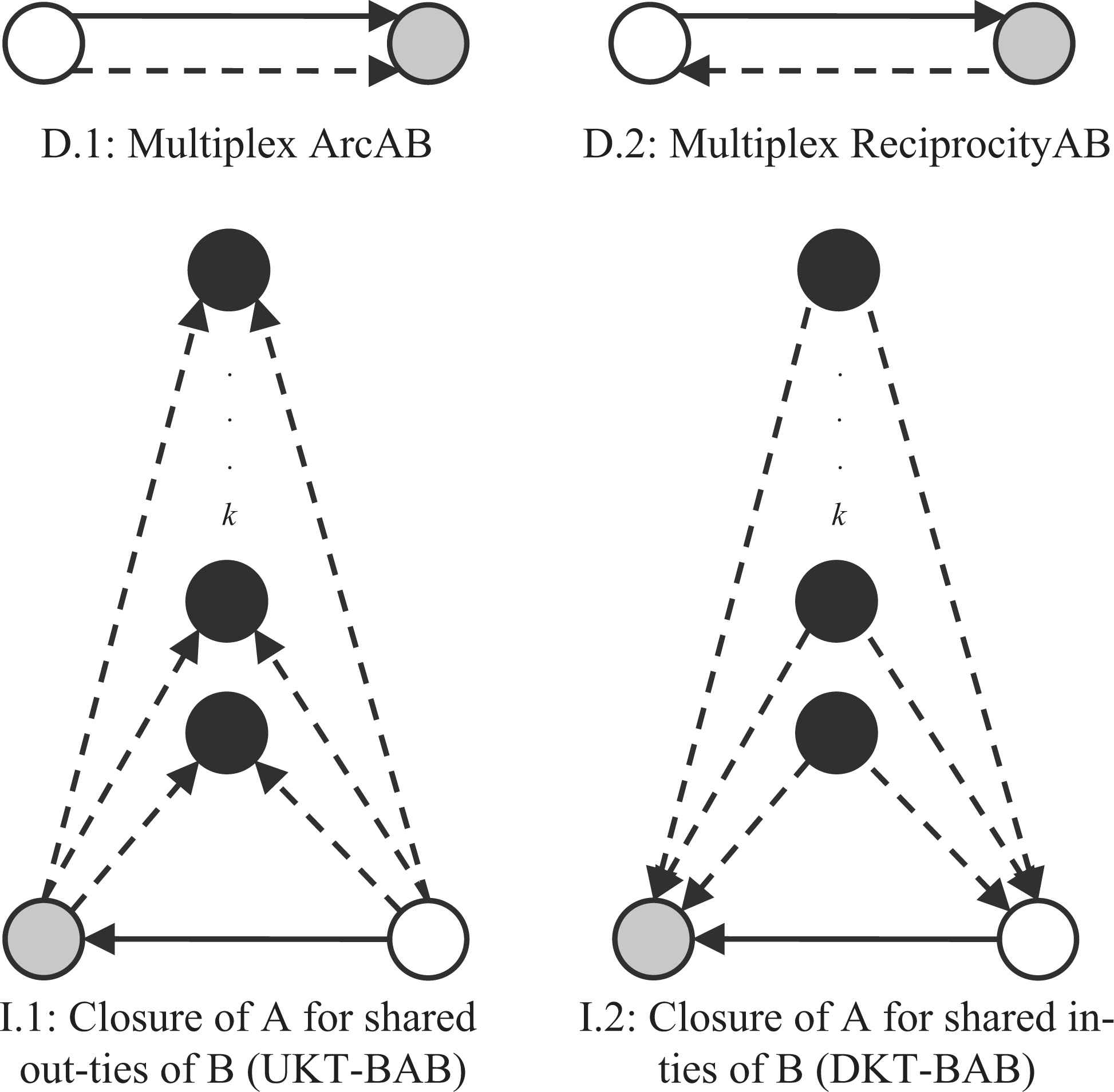
Direct (D.1-2, Above) and Indirect Effects (I.1-2, Below) of Interplay Between Defending (Solid Lines, Relations A) and (Dis)liking (Dashed Lines, Relations B) in Two Mirrored Forms. D.1-2 and I.1-2 Were Included for Both Liking and Disliking Networks.
Mutual acquaintances may influence such a decision as well, for instance, when victims and their defenders like the same classmate (H1b1, Figure 1, I.1) or are liked by the same classmate (H1b2, Figure 1, I.2). This process may be understood by balance theory (Cartwright & Harary, 1956; Heider, 1946, 1958), which defines the stability of triadic configurations of positive and negative relationships. The idea is that people prefer balanced, stable, configurations which in the context of our study implies that students defend others to whom they are not only directly but also indirectly positively connected. Thus, in our study, we expect that students would be willing to defend the victims with whom they share likes in the classroom.
In contrast to liking, peers probably avoid to defend victims whom they dislike or who dislike them. Thus, disliking may be a reason for victims not to receive help from classmates (referring to being defended), directly (due to disliking of a potential defender by a victim: H2a1, Figure 1, D.1; and, disliking by a potential defender of a victim: H2a2, Figure 1, D.2). In accordance with balance theory, the expectations about indirect (triadic) dislike relations (referring to disliking of the same person: H2b1, Figure 1, I.1; and, disliking by the same person: H2b2, Figure 1, I.2) are based on the notion that students who dislike the same classmates or who are disliked by the same classmates would be more likely to be friends (Rambaran et al., 2015), and for that reason would be more likely to defend each other (Oldenburg et al., 2018). Previous research has shown that students are more likely to defend each other when they are victimized by the same person (Huitsing & Monks, 2018; Huitsing et al., 2014). Thus, having a shared negative position (being disliked or victimized) among classmates may facilitate defending between students. This is also in line with the finding that two people with the same negative opinion (dislike or gossip) about someone else have a positive attitude toward each other (Ellwardt et al., 2012; Oldenburg et al., 2018; Rambaran et al., 2015).
Bullying in a Classroom Context and Its Relation With Defending
Bullying situations occur mainly among classmates (Salmivalli, 2010). The classroom context most likely influences children’s motivations and decisions for individual defending choices through peer group values and classroom norms (Meter & Card, 2015). Most researchers examine the role of a descriptive bullying norm, referring to the overall (or average) classroom degree of bullying. Using this definition several studies found that children are less inclined to defend in a classroom or peer group with more bullying (Espelage et al., 2012; Lucas-Molina et al., 2018; Peets et al., 2015). One explanation is that children do not intervene because they think that most classmates will disapprove of their defending behavior (Peets et al., 2015). With many bullies in their classroom, children may not even defend their friends because that puts them at risk for social consequences, such as low status, peer rejection, and even peer victimization. Defending might also depend on the defending behavior of others in the classroom. When defending is the norm and expected, children may be more inclined to defend, but paradoxically less so when they believe their peers will defend, suggesting the presence of a “bystander effect” (Barhight et al., 2017). An alternative explanation, however, is that in a classroom with more bullies, fewer non-bullies are present to defend the victims of bullying. In this perspective, the lack of defending reflects a lack of availability of defenders rather than students’ hesitancy to break the social norms. Nonetheless, bullies might also be defenders and defend each other (Huitsing et al., 2014). Thus, even a classroom with many bullies will contain defenders.
Researchers increasingly use the bullying-popularity norm, which we refer to as a popularity norm, as another way to understand involvement in some behavior—here: bullying—if it is rewarded by peers—here: by popularity (Galvan et al., 2011; Salmivalli, 2010). Peer groups, social structures, and interactions in a classroom context tend to be organized along the dimension of social status (Farmer et al., 2011; Rodkin et al., 2015). In view of bullies being often considered to be socially skilled children that use proactive aggressive strategies to obtain dominance and social status among peers (Sijtsema et al., 2009), they tend to enhance their position in the peer group by targeting weaker peers. At the same time, bullies seek social support from peers who help them to maintain a high position, by becoming friends with others who join their bullying (Rambaran et al., 2020) and by receiving help against defenders of victims (Huitsing et al., 2014). When bullies control the social power in a classroom context, this might offset other children to side with the victim as that puts them in a weak position and increases the chances of negative social consequences. Based on socio-cognitive theory (Bandura, 1997), it can be argued that, in this context, children’s self-efficacy in defending may be weaker, referring to their beliefs in their capacity to act successfully in tackling bullying. Accordingly, they may be less motivated to defend. We expected that in a classroom where bullying is more strongly related to social status, fewer defending ties would be present (H3a), effects of liking would be weaker (H3b and H3c), and negative effects of disliking would be stronger (H3d and H3e). We expected that the effects of the popularity norm would be stronger than the effects of the descriptive norm (H4). This is because the social consequences (as described above) may be more severe when bullies are considered as popular. In line with this, research suggests that popular children generally defend more, but less so in a classroom where bullying positively associates with social status (Peets et al., 2015). Thus, children’s inclination to defend victims may depend on the norms of popular bullies.
The Present Study
We addressed the following questions: (1) To what extent is defending associated with direct and indirect (dis)liking relationships with the victims of bullying? (2) Does the classroom bullying norm, defined as a descriptive norm or a popularity norm, facilitate or inhibit students’ defending of victims?; (3) Does the classroom bullying norm affect the relation between (dis)liking and defending? To address our research questions, we used a cross-sectional design with data collected in fifth-grade classrooms. We focused on late childhood because, by this developmental stage, youth start to add greater importance to beliefs about the role of popularity among peers, while maintaining beliefs about appropriate (normative) behavior in the classroom advocated by the teacher (Juvonen & Murdock, 1995).
We examined our hypotheses using cross-sectional bivariate social network analysis using bivariate exponential random graph modeling (ERGM). This modeling framework allows us to examine the extent to which liking and disliking co-occur with defending relationships, that is, whether a defender is (dis)liked by a victim and whether a victim is (dis)liked by a defender, and whether this depends on the classroom norm. In a bivariate ERGM, the co-occurrence of structural configurations involving two relationships is investigated, while taking into account the univariate ERGM specifications for either relationship. In an earlier version of this article, we additionally conducted multilevel analyses. For more information, we refer to Rambaran (2019). We preferred a social network approach over conventional analysis methods using individual defending outcomes and (dis)liking predictors based on aggregating individuals’ peer relations. The individual level approach disregards the interdependence of the relationships and leads to information loss, whereas a network approach acknowledges that (dis)liking and defending are relationships between individuals who are embedded in larger social networks.
Method
Sample
Classrooms were selected from the pre-assessment of the Dutch KiVa study at the end of the school year (in May 2012). KiVa is a program aimed to reduce school bullying among children in elementary education (8–12 years) in the Netherlands (Huitsing et al., 2020; Rambaran et al., 2019), originally developed in Finland (Kärnä et al., 2011, 2013). For this study, we selected the 48 Grade 5 classrooms with at least 20 students (omitting the 25 smaller classrooms with a total of 341 students) yielding a total sample of 1,272 students (50.8% boy, SD = 9.1%; Mean age 11.25 years, SD = 0.46). The ERGMs cannot be estimated in smaller classes. Note that the proportion of defenders (t = 1.65, p = .10), non-victims (t = 0.91, p = .36), victims (t = −0.91, p = .36), and bullies (t = 0.72, p = .47) was similar in the smaller and the larger classes, and the proportion of boys as well (t = −.06, p = .95). A description of the program and the complete sample can be found elsewhere (Huitsing et al., 2020; Rambaran et al., 2019).
Procedure
Students filled in an Internet-based questionnaire in their classroom during regular school hours. The process was administered by the teachers, who were present to answer questions and to assist the students when needed. Prior to the data collection, teachers were given detailed instructions concerning the procedure. During the data collection, support was available through phone and email.
At the beginning of the questionnaire, students received information about the goal of the study and how to fill in the questionnaire. They were told not to talk to each other or to discuss their answers when they filled out the questionnaire or afterwards to ensure each other’s privacy. It was explained to students that their answers would remain confidential. The teachers ensured that students who could not complete the questionnaire at the day of the data collection participated at another day within a month.
Prior to the first measurement (and for students who were new in school, after the first measurement), schools sent information letters to students’ parents. Parents who did not want their child to participate in the assessment were asked to return the form. Students were informed at school about the research and gave oral assent. Students did not participate when parents refused participation, when they did not want to participate themselves, or when they were unable to complete the questionnaire. At the start of data collection (2012), universities in the Netherlands did not require IRB permission for this type of research. All procedures performed in this study were in accordance with the 1964 Helsinki declaration and its later amendments or comparable ethical standards. A few students did not want to participate; also a few parents objected to their child’s participation. The participation rate was high (98.3%).
In an instructional movie, a professional actress first explained to students what bullying means, using the following text: Bullying is when some children repeatedly harass another child. The child who gets bullied has problems defending itself against this. Bullying is not the same as having a fight between two people who are equally strong. Bullying should also not be confused with joking around. Bullying is treating someone repeatedly in a mean way.
Measures
Following the general introduction, participants filled out nomination questions about the relationships with their classmates, using the accompanying text: “You and your classmates. The following questions concern how you and your classmates interact with each other. Answer the questions by selecting the names of your classmates.” For each question, students were presented with a roster showing the names of all classmates on their personal computer screen. Participants could choose as many same-sex and other-sex classmates as they wished for each nomination question.
Liking, disliking, and defending networks
For each classroom, these were based on directed “Who do you like?”, “Who do you dislike?”, and “Who defends you when you are bullied?” nominations (1 for present and 0 for absent). Liking and disliking nominations were coded 1 and non-nominations were coded 0. Children who indicated not being victimized by classmates did not fill out the nomination question on defending. Their “answers” were considered as “structural missing” (no outgoing nomination possible).
In identifying the victimized students, all participants were asked to indicate how often they were victimized in general in the past months (“Since the Christmas break”), according to Olweus’ (1996) self-reported bully/victim items and to indicate this for specific form(s) of victimization: physical harm (e.g., kicked), verbal harm (e.g., name calling), relational harm (e.g., gossiping), and cyber victimization. Answers were given on a 5-point scale: (1) “Not at all,” (2) “Once or twice,” (3) “Two or three times a month,” (4) “Once a week,” and (5) “Several times a week.” If participants indicated that they were victimized by classmates at least “Once or twice” (Score 2) on any item, they were presented with a roster showing the names of all classmates and asked whom of their classmates defended them when they were being victimized: “Some children help children who are being bullied. They do this by supporting them, comforting them, or by telling the bullies to stop bullying. Are there children who support, comfort, or help you when you are being bullied?” Figure S1 in the Supplements shows the distribution of number of defending nominations students received from victims in each classroom. Defending nominations were observed in each classroom.
Bullying norms
These were measured with descriptive norms and popularity norms. Descriptive norms refer to what is typically observed in a given situation or social context, and thus what most others do (Cialdini et al., 1990; Deutsch & Gerard, 1955; Veenstra et al., 2018). Accordingly, this is measured using the average behavior of all students in a classroom. Bullying behavior was based on directed “Who starts bullying you?” nominations (1 for present and 0 for absent) sent by self-reported victims (see above). Bullying nominations were coded 1 and non-nominations were coded 0. Proportions were calculated as the number of nominations received divided by the number of children in the classroom. Averaged proportions reflect the descriptive bullying norm in each classroom (average indegree). The final scores were standardized (z-scores) for better interpretation.
Popularity norms are based on the within-classroom association between social status (perceived popularity) and bullying, to capture the popularity of bullies in comparison with non-bullies (Henry et al., 2000; Veenstra et al., 2018). Because there is no obvious right choice for determining the bullying-popularity association, we measured this in three ways: (1) In our study, popularity was based on directed “Who is popular?” nominations. Based on prior work, proportions were calculated as the number of nominations received divided by the number of children in the classroom. These popularity scores were then correlated (using Spearman’s ρ) with the bullying scores (Garandeau et al., 2022; Peets et al., 2015); (2) Because nominations of bullying and popularity may be subject to outliers (a few children receiving many nominations: Figure S2 in the Supplements), correlations may be less suitable for our purpose (Ranganathan & Aggarwal, 2017). Alternatively, we calculated a weighted measure by multiplying the bullying scores with the popularity scores. To ensure that the popularity nominations of the non-bullies (our comparison group) were included in this calculation, all nominations were raised by one. Averaged scores for each classroom were standardized (z-scores); (3) The first two measures aggregate over individuals’ peer nominations, thereby leading to information loss. To overcome this, we correlated bullying and popularity nominations using the quadratic assignment procedure method, which allows for correlations between two digraphs. Figure S3 in the Supplements shows an overview of the (distribution of) the different norm scores for each classroom.
Control variables
We included sex (1 = boy, 0 = girl).
Analytic Strategy
Bivariate ERGMs (Lusher et al., 2013) were estimated in XPNet (Wang et al., 2009) to investigate the patterns of the defending, liking, and disliking networks. Currently, available software permits the analysis of only two different types of classroom networks simultaneously. Therefore, the analysis is split into a separate model for defending and liking and a separate model for defending and disliking.
To test the hypotheses, four multiplex configurations (Figure 1; for a detailed explanation: Table S1 in the Supplements) were included in the models for defending and (dis)liking, referring to configurations capturing the (lack of) co-occurrence of two different network ties between two or more actors in the network. Direct effects of co-occurrence of defending and (dis)liking were captured using two dyadic multiplex configurations: victims who (dis)like their defenders (D.1); defenders who (dis)like the victims they defend (D.2). Indirect effects of co-occurrence of (dis)liking and defending were captured using two types of triadic configurations: a victim and their defender who both (dis)like the same classmate(s) (I.1) and a victim and their defender who are both (dis)liked by one or more particular classmates (I.2). Note that victims nominated their defenders, but liking and disliking could go both ways (from victims to defenders, or the other way around, from defenders to victims).
To adequately capture the structural features of the univariate and bivariate defending, liking, and disliking networks, we followed previous research in choosing the parameters in bivariate ERGMs (Huitsing & Monks, 2018; Huitsing & Veenstra, 2012; Huitsing et al., 2012; Oldenburg et al., 2018). Moreover, sex was included not only as an individual covariate expressing differences in the tendencies of boys and girls in defending and (dis)liking but also as a dyadic (network) covariate, capturing tendencies for establishing same-sex ties (cross-sex ties as reference). To alleviate the limitations of the bivariate network analysis of defending and liking, parameters for the co-occurrence of defending with bullying and with disliking were included as control variables, as well as for the co-occurrence of liking with bullying and disliking. Similarly, in the bivariate ERGM analysis of defending and disliking, control variables of the co-occurrence of defending and disliking with liking were included.
Per classroom, two bivariate ERGMs with the same specification were estimated, one for defending with liking, the other for defending with disliking (Table S2 in the Supplements for an overview). For some classrooms, however, the ERGM specification was adjusted, leaving out parameters that could not be estimated due to lack of information or lack of convergence (Table S3 in the Supplements). For the converged models, the usual criterion for convergence (absolute value of t-statistics below .10 for all parameters; see Wang et al., 2009) was met for all classrooms, with most of them also having acceptable Goodness of Fit, defined as absolute values of t-statistics below 2 for (almost) all parameters (Table S4 in the Supplements). In general, the models for defending and liking had a better fit than for defending and disliking, most likely due to the fact that the disliking networks are sparser than the liking networks.
As a final step to summarize the ERGM findings and to investigate the hypotheses about the bullying norm, the parameter estimates were summarized with a meta-analysis using R-package metafor (Viechtbauer, 2010) using two model specifications: one (empty) model showing the mean estimates across all classrooms (Table 2) and another set of models in which the bullying norms measure was included (Table S6 in the Supplements).
Results
Descriptive Analysis
Table 1 presents the summarized descriptive findings for the 48 classroom networks. Information per classroom is reported in Table S5 in the Supplements. On average, victims nominated four defenders; students nominated eleven classmates who they liked, and three classmates who they disliked. Almost all students had at least one classmate they liked (99%) or disliked (76%) and nearly all victims had one defender (89%). Disliking and defending networks were sparser than liking networks, as indicated by the density (proportion of nominations), which was higher for liking (between .25 and .64) than for disliking (at most .22) and defending (at most .25). The proportion of reciprocated nominations was also higher for liking (between .25 and .62) than for disliking (at most .29) and defending (at most .35). Most liking nominations and defending were found between children with the same sex (proportions between .56 and .86 and .59 and 1). Indirect ties and transitivity (referring to small group structures) were more common for liking than for disliking and defending.
Descriptive Statistics of the Liking Networks, Defending Networks, and Disliking Networks (48 Classrooms, 1,272 Students).
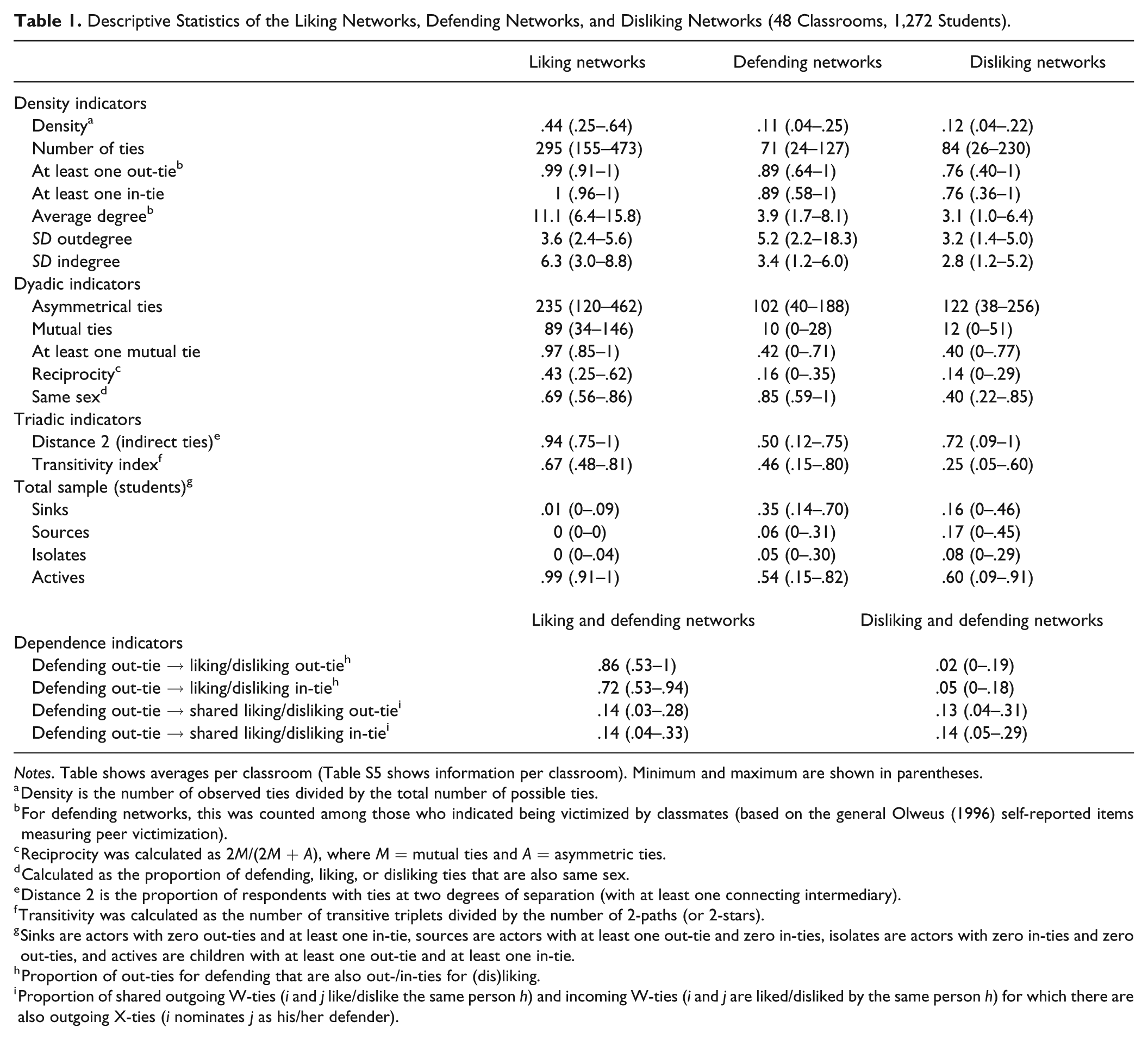
Notes. Table shows averages per classroom (Table S5 shows information per classroom). Minimum and maximum are shown in parentheses.
a Density is the number of observed ties divided by the total number of possible ties.
b For defending networks, this was counted among those who indicated being victimized by classmates (based on the general Olweus (1996) self-reported items measuring peer victimization).
c Reciprocity was calculated as 2M/(2M + A), where M = mutual ties and A = asymmetric ties.
d Calculated as the proportion of defending, liking, or disliking ties that are also same sex.
e Distance 2 is the proportion of respondents with ties at two degrees of separation (with at least one connecting intermediary).
f Transitivity was calculated as the number of transitive triplets divided by the number of 2-paths (or 2-stars).
g Sinks are actors with zero out-ties and at least one in-tie, sources are actors with at least one out-tie and zero in-ties, isolates are actors with zero in-ties and zero out-ties, and actives are children with at least one out-tie and at least one in-tie.
h Proportion of out-ties for defending that are also out-/in-ties for (dis)liking.
i Proportion of shared outgoing W-ties (i and j like/dislike the same person h) and incoming W-ties (i and j are liked/disliked by the same person h) for which there are also outgoing X-ties (i nominates j as his/her defender).
Part 2 of Table 1 provides information about the co-occurrence of (dis)liking and defending. Victims liked the classmates they nominated as their defender or were liked by them (both .53 or higher). Victims mostly did not dislike the classmates they nominated as defender (at most .19) or were not disliked by them (at most .18). Victims and their defenders infrequently shared the same likes or dislikes: the number of nominations given for defending in relation to the total number of shared received or given nominations for liking was low (.03–.28 and .04–.33); the same was true for disliking (.04–.31 and .05–.29).
Bivariate ERGM Analysis
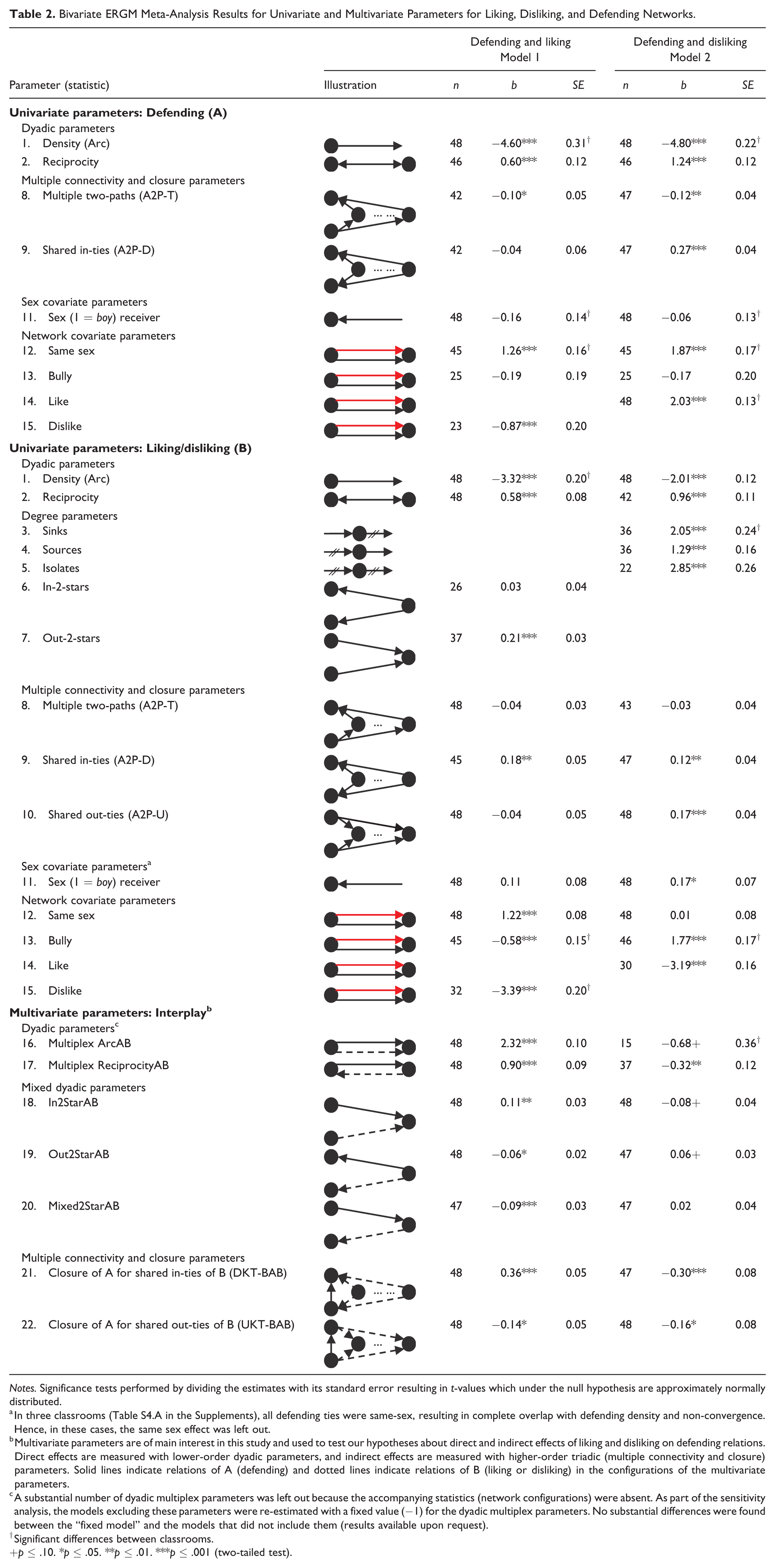
Table 2 presents the meta-analysis of the estimated ERGMs, combining the parameter estimates of all classrooms in a mean with standard error. The variability of parameter estimates across classrooms is tested and indicated. Model 1 displays the results for defending and liking; Model 2 displays the results for defending and disliking.
Bivariate ERGM Meta-Analysis Results for Univariate and Multivariate Parameters for Liking, Disliking, and Defending Networks.
Notes. Significance tests performed by dividing the estimates with its standard error resulting in t-values which under the null hypothesis are approximately normally distributed.
a In three classrooms (Table S4.A in the Supplements), all defending ties were same-sex, resulting in complete overlap with defending density and non-convergence. Hence, in these cases, the same sex effect was left out.
b Multivariate parameters are of main interest in this study and used to test our hypotheses about direct and indirect effects of liking and disliking on defending relations. Direct effects are measured with lower-order dyadic parameters, and indirect effects are measured with higher-order triadic (multiple connectivity and closure) parameters. Solid lines indicate relations of A (defending) and dotted lines indicate relations of B (liking or disliking) in the configurations of the multivariate parameters.
c A substantial number of dyadic multiplex parameters was left out because the accompanying statistics (network configurations) were absent. As part of the sensitivity analysis, the models excluding these parameters were re-estimated with a fixed value (−1) for the dyadic multiplex parameters. No substantial differences were found between the “fixed model” and the models that did not include them (results available upon request).
† Significant differences between classrooms.
+p ≤ .10. *p ≤ .05. **p ≤ .01. ***p ≤ .001 (two-tailed test).
Defending and liking
Density indicates the general occurrence of ties, comparable with the intercept or grand mean in (generalized) linear models. The negative density parameter estimates indicate (for all other variables in the model equal to zero) an overall low occurrence of liking and defending ties (Model 1 in Table 2) and varies significantly across classrooms. Reciprocity indicates the general occurrence of reciprocation of ties. The positive reciprocity parameter estimate reveals that students tended to like the classmates who liked them as well and to defend the classmates who defended them (victims defend each other).
The multiple two-paths (A2P-T) indicates a lack of generalized reciprocation: victims defend each other, but defended victims are less likely to defend victims who do not defend them. The nonsignificant shared in-ties (A2P-D) parameter of defending indicates a lack of tendency of victims to jointly indicate multiple defenders. The shared in-ties of liking indicates the tendency of students to jointly like multiple classmates.
The large positive same-sex parameter estimates and negligible sex receiver effects indicate that defending relations tended to occur mainly among boys and among girls, approximately equally often, with significant variation across classrooms. This also holds for liking relations, with less variability over classrooms. Considerable variation over classrooms was observed for the strong tendency against both liking and disliking a classmate and the tendency to not like a bully.
The positive Multiplex ArcAB parameter (b = 2.32, p < .001) and positive Multiplex ReciprocityAB parameter (b = 0.90, p < .001) indicate that victims are more likely to be defended by the classmates they liked and who liked them, consistent with the hypotheses about the direct effect of liking and being liked on defending (Hypotheses H1a1 and H1a2). With respect to the hypotheses that victims are more likely to be defended by the classmates to whom they are indirectly positively connected, mixed findings were obtained: the positive parameter estimate Closure of A for shared in-ties of B (b = 0.36, p < .001) indicates that victims tend to be defended by the classmates whom are liked by the same person as they are liked by themselves (H1b2), but less likely by those who like the same classmates as they do (H1b1), in view of the negative Closure of A for shared out-ties of B parameter (b = –0.14, p = .011).
Defending and disliking
The analysis of defending and disliking (Model 2 in Table 2) shows many comparable findings to those in Model 1. The estimates for the univariate defending configurations are slightly more pronounced, notably the configuration of victims indicating the same defenders. The parameter for the co-occurrence of defending and liking, a control variable in this analysis, is positive, as expected. The occurrence of disliking ties was low and disliking ties were often reciprocated, and boys tended to be more disliked than girls. Different than in the liking networks, students were disliking others without being disliked themselves as indicated by the positive estimate of sources parameter or were disliked without disliking others themselves, positive estimate of sinks, or were uninvolved in disliking ties (positive effect for isolates). Note that these processes did not occur in all classes equally often. The shared out-ties (A2P-U) indicate that students tend to share their dislike of the same classmates.
In line with the direct hypotheses (H2a1 and H2a2), victims were less likely to be defended by the classmates they disliked (negative Multiplex ArcAB; b = −0.68, p = .06) or who disliked them (negative Multiplex ReciprocityAB; b = −0.32, p < .01). No support was found for the indirect hypotheses (H2b1 and H2b2): A victim was less likely to be defended by a classmate if both are disliked by the same classmate(s) (H2b2, negative Closure of A for shared in-ties of B; b = −0.30, p < .001). Although configurations where two students disliked the same classmate(s) are more likely to occur, this does not imply an increased occurrence for victims of being defended (H2b2, negative Closure of A for shared in-ties of B; b = −0.16, p = .04).
Bullying norms
In the additional meta-analyses, we tested for the additional effect of bullying norms. These tests (one for each bullying norm) split the mean estimates across all classrooms (as shown in Table 2) into two sets of results, one showing the intercept (or baseline effect), that is, the mean estimates when bullying norms are “low” (below the median across all 48 classrooms) and another showing the mean estimates when bullying norms are “high” (above the median across all 48 classrooms). In these analyses, we thus compare the mean estimates for each parameter in a classroom where the bullying norm is high to those where it is low. Note that this operationalization is not ideal for the popularity norm. The findings of these additional set of meta-analyses are provided in Table S6 in the Supplements. The intercept was left out in this table because it was comparable with the estimates in Table 2 (the mean estimates across all classrooms).
The analysis showed that bullying norms had an inconclusive effect on the relation between defending and (dis)liking as there was no consistent pattern to be found. Of note, the direct effect of co-occurrence of defending and disliking is lower in a classroom where bullying was high, indicating that victims were less likely to be defended by classmates who disliked them (H3d2, stronger negative Multiplex ReciprocityAB effect in Model 5 in Table S6.B), with some, although weaker evidence for victims to be less defended by classmates they disliked (H3d2, stronger negative Multiplex ArcAB effect in Model 5 in Table S6.B). The findings also point to more defending by boys in classrooms with high bullying norms (Model 5 in Table S6.A), and boys being less liked in those classrooms, and for victims to nominate their bullies and dislikes less often as their defenders.
Discussion
Defenders have a significant impact on the well-being of the victims: they can mitigate the negative consequences of victimization, for example, by making victims less anxious, less depressed, and increase their self-esteem (Sainio et al., 2011). It is thus not reassuring that only one fifth of the students are defenders of victims and that not all victims are defended by peers (Salmivalli, 2010). In this study, we investigated the extent to which defending depends on the (dis)liking relationships between defenders and victims and their relationships with other classmates as well as the influence of the amount of bullying (and its association with popularity) in the classroom (defined as the bullying norm) herein. We employed social network analysis (bivariate ERGMs) to answer our questions.
The findings are in line with the hypotheses that students who are more liked and less disliked by the victims are more likely to be nominated as defender by the victims. These findings mirror previous research on the relation between defending and social standing in the group (Caravita et al., 2009; Kollerová et al., 2018; Pöyhönen et al., 2012; Pronk et al., 2017; Salmivalli et al., 1996; van der Ploeg et al., 2017) and previous work on defending and friendships and dislike relations (Oldenburg et al., 2018).
The direct effect of liking is much stronger than the direct effect of disliking. This may be explained by disliking occurring less frequently. Thus, the positive judgments or social evaluations of the defenders by victims outweigh the negative judgments. This may be understood by viewing defending as prosocial or helping behavior (Meter & Card, 2015; Pronk et al., 2019; Sainio et al., 2011), where the defenders may be rewarded by a positive social evaluation by the victim and, if needed, by being defended themselves at other times (Meter & Card, 2015; Salmivalli et al., 1997; Thornberg et al., 2012).
The findings also shed more light on the nature of defending ties in terms of reciprocity between defending and (dis)liking. It also shows the importance of (local) subgroup processes of defending in liking and disliking networks by revealing the importance of both defenders’ and victims’ judgments as well as the judgments of other classmates to whom victims and defenders are tied. This is in line with theoretical and empirical work on defending (Meter & Card, 2015; Salmivalli et al., 1997; Thornberg et al., 2012). Our findings confirm that students do not defend random classmates; instead, defending choices (or motivations) likely depend on positive (liking or a friendship) and negative (disliking) relationships with the victim as well as with other classmates within the peer network.
Previous research provided evidence that perceived normative pressure from bullies plays a decisive role in shaping youth’ bullying and defending behaviors, pro- and antibullying attitudes, and their beliefs about aggression and prosociality (Pozzoli & Gini, 2010; Pozzoli et al., 2012; Salmivalli & Voeten, 2004), in particular when the norms are set by popular bullies (Garandeau et al., 2022; Peets et al., 2015). However, we found that the operationalization of a classroom bully norm was not self-evident and not consistent for the popularity norm definitions. Therefore, we cannot interpret the findings of the meta analyses investigating differences between classrooms with high and low bullying norms in a meaningful way. Although we think that this is an important avenue for further research, more work needs to be done on constructing a valid measure of bullying norms.
Implications, Limitations, and Future Directions
A better understanding of defending behavior is crucial to bullying interventions in elementary school classrooms (Salmivalli, 2010), but no study has examined the relations between defending and (dis)liking relationships and the bullying norms in the classroom. This is surprising given the prominence in the bullying literature of the interdependence of defending behavior and classroom bullying norms (Meter & Card, 2015).
First, the findings of this study revealed that victim-defending networks are better understood through analyzing them together with other network types—in this study, with liking and disliking networks. By applying a bivariate network approach, researchers are able to study the occurrence and development of more complex network structures that result from the interdependence of multiple networks. In this study, it was shown that victim-defending relationships were related to (dis)liking relationships in dyadic and triadic configurations.
Our findings also have implications for applied aspects of bullying interventions. Specifically, our findings confirm that defending is first and foremost driven by the direct friendly relationship between victim and defender, and to a lesser extent by the shared relationships with other classmates, which is in line with the current conceptual understanding of defending (Meter & Card, 2015; Thornberg et al., 2012). Victims who had a positive relationship with their classmates were more likely to be defended. Our findings provide a way for schools to combat bullying by paying attention to develop positive relationships (e.g., friendships or cooperation) between victims and potential defenders (bystanders).
The direct reasons for why children refrain from defending were unexamined, which is needed to more fully understand the defending process. Additionally, we lack information concerning why students engage in defending behavior. Information about the characteristics of the victims and defenders might provide additional information about why defending relationships between victims and defenders are formed (Veenstra & Huitsing, 2021). This investigation would benefit from taking a broader perspective, by not only asking the victim about their defenders but also asking bullies about their victims and asking defenders which victims they support.
We further note that our operationalization of bullying norms is subject to discussion. For instance, students may also be influenced by injunctive norms (Henry et al., 2000), which reflect classmates’ beliefs about the acceptability of behavior (Cialdini et al., 1990), referring to what people are expected to do in a certain situation (Deutsch & Gerard, 1955). Students may be more inclined to defend victims when their peers expect them to do so. Normative beliefs of students may also be driven by sex, which may be particularly relevant for defending, which, to a large extent, is a gendered process: that is, girls defend mainly other girls and boys defend mainly other boys (Sainio et al., 2011; Thornberg & Wänström, 2018). For both boys and girls, the judgments of other boys or other girls may thus be more important than the judgments of all classmates (referring to gender classroom norms; Busching & Krahé, 2015).
Apart from these operationalization issues, the cross-sectional approach of our study does not allow us to account for the possible change in bullying norms and defending and (dis)liking ties. It is known that bullying roles are not unique and stable (Salmivalli, 2010): bullies may seek new victims to maintain a high status in the group (van der Ploeg et al., 2020); similarly, defending (relations) is also subject to change (Huitsing et al., 2014; Sijtsema et al., 2014). Moreover, the cross-sectional approach raises questions about directionality: we do not know if liking someone causes one to defend them, or if defending someone causes one to like them. It could also be that liking or defending someone is latent and is only manifest when one sees the person being bullied.
Conclusion
Our findings indicate that defending is first and foremost driven by the direct friendly relationship between victims and defenders, and to a lesser extent by the shared relationships with other classmates. Whereas a broader conceptualization of bullying norms is needed, our findings are inconclusive about the role of classrooms bullying norms in the (co-)occurrence of defending and (dis)liking. Yet, novel findings highlight how defending can be fostered through developing positive relationships between victims and potential defenders (bystanders).
Supplemental Material
Supplemental Material, sj-docx-1-jbd-10.1177_01650254211029715 - The relation between defending, (dis)liking, and the classroom bullying norm: A cross-sectional social network approach in late childhood
Supplemental Material, sj-docx-1-jbd-10.1177_01650254211029715 for The relation between defending, (dis)liking, and the classroom bullying norm: A cross-sectional social network approach in late childhood by J. Ashwin Rambaran, Marijtje A. J. van Duijn, Jan Kornelis Dijkstra and René Veenstra in International Journal of Behavioral Development
Footnotes
Authors’ note
J. Ashwin Rambaran, Department of Psychology and Combined Program in Education and Psychology (CPEP), University of Michigan, Ann Arbor, MI, USA; J. Ashwin Rambaran, Marijtje A. J. van Duijn, Jan Kornelis Dijkstra, and René Veenstra, Department of Sociology and Interuniversity Center for Social Science Theory and Methodology (ICS), University of Groningen, Groningen, The Netherlands.
Acknowledgment
We thank the members of the research groups Social Development of Adolescents and Statistical Methods for Social Network Analysis at the University of Groningen for their useful comments and suggestions on this study.
Funding
The author(s) disclosed receipt of the following financial support for the research, authorship, and/or publication of this article: This research was funded by the Dutch Scientific Organization (NWO) Program Council for Fundamental Scientific Education Research (PROO) Project number 411-12-027 awarded to René Veenstra, Jan Kornelis Dijkstra, Wilma A. M. Vollebergh, Marijtje A. J. van Duijn, Zeena Harakeh, and Christian Steglich (2013).

Supplemental Material
Supplemental material for this article is available online.
References
Supplementary Material
Please find the following supplemental material available below.
For Open Access articles published under a Creative Commons License, all supplemental material carries the same license as the article it is associated with.
For non-Open Access articles published, all supplemental material carries a non-exclusive license, and permission requests for re-use of supplemental material or any part of supplemental material shall be sent directly to the copyright owner as specified in the copyright notice associated with the article.
